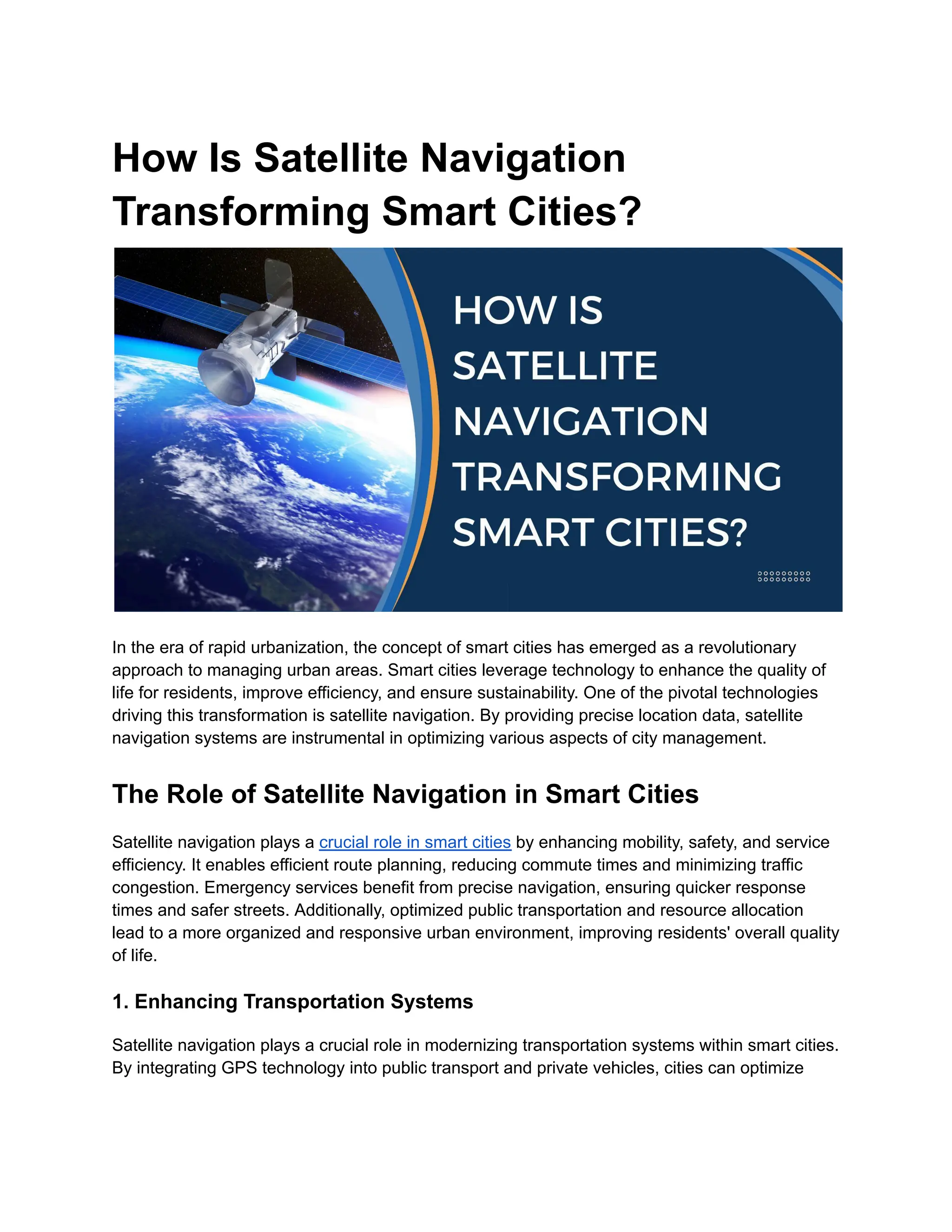
How Is Satellite Navigation
Transforming Smart Cities?
In the era of rapid urbanization, the concept of smart cities has emerged as a revolutionary
approach to managing urban areas. Smart cities leverage technology to enhance the quality of
life for residents, improve efficiency, and ensure sustainability. One of the pivotal technologies
driving this transformation is satellite navigation. By providing precise location data, satellite
navigation systems are instrumental in optimizing various aspects of city management.
The Role of Satellite Navigation in Smart Cities
Satellite navigation plays a crucial role in smart cities by enhancing mobility, safety, and service
efficiency. It enables efficient route planning, reducing commute times and minimizing traffic
congestion. Emergency services benefit from precise navigation, ensuring quicker response
times and safer streets. Additionally, optimized public transportation and resource allocation
lead to a more organized and responsive urban environment, improving residents' overall quality
of life.
1. Enhancing Transportation Systems
Satellite navigation plays a crucial role in modernizing transportation systems within smart cities.
By integrating GPS technology into public transport and private vehicles, cities can optimize
routes, reduce travel times, and decrease fuel consumption. Real-time traffic updates and
navigation assistance help alleviate congestion, making urban mobility more efficient.
2. Improving Public Safety
In smart cities, public safety is significantly enhanced through satellite navigation. Emergency
response units, such as police, fire, and medical services, rely on GPS to reach incident
locations swiftly. This technology ensures faster response times and better coordination during
emergencies, ultimately saving lives and reducing property damage.
3. Facilitating Efficient Urban Planning
Urban planners use satellite navigation data to make informed decisions about city
development. GPS mapping and spatial analysis enable planners to design efficient
infrastructure, optimize land use, and monitor environmental changes. This data-driven
approach leads to more sustainable and well-organized urban environments.
Key Applications of Satellite Navigation in Smart Cities
In the era of rapid urbanization, the concept of smart cities has emerged as a revolutionary
approach to managing urban areas. Smart cities leverage advanced technologies to enhance
the quality of life for residents, improve efficiency, and ensure sustainability. One of the pivotal
technologies driving this transformation is satellite navigation. By providing precise location
data, satellite navigation systems are instrumental in optimizing various aspects of city
management, from transportation and public safety to urban planning and environmental
monitoring.
1. Intelligent Transportation Systems (ITS)
Intelligent Transportation Systems (ITS) utilize satellite navigation to enhance the overall
transportation network. By collecting and analyzing data from various sources, ITS can manage
traffic flow, provide real-time information to commuters, and improve the efficiency of public
transportation.
2. Smart Traffic Management
Satellite navigation aids in smart traffic management by monitoring vehicle movements and
traffic patterns. This information is used to adjust traffic signals, manage congestion, and
provide alternative routes to drivers. As a result, travel times are reduced, and road safety is
improved.
3. Emergency Response Systems
Emergency response systems benefit greatly from satellite navigation. GPS technology allows
for precise location tracking, enabling rapid deployment of emergency services. Additionally, it
facilitates the coordination of multiple response teams, ensuring that resources are utilized
effectively.
Benefits of Satellite Navigation in Urban Development
As cities strive to become smarter and more efficient, the integration of satellite navigation
technology has emerged as a key factor in urban development. By providing accurate and
real-time location data, satellite navigation systems offer numerous advantages that enhance
the overall functionality and livability of urban environments. From improving transportation
efficiency and reducing environmental impact to increasing productivity and enhancing
residents' quality of life, the benefits of satellite navigation are multifaceted.
1. Increased Efficiency and Productivity
By integrating satellite navigation into various urban systems, cities can achieve higher levels of
efficiency and productivity. Optimized transportation routes reduce congestion and enhance the
efficiency of public transport systems, ensuring timely arrivals and departures. Emergency
services, such as ambulances and fire trucks, benefit from precise navigation, enabling faster
response times. Better resource allocation ensures that city resources, including utilities and
maintenance services, are deployed where they are needed most, reducing waste and
improving service delivery. This integration contributes to a more dynamic and responsive urban
environment, enhancing the overall quality of life for residents.
2. Reduced Environmental Impact
Satellite navigation helps reduce the environmental impact of urban activities. Efficient route
planning minimizes fuel consumption and emissions, contributing to cleaner air and a healthier
urban ecosystem. By optimizing transportation routes and reducing traffic congestion, satellite
navigation systems help lower the carbon footprint of daily commutes and logistics operations.
Furthermore, better land use planning facilitated by precise geographical data helps preserve
natural resources and reduce urban sprawl, ensuring that urban development is sustainable and
environmentally friendly. This holistic approach not only improves the quality of life for urban
residents but also supports long-term ecological balance.
3. Enhanced Quality of Life for Residents
The ultimate goal of smart cities is to enhance the quality of life for their residents. Satellite
navigation contributes to this by improving mobility, safety, and access to services. Efficient
route planning reduces commute times, allowing residents to spend less time in traffic and more
time on productive or recreational activities. Enhanced navigation for emergency services
ensures faster response times, making streets safer. Additionally, optimized public
transportation and service delivery create a more organized and responsive urban landscape,
ensuring that residents have easy access to essential services and amenities. Overall, the
integration of satellite navigation in smart cities fosters a more efficient, safe, and enjoyable
living environment.
Challenges and Future Prospects
The integration of satellite navigation in smart cities, while highly beneficial, is not without its
challenges. Technical issues such as signal interference, data accuracy, and cybersecurity risks
can hinder the effectiveness of GPS systems. Moreover, developing the necessary
infrastructure to support these technologies requires significant investment and planning.
Despite these obstacles, the future prospects for satellite navigation in urban development are
promising. Continuous advancements in technology, such as improved GPS accuracy, the
advent of autonomous vehicles, and innovations in augmented reality navigation, are set to
revolutionize urban management.
1. Technical and Infrastructural Challenges
Despite its benefits, the implementation of satellite navigation in smart cities faces several
challenges. Technical issues, such as signal interference and data accuracy, can hinder the
effectiveness of GPS systems. Additionally, the infrastructure required to support these
technologies can be costly and complex to develop.
2. Future Developments and Innovations
The future of satellite navigation in smart cities looks promising, with continuous advancements
in technology. Innovations such as augmented reality navigation, autonomous vehicles, and
enhanced GPS accuracy are set to revolutionize urban management further. As these
technologies evolve, their integration into smart cities will become more seamless and impactful.
Conclusion
Satellite navigation is undeniably transforming the landscape of smart cities. Its applications in
transportation, public safety, and urban planning are making cities more efficient, sustainable,
and livable. As technology continues to advance, the potential for satellite navigation to enhance
smart cities will only grow. For more insights into technological trends and urban development,
consider exploring resources from a Market Research Company in the USA.

How Is Satellite Navigation Transforming Smart Cities.pdf

  • 1.
    How Is SatelliteNavigation Transforming Smart Cities? In the era of rapid urbanization, the concept of smart cities has emerged as a revolutionary approach to managing urban areas. Smart cities leverage technology to enhance the quality of life for residents, improve efficiency, and ensure sustainability. One of the pivotal technologies driving this transformation is satellite navigation. By providing precise location data, satellite navigation systems are instrumental in optimizing various aspects of city management. The Role of Satellite Navigation in Smart Cities Satellite navigation plays a crucial role in smart cities by enhancing mobility, safety, and service efficiency. It enables efficient route planning, reducing commute times and minimizing traffic congestion. Emergency services benefit from precise navigation, ensuring quicker response times and safer streets. Additionally, optimized public transportation and resource allocation lead to a more organized and responsive urban environment, improving residents' overall quality of life. 1. Enhancing Transportation Systems Satellite navigation plays a crucial role in modernizing transportation systems within smart cities. By integrating GPS technology into public transport and private vehicles, cities can optimize
  • 2.
    routes, reduce traveltimes, and decrease fuel consumption. Real-time traffic updates and navigation assistance help alleviate congestion, making urban mobility more efficient. 2. Improving Public Safety In smart cities, public safety is significantly enhanced through satellite navigation. Emergency response units, such as police, fire, and medical services, rely on GPS to reach incident locations swiftly. This technology ensures faster response times and better coordination during emergencies, ultimately saving lives and reducing property damage. 3. Facilitating Efficient Urban Planning Urban planners use satellite navigation data to make informed decisions about city development. GPS mapping and spatial analysis enable planners to design efficient infrastructure, optimize land use, and monitor environmental changes. This data-driven approach leads to more sustainable and well-organized urban environments. Key Applications of Satellite Navigation in Smart Cities In the era of rapid urbanization, the concept of smart cities has emerged as a revolutionary approach to managing urban areas. Smart cities leverage advanced technologies to enhance the quality of life for residents, improve efficiency, and ensure sustainability. One of the pivotal technologies driving this transformation is satellite navigation. By providing precise location data, satellite navigation systems are instrumental in optimizing various aspects of city management, from transportation and public safety to urban planning and environmental monitoring. 1. Intelligent Transportation Systems (ITS) Intelligent Transportation Systems (ITS) utilize satellite navigation to enhance the overall transportation network. By collecting and analyzing data from various sources, ITS can manage traffic flow, provide real-time information to commuters, and improve the efficiency of public transportation. 2. Smart Traffic Management Satellite navigation aids in smart traffic management by monitoring vehicle movements and traffic patterns. This information is used to adjust traffic signals, manage congestion, and provide alternative routes to drivers. As a result, travel times are reduced, and road safety is improved. 3. Emergency Response Systems
  • 3.
    Emergency response systemsbenefit greatly from satellite navigation. GPS technology allows for precise location tracking, enabling rapid deployment of emergency services. Additionally, it facilitates the coordination of multiple response teams, ensuring that resources are utilized effectively. Benefits of Satellite Navigation in Urban Development As cities strive to become smarter and more efficient, the integration of satellite navigation technology has emerged as a key factor in urban development. By providing accurate and real-time location data, satellite navigation systems offer numerous advantages that enhance the overall functionality and livability of urban environments. From improving transportation efficiency and reducing environmental impact to increasing productivity and enhancing residents' quality of life, the benefits of satellite navigation are multifaceted. 1. Increased Efficiency and Productivity By integrating satellite navigation into various urban systems, cities can achieve higher levels of efficiency and productivity. Optimized transportation routes reduce congestion and enhance the efficiency of public transport systems, ensuring timely arrivals and departures. Emergency services, such as ambulances and fire trucks, benefit from precise navigation, enabling faster response times. Better resource allocation ensures that city resources, including utilities and maintenance services, are deployed where they are needed most, reducing waste and improving service delivery. This integration contributes to a more dynamic and responsive urban environment, enhancing the overall quality of life for residents. 2. Reduced Environmental Impact Satellite navigation helps reduce the environmental impact of urban activities. Efficient route planning minimizes fuel consumption and emissions, contributing to cleaner air and a healthier urban ecosystem. By optimizing transportation routes and reducing traffic congestion, satellite navigation systems help lower the carbon footprint of daily commutes and logistics operations. Furthermore, better land use planning facilitated by precise geographical data helps preserve natural resources and reduce urban sprawl, ensuring that urban development is sustainable and environmentally friendly. This holistic approach not only improves the quality of life for urban residents but also supports long-term ecological balance. 3. Enhanced Quality of Life for Residents The ultimate goal of smart cities is to enhance the quality of life for their residents. Satellite navigation contributes to this by improving mobility, safety, and access to services. Efficient route planning reduces commute times, allowing residents to spend less time in traffic and more time on productive or recreational activities. Enhanced navigation for emergency services ensures faster response times, making streets safer. Additionally, optimized public transportation and service delivery create a more organized and responsive urban landscape,
  • 4.
    ensuring that residentshave easy access to essential services and amenities. Overall, the integration of satellite navigation in smart cities fosters a more efficient, safe, and enjoyable living environment. Challenges and Future Prospects The integration of satellite navigation in smart cities, while highly beneficial, is not without its challenges. Technical issues such as signal interference, data accuracy, and cybersecurity risks can hinder the effectiveness of GPS systems. Moreover, developing the necessary infrastructure to support these technologies requires significant investment and planning. Despite these obstacles, the future prospects for satellite navigation in urban development are promising. Continuous advancements in technology, such as improved GPS accuracy, the advent of autonomous vehicles, and innovations in augmented reality navigation, are set to revolutionize urban management. 1. Technical and Infrastructural Challenges Despite its benefits, the implementation of satellite navigation in smart cities faces several challenges. Technical issues, such as signal interference and data accuracy, can hinder the effectiveness of GPS systems. Additionally, the infrastructure required to support these technologies can be costly and complex to develop. 2. Future Developments and Innovations The future of satellite navigation in smart cities looks promising, with continuous advancements in technology. Innovations such as augmented reality navigation, autonomous vehicles, and enhanced GPS accuracy are set to revolutionize urban management further. As these technologies evolve, their integration into smart cities will become more seamless and impactful. Conclusion Satellite navigation is undeniably transforming the landscape of smart cities. Its applications in transportation, public safety, and urban planning are making cities more efficient, sustainable, and livable. As technology continues to advance, the potential for satellite navigation to enhance smart cities will only grow. For more insights into technological trends and urban development, consider exploring resources from a Market Research Company in the USA.