Title of Lesson: How Full is your Bucket?
TEKS:
ELAR:
110.12 (9) (1) Reading/Comprehension of Literary Text/Fiction. Students understand, make inferences and
draw conclusions about the structure and elements of fiction and provide evidence from text to support their
understanding. Students are expected to:
(A) Describe the plot (problem and solution) and retell a story's beginning, middle, and end with
attention to the sequence of events; and
(B) Describe characters in a story and the reasons for their actions and feelings.
ART:
117.5 (b)(2) Creative expression/performance. The student expresses ideas through original artworks, using
a variety of media with appropriate skill.
ELPS:
Listening – Intermediate ELLs have the ability to understand simple, high-frequency spoken English used in
routine academic and social settings.
Speaking – Intermediate ELLs have the ability to speak in a simple manner using English commonly heard in
routine academic and social settings.
NCTE:
(9.) Students develop an understanding of and respect for diversity in language use, patterns, and dialect across
cultures, ethnic groups, geographic regions, and social roles.
OBJECTIVES:
1. After reading the text, the student will be able to summarize in his/her own words what it means to be
respectful in no more than three sentences.
2. The student will be able to distinguish between respectful and disrespectful behaviors by recalling at
least two examples from the story.
3. Using the main character of the story as a reference, the student will be able to develop a personal plan
to demonstrate respectful behavior in the classroom at all times.
ASSESSMENT:
1. Pre-Assessment
 Think-Pair-Share
2. Formative
 Anchor Chart Participation
 Journal Quick-Write
 Classroom Tweet
 Written bucket fillers to peers
3. Summative
 Display of Buckets
MATERIALS:
1. Book, How Full is your Bucket by Tom Rath
2. Paper for Anchor Chart
3. Respect by Aretha Franklin on iTunes
4. Art supplies: crayons, colored pencils, markers
5. Buckets
 Could be paper holders, cups, mini-buckets, etc.
 Need one for each student
6. Copy of visual poster
7. Extra copies of Bucket fillers
PROCEDURES:
Total Time: 45 minutes
Prior Knowledge- Students are familiar with classroom philosophy of respecting others.
Continuing Knowledge- After this lesson is complete each student will have a bucket displayed on the
“Respect” wall. Students will be able to fill up their peers buckets as part of the morning routine or during free
time. Students will be encouraged to write at least one bucket filler per week for a different peer each time.
Introduction:
1. (1 minute) Hook: Play sound bite or chorus of Respect by Aretha Franklin
2. (5 minutes) Think, Pair, Share
o Think: Ask students to think about the song they just heard?
o Pair: Have students share their thoughts about the song with their elbow partner and together
come up with a new idea about the song. Maybe what it means? How the song might apply to
what we are going to learn? Etc.
o Share: After listening to their answers, choose a few groups that have relevant ideas to share
with the class.
3. (15 minutes) Teaching:
o Input: Students, you are correct we are going to be learning about respect today and what
respectful behaviors look like with our peers in the classroom. In order, to ensure that you
understand what a respectful behavior looks like, we will also learn what disrespectful behavior
looks like. Everyone come down to the carpet because we are going to start by reading a book
written by Tom Rath, How full is Your Bucket. Let’s begin.
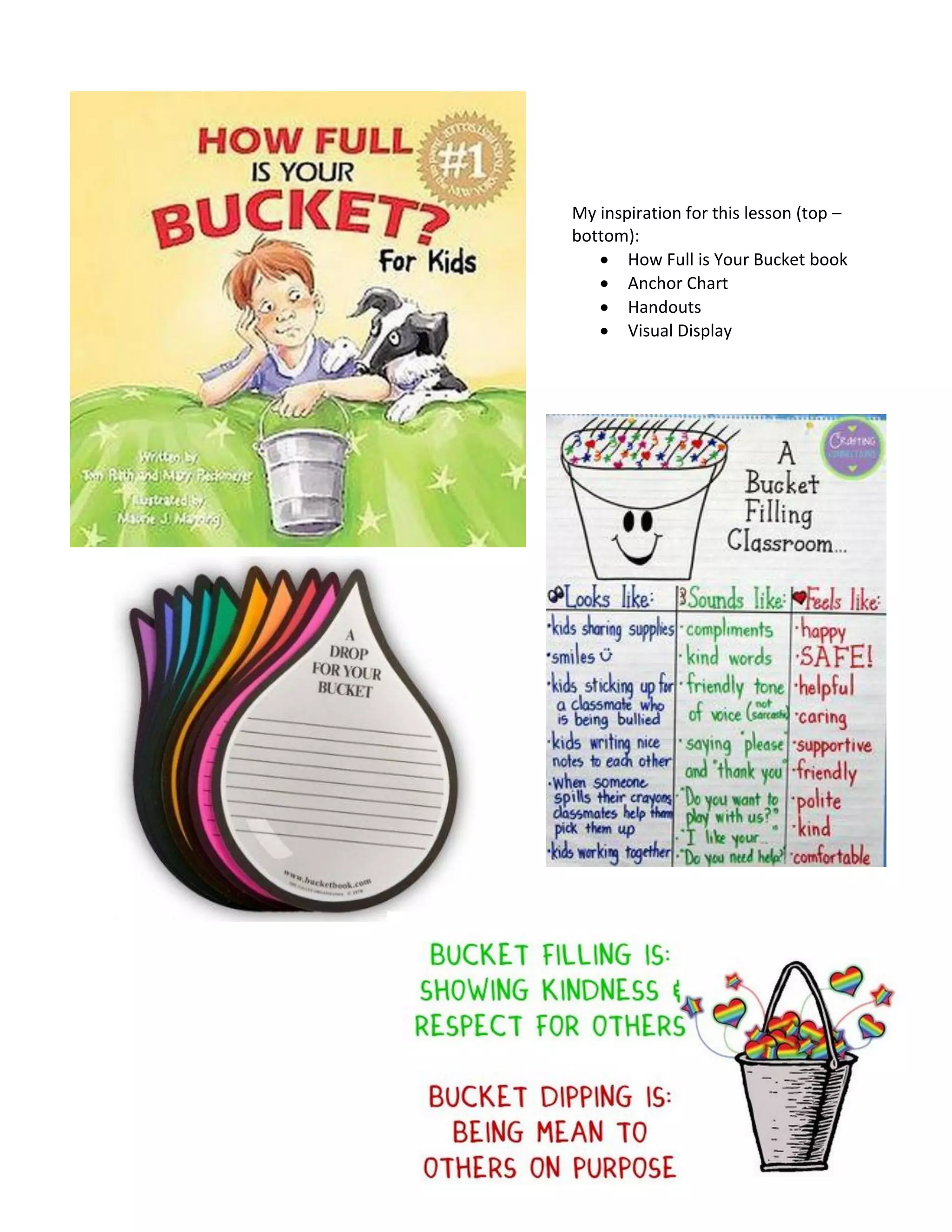
o Modeling: Students, now that we are done reading let’s analyze the text by creating this visual
display together. Teacher will create anchor chart by asking students to come up with examples
of respectful behavior and disrespectful behavior. The teacher could also take this a step further
and ask how respectful behavior makes us feel and how disrespectful behavior makes us feel.
o Checking for Understanding: Students, now I would like for you to go back to your desk and do
a quick-write in your journal. Prompt: In your own words, please describe what it means to be
respectful. Remember, our quick-writes do not exceed than three sentences. Once you are done
raise your hand and I will come take a quick look before we move on.
Activity:
1. (2 minutes) Instructions: Now that we all have a clear idea of what respect is and can identify respectful
behavior and disrespectful behavior, I would like for us to all create our own buckets. These buckets
will be hung on our respect wall. These buckets will serve as a visual reminder for all of us. Remember,
you can either be a bucket filler (respectful behavior) or a bucket dipper (disrespectful behavior) and we
all want to be bucket fillers. You can decorate your bucket however you would like. Also, once you
have created your bucket, I would like for each of you to write a bucket filler for your surprise buddy. I
will give you your surprise buddy once you have completed your bucket. Does anyone have any
questions? Ok, let’s begin.
2. (2 minutes) Materials: Class helpers will pass out all art supplies and buckets during this time.
3. (10 minutes) Working Time: Happy and upbeat music could be playing in the background to support a
positive classroom environment. Some suggestions include Pharrell Williams “Happy” and Aretha
Franklin ‘Respect.” I will have everyone’s name written on a “bucket filler” piece of paper to hand out
to the students as they show me their completed buckets. This will ensure that everyone in class will
receive a bucket filler in their bucket.
4. (5 minutes) Clean-up: Everyone will clean up his/her work station. Place any unfinished work into
folder to complete at a later time.
Closure:
1. (5 minutes) Review: Let’s review our key concepts from today’s lesson.
 Respect is a feeling of deep admiration for someone or something caused by his or her abilities,
qualities, or achievements.
 Bucket Fillers are respectable behaviors. A bucket filler can be something we say or something we
do for someone else. A bucket filler is always a positive experience and ensures a safe learning
environment. Bucket fillers are encouraged and you can never have too many.
 Bucket Dippers are disrespectable behaviors. A bucket dipper can be something we say or
something we do that hurts someone else. A bucket filler is always a negative experience and does
not provide a safe learning environment. Bucket dippers should be avoided.
 Everyone should practice filling buckets because it is a product of respectable behavior and when
we fill other buckets up ours gets filled, as well.
 Remember, during morning minutes or any free time you can write a bucket filler to a peer.
Assignment: Using, How Full is Your Bucket, as a source for characters and ideas, focus on the main concept
of the book, respect, to develop a personal plan that will help ensure you demonstrate respectful behavior in the
classroom at all times.
This can be a performance or role-play in front of the class, this can be an illustration, this can be a written
explanation or it can be a combination of the options. Your personal plan should be unique to you. I do not
expect anyone to have the same personal plan.
Your personal plan should include your own definition of respect, examples of respectful behavior, a specific
plan of action to correct disrespectful behavior and a short reflection on why you feel it is important to be
respectful to your peers. This will be due in one week. Review rubric.
REMEDIATION/EXTENSION ACTIVITIES:
1. Beginner/Intermediate
 Student can listen to audio books to encourage key concepts.
 Student can identify pictures as either bucket filler or bucket dipper.
 Student can discuss examples with teacher.
2. Intermediate/Advanced
 Have student submit a class tweet bucket filler to share with the world.
 Student can take this concept home and practice being a bucket filler outside of school. Student
can produce evidence to teacher.
 Student can read additional bucket filling books and share with class what he/she learned in any
form that the student chooses. Book suggestions include Fill a Bucket and Have you Filled a
Bucket Today.
 Student can write an opinion article about their experience of bucket filling and bucket dipping.
Try to publish the article in the class blog, newspaper, etc.
3. Student Choice
 I always incorporate a student choice option to encourage student creativity self-expression in a
way he/she feels most comfortable with. Students are welcome to propose an idea regarding the
lesson to replace homework, extend homework, or work on during free time.
REFLECTION & REVISION:
1. Reflective thoughts about lesson after taught:
2. Suggestions for revision if used again:
Rubric: Personal Plan - Respect
Student Name: Date:
Assignment: Personal Plan - Respect
Criteria Fair Good Excellent
Personal Definition
of Respect
Definition of respect
is not present.
Definition of respect
is present, but not
authentic.
Definition of respect
is present and
authentic.
Unique plan of action
including examples
Plan of action is not
present with no
concrete examples.
Plan of action is
present with less than
two examples present
Plan of action is
present and two
concrete examples
are present
Reflection on why
respecting peers is
important
Reflection is not
supported with
specific examples or
detail
Reflection is
supported with at
least one specific
example or detail
Reflection is
supported with more
than one specific
examples or detail
Overall:
Additional Comments:
Resources:
This lesson supports a learner-centered classroom (Brown, 2003; McCombs, Daniels, & Perry,
2008) rooted in the Love and Logic philosophy (Fay, Jim & Funk, David, 1995).
Brown, D. M. (2003). Learner-Centered Conditions That Ensure Students’ Success in Learning.
Education, 124(1), 99–107.
Fay, Jim, & Funk, David. (1995). Teaching with Love & Logic. The Love and Logic Press, Inc.
McCombs, B. L., Daniels, D. H., & Perry, K. E. (2008). Children’s and Teachers’ Perceptions of
Learner-Centered Practices, and Student Motivation: Implications for Early Schooling.
Elementary School Journal, 109(1), 16–35.
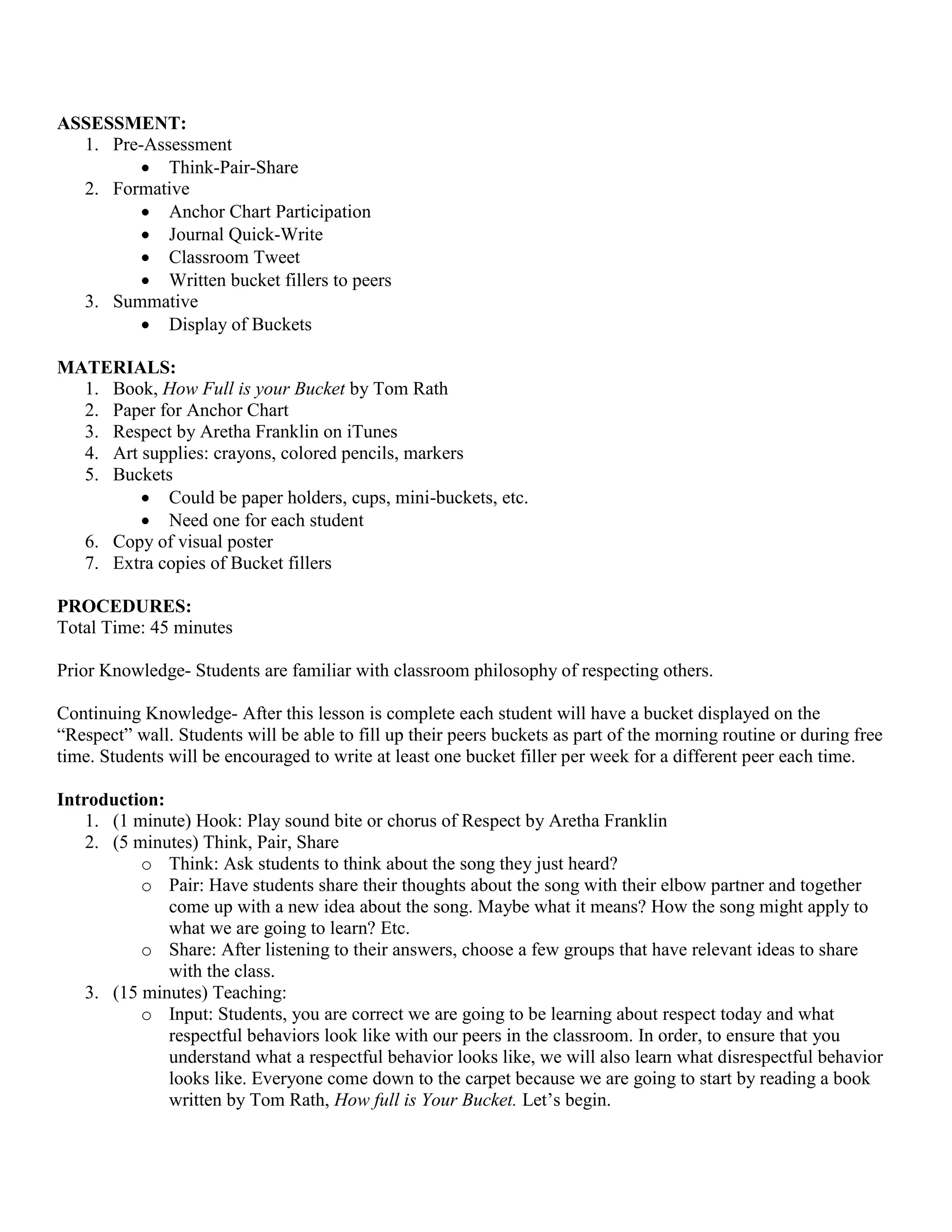
My inspiration for this lesson (top –
bottom):
 How Full is Your Bucket book
 Anchor Chart
 Handouts
 Visual Display

How Full is Your Bucket

  • 1.
    Title of Lesson:How Full is your Bucket? TEKS: ELAR: 110.12 (9) (1) Reading/Comprehension of Literary Text/Fiction. Students understand, make inferences and draw conclusions about the structure and elements of fiction and provide evidence from text to support their understanding. Students are expected to: (A) Describe the plot (problem and solution) and retell a story's beginning, middle, and end with attention to the sequence of events; and (B) Describe characters in a story and the reasons for their actions and feelings. ART: 117.5 (b)(2) Creative expression/performance. The student expresses ideas through original artworks, using a variety of media with appropriate skill. ELPS: Listening – Intermediate ELLs have the ability to understand simple, high-frequency spoken English used in routine academic and social settings. Speaking – Intermediate ELLs have the ability to speak in a simple manner using English commonly heard in routine academic and social settings. NCTE: (9.) Students develop an understanding of and respect for diversity in language use, patterns, and dialect across cultures, ethnic groups, geographic regions, and social roles. OBJECTIVES: 1. After reading the text, the student will be able to summarize in his/her own words what it means to be respectful in no more than three sentences. 2. The student will be able to distinguish between respectful and disrespectful behaviors by recalling at least two examples from the story. 3. Using the main character of the story as a reference, the student will be able to develop a personal plan to demonstrate respectful behavior in the classroom at all times.
  • 2.
    ASSESSMENT: 1. Pre-Assessment  Think-Pair-Share 2.Formative  Anchor Chart Participation  Journal Quick-Write  Classroom Tweet  Written bucket fillers to peers 3. Summative  Display of Buckets MATERIALS: 1. Book, How Full is your Bucket by Tom Rath 2. Paper for Anchor Chart 3. Respect by Aretha Franklin on iTunes 4. Art supplies: crayons, colored pencils, markers 5. Buckets  Could be paper holders, cups, mini-buckets, etc.  Need one for each student 6. Copy of visual poster 7. Extra copies of Bucket fillers PROCEDURES: Total Time: 45 minutes Prior Knowledge- Students are familiar with classroom philosophy of respecting others. Continuing Knowledge- After this lesson is complete each student will have a bucket displayed on the “Respect” wall. Students will be able to fill up their peers buckets as part of the morning routine or during free time. Students will be encouraged to write at least one bucket filler per week for a different peer each time. Introduction: 1. (1 minute) Hook: Play sound bite or chorus of Respect by Aretha Franklin 2. (5 minutes) Think, Pair, Share o Think: Ask students to think about the song they just heard? o Pair: Have students share their thoughts about the song with their elbow partner and together come up with a new idea about the song. Maybe what it means? How the song might apply to what we are going to learn? Etc. o Share: After listening to their answers, choose a few groups that have relevant ideas to share with the class. 3. (15 minutes) Teaching: o Input: Students, you are correct we are going to be learning about respect today and what respectful behaviors look like with our peers in the classroom. In order, to ensure that you understand what a respectful behavior looks like, we will also learn what disrespectful behavior looks like. Everyone come down to the carpet because we are going to start by reading a book written by Tom Rath, How full is Your Bucket. Let’s begin.
  • 3.
    o Modeling: Students,now that we are done reading let’s analyze the text by creating this visual display together. Teacher will create anchor chart by asking students to come up with examples of respectful behavior and disrespectful behavior. The teacher could also take this a step further and ask how respectful behavior makes us feel and how disrespectful behavior makes us feel. o Checking for Understanding: Students, now I would like for you to go back to your desk and do a quick-write in your journal. Prompt: In your own words, please describe what it means to be respectful. Remember, our quick-writes do not exceed than three sentences. Once you are done raise your hand and I will come take a quick look before we move on. Activity: 1. (2 minutes) Instructions: Now that we all have a clear idea of what respect is and can identify respectful behavior and disrespectful behavior, I would like for us to all create our own buckets. These buckets will be hung on our respect wall. These buckets will serve as a visual reminder for all of us. Remember, you can either be a bucket filler (respectful behavior) or a bucket dipper (disrespectful behavior) and we all want to be bucket fillers. You can decorate your bucket however you would like. Also, once you have created your bucket, I would like for each of you to write a bucket filler for your surprise buddy. I will give you your surprise buddy once you have completed your bucket. Does anyone have any questions? Ok, let’s begin. 2. (2 minutes) Materials: Class helpers will pass out all art supplies and buckets during this time. 3. (10 minutes) Working Time: Happy and upbeat music could be playing in the background to support a positive classroom environment. Some suggestions include Pharrell Williams “Happy” and Aretha Franklin ‘Respect.” I will have everyone’s name written on a “bucket filler” piece of paper to hand out to the students as they show me their completed buckets. This will ensure that everyone in class will receive a bucket filler in their bucket. 4. (5 minutes) Clean-up: Everyone will clean up his/her work station. Place any unfinished work into folder to complete at a later time. Closure: 1. (5 minutes) Review: Let’s review our key concepts from today’s lesson.  Respect is a feeling of deep admiration for someone or something caused by his or her abilities, qualities, or achievements.  Bucket Fillers are respectable behaviors. A bucket filler can be something we say or something we do for someone else. A bucket filler is always a positive experience and ensures a safe learning environment. Bucket fillers are encouraged and you can never have too many.  Bucket Dippers are disrespectable behaviors. A bucket dipper can be something we say or something we do that hurts someone else. A bucket filler is always a negative experience and does not provide a safe learning environment. Bucket dippers should be avoided.  Everyone should practice filling buckets because it is a product of respectable behavior and when we fill other buckets up ours gets filled, as well.  Remember, during morning minutes or any free time you can write a bucket filler to a peer.
  • 4.
    Assignment: Using, HowFull is Your Bucket, as a source for characters and ideas, focus on the main concept of the book, respect, to develop a personal plan that will help ensure you demonstrate respectful behavior in the classroom at all times. This can be a performance or role-play in front of the class, this can be an illustration, this can be a written explanation or it can be a combination of the options. Your personal plan should be unique to you. I do not expect anyone to have the same personal plan. Your personal plan should include your own definition of respect, examples of respectful behavior, a specific plan of action to correct disrespectful behavior and a short reflection on why you feel it is important to be respectful to your peers. This will be due in one week. Review rubric. REMEDIATION/EXTENSION ACTIVITIES: 1. Beginner/Intermediate  Student can listen to audio books to encourage key concepts.  Student can identify pictures as either bucket filler or bucket dipper.  Student can discuss examples with teacher. 2. Intermediate/Advanced  Have student submit a class tweet bucket filler to share with the world.  Student can take this concept home and practice being a bucket filler outside of school. Student can produce evidence to teacher.  Student can read additional bucket filling books and share with class what he/she learned in any form that the student chooses. Book suggestions include Fill a Bucket and Have you Filled a Bucket Today.  Student can write an opinion article about their experience of bucket filling and bucket dipping. Try to publish the article in the class blog, newspaper, etc. 3. Student Choice  I always incorporate a student choice option to encourage student creativity self-expression in a way he/she feels most comfortable with. Students are welcome to propose an idea regarding the lesson to replace homework, extend homework, or work on during free time. REFLECTION & REVISION: 1. Reflective thoughts about lesson after taught: 2. Suggestions for revision if used again:
  • 5.
    Rubric: Personal Plan- Respect Student Name: Date: Assignment: Personal Plan - Respect Criteria Fair Good Excellent Personal Definition of Respect Definition of respect is not present. Definition of respect is present, but not authentic. Definition of respect is present and authentic. Unique plan of action including examples Plan of action is not present with no concrete examples. Plan of action is present with less than two examples present Plan of action is present and two concrete examples are present Reflection on why respecting peers is important Reflection is not supported with specific examples or detail Reflection is supported with at least one specific example or detail Reflection is supported with more than one specific examples or detail Overall: Additional Comments:
  • 6.
    Resources: This lesson supportsa learner-centered classroom (Brown, 2003; McCombs, Daniels, & Perry, 2008) rooted in the Love and Logic philosophy (Fay, Jim & Funk, David, 1995). Brown, D. M. (2003). Learner-Centered Conditions That Ensure Students’ Success in Learning. Education, 124(1), 99–107. Fay, Jim, & Funk, David. (1995). Teaching with Love & Logic. The Love and Logic Press, Inc. McCombs, B. L., Daniels, D. H., & Perry, K. E. (2008). Children’s and Teachers’ Perceptions of Learner-Centered Practices, and Student Motivation: Implications for Early Schooling. Elementary School Journal, 109(1), 16–35.
  • 7.
    My inspiration forthis lesson (top – bottom):  How Full is Your Bucket book  Anchor Chart  Handouts  Visual Display