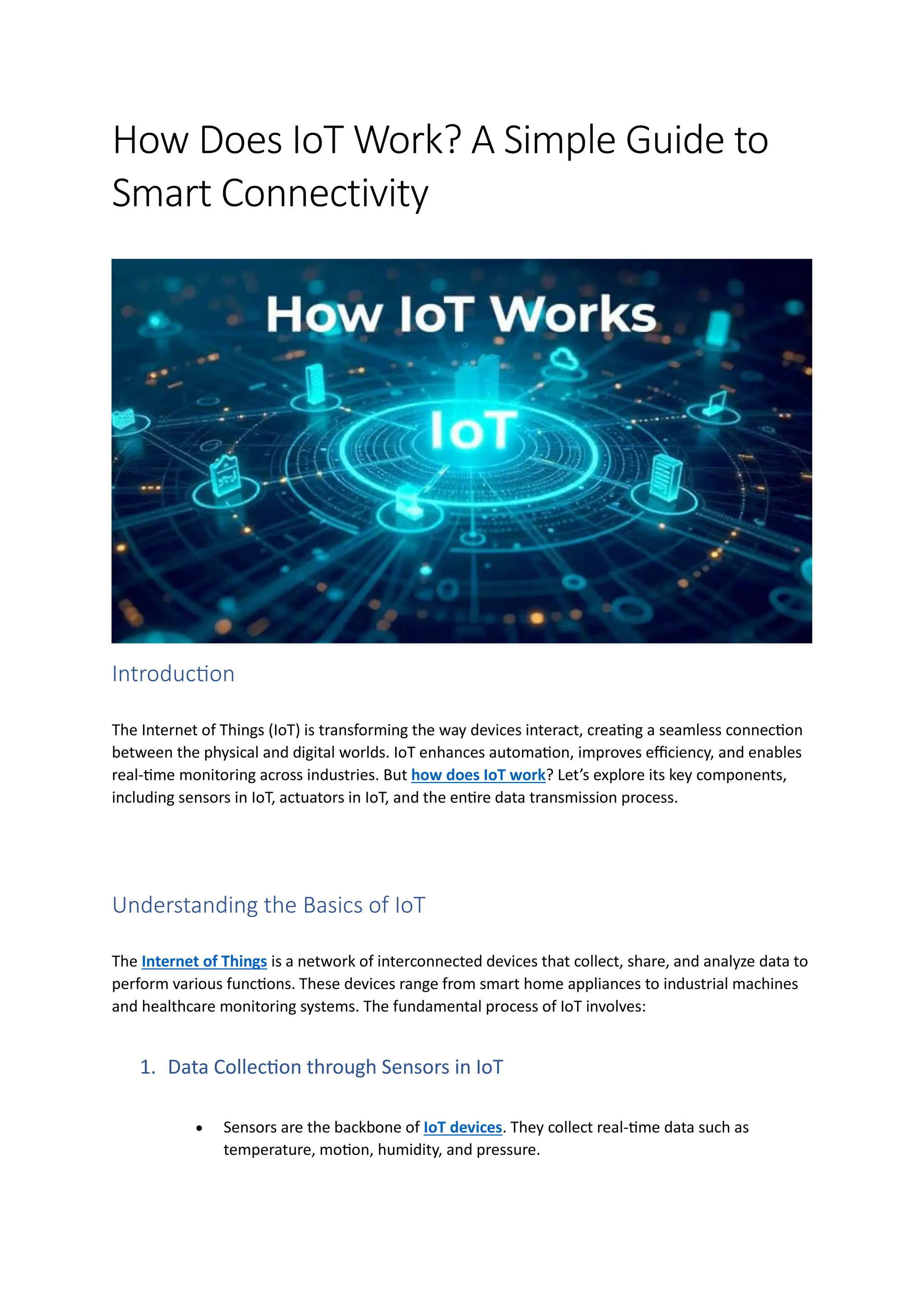
How Does IoT Work? A Simple Guide to
Smart Connectivity
Introduction
The Internet of Things (IoT) is transforming the way devices interact, creating a seamless connection
between the physical and digital worlds. IoT enhances automation, improves efficiency, and enables
real-time monitoring across industries. But how does IoT work? Let’s explore its key components,
including sensors in IoT, actuators in IoT, and the entire data transmission process.
Understanding the Basics of IoT
The Internet of Things is a network of interconnected devices that collect, share, and analyze data to
perform various functions. These devices range from smart home appliances to industrial machines
and healthcare monitoring systems. The fundamental process of IoT involves:
1. Data Collection through Sensors in IoT
• Sensors are the backbone of IoT devices. They collect real-time data such as
temperature, motion, humidity, and pressure.
• Examples include temperature sensors in smart thermostats, motion sensors in
security cameras, and heart rate monitors in wearables.
2. Data Processing and Transmission
• Once data is collected, it is transmitted via wireless networks such as Wi-Fi,
Bluetooth, or cellular networks.
• The data is sent to cloud platforms or edge computing systems for processing and
analysis.
3. Action Execution through Actuators in IoT
• Actuators receive commands from the system and take action accordingly.
• Examples include smart locks unlocking doors remotely, irrigation systems adjusting
water flow, and industrial robots performing automated tasks.
How Does IoT Work? The Step-by-Step Process
To understand how does IoT work, let’s break it down into four essential steps:
1. Data Sensing – IoT devices use sensors in IoT to collect data from their surroundings.
2. Data Transmission – The collected data is sent to cloud servers or edge devices through
networks like Wi-Fi, 5G, or LPWAN.
3. Data Processing – Cloud-based analytics and AI-powered platforms analyze the received
data.
4. Action and Response – Based on the analysis, actuators in IoT execute the required action,
such as adjusting temperature or sending alerts.
Applications of IoT in Different Industries
IoT has a wide range of applications across industries, making operations more efficient and data-
driven:
• Smart Homes – IoT enables smart thermostats, security systems, and voice-controlled
assistants.
• Healthcare – Wearable devices track heart rate, oxygen levels, and physical activity in real-
time.
• Manufacturing – IoT optimizes predictive maintenance, reducing machine downtime.
• Agriculture – Smart irrigation systems adjust water usage based on soil moisture levels.
• Transportation – GPS-enabled fleet management improves logistics and fuel efficiency.
The Future of IoT
The Internet of Things is evolving rapidly, with advancements in AI, 5G connectivity, and edge
computing. Future innovations will enhance automation, security, and real-time decision-making
across various sectors. As IoT continues to expand, businesses and consumers will experience a more
connected, data-driven world.
Conclusion
Understanding how does IoT work is crucial in today’s technology-driven world. By leveraging sensors
in IoT for data collection and actuators in IoT for execution, the IoT ecosystem enables smart
automation and efficiency. As the technology advances, its impact on industries and daily life will
only grow, shaping a smarter, more connected future.
Original Source

How Does IoT Work? A Simple Guide to Connected Devices

  • 1.
    How Does IoTWork? A Simple Guide to Smart Connectivity Introduction The Internet of Things (IoT) is transforming the way devices interact, creating a seamless connection between the physical and digital worlds. IoT enhances automation, improves efficiency, and enables real-time monitoring across industries. But how does IoT work? Let’s explore its key components, including sensors in IoT, actuators in IoT, and the entire data transmission process. Understanding the Basics of IoT The Internet of Things is a network of interconnected devices that collect, share, and analyze data to perform various functions. These devices range from smart home appliances to industrial machines and healthcare monitoring systems. The fundamental process of IoT involves: 1. Data Collection through Sensors in IoT • Sensors are the backbone of IoT devices. They collect real-time data such as temperature, motion, humidity, and pressure.
  • 2.
    • Examples includetemperature sensors in smart thermostats, motion sensors in security cameras, and heart rate monitors in wearables. 2. Data Processing and Transmission • Once data is collected, it is transmitted via wireless networks such as Wi-Fi, Bluetooth, or cellular networks. • The data is sent to cloud platforms or edge computing systems for processing and analysis. 3. Action Execution through Actuators in IoT • Actuators receive commands from the system and take action accordingly. • Examples include smart locks unlocking doors remotely, irrigation systems adjusting water flow, and industrial robots performing automated tasks. How Does IoT Work? The Step-by-Step Process To understand how does IoT work, let’s break it down into four essential steps: 1. Data Sensing – IoT devices use sensors in IoT to collect data from their surroundings. 2. Data Transmission – The collected data is sent to cloud servers or edge devices through networks like Wi-Fi, 5G, or LPWAN. 3. Data Processing – Cloud-based analytics and AI-powered platforms analyze the received data. 4. Action and Response – Based on the analysis, actuators in IoT execute the required action, such as adjusting temperature or sending alerts.
  • 3.
    Applications of IoTin Different Industries IoT has a wide range of applications across industries, making operations more efficient and data- driven: • Smart Homes – IoT enables smart thermostats, security systems, and voice-controlled assistants. • Healthcare – Wearable devices track heart rate, oxygen levels, and physical activity in real- time. • Manufacturing – IoT optimizes predictive maintenance, reducing machine downtime. • Agriculture – Smart irrigation systems adjust water usage based on soil moisture levels. • Transportation – GPS-enabled fleet management improves logistics and fuel efficiency. The Future of IoT The Internet of Things is evolving rapidly, with advancements in AI, 5G connectivity, and edge computing. Future innovations will enhance automation, security, and real-time decision-making across various sectors. As IoT continues to expand, businesses and consumers will experience a more connected, data-driven world. Conclusion Understanding how does IoT work is crucial in today’s technology-driven world. By leveraging sensors in IoT for data collection and actuators in IoT for execution, the IoT ecosystem enables smart automation and efficiency. As the technology advances, its impact on industries and daily life will only grow, shaping a smarter, more connected future. Original Source