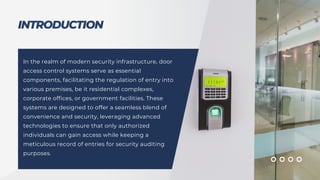
INTRODUCTION
In the realm of modern security infrastructure, door
access control systems serve as essential
components, facilitating the regulation of entry into
various premises, be it residential complexes,
corporate offices, or government facilities. These
systems are designed to offer a seamless blend of
convenience and security, leveraging advanced
technologies to ensure that only authorized
individuals can gain access while keeping a
meticulous record of entries for security auditing
purposes.
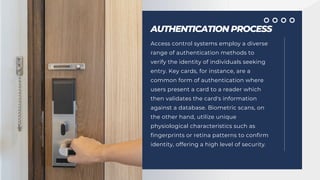
AUTHENTICATION PROCESS
Access control systems employ a diverse
range of authentication methods to
verify the identity of individuals seeking
entry. Key cards, for instance, are a
common form of authentication where
users present a card to a reader which
then validates the card's information
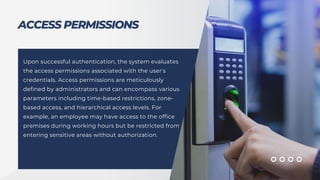
against a database. Biometric scans, on
the other hand, utilize unique
physiological characteristics such as
fingerprints or retina patterns to confirm
identity, offering a high level of security.
ACCESS PERMISSIONS
Upon successful authentication, the system evaluates
the access permissions associated with the user's
credentials. Access permissions are meticulously
defined by administrators and can encompass various
parameters including time-based restrictions, zone-
based access, and hierarchical access levels. For
example, an employee may have access to the office
premises during working hours but be restricted from
entering sensitive areas without authorization.
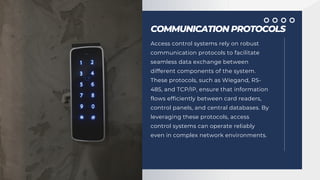
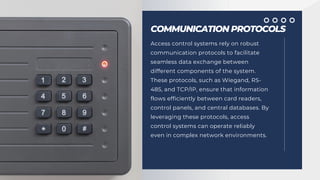
COMMUNICATION PROTOCOLS
Access control systems rely on robust
communication protocols to facilitate
seamless data exchange between
different components of the system.
These protocols, such as Wiegand, RS-
485, and TCP/IP, ensure that information
flows efficiently between card readers,
control panels, and central databases. By
leveraging these protocols, access
control systems can operate reliably
even in complex network environments.
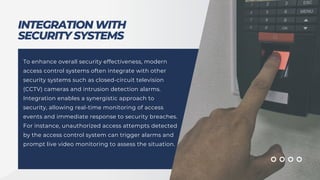
INTEGRATION WITH
SECURITY SYSTEMS
To enhance overall security effectiveness, modern
access control systems often integrate with other
security systems such as closed-circuit television
(CCTV) cameras and intrusion detection alarms.
Integration enables a synergistic approach to
security, allowing real-time monitoring of access
events and immediate response to security breaches.
For instance, unauthorized access attempts detected
by the access control system can trigger alarms and
prompt live video monitoring to assess the situation.
COMMUNICATION PROTOCOLS
Access control systems rely on robust
communication protocols to facilitate
seamless data exchange between
different components of the system.
These protocols, such as Wiegand, RS-
485, and TCP/IP, ensure that information
flows efficiently between card readers,
control panels, and central databases. By
leveraging these protocols, access
control systems can operate reliably
even in complex network environments.
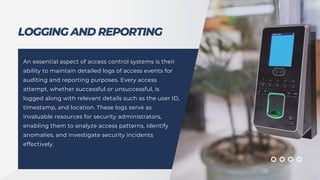
LOGGING AND REPORTING
An essential aspect of access control systems is their
ability to maintain detailed logs of access events for
auditing and reporting purposes. Every access
attempt, whether successful or unsuccessful, is
logged along with relevant details such as the user ID,
timestamp, and location. These logs serve as
invaluable resources for security administrators,
enabling them to analyze access patterns, identify
anomalies, and investigate security incidents
effectively.
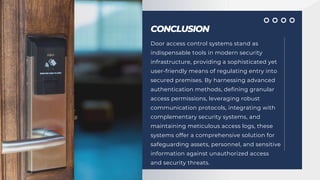
CONCLUSION
Door access control systems stand as
indispensable tools in modern security
infrastructure, providing a sophisticated yet
user-friendly means of regulating entry into
secured premises. By harnessing advanced
authentication methods, defining granular
access permissions, leveraging robust
communication protocols, integrating with
complementary security systems, and
maintaining meticulous access logs, these
systems offer a comprehensive solution for
safeguarding assets, personnel, and sensitive
information against unauthorized access
and security threats.

THANK
YOU
OFFICE
01453 707007
www.foxmoorsecurity.co.uk
24 Arundel Cl, Tuffley,
Gloucester GL4 0TW, United
Kingdom

How Does Door Access Control System Work

  • 2.
    INTRODUCTION In the realmof modern security infrastructure, door access control systems serve as essential components, facilitating the regulation of entry into various premises, be it residential complexes, corporate offices, or government facilities. These systems are designed to offer a seamless blend of convenience and security, leveraging advanced technologies to ensure that only authorized individuals can gain access while keeping a meticulous record of entries for security auditing purposes.
  • 3.
    AUTHENTICATION PROCESS Access controlsystems employ a diverse range of authentication methods to verify the identity of individuals seeking entry. Key cards, for instance, are a common form of authentication where users present a card to a reader which then validates the card's information against a database. Biometric scans, on the other hand, utilize unique physiological characteristics such as fingerprints or retina patterns to confirm identity, offering a high level of security.
  • 4.
    ACCESS PERMISSIONS Upon successfulauthentication, the system evaluates the access permissions associated with the user's credentials. Access permissions are meticulously defined by administrators and can encompass various parameters including time-based restrictions, zone- based access, and hierarchical access levels. For example, an employee may have access to the office premises during working hours but be restricted from entering sensitive areas without authorization.
  • 5.
    COMMUNICATION PROTOCOLS Access controlsystems rely on robust communication protocols to facilitate seamless data exchange between different components of the system. These protocols, such as Wiegand, RS- 485, and TCP/IP, ensure that information flows efficiently between card readers, control panels, and central databases. By leveraging these protocols, access control systems can operate reliably even in complex network environments.
  • 6.
    INTEGRATION WITH SECURITY SYSTEMS Toenhance overall security effectiveness, modern access control systems often integrate with other security systems such as closed-circuit television (CCTV) cameras and intrusion detection alarms. Integration enables a synergistic approach to security, allowing real-time monitoring of access events and immediate response to security breaches. For instance, unauthorized access attempts detected by the access control system can trigger alarms and prompt live video monitoring to assess the situation.
  • 7.
    COMMUNICATION PROTOCOLS Access controlsystems rely on robust communication protocols to facilitate seamless data exchange between different components of the system. These protocols, such as Wiegand, RS- 485, and TCP/IP, ensure that information flows efficiently between card readers, control panels, and central databases. By leveraging these protocols, access control systems can operate reliably even in complex network environments.
  • 8.
    LOGGING AND REPORTING Anessential aspect of access control systems is their ability to maintain detailed logs of access events for auditing and reporting purposes. Every access attempt, whether successful or unsuccessful, is logged along with relevant details such as the user ID, timestamp, and location. These logs serve as invaluable resources for security administrators, enabling them to analyze access patterns, identify anomalies, and investigate security incidents effectively.
  • 9.
    CONCLUSION Door access controlsystems stand as indispensable tools in modern security infrastructure, providing a sophisticated yet user-friendly means of regulating entry into secured premises. By harnessing advanced authentication methods, defining granular access permissions, leveraging robust communication protocols, integrating with complementary security systems, and maintaining meticulous access logs, these systems offer a comprehensive solution for safeguarding assets, personnel, and sensitive information against unauthorized access and security threats.
  • 10.
    THANK YOU OFFICE 01453 707007 www.foxmoorsecurity.co.uk 24 ArundelCl, Tuffley, Gloucester GL4 0TW, United Kingdom