S oftware
E ngineering &
N etwork
S ystems Lab
How Does Cybersecurity
Relate to Safety?
Betty H.C. Cheng,
Software Engineering and Network Systems Lab
Digital Evolution Laboratory
BEACON: NSF Center for Evolution in Action
Department of Computer Science and Engineering
Michigan State University
chengb at cse dot msu dot edu
http://www.cse.msu.edu/~chengb
S oftware
E ngineering &
N etwork
S ystems Lab
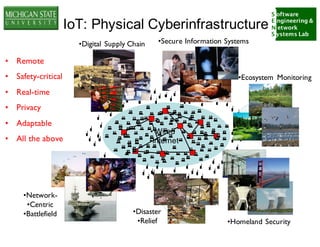
IoT: Physical Cyberinfrastructure
•Network-
•Centric
•Battlefield
•Homeland Security
•Ecosystem Monitoring
•Disaster
•Relief
•Secure Information Systems•Digital Supply Chain
• Remote
• Safety-critical
• Real-time
• Privacy
• Adaptable
• All the above
• Wired
•Internet
S oftware
E ngineering &
N etwork
S ystems Lab
New Scale: Internet of Things
Healthcare Infrastructure
•20
•Ultra-Large-ScaleSystems
•Linda Northrop, ICSE 2007
•© 2007 Carnegie Mellon University
•New scale:
• Data stored, accessed, manipulated, and refined
• Number of connections/interdependencies among
components
• Number of hardware elements
Heterogeneous Collection of Distributed Systems
S oftware
E ngineering &
N etwork
S ystems Lab
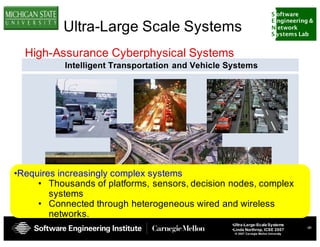
Intelligent Transportation and Vehicle Systems
•21
•Ultra-Large-ScaleSystems
•Linda Northrop, ICSE 2007
•© 2007 Carnegie Mellon University
High-Assurance Cyberphysical Systems
•Requires increasingly complex systems
• Thousands of platforms, sensors, decision nodes, complex
systems
• Connected through heterogeneous wired and wireless
networks.
Ultra-Large Scale Systems
S oftware
E ngineering &
N etwork
S ystems Lab
S oftware
E ngineering &
N etwork
S ystems LabThe ULS/IoT Ecosystem
• Key elements:
– Computing devices
– Business and organizational policies
– Environment (including people)
• Forces:
– Competition for resources
– Unexpected environmental changes
– Decentralized control
– Demand for assurance (safety and
security)
S oftware
E ngineering &
N etwork
S ystems Lab
Approach
• Key Cybersecurity Challenges:
– Prevention
– Detection
– Mitigation
• Competing Concerns:
• Safety
• Information Access (e.g., “Internet of Things”)
• Heterogeneity of Systems and Stakeholders
• Multi-Disciplinary Strategies:
– Leverage enabling technologies from other disciplines
(e.g., biology, AI, control, cognitive & social science, etc.)
– Collaborate with other disciplines for a more holistic,
systemic approach to address cybersecurity and safety.
6

How Does Cybersecurity Relate to Safety?

  • 1.
    S oftware E ngineering& N etwork S ystems Lab How Does Cybersecurity Relate to Safety? Betty H.C. Cheng, Software Engineering and Network Systems Lab Digital Evolution Laboratory BEACON: NSF Center for Evolution in Action Department of Computer Science and Engineering Michigan State University chengb at cse dot msu dot edu http://www.cse.msu.edu/~chengb
  • 2.
    S oftware E ngineering& N etwork S ystems Lab IoT: Physical Cyberinfrastructure •Network- •Centric •Battlefield •Homeland Security •Ecosystem Monitoring •Disaster •Relief •Secure Information Systems•Digital Supply Chain • Remote • Safety-critical • Real-time • Privacy • Adaptable • All the above • Wired •Internet
  • 3.
    S oftware E ngineering& N etwork S ystems Lab New Scale: Internet of Things Healthcare Infrastructure •20 •Ultra-Large-ScaleSystems •Linda Northrop, ICSE 2007 •© 2007 Carnegie Mellon University •New scale: • Data stored, accessed, manipulated, and refined • Number of connections/interdependencies among components • Number of hardware elements Heterogeneous Collection of Distributed Systems
  • 4.
    S oftware E ngineering& N etwork S ystems Lab Intelligent Transportation and Vehicle Systems •21 •Ultra-Large-ScaleSystems •Linda Northrop, ICSE 2007 •© 2007 Carnegie Mellon University High-Assurance Cyberphysical Systems •Requires increasingly complex systems • Thousands of platforms, sensors, decision nodes, complex systems • Connected through heterogeneous wired and wireless networks. Ultra-Large Scale Systems
  • 5.
    S oftware E ngineering& N etwork S ystems Lab S oftware E ngineering & N etwork S ystems LabThe ULS/IoT Ecosystem • Key elements: – Computing devices – Business and organizational policies – Environment (including people) • Forces: – Competition for resources – Unexpected environmental changes – Decentralized control – Demand for assurance (safety and security)
  • 6.
    S oftware E ngineering& N etwork S ystems Lab Approach • Key Cybersecurity Challenges: – Prevention – Detection – Mitigation • Competing Concerns: • Safety • Information Access (e.g., “Internet of Things”) • Heterogeneity of Systems and Stakeholders • Multi-Disciplinary Strategies: – Leverage enabling technologies from other disciplines (e.g., biology, AI, control, cognitive & social science, etc.) – Collaborate with other disciplines for a more holistic, systemic approach to address cybersecurity and safety. 6