How does a
Computer work?
Introduction
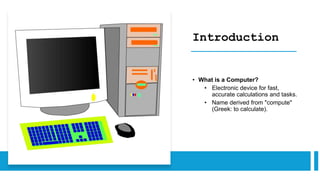
• What is a Computer?
• Electronic device for fast,
accurate calculations and tasks.
• Name derived from "compute"
(Greek: to calculate).
Basic Working
of a Computer
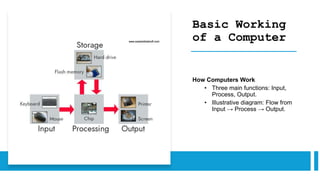
How Computers Work
• Three main functions: Input,
Process, Output.
• Illustrative diagram: Flow from
Input → Process → Output.
Input in
Computing
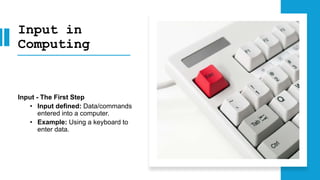
Input - The First Step
• Input defined: Data/commands
entered into a computer.
• Example: Using a keyboard to
enter data.
Processing
Information
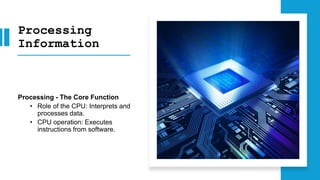
Processing - The Core Function
• Role of the CPU: Interprets and
processes data.
• CPU operation: Executes
instructions from software.
Output in
Computing
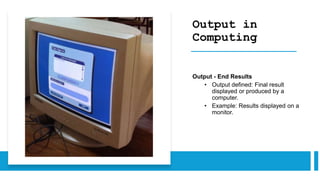
Output - End Results
• Output defined: Final result
displayed or produced by a
computer.
• Example: Results displayed on a
monitor.
Applying Computer
Logic to Everyday
Life
Understanding Through Daily Examples
• Making a Sandwich:
• Input: Ingredients
• Process: Assemble
• Output: Sandwich
• Using an ATM:
• Input: ATM Card
• Process: Card verification and
transaction processing
• Output: Cash or account
transaction receipt
Conclusion
Key Takeaways
• Computers are fundamental electronic devices that operate based
on simple logic: Input, Process, Output.
• This logical structure is applicable to many everyday tasks,
illustrating the pervasive nature of computing principles in daily
life.
• Understanding these basic concepts helps in appreciating how
complex systems are built on simple, understandable steps.

How does a Computer work and how input output .pptx

  • 1.
  • 2.
    Introduction • What isa Computer? • Electronic device for fast, accurate calculations and tasks. • Name derived from "compute" (Greek: to calculate).
  • 3.
    Basic Working of aComputer How Computers Work • Three main functions: Input, Process, Output. • Illustrative diagram: Flow from Input → Process → Output.
  • 4.
    Input in Computing Input -The First Step • Input defined: Data/commands entered into a computer. • Example: Using a keyboard to enter data.
  • 5.
    Processing Information Processing - TheCore Function • Role of the CPU: Interprets and processes data. • CPU operation: Executes instructions from software.
  • 6.
    Output in Computing Output -End Results • Output defined: Final result displayed or produced by a computer. • Example: Results displayed on a monitor.
  • 7.
    Applying Computer Logic toEveryday Life Understanding Through Daily Examples • Making a Sandwich: • Input: Ingredients • Process: Assemble • Output: Sandwich • Using an ATM: • Input: ATM Card • Process: Card verification and transaction processing • Output: Cash or account transaction receipt
  • 8.
    Conclusion Key Takeaways • Computersare fundamental electronic devices that operate based on simple logic: Input, Process, Output. • This logical structure is applicable to many everyday tasks, illustrating the pervasive nature of computing principles in daily life. • Understanding these basic concepts helps in appreciating how complex systems are built on simple, understandable steps.

Editor's Notes

  • #3 "A computer is an electronic device designed for performing fast and accurate calculations and tasks. The term 'computer' originally comes from the Greek word meaning 'to calculate.' Our journey today covers how these devices manage to perform an astounding array of tasks using basic computational principles."
  • #4 "Let's break down how computers work into three main functions: Input, Process, and Output. This model is foundational in computing. We input data, the computer processes it, and then produces output. This simple flow is the backbone of every computing task."
  • #5 "The first step in computing is input. This involves entering data or commands into the computer system. For example, when you type on a keyboard, you're inputting data. This data is then ready for the next stage, which is processing."
  • #6 "At the core of a computer is its ability to process information, primarily handled by the CPU or Central Processing Unit. The CPU interprets and processes the data it receives from the input devices, performing computations and executing instructions from software."
  • #7 "After processing the information, the computer provides output. This is the final result of the computational processes displayed or produced as useful information. For example, text appearing on your monitor after typing or print documents from your inputs."
  • #8 "Understanding computer logic can be seen in everyday tasks. For instance, making a sandwich involves input (ingredients), process (assembling the sandwich), and output (the finished sandwich). Similarly, using an ATM involves inputting your card, the machine processing your transaction, and then outputting cash or a transaction receipt."
  • #9 "To conclude, computers are fundamental electronic devices that operate based on the simple logic of input, process, and output. This logic helps us understand how complex computer systems function and illustrates how pervasive computing principles are in our daily tasks. Understanding these concepts allows us to appreciate and better interact with the technology around us."