RODNYA 2016
rodnya.moscow
The Washington Post.
Facebook fake-news writer:
‘I think Donald Trump is in the White House because of me’.
Paul Horner —
one of the most influential
fake-news writer.
The one who misinformed
the whole world.
http://cnn.com.de
http://nbc.com.co
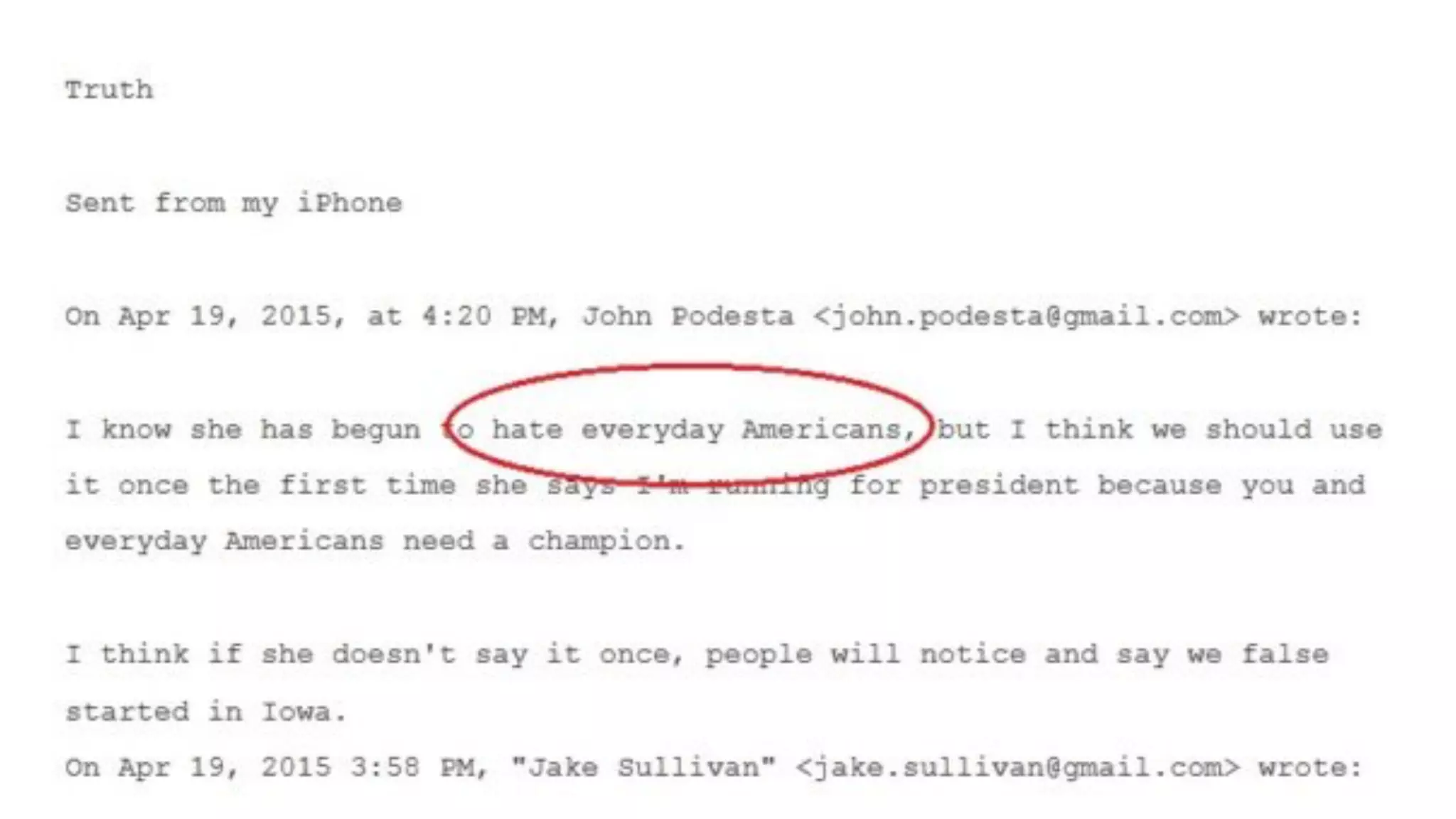
post-truth trolles &
political propagandist.
Paul Horner
Source
Facebook account, fake sites
http://abcnews.com.co
High level distributors
News consumers spread it via
Likes/tweets/shares
We, people
Low level distributors
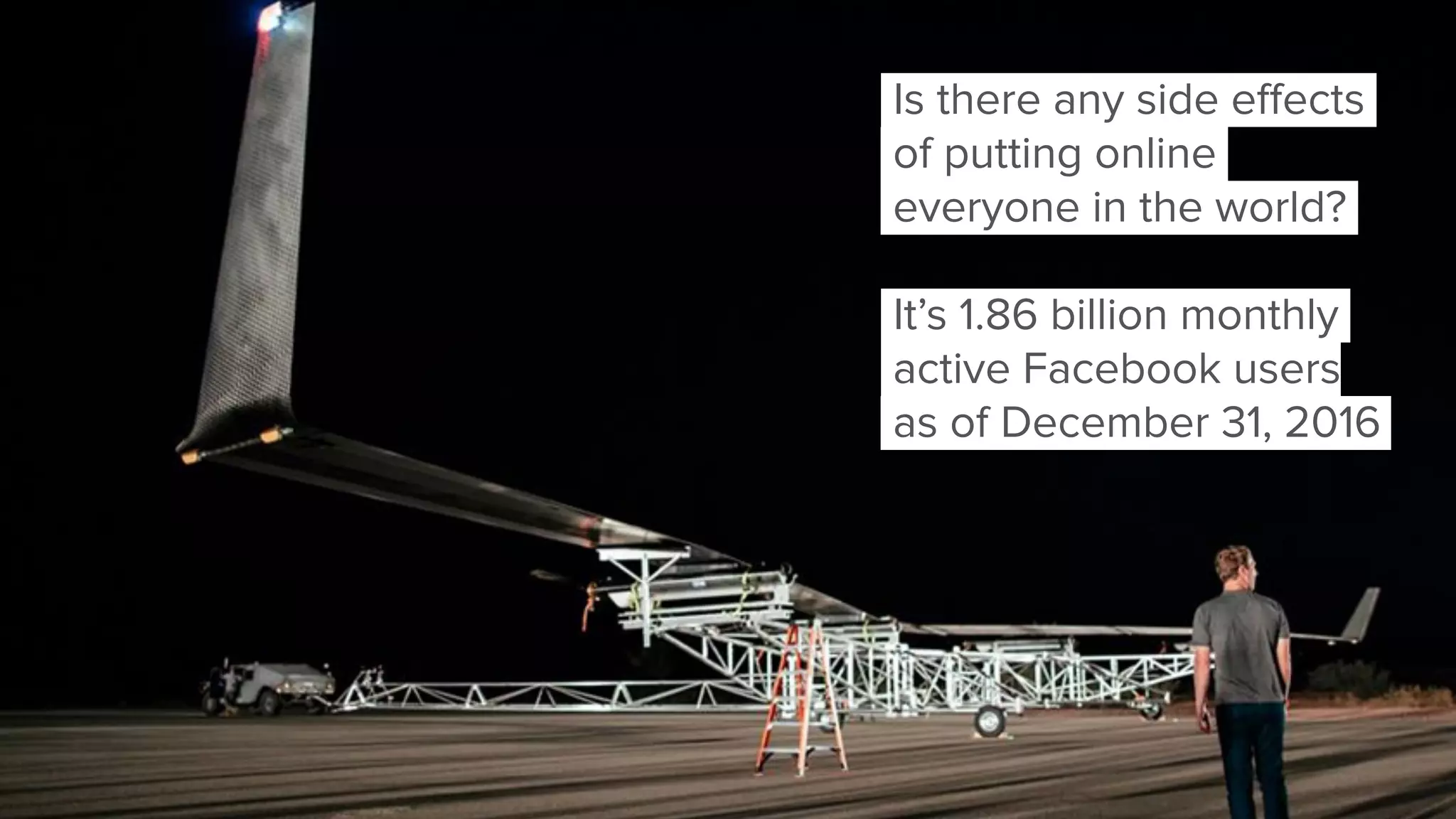
Is there any side effects
of putting online
everyone in the world?
It’s 1.86 billion monthly
active Facebook users
as of December 31, 2016
“Facebook cannot claim to be entirely agnostic. If
they are going to traffic in journalism and information
as part of what they do, there is an obligation to
separate truth from lies masquerading as fact”.
JOHN AVLON
Editor in Chief, the Daily Beast
“I am very wary of big technology companies becoming
censors of what people consume. Do we allow
Facebook to designate what is journalism? Are we
going to say that the big tech companies today should
tell us who we should turn to for news?”
VINCE COGLIANESE
Editor in Chief, the Daily Caller
“They have to take responsibility for what they have achieved,
which is a system that very efficiently distributes falsehoods
and lies to an enormous audience. That’s what they have to
live with and it’s kind of irrelevant whether they think they are a
media company or not.”
JOHN COOK
Executive Editor, Gizmodo Media Group
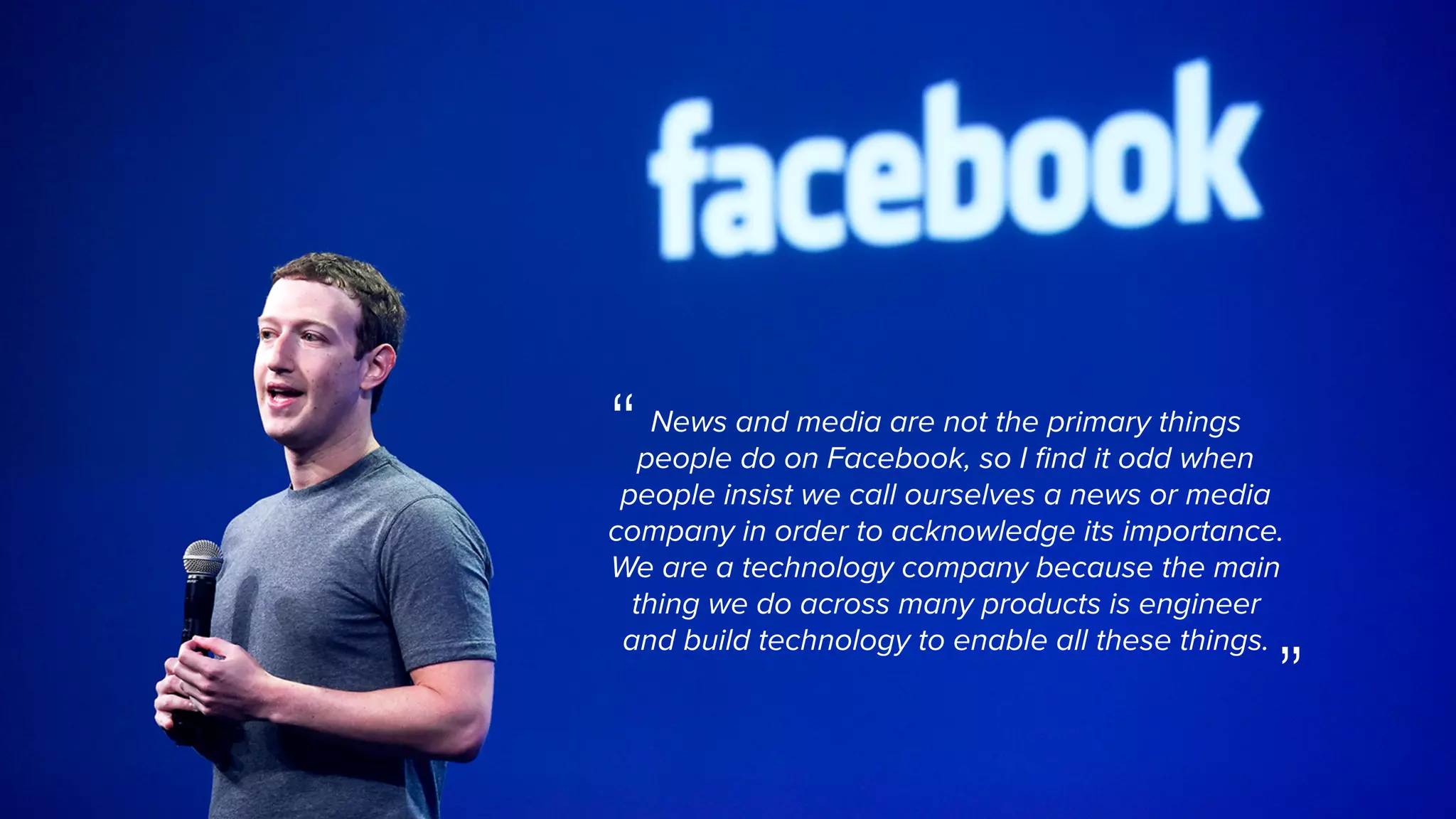
“
”
News and media are not the primary things
people do on Facebook, so I find it odd when
people insist we call ourselves a news or media
company in order to acknowledge its importance.
We are a technology company because the main
thing we do across many products is engineer
and build technology to enable all these things.
“
Are we actually ready to agree that our
News Feed is just a matter of great
technology?
“
”
∼63% of users consume their
news from Facebook
1.
Laboratory of Computational Social Science, Networks Department, IMT Alti Studi Lucca, 55100 Lucca, Italy; bIUSS Institute for Advanced Study, 27100 Pavia, Italy; cISC-CNR Uos “Sapienza,” 00185 Rome, Italy; and dDepartment of Physics, Boston University, Boston, MA 02115
http://www.pnas.org/content/early/2017/02/28/1617052114.full.pdf
”
“Trending topics” features designed to show
you the latest news according to how many
people are posting about a topic on Facebook.
So as far is went viral — you definitely will see it.
2.
Laboratory of Computational Social Science, Networks Department, IMT Alti Studi Lucca, 55100 Lucca, Italy; bIUSS Institute for Advanced Study, 27100 Pavia, Italy; cISC-CNR Uos “Sapienza,” 00185 Rome, Italy; and dDepartment of Physics, Boston University, Boston, MA 02115
http://www.pnas.org/content/early/2017/02/28/1617052114.full.pdf
”
Users, indeed, tend to focus on specific narratives and join
polarised groups (echo chambers) where they end up
reinforcing their worldview and dismissing contradictory
information. They are not open for searching the new
content to compare and analyse.
You look for the ideas [you agree with] and you refuse
any kind of contact with something else.
3.
Laboratory of Computational Social Science, Networks Department, IMT Alti Studi Lucca, 55100 Lucca, Italy; bIUSS Institute for Advanced Study, 27100 Pavia, Italy; cISC-CNR Uos “Sapienza,” 00185 Rome, Italy; and dDepartment of Physics, Boston University, Boston, MA 02115
http://www.pnas.org/content/early/2017/02/28/1617052114.full.pdf
”
Discussion and elaboration of narratives in
such a segregated environment elicits group
polarisation and negatively influences on user
emotion.
4.
Laboratory of Computational Social Science, Networks Department, IMT Alti Studi Lucca, 55100 Lucca, Italy; bIUSS Institute for Advanced Study, 27100 Pavia, Italy; cISC-CNR Uos “Sapienza,” 00185 Rome, Italy; and dDepartment of Physics, Boston University, Boston, MA 02115
http://www.pnas.org/content/early/2017/02/28/1617052114.full.pdf
”
5.
Because users tend to focus on a small number
of pages, the news sphere of Facebook is
clustered and dominated by a precise community
structure and users tend to focus their attention
on a single group of news outlets.
Laboratory of Computational Social Science, Networks Department, IMT Alti Studi Lucca, 55100 Lucca, Italy; bIUSS Institute for Advanced Study, 27100 Pavia, Italy; cISC-CNR Uos “Sapienza,” 00185 Rome, Italy; and dDepartment of Physics, Boston University, Boston, MA 02115
http://www.pnas.org/content/early/2017/02/28/1617052114.full.pdf
”
5.
People have no time to go deep inside
the material and grab only the headlines
to create their own view of the news
agenda.
Laboratory of Computational Social Science, Networks Department, IMT Alti Studi Lucca, 55100 Lucca, Italy; bIUSS Institute for Advanced Study, 27100 Pavia, Italy; cISC-CNR Uos “Sapienza,” 00185 Rome, Italy; and dDepartment of Physics, Boston University, Boston, MA 02115
http://www.pnas.org/content/early/2017/02/28/1617052114.full.pdf
”
“
”
For too many of us, it's become safer to
retreat into our own bubbles, whether in our
neighborhoods or on college campuses, or
places of worship, or especially our social
media feeds, surrounded by people who
look like us and share the same political
outlook and never challenge our
assumptions.
We become so secure in our bubbles that
we start accepting only information,
whether it's true or not, that fits our
opinions, instead of basing our opinions on
the evidence that is out there.
And what about the mass
media? Could they be a light in
the end of this fake tunnel?
MEDIA
Be trustworthy and interactive at the same time
Be “live” and use fast distributing
technologies
Be more visual and tangible
Be more diverse and full of special rubrics
to understand each audience better
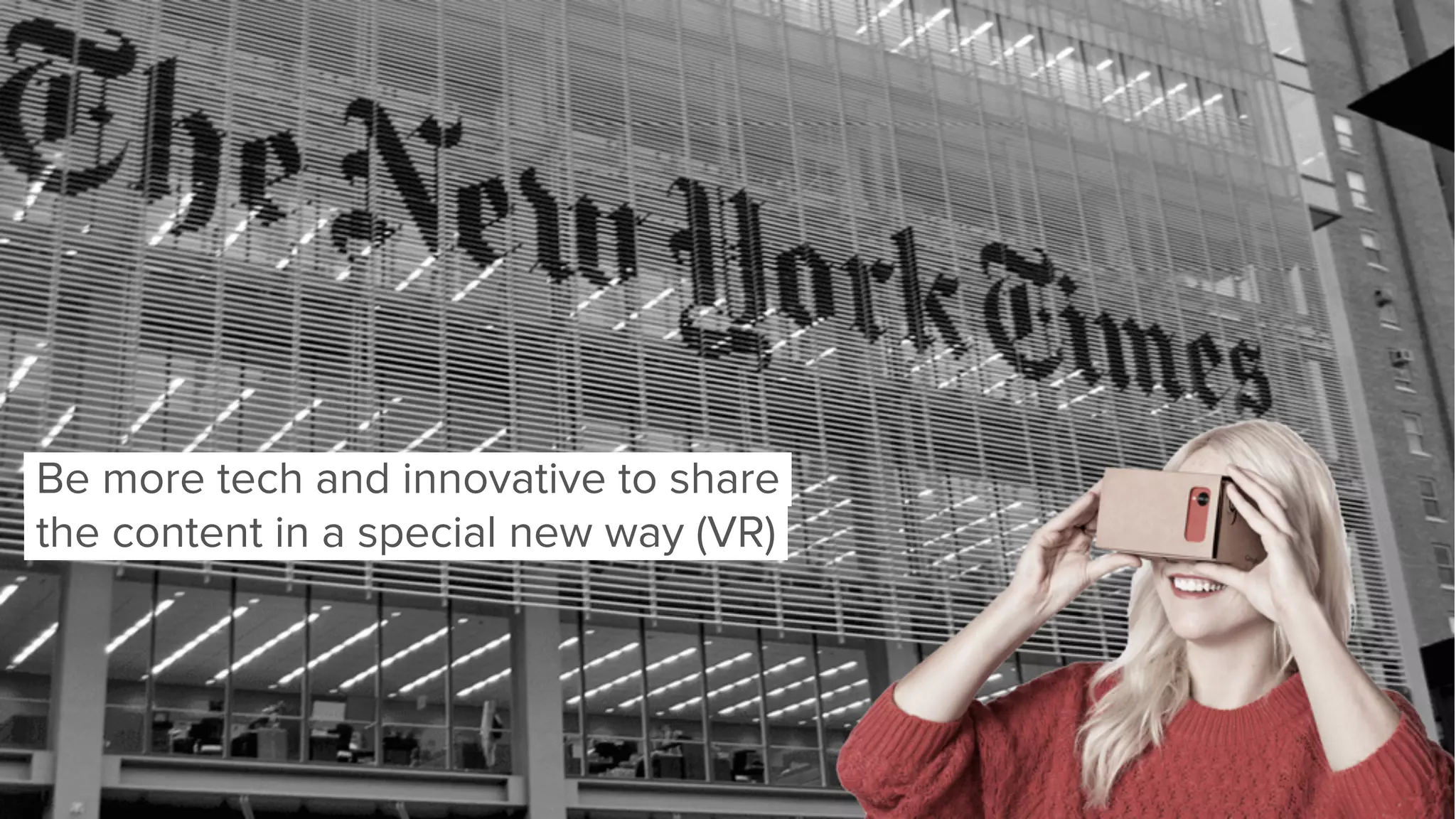
Be more tech and innovative to share
the content in a special new way (VR)
Facebook is a new kind of platform and we want to do our part to
enable people to have meaningful conversations. We know that our
community values sharing and discussing ideas and news, and as a
part of our service, we care a great deal about making sure that a
healthy news ecosystem and journalism can thrive.
“
Facebook rolled out it’s solution to fake news.
What about us?
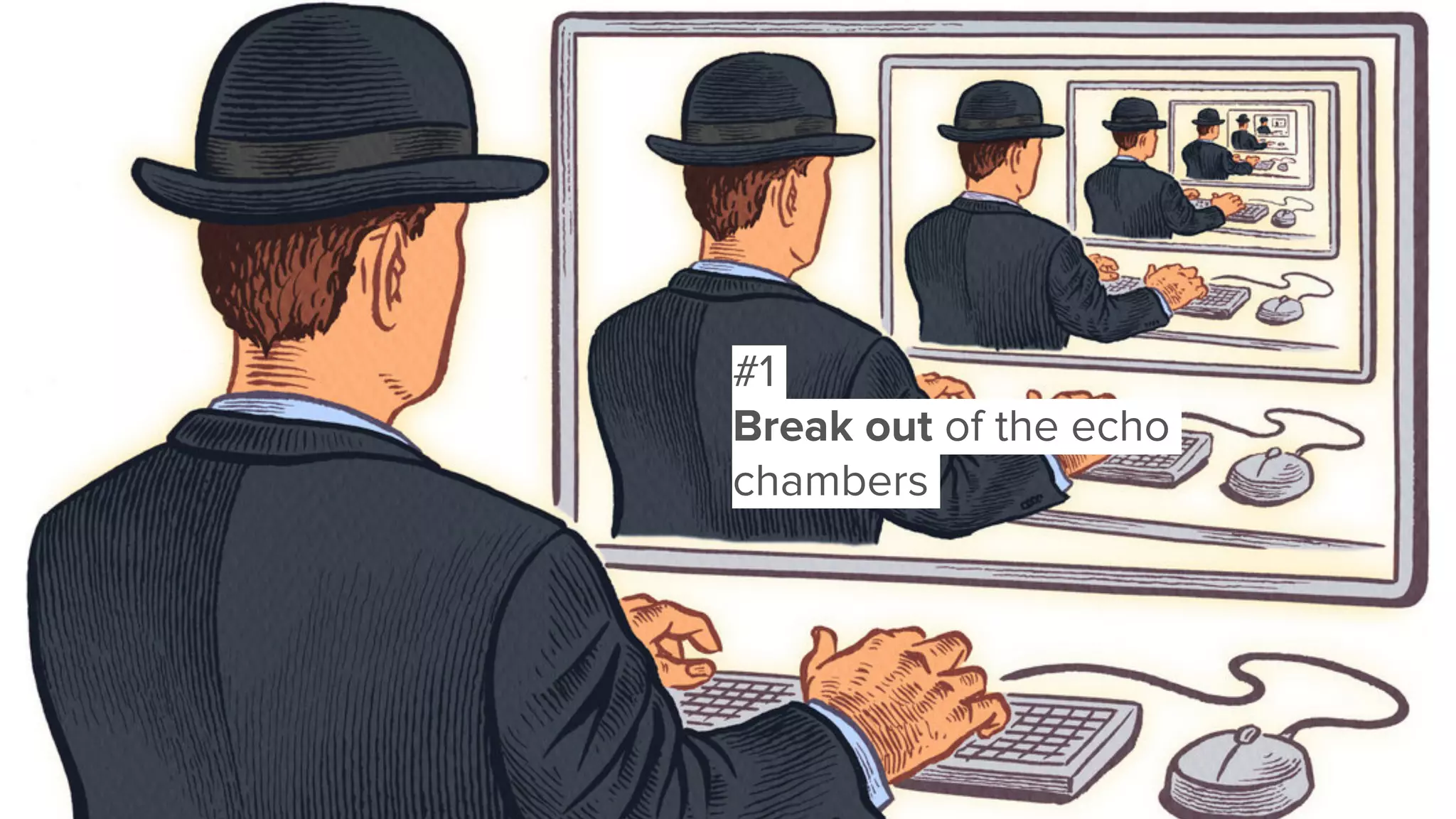
#1
Break out of the echo
chambers
#2
Use ant test echo chambers — invest
less and get more. You have no need
to be everywhere to actually be
everywhere. Because everywhere
doesn’t exist anymore — there is only
social bubbles around.
#3
Explore your audience in a proper
new way. Forgetaboutwomen25-30
with2childrenlovingfashionand
cookingactiveandeasy-going.
Explore the way to find your
consumer in a different echo
chambers.
#4
Help people: make everything real,
tangible and easy checking, look for
the reliable sources for your
message. And again use different
opinion leaders for different bubbles.
#5
Nothing new.
Creative and fast
idea is the genuine
God of everything.
Check the links!
http://cnn.com NEVER http://cnn.com.de
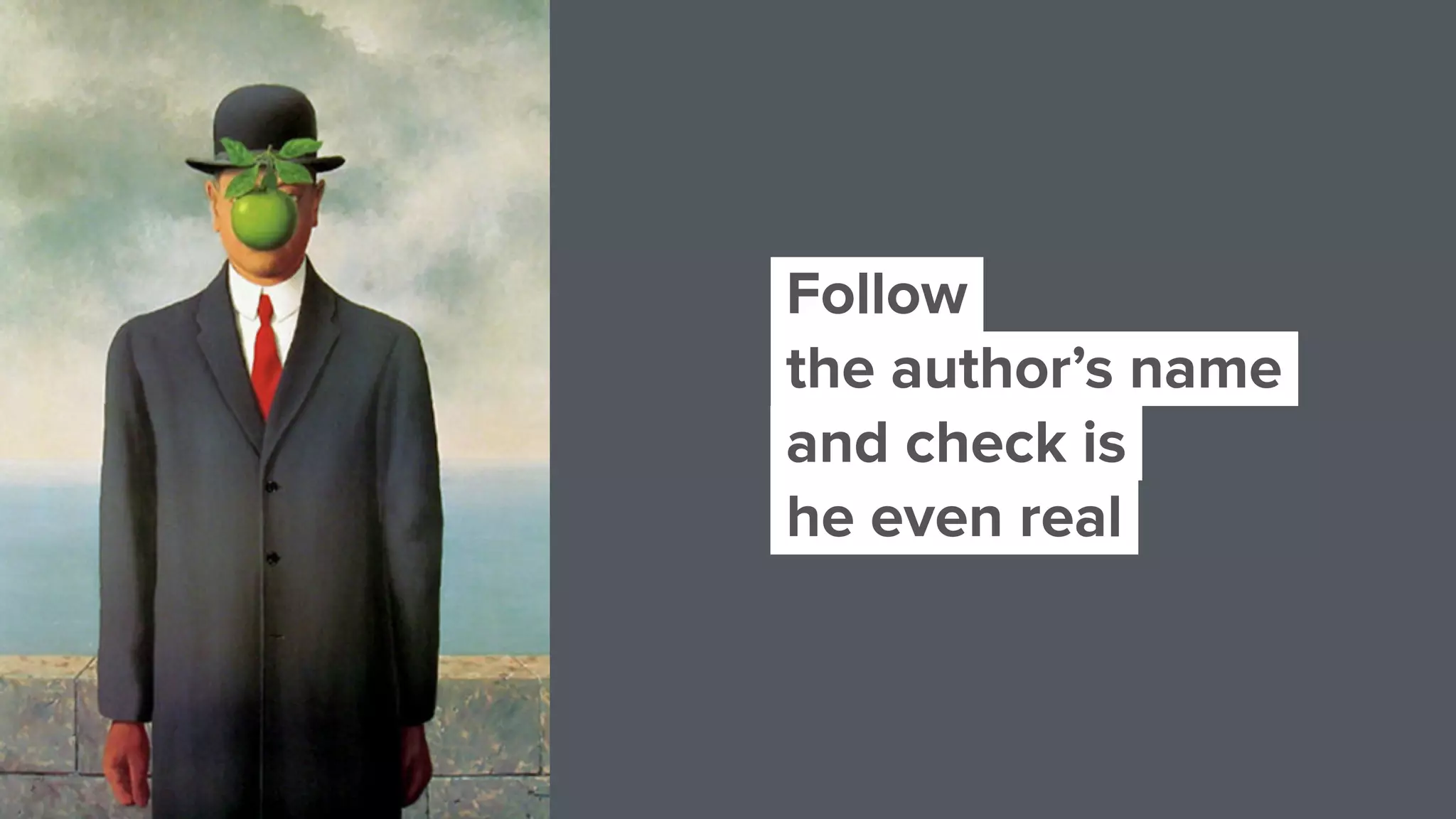
Follow
the author’s name
and check is
he even real
Take new social mission.
We are janitor of hyperreality.
RODNYA 2017
rodnya.moscow
We make creative
ideas newsworthy!
Follow us on Facebook!

How do post-truth and fake-news changed our reality?

  • 1.
  • 2.
    The Washington Post. Facebookfake-news writer: ‘I think Donald Trump is in the White House because of me’.
  • 3.
    Paul Horner — oneof the most influential fake-news writer. The one who misinformed the whole world.
  • 4.
  • 5.
  • 8.
    post-truth trolles & politicalpropagandist. Paul Horner Source Facebook account, fake sites http://abcnews.com.co High level distributors News consumers spread it via Likes/tweets/shares We, people Low level distributors
  • 9.
    Is there anyside effects of putting online everyone in the world? It’s 1.86 billion monthly active Facebook users as of December 31, 2016
  • 10.
    “Facebook cannot claimto be entirely agnostic. If they are going to traffic in journalism and information as part of what they do, there is an obligation to separate truth from lies masquerading as fact”. JOHN AVLON Editor in Chief, the Daily Beast
  • 11.
    “I am verywary of big technology companies becoming censors of what people consume. Do we allow Facebook to designate what is journalism? Are we going to say that the big tech companies today should tell us who we should turn to for news?” VINCE COGLIANESE Editor in Chief, the Daily Caller
  • 12.
    “They have totake responsibility for what they have achieved, which is a system that very efficiently distributes falsehoods and lies to an enormous audience. That’s what they have to live with and it’s kind of irrelevant whether they think they are a media company or not.” JOHN COOK Executive Editor, Gizmodo Media Group
  • 13.
    “ ” News and mediaare not the primary things people do on Facebook, so I find it odd when people insist we call ourselves a news or media company in order to acknowledge its importance. We are a technology company because the main thing we do across many products is engineer and build technology to enable all these things.
  • 14.
    “ Are we actuallyready to agree that our News Feed is just a matter of great technology?
  • 15.
    “ ” ∼63% of usersconsume their news from Facebook 1. Laboratory of Computational Social Science, Networks Department, IMT Alti Studi Lucca, 55100 Lucca, Italy; bIUSS Institute for Advanced Study, 27100 Pavia, Italy; cISC-CNR Uos “Sapienza,” 00185 Rome, Italy; and dDepartment of Physics, Boston University, Boston, MA 02115 http://www.pnas.org/content/early/2017/02/28/1617052114.full.pdf
  • 16.
    ” “Trending topics” featuresdesigned to show you the latest news according to how many people are posting about a topic on Facebook. So as far is went viral — you definitely will see it. 2. Laboratory of Computational Social Science, Networks Department, IMT Alti Studi Lucca, 55100 Lucca, Italy; bIUSS Institute for Advanced Study, 27100 Pavia, Italy; cISC-CNR Uos “Sapienza,” 00185 Rome, Italy; and dDepartment of Physics, Boston University, Boston, MA 02115 http://www.pnas.org/content/early/2017/02/28/1617052114.full.pdf
  • 17.
    ” Users, indeed, tendto focus on specific narratives and join polarised groups (echo chambers) where they end up reinforcing their worldview and dismissing contradictory information. They are not open for searching the new content to compare and analyse. You look for the ideas [you agree with] and you refuse any kind of contact with something else. 3. Laboratory of Computational Social Science, Networks Department, IMT Alti Studi Lucca, 55100 Lucca, Italy; bIUSS Institute for Advanced Study, 27100 Pavia, Italy; cISC-CNR Uos “Sapienza,” 00185 Rome, Italy; and dDepartment of Physics, Boston University, Boston, MA 02115 http://www.pnas.org/content/early/2017/02/28/1617052114.full.pdf
  • 18.
    ” Discussion and elaborationof narratives in such a segregated environment elicits group polarisation and negatively influences on user emotion. 4. Laboratory of Computational Social Science, Networks Department, IMT Alti Studi Lucca, 55100 Lucca, Italy; bIUSS Institute for Advanced Study, 27100 Pavia, Italy; cISC-CNR Uos “Sapienza,” 00185 Rome, Italy; and dDepartment of Physics, Boston University, Boston, MA 02115 http://www.pnas.org/content/early/2017/02/28/1617052114.full.pdf
  • 19.
    ” 5. Because users tendto focus on a small number of pages, the news sphere of Facebook is clustered and dominated by a precise community structure and users tend to focus their attention on a single group of news outlets. Laboratory of Computational Social Science, Networks Department, IMT Alti Studi Lucca, 55100 Lucca, Italy; bIUSS Institute for Advanced Study, 27100 Pavia, Italy; cISC-CNR Uos “Sapienza,” 00185 Rome, Italy; and dDepartment of Physics, Boston University, Boston, MA 02115 http://www.pnas.org/content/early/2017/02/28/1617052114.full.pdf
  • 20.
    ” 5. People have notime to go deep inside the material and grab only the headlines to create their own view of the news agenda. Laboratory of Computational Social Science, Networks Department, IMT Alti Studi Lucca, 55100 Lucca, Italy; bIUSS Institute for Advanced Study, 27100 Pavia, Italy; cISC-CNR Uos “Sapienza,” 00185 Rome, Italy; and dDepartment of Physics, Boston University, Boston, MA 02115 http://www.pnas.org/content/early/2017/02/28/1617052114.full.pdf
  • 23.
    ” “ ” For too manyof us, it's become safer to retreat into our own bubbles, whether in our neighborhoods or on college campuses, or places of worship, or especially our social media feeds, surrounded by people who look like us and share the same political outlook and never challenge our assumptions. We become so secure in our bubbles that we start accepting only information, whether it's true or not, that fits our opinions, instead of basing our opinions on the evidence that is out there.
  • 24.
    And what aboutthe mass media? Could they be a light in the end of this fake tunnel?
  • 25.
  • 26.
    Be trustworthy andinteractive at the same time
  • 27.
    Be “live” anduse fast distributing technologies
  • 28.
    Be more visualand tangible
  • 29.
    Be more diverseand full of special rubrics to understand each audience better
  • 30.
    Be more techand innovative to share the content in a special new way (VR)
  • 31.
    Facebook is anew kind of platform and we want to do our part to enable people to have meaningful conversations. We know that our community values sharing and discussing ideas and news, and as a part of our service, we care a great deal about making sure that a healthy news ecosystem and journalism can thrive. “
  • 32.
    Facebook rolled outit’s solution to fake news.
  • 33.
  • 34.
    #1 Break out ofthe echo chambers
  • 35.
    #2 Use ant testecho chambers — invest less and get more. You have no need to be everywhere to actually be everywhere. Because everywhere doesn’t exist anymore — there is only social bubbles around.
  • 36.
    #3 Explore your audiencein a proper new way. Forgetaboutwomen25-30 with2childrenlovingfashionand cookingactiveandeasy-going. Explore the way to find your consumer in a different echo chambers.
  • 37.
    #4 Help people: makeeverything real, tangible and easy checking, look for the reliable sources for your message. And again use different opinion leaders for different bubbles.
  • 38.
    #5 Nothing new. Creative andfast idea is the genuine God of everything.
  • 39.
    Check the links! http://cnn.comNEVER http://cnn.com.de
  • 40.
    Follow the author’s name andcheck is he even real
  • 41.
    Take new socialmission. We are janitor of hyperreality.
  • 42.
    RODNYA 2017 rodnya.moscow We makecreative ideas newsworthy! Follow us on Facebook!