POWERED BY ZDLC
Cognizant BCBS Solution
2
www.cognizant.com
Copyright © 2014 Cognizant
OVERVIEW OF THE
Cognizant BCBS Solution
By automating the process, the Cognizant BCBS Solution accelerates and increases the precision of providing
compliant data to auditors. This, in turn, reduces risks and costs associated with the compliance process,
diminishing the overhead on banking operations.
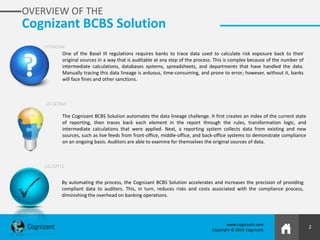
One of the Basel III regulations requires banks to trace data used to calculate risk exposure back to their
original sources in a way that is auditable at any step of the process. This is complex because of the number of
intermediate calculations, databases systems, spreadsheets, and departments that have handled the data.
Manually tracing this data lineage is arduous, time-consuming, and prone to error; however, without it, banks
will face fines and other sanctions.
The Cognizant BCBS Solution automates the data lineage challenge. It first creates an index of the current state
of reporting, then traces back each element in the report through the rules, transformation logic, and
intermediate calculations that were applied. Next, a reporting system collects data from existing and new
sources, such as live feeds from front-office, middle-office, and back-office systems to demonstrate compliance
on an ongoing basis. Auditors are able to examine for themselves the original sources of data.
PROBLEM
SOLUTION
BENEFITS
CONTENTS
www.cognizant.com
Copyright © 2014 Cognizant
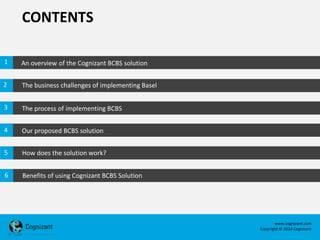
An overview of the Cognizant BCBS solution1
The business challenges of implementing Basel2
The process of implementing BCBS3
Our proposed BCBS solution4
How does the solution work?5
Benefits of using Cognizant BCBS Solution6
4
www.cognizant.com
Copyright © 2014 Cognizant
AN OVERVIEW OF THE
Cognizant BCBS Solution
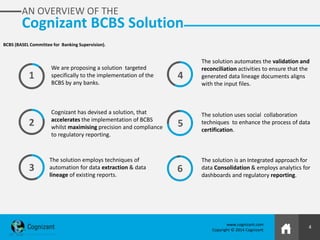
The solution is an Integrated approach for
data Consolidation & employs analytics for
dashboards and regulatory reporting.
We are proposing a solution targeted
specifically to the implementation of the
BCBS by any banks.
Cognizant has devised a solution, that
accelerates the implementation of BCBS
whilst maximising precision and compliance
to regulatory reporting.
The solution employs techniques of
automation for data extraction & data
lineage of existing reports.
The solution uses social collaboration
techniques to enhance the process of data
certification.
1
2
3
4
5
6
BCBS (BASEL Committee for Banking Supervision).
The solution automates the validation and
reconciliation activities to ensure that the
generated data lineage documents aligns
with the input files.
5
www.cognizant.com
Copyright © 2014 Cognizant
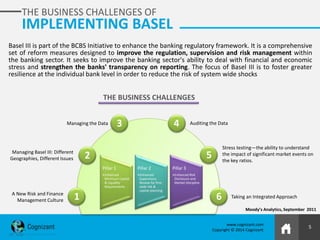
Managing the Data
Taking an Integrated Approach
A New Risk and Finance
Management Culture
Managing Basel III: Different
Geographies, Different Issues
Auditing the Data
Stress testing—the ability to understand
the impact of significant market events on
the key ratios.
THE BUSINESS CHALLENGES OF
IMPLEMENTING BASEL
1
2
3 4
5
6
Basel III is part of the BCBS Initiative to enhance the banking regulatory framework. It is a comprehensive
set of reform measures designed to improve the regulation, supervision and risk management within
the banking sector. It seeks to improve the banking sector's ability to deal with financial and economic
stress and strengthen the banks' transparency on reporting. The focus of Basel III is to foster greater
resilience at the individual bank level in order to reduce the risk of system wide shocks
THE BUSINESS CHALLENGES
Moody’s Analytics, September 2011
Pillar 1
•Enhanced
Minimum Capital
& Liquidity
Requirements
Pillar 2
•Enhanced
Supervisory
Review for firm
wide risk &
capital planning
Pillar 3
•Enhanced Risk
Disclosure and
Market Discipline
6
www.cognizant.com
Copyright © 2014 Cognizant
THE COMPREHENSIVE
Regulatory Compliance Reporting
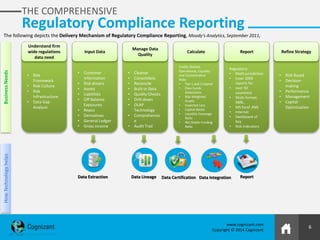
The following depicts the Delivery Mechanism of Regulatory Compliance Reporting, Moody’s Analytics, September 2011,
• Risk
Framework
• Risk Culture
• Risk
Infrastructure
• Data Gap
Analysis
• Customer
information
• Risk drivers
• Assets
• Liabilities
• Off Balance
Exposures
• Repos
• Derivatives
• General Ledger
• Gross income
• Cleanse
• Consolidate
• Reconcile
• Built-in Data
• Quality Checks
• Drill-down
• OLAP
Technology
• Comprehensiv
e
• Audit Trail
Credit, Market,
Operational, Liquidity
and Concentration
Risks
• Tier 1 and 2 Capital
• Own Funds
Deductions
• Risk Weighted
Assets
• Expected Loss
• Capital Ratios
• Liquidity Coverage
Ratio
• Net Stable Funding
Ratio
Regulatory:
• Multi-jurisdiction
• (over 2000
reports for
• over 50
countries)
• Multi-format:
XBRL,
• MS Excel ,XML
• Internal:
• Dashboard of
Key
• Risk Indicators
• Risk Based
• Decision-
making
• Performance
• Management
• Capital
Optimization
Understand firm
wide regulations
data need
Input Data
Manage Data
Quality
Calculate Report Refine Strategy
Data Extraction Data Lineage Data Certification Data Integration Report
HowTechnologyhelpsBusinessNeeds
7
www.cognizant.com
Copyright © 2014 Cognizant
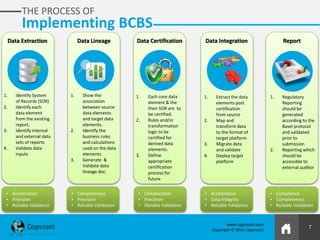
Data Extraction Data Lineage Data Certification Data Integration Report
1. Identify System
of Records (SOR)
2. Identify each
data element
from the existing
report,
3. Identify internal
and external data
sets of reports
4. Validate data
inputs
• Acceleration
• Precision
• Reliable Validation
1. Show the
association
between source
data elements
and target data
elements.
2. Identify the
business rules
and calculations
used on the data
elements
3. Generate &
Validate data
lineage doc.
• Completeness
• Precision
• Reliable Validation
1. Each core data
element & the
their SOR are to
be certified.
2. Rules and/or
transformation
logic to be
certified for
derived data
elements.
3. Define
appropriate
certification
process for
future
• Collaborative
• Precision
• Reliable Validation
1. Extract the data
elements post
certification
from source
2. Map and
transform data
to the format of
target platform
3. Migrate data
and validate
4. Deploy target
platform
• Acceleration
• Data Integrity
• Reliable Validation
1. Regulatory
Reporting
should be
generated
according to the
Basel protocol
and validated
prior to
submission
2. Reporting which
should be
accessible to
external auditor
• Compliance
• Completeness
• Reliable Validation
THE PROCESS OF
Implementing BCBS
8
www.cognizant.com
Copyright © 2014 Cognizant
Data Extraction Data Lineage Data Certification Data Integration Report
• Acceleration
• Precision
• Reliable Validation
• Completeness
• Precision
• Reliable Validation
• Collaborative
• Precision
• Reliable Validation
• Acceleration
• Data Integrity
• Reliable Validation
• Compliance
• Completeness
• Reliable Validation
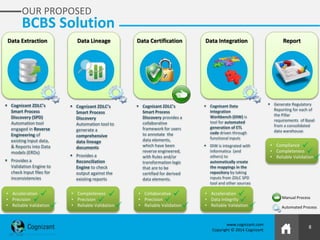
OUR PROPOSED
BCBS Solution

 Cognizant ZDLC’s
Smart Process
Discovery (SPD)
Automation tool
engaged in Reverse
Engineering of
existing Input data,
& Reports into Data
models (ERDs)
 Provides a
Validation Engine to
check Input files for
inconsistencies


 Cognizant ZDLC’s
Smart Process
Discovery
Automation tool to
generate a
comprehensive
data lineage
documents
 Provides a
Reconciliation
Engine to check
output against the
existing reports



 Cognizant ZDLC’s
Smart Process
Discovery provides a
collaborative
framework for users
to annotate the
data elements,
which have been
reverse engineered,
with Rules and/or
transformation logic
that are to be
certified for derived
data elements.



 Cognizant Data
Integration
Workbench (DIW) is
tool for automated
generation of ETL
code driven through
functional inputs
 DIW is integrated with
Informatica (and
others) to
automatically create
the mappings in the
repository by taking
inputs from ZDLC SPD
tool and other sources



 Generate Regulatory
Reporting for each of
the Pillar
requirements of Basel
from a consolidated
data warehouse.



Manual Process
Automated Process
9
www.cognizant.com
Copyright © 2014 Cognizant
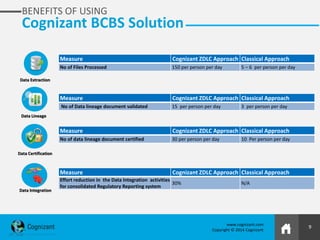
BENEFITS OF USING
Cognizant BCBS Solution
Measure Cognizant ZDLC Approach Classical Approach
No of Files Processed 150 per person per day 5 – 6 per person per day
Measure Cognizant ZDLC Approach Classical Approach
No of Data lineage document validated 15 per person per day 3 per person per day
Measure Cognizant ZDLC Approach Classical Approach
No of data lineage document certified 30 per person per day 10 Per person per day
Measure Cognizant ZDLC Approach Classical Approach
Effort reduction in the Data Integration activities
for consolidated Regulatory Reporting system
30% N/A
Data Extraction
Data Lineage
Data Certification
Data Integration
10
www.cognizant.com
Copyright © 2014 Cognizant
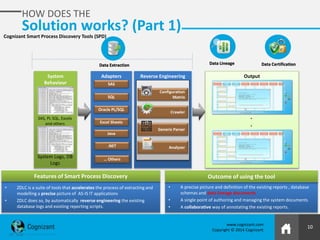
HOW DOES THE
Solution works? (Part 1)
OutputReverse Engineering
Core Module
AdaptersSystem
Behaviour
SQL
Oracle PL/SQL
Excel Sheets
Java
Configuration
Matrix
Crawler
Generic Parser
Analyser
SAS, PL SQL, Excels
and others
System Logs, DB
Logs
.
.
.
• ZDLC is a suite of tools that accelerates the process of extracting and
modelling a precise picture of AS-IS IT applications
• ZDLC does so, by automatically reverse engineering the existing
database logs and existing reporting scripts.
• A precise picture and definition of the existing reports , database
schemas and data lineage documents
• A single point of authoring and managing the system documents
• A collaborative way of annotating the existing reports.
Features of Smart Process Discovery Outcome of using the tool
SAS
… Others
.NET
Cognizant Smart Process Discovery Tools (SPD)
Data Extraction Data Lineage Data Certification
11
www.cognizant.com
Copyright © 2014 Cognizant
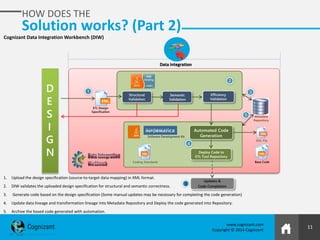
HOW DOES THE
Solution works? (Part 2)
Cognizant Data Integration Workbench (DIW)
XML
Binding
<xml>
Structural
Validation
Semantic
Validation
Efficiency
Validation
Software Development Kit
Automated Code
Generation
Deploy Code to
ETL Tool Repository
Updates &
Code Completion
D
E
S
I
G
N
ETL Design
Specification
Coding Standards
Metadata
Repository
Base Code
1
2
3
4
5
9
DDL File
DDL
1. Upload the design specification (source-to-target data mapping) in XML format.
2. DIW validates the uploaded design specification for structural and semantic correctness.
3. Generate code based on the design specification (Some manual updates may be necessary for completing the code generation)
4. Update data lineage and transformation lineage into Metadata Repository and Deploy the code generated into Repository.
5. Archive the based code generated with automation.
Data Integration

How Cognizant's ZDLC solution is helping Data Lineage for compliance to Basel III

  • 1.
  • 2.
    2 www.cognizant.com Copyright © 2014Cognizant OVERVIEW OF THE Cognizant BCBS Solution By automating the process, the Cognizant BCBS Solution accelerates and increases the precision of providing compliant data to auditors. This, in turn, reduces risks and costs associated with the compliance process, diminishing the overhead on banking operations. One of the Basel III regulations requires banks to trace data used to calculate risk exposure back to their original sources in a way that is auditable at any step of the process. This is complex because of the number of intermediate calculations, databases systems, spreadsheets, and departments that have handled the data. Manually tracing this data lineage is arduous, time-consuming, and prone to error; however, without it, banks will face fines and other sanctions. The Cognizant BCBS Solution automates the data lineage challenge. It first creates an index of the current state of reporting, then traces back each element in the report through the rules, transformation logic, and intermediate calculations that were applied. Next, a reporting system collects data from existing and new sources, such as live feeds from front-office, middle-office, and back-office systems to demonstrate compliance on an ongoing basis. Auditors are able to examine for themselves the original sources of data. PROBLEM SOLUTION BENEFITS
  • 3.
    CONTENTS www.cognizant.com Copyright © 2014Cognizant An overview of the Cognizant BCBS solution1 The business challenges of implementing Basel2 The process of implementing BCBS3 Our proposed BCBS solution4 How does the solution work?5 Benefits of using Cognizant BCBS Solution6
  • 4.
    4 www.cognizant.com Copyright © 2014Cognizant AN OVERVIEW OF THE Cognizant BCBS Solution The solution is an Integrated approach for data Consolidation & employs analytics for dashboards and regulatory reporting. We are proposing a solution targeted specifically to the implementation of the BCBS by any banks. Cognizant has devised a solution, that accelerates the implementation of BCBS whilst maximising precision and compliance to regulatory reporting. The solution employs techniques of automation for data extraction & data lineage of existing reports. The solution uses social collaboration techniques to enhance the process of data certification. 1 2 3 4 5 6 BCBS (BASEL Committee for Banking Supervision). The solution automates the validation and reconciliation activities to ensure that the generated data lineage documents aligns with the input files.
  • 5.
    5 www.cognizant.com Copyright © 2014Cognizant Managing the Data Taking an Integrated Approach A New Risk and Finance Management Culture Managing Basel III: Different Geographies, Different Issues Auditing the Data Stress testing—the ability to understand the impact of significant market events on the key ratios. THE BUSINESS CHALLENGES OF IMPLEMENTING BASEL 1 2 3 4 5 6 Basel III is part of the BCBS Initiative to enhance the banking regulatory framework. It is a comprehensive set of reform measures designed to improve the regulation, supervision and risk management within the banking sector. It seeks to improve the banking sector's ability to deal with financial and economic stress and strengthen the banks' transparency on reporting. The focus of Basel III is to foster greater resilience at the individual bank level in order to reduce the risk of system wide shocks THE BUSINESS CHALLENGES Moody’s Analytics, September 2011 Pillar 1 •Enhanced Minimum Capital & Liquidity Requirements Pillar 2 •Enhanced Supervisory Review for firm wide risk & capital planning Pillar 3 •Enhanced Risk Disclosure and Market Discipline
  • 6.
    6 www.cognizant.com Copyright © 2014Cognizant THE COMPREHENSIVE Regulatory Compliance Reporting The following depicts the Delivery Mechanism of Regulatory Compliance Reporting, Moody’s Analytics, September 2011, • Risk Framework • Risk Culture • Risk Infrastructure • Data Gap Analysis • Customer information • Risk drivers • Assets • Liabilities • Off Balance Exposures • Repos • Derivatives • General Ledger • Gross income • Cleanse • Consolidate • Reconcile • Built-in Data • Quality Checks • Drill-down • OLAP Technology • Comprehensiv e • Audit Trail Credit, Market, Operational, Liquidity and Concentration Risks • Tier 1 and 2 Capital • Own Funds Deductions • Risk Weighted Assets • Expected Loss • Capital Ratios • Liquidity Coverage Ratio • Net Stable Funding Ratio Regulatory: • Multi-jurisdiction • (over 2000 reports for • over 50 countries) • Multi-format: XBRL, • MS Excel ,XML • Internal: • Dashboard of Key • Risk Indicators • Risk Based • Decision- making • Performance • Management • Capital Optimization Understand firm wide regulations data need Input Data Manage Data Quality Calculate Report Refine Strategy Data Extraction Data Lineage Data Certification Data Integration Report HowTechnologyhelpsBusinessNeeds
  • 7.
    7 www.cognizant.com Copyright © 2014Cognizant Data Extraction Data Lineage Data Certification Data Integration Report 1. Identify System of Records (SOR) 2. Identify each data element from the existing report, 3. Identify internal and external data sets of reports 4. Validate data inputs • Acceleration • Precision • Reliable Validation 1. Show the association between source data elements and target data elements. 2. Identify the business rules and calculations used on the data elements 3. Generate & Validate data lineage doc. • Completeness • Precision • Reliable Validation 1. Each core data element & the their SOR are to be certified. 2. Rules and/or transformation logic to be certified for derived data elements. 3. Define appropriate certification process for future • Collaborative • Precision • Reliable Validation 1. Extract the data elements post certification from source 2. Map and transform data to the format of target platform 3. Migrate data and validate 4. Deploy target platform • Acceleration • Data Integrity • Reliable Validation 1. Regulatory Reporting should be generated according to the Basel protocol and validated prior to submission 2. Reporting which should be accessible to external auditor • Compliance • Completeness • Reliable Validation THE PROCESS OF Implementing BCBS
  • 8.
    8 www.cognizant.com Copyright © 2014Cognizant Data Extraction Data Lineage Data Certification Data Integration Report • Acceleration • Precision • Reliable Validation • Completeness • Precision • Reliable Validation • Collaborative • Precision • Reliable Validation • Acceleration • Data Integrity • Reliable Validation • Compliance • Completeness • Reliable Validation OUR PROPOSED BCBS Solution   Cognizant ZDLC’s Smart Process Discovery (SPD) Automation tool engaged in Reverse Engineering of existing Input data, & Reports into Data models (ERDs)  Provides a Validation Engine to check Input files for inconsistencies    Cognizant ZDLC’s Smart Process Discovery Automation tool to generate a comprehensive data lineage documents  Provides a Reconciliation Engine to check output against the existing reports     Cognizant ZDLC’s Smart Process Discovery provides a collaborative framework for users to annotate the data elements, which have been reverse engineered, with Rules and/or transformation logic that are to be certified for derived data elements.     Cognizant Data Integration Workbench (DIW) is tool for automated generation of ETL code driven through functional inputs  DIW is integrated with Informatica (and others) to automatically create the mappings in the repository by taking inputs from ZDLC SPD tool and other sources     Generate Regulatory Reporting for each of the Pillar requirements of Basel from a consolidated data warehouse.    Manual Process Automated Process
  • 9.
    9 www.cognizant.com Copyright © 2014Cognizant BENEFITS OF USING Cognizant BCBS Solution Measure Cognizant ZDLC Approach Classical Approach No of Files Processed 150 per person per day 5 – 6 per person per day Measure Cognizant ZDLC Approach Classical Approach No of Data lineage document validated 15 per person per day 3 per person per day Measure Cognizant ZDLC Approach Classical Approach No of data lineage document certified 30 per person per day 10 Per person per day Measure Cognizant ZDLC Approach Classical Approach Effort reduction in the Data Integration activities for consolidated Regulatory Reporting system 30% N/A Data Extraction Data Lineage Data Certification Data Integration
  • 10.
    10 www.cognizant.com Copyright © 2014Cognizant HOW DOES THE Solution works? (Part 1) OutputReverse Engineering Core Module AdaptersSystem Behaviour SQL Oracle PL/SQL Excel Sheets Java Configuration Matrix Crawler Generic Parser Analyser SAS, PL SQL, Excels and others System Logs, DB Logs . . . • ZDLC is a suite of tools that accelerates the process of extracting and modelling a precise picture of AS-IS IT applications • ZDLC does so, by automatically reverse engineering the existing database logs and existing reporting scripts. • A precise picture and definition of the existing reports , database schemas and data lineage documents • A single point of authoring and managing the system documents • A collaborative way of annotating the existing reports. Features of Smart Process Discovery Outcome of using the tool SAS … Others .NET Cognizant Smart Process Discovery Tools (SPD) Data Extraction Data Lineage Data Certification
  • 11.
    11 www.cognizant.com Copyright © 2014Cognizant HOW DOES THE Solution works? (Part 2) Cognizant Data Integration Workbench (DIW) XML Binding <xml> Structural Validation Semantic Validation Efficiency Validation Software Development Kit Automated Code Generation Deploy Code to ETL Tool Repository Updates & Code Completion D E S I G N ETL Design Specification Coding Standards Metadata Repository Base Code 1 2 3 4 5 9 DDL File DDL 1. Upload the design specification (source-to-target data mapping) in XML format. 2. DIW validates the uploaded design specification for structural and semantic correctness. 3. Generate code based on the design specification (Some manual updates may be necessary for completing the code generation) 4. Update data lineage and transformation lineage into Metadata Repository and Deploy the code generated into Repository. 5. Archive the based code generated with automation. Data Integration