HOUSEHOLD REGISTRATION SYSTEM
CHINA – FRANCE
Tsang Sze Na, Bianca 07019173
Yip Shuk Ching, Kobi 09006281
CHINA – HUKOU SYSTEM
 Fragmented legislations about household
registration system
 “Hukou Registration Ordinance”(戶口登記條例)
 Rural households and urban households
 Get approval from officials before migration
 Differentia in welfare systems and political rights
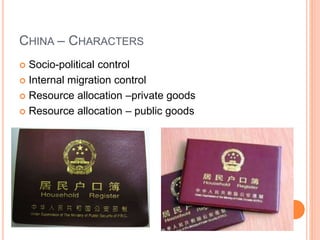
CHINA – CHARACTERS
 Socio-political control
 Internal migration control
 Resource allocation –private goods
 Resource allocation – public goods
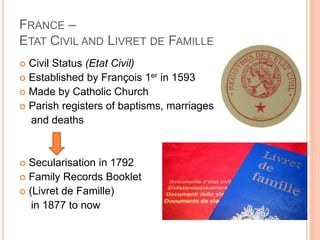
FRANCE –
ETAT CIVIL AND LIVRET DE FAMILLE
 Civil Status (Etat Civil)
 Established by François 1er in 1593
 Made by Catholic Church
 Parish registers of baptisms, marriages
and deaths
 Secularisation in 1792
 Family Records Booklet
 (Livret de Famille)
in 1877 to now
SIMILARITIES
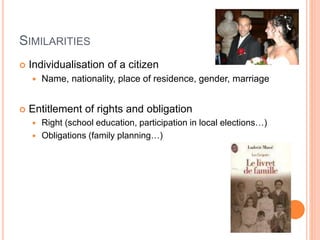
 Individualisation of a citizen
 Name, nationality, place of residence, gender, marriage
 Entitlement of rights and obligation
 Right (school education, participation in local elections…)
 Obligations (family planning…)
SIMILARITIES
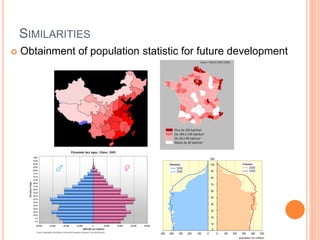
 Obtainment of population statistic for future development
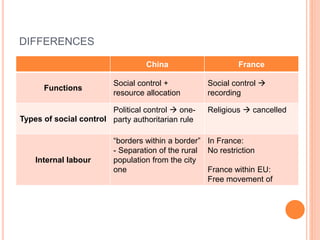
DIFFERENCES
China France
Functions
Social control +
resource allocation
Social control 
recording
Types of social control
Political control  one-
party authoritarian rule
Religious  cancelled
Internal labour
“borders within a border”
- Separation of the rural
population from the city
one
In France:
No restriction
France within EU:
Free movement of
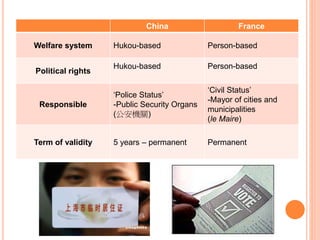
China France
Welfare system Hukou-based Person-based
Political rights
Hukou-based Person-based
Responsible
‘Police Status’
-Public Security Organs
(公安機關)
‘Civil Status’
-Mayor of cities and
municipalities
(le Maire)
Term of validity 5 years – permanent Permanent
CHINESE HOUSEHOLD REGISTRATION SYSTEM
IMPACTS AND DRAWBACKS
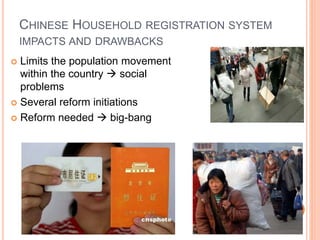
 Limits the population movement
within the country  social
problems
 Several reform initiations
 Reform needed  big-bang
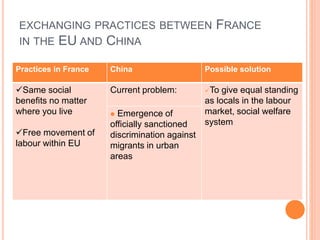
EXCHANGING PRACTICES BETWEEN FRANCE
IN THE EU AND CHINA
Practices in France China Possible solution
Same social
benefits no matter
where you live
Free movement of
labour within EU
Current problem: To give equal standing
as locals in the labour
market, social welfare
system
 Emergence of
officially sanctioned
discrimination against
migrants in urban
areas
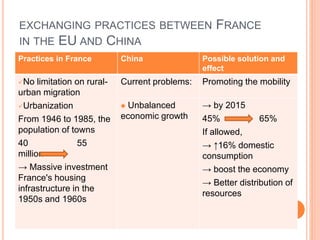
EXCHANGING PRACTICES BETWEEN FRANCE
IN THE EU AND CHINA
Practices in France China Possible solution and
effect
No limitation on rural-
urban migration
Urbanization
From 1946 to 1985, the
population of towns
40 55
million
→ Massive investment
France's housing
infrastructure in the
1950s and 1960s
Current problems: Promoting the mobility
 Unbalanced
economic growth
→ by 2015
45% 65%
If allowed,
→ ↑16% domestic
consumption
→ boost the economy
→ Better distribution of
resources

Household registration system

  • 1.
    HOUSEHOLD REGISTRATION SYSTEM CHINA– FRANCE Tsang Sze Na, Bianca 07019173 Yip Shuk Ching, Kobi 09006281
  • 2.
    CHINA – HUKOUSYSTEM  Fragmented legislations about household registration system  “Hukou Registration Ordinance”(戶口登記條例)  Rural households and urban households  Get approval from officials before migration  Differentia in welfare systems and political rights
  • 3.
    CHINA – CHARACTERS Socio-political control  Internal migration control  Resource allocation –private goods  Resource allocation – public goods
  • 4.
    FRANCE – ETAT CIVILAND LIVRET DE FAMILLE  Civil Status (Etat Civil)  Established by François 1er in 1593  Made by Catholic Church  Parish registers of baptisms, marriages and deaths  Secularisation in 1792  Family Records Booklet  (Livret de Famille) in 1877 to now
  • 5.
    SIMILARITIES  Individualisation ofa citizen  Name, nationality, place of residence, gender, marriage  Entitlement of rights and obligation  Right (school education, participation in local elections…)  Obligations (family planning…)
  • 6.
    SIMILARITIES  Obtainment ofpopulation statistic for future development
  • 7.
    DIFFERENCES China France Functions Social control+ resource allocation Social control  recording Types of social control Political control  one- party authoritarian rule Religious  cancelled Internal labour “borders within a border” - Separation of the rural population from the city one In France: No restriction France within EU: Free movement of
  • 8.
    China France Welfare systemHukou-based Person-based Political rights Hukou-based Person-based Responsible ‘Police Status’ -Public Security Organs (公安機關) ‘Civil Status’ -Mayor of cities and municipalities (le Maire) Term of validity 5 years – permanent Permanent
  • 9.
    CHINESE HOUSEHOLD REGISTRATIONSYSTEM IMPACTS AND DRAWBACKS  Limits the population movement within the country  social problems  Several reform initiations  Reform needed  big-bang
  • 10.
    EXCHANGING PRACTICES BETWEENFRANCE IN THE EU AND CHINA Practices in France China Possible solution Same social benefits no matter where you live Free movement of labour within EU Current problem: To give equal standing as locals in the labour market, social welfare system  Emergence of officially sanctioned discrimination against migrants in urban areas
  • 11.
    EXCHANGING PRACTICES BETWEENFRANCE IN THE EU AND CHINA Practices in France China Possible solution and effect No limitation on rural- urban migration Urbanization From 1946 to 1985, the population of towns 40 55 million → Massive investment France's housing infrastructure in the 1950s and 1960s Current problems: Promoting the mobility  Unbalanced economic growth → by 2015 45% 65% If allowed, → ↑16% domestic consumption → boost the economy → Better distribution of resources