








Honeywords:
Detectable Password
Theft
Gavin Holt
Abertay University
whoami
Gavin Holt (@GavinHolt)
Fourth Year Honours Student at Abertay University
One of the organisers of Securi-Tay 3
Vice President of Abertay Ethical Hacking Society (@AbertayHackers)
What are we covering today?
Why is password theft so dangerous?
How are passwords currently being stored? (The good, the bad and the plain
stupid)
What are Honeywords?
How Honeywords can be implemented
The benefits of Honeywords
What Honeywords won’t save you from
Summary
Questions
Why is password theft so
dangerous?
Obvious Answer:
Because then someone has your
password
Less Obvious Answer:
Because then someone has your
password…for everything
60%+ of users use the same
password across multiple sites
(PayPal Report)
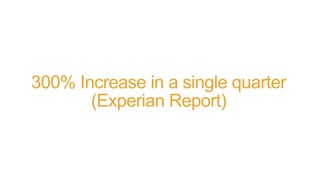
300% Increase in a single quarter
(Experian Report)
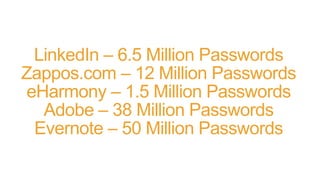
LinkedIn – 6.5 Million Passwords
Zappos.com – 12 Million Passwords
eHarmony – 1.5 Million Passwords
Adobe – 38 Million Passwords
Evernote – 50 Million Passwords
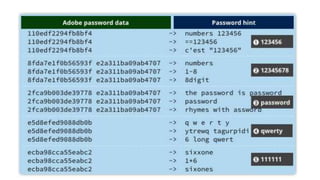
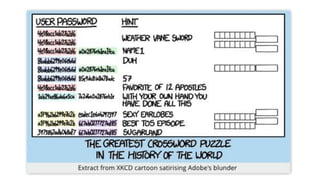
But when you analyse a dump, you
have to wonder why you bother…
A lot of usernames and passwords
out there.
But Gavin, People don’t store
passwords in the plain anymore,
right?
http://plaintextoffenders.com/
Oh okay, but the big guys are doing
it right?
LinkedIn’s 6.5 Million Passwords
were unsalted.
Even if they salt the passwords, they
aren’t always per user salts.
Salting doesn’t stop a targeted
attack
Password Cracking is getting faster!
Making the Hashing more complex
and resource intensive is only part of
the solution.
How do I even know if my password
has been stolen?
You might not!
Some sneaky SysAdmins might put
some fake accounts in.
So if the User “Rory” logs in, they
can assume they have been
compromised.
Pretty useful idea – Honeypot
accounts.
Hackers are sneaky
Can potentially spot these fake
accounts by looking at their activity
and permissions.
So fake user accounts aren’t fool
proof.
But we like the idea of making it a
high-risk guessing game for the
attacker.
Why not have fake Passwords?
Introducing: Honeywords
First discussed by Jules and Rivest
of MIT in May 2013.
If for every user account, we have
multiple passwords, with only one
legit password, can we detect
password theft by watching for our
known entries?
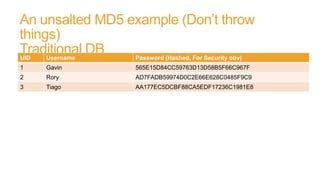
An unsalted MD5 example (Don’t throw
things)
Traditional DBUID Username Password (Hashed, For Security obv)
1 Gavin 565E15D84CC59763D13D58B5F66C967F
2 Rory AD7FADB59974D0C2E66E628C0485F9C9
3 Tiago AA177EC5DCBF88CA5EDF17236C1981E8
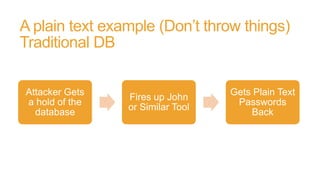
A plain text example (Don’t throw things)
Traditional DB
Attacker Gets
a hold of the
database
Fires up John
or Similar Tool
Gets Plain Text
Passwords
Back
Lets implement Honeywords…
How do we make Honeywords?
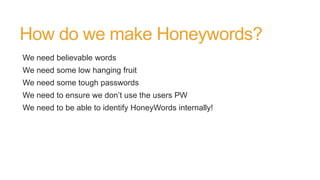
We need believable words
We need some low hanging fruit
We need some tough passwords
We need to ensure we don’t use the users PW
We need to be able to identify HoneyWords internally!
How do we make Honeywords?
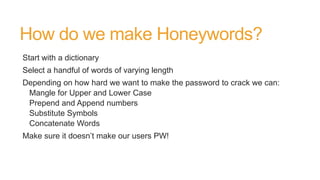
Start with a dictionary
Select a handful of words of varying length
Depending on how hard we want to make the password to crack we can:
Mangle for Upper and Lower Case
Prepend and Append numbers
Substitute Symbols
Concatenate Words
Make sure it doesn’t make our users PW!
How do we make Honeywords?
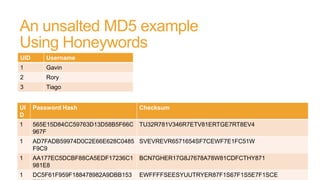
We need to make a correct Checksum for our users password
We also need to make some fake checksums for the honeywords we have
generated
An unsalted MD5 example
Using Honeywords
UID Username
1 Gavin
2 Rory
3 Tiago
UI
D
Password Hash Checksum
1 565E15D84CC59763D13D58B5F66C
967F
TU32R781V346R7ETV81ERTGE7RT8EV4
1 AD7FADB59974D0C2E66E628C0485
F9C9
SVEVREVR6571654SF7CEWF7E1FC51W
1 AA177EC5DCBF88CA5EDF17236C1
981E8
BCN7GHER17G8J7678A78W81CDFCTHY871
1 DC5F61F959F188478982A9DBB153 EWFFFFSEESYUUTRYER87F1S67F1S5E7F1SCE
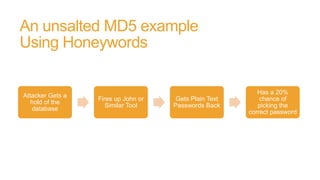
An unsalted MD5 example
Using Honeywords
Attacker Gets a
hold of the
database
Fires up John or
Similar Tool
Gets Plain Text
Passwords Back
Has a 20%
chance of
picking the
correct password
1/5 Chance of getting it right
Can greatly decrease this chance by
adding more Honeywords!
How would I even authenticate
against that?
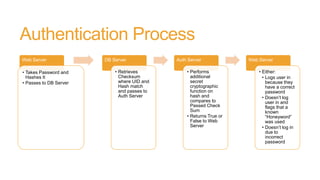
Authentication Process
Web Server
• Takes Password and
Hashes It
• Passes to DB Server
DB Server
• Retrieves
Checksum
where UID and
Hash match
and passes to
Auth Server
Auth Server
• Performs
additional
secret
cryptographic
function on
hash and
compares to
Passed Check
Sum
• Returns True or
False to Web
Server
Web Server
• Either:
• Logs user in
because they
have a correct
password
• Doesn’t log
user in and
flags that a
known
“Honeyword”
was used
• Doesn’t log in
due to
incorrect
password
In order to gain 100% certainty that
they have the correct password,
they attack would need to
compromise all 3 boxes.
So we now know when a password
we have purposely added to the DB
is used.
We can detect password theft!
What else can we do with it?
Time based detection?
Change the fake passwords
periodically to pinpoint when they
were stolen?
Alerting other services that
passwords have been stolen
Central API for Services to use
Pass UIDs of known compromised
accounts to a central service to alert
users across platforms they may be
vulnerable?
The Benefits of Honeywords
The benefits of Honeywords
Can be used to detect password theft
Can be used to prevent the usage of stolen credentials
Can provide warnings to other services that users may reuse passwords on
Can be used to deter attackers from trying to compromise accounts
What Honeywords won’t do
Honeywords won’t stop your service being compromised
If they have your Password file, you have problems to begin with
Honeywords won’t stop the hashes from being cracked
Only per hash salting and intensive hashing functions will slow that down
Honeywords won’t stop attackers from gaining a users password by another
method
Social Engineering, Key Logger, or simply guessing a rubbish password
Honeywords are not a replacement
to a strong password policy and
user awareness
In Summary
Honeywords allow for detectable password theft by seeding a database with
known “wrong” passwords.
Watching for these passwords allows Systems to detect when they have had
their password DB stolen.
Honeywords should be of varying difficulty in order to disguise themselves
Honeywords are not a replacement for:
A strong password policy
A strong password storage mechanism
End Point Security
Any Questions?
Tweet me @GavinHolt later if you
think of any

Honeywords - BSides London 2014

  • 1.
  • 2.
    whoami Gavin Holt (@GavinHolt) FourthYear Honours Student at Abertay University One of the organisers of Securi-Tay 3 Vice President of Abertay Ethical Hacking Society (@AbertayHackers)
  • 3.
    What are wecovering today? Why is password theft so dangerous? How are passwords currently being stored? (The good, the bad and the plain stupid) What are Honeywords? How Honeywords can be implemented The benefits of Honeywords What Honeywords won’t save you from Summary Questions
  • 4.
    Why is passwordtheft so dangerous?
  • 5.
    Obvious Answer: Because thensomeone has your password
  • 6.
    Less Obvious Answer: Becausethen someone has your password…for everything
  • 7.
    60%+ of usersuse the same password across multiple sites (PayPal Report)
  • 8.
    300% Increase ina single quarter (Experian Report)
  • 9.
    LinkedIn – 6.5Million Passwords Zappos.com – 12 Million Passwords eHarmony – 1.5 Million Passwords Adobe – 38 Million Passwords Evernote – 50 Million Passwords
  • 10.
    But when youanalyse a dump, you have to wonder why you bother…
  • 13.
    A lot ofusernames and passwords out there.
  • 14.
    But Gavin, Peopledon’t store passwords in the plain anymore, right?
  • 15.
  • 16.
    Oh okay, butthe big guys are doing it right?
  • 17.
    LinkedIn’s 6.5 MillionPasswords were unsalted.
  • 18.
    Even if theysalt the passwords, they aren’t always per user salts.
  • 19.
    Salting doesn’t stopa targeted attack
  • 20.
    Password Cracking isgetting faster!
  • 21.
    Making the Hashingmore complex and resource intensive is only part of the solution.
  • 22.
    How do Ieven know if my password has been stolen?
  • 23.
  • 24.
    Some sneaky SysAdminsmight put some fake accounts in.
  • 25.
    So if theUser “Rory” logs in, they can assume they have been compromised.
  • 26.
    Pretty useful idea– Honeypot accounts.
  • 27.
  • 28.
    Can potentially spotthese fake accounts by looking at their activity and permissions.
  • 29.
    So fake useraccounts aren’t fool proof.
  • 30.
    But we likethe idea of making it a high-risk guessing game for the attacker.
  • 31.
    Why not havefake Passwords?
  • 32.
  • 33.
    First discussed byJules and Rivest of MIT in May 2013.
  • 34.
    If for everyuser account, we have multiple passwords, with only one legit password, can we detect password theft by watching for our known entries?
  • 35.
    An unsalted MD5example (Don’t throw things) Traditional DBUID Username Password (Hashed, For Security obv) 1 Gavin 565E15D84CC59763D13D58B5F66C967F 2 Rory AD7FADB59974D0C2E66E628C0485F9C9 3 Tiago AA177EC5DCBF88CA5EDF17236C1981E8
  • 36.
    A plain textexample (Don’t throw things) Traditional DB Attacker Gets a hold of the database Fires up John or Similar Tool Gets Plain Text Passwords Back
  • 37.
  • 38.
    How do wemake Honeywords?
  • 39.
    How do wemake Honeywords? We need believable words We need some low hanging fruit We need some tough passwords We need to ensure we don’t use the users PW We need to be able to identify HoneyWords internally!
  • 40.
    How do wemake Honeywords? Start with a dictionary Select a handful of words of varying length Depending on how hard we want to make the password to crack we can: Mangle for Upper and Lower Case Prepend and Append numbers Substitute Symbols Concatenate Words Make sure it doesn’t make our users PW!
  • 41.
    How do wemake Honeywords? We need to make a correct Checksum for our users password We also need to make some fake checksums for the honeywords we have generated
  • 42.
    An unsalted MD5example Using Honeywords UID Username 1 Gavin 2 Rory 3 Tiago UI D Password Hash Checksum 1 565E15D84CC59763D13D58B5F66C 967F TU32R781V346R7ETV81ERTGE7RT8EV4 1 AD7FADB59974D0C2E66E628C0485 F9C9 SVEVREVR6571654SF7CEWF7E1FC51W 1 AA177EC5DCBF88CA5EDF17236C1 981E8 BCN7GHER17G8J7678A78W81CDFCTHY871 1 DC5F61F959F188478982A9DBB153 EWFFFFSEESYUUTRYER87F1S67F1S5E7F1SCE
  • 43.
    An unsalted MD5example Using Honeywords Attacker Gets a hold of the database Fires up John or Similar Tool Gets Plain Text Passwords Back Has a 20% chance of picking the correct password
  • 44.
    1/5 Chance ofgetting it right
  • 45.
    Can greatly decreasethis chance by adding more Honeywords!
  • 46.
    How would Ieven authenticate against that?
  • 47.
    Authentication Process Web Server •Takes Password and Hashes It • Passes to DB Server DB Server • Retrieves Checksum where UID and Hash match and passes to Auth Server Auth Server • Performs additional secret cryptographic function on hash and compares to Passed Check Sum • Returns True or False to Web Server Web Server • Either: • Logs user in because they have a correct password • Doesn’t log user in and flags that a known “Honeyword” was used • Doesn’t log in due to incorrect password
  • 48.
    In order togain 100% certainty that they have the correct password, they attack would need to compromise all 3 boxes.
  • 49.
    So we nowknow when a password we have purposely added to the DB is used.
  • 50.
    We can detectpassword theft!
  • 51.
    What else canwe do with it?
  • 52.
  • 53.
    Change the fakepasswords periodically to pinpoint when they were stolen?
  • 54.
    Alerting other servicesthat passwords have been stolen
  • 55.
    Central API forServices to use
  • 56.
    Pass UIDs ofknown compromised accounts to a central service to alert users across platforms they may be vulnerable?
  • 57.
    The Benefits ofHoneywords
  • 58.
    The benefits ofHoneywords Can be used to detect password theft Can be used to prevent the usage of stolen credentials Can provide warnings to other services that users may reuse passwords on Can be used to deter attackers from trying to compromise accounts
  • 59.
  • 60.
    What Honeywords won’tdo Honeywords won’t stop your service being compromised If they have your Password file, you have problems to begin with Honeywords won’t stop the hashes from being cracked Only per hash salting and intensive hashing functions will slow that down Honeywords won’t stop attackers from gaining a users password by another method Social Engineering, Key Logger, or simply guessing a rubbish password
  • 61.
    Honeywords are nota replacement to a strong password policy and user awareness
  • 62.
    In Summary Honeywords allowfor detectable password theft by seeding a database with known “wrong” passwords. Watching for these passwords allows Systems to detect when they have had their password DB stolen. Honeywords should be of varying difficulty in order to disguise themselves Honeywords are not a replacement for: A strong password policy A strong password storage mechanism End Point Security
  • 63.
    Any Questions? Tweet me@GavinHolt later if you think of any