HOMEOSTASIS
Teacher Angel
What is Homeostasis?
HOMEOSTASIS
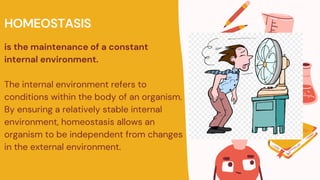
is the maintenance of a constant
internal environment.
The internal environment refers to
conditions within the body of an organism.
By ensuring a relatively stable internal
environment, homeostasis allows an
organism to be independent from changes
in the external environment.
One of the reasons is because the
enzymes in your body can oly work
within a certain range of
temperatures. Changes in body
temperature may result in enzyme
inactivation or even danaturation. This
explains why people suffering from
high fever must consult a doctor, as
high fevers can be fatal.
Why does body temperature
have to be kept constant?
EXAMPLE OF
HOMEOSTASIS IN HUMANS
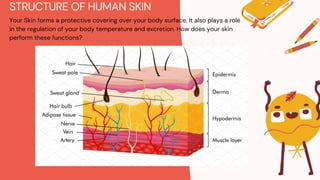
STRUCTURE OF HUMAN SKIN
Your Skin forms a protective covering over your body surface. It also plays a role
in the regulation of your body temperature and excretion. How does your skin
perform these functions?
REGULATING BODY
TEMPERATURE
1.
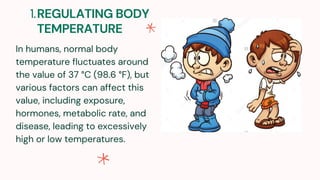
In humans, normal body
temperature fluctuates around
the value of 37 °C (98.6 °F), but
various factors can affect this
value, including exposure,
hormones, metabolic rate, and
disease, leading to excessively
high or low temperatures.
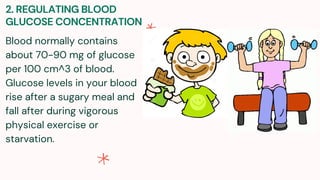
2. REGULATING BLOOD
GLUCOSE CONCENTRATION
Blood normally contains
about 70-90 mg of glucose
per 100 cm^3 of blood.
Glucose levels in your blood
rise after a sugary meal and
fall after during vigorous
physical exercise or
starvation.
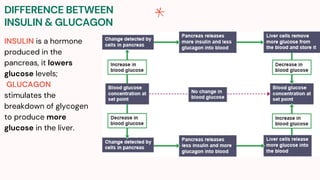
DIFFERENCE BETWEEN
INSULIN & GLUCAGON
INSULIN is a hormone
produced in the
pancreas, it lowers
glucose levels;
GLUCAGON
stimulates the
breakdown of glycogen
to produce more
glucose in the liver.
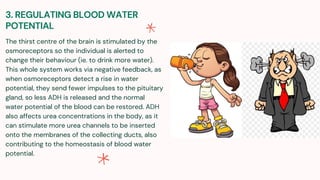
3. REGULATING BLOOD WATER
POTENTIAL
The thirst centre of the brain is stimulated by the
osmoreceptors so the individual is alerted to
change their behaviour (ie. to drink more water).
This whole system works via negative feedback, as
when osmoreceptors detect a rise in water
potential, they send fewer impulses to the pituitary
gland, so less ADH is released and the normal
water potential of the blood can be restored. ADH
also affects urea concentrations in the body, as it
can stimulate more urea channels to be inserted
onto the membranes of the collecting ducts, also
contributing to the homeostasis of blood water
potential.
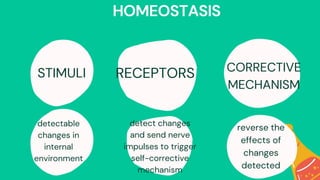
HOMEOSTASIS
STIMULI RECEPTORS CORRECTIVE
MECHANISM
detectable
changes in
internal
environment
detect changes
and send nerve
impulses to trigger
self-corrective
mechanism
reverse the
effects of
changes
detected
Learning Activity # 1
(Individual Performance)
For 1 hour activity, choose a
partner and follow the
instructions provided in the
worksheet: "Negative Feedback
to Regulate Homeostasis"
Then, Answer all the questions
given and submit your paper to
your teacher once your done.
QUIZ #1: HOMEOSTASIS
REVIEW PAGE 246 & 249
(BIOLOGY MATTERS BOOK)
Learning
Activity #2
(Group Performance)
Bring the following Materials:
1/2 ILLUSTRATION BOARD
WATER COLOR
MARKET
PRINTED LABELS OF THE
STRUCTURE OF THE SKIN
GLUE
"THE STRUCTURE OF HUMAN SKIN"
THANK YOU
FOR ATTENDING!

HOMEOSTASIS.pdf

  • 1.
  • 2.
  • 4.
    HOMEOSTASIS is the maintenanceof a constant internal environment. The internal environment refers to conditions within the body of an organism. By ensuring a relatively stable internal environment, homeostasis allows an organism to be independent from changes in the external environment.
  • 5.
    One of thereasons is because the enzymes in your body can oly work within a certain range of temperatures. Changes in body temperature may result in enzyme inactivation or even danaturation. This explains why people suffering from high fever must consult a doctor, as high fevers can be fatal. Why does body temperature have to be kept constant?
  • 6.
  • 7.
    STRUCTURE OF HUMANSKIN Your Skin forms a protective covering over your body surface. It also plays a role in the regulation of your body temperature and excretion. How does your skin perform these functions?
  • 8.
    REGULATING BODY TEMPERATURE 1. In humans,normal body temperature fluctuates around the value of 37 °C (98.6 °F), but various factors can affect this value, including exposure, hormones, metabolic rate, and disease, leading to excessively high or low temperatures.
  • 9.
    2. REGULATING BLOOD GLUCOSECONCENTRATION Blood normally contains about 70-90 mg of glucose per 100 cm^3 of blood. Glucose levels in your blood rise after a sugary meal and fall after during vigorous physical exercise or starvation.
  • 10.
    DIFFERENCE BETWEEN INSULIN &GLUCAGON INSULIN is a hormone produced in the pancreas, it lowers glucose levels; GLUCAGON stimulates the breakdown of glycogen to produce more glucose in the liver.
  • 11.
    3. REGULATING BLOODWATER POTENTIAL The thirst centre of the brain is stimulated by the osmoreceptors so the individual is alerted to change their behaviour (ie. to drink more water). This whole system works via negative feedback, as when osmoreceptors detect a rise in water potential, they send fewer impulses to the pituitary gland, so less ADH is released and the normal water potential of the blood can be restored. ADH also affects urea concentrations in the body, as it can stimulate more urea channels to be inserted onto the membranes of the collecting ducts, also contributing to the homeostasis of blood water potential.
  • 12.
    HOMEOSTASIS STIMULI RECEPTORS CORRECTIVE MECHANISM detectable changesin internal environment detect changes and send nerve impulses to trigger self-corrective mechanism reverse the effects of changes detected
  • 13.
    Learning Activity #1 (Individual Performance) For 1 hour activity, choose a partner and follow the instructions provided in the worksheet: "Negative Feedback to Regulate Homeostasis" Then, Answer all the questions given and submit your paper to your teacher once your done.
  • 14.
    QUIZ #1: HOMEOSTASIS REVIEWPAGE 246 & 249 (BIOLOGY MATTERS BOOK)
  • 15.
    Learning Activity #2 (Group Performance) Bringthe following Materials: 1/2 ILLUSTRATION BOARD WATER COLOR MARKET PRINTED LABELS OF THE STRUCTURE OF THE SKIN GLUE "THE STRUCTURE OF HUMAN SKIN"
  • 16.