HOLY SPIRIT AND THE TRINITY
EDITED BY GLENN PEASE
First, look at the places in the Bible that refer to all three persons in the trinity
together.
(a) **And Jesus being baptized forthwith came out
of the water : and lo, the heavens were opened to Him ;
and He saw the Spirit of God descending as a dove,
and coming upon Him, and behold a Voice from hea-
ven (the Father) saying: This is my beloved Son in
whom I am well pleased'* (Matth. Ill, 16-17).
(b) **And as He unfolded the book. He found the
place where it was written: The Spirit of the Lord is
upon Me. Wherefore He hath anointed Me to preach
the gospel to the poor. He hath sent Me to heal the con-
trite of heart, to preach deliverance to the captives, and
sight to the blind, to set at liberty them that are bruised,
to preach the acceptable year of the Lord, and the day
of reward'* (Luke IV, 18-19).
(c) **And Jesus coming, spoke to them, saying:
All power is given Me in heaven and on earth; Going,
therefore, teach ye all nations, baptizing them in the
name of the Father, and of the Son, and of the Holy
Ghost" (Matth. XXVIII, 18-19).
(d) **The grace of Our Lord Jesus Christ, and the
charity of God and the communication of the Holy
Spirit be with you all. Amen" (II Cor. XIII, 13).
(e) **And there are three who give testimony in
heaven, the Father, the Word, and the Holy Ghost. And
these three are one** (I John V, 7).
(f) *Tor it is impossible for those who were once
illuminated, have tasted also of the heavenly gift, and
were made partakers of the Holy Ghost, have, more-
over, tasted the good work of God — to be renewed
again to penance, crucifying again to themselves the
Son of God, and making Him a mockery** (Hebrews
VI, 4-6).
(g) Discoursing after the Last Supper, Our Lord
said: **He that loveth Me not, keepeth not My words.
And the word which you have heard is not Mine, but
the Father*s that sent Me. These things have I spoken
to you, abiding with you. But the Paraclete, the Holy
Ghost, whom the Father will send in My name. He will
teach you all things and bring all things to your mind,
whatsoever I shall have said to you'* (John XIV,
24-26).
(h) ". . . how much more shall the blood of Christ, who through the eternal
Spirit offered himself without blemish unto God, cleanse your conscience
from dead works to serve the living God?"
—Hebrews 9:14
"The doctrine of the Trinity is not expressly taught in the Bible; it is the putting together of
truths that are taught. It is clearly taught in the Bible that there is but one God. It is also
clearly taught that there are three Divine Persons -- the Father, the Son, and the Holy Spirit."
CRISWELL
"I copied down some of these passages in the Bible where all three in the Godhead
are named. In the passage of our beginning text, “The grace of the Lord Jesus, the
love of God, the communion of the Holy Spirit, be with you all” [2 Corinthians
13:14]. Now these are passages in the New Testament where all three are named:
Luke 1:35, John 14:26, John 15:26, Galatians 4:6, 1 Peter 1:2, Jude 20 and 21,
Revelation 1:4-6. And then I went through the Book of Ephesians, and in the Book
of Ephesians all three Persons of the Trinity are named in Ephesians 1:17, Ephesians
2:18, Ephesians 3:14 and 16, Ephesians 4:4-7, Ephesians 5:18-20, and Ephesians
6:17, 23. All three of them are named as Paul names them here, “The grace of the
Lord Jesus, and the love of God, and the communion of the Holy Spirit, be with you
all. Amen” [2 Corinthians 13:14]. God reveals Himself in His self-disclosure as a
tripersonality.
Now, in my studying I was overwhelmed by something I had never seen before.
Wherever in the Bible all three of Them are named, where They stand together,
without exception it is for a redemptive blessing. It is in comfort and mercy that
God thus reveals Himself.
Let me by contrast explain what I mean. Sometimes God the Father will reveal
Himself in awesome judgment as He did upon Mount Sinai. In thunder and in
lightning and in darkness God delivers His commandments [Exodus 19:16]: “This
do and live, Disobey and die” [Leviticus 18:5; Deuteronomy 28:15-22]. The
presence of God is so awesome that even the animals that touched the mountain died
[Exodus 19:13], and the people said to Moses, “Let us not hear His voice, lest we
die” [Exodus 20:19]. That’s a revelation of God the Father.
In the Book of Matthew, Jesus says of Himself that “This is a stone, I, a stone of
stumbling to men who cannot believe; and on those whom the stone falls it shall
grind them to powder” [Matthew 21:44]: the Son of God. And in that same Book of
Matthew it speaks of the Holy Spirit: “Every sin shall be forgiven a man; if he
blasphemes the name of God, forgiven”—blaspheme the name of the Son, he can be
forgiven—“but whosoever blasphemes the Holy Spirit there is never forgiveness,
neither in this world nor in the world to come” [Matthew 12:31-32]. It is an
unpardonable sin. When you read in the Bible of each one of the members of the
Godhead individually, sometimes it is awesome in judgment. But whenever the
three are presented as standing together, it is always and without exception in
mercy, and in redemption, and in loving-kindness, and in infinite merciful
forgiveness.
I take just two passages. One will be in the sixty-third chapter of Isaiah. All three
persons of the Godhead are named in Isaiah 63:7-10. Now, you look how he will
speak: “I will mention the loving-kindness of the Lord…according to all that the
Lord hath bestowed upon us, and His great goodness toward us . . . For He said,
Surely they are My people . . . so He was their Savior,” capital “S.” “In all their
affliction He was afflicted, and the Angel of His Presence”—didn’t I say all through
the Bible that Angel appears?—“in all their affliction He was afflicted, and the
Angel of His Presence saved them: in His love and in His pity He redeemed them;
and He bare them, and carried them all the days of old” [Isaiah 63:7-9]. What a
beautiful revelation of God. All three of Them named here.
I choose just one other passage, the three of Them named together always in mercy
and redemption. The first chapter of the Revelation: “John to the seven churches
which are in Asia,” number one, “Grace be unto you, and peace, from Him which is,
and which was, and which is to come”: that’s God. Number two: “And from the
seven Spirits which are before His throne” [Revelation 1:4]—seven, there, is a
number of the fullness and plentitude, the overflowing presence of the Spirit of God.
That’s number two. And number three:
And from Jesus the Christ, who is the faithful witness, the first begotten of the dead,
the Prince of the kings of the earth. Unto Him that loved us, and washed us from
our sins in His own blood, And hath made us kings and priests unto God … to Him
be glory and dominion for ever and ever. Amen.
[Revelation 1:5-6]
Always when the three are presented together, it is in mercy and love and
redemption. That’s the revelation of God in the Bible; always as a tripersonality.
Now the second part of our message. We know God in human experience as a
tripersonality: God the Father transcendent above all, God the Son immanent
through all, and God the Holy Spirit inherent in all. We know God in human
experience as a tri-personality. We know Him that way in conversion, in salvation,
in regeneration. God, the great and holy, beyond and above all of the whole world,
the great holy God; and we, so sinful, a dying creature. How do we approach the
awesome holiness of God, we who are made out of dust and ashes, we who are so
sinful? How do we come into His presence?
We come in the redemptive love and mercy of Jesus our Lord [Ephesians 2:13]. He
bore our sins [1 Peter 2:24], and He washed away the stain in our souls [1
Corinthians 6:11], and we are invited to come boldly to the throne of grace, the
throne of grace, that we might find forgiveness and pardon [Hebrews 4:16], and we
are encouraged thus to come by the moving of the Spirit in our hearts [Romans 8:9].
No one would respond were it not for the moving of the Spirit in our hearts. We
know God and we come to God in human experience as a tripersonality.
Thus do we live before the Lord. We pray to him in a tripersonality, the self-
revelation of God to us. We pray to the Father, “Our Father who art in heaven”
[Matthew 6:9], and we come in the name of Jesus [John 14:13-14]; not in our name
or in our righteousness, but we plead the blood and the forgiveness and the pardon
of our Lord [Hebrews 10:19-22]. And the Holy Spirit moves us. We feel His
presence in our deepest souls. The Holy Spirit of God moves us to call upon the
name of the Lord [Ephesians 6:18; Jude 1:20]. We know God in human experience
as a tripersonality: our Father, and our Savior, and the Spirit of God that moves in
our souls."
DANIEL STEELE
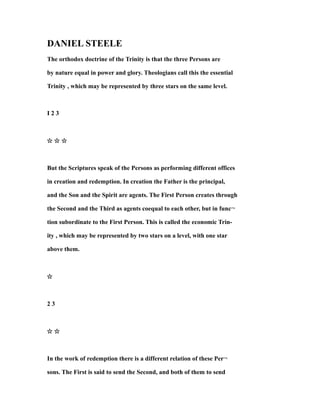
The orthodox doctrine of the Trinity is that the three Persons are
by nature equal in power and glory. Theologians call this the essential
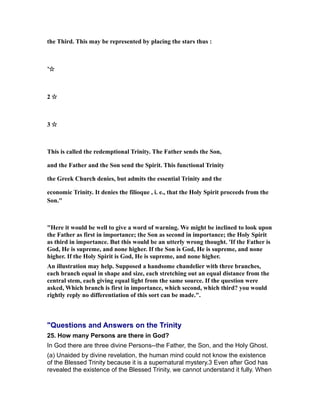
Trinity , which may be represented by three stars on the same level.
I 2 3
☆ ☆ ☆
But the Scriptures speak of the Persons as performing different offices
in creation and redemption. In creation the Father is the principal,
and the Son and the Spirit are agents. The First Person creates through
the Second and the Third as agents coequal to each other, but in func¬
tion subordinate to the First Person. This is called the economic Trin-
ity , which may be represented by two stars on a level, with one star
above them.
☆
2 3
☆ ☆
In the work of redemption there is a different relation of these Per¬
sons. The First is said to send the Second, and both of them to send
the Third. This may be represented by placing the stars thus :
’☆
2 ☆
3 ☆
This is called the redemptional Trinity. The Father sends the Son,
and the Father and the Son send the Spirit. This functional Trinity
the Greek Church denies, but admits the essential Trinity and the
economic Trinity. It denies the filioque , i. e., that the Holy Spirit proceeds from the
Son."
"Here it would be well to give a word of warning. We might be inclined to look upon
the Father as first in importance; the Son as second in importance; the Holy Spirit
as third in importance. But this would be an utterly wrong thought. 'If the Father is
God, He is supreme, and none higher. If the Son is God, He is supreme, and none
higher. If the Holy Spirit is God, He is supreme, and none higher.
An illustration may help. Supposed a handsome chandelier with three branches,
each branch equal in shape and size, each stretching out an equal distance from the
central stem, each giving equal light from the same source. If the question were
asked, Which branch is first in importance, which second, which third? you would
rightly reply no differentiation of this sort can be made.".
"Questions and Answers on the Trinity
25. How many Persons are there in God?
In God there are three divine Persons--the Father, the Son, and the Holy Ghost.
(a) Unaided by divine revelation, the human mind could not know the existence
of the Blessed Trinity because it is a supernatural mystery.3 Even after God has
revealed the existence of the Blessed Trinity, we cannot understand it fully. When
we believe, on the word of God, that there are three Persons in one God, we do
not believe that three Persons are one Person, or that three gods are one God;
this would be a contradiction.
26. Is the Father God?
The Father is God and the first Person of the Blessed Trinity.
(a) The first Person of the Blessed Trinity is called the Father because from all
eternity He begets the second Person, His only-begotten Son.
(b) God the Father is called the first Person not because He is greater or older
than the other two Persons, but because He is unbegotten.
27. Is the Son God?
The Son is God and the second Person of the Blessed Trinity.
(a) The second Person of the Blessed Trinity is called the Son because from all
eternity, He is the only begotten of the Father. Proceeding from the Father, the
Son is called the Divine Word or the Wisdom of the Father.
28. Is the Holy Ghost God?
The Holy Ghost is God and the third Person of the Blessed Trinity.
(a) The third Person of the Blessed Trinity is called the Holy Ghost because from
all eternity He is breathed forth, as it were, by the Father and the Son.
Proceeding from the Father and the Son, He is called the Gift or Love of the
Father and the Son.
(b) The word "Ghost" applied to the third Person means "Spirit."
29. What do we mean by the Blessed Trinity?
By the Blessed Trinity we mean one and the same God in three divine Persons.
30. Are the three divine Persons really distinct from one another?
The three divine Persons are really distinct from one another.
(a) Although the Father, the Son, and the Holy Ghost are distinct Persons, they
are not distinct in nature. The nature of the Father is entirely the nature of the
Son; and the nature of the Father and the Son is entirely the nature of the Holy
Ghost.
31. Are the three divine Persons perfectly equal to one another?
The three divine Persons are perfectly equal to one another, because all are one
and the same God.
(a) No one of the three Persons precedes the others in time or in power, but all
are equally eternal and all-powerful because they have the same divine nature.
32. How are the three divine Persons, though really distinct from one
another, one and the same God?
The three divine Persons, though really distinct from one another, are one and
the same God because all have one and the same divine nature.
(a) Because the three divine Persons have one and the same divine nature, they
have the same perfections and the same external works are produced by them.
But in order that we may better know the three divine Persons, certain
perfections and works are attributed to each Person; for example, omnipotence
and the works of omnipotence, such as creation, to the Father; wisdom and the
works of wisdom, such as enlightenment, to the Son, love and the works of love,
such as sanctification, to the Holy Ghost.
33. Can we fully understand how the three divine Persons, though really
distinct from one another, are one and the same God?
We cannot fully understand how the three divine Persons, though really distinct
from one another, are one and the same God because this is a supernatural
mystery.
34. What is a supernatural mystery?
A supernatural mystery is a truth which we cannot fully understand, but which we
firmly believe because we have God's word for it.
(a) In addition to those truths which can be attained by man's natural reason,
there are certain mysteries hidden in God which we cannot know without divine
revelation, but which we must believe because God has revealed them. Divine
mysteries by their very nature are far above the power of human understanding
and even when revealed and accepted on faith they remain obscure during our
life on earth. To understand these things fully, a finite mind would have to
comprehend the infinite.
(b) In heaven there will be a fuller understanding of these mysteries, but never an
infinite comprehension of them.
It is reasonable to believe supernatural mysteries revealed by God because He
can neither deceive nor be deceived. In our everyday life we believe many things
on the word of human beings even though at times they deceive or are
deceived."
MORGAN
THE RELATION OF THE SPIRIT TO THE TRINITY
The doctrine of the Trinity is one of the declared
facts of Holy Scripture of which no perfect ex-
planation is possible to minds that are finite. The idea
of one Essence subsisting after a threefold manner, and
in a Trinity of relationships, finds nothing in the phe-
nomena of nature upon which it can fasten as a suffi-
cient symbol. There have been many attempts to give
the mind of man an understanding of this mystery by
some such symbol. The mystics attempted, by anal-
ogy, to reconcile the doctrine to human reason. They
made use of such figures as those of the light, the radi-
ance, and the heat of the sun; the fountain, the flux,
and the stream of the river; the root, the stem, and
the flower of the plant; the intellect, the will, and the
feeling of man; or, perhaps most familiar of all, the
human being, consisting of spirit, soul, and body.
They declared that in. all these things, and indeed
throughout nature, there is a perpetual reproduction of
that which is the essence of the Divine Trinity in Unity.
All these illustrations suggest a Trinitarian possi-
bility ; but if employed as final symbols, they only serve
to mystify. They are insufficient, and differ from the
declared facts so radically, that the impression they cre-
ate, as to the great underlying fact of Divinity One
in Three and Three in One is vague and evanescent.
As in the case of the personality of the Spirit, so here;
the things which are evident are faint and incomplete
suggestions of the facts concerning the Infinite. The
Scriptures contain a progressive revelation of the doc-
trine ; but when the last word has been said, there is no
attempt made to explain the mystery. All that they
give is a declaration of the fact, without attempting to
give that which would be incomprehensible, a definition
or explanation that is final.
The first hint of plurality in the unity of the Godhead
is found in the words : 'And God said, Let Us make man
in Our image, after Our likeness. 1 To claim that as a
definite and final statement of the doctrine of Trinity in
Unity would be false. It is the privilege of those who
live in the light of the New Testament to view the Old
Testament therein. All things were made by Him;
and without Him was not anything made that hath been
made* This refers to the work of the Word, the
. i. 26. *Johh i. 3.
eternal Son, in creation. It was by His intermediation
that the worlds were formed in the beginning.
Thus the Bible story of creation reflects the presence
of the three Persons in the Trinity, the Father, as
original Source; the Son, as Intermediary; the Spirit,
as the Medium through which creation came into
being.
The truth is still further developed in the words:
So shall they put My name upon the children of Israel. 2
The emphasis should be laid upon the word so, SO
shall they put My name upon the children of Israel.
The method indicated is to be found in the three pre-
ceding verses.
The Lord bless thee, and keep thee:
The Lord make His face to shine upon thee, and be
gracious unto thee:
The Lord lift up His countenance upon thee, and
give thee peace*
This is the trinity of benediction in unity, My name
in threefold repetition. It is not probable that the
priest of the old dispensation, in pronouncing that bene-
diction, had a clear understanding of the truth of the
Trinity in Unity, but a hint was enshrined therein
which prepared the way for future development. Thus
in the priestly benediction of Numbers, there is an ad-
vance upon the suggestion of Genesis.*
1 Gen. i. i. John i. 3. Gen. i. 2. 2 Num. vi. 27. 8 Num. vi.
24-26. * This priestly benediction of the Old Testament has its
fulfilment in that of the New : The grace of the Lord Jesus Christ r
The messages of the prophets contain suggestions
on the subject: In the year that King Uzsiah died I
saw the Lord sitting upon a throne, high and lifted up,
and His train filled the temple. Around*- Him stood
the seraphim: each one had six wings; with twain he
covered his face, and with twain he covered his feet,
and with twain he did fly. And one cried unto an-
other, and said, Holy, holy, holy, is the Lord of hosts.
Isaiah was permitted to have a vision of the King,
high and lifted up. He heard the doxology of the hid-
den place, the cherubim and seraphim chanting the
praise of the Eternal, and they sang Holy, holy, holy,
is the Lord of hosts, a threefold ascription of praise to
the one Person.
In this prophecy also is to be found perhaps the most
clear statement of the doctrine of the Trinity that the
Old Testament contains : Come ye near unto Me, hear
ye this; from the beginning I have not spoken in secret;
from the time that it was, there am I: and now the Lord
God hath sent Me, and His Spirit. 3 There is an im-
portant alteration in this passage from the Authorized
Version, which reads: The Lord God, and His Spirit,
hath sent Me. The Me here is the coming One of
Whom the prophets wrote and spoke the great De-
liverer, the Messiah, Jesus. The Authorized Version
and the love of God, and the communion of the Holy Spirit, be
with you all. Here also the Trinity is named. 2 Cor. xiii. 14.
1 Around, {not above, as in the English Version) . . .
Dr. G. A. Smith.
s lsa. vi. 1-3. 8 Isa. xlviii. 16
makes it appear as though Christ was sent by God and
the Spirit; but in the Scriptures He is never so spoken
of. This change in the Revised Version is of the
utmost importance; for it contains a prophecy of the
coming of Christ and the dawning of the dispensation
of the Spirit. God hath sent Me, and His Spirit. Here
the Trinity is distinctly revealed, not as a doctrine, but
incidentally in the midst of prophecy. All that the
New Testament unfolds in its beauty is suggested in
this prophecy, uttered centuries before the coming of
the Messiah God sending Son and Spirit.
The New Testament takes up the suggestion of the
Old, making it clear and plain: And Jesus, when He
was baptised, ivent up straightway from the water: and
lo, the heavens were opened unto Him, and He saw the
Spirit of God descending as a dove, and coming upon
Him; and lo, a voice out of the heavens, saying, This is
My beloved Son, in Whom I am well pleased.' 1 The
voice of the Father is heard from the heavens, an-
nouncing His pleasure in the Son, while the anointing
Spirit descends upon Him. This is a manifestation of
the one God in His threefold personality. Thus, at
the outset of Christ's public ministry, the truth of the
Trinity was declared by a solemn manifestation, though
the men around did not then comprehend the deep sig-
nificance of the event.
The Paschal discourses contain the Lord's full teach-
1 Matt. iii. 16, 17.
ing on the subject of the Spirit. This is of sufficient
importance to demand special attention, and a subse-
quent chapter will be devoted to it. 1
One more reference claims attention in this section.
The Master having finished His work on Calvary ; the
Resurrection being accomplished; and the Ascension
imminent; He gave to His disciples the commission
under which they were to serve. In connection with
this, He committed to them the great baptismal for-
mula, which contains the most simple and concise state-
ment of the Trinity that is to be found in the whole of
Scripture : Baptising them into the name of the Father
and of the Son and of the Holy Spirit. 2 The phrase of
the, in each case clearly marks the separation of person-
ality, but the singular number of the name, by which
these are prefaced, marks the unity of the Godhead.
That baptismal formula is the consummation of all pre-
vious suggestion, and the standard of all subsequent
teaching concerning the Trinity.
The declarations of Scripture, then, may be sum-
marized thus : In one essential Godhead there coexist
three Persons, consubstantial, coequal, and coeternal.
This mystery cannot be explained nor defined, because
it is beyond the grasp of the finite ; and no explanation
is attempted in the inspired Book.
Accepting the doctrine of the Trinity, it is now com-
petent most reverently to enquire what Scripture
x john xiv., xv., xvi. *Matt. xxviii. 19.
teaches concerning the relation of the Holy Spirit to the
Trinity.
The Holy Spirit is always spoken of as the third
Person in the Trinity.
In the historical revelation the last personality re-
vealed is that of the Spirit. That of the Father was thv
supreme point in the creation and history of the Jewish
people: The Lord our God is one Lord. 1 Then there
came the revelation of the Son ; and lastly, as the con-
summation of His mission, came the revelation of the
personality of the Spirit.
Again, in the actual facts of the awe-inspiring mys-
tery of the Trinity, the Holy Spirit is not first.
It is distinctly stated that the Spirit is sent; and
Christ declared that the Spirit proceedeth from the
Father? This order can never be reversed. The
Father cannot be spoken of as being sent of the Spirit,
neither can He be said to proceed from the Spirit;
therefore, in a sense hard to understand, but distinctly
announced, the Holy Spirit cannot be the first Person
in this mystery oi the Trinity.
Nor can He be the second Person therein. The
Son is spoken of as sending the Spirit from the
Father, and as Himself sending the Spirit. 3 Within
the realm of Divinity the Son is never said to be
sent by the Spirit. It is said of Jesus that the
Spirit drove Him into the wilderness ; but that was in
1 Deut. vi. 4. 2 Jolin xiv. 26, xv. 26. * John xv. 26, xvi. 7.
His representative capacity as a Man. In His Divinity
He is sent by the Father, for the accomplishment of the
Father's work ; but He is never spoken of as being sent
by the Spirit. Consequently, the Spirit, sent by the Son
is the third Person within the Trinity, in the order in
which these Persons move in the mighty majesty of their
wondrous activities. The great creeds of the Church
have caught up the idea of the Spirit proceeding from
the Father and from the Son. While there is no direct
and positive statement of the kind, still the very argu-
ment of the Lord's own teaching, as recorded in the
Gospel of John, coincides with that expression of the
truth.
The term third must be used with most careful limi-
tations. As used with reference to the Persons in the
Godhead, it does not imply inferiority. Once in the
writings of Paul he reverses the order, and names the
Spirit first : One Spirit, even as also ye zvere called in
one hope of your calling; one Lord, one faith, one bap-
tism, one God and Father of a//. 1 Upon another occa-
sion he changes the order again, and places the Spirit in
the second place : Now I beseech you, brethren, by our
Lord Jesus Christ, and by the love of the Spirit, that ye
strive together with me in your prayers to God for me.*
The word third is not used in the sense of inferiority.
Perhaps that fact will most surely be understood by re-
membering that the term third has here no reference to
*Eph. iv. 4-6. 2 Rom. xv. 30.
time. The time element must be eliminated from all
consideration of Divine things. It is very difficult to
do this. Speaking of the Father, and of the Spirit pro-
ceeding from the Father, unconsciously, but none the
less certainly, the time element enters into the concep-
tion. It may be argued that there can be no procession
save that which has a beginning. If that be true,
neither can there be a Source from which procession is
made, which has no beginning. When dealing with the
things of God, time is not; it finds no place in the
boundless Being of the Eternal. The procession of the
Spirit from the Father is as eternal as is the Father
from Whom the Spirit proceeds.
The relation of the Spirit to the Father is declared in
the words: The Spirit proceedeth from the Father. 1
He is the gift and outmoving of the Divine Essence, the
Eternal Spirit. This defies analysis. It is a truth de-
clared, which remains an impenetrable mystery. Men
have no right to make any attempt to discover that
which is not revealed. It is the simple declaration of
the Word of God, that the Spirit proceedeth from the
Father ; and there the matter must be left.
The relation of the Spirit to the Son is indicated in
the words of Jesus in which He declared that the Son
receives from the Father, and the Spirit therefore pro-
ceedeth through the Son. 2 Professor Swete, in a paper
read before the Church Congress several years ago, in
1 John xv. 26. 'John xiv. 16, xv. 26.
well-chosen words stated, with as much clearness as is
possible, the great mystery of the Spirit's relationship to
the Son. These are his words: The Son is thus the
Intermediary of the self-communication of God. His
mediation in creation and in grace rests ultimately on
His mediation in the mystery of the Holy Trinity. The
mediation in creation, and the mediation in redemption
are based upon the fact, that Scripture declares, that in
an inscrutable manner, in a way that defies definition,
the Son is intermediary between Father and Spirit, in
that great and sublime and magnificent mystery of the
Trinity itself.
Here, again, the fact of limitation of language must
be borne in mind. These statements refer to eternal at-
titudes, and consequently they are dateless.
With great reverence and solemnity the question of
the function of the Holy Spirit within the Trinity may
now be considered.
No such consideration would be possible or proper if
it were not based upon the fact that a statement is made
with regard thereto in Scripture : For who among men
knoweth the things of a man, save the spirit of the man,
which is in him? 1 This is the apostle's analogy. There
immediately follows the statement of a truth of the ut-
most importance: Even so the things of God none
knoweth, save the Spirit of God. These words clearly
reveal the fact within the mystery of the Trinity the
x i Cor. ii. ix.
Spirit is the seat of the Divine consciousness. The
eternal Spirit knows the things of the eternal Godhead :
The Spirit scarcheth . . . the deep things of God. 1
That statement leads to the inner heart of this great
mystery; and from it a most important deduction is
drawn. Seeing that the Spirit of God is the seat of Di-
vine consciousness, He is also the Spirit of revelation.
As it is the Spirit of God Who knows the things of God,
it must of necessity be the Spirit Who unveils and re-
veals those things, as much as is necessary and possible,
to those outside the marvellous and mysterious circle of
the Deity. In that great fact, beyond perfect compre-
hension, lies the secret of the inspiration of Scripture,
and of the presence and work of the Spirit in the Church
and in the world.
If any person should accept this attempt to examine
one of the greatest mysteries of our most holy religion,
feeling that now all is clear, then the attempt has sadly
and awfully failed. This subject must be left where
God has left it a revealed mystery, not the revelation of
a mystery. That is to say, revelation has declared a
mystery; revelation has not given the explanation of
that mystery. The mind of man could never under-
stand, even if the most simple language were used, the
Trinity in the Unity of the Godhead, or the relation of
the Persons in the Godhead to each other. But, so far
as it is necessary and possible for man to see it, things
1 1 Cor. ii. 10.
which eye saw not, and ear heard not, and which entered
not into the heart of man . . . unto us God revealed
them through the Spirit. 1
The statement may thus be made in brief words.
There is one God. There are three Persons within the
Unity. The Holy Spirit is third in position, for ever
proceeding from the Father, through the mediation of
the Son. That Holy Spirit" is the Consciousness of
God, and therefore the Revealer of God.
While these things are too high and too wonderful for
perfect exposition, yet, so far as is necessary for redemp-
tion and life and final perfecting, God has allowed the
light of the glory of the inner facts of His own Being to
fall upon the human mind.
1 x Cor. ii. 9, xo.
John W. Ritenbaugh
Today we are going to take yet another look into a doctrine that I feel clearly shows
the extent that mankind, cut off from God, is willing to go in order to keep from
believing what the Bible literally says. It shows how human nature can persuade us
to be intellectually dishonest through using vague Scriptural statements to override
clear ones, and so on this Pentecost we are going to take a short look at the world's
admission that the basis for the Trinity doctrine is shaky at best, and then we are
going to take a much longer look at what the Bible clearly says that the Holy Spirit
is. But I also have to put a qualifier in here, because we are looking at what can be a
very large subject. This sermon is not going to answer every possible question that
might come up, but I think that it will give you a clear and truthful basis for
understanding what the Holy Spirit is.
Now perhaps you relegated this subject to being one of minor importance, or feel
that it is too complicated for you to grasp, and so you have left it to the ministry and
to the theologians to argue over because it appears to be more bookish and technical
and theoretical than practical and impacting on daily life. But brethren, while it is
something that theologians argue over, if any of you have had any of the other
thoughts, you could not be more wrong. It is not a doctrine of minor importance. It
is not all that complicated. It is very practical and it impacts very much on your
daily life. It is very likely that a person with only a Bible, a decent dictionary, and
perhaps most important of all an honest and open mind, is going to come up with
the correct answers in searching out the Scriptures. First we are going to take a look
at how the world rates this doctrine's importance, and the basic manner used to
reach their conclusions that God is a trinity. I am going to do a bit of reading here,
and I will try to emphasize things that are important.
Quote No. 1 is from The Catholic Encyclopedia, 1912 Edition, Volume 15, page 47,
from the article "The Dogma of the Trinity":
The trinity is the term employed to signify the central doctrine of the
Christian religion...
That tells you the importance that they put on it as being the central doctrine of the
Christian religion. Is that true?
...that in the unity of the Godhead there are three persons: The Father, the
Son, and the Holy Spirit, these three persons being truly distinct one from
another.
This the church teaches is the revelation regarding God's nature which Jesus
Christ, the Son of God, came upon earth to deliver to the world, and which
she [the church] proposes to man [humankind] as the foundation of her [the
church's] whole dogmatic system.
We are not talking about a doctrine here that is minor in any way whenever you are
talking about the central doctrine of the Christian religion which is the nature of
God. What they are saying then is that this doctrine, after the fact that there is God,
is the next most important thing.
Quote No. 2 is from The New Catholic Encyclopedia, 1967 Edition, page 295, article:
"Holy Trinity":
It is difficult in the second half of the twentieth century to offer a clear
objective and straight-forward account of the revelation doctrinal evolution
and theological elaboration of the mystery of the trinity. Trinitarian
discussions (Roman Catholic as well as others), present a somewhat unsteady
silhouette.
This is shaky.
Two things have happened. There is the recognition on the part of exegetes
[people who explain Scripture] and Biblical theologians, including a
constantly growing number of Roman Catholic, that one should not speak of
trinitarianism in the New Testament without serious qualification.
There is also the closely parallel recognition on the part of historians, the
dogma, and systematic theologians, that when one does speak of an
unqualified trinitarianism, one has moved from the period of Christian
origin, to say, the last quadrant of the fourth century.
At least 400 and some years later.
It was only then that what might be called the definitive trinitarian dogma,
"One God in three persons," became thoroughly assimilated into Christian
life and thought. Herein lies the difficulty. On the one hand it was the
dogmatic formula, 'One God in Three Persons' that would henceforth for
more than fifteen centuries [up to this present time] structure and guide the
trinitarian essence of the Christian message, both in the profession of faith
and theological dialectic. On the other hand the formula itself does not reflect
the immediate consciousness of the period of origin.
They are coming that close brethren to say they cannot see it in the Scripture.
It was the product of three centuries of doctrinal development, but current
preoccupation and current emphasis is far less with the subsequent
articulation of Christian dogma than with the primitive sources chiefly
biblical. It is this contemporary return to the sources that is ultimately
responsible for the unsteady silhouette.
Oh brethren! In that fancy academic language, they said when you go back to the
Bible, it gets shaky.
Quote No. 3 is from The International Standard Bible Encyclopedia, page 3012,
article: "Trinity":
The term 'trinity' is not a Biblical term, and we are not using biblical
language when we define what is expressed by it as the doctrine that there is
one only and true God, but in the unity of the Godhead there are three co-
eternal and co-equal persons, the same in substance but distinct in
subsistence. A doctrine so defined can be spoken of as a biblical doctrine only
on the principle that the sense of Scripture is Scripture....
The key word here is "the sense"—what they feel the Scripture infers.
...and the definition of a biblical doctrine in such an unbiblical language can
be justified only on the principle that it is better to preserve the truth of
Scripture than the words of Scripture.
Boy! You talk about academic gobbledygook!
In point of fact the doctrine of the trinity is purely a revealed doctrine. That
is to say, it embodies a truth which has never been discovered, and is
undiscoverable by natural reason. With all his searching, man has not been
able to find out for himself the deepest things of God.
Quote No. 4 is from The Catholic Encyclopedia, 1912 Edition, page 47, article:
"Trinity":
It is manifest that a doctrine so mysterious presupposes a divine revelation.
When the fact of revelation, understood in its full sense as the speech of God
to man, is no longer admitted, the rejection of the doctrine follows as a
necessary consequence.
Now listen to this. You thought the Protestants believed in the Trinity?
For this reason it has no place in liberal Protestantism of today.
This quote above is from the Catholic Encyclopedia which says "It has no place in
liberal Protestantism of today."
The writers of this school contend that the doctrine of the trinity as professed
by the church [meaning Catholic] is not contained in the New Testament, but
that it was first formulated in the Second Century and received final
approbation in the Fourth as a result of the Arian and Macedonian
controversies.
Was not this doctrine attempted to be sold to us as something that ALL of
Christianity outside of the church of God believed? No, brethren. Everybody does
not believe it. It is not universally accepted by those who cannot find it in the
Scriptures.
Quote No. 5 is from The New International Standard Bible Encyclopedia, page 3013:
As the doctrine of the trinity is undiscoverable by reason, so it is incapable of
proof from reason. There are no analogies to it in nature, not even in the
spiritual nature in man who is made in the image of God. In His trinitarian
mode of being, God is unique, and as there is nothing in the universe like
Him in the respect, so there is nothing which can help us to comprehend
Him.
Quote No. 6 is from The New International Standard Bible Encyclopedia, page 3014:
(Not clearly revealed in the Old Testament.)
So strongly is it felt in wide circles that a trinitarian conception is essential to
a worthy idea of God that there is a broad, a deep-seated unwillingness to
allow that God could ever have made Himself known otherwise than a
trinity. From this point of view it is inconceivable that the Old Testament
revelation should know nothing of the trinity. If however, (and this is the
faith of Christendom) a living idea of God must be thought in some way after
a trinitarian fashion, it must be antecedently [previously] probable that
traces of the trinity cannot be lacking in the Old Testament since its idea [the
Old Testament's idea] of God is a living or historical one. Whether there
really exists traces of the idea of the trinity in the Old Testament however is a
nice question. Certainly we cannot speak broadly of the revelation of the
doctrine of the trinity in the Old Testament. It is a plain matter of fact that
none who had depended on the revelation embodied in the Old Testament
alone has ever attained to the doctrine of the trinity. Nobody has ever found
it there. The tendency of more recent authors is to appeal, not so much to
specific texts of the Old Testament, as to the very organism of revelation in
the Old Testament in which there is perceived an underlying suggestion that
all things owe their existence and persistence to a three-fold cause.
That is academic language for "We are assuming."
Quote No. 7 is from The New International Standard Bible Encyclopedia, page 3015:
It is with a view to this cursoriness [skimpiness] of the allusions to it in the
New Testament...
I want you to get this. They are saying that it is just "alluded" to in the New
Testament, not the Old Testament. This is in the New Testament now.
...that it has been remarked the doctrine of the trinity is not so much heard,
as overheard in the statements of Scripture. It would be more exact to say
that it is not so much inculcated, as presupposed. The doctrine of the trinity
does not appear in the New Testament in the making, but it is already made.
Now wait a minute, brethren! This is the same book that a couple of paragraphs
before said it is not in the Old Testament, and yet here they are saying that in the
New Testament it appears as a doctrine already made.
It takes its place in the pages, as Dunkle [a researcher] phrases it, "with an
air almost of complaint, already in full completeness, leaving no trace of its
growth."
You talk about intellectual dishonesty. You see what we're dealing with here are
presuppositions and assumptions.
Quote No. 8 is from The Catholic Encyclopedia, 1912 Edition, "The Trinity: The
trinity as a mystery":
The Vatican Council has explained the meaning to be attributed to the term
'mystery' in theology. It lays down that a mystery is a truth which we are not
merely incapable of discovering apart from divine revelation, but which even
when revealed remains hidden by the veil of faith and enveloped, so to speak,
by a kind of darkness. In other words, our understanding of it remains only
partial even after we have accepted it as part of the divine message. Through
analogies and types we can form a representative concept expressive of what
is revealed, but we cannot attain that fuller knowledge which supposes that
the various elements of the concept are clearly grasped and the reciprocal
compatibility manifest. As regards the vindication of the mystery, the office
of the natural reason is solely to show that it contains no intrinsic
impossibility that any objection urged against it on that score that it violates
the laws of thought is invalid. More than that it cannot do. The Vatican
Council further defines that the Christian faith contains mysteries strictly so
called. All theologians admit that the doctrine of the trinity is of the number
of these. Indeed of all truth, it is the most impenetrable to reason. But
according to their own testimony, it still remains only a possibility.
Now I want you to turn with me to II Corinthians 11. It is impenetrable to reason
only because they are trying to read things into it that are not there. And I, with my
own eyes, have read that no less a personage than Billy Graham said that the
doctrine of the trinity is "incomprehensible." But now notice what Paul says here:
II Corinthians 11:1-3 Would to God you could bear with me a little in my
folly: and indeed bear with me. For I am jealous over you with godly
jealousy: for I have espoused you to one husband, that I may present you as a
chaste virgin to Christ. But I fear, lest by any means, as the serpent beguiled
Eve through his subtilty, so your minds should be corrupted from the
simplicity that is in Christ.
"But I fear, lest by any means, as the serpent beguiled Eve through his subtilty, that
your minds should be corrupted from the simplicity that is in Christ." The doctrines
and the way of God are not technically complicated to those to whom they are
revealed. They may be complicated to the world, and the reason for that is within
the loving purpose of God that He has not revealed some things to them, but to you
and me this doctrine should not be complicated, and so I want you to turn to
Matthew 13 and we will see what God Himself has to say.
Matthew 13:10-11 And the disciples came, and said unto him, Why speak you
unto them in parables? He answered and said unto them, Because it is given
unto you to know the mysteries of the kingdom of heaven, but to them it is
not given.
Matthew 13:16 But blessed are your eyes for they see; and your ears, for they
hear.
Sometimes I get some sarcasm in me that is probably wrong, and I feel as though
these people with all of the numbers and letters after their names ought to be able to
understand these things, and so I feel that they are being intellectually dishonest.
Maybe they are, because some apparently can see it, that things like this, like the
trinity doctrine are not there. But none of us brethren has any excuse. God has
revealed Himself, and He has revealed these doctrines, and the doctrine of the
trinity we can see is wrong, and the doctrine of the nature of God is not that
complicated. God is not a trinity. God is a Family! God uses all kinds of analogies to
get that across to us. He is the Father. Our Savior is the Son. We are His children.
We are Spirit-born. We are in His Family. We are going to inherit the Kingdom of
God. We are going to marry. We are the Bride of Christ. We are brethren. God is a
Family. He is not a closed trinitarian Godhead.
Now there are mysteries connected with the way of God, and these things need to be
revealed, and apparently that is one of the things that has not been revealed to
people. The word "mystery" in Greek is enigma, and I am going to give you the
definition of that which I got from William Barclay, because I think that it is
expressive of a truth. Barclay says, "An enigma is not a puzzle difficult to solve, but
a secret impossible to penetrate without a revelation."
The word "revealed" means "to make known," "to disclose," "to divulge," "to
make visible," "to expose," "to exhibit," "to remove the veil," and that is what has
happened to us. God has miraculously opened our minds to give us an
understanding that makes this doctrine simple so that we can see that God is a
Family. He is not a trinity. We can see very many aspects of this. We may not be able
to turn to the scriptures and explain it scripturally and give understanding to
someone to whom it has not been revealed, but we should be able to explain things
to one another, and encourage one another with the truth of God, because those to
whom it should be revealed it should be easily understood.
Deuteronomy 29:29 The secret things [Remember, "mystery" is a "secret"
impossible to penetrate.] belong unto the LORD our God: but those things
which are revealed belong unto us and to our children for ever, that we may
do all the words of this law.
Things like "the nature of God" have been revealed to us. It has been opened up to
us, but there are still things that have not yet been revealed, even to God's children.
God has never revealed to anyone of us yet when Jesus Christ is going to return. I
might add to that there are also prophecies that are written in His Word that we can
see the general sense of, but when we try to get the specifics of it, since He has not
yet revealed it to us, anything that we deal with in that area is going to be nothing
more than a speculation on our part. And as I said at the last Feast of Tabernacles, it
makes me wonder if we have ever gotten any of these things right. We do have the
general sense right, but the specifics elude us until God reveals it.
The Living Bible translates the last couple of phrases in that same verse as "but
these words which He has revealed are for us and our children to obey forever."
These things that God has revealed overwhelmingly pertain to how to conduct
ourselves within relationships. First and foremost is the relationship with God
Himself, and secondarily in our relationships with each other. Those things have
been made very clear to us. Whether we do them or not is another question
altogether, but they have been revealed to us, and we can see them clearly.
Deuteronomy 30:11-14 For this commandment which I command you this
day, it is not hidden from you, neither is it far off. It is not in heaven, that you
should say, Who shall go up for us to heaven, and bring it unto us, that we
may hear it, and do it? Neither is it beyond the sea, that you should say, Who
shall go over the sea for us, and bring it unto us, that we may hear it, and do
it? But the word is very near unto you, in your mouth, and in your heart, that
you may do it.
Before I expound on this, at least for a brief time, we have to remember to whom
this is written—to whom God spoke it. He spoke it to those who have made the
covenant with Him, but before we can determine who that is, we have to look
somewhere else first.
Right in the same context, back to Deuteronomy 29 again. A very important
principle. This is what leads in to what He said about the "secret." This is what
leads in to what He said there in Deuteronomy 30:11-14.
Deuteronomy 29:1-4 These are the words of the covenant, which the LORD
commanded Moses to make with the children of Israel in the land of Moab,
beside the covenant which he made with them in Horeb. And Moses called
unto all Israel, and said unto them, You have seen all that the LORD did
before your eyes in the land of Egypt unto Pharaoh, and unto all his servants,
and unto all his land; the great temptations which your eyes have seen, the
signs, and those great miracles: Yet the LORD has not given you a heart to
perceive, and eyes to see, and ears to hear, unto this day.
God never enabled the vast majority of those Israelites to understand this
spiritually. They could never understand their relationship with Him under the Old
Covenant. They could not understand it any better than these theologians who wrote
in those books that I quoted to you. They could not understand it any better than
anybody else who has ever lived who was unconverted, so I have to ask the question.
To whom them was Deuteronomy 30 written? It was written to those who obeyed the
covenant with God. It was written to those who can understand! You! Now God did
enable some in Israel's history to understand—people like Moses and Aaron and
Miriam and Joshua and Caleb and others besides them. All of those others, Paul
says in Romans 9 through 11, God concluded in unbelief, that He might have mercy
upon them because He withheld something from them that would have enabled
them to understand. But we have no excuse. These words, the book of Deuteronomy,
are primarily written to you and me. They are written to the church. It is written to
those to whom spiritual salvation has been offered.
I want you to go back to Ephesians 1:4. Paul writes to the church:
Ephesians 1:4 According as he [God] has chosen us [the church] in him
before the foundation of the world, that we should be holy and without blame
before him in love.
Ephesians 1:4 proves beyond dispute that God had the church in mind before the
foundation of the world. The foundation of the world was laid in Adam and Eve's
sin, so God had the church in mind before Adam and Eve were ever offered to eat of
the fruit of the Tree of the Knowledge of Good and Evil, or of the Tree of Life. And
so God, from the very beginning, right up until this time, has had the church in
mind. God has been looking forward to the church, its formulation, its growth, its
birth into His Family.
Deuteronomy 30 is written to those to whom He would give the Spirit to change
their hearts and enable them to keep His commandments. And so back in
Deuteronomy 30, after Christ's return, God's focus will shift away from the church
to the salvation of Israel and the rest of the world living during the Millennium, and
then in the Great White Throne to the spiritual salvation of all of those who have
lived and died without ever having been called of God. In those two judgments these
words will then become very important to them, but now they are important to you
and me.
I am now going to summarize Deuteronomy 30, beginning in verse 11. The
commandment that He speaks of there is summarized in verse 16: "In that I
command you this day to love the LORD your God."
I need not go any further. The commandment summarized in verse 16 is, "to love
the LORD your God with all your heart and with all your soul and with all your
mind." This is the first of the two great commandments. The inference is, without
adding anything to that, that if we will keep the first of those two great
commandments, the others will fall into place, because of key importance is our
relationship with God. He then goes on to say that our duty to Him is not hidden in
some inaccessible place. It is not beyond some insurmountable barrier, meaning the
sea. It is at our right hand, and it is in our mouth. In other words, it has been
preached, and the mention of the "heart" means that it is easily understandable.
The sum of it all is that God does not require the impossible from His people either
in doing or in understanding. There is nothing deep, impenetrable, and
unexplainable about the Holy Spirit to those to whom God has revealed Himself,
thus enabling them to understand, and so anybody who is converted and has normal
intelligence can understand this doctrine and use it to the full to glorify God and to
fulfill His purpose.
We must understand what the word "spirit" means in English, in Greek, and in
Hebrew. Do you know what? Though each language uses different sounds, as ruach
in Hebrew, pneuma in Greek, and "spirit" in English, even though there are
different sounds connected with the symbol, they communicate exactly the same
concepts. Now Bullinger, in The Companion Bible, Appendix 101 says pneuma
(translated "spirit") is used in fourteen different senses in the New Testament and
corresponds to the uses of ruach in the Old Testament. In other words these two
words are synonyms for each other. Now I am going to begin by giving uses from the
English language first, and these uses are going to be coming from the Reader's
Digest Oxford Complete Word Finder. I recommend this dictionary highly, because it
is a combination dictionary and thesaurus all rolled up into one.
Meanings of the word "spirit" in English:
A. The vital animating essence of a person or animal. Synonyms: breath, life,
vitality, vital spirit, soul, consciousness, psyche, self, heart, essence. All of
those are synonyms for the word "spirit" when the vital animating essence of
a person is meant.
B. The intelligent non-physical part of a person. Synonyms: mind.
C. A supernatural being, such as a ghost.
D. A prevailing mental or moral condition or attitude. When this use is
intended the word "spirit" may be translated into: attitude, principle,
thought, inspiration, notion, feeling, inclination, tendency, impulse,
atmosphere, mood, temper, sentiment, cheer, humor, frame of mind, morale,
esprit de corps, team spirit.
E. A person's mental or moral nature or qualities. When used in that sense
"spirit" may be translated as: character, temperament, temper, nature, kind,
persona, disposition, heart, will, mind, will-power, attitude, bent, inclination.
F. The real meaning as opposed to lip-service or verbal expressions. When
this sense is intended it means "the spirit of the law," meaning: sense, tenor,
signification, purport, intent, intention, purpose, aim, inclination, message,
essence, quintessence, core, part, meat, pith, substance, marrow.
As you can see, the usage of it is quite broad, but believe it or not, in the Bible it is
somewhat wider. In every usage except one, there is something in common. The odd
one, in English, is the one in which "ghost" is the indication of a being. In all of the
rest "spirit" has the usage of an invisible, internal, immaterial, animating force or
power that one is aware of only when it is manifested externally in some action. I
will explain this in one sentence. You never see spirit. You only see what spirit does.
You never see spirit. You only see what spirit does. That is the basic sense of the word
ruach, pneuma, or "spirit." We never see what is actually driving or motivating or
inspiring the person. All we see is the action that is taken.
Now the Bible uses "spirit" in all the ways just given, but in some cases more
specifically, and a couple are added. If you ever want to get a basic definition of this
word in Strong's Concordance, ruach is No. 7307, and pneuma is No. 4151. You can
look up the word in any resource, and the basic definition for both is "breath,"
"wind," or "current of air." Air is invisible. We can only see what it carries, or what
it does, but it is from that principle that the usage of ruach and pneuma is built.
Figuratively the usage is quite broad. These words symbolize the vital animating
essence of life. If you look this up in Zodhiates or in Vines, this is what you will find.
They symbolize the vital animating essence of life—the rational elements of life—
mind and mental disposition, such as angry, depressed, happy, peaceful, courageous,
wise, understanding, and many more, and like the English, also qualities of
character.
John 4:24 God is a Spirit: and they that worship him must worship him in
spirit and in truth.
It does not say that in the Greek. The King James is wrong. It says "God is spirit." It
does not say He is "a" spirit. There is no indefinite article in the Greek. What is
Jesus saying here? Basically He is saying that God is invisible and immaterial. God
is invisible and immaterial.
II Corinthians 3:16-17 Nevertheless when it [or anyone] shall turn to the
Lord, the veil [the blindness] shall be taken away. Now the Lord is that
Spirit. . . .
Both of these scriptures are saying that "God is Spirit," only the one directly refers
to the Father, the other directly refers to Jesus Christ. In these two instances,
"spirit" is being used in the sense of composition. But just because they are spirit
does not mean they have no form. If they had no form, how could the Bible honestly
say that we were created in the image of God? They do have form. Physically we are
in their image.
I Corinthians 15:45 And so it is written, The first man Adam was made a
living soul; the last Adam [Jesus Christ] was made a quickening spirit.
"Quickening" means "life giving." Again the reference here is to His composition.
He was made "a life-giving" Spirit. Kind of hang onto that idea of "quickening."
Paul's explanation continues.
I Corinthians 15:49 And as we have borne the image of the earthy, we shall
[in the resurrection] also bear the image of the heavenly.
Jesus Christ was resurrected bodily. He was spirit. When we are resurrected it will
be bodily. We too then will be "quickening"—life-giving, composed of spirit.
Luke 24:36-39 And as they thus spoke, Jesus himself stood in the midst of
them, and said unto them, Peace be unto you. But they were terrified and
affrighted, and supposed that they had seen a spirit [meaning a ghost]. And
he said unto them, Why are you troubled? And why do thoughts arise in your
hearts? Behold my hands and my feet, that it is I myself: handle me, and see;
for a spirit [ghost] has not flesh and bones, as you see me have.
Does that not make it very plain that God in composition is spirit, that He does have
form, that He is solid, and He has skin and bones? That even included the scars in
His hands and His feet.
We have to proceed from here, and we are going to see in John 3 how Jesus Himself
gave a basic usage of the word "spirit," so we can see that this is clearly and easily
understandable.
John 3:6-8 That which is born of the flesh is flesh; and that which is born of
the Spirit is spirit. Marvel not that I said unto you, You must be born again.
The wind blows where it lists, and you hear the sound thereof, but cannot tell
whence it comes, and whither it goes: so is every one that is born of the
Spirit.
When "spirit" is being used in the sense that Jesus is using it here, the "air" is the
closest physical thing He could use to illustrate His instruction. Air is material, but it
is invisible, and the invisibility is what He wants us to focus on. Spirit is invisible—
immaterial—and when it is used in this sense it has no form or substance. It is non-
physical, but it can affect the around and the about, the environment, including a
person regenerated by means of it.
We will stop here and give a clarifying thought. There is a common thread between
English, Hebrew, and Greek in the use of "spirit," in the use of ruach and pneuma
and "spirit," even when a spirit-composed being is shown. Spirit is the symbol used
to represent something non-physical, and normally invisible. Now we can reach a
conclusion, except in the one case where "spirit" or ruach or pneuma is used to
represent a being which has revealed itself. Spirit is never seen. All that is ever seen is
what spirit causes, motivates, inspires, encourages, impels, triggers, stirs, provokes,
stimulates, influences, or activates. Now why? Because in every other sense, except
where spirit clearly means a spirit being who has revealed himself, spirit is seen as a
function of the mind, whether it is God's mind, or whether it is man's mind. And
just as we surely do not see mind, but we do see what mind does, so also we cannot
see spirit. We only see what spirit does, and as we understand it, mind is more than
spirit, yet spirit can figuratively mean "one's mind."
Okay. Now let us begin to build on this.
I Corinthians 6:17 But he that is joined unto the Lord is one spirit.
This usage points out how easily one might be misled or confused by inference in
contrast to a direct concrete statement. From this verse one could conclude that if
one is joined to the Lord, then one is a spirit just like the Lord is composed of. "He
that is joined unto the Lord is one spirit." The hat pin test disproves that very
quickly. You are not one spirit, are you, not the way the Lord is a spirit.
When you read it in its wider context, Paul reveals that he is not writing on the
theme of spirit composition at all, His theme is "closeness of connection," which he
illustrates by being "joined to a harlot." Unity emerges as the theme as he begins to
bring Christ into the picture, and in this case the highest, purest form of unity that a
human being can be involved in. So Paul is suggesting then that sheep may wander
from the shepherd, a branch may be cut from a tree, a member severed from the
body, a child alienated from his parents, and even a wife from her husband, but
when two spirits blend into one, nothing can separate them. So close is the unity that
what affects one affects the other. This is why Jesus said there in Matthew 25,
"Inasmuch as you have done this unto the least of these, My brethren, you have
done it unto Me." What affects one affects the other.
Therefore Paul says do not involve Christ in sin. Do everything in your power to
affect that relationship, that unity, for good. Our unity with Jesus Christ is spiritual.
It is so close brethren, the way that God looks at it, it is closer than being joined in
intercourse with a harlot! The reason being, brethren, because even in that situation
we are still in reality two beings. But brethren, if you are in Christ, you are actually
in His body, and that is why Paul used the word "spirit." You cannot see it. It is
invisible, but it is real! You are IN Him! Are you aware of that? I hope we are
growing to understand it. You are a cell in His body, and everything that is done by
us, as Paul explains in I Corinthians 12, that when one part of the body hurts, the
whole body hurts. When one part of the body is strengthened, the whole body is
strengthened. We have got to begin to understand that when God uses the word
"spirit," it suggests a unity that is so close, it is a matter of the joining of minds!
In I Corinthians, as we begin to understand this, we can begin to see why it is so
easy to leap to a wrong conclusion. The Bible uses many inferences, and it is
necessary for anybody who is researching in that among us to look for something
more specific to clear the air, or to shed light on the subject, to let the plain and clear
scriptures clarify the vague ones. "Inference" is the act of forming a conclusion
based upon premises, and "premise" is a previous statement from which another is
inferred. Brethren, what if the inference is wrong? What if the premise is wrong?
Many premises, brethren, are merely theories. We saw that as I read all of those
quotes to you. They are assumptions. They are presumptions. The whole
evolutionary concept is built upon inferences, upon wrong premises, and yet it
dominates the thinking of all of academia, and brethren, so is the Trinity doctrine. It
is built upon false premises that are inferred into conclusions that are just as wrong
as the premise that they began with. In I Corinthians 2 we saw earlier that God is
Spirit, and we did not search it out at that time because we all know that it is a
truth. God also has a spirit, and again we did not search that out because it is so
obvious in regard to man. Man is material, but man also has a spirit. Now we are
going to prove it here.
I Corinthians 2:10-11 But God has revealed them unto us by His spirit. [He is
a spirit-being, composed of spirit, and He has a spirit.] For the Spirit
searches all things, yea, the deep things of God. For what man knows the
things of a man, save the spirit of man which is in him? [Though man is not
spirit (he is material), but like God, he has a spirit.] So the things of God
knows no man, but the Spirit of God.
Even as the spirit in man is invisible, immaterial, and an immaterial element of his
mind, so also is the Spirit of God an invisible, immaterial element of God's mind. A
question now. God is Spirit, and He has a spirit. Man is material, and he has a spirit.
What is the difference between the two? The answer to that is "nothing," and
"much." Nothing in the sense that they are both spirit and they are so much alike,
but the Spirit of God, in the analogy that we use, can be joined to the spirit of man,
and a begettal takes place.
Now one of the laws of this universe is the law of biogenesis. A law is a "cannot be
broken" principle. The law of biogenesis tells that kind reproduces after kind.
Reproduction will not take place spiritually unless the Spirit of God and the spirit of
man are capable of procreation, and so between the two of them there is no
difference. I want you to think of this. When God breathed into Adam the breath of
life, what did He breathe into him? Was that a precursor of what Jesus Christ did in
Luke 24 when He breathed on the disciples and said, "Receive you the Holy Spirit"?
It is that spirit that God breathed, as it were, into Adam that makes it possible for
the Spirit of God to be joined with the spirit of man. There is no difference between
the two except one—GOD IS HOLY! The only difference is that God's is holy. Man's
is foul, spoiled, rotten, filthy, dirty, murderous, adulterous, evil in every sense; but still
procreation can take place, and nobody even sees it. It happens in the mind! It is a
spiritual thing, a spiritual joining of what? Two minds. Herbert Armstrong used to
say that man was given God-like powers. Indeed he was, and those powers reside in
the essence of his mind, joined with the brain. We are beginning to see what spirit is
forming.
Let us examine this word "holy" just a bit. The basic meaning of the word "holy" is
"different." God's Spirit is different—different, and therefore set apart. It is
distinct. It is peculiar. It is different from the spirit that man is accustomed to
dealing with on a day-to-day basis since his birth; different because it is clean,
transcendently pure. It is so pure that it has an "otherness" to it. It is "a cut above"
anything that is earthy. Every action that proceeds from the mind of God is thus a
projection and a reflection of His Spirit, motivating, activating, inspiring, and
impelling it. Every action of God is pure and filled with love. It is kind, merciful,
gentle, good, life-giving, quickening, encouraging, strengthening.
These next scriptures will explain themselves.
Proverbs 30:5 Every word of God is pure.
Make a connection here, brethren, between "holy" and "word." Where do words
come from? Words come from the mind. Words are a product of the mind. Every
word of God is pure.
Psalm 12:6 The words of the LORD are pure words: as silver tried in a
furnace of earth, purified seven times.
Isaiah 55:8 For my thoughts are not your thoughts, neither are your ways my
ways, says the LORD.
Where do thoughts occur? They occur in the mind. Where do words come from?
They come out of the mind. Thoughts are formed by words in the mind. Thoughts
and words are spirit. The Lord's thoughts are holy thoughts, holy words—Holy
Spirit.
Isaiah 55:9 For as the heavens are higher than the earth, so are my ways
higher than your ways, and my thoughts than your thoughts.
So thoughts and words and ways are all functions of the mind. "Ways," the manner
in which things are done, are the product of words and thoughts. What is a word? In
one sense it is nothing but a sound until somebody gives meaning to it. A word is a
symbol of a concept. Words are spirit. Words are the essence of one's mind. It does
not matter whether it is God's or yours. We use words for communicating concepts
of all sorts, and they have the potential to have powerful effects. They can inspire,
encourage, exhort, depress, inform, cut to the quick, destroy reputations, mislead, or
calm. They can create faith, love, hope, determination, courage, endurance, fear,
enthusiasm, morality, ethics. Words are in the mix of every technical development of
man. Every invention that man has come up with has words at its foundation. The
list of qualities and the things that words can do is almost endless. I want you to see
in Psalm 104 what it says in regard to God.
Psalm 104:30 You send forth your spirit, they are created: and you renew the
face of the earth.
Do you understand, brethren, that this exactly describes the same process man goes
through when he invents, when he creates something new, or builds something? He
plans with his thoughts in his mind, the thoughts that are formed by words which
are the symbol of concepts, and then from his mind he sends them forth in the form
of activity, and builds with the tools what he has planned, and it all began with
spirit. Are you beginning to get the concept? And so these things begin as invisible,
immaterial concepts, invisible within the recesses of the mind.
John 6:63 It is the spirit that quickens [that gives life, that makes alive]; the
flesh profits nothings: the words that I speak unto you, they are spirit, and
they are life.
Now here is the difference between God's Holy Spirit and our spirit being noted.
God's Spirit (His Word, His thoughts, His way) always produces life—eternal life—
the way God lives. Jesus was made a life-giving Spirit, and He is the High Priest. He
is the leader as High Priest of what? The administration of life [II Corinthians 3].
The difference between the two covenants is that the priesthood under the Old
Covenant could not administer life, but the Priesthood under the New Covenant
administers life by ministering the Spirit of God to the mind of man. And so demons
and men and Satan cannot truthfully claim what Jesus claimed here, that His Spirit
is life. Now man's spirit, like the Tree of the Knowledge of Good and Evil, produces
death, because it produces sin.
Now let us try to understand something.
John 5:24 Verily, verily, I say unto you, He that hears my word, and believes
on him that sent me, has everlasting life. [The spirit of the mind of God
passes into the mind, joining with the spirit of man, and it brings with it life.]
And shall not come into condemnation; but is passed from death unto life.
But only if the person believes! Remember, belief has more to do with what the
person does with what he hears than the fact that he merely agrees with it.
Remember that words are spirit, and we pass from death to life by means of those
words.
John 8:51 Verily, verily, I say unto you, If a man keep my saying, he shall
never see death.
Romans 8:2 For the law of the Spirit of life in Christ Jesus has made me free
from the law of sin and death.
Paul is saying, "I have passed from death to life."
Let us go back to John 14, and let us start asking a question here. How was Jesus
able to produce miracles?
John 14:10 Believe you not that I am in the Father, and the Father in me?
The words that I speak unto you I speak not of myself; but the Father that
dwells in me, he does the works.
Now was the third person of the trinity in Jesus? Who did the works? The Father,
not a third person of a trinity. It was the Father! This is plain and just as clear as
anything!
John 14:11-12 Believe me that I am in the Father, and the Father in me, or
else believe me for the very works' sake. Verily, verily, I say unto you, He that
believes on me, the works that I do shall he do also; and greater works than
these shall he do, because I go unto my Father.
He would of course be administering the spirit Himself.
John 11:41-42 Then they took away the stone from the place where the dead
was laid. And Jesus lifted up his eyes, and said, Father, I thank you that you
have heard me. And I knew that you hear me always: but because of the
people which stand by I said it, that they may believe that you have sent me.
Jesus asked the Father to do what? To resurrect, to give life. Who did the works?
Jesus was only a man. Yes, He was God in the flesh. The important thing for you and
me to understand is that even as God the Father worked in Jesus Christ, He is
working in you and me. The pattern was established in the Son. The Father that
lives in you does the works. That is how the miracles were done. In John 5, Jesus
said, "Of My ownself I can do nothing." As close as they were, what He requested of
God was always according to God's will, and so God gave it. In that sense brethren,
Jesus never did a miracle in His life. What happened is, that when the Son
requested, God sent forth His Spirit, and performed it. It is the Father who enables,
and not a third person in a trinity. It is the Father Himself. Do you understand the
import of this? Do you understand who's living in you? It's the Father Himself that
enables us.
Let us go to the book of Philippians. We will carry this even further, so that it comes
right down to you.
Philippians 2:1-5 If there be therefore any consolation in Christ, if any
comfort of love, if any fellowship of the Spirit, if any bowels and mercies,
fulfill you my joy, that you be likeminded, having the same love, being of one
accord, of one mind. Let nothing be done through strife or vainglory; but in
lowliness of mind let each esteem others better than himself. Look not every
man on his own things, but every man also on the things of others. Let this
mind be in you, which was also in Christ Jesus.
Now go to verse 12 as we carry that thought forward as we continue the context.
Philippians 2:12-13 Wherefore, my beloved, as you have always obeyed, not
as in my presence only, but now much more in my absence, work out your
own salvation with fear and trembling. For it is God which works in you both
to will and to do of his good pleasure.
The Holy Spirit in the form of a third person is not in you. It is the Father Himself,
by His Spirit. Are you understanding how close the relationship is?
Matthew 16:17 And Jesus answered and said unto him, Blessed are you
Simon Bar Jona: for flesh and blood has not revealed it unto you, but my
Father which is in heaven.
I could go on and on with this.
I Corinthians 12:6 And there are diversities of operations, but it is the same
God which works all in all.
Romans 12:3 For I say, through the grace given unto me, to every man that is
among you, not to think of himself more highly than he ought to think; but to
think soberly, according as God has dealt to every man the measure of faith.
I Corinthians 15:10 But by the grace of God I am what I am: and his grace
which was bestowed upon me was not in vain; but I laboured more
abundantly than they all: yet not I, but the grace of God which was with me.
II Corinthians 3:5 Not that we are sufficient of ourselves to think any thing
as of ourselves; but our sufficiency is of God.
James 1:17-18 Every good gift and every perfect gift is from above, and
comes down from the Father of lights, with whom is no variableness, neither
shadow of turning. Of his own will begat he us with the word of truth, that
we should be a kind of firstfruits of his creatures.
Hebrews 13:20-21 Now may the God of peace, that brought again from the
dead our Lord Jesus, that great shepherd of the sheep, through the blood of
the everlasting covenant, make you perfect in every good work to do his will,
working in you that which is well-pleasing in his sight, through Jesus Christ;
to whom be glory for ever and ever. Amen.
I want you to turn to a very familiar scripture:
John 6:44 No man can come to me, except the Father which has sent me
draw him: and I will raise him up at the last day.
Brethren, our calling, our life in Christ begins when the Father—not a third party in
a trinity or Godhead—directly interfaces with our mind for the purpose of revealing
Himself, His ways, His purpose, His plan, His mind, His attitude, His perspective,
His character, His love, His power, His mercy, His forgiveness, and on and on, that
we might use our life and free moral agency to choose life—right back to
Deuteronomy 30 and its context.
But what I want us to get is that the Father Himself does this. God miraculously
joins His own mind to ours! There is nothing mysterious about that at all. He begins
a transference of His thoughts, His attitudes, His character—the Spirit of His mind
into our minds, and when it says, "Grieve not the Spirit of God," it is saying, "Don't
grieve the Father by resisting Him." He is transferring the invisible essence of His
mind through the access that we have to Him by means of the death of Jesus Christ.
He is not kidding about the importance of that. He is helping us to understand that
even as we are influenced by those who are around us, that unless we are in the
presence of God, we will not be influenced by Him, and so we have to share life with
Him.
This is where prayer begins to become important. This is where Bible study begins
to become important, because we are literally in His presence and He is transferring
the essence of His mind into ours. Nobody sees it. And when we obey, we are giving
Him permission to do this. We submit, using our free moral agency. There is nothing
magical about this at all. It occurs when we respond to the influence in the interface
that He creates between us when we believe His Word and submit and when we
strengthen the relationship through prayer, Bible study, and meditation. There is no
third person in a trinity called "the Holy Spirit." The "Holy Spirit," when a
personality is indicated by the context, is the Father or the Son.
In Ezra 1:1 it says very plainly that God stirred the spirit of Cyrus. In Haggai 1:14 it
says that God stirred the spirit in Zerubbabel and Joshua. That is what happens to
us! God stirs, excites our mind to things that we would never understand or grasp
unless He did what He did.
Ezra 1:1 Now in the first year of Cyrus king of Persia, that the word of the
LORD by the mouth of Jeremiah might be fulfilled, the LORD stirred up the
spirit of Cyrus king of Persia, that he made a proclamation throughout all his
kingdom, and put it also in writing.
Haggai 1:14 And the LORD stirred up the spirit of Zerubbabel the son of
Shealtiel, governor of Judah, and the spirit of Joshua the son of Josedech, the
high priest, and the spirit of all the remnant of the people; and they came and
did work in the house of the LORD of hosts, their God.
John 14:23 Jesus answered and said unto him, If a man love me, he will keep
my words: and my Father will love him, and we will come unto him, and
make our abode with him.
Is that not interesting? So simple—the Father and the Son, and this is right in the
context right after where He said, "I will send another spirit." It is the Father and
the Son who live in us, not a third person in a trinity.
Now what is the Holy Spirit? It is the essence of their mind. Is that not simple? It is
the essence of their mind. Jesus said, "The Father and I are one," because their
minds are so much alike. The Holy Spirit is power that issues forth from them, and
when we accept it, what does it issue forth from us in? What is its fruit? Love, joy,
peace, patience, kindness, meekness, faithfulness, gentleness, self-control.
It emanates directly from them for the express purpose of influencing us directly
and personally, and that is why you can be called "the called," "the chosen," "the
elect," because of all the people in this world, God chose directly to influence you.
Remember Ephesians 2:2? Satan indirectly affects everyone on earth with his spirit.
He broadcasts it forth, and it goes out in a general manner. But the relationship with
God is direct and personal. It does not go to everybody. It came directly to you. He
sent forth His Spirit. He was thinking about you, and He was creating thoughts in
His mind (also spirit) about you, and what you could become, where you could fit in
His Kingdom, and what He needed to do to prepare you for it.
He was thinking about you before He ever let you know, and when the time came
that it was right, He sent forth His Spirit and began to create you spiritually. He sent
forth His mind, and began to interface with you personally. That is the difference
between God's approach, and Satan's approach. Once you understand this, you can
begin to answer those ticky-tacky questions that have to do with the Trinity.
I hope that I have at least gotten something across here that may be helpful to you.
Like I said at the beginning, it is not going to answer all the questions, but it does
provide a basis. The Holy Spirit is the essence—it is an emanation from God's mind
to yours.
JWR/smp/drm
The Holy Spirit and the Trinity (Part 2)
The Meaning of the Spirit
John W. Ritenbaugh
Sermon; #348; 69 minutes
Given 04-Jul-98
Description: (hide)
John Ritenbaugh identifies spirit as the most important element in the whole salvation
process. Spirit (ruach in Hebrew, pneuma in Greek) can be defined as that invisible,
immaterial, internal activating agent which impels or creates. There are varieties of spirit
(generated through advertising, cheerleading, or political rallies) motivating people to "go
with the flow," conforming to a sheep-like mob psychology. Satan begets or inspires a
spirit or mood (Ephesians 2:2; John 8:44) that captivates all of us before our calling,
leading us to follow sinful appetites. God's Spirit is vastly different in that 1) it is holy,
2)provides a tap into infinite knowledge, and 3) provides us an interface with the mind,
wisdom, and character of God (I Corinthians 2:9).
Last Sabbath it came to mind (while Darryl was expounding on John 4:24 in regard to
"spirit and truth"), that spirit is the most important element in regard to the whole
salvation process. As an indication of this, mankind is surrounded by truth about God,
and yet we are not inclined to believe it, accept it, and use it. I want to go to a couple of
examples of this to show you God witnesses this to mankind in Romans 1:
Romans 1:18 For the wrath of God is revealed from heaven against all
ungodliness and unrighteousness of men, who hold [or suppress] the truth in
unrighteousness.
You cannot suppress what you do not have. Truth about God is available, and it is being
suppressed.
Romans 1:19-20 Because that which may be known of God is manifest in them
[or to them]; for God has shown it unto them. For the invisible things of him from
the creation of the world are clearly seen, being understood by the things that are
made, even his eternal power and [divine nature]; so that they are without excuse.
Now, it is quite a condemnation. God is not saying that He has revealed spiritual truth, or
let us say, saving truth to these people, but even what He has revealed to them in regard
to Himself—His power as Creator—that has been rejected. How much of mankind
believes the theory of evolution? That is an outright rejection of God.
Romans 2:14 For when the Gentiles, which have not the law, do by nature. . .
Now where does "nature" come from that would enable them to do, to keep, to observe
some of the law of God? Where does that come from?
Romans 2:14-15 For when the Gentiles, which have not the law [It had never
been revealed to them like it was to the Israelites.] do by nature the things
contained in the law, these, having not the law, [it was never given to them like it
was given to the Israelites] are a law unto themselves: Which show the work of
the law written in their hearts. . .
Paul was saying that mankind is in the image of God, and there is within man a
knowledge of that.
Romans 2:15 . . . their conscience also bearing witness, and their thoughts the
meanwhile accusing or else excusing one another.
Excusing themselves of what? I know what it is. It is that they do not obey the law better
than they know that they should be doing. The average Joe on the street knows enough
about sin and enough about the law of God to be able to keep the law of God better than
he does. He does not need to be converted to keep it better. He would not keep it the way
a converted person would be expected to keep it, but you see, that knowledge is being
rejected because there is no inclination to accept it and really make it a part of one's life.
Go back to Acts 14 and we will see how God approaches this from a little bit different
angle. Paul was being questioned by these people because they wanted to worship him.
Verse 16 is talking about God.
Acts 14:16-17 Who in times past suffered [or allowed] all nations to walk in their
own ways. Nevertheless he left not himself without witness, in that he did good.
What have we seen so far?
1. We have seen that God has revealed Himself as Creator to the world in a general
sense.
2. God has revealed His law to mankind in a general sense as well, in order that they
might understand enough that they would keep it better than they do. Their
conscience is smitten when they know that they are not living up to it.
3. He left mankind witness so that they know that He does good.
His providence is also known to man. Why do the unconverted keep Thanksgiving? To
give thanks to God for His providence. They know. The things of God are not all that
hidden.
Romans 2:17 Nevertheless he left not himself without witness, in that he did
good, and gave us rain from heaven, and fruitful seasons, filling our hearts with
food and gladness.
So mankind is surrounded by truth about God, (and we would have to be included in
this), and yet we were not inclined to believe it, to accept it, and to use it. We see then a
witness, not only of creation, but of God's goodness and man's nature. This principle of
God's revelation of Himself reaches into virtually every aspect of life, and yet there is a
powerful impulse to pass over it or outright reject it that is unfortunately successful most
of the time. In II Corinthians 11 we will add to man's dilemma here, the way God looks at
it. This time Paul was speaking to converted people.
II Corinthians 11:3 But I fear, lest by any means, as the serpent beguiled Eve
through his subtlety, so your minds should be corrupted from the simplicity that is
in Christ.
In this world's religion the simplicity is made complex by the same rejection process, and
it is responsible for the multitude of denominations calling themselves "Christian." The
people keep splitting. We are seeing this happening in the church of God, and at least on
the surface the problem seems to be technicalities in regard to doctrine. That is only a
small part of it. The real problem, brethren, is in the area of spirit, because all other
groups have truth, but something is powerfully influencing us to divide apart.
I want you to recall and to begin thinking of this a little bit more specifically of the eight
quotes that I gave you in my last sermon on this subject from the Catholic Encyclopedia.
They were primarily from there. They were actually from two different works, but most
of those were from the Catholic Encyclopedia that dogmatically stated that the Old
Testament has absolutely nothing about any trinity. "Zilch, nada. nothing," is the phrase
that I used. They did not say that, it was me who just said that, but they put it in scholarly
language. There is nothing there about any trinity. The same reference works went on to
say that the New Testament is so vague about a trinity, that they had constructed it on
what they think is the sense of the Scripture, and one of those references, (again it was a
Catholic Encyclopedia, and I have to commend them for their honesty) said the doctrine
was constructed out of what they called "Christological speculation." They admitted that
they are guessing on this doctrine.
This sermon is going to be a review of some of the material that I gave during that
sermon on Pentecost, beginning with the basic biblical usage of the word "spirit."
Remember that word in Hebrew is ruach, and in Greek pneuma. The English word
"spirit" is the virtually perfect synonym for both of those words. We are also going to
look into some reinforcing scriptures that I did not use at that time, and again I am going
to say to you by way of qualification that this sermon is not going to answer every
question. I am trying to get narrow and specific on this subject, so it is probably going to
take a number of sermons as I have time to put them together to cover it adequately. Turn
with me to John 3 to probably the best known scriptures in the entire Bible, at least in
evangelical Protestantism. Here in John 3:6 is the Bible's basic usage of the word "spirit."
It is about as clear as you are going to get. Notice how simple this is.
John 3:6 That which is born of the flesh is flesh.
Do we all agree on that? Okay.
John 3:6-7 And that which is born of the Spirit is spirit. Marvel not that I said
unto you, You must be born again.
Verse 8 is the one I am heading for here.
John 3:8 The wind blows where it lists, [or wherever it wishes, or wherever it
wants to] and you hear the sound thereof, but cannot tell whence it comes, and
where it goes: so is everyone that is born of the Spirit.
What we have here is an elementary example of how the Bible, with one exception, uses
"spirit." That one exception is when a being, a personality, is indicated. Now spirit,
ruach, and pneuma are the English, Hebrew, and Greek words used to convey what is
invisible, immaterial, internal, activating-dimension-agent or power.
While we were in the WCG, under Herbert Armstrong, we were taught that the Holy
Spirit is the power of God. That is a correct but incomplete, too-narrow concept. The
Holy Spirit indeed does empower, but so does man's spirit. The difference between the
two lies in the quality of what they empower us to do. Spirit is unseen. It is like the wind,
as Jesus clearly stated. Wind is Jesus' illustration of spirit. Wind is air.
That is what wind is. Wind is air, which we cannot see. Nobody has ever yet seen air.
What we do see is what air moves, or what it carries, like smog, or dust, or ash, or
moving tree limbs, or whatever. If you happen to be watching "Twister," it might be a
cow, or it might be a gasoline transporter or something, and you do not really see the
wind moving it, you only see the object flying through the air. Like the invisible wind,
unseen spirit causes other things to happen. Now get that. Like the invisible wind, unseen
spirit causes other things to happen.
Now in reference to a person, spirit activates, motivates, inspires, generates, initiates,
begins, begets, impels, spurs, encourages, provokes, triggers, influences, originates,
produces, spawns, creates, and fathers what we literally see in the way of conduct and
attitudes on the outside. This even applies to God. Turn with me to Isaiah 4, and you will
see very quickly that the period of time that he is prophesying about is right after the
return of Jesus Christ.
Isaiah 4:2 In that day shall the branch of the LORD be beautiful and glorious, and
the fruit of the earth shall be excellent and comely for them that are escaped of
Israel.
They escaped out of the tribulation. They escaped out of the Day of the Lord.
Isaiah 4:3-4 And it shall come to pass, that he that is left in Zion, and he that
remains in Jerusalem, shall be called holy, even every one that is written among
the living in Jerusalem. When the Lord shall have washed away the filth of the
daughters of Zion, and shall have purged the blood of Jerusalem from the midst
thereof by the spirit of judgment, and by the spirit of burning.
Spirit is used here in reference to that which is within God. It is being used to help us
understand the attitude motivating God's action. What is seen on the outside, externally, is
judgment; but spirit is seen as an internal, invisible force, impelling, motivating,
generating judgment, with fire representing a punishing, purging, purifying purpose. So
from God, a spirit motivates Him to judge. That is the way spirit is used in God's Word.
Isaiah 11:1-4 And there shall come forth a rod out of the stem of Jesse, [This is
the same period of time being spoken of.] and a Branch [Jesus Christ] shall grow
out of his roots: And the spirit of the LORD shall rest upon him, the spirit of
wisdom and understanding, the spirit of counsel and might, the spirit of
knowledge and of the fear of the LORD; and [Notice what the spirit will do.] shall
make him of quick understanding in the fear of the LORD: and he shall not judge
after the sight of his eyes, neither reprove after the hearing of his ears: But with
righteousness shall he judge the poor, and reprove with equity for the meek of the
earth: and he shall smite the earth: with the rod of his mouth, and with the breath
of his lips shall he slay the wicked.
Each one of the qualities of the mind is named to encourage us that this One, Jesus
Christ, will give judgments of the very highest quality. So spirit is the general word used
to indicate those internal, immaterial, and unseen qualities of mind that energize and
activate. As we continue to see this, we will see, both from God's Word and also from our
own experience, that they can be good or evil, edifying or destructive, clean or foul,
generous or miserly, selfless or selfish, cheerful or depressive, positive or negative, and
on and on it might go, but always spirit affects. It moves. It activates, generates, creates,
and impels in the direction of its force. Brethren, why are cheerleaders used at football
games and at basketball games? Is it not to generate a spirit? Can you see the spirit that is
energized? You cannot. It is invisible. It is unseen. And that simple usage is no different
in principle from what we are going to see here in the Bible.
Let us go to Exodus 23. Again the subject is judgment. Here is part of the law of God.
Exodus 23:2 You shall not follow a multitude to do evil; neither shall you speak
in a cause to decline after many to wrest [twist or pervert] judgment.
Here we are going to call on your experience in life. There is a spirit created in groups
that tends to pull those groups along with it. It is a form of mob psychology. "Birds of a
feather flock together." A milder form of this same process motivates people to conform
to certain current fashions and music, taste, dress, or whatever. There is today a cliché
that is used which says to "go with the flow," which urges us not to resist the power or the
direction of the spirit of an event, but rather choose to yield to it. So they say, "Go with
the flow." "Don't resist it. Go right along with it." See, choose to do that.
The choice should depend on its direction, but far too many yield to what is popular or
what feels good at the moment, rather than what is right. Sometimes we have to resist the
spirit, or the flow, or the power of an event. Those of you who are a little bit older ought
to be able to relate to this somewhat. It is very well-known that Adolph Hitler used large
crowds, martial music, aggressive speaking, and dramatic lighting to create a spirit, and
he was able to win the hearts of an awful lot of people in Germany so that almost the
whole nation walked in lock-step following that spirit.
Advertising follows the same course, only in a much simpler fashion, and in most cases
for it a lot less serious, but they try to create an aura about the product. They are creating
a spirit that might energize you and me to purchase their product. Restaurants create
ambience to put you into a mood so that when you eat in their restaurants, without saying
a word, the ambience in that restaurant, everything from the kind of music they play to
the décor, to the lighting, to the dress of the waitresses, everything is coordinated to
produce the kind of spirit that they want you to eat your meal in and have an enjoyable
time. Are you beginning to get the idea of what this word "spirit" means, and how it is
used?
It is very clear from I Corinthians 2 that man has a spiritual dimension to his mind that
imparts, that is, it empowers man with the understanding of the physical and material that
is woefully lacking when dealing with the things of the spirit realm. We find in other
places that this is largely because mankind has been deceived. Those of you who are
older in the truth probably heard Mr. Armstrong say this verse six zillion times, that it
says in Revelation 12:9, "And the great dragon was cast out, that old serpent, called the
Devil, and Satan, which deceives the whole world."
You probably thought that Satan deceived the world through "misinformation." He did,
but we are going to see it was not all because of misinformation, but there was a spirit
dimension to this that made people virtually unable to resist. Men can sort out fact from
fiction. We are intelligent enough to do that, but what if people are given truth but they do
not have the mind that inclines them or impels them, or motivates them to accept it? I can
guarantee you they will not accept it. Does not God have to lead us to repentance before
we will really accept His Word? Does this not mean that He works in a way to make our
minds willing to accept truth? You had better believe He does it. I am going to prove that
to you as we go along here.
So how is it that Satan has managed to do this? We can be influenced by spirits other than
God's if we have no defense against them, and mankind does not, at least ordinarily. Turn
with me to another well-known scripture here in Ephesians 2. I want to spend a bit of
time on this verse because it is quite instructive in regard to spirit. It has been a major
player in enabling Satan to pull this off over the entire world.
Ephesians 2:1-2 And you has he quickened, who were dead in trespasses and
sins; wherein in time past you walked according to the course of this world,
according to the prince of the power of the air, the spirit that now works in the
children of disobedience.
In verse 2 Paul is describing what lies behind what he mentions in verse 1—death. We
were dead in trespasses and sins. Death is the ultimate in bondage, but what is
responsible for, or behind death? The answer is: trespasses and sins. What is it that is
behind, or is responsible for, or motivates sin? This is what verse 2 is about, and Paul
names three things. The first one is that we walked according to the course of this world.
I spent a number of sermons on this, but I will remind you that "course" means "the
thoughts, the tendencies, the deeds, the pursuits, the inclinations, the passions, the
fashions of the world." We conducted our lives according to the system of things that we
were born into that does not give serious consideration of God and His way. It has values
and ways and systems that are alien to God, so we walked according to it. That is what is
behind sin. That is what lies at the foundation of death.
The second thing that he mentions here is that we conducted our lives "according to the
ruler of the air," "of the kingdom of the air." That is the way one translation has it. It can
be translated either "of" or "in," which is kind of interesting. We conducted our lives
according to the ruler of the kingdom of the air, or "in" the air. It is here that we are
beginning to touch on spirit.
What did we say at the beginning of this sermon? Why did Jesus use that illustration of
wind? Because wind is air, and air is invisible. Now take that thought and feed it right
back into this verse. That phrase indicates "according to the principalities and powers
who operate in the unseen world." In Ephesians 6:12, Paul brings the "principalities and
powers" back into the thought-flow of the book, and that we are wrestling against them.
Point 1, of where sin and death come from, is that we walked according to the course of
the world.
Point 2 is that we submitted through the unseen rulers, the principalities and powers who
operate in the unseen, i.e., spirit world.
Point 3 is where we make a diversion from the normal interpretation given in most cases.
My explanation is different, but I am convinced that it is correct. I came across this
accidentally while researching for my article on "Goodness" which is going to appear in
the next Forerunner. I want to say at this point that understanding "spirit" refers to "the
prince," the prince of the power of the air, "the spirit," so we have automatically said that
"the spirit" there is Satan the devil. No it is not. Well, that is not entirely wrong; it is not
just quite as accurate as it should be.
The Greek grammar will not permit that understanding that we have held these many
years, because it does not agree with the context of Paul's sentence. I originally ran across
this in a commentary by an Englishman by the name of Martin Lloyd Jones. I am not
going to quote from his explanation of it, instead I am going to quote from another
commentary, The Message of Ephesians by John R. W. Stott, and he is another
Englishman. It comes from Page 74.
Since the words ‘the spirit' are in the genitive, they are not in apposition to ‘the
prince,' which is in the accusative.
There is the problem. They are not in apposition. I will define that for you. Apposition is
not a word that we run across very often. Apposition means, "by the side of," or "parallel
with." In other words, "the spirit" does not explain "the prince." Is that clear enough? It
is not synonymous with. It is not parallel with. It stands on its own entirely. It is the third
reason.
Since the words ‘the spirit' are in the genitive, they are not in apposition to ‘the
prince,' which is in the accusative. We must rather understand ‘the ruler of the
kingdom of the air' is also ‘the ruler of the spirit which now works in disobedient
people.' Spirit then becomes an impersonal force or mood, which is actively at
work in non-Christian people. Since Scripture identifies the Devil not only as the
source of temptations to sin, but also as a lion and a murderer, we may safely
trace all evil, error, and violence back to him in the end. When he and the mood
he inspires. . .
Did you get that? "The mood he inspires"? So it is not completely detached from him, but
yet on the other hand "the spirit" and "the prince" are not one and the same. Continuing
the quote:
When he and the mood he inspires are said to be at work in human beings, the
verb, energio, is the same as that used of God's power which raised Jesus from the
dead.
Let me summarize that. "Spirit" here is not a personality. It is a powerful mood that
impels, influences people to follow it into sin. This spirit works in the disobedient. It
cannot be seen, because it works in the mind. It is a mood, an attitude, and it has power. It
energizes and brings forth conduct that produces sin and death. We can sum this up by
saying that Paul is telling us that before God intervened in our lives, we were controlled
from within by an evil principle of life that was contained within the system, that it is not
Satan himself that was in us, but his spirit.
Satan is the source and the governor of this evil principle. He hates God, hates His
creation, and has but one purpose in his life, and that is to destroy God's creation by
dominating man. Now how did he manage to gain control over virtually all of mankind?
It is not hard to understand once one understands how spirit works, and to know that
Satan has lived all the while that mankind has been on earth. All he had to do was infect
Adam and Eve with his foul spirit. He fathered it in them, and this has greatly helped
lead them into sin. He begot it in them, with their permission. They permitted it. They
used their free moral agency to submit to it, and they were hooked. Then he did it to Cain.
Remember at this time there were probably only four people on earth. That was all of
mankind. And then one by one, all of their progeny. They unwittingly aided him, because
they passed it on as well, because they were now infected with it. They passed it on much
like it was a contagious disease, and all of those infected with it have continued to pass it
on, and today Satan remains alive and he is continuing this same process, and he is aided
and abetted by all those similarly affected in much the same manner as passing along the
measles. This has resulted in something, so turn with me to John 8, where Jesus asked:
John 8:43 Why do you not understand my speech? [“Why don't you get it?”];
even because you cannot hear my word.
Could they hear the sound of His words? Of course they could, but the rejection principle
was at work, and they were not getting it. Now He is going to tell us why.
John 8:44 You are of your father the devil. . .
The Devil had infected them, fathered them, fathered his spirit in them, and that spirit
rejected God's word. It happened to each and every one of us.
John 8:44-45 You are of your father the devil, and the lusts of your father you
will do. He was a murderer from the beginning, and abode not in the truth,
because there is no truth in him. When he speaks a lie, he speaks of his own [or
out of his own mind], for he is a liar, and the father of it. And because I tell you
the truth, you believe me not.
It is a very simple process. He has accomplished this by perpetuating the original
infection. Brethren, it is wonderful that his powers are no where near as great as God's,
or we would really be in trouble. God has given us His Spirit in order that we might be
equipped to rightly discern and to make good choices. Now coincidentally, God will use
the same basic process when He restores His government, beginning in Jerusalem after
Christ returns, the same process in principle that Satan used.
The process will parallel the river of waters flowing from under the throne to heal the
whole earth and restore its beauty; only it will not be water. I do not mean that the water
is not going to go out; I am talking about this conversion principle. It will not be water; it
is the Holy Spirit of God. Water is only a type of the spiritual process of the change of
mankind, the submission to the Spirit of God. The spirit beginning in Jerusalem is going
to be carried by people whose hearts, whose minds have been healed. We will see this I
think before we get to the end of this sermon.
The sermon takes a little bit of a jog here, but it is still connected. The Holy Spirit is the
essence of God's mind. That is precisely where His power over all things in His creation
resides, that is, in His mind. The sovereignty over His governance of and His use of in
carrying out His purpose for His creation begins right there, in His mind. The Holy Spirit
is the fundamental nature of God's mind.
Now God's awareness of what is going on in His creation is so broad, and yet so precise,
that no thought can be withheld from Him. He can react, or act instantaneously by
sending forth His Spirit in order to ensure that His will is done. We share with Him a tiny
measure of this awareness, but it is usually confined to one very small area like a single
room. Now partly because we are so limited to such a small area of awareness, we do not
always understand what is going on. Sometimes brethren, we make some very bad
judgments. But it is also clear in I Corinthians 2 that God's and man's spirit can interface
with each other.
I Corinthians 2:9-10 But as it is written, Eye has not seen, nor ear heard, neither
have entered into the heart of man the things which God has prepared for them
that love him. But God has revealed them unto us [meaning the church, the
converted] by His spirit: for the spirit searches all things, yes, the deep things of
God.
Paul is going to name three areas of importance to all who are converted. In verse 10 he
names one of them, that revelation comes by God's Spirit. In verse 11 comes the second.
I Corinthians 2:11 For what man knows the things of a man, save the spirit of
man which is in him? Even so the things of God knows no man, but the spirit of
God.
By the Spirit of God our minds are illuminated. God is not merely revealed. We are
illuminated about Him. Understanding begins to come. The third one is in verse 12:
I Corinthians 2:12 Now we have received, not the spirit of the world, [We just
read of that in Ephesians 2:2.] but the spirit which is of God; that we might know
the things that are freely given to us of God.
This verse is talking about inspiration. It takes all three of these things for us to be
motivated, but it all comes by the same spirit: revelation, illumination, inspiration. These
verses then prove that God's Spirit and man's spirit can interface with each other. They
are so compatible that a begettal and a birth process are clearly shown in the Bible. We
will now go back again to Psalm 104. I want you to think of this in terms of God's
spiritual creation.
Psalm 104:30 You send forth your spirit, they are created: and you renew the face
of the earth.
It says "face of the earth," because the context is primarily physical and material. That is
exactly what happened when the earth was destroyed in Satan's warfare. God sent forth
His Spirit, and the face of the earth was renewed. Now what we have just read in I
Corinthians 2 is applied to a spiritual process of revelation, illumination, and inspiration
for the purpose of creation. God sends forth His Spirit, and creation begins; spiritual
creation begins. "Let us make man in our image." That occurs to those to whom He
invites directly, personally. God puts the touch on you so that He begins to be revealed,
so that He begins to be illuminated before you, and so that you and I are inspired to do
things.
There are three major differences between God's Spirit and our spirit. The most obvious
one is that God's is holy. Holy means different. But as you begin to follow the word
through its usage in the Bible, the real application of "holy" begins to become clear. It is
not merely different, it is peculiar. It is a "cut above." It is transcendentally pure, and
infinitely good in all that it motivates and energizes. Is Satan's spirit that way? Is man's
spirit? Not at all.
Point No. 1 here is that God's Spirit is holy.
Point No. 2 is the amount of knowledge that it is capable of transmitting and using, and
that knowledge is virtually, as far as we know, infinite as well.
Point No. 3 is that God is infinitely wise and mature, and therein lies His morality, His
character. Three kinds of power: purity, knowledge, and character.
Herbert Armstrong also taught us that God is not just the great Creator, but He is also the
great Educator. The motto of Ambassador College was "The Word of God is the
foundation of knowledge." The Word of God is not all knowledge. It is not the sum of all
knowledge. It contains the knowledge, the central, to the correct application for the
operation of life, and therefore the fulfillment of God's purpose. With that thought in
mind, let us go back to the marriage chapter there in Ephesians 5, and we will pick up a
principle there in regard to the use of life.
Ephesians 5:28-29 So ought men to love their wives as their own bodies. He that
loves his wife loves himself. For [a conclusion] no man every yet hated his own
flesh; but nourishes and cherishes it, even as the Lord the church.
There is a glimmer here of a major principle. Nobody wants to be a failure in life. A
person may be ignorant of what true success is. They may not have the will or the
patience, or even the full opportunity to attain to what they perceive as success. But
everybody wants to be a success at what they set out to do, and we will do what we feel is
in our power to achieve what we think is best for us, so that we can be happy, so that we
can be prosperous, whatever our vision happens to be. We do not set out to fail!
Let us add another thought to this. Since we find that we are free moral agents, we are
free to do whatever comes to mind; therefore we are free to rape, to steal, to commit
murder or adultery, or whatever, but we are also empowered to go in the opposite
direction, and do anything in between that, that is the worst, in whatever we consider to
be the perfection of character. With this thought then, with that in mind, what are the
most important pieces of information or knowledge that a person needs to have in order
to be a true success? Well, we just read of them there in I Corinthians 2: revelation,
illumination, and inspiration about God.
I will put it this way. First of all we need to know, and know that we know that God IS!
Do we? Or do we have doubts about it from time to time? Second, we need to know that
God is our Creator, our Savior, our Redeemer, our High Priest, our Friend, everything
that His names imply that He is. Do we? Now remember, the better equipped we are in
these things in God's revelation of Himself, the illumination of what He is doing, and the
inspiration that we need to carry on to success, the better off we are going to be.
The third thing we need is we need to know what He is doing so that we can get in
harmony with it if we really want to be a success. In other words, we need to know why
we were born. Now why? So that we might use our free moral agency to take life in that
direction in as perfect alignment with God's purpose so that we can truly succeed. Now
how does God get us to do this? BY HIS SPIRIT! That is the missing dimension in life.
There has to be a replacing of Satan's spirit, which is a mood, an attitude that is inclined
to destroy and to fail, and replace it with a spirit that is joyous, happy, light, positive,
selfless, and on and on it goes; otherwise we can never be a success because we will
always be held in bondage by a mood. Am I coming through clearly? There is a lot more
to say.
There is a cliché that knowledge is power. Well, that is a true saying, but with this rider,
that knowledge is power only if it is used; otherwise it is power waiting to be used, and
when it is used, [here is the catcher], knowledge can be used for good or evil, selflessly,
or selfishly, cooperatively, or competitively, to enslave, or to free. Again we could go on
making this list of contrasts longer and longer, but you get the point, do you not? The
choice is ours, because now you are equipped by the Spirit of God to make the right
choice. The knowledge is coming, and the inclination, the spirit to do it in, ought to be
there too. Are you quenching it? Or are you going with the flow with that spirit? The
choice is ours.
There is a sidebar to this, and I want you to go to another familiar scripture, but it is
important. Jesus is speaking.
John 6:63 It is the spirit that quickens.
The spirit makes alive, because remember we were dead following the spirit of this
world, …the spirit, that inclination, that mood that we read of in Ephesians 2:2. The
reference here in John 6:63 has to be made back to the holy spirit.
John 6:63 It is the spirit that quickens [that makes alive]; the flesh profits
nothing: the words that I speak unto you, they are spirit.
Is that not interesting? Words are spirit.
John 6:63 The words that I speak unto you, they are spirit, and they are life.
Words are spirit, and because they are His words, they give life.
Knowledge is nothing more than words. I said earlier that the Holy Spirit is the essence
of God's mind, and what does God reveal to us? The knowledge of Himself, and the
knowledge of what He is doing. The knowledge is really necessary to come to know Him.
Knowledge is always the essence of somebody's mind. It does not matter whether it is
God's, Satan's or a demon's, or some other human being's. It may be written in a book,
and the original author who said those words might have lived two thousand years ago.
Herbert Armstrong is dead, but his spirit lives on in the things that he wrote, the
knowledge that came out of the experiences of that man's life in his relationship with God
and others, you see, that he came in contact with. His spirit lives on in the form of words.
None of those words are anywhere near as good as Jesus' words. Jesus said His words are
spirit. Herbert Armstrong's words are spirit. John Ritenbaugh's words are spirit, but my
words are not always life. Herbert Armstrong's were not always life. Jesus' words always
were life. They quicken. They make alive. Knowledge coming out of a person's mind,
while it is in their mind, is invisible, it is internal, it is immaterial, but when it hits
somebody else's mind, it activates, it generates, it motivates, does it not? Yes it does.
Hang onto that thought.
Now what if a person is ignorant of the knowledge essential to true success? Then they
are completely at the mercy of the cultural forces around them, that is, their environment,
and in that is this "zeitgeist" that I spoke of a number of times in that series on "The
World." "Zeitgeist." "The spirit of the times." That is the literal translation of that word.
In our Creator's wisdom He has willed that this be so, that we be born into an
environment that is alien to Him, and alien to us. He has thought it good that we have to
face this before our calling.
We find in John 6:44 that Jesus said, "No man can come to Me except the Father which
has sent Me draw him, and I will raise him up at the last day." Sometimes that calling can
be dramatic, sudden, painfully embarrassing as Paul's was on the road to Damascus.
Sometimes it can be long and drawn out and done in virtual solitude, like Moses' forty
years in the wilderness as a shepherd. Sometimes it can be as uneventful as a child
growing up in the church to converted parents, as according to I Corinthians 7, those
children are sanctified already. However it comes, God is directly and personally
interfacing with us to reveal or disclose Himself, as Paul said, "by His Spirit."
This is probably a good time to stop. What I was going to go into here was to show you
what the mechanism for this calling is. Again, the Bible is very clear about how this
occurs. I have been telling you that God directly interfaces with us, and the next time I
will have to show you scriptures that show that, and how they show it, and how it is
accomplished.
JWR/smp/drm
THE REST OF HIS SEVEN MESSAGES CAN BE FOUND AT
http://www.truegospel.org/index.cfm/fuseaction/Audio.details/ID/466/Holy-Spirit-
Trinity-Part-3.htm
ROBERT N. McKAIG, D. D.
THE THREE DISPENSATIONS.
The twelve gates of pearl are each swung open
on two hinges, the immutable word, and the eternal
oath of Jehovah. And through these gates we see
that the very throne of God is security to the Son
that His kingdom on earth shall obtain.
“The Kingdom of God” on earth is that divine
system of Grace and Truth which with various de-
grees of light and certainty points out to all sinners
on the face of the earth the way of eternal salvation.
This kingdom has its great periods, or cycles, for
timeliness marks all the ways and all the works of
the Infinite God.
It is a pleasing task to study the manifestation of
Truth as it comes in single file at the command of
Jehovah to bless the world. Its forms are not sep-
arate and independent entities, and activities, but
different manifestations of the same divine and
eternal unity, each truth harmonizing with each pre-
ceding truth and all in perfect sympathy with both
11
12
Life and Times of Holy Spirit.
God and man, and all designed to lead man back
and up into union and fellowship with the Infinite
God.
The kingdom of God is overshadowing everyone
of us at the present moment like a divine incubation
with wings baptized with celestial fire, ready and
able to lift us up into higher and richer fields of
grace and glory as soon as we are able. We think
we are ever ready for we are always slow to believe
that on account of our own carnality and earthliness
many of the heavenly things would do us harm, just
as air would be death to a fish if the fish was lifted
out of the water, but for forty centuries the truth
could only reach this world by pictures, shadows,
signs and symbols, and even while hovering over us
today the Holy Spirit often whispers : “I have many
things to tell you, but ye cannot bear them now.”
God has divided this great kingdom into three dis-
pensations.
I. The dispensation of the Father.
II. The dispensation of the Son.
III. The dispensation of the Holy Spirit.
The fundamental idea of the kingdom is God
manifest in the flesh. In the first, man was created.
The second, the God man was created. In the third,
God comes to dwell in man. These divisions are not
made by caprice, or for convenience, but are accord-
ing to Supreme Wisdom, for the implantation, pro-
gression and development of the divine nature in our
humanity.
These dispensations are not marked out by definite
coast lines, or separated by intervening spaces, but
are contiguous like the colors of the rose in which
there is some space where no one can tell which color
obtains.
In the Old Testament times the first was preva-
lent. During the ministry of John and of Christ the
second was prevalent. And at Pentecost the third
obtained ; yet there were a few choice souls even in
the first who looked through the second and saw the
glory that should follow and experienced to some
degree the third. Just as ripe fruit will sometimes be
found amid the blossoms when spring and summer
meet together in the same tree.
These dispensations which come in succession are
now coexistent and are characterized by specific sav-
ing truths and experiences and in each of them there
are living today multitudes of sincere and noble
souls. FIRST DISPENSATION.
1. Standing in the defective light of the first dis-
pensation , conscious of our immortality, for that is
an essential element of manhood, the Truth first
dawns upon us that there is but one God — maker of
earth and heaven, judge of all men — and this truth
produces within us a serious Godly fear, and
that is the initial element in the kingdom of God.
The fear of God is the beginning of wisdom. The
highest idea of God was an Almighty Being to be
feared and obeyed. The highest idea of piety was
one who '‘feared God with all his house.” The word
"fear"’ is repeated about 600 times in the Old Testa-
ment, while the word "faith” occurs but twice. Yet
for more than a century of earth's history there was
only one family that feared God. The flood, the
overthrow of Babel, the plagues of Egypt, were
meant to teach the people to fear God and to con-
vince them that all other gods were vanities and lies.
The nearest approach to God the soul could make
was to fear Him and keep His commandments and
under the first dispensation this was the whole duty
of man.
2. Another feature of this dispensation is the
practice of righteousness. Peter says, "Of a truth
I perceive that God is no respecter of persons, but
in every nation he that feareth him and worketh
righteousness is accepted with him.” Paul says that
the living God does good to all men, giving them
rain from heaven, and fruitful seasons that he
may not be left without a witness, and whosoever
will believe the witnesses receive the knowledge
which sunshine and rain give, and which the night
showeth ; hear the speech which the day uttereth and
behold the glory which the heavens declare and who
do the right as God gives them to see the right
stand in favor with God, in the first dispensation
and God will take him at last into His arms and say,
as He did to Cyrus, (Is. 45-4) “I have called thee by
thy name, I have surnamed thee though thou hast
never known me/’ In the presence of these righteous
men, many modern -Christians would be impercepti-
ble.
3. Another thing that marks the genius of this
dispensation is the Spirit of Caste, or in its milder
form, sectarianism.
The spirit of permeation is entirely absent and the
spirit of separation pervades the whole period.
One nation was set apart from other nations and
that nation was subdivided and one tribe separated
from other tribes.
Certain days were separated from other days and
certain meats were separated from other meats. Cer-
tain clothing was separated from other clothing, and
certain works were holy and others unholy. No
prayers were offered, no sermons were preached, no
money given for the spread of the truth among
heathen nations.
They have wealth and learning and a perfect sys-
tem of worship, but they never once think of saving
the Gentiles. Their sacrifices and priesthood, their
splendid tabernacle and magnificent temple, drew
the world in admiration, but the truth was not
offered to a single nation. If a stranger tarried
within their gates, he was tolerated, but not allowed
to spread the Hebrew faith among his heathen broth-
ers. Their policy was to preserve their nationality
intact, and perfect their own ecclesiasticism till one
should come in the flesh and reign forever on the
throne of David.
The religion of this dispensation is never dif-
fusive. The great effort is to save self.
4. Another feature of this dispensation is the uni-
versal desire for the coming CHRIST.
There was an intense crying to have their God
come in the flesh and reign as king. They wanted
to see Him with their eyes and hear Him with their
ears and handle Him with their hands. Many of them
prophesied of the coming God. One of them said,
“My heart and my flesh crieth out for the living
God .” In order to satisfy this intense longing of the
flesh, God granted them a number of brief visible
incarnations before the time of Bethlehem. They
had announced His coming so many times that when
Jesus was born this desire was almost universal. So
that wise men from the East came saying, “Where
is he which is born king of the Jews, for we have
seen His star in the East and are come to worship
him. ,, The Greeks had the same undefined longing
and a band of them came saying, “We zvould see
Jesus.” No doubt there were multitudes of men in
the olden times who were longing for a divine
teacher. They were looking out through the win-
dows and crying through the lattice, “Why is his
chariot so long in coming? Why tarry the wheels
of his chariot ?”
In the first dispensation many men and women
have become eminent in the world's history. The
dim light of tradition, the knowledge they acquired
through “the things that are made” enabled them to
grasp many truths. There was Solon the Athenian
Lawgiver, and Aristides the Just, Plato and the
Queen of the Dark Land, with many others, whose
traveling preachers were the sun, moon and stars ;
though they never had read the law of Moses, they
never had a minister ordained by man, yet with un-
seared consciences they found among the silent stars,
a Nathan to accuse them, an Elijah to threaten them,
a Jacob to warn them, a Moses to teach them and
a Joshua to lead them towards heaven's gate. All
the soldiers, publicans and tax gatherers with Zac-
cheus, who received the words of John when he
preached repentance and the gospel of righteousness,
belonged to this dispensation. There are multitudes
of men and women in this country, some of them in
the churches, and many of them outside the churches,
who are living in the dim light of this dispensation,
who are shading their eyes, looking and longing to
see God. John Wesley says that no man living is
without some preventing grace. And every degree
of grace is a degree of life. There is a measure of
light that enlightens every man that cometh into the
world. Every human being has a measure of grace
(unless he cast it away), and those who use it will be
accepted of God in the Judgment Day, whether Jew
or Greek, or Christian, or Heathen.
The atonement of Christ covers the deficiency of
ability in the case of infants, and also covers the de-
ficiency of opportunity in the case of the heathen.
Brainerd found American Indians believing in
God, and when they could not dissuade their com-
panions from drinking and carousing would run
away into the woods, crying unto the Good Spirit,
though they had never heard the voice of a mission-
The Three Dispensations.
19
ary. Bishop Taylor found a great many heathen in
Africa who believed in the God of the Universe, and
worshipped Him, just as Paul found them in Cor-
inth.
One poor woman in the depths of Africa, broke
out in the most plaintive cry when he preached Jesus
unto her. “Oh, that is He who has come to me so
often in my prayers, but I couldn’t find out who He
was.” Beneath thousands and thousands of repul-
sive exteriors there are golden wings, delicately
folded, by which, when life’s rough day is over their
souls shall wing their way from a pillow of straw
to the bosom of the Lamb of God and He will say to
them, “Though ye have lain among the pots, yet
shall ye be as the wings of a dove covered with silver
and her feathers with yellow gold.”
We pass from this dispensation with the follow-
ing soliloquy.
1. The theology that declares that all who have
not heard of the birth at Bethlehem, or the death on
Calvary, can have no benefit from the Atonement of
Christ, is certainly contrary to the word of God, and
is irresistibly and universally denied by the common
judgment and conscience of man, for if some va-
grant ship should carry you to a far off heathen
island where no single ear had ever heard the first
word about Christ, underneath the thick crust of
savage life you will find the same old reaching after
God that you left behind you in the streets and pews
of home.
2. The theology that points to all the vast major-
ity of the human race, to the entire population of
countries for generations and centuries, suspending
their eternal salvation upon the conduct of men on
the other side of the globe is the natural Mother of
two sons, “Infidelity,” and that Bastard Fatherless
Child, called “Second Probation.”
3. The theology that makes the all knowing God
eternally condemn the Mohammedan and Pagan
worlds, while he saves the American church— full of
wealth and luxury, listening with bated breath to the
retaliation measures, and shameful, outrageous, con-
gressional bills to keep the condemned heathen
away — takes the disgrace from all the damned, and
puts it as a bloody chaplet on the brow of an all
loving God, and makes him a Devil.
II. We now stand in the second dispensation
and observe how the truth and grace of God are fur-
ther revealed to man.
The dispensation of the Son is a brief one. It was
prophesied that He would make a short work upon
the earth. The Truth manifested in the second dis-
pensation is the birth of Christ, His words and His
works — His vicarious death— His resurrection and
ascension. The grace revealed is the grace of par-
don for the penitents, the grace of peace with God
through our Lord Jesus Christ to the believer, the
grace of freedom from the condemnation of sin.
Then by the operation of the Spirit of God upon
the hearts of these penitent believers, they have the
grace of Sonship with the witness of the Spirit in
their hearts, crying Abba, Father. The word of
God in this dispensation is not yet the law of liberty
in the soul, but like an armed bodyguard it goes be-
fore him saying, “Thou shalt be this and thou shalt
do that,” and like an armed rearguard it declares,
“Thou shalt not be this and thou shalt not do that,”
and thus the word of God as it marches before him
and behind him has the power for the repression of
sin, but not the power of extermination.
I. The conscious experience of sustaining grace
in this dispensation is variable. As Theodore Cuyler
says, there is a lamentable alternation between a
foaming fullness and the pitiful dribble of an August
drought. There are transfiguration scenes and then
cock crowing experiences. There are soarings on
the wings of some Spiritual Hail Columbia, till the
soul would here no longer stay. Then tossed on the
bosom of some pestiferous doubt, the cry of the fool
is heard, "There is no God.”
2. The soul life of this dispensation while it is
freed from the dominion of sin seems to be walled
in with traditions, ordinances and sectarianisms. The
letter is learned, but the great, loving spirit of Jesus
is not fully received. And the ears of Jesus often
hear this statement : "Master, we saw some casting
out devils in thy name and we forbade them because
they followed not us.”
Contentions are frequently heard. I am of Paul,
and I am of Apollos and sometimes the church dedi-
cated to the God of Love, seems to be in sympathy
with the goddess of discord, whom Aristides de-
scribes as having fierce eyes, a wan countenance,
pale lips, long fingers and a dagger in her bosom.
Love is so mixed with self-interest and personal am-
bition that it can scarcely be called love. There are
thousands of Christians living in this variable, irreg-
ular life, which God intended to be a short experi-
ence as an introductory to a greater life in Christ.
We pass from this period with the following solilo-
quy. A vineyard exists for the purpose of maturing
vines and obtaining grapes. He must be a curious
vinedresser who denies the existence of vines and
grapes in a colder climate, or who doubts the quality
The Three Dispensations.
23
of grapes because they are larger and ripen sooner
in a warmer climate beyond the precincts of his own
vineyard.
III. We come now to the third dispensation , that
of the Holy Spirit . It is true the Holy Spirit
worked in the first dispensation producing repent-
ance and godly fear. He also applied the blood for
the forgiveness of sins and produced the new birth
in the second dispensation. But now the Holy Spirit
as the Official Successor of Jesus, becomes the abid-
ing Comforter who remains with us forever.
The Believer who is in the third dispensation is
one who has gone through the ministry of repent-
ance and followed Jesus in the regeneration and
then by an act of entire consecration and an inces-
sant faith in the cleansing blood of Christ, has re-
ceived the Pentecostal baptism with the Holy Spirit.
First, we saw the dimmest light, and in the faintest
tones heard the voice of God, and we longed and
struggled in the dark to return to our Creator.
Then we saw the Divine method of return — the
revealed way of access over which blessings and
prayer may pass and repass with confident golden
feet. Then comes the further revelation of truth in
which the eternal virtues are manifested to us in the
most intimate and blissful relations of which a man
is capable. Not through creation, or providence, nor
by the letter of the law being crystalized into doc-
trines and commandments, but the rear guard has
closed up on the vanguard and the Word of God
itself is transcribed in the heart and becomes a law
within, through which the soul is freed from all fear
and is surcharged with the Holy Spirit. And this
Divine Spirit mingling with our spirit fills us with
the peace of God which passeth all understanding,
and the joy of the Lord which is unutterable and full
of glory.
Not that this is the climax of life, but merely the
entrance into the land that God has promised to give
us and which is yet to be possessed.
The wine of ancient Italy was so luscious that
when the Gauls tasted it they refused to trade for
the wine, or buy it, but held a counsel of war and
resolved to conquer the whole land where it was
made and possess it themselves !
So when the third person of the adorable Trinity
comes into these tabernacles, he makes the truth so
delicious, the service so delightful, the communion
so rapturous, that the whole soul resolves by the
grace of God, upon the conquest of all the land and
the whole Kingdom of heaven suffers violence, and
the violent take it by force.
I. One thing of special observation now is the
vigor and reach of faith .
In the first age physical manifestations were de-
manded. Faith leaned upon torches, sights and
sounds and dew on the fleece, cloud by day and fire
by night ; manna from the Heaven and water from
the flinty rock were all demanded to sustain the
faith.
Then in the second dispensation, faith is often
weak for the evil heart of unbelief is only repressed
and not extirpated, brought under dominion, but
not cast out, and it often gives us battle. But now
faith begins its triumphant march. The march of
faith is like an army moving through the heart of
the enemy’s country. It reveals its progress by scat-
tering along its path the things it has learned to do
without. Faith begins down there where desires lord
it over us and we cannot do without luxuries at the
table, cannot do without a cigar or a glass of wine.
Then we rise above the grasp of appetites, money,
praise, honor and ease into the higher necessities
and truths of God, till we can say with the disciples
after they had left their boats and nets, “Lord, show
us the Father and it sufficethus.” Then pressing on
into the essential life of God, He will give us in some
way or another that wonderful levitation of soul
26
Life and Times of Holy Spirit.
when we can be happy, and go on doing without the
sun, moon and stars.
Enoch and Elijah traveled along this highway of
faith, casting off one necessity after another, taking
God as their portion in one calamity after another,
assimilating higher truths and virtues till at last
their faith took in God only, their mortality was
swallowed up of life and they were not, for God took
them.
2. In this period humanity is always greater than
technicality. The church has squandered a vast
amount of time and wasted a vast amount of energy
in quarreling over tec^i^lities, while souls have
perished for lack of knowledge, but in this period
the soul overflows the logical statement of creeds
and the life rises above the walls of sectarianism. I
remember a large cotton plantation in one of the val-
leys of Alabama. In the spring the slaves with plows
and shovels built low mud walls between the farms
and planted the cotton seed. The seed sprang up
and kissed the sunlight, and the cotton grew; and
the rains beat down the walls, so that in the fall these
farms were not only white as snow, but they were
joined together in one great valley of whiteness. We
have been like the cotton fields in the spring, but we
are growing and whitening and when the Holy Spirit
comes down like rain upon the mown grass and as
showers that water the earth , then we shall all be
washed in the cleansing blood and made whiter than
snow, then we shall clasp hands over these covered
walls and be united and inseparable forever, having
one purpose, one heart, one faith, one Spirit, one
Lord, one God and Father of all.
3. In this dispensation every believer is endued
with the constraining power of love and is a propa-
gandist. The soul has reached a period of exclusive
devotion to benevolence, when its supreme concern-
ment is not self-interest or family pride, church or
ecclesiastical glory, but the evangelization of the
world. The enduement of the Divine Spirit is the
efficient, crowning impulse for the redemption of the
race.
The fact of the soul’s value is not of sufficient
force to carry us through the trials of the cross. The
fact of the soul’s danger is not of sufficient force to
make us triumph over the enemies that are destroy-
ing it. The fact of human sympathy with wretched-
ness and woe is not of sufficient force to keep us effec-
tual in the service of God. Only when the heart is
surcharged with Divine Love fresh from the heart of
Jesus is it pained with such anguish for lost men
that it can easily die, but cannot give them up.
Why do men go to the Black Hills because gold
is there? That is not the full answer. Because gold
is imprisoned in the rough mountains and they want
to make it useful ? That is not the full answer. This
is the answer in classic phrase. Plutus, the son of
Jason and Cerez, has implanted in their souls a con-
suming love for gold and away to the hills they go.
The Black Hills of humanity are in the distance. The
dark tents are upon their sides, and in the valleys,
shall we wait for someone to come from the canons
or the low lands and tell us of precious souls, their
value, sin, misery and danger and beg us to perform
our duty? Will that arouse us? Will that give us
an impulse that will last till we die? Is that the
philosophy of salvation? Out of which side of the
chasm springs the bridge of salvation? Out of the
side of Misery and Woe or from the side of Love
and Glory?
Did some towering man, growing beyond his fel-
lows, overlook the battlements of heaven and waken
with his loud cries, for pity and mercy, a negligent
and forgetful God? Oh, no. Activity began on the
other side. It is the very soul of the gospel that we
love Him because he first loved us. The commenda-
tion of our Gospel is that when we were yet sinners
Christ died for us, thus making a bridge across
the gulf from the divine side of existence, over which
we may walk back into the joy and glory where we
belong. This divine love is the impulse that will
carry us to the ends of the earth. This divine love
came into the heart of Scotland’s great man and sent
him to the Black Hills, carrying the rudiments of
civilization with him, teaching the people the first
elements of Christianity, till shut out for five long
years from the civilized world, in the very heart of
Africa, on the shore of Lake Bangweolo, David Liv-
ingstone said : “Build me a little house in which to
die. I am going home. Heaven’s blessing come
down on everyone who will help to save this Dark
Continent.”
This same Supreme love, dwelling in the heart of
Bishop Taylor, constrained him with an army of
workers to take the Dark Continent in their strong
arms and lift it up to God.
We linger in this dispensation a moment for medi-
tation. These are the times of Holy Spirit. He is the
greatest need of the church today. How much he is
needed, more than talents, knowledge, facilities and
resources. How much He is needed in the hearts of
the people that we may all have an intense, inces-
sant and eternal impulse to finish at all hazards the
world’s redemption. He is needed in our hearts, homes
and churches to quench all the suppressed fire of sin
within us, to consume all our neutrality, lethargy and
unholy criticisms and send us out like flames of fire
through the land.
O, Thou Loving Spirit, come and dwell more
perfectly in us that we may stretch out our
right hands so all may see. that in their palms no
sword is clasped, that we may reach forth our left
hands that they may see the fingers that are quick
only to cover a brother’s fault or save a sinner’s
soul.
Give us the white robes of perfect love that all
may see our bosoms of pearl and stainless hearts.
“With malice towards none and charity for all,” we
bow with profound reverence at thy tribunal. We
acknowledge the sway of thy scepter, we swear eter-
nal allegiance to thy standards and marshalled under
thy banner we clasp hands with Christians of every
name, around the cross of Christ to work and fight,
to give and suffer, to preach and pray till all the dis-
cordant tongues of earth are translated into the
sweet language of the angels anthem.
“Glory to God in the highest, peace on earth and
good will to men.”
THE TRINITY IN EXPERIENCE
BY REINHOLD SEEBURG
NOTE from editor: "All of my recent uploads, and many to come are from the ten volume series
titled MODERN SERMONS BY WORLD SCHOLARS. You can find this online for around 150 dollars,
or read it here for free. They are all in public domain free of any copyright. I share them because
they have unique value to readers,speakers and other scholars."
Professor of theology at University of
Berlin since 1898; bora April 5, 1859, in
Porrafer, Livonia, Russia; preparatory
education at home; Gymnasium of Reval,
1870-78; studied theology at Dorpat,
1878-82, and at Erlangen; studied syste-
matic theology at Dorpat in 1884; pro-
fessor and second university preacher at
Dorpat, 1885; professor at Erlangen,
1889-98; author of "Conception of the
Christian Church," " The Apology of
Aristedes Investigated and Restored in
Zahns' Researches," "On the Threshold
of the Nineteenth Century," " The Funda-
mental Truth of the Christian Religion,"
" The German Church in the Nineteenth
Century," "Text-book of the History
of Doctrines," " The Lord's Supper in
the New Testament," "Guide to the
History of Doctrines," " Protestant
Ethics in Present Day Culture," " His-
tory and Religion," " The Social Idea of
the Church," "Revelation and Inspira-
tion," etc. [Titles translated from the
German.]
THE TRINITY IN EXPERIENCE
The Rev. Prof. Reinhold Seeburg
Edited by Glenn Pease
* ' The grace of the Lord Jesus Christ, and the love of
God, and the communion of the Holy Ghost he with
you all. Amen." — 2 Cor. 13 : 14.
IT was at a point in the course of the world's
history at which many paths crossed each
other. Three men were standing together
and were praising God. One of them was
holding bread in his hand. He held it aloft
and said : ' ' My God is the Creator and Pre-
server of all things ; He created men and cre-
ated bread for them, as things were at the be-
ginning so they abide." Another of these
men carried aloft a cross. '* My God/' he
said, ' ' is the Redeemer of the world, the cross
effaces guilt; since it was set up on Calvary,
it brings forgiveness of sins and salvation
for all." The third held a book in his hand
and spoke as follows: '' This book contains
God's holy word; whoever heeds it experi-
ences the power of the Holy Ghost which
teaches and renews him in a new, strong and
good life."
These three men were at variance with each
other. Each one thought he was teaching the
true God. What he said he considered to be
all the other two wished to state, namely, the
truth and main principle of knowledge. If
a fourth man had joined them there would
have been no closing of the dispute about
these infinite questions. On reflection he
would probably have declared : ** Your dispu-
tation is idle, for in reality you are all wor-
shiping the same God, the Creator, the Re-
deemer and the Comforter."
Which of the men was right? The dispute
which they carried on has not been settled up
to the present moment. Some declare we all
know that God is one ; others will say of the
Son what they say of God; and to a third
class of people the power of the Holy Ghost is
intended when they talk about God. Which
of them is right? Let us think over the no-
tions of these three men and then pass on to
the solution of the problem offered by the
fourth.
There is one God. He is the Creator and
Preserver of the world. By His power He
called the world into being and caused it to
exist. Through long evolutionary processes,
attended with stubborn conflicts and catas-
trophies the world has gradually assumed a
form of greater beauty and variety. But the
Spirit that was from the beginning, brooded
over it, controlling it, and adjusting it. Who
will refuse to praise the great Artificer who
planned the mighty whole, and with unerring
hand molded it into active life ?
And to every single thing the Almighty al-
lotted its special place and a suitable environ-
ment. He is the great Provider and the great
Breadgiver in the household of nature. He
is especially this to us men. He furnishes us
with bread and sends us wine also, and He
makes our nourishment a thing of joy to us.
He opened our eyes to the calm stream of
knowledge, so that those who drank of it
might experience true delight. He thrust into
our hands a scepter by whose power we could
make nature bow to our service. We have
subdued fire to our will, and even the light-
ning. We have made a highroad of the liquid
ocean and forced the air to propel us on our
way. We have invented manifold implements
of labor and these we combine in mutual co-
operation through our machinery and our
workshops.
These and many other things are the gifts
of our God. Yes, and the more we come to
know the unity of nature, and the operation
of her forces and the more steadily our hand
comes to wield the scepter that God has given
us, so much the greater and more mighty be-
comes to us the living God, the Lord of heaven
and earth. Almighty is He and wise, who
gives to everyone all he possesses. We ac-
knowledge that care is taken of us through
the love of the Father.
But let us stop to think as we use this word
love. The love of God? Can we really em-
ploy such an expression in earnest or merely
as one of those dazzling dreams with which
men delude themselves amid the terrible ex-
periences of life ? Thousands of people in our
time would say the latter — tired, sad men, not
pessimists by profession, but pessimists from
experience. And there are many undeniable
facts which they state in support of their
opinion.
For who can help perceiving that all the
brightness and glory of this world are flooded
by a sea of pain and suffering ? Imagine that
you lived in a flourishing city, seated at the
foot of a volcano. A stream of fiery lava de-
luges the city and reduces to ashes the works
of men, and the inhabitants themselves. Why
is it that God sends them no assistance in this
frightful calamity, and that the voice of their
prayers is drowned in the roar of the erup-
tion ? In the deep shaft of the mine poisonous
gases arise from the ground. Hundreds of
men fight there their last fight with gasping
breath and straining eyes, they stutter forth
their words of prayer, they utter cries for
help, but the God of love draws not near to
their succor. We enter a hospital. A young
child with hectic cheek is talking about the
restored health and happiness which God will
soon give him. But the physician turns away
with a shrug of the shoulders and whispers:
" It will be all over to-day."
And as among mankind so it is in the case
of external nature, almost every step we take
destroys a life and with unfeeling cruelty one
living creature causes the destruction of an-
other. It is easy to accumulate numberless
instances. What need to do so since the fact
is apparent to all. And so like some venom-
ous serpent ever crawls back to us the hate-
ful and benumbing thought — if there is a God
He cannot be a God of love.
We turn to another picture — the Savior
with the cross and crown of thorns. Small as
is that picture it affects us the more pro-
foundly because it is enframed in the history
of the human race. That picture meets the
inmost craving of our heart. The Man on the
cross bends dowTi to us and lifts us up to Him-
self. We are folded as it were in the arms of
a mother and gaze into the heart of God.
Here is the love which we seek, here is the
healing for all the pains of life. Thousands
express their gratitude for it out of thankful
hearts and we will gladly follow their ex-
ample.
But can we do so ? He seems to be so near
to us, the Man of sorrows with the sunny
heart of love in His bosom. And yet the
longer we gaze at Him, the farther He eludes
our apprehension, for He is *' The Lord.''
This Jesus was not only the marvelous man
with a heart, such as we also have, in Him also
lived and operated ai. eternal mind and an
almighty will. He whom we think we can
understand as a brother, is the Lord of man-
kind and of their history. He is no longer
sojourning among us, He has left the earth
and from heaven governs the designs and cal-
culations of mankind. He has inaugurated
a new history among man ; great it is and
marvelous. As the mind of a royal master
builder sets a thousand hands in motion, and
masses millions of stones into firmest masonry,
so Christ builds the temple of His Church and
reigns as King within her walls.
This is the great Christ, the mighty Lord,
and the Judge of mankind. You cannot trifle
with Him in sentimental musings upon whose
countenance is set the stamp of heavenly maj-
esty, strong and inflexible. Come not with
thy darling sins before Him who is environed
by the spirit of holiness as by a dazzling light.
His mind is ruler and conqueror. The people
are raised on high by Him and by Him are
cast down to the depths. Thrones are broken
to pieces like glass before Him, and by Him
the mighty are humbled in the dust. New
forms of life, and new ideals through the prog-
ress of centuries and cycles are created by
the breath of His mouth. He has appeared as
conqueror and judge over all the wide fields of
the world's history. He is the Lord, as man-
kind to-day still calls Him, and Him only.
I would that I were b}^ His side as His dis-
ciples were, on the shores of the Sea of Galilee.
Could I touch the hem of garments unnoticed ;
might I, like that sinful woman, kiss His feet,
I would certainly be helped and strengthened.
But now He is too great and too pure for me.
I should be filled with fear before Him with
His eyes ' ' as the sun ' ' ; before the might of
His hand, which shakes the world ; before His
feet which leave such deep traces behind
them, whenever He moves among mankind. I
should be filled with fear before Him, who
frees me from the fear of the world. I am
never so vividly conscious of my owti lost con-
dition as when I stand in the presence of Him
who is called the Savior. So vast is His great-
ness that it accords not with my littleness.
Some will tell me that I am exaggerating, for
He is only a man as I am. But this is not so,
if I measure Him aright, and I should deceive
myself were I to belittle Him. And more
than this, if what they say is true He could na
longer be of help to me. Considering all the
pain and care of my soul I require Him to be
as great as He actually is, and yet even in this
case I can claim but little from Him. My
littleness and my darkness enhance by con-
trast His greatness and His light, but they
also prevent me from apprehending and re-
taining Him. It is no false humility that
prompts me to say this; it is the unaffected
consciousness of its truth. What then? The
Savior of the world cannot be my Savior !
Then they refer me to the book that lies be-
fore me. It lies before me and yet it cannot
transport me to heaven. I can hold it in my
hand; long and frequently can I peruse it;
nothing hinders me from this. And then
other people come to me who have tasted of its
contents, and with glowing hearts point out to
me its words. My heart is touched. I learn
to care for the thoughts of the book; then
practical life interprets them to me, and men
who know me and my needs make more real
to me those thoughts. Those thoughts which
once were strange and cold to me, seem now to
be brought down on a breath of heavenly in-
spiration.
Great and wonderful are the thoughts of
that book. They speak in such plain and
vivid language of the Creator of the world,
and the Eedeemer of mankind with such
clearness and life, that they bring God to the
threshold of my door, and cause Him to ap-
pear at my windows. But this is merely the
beginning. My hesitation and doubts still re-
main the same. When I listen to the words
of the book all seems good to me. When I lay
it aside the image of the Creator and of the
Redeemer vanishes away. The book is like a
pedestal which is ever growing more sted-
fastly fixt in the kingdom of the world. But
the figures on the pedestal do not remain
standing there ; they totter and fall. The say-
ings of the book warm my heart, but are these
sayings actually true ? What can the pedestal
profit me unless the figures be upon it ?
So it :.9ems that the utterances of the three
men is of naught avail. Each one exalts his
own God but his God can never be mine. Or
was the fourth man right ? He thinks that he
alone has found God, who combines in his defi-
nition all that the three said. Let us see if
this is indeed the case. We have to consider
not only the apprehension but with the com-
prehension of something living and actual.
We next turn to the book and the book refers
us first to Christ, then to the Father. The
path rises from the lower to the higher. Can
this be the right way? From the book and
our experience of mankind, with the Holy
Spirit in our hearts, to the Lord on the cross,
who has power over human souls — this is the
path we will pursue.
" The communion of the Holy Ghost be
with you all ' ' — so speaks the apostle ? What
is this communion ?
A mean and quiet room lies before our eyes.
There a poor woman is seated reading the
Bible to her child. All is quiet in that room
while the woman with a look of rapt devo-
tion, as if she saw something vast and marvel-
ous, repeats the words of the text to the child.
Two friends are sitting together. They are
conversing about the loftiest subjects and
questionings are put away and doubt is
silenced, and they feel the presence of a living
Spirit that stirs their hearts. In a church the
old verities of the Bible are being preached,
and the listeners forget the preacher, and the
great subject penetrates the hearts of all pres-
ent and unites all in one mind.
What is it that in these cases moves the
heart and brings to it new ideas and new
aims? It is not the conclusions of logic, nor
forcible reasonings, nor newly discovered law,
nor vivid representation of advantage or dis-
advantage. It is the power of the Holy Spirit
which brings to the heart the knowledge of
new realities. The spirit of a higher life takes
possession of our life. But the power of this
spiritual life points to a will. And a will
from on high takes control of us, a will strong
and irresistible. This is the first result which
we experience after reading God's word; we
are mastered by another will. While we are
thus mastered we begin to exert our own will.
We seek for God, not because we feel that we
ourselves can find Him, but because we per-
ceive that we are being sought for by Him.
This is the beginning and the foundation of
communion with God. From the life that
goes on around us, and the words men say to
us a certain wall springs forth, and this will
holds and shackles us ; it wishes to control us.
A holier Will or Spirit from on high moves us
and excites us W'hile we are listening to the
words and uttered thoughts of men. And aU
these words and thoughts of men have but one
object : The w^orld asserts its claim upon me.
And still men listen so frequently to this
worldly voice, and so seldom is their heart
moved by the Spirit. How does this happen f
It is not to be attributed to the natural order
of things ; the fault lies with ourselves. There
is a horrible game of trifling going on in our
days. People trifle with God. Interesting
spiritual thoughts about God and His works
are indulged in as a pastime, when men have
had enough of the serious work and activity of
life. First comes eating and drinking, labor
and amusement. First work, then play, and
God has a place in the play of fancy and
meditation. But God is active and the activ-
ity and work of the Holy Spirit do not mani-
fest themselves in play. They only manifest
themselves in what is activity — in the earnest,
strenuous and simple sense. But how many
of us defeat this active working of the Holy
Spirit by clever sophisms or misleading para-
doxes, which occur to us as soon as ever we
begin to ponder over the idea of a God ! But
it is not from our minds that such thoughts
arise, but from our impressions of actual life.
Yet it is only when we suffer ourselves to be
thus imprest by the world of actuality, that
such impressions can prevail over us. While
people talk about God, they have Him not.
They dispute about God as a concept, to be
grasped by the mind, but they fail to grasp
God. The talk of these '' cultured " people
is like a firework in the night. It crackles and
sparkles, but it soon dies away in dimness,
darkness and evil stench. The firework is not
the fire that warms and lights up a room. If
you would have the fire from on high, give up
the idle thoughts, the vanity of thy imagin-
ings, be quiet and thoughtful and lowly in
heart, and ever ready to receive the gift and
to submit yourself. Frivolity is the death foe
of religion, for it is no more than inflated
nothingness, show without substance. But re-
ligion is actuality and produces actuality —
something really existing in the quiet heart,
altho it appears not in the sight of man.
Away then with this idle playing at religion,
with these inflated expressions and these arti-
ficial distinctions. Our souls are hungering
for realities ; for they are empty and of them-
selves contain nothing. Therefore we should
accept the impressions which the Holy Spirit
makes upon us, and the actualities which come
to us in a stream from on high we should make
our own.
Happy that soul which keeps quiet, if, from
the living world around it, the will of God
bursts upon its recognition. The Holy Spirit
encompasses it, and grants it communion with
another world. It discovers that reality
which human eyes discern not, and which fills
the heart. ]Ieanwhile from out of its daily
environment a mighty hand is stretched out
and clasps the soul. And the soul rests in
this hand, feels itself subdued and yet raised
above the whole world, feels itself animated
by another will and yet for the first time
happy in its freedom. It has gained commun-
ion with the Holy Spirit,
But now that our souls have become aware
of the strength of the present world, let them
break away with redoubled force from all the
questionings and deficiencies which we chil-
dren of earth and wretched sinners are con-
scious of. We all possess that force ; and with
many among us it might fitly be sprinkled
with the deep ashes of resignation. It profits
nothing, methink, to question and to seek.
Naught is to be discovered by earthly means,
and the portals of another world are irrevoca-
bly closed. But now the portals have been
opened and the fragrant breath of holiness
and the light of bliss streams forth from
them, and the questionings and the needs
which seemed so crushing a load, pass away
forever.
Wliat our souls wish and long for is in the
last analysis twofold. Our knowledge hinders
our progress if we load ourselves with guilt.
As soon as the breath of the Spirit sweeps
over us we become profoundly conscious of
it, and we wish to become good to others, so
that at last we earnestly apply ourselves to
goodness. What was once merely dark com-
pulsion now, for the first time, becomes in us
under that new breath of warm life, the very
thing we desire. Our will associates itself
with goodness, and yet there is conflict be-
tween them. What help can we find in such a
dilemma? We need reliable and genuine en-
couragement, and we crave constant inflexible
strength. That is all. And so the soul longs
at the break of the new day to become
stronger and more strenuous than it has been
in the dreams of the night. Who forgives the
bad and who gives us the good ? That is what
we need.
Then sounds in our ears the words '^ the
grace of our Lord Jesus Christ.^' *' Grace '*
— that is it. The Lord of the human race is
Christ, and His power shall bring salvation.
And now the Man on the cross, whose will has
guided the history of mankind, has made cer-
tain that we can be forgiven, and He has
power to make me good, so that our union be-
comes certain. The longing of my soul drives
me into His presence and now at last has be-
come so strong that I fling away all fear, and
cling to Him.
And then a new thing takes place. The will
which moves the history of the world, is mov-
ing my soul, and the profoundest vital ele-
ment of history is now contained in my soul.
Christ has conquered me as He has conquered
all things. I am become a new creature
through Christ the Lord. His almighty and
loving will creates a new, a sanctified race of
men, who are comprised in His Church. His
will introduces me to this congregation of the
sanctified. Holy are they. While I may not
deny their guilt and naughtiness, in spite of
that, they have been brought in harmony with
the converting and sanctifying power of His
will. Holy are they in that they have re-
ceived forgiveness and a new life. Into this
congregation I, also, by the Spirit that work-
eth in it, was admitted and by this means I
came under the influence of Christ. And I
was thereby assured that my sins were for-
given and that Christ had poured out upon
me a new life.
The Holy Spirit leads us to Christ. What
the Spirit says to us so that we may feel the
reality of it is, that Christ had made our soul
His own. And this ownership is so sted-
fastly anchored that no tide of doubt can ever
wash it away. Jesus, that Man of holiness,
died for us and His faith in suffering made
Him a hill of refuge for us. This fact rati-
fies the forgiveness of our sins. And Christ
the heavenly Lord and God, whose almighty
compassion changes sinful mankind into a
people of God, is become my Lord also. Deep
in the foundation of all history, according to
His ever gracious desire, are buried the roots
from which spring the principles of my life
and yield to me ever new strength, and ever
new efforts after goodness. At this moment I
am convinced that the cravings of my soul
have been satisfied. I, the guilt-laden sinner,
feel certain that there is such a thing as for-
giveness of sins, and that a new life is actually
begun in Christ. What the Spirit leads me to
discover is the reality of Christ. What I had
taken to be a purely personal conception, is
a fact of the world 's history. The supremacy
of Christ is the salvation of the world, as it
is my salvation.
And again occurs the question : Why do so
many shun the way to Christ, why do they
suffer Him to pass them by without approach-
ing Him? What the dream of their soul
desires, that He possesses; what their inmost
being longs for, that He gives. They were
created for Him, they belong to Him, the Lord
of the world's history. Why do they not
come to Him?
There prevails in these our days a great
longing for forgiveness and purity. Why do
not men come to Him who has fulfilled all his-
tory by His forgiveness and His purity of
life? It is therefore no dream of the night,
no fancy of an overwrought soul : it is actual-
ity in the clear light of history. He has it
and you need it, wherefore not approach
Him? Yes, wherefore not? There is a dis-
position in men's minds to explain away the
actual presence of the Holy Spirit in the con-
gregation, and falsely to consider that they
have no need of Christ. And there are many
imitations, so many adulterated foods which
in our time are sought for instead of Christ
the Bread of life, so many substitutes such as
margarine, watered milk, bran-bread !

Alas, how many men in our days provide
for their soul a thoroughly unwholesome diet !
Hunger and thirst after righteousness cannot
be experienced by them. In the deepest foun-
dations of their inner life nothing abides but
show, frivolty and make-believe. They are
like those slatternly housewives who the whole
day long are nibbling dainties and at dinner
cannot eat any regular meal. Here and there
a bit of esthetics, then a mouthful of poetry,
here a dusting of Schopenhauerian pessimism,
now a drop of Nietzsche 's superhumanism, and
a bonbon of benevolence or a lemonade of sen-
sational reading — in the name of God, who
can fill Himself with these things and yet
maintain his breath? They who live in this
way and perhaps are proud of their cosmo-
politan way of living, how can they express
any surprise that they are neither really hun-
gry nor really satisfied ?
Hunger and thirst after righteousness!
Oh, there is something irresistible about this
hunger and thirst, for the whole soul feels its
emptiness, and turns away from the world
with its plausible opinions and hastens to-
wards God, to find its satisfaction there. It
has the hunger for God and with God alone
would it be filled. And we? For us God is
too great, too all-embracing, too real I When
the great hunger of the soul is aroused every
means is resorted to, not to attain to grace, but
to allay that hunger through the instrumen-
tality of grace. And we have so many little
means and methods ready that we think we
shall be able to dispense with that old fash-
ioned grace of which we hear. When we are
inwardly perplexed and tormented and our
immortal sonl is straining after God, we are
likely to fall into a mood that seeks distrac-
tions, or to go through a curative course, or
to dawdle away our time in sentimentalities,
or perhaps to buy ' * a serious book, ' ' and set
it in the bookshelf, to talk no more about the
gross, or at least, the grossest pleasures of
life.
And beyond is standing the great Christ
and around Him a multitude — many from our
own people — who became strong, free, joy-
ful and happy through their Christ — in all
stations, in all classes, in all times. There are
men whose hunger was great, but who were
filled, there are actual people who struggled
with real obstacles and lived a real life,
through the power and grace of Christ. And
we, would we any longer live for show and
frivolous trifles, would we any longer bend
our back double before the idols of the day,
would we any longer bring up our children
to dwarf the soul, and to think nothing great
except talk ? No ! God help us all, that better
things than these may be found in our homes
and in our hearts ! But there will be nothing
better unless we are on the alert. Let us fol-
low the promptings of our hungering soul.
Back to Christ! it cries to us, back to the
great Christ of our Father ! In this path life
is flourishing and strength stands rooted.
Herein is the holy hunger after righteousness
and herein is a joyful, strong and happy, be-
cause a real life is to be found. ^Ye would
live — live — all men cry out for life, and
Christ is the way to life, and He is life eter-
nal. And when we have found in Christ the
life of our soul, then we reach the last stage
of advancement. This is faith in the '' love
of God " the Father. He who has experi-
enced the reality of the living God, while the
communion of the Holy Spirit encompasses
him, and Christ the Lord has allayed the in-
most cravings of his soul, God's love to him
is no mere assumption, no empty possibility —
no, it is an experiential reality. But to what
special point shall we direct our gaze, as we
think upon this love of the Father ? When an
individual man speaks to another and by his
words the will of God moves the hearer, we
call this the power of the Holy Spirit. When
we feel the love of God in action, which built
the structure of history and will build the
Church, we then speak of Christ the Lord.
But beyond the race of men who in mutual
cooperation live around us and of history
which conducts and guides our spiritual life,
there rises before us a wider realm of exist-
ence, which environs our whole life, and that
is nature. God acts upon us through the in-
strumentality of men, who in the present
world enter into communication with us, and
He acts in the events of history also, must not
His will also operate upon us through nature ?
The stage of human history is our earth, but
nature is not limited to the earth, its stage
is the whole vast universe. God dominates
the universe and His will animates all nature
and guides it to its goal. This is the last thing
which the soul experiences in its relations
with God.
The love of the Father prevails throughout
the wide world in its various relations. How
often has it been said and deeply pondered
that the love of God can be read in the twin-
kling stars. But this is not the case. It is only
when we have kno^Mi love in Christ, love that
moves the heart of men, that our heart comes
to understand what love is. And w^e see with
fresh clearness all the gifts and powers of na-
ture which the Creator gives and upholds
whereby to fill His creatures with joy and hap-
piness. How many pure joys, how many
exquisite raptures, how many moments of deep
tranquillity are inspired by the universal har-
mony of nature through the good things that
are showered upon us and the knowledge and
the power which they disclose. And how
quickly do all these emotions blend in a glo-
rious and peaceful unity with the deep feeling
inspired by Christ. We Christians are by no
means dissociated from the natural life, as
tho it were a pit of darkness. No, for many
times we are made conscious that the life of
those who have won Christ, becomes a new
gift, by which it is completed and its joy ful-
filled. He who values the world in accordance
with the will of Christ, for him it gains a
thousand fold in power and beauty.
And now nature effervesces and palpitates
with life and we all are enrapt within her
wide circumference and it is we whom the
whole combination as by an electric shock is
stirring. The eternal will of love, which made
everything good in the beginning, would rouse
our curiosity over the play of nature's forces
and her condition of universal activity. This
is the will of our loving Father. Whether the
sun rises or sets, whether seed time and har-
vest come and go, whether new forces in nature
are discovered or whether in the changing ex-
periences of the human race a man is born, or
after the satisfaction of life departs hence,-
whether hunger is allayed or sweet mysterious
love stirs in our soul its deepest springs — it is
all due to Him. And in deep gratitude the
soul recognizes the love of the Omnipotent.
' ' In Him we live and move and have our be-
ing " for *' He is not far from any one of
us."
world, how changed is thine appearance !
Thou art from God. No longer dost thou
seem to us a place sinister and evil like a
gigantic antediluvian monster. No, from thee
the loving eye of the Almighty beams -upon us
and His hand stretches out and moves in all
thy powers. O world, thou art my Father's
world, thou art my cradle and my ship of
passage, my storehouse and my chamber, my
house and my estate.
And I see that in the whole of my life and
in all the world and in all nature and in every
people there are many more good and kindly
things to be met with than difficulties and acts
of violence, much more joy and happiness
than pain and sorrow. Here it is that the
Father exercises His dominion, leading us and
training us up w-ith tenderness. If I count up
the sum of my life my hands are folded in
gratitude, for the Father hath done all things
well.
It is true that He only comes to the Father
who has found the Son. He alone whose soul
the spiritual lordship of Christ dominates can
realize the eternal love which reigns in nature.
He alone who turns the eye of his soul to the
light of Christ sees the mystery of that love
in the order and arrangement of nature 's life.
The gracious purpose of Jesus Christ which
moves in history brings our hearts into har-
mony with the loving will of the Father, who
controls the universe. Dark are the riddles
that we cannot answer. Such are poverty and
misfortune, the inexorable rule of natural law,
and the uncontrollable course of natural
events. No intellect can outwit them and no
will of man can master them. But in spite of
all abides still constant the conviction of our
hearts that almighty love encircles us. * ' The
eternal God is thy refuge and underneath are
the everlasting arms "; is the motto to which
faith responds. Love is over us and love is
underneath us. Whither can we then be
swept away out of the influence of that love?
And to what depths can we fall without fall-
ing into the arms of that eternal love ? As the
Father is in all things so we are in Him and
when in death our souls like a seed of corn
fall into the ground of the universe, whither
can we go without finding the love of the
Father there ?
O eternal, all prevailing, omnipresent love,
I thank thee that I have found thee in that
thou makest me to rejoice in life, whether I
live or die, for I am in thy kindly hand from
my first moment up to the opening of eter-
nity ! And yet there is many a man among us
who desires to know nothing of this great and
all-embracing love. He deceives himself for
he will not see it. His heart is like a sieve,
what it receives drips through and leaves it
empty. The unthankful man has a heart like
a sieve and like a crooked and withered hand.
There is nothing it can seize, hold and retain
possession of. We are unthankful to one an-
other from childhood and we are unthankful
to God up to old age. Unthankfulness makes
us poor, poor as beggars, unthankfulness
makes us godless and wretched. Take merely
this example. How fluent every tongue
among us becomes when the subject is the evil
and suffering of life, the adversity and en-
durance of wrong which people live through.
And how reserved and curt are the terms in
which the good gifts of God are enumerated.
Unless our selfish vanity prompted us through
which certain gifts of God to us were noised
abroad, it might almost be believed that all
that God has made is worthless. There are
_even some men in whose opinion God and His
Providence are always unjust.
But there is nothing which is punished so
surely and so terribly as ingratitude. In-
gratitude never attains to an inner and per-
manent possession of anything. Even if in-
gratitude has the best and the finest things,
the most intrinsically and profoundly pre-
cious things to us, all is outward, all is show,
because such gifts have not entered the heart.
And thus the ungrateful man can acquire all
the good gifts of God and yet have nothing.
He has the fruit, but he does not perceive the
tree; he acquires God's gifts but he is blind
to God the giver. His heart is a sieve and
sieves are always empty. In our ingratitude we
refuse to have God, we remain empty hearted
for we remain Godless. The love of God so
moves the heart that we become grateful, and
in such gratitude we taste and feel that the
love from above gives and supports our life.
This is the source of joy and peace, of courage
and action in our life; who of us would not
desire to attain to this ?
"We find, as we turn our glance backward,
that we have traveled a long way. The man
who is humble and serene feels the working
and the nearness of God because in the word
and thought which his environment reveals to
him the will of the Holy one supports him.
The soul in which the hunger after holiness
prevails receives from Christ the Lord the
consciousness of grace in the sense of pardon
and power. And to the grateful mind the
love of God the Father is made known in the
very existence of nature and in the processes
and progress of his own life.
Threefold is the tie which connects us with
the world around us. There are certain men
who are our personal associates; there is the
combined force of historical lives, to whose
influence we are subjected, and there is the
natural harmony of the universe which claims
our attention. Any further connections be-
tween us and our world does not exist. And
it is on this point that we see the predomi-
nance of the everlasting love which makes
these threefold ties the means through which
its activity is ordered. The contemporaries
who surround me and are best acquainted
with the need of my soul, talk to me of God,
according to my needs and understanding,
and the Holy Ghost works m their words and
through Him can I perceive the truth; God
lays claim to me. And as I perceive this I am
led forward into a world-embracing historic
stream of activity, which is the life of Christ *s
Church and in it I discover the fact : God lays
claim to the Church. But all history is re-
stricted by the conditions which nature im-
poses. The more I learn to discern the energy
of life which God has put forth in history, so
much more am I convinced that God created
the harmony in nature. God lays claim to
the world.
And this harmonious union of our life with
the world implies a harmonious union of our
life with God. In these double connections
the triune God — Father, Son and Holy Spirit
— operates on our individual soul. Whoever
understands this, knows also what vital truth
is the ground of belief in the triune God, and
why any weakening of this belief makes us
poorer by blinding us to a phase of God's
working in our life. We believe in the living
God because we experience His power and His
love through His living and encompassing
operation upon us. But love implies will and
will implies personality. God as the Holy
Spirit desires each individual of us; God as
the Son desires the congregation of the re-
deemed; God as the Father desires the
strength and life and happiness of the world.
In this threefold will we recognize Him as
threefold in will and threefold in person.
And yet there is still but one God, who is love,
whom we learn to see in the vast realm of be-
ing, interwoven with our own life.
It is all simple and clear. We have not to
do with a part of God ; God has no parts, for
He is an indivisible person, and a love that
embraces the whole world. And again, when
God leads us as the Holy Spirit to the Son
and when we feel that the love of the Son, as
revealed in history, encompasses us, and when
the Son leads us to the Father and we feel
that God's loving goodwill belongs to us, that
long goodness that suffuses the universe, then
we experience the entire Godhead with its un-
divided love. It is simple because we can ex-
perience it, children are conscious of it, and it
is shared by the wretched and the poor in its
whole and imdiminished fuhiess. And then
again difficult questions arise which tower
above the heavens and go deeper than the deep-
est depth of the intellect. The most powerful
intellects have but the power to utter stam-
mering words, and the more such things oc-
cupy our thoughts so much the more puzzling
becomes the riddle. The one God is the triune
God. And the wonder of it is, that anyone
can experience it, but no man can grasp it
with his mind and distinctly express it with
his tongue. It is as with life, and as with love,
which everyone has and no man can explain.
And more than this, for it is itself both life
and love. Before that which is at once the
source and object of our life and love, we stand
encompassed and maintained.
This is the holy Trinity as it is in our life
and as it operates on our life. We wish to
know it experientially and we can know it
experientially. Experiential knowledge would
produce in us greater and holier wisdom
from which, in which, and for which we would
live."
The Trinity Is A Paradox
The conception of God as Trinity has always been both central and problematic to Christianity,
yet "Three persons in one God" summarizes biblical revelation about the nature of the Godhead.
Externally, this conceptualization of God has caused the other two monotheistic religions,
Judaism and Islam, to accuse Christianity of being polytheistic. Internally, ever since the early
Christian Church chose this Trinitarian formula to best express what the Bible revealed about
God, no doctrine has seemed more essential to the Christian conceptualization of God. At the
same time, the doctrine of the Trinity has been repeatedly attacked as an illogical
misrepresentation of God by various determined minorities.
The Adventist Shift To Trinitarianism
In early nineteenth century America, the Christian Connection, a small denomination which for a
time counted Joseph Bates and James White among its ministers, was one such anti-Trinitarian
minority. As leaders in the little flock that grew and eventually organized into the Seventh-day
Adventist Church, Bates and White contributed to an anti-Trinitarian overtone in the formative
years of the movement. Over time, however, this early aversion to Trinitarian theology was
replaced with the recognition that though the scriptures do not use the term Trinity, the
descriptions of God given in Scripture call for just such a conception. So during the 1890s, when
the Adventist understanding of Jesus Christ was heightened and The Desire of Ages was written,
most Seventh-day Adventists came to a Trinitarian understanding of God as Father, Son and
Holy Spirit.
I believe it was a healthy process which caused many of the early Adventist leaders to initially
reject the traditional doctrine of the Trinity. They viewed this doctrine as coming from tradition
rather than from the Bible. Furthermore, some of them confused the Trinitarian formula of
three persons in one God with the modalistic conceptualization of God as one person in three
modes. Joseph Bates wrote that he could never accept that Jesus Christ and the Father were one
and the same person. This initial rejection set a healthy hermeneutic of not accepting Christian
tradition as authoritative, but instead, only accepting doctrine as they understood it from the
Bible. Thus, when the Adventist Church turned to a Trinitarian understanding of God, it was
because they believed it to be the best representation of all that the scriptures revealed about
God.
Such a shift in the conception of God has implications for how one relates to God, and also to
how one perceives salvation. Viewing God as a Heavenly Trio of three equal persons making up
a single Godhead has far-reaching ramifications for the doctrines of Christ, the Holy Spirit, and
salvation and these will be discussions for future blog postings. I would like to focus here on the
paradoxical Trinitarian formula of three in one and the ramifications this has regarding the place
of human logic in the interpretation and systematization of revealed truths found in the Bible.
Revelation And Logic
That three are one is a logical impossibility. It defies mathematical logic conceived as far back as
Pythagorus. It also defies Aristotelian logic. Arius was right in asserting that you cannot logically
conceive of the transcendent One as three. Plato conceived of the creative demiurge who
expressed divine immanence not as the indivisible One, but as the divisible, and decidedly
subordinate and unequal, Two. So why did the early church conceptualize God as three in one?
First, and most simply, because the writers of the New Testament so clearly portrayed Jesus
Christ as God along with the Father. Further and deeper exploration of the biblical teaching finds
both the oneness and the threeness of God in Scripture. The oneness is clear in passages like
Deut 6:4, which the Jews use as their shema, or daily prayer, “Hear oh Israel, the Lord our God,
the Lord is one.” The threeness can be seen in passages like the baptism of Christ in Matt 3:16,
17, where the Father, the Son and the Spirit are individually described as simultaneously active.
It is also evident in the great commission in Matt 28:19, where Jesus commands his disciples to
make disciples and baptize them "in the name of the Father, the Son and the Holy Spirit." This
became the standard benediction in the Christian Church. Thus two great prayers from the
Bible, the shema and the benediction, describe God as one and as three
In spite of human logic, the Bible insists that God is one and that God is three. Do we give
priority to logic or revelation?
Trinity: Solution Or Paradox?
Expressed this starkly, I must conclude that I will follow revelation before logic. Any other
answer creates a theology built from the bottom up, a human understanding based on
perception and analogy. On the other hand, placing divine revelation before logic allows for a
theology revealed from above, from God’s self-revelation. Granted, this revelation comes
through human agents and human language so that we are but “seeing through a glass darkly,”
and “knowing partially” (1 Cor 13:12); yet I would rather see partially the true God who is far
above human conception than to claim a full view of a humanly constructed divinity. I’ll take
God’s self-revelation through human agents rather than my own faulty and incomplete logic any
day.
Thus, the early church faced the revealed paradox that God is one, and yet God is three. They
did not resolve the paradox. They simply named it.
Trinity is not a solution. It is simply a one-word designation that holds the paradox intact: Three
in one, our Triune God.
Posted by John W. Reeve on March 19, 2010 in Church History, Historical Theology | Permalink
Save to del.icio.us
Another Look at the Trinity
by Matt Slick
11/24/2008
The Trinity can be a difficult concept to understand. Some think it is a logical
contradiction. Others call it a mystery. Does the Bible teach it? Yes it does (see Trinity),
but that doesn't automatically make it easier to comprehend.
The Trinity is defined as one God who exists in three eternal, simultaneous, and distinct
persons known as the Father, the Son, and the Holy Spirit. Such a definition may suffice
for some, but for others this explanation is insufficient.
Therefore, to help understand the Trinity better, I offer the following analogy that, I think,
is hinted at in Rom. 1:20: "For since the creation of the world His invisible attributes, His
eternal power and divine nature, have been clearly seen, being understood through what
has been made, so that they are without excuse."
Notice that this verse says God's attributes, power, and nature can be clearly seen in
creation. What does that mean? Should we be able to learn about God's attributes, power,
and nature by looking at what He has made? Apparently, according to the Bible, this is
possible.
When a painter paints a picture, what is in him is reflected in the painting he produces.
When a sculptor creates a work of art, it is from his heart and mind that the source of the
sculpture is born. The work is shaped by his creative ability. The creators of art leave
their marks--something that is their own and something that reflects what they are. Is this
the same with God? Has God left His fingerprints on creation? Of course He has.
Creation
Basically, the universe consists of three elements: Time, Space, and Matter. Each of these
is comprised of three 'components.'
Time Past Present Future
Space Height Width Depth
Matter Solid Liquid Gas
As the Trinitarian doctrine maintains, each of the persons of the Godhead is distinct; yet
they are all each, by nature, God.
With time, for example, the past is distinct from the present, which is distinct from the
future. Each is simultaneous, yet they are not three 'times' but one. That is, they all share
the same nature: time.
With space, height is distinct from width, which is distinct from depth, which is distinct
from height. Yet, they are not three 'spaces' but one. That is, they all share the same
nature: space.
With matter, solid is not the same as liquid, which is not the same as gas, which is not the
same as solid. Yet, they are not three 'matters' but one. That is, they all share the same
nature: matter.
Note that there are three sets of threes. In other words, there is a trinity of trinities. If we
were to look at the universe and notice these qualities within it, is it fair to say that these
are the fingerprints of God upon His creation? I think so. Not only is this simply an
observation but also it is a good source for an analogy of the Trinity.
A Criticism of Trinitarianism
Some critiques of the Trinitarian doctrine say that the Trinity is really teaching three gods
and not one. They will say that God the Father and God the Son and God the Holy Spirit
would make three gods since the Father plus the Son plus the Holy Spirit would make
three; but this is not a logical necessity. Instead of adding, why not multiply? One times
one times one equals one. Why must addition be the criteria by which the doctrine is
judged? It need not be. Rather, the doctrine should stand or fall based upon biblical
revelation and not human logic. Nevertheless, let me draw an analogy from creation itself
to illustrate the doctrine of the Trinity.
An Analogy of the Trinity
To continue with the observation about the Trinitarian nature of creation, I would like to
use 'time' to illustrate the Trinity. Is the "past" plus the "present" plus the "future" a total
of three times? Not at all. It simply is a representation of three distinct aspects of the
nature of time: past, present, and future. Likewise, the Father and the Son and Holy Spirit
are not three separate beings or entities but three distinct persons in the one nature of the
Godhead.
One more comment about Jesus. All cults deny that Jesus is God, the creator of the
universe, in flesh. Various objections are raised saying that Jesus could not be God;
otherwise, He would be praying to Himself, etc. Let's work with the analogy above and
continue with 'time' as our illustration.
Let's take 'present' and add to it human nature. Present, then, would have two natures:
time and man. If 'present' were truly human, then he would be able to communicate with
us, tell us much, and we could see and touch him; but, because he is also 'time' by nature,
he would be able to tell us both the past and the future as he manifested the 'time' nature
within him. If 'present' then communicated with the past and the future, it would not
mean he was communicating with himself but with the distinctions known as the past and
the future.
I know this is only an analogy; but I think it is a good, thorough, basic illustration of
God's nature as expressed in Trinitarian expression.
About The Author
Matt Slick is the President and Founder of the Christian Apologetics and Research
Ministry
UNKNOWN AUTHOR
1. The Holy Spirit is part of the Trinity
Christians believe in a God-head of three distinct persons loving and honoring each other
with such unity that they work as One holy and inseparable Entity (Deut. 6:4; Jn. 10:30,
17:21; Colossians 2:9; 1 Tim. 2:5). Three-in-one; both a community and an individual.
Love being the “bond” which holds them together, and thus love is a major characteristic
of God (Gal. 5:14; 1 Jn 4:8). We call this Godhead, for simplicity’s sake, “the Trinity.”
As usual, Timothy Keller says it best:
“The life of the Trinity is characterized not by self-centeredness but by mutually
self-giving love. When we delight and serve someone else, we enter into a
dynamic orbit around him or her, we center on the interests and desires of the
other. That creates a dance, particularly if there are three persons, each of whom
moves around the other two…. Each of the divine persons centers upon the
others. None demands that the others revolve around him. Each voluntarily circles
the other two, pouring love, delight, and adoration into them.” — Tim Keller,
The Reason for God, 224
Each divine Person cares so much about each other’s desires and concerns that no one of
them has to say “You do this.” Each of them perfectly loves the others voluntarily. This
dance Keller describes, is the pulse of authentic Love, the rhythm to which every person
ought to set their life-dance.
An open-minded, fresh reading of Scripture would indicate that there is some deference
of the Spirit to the Son and ultimately to the Father. There are many interpretations and
assumptions that could be made about this.
What is obvious from Scripture, though, is that all three are equally God and equally
eternal and they equally delight in each other. So apparently, it is not a matter of divine
hierarchy, but of divine roles. To my limited mind, even this seems unnecessary. Will the
Son ever rebel against the Father? Will the Holy Spirit really turn rogue and start spewing
His own words? Since they have the same desires, there will never be a contradiction
between them. Nevertheless, for whatever reason, they generally seem to embrace
separate roles.
The Holy Spirit is fully God and part of the Trinity and thus deserves to be worshiped as
such.
Some of us feel uncomfortable doing this because we have been taught that the Holy
Spirit will not “speak of himself.” I believe this, being King James English, is better
understood as the Holy Spirit will not “speak on His own.” In other words, He will only
speak the words Jesus tells Him, who also, in turn, only says and does whatever the
Father tells Him to say or do. It does not mean the Holy Spirit will never talk about
Himself.
“Don’t worry,” Jesus says, “He’s only going to say what I say.” Because One of the
Trinity would never consider making Himself independent of the other two. The Trinity
speaks as One because They are One.
Jesus was not diminishing Holy Spirit’s God-ness, instead, He was reassuring the
disciples that the Trinity all say the same thing. He was legitimizing the Helper.
Jesus goes on to say that having the Holy Spirit come is better than if Jesus stayed. Why
is this? Because Holy Spirit lives inside of every believer, but Jesus had limited Himself
to one body. Holy Spirit’s indwelling was literally Jesus everywhere. This is, obviously,
better.
Think of the Holy Spirit—the Helper, the Spirit of Christ, the Comforter — as the
“Modesty of God.” Because He moves and transforms lives, yet always points to the
Father and the Son. Do not imagine the Father and Son looking down on the Spirit as
some divine “less-than.” Instead, imagine the Spirit shining and beautiful but preferring
not to be noticed.
My Mom wonderfully portrayed this modesty. Beautiful, caring, and hospitable — she
definitely deserved any glory she received, yet she always seemed embarrassed by the
attention. I think that is the atmosphere of the Trinity. Not one of jealousy and contempt,
but of delight from the Father and Son and modesty from the Spirit.
(The concept of the Trinity is so established, in fact, that nearly every time “God” is
mentioned in the old testament, it uses the Hebrew word “elohiym,” which is plural.
Literally translated, Genesis 1 would say “In the beginning, Gods created the heavens and
the earth” and Deuteronomy 6 would say “Hear, O Israel: The LORD our Gods, the
LORD is one.”)
2. The Holy Spirit inspired Scripture
R.T. Kendall nailed it when He said that many believe in “God the Father, God the Son,
and God the Holy Bible” (40 Days with the Holy Spirit).
The Scriptures are a work of Holy Spirit: they do not replace Him. Nowhere in the Bible
does it say Scripture replaces the Holy Spirit. Nowhere. This is akin to saying that a
Lover’s letter, a Parent’s note, or a King’s decry replaces the Lover, Parent, or King,
which is absurd.
Which has more value: The Author or the book? Which can you know in a Trinity-
reflecting relationship: The Person or the thing? Can you have a loving relationship with
a “thing”? We usually call that idolatry.
This idea can be scary because it requires attentive and genuine relationship. And
relationships are hard! They usually involve much failure as you learn what pleases the
other person and how they communicate. It would be much easier to approach my faith
like a literature course or a math problem. I can handle general rules and formulas from
which I extract some sort of meaning, but relationships transcend rules and formulas.
They take time, energy, commitment, patience, and a serving heart.
People might also be scared because they feel this undermines the value of Scripture. But
it doesn’t! It does the opposite! The Bible has value because Holy Spirit inspired it.
Therefore, if I claim Holy Spirit told me to do something contrary to Scripture, then Holy
Spirit is speaking out of both sides of His mouth which is deceptive and duplicitous —
not characteristics of God. Satan is the deceiver. Therefore, if someone ever has an idea
to do something contrary to Scripture, you can be sure it is not the Holy Spirit talking,
even if it feels right at the time!
However, there are things about life which Scripture does not explicitly address.
In these areas, I think we should seek the Holy Spirit’s guidance and follow Romans 14,
which says, in essence, that some people have weaker consciences and no one should
force their convictions on others nor let their freedoms cause others to stumble.
Romans 14 is not talking about issues explicitly explained in Scripture, nor does it give
credence for any man to wallow in His weakness.
Take alcohol for instance. Scripture explains drunkenness is sin; drinking alcohol,
however, is not. Some Christians feel the liberty to drink, while others do not. Neither
one should tell the other what to do nor should the one who drinks tempt the other to
defile his conscience by drinking, or worse, by getting drunk.
Because each believer or community has different backgrounds, present circumstances,
and future callings, each must personally lean on the Spirit for guidance regarding such
issues (which includes receiving much counsel from wise people!). This will result in
differing beliefs about those things not explicitly commanded in Scripture. That’s okay.
We must not look down on people who interpret and apply Scripture differently than we
do. We must strive to be at peace with all men. This means we must learn how to love
and get along with people we disagree with — which is really hard.
The Holy Spirit has already made clear, through Scripture, what is across the board for all
believers. Another part of His role is to help us see and correctly interpret such broader
issues. Since the Holy Spirit lives in every believer, community is important for proper
interpretation."
The Three Great R's
James Smith, 1858
The excellent — but eccentric John Ryland, whenever he
was called upon by any young minister of the Gospel,
always urged upon him one thing, to make the three great
Rs prominent in his preaching. On one occasion when a
young minister called, he said, "And so you are going to
preach at ___. Now, if I were in your place, when I got
into the pulpit, I would look at them very earnestly, and
tell them that they were all lost and Ruined. Then I would
inform them that there was no Redemption — but by our
Lord Jesus Christ. Then I would insist upon it, that they
must be Regenerated by the Holy Spirit — or be lost
forever. And then, if I saw they did not like it, I would
preach Hell and damnation to them — and solemnly tell
them there was no other way to escape it."
Here are his three great R's:
Ruin by sin,
Redemption by Christ, and
Regeneration by the Holy Spirit.
Let us glance at them for a minute or two, for they are
important. Man is —
RUINED by Sin, by his own sin. He has broken God's pure
and perfect law; he has deprived himself of all power to
obey it in future; and he has brought himself under its
tremendous curse. He is, as a willful transgressor of God's
loving law, doomed to be banished from the presence of
the Lord, to be associated with all the impious rebels
against God's authority, both human and angelic, and to
suffer the vengeance of eternal fire! He has no power to
break his chains, escape from the grasp of justice, or
satisfy the demands of the violated law. Unless someone
interferes for him, and someone who is both able and
willing to meet all the demands of the great Lawgiver, and
as his substitute meet and satisfy all those demands — he
can never escape from the desert of his sins. All is in a
hopeless state. His condition is most perilous; his
prospects are dreadfully alarming. Hell is the place where
he must endure punishments. Eternity represents the
duration of those punishments. Devils and the most
degraded of mankind will be his companions in agony and
woe. Oh, fearful state! Oh, dismal condition! Oh, dreadful
doom! Yet this is the state, doom, and condition of every
sinful child of Adam by nature. He is ruined — totally
ruined — and, left to himself, eternally ruined. But there is
—
REDEMPTION By Christ. O wondrous love! Jesus, the
only begotten Son of God, undertook our cause, and in
order to qualify himself to become our Redeemer — he
took our nature, and thus became one with us! As one with
us, he stood forth for us, and engaged to fulfill the law that
we had broken, pay the penalty we had incurred, and give
full satisfaction to the justice and government of God for
all our sins. What he undertook — he accomplished; and
by his holy life and bitter death — he redeemed our souls
from Hell. His precious blood he paid as the price of our
ransom, and now "we have redemption through his blood,
even the forgiveness of our sins." For everyone who
believes in his name, he has done all that the law can
demand, and suffered all that the law can inflict. To
everyone that trusts in his blood, he has become a perfect
Savior, and will save them for evermore.
Oh, astonishing manifestation of grace on the part of the
Son — to be made flesh, to come under the law, to
undertake our cause, and engage to save, freely and
forever, all, and every one, who will come to God by him!
What a price to pay! What condescension to display! What
a theme to put into our mouths, for we "know that we
were not redeemed by corruptible things, as silver and
gold, from our vain conversation received by tradition from
our fathers; but with the precious blood of Christ, as of a
lamb without blemish and without spot."
Nor is redemption enough, for though that removes all
legal impediments out of the way, so that justice has
nothing to object, nor can the law present any hindrance
to our liberation and salvation — yet a change of nature is
necessary before we can be qualified to serve God
acceptably on earth, or enjoy God perfectly in Heaven.
Therefore, being ruined by our own sin, and redeemed by
the precious blood of the Lord Jesus Christ, we must yet
receive something more, and that something is —
REGENERATION by the Holy Spirit. Yes, we must be
born again. As dead in trespasses and sins — he must
quicken us. As corrupt, depraved, and polluted — he must
new create us. As blind, dark, and afar off from God — he
must give sight, enlighten, and bring us near. We did not
more need the mercy of the Father, in providing a Savior,
nor the grace of the Savior in coming into the world to
save us — than we need the power of the Holy Spirit to
make us new creatures in Christ! For though the work of
the Holy Spirit totally differs from the work of the Son — it
is none the less necessary for us. In vain had Jesus died
for us, in vain had He paid the price of our redemption — if
the Holy Spirit did not come to emancipate us by His
power. It is His work . . .
to open the prison doors,
to knock off the iron fetters,
to pour light on the blind eyes,
to impart vigor to the paralyzed faculties,
and to infuse life into the dead soul!
The Holy Spirit . . .
teaches us our need of Christ,
unveils before us the beauty, glory, and adaptation of
Christ,
applies to us His precious blood, and
introduces us into liberty, peace, and joy.
Blessed Spirit, author of our regeneration, giver of spiritual
life and light — but for you, we would have never sighed
for salvation, sought the Savior, or enjoyed the blessing of
redemption!
These, then, are the three great R's. Reader, are you
acquainted with them? Do you know what it is to be totally
ruined by sin, and unable to do anything toward your own
deliverance? Have you found redemption in the blood of
Jesus, even a deliverance from the law in its
condemnation, from sin in its guilt and power, and from
the present evil world in its terrors and fascinations? Have
you experienced the regenerating power of the Holy Spirit?
Are you a new creature? Are you born of the Spirit, taught
of the Spirit, and led by the Spirit? If so, blessed are you.
To know the three great R's experimentally is to be truly
wise, really holy, and eternally safe.
But they must all be known. To know our ruin and not our
redemption, will only make us wretched and miserable;
and to know that there is redemption in Christ Jesus, and
not enjoy it, will leave us exposed to all the terrors of the
law of God; and this redemption can only be enjoyed as
the result of the regenerating power and work of the Holy
Spirit. The Father's love in providing a Redeemer for us
when ruined; the Son's love in becoming the Redeemer of
lost and ruined sinners; and the Spirit's love in revealing
the Redeemer and applying the blessings of his redemption
constitute our salvation!
The Trinity
by Jonathan Edwards
‘Tis common when speaking of the Divine happiness to say that God is infinitely
happy in the enjoyment of Himself, in perfectly beholding and infinitely loving, and
rejoicing in, His own essence and perfections, and accordingly it must be supposed
that God perpetually and eternally has a most perfect idea of Himself, as it were an
exact image and representation of Himself ever before Him and in actual view, and
from hence arises a most pure and perfect act or energy in the Godhead, which is
the Divine love, complacence and joy. The knowledge or view which God has of
Himself must necessarily be conceived to be something distinct from His mere direct
existence. There must be something that answers to our reflection. The reflection as
we reflect on our own minds carries something of imperfection in it. However, if
God beholds Himself so as thence to have delight and joy in Himself He must
become his own object. There must be a duplicity. There is God and the idea of God,
if it be proper to call a conception of that that is purely spiritual an idea. If a man
could have an absolutely perfect idea of all that passed in his mind, all the series of
ideas and exercises in every respect perfect as to order, degree, circumstance and
for any particular space of time past, suppose the last hour, he would really to all
intents and purpose be over again what he was that last hour. And if it were possible
for a man by reflection perfectly to contemplate all that is in his own mind in an
hour, as it is and at the same time that it is there in its first and direct existence; if a
man, that is, had a perfect reflex or contemplative idea of every thought at the same
moment or moments that that thought was and of every exercise at and during the
same time that that exercise was, and so through a whole hour, a man would really
be two during that time, he would be indeed double, he would be twice at once. The
idea he has of himself would be himself again. Note, by having a reflex or
contemplative idea of what passes in our own minds I don’t mean consciousness
only. There is a great difference between a man’s having a view of himself, reflex or
contemplative idea of himself so as to delight in his own beauty or excellency, and a
mere direct consciousness. Or if we mean by consciousness of what is in our own
minds anything besides the mere simple existence in our minds of what is there, it is
nothing but a power by reflection to view or contemplate what passes. Therefore as
God with perfect clearness, fullness and strength, understands Himself, views His
own essence (in which there is no distinction of substance and act but which is
wholly substance and wholly act), that idea which God hath of Himself is absolutely
Himself. This representation of the Divine nature and essence is the Divine nature
and essence again: so that by God’s thinking of the Deity must certainly be
generated. Hereby there is another person begotten, there is another Infinite
Eternal Almighty and most holy and the same God, the very same Divine nature.
And this Person is the second person in the Trinity, the Only Begotten and dearly
Beloved Son of God; He is the eternal, necessary, perfect, substantial and personal
idea which God hath of Himself; and that it is so seems to me to be abundantly
confirmed by the Word of God. Nothing can more agree with the account the
Scripture gives us of the Son of God, His being in the form of God and His express
and perfect image and representation: (2 Cor 4:4) “Lest the light of the glorious
Gospel of Christ Who is the image of God should shine unto them” (Phil 2:6). “Who
being in the form of God” (Col 1:15). “Who is the image of the invisible God” (Heb
1:3). “Who being the brightness of His glory and the express image of His person.”
Christ is called the face of God (Exo 33:14): the word [A.V. presence] in the original
signifies face, looks, form or appearance. Now what can be so properly and fitly
called so with respect to God as God’s own perfect idea of Himself whereby He has
every moment a view of His own essence: this idea is that “face of God” which God
sees as a man sees his own face in a looking glass. ‘Tis of such form or appearance
whereby God eternally appears to Himself. The root that the original word comes
from signifies to look upon or behold: now what is that which God looks upon or
beholds in so eminent a manner as He doth on His own idea or that perfect image of
Himself which He has in view. This is what is eminently in God’s presence and is
therefore called the angel of God’s presence or face (Isa 63:9). But that the Son of
God is God’s own eternal and perfect idea is a thing we have yet much more
expressly revealed in God’s Word. First, in that Christ is called “the wisdom of
God.” If we are taught in the Scripture that Christ is the same with God’s wisdom
or knowledge, then it teaches us that He is the same with God’s perfect and eternal
idea. They are the same as we have already observed and I suppose none will deny.
But Christ is said to be the wisdom of God (1 Cor 1:24, Luke 11:49, compare with
Matt 23:34); and how much doth Christ speak in Proverbs under the name of
Wisdom especially in the 8th chapter. The Godhead being thus begotten by God’s
loving an idea of Himself and strewing forth in a distinct subsistence or person in
that idea, there proceeds a most pure act, and an infinitely holy and sacred energy
arises between the Father and Son in mutually loving and delighting in each other,
for their love and joy is mutual, (Prov 8:30) “I was daily His delight rejoicing always
before Him.” This is the eternal and most perfect and essential act of the Divine
nature, wherein the Godhead acts to an infinite degree and in the most perfect
manner possible. The Deity becomes all act, the Divine essence itself flows out and is
as it were breathed forth in love and joy. So that the Godhead therein stands forth
in yet another manner of subsistence, and there proceeds the third Person in the
Trinity, the Holy Spirit, viz., the Deity in act, for there is no other act but the act of
the will. We may learn by the Word of God that the Godhead or the Divine nature
and essence does subsist in love (I John 4:8). “He that loveth not knoweth not God;
for God is love.” In the context of which place I think it is plainly intimated to us
that the Holy Spirit is that Love, as in the 12th and 13th verses. “If we love one
another, God dwelleth in us, and His love is perfected in us; hereby know we that we
dwell in Him...because He hath given us of His Spirit.” ‘Tis the same argument in
both verses. In the 12th verse the apostle argues that if we have love dwelling in us
we have God dwelling in us, and in the 13th verse He clears the force of the
argument by this that love is God’s Spirit. Seeing we have God’s Spirit dwelling in
us, we have God dwelling in [in us], supposing it as a thing granted
2
and allowed that God’s Spirit is God. ‘Tis evident also by this that God’s dwelling in
us and His love or the love that He hath exerciseth, being in us, are the same thing.
The same is intimated in the same manner in the last verse of the foregoing chapter.
The apostle was, in the foregoing verses, speaking of love as a sure sign of sincerity
and our acceptance with God, beginning with the 18th verse, and He sums up the
argument thus in the last verse, and hereby do we know that He abideth in us by the
Spirit that He hath given us. The Scripture seems in many places to speak of love in
Christians as if it were the same with the Spirit of God in them, or at least as the
prime and most natural breathing and acting of the Spirit in the soul (Phil 2:1). If
there be therefore any consolation in Christ, any comfort of love, any fellowship of
the Spirit, if any bowels and mercies, fulfil ye my joy that ye be likeminded, having
the same love, being of one accord, of one mind” (2 Cor 6:6). “By kindness, by the
Holy Ghost, by love unfeigned” (Rom 15:30). “Now I beseech you, brethren, for the
Lord Jesus Christ’s sake, and for the love of the Spirit” (Col 1:8). “Who declared
unto us your love in the Spirit” (Rom 5:5). “Having the love of God shed abroad in
our hearts by the Holy Ghost which is given to us” (Gal 5:13-16). “Use not liberty
for an occasion to the flesh, but by love serve one another. For all the law is fulfilled
in one word, even in this: Thou shalt love thy neighbour as thyself. But if ye bite and
devour one another, take heed that ye be not consumed one of another. This I say
then, “Walk in the Spirit, and ye shall not fulfill the lusts of the flesh.” The Apostle
argues that Christian liberty does not make way for fulfilling the lusts of the flesh in
biting and devouring one another and the like, because a principle of love which was
the fulfilling of the law would prevent it, and in the 16th verse he asserts the same
thing in other words: “This I say then walk in the Spirit and ye shall not fulfill the
lusts of the flesh.” The third and last office of the Holy Spirit is to comfort and
delight the souls of God’s people, and thus one of His names is the Comforter, and
thus we have the phrase of “Joy in the Holy Ghost” (1 Thess 1:6). “Having received
the Word in much affliction with joy of the Holy Ghost” (Rom 14:17). “The
kingdom of God is . . . righteousness, and peace, and joy in the Holy Ghost” (Acts
9:31). “Walking in the fear of the Lord and in the comfort of the Holy Ghost.” But
how well doth this agree with the Holy Ghost being God’s joy and delight, (Acts
13:52) “And the disciples were filled with joy and with the Holy Ghost”—meaning
as I suppose that they were filled with spiritual joy. This is confirmed by the symbol
of the Holy Ghost, viz., a dove, which is the emblem of love or a lover, and is so used
in Scripture, and especially often so in Solomon’s Song, 1:5 “Behold thou art fair;
my love, behold thou art fair; thou hast dove’s eyes”: i.e. “Eyes of love,” and again
4:1, the same words; and 5:12, “His eyes are as the eyes of doves,” and 5:2, “My
love, my dove,” and 2:14 and 6:9; and this I believe to be the reason that the dove
alone of all birds (except the sparrow in the single case of the leprosy) was appointed
to be offered in sacrifice because of its innocency and because it is the emblem of
love, love being the most acceptable sacrifice to God. It was under this similitude
that the Holy Ghost descended from the Father on Christ at His baptism, signifying
the infinite love of the Father to the Son, Who is the true David, or beloved, as we
said before. The same was signified by what was exhibited to the eye in the
appearance there was of the Holy Ghost descending from the Father to the Son in
the shape of a dove, as was signified by what was exhibited to the eye in the voice
there was at the same time, viz., “This is My well Beloved Son in Whom I am well
pleased.” That God’s love or His loving kindness is the same with the Holy Ghost
seems to be plain by Psalm 36:7-9, “How excellent (or how precious as ‘tis in the
Hebrew) is Thy loving kindness O God, therefore the children of men put their trust
under the shadow of Thy wings, they shall be abundantly satisfied (in the Hebrew
“watered”) with the fatness of Thy house and Thou shalt make them to drink of the
river of Thy pleasures; for with Thee is the fountain of life and in Thy light shall we
see light.” Doubtless that precious loving kindness and that fatness of God’s house
and river of His pleasures and the water of the fountain of life and God’s light here
spoken [of] are the same thing; by which we learn that the Holy anointing oil that
was kept in the House of God, which was a type of the Holy Ghost, represented
God’s love, and that the “River of water of life” spoken of in the 22nd [chapter] of
Revelation, which proceeds out of the throne of God and of the Lamb, which is the
same with Ezekiel’s vision of Living and lifegiving water, which is here [in Psalm 36]
called the “Fountain of life and river of God’s pleasures,” is God’s loving-kindness.
But Christ Himself expressly teaches us that by spiritual fountains and rivers of
water of life is meant the Holy Ghost (John 4:14; 7:38, 39). That by the river of
God’s pleasures here is meant the same thing with the pure river of water of life
spoken of in Revelation 22:1, will be much confirmed if we compare those verses
with Revelation 21:23, 24; 22: 1,5. I think if we compare these places and weigh
them we cannot doubt but that it is the same happiness that is meant in this Psalm
which is spoken of there. So this well agrees with the similitudes and metaphors
that are used about the Holy Ghost in Scripture, such as water, fire, breath, wind,
oil, wine, a spring, a river, a being poured out and shed forth, and a being breathed
forth. Can there any spiritual thing be thought, or anything belonging to any
spiritual being to which such kind of metaphors so naturally agree, as to the
affection of a Spirit. The affection, love or joy, may be said to flow out as water or to
be breathed forth as breath or wind. But it would [not] sound so well to say that an
idea or judgment flows out or is breathed forth. It is no way different to say of the
affection that it is warm, or to compare love to fire, but it would not seem natural to
say the same of perception or reason. It seems natural enough to say that the soul is
poured out in affection or that love or delight are shed abroad: (Rom 5:5) “The love
of God is shed abroad in our hearts,” but it suits with nothing else belonging to a
spiritual being. This is that “river of water of life” spoken of in Revelation, which
proceeds from the throne of the Father and the Son, for the rivers of living water or
water of life are the Holy Ghost, by the same apostle’s own interpretation (John
7:38, 39); and the Holy Ghost being the infinite delight and pleasure of God, the
river is called the river of God’s pleasures (Psa 36:8), not God’s river of pleasures,
which I suppose signifies the same as the fatness of God’s House, which they that
trust in God shall be watered with, by which fatness of God’s House I suppose is
signified the same thing which oil typifies. It is a confirmation that the Holy Ghost
is God’s love and delight, because the saints communion with God consists in their
partaking of the Holy Ghost. The communion of saints is twofold: ‘tis their
communion with God and communion with one another, (1 John 1:3) “That ye also
may have fellowship with us, and truly our fellowship is with the Father and with
His Son, Jesus Christ.”
3
Communion is a common partaking of good, either of excellency or happiness, so
that when it is said the saints have communion or fellowship with the Father and
with the Son, the meaning of it is that they partake with the Father and the Son of
their good, which is either their excellency and glory (2 Peter 1:4), “Ye are made
partakers of the Divine nature”; (Heb 12:10) “That we might be partakers of His
holiness;” (John 17:22, 23), “And the glory which Thou hast given Me I have given
them, that they may be one, even as we are one, I in them and Thou in Me”; or of
their joy and happiness: (John 17:3) “That they might have My joy fulfilled in
themselves.” But the Holy Ghost being the love and joy of God is His beauty and
happiness, and it is in our partaking of the same Holy Spirit that our communion
with God consists: (2 Cor 13:14) “The grace of the Lord Jesus Christ, and the love
of God, and the communion of the Holy Ghost, be with you all, Amen.” They are not
different benefits but the same that the Apostle here wisheth, viz., the Holy Ghost:
in partaking of the Holy Ghost, we possess and enjoy the love and grace of the
Father and the Son, for the Holy Ghost is that love and grace, and therefore I
suppose it is that in that forementioned place, (1 John 1:3) we are said to have
fellowship with the Son and not with the Holy Ghost, because therein consists our
fellowship with the Father and the Son, even in partaking with them of the Holy
Ghost. In this also eminently consists our communion with the Son that we drink
into the same Spirit. This is the common excellency and joy and happiness in which
they all are united; ‘tis the bond of perfectness by which they are one in the Father
and the Son as the Father is in the Son. I can think of no other good account that
can be given of the apostle Paul’s wishing grace and peace from God the Father and
the Lord Jesus Christ in the beginning of his Epistles, without ever mentioning the
Holy Ghost,—as we find it thirteen times in his salutations in the beginnings of his
Epistles,—but [i.e., except] that the Holy Ghost is Himself love and grace of God the
Father and the Lord Jesus Christ; and in his blessing at the end of his second
Epistle to the Corinthians where all three Persons are mentioned he wishes grace
and love from the Son and the Father [except that] in the communion or the
partaking of the Holy Ghost, the blessing is from the Father and the Son in the Holy
Ghost. But the blessing from the Holy Ghost is Himself, the communication of
Himself. Christ promises that He and the Father will love believers (John 14:21,23),
but no mention is made of the Holy Ghost, and the love of Christ and the love of the
Father are often distinctly mentioned, but never any mention of the Holy Ghost’s
love. (This I suppose to be the reason why we have never any account of the Holy
Ghost’s loving either the Father or the Son, or of the Son’s or the Father’s loving
the Holy Ghost, or of the Holy Ghost’s loving the saints, tho these things are so often
predicated of both the other Persons.) And this I suppose to be that blessed Trinity
that we read of in the Holy Scriptures. The Father is the Deity subsisting in the
prime, unoriginated and most absolute manner, or the Deity in its direct existence.
The Son is the Deity generated by God’s understanding, or having an idea of
Himself and subsisting in that idea. The Holy Ghost is the Deity subsisting in act, or
the Divine essence flowing out and breathed forth in God’s Infinite love to and
delight in Himself. And I believe the whole Divine essence does truly and distinctly
subsist both in the Divine idea and Divine love, and that each of them are properly
distinct Persons. It is a maxim amongst divines that everything that is in God is
God which must be understood of real attributes and not of mere modalities. If a
man should tell me that the immutability of God is God, or that the omnipresence of
God and authority of God is God, I should not be able to think of any rational
meaning of what he said. It hardly sounds to me proper to say that God’s being
without change is God, or that God’s being everywhere is God, or that God’s having
a right of government over creatures is God. But if it be meant that the real
attributes of God, viz., His understanding and love are God, then what we have said
may in some measure explain how it is so, for Deity subsists in them distinctly; so
they are distinct Divine Persons. One of the principal objections that I can think of
against what has been supposed is concerning the Personality of the Holy Ghost—
that this scheme of things does not seem well to consist with [the fact] that a person
is that which hath understanding and will. If the three in the Godhead are Persons
they doubtless each of them have understanding, but this makes the understanding
one distinct person and love another. How therefore can this love be said to have
understanding? (Here I would observe that divines have not been wont to suppose
that these three had three distinct understandings, but all one and the same
understanding.) In order to clear up this matter let it be considered that the whole
Divine office is supposed truly and properly to subsist in each of these three, viz.,
God and His understanding and love, and that there is such a wonderful union
between them that they are, after an ineffable and inconceivable manner, One in
Another, so that One hath Another and they have communion in One Another and
are as it were predicable One of Another; as Christ said of Himself and the Father
“I am in the Father and the Father in Me,” so may it be said concerning all the
Persons in the Trinity, the Father is in the Son and the Son in the Father, the Holy
Ghost is in the Father, and the Father in the Holy Ghost, the Holy Ghost is in the
Son, and the Son in the Holy Ghost, and the Father understands because the Son
Who is the Divine understanding is in Him, the Father loves because the Holy Ghost
is in Him, so the Son loves because the Holy Ghost is in Him and proceeds from
Him, so the Holy Ghost or the Divine essence subsisting is Divine, but understands
because the Son the Divine Idea is in Him. Understanding may be predicated of this
love because it is the love of the understanding both objectively and subjectively.
God loves the understanding and that understanding also flows out in love so that
the Divine understanding is in the Deity subsisting in love. It is not a blind love.
Even in creatures there is consciousness included in the very nature of the will or act
of the soul, and tho perhaps not so that it can so properly be said that it is a seeing
or understanding will, yet it may truly and properly be said so in God by reason of
God’s infinitely more perfect manner of acting so that the whole Divine essence
flows out and subsists in this act, and the Son is in the Holy Spirit tho it does not
proceed from Him by reason (of the fact) that the understanding must be considered
as prior in the order of nature to the will or love or act, both in creatures and in the
Creator. The understanding is so in the Spirit that the Spirit may be said to know,
as the Spirit of God is truly and perfectly said to know and to search all things, even
the deep things of God. (All the Three are Persons for they all have understanding
and will. There is understanding and will in the Father, as the Son and the Holy
Ghost are in Him and proceed from Him. There is understanding and will in the
Son, as He is understanding and as the Holy
4
Ghost is in Him and proceeds from Him. There is understanding and will in the
Holy Ghost as He is the Divine will and as the Son is in Him. Nor is it to be looked
upon as a strange and unreasonable figment that the Persons should be said to have
an understanding or love by another person’s being in them, for we have Scripture
ground to conclude so concerning the Father’s having wisdom and understanding or
reason that it is by the Son’s being in Him; because we are there informed that He is
the wisdom and reason and truth of God, and hereby God is wise by His own
wisdom being in Him. Understanding and wisdom is in the Father as the Son is in
Him and proceeds from Him. Understanding is in the Holy Ghost because the Son is
in Him, not as proceeding from Him but as flowing out in Him.) But I don’t pretend
fully to explain how these things are and I am sensible a hundred other objections
may be made and puzzling doubts and questions raised that I can’t solve. I am far
from pretending to explaining the Trinity so as to render it no longer a mystery. I
think it to be the highest and deepest of all Divine mysteries still, notwithstanding
anything that I have said or conceived about it. I don’t intend to explain the Trinity.
But Scripture with reason may lead to say something further of it than has been
wont to be said, tho there are still left many things pertaining to it
incomprehensible. It seems to me that what I have here supposed concerning the
Trinity is exceeding analogous to the Gospel scheme and agreeable to the tenor of
the whole New Testament and abundantly illustrative of Gospel doctrines, as might
be particularly strewn, would it not exceedingly lengthen out this discourse. I shall
only now briefly observe that many things that have been wont to be said by
orthodox divines about the Trinity are hereby illustrated. Hereby we see how the
Father is the fountain of the Godhead, and why when He is spoken of in Scripture
He is so often, without any addition or distinction, called God, which has led some to
think that He only was truly and properly God. Hereby we may see why in the
economy of the Persons of the Trinity the Father should sustain the dignity of the
Deity, that the Father should have it as His office to uphold and maintain the rights
of the Godhead and should be God not only by essence, but as it were, by His
economical office. Hereby is illustrated the doctrine of the Holy Ghost. Proceeding
[from] both the Father and the Son. Hereby we see how that it is possible for the
Son to be begotten by the Father and the Holy Ghost to proceed from the Father
and Son, and yet that all the Persons should be Co-eternal. Hereby we may more
clearly understand the equality of the Persons among themselves, and that they are
every way equal in the society or family of the three. They are equal in honour:
besides the honour which is common to them all, viz., that they are all God, each has
His peculiar honour in the society or family. They are equal not only in essence, but
the Father’s honour is that He is, as it were, the Author of perfect and Infinite
wisdom. The Son’s honour is that He is that perfect and Divine wisdom itself the
excellency of which is that from whence arises the honour of being the author or
Generator of it. The honour of the Father and the Son is that they are infinitely
excellent, or that from them infinite excellency proceeds; but the honour of the Holy
Ghost is equal for He is that Divine excellency and beauty itself. Tis the honour of
the Father and the Son that they are infinitely holy and are the fountain of holiness,
but the honour of the Holy Ghost is that holiness itself. The honour of the Father
and the Son is [that] they are infinitely happy and are the original and fountain of
happiness and the honour of the Holy Ghost is equal for He is infinite happiness and
joy itself. The honour of the Father is that He is the fountain of the Deity as He
from Whom proceed both the Divine wisdom and also excellency and happiness.
The honour of the Son is equal for He is Himself the Divine wisdom and is He from
Whom proceeds the Divine excellency and happiness, and the honour of the Holy
Ghost is equal for He is the beauty and happiness of both the other Persons. By this
also we may fully understand the equality of each Person’s concern in the work of
redemption, and the equality of the Redeemed’s concern with them and dependence
upon them, and the equality and honour and praise due to each of them. Glory
belongs to the Father and the Son that they so greatly loved the world: to the Father
that He so loved that He gave His Only Begotten Son: to the Son that He so loved
the world as to give up Himself. But there is equal glory due to the Holy Ghost for
He is that love of the Father and the Son to the world. Just so much as the two first
Persons glorify themselves by showing the astonishing greatness of their love and
grace, just so much is that wonderful love and grace glorified Who is the Holy
Ghost. It shows the Infinite dignity and excellency of the Father that the Son so
delighted and prized His honour and glory that He stooped infinitely low rather
than [that] men’s salvation should be to the injury of that honour and glory. It
showed the infinite excellency and worth of the Son that the Father so delighted in
Him that for His sake He was ready to quit His anger and receive into favour those
that had [deserved?] infinitely ill at His Hands, and what was done shews how great
the excellency and worth of the Holy Ghost Who is that delight which the Father
and the Son have in each other: it shows it to be Infinite. So great as the worth of a
thing delighted in is to any one, so great is the worth of that delight and joy itself
which he has in it. Our dependence is equally upon each in this office. The Father
appoints and provides the Redeemer, and Himself accepts the price and grants the
thing purchased; the Son is the Redeemer by offering Himself and is the price; and
the Holy Ghost immediately communicates to us the thing purchased by
communicating Himself, and He is the thing purchased. The sum of all that Christ
purchased for men was the Holy Ghost: (Gal 3:13,14) “He was made a curse for
us . . . that we might receive the promise of the Spirit through faith.” What Christ
purchased for us was that we have communion with God [which] is His good, which
consists in partaking of the Holy Ghost: as we have shown, all the blessedness of the
Redeemed consists in their partaking of Christ’s fullness, which consists in
partaking of that Spirit which is given not by measure unto him: the oil that is
poured on the head of the Church runs down to the members of His body and to the
skirts of His garment (Psa 133:2). Christ purchased for us that we should have the
favour of God and might enjoy His love, but this love is the Holy Ghost.
5
Christ purchased for us true spiritual excellency, grace and holiness, the sum of
which is love to God, which is [nothing] but the indwelling of the Holy Ghost in the
heart. Christ purchased for us spiritual joy and comfort, which is in a participation
of God’s joy and happiness, which joy and happiness is the Holy Ghost as we have
strewn. The Holy Ghost is the sum of all good things. Good things and the Holy
Spirit are synonymous expressions in Scripture: (Matt 7:11) “How much more shall
your Heavenly Father give the Holy Spirit to them that ask Him.” The sum of all
spiritual good which the finite have in this world is that spring of living water within
them which we read of (John 4:10), and those rivers of living water flowing out of
them which we read of (John 7:38,39), which we are there told means the Holy
Ghost; and the sum of all happiness in the other world is that river of water of life
which proceeds out of the throne of God and the Lamb, which we read of (Rev
22:1), which is the River of God’s pleasures and is the Holy Ghost and therefore the
sum of the Gospel invitation to come and take the water of life (verse 17). The Holy
Ghost is the purchased possession and inheritance of the saints, as appears because
that little of it which the saints have in this world is said to be the earnest of that
purchased inheritance (Eph 1:14). Tis an earnest of that which we are to have a
fulness of hereafter (2 Cor 1:22; 5:5). The Holy Ghost is the great subject of all
Gospel promises and therefore is called the Spirit of promise (Eph 1:13). This is
called the promise of the Father (Luke 24:49), and the like in other places. (If the
Holy Ghost be a comprehension of all good things promised in the Gospel, we may
easily see the force of the Apostle’s arguing (Gal 3:2), “This only would I know,
Received ye the Spirit by the works of the law or by the hearing of faith?”) So that it
is God of Whom our good is purchased and it is God that purchases it and it is God
also that is the thing purchased. Thus all our good things are of God and through
God and in God, as we read in Romans 11:36: “For of Him and through Him and to
Him (or in Him) are all things.” “To Whom be glory forever.” All our good is of
God the Father, it is all through God the Son, and all is in the Holy Ghost as He is
Himself all our good. God is Himself the portion and purchased inheritance of His
people. Thus God is the Alpha and the Omega in this affair of redemption. If we
suppose no more than used to be supposed about the Holy Ghost, the concern of the
Holy Ghost in the work of redemption is not equal with the Father’s and the Son’s,
nor is there an equal part of the glory of this work belonging to Him: merely to
apply to us or immediately to give or hand to us the blessing purchased, after it was
purchased, as subservient to the other two Persons, is but a little thing [compared]
to the purchasing of it by the paying an Infinite price, by Christ offering up Himself
in sacrifice to procure it, and it is but a little thing to God the Father’s giving His
infinitely dear Son to be a sacrifice for us and upon His purchase to afford to us all
the blessings of His purchased. But according to this there is an equality. To be the
love of God to the world is as much as for the Father and the Son to do so much
from love to the world, and to be the thing purchased was as much as to be the
price. The price and the thing bought with that price are equal. And it is as much as
to afford the thing purchased, for the glory that belongs to Him that affords the
thing purchased arises from the worth of that thing that He affords and therefore it
is the same glory and an equal glory; the glory of the thing itself is its worth and
that is also the glory of him that affords it. There are two more eminent and
remarkable images of the Trinity among the creatures. The one is in the spiritual
creation, the soul of man. There is the mind, and the understanding or idea, and the
spirit of the mind as it is called in Scripture, i.e., the disposition, the will or affection.
The other is in the visible creation, viz., the Sun. The father is as the substance of the
Sun. (By substance I don’t mean in a philosophical sense, but the Sun as to its
internal constitution.) The Son is as the brightness and glory of the disk of the Sun
or that bright and glorious form under which it appears to our eyes. The Holy
Ghost is the action of the Sun which is within the Sun in its intestine heat, and, being
diffusive, enlightens, warms, enlivens and comforts the world. The Spirit as it is
God’s Infinite love to Himself and happiness in Himself, is as the internal heat of the
Sun, but as it is that by which God communicates Himself, it is as the emanation of
the sun’s action, or the emitted beams of the sun. The various sorts of rays of the
sun and their beautiful colours do well represent the Spirit. They well represent the
love and grace of God and were made use of for this purpose in the rainbow after
the flood, and I suppose also in that rainbow that was seen round about the throne
by Ezekiel (Eze 1:28; Rev 4:3) and round the head of Christ by John (Rev 10: l), or
the amiable excellency of God and the various beautiful graces and virtues of the
Spirit. These beautiful colours of the sunbeams we find made use of in Scripture for
this purpose, viz., to represent the graces of the Spirit, as (Psa 68:13) “Though ye
have lien among the pots, yet shall be as the wings of a dove covered with silver, and
her feathers with yellow gold,” i.e., like the light reflected in various beautiful
colours from the feathers of a dove, which colours represent the graces of the
Heavenly Dove. The same I suppose is signified by the various beautiful colours
reflected from the precious stones of the breastplate, and that these spiritual
ornaments of the Church are what are represented by the various colours of the
foundation and gates of the new Jerusalem (Rev 21; Isa 54:11, etc.) and the stones of
the Temple (1 Chr 29:2); and I believe the variety there is in the rays of the Sun and
their beautiful colours was designed by the Creator for this very purpose, and
indeed that the whole visible creation which is but the shadow of being is so made
and ordered by God as to typify and represent spiritual things, for which I could
give many reasons. (I don’t propose this merely as an hypothesis but as a part of
Divine truth sufficiently and fully ascertained by the revelation God has made in the
Holy Scriptures.) I am sensible what kind of objections many will be ready to make
against what has been said, what difficulties will be immediately found, How can
this be? And how can that be? I am far from affording this as any explication of
this mystery, that unfolds and renews the mysteriousness and incomprehensibleness
of it, for I am sensible that however by what has been said some difficulties are
lessened, others that are new appear, and the number of those things that appear
mysterious, wonderful and incomprehensible, is increased by it. I offer it only as a
farther manifestation of what of Divine truth the Word of God exhibits to the view
of our minds concerning this great mystery. I think the Word of God teaches us
more things concerning it to be believed by us than have been generally believed,
and that it exhibits many things concerning it exceeding [i.e., more] glorious and
wonderful than have been taken notice of; yea, that it reveals or exhibits many more
wonderful mysteries than those which have been taken notice of; which mysteries
that have been overvalued are
6
incomprehensible things and yet have been exhibited in the Word of God tho they
are an addition to the number of mysteries that are in it. No wonder that the more
things we are told concerning that which is so infinitely above our reach, the
number of visible mysteries increases. When we tell a child a little concerning God
he has not an hundredth part so many mysteries in view on the nature and
attributes of God and His works of creation and Providence as one that is told much
concerning God in a Divinity School; and yet he knows much more about God and
has a much clearer understanding of things of Divinity and is able more clearly to
explicate some things that were dark and very unintelligible to him. I humbly
apprehend that the things that have been observed increase the number of visible
mysteries in the Godhead in no other manner than as by them we perceive that God
has told us much more about it than was before generally observed. Under the Old
Testament the Church of God was not told near so much about the Trinity as they
are now. But what the New Testament has revealed, tho it has more opened to our
view the nature of God, yet it has increased the number of visible mysteries and they
thus appear to us exceeding wonderful and incomprehensible. And so also it has
come to pass in the Church being told [i.e., that the churches are told] more about
the incarnation and the satisfaction of Christ and other Gospel doctrines. It is so
not only in Divine things but natural things. He that looks on a plant, or the parts of
the bodies of animals, or any other works of nature, at a great distance where he has
but an obscure sight of it, may see something in it wonderful and beyond his
comprehension, but he that is near to it and views them narrowly indeed
understands more about them, has a clearer and distinct sight of them, and yet the
number of things that are wonderful and mysterious in them that appear to him are
much more than before, and, if he views them with a microscope, the number of the
wonders that he sees will be increased still but yet the microscope gives him more a
true knowledge concerning them. God is never said to love the Holy Ghost nor are
any epithets that betoken love anywhere given to Him, tho so many are ascribed to
the Son, as God’s Elect, The Beloved, He in Whom God’s soul delighteth, He in
Whom He is well pleased, etc. Yea such epithets seem to be ascribed to the Son as
tho He were the object of love exclusive of all other persons, as tho there were no
person whatsoever to share the love of the Father with the Son. To this purpose
evidently He is called God’s Only Begotten Son, at the time that it is added, “In
Whom He is well pleased.” There is nothing in Scripture that speaks of any
acceptance of the Holy Ghost or any reward or any mutual friendship between the
Holy Ghost and either of the other Persons, or any command to love the Holy Ghost
or to delight in or have any complacence in [the Holy Ghost], tho such commands
are so frequent with respect to the other Persons. That knowledge or understanding
in God which we must conceive of as first is His knowledge of every thing possible.
That love which must be this knowledge is what we must conceive of as belonging to
the essence of the Godhead in it’s first subsistence. Then comes a reflex act of
knowledge and His viewing Himself and knowing Himself and so knowing His own
knowledge and so the Son is begotten. There is such a thing in God as knowledge of
knowledge, an idea of an idea. Which can be nothing else than the idea or
knowledge repeated. The world was made for the Son of God especially. For God
made the world for Himself from love to Himself; but God loves Himself only in a
reflex act. He views Himself and so loves Himself, so He makes the world for
Himself viewed and reflected on, and that is the same with Himself repeated or
begotten in His own idea, and that is His Son. When God considers of making any
thing for Himself He presents Himself before Himself and views Himself as His End,
and that viewing Himself is the same as reflecting on Himself or having an idea of
Himself, and to make the world for the Godhead thus viewed and understood is to
make the world for the Godhead begotten and that is to make the world for the Son
of God. The love of God as it flows forth is wholly determined and directed by
Divine wisdom, so that those only are the objects of it that Divine wisdom chooses,
so that the creation of the world is to gratify Divine love as that is exercised by
Divine wisdom. But Christ is Divine wisdom so that the world is made to gratify
Divine love as exercised by Christ or to gratify the love that is in Christ’s heart, or
to provide a spouse for Christ. Those creatures which wisdom chooses for the object
of Divine love as Christ’s elect spouse and especially those elect creatures that
wisdom chiefly pitches upon and makes the end of the rest of creatures.
Taken from the book “Valiant for the truth” - A treasury of evangelical writings
compiled by David Otis Fuller -1961
TRINITY DEFINED
. Joseph Cook has given the most perfect definition of the Trinity we have ever
examined, — 1st, “The Father, Son and Holy Ghost are one and only one God, 2nd —
each has a peculiarity incommunicable to the others, 3rd — Neither is God without the
others, 4th — Each with the others is God.”

Holy spirit and the trinity

  • 1.
    HOLY SPIRIT ANDTHE TRINITY EDITED BY GLENN PEASE First, look at the places in the Bible that refer to all three persons in the trinity together. (a) **And Jesus being baptized forthwith came out of the water : and lo, the heavens were opened to Him ; and He saw the Spirit of God descending as a dove, and coming upon Him, and behold a Voice from hea- ven (the Father) saying: This is my beloved Son in whom I am well pleased'* (Matth. Ill, 16-17). (b) **And as He unfolded the book. He found the place where it was written: The Spirit of the Lord is upon Me. Wherefore He hath anointed Me to preach the gospel to the poor. He hath sent Me to heal the con- trite of heart, to preach deliverance to the captives, and sight to the blind, to set at liberty them that are bruised, to preach the acceptable year of the Lord, and the day of reward'* (Luke IV, 18-19). (c) **And Jesus coming, spoke to them, saying: All power is given Me in heaven and on earth; Going, therefore, teach ye all nations, baptizing them in the
  • 2.
    name of theFather, and of the Son, and of the Holy Ghost" (Matth. XXVIII, 18-19). (d) **The grace of Our Lord Jesus Christ, and the charity of God and the communication of the Holy Spirit be with you all. Amen" (II Cor. XIII, 13). (e) **And there are three who give testimony in heaven, the Father, the Word, and the Holy Ghost. And these three are one** (I John V, 7). (f) *Tor it is impossible for those who were once illuminated, have tasted also of the heavenly gift, and were made partakers of the Holy Ghost, have, more- over, tasted the good work of God — to be renewed again to penance, crucifying again to themselves the Son of God, and making Him a mockery** (Hebrews VI, 4-6). (g) Discoursing after the Last Supper, Our Lord said: **He that loveth Me not, keepeth not My words. And the word which you have heard is not Mine, but the Father*s that sent Me. These things have I spoken to you, abiding with you. But the Paraclete, the Holy Ghost, whom the Father will send in My name. He will
  • 3.
    teach you allthings and bring all things to your mind, whatsoever I shall have said to you'* (John XIV, 24-26). (h) ". . . how much more shall the blood of Christ, who through the eternal Spirit offered himself without blemish unto God, cleanse your conscience from dead works to serve the living God?" —Hebrews 9:14 "The doctrine of the Trinity is not expressly taught in the Bible; it is the putting together of truths that are taught. It is clearly taught in the Bible that there is but one God. It is also clearly taught that there are three Divine Persons -- the Father, the Son, and the Holy Spirit." CRISWELL "I copied down some of these passages in the Bible where all three in the Godhead are named. In the passage of our beginning text, “The grace of the Lord Jesus, the love of God, the communion of the Holy Spirit, be with you all” [2 Corinthians 13:14]. Now these are passages in the New Testament where all three are named: Luke 1:35, John 14:26, John 15:26, Galatians 4:6, 1 Peter 1:2, Jude 20 and 21, Revelation 1:4-6. And then I went through the Book of Ephesians, and in the Book of Ephesians all three Persons of the Trinity are named in Ephesians 1:17, Ephesians 2:18, Ephesians 3:14 and 16, Ephesians 4:4-7, Ephesians 5:18-20, and Ephesians 6:17, 23. All three of them are named as Paul names them here, “The grace of the Lord Jesus, and the love of God, and the communion of the Holy Spirit, be with you all. Amen” [2 Corinthians 13:14]. God reveals Himself in His self-disclosure as a tripersonality. Now, in my studying I was overwhelmed by something I had never seen before. Wherever in the Bible all three of Them are named, where They stand together,
  • 4.
    without exception itis for a redemptive blessing. It is in comfort and mercy that God thus reveals Himself. Let me by contrast explain what I mean. Sometimes God the Father will reveal Himself in awesome judgment as He did upon Mount Sinai. In thunder and in lightning and in darkness God delivers His commandments [Exodus 19:16]: “This do and live, Disobey and die” [Leviticus 18:5; Deuteronomy 28:15-22]. The presence of God is so awesome that even the animals that touched the mountain died [Exodus 19:13], and the people said to Moses, “Let us not hear His voice, lest we die” [Exodus 20:19]. That’s a revelation of God the Father. In the Book of Matthew, Jesus says of Himself that “This is a stone, I, a stone of stumbling to men who cannot believe; and on those whom the stone falls it shall grind them to powder” [Matthew 21:44]: the Son of God. And in that same Book of Matthew it speaks of the Holy Spirit: “Every sin shall be forgiven a man; if he blasphemes the name of God, forgiven”—blaspheme the name of the Son, he can be forgiven—“but whosoever blasphemes the Holy Spirit there is never forgiveness, neither in this world nor in the world to come” [Matthew 12:31-32]. It is an unpardonable sin. When you read in the Bible of each one of the members of the Godhead individually, sometimes it is awesome in judgment. But whenever the three are presented as standing together, it is always and without exception in mercy, and in redemption, and in loving-kindness, and in infinite merciful forgiveness. I take just two passages. One will be in the sixty-third chapter of Isaiah. All three persons of the Godhead are named in Isaiah 63:7-10. Now, you look how he will speak: “I will mention the loving-kindness of the Lord…according to all that the Lord hath bestowed upon us, and His great goodness toward us . . . For He said, Surely they are My people . . . so He was their Savior,” capital “S.” “In all their affliction He was afflicted, and the Angel of His Presence”—didn’t I say all through the Bible that Angel appears?—“in all their affliction He was afflicted, and the Angel of His Presence saved them: in His love and in His pity He redeemed them; and He bare them, and carried them all the days of old” [Isaiah 63:7-9]. What a beautiful revelation of God. All three of Them named here. I choose just one other passage, the three of Them named together always in mercy and redemption. The first chapter of the Revelation: “John to the seven churches which are in Asia,” number one, “Grace be unto you, and peace, from Him which is, and which was, and which is to come”: that’s God. Number two: “And from the seven Spirits which are before His throne” [Revelation 1:4]—seven, there, is a number of the fullness and plentitude, the overflowing presence of the Spirit of God. That’s number two. And number three:
  • 5.
    And from Jesusthe Christ, who is the faithful witness, the first begotten of the dead, the Prince of the kings of the earth. Unto Him that loved us, and washed us from our sins in His own blood, And hath made us kings and priests unto God … to Him be glory and dominion for ever and ever. Amen. [Revelation 1:5-6] Always when the three are presented together, it is in mercy and love and redemption. That’s the revelation of God in the Bible; always as a tripersonality. Now the second part of our message. We know God in human experience as a tripersonality: God the Father transcendent above all, God the Son immanent through all, and God the Holy Spirit inherent in all. We know God in human experience as a tri-personality. We know Him that way in conversion, in salvation, in regeneration. God, the great and holy, beyond and above all of the whole world, the great holy God; and we, so sinful, a dying creature. How do we approach the awesome holiness of God, we who are made out of dust and ashes, we who are so sinful? How do we come into His presence? We come in the redemptive love and mercy of Jesus our Lord [Ephesians 2:13]. He bore our sins [1 Peter 2:24], and He washed away the stain in our souls [1 Corinthians 6:11], and we are invited to come boldly to the throne of grace, the throne of grace, that we might find forgiveness and pardon [Hebrews 4:16], and we are encouraged thus to come by the moving of the Spirit in our hearts [Romans 8:9]. No one would respond were it not for the moving of the Spirit in our hearts. We know God and we come to God in human experience as a tripersonality. Thus do we live before the Lord. We pray to him in a tripersonality, the self- revelation of God to us. We pray to the Father, “Our Father who art in heaven” [Matthew 6:9], and we come in the name of Jesus [John 14:13-14]; not in our name or in our righteousness, but we plead the blood and the forgiveness and the pardon of our Lord [Hebrews 10:19-22]. And the Holy Spirit moves us. We feel His presence in our deepest souls. The Holy Spirit of God moves us to call upon the name of the Lord [Ephesians 6:18; Jude 1:20]. We know God in human experience as a tripersonality: our Father, and our Savior, and the Spirit of God that moves in our souls."
  • 6.
    DANIEL STEELE The orthodoxdoctrine of the Trinity is that the three Persons are by nature equal in power and glory. Theologians call this the essential Trinity , which may be represented by three stars on the same level. I 2 3 ☆ ☆ ☆ But the Scriptures speak of the Persons as performing different offices in creation and redemption. In creation the Father is the principal, and the Son and the Spirit are agents. The First Person creates through the Second and the Third as agents coequal to each other, but in func¬ tion subordinate to the First Person. This is called the economic Trin- ity , which may be represented by two stars on a level, with one star above them. ☆ 2 3 ☆ ☆ In the work of redemption there is a different relation of these Per¬ sons. The First is said to send the Second, and both of them to send
  • 7.
    the Third. Thismay be represented by placing the stars thus : ’☆ 2 ☆ 3 ☆ This is called the redemptional Trinity. The Father sends the Son, and the Father and the Son send the Spirit. This functional Trinity the Greek Church denies, but admits the essential Trinity and the economic Trinity. It denies the filioque , i. e., that the Holy Spirit proceeds from the Son." "Here it would be well to give a word of warning. We might be inclined to look upon the Father as first in importance; the Son as second in importance; the Holy Spirit as third in importance. But this would be an utterly wrong thought. 'If the Father is God, He is supreme, and none higher. If the Son is God, He is supreme, and none higher. If the Holy Spirit is God, He is supreme, and none higher. An illustration may help. Supposed a handsome chandelier with three branches, each branch equal in shape and size, each stretching out an equal distance from the central stem, each giving equal light from the same source. If the question were asked, Which branch is first in importance, which second, which third? you would rightly reply no differentiation of this sort can be made.". "Questions and Answers on the Trinity 25. How many Persons are there in God? In God there are three divine Persons--the Father, the Son, and the Holy Ghost. (a) Unaided by divine revelation, the human mind could not know the existence of the Blessed Trinity because it is a supernatural mystery.3 Even after God has revealed the existence of the Blessed Trinity, we cannot understand it fully. When
  • 8.
    we believe, onthe word of God, that there are three Persons in one God, we do not believe that three Persons are one Person, or that three gods are one God; this would be a contradiction. 26. Is the Father God? The Father is God and the first Person of the Blessed Trinity. (a) The first Person of the Blessed Trinity is called the Father because from all eternity He begets the second Person, His only-begotten Son. (b) God the Father is called the first Person not because He is greater or older than the other two Persons, but because He is unbegotten. 27. Is the Son God? The Son is God and the second Person of the Blessed Trinity. (a) The second Person of the Blessed Trinity is called the Son because from all eternity, He is the only begotten of the Father. Proceeding from the Father, the Son is called the Divine Word or the Wisdom of the Father. 28. Is the Holy Ghost God? The Holy Ghost is God and the third Person of the Blessed Trinity. (a) The third Person of the Blessed Trinity is called the Holy Ghost because from all eternity He is breathed forth, as it were, by the Father and the Son. Proceeding from the Father and the Son, He is called the Gift or Love of the Father and the Son. (b) The word "Ghost" applied to the third Person means "Spirit." 29. What do we mean by the Blessed Trinity? By the Blessed Trinity we mean one and the same God in three divine Persons. 30. Are the three divine Persons really distinct from one another? The three divine Persons are really distinct from one another. (a) Although the Father, the Son, and the Holy Ghost are distinct Persons, they are not distinct in nature. The nature of the Father is entirely the nature of the Son; and the nature of the Father and the Son is entirely the nature of the Holy Ghost. 31. Are the three divine Persons perfectly equal to one another? The three divine Persons are perfectly equal to one another, because all are one and the same God. (a) No one of the three Persons precedes the others in time or in power, but all are equally eternal and all-powerful because they have the same divine nature. 32. How are the three divine Persons, though really distinct from one another, one and the same God? The three divine Persons, though really distinct from one another, are one and the same God because all have one and the same divine nature.
  • 9.
    (a) Because thethree divine Persons have one and the same divine nature, they have the same perfections and the same external works are produced by them. But in order that we may better know the three divine Persons, certain perfections and works are attributed to each Person; for example, omnipotence and the works of omnipotence, such as creation, to the Father; wisdom and the works of wisdom, such as enlightenment, to the Son, love and the works of love, such as sanctification, to the Holy Ghost. 33. Can we fully understand how the three divine Persons, though really distinct from one another, are one and the same God? We cannot fully understand how the three divine Persons, though really distinct from one another, are one and the same God because this is a supernatural mystery. 34. What is a supernatural mystery? A supernatural mystery is a truth which we cannot fully understand, but which we firmly believe because we have God's word for it. (a) In addition to those truths which can be attained by man's natural reason, there are certain mysteries hidden in God which we cannot know without divine revelation, but which we must believe because God has revealed them. Divine mysteries by their very nature are far above the power of human understanding and even when revealed and accepted on faith they remain obscure during our life on earth. To understand these things fully, a finite mind would have to comprehend the infinite. (b) In heaven there will be a fuller understanding of these mysteries, but never an infinite comprehension of them. It is reasonable to believe supernatural mysteries revealed by God because He can neither deceive nor be deceived. In our everyday life we believe many things on the word of human beings even though at times they deceive or are deceived." MORGAN THE RELATION OF THE SPIRIT TO THE TRINITY The doctrine of the Trinity is one of the declared facts of Holy Scripture of which no perfect ex- planation is possible to minds that are finite. The idea
  • 10.
    of one Essencesubsisting after a threefold manner, and in a Trinity of relationships, finds nothing in the phe- nomena of nature upon which it can fasten as a suffi- cient symbol. There have been many attempts to give the mind of man an understanding of this mystery by some such symbol. The mystics attempted, by anal- ogy, to reconcile the doctrine to human reason. They made use of such figures as those of the light, the radi- ance, and the heat of the sun; the fountain, the flux, and the stream of the river; the root, the stem, and the flower of the plant; the intellect, the will, and the feeling of man; or, perhaps most familiar of all, the human being, consisting of spirit, soul, and body. They declared that in. all these things, and indeed throughout nature, there is a perpetual reproduction of that which is the essence of the Divine Trinity in Unity. All these illustrations suggest a Trinitarian possi- bility ; but if employed as final symbols, they only serve to mystify. They are insufficient, and differ from the declared facts so radically, that the impression they cre- ate, as to the great underlying fact of Divinity One in Three and Three in One is vague and evanescent. As in the case of the personality of the Spirit, so here; the things which are evident are faint and incomplete
  • 11.
    suggestions of thefacts concerning the Infinite. The Scriptures contain a progressive revelation of the doc- trine ; but when the last word has been said, there is no attempt made to explain the mystery. All that they give is a declaration of the fact, without attempting to give that which would be incomprehensible, a definition or explanation that is final. The first hint of plurality in the unity of the Godhead is found in the words : 'And God said, Let Us make man in Our image, after Our likeness. 1 To claim that as a definite and final statement of the doctrine of Trinity in Unity would be false. It is the privilege of those who live in the light of the New Testament to view the Old Testament therein. All things were made by Him; and without Him was not anything made that hath been made* This refers to the work of the Word, the . i. 26. *Johh i. 3. eternal Son, in creation. It was by His intermediation that the worlds were formed in the beginning. Thus the Bible story of creation reflects the presence of the three Persons in the Trinity, the Father, as original Source; the Son, as Intermediary; the Spirit, as the Medium through which creation came into
  • 12.
    being. The truth isstill further developed in the words: So shall they put My name upon the children of Israel. 2 The emphasis should be laid upon the word so, SO shall they put My name upon the children of Israel. The method indicated is to be found in the three pre- ceding verses. The Lord bless thee, and keep thee: The Lord make His face to shine upon thee, and be gracious unto thee: The Lord lift up His countenance upon thee, and give thee peace* This is the trinity of benediction in unity, My name in threefold repetition. It is not probable that the priest of the old dispensation, in pronouncing that bene- diction, had a clear understanding of the truth of the Trinity in Unity, but a hint was enshrined therein which prepared the way for future development. Thus in the priestly benediction of Numbers, there is an ad- vance upon the suggestion of Genesis.* 1 Gen. i. i. John i. 3. Gen. i. 2. 2 Num. vi. 27. 8 Num. vi.
  • 13.
    24-26. * Thispriestly benediction of the Old Testament has its fulfilment in that of the New : The grace of the Lord Jesus Christ r The messages of the prophets contain suggestions on the subject: In the year that King Uzsiah died I saw the Lord sitting upon a throne, high and lifted up, and His train filled the temple. Around*- Him stood the seraphim: each one had six wings; with twain he covered his face, and with twain he covered his feet, and with twain he did fly. And one cried unto an- other, and said, Holy, holy, holy, is the Lord of hosts. Isaiah was permitted to have a vision of the King, high and lifted up. He heard the doxology of the hid- den place, the cherubim and seraphim chanting the praise of the Eternal, and they sang Holy, holy, holy, is the Lord of hosts, a threefold ascription of praise to the one Person. In this prophecy also is to be found perhaps the most clear statement of the doctrine of the Trinity that the Old Testament contains : Come ye near unto Me, hear ye this; from the beginning I have not spoken in secret; from the time that it was, there am I: and now the Lord God hath sent Me, and His Spirit. 3 There is an im-
  • 14.
    portant alteration inthis passage from the Authorized Version, which reads: The Lord God, and His Spirit, hath sent Me. The Me here is the coming One of Whom the prophets wrote and spoke the great De- liverer, the Messiah, Jesus. The Authorized Version and the love of God, and the communion of the Holy Spirit, be with you all. Here also the Trinity is named. 2 Cor. xiii. 14. 1 Around, {not above, as in the English Version) . . . Dr. G. A. Smith. s lsa. vi. 1-3. 8 Isa. xlviii. 16 makes it appear as though Christ was sent by God and the Spirit; but in the Scriptures He is never so spoken of. This change in the Revised Version is of the utmost importance; for it contains a prophecy of the coming of Christ and the dawning of the dispensation of the Spirit. God hath sent Me, and His Spirit. Here the Trinity is distinctly revealed, not as a doctrine, but incidentally in the midst of prophecy. All that the New Testament unfolds in its beauty is suggested in this prophecy, uttered centuries before the coming of the Messiah God sending Son and Spirit. The New Testament takes up the suggestion of the Old, making it clear and plain: And Jesus, when He
  • 15.
    was baptised, iventup straightway from the water: and lo, the heavens were opened unto Him, and He saw the Spirit of God descending as a dove, and coming upon Him; and lo, a voice out of the heavens, saying, This is My beloved Son, in Whom I am well pleased.' 1 The voice of the Father is heard from the heavens, an- nouncing His pleasure in the Son, while the anointing Spirit descends upon Him. This is a manifestation of the one God in His threefold personality. Thus, at the outset of Christ's public ministry, the truth of the Trinity was declared by a solemn manifestation, though the men around did not then comprehend the deep sig- nificance of the event. The Paschal discourses contain the Lord's full teach- 1 Matt. iii. 16, 17. ing on the subject of the Spirit. This is of sufficient importance to demand special attention, and a subse- quent chapter will be devoted to it. 1 One more reference claims attention in this section. The Master having finished His work on Calvary ; the Resurrection being accomplished; and the Ascension imminent; He gave to His disciples the commission under which they were to serve. In connection with
  • 16.
    this, He committedto them the great baptismal for- mula, which contains the most simple and concise state- ment of the Trinity that is to be found in the whole of Scripture : Baptising them into the name of the Father and of the Son and of the Holy Spirit. 2 The phrase of the, in each case clearly marks the separation of person- ality, but the singular number of the name, by which these are prefaced, marks the unity of the Godhead. That baptismal formula is the consummation of all pre- vious suggestion, and the standard of all subsequent teaching concerning the Trinity. The declarations of Scripture, then, may be sum- marized thus : In one essential Godhead there coexist three Persons, consubstantial, coequal, and coeternal. This mystery cannot be explained nor defined, because it is beyond the grasp of the finite ; and no explanation is attempted in the inspired Book. Accepting the doctrine of the Trinity, it is now com- petent most reverently to enquire what Scripture x john xiv., xv., xvi. *Matt. xxviii. 19. teaches concerning the relation of the Holy Spirit to the Trinity.
  • 17.
    The Holy Spiritis always spoken of as the third Person in the Trinity. In the historical revelation the last personality re- vealed is that of the Spirit. That of the Father was thv supreme point in the creation and history of the Jewish people: The Lord our God is one Lord. 1 Then there came the revelation of the Son ; and lastly, as the con- summation of His mission, came the revelation of the personality of the Spirit. Again, in the actual facts of the awe-inspiring mys- tery of the Trinity, the Holy Spirit is not first. It is distinctly stated that the Spirit is sent; and Christ declared that the Spirit proceedeth from the Father? This order can never be reversed. The Father cannot be spoken of as being sent of the Spirit, neither can He be said to proceed from the Spirit; therefore, in a sense hard to understand, but distinctly announced, the Holy Spirit cannot be the first Person in this mystery oi the Trinity. Nor can He be the second Person therein. The Son is spoken of as sending the Spirit from the Father, and as Himself sending the Spirit. 3 Within the realm of Divinity the Son is never said to be
  • 18.
    sent by theSpirit. It is said of Jesus that the Spirit drove Him into the wilderness ; but that was in 1 Deut. vi. 4. 2 Jolin xiv. 26, xv. 26. * John xv. 26, xvi. 7. His representative capacity as a Man. In His Divinity He is sent by the Father, for the accomplishment of the Father's work ; but He is never spoken of as being sent by the Spirit. Consequently, the Spirit, sent by the Son is the third Person within the Trinity, in the order in which these Persons move in the mighty majesty of their wondrous activities. The great creeds of the Church have caught up the idea of the Spirit proceeding from the Father and from the Son. While there is no direct and positive statement of the kind, still the very argu- ment of the Lord's own teaching, as recorded in the Gospel of John, coincides with that expression of the truth. The term third must be used with most careful limi- tations. As used with reference to the Persons in the Godhead, it does not imply inferiority. Once in the writings of Paul he reverses the order, and names the Spirit first : One Spirit, even as also ye zvere called in one hope of your calling; one Lord, one faith, one bap- tism, one God and Father of a//. 1 Upon another occa- sion he changes the order again, and places the Spirit in
  • 19.
    the second place: Now I beseech you, brethren, by our Lord Jesus Christ, and by the love of the Spirit, that ye strive together with me in your prayers to God for me.* The word third is not used in the sense of inferiority. Perhaps that fact will most surely be understood by re- membering that the term third has here no reference to *Eph. iv. 4-6. 2 Rom. xv. 30. time. The time element must be eliminated from all consideration of Divine things. It is very difficult to do this. Speaking of the Father, and of the Spirit pro- ceeding from the Father, unconsciously, but none the less certainly, the time element enters into the concep- tion. It may be argued that there can be no procession save that which has a beginning. If that be true, neither can there be a Source from which procession is made, which has no beginning. When dealing with the things of God, time is not; it finds no place in the boundless Being of the Eternal. The procession of the Spirit from the Father is as eternal as is the Father from Whom the Spirit proceeds. The relation of the Spirit to the Father is declared in the words: The Spirit proceedeth from the Father. 1 He is the gift and outmoving of the Divine Essence, the Eternal Spirit. This defies analysis. It is a truth de-
  • 20.
    clared, which remainsan impenetrable mystery. Men have no right to make any attempt to discover that which is not revealed. It is the simple declaration of the Word of God, that the Spirit proceedeth from the Father ; and there the matter must be left. The relation of the Spirit to the Son is indicated in the words of Jesus in which He declared that the Son receives from the Father, and the Spirit therefore pro- ceedeth through the Son. 2 Professor Swete, in a paper read before the Church Congress several years ago, in 1 John xv. 26. 'John xiv. 16, xv. 26. well-chosen words stated, with as much clearness as is possible, the great mystery of the Spirit's relationship to the Son. These are his words: The Son is thus the Intermediary of the self-communication of God. His mediation in creation and in grace rests ultimately on His mediation in the mystery of the Holy Trinity. The mediation in creation, and the mediation in redemption are based upon the fact, that Scripture declares, that in an inscrutable manner, in a way that defies definition, the Son is intermediary between Father and Spirit, in that great and sublime and magnificent mystery of the Trinity itself.
  • 21.
    Here, again, thefact of limitation of language must be borne in mind. These statements refer to eternal at- titudes, and consequently they are dateless. With great reverence and solemnity the question of the function of the Holy Spirit within the Trinity may now be considered. No such consideration would be possible or proper if it were not based upon the fact that a statement is made with regard thereto in Scripture : For who among men knoweth the things of a man, save the spirit of the man, which is in him? 1 This is the apostle's analogy. There immediately follows the statement of a truth of the ut- most importance: Even so the things of God none knoweth, save the Spirit of God. These words clearly reveal the fact within the mystery of the Trinity the x i Cor. ii. ix. Spirit is the seat of the Divine consciousness. The eternal Spirit knows the things of the eternal Godhead : The Spirit scarcheth . . . the deep things of God. 1 That statement leads to the inner heart of this great mystery; and from it a most important deduction is drawn. Seeing that the Spirit of God is the seat of Di- vine consciousness, He is also the Spirit of revelation.
  • 22.
    As it isthe Spirit of God Who knows the things of God, it must of necessity be the Spirit Who unveils and re- veals those things, as much as is necessary and possible, to those outside the marvellous and mysterious circle of the Deity. In that great fact, beyond perfect compre- hension, lies the secret of the inspiration of Scripture, and of the presence and work of the Spirit in the Church and in the world. If any person should accept this attempt to examine one of the greatest mysteries of our most holy religion, feeling that now all is clear, then the attempt has sadly and awfully failed. This subject must be left where God has left it a revealed mystery, not the revelation of a mystery. That is to say, revelation has declared a mystery; revelation has not given the explanation of that mystery. The mind of man could never under- stand, even if the most simple language were used, the Trinity in the Unity of the Godhead, or the relation of the Persons in the Godhead to each other. But, so far as it is necessary and possible for man to see it, things 1 1 Cor. ii. 10. which eye saw not, and ear heard not, and which entered not into the heart of man . . . unto us God revealed them through the Spirit. 1
  • 23.
    The statement maythus be made in brief words. There is one God. There are three Persons within the Unity. The Holy Spirit is third in position, for ever proceeding from the Father, through the mediation of the Son. That Holy Spirit" is the Consciousness of God, and therefore the Revealer of God. While these things are too high and too wonderful for perfect exposition, yet, so far as is necessary for redemp- tion and life and final perfecting, God has allowed the light of the glory of the inner facts of His own Being to fall upon the human mind. 1 x Cor. ii. 9, xo. John W. Ritenbaugh Today we are going to take yet another look into a doctrine that I feel clearly shows the extent that mankind, cut off from God, is willing to go in order to keep from believing what the Bible literally says. It shows how human nature can persuade us to be intellectually dishonest through using vague Scriptural statements to override clear ones, and so on this Pentecost we are going to take a short look at the world's admission that the basis for the Trinity doctrine is shaky at best, and then we are going to take a much longer look at what the Bible clearly says that the Holy Spirit is. But I also have to put a qualifier in here, because we are looking at what can be a very large subject. This sermon is not going to answer every possible question that might come up, but I think that it will give you a clear and truthful basis for understanding what the Holy Spirit is. Now perhaps you relegated this subject to being one of minor importance, or feel that it is too complicated for you to grasp, and so you have left it to the ministry and to the theologians to argue over because it appears to be more bookish and technical and theoretical than practical and impacting on daily life. But brethren, while it is something that theologians argue over, if any of you have had any of the other thoughts, you could not be more wrong. It is not a doctrine of minor importance. It
  • 24.
    is not allthat complicated. It is very practical and it impacts very much on your daily life. It is very likely that a person with only a Bible, a decent dictionary, and perhaps most important of all an honest and open mind, is going to come up with the correct answers in searching out the Scriptures. First we are going to take a look at how the world rates this doctrine's importance, and the basic manner used to reach their conclusions that God is a trinity. I am going to do a bit of reading here, and I will try to emphasize things that are important. Quote No. 1 is from The Catholic Encyclopedia, 1912 Edition, Volume 15, page 47, from the article "The Dogma of the Trinity": The trinity is the term employed to signify the central doctrine of the Christian religion... That tells you the importance that they put on it as being the central doctrine of the Christian religion. Is that true? ...that in the unity of the Godhead there are three persons: The Father, the Son, and the Holy Spirit, these three persons being truly distinct one from another. This the church teaches is the revelation regarding God's nature which Jesus Christ, the Son of God, came upon earth to deliver to the world, and which she [the church] proposes to man [humankind] as the foundation of her [the church's] whole dogmatic system. We are not talking about a doctrine here that is minor in any way whenever you are talking about the central doctrine of the Christian religion which is the nature of God. What they are saying then is that this doctrine, after the fact that there is God, is the next most important thing. Quote No. 2 is from The New Catholic Encyclopedia, 1967 Edition, page 295, article: "Holy Trinity": It is difficult in the second half of the twentieth century to offer a clear objective and straight-forward account of the revelation doctrinal evolution and theological elaboration of the mystery of the trinity. Trinitarian discussions (Roman Catholic as well as others), present a somewhat unsteady silhouette. This is shaky. Two things have happened. There is the recognition on the part of exegetes [people who explain Scripture] and Biblical theologians, including a constantly growing number of Roman Catholic, that one should not speak of trinitarianism in the New Testament without serious qualification. There is also the closely parallel recognition on the part of historians, the dogma, and systematic theologians, that when one does speak of an unqualified trinitarianism, one has moved from the period of Christian origin, to say, the last quadrant of the fourth century. At least 400 and some years later. It was only then that what might be called the definitive trinitarian dogma,
  • 25.
    "One God inthree persons," became thoroughly assimilated into Christian life and thought. Herein lies the difficulty. On the one hand it was the dogmatic formula, 'One God in Three Persons' that would henceforth for more than fifteen centuries [up to this present time] structure and guide the trinitarian essence of the Christian message, both in the profession of faith and theological dialectic. On the other hand the formula itself does not reflect the immediate consciousness of the period of origin. They are coming that close brethren to say they cannot see it in the Scripture. It was the product of three centuries of doctrinal development, but current preoccupation and current emphasis is far less with the subsequent articulation of Christian dogma than with the primitive sources chiefly biblical. It is this contemporary return to the sources that is ultimately responsible for the unsteady silhouette. Oh brethren! In that fancy academic language, they said when you go back to the Bible, it gets shaky. Quote No. 3 is from The International Standard Bible Encyclopedia, page 3012, article: "Trinity": The term 'trinity' is not a Biblical term, and we are not using biblical language when we define what is expressed by it as the doctrine that there is one only and true God, but in the unity of the Godhead there are three co- eternal and co-equal persons, the same in substance but distinct in subsistence. A doctrine so defined can be spoken of as a biblical doctrine only on the principle that the sense of Scripture is Scripture.... The key word here is "the sense"—what they feel the Scripture infers. ...and the definition of a biblical doctrine in such an unbiblical language can be justified only on the principle that it is better to preserve the truth of Scripture than the words of Scripture. Boy! You talk about academic gobbledygook! In point of fact the doctrine of the trinity is purely a revealed doctrine. That is to say, it embodies a truth which has never been discovered, and is undiscoverable by natural reason. With all his searching, man has not been able to find out for himself the deepest things of God. Quote No. 4 is from The Catholic Encyclopedia, 1912 Edition, page 47, article: "Trinity": It is manifest that a doctrine so mysterious presupposes a divine revelation. When the fact of revelation, understood in its full sense as the speech of God to man, is no longer admitted, the rejection of the doctrine follows as a necessary consequence. Now listen to this. You thought the Protestants believed in the Trinity? For this reason it has no place in liberal Protestantism of today. This quote above is from the Catholic Encyclopedia which says "It has no place in
  • 26.
    liberal Protestantism oftoday." The writers of this school contend that the doctrine of the trinity as professed by the church [meaning Catholic] is not contained in the New Testament, but that it was first formulated in the Second Century and received final approbation in the Fourth as a result of the Arian and Macedonian controversies. Was not this doctrine attempted to be sold to us as something that ALL of Christianity outside of the church of God believed? No, brethren. Everybody does not believe it. It is not universally accepted by those who cannot find it in the Scriptures. Quote No. 5 is from The New International Standard Bible Encyclopedia, page 3013: As the doctrine of the trinity is undiscoverable by reason, so it is incapable of proof from reason. There are no analogies to it in nature, not even in the spiritual nature in man who is made in the image of God. In His trinitarian mode of being, God is unique, and as there is nothing in the universe like Him in the respect, so there is nothing which can help us to comprehend Him. Quote No. 6 is from The New International Standard Bible Encyclopedia, page 3014: (Not clearly revealed in the Old Testament.) So strongly is it felt in wide circles that a trinitarian conception is essential to a worthy idea of God that there is a broad, a deep-seated unwillingness to allow that God could ever have made Himself known otherwise than a trinity. From this point of view it is inconceivable that the Old Testament revelation should know nothing of the trinity. If however, (and this is the faith of Christendom) a living idea of God must be thought in some way after a trinitarian fashion, it must be antecedently [previously] probable that traces of the trinity cannot be lacking in the Old Testament since its idea [the Old Testament's idea] of God is a living or historical one. Whether there really exists traces of the idea of the trinity in the Old Testament however is a nice question. Certainly we cannot speak broadly of the revelation of the doctrine of the trinity in the Old Testament. It is a plain matter of fact that none who had depended on the revelation embodied in the Old Testament alone has ever attained to the doctrine of the trinity. Nobody has ever found it there. The tendency of more recent authors is to appeal, not so much to specific texts of the Old Testament, as to the very organism of revelation in the Old Testament in which there is perceived an underlying suggestion that all things owe their existence and persistence to a three-fold cause. That is academic language for "We are assuming." Quote No. 7 is from The New International Standard Bible Encyclopedia, page 3015: It is with a view to this cursoriness [skimpiness] of the allusions to it in the New Testament... I want you to get this. They are saying that it is just "alluded" to in the New Testament, not the Old Testament. This is in the New Testament now.
  • 27.
    ...that it hasbeen remarked the doctrine of the trinity is not so much heard, as overheard in the statements of Scripture. It would be more exact to say that it is not so much inculcated, as presupposed. The doctrine of the trinity does not appear in the New Testament in the making, but it is already made. Now wait a minute, brethren! This is the same book that a couple of paragraphs before said it is not in the Old Testament, and yet here they are saying that in the New Testament it appears as a doctrine already made. It takes its place in the pages, as Dunkle [a researcher] phrases it, "with an air almost of complaint, already in full completeness, leaving no trace of its growth." You talk about intellectual dishonesty. You see what we're dealing with here are presuppositions and assumptions. Quote No. 8 is from The Catholic Encyclopedia, 1912 Edition, "The Trinity: The trinity as a mystery": The Vatican Council has explained the meaning to be attributed to the term 'mystery' in theology. It lays down that a mystery is a truth which we are not merely incapable of discovering apart from divine revelation, but which even when revealed remains hidden by the veil of faith and enveloped, so to speak, by a kind of darkness. In other words, our understanding of it remains only partial even after we have accepted it as part of the divine message. Through analogies and types we can form a representative concept expressive of what is revealed, but we cannot attain that fuller knowledge which supposes that the various elements of the concept are clearly grasped and the reciprocal compatibility manifest. As regards the vindication of the mystery, the office of the natural reason is solely to show that it contains no intrinsic impossibility that any objection urged against it on that score that it violates the laws of thought is invalid. More than that it cannot do. The Vatican Council further defines that the Christian faith contains mysteries strictly so called. All theologians admit that the doctrine of the trinity is of the number of these. Indeed of all truth, it is the most impenetrable to reason. But according to their own testimony, it still remains only a possibility. Now I want you to turn with me to II Corinthians 11. It is impenetrable to reason only because they are trying to read things into it that are not there. And I, with my own eyes, have read that no less a personage than Billy Graham said that the doctrine of the trinity is "incomprehensible." But now notice what Paul says here: II Corinthians 11:1-3 Would to God you could bear with me a little in my folly: and indeed bear with me. For I am jealous over you with godly jealousy: for I have espoused you to one husband, that I may present you as a chaste virgin to Christ. But I fear, lest by any means, as the serpent beguiled Eve through his subtilty, so your minds should be corrupted from the simplicity that is in Christ. "But I fear, lest by any means, as the serpent beguiled Eve through his subtilty, that your minds should be corrupted from the simplicity that is in Christ." The doctrines and the way of God are not technically complicated to those to whom they are
  • 28.
    revealed. They maybe complicated to the world, and the reason for that is within the loving purpose of God that He has not revealed some things to them, but to you and me this doctrine should not be complicated, and so I want you to turn to Matthew 13 and we will see what God Himself has to say. Matthew 13:10-11 And the disciples came, and said unto him, Why speak you unto them in parables? He answered and said unto them, Because it is given unto you to know the mysteries of the kingdom of heaven, but to them it is not given. Matthew 13:16 But blessed are your eyes for they see; and your ears, for they hear. Sometimes I get some sarcasm in me that is probably wrong, and I feel as though these people with all of the numbers and letters after their names ought to be able to understand these things, and so I feel that they are being intellectually dishonest. Maybe they are, because some apparently can see it, that things like this, like the trinity doctrine are not there. But none of us brethren has any excuse. God has revealed Himself, and He has revealed these doctrines, and the doctrine of the trinity we can see is wrong, and the doctrine of the nature of God is not that complicated. God is not a trinity. God is a Family! God uses all kinds of analogies to get that across to us. He is the Father. Our Savior is the Son. We are His children. We are Spirit-born. We are in His Family. We are going to inherit the Kingdom of God. We are going to marry. We are the Bride of Christ. We are brethren. God is a Family. He is not a closed trinitarian Godhead. Now there are mysteries connected with the way of God, and these things need to be revealed, and apparently that is one of the things that has not been revealed to people. The word "mystery" in Greek is enigma, and I am going to give you the definition of that which I got from William Barclay, because I think that it is expressive of a truth. Barclay says, "An enigma is not a puzzle difficult to solve, but a secret impossible to penetrate without a revelation." The word "revealed" means "to make known," "to disclose," "to divulge," "to make visible," "to expose," "to exhibit," "to remove the veil," and that is what has happened to us. God has miraculously opened our minds to give us an understanding that makes this doctrine simple so that we can see that God is a Family. He is not a trinity. We can see very many aspects of this. We may not be able to turn to the scriptures and explain it scripturally and give understanding to someone to whom it has not been revealed, but we should be able to explain things to one another, and encourage one another with the truth of God, because those to whom it should be revealed it should be easily understood. Deuteronomy 29:29 The secret things [Remember, "mystery" is a "secret" impossible to penetrate.] belong unto the LORD our God: but those things which are revealed belong unto us and to our children for ever, that we may do all the words of this law. Things like "the nature of God" have been revealed to us. It has been opened up to us, but there are still things that have not yet been revealed, even to God's children. God has never revealed to anyone of us yet when Jesus Christ is going to return. I
  • 29.
    might add tothat there are also prophecies that are written in His Word that we can see the general sense of, but when we try to get the specifics of it, since He has not yet revealed it to us, anything that we deal with in that area is going to be nothing more than a speculation on our part. And as I said at the last Feast of Tabernacles, it makes me wonder if we have ever gotten any of these things right. We do have the general sense right, but the specifics elude us until God reveals it. The Living Bible translates the last couple of phrases in that same verse as "but these words which He has revealed are for us and our children to obey forever." These things that God has revealed overwhelmingly pertain to how to conduct ourselves within relationships. First and foremost is the relationship with God Himself, and secondarily in our relationships with each other. Those things have been made very clear to us. Whether we do them or not is another question altogether, but they have been revealed to us, and we can see them clearly. Deuteronomy 30:11-14 For this commandment which I command you this day, it is not hidden from you, neither is it far off. It is not in heaven, that you should say, Who shall go up for us to heaven, and bring it unto us, that we may hear it, and do it? Neither is it beyond the sea, that you should say, Who shall go over the sea for us, and bring it unto us, that we may hear it, and do it? But the word is very near unto you, in your mouth, and in your heart, that you may do it. Before I expound on this, at least for a brief time, we have to remember to whom this is written—to whom God spoke it. He spoke it to those who have made the covenant with Him, but before we can determine who that is, we have to look somewhere else first. Right in the same context, back to Deuteronomy 29 again. A very important principle. This is what leads in to what He said about the "secret." This is what leads in to what He said there in Deuteronomy 30:11-14. Deuteronomy 29:1-4 These are the words of the covenant, which the LORD commanded Moses to make with the children of Israel in the land of Moab, beside the covenant which he made with them in Horeb. And Moses called unto all Israel, and said unto them, You have seen all that the LORD did before your eyes in the land of Egypt unto Pharaoh, and unto all his servants, and unto all his land; the great temptations which your eyes have seen, the signs, and those great miracles: Yet the LORD has not given you a heart to perceive, and eyes to see, and ears to hear, unto this day. God never enabled the vast majority of those Israelites to understand this spiritually. They could never understand their relationship with Him under the Old Covenant. They could not understand it any better than these theologians who wrote in those books that I quoted to you. They could not understand it any better than anybody else who has ever lived who was unconverted, so I have to ask the question. To whom them was Deuteronomy 30 written? It was written to those who obeyed the covenant with God. It was written to those who can understand! You! Now God did enable some in Israel's history to understand—people like Moses and Aaron and Miriam and Joshua and Caleb and others besides them. All of those others, Paul
  • 30.
    says in Romans9 through 11, God concluded in unbelief, that He might have mercy upon them because He withheld something from them that would have enabled them to understand. But we have no excuse. These words, the book of Deuteronomy, are primarily written to you and me. They are written to the church. It is written to those to whom spiritual salvation has been offered. I want you to go back to Ephesians 1:4. Paul writes to the church: Ephesians 1:4 According as he [God] has chosen us [the church] in him before the foundation of the world, that we should be holy and without blame before him in love. Ephesians 1:4 proves beyond dispute that God had the church in mind before the foundation of the world. The foundation of the world was laid in Adam and Eve's sin, so God had the church in mind before Adam and Eve were ever offered to eat of the fruit of the Tree of the Knowledge of Good and Evil, or of the Tree of Life. And so God, from the very beginning, right up until this time, has had the church in mind. God has been looking forward to the church, its formulation, its growth, its birth into His Family. Deuteronomy 30 is written to those to whom He would give the Spirit to change their hearts and enable them to keep His commandments. And so back in Deuteronomy 30, after Christ's return, God's focus will shift away from the church to the salvation of Israel and the rest of the world living during the Millennium, and then in the Great White Throne to the spiritual salvation of all of those who have lived and died without ever having been called of God. In those two judgments these words will then become very important to them, but now they are important to you and me. I am now going to summarize Deuteronomy 30, beginning in verse 11. The commandment that He speaks of there is summarized in verse 16: "In that I command you this day to love the LORD your God." I need not go any further. The commandment summarized in verse 16 is, "to love the LORD your God with all your heart and with all your soul and with all your mind." This is the first of the two great commandments. The inference is, without adding anything to that, that if we will keep the first of those two great commandments, the others will fall into place, because of key importance is our relationship with God. He then goes on to say that our duty to Him is not hidden in some inaccessible place. It is not beyond some insurmountable barrier, meaning the sea. It is at our right hand, and it is in our mouth. In other words, it has been preached, and the mention of the "heart" means that it is easily understandable. The sum of it all is that God does not require the impossible from His people either in doing or in understanding. There is nothing deep, impenetrable, and unexplainable about the Holy Spirit to those to whom God has revealed Himself, thus enabling them to understand, and so anybody who is converted and has normal intelligence can understand this doctrine and use it to the full to glorify God and to fulfill His purpose. We must understand what the word "spirit" means in English, in Greek, and in Hebrew. Do you know what? Though each language uses different sounds, as ruach
  • 31.
    in Hebrew, pneumain Greek, and "spirit" in English, even though there are different sounds connected with the symbol, they communicate exactly the same concepts. Now Bullinger, in The Companion Bible, Appendix 101 says pneuma (translated "spirit") is used in fourteen different senses in the New Testament and corresponds to the uses of ruach in the Old Testament. In other words these two words are synonyms for each other. Now I am going to begin by giving uses from the English language first, and these uses are going to be coming from the Reader's Digest Oxford Complete Word Finder. I recommend this dictionary highly, because it is a combination dictionary and thesaurus all rolled up into one. Meanings of the word "spirit" in English: A. The vital animating essence of a person or animal. Synonyms: breath, life, vitality, vital spirit, soul, consciousness, psyche, self, heart, essence. All of those are synonyms for the word "spirit" when the vital animating essence of a person is meant. B. The intelligent non-physical part of a person. Synonyms: mind. C. A supernatural being, such as a ghost. D. A prevailing mental or moral condition or attitude. When this use is intended the word "spirit" may be translated into: attitude, principle, thought, inspiration, notion, feeling, inclination, tendency, impulse, atmosphere, mood, temper, sentiment, cheer, humor, frame of mind, morale, esprit de corps, team spirit. E. A person's mental or moral nature or qualities. When used in that sense "spirit" may be translated as: character, temperament, temper, nature, kind, persona, disposition, heart, will, mind, will-power, attitude, bent, inclination. F. The real meaning as opposed to lip-service or verbal expressions. When this sense is intended it means "the spirit of the law," meaning: sense, tenor, signification, purport, intent, intention, purpose, aim, inclination, message, essence, quintessence, core, part, meat, pith, substance, marrow. As you can see, the usage of it is quite broad, but believe it or not, in the Bible it is somewhat wider. In every usage except one, there is something in common. The odd one, in English, is the one in which "ghost" is the indication of a being. In all of the rest "spirit" has the usage of an invisible, internal, immaterial, animating force or power that one is aware of only when it is manifested externally in some action. I will explain this in one sentence. You never see spirit. You only see what spirit does. You never see spirit. You only see what spirit does. That is the basic sense of the word ruach, pneuma, or "spirit." We never see what is actually driving or motivating or inspiring the person. All we see is the action that is taken. Now the Bible uses "spirit" in all the ways just given, but in some cases more specifically, and a couple are added. If you ever want to get a basic definition of this word in Strong's Concordance, ruach is No. 7307, and pneuma is No. 4151. You can look up the word in any resource, and the basic definition for both is "breath," "wind," or "current of air." Air is invisible. We can only see what it carries, or what it does, but it is from that principle that the usage of ruach and pneuma is built.
  • 32.
    Figuratively the usageis quite broad. These words symbolize the vital animating essence of life. If you look this up in Zodhiates or in Vines, this is what you will find. They symbolize the vital animating essence of life—the rational elements of life— mind and mental disposition, such as angry, depressed, happy, peaceful, courageous, wise, understanding, and many more, and like the English, also qualities of character. John 4:24 God is a Spirit: and they that worship him must worship him in spirit and in truth. It does not say that in the Greek. The King James is wrong. It says "God is spirit." It does not say He is "a" spirit. There is no indefinite article in the Greek. What is Jesus saying here? Basically He is saying that God is invisible and immaterial. God is invisible and immaterial. II Corinthians 3:16-17 Nevertheless when it [or anyone] shall turn to the Lord, the veil [the blindness] shall be taken away. Now the Lord is that Spirit. . . . Both of these scriptures are saying that "God is Spirit," only the one directly refers to the Father, the other directly refers to Jesus Christ. In these two instances, "spirit" is being used in the sense of composition. But just because they are spirit does not mean they have no form. If they had no form, how could the Bible honestly say that we were created in the image of God? They do have form. Physically we are in their image. I Corinthians 15:45 And so it is written, The first man Adam was made a living soul; the last Adam [Jesus Christ] was made a quickening spirit. "Quickening" means "life giving." Again the reference here is to His composition. He was made "a life-giving" Spirit. Kind of hang onto that idea of "quickening." Paul's explanation continues. I Corinthians 15:49 And as we have borne the image of the earthy, we shall [in the resurrection] also bear the image of the heavenly. Jesus Christ was resurrected bodily. He was spirit. When we are resurrected it will be bodily. We too then will be "quickening"—life-giving, composed of spirit. Luke 24:36-39 And as they thus spoke, Jesus himself stood in the midst of them, and said unto them, Peace be unto you. But they were terrified and affrighted, and supposed that they had seen a spirit [meaning a ghost]. And he said unto them, Why are you troubled? And why do thoughts arise in your hearts? Behold my hands and my feet, that it is I myself: handle me, and see; for a spirit [ghost] has not flesh and bones, as you see me have. Does that not make it very plain that God in composition is spirit, that He does have form, that He is solid, and He has skin and bones? That even included the scars in His hands and His feet. We have to proceed from here, and we are going to see in John 3 how Jesus Himself gave a basic usage of the word "spirit," so we can see that this is clearly and easily understandable.
  • 33.
    John 3:6-8 Thatwhich is born of the flesh is flesh; and that which is born of the Spirit is spirit. Marvel not that I said unto you, You must be born again. The wind blows where it lists, and you hear the sound thereof, but cannot tell whence it comes, and whither it goes: so is every one that is born of the Spirit. When "spirit" is being used in the sense that Jesus is using it here, the "air" is the closest physical thing He could use to illustrate His instruction. Air is material, but it is invisible, and the invisibility is what He wants us to focus on. Spirit is invisible— immaterial—and when it is used in this sense it has no form or substance. It is non- physical, but it can affect the around and the about, the environment, including a person regenerated by means of it. We will stop here and give a clarifying thought. There is a common thread between English, Hebrew, and Greek in the use of "spirit," in the use of ruach and pneuma and "spirit," even when a spirit-composed being is shown. Spirit is the symbol used to represent something non-physical, and normally invisible. Now we can reach a conclusion, except in the one case where "spirit" or ruach or pneuma is used to represent a being which has revealed itself. Spirit is never seen. All that is ever seen is what spirit causes, motivates, inspires, encourages, impels, triggers, stirs, provokes, stimulates, influences, or activates. Now why? Because in every other sense, except where spirit clearly means a spirit being who has revealed himself, spirit is seen as a function of the mind, whether it is God's mind, or whether it is man's mind. And just as we surely do not see mind, but we do see what mind does, so also we cannot see spirit. We only see what spirit does, and as we understand it, mind is more than spirit, yet spirit can figuratively mean "one's mind." Okay. Now let us begin to build on this. I Corinthians 6:17 But he that is joined unto the Lord is one spirit. This usage points out how easily one might be misled or confused by inference in contrast to a direct concrete statement. From this verse one could conclude that if one is joined to the Lord, then one is a spirit just like the Lord is composed of. "He that is joined unto the Lord is one spirit." The hat pin test disproves that very quickly. You are not one spirit, are you, not the way the Lord is a spirit. When you read it in its wider context, Paul reveals that he is not writing on the theme of spirit composition at all, His theme is "closeness of connection," which he illustrates by being "joined to a harlot." Unity emerges as the theme as he begins to bring Christ into the picture, and in this case the highest, purest form of unity that a human being can be involved in. So Paul is suggesting then that sheep may wander from the shepherd, a branch may be cut from a tree, a member severed from the body, a child alienated from his parents, and even a wife from her husband, but when two spirits blend into one, nothing can separate them. So close is the unity that what affects one affects the other. This is why Jesus said there in Matthew 25, "Inasmuch as you have done this unto the least of these, My brethren, you have done it unto Me." What affects one affects the other. Therefore Paul says do not involve Christ in sin. Do everything in your power to affect that relationship, that unity, for good. Our unity with Jesus Christ is spiritual.
  • 34.
    It is soclose brethren, the way that God looks at it, it is closer than being joined in intercourse with a harlot! The reason being, brethren, because even in that situation we are still in reality two beings. But brethren, if you are in Christ, you are actually in His body, and that is why Paul used the word "spirit." You cannot see it. It is invisible, but it is real! You are IN Him! Are you aware of that? I hope we are growing to understand it. You are a cell in His body, and everything that is done by us, as Paul explains in I Corinthians 12, that when one part of the body hurts, the whole body hurts. When one part of the body is strengthened, the whole body is strengthened. We have got to begin to understand that when God uses the word "spirit," it suggests a unity that is so close, it is a matter of the joining of minds! In I Corinthians, as we begin to understand this, we can begin to see why it is so easy to leap to a wrong conclusion. The Bible uses many inferences, and it is necessary for anybody who is researching in that among us to look for something more specific to clear the air, or to shed light on the subject, to let the plain and clear scriptures clarify the vague ones. "Inference" is the act of forming a conclusion based upon premises, and "premise" is a previous statement from which another is inferred. Brethren, what if the inference is wrong? What if the premise is wrong? Many premises, brethren, are merely theories. We saw that as I read all of those quotes to you. They are assumptions. They are presumptions. The whole evolutionary concept is built upon inferences, upon wrong premises, and yet it dominates the thinking of all of academia, and brethren, so is the Trinity doctrine. It is built upon false premises that are inferred into conclusions that are just as wrong as the premise that they began with. In I Corinthians 2 we saw earlier that God is Spirit, and we did not search it out at that time because we all know that it is a truth. God also has a spirit, and again we did not search that out because it is so obvious in regard to man. Man is material, but man also has a spirit. Now we are going to prove it here. I Corinthians 2:10-11 But God has revealed them unto us by His spirit. [He is a spirit-being, composed of spirit, and He has a spirit.] For the Spirit searches all things, yea, the deep things of God. For what man knows the things of a man, save the spirit of man which is in him? [Though man is not spirit (he is material), but like God, he has a spirit.] So the things of God knows no man, but the Spirit of God. Even as the spirit in man is invisible, immaterial, and an immaterial element of his mind, so also is the Spirit of God an invisible, immaterial element of God's mind. A question now. God is Spirit, and He has a spirit. Man is material, and he has a spirit. What is the difference between the two? The answer to that is "nothing," and "much." Nothing in the sense that they are both spirit and they are so much alike, but the Spirit of God, in the analogy that we use, can be joined to the spirit of man, and a begettal takes place. Now one of the laws of this universe is the law of biogenesis. A law is a "cannot be broken" principle. The law of biogenesis tells that kind reproduces after kind. Reproduction will not take place spiritually unless the Spirit of God and the spirit of man are capable of procreation, and so between the two of them there is no difference. I want you to think of this. When God breathed into Adam the breath of
  • 35.
    life, what didHe breathe into him? Was that a precursor of what Jesus Christ did in Luke 24 when He breathed on the disciples and said, "Receive you the Holy Spirit"? It is that spirit that God breathed, as it were, into Adam that makes it possible for the Spirit of God to be joined with the spirit of man. There is no difference between the two except one—GOD IS HOLY! The only difference is that God's is holy. Man's is foul, spoiled, rotten, filthy, dirty, murderous, adulterous, evil in every sense; but still procreation can take place, and nobody even sees it. It happens in the mind! It is a spiritual thing, a spiritual joining of what? Two minds. Herbert Armstrong used to say that man was given God-like powers. Indeed he was, and those powers reside in the essence of his mind, joined with the brain. We are beginning to see what spirit is forming. Let us examine this word "holy" just a bit. The basic meaning of the word "holy" is "different." God's Spirit is different—different, and therefore set apart. It is distinct. It is peculiar. It is different from the spirit that man is accustomed to dealing with on a day-to-day basis since his birth; different because it is clean, transcendently pure. It is so pure that it has an "otherness" to it. It is "a cut above" anything that is earthy. Every action that proceeds from the mind of God is thus a projection and a reflection of His Spirit, motivating, activating, inspiring, and impelling it. Every action of God is pure and filled with love. It is kind, merciful, gentle, good, life-giving, quickening, encouraging, strengthening. These next scriptures will explain themselves. Proverbs 30:5 Every word of God is pure. Make a connection here, brethren, between "holy" and "word." Where do words come from? Words come from the mind. Words are a product of the mind. Every word of God is pure. Psalm 12:6 The words of the LORD are pure words: as silver tried in a furnace of earth, purified seven times. Isaiah 55:8 For my thoughts are not your thoughts, neither are your ways my ways, says the LORD. Where do thoughts occur? They occur in the mind. Where do words come from? They come out of the mind. Thoughts are formed by words in the mind. Thoughts and words are spirit. The Lord's thoughts are holy thoughts, holy words—Holy Spirit. Isaiah 55:9 For as the heavens are higher than the earth, so are my ways higher than your ways, and my thoughts than your thoughts. So thoughts and words and ways are all functions of the mind. "Ways," the manner in which things are done, are the product of words and thoughts. What is a word? In one sense it is nothing but a sound until somebody gives meaning to it. A word is a symbol of a concept. Words are spirit. Words are the essence of one's mind. It does not matter whether it is God's or yours. We use words for communicating concepts of all sorts, and they have the potential to have powerful effects. They can inspire, encourage, exhort, depress, inform, cut to the quick, destroy reputations, mislead, or calm. They can create faith, love, hope, determination, courage, endurance, fear,
  • 36.
    enthusiasm, morality, ethics.Words are in the mix of every technical development of man. Every invention that man has come up with has words at its foundation. The list of qualities and the things that words can do is almost endless. I want you to see in Psalm 104 what it says in regard to God. Psalm 104:30 You send forth your spirit, they are created: and you renew the face of the earth. Do you understand, brethren, that this exactly describes the same process man goes through when he invents, when he creates something new, or builds something? He plans with his thoughts in his mind, the thoughts that are formed by words which are the symbol of concepts, and then from his mind he sends them forth in the form of activity, and builds with the tools what he has planned, and it all began with spirit. Are you beginning to get the concept? And so these things begin as invisible, immaterial concepts, invisible within the recesses of the mind. John 6:63 It is the spirit that quickens [that gives life, that makes alive]; the flesh profits nothings: the words that I speak unto you, they are spirit, and they are life. Now here is the difference between God's Holy Spirit and our spirit being noted. God's Spirit (His Word, His thoughts, His way) always produces life—eternal life— the way God lives. Jesus was made a life-giving Spirit, and He is the High Priest. He is the leader as High Priest of what? The administration of life [II Corinthians 3]. The difference between the two covenants is that the priesthood under the Old Covenant could not administer life, but the Priesthood under the New Covenant administers life by ministering the Spirit of God to the mind of man. And so demons and men and Satan cannot truthfully claim what Jesus claimed here, that His Spirit is life. Now man's spirit, like the Tree of the Knowledge of Good and Evil, produces death, because it produces sin. Now let us try to understand something. John 5:24 Verily, verily, I say unto you, He that hears my word, and believes on him that sent me, has everlasting life. [The spirit of the mind of God passes into the mind, joining with the spirit of man, and it brings with it life.] And shall not come into condemnation; but is passed from death unto life. But only if the person believes! Remember, belief has more to do with what the person does with what he hears than the fact that he merely agrees with it. Remember that words are spirit, and we pass from death to life by means of those words. John 8:51 Verily, verily, I say unto you, If a man keep my saying, he shall never see death. Romans 8:2 For the law of the Spirit of life in Christ Jesus has made me free from the law of sin and death. Paul is saying, "I have passed from death to life." Let us go back to John 14, and let us start asking a question here. How was Jesus able to produce miracles?
  • 37.
    John 14:10 Believeyou not that I am in the Father, and the Father in me? The words that I speak unto you I speak not of myself; but the Father that dwells in me, he does the works. Now was the third person of the trinity in Jesus? Who did the works? The Father, not a third person of a trinity. It was the Father! This is plain and just as clear as anything! John 14:11-12 Believe me that I am in the Father, and the Father in me, or else believe me for the very works' sake. Verily, verily, I say unto you, He that believes on me, the works that I do shall he do also; and greater works than these shall he do, because I go unto my Father. He would of course be administering the spirit Himself. John 11:41-42 Then they took away the stone from the place where the dead was laid. And Jesus lifted up his eyes, and said, Father, I thank you that you have heard me. And I knew that you hear me always: but because of the people which stand by I said it, that they may believe that you have sent me. Jesus asked the Father to do what? To resurrect, to give life. Who did the works? Jesus was only a man. Yes, He was God in the flesh. The important thing for you and me to understand is that even as God the Father worked in Jesus Christ, He is working in you and me. The pattern was established in the Son. The Father that lives in you does the works. That is how the miracles were done. In John 5, Jesus said, "Of My ownself I can do nothing." As close as they were, what He requested of God was always according to God's will, and so God gave it. In that sense brethren, Jesus never did a miracle in His life. What happened is, that when the Son requested, God sent forth His Spirit, and performed it. It is the Father who enables, and not a third person in a trinity. It is the Father Himself. Do you understand the import of this? Do you understand who's living in you? It's the Father Himself that enables us. Let us go to the book of Philippians. We will carry this even further, so that it comes right down to you. Philippians 2:1-5 If there be therefore any consolation in Christ, if any comfort of love, if any fellowship of the Spirit, if any bowels and mercies, fulfill you my joy, that you be likeminded, having the same love, being of one accord, of one mind. Let nothing be done through strife or vainglory; but in lowliness of mind let each esteem others better than himself. Look not every man on his own things, but every man also on the things of others. Let this mind be in you, which was also in Christ Jesus. Now go to verse 12 as we carry that thought forward as we continue the context. Philippians 2:12-13 Wherefore, my beloved, as you have always obeyed, not as in my presence only, but now much more in my absence, work out your own salvation with fear and trembling. For it is God which works in you both to will and to do of his good pleasure. The Holy Spirit in the form of a third person is not in you. It is the Father Himself, by His Spirit. Are you understanding how close the relationship is?
  • 38.
    Matthew 16:17 AndJesus answered and said unto him, Blessed are you Simon Bar Jona: for flesh and blood has not revealed it unto you, but my Father which is in heaven. I could go on and on with this. I Corinthians 12:6 And there are diversities of operations, but it is the same God which works all in all. Romans 12:3 For I say, through the grace given unto me, to every man that is among you, not to think of himself more highly than he ought to think; but to think soberly, according as God has dealt to every man the measure of faith. I Corinthians 15:10 But by the grace of God I am what I am: and his grace which was bestowed upon me was not in vain; but I laboured more abundantly than they all: yet not I, but the grace of God which was with me. II Corinthians 3:5 Not that we are sufficient of ourselves to think any thing as of ourselves; but our sufficiency is of God. James 1:17-18 Every good gift and every perfect gift is from above, and comes down from the Father of lights, with whom is no variableness, neither shadow of turning. Of his own will begat he us with the word of truth, that we should be a kind of firstfruits of his creatures. Hebrews 13:20-21 Now may the God of peace, that brought again from the dead our Lord Jesus, that great shepherd of the sheep, through the blood of the everlasting covenant, make you perfect in every good work to do his will, working in you that which is well-pleasing in his sight, through Jesus Christ; to whom be glory for ever and ever. Amen. I want you to turn to a very familiar scripture: John 6:44 No man can come to me, except the Father which has sent me draw him: and I will raise him up at the last day. Brethren, our calling, our life in Christ begins when the Father—not a third party in a trinity or Godhead—directly interfaces with our mind for the purpose of revealing Himself, His ways, His purpose, His plan, His mind, His attitude, His perspective, His character, His love, His power, His mercy, His forgiveness, and on and on, that we might use our life and free moral agency to choose life—right back to Deuteronomy 30 and its context. But what I want us to get is that the Father Himself does this. God miraculously joins His own mind to ours! There is nothing mysterious about that at all. He begins a transference of His thoughts, His attitudes, His character—the Spirit of His mind into our minds, and when it says, "Grieve not the Spirit of God," it is saying, "Don't grieve the Father by resisting Him." He is transferring the invisible essence of His mind through the access that we have to Him by means of the death of Jesus Christ. He is not kidding about the importance of that. He is helping us to understand that even as we are influenced by those who are around us, that unless we are in the presence of God, we will not be influenced by Him, and so we have to share life with Him.
  • 39.
    This is whereprayer begins to become important. This is where Bible study begins to become important, because we are literally in His presence and He is transferring the essence of His mind into ours. Nobody sees it. And when we obey, we are giving Him permission to do this. We submit, using our free moral agency. There is nothing magical about this at all. It occurs when we respond to the influence in the interface that He creates between us when we believe His Word and submit and when we strengthen the relationship through prayer, Bible study, and meditation. There is no third person in a trinity called "the Holy Spirit." The "Holy Spirit," when a personality is indicated by the context, is the Father or the Son. In Ezra 1:1 it says very plainly that God stirred the spirit of Cyrus. In Haggai 1:14 it says that God stirred the spirit in Zerubbabel and Joshua. That is what happens to us! God stirs, excites our mind to things that we would never understand or grasp unless He did what He did. Ezra 1:1 Now in the first year of Cyrus king of Persia, that the word of the LORD by the mouth of Jeremiah might be fulfilled, the LORD stirred up the spirit of Cyrus king of Persia, that he made a proclamation throughout all his kingdom, and put it also in writing. Haggai 1:14 And the LORD stirred up the spirit of Zerubbabel the son of Shealtiel, governor of Judah, and the spirit of Joshua the son of Josedech, the high priest, and the spirit of all the remnant of the people; and they came and did work in the house of the LORD of hosts, their God. John 14:23 Jesus answered and said unto him, If a man love me, he will keep my words: and my Father will love him, and we will come unto him, and make our abode with him. Is that not interesting? So simple—the Father and the Son, and this is right in the context right after where He said, "I will send another spirit." It is the Father and the Son who live in us, not a third person in a trinity. Now what is the Holy Spirit? It is the essence of their mind. Is that not simple? It is the essence of their mind. Jesus said, "The Father and I are one," because their minds are so much alike. The Holy Spirit is power that issues forth from them, and when we accept it, what does it issue forth from us in? What is its fruit? Love, joy, peace, patience, kindness, meekness, faithfulness, gentleness, self-control. It emanates directly from them for the express purpose of influencing us directly and personally, and that is why you can be called "the called," "the chosen," "the elect," because of all the people in this world, God chose directly to influence you. Remember Ephesians 2:2? Satan indirectly affects everyone on earth with his spirit. He broadcasts it forth, and it goes out in a general manner. But the relationship with God is direct and personal. It does not go to everybody. It came directly to you. He sent forth His Spirit. He was thinking about you, and He was creating thoughts in His mind (also spirit) about you, and what you could become, where you could fit in His Kingdom, and what He needed to do to prepare you for it. He was thinking about you before He ever let you know, and when the time came that it was right, He sent forth His Spirit and began to create you spiritually. He sent forth His mind, and began to interface with you personally. That is the difference
  • 40.
    between God's approach,and Satan's approach. Once you understand this, you can begin to answer those ticky-tacky questions that have to do with the Trinity. I hope that I have at least gotten something across here that may be helpful to you. Like I said at the beginning, it is not going to answer all the questions, but it does provide a basis. The Holy Spirit is the essence—it is an emanation from God's mind to yours. JWR/smp/drm The Holy Spirit and the Trinity (Part 2) The Meaning of the Spirit John W. Ritenbaugh Sermon; #348; 69 minutes Given 04-Jul-98 Description: (hide) John Ritenbaugh identifies spirit as the most important element in the whole salvation process. Spirit (ruach in Hebrew, pneuma in Greek) can be defined as that invisible, immaterial, internal activating agent which impels or creates. There are varieties of spirit (generated through advertising, cheerleading, or political rallies) motivating people to "go with the flow," conforming to a sheep-like mob psychology. Satan begets or inspires a spirit or mood (Ephesians 2:2; John 8:44) that captivates all of us before our calling, leading us to follow sinful appetites. God's Spirit is vastly different in that 1) it is holy, 2)provides a tap into infinite knowledge, and 3) provides us an interface with the mind, wisdom, and character of God (I Corinthians 2:9). Last Sabbath it came to mind (while Darryl was expounding on John 4:24 in regard to "spirit and truth"), that spirit is the most important element in regard to the whole salvation process. As an indication of this, mankind is surrounded by truth about God, and yet we are not inclined to believe it, accept it, and use it. I want to go to a couple of examples of this to show you God witnesses this to mankind in Romans 1: Romans 1:18 For the wrath of God is revealed from heaven against all ungodliness and unrighteousness of men, who hold [or suppress] the truth in unrighteousness. You cannot suppress what you do not have. Truth about God is available, and it is being suppressed. Romans 1:19-20 Because that which may be known of God is manifest in them [or to them]; for God has shown it unto them. For the invisible things of him from the creation of the world are clearly seen, being understood by the things that are made, even his eternal power and [divine nature]; so that they are without excuse. Now, it is quite a condemnation. God is not saying that He has revealed spiritual truth, or let us say, saving truth to these people, but even what He has revealed to them in regard to Himself—His power as Creator—that has been rejected. How much of mankind believes the theory of evolution? That is an outright rejection of God.
  • 41.
    Romans 2:14 Forwhen the Gentiles, which have not the law, do by nature. . . Now where does "nature" come from that would enable them to do, to keep, to observe some of the law of God? Where does that come from? Romans 2:14-15 For when the Gentiles, which have not the law [It had never been revealed to them like it was to the Israelites.] do by nature the things contained in the law, these, having not the law, [it was never given to them like it was given to the Israelites] are a law unto themselves: Which show the work of the law written in their hearts. . . Paul was saying that mankind is in the image of God, and there is within man a knowledge of that. Romans 2:15 . . . their conscience also bearing witness, and their thoughts the meanwhile accusing or else excusing one another. Excusing themselves of what? I know what it is. It is that they do not obey the law better than they know that they should be doing. The average Joe on the street knows enough about sin and enough about the law of God to be able to keep the law of God better than he does. He does not need to be converted to keep it better. He would not keep it the way a converted person would be expected to keep it, but you see, that knowledge is being rejected because there is no inclination to accept it and really make it a part of one's life. Go back to Acts 14 and we will see how God approaches this from a little bit different angle. Paul was being questioned by these people because they wanted to worship him. Verse 16 is talking about God. Acts 14:16-17 Who in times past suffered [or allowed] all nations to walk in their own ways. Nevertheless he left not himself without witness, in that he did good. What have we seen so far? 1. We have seen that God has revealed Himself as Creator to the world in a general sense. 2. God has revealed His law to mankind in a general sense as well, in order that they might understand enough that they would keep it better than they do. Their conscience is smitten when they know that they are not living up to it. 3. He left mankind witness so that they know that He does good. His providence is also known to man. Why do the unconverted keep Thanksgiving? To give thanks to God for His providence. They know. The things of God are not all that hidden. Romans 2:17 Nevertheless he left not himself without witness, in that he did good, and gave us rain from heaven, and fruitful seasons, filling our hearts with food and gladness. So mankind is surrounded by truth about God, (and we would have to be included in this), and yet we were not inclined to believe it, to accept it, and to use it. We see then a witness, not only of creation, but of God's goodness and man's nature. This principle of God's revelation of Himself reaches into virtually every aspect of life, and yet there is a powerful impulse to pass over it or outright reject it that is unfortunately successful most
  • 42.
    of the time.In II Corinthians 11 we will add to man's dilemma here, the way God looks at it. This time Paul was speaking to converted people. II Corinthians 11:3 But I fear, lest by any means, as the serpent beguiled Eve through his subtlety, so your minds should be corrupted from the simplicity that is in Christ. In this world's religion the simplicity is made complex by the same rejection process, and it is responsible for the multitude of denominations calling themselves "Christian." The people keep splitting. We are seeing this happening in the church of God, and at least on the surface the problem seems to be technicalities in regard to doctrine. That is only a small part of it. The real problem, brethren, is in the area of spirit, because all other groups have truth, but something is powerfully influencing us to divide apart. I want you to recall and to begin thinking of this a little bit more specifically of the eight quotes that I gave you in my last sermon on this subject from the Catholic Encyclopedia. They were primarily from there. They were actually from two different works, but most of those were from the Catholic Encyclopedia that dogmatically stated that the Old Testament has absolutely nothing about any trinity. "Zilch, nada. nothing," is the phrase that I used. They did not say that, it was me who just said that, but they put it in scholarly language. There is nothing there about any trinity. The same reference works went on to say that the New Testament is so vague about a trinity, that they had constructed it on what they think is the sense of the Scripture, and one of those references, (again it was a Catholic Encyclopedia, and I have to commend them for their honesty) said the doctrine was constructed out of what they called "Christological speculation." They admitted that they are guessing on this doctrine. This sermon is going to be a review of some of the material that I gave during that sermon on Pentecost, beginning with the basic biblical usage of the word "spirit." Remember that word in Hebrew is ruach, and in Greek pneuma. The English word "spirit" is the virtually perfect synonym for both of those words. We are also going to look into some reinforcing scriptures that I did not use at that time, and again I am going to say to you by way of qualification that this sermon is not going to answer every question. I am trying to get narrow and specific on this subject, so it is probably going to take a number of sermons as I have time to put them together to cover it adequately. Turn with me to John 3 to probably the best known scriptures in the entire Bible, at least in evangelical Protestantism. Here in John 3:6 is the Bible's basic usage of the word "spirit." It is about as clear as you are going to get. Notice how simple this is. John 3:6 That which is born of the flesh is flesh. Do we all agree on that? Okay. John 3:6-7 And that which is born of the Spirit is spirit. Marvel not that I said unto you, You must be born again. Verse 8 is the one I am heading for here. John 3:8 The wind blows where it lists, [or wherever it wishes, or wherever it wants to] and you hear the sound thereof, but cannot tell whence it comes, and where it goes: so is everyone that is born of the Spirit. What we have here is an elementary example of how the Bible, with one exception, uses
  • 43.
    "spirit." That oneexception is when a being, a personality, is indicated. Now spirit, ruach, and pneuma are the English, Hebrew, and Greek words used to convey what is invisible, immaterial, internal, activating-dimension-agent or power. While we were in the WCG, under Herbert Armstrong, we were taught that the Holy Spirit is the power of God. That is a correct but incomplete, too-narrow concept. The Holy Spirit indeed does empower, but so does man's spirit. The difference between the two lies in the quality of what they empower us to do. Spirit is unseen. It is like the wind, as Jesus clearly stated. Wind is Jesus' illustration of spirit. Wind is air. That is what wind is. Wind is air, which we cannot see. Nobody has ever yet seen air. What we do see is what air moves, or what it carries, like smog, or dust, or ash, or moving tree limbs, or whatever. If you happen to be watching "Twister," it might be a cow, or it might be a gasoline transporter or something, and you do not really see the wind moving it, you only see the object flying through the air. Like the invisible wind, unseen spirit causes other things to happen. Now get that. Like the invisible wind, unseen spirit causes other things to happen. Now in reference to a person, spirit activates, motivates, inspires, generates, initiates, begins, begets, impels, spurs, encourages, provokes, triggers, influences, originates, produces, spawns, creates, and fathers what we literally see in the way of conduct and attitudes on the outside. This even applies to God. Turn with me to Isaiah 4, and you will see very quickly that the period of time that he is prophesying about is right after the return of Jesus Christ. Isaiah 4:2 In that day shall the branch of the LORD be beautiful and glorious, and the fruit of the earth shall be excellent and comely for them that are escaped of Israel. They escaped out of the tribulation. They escaped out of the Day of the Lord. Isaiah 4:3-4 And it shall come to pass, that he that is left in Zion, and he that remains in Jerusalem, shall be called holy, even every one that is written among the living in Jerusalem. When the Lord shall have washed away the filth of the daughters of Zion, and shall have purged the blood of Jerusalem from the midst thereof by the spirit of judgment, and by the spirit of burning. Spirit is used here in reference to that which is within God. It is being used to help us understand the attitude motivating God's action. What is seen on the outside, externally, is judgment; but spirit is seen as an internal, invisible force, impelling, motivating, generating judgment, with fire representing a punishing, purging, purifying purpose. So from God, a spirit motivates Him to judge. That is the way spirit is used in God's Word. Isaiah 11:1-4 And there shall come forth a rod out of the stem of Jesse, [This is the same period of time being spoken of.] and a Branch [Jesus Christ] shall grow out of his roots: And the spirit of the LORD shall rest upon him, the spirit of wisdom and understanding, the spirit of counsel and might, the spirit of knowledge and of the fear of the LORD; and [Notice what the spirit will do.] shall make him of quick understanding in the fear of the LORD: and he shall not judge after the sight of his eyes, neither reprove after the hearing of his ears: But with righteousness shall he judge the poor, and reprove with equity for the meek of the earth: and he shall smite the earth: with the rod of his mouth, and with the breath
  • 44.
    of his lipsshall he slay the wicked. Each one of the qualities of the mind is named to encourage us that this One, Jesus Christ, will give judgments of the very highest quality. So spirit is the general word used to indicate those internal, immaterial, and unseen qualities of mind that energize and activate. As we continue to see this, we will see, both from God's Word and also from our own experience, that they can be good or evil, edifying or destructive, clean or foul, generous or miserly, selfless or selfish, cheerful or depressive, positive or negative, and on and on it might go, but always spirit affects. It moves. It activates, generates, creates, and impels in the direction of its force. Brethren, why are cheerleaders used at football games and at basketball games? Is it not to generate a spirit? Can you see the spirit that is energized? You cannot. It is invisible. It is unseen. And that simple usage is no different in principle from what we are going to see here in the Bible. Let us go to Exodus 23. Again the subject is judgment. Here is part of the law of God. Exodus 23:2 You shall not follow a multitude to do evil; neither shall you speak in a cause to decline after many to wrest [twist or pervert] judgment. Here we are going to call on your experience in life. There is a spirit created in groups that tends to pull those groups along with it. It is a form of mob psychology. "Birds of a feather flock together." A milder form of this same process motivates people to conform to certain current fashions and music, taste, dress, or whatever. There is today a cliché that is used which says to "go with the flow," which urges us not to resist the power or the direction of the spirit of an event, but rather choose to yield to it. So they say, "Go with the flow." "Don't resist it. Go right along with it." See, choose to do that. The choice should depend on its direction, but far too many yield to what is popular or what feels good at the moment, rather than what is right. Sometimes we have to resist the spirit, or the flow, or the power of an event. Those of you who are a little bit older ought to be able to relate to this somewhat. It is very well-known that Adolph Hitler used large crowds, martial music, aggressive speaking, and dramatic lighting to create a spirit, and he was able to win the hearts of an awful lot of people in Germany so that almost the whole nation walked in lock-step following that spirit. Advertising follows the same course, only in a much simpler fashion, and in most cases for it a lot less serious, but they try to create an aura about the product. They are creating a spirit that might energize you and me to purchase their product. Restaurants create ambience to put you into a mood so that when you eat in their restaurants, without saying a word, the ambience in that restaurant, everything from the kind of music they play to the décor, to the lighting, to the dress of the waitresses, everything is coordinated to produce the kind of spirit that they want you to eat your meal in and have an enjoyable time. Are you beginning to get the idea of what this word "spirit" means, and how it is used? It is very clear from I Corinthians 2 that man has a spiritual dimension to his mind that imparts, that is, it empowers man with the understanding of the physical and material that is woefully lacking when dealing with the things of the spirit realm. We find in other places that this is largely because mankind has been deceived. Those of you who are older in the truth probably heard Mr. Armstrong say this verse six zillion times, that it says in Revelation 12:9, "And the great dragon was cast out, that old serpent, called the
  • 45.
    Devil, and Satan,which deceives the whole world." You probably thought that Satan deceived the world through "misinformation." He did, but we are going to see it was not all because of misinformation, but there was a spirit dimension to this that made people virtually unable to resist. Men can sort out fact from fiction. We are intelligent enough to do that, but what if people are given truth but they do not have the mind that inclines them or impels them, or motivates them to accept it? I can guarantee you they will not accept it. Does not God have to lead us to repentance before we will really accept His Word? Does this not mean that He works in a way to make our minds willing to accept truth? You had better believe He does it. I am going to prove that to you as we go along here. So how is it that Satan has managed to do this? We can be influenced by spirits other than God's if we have no defense against them, and mankind does not, at least ordinarily. Turn with me to another well-known scripture here in Ephesians 2. I want to spend a bit of time on this verse because it is quite instructive in regard to spirit. It has been a major player in enabling Satan to pull this off over the entire world. Ephesians 2:1-2 And you has he quickened, who were dead in trespasses and sins; wherein in time past you walked according to the course of this world, according to the prince of the power of the air, the spirit that now works in the children of disobedience. In verse 2 Paul is describing what lies behind what he mentions in verse 1—death. We were dead in trespasses and sins. Death is the ultimate in bondage, but what is responsible for, or behind death? The answer is: trespasses and sins. What is it that is behind, or is responsible for, or motivates sin? This is what verse 2 is about, and Paul names three things. The first one is that we walked according to the course of this world. I spent a number of sermons on this, but I will remind you that "course" means "the thoughts, the tendencies, the deeds, the pursuits, the inclinations, the passions, the fashions of the world." We conducted our lives according to the system of things that we were born into that does not give serious consideration of God and His way. It has values and ways and systems that are alien to God, so we walked according to it. That is what is behind sin. That is what lies at the foundation of death. The second thing that he mentions here is that we conducted our lives "according to the ruler of the air," "of the kingdom of the air." That is the way one translation has it. It can be translated either "of" or "in," which is kind of interesting. We conducted our lives according to the ruler of the kingdom of the air, or "in" the air. It is here that we are beginning to touch on spirit. What did we say at the beginning of this sermon? Why did Jesus use that illustration of wind? Because wind is air, and air is invisible. Now take that thought and feed it right back into this verse. That phrase indicates "according to the principalities and powers who operate in the unseen world." In Ephesians 6:12, Paul brings the "principalities and powers" back into the thought-flow of the book, and that we are wrestling against them. Point 1, of where sin and death come from, is that we walked according to the course of the world. Point 2 is that we submitted through the unseen rulers, the principalities and powers who operate in the unseen, i.e., spirit world.
  • 46.
    Point 3 iswhere we make a diversion from the normal interpretation given in most cases. My explanation is different, but I am convinced that it is correct. I came across this accidentally while researching for my article on "Goodness" which is going to appear in the next Forerunner. I want to say at this point that understanding "spirit" refers to "the prince," the prince of the power of the air, "the spirit," so we have automatically said that "the spirit" there is Satan the devil. No it is not. Well, that is not entirely wrong; it is not just quite as accurate as it should be. The Greek grammar will not permit that understanding that we have held these many years, because it does not agree with the context of Paul's sentence. I originally ran across this in a commentary by an Englishman by the name of Martin Lloyd Jones. I am not going to quote from his explanation of it, instead I am going to quote from another commentary, The Message of Ephesians by John R. W. Stott, and he is another Englishman. It comes from Page 74. Since the words ‘the spirit' are in the genitive, they are not in apposition to ‘the prince,' which is in the accusative. There is the problem. They are not in apposition. I will define that for you. Apposition is not a word that we run across very often. Apposition means, "by the side of," or "parallel with." In other words, "the spirit" does not explain "the prince." Is that clear enough? It is not synonymous with. It is not parallel with. It stands on its own entirely. It is the third reason. Since the words ‘the spirit' are in the genitive, they are not in apposition to ‘the prince,' which is in the accusative. We must rather understand ‘the ruler of the kingdom of the air' is also ‘the ruler of the spirit which now works in disobedient people.' Spirit then becomes an impersonal force or mood, which is actively at work in non-Christian people. Since Scripture identifies the Devil not only as the source of temptations to sin, but also as a lion and a murderer, we may safely trace all evil, error, and violence back to him in the end. When he and the mood he inspires. . . Did you get that? "The mood he inspires"? So it is not completely detached from him, but yet on the other hand "the spirit" and "the prince" are not one and the same. Continuing the quote: When he and the mood he inspires are said to be at work in human beings, the verb, energio, is the same as that used of God's power which raised Jesus from the dead. Let me summarize that. "Spirit" here is not a personality. It is a powerful mood that impels, influences people to follow it into sin. This spirit works in the disobedient. It cannot be seen, because it works in the mind. It is a mood, an attitude, and it has power. It energizes and brings forth conduct that produces sin and death. We can sum this up by saying that Paul is telling us that before God intervened in our lives, we were controlled from within by an evil principle of life that was contained within the system, that it is not Satan himself that was in us, but his spirit. Satan is the source and the governor of this evil principle. He hates God, hates His creation, and has but one purpose in his life, and that is to destroy God's creation by dominating man. Now how did he manage to gain control over virtually all of mankind?
  • 47.
    It is nothard to understand once one understands how spirit works, and to know that Satan has lived all the while that mankind has been on earth. All he had to do was infect Adam and Eve with his foul spirit. He fathered it in them, and this has greatly helped lead them into sin. He begot it in them, with their permission. They permitted it. They used their free moral agency to submit to it, and they were hooked. Then he did it to Cain. Remember at this time there were probably only four people on earth. That was all of mankind. And then one by one, all of their progeny. They unwittingly aided him, because they passed it on as well, because they were now infected with it. They passed it on much like it was a contagious disease, and all of those infected with it have continued to pass it on, and today Satan remains alive and he is continuing this same process, and he is aided and abetted by all those similarly affected in much the same manner as passing along the measles. This has resulted in something, so turn with me to John 8, where Jesus asked: John 8:43 Why do you not understand my speech? [“Why don't you get it?”]; even because you cannot hear my word. Could they hear the sound of His words? Of course they could, but the rejection principle was at work, and they were not getting it. Now He is going to tell us why. John 8:44 You are of your father the devil. . . The Devil had infected them, fathered them, fathered his spirit in them, and that spirit rejected God's word. It happened to each and every one of us. John 8:44-45 You are of your father the devil, and the lusts of your father you will do. He was a murderer from the beginning, and abode not in the truth, because there is no truth in him. When he speaks a lie, he speaks of his own [or out of his own mind], for he is a liar, and the father of it. And because I tell you the truth, you believe me not. It is a very simple process. He has accomplished this by perpetuating the original infection. Brethren, it is wonderful that his powers are no where near as great as God's, or we would really be in trouble. God has given us His Spirit in order that we might be equipped to rightly discern and to make good choices. Now coincidentally, God will use the same basic process when He restores His government, beginning in Jerusalem after Christ returns, the same process in principle that Satan used. The process will parallel the river of waters flowing from under the throne to heal the whole earth and restore its beauty; only it will not be water. I do not mean that the water is not going to go out; I am talking about this conversion principle. It will not be water; it is the Holy Spirit of God. Water is only a type of the spiritual process of the change of mankind, the submission to the Spirit of God. The spirit beginning in Jerusalem is going to be carried by people whose hearts, whose minds have been healed. We will see this I think before we get to the end of this sermon. The sermon takes a little bit of a jog here, but it is still connected. The Holy Spirit is the essence of God's mind. That is precisely where His power over all things in His creation resides, that is, in His mind. The sovereignty over His governance of and His use of in carrying out His purpose for His creation begins right there, in His mind. The Holy Spirit is the fundamental nature of God's mind. Now God's awareness of what is going on in His creation is so broad, and yet so precise,
  • 48.
    that no thoughtcan be withheld from Him. He can react, or act instantaneously by sending forth His Spirit in order to ensure that His will is done. We share with Him a tiny measure of this awareness, but it is usually confined to one very small area like a single room. Now partly because we are so limited to such a small area of awareness, we do not always understand what is going on. Sometimes brethren, we make some very bad judgments. But it is also clear in I Corinthians 2 that God's and man's spirit can interface with each other. I Corinthians 2:9-10 But as it is written, Eye has not seen, nor ear heard, neither have entered into the heart of man the things which God has prepared for them that love him. But God has revealed them unto us [meaning the church, the converted] by His spirit: for the spirit searches all things, yes, the deep things of God. Paul is going to name three areas of importance to all who are converted. In verse 10 he names one of them, that revelation comes by God's Spirit. In verse 11 comes the second. I Corinthians 2:11 For what man knows the things of a man, save the spirit of man which is in him? Even so the things of God knows no man, but the spirit of God. By the Spirit of God our minds are illuminated. God is not merely revealed. We are illuminated about Him. Understanding begins to come. The third one is in verse 12: I Corinthians 2:12 Now we have received, not the spirit of the world, [We just read of that in Ephesians 2:2.] but the spirit which is of God; that we might know the things that are freely given to us of God. This verse is talking about inspiration. It takes all three of these things for us to be motivated, but it all comes by the same spirit: revelation, illumination, inspiration. These verses then prove that God's Spirit and man's spirit can interface with each other. They are so compatible that a begettal and a birth process are clearly shown in the Bible. We will now go back again to Psalm 104. I want you to think of this in terms of God's spiritual creation. Psalm 104:30 You send forth your spirit, they are created: and you renew the face of the earth. It says "face of the earth," because the context is primarily physical and material. That is exactly what happened when the earth was destroyed in Satan's warfare. God sent forth His Spirit, and the face of the earth was renewed. Now what we have just read in I Corinthians 2 is applied to a spiritual process of revelation, illumination, and inspiration for the purpose of creation. God sends forth His Spirit, and creation begins; spiritual creation begins. "Let us make man in our image." That occurs to those to whom He invites directly, personally. God puts the touch on you so that He begins to be revealed, so that He begins to be illuminated before you, and so that you and I are inspired to do things. There are three major differences between God's Spirit and our spirit. The most obvious one is that God's is holy. Holy means different. But as you begin to follow the word through its usage in the Bible, the real application of "holy" begins to become clear. It is not merely different, it is peculiar. It is a "cut above." It is transcendentally pure, and
  • 49.
    infinitely good inall that it motivates and energizes. Is Satan's spirit that way? Is man's spirit? Not at all. Point No. 1 here is that God's Spirit is holy. Point No. 2 is the amount of knowledge that it is capable of transmitting and using, and that knowledge is virtually, as far as we know, infinite as well. Point No. 3 is that God is infinitely wise and mature, and therein lies His morality, His character. Three kinds of power: purity, knowledge, and character. Herbert Armstrong also taught us that God is not just the great Creator, but He is also the great Educator. The motto of Ambassador College was "The Word of God is the foundation of knowledge." The Word of God is not all knowledge. It is not the sum of all knowledge. It contains the knowledge, the central, to the correct application for the operation of life, and therefore the fulfillment of God's purpose. With that thought in mind, let us go back to the marriage chapter there in Ephesians 5, and we will pick up a principle there in regard to the use of life. Ephesians 5:28-29 So ought men to love their wives as their own bodies. He that loves his wife loves himself. For [a conclusion] no man every yet hated his own flesh; but nourishes and cherishes it, even as the Lord the church. There is a glimmer here of a major principle. Nobody wants to be a failure in life. A person may be ignorant of what true success is. They may not have the will or the patience, or even the full opportunity to attain to what they perceive as success. But everybody wants to be a success at what they set out to do, and we will do what we feel is in our power to achieve what we think is best for us, so that we can be happy, so that we can be prosperous, whatever our vision happens to be. We do not set out to fail! Let us add another thought to this. Since we find that we are free moral agents, we are free to do whatever comes to mind; therefore we are free to rape, to steal, to commit murder or adultery, or whatever, but we are also empowered to go in the opposite direction, and do anything in between that, that is the worst, in whatever we consider to be the perfection of character. With this thought then, with that in mind, what are the most important pieces of information or knowledge that a person needs to have in order to be a true success? Well, we just read of them there in I Corinthians 2: revelation, illumination, and inspiration about God. I will put it this way. First of all we need to know, and know that we know that God IS! Do we? Or do we have doubts about it from time to time? Second, we need to know that God is our Creator, our Savior, our Redeemer, our High Priest, our Friend, everything that His names imply that He is. Do we? Now remember, the better equipped we are in these things in God's revelation of Himself, the illumination of what He is doing, and the inspiration that we need to carry on to success, the better off we are going to be. The third thing we need is we need to know what He is doing so that we can get in harmony with it if we really want to be a success. In other words, we need to know why we were born. Now why? So that we might use our free moral agency to take life in that direction in as perfect alignment with God's purpose so that we can truly succeed. Now how does God get us to do this? BY HIS SPIRIT! That is the missing dimension in life. There has to be a replacing of Satan's spirit, which is a mood, an attitude that is inclined
  • 50.
    to destroy andto fail, and replace it with a spirit that is joyous, happy, light, positive, selfless, and on and on it goes; otherwise we can never be a success because we will always be held in bondage by a mood. Am I coming through clearly? There is a lot more to say. There is a cliché that knowledge is power. Well, that is a true saying, but with this rider, that knowledge is power only if it is used; otherwise it is power waiting to be used, and when it is used, [here is the catcher], knowledge can be used for good or evil, selflessly, or selfishly, cooperatively, or competitively, to enslave, or to free. Again we could go on making this list of contrasts longer and longer, but you get the point, do you not? The choice is ours, because now you are equipped by the Spirit of God to make the right choice. The knowledge is coming, and the inclination, the spirit to do it in, ought to be there too. Are you quenching it? Or are you going with the flow with that spirit? The choice is ours. There is a sidebar to this, and I want you to go to another familiar scripture, but it is important. Jesus is speaking. John 6:63 It is the spirit that quickens. The spirit makes alive, because remember we were dead following the spirit of this world, …the spirit, that inclination, that mood that we read of in Ephesians 2:2. The reference here in John 6:63 has to be made back to the holy spirit. John 6:63 It is the spirit that quickens [that makes alive]; the flesh profits nothing: the words that I speak unto you, they are spirit. Is that not interesting? Words are spirit. John 6:63 The words that I speak unto you, they are spirit, and they are life. Words are spirit, and because they are His words, they give life. Knowledge is nothing more than words. I said earlier that the Holy Spirit is the essence of God's mind, and what does God reveal to us? The knowledge of Himself, and the knowledge of what He is doing. The knowledge is really necessary to come to know Him. Knowledge is always the essence of somebody's mind. It does not matter whether it is God's, Satan's or a demon's, or some other human being's. It may be written in a book, and the original author who said those words might have lived two thousand years ago. Herbert Armstrong is dead, but his spirit lives on in the things that he wrote, the knowledge that came out of the experiences of that man's life in his relationship with God and others, you see, that he came in contact with. His spirit lives on in the form of words. None of those words are anywhere near as good as Jesus' words. Jesus said His words are spirit. Herbert Armstrong's words are spirit. John Ritenbaugh's words are spirit, but my words are not always life. Herbert Armstrong's were not always life. Jesus' words always were life. They quicken. They make alive. Knowledge coming out of a person's mind, while it is in their mind, is invisible, it is internal, it is immaterial, but when it hits somebody else's mind, it activates, it generates, it motivates, does it not? Yes it does. Hang onto that thought. Now what if a person is ignorant of the knowledge essential to true success? Then they are completely at the mercy of the cultural forces around them, that is, their environment,
  • 51.
    and in thatis this "zeitgeist" that I spoke of a number of times in that series on "The World." "Zeitgeist." "The spirit of the times." That is the literal translation of that word. In our Creator's wisdom He has willed that this be so, that we be born into an environment that is alien to Him, and alien to us. He has thought it good that we have to face this before our calling. We find in John 6:44 that Jesus said, "No man can come to Me except the Father which has sent Me draw him, and I will raise him up at the last day." Sometimes that calling can be dramatic, sudden, painfully embarrassing as Paul's was on the road to Damascus. Sometimes it can be long and drawn out and done in virtual solitude, like Moses' forty years in the wilderness as a shepherd. Sometimes it can be as uneventful as a child growing up in the church to converted parents, as according to I Corinthians 7, those children are sanctified already. However it comes, God is directly and personally interfacing with us to reveal or disclose Himself, as Paul said, "by His Spirit." This is probably a good time to stop. What I was going to go into here was to show you what the mechanism for this calling is. Again, the Bible is very clear about how this occurs. I have been telling you that God directly interfaces with us, and the next time I will have to show you scriptures that show that, and how they show it, and how it is accomplished. JWR/smp/drm THE REST OF HIS SEVEN MESSAGES CAN BE FOUND AT http://www.truegospel.org/index.cfm/fuseaction/Audio.details/ID/466/Holy-Spirit- Trinity-Part-3.htm ROBERT N. McKAIG, D. D. THE THREE DISPENSATIONS. The twelve gates of pearl are each swung open on two hinges, the immutable word, and the eternal oath of Jehovah. And through these gates we see that the very throne of God is security to the Son that His kingdom on earth shall obtain.
  • 52.
    “The Kingdom ofGod” on earth is that divine system of Grace and Truth which with various de- grees of light and certainty points out to all sinners on the face of the earth the way of eternal salvation. This kingdom has its great periods, or cycles, for timeliness marks all the ways and all the works of the Infinite God. It is a pleasing task to study the manifestation of Truth as it comes in single file at the command of Jehovah to bless the world. Its forms are not sep- arate and independent entities, and activities, but different manifestations of the same divine and eternal unity, each truth harmonizing with each pre- ceding truth and all in perfect sympathy with both 11 12
  • 53.
    Life and Timesof Holy Spirit. God and man, and all designed to lead man back and up into union and fellowship with the Infinite God. The kingdom of God is overshadowing everyone of us at the present moment like a divine incubation with wings baptized with celestial fire, ready and able to lift us up into higher and richer fields of grace and glory as soon as we are able. We think we are ever ready for we are always slow to believe that on account of our own carnality and earthliness many of the heavenly things would do us harm, just as air would be death to a fish if the fish was lifted out of the water, but for forty centuries the truth could only reach this world by pictures, shadows, signs and symbols, and even while hovering over us today the Holy Spirit often whispers : “I have many things to tell you, but ye cannot bear them now.”
  • 54.
    God has dividedthis great kingdom into three dis- pensations. I. The dispensation of the Father. II. The dispensation of the Son. III. The dispensation of the Holy Spirit. The fundamental idea of the kingdom is God manifest in the flesh. In the first, man was created. The second, the God man was created. In the third, God comes to dwell in man. These divisions are not made by caprice, or for convenience, but are accord- ing to Supreme Wisdom, for the implantation, pro- gression and development of the divine nature in our humanity. These dispensations are not marked out by definite coast lines, or separated by intervening spaces, but are contiguous like the colors of the rose in which there is some space where no one can tell which color obtains. In the Old Testament times the first was preva-
  • 55.
    lent. During theministry of John and of Christ the second was prevalent. And at Pentecost the third obtained ; yet there were a few choice souls even in the first who looked through the second and saw the glory that should follow and experienced to some degree the third. Just as ripe fruit will sometimes be found amid the blossoms when spring and summer meet together in the same tree. These dispensations which come in succession are now coexistent and are characterized by specific sav- ing truths and experiences and in each of them there are living today multitudes of sincere and noble souls. FIRST DISPENSATION. 1. Standing in the defective light of the first dis- pensation , conscious of our immortality, for that is an essential element of manhood, the Truth first dawns upon us that there is but one God — maker of earth and heaven, judge of all men — and this truth produces within us a serious Godly fear, and that is the initial element in the kingdom of God. The fear of God is the beginning of wisdom. The highest idea of God was an Almighty Being to be feared and obeyed. The highest idea of piety was
  • 56.
    one who '‘fearedGod with all his house.” The word "fear"’ is repeated about 600 times in the Old Testa- ment, while the word "faith” occurs but twice. Yet for more than a century of earth's history there was only one family that feared God. The flood, the overthrow of Babel, the plagues of Egypt, were meant to teach the people to fear God and to con- vince them that all other gods were vanities and lies. The nearest approach to God the soul could make was to fear Him and keep His commandments and under the first dispensation this was the whole duty of man. 2. Another feature of this dispensation is the practice of righteousness. Peter says, "Of a truth I perceive that God is no respecter of persons, but in every nation he that feareth him and worketh righteousness is accepted with him.” Paul says that the living God does good to all men, giving them rain from heaven, and fruitful seasons that he may not be left without a witness, and whosoever will believe the witnesses receive the knowledge which sunshine and rain give, and which the night showeth ; hear the speech which the day uttereth and
  • 57.
    behold the glorywhich the heavens declare and who do the right as God gives them to see the right stand in favor with God, in the first dispensation and God will take him at last into His arms and say, as He did to Cyrus, (Is. 45-4) “I have called thee by thy name, I have surnamed thee though thou hast never known me/’ In the presence of these righteous men, many modern -Christians would be impercepti- ble. 3. Another thing that marks the genius of this dispensation is the Spirit of Caste, or in its milder form, sectarianism. The spirit of permeation is entirely absent and the spirit of separation pervades the whole period. One nation was set apart from other nations and that nation was subdivided and one tribe separated from other tribes. Certain days were separated from other days and certain meats were separated from other meats. Cer- tain clothing was separated from other clothing, and certain works were holy and others unholy. No
  • 58.
    prayers were offered,no sermons were preached, no money given for the spread of the truth among heathen nations. They have wealth and learning and a perfect sys- tem of worship, but they never once think of saving the Gentiles. Their sacrifices and priesthood, their splendid tabernacle and magnificent temple, drew the world in admiration, but the truth was not offered to a single nation. If a stranger tarried within their gates, he was tolerated, but not allowed to spread the Hebrew faith among his heathen broth- ers. Their policy was to preserve their nationality intact, and perfect their own ecclesiasticism till one should come in the flesh and reign forever on the throne of David. The religion of this dispensation is never dif- fusive. The great effort is to save self. 4. Another feature of this dispensation is the uni- versal desire for the coming CHRIST. There was an intense crying to have their God come in the flesh and reign as king. They wanted
  • 59.
    to see Himwith their eyes and hear Him with their ears and handle Him with their hands. Many of them prophesied of the coming God. One of them said, “My heart and my flesh crieth out for the living God .” In order to satisfy this intense longing of the flesh, God granted them a number of brief visible incarnations before the time of Bethlehem. They had announced His coming so many times that when Jesus was born this desire was almost universal. So that wise men from the East came saying, “Where is he which is born king of the Jews, for we have seen His star in the East and are come to worship him. ,, The Greeks had the same undefined longing and a band of them came saying, “We zvould see Jesus.” No doubt there were multitudes of men in the olden times who were longing for a divine teacher. They were looking out through the win- dows and crying through the lattice, “Why is his chariot so long in coming? Why tarry the wheels of his chariot ?” In the first dispensation many men and women have become eminent in the world's history. The dim light of tradition, the knowledge they acquired through “the things that are made” enabled them to
  • 60.
    grasp many truths.There was Solon the Athenian Lawgiver, and Aristides the Just, Plato and the Queen of the Dark Land, with many others, whose traveling preachers were the sun, moon and stars ; though they never had read the law of Moses, they never had a minister ordained by man, yet with un- seared consciences they found among the silent stars, a Nathan to accuse them, an Elijah to threaten them, a Jacob to warn them, a Moses to teach them and a Joshua to lead them towards heaven's gate. All the soldiers, publicans and tax gatherers with Zac- cheus, who received the words of John when he preached repentance and the gospel of righteousness, belonged to this dispensation. There are multitudes of men and women in this country, some of them in the churches, and many of them outside the churches, who are living in the dim light of this dispensation, who are shading their eyes, looking and longing to see God. John Wesley says that no man living is without some preventing grace. And every degree of grace is a degree of life. There is a measure of light that enlightens every man that cometh into the world. Every human being has a measure of grace (unless he cast it away), and those who use it will be accepted of God in the Judgment Day, whether Jew
  • 61.
    or Greek, orChristian, or Heathen. The atonement of Christ covers the deficiency of ability in the case of infants, and also covers the de- ficiency of opportunity in the case of the heathen. Brainerd found American Indians believing in God, and when they could not dissuade their com- panions from drinking and carousing would run away into the woods, crying unto the Good Spirit, though they had never heard the voice of a mission- The Three Dispensations. 19 ary. Bishop Taylor found a great many heathen in Africa who believed in the God of the Universe, and worshipped Him, just as Paul found them in Cor- inth.
  • 62.
    One poor womanin the depths of Africa, broke out in the most plaintive cry when he preached Jesus unto her. “Oh, that is He who has come to me so often in my prayers, but I couldn’t find out who He was.” Beneath thousands and thousands of repul- sive exteriors there are golden wings, delicately folded, by which, when life’s rough day is over their souls shall wing their way from a pillow of straw to the bosom of the Lamb of God and He will say to them, “Though ye have lain among the pots, yet shall ye be as the wings of a dove covered with silver and her feathers with yellow gold.” We pass from this dispensation with the follow- ing soliloquy. 1. The theology that declares that all who have not heard of the birth at Bethlehem, or the death on Calvary, can have no benefit from the Atonement of Christ, is certainly contrary to the word of God, and is irresistibly and universally denied by the common judgment and conscience of man, for if some va- grant ship should carry you to a far off heathen island where no single ear had ever heard the first
  • 63.
    word about Christ,underneath the thick crust of savage life you will find the same old reaching after God that you left behind you in the streets and pews of home. 2. The theology that points to all the vast major- ity of the human race, to the entire population of countries for generations and centuries, suspending their eternal salvation upon the conduct of men on the other side of the globe is the natural Mother of two sons, “Infidelity,” and that Bastard Fatherless Child, called “Second Probation.” 3. The theology that makes the all knowing God eternally condemn the Mohammedan and Pagan worlds, while he saves the American church— full of wealth and luxury, listening with bated breath to the retaliation measures, and shameful, outrageous, con- gressional bills to keep the condemned heathen away — takes the disgrace from all the damned, and puts it as a bloody chaplet on the brow of an all loving God, and makes him a Devil. II. We now stand in the second dispensation and observe how the truth and grace of God are fur-
  • 64.
    ther revealed toman. The dispensation of the Son is a brief one. It was prophesied that He would make a short work upon the earth. The Truth manifested in the second dis- pensation is the birth of Christ, His words and His works — His vicarious death— His resurrection and ascension. The grace revealed is the grace of par- don for the penitents, the grace of peace with God through our Lord Jesus Christ to the believer, the grace of freedom from the condemnation of sin. Then by the operation of the Spirit of God upon the hearts of these penitent believers, they have the grace of Sonship with the witness of the Spirit in their hearts, crying Abba, Father. The word of God in this dispensation is not yet the law of liberty in the soul, but like an armed bodyguard it goes be- fore him saying, “Thou shalt be this and thou shalt do that,” and like an armed rearguard it declares, “Thou shalt not be this and thou shalt not do that,” and thus the word of God as it marches before him and behind him has the power for the repression of sin, but not the power of extermination.
  • 65.
    I. The consciousexperience of sustaining grace in this dispensation is variable. As Theodore Cuyler says, there is a lamentable alternation between a foaming fullness and the pitiful dribble of an August drought. There are transfiguration scenes and then cock crowing experiences. There are soarings on the wings of some Spiritual Hail Columbia, till the soul would here no longer stay. Then tossed on the bosom of some pestiferous doubt, the cry of the fool is heard, "There is no God.” 2. The soul life of this dispensation while it is freed from the dominion of sin seems to be walled in with traditions, ordinances and sectarianisms. The letter is learned, but the great, loving spirit of Jesus is not fully received. And the ears of Jesus often hear this statement : "Master, we saw some casting out devils in thy name and we forbade them because they followed not us.” Contentions are frequently heard. I am of Paul, and I am of Apollos and sometimes the church dedi- cated to the God of Love, seems to be in sympathy with the goddess of discord, whom Aristides de- scribes as having fierce eyes, a wan countenance,
  • 66.
    pale lips, longfingers and a dagger in her bosom. Love is so mixed with self-interest and personal am- bition that it can scarcely be called love. There are thousands of Christians living in this variable, irreg- ular life, which God intended to be a short experi- ence as an introductory to a greater life in Christ. We pass from this period with the following solilo- quy. A vineyard exists for the purpose of maturing vines and obtaining grapes. He must be a curious vinedresser who denies the existence of vines and grapes in a colder climate, or who doubts the quality The Three Dispensations. 23 of grapes because they are larger and ripen sooner in a warmer climate beyond the precincts of his own vineyard.
  • 67.
    III. We comenow to the third dispensation , that of the Holy Spirit . It is true the Holy Spirit worked in the first dispensation producing repent- ance and godly fear. He also applied the blood for the forgiveness of sins and produced the new birth in the second dispensation. But now the Holy Spirit as the Official Successor of Jesus, becomes the abid- ing Comforter who remains with us forever. The Believer who is in the third dispensation is one who has gone through the ministry of repent- ance and followed Jesus in the regeneration and then by an act of entire consecration and an inces- sant faith in the cleansing blood of Christ, has re- ceived the Pentecostal baptism with the Holy Spirit. First, we saw the dimmest light, and in the faintest tones heard the voice of God, and we longed and struggled in the dark to return to our Creator. Then we saw the Divine method of return — the revealed way of access over which blessings and prayer may pass and repass with confident golden feet. Then comes the further revelation of truth in
  • 68.
    which the eternalvirtues are manifested to us in the most intimate and blissful relations of which a man is capable. Not through creation, or providence, nor by the letter of the law being crystalized into doc- trines and commandments, but the rear guard has closed up on the vanguard and the Word of God itself is transcribed in the heart and becomes a law within, through which the soul is freed from all fear and is surcharged with the Holy Spirit. And this Divine Spirit mingling with our spirit fills us with the peace of God which passeth all understanding, and the joy of the Lord which is unutterable and full of glory. Not that this is the climax of life, but merely the entrance into the land that God has promised to give us and which is yet to be possessed. The wine of ancient Italy was so luscious that when the Gauls tasted it they refused to trade for the wine, or buy it, but held a counsel of war and resolved to conquer the whole land where it was made and possess it themselves !
  • 69.
    So when thethird person of the adorable Trinity comes into these tabernacles, he makes the truth so delicious, the service so delightful, the communion so rapturous, that the whole soul resolves by the grace of God, upon the conquest of all the land and the whole Kingdom of heaven suffers violence, and the violent take it by force. I. One thing of special observation now is the vigor and reach of faith . In the first age physical manifestations were de- manded. Faith leaned upon torches, sights and sounds and dew on the fleece, cloud by day and fire by night ; manna from the Heaven and water from the flinty rock were all demanded to sustain the faith. Then in the second dispensation, faith is often weak for the evil heart of unbelief is only repressed and not extirpated, brought under dominion, but not cast out, and it often gives us battle. But now faith begins its triumphant march. The march of faith is like an army moving through the heart of the enemy’s country. It reveals its progress by scat-
  • 70.
    tering along itspath the things it has learned to do without. Faith begins down there where desires lord it over us and we cannot do without luxuries at the table, cannot do without a cigar or a glass of wine. Then we rise above the grasp of appetites, money, praise, honor and ease into the higher necessities and truths of God, till we can say with the disciples after they had left their boats and nets, “Lord, show us the Father and it sufficethus.” Then pressing on into the essential life of God, He will give us in some way or another that wonderful levitation of soul 26 Life and Times of Holy Spirit. when we can be happy, and go on doing without the sun, moon and stars.
  • 71.
    Enoch and Elijahtraveled along this highway of faith, casting off one necessity after another, taking God as their portion in one calamity after another, assimilating higher truths and virtues till at last their faith took in God only, their mortality was swallowed up of life and they were not, for God took them. 2. In this period humanity is always greater than technicality. The church has squandered a vast amount of time and wasted a vast amount of energy in quarreling over tec^i^lities, while souls have perished for lack of knowledge, but in this period the soul overflows the logical statement of creeds and the life rises above the walls of sectarianism. I remember a large cotton plantation in one of the val- leys of Alabama. In the spring the slaves with plows and shovels built low mud walls between the farms and planted the cotton seed. The seed sprang up and kissed the sunlight, and the cotton grew; and the rains beat down the walls, so that in the fall these farms were not only white as snow, but they were joined together in one great valley of whiteness. We have been like the cotton fields in the spring, but we are growing and whitening and when the Holy Spirit
  • 72.
    comes down likerain upon the mown grass and as showers that water the earth , then we shall all be washed in the cleansing blood and made whiter than snow, then we shall clasp hands over these covered walls and be united and inseparable forever, having one purpose, one heart, one faith, one Spirit, one Lord, one God and Father of all. 3. In this dispensation every believer is endued with the constraining power of love and is a propa- gandist. The soul has reached a period of exclusive devotion to benevolence, when its supreme concern- ment is not self-interest or family pride, church or ecclesiastical glory, but the evangelization of the world. The enduement of the Divine Spirit is the efficient, crowning impulse for the redemption of the race. The fact of the soul’s value is not of sufficient force to carry us through the trials of the cross. The fact of the soul’s danger is not of sufficient force to make us triumph over the enemies that are destroy- ing it. The fact of human sympathy with wretched- ness and woe is not of sufficient force to keep us effec-
  • 73.
    tual in theservice of God. Only when the heart is surcharged with Divine Love fresh from the heart of Jesus is it pained with such anguish for lost men that it can easily die, but cannot give them up. Why do men go to the Black Hills because gold is there? That is not the full answer. Because gold is imprisoned in the rough mountains and they want to make it useful ? That is not the full answer. This is the answer in classic phrase. Plutus, the son of Jason and Cerez, has implanted in their souls a con- suming love for gold and away to the hills they go. The Black Hills of humanity are in the distance. The dark tents are upon their sides, and in the valleys, shall we wait for someone to come from the canons or the low lands and tell us of precious souls, their value, sin, misery and danger and beg us to perform our duty? Will that arouse us? Will that give us an impulse that will last till we die? Is that the philosophy of salvation? Out of which side of the chasm springs the bridge of salvation? Out of the side of Misery and Woe or from the side of Love and Glory? Did some towering man, growing beyond his fel-
  • 74.
    lows, overlook thebattlements of heaven and waken with his loud cries, for pity and mercy, a negligent and forgetful God? Oh, no. Activity began on the other side. It is the very soul of the gospel that we love Him because he first loved us. The commenda- tion of our Gospel is that when we were yet sinners Christ died for us, thus making a bridge across the gulf from the divine side of existence, over which we may walk back into the joy and glory where we belong. This divine love is the impulse that will carry us to the ends of the earth. This divine love came into the heart of Scotland’s great man and sent him to the Black Hills, carrying the rudiments of civilization with him, teaching the people the first elements of Christianity, till shut out for five long years from the civilized world, in the very heart of Africa, on the shore of Lake Bangweolo, David Liv- ingstone said : “Build me a little house in which to die. I am going home. Heaven’s blessing come down on everyone who will help to save this Dark Continent.” This same Supreme love, dwelling in the heart of Bishop Taylor, constrained him with an army of
  • 75.
    workers to takethe Dark Continent in their strong arms and lift it up to God. We linger in this dispensation a moment for medi- tation. These are the times of Holy Spirit. He is the greatest need of the church today. How much he is needed, more than talents, knowledge, facilities and resources. How much He is needed in the hearts of the people that we may all have an intense, inces- sant and eternal impulse to finish at all hazards the world’s redemption. He is needed in our hearts, homes and churches to quench all the suppressed fire of sin within us, to consume all our neutrality, lethargy and unholy criticisms and send us out like flames of fire through the land. O, Thou Loving Spirit, come and dwell more perfectly in us that we may stretch out our right hands so all may see. that in their palms no sword is clasped, that we may reach forth our left hands that they may see the fingers that are quick only to cover a brother’s fault or save a sinner’s soul.
  • 76.
    Give us thewhite robes of perfect love that all may see our bosoms of pearl and stainless hearts. “With malice towards none and charity for all,” we bow with profound reverence at thy tribunal. We acknowledge the sway of thy scepter, we swear eter- nal allegiance to thy standards and marshalled under thy banner we clasp hands with Christians of every name, around the cross of Christ to work and fight, to give and suffer, to preach and pray till all the dis- cordant tongues of earth are translated into the sweet language of the angels anthem. “Glory to God in the highest, peace on earth and good will to men.” THE TRINITY IN EXPERIENCE BY REINHOLD SEEBURG NOTE from editor: "All of my recent uploads, and many to come are from the ten volume series titled MODERN SERMONS BY WORLD SCHOLARS. You can find this online for around 150 dollars, or read it here for free. They are all in public domain free of any copyright. I share them because they have unique value to readers,speakers and other scholars." Professor of theology at University of Berlin since 1898; bora April 5, 1859, in
  • 77.
    Porrafer, Livonia, Russia;preparatory education at home; Gymnasium of Reval, 1870-78; studied theology at Dorpat, 1878-82, and at Erlangen; studied syste- matic theology at Dorpat in 1884; pro- fessor and second university preacher at Dorpat, 1885; professor at Erlangen, 1889-98; author of "Conception of the Christian Church," " The Apology of Aristedes Investigated and Restored in Zahns' Researches," "On the Threshold of the Nineteenth Century," " The Funda- mental Truth of the Christian Religion," " The German Church in the Nineteenth Century," "Text-book of the History of Doctrines," " The Lord's Supper in the New Testament," "Guide to the History of Doctrines," " Protestant Ethics in Present Day Culture," " His- tory and Religion," " The Social Idea of the Church," "Revelation and Inspira-
  • 78.
    tion," etc. [Titlestranslated from the German.] THE TRINITY IN EXPERIENCE The Rev. Prof. Reinhold Seeburg Edited by Glenn Pease * ' The grace of the Lord Jesus Christ, and the love of God, and the communion of the Holy Ghost he with you all. Amen." — 2 Cor. 13 : 14. IT was at a point in the course of the world's history at which many paths crossed each other. Three men were standing together and were praising God. One of them was holding bread in his hand. He held it aloft and said : ' ' My God is the Creator and Pre- server of all things ; He created men and cre- ated bread for them, as things were at the be- ginning so they abide." Another of these
  • 79.
    men carried alofta cross. '* My God/' he said, ' ' is the Redeemer of the world, the cross effaces guilt; since it was set up on Calvary, it brings forgiveness of sins and salvation for all." The third held a book in his hand and spoke as follows: '' This book contains God's holy word; whoever heeds it experi- ences the power of the Holy Ghost which teaches and renews him in a new, strong and good life." These three men were at variance with each other. Each one thought he was teaching the true God. What he said he considered to be all the other two wished to state, namely, the truth and main principle of knowledge. If a fourth man had joined them there would have been no closing of the dispute about these infinite questions. On reflection he would probably have declared : ** Your dispu- tation is idle, for in reality you are all wor-
  • 80.
    shiping the sameGod, the Creator, the Re- deemer and the Comforter." Which of the men was right? The dispute which they carried on has not been settled up to the present moment. Some declare we all know that God is one ; others will say of the Son what they say of God; and to a third class of people the power of the Holy Ghost is intended when they talk about God. Which of them is right? Let us think over the no- tions of these three men and then pass on to the solution of the problem offered by the fourth. There is one God. He is the Creator and Preserver of the world. By His power He called the world into being and caused it to exist. Through long evolutionary processes, attended with stubborn conflicts and catas- trophies the world has gradually assumed a
  • 81.
    form of greaterbeauty and variety. But the Spirit that was from the beginning, brooded over it, controlling it, and adjusting it. Who will refuse to praise the great Artificer who planned the mighty whole, and with unerring hand molded it into active life ? And to every single thing the Almighty al- lotted its special place and a suitable environ- ment. He is the great Provider and the great Breadgiver in the household of nature. He is especially this to us men. He furnishes us with bread and sends us wine also, and He makes our nourishment a thing of joy to us. He opened our eyes to the calm stream of knowledge, so that those who drank of it might experience true delight. He thrust into our hands a scepter by whose power we could make nature bow to our service. We have subdued fire to our will, and even the light- ning. We have made a highroad of the liquid
  • 82.
    ocean and forcedthe air to propel us on our way. We have invented manifold implements of labor and these we combine in mutual co- operation through our machinery and our workshops. These and many other things are the gifts of our God. Yes, and the more we come to know the unity of nature, and the operation of her forces and the more steadily our hand comes to wield the scepter that God has given us, so much the greater and more mighty be- comes to us the living God, the Lord of heaven and earth. Almighty is He and wise, who gives to everyone all he possesses. We ac- knowledge that care is taken of us through the love of the Father. But let us stop to think as we use this word love. The love of God? Can we really em- ploy such an expression in earnest or merely
  • 83.
    as one ofthose dazzling dreams with which men delude themselves amid the terrible ex- periences of life ? Thousands of people in our time would say the latter — tired, sad men, not pessimists by profession, but pessimists from experience. And there are many undeniable facts which they state in support of their opinion. For who can help perceiving that all the brightness and glory of this world are flooded by a sea of pain and suffering ? Imagine that you lived in a flourishing city, seated at the foot of a volcano. A stream of fiery lava de- luges the city and reduces to ashes the works of men, and the inhabitants themselves. Why is it that God sends them no assistance in this frightful calamity, and that the voice of their prayers is drowned in the roar of the erup- tion ? In the deep shaft of the mine poisonous gases arise from the ground. Hundreds of
  • 84.
    men fight theretheir last fight with gasping breath and straining eyes, they stutter forth their words of prayer, they utter cries for help, but the God of love draws not near to their succor. We enter a hospital. A young child with hectic cheek is talking about the restored health and happiness which God will soon give him. But the physician turns away with a shrug of the shoulders and whispers: " It will be all over to-day." And as among mankind so it is in the case of external nature, almost every step we take destroys a life and with unfeeling cruelty one living creature causes the destruction of an- other. It is easy to accumulate numberless instances. What need to do so since the fact is apparent to all. And so like some venom- ous serpent ever crawls back to us the hate- ful and benumbing thought — if there is a God He cannot be a God of love.
  • 85.
    We turn toanother picture — the Savior with the cross and crown of thorns. Small as is that picture it affects us the more pro- foundly because it is enframed in the history of the human race. That picture meets the inmost craving of our heart. The Man on the cross bends dowTi to us and lifts us up to Him- self. We are folded as it were in the arms of a mother and gaze into the heart of God. Here is the love which we seek, here is the healing for all the pains of life. Thousands express their gratitude for it out of thankful hearts and we will gladly follow their ex- ample. But can we do so ? He seems to be so near to us, the Man of sorrows with the sunny heart of love in His bosom. And yet the longer we gaze at Him, the farther He eludes our apprehension, for He is *' The Lord.''
  • 86.
    This Jesus wasnot only the marvelous man with a heart, such as we also have, in Him also lived and operated ai. eternal mind and an almighty will. He whom we think we can understand as a brother, is the Lord of man- kind and of their history. He is no longer sojourning among us, He has left the earth and from heaven governs the designs and cal- culations of mankind. He has inaugurated a new history among man ; great it is and marvelous. As the mind of a royal master builder sets a thousand hands in motion, and masses millions of stones into firmest masonry, so Christ builds the temple of His Church and reigns as King within her walls. This is the great Christ, the mighty Lord, and the Judge of mankind. You cannot trifle with Him in sentimental musings upon whose countenance is set the stamp of heavenly maj- esty, strong and inflexible. Come not with
  • 87.
    thy darling sinsbefore Him who is environed by the spirit of holiness as by a dazzling light. His mind is ruler and conqueror. The people are raised on high by Him and by Him are cast down to the depths. Thrones are broken to pieces like glass before Him, and by Him the mighty are humbled in the dust. New forms of life, and new ideals through the prog- ress of centuries and cycles are created by the breath of His mouth. He has appeared as conqueror and judge over all the wide fields of the world's history. He is the Lord, as man- kind to-day still calls Him, and Him only. I would that I were b}^ His side as His dis- ciples were, on the shores of the Sea of Galilee. Could I touch the hem of garments unnoticed ; might I, like that sinful woman, kiss His feet, I would certainly be helped and strengthened. But now He is too great and too pure for me. I should be filled with fear before Him with
  • 88.
    His eyes '' as the sun ' ' ; before the might of His hand, which shakes the world ; before His feet which leave such deep traces behind them, whenever He moves among mankind. I should be filled with fear before Him, who frees me from the fear of the world. I am never so vividly conscious of my owti lost con- dition as when I stand in the presence of Him who is called the Savior. So vast is His great- ness that it accords not with my littleness. Some will tell me that I am exaggerating, for He is only a man as I am. But this is not so, if I measure Him aright, and I should deceive myself were I to belittle Him. And more than this, if what they say is true He could na longer be of help to me. Considering all the pain and care of my soul I require Him to be as great as He actually is, and yet even in this case I can claim but little from Him. My littleness and my darkness enhance by con- trast His greatness and His light, but they
  • 89.
    also prevent mefrom apprehending and re- taining Him. It is no false humility that prompts me to say this; it is the unaffected consciousness of its truth. What then? The Savior of the world cannot be my Savior ! Then they refer me to the book that lies be- fore me. It lies before me and yet it cannot transport me to heaven. I can hold it in my hand; long and frequently can I peruse it; nothing hinders me from this. And then other people come to me who have tasted of its contents, and with glowing hearts point out to me its words. My heart is touched. I learn to care for the thoughts of the book; then practical life interprets them to me, and men who know me and my needs make more real to me those thoughts. Those thoughts which once were strange and cold to me, seem now to be brought down on a breath of heavenly in- spiration.
  • 90.
    Great and wonderfulare the thoughts of that book. They speak in such plain and vivid language of the Creator of the world, and the Eedeemer of mankind with such clearness and life, that they bring God to the threshold of my door, and cause Him to ap- pear at my windows. But this is merely the beginning. My hesitation and doubts still re- main the same. When I listen to the words of the book all seems good to me. When I lay it aside the image of the Creator and of the Redeemer vanishes away. The book is like a pedestal which is ever growing more sted- fastly fixt in the kingdom of the world. But the figures on the pedestal do not remain standing there ; they totter and fall. The say- ings of the book warm my heart, but are these sayings actually true ? What can the pedestal profit me unless the figures be upon it ? So it :.9ems that the utterances of the three
  • 91.
    men is ofnaught avail. Each one exalts his own God but his God can never be mine. Or was the fourth man right ? He thinks that he alone has found God, who combines in his defi- nition all that the three said. Let us see if this is indeed the case. We have to consider not only the apprehension but with the com- prehension of something living and actual. We next turn to the book and the book refers us first to Christ, then to the Father. The path rises from the lower to the higher. Can this be the right way? From the book and our experience of mankind, with the Holy Spirit in our hearts, to the Lord on the cross, who has power over human souls — this is the path we will pursue. " The communion of the Holy Ghost be with you all ' ' — so speaks the apostle ? What is this communion ?
  • 92.
    A mean andquiet room lies before our eyes. There a poor woman is seated reading the Bible to her child. All is quiet in that room while the woman with a look of rapt devo- tion, as if she saw something vast and marvel- ous, repeats the words of the text to the child. Two friends are sitting together. They are conversing about the loftiest subjects and questionings are put away and doubt is silenced, and they feel the presence of a living Spirit that stirs their hearts. In a church the old verities of the Bible are being preached, and the listeners forget the preacher, and the great subject penetrates the hearts of all pres- ent and unites all in one mind. What is it that in these cases moves the heart and brings to it new ideas and new aims? It is not the conclusions of logic, nor forcible reasonings, nor newly discovered law, nor vivid representation of advantage or dis-
  • 93.
    advantage. It isthe power of the Holy Spirit which brings to the heart the knowledge of new realities. The spirit of a higher life takes possession of our life. But the power of this spiritual life points to a will. And a will from on high takes control of us, a will strong and irresistible. This is the first result which we experience after reading God's word; we are mastered by another will. While we are thus mastered we begin to exert our own will. We seek for God, not because we feel that we ourselves can find Him, but because we per- ceive that we are being sought for by Him. This is the beginning and the foundation of communion with God. From the life that goes on around us, and the words men say to us a certain wall springs forth, and this will holds and shackles us ; it wishes to control us. A holier Will or Spirit from on high moves us and excites us W'hile we are listening to the
  • 94.
    words and utteredthoughts of men. And aU these words and thoughts of men have but one object : The w^orld asserts its claim upon me. And still men listen so frequently to this worldly voice, and so seldom is their heart moved by the Spirit. How does this happen f It is not to be attributed to the natural order of things ; the fault lies with ourselves. There is a horrible game of trifling going on in our days. People trifle with God. Interesting spiritual thoughts about God and His works are indulged in as a pastime, when men have had enough of the serious work and activity of life. First comes eating and drinking, labor and amusement. First work, then play, and God has a place in the play of fancy and meditation. But God is active and the activ- ity and work of the Holy Spirit do not mani- fest themselves in play. They only manifest themselves in what is activity — in the earnest,
  • 95.
    strenuous and simplesense. But how many of us defeat this active working of the Holy Spirit by clever sophisms or misleading para- doxes, which occur to us as soon as ever we begin to ponder over the idea of a God ! But it is not from our minds that such thoughts arise, but from our impressions of actual life. Yet it is only when we suffer ourselves to be thus imprest by the world of actuality, that such impressions can prevail over us. While people talk about God, they have Him not. They dispute about God as a concept, to be grasped by the mind, but they fail to grasp God. The talk of these '' cultured " people is like a firework in the night. It crackles and sparkles, but it soon dies away in dimness, darkness and evil stench. The firework is not the fire that warms and lights up a room. If you would have the fire from on high, give up the idle thoughts, the vanity of thy imagin- ings, be quiet and thoughtful and lowly in
  • 96.
    heart, and everready to receive the gift and to submit yourself. Frivolity is the death foe of religion, for it is no more than inflated nothingness, show without substance. But re- ligion is actuality and produces actuality — something really existing in the quiet heart, altho it appears not in the sight of man. Away then with this idle playing at religion, with these inflated expressions and these arti- ficial distinctions. Our souls are hungering for realities ; for they are empty and of them- selves contain nothing. Therefore we should accept the impressions which the Holy Spirit makes upon us, and the actualities which come to us in a stream from on high we should make our own. Happy that soul which keeps quiet, if, from the living world around it, the will of God bursts upon its recognition. The Holy Spirit encompasses it, and grants it communion with
  • 97.
    another world. Itdiscovers that reality which human eyes discern not, and which fills the heart. ]Ieanwhile from out of its daily environment a mighty hand is stretched out and clasps the soul. And the soul rests in this hand, feels itself subdued and yet raised above the whole world, feels itself animated by another will and yet for the first time happy in its freedom. It has gained commun- ion with the Holy Spirit, But now that our souls have become aware of the strength of the present world, let them break away with redoubled force from all the questionings and deficiencies which we chil- dren of earth and wretched sinners are con- scious of. We all possess that force ; and with many among us it might fitly be sprinkled with the deep ashes of resignation. It profits nothing, methink, to question and to seek. Naught is to be discovered by earthly means,
  • 98.
    and the portalsof another world are irrevoca- bly closed. But now the portals have been opened and the fragrant breath of holiness and the light of bliss streams forth from them, and the questionings and the needs which seemed so crushing a load, pass away forever. Wliat our souls wish and long for is in the last analysis twofold. Our knowledge hinders our progress if we load ourselves with guilt. As soon as the breath of the Spirit sweeps over us we become profoundly conscious of it, and we wish to become good to others, so that at last we earnestly apply ourselves to goodness. What was once merely dark com- pulsion now, for the first time, becomes in us under that new breath of warm life, the very thing we desire. Our will associates itself with goodness, and yet there is conflict be- tween them. What help can we find in such a
  • 99.
    dilemma? We needreliable and genuine en- couragement, and we crave constant inflexible strength. That is all. And so the soul longs at the break of the new day to become stronger and more strenuous than it has been in the dreams of the night. Who forgives the bad and who gives us the good ? That is what we need. Then sounds in our ears the words '^ the grace of our Lord Jesus Christ.^' *' Grace '* — that is it. The Lord of the human race is Christ, and His power shall bring salvation. And now the Man on the cross, whose will has guided the history of mankind, has made cer- tain that we can be forgiven, and He has power to make me good, so that our union be- comes certain. The longing of my soul drives me into His presence and now at last has be- come so strong that I fling away all fear, and cling to Him.
  • 100.
    And then anew thing takes place. The will which moves the history of the world, is mov- ing my soul, and the profoundest vital ele- ment of history is now contained in my soul. Christ has conquered me as He has conquered all things. I am become a new creature through Christ the Lord. His almighty and loving will creates a new, a sanctified race of men, who are comprised in His Church. His will introduces me to this congregation of the sanctified. Holy are they. While I may not deny their guilt and naughtiness, in spite of that, they have been brought in harmony with the converting and sanctifying power of His will. Holy are they in that they have re- ceived forgiveness and a new life. Into this congregation I, also, by the Spirit that work- eth in it, was admitted and by this means I came under the influence of Christ. And I was thereby assured that my sins were for-
  • 101.
    given and thatChrist had poured out upon me a new life. The Holy Spirit leads us to Christ. What the Spirit says to us so that we may feel the reality of it is, that Christ had made our soul His own. And this ownership is so sted- fastly anchored that no tide of doubt can ever wash it away. Jesus, that Man of holiness, died for us and His faith in suffering made Him a hill of refuge for us. This fact rati- fies the forgiveness of our sins. And Christ the heavenly Lord and God, whose almighty compassion changes sinful mankind into a people of God, is become my Lord also. Deep in the foundation of all history, according to His ever gracious desire, are buried the roots from which spring the principles of my life and yield to me ever new strength, and ever new efforts after goodness. At this moment I am convinced that the cravings of my soul
  • 102.
    have been satisfied.I, the guilt-laden sinner, feel certain that there is such a thing as for- giveness of sins, and that a new life is actually begun in Christ. What the Spirit leads me to discover is the reality of Christ. What I had taken to be a purely personal conception, is a fact of the world 's history. The supremacy of Christ is the salvation of the world, as it is my salvation. And again occurs the question : Why do so many shun the way to Christ, why do they suffer Him to pass them by without approach- ing Him? What the dream of their soul desires, that He possesses; what their inmost being longs for, that He gives. They were created for Him, they belong to Him, the Lord of the world's history. Why do they not come to Him? There prevails in these our days a great
  • 103.
    longing for forgivenessand purity. Why do not men come to Him who has fulfilled all his- tory by His forgiveness and His purity of life? It is therefore no dream of the night, no fancy of an overwrought soul : it is actual- ity in the clear light of history. He has it and you need it, wherefore not approach Him? Yes, wherefore not? There is a dis- position in men's minds to explain away the actual presence of the Holy Spirit in the con- gregation, and falsely to consider that they have no need of Christ. And there are many imitations, so many adulterated foods which in our time are sought for instead of Christ the Bread of life, so many substitutes such as margarine, watered milk, bran-bread ! Alas, how many men in our days provide for their soul a thoroughly unwholesome diet ! Hunger and thirst after righteousness cannot be experienced by them. In the deepest foun-
  • 104.
    dations of theirinner life nothing abides but show, frivolty and make-believe. They are like those slatternly housewives who the whole day long are nibbling dainties and at dinner cannot eat any regular meal. Here and there a bit of esthetics, then a mouthful of poetry, here a dusting of Schopenhauerian pessimism, now a drop of Nietzsche 's superhumanism, and a bonbon of benevolence or a lemonade of sen- sational reading — in the name of God, who can fill Himself with these things and yet maintain his breath? They who live in this way and perhaps are proud of their cosmo- politan way of living, how can they express any surprise that they are neither really hun- gry nor really satisfied ? Hunger and thirst after righteousness! Oh, there is something irresistible about this hunger and thirst, for the whole soul feels its emptiness, and turns away from the world
  • 105.
    with its plausibleopinions and hastens to- wards God, to find its satisfaction there. It has the hunger for God and with God alone would it be filled. And we? For us God is too great, too all-embracing, too real I When the great hunger of the soul is aroused every means is resorted to, not to attain to grace, but to allay that hunger through the instrumen- tality of grace. And we have so many little means and methods ready that we think we shall be able to dispense with that old fash- ioned grace of which we hear. When we are inwardly perplexed and tormented and our immortal sonl is straining after God, we are likely to fall into a mood that seeks distrac- tions, or to go through a curative course, or to dawdle away our time in sentimentalities, or perhaps to buy ' * a serious book, ' ' and set it in the bookshelf, to talk no more about the gross, or at least, the grossest pleasures of life.
  • 106.
    And beyond isstanding the great Christ and around Him a multitude — many from our own people — who became strong, free, joy- ful and happy through their Christ — in all stations, in all classes, in all times. There are men whose hunger was great, but who were filled, there are actual people who struggled with real obstacles and lived a real life, through the power and grace of Christ. And we, would we any longer live for show and frivolous trifles, would we any longer bend our back double before the idols of the day, would we any longer bring up our children to dwarf the soul, and to think nothing great except talk ? No ! God help us all, that better things than these may be found in our homes and in our hearts ! But there will be nothing better unless we are on the alert. Let us fol- low the promptings of our hungering soul. Back to Christ! it cries to us, back to the
  • 107.
    great Christ ofour Father ! In this path life is flourishing and strength stands rooted. Herein is the holy hunger after righteousness and herein is a joyful, strong and happy, be- cause a real life is to be found. ^Ye would live — live — all men cry out for life, and Christ is the way to life, and He is life eter- nal. And when we have found in Christ the life of our soul, then we reach the last stage of advancement. This is faith in the '' love of God " the Father. He who has experi- enced the reality of the living God, while the communion of the Holy Spirit encompasses him, and Christ the Lord has allayed the in- most cravings of his soul, God's love to him is no mere assumption, no empty possibility — no, it is an experiential reality. But to what special point shall we direct our gaze, as we think upon this love of the Father ? When an individual man speaks to another and by his words the will of God moves the hearer, we
  • 108.
    call this thepower of the Holy Spirit. When we feel the love of God in action, which built the structure of history and will build the Church, we then speak of Christ the Lord. But beyond the race of men who in mutual cooperation live around us and of history which conducts and guides our spiritual life, there rises before us a wider realm of exist- ence, which environs our whole life, and that is nature. God acts upon us through the in- strumentality of men, who in the present world enter into communication with us, and He acts in the events of history also, must not His will also operate upon us through nature ? The stage of human history is our earth, but nature is not limited to the earth, its stage is the whole vast universe. God dominates the universe and His will animates all nature and guides it to its goal. This is the last thing which the soul experiences in its relations with God.
  • 109.
    The love ofthe Father prevails throughout the wide world in its various relations. How often has it been said and deeply pondered that the love of God can be read in the twin- kling stars. But this is not the case. It is only when we have kno^Mi love in Christ, love that moves the heart of men, that our heart comes to understand what love is. And w^e see with fresh clearness all the gifts and powers of na- ture which the Creator gives and upholds whereby to fill His creatures with joy and hap- piness. How many pure joys, how many exquisite raptures, how many moments of deep tranquillity are inspired by the universal har- mony of nature through the good things that are showered upon us and the knowledge and the power which they disclose. And how quickly do all these emotions blend in a glo- rious and peaceful unity with the deep feeling inspired by Christ. We Christians are by no
  • 110.
    means dissociated fromthe natural life, as tho it were a pit of darkness. No, for many times we are made conscious that the life of those who have won Christ, becomes a new gift, by which it is completed and its joy ful- filled. He who values the world in accordance with the will of Christ, for him it gains a thousand fold in power and beauty. And now nature effervesces and palpitates with life and we all are enrapt within her wide circumference and it is we whom the whole combination as by an electric shock is stirring. The eternal will of love, which made everything good in the beginning, would rouse our curiosity over the play of nature's forces and her condition of universal activity. This is the will of our loving Father. Whether the sun rises or sets, whether seed time and har- vest come and go, whether new forces in nature are discovered or whether in the changing ex-
  • 111.
    periences of thehuman race a man is born, or after the satisfaction of life departs hence,- whether hunger is allayed or sweet mysterious love stirs in our soul its deepest springs — it is all due to Him. And in deep gratitude the soul recognizes the love of the Omnipotent. ' ' In Him we live and move and have our be- ing " for *' He is not far from any one of us." world, how changed is thine appearance ! Thou art from God. No longer dost thou seem to us a place sinister and evil like a gigantic antediluvian monster. No, from thee the loving eye of the Almighty beams -upon us and His hand stretches out and moves in all thy powers. O world, thou art my Father's world, thou art my cradle and my ship of passage, my storehouse and my chamber, my house and my estate.
  • 112.
    And I seethat in the whole of my life and in all the world and in all nature and in every people there are many more good and kindly things to be met with than difficulties and acts of violence, much more joy and happiness than pain and sorrow. Here it is that the Father exercises His dominion, leading us and training us up w-ith tenderness. If I count up the sum of my life my hands are folded in gratitude, for the Father hath done all things well. It is true that He only comes to the Father who has found the Son. He alone whose soul the spiritual lordship of Christ dominates can realize the eternal love which reigns in nature. He alone who turns the eye of his soul to the light of Christ sees the mystery of that love in the order and arrangement of nature 's life. The gracious purpose of Jesus Christ which moves in history brings our hearts into har-
  • 113.
    mony with theloving will of the Father, who controls the universe. Dark are the riddles that we cannot answer. Such are poverty and misfortune, the inexorable rule of natural law, and the uncontrollable course of natural events. No intellect can outwit them and no will of man can master them. But in spite of all abides still constant the conviction of our hearts that almighty love encircles us. * ' The eternal God is thy refuge and underneath are the everlasting arms "; is the motto to which faith responds. Love is over us and love is underneath us. Whither can we then be swept away out of the influence of that love? And to what depths can we fall without fall- ing into the arms of that eternal love ? As the Father is in all things so we are in Him and when in death our souls like a seed of corn fall into the ground of the universe, whither can we go without finding the love of the Father there ?
  • 114.
    O eternal, allprevailing, omnipresent love, I thank thee that I have found thee in that thou makest me to rejoice in life, whether I live or die, for I am in thy kindly hand from my first moment up to the opening of eter- nity ! And yet there is many a man among us who desires to know nothing of this great and all-embracing love. He deceives himself for he will not see it. His heart is like a sieve, what it receives drips through and leaves it empty. The unthankful man has a heart like a sieve and like a crooked and withered hand. There is nothing it can seize, hold and retain possession of. We are unthankful to one an- other from childhood and we are unthankful to God up to old age. Unthankfulness makes us poor, poor as beggars, unthankfulness makes us godless and wretched. Take merely this example. How fluent every tongue among us becomes when the subject is the evil
  • 115.
    and suffering oflife, the adversity and en- durance of wrong which people live through. And how reserved and curt are the terms in which the good gifts of God are enumerated. Unless our selfish vanity prompted us through which certain gifts of God to us were noised abroad, it might almost be believed that all that God has made is worthless. There are _even some men in whose opinion God and His Providence are always unjust. But there is nothing which is punished so surely and so terribly as ingratitude. In- gratitude never attains to an inner and per- manent possession of anything. Even if in- gratitude has the best and the finest things, the most intrinsically and profoundly pre- cious things to us, all is outward, all is show, because such gifts have not entered the heart. And thus the ungrateful man can acquire all the good gifts of God and yet have nothing.
  • 116.
    He has thefruit, but he does not perceive the tree; he acquires God's gifts but he is blind to God the giver. His heart is a sieve and sieves are always empty. In our ingratitude we refuse to have God, we remain empty hearted for we remain Godless. The love of God so moves the heart that we become grateful, and in such gratitude we taste and feel that the love from above gives and supports our life. This is the source of joy and peace, of courage and action in our life; who of us would not desire to attain to this ? "We find, as we turn our glance backward, that we have traveled a long way. The man who is humble and serene feels the working and the nearness of God because in the word and thought which his environment reveals to him the will of the Holy one supports him. The soul in which the hunger after holiness prevails receives from Christ the Lord the
  • 117.
    consciousness of gracein the sense of pardon and power. And to the grateful mind the love of God the Father is made known in the very existence of nature and in the processes and progress of his own life. Threefold is the tie which connects us with the world around us. There are certain men who are our personal associates; there is the combined force of historical lives, to whose influence we are subjected, and there is the natural harmony of the universe which claims our attention. Any further connections be- tween us and our world does not exist. And it is on this point that we see the predomi- nance of the everlasting love which makes these threefold ties the means through which its activity is ordered. The contemporaries who surround me and are best acquainted with the need of my soul, talk to me of God, according to my needs and understanding,
  • 118.
    and the HolyGhost works m their words and through Him can I perceive the truth; God lays claim to me. And as I perceive this I am led forward into a world-embracing historic stream of activity, which is the life of Christ *s Church and in it I discover the fact : God lays claim to the Church. But all history is re- stricted by the conditions which nature im- poses. The more I learn to discern the energy of life which God has put forth in history, so much more am I convinced that God created the harmony in nature. God lays claim to the world. And this harmonious union of our life with the world implies a harmonious union of our life with God. In these double connections the triune God — Father, Son and Holy Spirit — operates on our individual soul. Whoever understands this, knows also what vital truth is the ground of belief in the triune God, and
  • 119.
    why any weakeningof this belief makes us poorer by blinding us to a phase of God's working in our life. We believe in the living God because we experience His power and His love through His living and encompassing operation upon us. But love implies will and will implies personality. God as the Holy Spirit desires each individual of us; God as the Son desires the congregation of the re- deemed; God as the Father desires the strength and life and happiness of the world. In this threefold will we recognize Him as threefold in will and threefold in person. And yet there is still but one God, who is love, whom we learn to see in the vast realm of be- ing, interwoven with our own life. It is all simple and clear. We have not to do with a part of God ; God has no parts, for He is an indivisible person, and a love that embraces the whole world. And again, when
  • 120.
    God leads usas the Holy Spirit to the Son and when we feel that the love of the Son, as revealed in history, encompasses us, and when the Son leads us to the Father and we feel that God's loving goodwill belongs to us, that long goodness that suffuses the universe, then we experience the entire Godhead with its un- divided love. It is simple because we can ex- perience it, children are conscious of it, and it is shared by the wretched and the poor in its whole and imdiminished fuhiess. And then again difficult questions arise which tower above the heavens and go deeper than the deep- est depth of the intellect. The most powerful intellects have but the power to utter stam- mering words, and the more such things oc- cupy our thoughts so much the more puzzling becomes the riddle. The one God is the triune God. And the wonder of it is, that anyone can experience it, but no man can grasp it with his mind and distinctly express it with
  • 121.
    his tongue. Itis as with life, and as with love, which everyone has and no man can explain. And more than this, for it is itself both life and love. Before that which is at once the source and object of our life and love, we stand encompassed and maintained. This is the holy Trinity as it is in our life and as it operates on our life. We wish to know it experientially and we can know it experientially. Experiential knowledge would produce in us greater and holier wisdom from which, in which, and for which we would live." The Trinity Is A Paradox The conception of God as Trinity has always been both central and problematic to Christianity, yet "Three persons in one God" summarizes biblical revelation about the nature of the Godhead. Externally, this conceptualization of God has caused the other two monotheistic religions, Judaism and Islam, to accuse Christianity of being polytheistic. Internally, ever since the early Christian Church chose this Trinitarian formula to best express what the Bible revealed about God, no doctrine has seemed more essential to the Christian conceptualization of God. At the same time, the doctrine of the Trinity has been repeatedly attacked as an illogical
  • 122.
    misrepresentation of Godby various determined minorities. The Adventist Shift To Trinitarianism In early nineteenth century America, the Christian Connection, a small denomination which for a time counted Joseph Bates and James White among its ministers, was one such anti-Trinitarian minority. As leaders in the little flock that grew and eventually organized into the Seventh-day Adventist Church, Bates and White contributed to an anti-Trinitarian overtone in the formative years of the movement. Over time, however, this early aversion to Trinitarian theology was replaced with the recognition that though the scriptures do not use the term Trinity, the descriptions of God given in Scripture call for just such a conception. So during the 1890s, when the Adventist understanding of Jesus Christ was heightened and The Desire of Ages was written, most Seventh-day Adventists came to a Trinitarian understanding of God as Father, Son and Holy Spirit. I believe it was a healthy process which caused many of the early Adventist leaders to initially reject the traditional doctrine of the Trinity. They viewed this doctrine as coming from tradition rather than from the Bible. Furthermore, some of them confused the Trinitarian formula of three persons in one God with the modalistic conceptualization of God as one person in three modes. Joseph Bates wrote that he could never accept that Jesus Christ and the Father were one and the same person. This initial rejection set a healthy hermeneutic of not accepting Christian tradition as authoritative, but instead, only accepting doctrine as they understood it from the Bible. Thus, when the Adventist Church turned to a Trinitarian understanding of God, it was because they believed it to be the best representation of all that the scriptures revealed about God. Such a shift in the conception of God has implications for how one relates to God, and also to how one perceives salvation. Viewing God as a Heavenly Trio of three equal persons making up a single Godhead has far-reaching ramifications for the doctrines of Christ, the Holy Spirit, and salvation and these will be discussions for future blog postings. I would like to focus here on the paradoxical Trinitarian formula of three in one and the ramifications this has regarding the place of human logic in the interpretation and systematization of revealed truths found in the Bible. Revelation And Logic That three are one is a logical impossibility. It defies mathematical logic conceived as far back as Pythagorus. It also defies Aristotelian logic. Arius was right in asserting that you cannot logically conceive of the transcendent One as three. Plato conceived of the creative demiurge who expressed divine immanence not as the indivisible One, but as the divisible, and decidedly subordinate and unequal, Two. So why did the early church conceptualize God as three in one? First, and most simply, because the writers of the New Testament so clearly portrayed Jesus Christ as God along with the Father. Further and deeper exploration of the biblical teaching finds both the oneness and the threeness of God in Scripture. The oneness is clear in passages like
  • 123.
    Deut 6:4, whichthe Jews use as their shema, or daily prayer, “Hear oh Israel, the Lord our God, the Lord is one.” The threeness can be seen in passages like the baptism of Christ in Matt 3:16, 17, where the Father, the Son and the Spirit are individually described as simultaneously active. It is also evident in the great commission in Matt 28:19, where Jesus commands his disciples to make disciples and baptize them "in the name of the Father, the Son and the Holy Spirit." This became the standard benediction in the Christian Church. Thus two great prayers from the Bible, the shema and the benediction, describe God as one and as three In spite of human logic, the Bible insists that God is one and that God is three. Do we give priority to logic or revelation? Trinity: Solution Or Paradox? Expressed this starkly, I must conclude that I will follow revelation before logic. Any other answer creates a theology built from the bottom up, a human understanding based on perception and analogy. On the other hand, placing divine revelation before logic allows for a theology revealed from above, from God’s self-revelation. Granted, this revelation comes through human agents and human language so that we are but “seeing through a glass darkly,” and “knowing partially” (1 Cor 13:12); yet I would rather see partially the true God who is far above human conception than to claim a full view of a humanly constructed divinity. I’ll take God’s self-revelation through human agents rather than my own faulty and incomplete logic any day. Thus, the early church faced the revealed paradox that God is one, and yet God is three. They did not resolve the paradox. They simply named it. Trinity is not a solution. It is simply a one-word designation that holds the paradox intact: Three in one, our Triune God. Posted by John W. Reeve on March 19, 2010 in Church History, Historical Theology | Permalink Save to del.icio.us Another Look at the Trinity by Matt Slick 11/24/2008 The Trinity can be a difficult concept to understand. Some think it is a logical contradiction. Others call it a mystery. Does the Bible teach it? Yes it does (see Trinity), but that doesn't automatically make it easier to comprehend. The Trinity is defined as one God who exists in three eternal, simultaneous, and distinct
  • 124.
    persons known asthe Father, the Son, and the Holy Spirit. Such a definition may suffice for some, but for others this explanation is insufficient. Therefore, to help understand the Trinity better, I offer the following analogy that, I think, is hinted at in Rom. 1:20: "For since the creation of the world His invisible attributes, His eternal power and divine nature, have been clearly seen, being understood through what has been made, so that they are without excuse." Notice that this verse says God's attributes, power, and nature can be clearly seen in creation. What does that mean? Should we be able to learn about God's attributes, power, and nature by looking at what He has made? Apparently, according to the Bible, this is possible. When a painter paints a picture, what is in him is reflected in the painting he produces. When a sculptor creates a work of art, it is from his heart and mind that the source of the sculpture is born. The work is shaped by his creative ability. The creators of art leave their marks--something that is their own and something that reflects what they are. Is this the same with God? Has God left His fingerprints on creation? Of course He has. Creation Basically, the universe consists of three elements: Time, Space, and Matter. Each of these is comprised of three 'components.' Time Past Present Future Space Height Width Depth Matter Solid Liquid Gas As the Trinitarian doctrine maintains, each of the persons of the Godhead is distinct; yet they are all each, by nature, God. With time, for example, the past is distinct from the present, which is distinct from the future. Each is simultaneous, yet they are not three 'times' but one. That is, they all share the same nature: time. With space, height is distinct from width, which is distinct from depth, which is distinct from height. Yet, they are not three 'spaces' but one. That is, they all share the same nature: space. With matter, solid is not the same as liquid, which is not the same as gas, which is not the same as solid. Yet, they are not three 'matters' but one. That is, they all share the same nature: matter. Note that there are three sets of threes. In other words, there is a trinity of trinities. If we were to look at the universe and notice these qualities within it, is it fair to say that these are the fingerprints of God upon His creation? I think so. Not only is this simply an observation but also it is a good source for an analogy of the Trinity.
  • 125.
    A Criticism ofTrinitarianism Some critiques of the Trinitarian doctrine say that the Trinity is really teaching three gods and not one. They will say that God the Father and God the Son and God the Holy Spirit would make three gods since the Father plus the Son plus the Holy Spirit would make three; but this is not a logical necessity. Instead of adding, why not multiply? One times one times one equals one. Why must addition be the criteria by which the doctrine is judged? It need not be. Rather, the doctrine should stand or fall based upon biblical revelation and not human logic. Nevertheless, let me draw an analogy from creation itself to illustrate the doctrine of the Trinity. An Analogy of the Trinity To continue with the observation about the Trinitarian nature of creation, I would like to use 'time' to illustrate the Trinity. Is the "past" plus the "present" plus the "future" a total of three times? Not at all. It simply is a representation of three distinct aspects of the nature of time: past, present, and future. Likewise, the Father and the Son and Holy Spirit are not three separate beings or entities but three distinct persons in the one nature of the Godhead. One more comment about Jesus. All cults deny that Jesus is God, the creator of the universe, in flesh. Various objections are raised saying that Jesus could not be God; otherwise, He would be praying to Himself, etc. Let's work with the analogy above and continue with 'time' as our illustration. Let's take 'present' and add to it human nature. Present, then, would have two natures: time and man. If 'present' were truly human, then he would be able to communicate with us, tell us much, and we could see and touch him; but, because he is also 'time' by nature, he would be able to tell us both the past and the future as he manifested the 'time' nature within him. If 'present' then communicated with the past and the future, it would not mean he was communicating with himself but with the distinctions known as the past and the future. I know this is only an analogy; but I think it is a good, thorough, basic illustration of God's nature as expressed in Trinitarian expression. About The Author Matt Slick is the President and Founder of the Christian Apologetics and Research Ministry UNKNOWN AUTHOR 1. The Holy Spirit is part of the Trinity Christians believe in a God-head of three distinct persons loving and honoring each other with such unity that they work as One holy and inseparable Entity (Deut. 6:4; Jn. 10:30, 17:21; Colossians 2:9; 1 Tim. 2:5). Three-in-one; both a community and an individual.
  • 126.
    Love being the“bond” which holds them together, and thus love is a major characteristic of God (Gal. 5:14; 1 Jn 4:8). We call this Godhead, for simplicity’s sake, “the Trinity.” As usual, Timothy Keller says it best: “The life of the Trinity is characterized not by self-centeredness but by mutually self-giving love. When we delight and serve someone else, we enter into a dynamic orbit around him or her, we center on the interests and desires of the other. That creates a dance, particularly if there are three persons, each of whom moves around the other two…. Each of the divine persons centers upon the others. None demands that the others revolve around him. Each voluntarily circles the other two, pouring love, delight, and adoration into them.” — Tim Keller, The Reason for God, 224 Each divine Person cares so much about each other’s desires and concerns that no one of them has to say “You do this.” Each of them perfectly loves the others voluntarily. This dance Keller describes, is the pulse of authentic Love, the rhythm to which every person ought to set their life-dance. An open-minded, fresh reading of Scripture would indicate that there is some deference of the Spirit to the Son and ultimately to the Father. There are many interpretations and assumptions that could be made about this. What is obvious from Scripture, though, is that all three are equally God and equally eternal and they equally delight in each other. So apparently, it is not a matter of divine hierarchy, but of divine roles. To my limited mind, even this seems unnecessary. Will the Son ever rebel against the Father? Will the Holy Spirit really turn rogue and start spewing His own words? Since they have the same desires, there will never be a contradiction between them. Nevertheless, for whatever reason, they generally seem to embrace separate roles. The Holy Spirit is fully God and part of the Trinity and thus deserves to be worshiped as such. Some of us feel uncomfortable doing this because we have been taught that the Holy Spirit will not “speak of himself.” I believe this, being King James English, is better understood as the Holy Spirit will not “speak on His own.” In other words, He will only speak the words Jesus tells Him, who also, in turn, only says and does whatever the Father tells Him to say or do. It does not mean the Holy Spirit will never talk about Himself. “Don’t worry,” Jesus says, “He’s only going to say what I say.” Because One of the Trinity would never consider making Himself independent of the other two. The Trinity speaks as One because They are One. Jesus was not diminishing Holy Spirit’s God-ness, instead, He was reassuring the disciples that the Trinity all say the same thing. He was legitimizing the Helper. Jesus goes on to say that having the Holy Spirit come is better than if Jesus stayed. Why is this? Because Holy Spirit lives inside of every believer, but Jesus had limited Himself to one body. Holy Spirit’s indwelling was literally Jesus everywhere. This is, obviously, better.
  • 127.
    Think of theHoly Spirit—the Helper, the Spirit of Christ, the Comforter — as the “Modesty of God.” Because He moves and transforms lives, yet always points to the Father and the Son. Do not imagine the Father and Son looking down on the Spirit as some divine “less-than.” Instead, imagine the Spirit shining and beautiful but preferring not to be noticed. My Mom wonderfully portrayed this modesty. Beautiful, caring, and hospitable — she definitely deserved any glory she received, yet she always seemed embarrassed by the attention. I think that is the atmosphere of the Trinity. Not one of jealousy and contempt, but of delight from the Father and Son and modesty from the Spirit. (The concept of the Trinity is so established, in fact, that nearly every time “God” is mentioned in the old testament, it uses the Hebrew word “elohiym,” which is plural. Literally translated, Genesis 1 would say “In the beginning, Gods created the heavens and the earth” and Deuteronomy 6 would say “Hear, O Israel: The LORD our Gods, the LORD is one.”) 2. The Holy Spirit inspired Scripture R.T. Kendall nailed it when He said that many believe in “God the Father, God the Son, and God the Holy Bible” (40 Days with the Holy Spirit). The Scriptures are a work of Holy Spirit: they do not replace Him. Nowhere in the Bible does it say Scripture replaces the Holy Spirit. Nowhere. This is akin to saying that a Lover’s letter, a Parent’s note, or a King’s decry replaces the Lover, Parent, or King, which is absurd. Which has more value: The Author or the book? Which can you know in a Trinity- reflecting relationship: The Person or the thing? Can you have a loving relationship with a “thing”? We usually call that idolatry. This idea can be scary because it requires attentive and genuine relationship. And relationships are hard! They usually involve much failure as you learn what pleases the other person and how they communicate. It would be much easier to approach my faith like a literature course or a math problem. I can handle general rules and formulas from which I extract some sort of meaning, but relationships transcend rules and formulas. They take time, energy, commitment, patience, and a serving heart. People might also be scared because they feel this undermines the value of Scripture. But it doesn’t! It does the opposite! The Bible has value because Holy Spirit inspired it. Therefore, if I claim Holy Spirit told me to do something contrary to Scripture, then Holy Spirit is speaking out of both sides of His mouth which is deceptive and duplicitous — not characteristics of God. Satan is the deceiver. Therefore, if someone ever has an idea to do something contrary to Scripture, you can be sure it is not the Holy Spirit talking, even if it feels right at the time! However, there are things about life which Scripture does not explicitly address. In these areas, I think we should seek the Holy Spirit’s guidance and follow Romans 14, which says, in essence, that some people have weaker consciences and no one should force their convictions on others nor let their freedoms cause others to stumble.
  • 128.
    Romans 14 isnot talking about issues explicitly explained in Scripture, nor does it give credence for any man to wallow in His weakness. Take alcohol for instance. Scripture explains drunkenness is sin; drinking alcohol, however, is not. Some Christians feel the liberty to drink, while others do not. Neither one should tell the other what to do nor should the one who drinks tempt the other to defile his conscience by drinking, or worse, by getting drunk. Because each believer or community has different backgrounds, present circumstances, and future callings, each must personally lean on the Spirit for guidance regarding such issues (which includes receiving much counsel from wise people!). This will result in differing beliefs about those things not explicitly commanded in Scripture. That’s okay. We must not look down on people who interpret and apply Scripture differently than we do. We must strive to be at peace with all men. This means we must learn how to love and get along with people we disagree with — which is really hard. The Holy Spirit has already made clear, through Scripture, what is across the board for all believers. Another part of His role is to help us see and correctly interpret such broader issues. Since the Holy Spirit lives in every believer, community is important for proper interpretation." The Three Great R's James Smith, 1858 The excellent — but eccentric John Ryland, whenever he was called upon by any young minister of the Gospel, always urged upon him one thing, to make the three great Rs prominent in his preaching. On one occasion when a young minister called, he said, "And so you are going to preach at ___. Now, if I were in your place, when I got into the pulpit, I would look at them very earnestly, and tell them that they were all lost and Ruined. Then I would inform them that there was no Redemption — but by our Lord Jesus Christ. Then I would insist upon it, that they must be Regenerated by the Holy Spirit — or be lost forever. And then, if I saw they did not like it, I would preach Hell and damnation to them — and solemnly tell them there was no other way to escape it." Here are his three great R's: Ruin by sin, Redemption by Christ, and Regeneration by the Holy Spirit.
  • 129.
    Let us glanceat them for a minute or two, for they are important. Man is — RUINED by Sin, by his own sin. He has broken God's pure and perfect law; he has deprived himself of all power to obey it in future; and he has brought himself under its tremendous curse. He is, as a willful transgressor of God's loving law, doomed to be banished from the presence of the Lord, to be associated with all the impious rebels against God's authority, both human and angelic, and to suffer the vengeance of eternal fire! He has no power to break his chains, escape from the grasp of justice, or satisfy the demands of the violated law. Unless someone interferes for him, and someone who is both able and willing to meet all the demands of the great Lawgiver, and as his substitute meet and satisfy all those demands — he can never escape from the desert of his sins. All is in a hopeless state. His condition is most perilous; his prospects are dreadfully alarming. Hell is the place where he must endure punishments. Eternity represents the duration of those punishments. Devils and the most degraded of mankind will be his companions in agony and woe. Oh, fearful state! Oh, dismal condition! Oh, dreadful doom! Yet this is the state, doom, and condition of every sinful child of Adam by nature. He is ruined — totally ruined — and, left to himself, eternally ruined. But there is — REDEMPTION By Christ. O wondrous love! Jesus, the only begotten Son of God, undertook our cause, and in order to qualify himself to become our Redeemer — he took our nature, and thus became one with us! As one with us, he stood forth for us, and engaged to fulfill the law that we had broken, pay the penalty we had incurred, and give full satisfaction to the justice and government of God for all our sins. What he undertook — he accomplished; and by his holy life and bitter death — he redeemed our souls from Hell. His precious blood he paid as the price of our ransom, and now "we have redemption through his blood, even the forgiveness of our sins." For everyone who believes in his name, he has done all that the law can demand, and suffered all that the law can inflict. To everyone that trusts in his blood, he has become a perfect Savior, and will save them for evermore. Oh, astonishing manifestation of grace on the part of the
  • 130.
    Son — tobe made flesh, to come under the law, to undertake our cause, and engage to save, freely and forever, all, and every one, who will come to God by him! What a price to pay! What condescension to display! What a theme to put into our mouths, for we "know that we were not redeemed by corruptible things, as silver and gold, from our vain conversation received by tradition from our fathers; but with the precious blood of Christ, as of a lamb without blemish and without spot." Nor is redemption enough, for though that removes all legal impediments out of the way, so that justice has nothing to object, nor can the law present any hindrance to our liberation and salvation — yet a change of nature is necessary before we can be qualified to serve God acceptably on earth, or enjoy God perfectly in Heaven. Therefore, being ruined by our own sin, and redeemed by the precious blood of the Lord Jesus Christ, we must yet receive something more, and that something is — REGENERATION by the Holy Spirit. Yes, we must be born again. As dead in trespasses and sins — he must quicken us. As corrupt, depraved, and polluted — he must new create us. As blind, dark, and afar off from God — he must give sight, enlighten, and bring us near. We did not more need the mercy of the Father, in providing a Savior, nor the grace of the Savior in coming into the world to save us — than we need the power of the Holy Spirit to make us new creatures in Christ! For though the work of the Holy Spirit totally differs from the work of the Son — it is none the less necessary for us. In vain had Jesus died for us, in vain had He paid the price of our redemption — if the Holy Spirit did not come to emancipate us by His power. It is His work . . . to open the prison doors, to knock off the iron fetters, to pour light on the blind eyes, to impart vigor to the paralyzed faculties, and to infuse life into the dead soul! The Holy Spirit . . . teaches us our need of Christ, unveils before us the beauty, glory, and adaptation of Christ, applies to us His precious blood, and introduces us into liberty, peace, and joy.
  • 131.
    Blessed Spirit, authorof our regeneration, giver of spiritual life and light — but for you, we would have never sighed for salvation, sought the Savior, or enjoyed the blessing of redemption! These, then, are the three great R's. Reader, are you acquainted with them? Do you know what it is to be totally ruined by sin, and unable to do anything toward your own deliverance? Have you found redemption in the blood of Jesus, even a deliverance from the law in its condemnation, from sin in its guilt and power, and from the present evil world in its terrors and fascinations? Have you experienced the regenerating power of the Holy Spirit? Are you a new creature? Are you born of the Spirit, taught of the Spirit, and led by the Spirit? If so, blessed are you. To know the three great R's experimentally is to be truly wise, really holy, and eternally safe. But they must all be known. To know our ruin and not our redemption, will only make us wretched and miserable; and to know that there is redemption in Christ Jesus, and not enjoy it, will leave us exposed to all the terrors of the law of God; and this redemption can only be enjoyed as the result of the regenerating power and work of the Holy Spirit. The Father's love in providing a Redeemer for us when ruined; the Son's love in becoming the Redeemer of lost and ruined sinners; and the Spirit's love in revealing the Redeemer and applying the blessings of his redemption constitute our salvation! The Trinity by Jonathan Edwards ‘Tis common when speaking of the Divine happiness to say that God is infinitely happy in the enjoyment of Himself, in perfectly beholding and infinitely loving, and rejoicing in, His own essence and perfections, and accordingly it must be supposed that God perpetually and eternally has a most perfect idea of Himself, as it were an exact image and representation of Himself ever before Him and in actual view, and from hence arises a most pure and perfect act or energy in the Godhead, which is the Divine love, complacence and joy. The knowledge or view which God has of Himself must necessarily be conceived to be something distinct from His mere direct existence. There must be something that answers to our reflection. The reflection as
  • 132.
    we reflect onour own minds carries something of imperfection in it. However, if God beholds Himself so as thence to have delight and joy in Himself He must become his own object. There must be a duplicity. There is God and the idea of God, if it be proper to call a conception of that that is purely spiritual an idea. If a man could have an absolutely perfect idea of all that passed in his mind, all the series of ideas and exercises in every respect perfect as to order, degree, circumstance and for any particular space of time past, suppose the last hour, he would really to all intents and purpose be over again what he was that last hour. And if it were possible for a man by reflection perfectly to contemplate all that is in his own mind in an hour, as it is and at the same time that it is there in its first and direct existence; if a man, that is, had a perfect reflex or contemplative idea of every thought at the same moment or moments that that thought was and of every exercise at and during the same time that that exercise was, and so through a whole hour, a man would really be two during that time, he would be indeed double, he would be twice at once. The idea he has of himself would be himself again. Note, by having a reflex or contemplative idea of what passes in our own minds I don’t mean consciousness only. There is a great difference between a man’s having a view of himself, reflex or contemplative idea of himself so as to delight in his own beauty or excellency, and a mere direct consciousness. Or if we mean by consciousness of what is in our own minds anything besides the mere simple existence in our minds of what is there, it is nothing but a power by reflection to view or contemplate what passes. Therefore as God with perfect clearness, fullness and strength, understands Himself, views His own essence (in which there is no distinction of substance and act but which is wholly substance and wholly act), that idea which God hath of Himself is absolutely Himself. This representation of the Divine nature and essence is the Divine nature and essence again: so that by God’s thinking of the Deity must certainly be generated. Hereby there is another person begotten, there is another Infinite Eternal Almighty and most holy and the same God, the very same Divine nature. And this Person is the second person in the Trinity, the Only Begotten and dearly Beloved Son of God; He is the eternal, necessary, perfect, substantial and personal idea which God hath of Himself; and that it is so seems to me to be abundantly confirmed by the Word of God. Nothing can more agree with the account the Scripture gives us of the Son of God, His being in the form of God and His express and perfect image and representation: (2 Cor 4:4) “Lest the light of the glorious Gospel of Christ Who is the image of God should shine unto them” (Phil 2:6). “Who being in the form of God” (Col 1:15). “Who is the image of the invisible God” (Heb 1:3). “Who being the brightness of His glory and the express image of His person.” Christ is called the face of God (Exo 33:14): the word [A.V. presence] in the original signifies face, looks, form or appearance. Now what can be so properly and fitly called so with respect to God as God’s own perfect idea of Himself whereby He has every moment a view of His own essence: this idea is that “face of God” which God
  • 133.
    sees as aman sees his own face in a looking glass. ‘Tis of such form or appearance whereby God eternally appears to Himself. The root that the original word comes from signifies to look upon or behold: now what is that which God looks upon or beholds in so eminent a manner as He doth on His own idea or that perfect image of Himself which He has in view. This is what is eminently in God’s presence and is therefore called the angel of God’s presence or face (Isa 63:9). But that the Son of God is God’s own eternal and perfect idea is a thing we have yet much more expressly revealed in God’s Word. First, in that Christ is called “the wisdom of God.” If we are taught in the Scripture that Christ is the same with God’s wisdom or knowledge, then it teaches us that He is the same with God’s perfect and eternal idea. They are the same as we have already observed and I suppose none will deny. But Christ is said to be the wisdom of God (1 Cor 1:24, Luke 11:49, compare with Matt 23:34); and how much doth Christ speak in Proverbs under the name of Wisdom especially in the 8th chapter. The Godhead being thus begotten by God’s loving an idea of Himself and strewing forth in a distinct subsistence or person in that idea, there proceeds a most pure act, and an infinitely holy and sacred energy arises between the Father and Son in mutually loving and delighting in each other, for their love and joy is mutual, (Prov 8:30) “I was daily His delight rejoicing always before Him.” This is the eternal and most perfect and essential act of the Divine nature, wherein the Godhead acts to an infinite degree and in the most perfect manner possible. The Deity becomes all act, the Divine essence itself flows out and is as it were breathed forth in love and joy. So that the Godhead therein stands forth in yet another manner of subsistence, and there proceeds the third Person in the Trinity, the Holy Spirit, viz., the Deity in act, for there is no other act but the act of the will. We may learn by the Word of God that the Godhead or the Divine nature and essence does subsist in love (I John 4:8). “He that loveth not knoweth not God; for God is love.” In the context of which place I think it is plainly intimated to us that the Holy Spirit is that Love, as in the 12th and 13th verses. “If we love one another, God dwelleth in us, and His love is perfected in us; hereby know we that we dwell in Him...because He hath given us of His Spirit.” ‘Tis the same argument in both verses. In the 12th verse the apostle argues that if we have love dwelling in us we have God dwelling in us, and in the 13th verse He clears the force of the argument by this that love is God’s Spirit. Seeing we have God’s Spirit dwelling in us, we have God dwelling in [in us], supposing it as a thing granted 2 and allowed that God’s Spirit is God. ‘Tis evident also by this that God’s dwelling in us and His love or the love that He hath exerciseth, being in us, are the same thing. The same is intimated in the same manner in the last verse of the foregoing chapter. The apostle was, in the foregoing verses, speaking of love as a sure sign of sincerity
  • 134.
    and our acceptancewith God, beginning with the 18th verse, and He sums up the argument thus in the last verse, and hereby do we know that He abideth in us by the Spirit that He hath given us. The Scripture seems in many places to speak of love in Christians as if it were the same with the Spirit of God in them, or at least as the prime and most natural breathing and acting of the Spirit in the soul (Phil 2:1). If there be therefore any consolation in Christ, any comfort of love, any fellowship of the Spirit, if any bowels and mercies, fulfil ye my joy that ye be likeminded, having the same love, being of one accord, of one mind” (2 Cor 6:6). “By kindness, by the Holy Ghost, by love unfeigned” (Rom 15:30). “Now I beseech you, brethren, for the Lord Jesus Christ’s sake, and for the love of the Spirit” (Col 1:8). “Who declared unto us your love in the Spirit” (Rom 5:5). “Having the love of God shed abroad in our hearts by the Holy Ghost which is given to us” (Gal 5:13-16). “Use not liberty for an occasion to the flesh, but by love serve one another. For all the law is fulfilled in one word, even in this: Thou shalt love thy neighbour as thyself. But if ye bite and devour one another, take heed that ye be not consumed one of another. This I say then, “Walk in the Spirit, and ye shall not fulfill the lusts of the flesh.” The Apostle argues that Christian liberty does not make way for fulfilling the lusts of the flesh in biting and devouring one another and the like, because a principle of love which was the fulfilling of the law would prevent it, and in the 16th verse he asserts the same thing in other words: “This I say then walk in the Spirit and ye shall not fulfill the lusts of the flesh.” The third and last office of the Holy Spirit is to comfort and delight the souls of God’s people, and thus one of His names is the Comforter, and thus we have the phrase of “Joy in the Holy Ghost” (1 Thess 1:6). “Having received the Word in much affliction with joy of the Holy Ghost” (Rom 14:17). “The kingdom of God is . . . righteousness, and peace, and joy in the Holy Ghost” (Acts 9:31). “Walking in the fear of the Lord and in the comfort of the Holy Ghost.” But how well doth this agree with the Holy Ghost being God’s joy and delight, (Acts 13:52) “And the disciples were filled with joy and with the Holy Ghost”—meaning as I suppose that they were filled with spiritual joy. This is confirmed by the symbol of the Holy Ghost, viz., a dove, which is the emblem of love or a lover, and is so used in Scripture, and especially often so in Solomon’s Song, 1:5 “Behold thou art fair; my love, behold thou art fair; thou hast dove’s eyes”: i.e. “Eyes of love,” and again 4:1, the same words; and 5:12, “His eyes are as the eyes of doves,” and 5:2, “My love, my dove,” and 2:14 and 6:9; and this I believe to be the reason that the dove alone of all birds (except the sparrow in the single case of the leprosy) was appointed to be offered in sacrifice because of its innocency and because it is the emblem of love, love being the most acceptable sacrifice to God. It was under this similitude that the Holy Ghost descended from the Father on Christ at His baptism, signifying the infinite love of the Father to the Son, Who is the true David, or beloved, as we said before. The same was signified by what was exhibited to the eye in the appearance there was of the Holy Ghost descending from the Father to the Son in
  • 135.
    the shape ofa dove, as was signified by what was exhibited to the eye in the voice there was at the same time, viz., “This is My well Beloved Son in Whom I am well pleased.” That God’s love or His loving kindness is the same with the Holy Ghost seems to be plain by Psalm 36:7-9, “How excellent (or how precious as ‘tis in the Hebrew) is Thy loving kindness O God, therefore the children of men put their trust under the shadow of Thy wings, they shall be abundantly satisfied (in the Hebrew “watered”) with the fatness of Thy house and Thou shalt make them to drink of the river of Thy pleasures; for with Thee is the fountain of life and in Thy light shall we see light.” Doubtless that precious loving kindness and that fatness of God’s house and river of His pleasures and the water of the fountain of life and God’s light here spoken [of] are the same thing; by which we learn that the Holy anointing oil that was kept in the House of God, which was a type of the Holy Ghost, represented God’s love, and that the “River of water of life” spoken of in the 22nd [chapter] of Revelation, which proceeds out of the throne of God and of the Lamb, which is the same with Ezekiel’s vision of Living and lifegiving water, which is here [in Psalm 36] called the “Fountain of life and river of God’s pleasures,” is God’s loving-kindness. But Christ Himself expressly teaches us that by spiritual fountains and rivers of water of life is meant the Holy Ghost (John 4:14; 7:38, 39). That by the river of God’s pleasures here is meant the same thing with the pure river of water of life spoken of in Revelation 22:1, will be much confirmed if we compare those verses with Revelation 21:23, 24; 22: 1,5. I think if we compare these places and weigh them we cannot doubt but that it is the same happiness that is meant in this Psalm which is spoken of there. So this well agrees with the similitudes and metaphors that are used about the Holy Ghost in Scripture, such as water, fire, breath, wind, oil, wine, a spring, a river, a being poured out and shed forth, and a being breathed forth. Can there any spiritual thing be thought, or anything belonging to any spiritual being to which such kind of metaphors so naturally agree, as to the affection of a Spirit. The affection, love or joy, may be said to flow out as water or to be breathed forth as breath or wind. But it would [not] sound so well to say that an idea or judgment flows out or is breathed forth. It is no way different to say of the affection that it is warm, or to compare love to fire, but it would not seem natural to say the same of perception or reason. It seems natural enough to say that the soul is poured out in affection or that love or delight are shed abroad: (Rom 5:5) “The love of God is shed abroad in our hearts,” but it suits with nothing else belonging to a spiritual being. This is that “river of water of life” spoken of in Revelation, which proceeds from the throne of the Father and the Son, for the rivers of living water or water of life are the Holy Ghost, by the same apostle’s own interpretation (John 7:38, 39); and the Holy Ghost being the infinite delight and pleasure of God, the river is called the river of God’s pleasures (Psa 36:8), not God’s river of pleasures, which I suppose signifies the same as the fatness of God’s House, which they that trust in God shall be watered with, by which fatness of God’s House I suppose is
  • 136.
    signified the samething which oil typifies. It is a confirmation that the Holy Ghost is God’s love and delight, because the saints communion with God consists in their partaking of the Holy Ghost. The communion of saints is twofold: ‘tis their communion with God and communion with one another, (1 John 1:3) “That ye also may have fellowship with us, and truly our fellowship is with the Father and with His Son, Jesus Christ.” 3 Communion is a common partaking of good, either of excellency or happiness, so that when it is said the saints have communion or fellowship with the Father and with the Son, the meaning of it is that they partake with the Father and the Son of their good, which is either their excellency and glory (2 Peter 1:4), “Ye are made partakers of the Divine nature”; (Heb 12:10) “That we might be partakers of His holiness;” (John 17:22, 23), “And the glory which Thou hast given Me I have given them, that they may be one, even as we are one, I in them and Thou in Me”; or of their joy and happiness: (John 17:3) “That they might have My joy fulfilled in themselves.” But the Holy Ghost being the love and joy of God is His beauty and happiness, and it is in our partaking of the same Holy Spirit that our communion with God consists: (2 Cor 13:14) “The grace of the Lord Jesus Christ, and the love of God, and the communion of the Holy Ghost, be with you all, Amen.” They are not different benefits but the same that the Apostle here wisheth, viz., the Holy Ghost: in partaking of the Holy Ghost, we possess and enjoy the love and grace of the Father and the Son, for the Holy Ghost is that love and grace, and therefore I suppose it is that in that forementioned place, (1 John 1:3) we are said to have fellowship with the Son and not with the Holy Ghost, because therein consists our fellowship with the Father and the Son, even in partaking with them of the Holy Ghost. In this also eminently consists our communion with the Son that we drink into the same Spirit. This is the common excellency and joy and happiness in which they all are united; ‘tis the bond of perfectness by which they are one in the Father and the Son as the Father is in the Son. I can think of no other good account that can be given of the apostle Paul’s wishing grace and peace from God the Father and the Lord Jesus Christ in the beginning of his Epistles, without ever mentioning the Holy Ghost,—as we find it thirteen times in his salutations in the beginnings of his Epistles,—but [i.e., except] that the Holy Ghost is Himself love and grace of God the Father and the Lord Jesus Christ; and in his blessing at the end of his second Epistle to the Corinthians where all three Persons are mentioned he wishes grace and love from the Son and the Father [except that] in the communion or the partaking of the Holy Ghost, the blessing is from the Father and the Son in the Holy Ghost. But the blessing from the Holy Ghost is Himself, the communication of Himself. Christ promises that He and the Father will love believers (John 14:21,23),
  • 137.
    but no mentionis made of the Holy Ghost, and the love of Christ and the love of the Father are often distinctly mentioned, but never any mention of the Holy Ghost’s love. (This I suppose to be the reason why we have never any account of the Holy Ghost’s loving either the Father or the Son, or of the Son’s or the Father’s loving the Holy Ghost, or of the Holy Ghost’s loving the saints, tho these things are so often predicated of both the other Persons.) And this I suppose to be that blessed Trinity that we read of in the Holy Scriptures. The Father is the Deity subsisting in the prime, unoriginated and most absolute manner, or the Deity in its direct existence. The Son is the Deity generated by God’s understanding, or having an idea of Himself and subsisting in that idea. The Holy Ghost is the Deity subsisting in act, or the Divine essence flowing out and breathed forth in God’s Infinite love to and delight in Himself. And I believe the whole Divine essence does truly and distinctly subsist both in the Divine idea and Divine love, and that each of them are properly distinct Persons. It is a maxim amongst divines that everything that is in God is God which must be understood of real attributes and not of mere modalities. If a man should tell me that the immutability of God is God, or that the omnipresence of God and authority of God is God, I should not be able to think of any rational meaning of what he said. It hardly sounds to me proper to say that God’s being without change is God, or that God’s being everywhere is God, or that God’s having a right of government over creatures is God. But if it be meant that the real attributes of God, viz., His understanding and love are God, then what we have said may in some measure explain how it is so, for Deity subsists in them distinctly; so they are distinct Divine Persons. One of the principal objections that I can think of against what has been supposed is concerning the Personality of the Holy Ghost— that this scheme of things does not seem well to consist with [the fact] that a person is that which hath understanding and will. If the three in the Godhead are Persons they doubtless each of them have understanding, but this makes the understanding one distinct person and love another. How therefore can this love be said to have understanding? (Here I would observe that divines have not been wont to suppose that these three had three distinct understandings, but all one and the same understanding.) In order to clear up this matter let it be considered that the whole Divine office is supposed truly and properly to subsist in each of these three, viz., God and His understanding and love, and that there is such a wonderful union between them that they are, after an ineffable and inconceivable manner, One in Another, so that One hath Another and they have communion in One Another and are as it were predicable One of Another; as Christ said of Himself and the Father “I am in the Father and the Father in Me,” so may it be said concerning all the Persons in the Trinity, the Father is in the Son and the Son in the Father, the Holy Ghost is in the Father, and the Father in the Holy Ghost, the Holy Ghost is in the Son, and the Son in the Holy Ghost, and the Father understands because the Son Who is the Divine understanding is in Him, the Father loves because the Holy Ghost
  • 138.
    is in Him,so the Son loves because the Holy Ghost is in Him and proceeds from Him, so the Holy Ghost or the Divine essence subsisting is Divine, but understands because the Son the Divine Idea is in Him. Understanding may be predicated of this love because it is the love of the understanding both objectively and subjectively. God loves the understanding and that understanding also flows out in love so that the Divine understanding is in the Deity subsisting in love. It is not a blind love. Even in creatures there is consciousness included in the very nature of the will or act of the soul, and tho perhaps not so that it can so properly be said that it is a seeing or understanding will, yet it may truly and properly be said so in God by reason of God’s infinitely more perfect manner of acting so that the whole Divine essence flows out and subsists in this act, and the Son is in the Holy Spirit tho it does not proceed from Him by reason (of the fact) that the understanding must be considered as prior in the order of nature to the will or love or act, both in creatures and in the Creator. The understanding is so in the Spirit that the Spirit may be said to know, as the Spirit of God is truly and perfectly said to know and to search all things, even the deep things of God. (All the Three are Persons for they all have understanding and will. There is understanding and will in the Father, as the Son and the Holy Ghost are in Him and proceed from Him. There is understanding and will in the Son, as He is understanding and as the Holy 4 Ghost is in Him and proceeds from Him. There is understanding and will in the Holy Ghost as He is the Divine will and as the Son is in Him. Nor is it to be looked upon as a strange and unreasonable figment that the Persons should be said to have an understanding or love by another person’s being in them, for we have Scripture ground to conclude so concerning the Father’s having wisdom and understanding or reason that it is by the Son’s being in Him; because we are there informed that He is the wisdom and reason and truth of God, and hereby God is wise by His own wisdom being in Him. Understanding and wisdom is in the Father as the Son is in Him and proceeds from Him. Understanding is in the Holy Ghost because the Son is in Him, not as proceeding from Him but as flowing out in Him.) But I don’t pretend fully to explain how these things are and I am sensible a hundred other objections may be made and puzzling doubts and questions raised that I can’t solve. I am far from pretending to explaining the Trinity so as to render it no longer a mystery. I think it to be the highest and deepest of all Divine mysteries still, notwithstanding anything that I have said or conceived about it. I don’t intend to explain the Trinity. But Scripture with reason may lead to say something further of it than has been wont to be said, tho there are still left many things pertaining to it incomprehensible. It seems to me that what I have here supposed concerning the Trinity is exceeding analogous to the Gospel scheme and agreeable to the tenor of
  • 139.
    the whole NewTestament and abundantly illustrative of Gospel doctrines, as might be particularly strewn, would it not exceedingly lengthen out this discourse. I shall only now briefly observe that many things that have been wont to be said by orthodox divines about the Trinity are hereby illustrated. Hereby we see how the Father is the fountain of the Godhead, and why when He is spoken of in Scripture He is so often, without any addition or distinction, called God, which has led some to think that He only was truly and properly God. Hereby we may see why in the economy of the Persons of the Trinity the Father should sustain the dignity of the Deity, that the Father should have it as His office to uphold and maintain the rights of the Godhead and should be God not only by essence, but as it were, by His economical office. Hereby is illustrated the doctrine of the Holy Ghost. Proceeding [from] both the Father and the Son. Hereby we see how that it is possible for the Son to be begotten by the Father and the Holy Ghost to proceed from the Father and Son, and yet that all the Persons should be Co-eternal. Hereby we may more clearly understand the equality of the Persons among themselves, and that they are every way equal in the society or family of the three. They are equal in honour: besides the honour which is common to them all, viz., that they are all God, each has His peculiar honour in the society or family. They are equal not only in essence, but the Father’s honour is that He is, as it were, the Author of perfect and Infinite wisdom. The Son’s honour is that He is that perfect and Divine wisdom itself the excellency of which is that from whence arises the honour of being the author or Generator of it. The honour of the Father and the Son is that they are infinitely excellent, or that from them infinite excellency proceeds; but the honour of the Holy Ghost is equal for He is that Divine excellency and beauty itself. Tis the honour of the Father and the Son that they are infinitely holy and are the fountain of holiness, but the honour of the Holy Ghost is that holiness itself. The honour of the Father and the Son is [that] they are infinitely happy and are the original and fountain of happiness and the honour of the Holy Ghost is equal for He is infinite happiness and joy itself. The honour of the Father is that He is the fountain of the Deity as He from Whom proceed both the Divine wisdom and also excellency and happiness. The honour of the Son is equal for He is Himself the Divine wisdom and is He from Whom proceeds the Divine excellency and happiness, and the honour of the Holy Ghost is equal for He is the beauty and happiness of both the other Persons. By this also we may fully understand the equality of each Person’s concern in the work of redemption, and the equality of the Redeemed’s concern with them and dependence upon them, and the equality and honour and praise due to each of them. Glory belongs to the Father and the Son that they so greatly loved the world: to the Father that He so loved that He gave His Only Begotten Son: to the Son that He so loved the world as to give up Himself. But there is equal glory due to the Holy Ghost for He is that love of the Father and the Son to the world. Just so much as the two first Persons glorify themselves by showing the astonishing greatness of their love and
  • 140.
    grace, just somuch is that wonderful love and grace glorified Who is the Holy Ghost. It shows the Infinite dignity and excellency of the Father that the Son so delighted and prized His honour and glory that He stooped infinitely low rather than [that] men’s salvation should be to the injury of that honour and glory. It showed the infinite excellency and worth of the Son that the Father so delighted in Him that for His sake He was ready to quit His anger and receive into favour those that had [deserved?] infinitely ill at His Hands, and what was done shews how great the excellency and worth of the Holy Ghost Who is that delight which the Father and the Son have in each other: it shows it to be Infinite. So great as the worth of a thing delighted in is to any one, so great is the worth of that delight and joy itself which he has in it. Our dependence is equally upon each in this office. The Father appoints and provides the Redeemer, and Himself accepts the price and grants the thing purchased; the Son is the Redeemer by offering Himself and is the price; and the Holy Ghost immediately communicates to us the thing purchased by communicating Himself, and He is the thing purchased. The sum of all that Christ purchased for men was the Holy Ghost: (Gal 3:13,14) “He was made a curse for us . . . that we might receive the promise of the Spirit through faith.” What Christ purchased for us was that we have communion with God [which] is His good, which consists in partaking of the Holy Ghost: as we have shown, all the blessedness of the Redeemed consists in their partaking of Christ’s fullness, which consists in partaking of that Spirit which is given not by measure unto him: the oil that is poured on the head of the Church runs down to the members of His body and to the skirts of His garment (Psa 133:2). Christ purchased for us that we should have the favour of God and might enjoy His love, but this love is the Holy Ghost. 5 Christ purchased for us true spiritual excellency, grace and holiness, the sum of which is love to God, which is [nothing] but the indwelling of the Holy Ghost in the heart. Christ purchased for us spiritual joy and comfort, which is in a participation of God’s joy and happiness, which joy and happiness is the Holy Ghost as we have strewn. The Holy Ghost is the sum of all good things. Good things and the Holy Spirit are synonymous expressions in Scripture: (Matt 7:11) “How much more shall your Heavenly Father give the Holy Spirit to them that ask Him.” The sum of all spiritual good which the finite have in this world is that spring of living water within them which we read of (John 4:10), and those rivers of living water flowing out of them which we read of (John 7:38,39), which we are there told means the Holy Ghost; and the sum of all happiness in the other world is that river of water of life which proceeds out of the throne of God and the Lamb, which we read of (Rev 22:1), which is the River of God’s pleasures and is the Holy Ghost and therefore the sum of the Gospel invitation to come and take the water of life (verse 17). The Holy
  • 141.
    Ghost is thepurchased possession and inheritance of the saints, as appears because that little of it which the saints have in this world is said to be the earnest of that purchased inheritance (Eph 1:14). Tis an earnest of that which we are to have a fulness of hereafter (2 Cor 1:22; 5:5). The Holy Ghost is the great subject of all Gospel promises and therefore is called the Spirit of promise (Eph 1:13). This is called the promise of the Father (Luke 24:49), and the like in other places. (If the Holy Ghost be a comprehension of all good things promised in the Gospel, we may easily see the force of the Apostle’s arguing (Gal 3:2), “This only would I know, Received ye the Spirit by the works of the law or by the hearing of faith?”) So that it is God of Whom our good is purchased and it is God that purchases it and it is God also that is the thing purchased. Thus all our good things are of God and through God and in God, as we read in Romans 11:36: “For of Him and through Him and to Him (or in Him) are all things.” “To Whom be glory forever.” All our good is of God the Father, it is all through God the Son, and all is in the Holy Ghost as He is Himself all our good. God is Himself the portion and purchased inheritance of His people. Thus God is the Alpha and the Omega in this affair of redemption. If we suppose no more than used to be supposed about the Holy Ghost, the concern of the Holy Ghost in the work of redemption is not equal with the Father’s and the Son’s, nor is there an equal part of the glory of this work belonging to Him: merely to apply to us or immediately to give or hand to us the blessing purchased, after it was purchased, as subservient to the other two Persons, is but a little thing [compared] to the purchasing of it by the paying an Infinite price, by Christ offering up Himself in sacrifice to procure it, and it is but a little thing to God the Father’s giving His infinitely dear Son to be a sacrifice for us and upon His purchase to afford to us all the blessings of His purchased. But according to this there is an equality. To be the love of God to the world is as much as for the Father and the Son to do so much from love to the world, and to be the thing purchased was as much as to be the price. The price and the thing bought with that price are equal. And it is as much as to afford the thing purchased, for the glory that belongs to Him that affords the thing purchased arises from the worth of that thing that He affords and therefore it is the same glory and an equal glory; the glory of the thing itself is its worth and that is also the glory of him that affords it. There are two more eminent and remarkable images of the Trinity among the creatures. The one is in the spiritual creation, the soul of man. There is the mind, and the understanding or idea, and the spirit of the mind as it is called in Scripture, i.e., the disposition, the will or affection. The other is in the visible creation, viz., the Sun. The father is as the substance of the Sun. (By substance I don’t mean in a philosophical sense, but the Sun as to its internal constitution.) The Son is as the brightness and glory of the disk of the Sun or that bright and glorious form under which it appears to our eyes. The Holy Ghost is the action of the Sun which is within the Sun in its intestine heat, and, being diffusive, enlightens, warms, enlivens and comforts the world. The Spirit as it is
  • 142.
    God’s Infinite loveto Himself and happiness in Himself, is as the internal heat of the Sun, but as it is that by which God communicates Himself, it is as the emanation of the sun’s action, or the emitted beams of the sun. The various sorts of rays of the sun and their beautiful colours do well represent the Spirit. They well represent the love and grace of God and were made use of for this purpose in the rainbow after the flood, and I suppose also in that rainbow that was seen round about the throne by Ezekiel (Eze 1:28; Rev 4:3) and round the head of Christ by John (Rev 10: l), or the amiable excellency of God and the various beautiful graces and virtues of the Spirit. These beautiful colours of the sunbeams we find made use of in Scripture for this purpose, viz., to represent the graces of the Spirit, as (Psa 68:13) “Though ye have lien among the pots, yet shall be as the wings of a dove covered with silver, and her feathers with yellow gold,” i.e., like the light reflected in various beautiful colours from the feathers of a dove, which colours represent the graces of the Heavenly Dove. The same I suppose is signified by the various beautiful colours reflected from the precious stones of the breastplate, and that these spiritual ornaments of the Church are what are represented by the various colours of the foundation and gates of the new Jerusalem (Rev 21; Isa 54:11, etc.) and the stones of the Temple (1 Chr 29:2); and I believe the variety there is in the rays of the Sun and their beautiful colours was designed by the Creator for this very purpose, and indeed that the whole visible creation which is but the shadow of being is so made and ordered by God as to typify and represent spiritual things, for which I could give many reasons. (I don’t propose this merely as an hypothesis but as a part of Divine truth sufficiently and fully ascertained by the revelation God has made in the Holy Scriptures.) I am sensible what kind of objections many will be ready to make against what has been said, what difficulties will be immediately found, How can this be? And how can that be? I am far from affording this as any explication of this mystery, that unfolds and renews the mysteriousness and incomprehensibleness of it, for I am sensible that however by what has been said some difficulties are lessened, others that are new appear, and the number of those things that appear mysterious, wonderful and incomprehensible, is increased by it. I offer it only as a farther manifestation of what of Divine truth the Word of God exhibits to the view of our minds concerning this great mystery. I think the Word of God teaches us more things concerning it to be believed by us than have been generally believed, and that it exhibits many things concerning it exceeding [i.e., more] glorious and wonderful than have been taken notice of; yea, that it reveals or exhibits many more wonderful mysteries than those which have been taken notice of; which mysteries that have been overvalued are 6 incomprehensible things and yet have been exhibited in the Word of God tho they
  • 143.
    are an additionto the number of mysteries that are in it. No wonder that the more things we are told concerning that which is so infinitely above our reach, the number of visible mysteries increases. When we tell a child a little concerning God he has not an hundredth part so many mysteries in view on the nature and attributes of God and His works of creation and Providence as one that is told much concerning God in a Divinity School; and yet he knows much more about God and has a much clearer understanding of things of Divinity and is able more clearly to explicate some things that were dark and very unintelligible to him. I humbly apprehend that the things that have been observed increase the number of visible mysteries in the Godhead in no other manner than as by them we perceive that God has told us much more about it than was before generally observed. Under the Old Testament the Church of God was not told near so much about the Trinity as they are now. But what the New Testament has revealed, tho it has more opened to our view the nature of God, yet it has increased the number of visible mysteries and they thus appear to us exceeding wonderful and incomprehensible. And so also it has come to pass in the Church being told [i.e., that the churches are told] more about the incarnation and the satisfaction of Christ and other Gospel doctrines. It is so not only in Divine things but natural things. He that looks on a plant, or the parts of the bodies of animals, or any other works of nature, at a great distance where he has but an obscure sight of it, may see something in it wonderful and beyond his comprehension, but he that is near to it and views them narrowly indeed understands more about them, has a clearer and distinct sight of them, and yet the number of things that are wonderful and mysterious in them that appear to him are much more than before, and, if he views them with a microscope, the number of the wonders that he sees will be increased still but yet the microscope gives him more a true knowledge concerning them. God is never said to love the Holy Ghost nor are any epithets that betoken love anywhere given to Him, tho so many are ascribed to the Son, as God’s Elect, The Beloved, He in Whom God’s soul delighteth, He in Whom He is well pleased, etc. Yea such epithets seem to be ascribed to the Son as tho He were the object of love exclusive of all other persons, as tho there were no person whatsoever to share the love of the Father with the Son. To this purpose evidently He is called God’s Only Begotten Son, at the time that it is added, “In Whom He is well pleased.” There is nothing in Scripture that speaks of any acceptance of the Holy Ghost or any reward or any mutual friendship between the Holy Ghost and either of the other Persons, or any command to love the Holy Ghost or to delight in or have any complacence in [the Holy Ghost], tho such commands are so frequent with respect to the other Persons. That knowledge or understanding in God which we must conceive of as first is His knowledge of every thing possible. That love which must be this knowledge is what we must conceive of as belonging to the essence of the Godhead in it’s first subsistence. Then comes a reflex act of knowledge and His viewing Himself and knowing Himself and so knowing His own
  • 144.
    knowledge and sothe Son is begotten. There is such a thing in God as knowledge of knowledge, an idea of an idea. Which can be nothing else than the idea or knowledge repeated. The world was made for the Son of God especially. For God made the world for Himself from love to Himself; but God loves Himself only in a reflex act. He views Himself and so loves Himself, so He makes the world for Himself viewed and reflected on, and that is the same with Himself repeated or begotten in His own idea, and that is His Son. When God considers of making any thing for Himself He presents Himself before Himself and views Himself as His End, and that viewing Himself is the same as reflecting on Himself or having an idea of Himself, and to make the world for the Godhead thus viewed and understood is to make the world for the Godhead begotten and that is to make the world for the Son of God. The love of God as it flows forth is wholly determined and directed by Divine wisdom, so that those only are the objects of it that Divine wisdom chooses, so that the creation of the world is to gratify Divine love as that is exercised by Divine wisdom. But Christ is Divine wisdom so that the world is made to gratify Divine love as exercised by Christ or to gratify the love that is in Christ’s heart, or to provide a spouse for Christ. Those creatures which wisdom chooses for the object of Divine love as Christ’s elect spouse and especially those elect creatures that wisdom chiefly pitches upon and makes the end of the rest of creatures. Taken from the book “Valiant for the truth” - A treasury of evangelical writings compiled by David Otis Fuller -1961 TRINITY DEFINED . Joseph Cook has given the most perfect definition of the Trinity we have ever examined, — 1st, “The Father, Son and Holy Ghost are one and only one God, 2nd — each has a peculiarity incommunicable to the others, 3rd — Neither is God without the others, 4th — Each with the others is God.”