HOLOGRAPHICVERSATILE DISCPRESENTED BYSOUMENDRA PRASAD SAHOOe-mail – somu123_pdp@yahoo.co.inRegd No. – 0601214081Branch – Computer Science & Engineering KONARK INSTITUTE OF SCIENCE & TECH.
WILL  DISCUSS  ABOUTWhat is HVD ?Basics of Holographic MemoryTechnology ComparisonHVD TechnologyHVD StructureThe HVD System: Writing DataThe HVD System: Reading DataHVD CapacityHow HVD compares ?AdvantagesHVD AllianceHVD ForumConclusionReferences
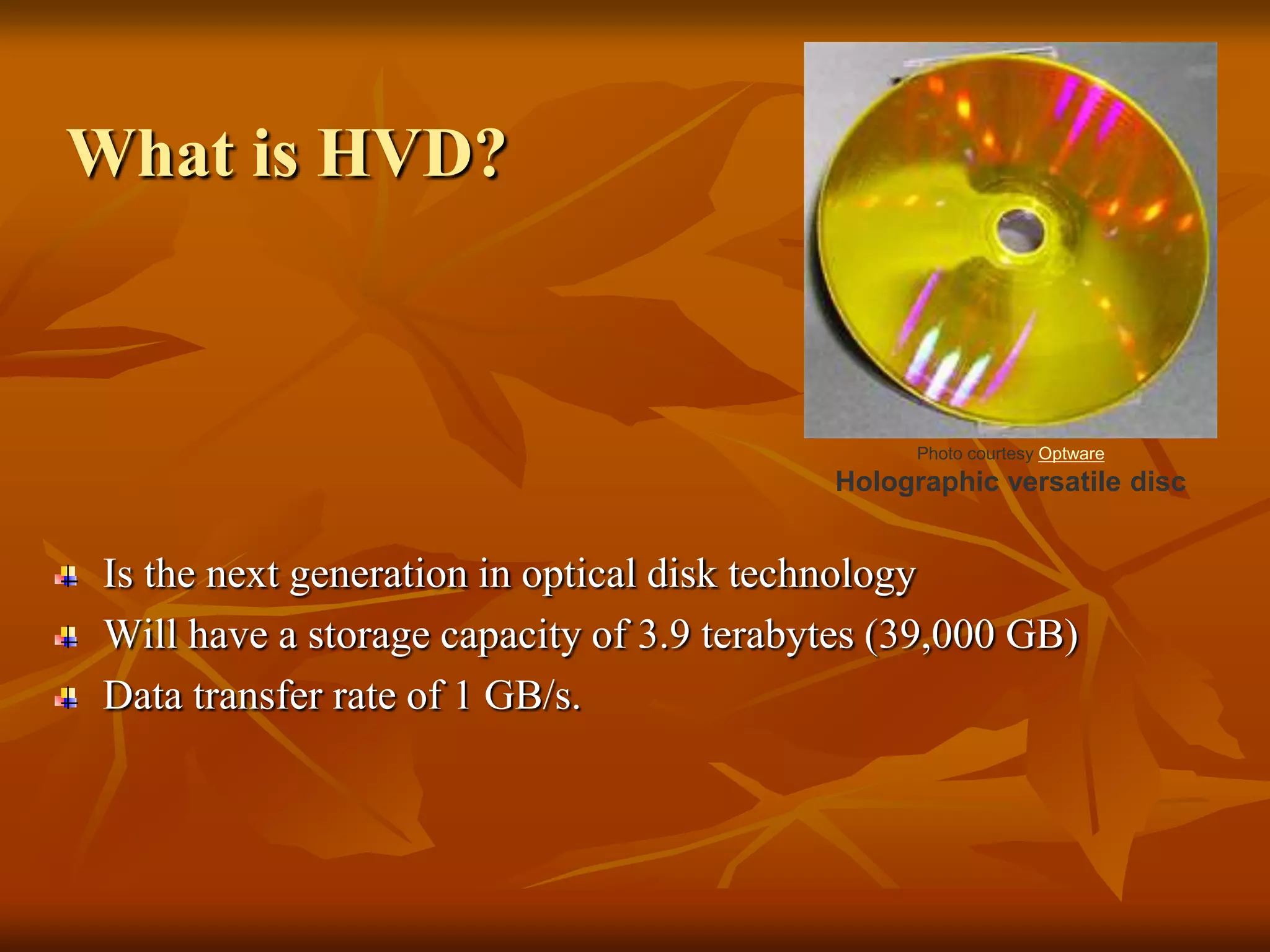
What is HVD?Photo courtesy OptwareHolographic versatile discIs the next generation in optical disk technology Will have a storage capacity of 3.9 terabytes (39,000 GB) Data transfer rate of 1 GB/s.
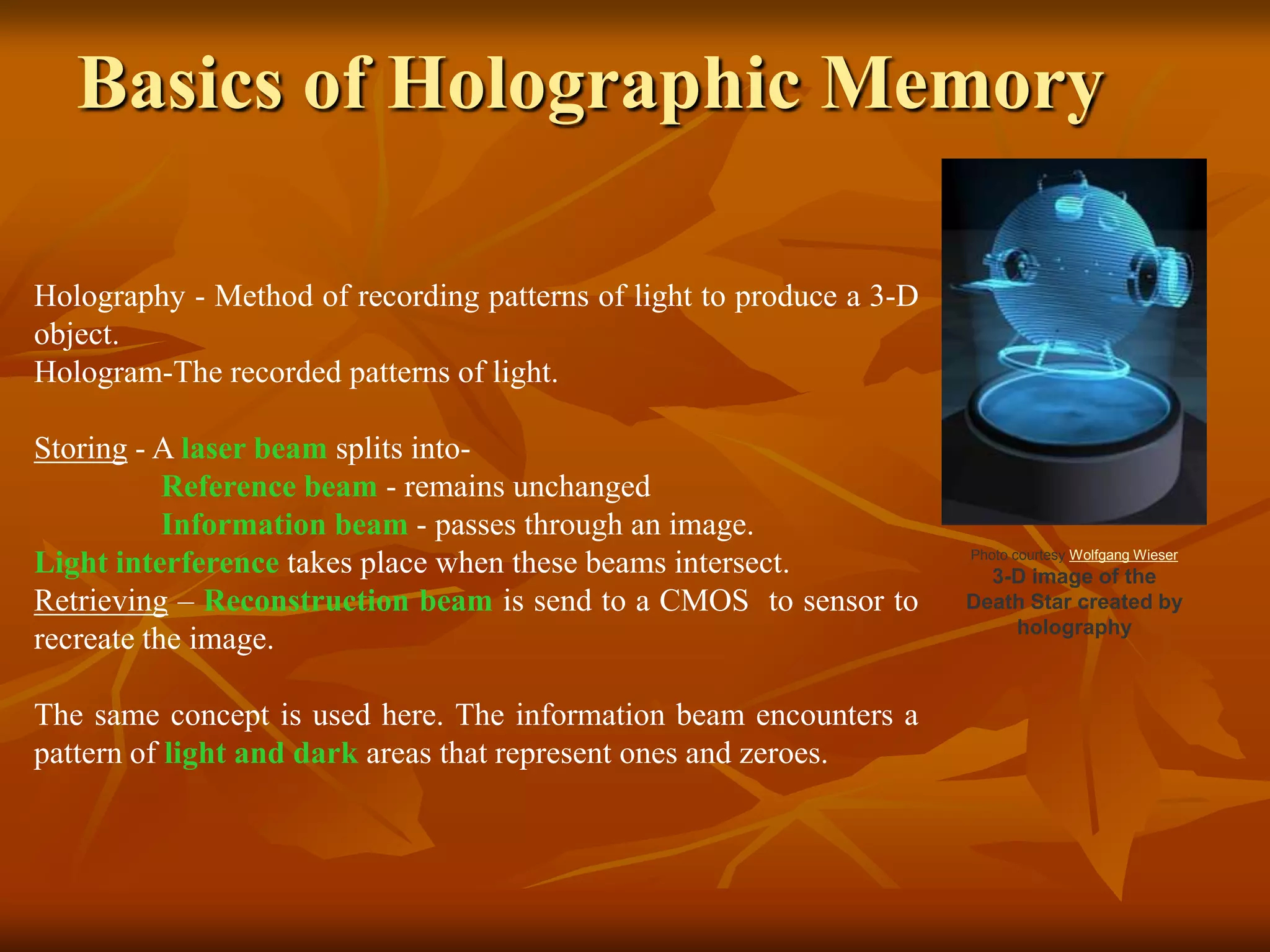
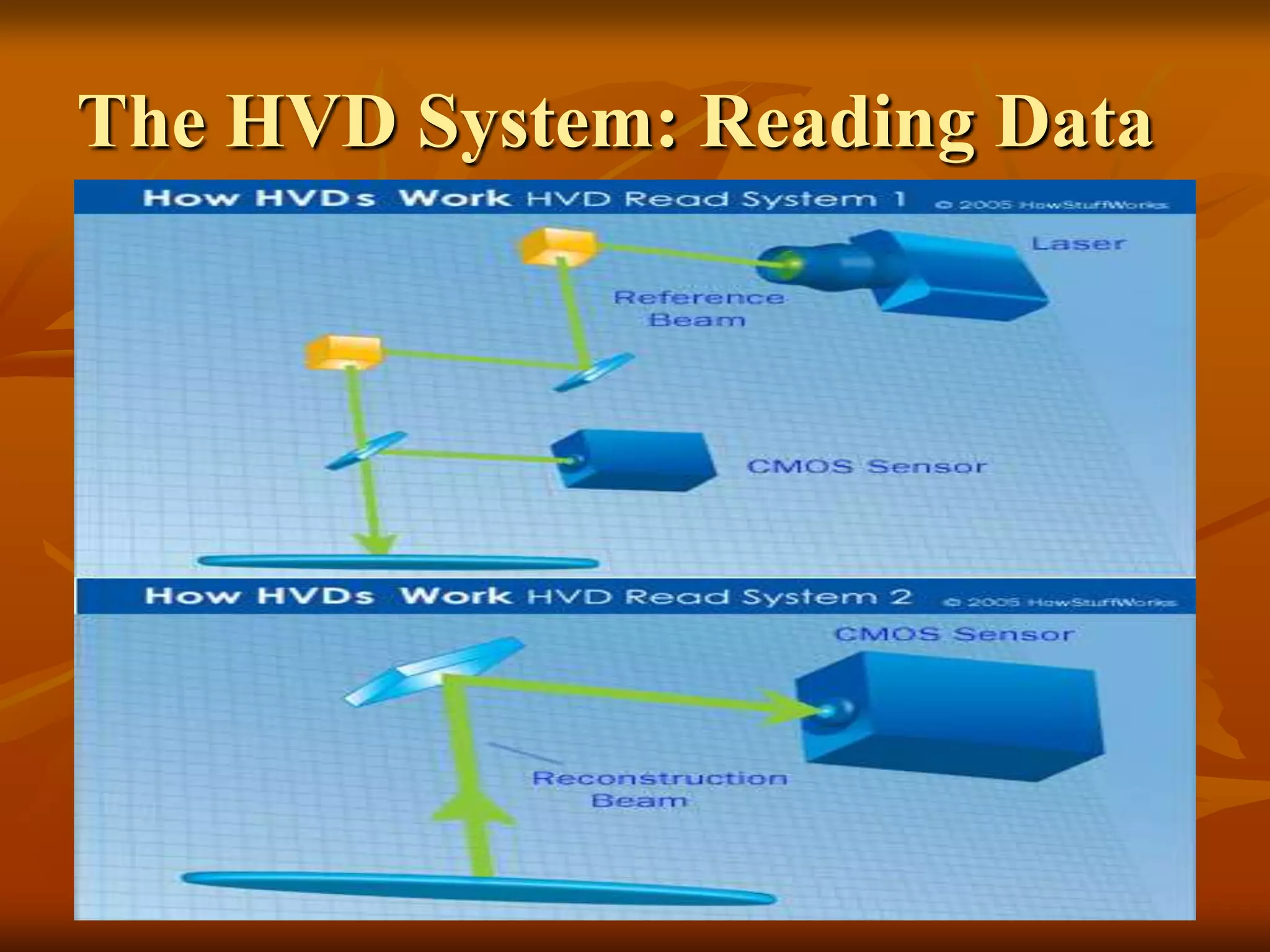
Basics of Holographic MemoryHolography - Method of recording patterns of light to produce a 3-D object. Hologram-The recorded patterns of light. Storing - A laser beam splits into- Reference beam - remains unchanged Information beam - passes through an image.Light interference takes place when these beams intersect.Retrieving – Reconstruction beam is send to a CMOS  to sensor to recreate the image.The same concept is used here. The information beam encounters a pattern of light and dark areas that represent ones and zeroes.
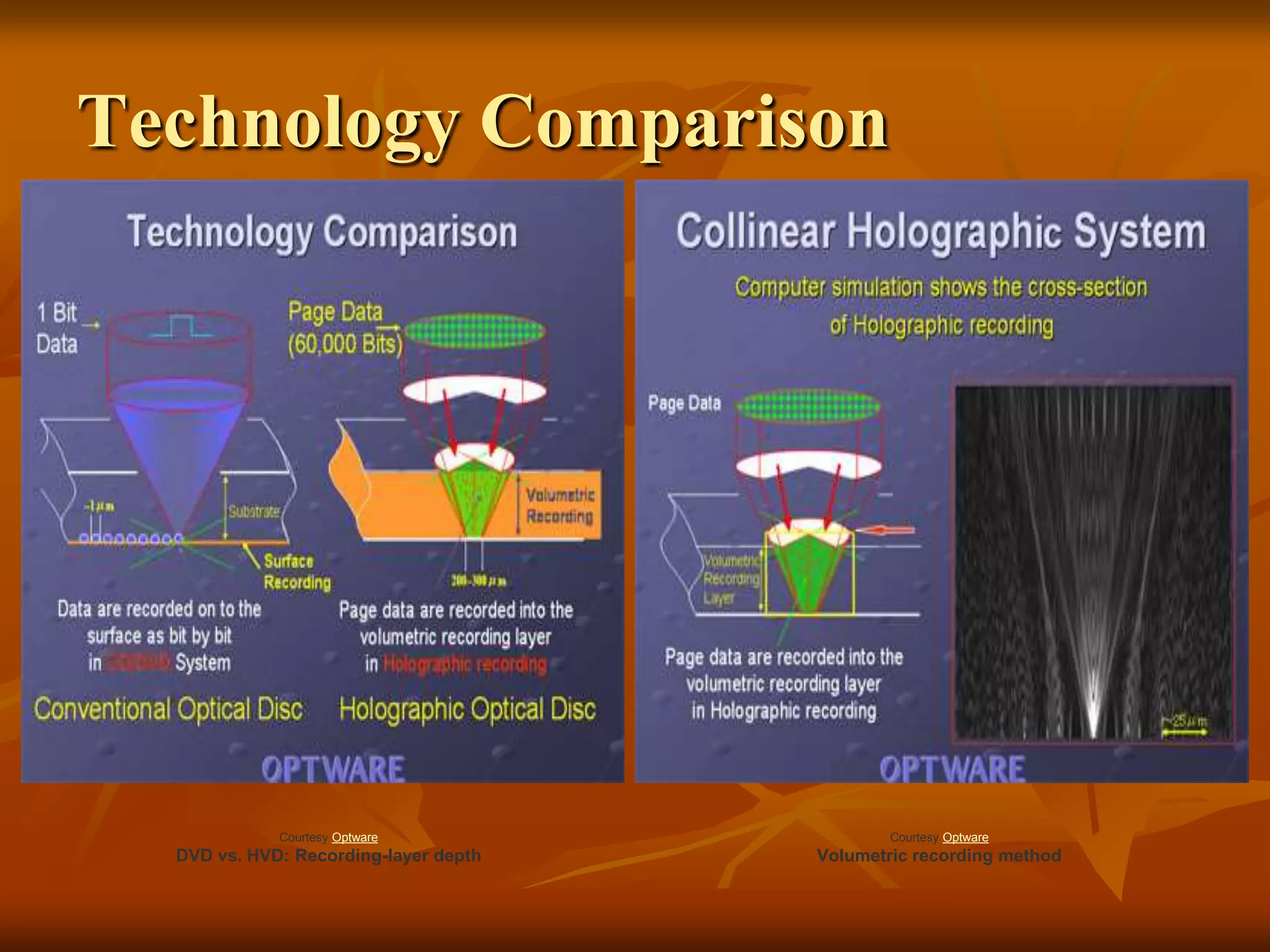
Technology Comparison
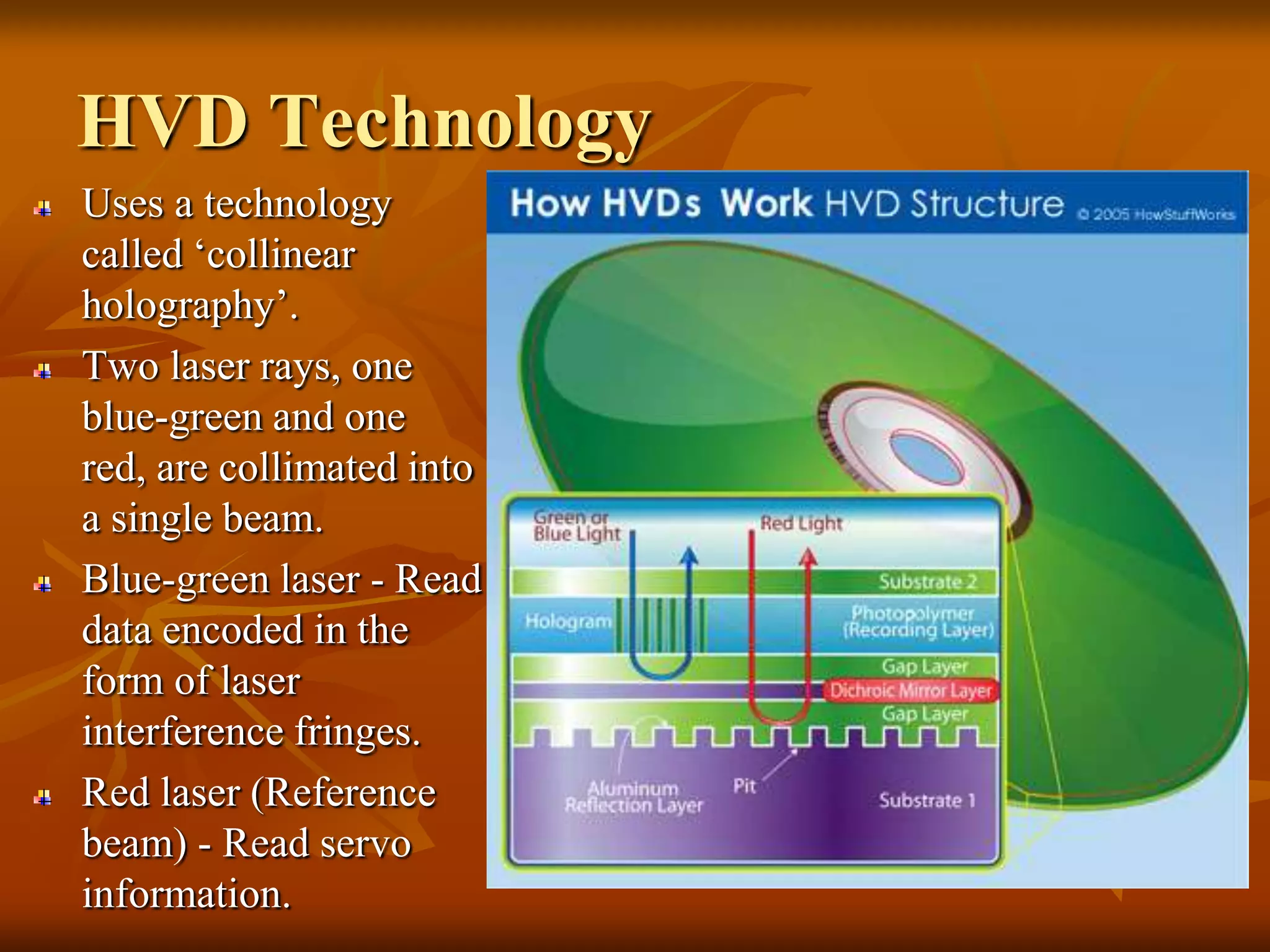
HVD TechnologyUses a technology called ‘collinear holography’. Two laser rays, one blue-green and one red, are collimated into a single beam.Blue-green laser - Read  data encoded in the form of laser interference fringes. Red laser (Reference beam) - Read servo information.
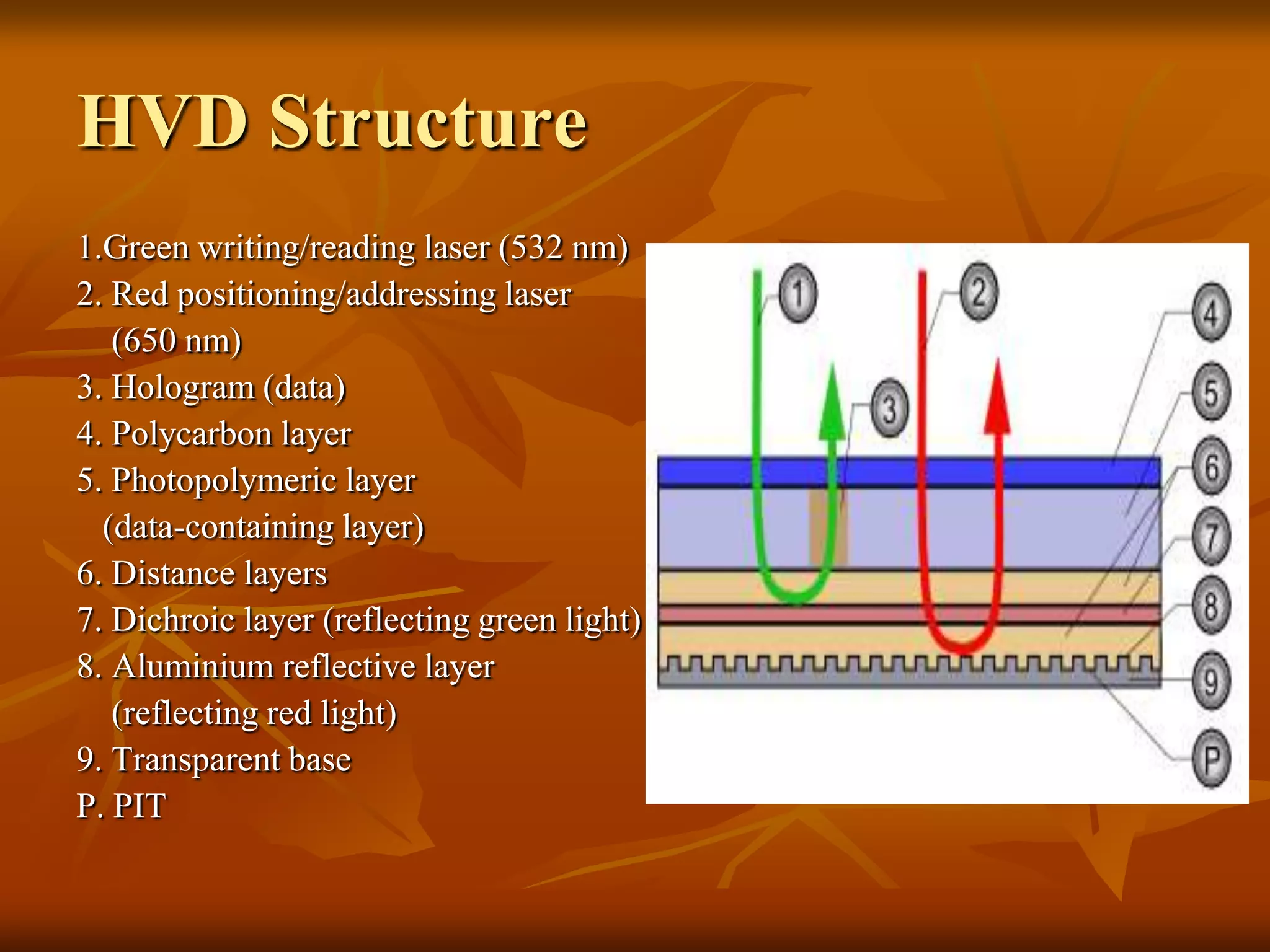
HVD Structure 1.Green writing/reading laser (532 nm)2. Red positioning/addressing laser     (650 nm)3. Hologram (data)4. Polycarbon layer5. Photopolymeric layer    (data-containing layer)6. Distance layers7. Dichroic layer (reflecting green light)8. Aluminium reflective layer     (reflecting red light)9. Transparent baseP. PIT
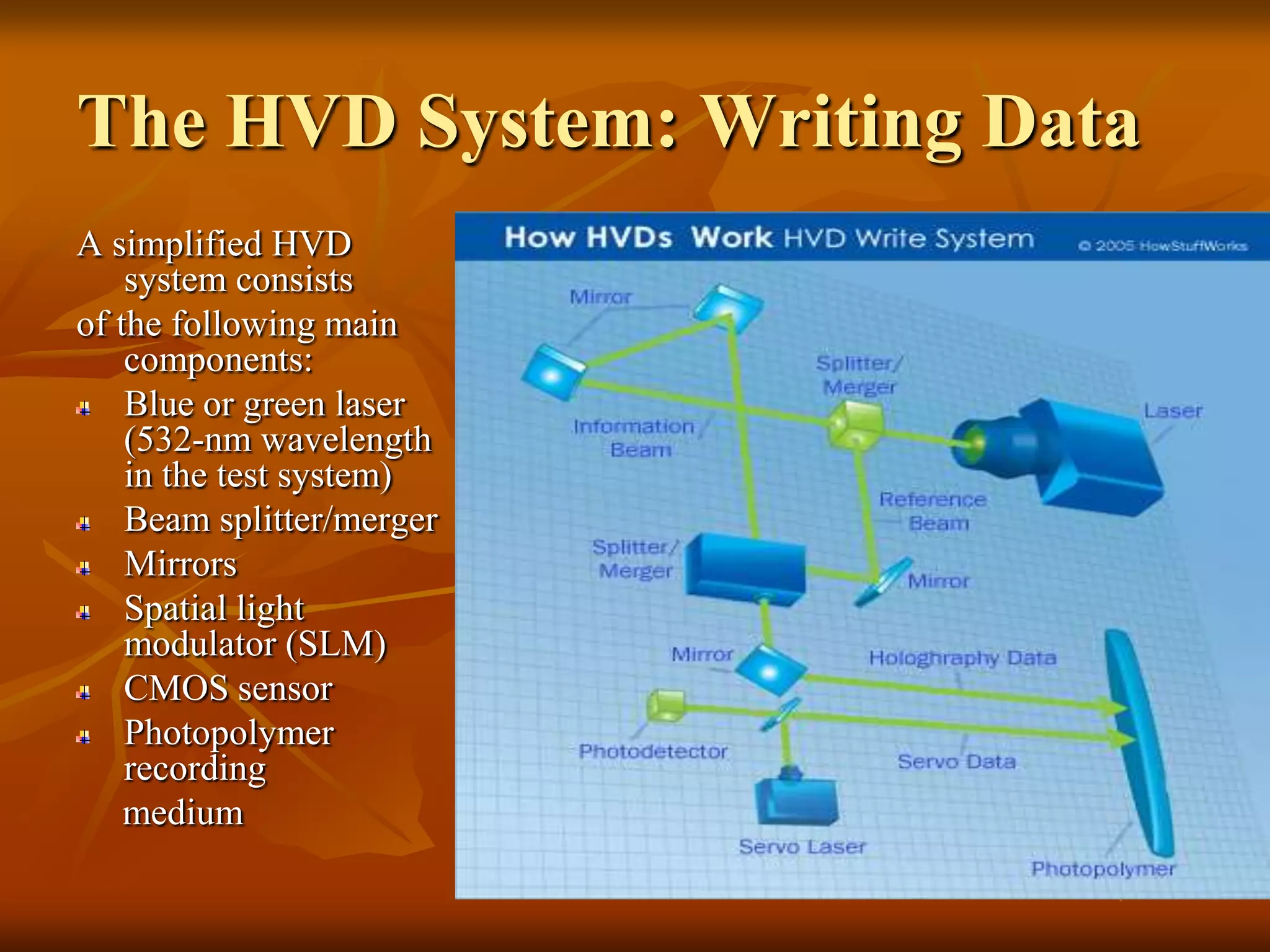
The HVD System: Writing DataA simplified HVD system consistsof the following main components: Blue or green laser (532-nm wavelength in the test system) Beam splitter/merger Mirrors Spatial light modulator (SLM) CMOS sensor Photopolymer recording      medium
The HVD System: Reading Data
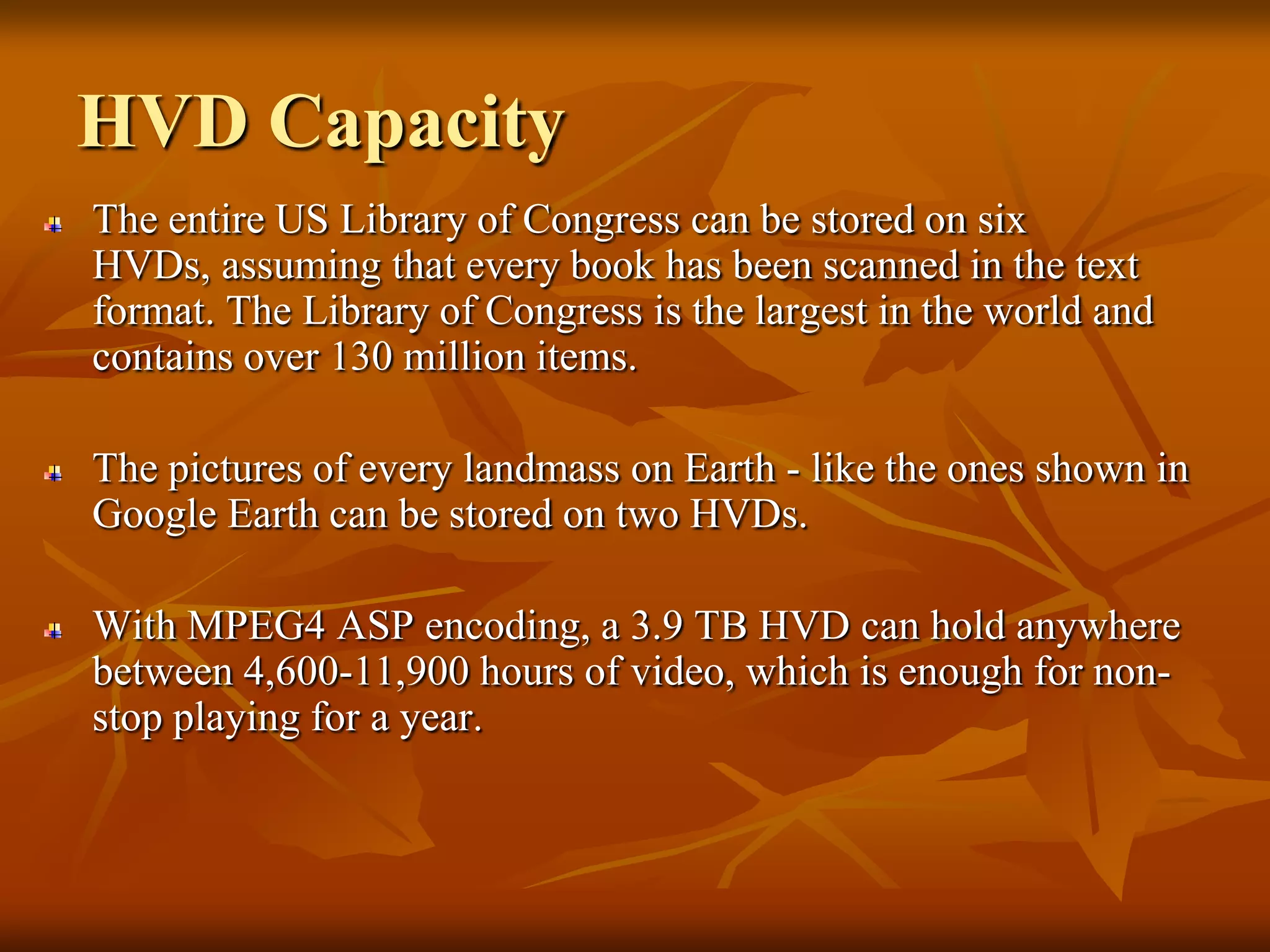
HVD CapacityThe entire US Library of Congress can be stored on six HVDs, assuming that every book has been scanned in the text format. The Library of Congress is the largest in the world and contains over 130 million items. The pictures of every landmass on Earth - like the ones shown in Google Earth can be stored on two HVDs. With MPEG4 ASP encoding, a 3.9 TB HVD can hold anywhere between 4,600-11,900 hours of video, which is enough for non-stop playing for a year.
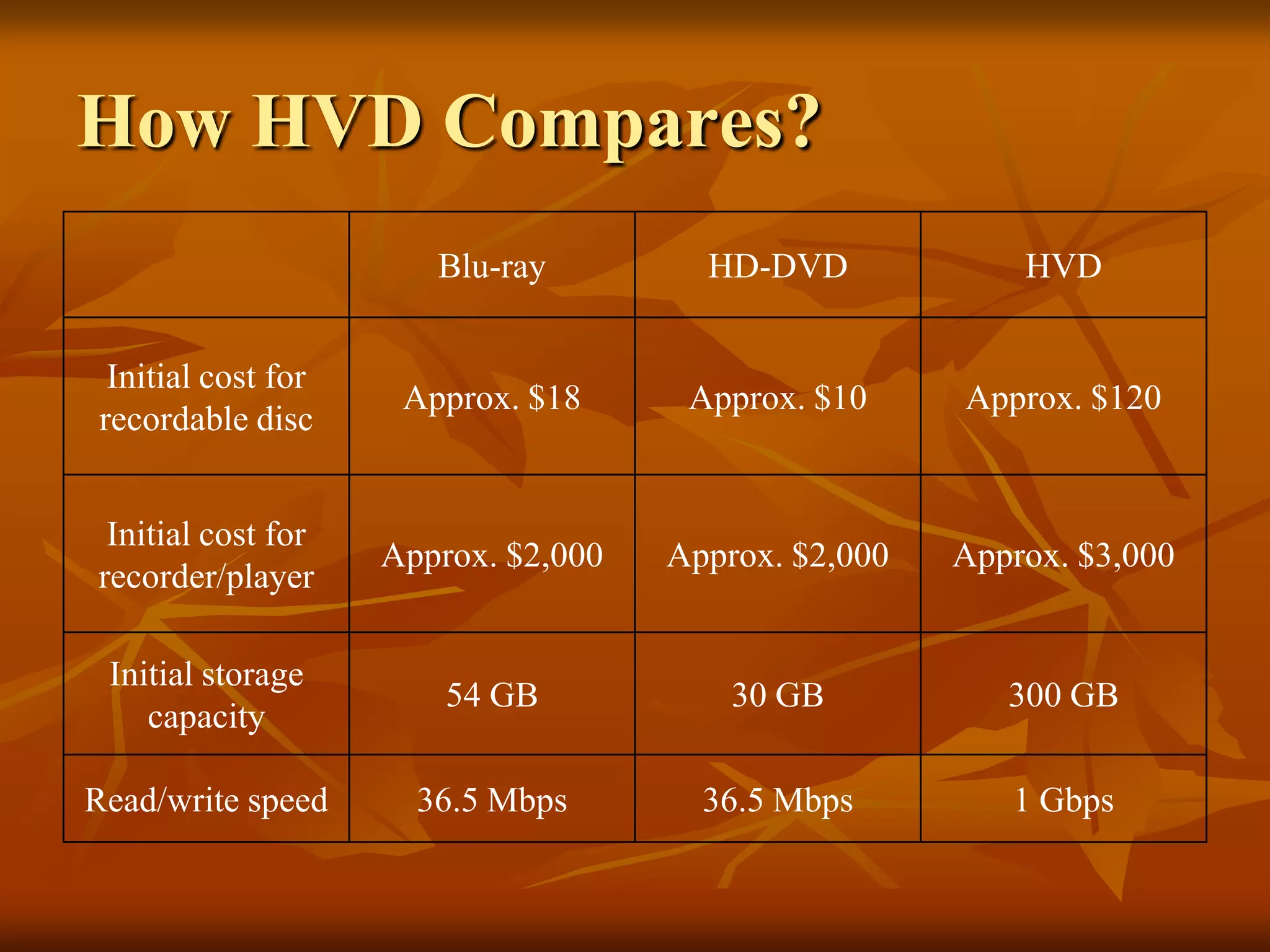
How HVD Compares?
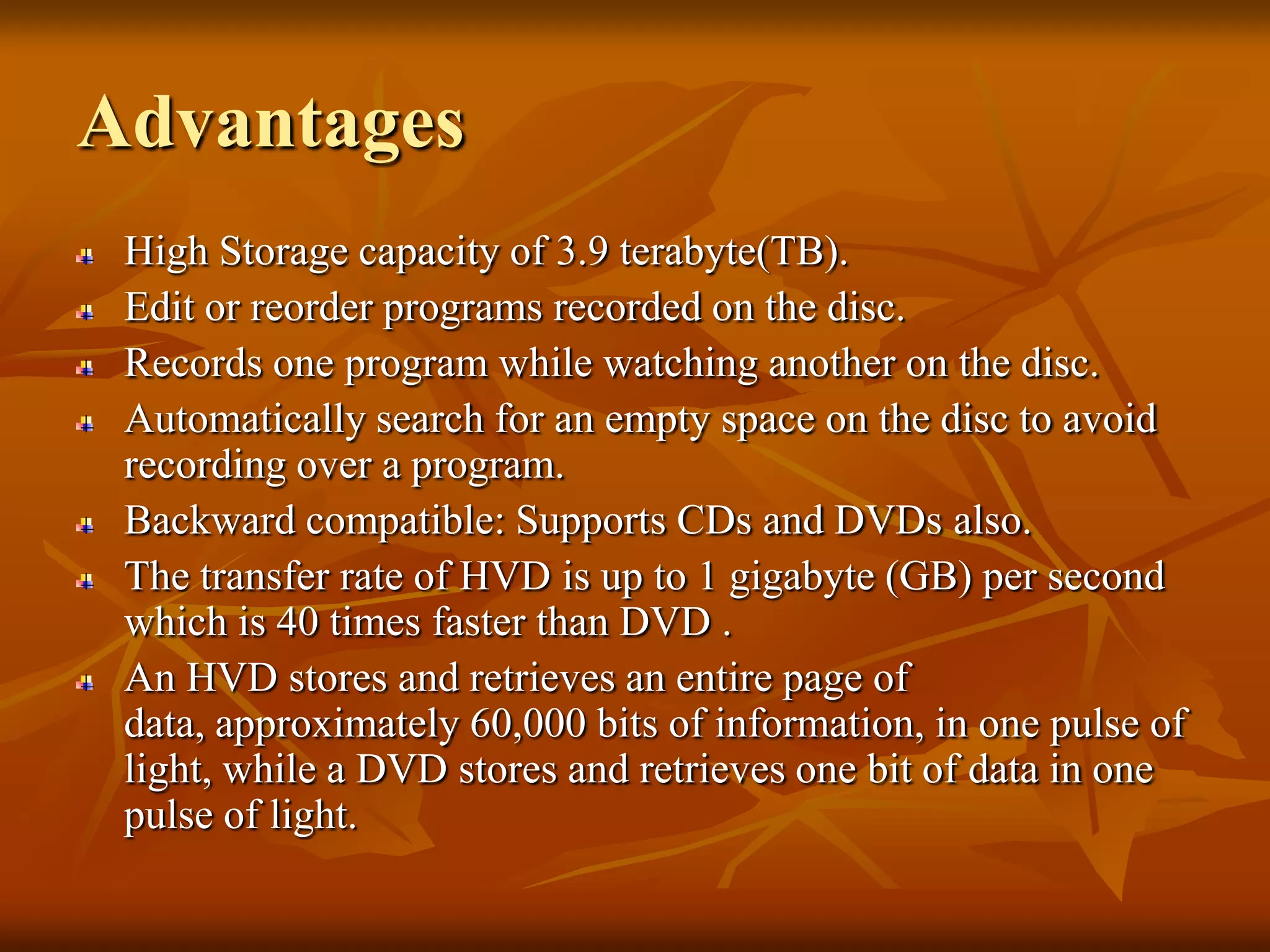
AdvantagesHigh Storage capacity of 3.9 terabyte(TB).Edit or reorder programs recorded on the disc.Records one program while watching another on the disc.Automatically search for an empty space on the disc to avoid recording over a program.Backward compatible: Supports CDs and DVDs also.The transfer rate of HVD is up to 1 gigabyte (GB) per second which is 40 times faster than DVD . An HVD stores and retrieves an entire page of data, approximately 60,000 bits of information, in one pulse of light, while a DVD stores and retrieves one bit of data in one pulse of light.
HVD Alliance
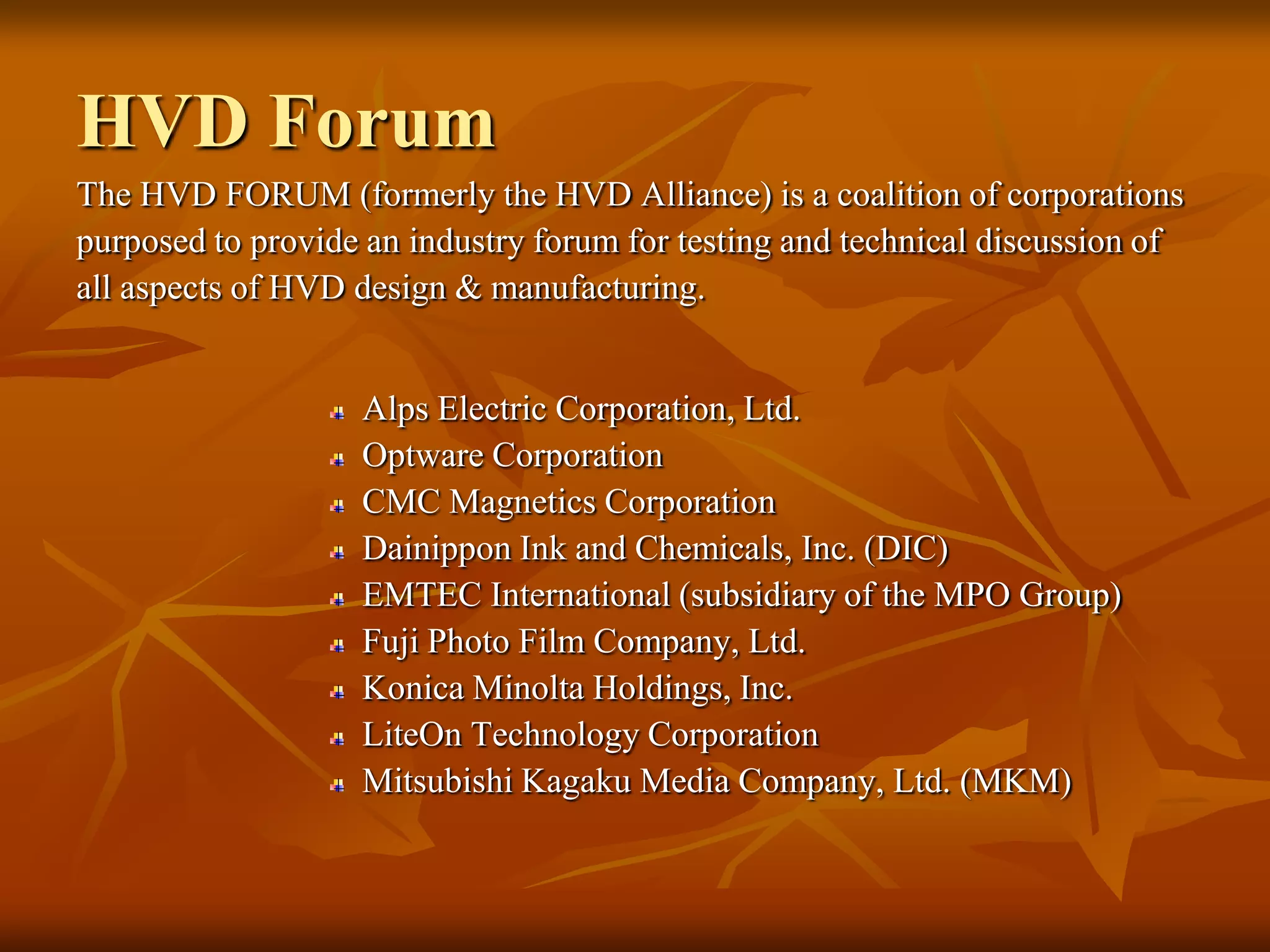
HVD ForumThe HVD FORUM (formerly the HVD Alliance) is a coalition of corporationspurposed to provide an industry forum for testing and technical discussion ofall aspects of HVD design & manufacturing.Alps Electric Corporation, Ltd.Optware CorporationCMC Magnetics CorporationDainippon Ink and Chemicals, Inc. (DIC)EMTEC International (subsidiary of the MPO Group)Fuji Photo Film Company, Ltd.Konica Minolta Holdings, Inc.LiteOn Technology CorporationMitsubishi Kagaku Media Company, Ltd. (MKM)
ConclusionHVD  will soon replace previous DVDs.Currently supported by more than 170 of the world's leading consumer electronics, personal computer, recording media, video game and music companies. The format also has broad support from the major movie studios as a successor to today's DVD format.Holographic Versatile Disc already has the backing of seven out of eight leading Hollywood studios. It will soon be able to enjoy a growing range of film entertainment with unsurpassed Full HD pictures and cinema-quality multi-channel sound.
Referenceshttp://www.tech-faq.com/hvd.htmlhttp://electronics.howstuffworks.com/hvd.html http://en.wikipedia.org/wiki/Holographic_Versatile_Dischttp://www.eweek.com/article2/0,1759,1759907,00.asphttp://www.news.com/Group-aims-to-drastically-up-disc-storage/2100-1041_3-5562599.html

Holographicversatiledisc2 090920022808-phpapp01

  • 1.
    HOLOGRAPHICVERSATILE DISCPRESENTED BYSOUMENDRAPRASAD SAHOOe-mail – somu123_pdp@yahoo.co.inRegd No. – 0601214081Branch – Computer Science & Engineering KONARK INSTITUTE OF SCIENCE & TECH.
  • 2.
    WILL DISCUSS ABOUTWhat is HVD ?Basics of Holographic MemoryTechnology ComparisonHVD TechnologyHVD StructureThe HVD System: Writing DataThe HVD System: Reading DataHVD CapacityHow HVD compares ?AdvantagesHVD AllianceHVD ForumConclusionReferences
  • 3.
    What is HVD?Photocourtesy OptwareHolographic versatile discIs the next generation in optical disk technology Will have a storage capacity of 3.9 terabytes (39,000 GB) Data transfer rate of 1 GB/s.
  • 4.
    Basics of HolographicMemoryHolography - Method of recording patterns of light to produce a 3-D object. Hologram-The recorded patterns of light. Storing - A laser beam splits into- Reference beam - remains unchanged Information beam - passes through an image.Light interference takes place when these beams intersect.Retrieving – Reconstruction beam is send to a CMOS to sensor to recreate the image.The same concept is used here. The information beam encounters a pattern of light and dark areas that represent ones and zeroes.
  • 5.
  • 6.
    HVD TechnologyUses atechnology called ‘collinear holography’. Two laser rays, one blue-green and one red, are collimated into a single beam.Blue-green laser - Read data encoded in the form of laser interference fringes. Red laser (Reference beam) - Read servo information.
  • 7.
    HVD Structure 1.Greenwriting/reading laser (532 nm)2. Red positioning/addressing laser (650 nm)3. Hologram (data)4. Polycarbon layer5. Photopolymeric layer (data-containing layer)6. Distance layers7. Dichroic layer (reflecting green light)8. Aluminium reflective layer (reflecting red light)9. Transparent baseP. PIT
  • 8.
    The HVD System:Writing DataA simplified HVD system consistsof the following main components: Blue or green laser (532-nm wavelength in the test system) Beam splitter/merger Mirrors Spatial light modulator (SLM) CMOS sensor Photopolymer recording medium
  • 9.
    The HVD System:Reading Data
  • 10.
    HVD CapacityThe entireUS Library of Congress can be stored on six HVDs, assuming that every book has been scanned in the text format. The Library of Congress is the largest in the world and contains over 130 million items. The pictures of every landmass on Earth - like the ones shown in Google Earth can be stored on two HVDs. With MPEG4 ASP encoding, a 3.9 TB HVD can hold anywhere between 4,600-11,900 hours of video, which is enough for non-stop playing for a year.
  • 11.
  • 12.
    AdvantagesHigh Storage capacityof 3.9 terabyte(TB).Edit or reorder programs recorded on the disc.Records one program while watching another on the disc.Automatically search for an empty space on the disc to avoid recording over a program.Backward compatible: Supports CDs and DVDs also.The transfer rate of HVD is up to 1 gigabyte (GB) per second which is 40 times faster than DVD . An HVD stores and retrieves an entire page of data, approximately 60,000 bits of information, in one pulse of light, while a DVD stores and retrieves one bit of data in one pulse of light.
  • 13.
  • 14.
    HVD ForumThe HVDFORUM (formerly the HVD Alliance) is a coalition of corporationspurposed to provide an industry forum for testing and technical discussion ofall aspects of HVD design & manufacturing.Alps Electric Corporation, Ltd.Optware CorporationCMC Magnetics CorporationDainippon Ink and Chemicals, Inc. (DIC)EMTEC International (subsidiary of the MPO Group)Fuji Photo Film Company, Ltd.Konica Minolta Holdings, Inc.LiteOn Technology CorporationMitsubishi Kagaku Media Company, Ltd. (MKM)
  • 15.
    ConclusionHVD willsoon replace previous DVDs.Currently supported by more than 170 of the world's leading consumer electronics, personal computer, recording media, video game and music companies. The format also has broad support from the major movie studios as a successor to today's DVD format.Holographic Versatile Disc already has the backing of seven out of eight leading Hollywood studios. It will soon be able to enjoy a growing range of film entertainment with unsurpassed Full HD pictures and cinema-quality multi-channel sound.
  • 16.