Programme Specification         
HNC in Electrical and Electronic Engineering with Control 
  
1. Key Programme Facts           
 
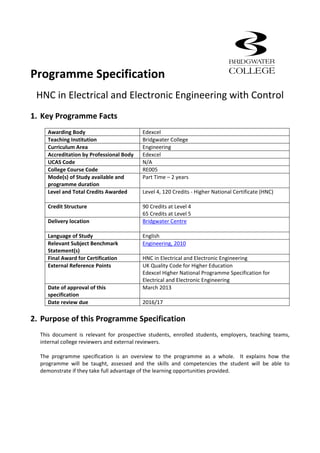
Awarding Body  Edexcel 
Teaching Institution  Bridgwater College 
Curriculum Area  Engineering 
Accreditation by Professional Body  Edexcel 
UCAS Code  N/A 
College Course Code  RE005 
Mode(s) of Study available and 
programme duration 
Part Time – 2 years  
 
Level and Total Credits Awarded  Level 4, 120 Credits ‐ Higher National Certificate (HNC) 
 
Credit Structure  90 Credits at Level 4 
65 Credits at Level 5 
Delivery location  Bridgwater Centre 
 
Language of Study  English 
Relevant Subject Benchmark 
Statement(s) 
Engineering, 2010 
Final Award for Certification  HNC in Electrical and Electronic Engineering 
External Reference Points  UK Quality Code for Higher Education  
Edexcel Higher National Programme Specification for 
Electrical and Electronic Engineering 
Date of approval of this 
specification 
March 2013 
Date review due  2016/17 
 
2. Purpose of this Programme Specification 
 
This  document  is  relevant  for  prospective  students,  enrolled  students,  employers,  teaching  teams, 
internal college reviewers and external reviewers. 
 
The  programme  specification  is  an  overview  to  the  programme  as  a  whole.    It  explains  how  the 
programme  will  be  taught,  assessed  and  the  skills  and  competencies  the  student  will  be  able  to 
demonstrate if they take full advantage of the learning opportunities provided.   


Page 2 of 5
Role of the Awarding Body 
 
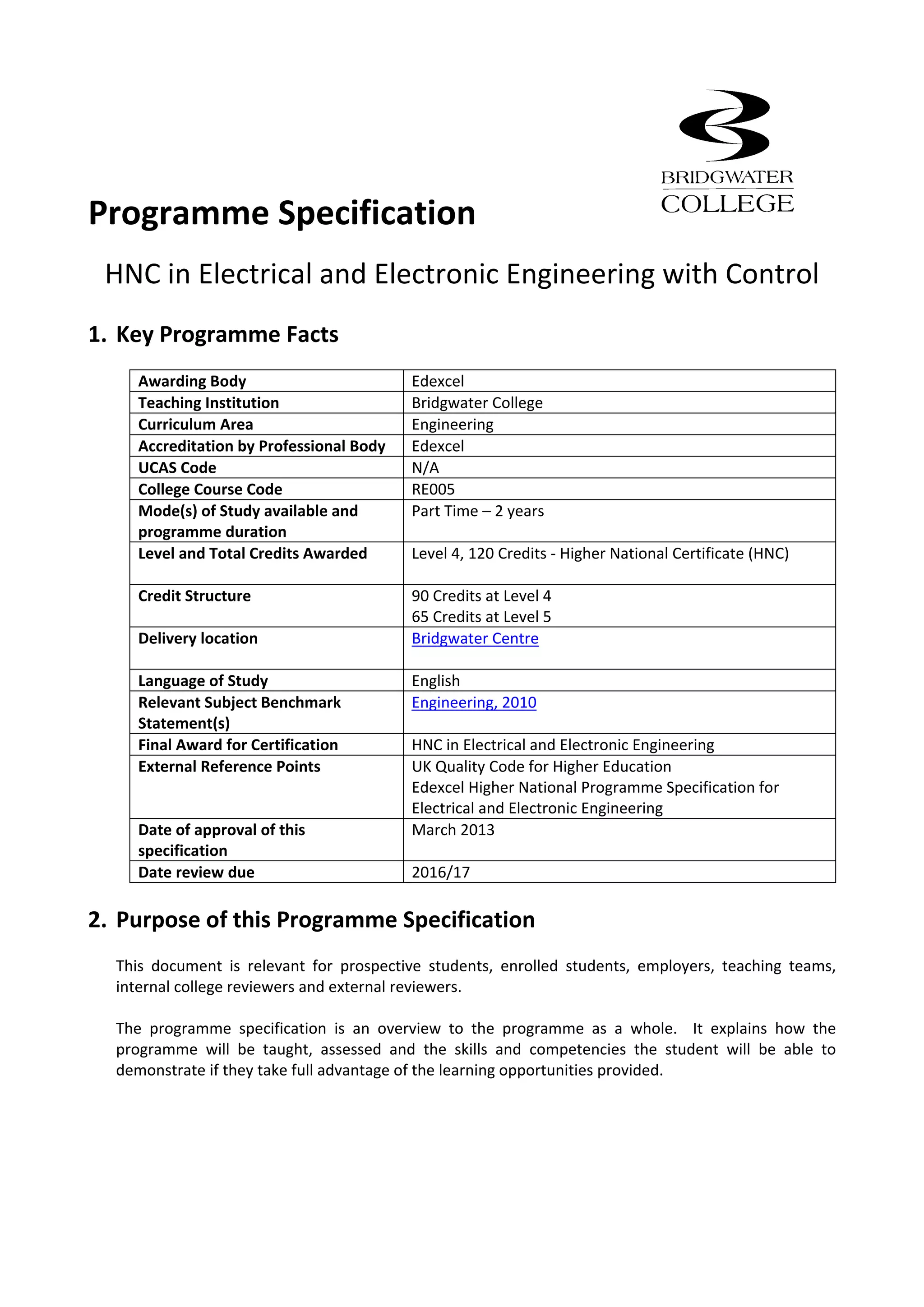
Edexcel is the awarding body and as such have overall responsibility for the quality and standards of the 
programme.  Bridgwater College is approved to manage and deliver the programme within Edexcel’s 
quality framework and Edexcel accredits the successful student with their final award.   
 
3. Aims of the Programme 
 
Bridgwater College has developed this programme to equip graduates with the skills to meet the needs 
and expectations of the local/regional/national industry.    
 
 
The programme aims to: 
 provide a vocationally relevant programme that enables students to obtain a nationally 
recognised qualification in Engineering 
 equip graduates with a range of transferable skills, together with underpinning knowledge, to 
prepare them for employment for further academic progression 
 provide opportunities for students to develop their interpersonal skills 
 be accessible and supportive 
 
4. Distinctive Features of the Programme 
 
This programme has the following distinctive features: 
 Industry standard equipment and software. 
 An industrially experienced teaching team 
 Close links with local engineering companies  
The College has recently made substantial investments in Robotic, PLC, CNC, CAD and Process Control 
Technology and will be opening a brand new state of the art Engineering facility in January 2011. 
5. Entry Requirements 
You will require a full Level 3 qualification in a relevant subject and at least 4 GCSEs at grades A*‐C 
including Maths and English or Level 2 equivalent. 
Mature  applicants  with  relevant  experience  who  do  not  have  the  stated  entry  requirements  are 
encouraged to apply. 
  
6. Intended Programme Learning Outcomes 
 
This course is designed for those looking to develop a career in electrical/electronic or control systems 
engineering,  with  the  emphasis  on  applying  electrical,  electronic  and  control  principles  to  practical 
situations such as PLC and robot workcells. 
 
Level 4  
 
A) Knowledge 
 
Page 3 of 5
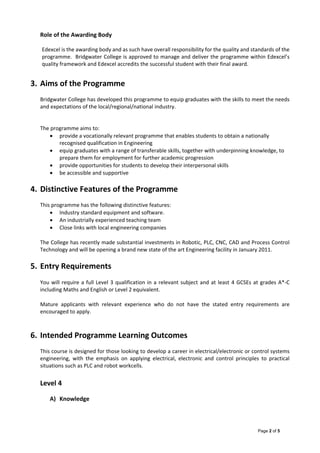
1. Relevant mathematics for analysing and modelling engineering systems. 
2. Scientific and theoretical specifications of engineering systems. 
3. The application of the design process to engineering systems. 
4. The use and relevance of appropriate software for the engineering industry. 
5. The importance of relevant business, ethics and the environment. 
6. The selection of materials and manufacturing processes appropriate to the engineering 
environment. 
 
B) Understanding and skills 
 
1. Apply analytical techniques to the solution of problems. 
2. Build a holistic approach to solving problems, by applying judgement to criteria including 
risk, cost, safety and the environment. 
3. Develop an awareness of the effects upon society of technological developments and 
develop a proper sense of professional conduct in relation to society’s use of technology in 
the engineering / nuclear environment. 
4. Develop critical skills with regard to literature searching, appraising and evaluating from a 
variety of sources and synthesising the results. 
5. Plan, execute and report on laboratory experiments, workshop practices and/or projects. 
6. Use various problem‐solving techniques to develop innovative solutions. 
 
 
C) Other attributes 
 
1. Communicate effectively in writing, speaking and in other appropriate forms of 
presentation. 
2. Read, interpret and understand documents and be conscious of security issues related to 
complex products and systems. 
3. Use information technology to handle data, simulations and communications and to assist 
with design and testing.  
4. Manipulate data and perform calculations appropriate to engineering/operational 
situations in both simulation and practice.  
5. Work as an effective team member to achieve agreed goals within a predefined 
hierarchical framework.  
6. Assess problem domains and formulate appropriate problem solving strategies in critical 
situations. 
 
Page 4 of 5
 
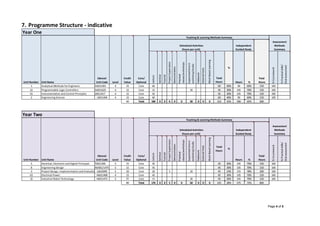
7. Programme Structure ‐ indicative 
 
Lecture
Seminar
Tutorial
Project Supervision
Demonstration
Practical 
classes/workshops
Supervised time in 
workshop/studio
Fieldwork
External Visits
Work Based Learning
Total
Hours
%
Hours %
% Coursework
% Practical skills/
Oral assessment
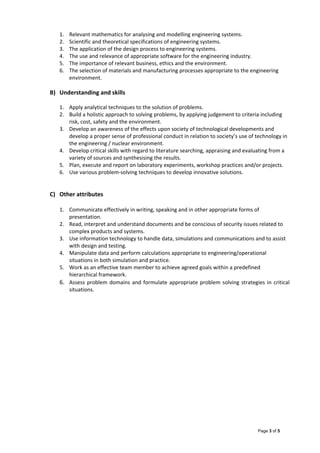
1 Analytical Methods for Engineers  A6011401 4 15 Core 60 60 40% 90 60% 150 100
22 Programmable Logic Controllers A6011625 4 15 Core 15 30 45 30% 105 70% 150 100
55 Instrumentation and Control Principles J6011417 4 15 Core 45 45 30% 105 70% 150 100
2 Engineering Science  L6011404 4 15 Core 60 60 40% 90 60% 150 100
60 Total 180 0 0 0 0 0 30 0 0 0 210 35% 390 65% 600
Lecture
Seminar
Tutorial
Project Supervision
Demonstration
Practical 
classes/workshops
Supervised time in 
workshop/studio
Fieldwork
External Visits
Work Based Learning
Total
Hours
%
Hours %
% Coursework
% Practical skills/
Oral assessment
5 Electrical, Electronic and Digital Principals T6011395 5 15 Core 45 45 30% 105 70% 150 100
8 Engineering Design M/601/1475 5 15 Core 45 45 30% 105 70% 150 100
3 Project Design, Implementation and Evaluatio L6010995 5 20 Core 20 5 20 45 23% 155 78% 200 100
63 Electrical Power H6011408 4 15 Core 45 45 30% 105 70% 150 100
32 Industrial Robot Technology H6011473 5 15 Core 15 30 45 30% 105 70% 150 100
80 Total 170 0 0 5 0 0 50 0 0 0 225 28% 575 72% 800
Assessment 
Methods 
Summary
Assessment 
Methods 
Summary
Independent 
Guided Study
Total
 Hours
Teaching & Learning Methods Summary
 Scheduled Activities 
(hours per unit)
Teaching & Learning Methods Summary
 Scheduled Activities 
(hours per unit)
Independent 
Guided Study
Total
 Hours
Year One
Unit Number  Unit Name
Year Two
Unit Number  Unit Name
Level
Credit 
Value
Core/
Optional
Edexcel 
Unit Code
Core/
OptionalLevel
Credit 
Value
Edexcel 
Unit Code
Page 5 of 5
 
8. Teaching and Learning Methods 
You will learn through a combination of lectures, directed study, assignment work, practical exercises and a 
major project normally relevant to your employment and devised with the co‐operation of your employer. 
 
9. Assessment Methods 
 
Learners are required to complete a variety of assignments for each of their course elements. Assignment 
work comprises a mixture of practical design/workshop activities and written/research tasks. Guidance is 
provided as to how different levels of attainment can be achieved. 
 
Assessment Regulations are available via Blackboard under HE Information (you will require a log in to 
access). 
 
10. Learning Support  
 
Support is available as needed at every level of study.  Every student will receive time for structured tutorial 
support to assist with their academic progress at programme level.  There is a dedicated HE specialist in the 
Learning  Resource  Centre  who  can  assist  with  any  HE  related  enquiries.    Other  types  of  support  are 
accessible via the Student Services team as needed on an individual basis.   
 
11. Academic progression  
 
Graduates from this programme can progress onto a variety of engineering courses at university.  The entry 
point on to university courses is dependent on the institute and/or course applied for. 
 
 
12. Employability 
 
This qualification will equip you with the knowledge, skills and understanding as detailed in Section 6.  You 
can apply this skillset and experiences gained through the study of this qualification to confidently apply for 
employment in the engineering sector. You can look for work in a broad range of engineering occupations 
in engineering systems, design and manufacturing or maintenance, working as a technician, engineer or 
project leader in industry. 
 
Most graduates from this programme are successfully employed in the following areas: 
 Electrical generation: providing energy for local and global communities 
 Production:  Monitoring and controlling of production lines 
 Installation: Setting up and configuring robotics/programmes and software  
 
13. Indicators of Quality and Standards 
 
QAA review 
External Examining and reports  
Self Evaluation 
Self Assessment Monitoring 
Student feedback 

HNC Electrical and Electronic Control

  • 1.
    Programme Specification         HNC in Electrical and Electronic Engineering with Control     1. Key Programme Facts              Awarding Body  Edexcel  Teaching Institution  Bridgwater College  Curriculum Area  Engineering  Accreditation by Professional Body  Edexcel  UCAS Code  N/A  College Course Code  RE005  Mode(s) of Study available and  programme duration  Part Time – 2 years     Level and Total Credits Awarded  Level 4, 120 Credits ‐ Higher National Certificate (HNC)    Credit Structure  90 Credits at Level 4  65 Credits at Level 5  Delivery location  Bridgwater Centre    Language of Study  English  Relevant Subject Benchmark  Statement(s)  Engineering, 2010  Final Award for Certification  HNC in Electrical and Electronic Engineering  External Reference Points  UK Quality Code for Higher Education   Edexcel Higher National Programme Specification for  Electrical and Electronic Engineering  Date of approval of this  specification  March 2013  Date review due  2016/17    2. Purpose of this Programme Specification    This  document  is  relevant  for  prospective  students,  enrolled  students,  employers,  teaching  teams,  internal college reviewers and external reviewers.    The  programme  specification  is  an  overview  to  the  programme  as  a  whole.    It  explains  how  the  programme  will  be  taught,  assessed  and  the  skills  and  competencies  the  student  will  be  able  to  demonstrate if they take full advantage of the learning opportunities provided.           
  • 2.
    Page 2 of5 Role of the Awarding Body    Edexcel is the awarding body and as such have overall responsibility for the quality and standards of the  programme.  Bridgwater College is approved to manage and deliver the programme within Edexcel’s  quality framework and Edexcel accredits the successful student with their final award.      3. Aims of the Programme    Bridgwater College has developed this programme to equip graduates with the skills to meet the needs  and expectations of the local/regional/national industry.         The programme aims to:   provide a vocationally relevant programme that enables students to obtain a nationally  recognised qualification in Engineering   equip graduates with a range of transferable skills, together with underpinning knowledge, to  prepare them for employment for further academic progression   provide opportunities for students to develop their interpersonal skills   be accessible and supportive    4. Distinctive Features of the Programme    This programme has the following distinctive features:   Industry standard equipment and software.   An industrially experienced teaching team   Close links with local engineering companies   The College has recently made substantial investments in Robotic, PLC, CNC, CAD and Process Control  Technology and will be opening a brand new state of the art Engineering facility in January 2011.  5. Entry Requirements  You will require a full Level 3 qualification in a relevant subject and at least 4 GCSEs at grades A*‐C  including Maths and English or Level 2 equivalent.  Mature  applicants  with  relevant  experience  who  do  not  have  the  stated  entry  requirements  are  encouraged to apply.     6. Intended Programme Learning Outcomes    This course is designed for those looking to develop a career in electrical/electronic or control systems  engineering,  with  the  emphasis  on  applying  electrical,  electronic  and  control  principles  to  practical  situations such as PLC and robot workcells.    Level 4     A) Knowledge   
  • 3.
    Page 3 of5 1. Relevant mathematics for analysing and modelling engineering systems.  2. Scientific and theoretical specifications of engineering systems.  3. The application of the design process to engineering systems.  4. The use and relevance of appropriate software for the engineering industry.  5. The importance of relevant business, ethics and the environment.  6. The selection of materials and manufacturing processes appropriate to the engineering  environment.    B) Understanding and skills    1. Apply analytical techniques to the solution of problems.  2. Build a holistic approach to solving problems, by applying judgement to criteria including  risk, cost, safety and the environment.  3. Develop an awareness of the effects upon society of technological developments and  develop a proper sense of professional conduct in relation to society’s use of technology in  the engineering / nuclear environment.  4. Develop critical skills with regard to literature searching, appraising and evaluating from a  variety of sources and synthesising the results.  5. Plan, execute and report on laboratory experiments, workshop practices and/or projects.  6. Use various problem‐solving techniques to develop innovative solutions.      C) Other attributes    1. Communicate effectively in writing, speaking and in other appropriate forms of  presentation.  2. Read, interpret and understand documents and be conscious of security issues related to  complex products and systems.  3. Use information technology to handle data, simulations and communications and to assist  with design and testing.   4. Manipulate data and perform calculations appropriate to engineering/operational  situations in both simulation and practice.   5. Work as an effective team member to achieve agreed goals within a predefined  hierarchical framework.   6. Assess problem domains and formulate appropriate problem solving strategies in critical  situations.   
  • 4.
    Page 4 of5   7. Programme Structure ‐ indicative    Lecture Seminar Tutorial Project Supervision Demonstration Practical  classes/workshops Supervised time in  workshop/studio Fieldwork External Visits Work Based Learning Total Hours % Hours % % Coursework % Practical skills/ Oral assessment 1 Analytical Methods for Engineers  A6011401 4 15 Core 60 60 40% 90 60% 150 100 22 Programmable Logic Controllers A6011625 4 15 Core 15 30 45 30% 105 70% 150 100 55 Instrumentation and Control Principles J6011417 4 15 Core 45 45 30% 105 70% 150 100 2 Engineering Science  L6011404 4 15 Core 60 60 40% 90 60% 150 100 60 Total 180 0 0 0 0 0 30 0 0 0 210 35% 390 65% 600 Lecture Seminar Tutorial Project Supervision Demonstration Practical  classes/workshops Supervised time in  workshop/studio Fieldwork External Visits Work Based Learning Total Hours % Hours % % Coursework % Practical skills/ Oral assessment 5 Electrical, Electronic and Digital Principals T6011395 5 15 Core 45 45 30% 105 70% 150 100 8 Engineering Design M/601/1475 5 15 Core 45 45 30% 105 70% 150 100 3 Project Design, Implementation and Evaluatio L6010995 5 20 Core 20 5 20 45 23% 155 78% 200 100 63 Electrical Power H6011408 4 15 Core 45 45 30% 105 70% 150 100 32 Industrial Robot Technology H6011473 5 15 Core 15 30 45 30% 105 70% 150 100 80 Total 170 0 0 5 0 0 50 0 0 0 225 28% 575 72% 800 Assessment  Methods  Summary Assessment  Methods  Summary Independent  Guided Study Total  Hours Teaching & Learning Methods Summary  Scheduled Activities  (hours per unit) Teaching & Learning Methods Summary  Scheduled Activities  (hours per unit) Independent  Guided Study Total  Hours Year One Unit Number  Unit Name Year Two Unit Number  Unit Name Level Credit  Value Core/ Optional Edexcel  Unit Code Core/ OptionalLevel Credit  Value Edexcel  Unit Code
  • 5.
    Page 5 of5   8. Teaching and Learning Methods  You will learn through a combination of lectures, directed study, assignment work, practical exercises and a  major project normally relevant to your employment and devised with the co‐operation of your employer.    9. Assessment Methods    Learners are required to complete a variety of assignments for each of their course elements. Assignment  work comprises a mixture of practical design/workshop activities and written/research tasks. Guidance is  provided as to how different levels of attainment can be achieved.    Assessment Regulations are available via Blackboard under HE Information (you will require a log in to  access).    10. Learning Support     Support is available as needed at every level of study.  Every student will receive time for structured tutorial  support to assist with their academic progress at programme level.  There is a dedicated HE specialist in the  Learning  Resource  Centre  who  can  assist  with  any  HE  related  enquiries.    Other  types  of  support  are  accessible via the Student Services team as needed on an individual basis.      11. Academic progression     Graduates from this programme can progress onto a variety of engineering courses at university.  The entry  point on to university courses is dependent on the institute and/or course applied for.      12. Employability    This qualification will equip you with the knowledge, skills and understanding as detailed in Section 6.  You  can apply this skillset and experiences gained through the study of this qualification to confidently apply for  employment in the engineering sector. You can look for work in a broad range of engineering occupations  in engineering systems, design and manufacturing or maintenance, working as a technician, engineer or  project leader in industry.    Most graduates from this programme are successfully employed in the following areas:   Electrical generation: providing energy for local and global communities   Production:  Monitoring and controlling of production lines   Installation: Setting up and configuring robotics/programmes and software     13. Indicators of Quality and Standards    QAA review  External Examining and reports   Self Evaluation  Self Assessment Monitoring  Student feedback