Teaching Notes: Unit & Lesson Slides
• The content, vocabulary, videos and activities shown on the following slides come
directly from your student and teacher text. PDFs are referenced on slides and can be
downloaded by teachers and students online at Ed: Your Friend in Learning (Ed: YFIL)
• All slide content is editable, as you may add, remove or edit content to meet your
individual classroom needs.
• Many slides include notes such as: the Performance Expectations, Anchor
Phenomenon, lesson objectives, building on prior knowledge, lab notes.
• It is recommended that students utilize an evidence notebook as they ask questions,
collect evidence and data throughout the lessons. This will help them with sense-
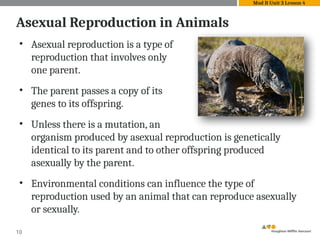
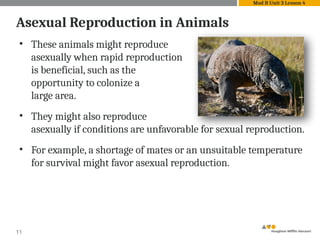
making of the Anchor Phenomenon. Look for the notebook icon on the first and last
slide of each lesson as a reminder.
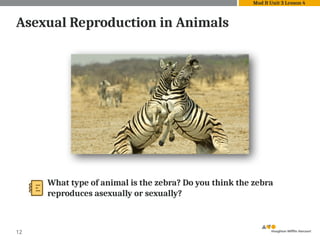
o Support for Evidence Notebooks can be found in the front of your Teacher
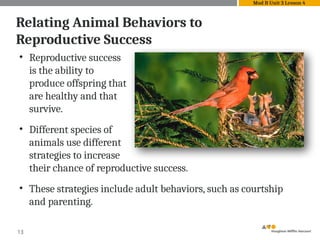
Edition, and prompts will be shown in the student text throughout each
lesson.
1
Teaching Notes
Teaching Notes: Using Unit & Lesson Slides
• It is recommended you play/present slides
when using for instruction.
• Note: Some videos may not play with Google
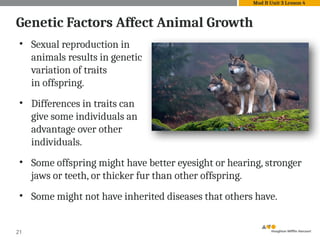
Slides. All videos can be found in the
Student & Teacher eBooks
• Slides that contain animations will have
content that is initially hidden and revealed
with click in play/presenter view. You can
see all slide content in normal view.
• To manage animations:
– Open in PowerPoint
– Click Animations
– Click Animation Pane
– Click the X to remove
2
Teaching Notes
Teaching Suggestions: In-Person, Remote or
Hybrid
This editable, flexible resource can be used in a growing number of
ways to meet your needs while supporting remote, hybrid or in-
person teaching and learning for all:
• In-person instructional and learning tool for teachers and
students
• Digital or remote presentation tool for online or virtual meetings
• Easy-to-follow for parent-led instruction or substitute teachers
• Flipped model instructional support for student distance learning
• Student collaboration or alternative to collecting student
responses
3
Teaching Notes
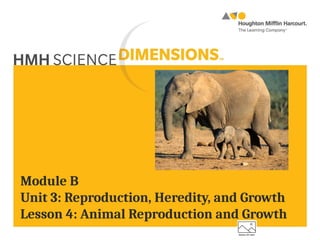
Module B
Unit 3: Reproduction, Heredity, and Growth
Lesson 4: Animal Reproduction and Growth
5
ELD Language Support
Lesson Vocabulary
ELL/ELD Strategy
Illustrated Dictionary Draw models and write descriptions in
your native language to help recall courtship, parenting, or
offspring behaviors in animals.
Mod B Unit 3 Lesson 4
6
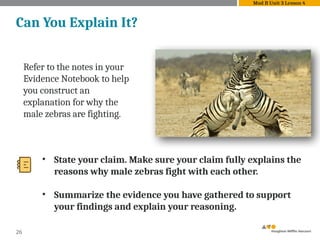
Can You Explain It?
Why are these male zebras fighting?
These zebras live on the
grassy plains in Etosha
National Park in Namibia.
Plains zebras live in family
groups that include one
male and several females
with their offspring.
Mod B Unit 3 Lesson 4
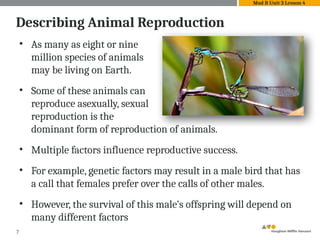
• As many as eight or nine
million species of animals
may be living on Earth.
• Some of these animals can
reproduce asexually, sexual
reproduction is the
dominant form of reproduction of animals.
• Multiple factors influence reproductive success.
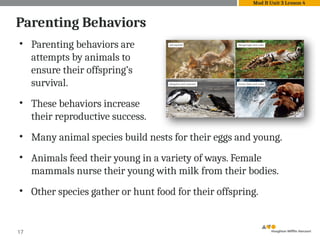
• For example, genetic factors may result in a male bird that has
a call that females prefer over the calls of other males.
• However, the survival of this male's offspring will depend on
many different factors
7
Describing Animal Reproduction
Mod B Unit 3 Lesson 4
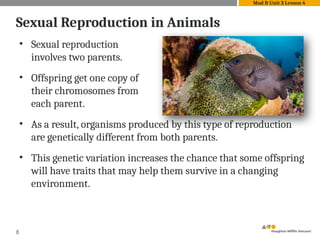
• Sexual reproduction
involves two parents.
• Offspring get one copy of
their chromosomes from
each parent.
• As a result, organisms produced by this type of reproduction
are genetically different from both parents.
• This genetic variation increases the chance that some offspring
will have traits that may help them survive in a changing
environment.
8
Sexual Reproduction in Animals
Mod B Unit 3 Lesson 4
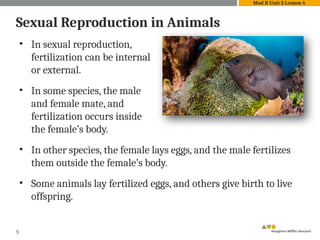
• In sexual reproduction,
fertilization can be internal
or external.
• In some species, the male
and female mate, and
fertilization occurs inside
the female’s body.
• In other species, the female lays eggs, and the male fertilizes
them outside the female’s body.
• Some animals lay fertilized eggs, and others give birth to live
offspring.
9
Sexual Reproduction in Animals
Mod B Unit 3 Lesson 4
• Asexual reproduction is a type of
reproduction that involves only
one parent.
• The parent passes a copy of its
genes to its offspring.
• Unless there is a mutation, an
organism produced by asexual reproduction is genetically
identical to its parent and to other offspring produced
asexually by the parent.
• Environmental conditions can influence the type of
reproduction used by an animal that can reproduce asexually
or sexually.
10
Asexual Reproduction in Animals
Mod B Unit 3 Lesson 4
• These animals might reproduce
asexually when rapid reproduction
is beneficial, such as the
opportunity to colonize a
large area.
• They might also reproduce
asexually if conditions are unfavorable for sexual reproduction.
• For example, a shortage of mates or an unsuitable temperature
for survival might favor asexual reproduction.
11
Asexual Reproduction in Animals
Mod B Unit 3 Lesson 4
12
Asexual Reproduction in Animals
What type of animal is the zebra? Do you think the zebra
reproduces asexually or sexually?
Mod B Unit 3 Lesson 4
13
Relating Animal Behaviors to
Reproductive Success
Mod B Unit 3 Lesson 4
• Reproductive success
is the ability to
produce offspring that
are healthy and that
survive.
• Different species of
animals use different
strategies to increase
their chance of reproductive success.
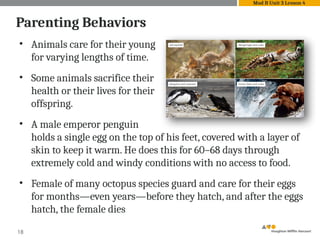
• These strategies include adult behaviors, such as courtship
and parenting.
14
Relating Animal Behaviors to
Reproductive Success
Mod B Unit 3 Lesson 4
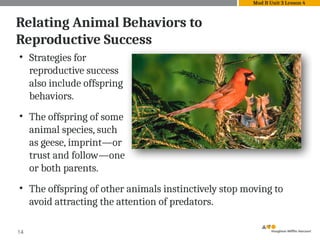
• Strategies for
reproductive success
also include offspring
behaviors.
• The offspring of some
animal species, such
as geese, imprint—or
trust and follow—one
or both parents.
• The offspring of other animals instinctively stop moving to
avoid attracting the attention of predators.
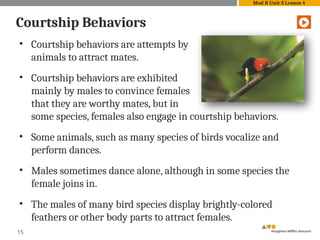
• Courtship behaviors are attempts by
animals to attract mates.
• Courtship behaviors are exhibited
mainly by males to convince females
that they are worthy mates, but in
some species, females also engage in courtship behaviors.
• Some animals, such as many species of birds vocalize and
perform dances.
• Males sometimes dance alone, although in some species the
female joins in.
• The males of many bird species display brightly-colored
feathers or other body parts to attract females.
15
Courtship Behaviors
Mod B Unit 3 Lesson 4
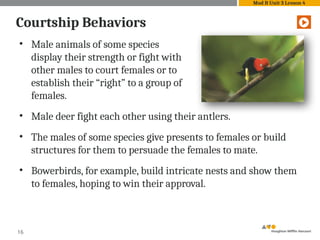
• Male animals of some species
display their strength or fight with
other males to court females or to
establish their “right” to a group of
females.
• Male deer fight each other using their antlers.
• The males of some species give presents to females or build
structures for them to persuade the females to mate.
• Bowerbirds, for example, build intricate nests and show them
to females, hoping to win their approval.
16
Courtship Behaviors
Mod B Unit 3 Lesson 4
• Parenting behaviors are
attempts by animals to
ensure their offspring’s
survival.
• These behaviors increase
their reproductive success.
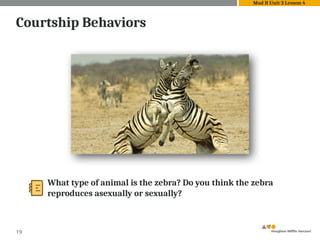
• Many animal species build nests for their eggs and young.
• Animals feed their young in a variety of ways. Female
mammals nurse their young with milk from their bodies.
• Other species gather or hunt food for their offspring.
17
Parenting Behaviors
Mod B Unit 3 Lesson 4
• Animals care for their young
for varying lengths of time.
• Some animals sacrifice their
health or their lives for their
offspring.
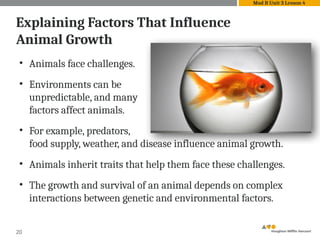
• A male emperor penguin
holds a single egg on the top of his feet, covered with a layer of
skin to keep it warm. He does this for 60–68 days through
extremely cold and windy conditions with no access to food.
• Female of many octopus species guard and care for their eggs
for months—even years—before they hatch, and after the eggs
hatch, the female dies
18
Parenting Behaviors
Mod B Unit 3 Lesson 4
19
Courtship Behaviors
What type of animal is the zebra? Do you think the zebra
reproduces asexually or sexually?
Mod B Unit 3 Lesson 4
20
Explaining Factors That Influence
Animal Growth
Mod B Unit 3 Lesson 4
• Animals face challenges.
• Environments can be
unpredictable, and many
factors affect animals.
• For example, predators,
food supply, weather, and disease influence animal growth.
• Animals inherit traits that help them face these challenges.
• The growth and survival of an animal depends on complex
interactions between genetic and environmental factors.
21
Genetic Factors Affect Animal Growth
Mod B Unit 3 Lesson 4
• Sexual reproduction in
animals results in genetic
variation of traits
in offspring.
• Differences in traits can
give some individuals an
advantage over other
individuals.
• Some offspring might have better eyesight or hearing, stronger
jaws or teeth, or thicker fur than other offspring.
• Some might not have inherited diseases that others have.
22
Genetic Factors Affect Animal Growth
Mod B Unit 3 Lesson 4
• These genetic differences
affect entire populations.
• Due to differences in
genetic traits, some
individuals in an animal
population might be able
to survive changing
environmental conditions better than other individuals.
• As a result, the population can continue to exist in the
community.
23
Environmental Factors Affect
Animal Growth
Mod B Unit 3 Lesson 4
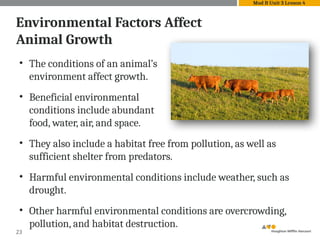
• The conditions of an animal’s
environment affect growth.
• Beneficial environmental
conditions include abundant
food, water, air, and space.
• They also include a habitat free from pollution, as well as
sufficient shelter from predators.
• Harmful environmental conditions include weather, such as
drought.
• Other harmful environmental conditions are overcrowding,
pollution, and habitat destruction.
24
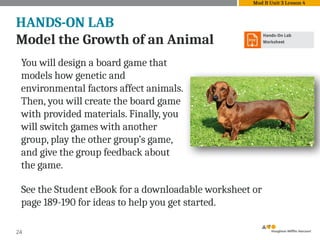
HANDS-ON LAB
Model the Growth of an Animal
You will design a board game that
models how genetic and
environmental factors affect animals.
Then, you will create the board game
with provided materials. Finally, you
will switch games with another
group, play the other group’s game,
and give the group feedback about
the game.
See the Student eBook for a downloadable worksheet or
page 189-190 for ideas to help you get started.
Mod B Unit 3 Lesson 4
25
TAKE IT FURTHER
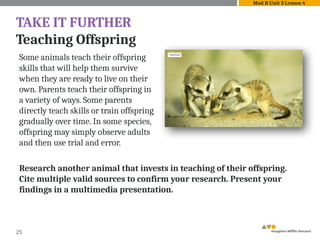
Teaching Offspring
Some animals teach their offspring
skills that will help them survive
when they are ready to live on their
own. Parents teach their offspring in
a variety of ways. Some parents
directly teach skills or train offspring
gradually over time. In some species,
offspring may simply observe adults
and then use trial and error.
Mod B Unit 3 Lesson 4
Research another animal that invests in teaching of their offspring.
Cite multiple valid sources to confirm your research. Present your
findings in a multimedia presentation.
26
Can You Explain It?
Refer to the notes in your
Evidence Notebook to help
you construct an
explanation for why the
male zebras are fighting.
• State your claim. Make sure your claim fully explains the
reasons why male zebras fight with each other.
• Summarize the evidence you have gathered to support
your findings and explain your reasoning.
Mod B Unit 3 Lesson 4
Image Credits
Mod B Unit 3 Lesson 4
elephant and young ©Heinrich van den Berg/Gallo Images/Getty Images;
fighting zebras ©Gallo Images - Brian Joffe/Riser/Getty Images; mating
dragonflies ©Milan Vachal/Shutterstock; male damselfish ©Luis Javier
Sandoval/ Oxford Scientific/Getty Images; Komodo dragon ©SURZ/YAY Media
AS/Alamy; cardinal and young ©JupiterImages/Photos.com/Getty Images;
manakin ©Tim Laman/National Geographic Stock; red squirrel
©hardeko/iStock/Getty Images Plus/ Getty Images; Bengal tiger and cubs
©Exactostock - 1598/Superstock; penguins ©David Osborn/Alamy; brown
bear and cubs © Sanford/Agliolo/
CORBIS/Flirt/Alamy; goldfish ©Mikael Damkier/Fotolia; gray wolf ©Sergio
Pitamitz/National Geographic/Getty Images; cattle ©Sam Wirzba/Design
Pics/Alamy; dachshund © Capture Light/Shutterstock; meerkat © David W.
Macdonald/Oxford Scientific/
Getty Images
27
Mod B Unit 3 Lesson 4

HMHScienceDimensions_ModB_U3_L4 (1).pptx

  • 1.
    Teaching Notes: Unit& Lesson Slides • The content, vocabulary, videos and activities shown on the following slides come directly from your student and teacher text. PDFs are referenced on slides and can be downloaded by teachers and students online at Ed: Your Friend in Learning (Ed: YFIL) • All slide content is editable, as you may add, remove or edit content to meet your individual classroom needs. • Many slides include notes such as: the Performance Expectations, Anchor Phenomenon, lesson objectives, building on prior knowledge, lab notes. • It is recommended that students utilize an evidence notebook as they ask questions, collect evidence and data throughout the lessons. This will help them with sense- making of the Anchor Phenomenon. Look for the notebook icon on the first and last slide of each lesson as a reminder. o Support for Evidence Notebooks can be found in the front of your Teacher Edition, and prompts will be shown in the student text throughout each lesson. 1 Teaching Notes
  • 2.
    Teaching Notes: UsingUnit & Lesson Slides • It is recommended you play/present slides when using for instruction. • Note: Some videos may not play with Google Slides. All videos can be found in the Student & Teacher eBooks • Slides that contain animations will have content that is initially hidden and revealed with click in play/presenter view. You can see all slide content in normal view. • To manage animations: – Open in PowerPoint – Click Animations – Click Animation Pane – Click the X to remove 2 Teaching Notes
  • 3.
    Teaching Suggestions: In-Person,Remote or Hybrid This editable, flexible resource can be used in a growing number of ways to meet your needs while supporting remote, hybrid or in- person teaching and learning for all: • In-person instructional and learning tool for teachers and students • Digital or remote presentation tool for online or virtual meetings • Easy-to-follow for parent-led instruction or substitute teachers • Flipped model instructional support for student distance learning • Student collaboration or alternative to collecting student responses 3 Teaching Notes
  • 4.
    Module B Unit 3:Reproduction, Heredity, and Growth Lesson 4: Animal Reproduction and Growth
  • 5.
    5 ELD Language Support LessonVocabulary ELL/ELD Strategy Illustrated Dictionary Draw models and write descriptions in your native language to help recall courtship, parenting, or offspring behaviors in animals. Mod B Unit 3 Lesson 4
  • 6.
    6 Can You ExplainIt? Why are these male zebras fighting? These zebras live on the grassy plains in Etosha National Park in Namibia. Plains zebras live in family groups that include one male and several females with their offspring. Mod B Unit 3 Lesson 4
  • 7.
    • As manyas eight or nine million species of animals may be living on Earth. • Some of these animals can reproduce asexually, sexual reproduction is the dominant form of reproduction of animals. • Multiple factors influence reproductive success. • For example, genetic factors may result in a male bird that has a call that females prefer over the calls of other males. • However, the survival of this male's offspring will depend on many different factors 7 Describing Animal Reproduction Mod B Unit 3 Lesson 4
  • 8.
    • Sexual reproduction involvestwo parents. • Offspring get one copy of their chromosomes from each parent. • As a result, organisms produced by this type of reproduction are genetically different from both parents. • This genetic variation increases the chance that some offspring will have traits that may help them survive in a changing environment. 8 Sexual Reproduction in Animals Mod B Unit 3 Lesson 4
  • 9.
    • In sexualreproduction, fertilization can be internal or external. • In some species, the male and female mate, and fertilization occurs inside the female’s body. • In other species, the female lays eggs, and the male fertilizes them outside the female’s body. • Some animals lay fertilized eggs, and others give birth to live offspring. 9 Sexual Reproduction in Animals Mod B Unit 3 Lesson 4
  • 10.
    • Asexual reproductionis a type of reproduction that involves only one parent. • The parent passes a copy of its genes to its offspring. • Unless there is a mutation, an organism produced by asexual reproduction is genetically identical to its parent and to other offspring produced asexually by the parent. • Environmental conditions can influence the type of reproduction used by an animal that can reproduce asexually or sexually. 10 Asexual Reproduction in Animals Mod B Unit 3 Lesson 4
  • 11.
    • These animalsmight reproduce asexually when rapid reproduction is beneficial, such as the opportunity to colonize a large area. • They might also reproduce asexually if conditions are unfavorable for sexual reproduction. • For example, a shortage of mates or an unsuitable temperature for survival might favor asexual reproduction. 11 Asexual Reproduction in Animals Mod B Unit 3 Lesson 4
  • 12.
    12 Asexual Reproduction inAnimals What type of animal is the zebra? Do you think the zebra reproduces asexually or sexually? Mod B Unit 3 Lesson 4
  • 13.
    13 Relating Animal Behaviorsto Reproductive Success Mod B Unit 3 Lesson 4 • Reproductive success is the ability to produce offspring that are healthy and that survive. • Different species of animals use different strategies to increase their chance of reproductive success. • These strategies include adult behaviors, such as courtship and parenting.
  • 14.
    14 Relating Animal Behaviorsto Reproductive Success Mod B Unit 3 Lesson 4 • Strategies for reproductive success also include offspring behaviors. • The offspring of some animal species, such as geese, imprint—or trust and follow—one or both parents. • The offspring of other animals instinctively stop moving to avoid attracting the attention of predators.
  • 15.
    • Courtship behaviorsare attempts by animals to attract mates. • Courtship behaviors are exhibited mainly by males to convince females that they are worthy mates, but in some species, females also engage in courtship behaviors. • Some animals, such as many species of birds vocalize and perform dances. • Males sometimes dance alone, although in some species the female joins in. • The males of many bird species display brightly-colored feathers or other body parts to attract females. 15 Courtship Behaviors Mod B Unit 3 Lesson 4
  • 16.
    • Male animalsof some species display their strength or fight with other males to court females or to establish their “right” to a group of females. • Male deer fight each other using their antlers. • The males of some species give presents to females or build structures for them to persuade the females to mate. • Bowerbirds, for example, build intricate nests and show them to females, hoping to win their approval. 16 Courtship Behaviors Mod B Unit 3 Lesson 4
  • 17.
    • Parenting behaviorsare attempts by animals to ensure their offspring’s survival. • These behaviors increase their reproductive success. • Many animal species build nests for their eggs and young. • Animals feed their young in a variety of ways. Female mammals nurse their young with milk from their bodies. • Other species gather or hunt food for their offspring. 17 Parenting Behaviors Mod B Unit 3 Lesson 4
  • 18.
    • Animals carefor their young for varying lengths of time. • Some animals sacrifice their health or their lives for their offspring. • A male emperor penguin holds a single egg on the top of his feet, covered with a layer of skin to keep it warm. He does this for 60–68 days through extremely cold and windy conditions with no access to food. • Female of many octopus species guard and care for their eggs for months—even years—before they hatch, and after the eggs hatch, the female dies 18 Parenting Behaviors Mod B Unit 3 Lesson 4
  • 19.
    19 Courtship Behaviors What typeof animal is the zebra? Do you think the zebra reproduces asexually or sexually? Mod B Unit 3 Lesson 4
  • 20.
    20 Explaining Factors ThatInfluence Animal Growth Mod B Unit 3 Lesson 4 • Animals face challenges. • Environments can be unpredictable, and many factors affect animals. • For example, predators, food supply, weather, and disease influence animal growth. • Animals inherit traits that help them face these challenges. • The growth and survival of an animal depends on complex interactions between genetic and environmental factors.
  • 21.
    21 Genetic Factors AffectAnimal Growth Mod B Unit 3 Lesson 4 • Sexual reproduction in animals results in genetic variation of traits in offspring. • Differences in traits can give some individuals an advantage over other individuals. • Some offspring might have better eyesight or hearing, stronger jaws or teeth, or thicker fur than other offspring. • Some might not have inherited diseases that others have.
  • 22.
    22 Genetic Factors AffectAnimal Growth Mod B Unit 3 Lesson 4 • These genetic differences affect entire populations. • Due to differences in genetic traits, some individuals in an animal population might be able to survive changing environmental conditions better than other individuals. • As a result, the population can continue to exist in the community.
  • 23.
    23 Environmental Factors Affect AnimalGrowth Mod B Unit 3 Lesson 4 • The conditions of an animal’s environment affect growth. • Beneficial environmental conditions include abundant food, water, air, and space. • They also include a habitat free from pollution, as well as sufficient shelter from predators. • Harmful environmental conditions include weather, such as drought. • Other harmful environmental conditions are overcrowding, pollution, and habitat destruction.
  • 24.
    24 HANDS-ON LAB Model theGrowth of an Animal You will design a board game that models how genetic and environmental factors affect animals. Then, you will create the board game with provided materials. Finally, you will switch games with another group, play the other group’s game, and give the group feedback about the game. See the Student eBook for a downloadable worksheet or page 189-190 for ideas to help you get started. Mod B Unit 3 Lesson 4
  • 25.
    25 TAKE IT FURTHER TeachingOffspring Some animals teach their offspring skills that will help them survive when they are ready to live on their own. Parents teach their offspring in a variety of ways. Some parents directly teach skills or train offspring gradually over time. In some species, offspring may simply observe adults and then use trial and error. Mod B Unit 3 Lesson 4 Research another animal that invests in teaching of their offspring. Cite multiple valid sources to confirm your research. Present your findings in a multimedia presentation.
  • 26.
    26 Can You ExplainIt? Refer to the notes in your Evidence Notebook to help you construct an explanation for why the male zebras are fighting. • State your claim. Make sure your claim fully explains the reasons why male zebras fight with each other. • Summarize the evidence you have gathered to support your findings and explain your reasoning. Mod B Unit 3 Lesson 4
  • 27.
    Image Credits Mod BUnit 3 Lesson 4 elephant and young ©Heinrich van den Berg/Gallo Images/Getty Images; fighting zebras ©Gallo Images - Brian Joffe/Riser/Getty Images; mating dragonflies ©Milan Vachal/Shutterstock; male damselfish ©Luis Javier Sandoval/ Oxford Scientific/Getty Images; Komodo dragon ©SURZ/YAY Media AS/Alamy; cardinal and young ©JupiterImages/Photos.com/Getty Images; manakin ©Tim Laman/National Geographic Stock; red squirrel ©hardeko/iStock/Getty Images Plus/ Getty Images; Bengal tiger and cubs ©Exactostock - 1598/Superstock; penguins ©David Osborn/Alamy; brown bear and cubs © Sanford/Agliolo/ CORBIS/Flirt/Alamy; goldfish ©Mikael Damkier/Fotolia; gray wolf ©Sergio Pitamitz/National Geographic/Getty Images; cattle ©Sam Wirzba/Design Pics/Alamy; dachshund © Capture Light/Shutterstock; meerkat © David W. Macdonald/Oxford Scientific/ Getty Images 27 Mod B Unit 3 Lesson 4

Editor's Notes

  • #4 The learning experiences in this lesson prepare students for the mastery of MS-LS1-4 Use argument based on empirical evidence and scientific reasoning to support an explanation for how characteristic animal behaviors and specialized plant structures affect the probability of successful reproduction of animals and plants respectively. MS-LS1-5 Construct a scientific explanation based on evidence for how environmental and genetic factors influence the growth of organisms.
  • #6 Lesson Objective Students gather evidence to explain factors that affect the reproduction and growth of animals. Throughout the lesson, students gather evidence to explain how the fighting behavior of male zebras relates to reproductive success.