History of Computers
Week 1
Definition of a Computer
 A computer is defined in
the following ways
 By the work it does
 By the kind of
information it handles
 By its size and price
Particulars are Moving
Targets
 Technology advances at
exponential rates
 Computer memory capacity
quadruples every 3 years?
 Computer processor speed
doubles every 3 years?
 Computer networks - number of
hosts doubles every year
Computer Networks
 Network - two or more
connected computers
 Purpose - sharing or exchange
of information and/or
resources
 Benefits
 improved efficiency
 reduces need for travel…
Computers and Networks
 Facilitate
 Concentration of knowledge and
control
 Distribution of knowledge and control
 Have the power to
 Amass and interrogate enormous
volumes of data
 Process data at enormous rates for
real systems and simulations
Computers and Networks
Challenge:
 Constitutional definitions
 Social structures
 Lifestyle options
What is a Society?
 A voluntary association of
individuals for common ends
 An enduring and cooperating social
group whose members have
developed organized patterns of
relationships through interaction
with one another
 A companionship with one’s
fellows
What is a Society?
 A part of a community that is a unit
distinguishable by particular aims
or standards of living or conduct
 The sum of human conditions and
activity regarded as a whole
functioning interdependently
 The customs and organization of
an ordered community
How have Computers
Affected Society?
 What are the parts of a
society?
 What has been the affect of
computers on these parts?
 What are the benefits?
 What are the problems?
 What will happen next?
What about the Internet?
 In recent years this one
area has affected society
more than any other
 How?
 What are the issues here?
The Parts of a Society
 Education
 Transportation
 Private Sector
 Business
 Government
 Entertainment
 Housing
The Parts of a Society
 Currency (banking)
 Jobs
 Space
 Medicine
 Anything else?
Technological Revolutions
 Agricultural Revolution
 Industrial Revolution
 Computational Revolution
Revolution Comparison
 Workforce distribution
 Productivity benefits
 Breadth of impact
How Society Reacts to
Revolutions
 Incorporate benefits
 Civilize change
 Compensate injured
 Regain balance
Early Calculating
Machines
 Abacus
 Slide rule
 Mechanical calculator
 Stepped reckoner
 Textile industry - Jacquard
Loom
 Difference engine
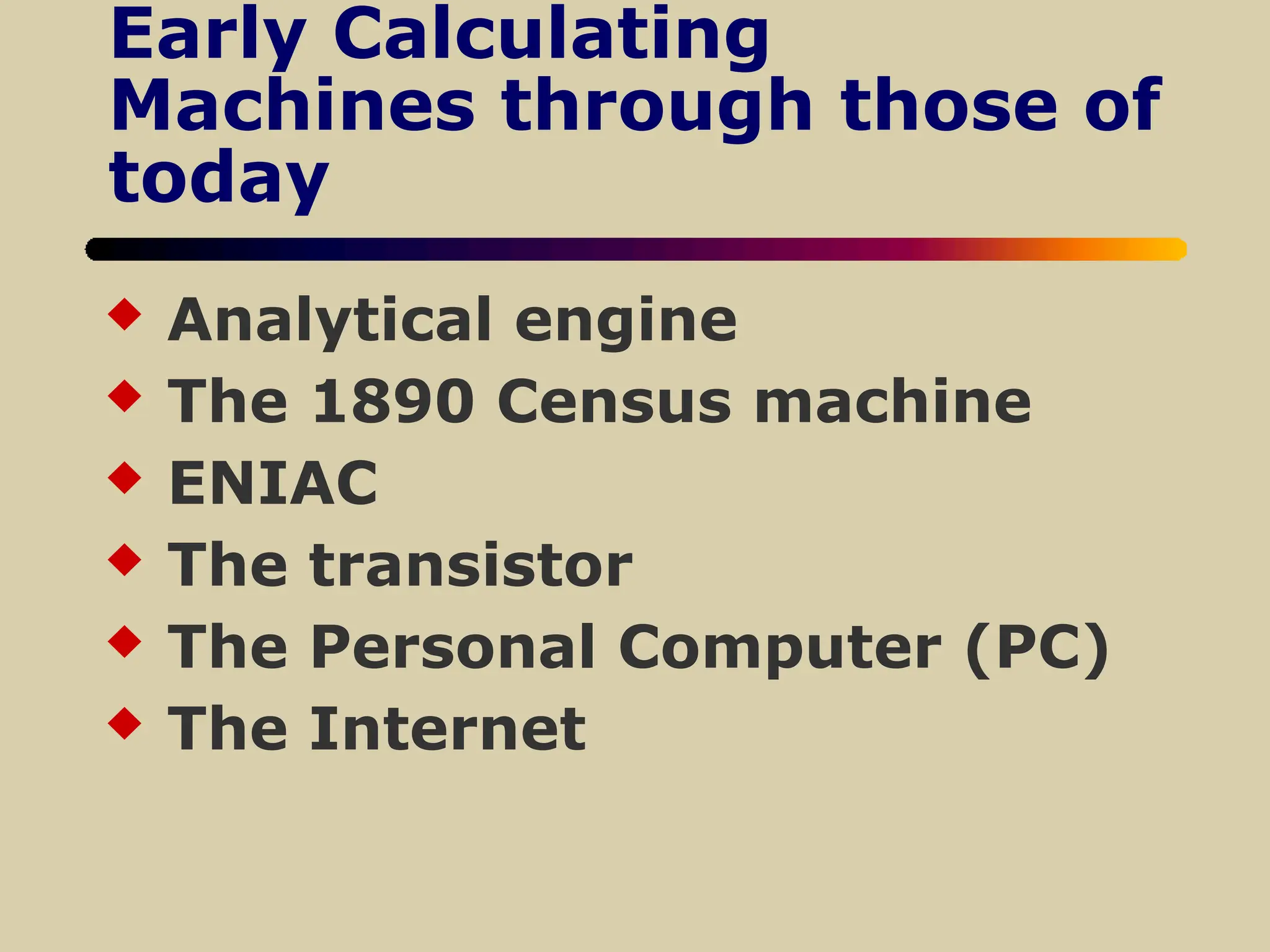
Early Calculating
Machines through those of
today
 Analytical engine
 The 1890 Census machine
 ENIAC
 The transistor
 The Personal Computer (PC)
 The Internet
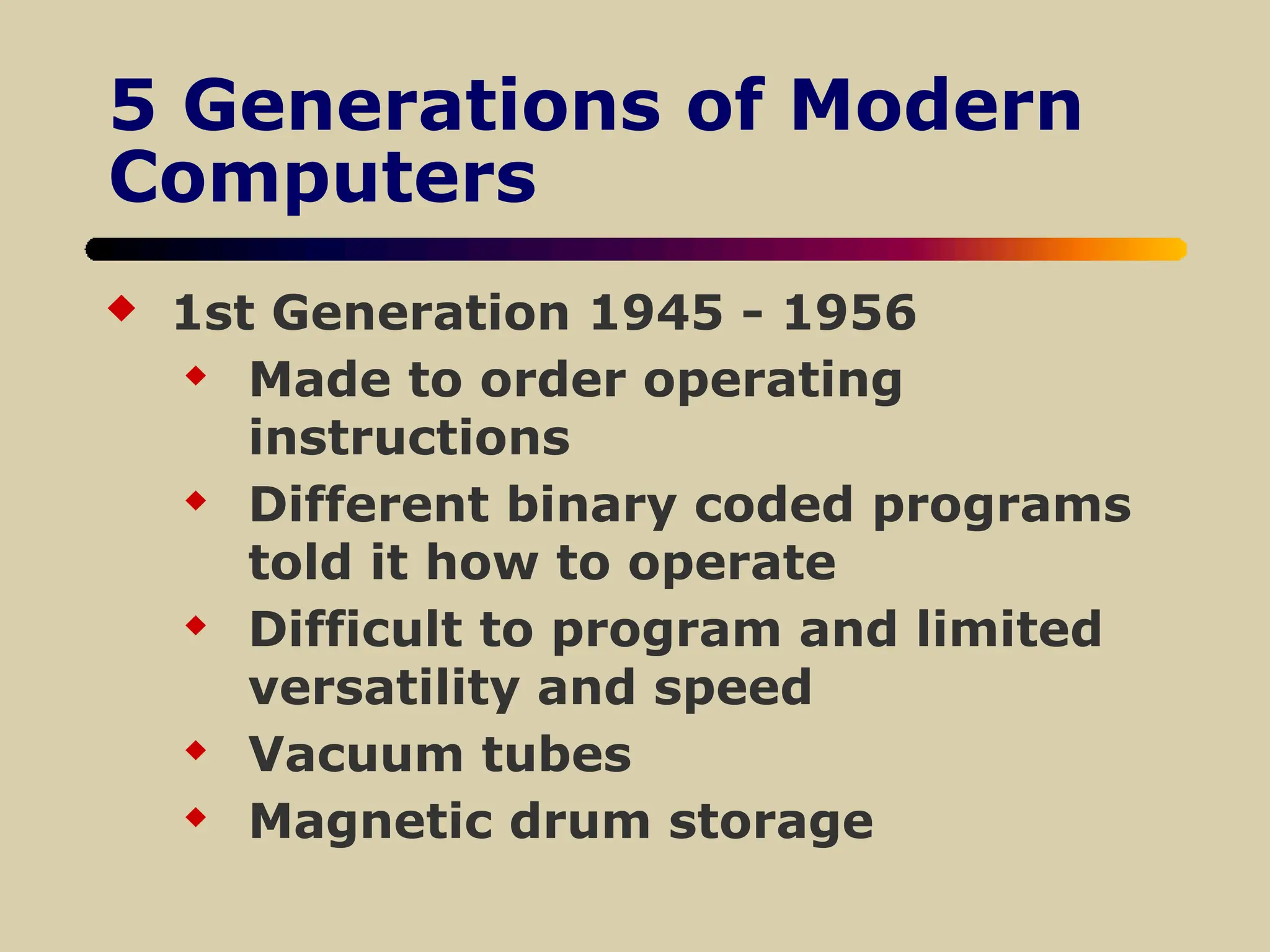
5 Generations of Modern
Computers
 1st Generation 1945 - 1956
 Made to order operating
instructions
 Different binary coded programs
told it how to operate
 Difficult to program and limited
versatility and speed
 Vacuum tubes
 Magnetic drum storage
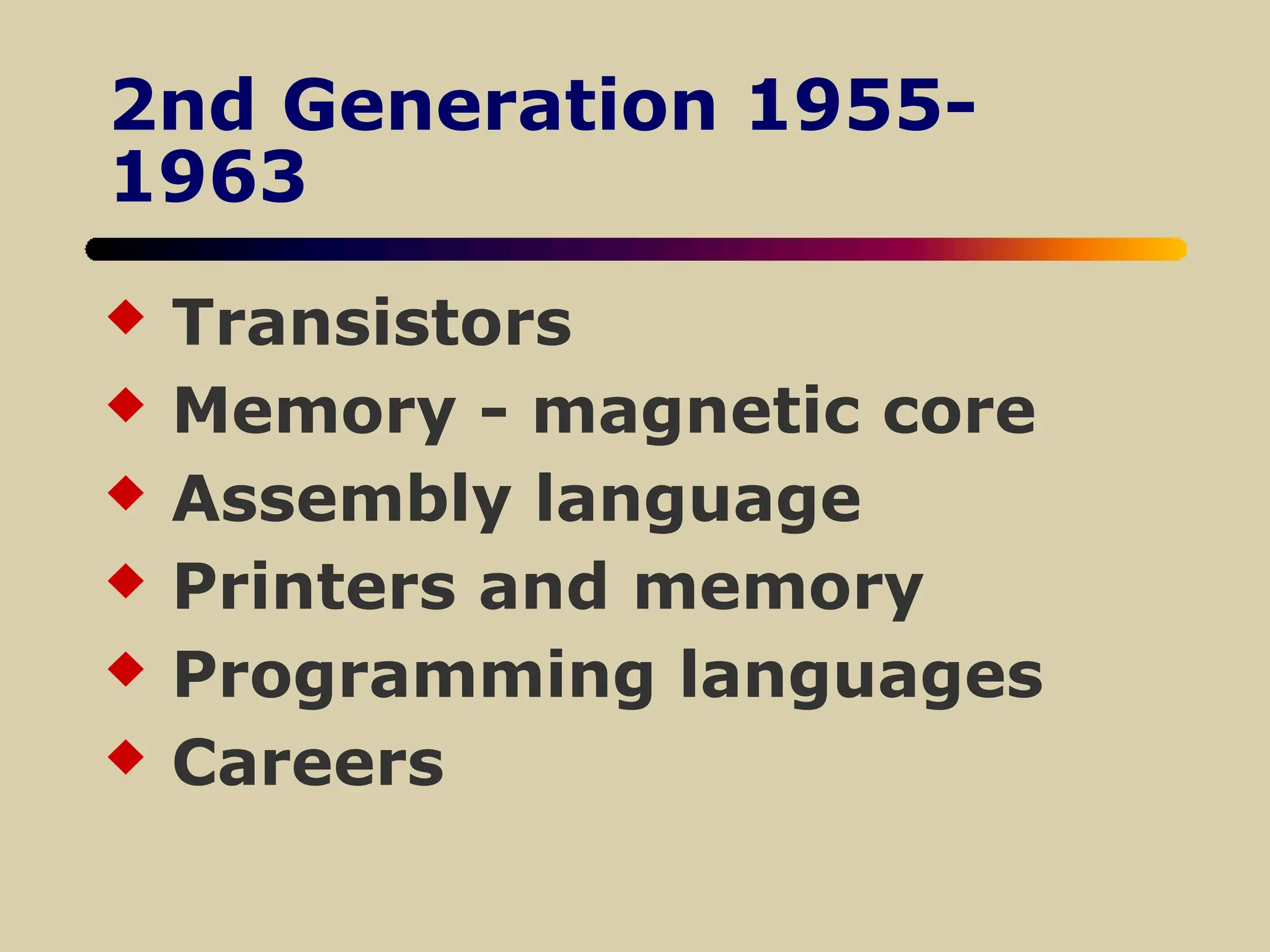
2nd Generation 1955-
1963
 Transistors
 Memory - magnetic core
 Assembly language
 Printers and memory
 Programming languages
 Careers
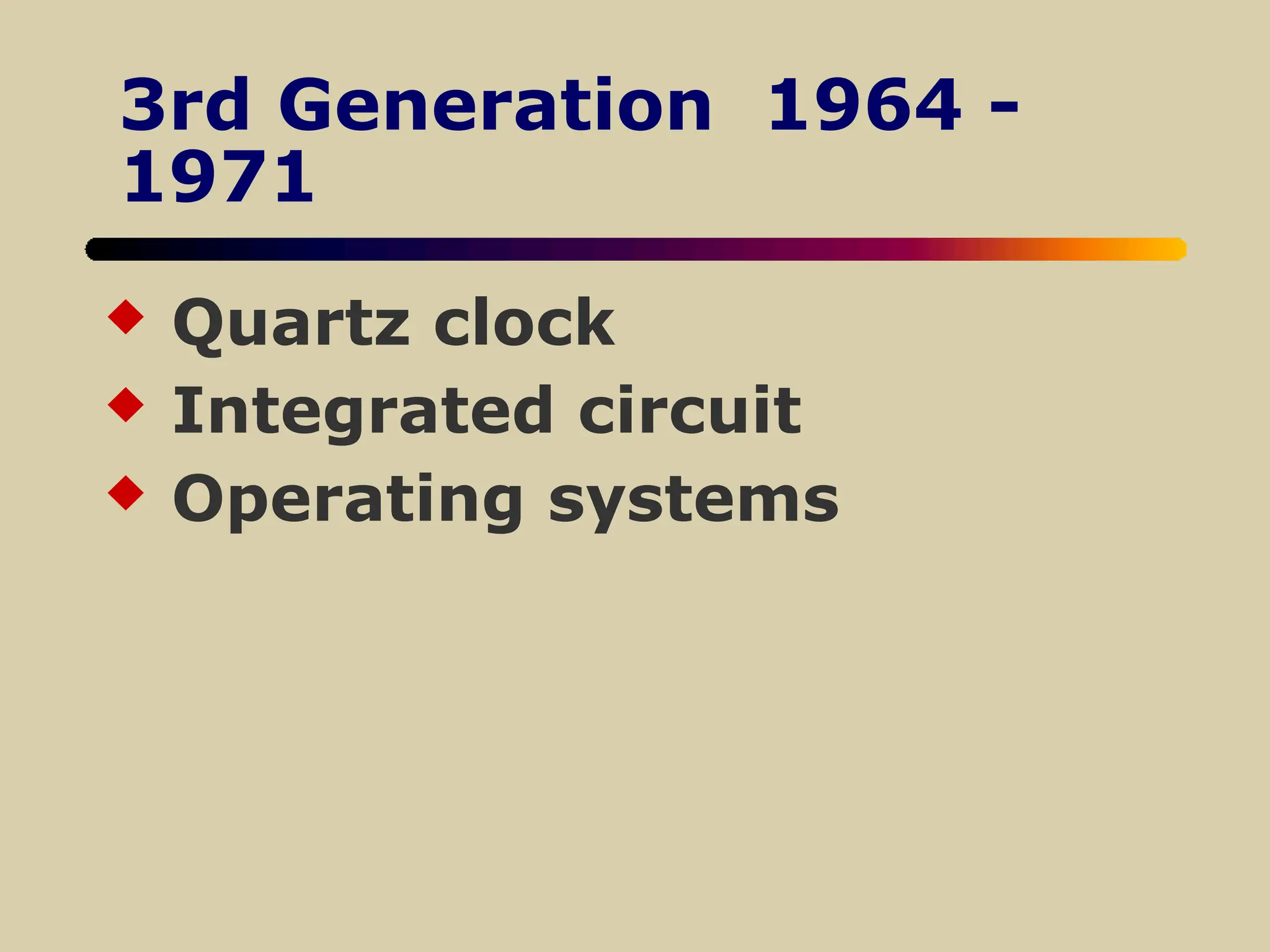
3rd Generation 1964 -
1971
 Quartz clock
 Integrated circuit
 Operating systems
4th Generation 1971 -
now
 LSI - Large Scale Integration
 VLSI- Very Large Scale
Integration (ULSI)
 Chip
 General consumer usage
 Networks
5th Generation
 This is the future
 What will it be like?
 What changes will be big
enough to create this new
generation?
Pioneers of Computing
 Charles
Babbage
 Konrad Zuse
 John von
Neumann
 Alan Turing
 Steve Jobs
Important Machines
 IBM 700 Series
 IBM 360/370
Series
 CDC star
 Cray 1
 DEC VAX
 IBM PC
 Apple McIntosh
Taxonomy of Computers
 Mainframes
 Minis
 Micros
 Supercomputers
 Embedded
Don’t Forget the Chip
 Computers are used in many
different technologies
 For example: bread
machine, ATM, cars, TV,
microwave, cash register,
…..
 How has this utilization
affected society?
ATM Example
 Positive
 CONVENIENCE
 Negative
 Unemployment
 Alienation and customer service
 Crime
 Loss of privacy
 Errors
Reconsider the Problems
 Unemployment -> more computer
jobs
 Alienation -> go during business
hours
 Crime -> add lights, change
angle,etc.
Weigh the positive against the
negative
Solutions to Problems
 Technical
 Managerial
 Legal
 Market mechanisms
 Education
Issues to be Studied Due
to Computers in Society
 Privacy of communications
 Intellectual property
 Constitutional issues
 General social issues
 Professional ethics

History of Computer and Computer Network.ppt

  • 1.
  • 2.
    Definition of aComputer  A computer is defined in the following ways  By the work it does  By the kind of information it handles  By its size and price
  • 3.
    Particulars are Moving Targets Technology advances at exponential rates  Computer memory capacity quadruples every 3 years?  Computer processor speed doubles every 3 years?  Computer networks - number of hosts doubles every year
  • 4.
    Computer Networks  Network- two or more connected computers  Purpose - sharing or exchange of information and/or resources  Benefits  improved efficiency  reduces need for travel…
  • 5.
    Computers and Networks Facilitate  Concentration of knowledge and control  Distribution of knowledge and control  Have the power to  Amass and interrogate enormous volumes of data  Process data at enormous rates for real systems and simulations
  • 6.
    Computers and Networks Challenge: Constitutional definitions  Social structures  Lifestyle options
  • 7.
    What is aSociety?  A voluntary association of individuals for common ends  An enduring and cooperating social group whose members have developed organized patterns of relationships through interaction with one another  A companionship with one’s fellows
  • 8.
    What is aSociety?  A part of a community that is a unit distinguishable by particular aims or standards of living or conduct  The sum of human conditions and activity regarded as a whole functioning interdependently  The customs and organization of an ordered community
  • 9.
    How have Computers AffectedSociety?  What are the parts of a society?  What has been the affect of computers on these parts?  What are the benefits?  What are the problems?  What will happen next?
  • 10.
    What about theInternet?  In recent years this one area has affected society more than any other  How?  What are the issues here?
  • 11.
    The Parts ofa Society  Education  Transportation  Private Sector  Business  Government  Entertainment  Housing
  • 12.
    The Parts ofa Society  Currency (banking)  Jobs  Space  Medicine  Anything else?
  • 13.
    Technological Revolutions  AgriculturalRevolution  Industrial Revolution  Computational Revolution
  • 14.
    Revolution Comparison  Workforcedistribution  Productivity benefits  Breadth of impact
  • 15.
    How Society Reactsto Revolutions  Incorporate benefits  Civilize change  Compensate injured  Regain balance
  • 16.
    Early Calculating Machines  Abacus Slide rule  Mechanical calculator  Stepped reckoner  Textile industry - Jacquard Loom  Difference engine
  • 17.
    Early Calculating Machines throughthose of today  Analytical engine  The 1890 Census machine  ENIAC  The transistor  The Personal Computer (PC)  The Internet
  • 18.
    5 Generations ofModern Computers  1st Generation 1945 - 1956  Made to order operating instructions  Different binary coded programs told it how to operate  Difficult to program and limited versatility and speed  Vacuum tubes  Magnetic drum storage
  • 19.
    2nd Generation 1955- 1963 Transistors  Memory - magnetic core  Assembly language  Printers and memory  Programming languages  Careers
  • 20.
    3rd Generation 1964- 1971  Quartz clock  Integrated circuit  Operating systems
  • 21.
    4th Generation 1971- now  LSI - Large Scale Integration  VLSI- Very Large Scale Integration (ULSI)  Chip  General consumer usage  Networks
  • 22.
    5th Generation  Thisis the future  What will it be like?  What changes will be big enough to create this new generation?
  • 23.
    Pioneers of Computing Charles Babbage  Konrad Zuse  John von Neumann  Alan Turing  Steve Jobs
  • 24.
    Important Machines  IBM700 Series  IBM 360/370 Series  CDC star  Cray 1  DEC VAX  IBM PC  Apple McIntosh
  • 25.
    Taxonomy of Computers Mainframes  Minis  Micros  Supercomputers  Embedded
  • 26.
    Don’t Forget theChip  Computers are used in many different technologies  For example: bread machine, ATM, cars, TV, microwave, cash register, …..  How has this utilization affected society?
  • 27.
    ATM Example  Positive CONVENIENCE  Negative  Unemployment  Alienation and customer service  Crime  Loss of privacy  Errors
  • 28.
    Reconsider the Problems Unemployment -> more computer jobs  Alienation -> go during business hours  Crime -> add lights, change angle,etc. Weigh the positive against the negative
  • 29.
    Solutions to Problems Technical  Managerial  Legal  Market mechanisms  Education
  • 30.
    Issues to beStudied Due to Computers in Society  Privacy of communications  Intellectual property  Constitutional issues  General social issues  Professional ethics