On this 20th century, business operators are tremendously expanding their activities from local to international to gain more market share. With this globalization era, the organization has to face the regulatory pressures as each country has different kinds of regulation, the high of customer demands and intense competitiveness from other rivalry that force the organization to change so they can fit with the external environment that may impact the organizations. Organizational change can be defined as \"
the movement of an organization away from its present state and toward some desired future state to increase its efficiency and effectiveness.\"
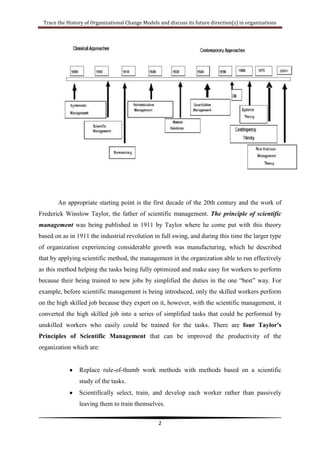
 During organizational change, managers must balance the need to improve current operations with the need to respond to new and unpredictable events. Change is not new to the organization; it happened from time to time whether it is unplanned or planned. What is comparatively new, however, is the study of organization change. The study here means are the models, approaches, theories or tools of change can facilitate and enhance effective change and what leads to fail at the organization change. These different kinds of models are keeps developing to new models or approaches because of the new initiatives, projects based working, technology improvements and staying ahead among other rivalry. Thus, it can help to smoothen out the process of change management. <br />The history of organizational change models is started in the old times where once the organizations had been set up, changes will exists. The organizations that adapt to change regardless it success or not, they apply many kinds of models to ensure that the change is effectively and to overcome the resist of change. With these models also, the managers will be more understand what happened inside the organization and directly can formulate strategies to be leader in business environments. In understanding the need for change and the guiding philosophy of change can be developed from the way managements thought evolved over a period of time. In different era we see different management philosophy and thoughts that can guide the business to operate efficiently. The following diagram is the evolution of management that representation approaches that can be as bases for the organization to implement strategy. It tells us what has turned the wheel of change and what has been the guiding force for the process of change from time to time. <br />An appropriate starting point is the first decade of the 20th century and the work of Frederick Winslow Taylor, the father of scientific management. The principle of scientific management was being published in 1911 by Taylor where he come put with this theory based on as in 1911 the industrial revolution in full swing, and during this time the larger type of organization experiencing considerable growth was manufacturing, which he described that by applying scientific method, the management in the organization able to run effectively as this method helping the tasks being fully optimized and make easy for workers to perform because their being trained to new jobs by simplified the duties in the one “best” way. For example, before scientific management is being introduced, only the skilled workers perform on the high skilled job because they expert on it, however, with the scientific management, it converted the high skilled job into a series of simplified tasks that could be performed by unskilled workers who easily could be trained for the tasks. There are four Taylor's Principles of Scientific Management that can be improved the productivity of the organization which are:<br />Replace rule-of-thumb work methods with methods based on a scientific study of the tasks. <br />Scientifically select, train, and develop each worker rather than passively leaving them to train themselves.<br />Cooperate with the workers to ensure that the scientifically developed methods are being followed.<br />Divide work nearly equally between managers and workers, so that the managers apply scientific management principles to planning the work and the workers actually perform the tasks<br />With these principles, some scholars said Taylor was probably as an organization change agent, because with his theory of scientific management would be able the organization success to change because with the these four principles it is easy for the organization adapt to changes as it involved the workers and managers to cooperate together by treating each workers as humanely by giving them training, planning and set up rule of thumbs. <br />During this period also, the evolving of new theories that involved of change management is Hawthorne studies. It turned out because of the Taylor’s method is emphasized on economics and engineering whereas in this era the companies also routinely studied the effects of the physical environment on their workers. For example, they made different kind of lighting brightness to find the optimum level of light for maximum productivity. They played music in the workplace, varied the temperature, tried different compensation schemes, adjusted the number of working hours in a day and more. Beginning in 1924 and continuing into 1933, the Western Electric Company sponsored a series of experiments for studying worker productivity and morale at its Hawthorne Works, in Chicago. The researchers, from the Harvard Business School, were led by Fritz Roethlisberger, T. N. Whitehead, Elton Mayo, and George Homans and by W. J. Dickson of Western Electric. The four categories of Hawthorne’s experiments are the illumination experiments, the relay assembly group experiments, the interviewing program and the bank-wiring group studies. These experiments are to determine the effect of working conditions on productivity and morale. Throughout these experiments it was clear that the responses of workers to what was happening about them were dependent on the significance these events had for them. As a result of the research, it proved the importance of employee attitudes and sentiments. From the result also, the researchers conclusively stated that the Hawthorne studies are significant as a precursor to our understanding of organization change for the following reasons:<br />They demonstrated the important influence of psychological or human factors on worker productivity and morale.
They signalled the criticality of certain variables for worker satisfaction: autonomy on the job (workers being able to set their own work pace), the relative lack of a need for close supervision of people who know their jobs, the importance of receiving feedback on the direct relationship between performance and reward, and having choices and some influence over change.
They ushered in more humanistic treatment of workers on the job.Then as time goes by, the organizational changes theory keep developing to new model as in late 1940s and early 1950s after the world war II, Industrial Psychology or in modern days it called Organizational Psychology theory has been emphasized as it will give better understanding on organization change that influenced by  the Hawthorne studies and few researchers such as Kurt Lewin and HYPERLINK \"
http://en.wikipedia.org/wiki/Muzafer_Sherif\"
 \o \"
Muzafer Sherif\"
Muzafer Sherif. In 1953, a researcher named Edwin A. Fleishman conducted a researcher about this approach as for him it is useful background for understanding the current of organization. This research is a combined of training and the a psychological test, to see the consequences of supervisor training whether supervisors’ attitudes and behaviour would change as a result training program on leadership principles and techniques by giving several questionnaires that highlighted the tests about here are the  (1) initiation of structure, the task direction and conditions for effective performance, and (2) consideration, the leader’s sensitivity to and consideration of subordinates’ needs and feelings. Thus, with this research it concludes that as from the training and test it gives results that individual change strategy will occur if the objective of the training was the same direction with the whole organization change. The understanding of industrial psychology gives contributions as if the organization wanted to change they must to look at both ways which are focusing on the individual and focusing on contextual variables (such as group norms and organizational culture) and systemic factors (such as structure). <br /> When world war over, people seems to pursue a variety of many invention or innovation event. Kurt Lewin, the director of the Research Centre for Group Dynamics, conducted a training workshop that would help to improve community leadership in general and interracial relationships in particular. The training consisted of lectures, role play, and group discussion. All researchers and trainers met to evaluate the training by discussing participant behaviour as the participants receive feedback from one another on their behaviour in the group, and this feedback becomes the learning source for the organizations staffs’ development. Participants also have an opportunity to learn more about group behaviour and intergroup relationships.  In other means, the participants become sensitive between each other as how they were being perceived by others and the impact of their attitudes towards others. Kurt Lewin believe that with the Sensitivity Training, T-Groups and Laboratory Training it provide many data collection for change because with the understanding of the individual change it will be easy for the whole organizations to change.<br />During these era also, the mostly famously classic approaches of change process model developed by Kurt Lewin in 1947 is the three stage model that includes Unfreezing: It involves getting to be more understanding that change is necessary, and getting ready to not stick from our current comfort zone anymore, Change: Transition is the inner movement or process of change we make in reaction to a change. This second stage occurs as we decided to make the changes that are needed. Final stage is Refreezing: The changes are accepted and become the new culture for the organizations. People build new relationships and become comfortable with their new routines. This model has been developed because it helps the OD practitioner to know what are the steps need to be taken in dealing with the change process. With the action involved in this each stages the OD practitioners solve their own problems and learn to do better.<br />After that, the period immediately was a productive time for innovation and creativity because it is the newly nationalized coal industry where mostly the organizations have problems in adaptation to new technology. Based on the research conducted by Eric Trist (1993), if the organizations want to adapt new technology, it must be based on new approach called Sociotechnical system. This approach is a new approach to organization change. It consists of the technical system (equipment, machinery, chemical processes, etc.) and the social system (individual workers and groups of workers). Considering organization change through a sociotechnical system means that the person involved would gather data about both the social and technical systems, then considers and act with the perspective that the two are interdependent: A change in one system will directly affect the other, and this effect must be treated as leverage in the change process. For example, changing a piece of software in an organization’s information system (the technical) will directly affect how employees who use the software interact with one another in the future.<br />Both sensitivity training and sociotechnical systems set the stage for the emergence of organization development (OD). As the T-group method of learning and change began to proliferate in the 1950s, it gradually gravitated to organizational life. All these models above starting from the 1940s’s model such as the National Training Laboratories and T-Groups up to 1980s of Strategic Change models are the evolution of organization development. Refer to Cummings and Worley, \"
Organization Development and Change\"
, Sixth Edition, South-Western Publishing, 1997, stated that ”Organization development is a system-wide application of behavioural science knowledge to the planned development and reinforcement of organizational strategies, structures, and processes for improving an organization's effectiveness.\"
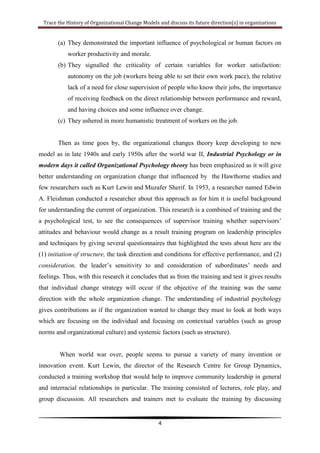
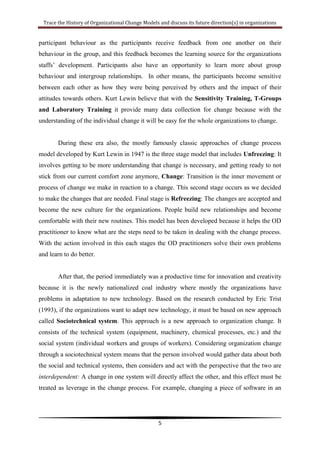
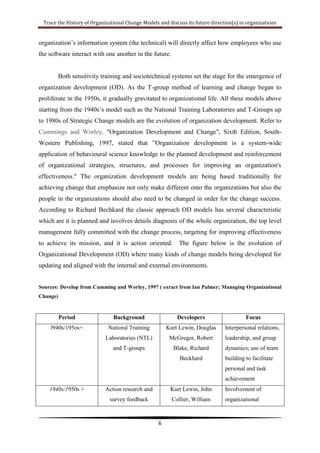
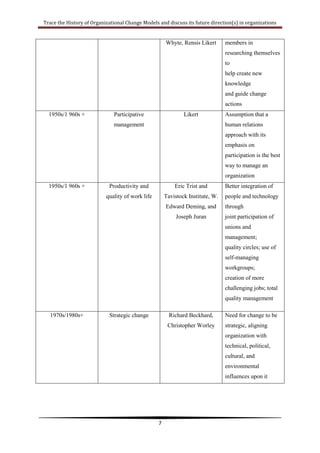
 The organization development models are being based traditionally for achieving change that emphasize not only make different onto the organizations but also the people in the organizations should also need to be changed in order for the change success. According to Richard Bechkard the classic approach OD models has several characteristic which are it is planned and involves details diagnosis of the whole organization, the top level management fully committed with the change process, targeting for improving effectiveness to achieve its mission, and it is action oriented.  The figure below is the evolution of Organizational Development (OD) where many kinds of change models being developed for updating and aligned with the internal and external environments.<br />Sources: Develop from Cumming and Worley, 1997 ( exract from Ian Palmer; Managing Organizational Change)<br />PeriodBackgroundDevelopersFocusl940s/195os+Natioral Training Laboratories (NTL) and T-groupsKurt Lewin, Douglas McGregor, Robert Blake, Richard BeckhardInterpersonal relations, leadership, and group dynamics; use of team building to facilitate personal and task achievement 1940s/1950s +  Action research and survey feedbackKurt Lewin, John Collier, William Whyte, Rensis LikertInvolvement of organizational members in researching themselves to help create new knowledge and guide change actions1950s/1 960s +Participative managementLikertAssumption that a human relations approach with its emphasis on participation is the best way to manage an organization 1950s/1 960s +Productivity and quality of work lifeEric Trist and Tavistock Institute, W. Edward Deming, and Joseph JuranBetter integration of people and technology  through joint participation of unions and management; quality circles; use of self-managing workgroups; creation of more challenging jobs; total quality management1970s/1980s+Strategic changeRichard Beckhard, Christopher WorleyNeed for change to be strategic, aligning organization with technical, political, cultural, and environmental influences upon it<br />However, there are contradictory opinions about these traditional OD models’ status and its future prospects of organizational development as these models during the OD evolution have several challenges  especially in future because the OD models are basically on behavioural science theory that whose time has come and gone. An article made by Bunker, Alban, and Lewicki state that for OD to be more revitalize in future these are the points that are very important to focus on: virtual teams, conflict resolution, work group effectiveness, social network analysis, trust, and intractable conflict as these areas can close the gap between research theory and practice (i.e., training). Furthermore, as new era come and many factors has involved such from the external factors that currently intense competition among rivalry are strong, what the organization should do is change to be more systematically that can fit with the environment. A survey conducted by Church, Waclawski, and Berr, they proved that the most in-demand services right now for future change management are these areas: <br />executive coaching and development <br />team building and team effectiveness <br />facilitating strategic organizational change <br />systemic integration <br />Diversity and multiculturalism.<br />These areas should be highlighted in the organization because, in these modern time, organization need to face the challenges outside there such as need for speed, resistance to change and updating interpersonal skills and awareness.<br />Thus, for the organization to be more successful in dealing organization change, the change management approaches is being introduced for organizational change for dealing the new era challenges in organization. These change management approaches or may be called emergent change approaches, is more systematic approach as it provide multistep models of how to achieve large scale, transformational change. Emergent approaches seem fit in a fast changing environment where changes affect the whole organization and the focus is more on human resources and behaviors. <br />Briefly, emergent approaches to change have the following characteristics, as extracted from Burnes (1996):<br />change is seen as a continuous process of learning and experimentation in order to adapt and align to a turbulent environment: small-scale changes over time can lead to larger changes in the organizations;
managers should create a climate of risk-taking and empower employees through participative management of the change process;
managers should create a collective vision to direct the change process: and
key activities should be information-gathering, communication and learningContradicted with the traditional planned approaches of change the emergent approaches to change management focus on finding and strengthen the organizational capabilities: which involving all participants: change of culture instead of structures: emergent transformations: by using incentives for support: and lastly on using small and process-driven change consultants. To conclude this section on change approaches, it is vital to note that most organizations tend to follow a combination of the planned and emergent approaches to change management, depending on their circumstances and the specific objectives of the organization (Burnes, 1996, p. 338; Beer & Nohria, 2ooo).<br />Examples of various change management approaches are Kanter, Stein and Jick (1992) Ten Commandments; Pendlebury, Grourd, and Meston (1998) Ten Keys; Taffinder (1998) Transformation Trajectory; Kirkpatrick (2001) Step-by-Step Model; Light (2005) RAND’s Six Steps and Leppitt (2006) Integrated Model. These new models are entails of steps version on how change should be implemented. Such as the Ten Commandments, these are the steps that need to be followed as change often being messy and difficult, with the sequence steps the organization can achieve effective change:<br />Analyze the organization and its need for change.
Create vision and common direction.
Separate from the past.
Create a sense of urgency.
Support a strong leader role.
 Line up political sponsorship.
Craft an implementation plan.

History change

  • 1.
    On this 20thcentury, business operators are tremendously expanding their activities from local to international to gain more market share. With this globalization era, the organization has to face the regulatory pressures as each country has different kinds of regulation, the high of customer demands and intense competitiveness from other rivalry that force the organization to change so they can fit with the external environment that may impact the organizations. Organizational change can be defined as \" the movement of an organization away from its present state and toward some desired future state to increase its efficiency and effectiveness.\" During organizational change, managers must balance the need to improve current operations with the need to respond to new and unpredictable events. Change is not new to the organization; it happened from time to time whether it is unplanned or planned. What is comparatively new, however, is the study of organization change. The study here means are the models, approaches, theories or tools of change can facilitate and enhance effective change and what leads to fail at the organization change. These different kinds of models are keeps developing to new models or approaches because of the new initiatives, projects based working, technology improvements and staying ahead among other rivalry. Thus, it can help to smoothen out the process of change management. <br />The history of organizational change models is started in the old times where once the organizations had been set up, changes will exists. The organizations that adapt to change regardless it success or not, they apply many kinds of models to ensure that the change is effectively and to overcome the resist of change. With these models also, the managers will be more understand what happened inside the organization and directly can formulate strategies to be leader in business environments. In understanding the need for change and the guiding philosophy of change can be developed from the way managements thought evolved over a period of time. In different era we see different management philosophy and thoughts that can guide the business to operate efficiently. The following diagram is the evolution of management that representation approaches that can be as bases for the organization to implement strategy. It tells us what has turned the wheel of change and what has been the guiding force for the process of change from time to time. <br />An appropriate starting point is the first decade of the 20th century and the work of Frederick Winslow Taylor, the father of scientific management. The principle of scientific management was being published in 1911 by Taylor where he come put with this theory based on as in 1911 the industrial revolution in full swing, and during this time the larger type of organization experiencing considerable growth was manufacturing, which he described that by applying scientific method, the management in the organization able to run effectively as this method helping the tasks being fully optimized and make easy for workers to perform because their being trained to new jobs by simplified the duties in the one “best” way. For example, before scientific management is being introduced, only the skilled workers perform on the high skilled job because they expert on it, however, with the scientific management, it converted the high skilled job into a series of simplified tasks that could be performed by unskilled workers who easily could be trained for the tasks. There are four Taylor's Principles of Scientific Management that can be improved the productivity of the organization which are:<br />Replace rule-of-thumb work methods with methods based on a scientific study of the tasks. <br />Scientifically select, train, and develop each worker rather than passively leaving them to train themselves.<br />Cooperate with the workers to ensure that the scientifically developed methods are being followed.<br />Divide work nearly equally between managers and workers, so that the managers apply scientific management principles to planning the work and the workers actually perform the tasks<br />With these principles, some scholars said Taylor was probably as an organization change agent, because with his theory of scientific management would be able the organization success to change because with the these four principles it is easy for the organization adapt to changes as it involved the workers and managers to cooperate together by treating each workers as humanely by giving them training, planning and set up rule of thumbs. <br />During this period also, the evolving of new theories that involved of change management is Hawthorne studies. It turned out because of the Taylor’s method is emphasized on economics and engineering whereas in this era the companies also routinely studied the effects of the physical environment on their workers. For example, they made different kind of lighting brightness to find the optimum level of light for maximum productivity. They played music in the workplace, varied the temperature, tried different compensation schemes, adjusted the number of working hours in a day and more. Beginning in 1924 and continuing into 1933, the Western Electric Company sponsored a series of experiments for studying worker productivity and morale at its Hawthorne Works, in Chicago. The researchers, from the Harvard Business School, were led by Fritz Roethlisberger, T. N. Whitehead, Elton Mayo, and George Homans and by W. J. Dickson of Western Electric. The four categories of Hawthorne’s experiments are the illumination experiments, the relay assembly group experiments, the interviewing program and the bank-wiring group studies. These experiments are to determine the effect of working conditions on productivity and morale. Throughout these experiments it was clear that the responses of workers to what was happening about them were dependent on the significance these events had for them. As a result of the research, it proved the importance of employee attitudes and sentiments. From the result also, the researchers conclusively stated that the Hawthorne studies are significant as a precursor to our understanding of organization change for the following reasons:<br />They demonstrated the important influence of psychological or human factors on worker productivity and morale.
  • 2.
    They signalled thecriticality of certain variables for worker satisfaction: autonomy on the job (workers being able to set their own work pace), the relative lack of a need for close supervision of people who know their jobs, the importance of receiving feedback on the direct relationship between performance and reward, and having choices and some influence over change.
  • 3.
    They ushered inmore humanistic treatment of workers on the job.Then as time goes by, the organizational changes theory keep developing to new model as in late 1940s and early 1950s after the world war II, Industrial Psychology or in modern days it called Organizational Psychology theory has been emphasized as it will give better understanding on organization change that influenced by the Hawthorne studies and few researchers such as Kurt Lewin and HYPERLINK \" http://en.wikipedia.org/wiki/Muzafer_Sherif\" \o \" Muzafer Sherif\" Muzafer Sherif. In 1953, a researcher named Edwin A. Fleishman conducted a researcher about this approach as for him it is useful background for understanding the current of organization. This research is a combined of training and the a psychological test, to see the consequences of supervisor training whether supervisors’ attitudes and behaviour would change as a result training program on leadership principles and techniques by giving several questionnaires that highlighted the tests about here are the (1) initiation of structure, the task direction and conditions for effective performance, and (2) consideration, the leader’s sensitivity to and consideration of subordinates’ needs and feelings. Thus, with this research it concludes that as from the training and test it gives results that individual change strategy will occur if the objective of the training was the same direction with the whole organization change. The understanding of industrial psychology gives contributions as if the organization wanted to change they must to look at both ways which are focusing on the individual and focusing on contextual variables (such as group norms and organizational culture) and systemic factors (such as structure). <br /> When world war over, people seems to pursue a variety of many invention or innovation event. Kurt Lewin, the director of the Research Centre for Group Dynamics, conducted a training workshop that would help to improve community leadership in general and interracial relationships in particular. The training consisted of lectures, role play, and group discussion. All researchers and trainers met to evaluate the training by discussing participant behaviour as the participants receive feedback from one another on their behaviour in the group, and this feedback becomes the learning source for the organizations staffs’ development. Participants also have an opportunity to learn more about group behaviour and intergroup relationships. In other means, the participants become sensitive between each other as how they were being perceived by others and the impact of their attitudes towards others. Kurt Lewin believe that with the Sensitivity Training, T-Groups and Laboratory Training it provide many data collection for change because with the understanding of the individual change it will be easy for the whole organizations to change.<br />During these era also, the mostly famously classic approaches of change process model developed by Kurt Lewin in 1947 is the three stage model that includes Unfreezing: It involves getting to be more understanding that change is necessary, and getting ready to not stick from our current comfort zone anymore, Change: Transition is the inner movement or process of change we make in reaction to a change. This second stage occurs as we decided to make the changes that are needed. Final stage is Refreezing: The changes are accepted and become the new culture for the organizations. People build new relationships and become comfortable with their new routines. This model has been developed because it helps the OD practitioner to know what are the steps need to be taken in dealing with the change process. With the action involved in this each stages the OD practitioners solve their own problems and learn to do better.<br />After that, the period immediately was a productive time for innovation and creativity because it is the newly nationalized coal industry where mostly the organizations have problems in adaptation to new technology. Based on the research conducted by Eric Trist (1993), if the organizations want to adapt new technology, it must be based on new approach called Sociotechnical system. This approach is a new approach to organization change. It consists of the technical system (equipment, machinery, chemical processes, etc.) and the social system (individual workers and groups of workers). Considering organization change through a sociotechnical system means that the person involved would gather data about both the social and technical systems, then considers and act with the perspective that the two are interdependent: A change in one system will directly affect the other, and this effect must be treated as leverage in the change process. For example, changing a piece of software in an organization’s information system (the technical) will directly affect how employees who use the software interact with one another in the future.<br />Both sensitivity training and sociotechnical systems set the stage for the emergence of organization development (OD). As the T-group method of learning and change began to proliferate in the 1950s, it gradually gravitated to organizational life. All these models above starting from the 1940s’s model such as the National Training Laboratories and T-Groups up to 1980s of Strategic Change models are the evolution of organization development. Refer to Cummings and Worley, \" Organization Development and Change\" , Sixth Edition, South-Western Publishing, 1997, stated that ”Organization development is a system-wide application of behavioural science knowledge to the planned development and reinforcement of organizational strategies, structures, and processes for improving an organization's effectiveness.\" The organization development models are being based traditionally for achieving change that emphasize not only make different onto the organizations but also the people in the organizations should also need to be changed in order for the change success. According to Richard Bechkard the classic approach OD models has several characteristic which are it is planned and involves details diagnosis of the whole organization, the top level management fully committed with the change process, targeting for improving effectiveness to achieve its mission, and it is action oriented. The figure below is the evolution of Organizational Development (OD) where many kinds of change models being developed for updating and aligned with the internal and external environments.<br />Sources: Develop from Cumming and Worley, 1997 ( exract from Ian Palmer; Managing Organizational Change)<br />PeriodBackgroundDevelopersFocusl940s/195os+Natioral Training Laboratories (NTL) and T-groupsKurt Lewin, Douglas McGregor, Robert Blake, Richard BeckhardInterpersonal relations, leadership, and group dynamics; use of team building to facilitate personal and task achievement 1940s/1950s + Action research and survey feedbackKurt Lewin, John Collier, William Whyte, Rensis LikertInvolvement of organizational members in researching themselves to help create new knowledge and guide change actions1950s/1 960s +Participative managementLikertAssumption that a human relations approach with its emphasis on participation is the best way to manage an organization 1950s/1 960s +Productivity and quality of work lifeEric Trist and Tavistock Institute, W. Edward Deming, and Joseph JuranBetter integration of people and technology through joint participation of unions and management; quality circles; use of self-managing workgroups; creation of more challenging jobs; total quality management1970s/1980s+Strategic changeRichard Beckhard, Christopher WorleyNeed for change to be strategic, aligning organization with technical, political, cultural, and environmental influences upon it<br />However, there are contradictory opinions about these traditional OD models’ status and its future prospects of organizational development as these models during the OD evolution have several challenges especially in future because the OD models are basically on behavioural science theory that whose time has come and gone. An article made by Bunker, Alban, and Lewicki state that for OD to be more revitalize in future these are the points that are very important to focus on: virtual teams, conflict resolution, work group effectiveness, social network analysis, trust, and intractable conflict as these areas can close the gap between research theory and practice (i.e., training). Furthermore, as new era come and many factors has involved such from the external factors that currently intense competition among rivalry are strong, what the organization should do is change to be more systematically that can fit with the environment. A survey conducted by Church, Waclawski, and Berr, they proved that the most in-demand services right now for future change management are these areas: <br />executive coaching and development <br />team building and team effectiveness <br />facilitating strategic organizational change <br />systemic integration <br />Diversity and multiculturalism.<br />These areas should be highlighted in the organization because, in these modern time, organization need to face the challenges outside there such as need for speed, resistance to change and updating interpersonal skills and awareness.<br />Thus, for the organization to be more successful in dealing organization change, the change management approaches is being introduced for organizational change for dealing the new era challenges in organization. These change management approaches or may be called emergent change approaches, is more systematic approach as it provide multistep models of how to achieve large scale, transformational change. Emergent approaches seem fit in a fast changing environment where changes affect the whole organization and the focus is more on human resources and behaviors. <br />Briefly, emergent approaches to change have the following characteristics, as extracted from Burnes (1996):<br />change is seen as a continuous process of learning and experimentation in order to adapt and align to a turbulent environment: small-scale changes over time can lead to larger changes in the organizations;
  • 4.
    managers should createa climate of risk-taking and empower employees through participative management of the change process;
  • 5.
    managers should createa collective vision to direct the change process: and
  • 6.
    key activities shouldbe information-gathering, communication and learningContradicted with the traditional planned approaches of change the emergent approaches to change management focus on finding and strengthen the organizational capabilities: which involving all participants: change of culture instead of structures: emergent transformations: by using incentives for support: and lastly on using small and process-driven change consultants. To conclude this section on change approaches, it is vital to note that most organizations tend to follow a combination of the planned and emergent approaches to change management, depending on their circumstances and the specific objectives of the organization (Burnes, 1996, p. 338; Beer & Nohria, 2ooo).<br />Examples of various change management approaches are Kanter, Stein and Jick (1992) Ten Commandments; Pendlebury, Grourd, and Meston (1998) Ten Keys; Taffinder (1998) Transformation Trajectory; Kirkpatrick (2001) Step-by-Step Model; Light (2005) RAND’s Six Steps and Leppitt (2006) Integrated Model. These new models are entails of steps version on how change should be implemented. Such as the Ten Commandments, these are the steps that need to be followed as change often being messy and difficult, with the sequence steps the organization can achieve effective change:<br />Analyze the organization and its need for change.
  • 7.
    Create vision andcommon direction.
  • 8.
  • 9.
    Create a senseof urgency.
  • 10.
    Support a strongleader role.
  • 11.
    Line uppolitical sponsorship.
  • 12.