Human Tradition In Colonial Latin America Biographical Histories Megan Beaver  History 27
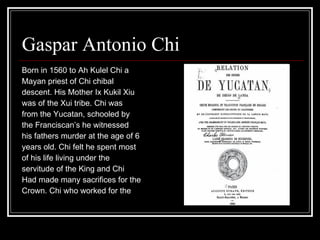
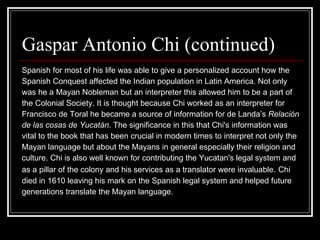
Gaspar Antonio Chi  Born in 1560 to Ah Kulel Chi a Mayan priest of Chi chibal  descent. His Mother Ix Kukil Xiu  was of the Xui tribe. Chi was from the Yucatan, schooled by  the Franciscan’s he witnessed  his fathers murder at the age of 6 years old. Chi felt he spent most  of his life living under the servitude of the King and Chi  Had made many sacrifices for the  Crown. Chi who worked for the
Gaspar Antonio Chi (continued)  Spanish for most of his life was able to give a personalized account how the Spanish Conquest affected the Indian population in Latin America. Not only  was he a Mayan Nobleman but an interpreter this allowed him to be a part of  the Colonial Society. It is thought because Chi worked as an interpreter for Francisco de Toral he became a source of information for de Landa’s  Relación  de las cosas de Yucatán . The significance in this that Chi's information was  vital to the book that has been crucial in modern times to interpret not only the  Mayan language but about the Mayans in general especially their religion and  culture. Chi is also well known for contributing the Yucatan's legal system and  as a pillar of the colony and his services as a translator were invaluable .  Chi  died in 1610 leaving his mark on the Spanish legal system and helped future  generations translate the Mayan language.
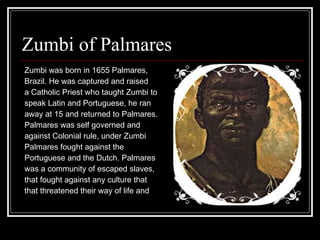
Zumbi of Palmares  Zumbi was born in 1655 Palmares,  Brazil. He was captured and raised  a Catholic Priest who taught Zumbi to speak Latin and Portuguese, he ran  away at 15 and returned to Palmares.  Palmares was self governed and  against Colonial rule, under Zumbi  Palmares fought against the Portuguese and the Dutch. Palmares  was a community of escaped slaves,  that fought against any culture that that threatened their way of life and
Zumbi of Palmares (continued) return them to slavery. Zumbi a successful military leader defeated a 1693  expedition led by Antonio Jacome Bezerra, a1776 he defeated an expedition  led by Mahor Manuel Lopes. Zumbi seized power from Ganga Zumba in 1677, Portugal knew Zumbi was a force to be reckoned with and in 1685 the King  attempted to make peace, by 1690 the Portuguese were more organized and  an army led by Domingos Jorge Velho, attacked Palmares, yet Zumbi  defeated them. Zumbi was not so lucky in 1694 when he discovered an  expedition was approaching with weapons. Unable to stave off the attack after  putting up a long fight Palmares was seized however he escaped. Zumbi  was killed in combat in 1695 after spending a year hiding and raiding for  supplies. His body was mutilated publically and his head was put on a  pole. Despite his death Zumbi is hero to the descendants of those he freed. He is still loved and celebrated in Brazil.
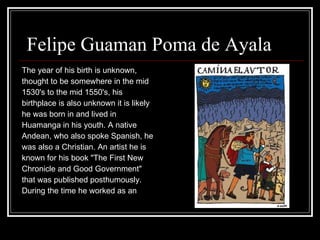
Felipe Guaman Poma de Ayala  The year of his birth is unknown,  thought to be somewhere in the mid 1530's to the mid 1550's, his  birthplace is also unknown it is likely  he was born in and lived in  Huamanga in his youth. A native  Andean, who also spoke Spanish, he  was also a Christian. An artist he is  known for his book "The First New  Chronicle and Good Government"  that was published posthumously.  During the time he worked as an
Guaman Poma (continued) interpreter he represented his family and his own claims to land in the Valley  of the Chupas in court, which he lost, for which later he was sentenced for  misrepresenting himself through deceit and was lashed in public as a  result and expelled from Huamanga. Guaman Poma as a result became a  social activist teaching his people to read and write, advocating that the  Andeans should have rights. He documented pre-Columbian and conquest  in his book Nueva coronica y buen gobierno, and campaigned to the king to  end the disenfranchisement of Andean social stratification. Guaman Poma  became an adocate for the Indians who were treated unfairly. His book  Coronica is important because it gives the viewpoint of a Quechua rather than  from the Cusco point of view, giving valuable insight to scholars and the  artwork was exceptional.
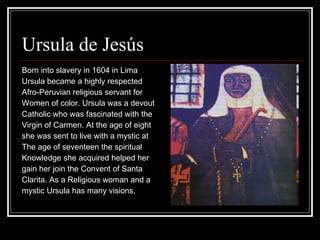
Ursula de Jesús  Born into slavery in 1604 in Lima  Ursula became a highly respected  Afro-Peruvian religious servant for  Women of color. Ursula was a devout  Catholic who was fascinated with the Virgin of Carmen. At the age of eight  she was sent to live with a mystic at  The age of seventeen the spiritual Knowledge she acquired helped her  gain her join the Convent of Santa  Clarita. As a Religious woman and a  mystic Ursula has many visions,
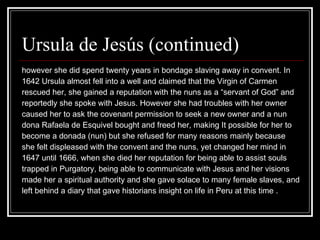
Ursula de Jesús (continued)  however she did spend twenty years in bondage slaving away in convent. In  1642 Ursula almost fell into a well and claimed that the Virgin of Carmen  rescued her, she gained a reputation with the nuns as a “servant of God” and  reportedly she spoke with Jesus. However she had troubles with her owner  caused her to ask the covenant permission to seek a new owner and a nun  dona Rafaela de Esquivel bought and freed her, making It possible for her to  become a donada (nun) but she refused for many reasons mainly because  she felt displeased with the convent and the nuns, yet changed her mind in  1647 until 1666, when she died her reputation for being able to assist souls  trapped in Purgatory, being able to communicate with Jesus and her visions  made her a spiritual authority and she gave solace to many female slaves, and left behind a diary that gave historians insight on life in Peru at this time .
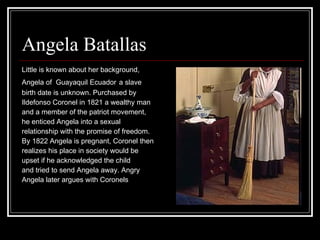
Angela Batallas  Little is known about her background, Angela of  Guayaquil Ecuador   a slave  birth date is unknown. Purchased by  Ildefonso Coronel in 1821 a wealthy man  and a member of the patriot movement,  he enticed Angela into a sexual relationship with the promise of freedom.  By 1822 Angela is pregnant, Coronel then  realizes his place in society would be  upset if he acknowledged the child  and tried to send Angela away. Angry Angela later argues with Coronels
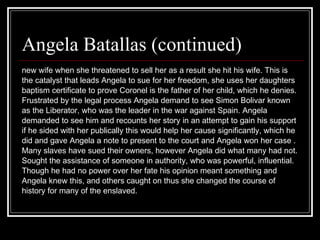
new wife when she threatened to sell her as a result she hit his wife. This is  the catalyst that leads Angela to sue for her freedom, she uses her daughters  baptism certificate to prove Coronel is the father of her child, which he denies. Frustrated by the legal process Angela demand to see Simon Bolivar known  as the Liberator, who was the leader in the war against Spain. Angela  demanded to see him and recounts her story in an attempt to gain his support  if he sided with her publically this would help her cause significantly, which he  did and gave Angela a note to present to the court and Angela won her case . Many slaves have sued their owners, however Angela did what many had not.  Sought the assistance of someone in authority, who was powerful, influential.  Though he had no power over her fate his opinion meant something and  Angela knew this, and others caught on thus she changed the course of  history for many of the enslaved.  Angela Batallas (continued)
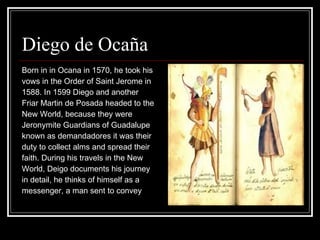
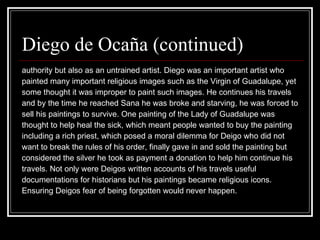
Diego de Ocaña  Born in in Ocana in 1570, he took his  vows in the Order of Saint Jerome in  1588. In 1599 Diego and another  Friar Martin de Posada headed to the  New World, because they were  Jeronymite Guardians of Guadalupe  known as demandadores it was their  duty to collect alms and spread their  faith. During his travels in the New  World, Deigo documents his journey  in detail, he thinks of himself as a  messenger, a man sent to convey
Diego de Ocaña (continued) authority but also as an untrained artist. Diego was an important artist who  painted many important religious images such as the Virgin of Guadalupe, yet  some thought it was improper to paint such images. He continues his travels  and by the time he reached Sana he was broke and starving, he was forced to  sell his paintings to survive. One painting of the Lady of Guadalupe was  thought to help heal the sick, which meant people wanted to buy the painting including a rich priest, which posed a moral dilemma for Deigo who did not want to break the rules of his order, finally gave in and sold the painting but considered the silver he took as payment a donation to help him continue his  travels. Not only were Deigos written accounts of his travels useful  documentations for historians but his paintings became religious icons.  Ensuring Deigos fear of being forgotten would never happen.
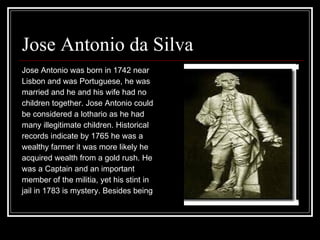
Jose Antonio da Silva Jose Antonio was born in 1742 near Lisbon and was Portuguese, he was  married and he and his wife had no  children together. Jose Antonio could  be considered a lothario as he had  many illegitimate children. Historical  records indicate by 1765 he was a  wealthy farmer it was more likely he  acquired wealth from a gold rush. He  was a Captain and an important  member of the militia, yet his stint in  jail in 1783 is mystery. Besides being
Jose Antonio da Silva (continued)  powerful in his hometown of Santana but also in the community of Sao Paulo.  Jose Antonia acknowledged his illegitmate son with his mistress Ignacia  Franca thourough baptism records which was risky at that time, however the  end result was he could have a relationship with his child and not keep it a  secret. By 1778 his new mistress and children were living with Jose Antonio  and this was listed on the census, he also had two mulatto children with one  of his slaves. His mistresses seemed to gain a higher social position and some  gained their freedom. His wife, children, and mistresses all gained from his  death in1797 whether it be slaves, money, or property. What Jose Antonio’s  life proves is that it was entirely possible for two people of different races and or social status’s to have a romantic relationship without facing consequences  from the church thus explaining how Brazil is racially diverse today.
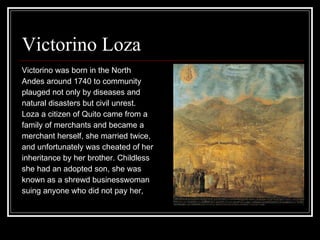
Victorino Loza  Victorino was born in the North  Andes around 1740 to community  plauged not only by diseases and  natural disasters but civil unrest.  Loza a citizen of Quito came from a  family of merchants and became a  merchant herself, she married twice,  and unfortunately was cheated of her  inheritance by her brother. Childless  she had an adopted son, she was  known as a shrewd businesswoman  suing anyone who did not pay her,
Victorino Loza (continued) one suit she waited sixteen years to collect on. Her second marriage was more  of a business arrangement, her new husband was to travel for business for her so she could keep her good reputation. Loza began investing in landed estates  in 1776, by 1782 she owned three properties that were prosperous.  Concerned with her adopted sons future she set up a trust, sold her properties and invested the profits. When she moved onto ownership of a plantation she  “ bought” employees to make up for the shortage of available laborers.  Unfortunately her husband had an affair and her attempt to end it failed so she  reported the affair to the president of the Auidencia and sued him quietly, as a  consequence her husband was sent to jail but the affair continued. The pair  sued each other, and he lost. Loza died alone but rich and successful in 1805,  proving that a woman could be a successful and did not need a man to do so.
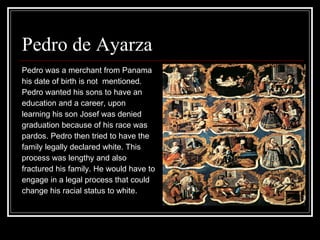
Pedro de Ayarza  Pedro was a merchant from Panama  his date of birth is not  mentioned. Pedro wanted his sons to have an  education and a career, upon  learning his son Josef was denied  graduation because of his race was  pardos. Pedro then tried to have the  family legally declared white. This process was lengthy and also  fractured his family. He would have to engage in a legal process that could  change his racial status to white.
Pedro de Ayarza (continied) The crown issued a 1795 arancel the chance to purchase this status, as long  as they had ample documentation and recommendations. Pedro did this as  well as hiring an apoderado. His first petition sent in 1795 and also provided  information such as his military service, and friends testified on his behalf, a  few negative witnesses hampered this attempt only his eldest was whitened in  1797. His second attempt in 1799 lasted four years at this point Joesph was a  lawyer and Pedro wanted his two other sons to graduate, they were legally  whitened in 1803 but the decision was reversed. From 1804 to 1806 Pedro  sought to overturn the reversal which was denied. The final petition in 1807  pleading it was vital to his younger sons futures, the case was never ruled on.  Pedros legal battle showed that race was being looked at in a new light that  a persons worth mattered now, not just their skin color.
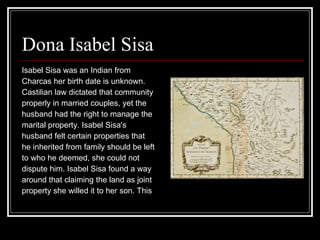
Dona Isabel Sisa  Isabel Sisa was an Indian from  Charcas her birth date is unknown.  Castilian law dictated that community  properly in married couples, yet the  husband had the right to manage the  marital property. Isabel Sisa's  husband felt certain properties that  he inherited from family should be left  to who he deemed, she could not  dispute him. Isabel Sisa found a way  around that claiming the land as joint  property she willed it to her son. This
Dona Isabel Sisa (continued) led to a lengthy legal battle between the couple. Will's at this time also  documented private information, her first will revealed not only what she  owned but after adding a codicil she was afraid of her husband and he had not  spit the profits from the harvest and he has taken the money she earned on  her own. Her husbands will revealed their were no heirs from the marriage,  leaving the question who was Juan to the couple, a later will revealed don Domingo had 2 illegitimate sons and Isabel Sisa brought no assets into the  marriage. After her husbands death she fought his will and the truth of how  he gained his assets came out, after revealing he was an Indian she gained  community property. Isabel Sisa's argument that being able to read and write  indicated power was also a persuasive argument, not only did she defy  stereotypes about Indians she also rebuked gender inequality.
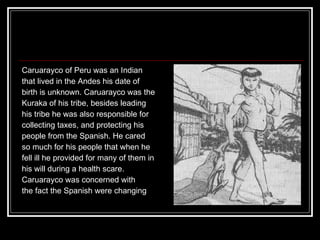
Don Melchior Caruarayco (cont.)  the values and traditions of his culture. Caruarayco felt that the Spanish did  not care nor understand traditions and practices and saw a decline in his tribe  after the Spanish invasion; the Spanish had imposed upon the natives and  forced them to supply labor.  Christianity was also forced upon the natives and  as tribal life declined Christianity gained popularity. There was little  Caruarayco could do to oppose the Spanish so his position of challenged as  other members of the tribe declared their claim to the position. This was taking  place in other tribes as well. The natives being introduction to a new faith and  new culture was a threat to tribal life and it did indeed suffer and decline as a  result. Tribal practices waned, vales, changed, and traditions died. The  significance here is that the Spanish colonization not only changed the lives of  the indigenous people but dramatically altered their way of life and in some  cases obliterated cultures.
Caruarayco of Peru was an Indian  that lived in the Andes his date of  birth is unknown. Caruarayco was the  Kuraka of his tribe, besides leading  his tribe he was also responsible for  collecting taxes, and protecting his  people from the Spanish. He cared  so much for his people that when he  fell ill he provided for many of them in  his will during a health scare.  Caruarayco was concerned with  the fact the Spanish were changing

History 27 assignment 4

  • 1.
    Human Tradition InColonial Latin America Biographical Histories Megan Beaver History 27
  • 2.
    Gaspar Antonio Chi Born in 1560 to Ah Kulel Chi a Mayan priest of Chi chibal descent. His Mother Ix Kukil Xiu was of the Xui tribe. Chi was from the Yucatan, schooled by the Franciscan’s he witnessed his fathers murder at the age of 6 years old. Chi felt he spent most of his life living under the servitude of the King and Chi Had made many sacrifices for the Crown. Chi who worked for the
  • 3.
    Gaspar Antonio Chi(continued) Spanish for most of his life was able to give a personalized account how the Spanish Conquest affected the Indian population in Latin America. Not only was he a Mayan Nobleman but an interpreter this allowed him to be a part of the Colonial Society. It is thought because Chi worked as an interpreter for Francisco de Toral he became a source of information for de Landa’s Relación de las cosas de Yucatán . The significance in this that Chi's information was vital to the book that has been crucial in modern times to interpret not only the Mayan language but about the Mayans in general especially their religion and culture. Chi is also well known for contributing the Yucatan's legal system and as a pillar of the colony and his services as a translator were invaluable . Chi died in 1610 leaving his mark on the Spanish legal system and helped future generations translate the Mayan language.
  • 4.
    Zumbi of Palmares Zumbi was born in 1655 Palmares, Brazil. He was captured and raised a Catholic Priest who taught Zumbi to speak Latin and Portuguese, he ran away at 15 and returned to Palmares. Palmares was self governed and against Colonial rule, under Zumbi Palmares fought against the Portuguese and the Dutch. Palmares was a community of escaped slaves, that fought against any culture that that threatened their way of life and
  • 5.
    Zumbi of Palmares(continued) return them to slavery. Zumbi a successful military leader defeated a 1693 expedition led by Antonio Jacome Bezerra, a1776 he defeated an expedition led by Mahor Manuel Lopes. Zumbi seized power from Ganga Zumba in 1677, Portugal knew Zumbi was a force to be reckoned with and in 1685 the King attempted to make peace, by 1690 the Portuguese were more organized and an army led by Domingos Jorge Velho, attacked Palmares, yet Zumbi defeated them. Zumbi was not so lucky in 1694 when he discovered an expedition was approaching with weapons. Unable to stave off the attack after putting up a long fight Palmares was seized however he escaped. Zumbi was killed in combat in 1695 after spending a year hiding and raiding for supplies. His body was mutilated publically and his head was put on a pole. Despite his death Zumbi is hero to the descendants of those he freed. He is still loved and celebrated in Brazil.
  • 6.
    Felipe Guaman Pomade Ayala The year of his birth is unknown, thought to be somewhere in the mid 1530's to the mid 1550's, his birthplace is also unknown it is likely he was born in and lived in Huamanga in his youth. A native Andean, who also spoke Spanish, he was also a Christian. An artist he is known for his book "The First New Chronicle and Good Government" that was published posthumously. During the time he worked as an
  • 7.
    Guaman Poma (continued)interpreter he represented his family and his own claims to land in the Valley of the Chupas in court, which he lost, for which later he was sentenced for misrepresenting himself through deceit and was lashed in public as a result and expelled from Huamanga. Guaman Poma as a result became a social activist teaching his people to read and write, advocating that the Andeans should have rights. He documented pre-Columbian and conquest in his book Nueva coronica y buen gobierno, and campaigned to the king to end the disenfranchisement of Andean social stratification. Guaman Poma became an adocate for the Indians who were treated unfairly. His book Coronica is important because it gives the viewpoint of a Quechua rather than from the Cusco point of view, giving valuable insight to scholars and the artwork was exceptional.
  • 8.
    Ursula de Jesús Born into slavery in 1604 in Lima Ursula became a highly respected Afro-Peruvian religious servant for Women of color. Ursula was a devout Catholic who was fascinated with the Virgin of Carmen. At the age of eight she was sent to live with a mystic at The age of seventeen the spiritual Knowledge she acquired helped her gain her join the Convent of Santa Clarita. As a Religious woman and a mystic Ursula has many visions,
  • 9.
    Ursula de Jesús(continued) however she did spend twenty years in bondage slaving away in convent. In 1642 Ursula almost fell into a well and claimed that the Virgin of Carmen rescued her, she gained a reputation with the nuns as a “servant of God” and reportedly she spoke with Jesus. However she had troubles with her owner caused her to ask the covenant permission to seek a new owner and a nun dona Rafaela de Esquivel bought and freed her, making It possible for her to become a donada (nun) but she refused for many reasons mainly because she felt displeased with the convent and the nuns, yet changed her mind in 1647 until 1666, when she died her reputation for being able to assist souls trapped in Purgatory, being able to communicate with Jesus and her visions made her a spiritual authority and she gave solace to many female slaves, and left behind a diary that gave historians insight on life in Peru at this time .
  • 10.
    Angela Batallas Little is known about her background, Angela of Guayaquil Ecuador a slave birth date is unknown. Purchased by Ildefonso Coronel in 1821 a wealthy man and a member of the patriot movement, he enticed Angela into a sexual relationship with the promise of freedom. By 1822 Angela is pregnant, Coronel then realizes his place in society would be upset if he acknowledged the child and tried to send Angela away. Angry Angela later argues with Coronels
  • 11.
    new wife whenshe threatened to sell her as a result she hit his wife. This is the catalyst that leads Angela to sue for her freedom, she uses her daughters baptism certificate to prove Coronel is the father of her child, which he denies. Frustrated by the legal process Angela demand to see Simon Bolivar known as the Liberator, who was the leader in the war against Spain. Angela demanded to see him and recounts her story in an attempt to gain his support if he sided with her publically this would help her cause significantly, which he did and gave Angela a note to present to the court and Angela won her case . Many slaves have sued their owners, however Angela did what many had not. Sought the assistance of someone in authority, who was powerful, influential. Though he had no power over her fate his opinion meant something and Angela knew this, and others caught on thus she changed the course of history for many of the enslaved. Angela Batallas (continued)
  • 12.
    Diego de Ocaña Born in in Ocana in 1570, he took his vows in the Order of Saint Jerome in 1588. In 1599 Diego and another Friar Martin de Posada headed to the New World, because they were Jeronymite Guardians of Guadalupe known as demandadores it was their duty to collect alms and spread their faith. During his travels in the New World, Deigo documents his journey in detail, he thinks of himself as a messenger, a man sent to convey
  • 13.
    Diego de Ocaña (continued)authority but also as an untrained artist. Diego was an important artist who painted many important religious images such as the Virgin of Guadalupe, yet some thought it was improper to paint such images. He continues his travels and by the time he reached Sana he was broke and starving, he was forced to sell his paintings to survive. One painting of the Lady of Guadalupe was thought to help heal the sick, which meant people wanted to buy the painting including a rich priest, which posed a moral dilemma for Deigo who did not want to break the rules of his order, finally gave in and sold the painting but considered the silver he took as payment a donation to help him continue his travels. Not only were Deigos written accounts of his travels useful documentations for historians but his paintings became religious icons. Ensuring Deigos fear of being forgotten would never happen.
  • 14.
    Jose Antonio daSilva Jose Antonio was born in 1742 near Lisbon and was Portuguese, he was married and he and his wife had no children together. Jose Antonio could be considered a lothario as he had many illegitimate children. Historical records indicate by 1765 he was a wealthy farmer it was more likely he acquired wealth from a gold rush. He was a Captain and an important member of the militia, yet his stint in jail in 1783 is mystery. Besides being
  • 15.
    Jose Antonio daSilva (continued) powerful in his hometown of Santana but also in the community of Sao Paulo. Jose Antonia acknowledged his illegitmate son with his mistress Ignacia Franca thourough baptism records which was risky at that time, however the end result was he could have a relationship with his child and not keep it a secret. By 1778 his new mistress and children were living with Jose Antonio and this was listed on the census, he also had two mulatto children with one of his slaves. His mistresses seemed to gain a higher social position and some gained their freedom. His wife, children, and mistresses all gained from his death in1797 whether it be slaves, money, or property. What Jose Antonio’s life proves is that it was entirely possible for two people of different races and or social status’s to have a romantic relationship without facing consequences from the church thus explaining how Brazil is racially diverse today.
  • 16.
    Victorino Loza Victorino was born in the North Andes around 1740 to community plauged not only by diseases and natural disasters but civil unrest. Loza a citizen of Quito came from a family of merchants and became a merchant herself, she married twice, and unfortunately was cheated of her inheritance by her brother. Childless she had an adopted son, she was known as a shrewd businesswoman suing anyone who did not pay her,
  • 17.
    Victorino Loza (continued)one suit she waited sixteen years to collect on. Her second marriage was more of a business arrangement, her new husband was to travel for business for her so she could keep her good reputation. Loza began investing in landed estates in 1776, by 1782 she owned three properties that were prosperous. Concerned with her adopted sons future she set up a trust, sold her properties and invested the profits. When she moved onto ownership of a plantation she “ bought” employees to make up for the shortage of available laborers. Unfortunately her husband had an affair and her attempt to end it failed so she reported the affair to the president of the Auidencia and sued him quietly, as a consequence her husband was sent to jail but the affair continued. The pair sued each other, and he lost. Loza died alone but rich and successful in 1805, proving that a woman could be a successful and did not need a man to do so.
  • 18.
    Pedro de Ayarza Pedro was a merchant from Panama his date of birth is not mentioned. Pedro wanted his sons to have an education and a career, upon learning his son Josef was denied graduation because of his race was pardos. Pedro then tried to have the family legally declared white. This process was lengthy and also fractured his family. He would have to engage in a legal process that could change his racial status to white.
  • 19.
    Pedro de Ayarza(continied) The crown issued a 1795 arancel the chance to purchase this status, as long as they had ample documentation and recommendations. Pedro did this as well as hiring an apoderado. His first petition sent in 1795 and also provided information such as his military service, and friends testified on his behalf, a few negative witnesses hampered this attempt only his eldest was whitened in 1797. His second attempt in 1799 lasted four years at this point Joesph was a lawyer and Pedro wanted his two other sons to graduate, they were legally whitened in 1803 but the decision was reversed. From 1804 to 1806 Pedro sought to overturn the reversal which was denied. The final petition in 1807 pleading it was vital to his younger sons futures, the case was never ruled on. Pedros legal battle showed that race was being looked at in a new light that a persons worth mattered now, not just their skin color.
  • 20.
    Dona Isabel Sisa Isabel Sisa was an Indian from Charcas her birth date is unknown. Castilian law dictated that community properly in married couples, yet the husband had the right to manage the marital property. Isabel Sisa's husband felt certain properties that he inherited from family should be left to who he deemed, she could not dispute him. Isabel Sisa found a way around that claiming the land as joint property she willed it to her son. This
  • 21.
    Dona Isabel Sisa(continued) led to a lengthy legal battle between the couple. Will's at this time also documented private information, her first will revealed not only what she owned but after adding a codicil she was afraid of her husband and he had not spit the profits from the harvest and he has taken the money she earned on her own. Her husbands will revealed their were no heirs from the marriage, leaving the question who was Juan to the couple, a later will revealed don Domingo had 2 illegitimate sons and Isabel Sisa brought no assets into the marriage. After her husbands death she fought his will and the truth of how he gained his assets came out, after revealing he was an Indian she gained community property. Isabel Sisa's argument that being able to read and write indicated power was also a persuasive argument, not only did she defy stereotypes about Indians she also rebuked gender inequality.
  • 22.
    Don Melchior Caruarayco(cont.) the values and traditions of his culture. Caruarayco felt that the Spanish did not care nor understand traditions and practices and saw a decline in his tribe after the Spanish invasion; the Spanish had imposed upon the natives and forced them to supply labor. Christianity was also forced upon the natives and as tribal life declined Christianity gained popularity. There was little Caruarayco could do to oppose the Spanish so his position of challenged as other members of the tribe declared their claim to the position. This was taking place in other tribes as well. The natives being introduction to a new faith and new culture was a threat to tribal life and it did indeed suffer and decline as a result. Tribal practices waned, vales, changed, and traditions died. The significance here is that the Spanish colonization not only changed the lives of the indigenous people but dramatically altered their way of life and in some cases obliterated cultures.
  • 23.
    Caruarayco of Peruwas an Indian that lived in the Andes his date of birth is unknown. Caruarayco was the Kuraka of his tribe, besides leading his tribe he was also responsible for collecting taxes, and protecting his people from the Spanish. He cared so much for his people that when he fell ill he provided for many of them in his will during a health scare. Caruarayco was concerned with the fact the Spanish were changing