The Human
Body:
A Study of
Major Organ
Systems,
Organs, and
Tissues


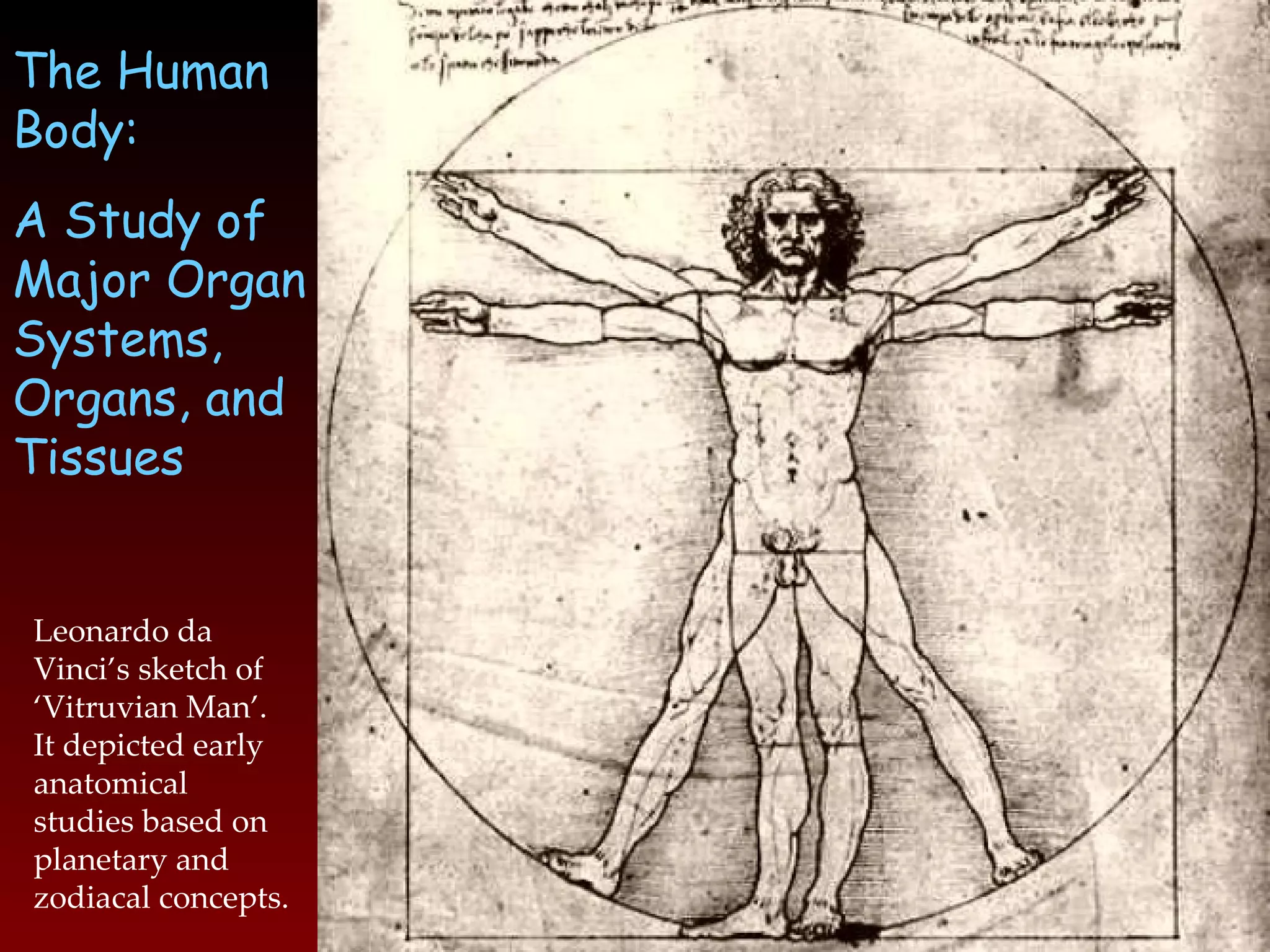
Leonardo da
Vinci’s sketch of
‘Vitruvian Man’.
It depicted early
anatomical
studies based on
planetary and
zodiacal concepts.
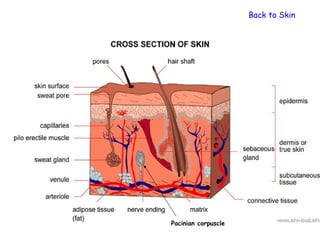
Table of Contents
Digestive System       Credits (P1)
Circulatory System
                       Credits (P2)
Respiratory System
Immune System
Skin
Urinary System
Endocrine Glands
Reproductive System
Nervous System
Table of Co

            Digestive System

Esophagus                 Liver (macro)
Stomach (macro)           Vessel elements of the l
Stomach (micro)           Pancreas
Small intestine (macro) Tongue
Small intestine (micro) Tooth
Large intestine (macro)
Large intestine mucous cells (micro)
Back to Digestive Sy
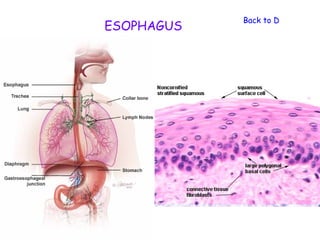
ESOPHAGUS
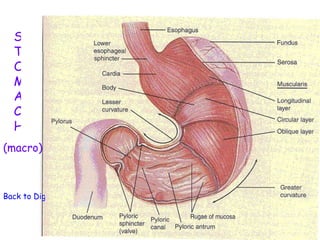
S
  T
  O
  M
  A
  C
  H
(macro)


Back to Digestive System
Back to Digest
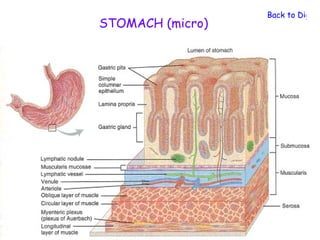
STOMACH (micro)
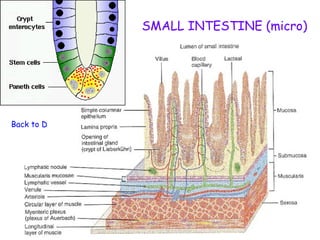
SMALL INTESTINE (micro)


Back to Digestive System
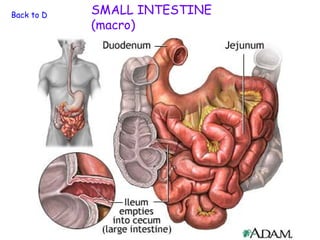
SMALL
Back to Digestive System     INTESTINE
                (macro)
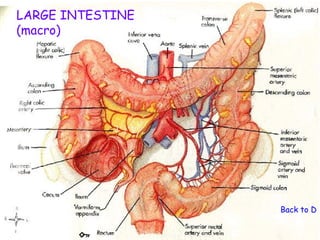
LARGE INTESTINE
(macro)


                  Back to Dig
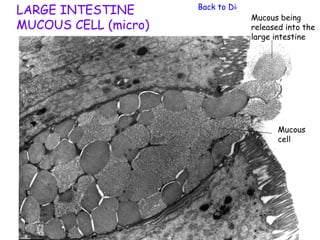
LARGE INTESTINE       Back to Digestive System
                                    Mucous being
MUCOUS CELL (micro)                 released into the
                                    large intestine


                                           Mucous
                                           cell
Back to Diges
Back to Diges
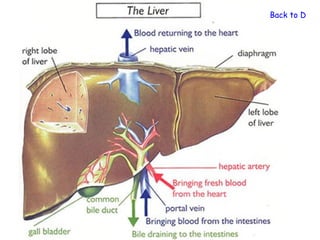
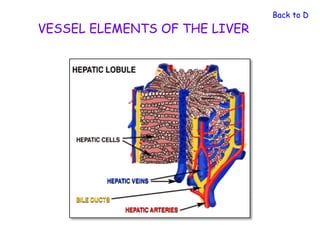
VESSEL ELEMENTS OF THE LIVER
Back to Digest


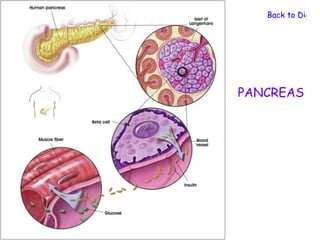
PANCREAS
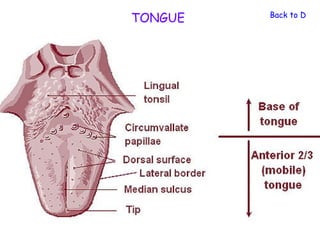
TONGUE   Back to Diges
Back to Diges


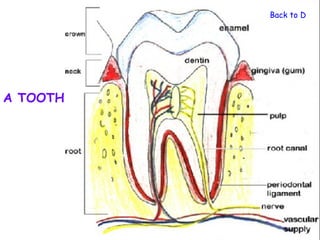
A TOOTH
Table of Co

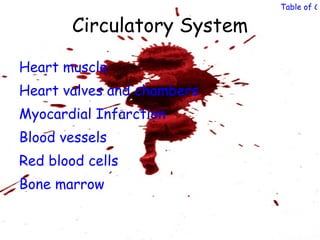
        Circulatory System

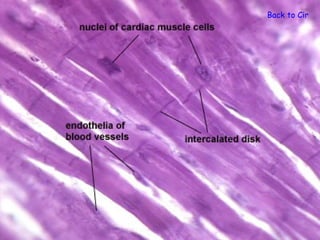
Heart muscle
Heart valves and chambers
Myocardial Infarction
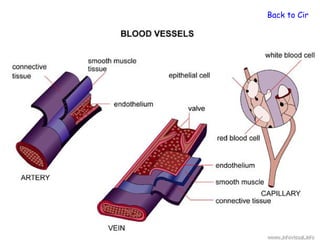
Blood vessels
Red blood cells
Bone marrow
Back to Circula
Back to Circula


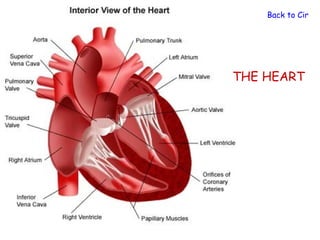
THE HEART
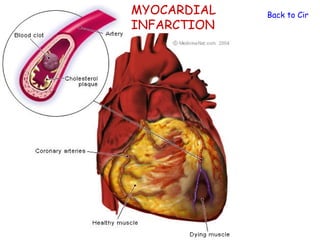
MYOCARDIAL   Back to Circula
INFARCTION
Back to Circula
Back to Circulatory System


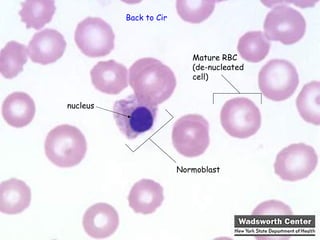
                          Mature RBC
                          (de-nucleated
                          cell)


nucleus


                      Normoblast
Back to Circula

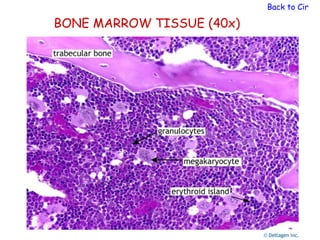
BONE MARROW TISSUE (40x)
Table of Co

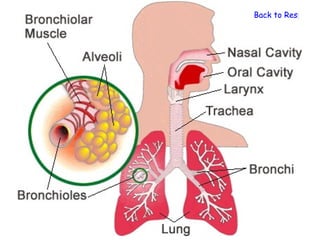
        Respiratory System

Lung
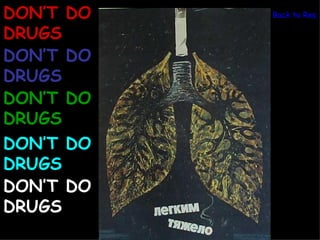
Cigarettes CAN Kill You
Back to Respirator
DON’T DO   Back to Resp

DRUGS
DON’T DO
DRUGS
DON’T DO
DRUGS
DON’T DO
DRUGS
DON’T DO
DRUGS
Table of Co

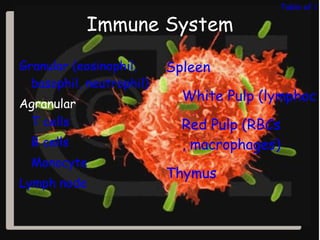
            Immune System

Granular (eosinophil,     Spleen
  basophil, neutrophil)
                            White Pulp (lymphocy
Agranular
 T cells                    Red Pulp (RBCs
  B cells                   , macrophages)
  Monocyte
                          Thymus
Lymph node
Back to Immune System


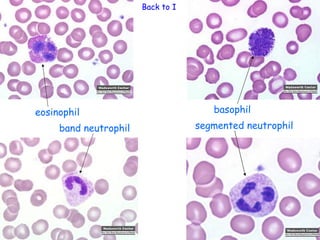
eosinophil                             basophil
     band neutrophil               segmented neutrophil
Back to Immu


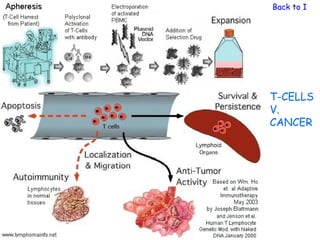
T-CELLS
V.
CANCER
Back to Immu


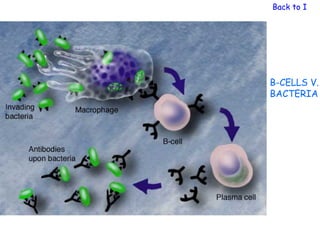
B-CELLS V.
BACTERIA
Back to Immu


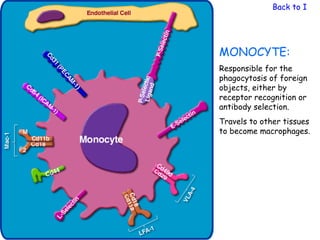
MONOCYTE:
Responsible for the
phagocytosis of foreign
objects, either by
receptor recognition or
antibody selection.
Travels to other tissues
to become macrophages.
Back to Immu
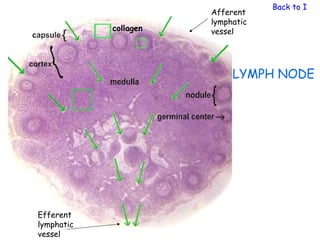
                       Afferent
                       lymphatic
            collagen   vessel


                            LYMPH NODE


Efferent
lymphatic
vessel
Back to Immu


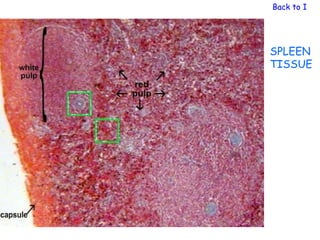
SPLEEN
TISSUE
Back to Immu


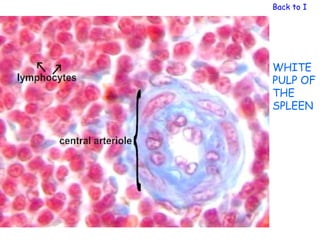
WHITE
PULP OF
THE
SPLEEN
Back to Immu


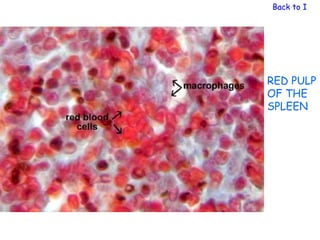
RED PULP
OF THE
SPLEEN
Back to Immu
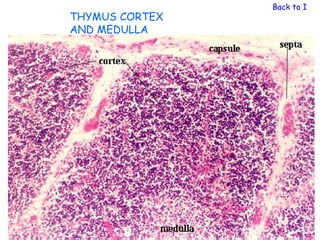
THYMUS CORTEX
AND MEDULLA
Table of Co

                 Skin

Cross-section of epithelium
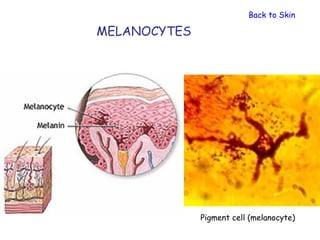
Melanocyte
Back to Skin


Pacinian corpuscle
Back to Skin

MELANOCYTES


              Pigment cell (melanocyte)
Table of Co

           Urinary System

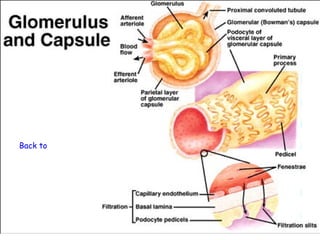
Glomerulus
   / Bowman’s capsule
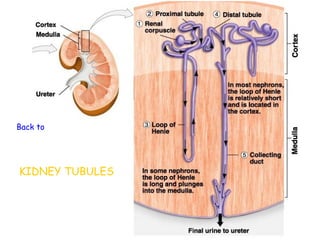
Ducts and tubules of kidney
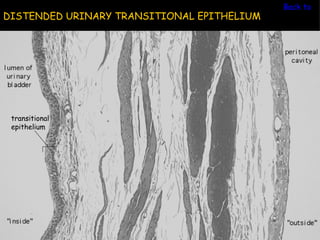
Distended transitional epithelium (bladder)
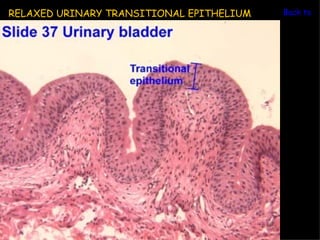
Relaxed transitional epithelium (bladder)
Back to Urinary System


KIDNEY TUBULES
Back to Ur
DISTENDED URINARY TRANSITIONAL EPITHELIUM


 transitional
 epithelium
RELAXED URINARY TRANSITIONAL EPITHELIUM   Back to Ur
Table of Co

Endocrine System
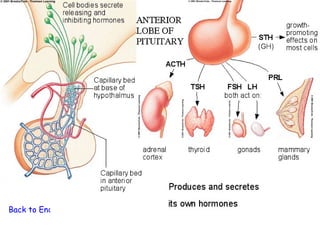
Anterior pituitary gland (and hormones rel
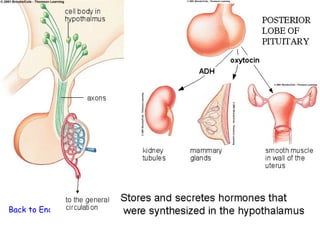
Posterior pituitary gland (and hormones re
Thymus tissue
Adrenal gland tissue (micro)
Adrenal gland (macro)
Back to Endocrine System
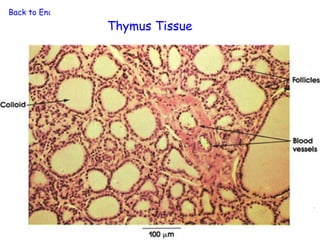
                           Thymus Tissue
Back to Endocrine System


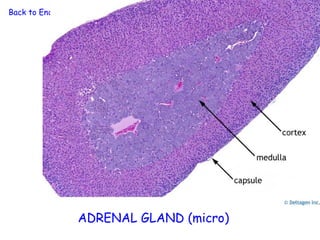
                 ADRENAL GLAND (micro)
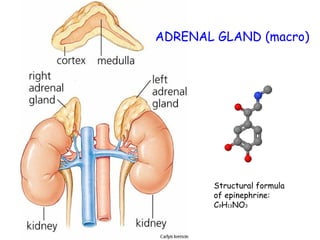
ADRENAL GLAND (macro)


       Structural formula
       of epinephrine:
       C9H13NO3
Table of Co

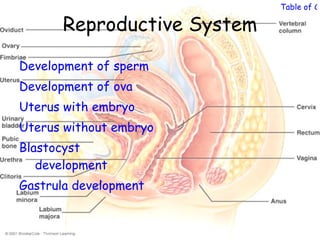
      Reproductive System

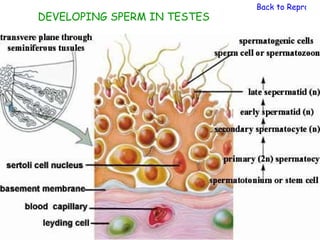
Development of sperm
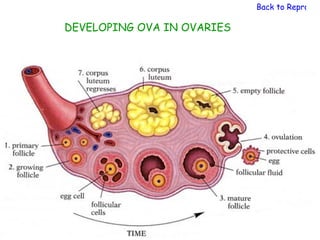
Development of ova
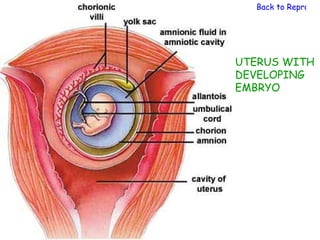
Uterus with embryo
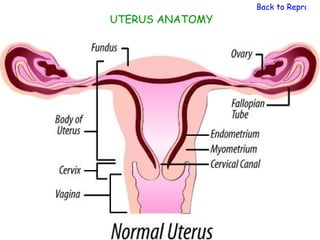
Uterus without embryo
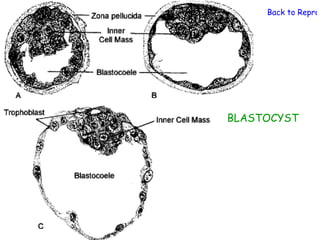
Blastocyst
   development
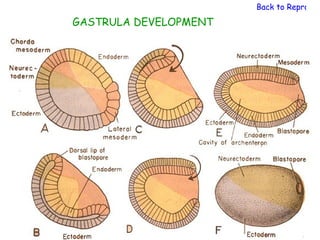
Gastrula development
Back to Reproduc
DEVELOPING SPERM IN TESTES
Back to Reproduc

DEVELOPING OVA IN OVARIES
Back to Reproduc


UTERUS WITH
DEVELOPING
EMBRYO
Back to Reproduc
UTERUS ANATOMY
Back to Reprod


BLASTOCYST
Back to Reproduc
GASTRULA DEVELOPMENT
Table of Co

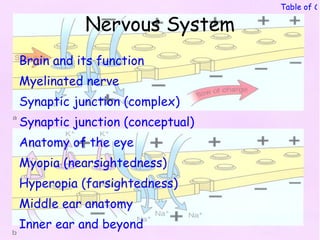
           Nervous System
Brain and its function
Myelinated nerve
Synaptic junction (complex)
Synaptic junction (conceptual)
Anatomy of the eye
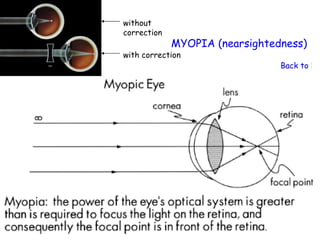
Myopia (nearsightedness)
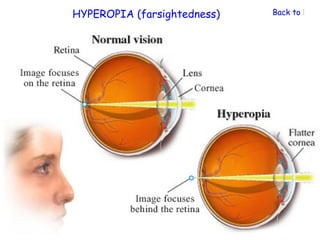
Hyperopia (farsightedness)
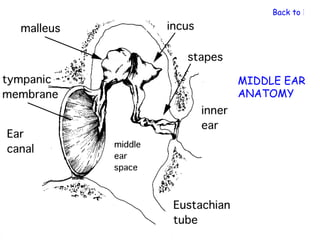
Middle ear anatomy
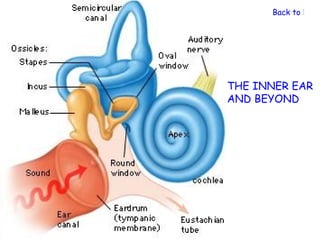
Inner ear and beyond
Back to Nervous System


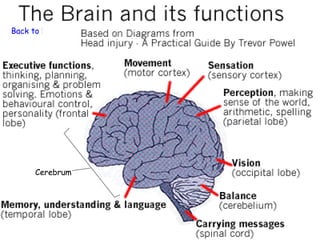
     Cerebrum
Back to Nerv

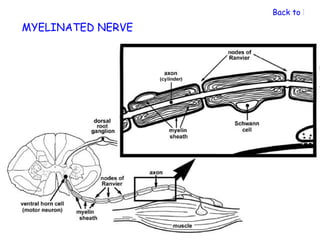
MYELINATED NERVE
Back to Nerv


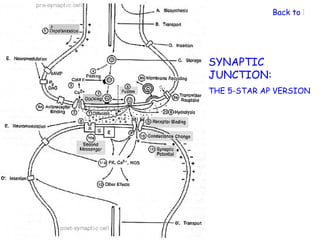
SYNAPTIC
JUNCTION:
THE 5-STAR AP VERSION
Back to Nerv

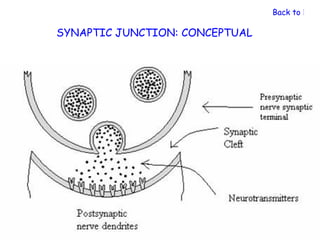
SYNAPTIC JUNCTION: CONCEPTUAL
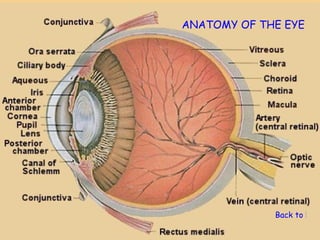
ANATOMY OF THE EYE


             Back to Ner
without
correction
             MYOPIA (nearsightedness)
with correction
                                Back to Ne
HYPEROPIA (farsightedness)   Back to Nerv
Back to Nerv


MIDDLE EAR
ANATOMY
Back to Nerv


THE INNER EAR
AND BEYOND
Table of Co

         Dense Connective
         Tissue Systems
Cardiac Muscle (cross-section) Tissue
                         Bone

Cardiac Muscle (longitudinal section)
                          Adipose Cells

Smooth Muscle (high power)
                        Hyaline / Elastic Car

Smooth Muscle (low power)
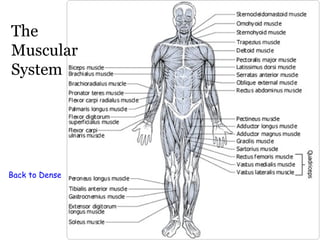
                        The Muscular System

                         Skeletal Muscle
Back to Dense Connective Tissue Systems

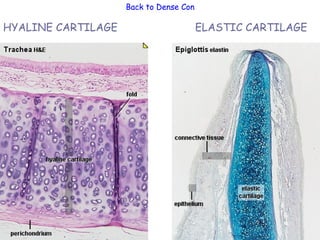
HYALINE CARTILAGE                    ELASTIC CARTILAGE
Back to Dense Connect
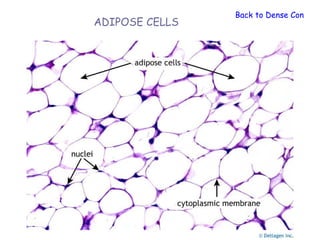
ADIPOSE CELLS
Back to Dense Connect
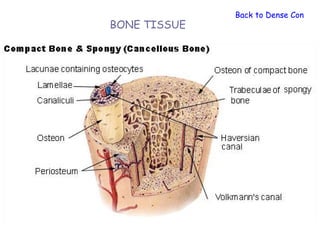
BONE TISSUE
Back to Dense Connect
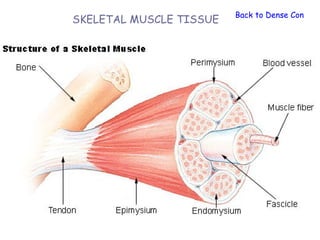
SKELETAL MUSCLE TISSUE
Back to Dense Co
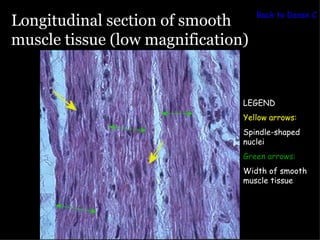
Longitudinal section of smooth
muscle tissue (low magnification)


                                LEGEND
                                Yellow arrows:
                                Spindle-shaped
                                nuclei
                                Green arrows:
                                Width of smooth
                                muscle tissue
Back to Dense Co
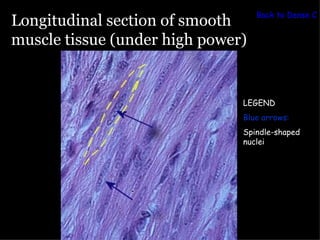
Longitudinal section of smooth
muscle tissue (under high power)


                               LEGEND
                               Blue arrows:
                               Spindle-shaped
                               nuclei
Back to Dense Conn
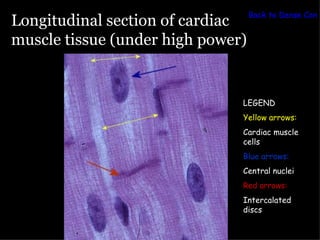
Longitudinal section of cardiac
muscle tissue (under high power)


                               LEGEND
                               Yellow arrows:
                               Cardiac muscle
                               cells
                               Blue arrows:
                               Central nuclei
                               Red arrows:
                               Intercalated
                               discs
The
Muscular
System


Back to Dense Connective Tissue Systems
Back to Dense Connect
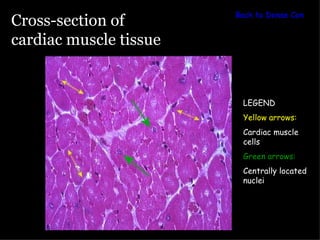
Cross-section of
cardiac muscle tissue


                         LEGEND
                         Yellow arrows:
                         Cardiac muscle
                         cells
                         Green arrows:
                         Centrally located
                         nuclei
Table of Con
                              Credits
http://www.uh.edu/
http://www.medicinenet.com
http://www.bbc.co.uk/science/humanbody/body/factfiles/skeleton_anatomy.shtml
http://www.ama-assn.org/ama/pub/category/7169.html
http://www3.umdnj.edu/histsweb/lab6/cardiacmuscle/cmarrangement.html
http://www3.umdnj.edu/histsweb/lab6/smoothmuscle/smcarrangement.html
http://training.seer.cancer.gov/
http://www.deltagen.com
http://www.lab.anhb.uwa.edu.au/
www.massgeneral.org/
www.rivm.nl
http://www.nlm.nih.gov/
http://www.yeatsvision.com
www.vivo.colostate.edu/
www.bgu.ac.il/~shaulm/large_intestine.html
http://janis7hepc.com/
www.liverdoctor.com/
http://gallery.globalink.org/
home.mc.ntu.edu.tw
http://www.mainlinehealth.org
www.wadsworth.org/
Table of Con
                               Credits
http://www.infovisual.info/03/img_en/   http://www.cbituk.org
www.lymphomainfo.net                    http://www.neuroanatomy.wisc.edu
www.ffn.ub.es                           http://www.lib.duke.edu
www.biocarta.com                        www.madsci.org
http://science.nhmccd.edu               http://www.discoveryfund.org
http://www.cytochemistry.net            http://www.phon.ox.ac.uk/
http://www.loc.gov/                     http://www.brainconnection.com
http://www.awta.com.au/                 www-staff.lboro.ac.uk
http://www.biotech.um.edu               http://www.tedmontgomery.com/
http://www.uic.edu                      http://health.yahoo.com
http://www.bu.edu/                      http://www.rakemag.com
http://trc.ucdavis.edu                  http://www.veganfoodpyramid.com
http://www.anatomyatlases.org/          http://halloweensunseen.com
http://www.yourdictionary.com           http://www.angelo.edu/
http://www.medicalcomputing.net         http://www.slowtheflow.com/
http://en.wikipedia.org                 http://lobo.sbc.edu/
http://www.creationofman.net/
http://instruct1.cit.cornell.edu
www.nuff.org
http://www.bioethics.gov
http://www.geol.umd.edu

Histology Atlas

  • 1.
    The Human Body: A Studyof Major Organ Systems, Organs, and Tissues Leonardo da Vinci’s sketch of ‘Vitruvian Man’. It depicted early anatomical studies based on planetary and zodiacal concepts.
  • 2.
    Table of Contents DigestiveSystem Credits (P1) Circulatory System Credits (P2) Respiratory System Immune System Skin Urinary System Endocrine Glands Reproductive System Nervous System
  • 3.
    Table of Co Digestive System Esophagus Liver (macro) Stomach (macro) Vessel elements of the l Stomach (micro) Pancreas Small intestine (macro) Tongue Small intestine (micro) Tooth Large intestine (macro) Large intestine mucous cells (micro)
  • 4.
    Back to DigestiveSy ESOPHAGUS
  • 5.
    S T O M A C H (macro) Back to Digestive System
  • 6.
  • 7.
    SMALL INTESTINE (micro) Backto Digestive System
  • 8.
    SMALL Back to DigestiveSystem INTESTINE (macro)
  • 9.
  • 10.
    LARGE INTESTINE Back to Digestive System Mucous being MUCOUS CELL (micro) released into the large intestine Mucous cell
  • 11.
  • 12.
    Back to Diges VESSELELEMENTS OF THE LIVER
  • 13.
  • 14.
    TONGUE Back to Diges
  • 15.
  • 16.
    Table of Co Circulatory System Heart muscle Heart valves and chambers Myocardial Infarction Blood vessels Red blood cells Bone marrow
  • 17.
  • 18.
  • 19.
    MYOCARDIAL Back to Circula INFARCTION
  • 20.
  • 21.
    Back to CirculatorySystem Mature RBC (de-nucleated cell) nucleus Normoblast
  • 22.
    Back to Circula BONEMARROW TISSUE (40x)
  • 23.
    Table of Co Respiratory System Lung Cigarettes CAN Kill You
  • 24.
  • 25.
    DON’T DO Back to Resp DRUGS DON’T DO DRUGS DON’T DO DRUGS DON’T DO DRUGS DON’T DO DRUGS
  • 26.
    Table of Co Immune System Granular (eosinophil, Spleen basophil, neutrophil) White Pulp (lymphocy Agranular T cells Red Pulp (RBCs B cells , macrophages) Monocyte Thymus Lymph node
  • 27.
    Back to ImmuneSystem eosinophil basophil band neutrophil segmented neutrophil
  • 28.
  • 29.
  • 30.
    Back to Immu MONOCYTE: Responsiblefor the phagocytosis of foreign objects, either by receptor recognition or antibody selection. Travels to other tissues to become macrophages.
  • 31.
    Back to Immu Afferent lymphatic collagen vessel LYMPH NODE Efferent lymphatic vessel
  • 32.
  • 33.
  • 34.
    Back to Immu REDPULP OF THE SPLEEN
  • 35.
    Back to Immu THYMUSCORTEX AND MEDULLA
  • 36.
    Table of Co Skin Cross-section of epithelium Melanocyte
  • 37.
  • 38.
    Back to Skin MELANOCYTES Pigment cell (melanocyte)
  • 39.
    Table of Co Urinary System Glomerulus / Bowman’s capsule Ducts and tubules of kidney Distended transitional epithelium (bladder) Relaxed transitional epithelium (bladder)
  • 40.
  • 41.
    Back to UrinarySystem KIDNEY TUBULES
  • 42.
    Back to Ur DISTENDEDURINARY TRANSITIONAL EPITHELIUM transitional epithelium
  • 43.
    RELAXED URINARY TRANSITIONALEPITHELIUM Back to Ur
  • 44.
    Table of Co EndocrineSystem Anterior pituitary gland (and hormones rel Posterior pituitary gland (and hormones re Thymus tissue Adrenal gland tissue (micro) Adrenal gland (macro)
  • 45.
  • 46.
  • 47.
    Back to EndocrineSystem Thymus Tissue
  • 48.
    Back to EndocrineSystem ADRENAL GLAND (micro)
  • 49.
    ADRENAL GLAND (macro) Structural formula of epinephrine: C9H13NO3
  • 50.
    Table of Co Reproductive System Development of sperm Development of ova Uterus with embryo Uterus without embryo Blastocyst development Gastrula development
  • 51.
  • 52.
  • 53.
    Back to Reproduc UTERUSWITH DEVELOPING EMBRYO
  • 54.
  • 55.
  • 56.
  • 57.
    Table of Co Nervous System Brain and its function Myelinated nerve Synaptic junction (complex) Synaptic junction (conceptual) Anatomy of the eye Myopia (nearsightedness) Hyperopia (farsightedness) Middle ear anatomy Inner ear and beyond
  • 58.
    Back to NervousSystem Cerebrum
  • 59.
  • 60.
  • 61.
    Back to Nerv SYNAPTICJUNCTION: CONCEPTUAL
  • 62.
    ANATOMY OF THEEYE Back to Ner
  • 63.
    without correction MYOPIA (nearsightedness) with correction Back to Ne
  • 64.
  • 65.
  • 66.
    Back to Nerv THEINNER EAR AND BEYOND
  • 67.
    Table of Co Dense Connective Tissue Systems Cardiac Muscle (cross-section) Tissue Bone Cardiac Muscle (longitudinal section) Adipose Cells Smooth Muscle (high power) Hyaline / Elastic Car Smooth Muscle (low power) The Muscular System Skeletal Muscle
  • 68.
    Back to DenseConnective Tissue Systems HYALINE CARTILAGE ELASTIC CARTILAGE
  • 69.
    Back to DenseConnect ADIPOSE CELLS
  • 70.
    Back to DenseConnect BONE TISSUE
  • 71.
    Back to DenseConnect SKELETAL MUSCLE TISSUE
  • 72.
    Back to DenseCo Longitudinal section of smooth muscle tissue (low magnification) LEGEND Yellow arrows: Spindle-shaped nuclei Green arrows: Width of smooth muscle tissue
  • 73.
    Back to DenseCo Longitudinal section of smooth muscle tissue (under high power) LEGEND Blue arrows: Spindle-shaped nuclei
  • 74.
    Back to DenseConn Longitudinal section of cardiac muscle tissue (under high power) LEGEND Yellow arrows: Cardiac muscle cells Blue arrows: Central nuclei Red arrows: Intercalated discs
  • 75.
    The Muscular System Back to DenseConnective Tissue Systems
  • 76.
    Back to DenseConnect Cross-section of cardiac muscle tissue LEGEND Yellow arrows: Cardiac muscle cells Green arrows: Centrally located nuclei
  • 77.
    Table of Con Credits http://www.uh.edu/ http://www.medicinenet.com http://www.bbc.co.uk/science/humanbody/body/factfiles/skeleton_anatomy.shtml http://www.ama-assn.org/ama/pub/category/7169.html http://www3.umdnj.edu/histsweb/lab6/cardiacmuscle/cmarrangement.html http://www3.umdnj.edu/histsweb/lab6/smoothmuscle/smcarrangement.html http://training.seer.cancer.gov/ http://www.deltagen.com http://www.lab.anhb.uwa.edu.au/ www.massgeneral.org/ www.rivm.nl http://www.nlm.nih.gov/ http://www.yeatsvision.com www.vivo.colostate.edu/ www.bgu.ac.il/~shaulm/large_intestine.html http://janis7hepc.com/ www.liverdoctor.com/ http://gallery.globalink.org/ home.mc.ntu.edu.tw http://www.mainlinehealth.org www.wadsworth.org/
  • 78.
    Table of Con Credits http://www.infovisual.info/03/img_en/ http://www.cbituk.org www.lymphomainfo.net http://www.neuroanatomy.wisc.edu www.ffn.ub.es http://www.lib.duke.edu www.biocarta.com www.madsci.org http://science.nhmccd.edu http://www.discoveryfund.org http://www.cytochemistry.net http://www.phon.ox.ac.uk/ http://www.loc.gov/ http://www.brainconnection.com http://www.awta.com.au/ www-staff.lboro.ac.uk http://www.biotech.um.edu http://www.tedmontgomery.com/ http://www.uic.edu http://health.yahoo.com http://www.bu.edu/ http://www.rakemag.com http://trc.ucdavis.edu http://www.veganfoodpyramid.com http://www.anatomyatlases.org/ http://halloweensunseen.com http://www.yourdictionary.com http://www.angelo.edu/ http://www.medicalcomputing.net http://www.slowtheflow.com/ http://en.wikipedia.org http://lobo.sbc.edu/ http://www.creationofman.net/ http://instruct1.cit.cornell.edu www.nuff.org http://www.bioethics.gov http://www.geol.umd.edu