HIPAA Security Putting  the Pieces Together People’s  Hospital
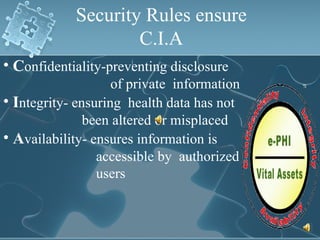
C onfidentiality-preventing disclosure  of private  information I ntegrity- ensuring  health data has not been altered or misplaced A vailability- ensures information is  accessible by  authorized  users Security Rules ensure C.I.A
3 Safeguards of the HIPAA Security Rules Technical Physical Administrative
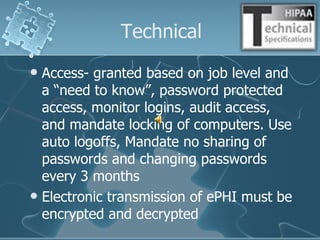
Technical Access- granted based on job level and a “need to know”, password protected access, monitor logins, audit access, and mandate locking of computers. Use auto logoffs, Mandate no sharing of passwords and changing passwords every 3 months Electronic transmission of ePHI must be encrypted and decrypted
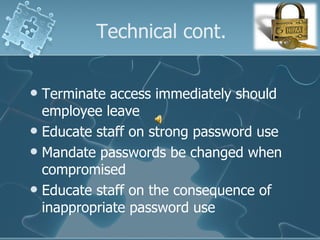
Technical cont. Terminate access immediately should employee leave Educate staff on strong password use Mandate passwords be changed when compromised Educate staff on the consequence of inappropriate password use
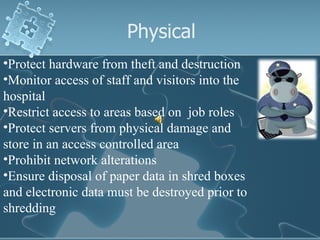
Physical Protect hardware from theft and destruction Monitor access of staff and visitors into the hospital Restrict access to areas based on  job roles Protect servers from physical damage and  store in an access controlled area Prohibit network alterations Ensure disposal of paper data in shred boxes and electronic data must be destroyed prior to shredding
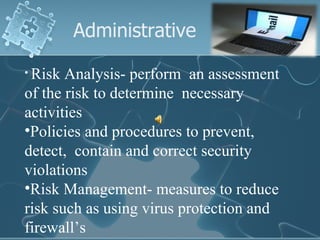
Administrative Risk Analysis- perform  an assessment of the risk to determine  necessary activities Policies and procedures to prevent, detect,  contain and correct security  violations Risk Management- measures to reduce risk such as using virus protection and firewall’s
Administrative cont. Sanctions- Ensure staff are educated on the “0 tolerance”  policy regarding infractions Information  System Activity Review- run audits and reports regularly Security Awareness-ensure all staff are trained on security Back Up data plans and disaster recovery plans will be implemented
Administrative cont. Mr. Joe Smith, the  Information Security officer responsible for policies and procedures Security Incident Reporting- identify violations and corrective actions Instruct staff aware if an unauthorized disclosure occurs, they should report it promptly
HIPAA is mandated by law All health care providers and  their associates must comply All  health care providers and their associates must be aware of the laws and consequences of violations
Ensure Compliance
References Wager, K. A., Lee, F. W., & Glaser, J. (2009). Introduction to Health Care Information.  Health care information systems: a practical approach for health care management  (2nd ed., p. 5). San Francisco, CA: Jossey-Bass.  Summary of the HIPAA Security Rule. (n.d.).  United States Department of Health and Human Services . Retrieved June 20, 2011, from http://www.hhs.gov/ocr/privacy/hipaa

hipaa presentation

  • 1.
    HIPAA Security Putting the Pieces Together People’s Hospital
  • 2.
    C onfidentiality-preventing disclosure of private information I ntegrity- ensuring health data has not been altered or misplaced A vailability- ensures information is accessible by authorized users Security Rules ensure C.I.A
  • 3.
    3 Safeguards ofthe HIPAA Security Rules Technical Physical Administrative
  • 4.
    Technical Access- grantedbased on job level and a “need to know”, password protected access, monitor logins, audit access, and mandate locking of computers. Use auto logoffs, Mandate no sharing of passwords and changing passwords every 3 months Electronic transmission of ePHI must be encrypted and decrypted
  • 5.
    Technical cont. Terminateaccess immediately should employee leave Educate staff on strong password use Mandate passwords be changed when compromised Educate staff on the consequence of inappropriate password use
  • 6.
    Physical Protect hardwarefrom theft and destruction Monitor access of staff and visitors into the hospital Restrict access to areas based on job roles Protect servers from physical damage and store in an access controlled area Prohibit network alterations Ensure disposal of paper data in shred boxes and electronic data must be destroyed prior to shredding
  • 7.
    Administrative Risk Analysis-perform an assessment of the risk to determine necessary activities Policies and procedures to prevent, detect, contain and correct security violations Risk Management- measures to reduce risk such as using virus protection and firewall’s
  • 8.
    Administrative cont. Sanctions-Ensure staff are educated on the “0 tolerance” policy regarding infractions Information System Activity Review- run audits and reports regularly Security Awareness-ensure all staff are trained on security Back Up data plans and disaster recovery plans will be implemented
  • 9.
    Administrative cont. Mr.Joe Smith, the Information Security officer responsible for policies and procedures Security Incident Reporting- identify violations and corrective actions Instruct staff aware if an unauthorized disclosure occurs, they should report it promptly
  • 10.
    HIPAA is mandatedby law All health care providers and their associates must comply All health care providers and their associates must be aware of the laws and consequences of violations
  • 11.
  • 12.
    References Wager, K.A., Lee, F. W., & Glaser, J. (2009). Introduction to Health Care Information. Health care information systems: a practical approach for health care management (2nd ed., p. 5). San Francisco, CA: Jossey-Bass. Summary of the HIPAA Security Rule. (n.d.). United States Department of Health and Human Services . Retrieved June 20, 2011, from http://www.hhs.gov/ocr/privacy/hipaa