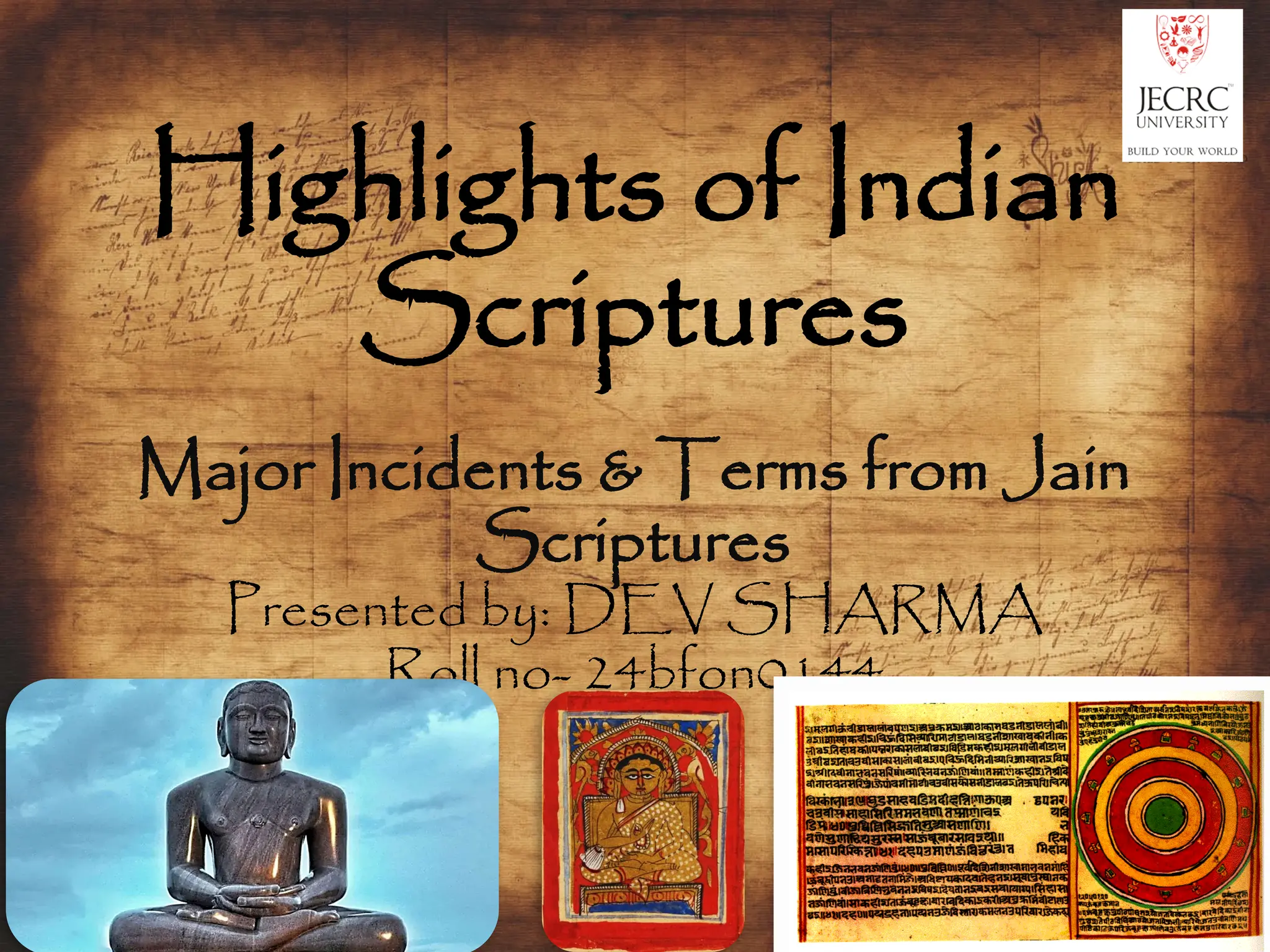
Introduction to JainScriptures
• Jainism is one of the oldest religions in
India.
• Core scriptures: Agamas (canonical
texts), Tattvartha Sutra (philosophy), and
Kalpa S tra (biographies).
ū
• Key themes: Ahimsa (non-violence),
Anekantavada (multiplicity of views), and
Karma theory.
3.
Life of Mahavira
•Born as Vardhamana in 599 BCE in
Kundagrama.
• Renounced worldly life at 30, attained
Kevala Jnana (omniscience) after 12 years
of penance.
• Founded Jain Sangha (monastic order),
preached non-violence and truth.
4.
Tirthankaras and TheirRole
• 24 Tirthankaras (spiritual teachers) in
Jainism.
• Rishabhanatha – First Tirthankara, credited
with establishing society.
• Mahavira – Last Tirthankara, revived Jain
teachings.
5.
Key Jain Terms& Concepts
• Ahimsa: Absolute non-violence towards all
living beings.
• Aparigraha: Non-attachment to material
possessions.
• Syadvada: Doctrine of relativity; truth
depends on perspective.
6.
Jain Cosmology &Universe
Structure
• Universe is eternal, without a creator.
• Divided into Urdhva Loka (heavenly
realms), Madhya Loka (human world), and
Adho Loka (hellish realms).
• Tirthankaras are born in Madhya Loka to
guide beings to liberation.
7.
Conclusion & JainInfluence on
Indian Thought
• Jain principles influenced Hinduism, Buddhism,
and Gandhian philosophy.
• Emphasis on peace, vegetarianism, and
environmental conservation.
• Jainism’s message: Spiritual liberation through
ethical living.