Higher Order Thinking Tiffany Buchanan IDE 650 Dr. Baggett
Definition of Higher Order Thinking Skills (H.O.T.S.) “… the use of cognitive skills or strategies that increase the probability of a desirable outcome…” (Halpern 1998)  “ Recognizable and complex thinking that can yield multiple solutions but is self-regulated” (Zohar et   al. 2003)
Characteristics of H. O. T. S. Purposeful Recognizable Reasoned Challenging Goal directed Intentional/deliberate
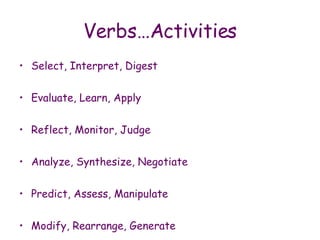
Verbs…Activities Select, Interpret, Digest Evaluate, Learn, Apply Reflect, Monitor, Judge Analyze, Synthesize, Negotiate Predict, Assess, Manipulate Modify, Rearrange, Generate
Supply and Demand There is a demand for a new kind of worker.
“ Workers with poor cognitive skills can expect more competition for fewer jobs that pay poorly” (Halpern 1998).
There is a demand for a new type of worker – the knowledge worker.
Industry seeks out individuals that are technologically literate, critical thinkers, and lifelong learners.  Business leaders and businesses alike thrive on the intellectual ability of workers to provide the competitive edge   needed to be successful.
Individuals must be able to transfer knowledge and critical thinking strategies from the classroom to the boardroom.
“ Human capital is the wisest investment” (Halpern   1998).
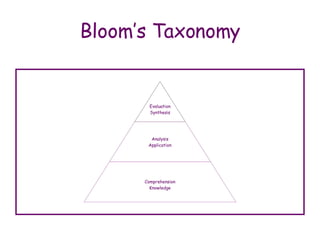
Bloom’s Taxonomy Evaluation Synthesis Analysis Application Comprehension Knowledge
The problem lies not in getting knowledge but applying knowledge .  Teaching & Learning
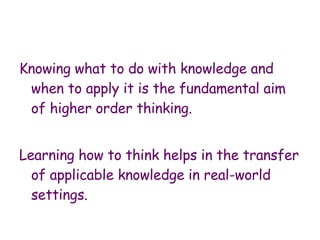
Knowing what to do with knowledge and when to apply it is the fundamental aim of higher order thinking.  Learning how to think helps in the transfer of applicable knowledge in real-world settings.
The best educational practices demonstrate how to learn and how to think.
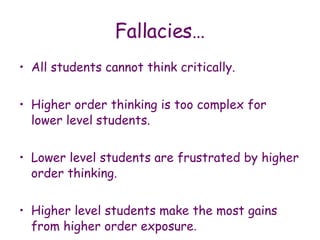
Fallacies… All students cannot think critically. Higher order thinking is too complex for lower level   students. Lower level students are frustrated by higher order thinking. Higher level students make the most gains from higher order exposure .
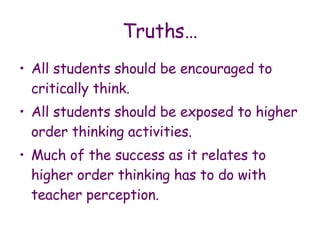
Truths… All students should be encouraged to critically think. All students should be exposed to higher order thinking activities. Much of the success as it relates to higher order thinking has to do with teacher perception.
Truths cont… Faulty teacher perceptions undermine the goal of closing achievement gaps. Teachers plan lessons and activities based on their perception of students.
In sum… Higher order thinking exposes and prepares students to compete in post-secondary education and America’s workforce by applying knowledge at the right time for the right reason.
Links http://www.youtube.com/watch?v=bmF8iIeOVEo This link will provide you an excerpt of Don Imus’ comments about the Rutgers University girls’ basketball team.
References Black, P., McCormick, R., James, M., & Peddler, D.  (2006). Learning how to learn and assessment for  learning: a theoretical inquiry. [Electronic Version].  Research Papers in Education ,  21 (2), 119-132. Halpern, D. F. (1998). Teaching critical thinking for  transfer across domains. [Electronic Version].  American Psychologist ,  53 (4), 449-455. Zohar, A., & Dori, Y. J. (2003). Higher order thinking  skills and low-achieving students: Are they mutually  exclusive? [Electronic Version].  The Journal of the  Learning Sciences, 12 (2), 145-181.

Higherorderthinking

  • 1.
    Higher Order ThinkingTiffany Buchanan IDE 650 Dr. Baggett
  • 2.
    Definition of HigherOrder Thinking Skills (H.O.T.S.) “… the use of cognitive skills or strategies that increase the probability of a desirable outcome…” (Halpern 1998) “ Recognizable and complex thinking that can yield multiple solutions but is self-regulated” (Zohar et al. 2003)
  • 3.
    Characteristics of H.O. T. S. Purposeful Recognizable Reasoned Challenging Goal directed Intentional/deliberate
  • 4.
    Verbs…Activities Select, Interpret,Digest Evaluate, Learn, Apply Reflect, Monitor, Judge Analyze, Synthesize, Negotiate Predict, Assess, Manipulate Modify, Rearrange, Generate
  • 5.
    Supply and DemandThere is a demand for a new kind of worker.
  • 6.
    “ Workers withpoor cognitive skills can expect more competition for fewer jobs that pay poorly” (Halpern 1998).
  • 7.
    There is ademand for a new type of worker – the knowledge worker.
  • 8.
    Industry seeks outindividuals that are technologically literate, critical thinkers, and lifelong learners. Business leaders and businesses alike thrive on the intellectual ability of workers to provide the competitive edge needed to be successful.
  • 9.
    Individuals must beable to transfer knowledge and critical thinking strategies from the classroom to the boardroom.
  • 10.
    “ Human capitalis the wisest investment” (Halpern 1998).
  • 11.
    Bloom’s Taxonomy EvaluationSynthesis Analysis Application Comprehension Knowledge
  • 12.
    The problem liesnot in getting knowledge but applying knowledge . Teaching & Learning
  • 13.
    Knowing what todo with knowledge and when to apply it is the fundamental aim of higher order thinking. Learning how to think helps in the transfer of applicable knowledge in real-world settings.
  • 14.
    The best educationalpractices demonstrate how to learn and how to think.
  • 15.
    Fallacies… All studentscannot think critically. Higher order thinking is too complex for lower level students. Lower level students are frustrated by higher order thinking. Higher level students make the most gains from higher order exposure .
  • 16.
    Truths… All studentsshould be encouraged to critically think. All students should be exposed to higher order thinking activities. Much of the success as it relates to higher order thinking has to do with teacher perception.
  • 17.
    Truths cont… Faultyteacher perceptions undermine the goal of closing achievement gaps. Teachers plan lessons and activities based on their perception of students.
  • 18.
    In sum… Higherorder thinking exposes and prepares students to compete in post-secondary education and America’s workforce by applying knowledge at the right time for the right reason.
  • 19.
    Links http://www.youtube.com/watch?v=bmF8iIeOVEo Thislink will provide you an excerpt of Don Imus’ comments about the Rutgers University girls’ basketball team.
  • 20.
    References Black, P.,McCormick, R., James, M., & Peddler, D. (2006). Learning how to learn and assessment for learning: a theoretical inquiry. [Electronic Version]. Research Papers in Education , 21 (2), 119-132. Halpern, D. F. (1998). Teaching critical thinking for transfer across domains. [Electronic Version]. American Psychologist , 53 (4), 449-455. Zohar, A., & Dori, Y. J. (2003). Higher order thinking skills and low-achieving students: Are they mutually exclusive? [Electronic Version]. The Journal of the Learning Sciences, 12 (2), 145-181.