Islamic Republic of Afghanistan


CONDUCTING SURVEYS
on DISABILITY
A COMPREHENSIVE TOOLKIT


Parul BAKHSHI
Jean François TRANI
Cécile ROLLAND


NATIONAL DISABILITY SURVEY IN AFGHANISTAN, 2005
Islamic Republic of Afghanistan


        CONDUCTING SURVEYS
                    on DISABILITY

                 A COMPREHENSIVE TOOLKIT


NATIONAL DISABILITY SURVEY IN AFGHANISTAN
                   2005


European Union                                             United Nations
© Handicap International 2006

We would like to express our gratitude to Susan Helseth, Ashraf Mashkoor, Elisabeth Rousset and Frédéric
Tissot for believing in the project from the very beginning and for their support in the most difficult times.


ISBN : 2-909064-74-3

Authors
Parul Bakhshi, parulbakhshi@yahoo.com
Jean-François Trani, jftrani@yahoo.fr
Cécile Rolland, cecilerolland@caramail.com

Editing, design and printing
New Concept Information Systems Pvt. Ltd.
New Delhi, India

Published by
Handicap International
14, Avenue Berthelot
69361 Lyon Cedex 07, France
Tel +33 (0) 4 78 69 79 79
Fax +33 (0) 4 78 69 79 94
email: contact@handicap-international.org
www.handicap-international.org

Photographs
Taken by Dr. Frédéric Tissot for Handicap International Afghanistan Programme
House No. 133
Qala-e-Fatullah, 5th street,
Kabul, Afghanistan
Contents

Acknowledgements                                                     v
Abbreviations                                                       vi
Preface                                                            vii

Introduction                                                        1


Fact File 1
Defining Objectives, Understanding the Context
Defining Specific Objectives, Ensuring Political Grounding            3
Understanding Beliefs and Realities in a Given Context              4
A Simple Theoretical Framework as a Basis for Defining Disability    6


Fact File 2
Defining the Methodology, Selecting the Sample Size
Why Choose to Survey?                                               9
The Sampling Frame                                                 10
The 3-Stage Sampling Method Used for the NDSA                      11
The Control Groups                                                 12


Annexure 1
The Stages of Sampling of the NDSA
The First Stage of Sampling at the National Level                  15
The Second Stage of Sampling: Choosing the Clusters                16
Third Stage of Random Sampling: Choosing the Households            17


Annexure 2
Details of the Third Stage of the NDSA Sampling Process
Document Used for Training of the Survey Team                      18


Fact File 3
Elaborating Relevant Tools
Looking at Tools that Already Exist                                23
Detecting Disability: the Screening Questions                      24
The Other Modules of the Questionnaire                             28


Fact File 4
Training of the Survey Team
Who Should Survey?                                                 33
Sensitisation: Changing Set Ideas and Vocabulary                   34
A Well-Planned, Comprehensive and Diverse Schedule                 35
Specific Aspects of Training for Surveys on Disability              37
Annexure 3
                                Training for Surveyors for a Study on Disability: the
                                Experience of the NDSA
                                Getting Started                                                  41
                                Devising the Schedule                                            43
                                Disability Concept                                               44
                                Physical Disability                                              44
                                Sensorial Disability                                             46
                                Mental Disability (Mental Illness and Intellectual Disability)   46
                                Children with Disability                                         48


                                Fact File 5
                                Field Organisation
                                Human Resources: the Team                                        51
                                Preparing for the Fieldwork                                      54
                                Organising and Supervising Fieldwork                             55
                                Ensuring the Quality of the Data Collected                       57


                                Fact File 6
                                Analysis and Dissemination of Results
                                Analysing the Survey Data                                        59
                                Dissemination of the Information                                 61


                                Conclusion                                                       63


                                Bibliography                                                     64


                                Annexure 4                                                       65
                                Tools for the NDSA                                               65
                                Check List                                                       66
                                Household File                                                   68
                                Screening Questions                                              70
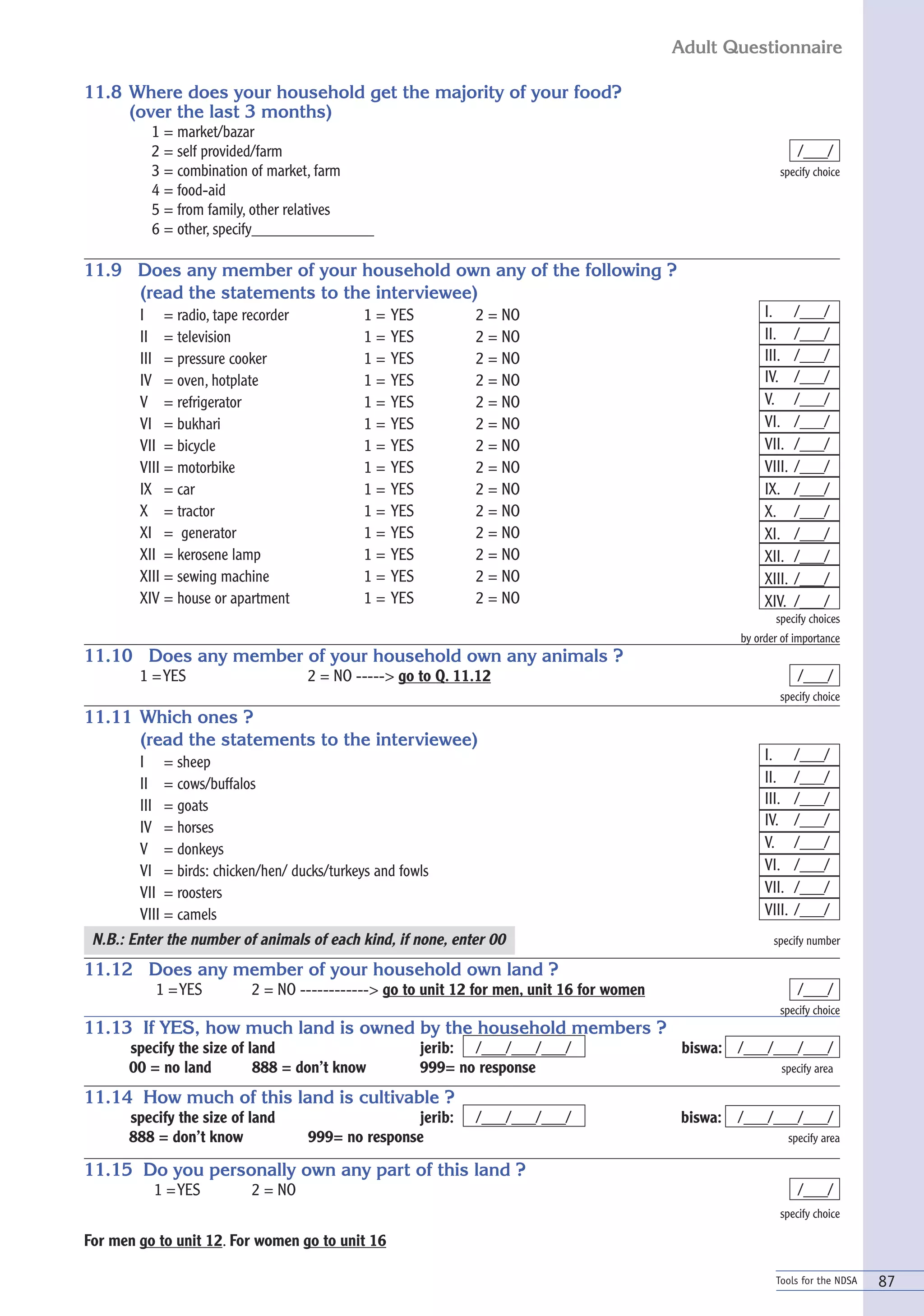
                                Adult Questionnaire                                              74
                                Child Questionnaire                                              97


iv   Conducting Surveys on Disability: A Comprehensive Toolkit
Acknowledgements
We would like to thank the following people for their precious contribution to this project:


Firoz Ali Alizada (HI)                                                     Non Governmental Organisations
Elena M. Andresen (University of Florida)                                  Afghan National Association for the Deaf
Parween Azimi (NPAD)                                                       Aide Médicale Internationale
Mario Biggeri (University of Florence)                                     Community Center for Disabled
Federica Biondi (INTERSOS)                                                 Handicap International Belgium
Tania Burchardt (London School of Economics)                               Healthnet International
Alberto Cairo (ICRC)                                                       IAM (International Assistance Mission)
Sonia Cautin (HI)                                                          ICRC, International Committee of the Red Cross
Flavio Comim (Cambridge University)                                        INTERSOS
Heather Dawson (HI)                                                        MADERA
Masooma Faizi (HI)                                                         Médecins du Monde
Fiona Gall (SGAA)                                                          National Afghan Disabled Women Association
Elias Hameedi (Afghan Human Rights Commission)                             National Association for Disabled of Afghanistan
Chris Lang (HIB)                                                           National Disability Union
Sue MacKey (HI)                                                            Sandy Gall’s Afghanistan Appeal
Dan Mont (World Bank)                                                      SERVE
Valerie Piloti (ACF)                                                       Swedish Committee of Afghanistan
Samiullah Sami (HI)
BjÖrn Schranz (HI)
Lorella Terzi (University of London)
Erik Vandissel (MoLSA/UNICEF)
Peter Ventevogel (Health Net International)

Johns Hopkins Bloomberg School of Public Health
Gilbert Burhnam
Ayan A. Noor
Lakwinder P. Singh

The Government of Afghanistan
Ministry of Martyrs and Disabled and Social Affairs
Ministry of Public Health
Central Statistics Office


                                                                                                                              Acknowledgements   v
Abbreviations
          AFAs        :            Afghanis
          BPHS        :            Basic Package of Health Services
          CI          :            Confidence Interval
          CSO         :            Central Statistics Office
          DPO         :            Disabled Persons Organisation
          GoA         :            Government of Afghanistan
          HDR         :            Human Development Report
          Hrs         :            Hours
          ICF         :            International Classification of Functioning, Disability and Health
          IDPs        :            Internally Displaced Persons
          IED         :            Improvised Explosive Devise
          ILO         :            International Labour Organization
          MDGs        :            Millennium Development Goals
          MICS        :            Multi Indicators Cluster Survey
          Mins        :            Minutes
          MMDSA :                  Ministry of Martyrs, Disabled and Social Affairs
          MoE         :            Ministry of Education
          MoWA        :            Ministry of Women’s Affairs
          MoPH        :            Ministry of Public Health
          ND          :            Non-Disabled
          NDSA        :            National Disability Survey in Afghanistan
          NGO         :            Non Governmental Organisation
          NRVA        :            National Risk and Vulnerability Assessment
          MTM         :            Master Trainer Monitor
          NHSPA :                  National Health Services Performance Assessment
          PPS         :            Probability Proportional to Size
          PwD         :            Person with Disability
          RTM         :            Regional Team Manager
          UN          :            United Nations
          UNDP        :            United Nations Development Programme
          UNICEF :                 United Nations Children’s Fund
          UXO         :            Unexploded Ordnance
          WFP         :            World Food Programme
          WHO         :            World Health Organization


vi   Conducting Surveys on Disability: A Comprehensive Toolkit
Preface

My involvement with the National Disability Survey in Afghanistan started at the very beginning of this challenge, three years ago,
when two members of my research team told me they were planning to launch a national household survey on disability. This project
was motivated by a strong ideal, to better understand the living conditions and the needs of Afghans with disability. In order to design
the methods and tools to achieve this, a number of experts from various origins came together to generate a strong team spirit; it has
been an interesting challenge to be part of this team.


This comprehensive toolkit gives the basis for the design and the implementation of household surveys on disability. It is an instrument
that can be used for all those interested in knowing how to look at disability within a specific political, cultural, religious and social
context.The six fact files of this document detail the various steps required to design, conduct and analyse a survey focusing on similar
issues. These steps include: understanding the socio-economic context in order to specify the survey objectives, setting up appropriate
methodologies including the sample selection and the design of questionnaires, training the interviewers teams, conducting field
operations to collect the data and, finally, analysing and disseminating the relevant information.


This toolkit was not written for a specific profile of persons. It argues that commitment of all partners, at all stages, is a pre-requisite
to ensuring that scientific findings are translated into relevant policy decisions. In order to carry out any form of action research,
bridging the gap between the various actors working in the field of development, be it researchers and academicians, non-government
organisations or policy designers and practitioners, is a must. In the pages that follow, academicians and researchers defined a set
of methodologies, which were successfully tested in the field in order to observe and measure issues related to disability. The role of
the policy designers and practitioners is to then suggest relevant policy measures, through a participatory mechanism. In order to do
this, they need to know the underlying assumptions, understand the methodologies used to collect the data in the field, and grasp
the socio-economic reality. This is the only way to ensure that the results will not be misinterpreted or misused, and that they will be
accepted and considered valid.


It has been a pleasure to be part of the team.The discussions and debates around the NDSA have helped better understand the issues
related to vulnerable groups in general, and disability in particular. This project is a real success for the Ministry of Martyrs, Disabled
and Social Affairs of Afghanistan and the teams of Handicap International who commissioned and implemented the study.To all those
who would like to undertake such challenges, one can only hope this toolkit be of a great help. Firstly, to better understand the daily
situation of the persons with disability. Secondly, to implement relevant policies that improve their capability and help them to lead
the lives that they value.


                                                                                                                       Jean-Luc Dubois
                                                                                                                     Director of Research
                                                                                            Institute of Research for Development, Paris


                                                                                                                                          Preface   vii
Introduction
Carrying out a survey on disability is always a perilous endeavour. A myriad of questions arise regarding
definitions, methodology, training of surveyors... This toolkit has been compiled following the National
Disability Survey in Afghanistan (NDSA), the fieldwork for which was carried out between November 2004
and July 2005. It brought together people from different walks of life, in Afghanistan or around the world,
who contributed to make this task possible.

The present document is an attempt to compile a variety of documents, experiences and discussions that
took place during the many steps of the NDSA, the lessons learnt regarding the sampling process, tools, as
well as the organisation. Some questions were omnipresent and still remain unanswered; however they did
lead to some very interesting discussions: this document attempts to present these debates, as well as some
solutions that were chosen for the NDSA. The comprehensive toolkit has been designed to help answer some
of these queries that are intrinsic to a majority of surveys and studies carried out in the field of disability,
by making recommendations on how to proceed. It was designed following the experience gained from the
NDSA, carried out by Handicap International for the Government of Afghanistan. This applied research was
implemented in one of the most dangerous post-conflict contexts in the world today. However, at a time when
policies are being decided in the country, it seemed essential to have a comprehensive view regarding the
multitude of issues that impact the lives of Afghans with disability.

The NDSA was a household survey that covered all 34 provinces of the country and was conducted in close
collaboration with the Ministry of Public Health of Afghanistan, the Ministry of Martyrs, Disabled and Social
Affairs and the Central Statistics Office under the Ministry of Economics and in partnership with the local team
of the Johns Hopkins Bloomberg School of Public Health, Baltimore, USA. The project was commissioned in
view of the need to provide evidence regarding persons with disability, required by all partners working in
the country. Economic and political decisions were being made on very local and sporadic estimations of the
prevalence rate, which varied from 3% to 10% of the total population. There was no information regarding
the numbers, profiles, living conditions and coping strategies of persons with disability. Programmes that
were run by national and international organisations were often based on intuition and depended largely on
accessibility to populations. As a result there was a demand, both on part of the government and organisations
working in the field of disability, for a more complete knowledge regarding this population in order to tailor
and adapt policies and programme to the needs of the beneficiaries.

The suggestions and guidelines presented in this document are general, and are based on the lessons that
were learnt in the field regarding the specificities of carrying out a survey on disability. The aim here is not
to provide a pre-defined method for conducting a similar project, but to offer certain elements that can help
avoid biases and errors when carrying out a survey on vulnerable groups. All the elements that are presented
here will need to be re-thought and adapted to the socio-cultural context within which the survey is planned.
Moreover, this document presents the various steps that were devised for a national-level or large-scale
survey. However, a number of recommendations made can be used for smaller scale or local surveys and
studies. The toolkit aims to facilitate the task of anyone who is planning to carry out a survey on disability, be
it small-scale or nationwide.


                                                                                                                     Introduction   1
The present document is divided into six different fact files that      It is important to state here that the NDSA was carried out in
         may be used as a whole or independently:                               a very unique context- the recent history of Afghanistan has
         • Fact File 1: Understanding the Context, Defining                      categorised it under the “post-conflict” label. However, the
             Objectives;                                                        transition from a post-conflict stage to a development and
         • Fact File 2: Defining the Methodology, Selecting the                  rehabilitation stage is the main challenge that the country faces
             Sample;                                                            today.The successive wars and the despicable security conditions
         • Fact File 3: Elaborating Relevant Tools;                             in most regions have contributed not only to a paucity of
         • Fact File 4: Training the Survey Team;                               comprehensive rehabilitation services but also to the lack of any
         • Fact File 5: Field Organisation;                                     overall picture regarding disability in the country. Added to that,
         • Fact File 6: Analysis and Dissemination of Information.              very complex political and international dynamics have led to an
                                                                                unstable situation.The NDSA has been the first household survey
         Each fact file consists of examples from the NDSA. It also              that is nationally representative, and which attempts to look at
         contains technical files which can be used as a checklist for other     the overall situation of persons with disability in the country.
         surveys. These files summarise all the questions that need to be
         asked before starting a survey on disability.                          There are two main methods of conducting a national survey on
                                                                                disability:
         General Considerations – How to                                        • By using a national sample of households and screening
                                                                                     them for disability: this was the case of the NDSA;
         Get Started
                                                                                • By screening for disability in a national census or a
         Crucial questions need to be asked, and answered, at the very
                                                                                     national survey (about health, education, labour…)
         onset, before starting the survey. These may be related not only
         to the very need for a survey, its aims and objectives, but also to
         the social and cultural norms, the political situation, the financial   In order to compare the situation of persons with and without
         possibilities within a given context, as well as the expectations      disability, the survey should include a sample of non-disabled
         and queries of all the various stakeholders and governmental           persons as well. This makes it possible to assess the differences
         bodies and international as well as local organisations who will       between the two groups, as well as to evaluate the opportunities
         use the results and findings.                                           that seem open to each one of them in terms of education,
                                                                                health, employment, livelihood, social participation…
         The first question that may be asked is why a survey? A
         survey is necessary when a given finite population, or a sub-           Any survey, small or large, entails a clear and detailed planning of a
         population, i.e. the disabled people of Afghanistan, has to be         number of diverse aspects, which in turn will shape the organisation
         studied. The survey provides information about this population.        of the study as well as the use of the results provided by it.
         This information is gathered through variables, which give the         Technical File A asks some general questions regarding the survey
         population characteristics or parameters. A sample, which is a         and its implications, for the researchers, the decisions makers, the
         subset of elements of the population, is selected and studied.         organisations working in the field and for persons with disability.


              Getting Started
              Make sure that you have certain facts regarding the study clearly in mind:
              • Do you need a survey, or would another type of study be more appropriate?
              • Who is the study being carried out for, who has commissioned it?
              • Who is funding the study?
              • Which organisations, groups, NGOs will be able to use the results of the study?
              • What is the overall aim of the study?
              • What are the specific objectives?
              • What is the time frame?
              • What is the allocated budget?
              • What are the needs in terms of time and human resources?
              • What are the general socio-cultural specificities of the country and how will these influence a survey on disability?


2   Conducting Surveys on Disability: A Comprehensive Toolkit
Fact File
Defining Objectives,
Understanding the Context
                                                                                                                                         1
Surveys on disability are carried out not only for research purposes but also to help with the implementation of
programmes.The first objective is to provide general understanding of the situation of persons with disability,
whereas the second aim is to provide insights regarding specific living conditions, the immediate and long-
term needs of the persons with disability and the means to implement relevant programmes to meet these
needs. The defining of the overall objectives is usually done in view of the demands of the main partners,
their programmes and policies, and their expectations. For a national survey these partners may include the
government, as well as the donor agencies. There might also be considerable pressure from existing lobbies
and organisations of persons with disability, which may influence crucial aspects of the survey, such as the
very definition of ‘disability’ and the conditions that should be included under this heading. The challenge
then is to strike a balance between specific demands of the partners and decision makers on one hand, and
scientific validation and neutrality on the other. However, this balance must be found in order to guarantee
that the results and findings of the study are taken into consideration when strategies and policies are being
defined and implemented.

The lesson that was learnt from the NDSA experience is to ensure that the following two aspects are not
ignored at any time:
• The scientific validity, guaranteed by researchers who are not involved in the organisations, donor
     agencies or the decision making bodies in a direct way.
• The political validity, which is ensured by persons in charge of liaising with the different
     stakeholders and making sure that the results of the survey are not misinterpreted or misused, but also
     that they are utilised in a relevant and appropriate manner.


Defining Specific Objectives, Ensuring Political Grounding
The clear defining of the general outcomes of the survey as well as the specific questions that the study will
provide answers to, is the first step towards implementing a sound and useful study. What questions is the
survey attempting to answer? What are the overall goals of the study and what are the specific objectives? This
very crucial aspect of the process is closely related to the funding bodies that the reports will be submitted to
of course, but the researchers can be clear about the independence of carrying out their fieldwork as well as
analysis. The donors and other decision makers provide the general framework of what questions and fields
are addressed by the study; they cannot have their say in what the results should be.

Whatever the context, the overall goal set by all the stakeholders is improving living conditions and enhancing
choices of vulnerable groups in general and persons with disability in particular. In order to make ‘evidence-
based’ decisions and define policies and programmes, there is a need to have reliable insights into the living
conditions of these groups.

Before starting the survey process on the field, researchers will need to think about the use of the results
that their work will provide. At the end of the project a question that often arises is: and now what? One
of the major concerns of researchers is to see their results and policy recommendations translated into
effective policies and programmes. However this final phase can only be ensured if the various partners
are aware of the project and of how their programmes can benefit form it. Within a given context, are the


                                                                                                         Defining Objectives, Understanding the Context   3
Objectives of the NDSA
              For the NDSA the main aim was to provide a comprehensive picture of disability in the country, prevalence rates and
              information regarding all the major issues concerning access to public services (school, health care facilities), livelihoods and
              social participation of persons with disability. However, the objectives were also dependent on the expectations and demands
              of the funding agencies as well as the political partners. Although the overall goal of the survey seemed clear, its political
              implications and consequences were less explicit.The results of the survey would impact the disability scene in the country by
              putting forward findings that would not always be in line with the beliefs that programmes and policies have been based on
              to date.The political side of the survey was trickier to handle.The study was aimed at providing insights and recommendations
              for the Government of Afghanistan even though other NGOs and organisations would also benefit from it.

              However from a research perspective the objectives were clear:
              • To measure prevalence of disability by type of disability;
              • To provide insight into the needs and opportunities of persons with disability in Afghanistan. These may include
                 needs in terms of rehabilitation, education, employment, vocational training, social integration and political
                 participation;
              • To identify barriers, difficulties and stigmatisation that persons with disability face in everyday life;
              • To provide strategic guidelines on how to overcome main difficulties faced by persons with disability.


         conditions necessary to ensure this next phase in place? Once                     Understanding Beliefs and
         the knowledge is available, who is responsible for translating it                 Realities in a Given Context
         into sustainable public action? How can researchers ensure that                   Understanding the dynamics that influence the living conditions
         the will to expand choices and freedoms is a priority throughout:                 of vulnerable groups within a given context is yet another hurdle
         from the very conception of the study to the implementation of                    to cross. This requires an in-depth analysis of the religious,
         policies? These questions will be constant and will need to be                    cultural and social aspects of a given country, a task that is often
         considered and worked upon alongside the research if the results                  rendered more complex by gender and ethnic implications as
         are to be used for the intended purpose.                                          well as economic factors. No valid and reliable study can be


              Political Ponderings for the NDSA....
              “Afghanistan is now 3 years post-conflict and has been in the throes of rapid policy and infrastructure development. With this
              period of brisk growth the need for information on which to base decisions has been clearly outlined in at least 2 different
              offices of the GoA, the MoPH and the MMDSA. Until now, there has not been an environment conducive to the development
              of evidence-based decisions or the funding available for establishment of baseline data in the field of disabilities. The will
              and need has been there within the programmes. With the NDSA close to providing quality research and data in the field of
              disability for the first time, one must stop to ask, where does the onus fall to carry the mantle of the information from research
              to policy? Who takes on the responsibility for translating this information to action? Does this fall on the researchers or on
              the policy developers and implementers? One may argue that the limited capacity of the GoA in this field precludes them
              from taking the more active role in the use of this data, but that the UN agencies and international partners, who have an
              understanding of the field of human development which is derived from the capabilities approach, should carry forth this
              function. Since the GoA has the ultimate responsibility for the development of sustainable and practical solutions to the
              problems inherited after over 20 years of conflict, one could easily argue that it is they who have the burden of carrying this
              research forward to programme and policy development in partnership with the development partners; the question is, will
              they?”1

         1
          TRANI J. F. et. al, (2005), “Disability in Afghanistan: Taking a Capabilities Approach to Look at Research Challenges and Policy
         Implications”,paper presented at the 5th International Conference of the Capabilities Approach, UNESCO, Paris.


4   Conducting Surveys on Disability: A Comprehensive Toolkit
carried out without first understanding the underlying socio-                       practices, religious beliefs, and ways of life using basic qualitative
cultural elements that form the frame within which tools should                    methods:
be conceived and results understood.                                               • Life stories;
                                                                                   • Focus group discussions;
If the researchers do not belong to the country of survey, they need               • Open-ended, one-to-one interviews;
to familiarise themselves with the history, culture and religious                  • Word association techniques;
aspects of people’s lives in order to determine what is acceptable                 • Case studies.
and what is taboo, and avoid the trap of ethnocentrism. Here it
becomes necessary to comprehend group dynamics and gender                          Conducting these preliminary sessions precedes any defining
relations, even more so in what are broadly known as ‘traditional                  of questions and tools. Researchers need to determine what is
cultures’ where collective identities tend to be much more salient                 relevant, what is acceptable and what is sensitive. It is important
and influence the way people act and interact.                                      also to approach various types of groups within a given
                                                                                   population and not just the target group for the study in order to
The first step towards comprehending the cultural norms and                         have a comprehensive view of disability in a given context:
beliefs is by conducting open discussions regarding cultural                       • Persons with disability;


      Complex Social Representation of Persons with Disability in
      Afghanistan
      A study on “Afghan’s perceptions on disability” that was carried out in 20042 showed a complex picture of the beliefs,
      knowledge and attitudes related to different types of disability. According to the study, there is a common belief that war-
      related disabled are viewed as courageous heroes, having made a sacrifice for their country. These persons are not only a
      socially visible group (more so than in a number of other countries), but they also constitute an influential political group.
      Moreover, the results of this study clearly show that there is no real consensus on how to term disability in Dari.

      Mayub, Malul, Diwana...as defined in the study
      “The first aspect of disability in Afghanistan is the difference between mayub and malul: in Dari, they are two words that
      relate to the English word ‘disability’. Officially, the definitions of mayub and malul commonly given are the following:

       •    Malul is a person who became disabled because of an accident (war, mine, car accident, disease etc.)
       •    Mayub is a person who became disabled ‘by birth’. This category can include disability due to congenital factors, as
            well as related to birth accidents, disease, malnutrition…anything that occurs in the first months.”

      There is clearly an overall confusion between types and causes of disability when it comes to common beliefs.
      “But in people’s interpretation, mayub and malul can have different meanings. In general, people know that one of these
      terms is related to ‘birth-caused’ disability and the other term to ‘accident-caused disability’. However, they very often put
      mental disability and sensorial disability in the category of birth-related disabilities, and the physical disabilities in the
      category of accident related disabilities. Also, people occasionally qualify an amputee a malul and the deformed – when
      the body members are ‘dry’ (khushq) – a mayub. So the mayub and malul in colloquial terms can be related to the physical
      aspect of disability.”

      Finally, “the diwana is the colloquial term that refers to any impairment related to asab (mind). It is used as much for people
      with mental illness as for people with intellectual disability”. The diwana, are the most stigmatised; they face the most
      difficulties in terms of integrating within their families and society.


2
    THAKKAR M., CERVEAU T., DAVIN E. (2004), “Afghan perceptions on Disability”, Altai Consulting Report for UNICEF/UNDP, 2004, 61p.


                                                                                                                          Defining Objectives, Understanding the Context   5
•     Disabled persons’ organisations;                                         A Simple Theoretical Framework
         •     NGOs working with persons with disability;                               as a Basis for Defining Disability
         •     Decision makers at the state-level;                                      This phase ensures that the survey methodology is built on a stable
         •     Religious leaders and community leaders;                                 basis that, in turn, will provide the framework for the interpretation
         •     Experts and researchers;                                                 of results. A very complex set of social representations are usually
         •     Lay persons in general, including men and women.                         infused into the social fabric and affect all spheres of life. As a
                                                                                        consequence, vulnerable groups such as persons with disability
         The social representations that are linked to disability are                   are valorised or shunned, admired or hidden, according to the
         sometimes difficult to understand; what is valorised? What is                   perceived causes. The challenge then is to have a framework
         hidden? What are the reasons behind stigma and discriminations?                that encompasses all these differences. In order to elaborate the
         Who is the most discriminated against? What is the plight of                   tools for a survey it is necessary to review the various definitions
         women with disability? Researchers need to get a sound idea of                 that have been put forward on the subject of disability and to
         what type of belief systems and social practices they are dealing              consider all work previously done. Once the first hurdle of coming
         with.                                                                          to a consensus on what is called disability in terms of definitions
                                                                                        and theoretical considerations has been crossed, the main task
         Researchers have to be careful of the use of the right word and of             remains of translating these definitions into tools that can be used
         the several meanings it may have. The choice of words and their                to detect disability within households and communities.This needs
         implications are an inherent element for designing a survey in a               to be done while keeping in mind cultural and social specificities of
         language the researchers are not familiar with. Usually a variety              the socio-cultural context. Drawing on different schools of thought
         of terms refer to various realities. For example in Afghanistan,               can contribute to defining an adapted framework within which the
         the war disabled often have a much more valorised place within                 survey is elaborated.
         society and are the main recipients of public attention and the
         target group for compensation programmes. The risk that may                    Based on the abundance of literature that exists on the concept
         then arise is to have this category over-represented in the study              of disability, before reaching a definition, researchers need to
         while the other, less visible categories would be under-estimated.             bear in mind two main aims:
         As a result, for the NDSA, the research team had to derive a tool              • Firstly, the need to be functional in order to be able to
         that would work around this problem and not just look at the                        design a questionnaire that takes into account individual,
         more accepted forms of disability.                                                  institutional, societal and environmental factors: “Disability
                                                                                             is multidimensional, thus, we cannot ascertain the single
         This information can be collected through different methods:                        “true” disabled population. Different purposes are related
         focus groups with persons with disability, discussions with                         to different dimensions of disability or different conceptual
         experts, individual interviews... It will form the basis of the                     components of disability models3”.
         questionnaire and other tools.


              Understanding the Context
              This technical file can only be completed with interviews and focus group discussions with persons with disability as well as
              lay people from the general population that the survey looks at. This step is essential to the design of tools and methods and
              for ensuring that the questions are relevant to the lives of the interviewees.
              • What are the terms that translate the term ‘disability’?
              • What are the different types of disabilities identified by the people?
              • How do people categorise disability? In terms of physical impairments? In terms of causes? According to a variety of
                   different factors?
              • What are the sensitive subjects that people feel uncomfortable talking about?
              • What differences do they perceive between persons with and without disability?
              • What is the general reaction of lay people towards persons with disability? Compassion? Pity? Discrimination?
              • What are the major problems identified by people in everyday functioning? What are the main barriers?


         3
           See WASHINGTON GROUP (WG) (2005), Report of the on Disability Statistics, December 30th 2005, p. 2., http://www.cdc.gov/nchs/citygroup.htm,
         accessed September 9th, 2006.


6   Conducting Surveys on Disability: A Comprehensive Toolkit
•       Secondly, the view on disability needs to be relevant                            In the past decade, the capabilities approach put forward
        to the context and allow space for gender, ethnic and                            by Amartya Sen has placed the definition of disability within
        religious factors, which come into play in the lives of                          the wider spectrum of human development. The capabilities
        persons with disability.                                                         approach provides further insight into the issues related to
                                                                                         disability since it proposes to look, not at what a person actually
For long, two main models have been presented as having                                  does (functionings), but at the range of possibilities that he/she
contrasting views.The medical view, based on the individual and                          chooses that specific functioning from – this is the capabilities
his/her impairment considers the physical or mental ‘problem’                            set. This view is based of “beings and doings that an individual
that a person has. This view, which entails approaching the                              has reason to value”, thus shifting the focus from the specificities
subject of disability by focusing on the individual, has often been                      of the disabling situation to how to look at establishing equality
considered to be biased by disability activists and organisations.                       in terms of possibilities and choices. This perspective looks at
The latter put forward the argument that persons are ‘disabled’                          the interplay between individual characteristics and social
because of the structure of the society in which they live,                              restrictions and proposes to measure outcomes in terms of the
which does not accommodate their impairment. Thus, it is the                             expanding of people’s choices, and thus, freedoms. Limiting the
environment, physical and social, that makes a person with                               definition to merely a quantitative, or income and institutional
impairment, a person with disability. This view, which has been                          access would be ignoring the dynamics that exist between the
put forward by a number of disabled persons’ organisations,                              individual and the community. The focus on human diversity
looks at the barriers that exist within the social context and that                      within the capabilities approach is also particularly important
prevent a person from achieving the same level of functioning as                         in view of the research: “Within this view of human diversity
a non-disabled person. In this perspective it is society that needs                      as central, therefore, according to the capability approach, it
to be reviewed in order to take into account the disabled person’s                       makes a difference whether someone is a man or a woman and
needs. Mainstreaming disability concerns is a progressive and                            if he or she has physical and mental prowess or weaknesses;
sustainable way of redesigning society in order to include people                        if someone lives in a temperate physical environment or in
with disability.                                                                         more adverse climatic zones, and in certain social and cultural
                                                                                         arrangements rather than in others. And the difference entailed
In terms of definition, the World Health Organization has                                 by these variations has to be accounted for, when addressing the
defined the International Classification of Functioning,                                   demands of equality”5.
Disability and Health (ICF). This document looks at disability
as a combination of different types of factors that influence the                         There are evidently similarities between these various definitions
environment within which persons with disability evolve. “In the                         of disability, the emphasis being on the interplay between the
ICF, the term functionings refers to all body functions, activities                      individual and the collective. Within the human development
and participation, while disability is similarly an umbrella                             perspective, the definition of disability devised for the NDSA
term for impairment, activity limitations and participation                              needed to take into account these diverse aspects:
restrictions”4.                                                                          • The individual’s potentialities and vulnerabilities;
This definition is based upon two main concepts:                                          • The opportunities offered by the environment the
• Body functions and structures focus upon personal                                           individual lives in;
      factors which correspond to the personality and                                    • The agency role of the individual or communities, which
      characteristic attributes of an individual,                                             looks at the extent to which the person (or the group)
• Activities and participation focus upon the                                                 considers him/herself as the main actor and decision
      environmental factors, including the physical environment,                              maker in his/her own life.
      the social environment, the impact of attitudes etc.


4
    WORLD HEALTH ORGANIZATION (1987), International Classification of Impairments, Activities and Participation, Geneva.
    WORLD HEALTH ORGANIZATION (2001), International Classification of Functioning, Disability and Health, Geneva.
5
    TERZI L. (2003), “A Capability Perspective on Impairment, Disability and Special Needs: Towards Social Justice in Education”, paper presented at the 3rd Conference on
    the Capability Approach, From Sustainable Development to Sustainable Freedom, 7-9 September 2003, University of Pavia, Italy.


                                                                                                                                 Defining Objectives, Understanding the Context   7
Definition of Disability in the NDSA
              The NDSA questionnaire is designed to place emphasis on the individual and societal factors that influence the lives of the
              disabled.The institutional factors will be addressed to a lesser extent; the aim of the survey being to provide policy guidelines
              for the GoA in a country where the state support structures need to be set up in most parts of the country. The definition
              utilised for the survey draws on all the definitions stated:

              Disability is thus the condition that results from the interaction between an individual impairment in functioning
              and the community and social resources, beliefs and practices that enable or prevent a person from participating
              in all spheres of social life and taking decisions that are relevant to his/her own future.


8   Conducting Surveys on Disability: A Comprehensive Toolkit
Fact File
Defining the Methodology,
Selecting the Sample Size
                                                                                                                                          2
There are a number of ways to proceed when carrying out a survey on vulnerable groups in general and
disability in particular: these range from localised qualitative surveys, limited to a specific target group, to
nationwide quantitative surveys which require a representative sample of the target populations.


Why Choose to Survey?
A survey is a procedure for systematically collecting information about attitudes, preferences, knowledge, or
behaviour by asking people questions. Some people distinguish between applied and research surveys, the
purpose of the latter is to increase scientific knowledge, by testing theories for example.

Major Characteristics
Surveying has three major characteristics:
• Asking people questions using a formal procedure;
• Using a quantitative method that collects standardised information;
• Obtaining information from a sample that is representative of the population that the sample was
    drawn from.
Surveys are used because:
• They are cheaper in comparison with a census, for example;
• They are more practical (they take up less time and interview a limited number of persons);
• They are accurate (the results can be valid for a wider population if certain statistical principles are
    respected).
• They provide more information than a census.

Defining the methodology that will be followed throughout the survey process will lay down a road map
for each step. The choice of the type of survey done will depend upon the objectives of the survey. There are
various possibilities depending upon the expected outcomes. For a survey on disability these options could
include:
• A census that includes questions on disability;
• A nationally representative survey with screening questions for detecting disability;
• A regionally or provincially representative survey with screening questions for detecting disability;
• A local qualitative survey that looks at a specific limited population (women with disability, for
     instance).

The steps that have been presented in this toolkit refer to a large scale, probability proportional to population
size (PPS) survey. The NDSA falls into this category and was carried out in all the provinces of Afghanistan.
Smaller scale and more qualitative surveys would use some elements that are described in this section.

The choice of the methodology will, in turn, determine the types of results that will be derived from this survey
and will have major implications in terms of the financial and human resources possibilities.


                                                                                                     Defining the Methodology, Selecting the Sample Size   9
Sample, Results, Method and Specificities for Various Surveys
            Type of Survey                Survey Sample                 Results Valid for       Methods                                      Specificities
            Census                        Entire population             Entire Population       Closed/pre-coded questionnaire               Very costly in terms of
                                                                                                                                             organisation and analysis
            National PPS1                 A statistically               Entire population       Closed/pre-coded questionnaire               Cost-efficient to establish
                                          representative sample                                                                              national prevalence rates
            Regional/Provincial PPS       A statistically               Entire population       Closed/pre-coded questionnaire               Cost-efficient to establish
                                          representative sample                                                                              regional prevalence rates
            Qualitative theme-based       Target sample                 Target group            •     Open Questionnaire;                    In depth study of selected
            survey                                                                              •     Focus group discussions;               themes regarding disability for
                                                                                                •     Interviews;                            a chosen group having specific
                                                                                                •     Life stories;                          characteristics
                                                                                                •     Observation...
            Participatory Observation     Chosen individuals/           Individuals/            •     Open Questionnaire;                    In depth study of selected
                                          communities                   communities             •     Focus group discussions;               themes regarding disability for
                                                                                                •     Interviews;                            a chosen group having specific
                                                                                                •     Life stories;                          characteristics
                                                                                                •     Observation...


          The Sampling Frame                                                                   •     Because the knowledge required to reach the goals
          A number of documents present the survey methodology in                                    previously defined needs to be based on a wide range of
          detail. They also look at surveys on disability specifically. Two                           questions. This information cannot be obtained by a limited
          documents among others that provide a comprehensive view of                                number of questions, which is the case in a census.
          survey techniques are:
          • L. Kish, Survey Sampling, New York, Wiley, 1965.                                   A sampling method is used for all these reasons and can be
          • Guidelines and Principles for the Development of                                   done in many ways, depending on what the expected results of
               Disability Statistics, Department of Economic and Social                        the study are. So first, the research team must be clear on what
               Affairs, Statistics Division, Statistics on Special Population                  the aims and objectives are.
               Groups, Series Y No. 10, United Nations, 2001.
                                                                                               When sampling, the major task is to select a representative
          The aim in the present document is not to go into sampling                           sample.This means that the group of people that are interviewed
          detail, but to try and explain certain simple steps that help                        will have a very high chance of representing (having similar
          ensure that the survey on disability provides valid prevalence                       characteristics as) the target or “parent” population: for a national
          rates and a look at comprehensive coping strategies.                                 survey this is the entire population of the country.

          Why Sample?                                                                          Any sampling frame is based on two principles:
          Sample surveys do not aim to enumerate or list every individual                      • Everyone has an equal chance of being included in the
          or household in the country but to be representative of the                               sample;
          population under study. A sample is chosen for various reasons:                      • In order to avoid bias, researchers need to ensure that the
          • Because it is close to impossible to include everyone in                                sample selected has the same characteristics as the parent
              terms of time, the distances and the resources (human and                             population.
              financial).
          • But more importantly, because including everyone is not                            Defining the Sample Size
              necessary; in fact, statistically the same results can be                        The question that then arises is how big should the sample size
              obtained from a small part of the entire population.                             be?This is again closely linked to the objectives of the survey. The
          • Because surveying each and every individual is not always                          more general the results, the smaller the sample requires to
              possible.                                                                        be. A national survey on disability requires a sound sampling


          1
            PPS survey refers to a survey methodology where the random sampling is done according to the population size. This means that in provinces with high number of
          inhabitants there are more clusters and the remote areas have fewer clusters. For example for the NDSA, Kabul city had the highest number of clusters, being the most
          populated region of the country.


10   Conducting Surveys on Disability: A Comprehensive Toolkit
methodology that allows the establishing of valid prevalence                           an adequate number of interviewees identified as having
rates at the national, and sometimes at regional/provincial,                           a disability. This is also important if the researcher wants
or even local levels. As a result the conclusions that would be                        to sub-divide the population of persons with disability into
made for the sample would be relevant at the national and                              sub-groups (by types of disability for instance) or carry out
sub-national levels. If results are required at a more local level,                    complex analysis (for instance rate of employment by age
the sample size would be larger in order to provide regional,                          classes, or school retention by level of education…).
provincial or district-level results.                                            •     If the survey is not a representative sample survey, the
                                                                                       sample will not be representative of the whole population
How large should the sample size be in order to be                                     of persons with disability. As a result, the conclusions made
nationally representative?                                                             for the sample will not be considered to be statistically valid
The defining of a precise sample that allows the research team to                       for the entire parent population.
reach the defined objectives requires the expertise of statisticians              •     The coverage of specific locations or circumstances is
specialised in sampling and survey methodology. In the case of                         challenging at best and impossible at worst.This may be the
the NDSA, partners at the Johns Hopkins Bloomberg School of                            case for persons living in institutions (such as jails, schools
Public Health in Baltimore carried out the necessary calculations                      or hospitals…), nomadic population or refugees living in
and came up with the number of households that would need                              camps, homeless persons...
to be surveyed in order to obtain the rate of prevalence. The
calculations to determine the number of households take into                     The 3-Stage Sampling Method Used
account three factors:                                                           for the NDSA
• The estimated rate of prevalence of disability;                                In order to provide rates and results that were reliable, it was
• The confidence interval;                                                        essential that the random method be followed at every step of
• The level of precision that is selected2.                                      the sampling frame for the NDSA: as a result at every step of the
                                                                                 process, each household had an equal chance of being selected.
In the case of small population groups such as very vulnerable
groups (women alone with children, persons with disability…),                    First Stage of Sampling
it is necessary to define a relatively large sample to be sure                    For the NDSA, the first stage of sampling is the district. Two
to include a sufficient number of interviewees having the                         sources of population data were used to define the district
characteristics of the group studied.                                            population frame. Afghanistan consists of 34 provinces. For 30
                                                                                 of these, the 2003-2004 population pre-census figures were
However, the random sampling survey method does present a                        available. As a result the districts were ordered based on the
few limitations:                                                                 population size. For the remaining 4 provinces, which were not
• A very large sample is required to detect and interview                        covered by the pre-census due to security issues, the Central


    Sampling Design
                                                                 Define sample size list of all
          1st Stage of sampling                                    villages of the country


                                                                175 clusters randomly selected
          2nd Stage of sampling                                  using PPS method from the
                                                                           database


          3rd Stage of sampling                                  In each cluster 30 households
                                                                     are randomly selected


                                  Households with ‘disability’                              Every 5th household without disability
                                  • PwDs are interviewed                                    A person above age 5 is randomly
                                  • Match for each PwD is interview                         selected for interview


2
    Annexure 1


                                                                                                                 Defining the Methodology, Selecting the Sample Size   11
Statistics Office provided projections for 2003-2004 calculated       step of the sampling process was defined with precision, and all
          based on the 1979 census and the same ordering was done.             possibilities were thought of:
          The required number of districts to be included in the survey        • The survey team proceeded to the centre of the cluster;
          was then selected following the same method for both lists. As a     • The team chose a direction by spinning the pointer;
          result the NDSA was carried out in 175 districts throughout the      • They numbered the houses from 1-30 in that direction in
          country and including all 34 provinces.                                   chalk;
                                                                               • One household between 1 and 30 was randomly selected:
          The first stage of sampling consisted in defining the size of the           this is the first household where the interview was carried
          sample as well as its distribution into the number of clusters. As        out;
          a result the NDSA sample consisted of 5250 households, with 30       • That household, and the nearest 29 were selected for
          households in each selected cluster. This represented a sample            interview;
          of 175 clusters throughout the 34 provinces of the country. The      • The next 29 households of the cluster were chosen using
          following steps were followed:                                            the “nearest front door” method.
          • All the districts in Afghanistan were listed with their
               population;                                                     The Control Groups
          • From this list 175 clusters or “neighbourhoods” were               In order to understand the living conditions and coping
               chosen;3                                                        strategies of any vulnerable group it needs to be compared to
          • Big provinces had more clusters;                                   those who are considered less vulnerable.This helps understand
          • Smaller provinces had fewer clusters;                              if a given problem is specifically linked to the vulnerability that
          • All provinces had some clusters.                                   the survey is looking at, or whether the problem is shared
                                                                               by the family and the community as a whole. For surveys on
          Second Stage of Sampling: Finding the                                disability, researchers need to define which groups without
          Villages4                                                            disability will be interviewed for meaningful comparison of
          All the villages were listed according to the Central Statistics     living conditions.
          Office population data and the villages were then selected. For
          the 4 provinces were the pre-census has not been completed,          Identifying Households with a Person
          village populations were not available, and the villages had to      with Disability
          be randomly selected.                                                It is essential not only to identify persons with disability but
                                                                               also to look at the situation of family and the household that
          Third Stage of Sampling: Finding the                                 they belong to. How does this collective unit function in this
          Household5                                                           case? In order to answer these questions two different types
          The accepted number of households per cluster varies between         of groups for comparison: the in-household ‘Match’ and
          25 and 40. For the NDSA the number of households per cluster         the ‘Control’ from a household that has no person with
          was constant at 30: these also needed to be randomly selected.       disability living in it.
          In order to do this in an appropriate manner each and every


               Sample Selection for the NDSA
                •    The disability prevalence rate was estimated at 6%;
                •    The number of households selected for the NDSA is of 5250;
                •    If 6% was in fact the real rate, the NDSA would have to survey close to 6000 households with the confidence interval,
                     precision required;
                •    5250 households represents close to 47,000 persons.


          3
           Annexure 1
          4
           Annexure 1
          5
           Annexure 2


12   Conducting Surveys on Disability: A Comprehensive Toolkit
The Intricacies of the Sampling Procedure....
    “The survey team goes to the centre of the cluster”, not that simple.

    1.     Here we had two methods for determining the centre of the cluster.
    •    In Kabul for example, where each selected cluster was in fact a nahia/district, we asked AIMS (Afghanistan Information
         and Mapping Services) to calculate the GPS centres for each of the nahias selected. Because AIMS did not have the
         adequate software, this calculation was very approximate. However one major problem that arose was the fact that
         sometime the GPS coordinates of the geographical district were on a mountain top which might have been mined. So
         we re-defined the lines of the district, restricting it to the residential areas in order to be sure that our centre would be
         within a place where people were actually living.
    •    In smaller clusters, villages, small towns, it was usually the person in charge who determined what the centre was.
    2.     The survey team spins the pointer for the first numbering of
           households...
    This determines the direction in which the first numbering of the households would be done. Once the direction is indicated,
    then the team marks households 1-30 in that direction, in chalk for the first numbering. Once the team finishes this
    numbering it then randomly selects the starting point.
    3.     The random selection of the first household...
    The team has slips of paper numbered from 1-30. They put them in an opaque plastic bag and select one number: this will
    be the first household that will be surveyed. If the number selected is 15, then the team goes back to the house numbered 15
    in chalk and proceeds to number it the first household for survey. This is done in black felt with the inscription ‘NDSA’ under
    it for the verification teams.
    4.     The application of the ‘nearest front door’ method
    From then on the team starts the survey of 30 households. They follow the method of the ‘nearest front door’, which consists
    in seeing which door is closest to the house that they have just surveyed.They proceed till they have completed 30 households
    in total in the village. The team does not leave the cluster without completing a total of 30 households.


The ‘Match’ is Found Within the                                        The ‘Control’ is Found Within a
Household of a Person with Disability                                  Household Without any Person with
Interviewing the match person allows comparison between the            Disability
situation of a person with disability and a non-disabled person        The aim of choosing a ‘Control’ person is to compare the situation
within the same household. Ideally, the ‘Match’ has similar            of a person with disability with that of a non-disabled from a
characteristics as the person with disability, primarily in terms of   household without any person with disability living in it.This allows
gender and age. In order to ensure this, a number of ‘rules’ need      comparison at the individual level but also at the household-level
to be clearly set-up in order to find the most appropriate ‘match’      to see how disability impacts the family as a functioning entity.
within the household. In a country like Afghanistan, the gender
variable seems the most essential since gender differences are
the most salient and determine relations within the family and
the community in general.


                                                                                                     Defining the Methodology, Selecting the Sample Size   13
From the NDSA Field Manual...
               In each selected village the chief of the household in each of the 30 households will be interviewed with module 1 (household
               questions) and module 2 (screening questions) to determine if a person with disability resides within the house. If a person with
               disability is living in the household then the entire questionnaire will be administered to that individual or to the caregiver. In
               the advent that the person with disability is not home at the time of the interview, the team must return to that house before
               they leave that cluster to check for his/her presence.

               Identifying the ‘Match’
               In houses where a PwD is found, a similar ND person must also be interviewed with module 3-20 for adults or 3-7 for children.
               Similar age and gender characteristics must be met for both individuals, PwDs and ND if possible.

               For every PwD interviewed, a matched individual with no disability must also be interviewed. At minimum, females must be
               matched with females and males matched with males. The following criteria must be implemented in order.
               1. If there is a ND person within 2 years difference (above or below) from the PwD and of the same sex then select
                    that individual as the match and fill out modules 3-20 for adults or modules 3-7 for children. If there is more than one
                    person within a 2-year age gap, then select the one closest in age. If there are two individuals of equal distance in age
                    then randomly choose one individual to interview.
               2. If there is no ND person within a 2-year age gap then the interviewer must randomly select a ND person of the same
                    sex within the same age category (14 and below for children, or 15 and above for adults).
               3. If there are no ND individuals of the same sex within the same category, then randomly choose an individual of the
                    same sex in the other age category.

               Identifying the ‘Control’
               Within the 5th ND household, one person must be randomly selected from all those individuals present to complete modules
               3-20 for adults or 3-7 for children. The 5th ND household is only determined after module 2 (screening questions) has been
               completed by the head of the household/or person answering questions for the head of the household. All names must be
               placed in a basket and one name is randomly selected.This individual will be the control for the 5th ND household. (If a match
               for a previous PwD is needed then this will be done after this selection process). Continue to the next 5th ND house and repeat
               this process.


14   Conducting Surveys on Disability: A Comprehensive Toolkit
Annexure 1

The Stages of Sampling
of the NDSA

There are several ways to select a sample. For the NDSA, the                         be drawn up to ensure that all items in the parent population
disability rate estimate has been based on existing estimations.                     have the same chance of appearing in the sample.
The estimations of the number of persons with disability in the
country vary from:                                                                   The First Stage of Sampling at
• 3% according to UNDP/UNOPS estimations in 1999, i.e.                               the National Level
     700,000 Afghans with a disability.                                              The first stage of sampling was to determine the sample size
• 4% that is, 800,000 people according to International                              that would help us establish the numbers that would be needed
     Labor Office (ILO) and                                                           for this survey.
• 10% according to WHO estimates, which is a population
     of 2 million Afghans.1                                                          The NDSA sample size was defined keeping in mind an
                                                                                     estimated prevalence rate of 6 to 8%, different estimates of
In the current situation, the best choice is random sampling,                        disability in the country range from 3% to 10%. We estimated
which means that at the outset, all possible items included in the                   that a minimum of 1915 persons with disability would need to
population have an equal chance of being selected. This implies                      be interviewed, with a confidence interval of 95%, an alpha of
a very careful pre-selection plan of the population, which would                     0.05 and a precision of 15% considering design effect. Based


                                                Precision 10%                           Precision 15%                            Precision 20%
    Assuming a “true” 4% prevalence of disabilities
    True value in this range                    Range 3.6-4.4 %                         Range 3.4-4.6 %                          Range 3.2-4.8 %
    90% confidence                               6,492                                   2,886                                    1,623
    95% confidence                               9,216                                   4,097                                    2,305
    99% confidence                               15,915                                  7,075                                    3,980
    Assuming a “true” 6% prevalence of disabilities
    True value in this range                    Range 5.4-6.6 %                         Range 5.1-6.9 %                          Range 4.8-7.2 %
    90% confidence                               4,328                                   1,884                                    1,060
    95% confidence                               6,017                                   2,675                                    1504
    99% confidence                               10,391                                  4,619                                    2,598
    Assuming a “true” 8% prevalence of disabilities
    True value in this range                    7.2-8.8 %                               6.8-9.2 %                                6.4-9.6 %
    90% confidence                               3,111                                   1,383                                    778
    95% confidence                               4,417                                   1,963                                    1,104
    99% confidence                               7,628                                   3,918                                    1,907
    Assuming a “true” 10% prevalence of disabilities
    True value in this range                    9-11%                                   8.5-11.5 %                               8-12 %
    90% confidence                               2,435                                   1,085                                    609
    95% confidence                               3,457                                   1,536                                    864
    99% confidence                               5,970                                   2,654                                    1493


The number of persons with disability are based on estimates of the total population provided by the organisations themselves.
1


                                                                                                                                          The Stages of Sampling of the NDSA   15
on CSO population database 2003-2004 the sampling method             Choice of Clusters for the Provinces
          for the next stage was established.                                  Where Population Estimates were
                                                                               Available
          The number of households that would be needed was                    •   First the list in alphabetical descending order for
          determined on the estimations of the CSO population database             sampling (at province-level and at village-level) was
          in order to obtain our sample size for persons with disability.          organised.
          Keeping in mind that the cluster effect is maximal with 30           •   The population for these clusters was of 20006246.
          households within the cluster, this would require doing a total      •   The sampling interval was 20006246/164= 121989.3
          of 5000 to 6000 households.                                          •   A random number gave the starting point, chosen
                                                                                   through the ALEA method2.
          The Second Stage of Sampling:                                        •   The first village chosen was where the xth individual lived
          Choosing the Clusters                                                •   We thus proceed with the selection, always adding
          The sampling for the NDSA was carried out with a random selection        121989 to the last selected number. Each village where
          method. As data was available only for 30 provinces out of 34            the chosen number individual lived was a selected
          regarding population figures, 2 different methods were used:              cluster for the NDSA.
          • One for the 30 provinces for which we had the
               population pre-census;                                          Choice of Clusters for the Provinces
          • The other for the 4 provinces for which the population             for Where Population Estimates were
               pre-census data is not available. For these provinces the       not Available
               sampling level was defined according to district-level           We considered the provinces as stand-alone, or based on the
               estimations and the sampling interval was different.            number of clusters already determined. This meant that each
                                                                               province was considered as a separate entity and we selected
          The province wise-estimates for population, using the Central        the number of clusters in each one according to our method. For
          Statistics Office projections for 2003-2004, are available at         the population’s estimates, the projections that had been made
          this level for the 4 provinces. From this list clusters, for the     on the 1979 census data for these provinces were taken into
          4 provinces for which this information was not available in          consideration and the cumulative population was calculated.
          the pre-census, the sampling was done using a separate
          methodology.                                                         Then, for the provinces where we did not have the data, we
                                                                               proceeded in the same manner as for the other provinces.
          For the particular case of the new provinces, Panjsheer and
          Daikundi, which were initially part of other provinces Parwan        For the Province of Helmand
          and Uruzgan respectively, there was representation for               •   The total population is at 756400;
          the population because these provinces were part of other            •   6 clusters in this province have to be selected;
          provinces.The use of the PPS method ensured that we included         •   The sampling interval is 126066.667 (756400/6);
          these provinces in the sample selection.                             •   The random number selected through ALEA is Y6.
                                                                               For the Province of Paktika
          A sample of 150 clusters was defined, with a requirement for          •   The total population is 357300;
          over-sampling, which came to a total of 175 clusters.                •   3 clusters in this province have to be selected;
                                                                               •   The sampling interval is 119100 (357300/3) ;
          The estimated population being of 20.691 million, the interval       •   The random number selected through ALEA is Z6.
          for determining the choice of clusters was of 118,237 (20.691        For the Province of Zabul
          million/175).                                                        •   The total population is 249100;
                                                                               •   2 clusters in this province have to be selected;
          Of these, according to the population, 11 clusters fell within the   •   The sampling interval is 124550 (249100/2);
          3 missing provinces:                                                 •   The random number selected through ALEA is W6.
          • 2 in Zabul Province;
          • 3 in Paktika Province;                                             At the end of this sampling frame, a list of 175 clusters was
          • 6 in Helmand Province.                                             selected according to population size and represented all the
          In the remaining 30 provinces 164 clusters were selected.            provinces of the country.

          2
              For confidentiality reasons these numbers are not specified here


16   Conducting Surveys on Disability: A Comprehensive Toolkit
Third Stage of Random Sampling:                                      2. The Survey Team Spinned the
Choosing the Households                                              Pointer for the First Numbering of
There were 30 households selected within a cluster, statisticians    Households
affirm that beyond this figure the cluster-effect is relatively        This determined the direction in which the first numbering of the
decreased. Therefore, in order to have more reliable figures and      households was done. Once the direction was indicated, then the
sub-regional level data, it had been decided to keep the number      team marked households 1-30 in that direction, in chalk for
of clusters stable at 30 households per cluster.                     the first numbering. Once the team finished this numbering, it
                                                                     then randomly selected the starting point.
The selection of the households within a cluster was also
determined according to a strict methodology.                        3. The Random Selection of the First
                                                                     Household
1. The Survey Team went to the Centre                                The team had slips of paper numbered from 1-30.They put them
of the Cluster                                                       in an opaque plastic bag and selected one number: this was the
Here two methods for determining the centre of the cluster           first household that would be surveyed. If the number selected
were applied:                                                        was 15, then the team went back to the house numbered 15 in
                                                                     chalk and proceeded to number it the first household for survey.
•   In Kabul for example, where each selected cluster was in         This was done in black felt with the inscription ‘NDSA’ under it
    fact a nahia/district, AIMS (Afghanistan Information and         for the verification teams.
    Mapping Services) calculated the GPS centres for each
    of the nahias selected. Because AIMS did not have the            4. The Application of the ‘Nearest
    adequate software, this calculation was very approximate.        Front Door’ Method
    However one major problem that arose was the fact that           From then on the team started the survey of 30 households.They
    sometime the GPS coordinates of the geographical district        followed the method of the ‘nearest front door’ which consisted
    were on a mountain top which might be mined. So the              of seeing which door was closest to the house that they had just
    lines of the district were re-defined, restricting it to the      surveyed.They proceeded till they had completed 30 households
    residential areas in order to be sure that our centre would      in total in the village. The team did not leave the cluster without
    be within a place where people were actually living.             completing a total of 30 households.
•   In smaller clusters, villages, small towns, it was usually the
    person in charge, the Elders, representatives of the Shura
    who determined what the centre was.


                                                                                                               The Stages of Sampling of the NDSA   17
Annexure 2
          Details of the Third Stage of
          the NDSA Sampling Process
          Document Used for Training of the Survey Team


18   Conducting Surveys on Disability: A Comprehensive Toolkit
Details of the Third Stage of the NDSA Sampling Process   19
20   Conducting Surveys on Disability: A Comprehensive Toolkit
Details of the Third Stage of the NDSA Sampling Process   21
Fact File

Elaborating Relevant Tools
                                                                                                                                 3
This stage of the survey process is the one that is the most time consuming and the most subtle. Here the
objectives of the survey that have been defined along with the various stakeholders need to be specifically
taken into consideration, while maintaining cultural and social relevance and acceptability. The conception
of the tools of survey, mainly the questionnaire, is of great importance in disability assessment in order to
avoid conceptual error, which is the major type of non-sampling errors (with a high level of non-response
for instance) and can jeopardise the validity of the survey results. Conceptual errors result from inadequate
definitions of disability, irrelevant phrasing of questions, non-respect of survey protocols, poor translation into
local languages and insufficient training of surveyors.

The request to provide comments from a variety of partners and specialists (disability activists in the country
and those working in other countries of the region; researchers, donors and decisions makers), can be a long
and sometimes tedious process. Of course there are certain subjects where the debate is ongoing worldwide
and where the researchers will have to take a decision in view of the characteristics of the field and the
objectives.


Looking at Tools that Already Exist
Some institutions specialised in disability surveys have developed a set of questions that are used with
specific adaptations in different contexts and for specific objectives. These tools can be useful for drawing up
a questionnaire and can be adapted to the specificities of the context. This section looks at the tools that are
used as well as the ICF and its advantages for surveying.

Existing Tools for Detecting Disability
1) The Hopkins Symptoms Checklist 25(HSCL-25) is an instrument for detecting anxiety and depression
   in torture and trauma victims.
2) The Hopkins Symptom Checklist-90-revised (SCL-90-R) is a self-report instrument designed to
   screen for a broad range of psychological problems and symptoms of psychopathology, it can also be
   used as a progress or outcomes measurement instrument.
3) The Harvard Trauma Questionnaire is the first culturally validated instrument to measure trauma/
   torture and psychiatric symptoms of post-traumatic stress disorder in refugee populations. It is being
   used worldwide, having been translated into over 30 languages.
4) The World Health Organization Disability Assessment Schedule II (WHODAS II) assesses day-to-
   day functioning in six activity domains. Results provide a profile of functioning across the domains, as
   well as an overall disability score. This instrument is available in 16 languages and 11 versions adapted
   to cultural contexts.
5) The Washington Group set of questions. The Washington Group on Disability Statistics was formed as
   a result of the United Nations International Seminar on Measurement of Disability that took place in New
   York in June 2001. An outcome of that meeting was the recognition that statistical and methodological
   work was needed at an international level in order to facilitate the comparison of data on disability
   cross-nationally. The Washington Group has developed a short set of questions on disability that address
   the issue of assessing equalisation of opportunity. The question-set is intended for use primarily in
   census formats but also in national surveys and to provide international comparability of the resulting


                                                                                                                     Elaborating Relevant Tools   23
data. Pre-tests of these questions have been initiated in        •    It covers matters that might be irrelevant for a
                approximately 11 countries. The group also addresses the              given purpose. In an Afghan survey, questions about
                implementation problems and methodological issues that                “maintaining vehicles” or “taking care of plants, indoors
                arise in censuses and national surveys.Two sets of questions          and outdoors1” are not relevant.
                are developed, one about basic activities and one related        •    It provides principles, not in-depth consideration.
                to aspects of participation including considerations about            For instance, it does not consider cultural issues such
                environmental factors.                                                as stigma. In the chapter on attitudes the ICF provides
                                                                                      general considerations and definitions related to attitudes
          Using the ICF                                                               and social norms. It does not provide guidance on how to
          The ICF framework provides the conceptual basis for the                     understand attitudes in a given context.
          establishment of a set of questions adapted to a given cultural        •    Some elements cannot be measured in a survey,
          context. It is organised in 4 parts:                                        especially in a country that does not benefit from an
          • Body Functions composed of 8 chapters looking at                          effective health system reaching the whole population: this
               each and every type of body functions: mental, sensory,                is the case of almost all body structures presented in the
               cardiovascular, haematological, immunological and                      second part. It does not make much sense either to have
               respiratory systems, etc.                                              the information concerning the structure of the eye socket
          • Body Structures look at the physical and mental                           or the structure of external ear when the target population
               constitution in 8 chapters: structure of the nervous system,           is in priority the very severely impaired persons.
               eye system, voice and speech, etc.                                •    In some countries, or some remote parts of countries where
          • Activities and Participation composed of 9 chapters                       literacy level is low, the “qualifiers” used in the ICF to
               looking at all activities from learning activities to                  measure the extent or magnitude of the functioning
               communication and domestic activities and community,                   or disability in a given question, are not relevant.
               social and civil life.                                                 Interviewees are not able to determine if the difficulty they
          • The last part is related to environmental factors and is                  have is absent, mild, moderate, severe or complete.The same
               composed of 5 chapters from product and technology to                  problem occurs when identifying a level of ability with similar
               natural environment, support and relationship attitudes,               qualifiers. Absence or existence of a given ability might be
               services, systems and policies.                                        meaningful, providing a degree of ability or difficulty may not.

          The ICF is a very comprehensive document providing a detailed          Finally, a questionnaire is a set of limited questions. Out of a set of
          classification of body functions and structures, activities and         hundreds of items listed in the ICF, the researchers have to make
          environmental factors in a 300-page document. It is a good             choices about which disabling conditions they want to identify,
          basis for construction of a questionnaire and must be used             related to the issues and the context they are dealing with.
          as a dictionary/guide to help the designing of questions for a
          screening tool, aiming at identifying impairments and disabling        Detecting Disability: the
          situations. Some of the information can be used for other              Screening Questions
          modules of the questionnaire aiming at understanding access            Various surveys that have been carried out on a large scale in
          to school or health services, livelihood, or social participation of   developing countries have shown a number of weak points. One
          persons with disability within a given socio-cultural context. For     of the major ones relates to the methods used for the “detection”
          instance, chapter 8 in part 3 (Activities and Participation) related   or identification of persons with disability.
          to major life areas provides a checklist of matters to consider for
          each field: education, work and employment...                           In a survey on disability, the respondents that need to be
                                                                                 included must be identified: how to proceed with the selection of
          However, because it is in fact very comprehensive, it must be          respondents is matter for ongoing debates among specialists.The
          used carefully:                                                        definition of disability2 has to be translated into precise and relevant
          • It is not a tool initially elaborated for survey purposes            questions that constitute the screening tool.The tool used by the
              but for use by medical and other types of staff working            NDSA is a questionnaire that consists of 27 distinct and simple
              in the medical or disability field. It does not provide the         questions3; each one can be answered by Yes or No and relates to:
              questions to put in your questionnaire.                            • Signs, conditions or symptoms associated with physical or
                                                                                      mental difficulties;
          1
            WORLD HEALTH ORGANIZATION (2001), op. cit. p. 156-7.                 • Limitation or difficulty in performing certain activities.
          2
            Annexure 4, P 70.
          3
            Annexure 4

24   Conducting Surveys on Disability: A Comprehensive Toolkit
Various Sources of Information for                                      sections: physical, psychological, intellectual and sensorial.
Detecting Disability                                                    These questions relate to the concept of what is disabling
The design of the “screener” for disability can rely on different       in order to lead a fulfilling life within the community and in
methods. It is, however, essential to rely on existing tools that       society. In defining the screening process there may be various
have been tested and used worldwide as they offer consistency           considerations. The term itself is often disabling: ‘disability’ in
for identifying and measuring disability.                               many cultures refers to socially acceptable forms of disability,
                                                                        ignoring other forms, such as mental disability.
The screening tool aims to identify the different types of disability
that might exist within a given household. It is composed of            The designing of questions that are not stigmatising and that are
several sections related to different types of difficulties. Each        presented in a non-threatening manner for the interviewees and
section consists of a series of questions. The design, phrasing         their families, remains a difficult task.
and choice of questions in the screening are based on existing
bibliography and tools, discussions with experts in the country         As a result various sources can be used to validate the detection
and abroad, as well as interviews and pre-tests with persons            of a person with disability within the household:
with disability. For the NDSA the screening tool was based on:          • The screening tool;
• Advice and inputs from experts on disability and persons              • The opinion of the surveyor
      with disability, and organisations of Afghans with
      disability;                                                       These may be confirmed (or not) by the interviewee’s point of
• Use of documents, mainly the ICF and the WHODAS II;                   view.
• Pre-tests on the field to ensure that the wordings of the              • The interviewee’s opinion regarding his/her own condition.
      questions were understood and did not reflect stigma and
      prejudice.                                                        Detecting disability through an adapted and unbiased tool is
                                                                        one of the main pre-requisites to carrying out any survey on the
A large number of surveys have made the mistake of relying on           subject of disability. Examples of surveys that have been carried
one person as a source for detecting the presence of a person           out in other countries have shown that there is a serious risk
with disability within a given household. The surveyors, more           of wrong estimation or underestimation if the screening tool is
often that not, have limited experience with disability, or, when       dependent solely on the survey team, especially if the training
they are health and social workers, have experience with specific        was insufficient or inadequate.
types of disability. Moreover, the training of the survey team is
often too short, limited to visible disabilities or those that are      Using a screening tool does, however, present a limitation, which
culturally accepted and easily identified. All this can lead to an       seems difficult to avoid. The questions of the screening tool
under-evaluation of the disability prevalence rates.                    are asked to the head of household. Therefore, there is a risk
                                                                        of underestimating the existence of disability conditions among
For a survey on disability that aims at establishing prevalence         household members. The ideal solution would be to interview
rates, researchers need to devise a screening methodology that          each member of the household with the screening tool. This is
is not based on the judgement of one or more surveyors only.The         practically impossible for a survey, more so in a country like
screening questions can be determined according to different            Afghanistan. People are out in the fields, villages are often


    Different Sources of Information to Determine the Presence of a
    Person with Disability within the Household:
    •    The opinion of the surveyors was important and allowed us to curb the risk of families stating having a person with
         disability in the hope of getting some state support.
    •    The screening tool which consisted of a list of 27 simple questions that addressed different types of disability.
    •    Self-perception of the interviewee: this was asked for persons who were interviewed after having been screened as
         having some form of disability. At the end of the entire questionnaire, he/she was asked if she/he saw her/himself as
         disabled or not.


                                                                                                                          Elaborating Relevant Tools   25
difficult to reach, and security is a major concern. One possible                       types of problems which are not collectively identified as a
          way to overcome this bias is to ask another member of the                              disability but that none the less lead to persons being disabled
          household to confirm the answers of the head of household; this,                        in their everyday lives. For example, after the age of fifty, persons
          however, is a tedious and time-consuming task.                                         who have serious difficulties seeing and need help to move
                                                                                                 around, are often not seen as disabled but just as being old.
          The Choice of Terms in View of Lay
          Beliefs and Attitudes                                                                  The Various Sections of the Screening
          While developing the tool, it is necessary to determine the terms                      Tool6
          that will be used in order to ask the questions that relate to                         The elaboration of the various sections of the screening tool
          screening. In a number of cultures, the equivalent of the term                         is a long and complex process. It needs consultation with a
          “disability” is closely linked to a range of social representations,                   number of specialists, review of existing frames for screening,
          beliefs and practices. Before using the term it is essential that                      associations between impairments, functioning, environment
          researchers understand what stereotypes the term ‘activates’ in                        and the wording of specific questions. The types of disabilities
          a given social and cultural setting. Moreover, in a number of                          that the survey attempts to identify within each cluster can be
          languages, various terms refer to different realities.                                 elaborated using lists and categorisations that already exist in
                                                                                                 the country. Needless to say, these will need to be adapted, re-
          The tool permits comparison and can be used with all persons.                          phrased, and allow space for people presenting multiple and
          When elaborating this tool, one must keep in mind that the                             complex forms of disability. However, contrary to a number of lists
          translation of the disability terminology is a difficult dilemma4.                      that have been established previously, which have been based on
          The stereotypes and the prejudices that were linked to disability                      a categorisation according to causes of disability, the screening
          need to be curbed as much as possible in order to:                                     should not have reference to why or how the disability
          • Avoid getting stereotyped answers that are often activated                           appeared. This tool merely looks at the present situation of the
               by the use of the term itself;                                                    members of the household. Asking the questions about existing
          • Ensure that no specific types of disability are left out,                             disabilities is also a way of avoiding the glorification of certain
               especially the mental forms and those resulting from                              persons with disability (the war-related and land mine survivors)
               stigmatised or hereditary causes.                                                 and the shame linked to types of disability resulting from
                                                                                                 congenital or birth-related causes and which are considered to
          The use of the accepted and familiar terms only brings out the                         be worse due to their social implications. The screening tool of
          types of conditions, which are already culturally recognised as                        the NDSA comprised of various questions that related to the
          being disabilities. This does not allow space to find the different                     types of disability listed below. However, each disability was


               ‘Disability’ vs ‘Difficulty’
               In view of these points the NDSA made the choice, like a number of other surveys that have been carried out, to use the term
               “difficulty” or “mushkel” in Dari. This term is less threatening and constitutes less of a ‘label’ for the persons concerned, thus
               making the reference to disability easier. Lastly, the use of this more neutral term would discourage persons who believe that
               there were direct cash or goods benefits linked to the survey.

               The debate on the advantages and the drawbacks of the use of the term is still continuing; researchers supporting the use of
               this term placing the need to find the various, and the more hidden persons with disability; on the other hand the organisations
               of persons with disability as well as other structures that are working on these issues were concerned that not using the term
               “disability” would mean denying their identity as persons with disability5. The elaboration and the testing of the NDSA tool
               showed that the latter argument, important as it is from a rights perspective, was not a drawback for conducting research in a
               respectful but non-biased manner.


          4
            In order to determine the questions and the terms that would be used in the questionnaire the NDSA team carried out discussions with persons with disability as well
          as the general population. At least three different terms came up in Dari: mayub, malul and diwana, the last one for the persons with mental disability.There was often a
          disagreement between people on what these terms referred to and their meaning seemed to change according to dialects and regions of the country.
          5
            This concern was voiced by the National Policy for Action of Disability (NPAD) of the UNDP in Afghanistan.
          6
            Annexure 4: Screening tool


26   Conducting Surveys on Disability: A Comprehensive Toolkit
screened through a specific question, studies having shown that                              Speech Impairments
the aggregation of several disabilities into one question leads to                          • Total;
serious underestimation.                                                                    • Severe;
                                                                                            • Partial.
The screening tool of the NDSA is composed of five
sections                                                                                    Section B: Intellectual and Learning
                                                                                            Difficulties
Section A: Physical and Sensorial                                                           This section consists of four questions, 2.9 to 2.12.The procedure
Difficulties                                                                                is the same than for the previous section but the person has to
This section consists of a series of questions regarding physical                           have at least two of the 4 signs in order to be considered as
and sensorial types of disability. For each question the surveyor                           having a disability. A Yes to only one question does not suffice.
lists the people who have a particular problem who will be                                  • Later/slower speaking patterns compared to other
afterwards interviewed, depending on his/her age, with the                                       members of the family;
adult or the child questionnaire.                                                           • Later/slower walking, mobility development compared to
                                                                                                 other members of the family;
For this section, a Yes to any one of the questions 2.1 to 2.6 will                         • General retardation in development patterns, behaving
suffice to presume that a person may be disabled. The questions                                   much younger that the given age.
screen for lacking a limb, deformity, movement limitation and all
sensorial impairments.                                                                      Section C: Behavioural and Psychological
                                                                                            Difficulties
Lack part of/entire member(s) of the body                                                   This section looks at some behavioural patterns that persons
• Left leg below the knee;                                                                  of the household might have. It consists of 8 questions. The
• Left leg above the knee;                                                                  procedure is the same than for the previous section, the person
• Right leg below the knee;                                                                 must show at least two of the 8 signs in order to be considered as
• Right leg above the knee;                                                                 having a disability. A Yes to only one question does not suffice.
• Right arm below the elbow;                                                                • Difficulty or impossibility in expressing needs, using
• Right arm above the elbow;                                                                     language that no one understands;
• Left arm below the elbow;                                                                 • Difficulty or impossibility in being with people who are not
• Left arm above the elbow;                                                                      familiar;
• Hand amputee (thumb and at least 2 entire fingers);                                        • Difficulty or impossibility in keeping still, staying in one place;
• Foot amputee (more than the toes).                                                        • Difficulty or impossibility in keeping quiet, talking all the
Difficulties that impede movement and mobility7                                                   time in presence of others or alone;
• Left leg;                                                                                 • Violent behaviour regarding yourself (banging head
• Right leg;                                                                                     against the wall, self-mutilation, biting own hand etc.).
• All body;
• Lower part of body;                                                                       Section D: Communication and Social
• Both legs;                                                                                Functioning Difficulties (Linked to
• Right side;                                                                               Identifiable Reason)
• Left side;                                                                                This sections looks at some attitudes and interaction patterns
• Right arm;                                                                                that persons of the household might have. It consists of 6
• Left arm.                                                                                 questions. The procedure is the same as for the previous section;
Visual impairments                                                                          the person has to have at least two of the 6 signs in order to
• Both eyes blind;                                                                          be considered as having a disability. A Yes to only one question
• One eye blind;                                                                            does not suffice.
• Both eyes low vision.                                                                     • Having repetitive, stereotyped body movements (rocking
Hearing impairments                                                                              back and forth);
• Both ears deaf;                                                                           • Sudden and unpredictable physically violent behaviour
• One ear deaf;                                                                                  towards other person (hitting, biting, scratching, spitting,
• Both ears low hearing.                                                                         pulling hair...) without reason;

7
    One of the limitations here is too much focus on extremities. All surveys on disability should include various types of spine problems that lead to a disabling situation.


                                                                                                                                                           Elaborating Relevant Tools   27
•     Sudden and unpredictable verbally violent behaviour             •    In some parts, the entire cluster needed to be surveyed
                towards other person (abusing, using foul language                   with a limited team in a day period to avoid security
                constantly...) without reason;                                       threat. Priorities need to be clear in such cases!
          •     Getting angry very easily and screaming/yelling without
                reason, when touched.                                           To limit this risk, the NDSA team proceeded as follows:
                                                                                • The head of household was asked to request help from the
          Section E: Fits and Seizures                                               women of the household when he had a doubt about the
          This section looks at some specific fits that persons of the                 ability of a person to perform a given task: this has proved
          household might have. It consists of 3 questions. The procedure            to be an efficient solution to avoid underestimation or
          is the same than for the previous section, the person has to have          non-cooperation.
          a Yes to two of the questions in order to be considered as having     • The Monitor Master Trainer, usually a medical doctor, in
          a disability.                                                              charge of the supervision of the team was called upon in
          • Fits, seizures;                                                          case of a contentious case and the person concerned in
          • Epilepsy signs;                                                          the household was met.
          • Fainting or passing out without reason.                             • Surveyors were trained to reformulate questions and
                                                                                     explain the signs.
          This module of the questionnaire is essential for the rest of the     • Above all, questions were made very simple, culturally
          survey. The screener is the tool from which the prevalence rate is         friendly, and composed with neutral words to avoid
          estimated. This is why it has to be filled out with great care and          stigma.
          sensitivity. For example, if someone seems to hesitate a lot, the
          surveyor has to be convincing and non-threatening in order to         The Other Modules of the
          ensure that the persons of the household do not feel that they        Questionnaire
          are being judged.                                                     Once the screening has been carried out, surveyors can move
                                                                                to the next step: filling out the questionnaire that looks at living
          Filling out the Screening Questionnaire                               conditions. This tool is composed of a variety of questions that
          The screening questionnaire is used to identify the persons           can be used as indicators of the issues in focus. The questions
          with disability for follow-up. In the case of the NDSA, it was        are ordered in thematic modules. Inside each module, questions
          asked theoretically to the head of household, who is also the         are organised from the most simple to the most complex type
          person that answers the family questionnaire, providing the           of information required. Order of questioning always follows
          main information for the demographic items (age, sex, place           a logical pattern. Sometimes, questions asked are similar
          of birth, civil status, activity…) about each and every member        to those of other surveys carried in the country to allow
          of the household. The head of household can be encouraged             comparison over time and/or with different sub-groups of the
          by the surveyor to request help from another member of the            national population.
          household in case of difficulty or hesitation in answering any of
          the screening questions.                                              One of the aims of general surveys is to look at the living
                                                                                conditions of persons with disability in comparison with that of
          It might be argued that asking the head of household about            non-disabled persons. As a result the tool should be adapted
          abilities and difficulties or signs of disability for any of the       for interview of the control groups of non-disabled persons
          household members is a major risk for missing a person with           as well. Keeping this in mind, the questionnaire devised would
          disability, thus underestimating their number. Nevertheless, a        need to be valid for the match within the household of a person
          complex sample selection procedure might not be adapted to a          with disability and the control group outside the household of a
          country such as Afghanistan because:                                  person with disability. In a number of developing and transition
          •     There is no possibility to proceed with a systematic            countries, where the structures and services are non-existent in
                medical diagnostic (only 54% of the population declared         most parts of the country, it is important that the results presented
                having access to a health centre);                              establish whether the problems found are specific to persons
          •     A majority of persons with disability do not have any medical   with disability (or certain types of disabilities) or whether they
                contact, and never received any treatment or support;           are more general problems shared by the community; the policy
          •     Some persons do not need to be identified because they           implications are of course very different in both these cases.
                will not be taken into consideration in policies at this
                stage: dyslexia, for instance is not a problem in a country     The major principles to be followed are presented here. The
                with less than 30% of literacy rate.                            questionnaire is the most important tool as it will provide the


28   Conducting Surveys on Disability: A Comprehensive Toolkit
information needed to reach the objectives defined.The quality of         A comprehensive questionnaire can be composed of different
the information collected relies mostly on the validity, reliability     units or modules focusing on elements that help understand the
and accuracy of the questions asked, as well as on the general           opinions and perceptions of persons with disability on matters
pattern followed in the questionnaire.                                   of concern:
                                                                          •       Family and demographic characteristics;
Principles for the Design of a                                            •       Health conditions and accessibility to existing services;
Questionnaire                                                             •       Education;
In view of the defined objectives, the questionnaire will be               •       Labour market, job accessibility, unemployment, under-
designed to provide insights into the various issues that have                    employment;
already been mentioned above. Within each field (health,                   •       Livelihoods, level and sources of income;
education, income...) the questionnaire will look at the                  •       Social networks and participation.
following aspects of the living conditions of the persons with
disability:                                                              The survey can thus provide very basic statistics (means,
• Identifying the resources (family, community and state                 distributions and cross tabulations by age, sex, ethnic group,
     level) that are available;                                          areas...) as well as more complex multivariate analyses.
• Looking at the access to these resources;                              Descriptive statistics are a starting point to answer the questions
• Identifying the existing barriers that prevent persons with            that the data was collected for.
     disability from accessing these resources, these can be
     physical, social, environmental and/or psychological;               While developing the tools that will be used for the survey, it
• Defining effective ways to overcome these barriers;                     is essential to ask what information each and every question is
• Identifying the range (or limitations) of choices that                 going to provide. This can be done by first defining the fields of
     persons with disability perceive as open to them;                   interest for the survey, and then by determining what type of
• Identifying ways to enhance capabilities of persons with               information will be required in each field. The box below may
     disability, by defining coping strategies that expand real           help to devise the relevant questions. Of course, the survey tool
     choices.                                                            may be limited to only one field.

The questionnaire is thus designed to reflect the hard facts of the       Step 1: Define the fields of interest for the survey;
everyday lives of persons with disability regarding issues such as       Step 2: Define the type of information that the survey is aimed
health and education. But it also looks at their view of reality                 at collecting;
and the changes that they would like to see in their living              Step 3: For each field and each type of information define the
conditions. Finally, questions should be designed to reflect the                  precise indicator(s) that will be calculated;
prejudice and discrimination faced by this vulnerable group and          Step 4: For the given indicator (s) define the most appropriate
to propose ways to ensure long-term changes.                                     question (s).


      Pattern for Drawing up the Questionnaire
        Information Fields             Identifying the          Access to these             Barriers to these      Identifying Ways to
                                         Resources                Resources                    Resources           Overcome Barriers
                                        Indicator(s):            Indicator(s):                Indicator(s):           Indicator(s):
      Health                            Question(s):             Question(s):                 Question(s):            Question(s):
                                        Indicator(s):            Indicator(s):                Indicator(s):           Indicator(s):
      Education                         Question(s):             Question(s):                 Question(s):            Question(s):
                                        Indicator(s):            Indicator(s):                Indicator(s):           Indicator(s):
      Employment and Income             Question(s):             Question(s):                 Question(s):            Question(s):
                                        Indicator(s):            Indicator(s):                Indicator(s):           Indicator(s):
      Livelihoods                       Question(s):             Question(s):                 Question(s):            Question(s):
                                        Indicator(s):            Indicator(s):                Indicator(s):           Indicator(s):
      Social Participation              Question(s):             Question(s):                 Question(s):            Question(s):
                                        Indicator(s):            Indicator(s):                Indicator(s):           Indicator(s):
      Awareness                         Question(s):             Question(s):                 Question(s):            Question(s):


                                                                                                                               Elaborating Relevant Tools   29
Asking Questions in a Logical Order: the Example of Education
               The questions follow a logical order, as for instance, in the Education Module.
               The question about reading and writing comes first.
               Then, it is logical to respect the following order:
               •     Ask about having received education; this induces conditional questioning. Thus a skip pattern is used to filter the
                     question that is not relevant.
               •     If the answer is No, ask why the person did not receive education;
               •     If the answer is Yes, ask about which type of institution provided education;
               •     If the person has been to a formal public or private school (i.e. was not educated at home, in a Madrasa…), ask about
                     the class reached.
               Example:
               4.1 Do you know how to read and write ( for instance a little note) ?
                     1 = YES 2 = NO                                                                                                /___/
                                                                                                                                          specify choice
               My name is (specify). I am from (specify the village or town). I am (X) years old. I would like to tell you about my situation.
               ______________________________________________________________________________________
               ______________________________________________________________________________________
               ______________________________________________________________________________________
                N.B.: Code again in the box below 1=YES if the interviewee could write the entire text,
                      and 2=NO if he/she could not write the entire text                                                                /___/
                                                                                                                                          specify choice
               4.2 What kind of education did you receive or are you receiving mainly ?
                   (2 answers possible)                                                                                                 /___/___/
                        1 = government school                                                                                             specify choice
                        2 = private school
                        3 = training centre
                        4 = religious school (Madrasa)
                        5 = in the family/or with someone
                        6 = no education
                N.B. : For s . answer 1 go to Q 4.4
               4.3 Why did you receive no formal education ?
                        1 = being disabled, I was refused                                                                                     /___/
                        2 = absence of school                                                                                             specify choice
                        3 = lack of money
                        4 = need to work
                        5 = education not very useful
                        6 = doesn’t like school
                        7 = too much work in the house/field
                        8 = useless for girls
                        9 = family does not allow girls to be educated
                      10 = no school for girls in the village
                      11 = quality of school is not good
                      12 = bad political situation
               N.B. : For all answers --------------> go to Q. 4.10
               4.4 Upto which class did you reach as a student?
                         1 = class 1            6 = class 6              11 = class 11                16 = PHD, more than 5 years
                         2 = class 2            7 = class 7              12 = class 12                17 = other, specify____________
                         3 = class 3            8 = class 8              13 = class 13 ___________________
                         4 = class 4            9 = class 9              14 = Bachelor’s s Degree, 3 years                                    /___/
                         5 = class 5            10 = class 10            15 = Master’s s Degree, 4/5 years                                specify choice


30   Conducting Surveys on Disability: A Comprehensive Toolkit
Major Steps in the Design of the                                            should be asked at the end of the interview;
Questionnaire                                                          •    It prevents the interviewee from becoming defensive or
A certain number of principles must be considered when                      suspicious from the very beginning of the interview, thus
designing a questionnaire. The quality of information gathered              jeopardising the collection of reliable information;
relies mainly on the efficient and easy use of this tool.               •    More generally, it avoids loss of interest and ensures a
                                                                            higher level of cooperation.
Logical Order of Questions and Skip
                                                                       Sensitive questions are not only those about disability. These can
Patterns
                                                                       be also questions about:
The quality of the information gathered depends largely upon
                                                                       • Income and loans;
the way the questionnaire is designed (see box, p30).
                                                                       • Sexuality;
                                                                       • Ill-treatment;
Single Meaning of Questions                                            • Access to adequate food, the omnipresence of hunger.
In a well-organised questionnaire, each question should have a
unique meaning and a single possible interpretation. This is
                                                                       Different Respondents
the ideal goal to pursue. Multiple meanings inevitably lead to
                                                                       The design of the questionnaire must take into consideration
incorrect and useless information. This does not allow for any
                                                                       that different people will answer the questionnaire. Usually,
kind of valid results during the analysis phase.
                                                                       the person screened or chosen through random sampling (for
                                                                       controls) is the one who is interviewed. In a household survey
Possible Link between Questions                                        related to disability, the person with disability is generally the
A question can be linked to a previous one. Usually, it is better      interviewee. There are some exceptions to this rule:
to have a pattern inside the questionnaire itself which will           • The questionnaire is composed of a family module that
explain the link (see box below).                                           consists of general questions about the household. In
                                                                            this case, the head of household can answer or any adult
Keep Sensitive Questions for the End                                        member of the household.
Since disability topics are sensitive in many cultures, particularly   • The questionnaire includes a screening tool used to
for certain types, the order in which questions are asked is                identify a specific issue: in the case of the NDSA, the
extremely important for several reasons:                                    screening tool is a set of questions to identify persons with
• It reduces non-response and even hostility in some                        disability. Usually, the screening questions are asked to
     places like south Afghanistan. The sensitive questions                 the head of household. There is a risk of underestimating


   Clarity of Meaning in a Question: the Example of the Screening
   Tool
   In section D of the screening questionnaire Q. 2.19 is worded as follows:
   “Does any member of your family make the same gesture over and over again (rocking, biting their arm, hitting
   their head…)?”
   During the training, a discussion arose among trainees about the notion of gesture. The phenomenon of palsy was considered
   by some of the trainees as a repetitive gesture. If we consider that a gesture is “the use of motion of the limbs or body as
   a mean of expression”, (Merriam-Webster Online Dictionary), then it does exclude an uncontrolled tremble of the hand for
   instance.


   Link Between Questions
   In the Adult Questionnaire, health module, Q. 3.11 asks about the time required to reach the closest available health care
   facility.
   This question depends on the type of means of transportation used to go to this health care facility, as asked in Q. 3.10.
   It also depends on the type of health care facility declared available in Q. 3.8.
   The goal of the training is to familiarise the surveyors with this kind of pattern.


                                                                                                                        Elaborating Relevant Tools   31
disability in doing so. Nevertheless, it is time-consuming          In a national survey like the NDSA, it is highly recommended to
                and practically difficult to administer the screening to all         test the questionnaire in both rural and urban clusters. The test
                members.                                                            can be done within households after applying the methodology
          •     The target person is not able to answer him/herself for             for systematic selection of households. Researchers accompany
                different reasons (child under a certain age, person with           the interviewers as observers and watch respondents answering
                mental, intellectual, behavioural difficulties, etc.). In this       questions and interviewers completing the forms. Another
                case, a proxy or assisted response can be used.                     possibility is to test the tool using the focus-group method where
          •     The person is not present at the time of the interview.             the researcher leads the group of participants through a structured
                                                                                    discussion around the questionnaire used for the survey.
          In the last two cases, an adult “proxy” respondent can be
          interviewed. A proxy is the response provided by another person.          These methods provide feedback useful to check that:
          This was often the caretaker in the case of the NDSA. Assisted            • Surveyors have understood the training on disability
          response is used whenever the person is not able to answer her/               concepts, interviewing procedures, and meaning of
          himself. This is useful for mentally challenged respondents or for            questions;
          younger children.                                                         • Respondents are not offended by sensitive questions, thus
                                                                                        that the wording and phraseology are adequate;
          Pilot Survey and Pre-Test                                                 • Questions are clear and unambiguous and not
          Once the design of the questionnaire has been completed, using                misunderstood by the respondents.
          the tools available and after discussion with experts and persons
          with disability, it needs to be tested in the conditions of the survey.


32   Conducting Surveys on Disability: A Comprehensive Toolkit
Fact File

Training of the Survey Team
                                                                                                                                       4
The importance of the training of the survey team is often underestimated in surveys on disability. As a
consequence, the length and the quality of the training phase is not always sufficient. The quality of the data
obtained, largely depends on the understanding and the commitment that the team has with regards to the
objectives of the survey as well as the comprehension of the tools and the methodology. In fact, non-response
occurs mainly when surveyors do not fully understand the survey goals and concepts, ask the questions
inconsistently, record answers inadequately which leads to a general lack of uniformity in the way the survey
is implemented.

This section of the toolkit focuses on the month-long training that was carried out for the Master Trainers and
Monitors of the NDSA, who in turn, were in charge of training the survey teams on the field. These training
sessions were elaborated with the help of a number of persons working in the field of disability and with
the participation of persons with disability within the training sessions. However, the confrontation between
scientific requirements of neutrality and inclusion of organisations of persons with disability remained constant
throughout the survey.


Who Should Survey?
This is a difficult question to answer. The decision depends on the socio-cultural and economic context that
the study is being carried out in; it also depends upon the education level in the country. When defining the
survey plan, a number of questions need to be taken into consideration and explained to the partners and the
stakeholders in order to be accepted.

Persons with Disability as Surveyors
Whatever the context of the survey, the decision to include persons with disability needs to be taken
at the very onset, when budgets and methodologies are being decided. In certain settings, surveyors
with disability might encourage families to talk about the members of their own households and facilitate
dialogue, whereas in other situations this might highlight certain types of disabilities and still stigmatise
other forms, making it even more difficult to find disabilities that are not socially and culturally accepted. In a
number of traditional societies the concept of disability is still closely linked to that of ability. There is a belief
that certain categories of persons with disability can and should be helped because they have the potential
to become contributing members of society. The inclusion of persons with disability needs to be systematic in
order to ensure that they are part of the process at every stage and the required measures need to be taken
in order to minimise the barriers that impede their work.

In the case of the NDSA, the decision to include persons with disability was strongly influenced by the
geographical setting as well as cultural and social norms. Of course the barriers and inaccessibility of certain
remote areas needed to be taken into account: a number of clusters selected for the NDSA were situated in
mountainous areas and could only be reached after several days on foot, on horseback or by donkey.

Moreover, in a country like Afghanistan, where the level of education is very low in the general population,
it was extremely difficult to find persons with disability having the required level of education and
who did not already have a stable job. In each regional centre, the NDSA team interviewed persons
with disability and trained the ones that had the minimal qualifications. However, it was not possible


                                                                                                                          Training of the Survey Team   33
to employ more than a handful of them in view of the lack               difficult to sensitise regarding the forms and types of disability that
          of education and the complexity of the survey tool, which               they are not familiar with.
          required high literacy skills.
                                                                                  Sensitisation: Changing Set Ideas
          Lastly, the persons with disability who were recommended as             and Vocabulary
          surveyors by the local authorities were usually from affluent            Sensitisation entails looking at the mechanisms of stereotypes
          families, having a political agenda in the region, and thus,            and prejudices, understand the dynamics of their creation as well
          presenting a huge bias for the neutrality of the survey process.        as the cultural dimensions that firmly keep them in place. If the
          A number of persons were from powerful families and had a               aim of a sensitisation is in fact to fight the discrimination that
          clear tendency to influence the results of the survey in favour of       results from these, then the first step is to try and understand
          getting aid for their region. The individuals who were disabled         these processes from a social, psychological and behavioural
          due to war or victims of landmines, extremely visible and socially      point of view. Although this may seem like a huge effort just for
          accepted within the Afghan context, also shared lay beliefs and         the survey, these beliefs strongly influence the attitudes of the
          prejudice towards other categories of persons with disability           survey team and impact the way the questions are asked, and in
          that are less valorised because they result from other causes           consequence, the quality of the answers that are obtained.
          (congenital, disease, malnutrition etc.).
                                                                                  What Are the Specific Aims of the
          Should Persons Working on Disability                                    Training Sessions?
          with National and International                                         What are the specificities of training for a survey on disability?
          Organisations be Included?                                              A particular type of sensitisation is required in this case, based
          Here again the decisions taken will depend upon the context.            on very technical elements and geared to obtain a very precise
          Within the NDSA team this did lead to a certain amount of debate.       outcome: carrying out an interview in the most respectful and
          The experience obtained through interviews and training sessions        unbiased way possible. Moreover, the time-frame for the training
          showed a number of concerns regarding the understanding of              for a survey is usually shorter than a sensitisation campaign,
          disability. Persons having prior experience in the field of disability   which can rely upon the repetition of information and reactivate
          were trained; however there was still a bias towards certain types      messages time and again in order to achieve a long-term result.
          of disability that were more visible. In Afghanistan the large          For a survey, the sensitisation is somewhat different. In order to be
          visibility of persons with war-related disabilities results in the      efficient in a short time, it is imperative to define certain objectives
          setting-up of a few rehabilitation and physiotherapy centres and        that will be essential for the data collection exercise.
          programs. As a consequence persons working on disability in the
          country have a very commendable picture of the particularities          The training sessions look at the following aspects:
          of physical disabilities, very often they do not even consider for      • A first sensitisation regarding the concept of disability;
          example mentally disabled persons as being in the same category.        • Work on existing prejudice (working through the
          In these cases, it may be easier to work on training of persons who          vocabulary that is used);
          share the social and cultural beliefs that are present in a given       • Understanding the similarities that exist between persons
          society rather than working with persons who have heightened                 with disability and persons without disability and trying to
          awareness about one aspect of disability and are sometimes more              work along with the perception of differences.

                                                                                  The main aim remains to create a vision of a ‘person’ and not
               For the NDSA it was decided to work with persons who               just a person with disability, make the surveyors take interest in
               had the qualifications required in order to fill out the             the lives of the persons and see what types of difficulties they
               questionnaire: minimum requirement being having                    are faced with.
               completed school. Some surveyors had prior health
               experience (a number of the MTM were doctors), almost              First Step: Understanding the Concept
               all of them had already participated in a national survey          of Disability
               and were working under one of our partners namely the              Fact file 1 already specified the social representations of
               Ministry of Public Health. Some of the surveyors were              disability in Afghanistan. There are a variety of terms that
               however teachers and university students. A great part of          translate disability into Dari and Pashto; these refer to different
               them were civil servants; this ensured their availability since    beliefs, realities and attitudes towards persons with disability.
               the survey was carried out on behalf of the Government of          It is important to fully understand the meaning of these terms,
               Afghanistan.                                                       how they are used and what they imply within a specific context.


34   Conducting Surveys on Disability: A Comprehensive Toolkit
It is difficult to explain and to make people interiorise the            A Well-Planned, Comprehensive
distinctions between impairment and disability, the next step
being to look at the individual first and not the impairment.
                                                                        and Diverse Schedule
                                                                        In order to achieve the complex aim of sensitising the survey team
                                                                        on disability, a variety of methods can be used at different stages
In order to achieve this we followed a simple three steps method:
                                                                        of the training sessions. The combinations of various methods that
• Bringing out the stereotypes and the related beliefs,
                                                                        use different cognitive and affective mechanisms ensure that the
     which are often based on real facts.
                                                                        message is not just understood on one level but also experienced.
• Understanding the prejudice that is often related to a
                                                                        In order to assess what the lay beliefs are among the group of
     given stereotype. A prejudice is the act of assigning a
                                                                        surveyors, it is important to ask them a few questions at the
     positive or negative belief to a given stereotype.
                                                                        beginning of the training. These questions may be the following:
• Fighting discrimination, which is the fact of taking action
                                                                        • How would you translate the term disability into your
     that is based on the prejudice.
                                                                             language?
                                                                        • How would you define the term?
   Example of the Three Steps Method                                    • Please state the different types of disability that you are
   Stereotype:     A person who is a landmine survivor                       familiar with;
                   often lacks a limb.                                  • Please think of a person with disability that you know
   Prejudice:      The fact of lacking a limb makes it                       or you have seen. What three terms would you use to
                   impossible for the person to go to                        describe her/him?
                   school.                                              • What do you think is the most evident similarity and the
   Discrimination: Such persons are not sent to school.                      main difference between you and that person?

                                                                        Defining a Training Schedule
While a stereotype can be, and usually is, based, on real life          This is a point that cannot be stressed enough: training for a
facts, very often it is accompanied by negative prejudice and           survey on disability cannot be done adequately in just a couple
discrimination. The training for the surveyors should look at           of days. Although there is no ideal training period, it is essential
this dynamic process and focus first and foremost on fighting             to ensure that all aspects of disability have been addressed and
discrimination and negative prejudice, which are at the source of       that survey techniques (interview, questionnaire, organisation…)
differences in living conditions between persons with disability and    have been over-viewed. What this document presents is not the
those without.The aim is not to ignore the differences that are real,   ideal training schedule. However there are some core aspects
but to understand that most of the beliefs that derive from the         that are inherent to any training.
perception of these differences are not only unjustified but often
contribute to the discrimination that persons with disability and       First week of Training for NDSA
their families face.                                                    Fields addressed during the first week of training by the
                                                                        occupational therapist, physiotherapist and psychologist were:
In the NDSA training, the theoretical definitions and the                • The concept of disability, discussing definitions;
differences between concepts were explained: impairment-                • Physical and sensorial disabilities;
disability-handicap. Any training session will need to ensure           • Mental disabilities;
beforehand that the translators know which term they should             • Children with disability;
use for each of these concepts in the local languages. If there         • Interviewing techniques (attitudes, vocabulary, respect).
is no satisfactory term, trainers should continue using the
term in English and explaining it.The most important element            Although the NDSA did allot one day to each of these themes,
is to stress the fact that a number of situations can be disabling,     there is no right way to proceed. The important fact is to address
and that this is not always linked to a permanent impairment.           all these through different means.
The examples that we did use for the Afghan survey were that
of our project manager who was unable to communicate in                 The NDSA training followed a pattern for the issues addressed
the training sessions without the help of the translator, who           during the first week:
happened to have a visual impairment. In this case who would            • Theoretical definitions and discussion about how to
be considered disabled?                                                      translate the terms;


                                                                                                                          Training of the Survey Team   35
•     The detection of these disabilities, the questions that can    Moreover, the researchers took this second week to discuss the
                be asked in order to detect these;                             meaning behind each and every term as well as its adequate
          •     Visit of centres in order to meet with persons with diverse    translation into Dari and Pashto. This was done for two main
                disabilities, discussions, underlining the similarities        reasons:
                between the surveyors and the persons with disability;         • This was an opportunity to change the translation of the
          •     Discussion and de-briefing about the visit, what did they            questionnaire as well as check that all the options were
                remember about the person, what did they feel;                      given for the pre-coded questions.
          •     Sometimes role-play exercises can be used in order to          • It was essential that the survey team, and more
                explain that communication is possible even when the                specifically the Master Trainers/Monitors, who would
                disability is severe and affects speech and movement.               be in charge of training the surveyors in the regional
                                                                                    centres, know what kind of information each and every
          Throughout the sessions, trainers were especially attentive               question was trying to obtain. This could only be done
          to the vocabulary being used and the attitudes of the                     if they felt that they understood the aims of each and
          surveyors. Attitudes shown by trainees were used as example               every question. The importance of this has been stressed
          for discussion over stigma.                                               in a number of surveys. If the distance between the
                                                                                    researcher and the survey team is too great and the
                                                                                    training time too short, these can seriously jeopardise
              Example of Stigma and Discriminatory                                  the quality of the data collected. The training for the
              Attitudes during the Training Sessions                                NDSA was carried out by the researchers, who had
              During the training session on children with disability, the          designed all the tools.
              surveyors visited a cerebral palsy ward for children. The aim
              of the session was to have a discussion with the families that
              bring their children to the service and try and understand         Second Week of Training
              their difficulties. Most of the surveyors being from a medical      As we stated, this week consisted of discussion of the
              background, it was very unfortunate that during this visit         methods and tools. Some aspects were specifically
              one of the groups of trainees did actually persist in asking       addressed by the training:
              questions to the mother about why the child was disabled,          • Sampling methods;
              what caused the disability, did the mother have other children     • Security on the field;
              with disability. The idea that somehow, the cause had to be        • Checklist and household file;
              identified remained very strong.The facilitator was not present     • Health module;
              for a few minutes and could not stop this line of discussion.      • Education module;
              The mother of the child, faced with these questions from a         • Employment module;
              group of persons was close to tears...                             • Livelihoods;
              The trainers and facilitators tried to talk with the mother to     • Social participation and inclusion.
              try and apologise.


                                                                               Third Week of Training: Getting on the
          Second Week: Tools and Interview                                     Field
          Techniques                                                           The third week consisted of field tests for the survey team.
          The second week of training can then be more centred on the          These field tests were progressive, starting with a relatively easy
          methodology and the tools of survey (questionnaires, field manual,    population and moving onto more remote areas and difficult
          sampling frame etc.). Explaining the questionnaire can seem          interviewees. These consisted of:
          relatively simple depending upon the length and the complexity       • 1 day of training with medical students;
          of the tools. The NDSA methodology and tools were extremely          • 3 days of field test in an organisation that provided
          complex: three stages of sampling and various questionnaires              training and employment for persons with disability;
          that could consist of up to 44 pages for an adult.                   • 2 days of field test on the field in urban and rural
                                                                                    clusters.
          The order of modules and of questions was examined and each
          question within each module defined, explained and debated            The main aim of this week of training was to make the surveyors
          about.                                                               familiar with the complexities of filling out the questionnaire and


36   Conducting Surveys on Disability: A Comprehensive Toolkit
avoid reading out the items each and every time. During this          people aware of their own beliefs regarding disability, of their
phase special attention needs to be paid to:                          reactions and their attitudes. This in turn will be used throughout
• Attitudes and behaviour of the surveyors;                           the training to assess changes in attitudes and reactions.
• Vocabulary and capacity to re-formulate questions in simple
     terms;                                                           Special Attention Given to Forms of
• Patience and respect for the interviewee;                           Mental Disability
• Accuracy when completing the questionnaire.                         If detecting disability within the household is a difficult task then
                                                                      finding people who have a mental disability is sometimes close
Specific Aspects of Training for                                      to impossible without proper training and adapted tools. Surveys
Surveys on Disability                                                 that are aimed at providing information regarding disability,
As stated earlier, this specific form of training does entail paying   more often than not, largely under-estimate the rate of mental
attention to certain aspects of disability. Some of the points were   forms of disability, be it mental illness or intellectual disability.
seen to be sensitive during the training for the NDSA. The first       This can be explained by various reasons:
one was looking at the beliefs and stereotypes that exist within      • There is a lack of knowledge regarding these forms of
the group and to work on these. The second aspect was to look               disability, which goes hand-in-hand with a lack of visibility
specifically at mental disability. Lastly it would be advisable not          within society.
to ignore the gender aspect during the training sessions.             • Mental disabilities are often surrounded by common beliefs
                                                                            and religious superstitions, which result from the overall
First Steps Towards Sensitisation….                                         inability to identify a specific cause. As a result it is believed
For large-scale surveys, more often than not, surveyors do not              that there is some mysterious or divine intervention; in
have a background in disability. Even when they do, they often              traditional cultures, mental disability is often viewed as a
work in specialised areas, dealing with a specific category of               punishment that a person had to endure for his/her acts.
persons with disability. The first sessions are meant to break         • The language often used is negative; stereotyped terms
the ice, bring out the prejudice and even discrimination that               refer to these forms of disability (often the equivalent of
the surveyors carry with them, knowingly or unknowingly, and                ‘mad’ or ‘crazy’).
that reflect the beliefs that are present within society as well.      • Like disability that results from congenital causes, mental
                                                                            forms have an effect on the image of the family and can
The first phase of training can be achieved through many different           have serious consequences on the marriage of siblings, for
methods, group discussion, word-association exercise and through            instance.
role-play.The aim remains the same, whatever the means, to make


   Breaking the Ice
   Ice-breaker exercises for the training of the surveyors of the NDSA included various games and role-play exercises. One of the
   interesting discussions was brought on by carrying out a quiz that was designed by our occupational therapist working in the
   country. The aim of this exercise was to see what beliefs were behind discriminatory behaviour towards persons with disability.
   Some experts were also present during this session to explain why certain beliefs were not based on any sound facts.

   QUIZ QUESTIONS
    •   I would buy cakes from a person who has leprosy…
    •   I would help start a home-group for 5 children with mental disability next to the local school…
    •   I would allow my child to marry a person who is blind…
    •   There should be special rules for people with physical disability so that they can get jobs more easily…
    •   I would feel happy if 6 disabled children (some visually and some hearing impaired) joined my child’s primary school
        class of 45 students…
    •   A person who has been in a mental hospital can drive a car…
    •   I would not be surprised if a person who has a spastic arm and leg took my order at a restaurant…
    •   Disability is sent from Allah to a person…
    •   A person who is in a wheelchair should get special help from the government to go to university…
    •   I would leave my three-month old baby with a neighbour who uses two crutches to walk…


                                                                                                                          Training of the Survey Team   37
All these reasons result in household members hiding the
          presence of a person who has a mental illness or intellectual           For the NDSA Training the General
          disability. The prejudices are often well-rooted in society; the        Aims of this Session Were:
          survey team is not exempt from this. What makes it even more            •    To make the trainees understand the differences
          difficult to convince teams to take the time and energy required              between sex and gender;
          to make sure that persons with mental disability are included,          •    To make them aware of the differences, which derive
          is that people can easily comprehend the programmes that can                 from discriminatory attitudes;
          be set-up for persons with physical and sensorial disability in         •    To help them understand the double discrimination
          terms of access to health services and education as well as the              that women with disability endure in society;
          setting up of effective employment opportunities and quotas             •    To make them realise that there are solutions that
          for reservations in public services. For persons with mental                 can improve the situation (without being culturally
          disability the needs and requirements are often seen as being                offensive).
          too costly, demanding too much effort. There is a more or less
          implicit hierarchy that exists within persons with disability as a
          group. In developing and transition countries there is a common       From Sensitisation to Awareness:
          belief that the limited resources should be used where they can       Maintaining Quality and Sustainability
          be most efficient and make people ‘productive’ and integrated
                                                                                of the Training Session
          members of society.
                                                                                The path from sensitisation to efficient and long-lasting awareness
                                                                                is difficult. For surveys, we have to admit that the main aim is
             The Experience of the NDSA                                         not to raise awareness regarding disability within the team. The
             Keeping in mind all these facts there are two elements             necessity to re-activate the knowledge and attitudes acquired
             that any training sessions must consist of in order to             during the first training cannot be stressed enough.
             ensure that mental forms of disability are not grossly
             under-estimated:                                                   ‘Booster’ Sessions: Re-activating the
             • The training should integrate modules that address               Messages
                the issue from a human rights perspective. This of              A survey can be carried out over a short period of time or can
                course is more effective if there has been some form            continue over several months. As time passes, survey teams
                of awareness-raising.                                           have a tendency to retain merely the technicalities of filling
             • The other aspect that should be stressed is the                  out the questionnaire. In order to ensure that the quality of
                necessity to help persons with mental disability as             the interview situation is not deteriorating, it is important to
                well as their families, in order to lessen the burden on        do short reminder training, focused on the following points
                the family as a unit.                                           where the tendency to go fast and cut corners is most likely.
             An effective training on mental disability will stress both        If the surveyors are in the field everyday, short “re-activation”
             these points.                                                      trainings should be carried out every month. The aim of these
                                                                                sessions is to ensure that the main aims and messages of the
                                                                                initial training do not wear off with time and the constraints
          Gender Sensitivity: a Constant Battle                                 of the field. These are of course shorter than the initial training
          A number of training sessions on disability only briefly address       and are tailored to suit each group of surveyors. The themes
          the gender aspect, which remains crucial in all contexts. The         that need to be re-addressed during these sessions can be very
          social fabric is not divided into clear-cut and independent           different and will depend closely upon what was observed on
          variables; various factors interact constantly to create complex      the field. The difficult task of the monitors/master trainers and
          social relations. Gender is a major factor that influences relations   researchers then, is to evaluate what the weaknesses of the
          within the family and the community. It defines social roles and       survey team are and design the booster session in function
          the expectations that are linked to these. In each context the        of these.
          aspects of gender that need to be worked on in view of carrying
          out a survey need to be defined. The main challenge then is to         For the NDSA, this step of the fieldwork and training was not
          carry out a session on women with disability, looking at the          adequately taken into consideration due to time and security
          specific problems of this vulnerable group. In certain cases a         constraints. In addition, the regional team managers could not
          more extensive sensitisation on gender issues in general may          be on the field often; as a consequence it became very difficult
          be necessary.                                                         to become aware of the weaknesses of each team. However,


38   Conducting Surveys on Disability: A Comprehensive Toolkit
during the verification of the questionnaires, it did become clear
that certain themes needed to be included in various consecutive        The Challenge Faced During the
sessions.                                                               NDSA
• Mental Disability (Mental Illness and Intellectual                    The challenge that we faced on the field was the need to
     Disability). This aspect of disability is a challenge in any       strike the balance between tackling dangerous situations
     training, not only those related to survey. As time and            with regards to security of the teams and the quality of
     security constraints increased during the fieldwork of             the interview situation.
     the NDSA, the effort and patience that were required               In fact, in certain regions bad security made it impossible
     to detect these ‘hidden’ forms of disability also                  to stay in a cluster for more than a day (the fact of
     deteriorated.                                                      returning to the same location increasing the risk of an
• Gender Issues: the need for a further booster training                attack). However, the surveyors were required to remain
     session in this aspect is also recommended, as with                patient during the sensitive questions and reformulate
     time, the common beliefs and attitudes towards women               when the interviewee did not understand the terms and
     in general, and women with disability in particular                not rush the interview.
     re-surface. For the NDSA this was even more salient                We realise that in certain cases security considerations
     as in certain regions, where long days of travel were              did take precedence...
     required, families would not allow the women to go. The
     male surveyors then had to carry out all the interviews,
     sometimes across closed doors…                                 •    Final Questions. The NDSA questionnaire was a lengthy
• Sampling Procedures: As the sampling of the NDSA was                   one and the most sensitive questions, those related to
     a tedious task, there was a tendency to cut corners when            ill-treatment for instance, were asked at the end so that
     the households in the clusters were too far apart or when           they did not influence the rest of the answers. However,
     another village needed to be included to complete the               surveyors may have had a tendency to rush through
     required 30 households per cluster. Survey teams need to            the final questions. Booster sessions can also look at
     be reminded of the importance of this step. In the NDSA,            maintaining a patient and respectful attitude till the very
     the researchers also informed the teams that random                 end of the interview.
     checks of clusters would be carried out.
• Place of the Interviewee with Disability. As time and             De-Briefing Sessions for the Surveyors
     fatigue wear out the surveyors, the efforts required to        Lastly, it is essential to organise de-briefing sessions with the
     interview people with very severe and multiple disability      survey team that have been on the field for long stretches of
     also deteriorated. As a result, in cases where the person      time.These sessions are aimed at creating an opportunity for the
     with disability cannot answer for him/herself and the          surveyors to express their frustrations and thoughts with regards
     caretaker needs to be interviewed, the actual respondent       to their experiences during the fieldwork. The teams invariably
     gets ignored. The surveyors should not forget that the         will be faced with difficult situations on the field, be it security or
     main focus remains the person with disability and he/she       dealing with the expectations of people, their living conditions,
     needs to be present during the interview and included and      their frustrations... It is important to create a time and space for
     acknowledged as often as possible.                             these experiences to be heard and discussed.


                                                                                                                      Training of the Survey Team   39
Experiencing Dialogue and Feedback During the NDSA Fieldwork
              One major and interesting team interaction during fieldwork was the discussion about responses to queries given by interviewees
              in a village. A recurring debate was about the help that should be given to the people. Frequently, the chief of the village or the
              Elder members of the Shura (Council) wrote a letter, with their signatures or fingerprints, requesting the Ministers providing
              support to the survey to provide help to the village.
              For surveyors, who sometimes took non-negligible risks to reach some areas, who walked long distances or endured several
              days of car travel to reach remote villages, simply collecting data did not make a lot of sense.
              This is why it is imperative:
               •    To provide repeated explanation why data collection can change order of priorities in implementation and designing of
                    programmes;
               •    To give feedback on the results to the interviewees and their families;
               •    To train part of the team on data analysis so that they better grasp the use that can be made of data collection work
                    that they are doing;
               •    To ensure follow-up for action on disability: make sure things do not stop at the survey level but results are
                    disseminated and translated into action.


40   Conducting Surveys on Disability: A Comprehensive Toolkit
Annexure 3
Training for Surveyors for
a Study on Disability: the
Experience of the NDSA

This section details the training sessions that were carried out for the Master Trainers Monitors (MTM) of the
National Disability Survey in Afghanistan (NDSA). This training, prepared and carried out by various experts
working on disability in the country, was done over a period of one month, in Kabul during November 2004.
The aim of this document is not to present a polished manual that explains what should be done,
but to share an experience that took into account the cultural specificities of the country in order to
sensitise a group of persons who were not experts in the field of disability.

The one-month training that was carried out for the MTM had a clear objective: training the team in order
to carry out the required survey in an adequate and respectful manner. This training session, one of the
longest carried out for such a study, brought together a series of experts working in the field of disability in
Afghanistan. A number of tools were put together and these needed to be respectful of the culture and the
context, use words that were accepted as well as work towards changing prejudiced beliefs regarding persons
with disability.

Even if this training was carried out for surveyors, the tools and methods can be of use for more general
sensitisations on disability. In fact, the MTM and the surveyors, though in majority from the medical field, had
never received any such training. Even the trainee who was a physiotherapist, and had been working for a
number of years with an NGO, had certain strong prejudices when it came to persons who had non-physical
disabilities.

The present annexure details that first phases of the training for the NDSA: understanding disability.
The last two weeks of training are not detailed here, and were more focused on the survey tools and
methodology, as well as on improving the interview skills and attitudes of the surveyor towards the
person with disability.


Getting Started
Contacting the Partners
Needless to say that training is a team effort. Any training on disability will invariably be done with the
collaboration of other partners working in the country. These can be local and international NGOs or
government structures such as hospitals, schools and other bodies. Moreover, visits to institutions as well as
schools and vocational training centres is a crucial component of the training. Discussion with these partners
should be done beforehand in order to explain the training and decide upon the interventions and visits that
can be organised. The NDSA training had support from partners in the various fields.

Some Pointers for Trainers and Facilitators
Here are some pointers that the trainers need to bear in mind throughout the training. Most important of all,
the trainers need to be reactive.You never know what the group dynamics are going to be like, methods and
exercises will be adapted to the group constantly; some things will work well, other will fall on their face.


                                                                                 Training for Surveyors for a Study on Disability: the Experience of the NDSA   41
Dear Training Team:                                                    •     Validation through a certificate for the trainees who pass
          •     Know your trainees well.                                               the test at the end;
          •     Listen to your trainees.                                         •     Attending the subsequent “booster” sessions.
          •     Evaluate and re-evaluate your sessions each day and
                make changes if necessary.                                       Here is an example of the contract that we signed for the
          •     Be aware that at some point you will begin to sort through       NDSA. Thought it might seem tedious, our experience showed
                these various ideas and evaluate their appropriateness in        that putting down the expectations and compensations as
                the environment you are in (religious or cultural limitations,   well as the sanctions in writing, can be of great use in case of
                economic situation, access to limited materials).                contention.
          •     You must be open to alternative solutions as they occur.
                There are several ways of delivering the same message,                         Example of Contract
                but which one is the best for your target population?
          •     Allow time for trainees to ask questions. It is important                                Contract Between
                that your trainees be aware that you are willing to change
                things and be flexible. Be accepting of all questions.                Name of the Organisation and Its representative
          •     At the end of each day, give trainees 15 minutes to give             in Afghanistan
                their reactions to the day. This can provide feedback on             And Mr/Ms. __________________________
                doubts, or questions that students were afraid to raise.             Hereafter referred to as the trainee,
                This is also a good way to sum-up what has been acquired
                during the session.                                                  According to the condition stated hereafter, in accordance
                                                                                     with the legislation in Afghanistan and general conditions
          Clarifying Roles, Duties and                                               within the organisation.
          Expectations
          In any project on disability it is important to be convinced of               I. General Terms and Conditions
          the commitment of the entire team to the project. In order to              1. The trainee will attend the workshop on Sensitisation
          establish a good relationship with the trainees, it is advisable              on Disability.
          to write down what is expected of them, and what they                      2. Here you can specify any other commitments that
          will receive out of the training, in a formal contract. The                   might follow. For the NDSA it was the carrying out of
          obligations of each and every member of the team are stipulated               the survey on the fields in specific provinces.
          in a written document that is signed by the concerned parties.
          This is even more important in a fast-changing environment                                     II. Duration
          such as Afghanistan.                                                           The present contract comes into effect on its date of
                                                                                         signature.
          It is also important to think about the monetary aspect: will the              It is a short-term contract for the training/survey on
          trainees receive any kind of payment, or other remuneration for                disability carried out in the city of ____________
          the training? For the NDSA it was clear that the training was                  ______. The contract is on a daily basis. Fridays are
          considered to be ‘part of the job’, it was required in order to                paid if the trainee is called and accepts to come.
          carry out the study on the field. We advise that this point be
          discussed and made clear in the very beginning of the                        III. Termination or Modification of
          survey.                                                                                 The Contract
                                                                                     1. The trainee declares that he/she is aware that a
          Points that need to be specified and agreed upon in the contract               humanitarian aid association is not a company. It
          for the trainees:                                                             operates in a context where security and funding
          • The purpose of the training;                                                conditions may be unstable.
          • The duration and daily timings of the training, venue;                   2. The trainee is informed and accepts the fact that:
          • Transport (to the training venue as well as to the centres                  • The contract may be terminated by the
                for visits);                                                                 association in the event of force majeure (such
          • Provision of lunch;                                                              as troubles forcing the association to withdraw).
          • Evaluation of training session (this can be done in the                     • In the event of insufficient funding, the
                form of a test at the end of the training);                                  organisation of the mission may be modified,


42   Conducting Surveys on Disability: A Comprehensive Toolkit
Clarifying the Terms with the
         or the mission forced to close. In such an event,   Translators and Interpreters
         employment contracts will be terminated             Before the beginning of the training you will need to look
         automatically.                                      at the translation of documents. The documents used for the
3. At the end of the training session, the trainee must      NDSA were translated into Dari and Pashto for the regional
   return anything given to him/her upon arrival and         training sessions. However it is recommended to go through
   belonging to the association (equipment, keys etc...).    the documents and to ensure that any new documents are
4. The organisation has the right to terminate the           translated. It is also essential to go through all the documents
   contract without prior notice in the case of serious      with the interpreters, or other persons who will be carrying out
   professional misconduct or negligence affecting his/      the training in the local languages.
   her work, or if the trainee neglects one of the clauses
   of this contract.                                         Be sure that you agree on how the main terms of the
                                                             training will be translated: Disability, Impairment,
                   IV. Payment                               Sensorial Disability, Mental Disability...
1. The wage is ____________ a day for training,
   with___________ more for food. The total amount           For the NDSA training the term disability was used
   is of _______________ for a day of training.              only to explain theory. During visits to centres,
2. In case of absence the day will not be paid.              discussions and other activities trainees had to use
3. In case the trainee arrives more than an hour late        the term difficulty.
   of leaves more than an hour early, the day will be
   considered as a half day.                                 Devising the Schedule
4. At the end of the training and if the trainee passes      This is a point that cannot be stressed enough: training for a
   the final test, he/she will receive a certificate.          survey on disability cannot be done adequately in just
                                                             a couple of days. Although there is no ideal training period,
               V. Working Hours                              it is essential to ensure that all aspects of disability have been
1. The trainee will attend sessions according to the         addressed. What we present in this document is not the ideal
   schedule set up. The typical day will start at 8 A.M.     training schedule. However there are some core aspects that
   and last till 4 PM. With a one hour lunch break at 12     should not be left out.
   P.M.
2. If there is delay in returning from lunch, the            Fields addressed during the training by our occupational
   afternoon session will be extended proportionately.       therapist, physiotherapist and psychologist were:
                                                             • The concept of disability, discussing definitions;
                 VI. Contention                              • Physical and sensorial disabilities;
1. In the event of contention regarding the                  • Mental disabilities (mental illness and intellectual
   interpretation of this contract, the English version           disability);
   will serve as sole reference.                             • Children with disability;
2. In case of the trainee stopping before the completion     • Interviewing techniques (attitudes, vocabulary, respect);
   of the session, the contract will be terminated and no    • Women and Disability;
   remuneration or compensation will be given.               • Talking about Human Rights;
                                                             • Mine-Risk and Security Information.
This contract formalises the employee’s agreement
with the terms and conditions stipulated.                    Although the NDSA did allot one day to each of these
                                                             themes, there is no right way to proceed. The important
In _____________, on                                         thing is to address these through different means.
Signatures should be preceded by the annotation “read        The NDSA training followed a pattern for the issues
and approved”                                                addressed during the first week:
                                                             • Theoretical definitions and discussion about how to
                                                                 translate the terms;
                                                             • The detection of these disabilities, the questions that can
Organisation                                      Trainee        be asked in order to detect these;


                                                                       Training for Surveyors for a Study on Disability: the Experience of the NDSA   43
•     Visits of centres in order to meet with persons with                   Disability Concept
                diverse disabilities, discussions, underlining the similarities        Objectives
                between the surveyors and the persons with disability;                 •    Introduce the concept of disability;
          •     Discussion and de-briefing about the visits, what did they              •    Bring out some negative prejudices and lay beliefs;
                remember about the person, what did they feel;                         •    Initiate a discussion;
          •     Sometimes role-play exercises can be used in order to                  •    Experience a disabling situation;
                explain that communication is possible even when the                   •    First steps towards sensitisation;
                disability is severe and affects speech and movement.                  •    Express Feelings.

          Throughout the training we were especially attentive to the
                                                                                       Notes for Trainers and Facilitators
          vocabulary being used and the attitudes of the surveyors.
                                                                                       While a stereotype can be based on real life facts, very often it
                                                                                       is accompanied by negative prejudice and discrimination, which
          The following schedule gives the skeleton of the training
                                                                                       are not justified. The training for the surveyors should look at
          sessions. This is of course flexible and will need to be adapted to
                                                                                       this dynamic process and focus first and foremost on fighting
          accommodate any specificities of the training.
                                                                                       discrimination and negative prejudice, which are at the source of
                                                                                       differences in living conditions between persons with disability
            Day                    Subject                           Facilitator(s)/   and those without. The aim is not to ignore the differences that
                                                                     Partners
                                                                                       are real but to understand that most of the beliefs that derive
            Day 1: Morning         Introduction, Expectations,
                                   First Test
                                                                                       from the perception of these differences are not only unfounded,
                                                                                       but often contribute to the discrimination that persons with
            Day 1: Afternoon       Disability Concept: Breaking
                                   the Ice                                             disability and their families face. It is difficult to explain and
            Day 2: Morning         Disability Concept: Role play
                                                                                       to make people interiorise the distinctions between impairment
                                                                                       and disability, the next step being to look at the individual and
            Day 2: Afternoon       Physical Disability: Theory
                                                                                       not the impairment.
            Day 3: Morning         Physical Disability: On the
                                   field
                                                                                       In order to achieve this, we followed a simple three-step method:
            Day 3: Afternoon       Sensorial Disability: Theory
                                                                                       • Bringing out the stereotypes and the related beliefs which
            Day 4: Morning         Sensorial Disability: On the
                                   Field                                                    are sometimes based on real facts;
                                                                                       • Understanding the prejudice that is often related to a
            Day 4: Afternoon       Mental Disability: Theory
                                                                                            given stereotype. A prejudice is the act of assigning a
            Day 5: Morning         Mental Disability: On the Field
                                                                                            positive or negative belief to a given stereotype;
            Day 5: Afternoon       Mental Disability: Sharing
                                   Experiences
                                                                                       • Fighting discrimination which is the fact of taking action
                                                                                            that is based on the prejudice.
            Day 6: Morning         Children with Disability:
                                   Theory
            Day 6: Afternoon       Children with Disability: On
                                                                                       At the end of this first session, trainees should be clear about
                                   the Field                                           what vocabulary to use and what not to use.
            Day 7: Morning         Working on Attitudes
            Day 7: Afternoon       Attitudes: Role play                                They should have a first grasp of the difference between the
                                                                                       concepts of impairment and disability.
            Day 8: Morning         Women with Disability
            Day 8: Afternoon       Lets talk about Human Rights
                                                                                       They should also have no doubts about which terms can be used
            Day 9: Morning         Security and Mine Risk
                                                                                       in the interviews for the survey, and which ones are absolutely
            Day 9: Afternoon       Some Useful Information                             unacceptable.
            Day 10: Morning        Working on Objectives
            Day 10: Afternoon      Assessment                                          Physical Disability
                                                                                       Objectives
          The last 10 days of the three-week training were devoted to the              •    Provide theoretical information regarding physical forms of
          explanation of the questionnaire and to interview techniques, both                disability;
          in theory and on the field, both in urban and rural settings.                 •    Sensitise trainees to physical disability;


44   Conducting Surveys on Disability: A Comprehensive Toolkit
•    Visits to centres;                                               •    Different groups will focus on different aspects. For
•    De-briefing sessions and discussion.                                   the NDSA training there was a tendency to ‘try and
                                                                           diagnose’ as well as a strong feeling of ‘pity’ for persons
Physical disability is probably the aspect, which is easiest to            with disability. The facilitators tried to work in order to
address since people in general feel familiar and comfortable              canalise these tendencies. We found that using the word
with this notion. But is it important to bear in mind that physical        disability stressed the divide between the persons with
disability is often dominated by amputees, war-disabled and                disability and the non-disabled. The word difficulty not
land mine survivors in Afghanistan.                                        only had the advantage of being usable for everyone, but
                                                                           also showed the similarities in the situations that people
However, during this session we chose to work on lay conceptions           experienced. For example everyone, at some point or
and attitudes that the trainees might have and that are a                  other, either due to accident or other health problems,
reflection of the prejudices and stereotypes that exist within              had experienced inability to move a part of their body. We
society in general.                                                        tried to work on what trainees felt when they faced these
                                                                           difficulties.
You will have a fair idea of these by looking at the                  •    The third problem that we faced was what we called the
responses given to the test carried out on the first day.                   ‘merit-efficiency aspect’.This is very closely linked to
                                                                           the perceived cause of disability; war-victims and landmine
Looking at Theory                                                          survivors “should be helped” –merit aspect. Moreover, when
A study on Knowledge, Attitudes and Practices of various groups            the effort is considered too much (for a total paralysis for
of persons regarding persons with disability1 showed that:                 example), then trainees did express their disagreement with
                                                                           the need to make the effort – efficiency aspect.
Knowledge on disability is characterised by:
• General lack of understanding of causes of disabilities,            The first step towards fighting these attitudes is not to let a
    especially for birth-related disability;                          single such remark go by without comment.
• Formal medical care is often used. But medical causes of
    disability are rarely mentioned;                                  The second step is to evoke rights, but not in isolation. Rights
• Very little awareness of consanguinity and genetically              must always be linked to a context and its consequences.
    caused disabilities.                                              For example “persons with disability have the same rights as
                                                                      other Afghans” has little impact. But asking the trainees, “What
Attitudes regarding disability are characterised by:                  does employment mean for you and your family?”“How would/
• Importance given to the interpreted cause of disability             did you feel if/when you had no employment?” and then “How
      (from birth or accident);                                       did it affect your family?”Then the transition can be made more
• More sympathy and respect for accident-related disability           easily towards the employment efforts needed for all Afghans,
      from all audiences.                                             whatever their difficulty may be.

Practices regarding disability are characterised by:                  Visits to Centres
• Doctors cannot always explain clearly the causes of                 For the NDSA training the aims of the visit to these centres
     disability, especially birth-related disabilities;               were:
• Occasionally, persons with disability and their families            • To meet with the persons with disability as well as their
     disguise birth-related as accident-related disability.                families;
                                                                      • To talk with them;
The aim of this session is to present the various forms               • To understand what their problems are and how they deal
of physical disability without focusing too much on the                    with these problems;
causes. During the session it is important to keep in mind the        • To understand how they deal with their problems and
following points:                                                          what solutions they find to these problems.
• Pay attention to vocabulary, a lot of terms that can
     be prejudices will come up and will need to be corrected         De-briefing Sessions
     (interpreters have to be briefed about this). It is therefore    You will need at least 30 minutes for this. If you are working with
     a helpful choice to have a person with disability as             several groups at the same time you will probably need close to
     translator.                                                      an hour at the very least.
THAKKAR M & el. (2004), op. cit.
1


                                                                                Training for Surveyors for a Study on Disability: the Experience of the NDSA   45
Before starting this session, at the end of the field visit, it is        are linked to sensorial disability can be positive, even if they are
          advised to have a brief talk with the facilitators in order to get an    linked to a variety of religious and cultural aspects. The overall
          idea of what the problems were regarding the attitude, behavior          pattern followed was the same as for the previous section.
          and the questions asked by the trainees.
          The de-briefing should be done immediately after the field                 However, facilitators need to be attentive to certain aspects
          visits and not the next day.                                             of sensorial disability. The study carried out on perceptions of
          The aim of the de-briefing session is to ensure that the trainees         disability showed that:
          express their feelings and their opinions about the visits to the        • Hearing/speech impairments of the children are often
          centres.                                                                      confused with intellectual/learning impairments;
                                                                                   • Attitudes vary for different types of disabilities: mental
          Some questions that can be used for the                                       disability stigmatised the most; blindness seems to be
          de-briefing sessions:                                                         stigmatised the least;
          • Who did you meet?                                                      • Speech impaired individuals are considered the most
          This is perhaps the most essential and the most sensitive                     capable;
          question. Here you need to avoid a description on symptoms               • There is general indifference towards and isolation of
          first. If the trainee starts by saying “we met an amputee, or                  disabled women, especially blind women.
          a paraplegic” interrupt immediately by “what was the person’s
          name? Age? Colour of eyes?”, any question that has no link with          The theory regarding these forms of disability was very brief. For
          the impairment.                                                          the NDSA trainers decided to centre the training on sensorial
                                                                                   disability on the notion of special needs and inclusion. This
          If a trainee starts by saying “we met a person who could                 was mainly done on the field visits.
          not walk”, the facilitator should immediately ask the counter
          question “what could he/she do?”.                                        For the NDSA training the aims of the visit to these centres were:
                                                                                   • To meet with the children and young persons with
          The aim is to look at the person first, not at a person with                   sensorial difficulties as well as their families;
          disability first.                                                         • To talk with them;
                                                                                   • To see various methods for learning to read and write and
          • How did the persons/people you met resemble you?                            solutions for education in general;
               What were the similarities?                                         • To understand how they deal with their problems and
          Here facilitators will need to focus and even over-focus on the               what solutions they find to these problems.
          similarities. These could be aspects of family life (he/she has
          children), interests (likes movies), or just general aspects.            Mental Disability (Mental Illness
                                                                                   and Intellectual Disability)
          • What difficulties did he/she face?                                      If understanding disability in general is a challenging task then
          Here again the trainees will have a tendency to talk about the           understanding mental disability is even more difficult without
          impairment. Facilitators should focus on the term difficulty.             proper training and adapted tools.
          We are not talking about the physical condition but difficulties
          regarding household tasks, education, employment, access to              This can be explained by various reasons:
          buildings.                                                               • There is a lack of knowledge regarding these forms of
          “She has no arms” is not a difficulty. “She cannot cook for                    disability which accompanies a lack of visibility within
          herself or dress herself” is a difficulty. Trainees will feel distant          society;
          to the first affirmation because they have not experienced it,             • All forms of mental disability are often surrounded
          they may identify more easily with the second, which relates to               by lay beliefs and superstitions. This is closely linked
          activities that they carry out also.The main goal remains to create           to the inability to identify a specific cause. As a result
          a vision of a ‘person’ and not just a person with disabilities, make          it is believed that there is some mysterious or divine
          the surveyors take interest in the lives of the persons and see               intervention; in traditional cultures, mental disability is
          what types of difficulties they are faced with.                                thus viewed as a punishment that a person had to endure
                                                                                        for his/her acts.
          Sensorial Disability                                                     • The language often used negative, stereotyped terms to
          Sensorial disability, like physical forms, are relatively easy to talk        refer to these forms of disability (often the equivalent of
          about in Afghanistan. Moreover, the beliefs and stereotypes that              ‘mad’ or ‘crazy’).


46   Conducting Surveys on Disability: A Comprehensive Toolkit
•    Like disability that results from congenital causes, mental        the problems faced as well as the way the family deals with it. Of
     forms have an effect on the image of the family and can have       course, this was thought about before and the facilitators agreed
     serious consequences on the marriage of siblings, for instance.    to talk about their experience. It was a little more difficult to get
                                                                        the trainee to talk about their own acquaintances, but some of
All these reasons result in household members hiding the                them did refer to neighbours and friends.
presence of a person who has a mental form of disability.
                                                                        •     What are the different types of mental disabilities
These prejudices are often well-rooted in society; the                        that you can think of?
trainees are not exempt from this. What makes it even more              This is a time when trainees realise that, contrarily to other types
difficult is that people can easily comprehend the programmes that       of disability, they do not have a precise idea of the different types
can be set-up for persons with physical and sensorial disability in     of difficulties that might exist. They will describe the symptoms,
terms of access to health services and education as well as the         but when asked “what is this type of problem?”, they often do
setting-up of effective employment opportunities and quotas for         not have any idea.
reservations in public services. For persons with mental disabilities
the needs and requirements are often seen as being too costly,          After this discussion, facilitators can go through the theory,
demanding too much effort. There is a more or less implicit             taking time to give examples of the different kinds of signs
hierarchy that exists within persons with disability as a group. In     and symptoms that characterise mental disability as well as the
developing countries there is a lay belief that the limited resources   different degrees of difficulty.
should be used where they can be most efficient and make people
‘productive’ and integrated members of society.                         For the NDSA training the messages that we wanted to deliver
                                                                        were:
Breaking the Ice                                                        • Mental disability is not a fatalistic state where nothing can
Keeping in mind all these facts there are two elements that any              be done.
training sessions must consist of in order to ensure that forms of      • There are ways of coping with certain symptoms,
mental disability are not grossly under-estimated:                           especially violent episodes.
• The training should integrate modules that address the issue          • The problems that the families face can be very similar to
      from a human rights perspective. This of course is more                those faced by families of other persons with difficulties.
      effective if there has been some form of awareness-raising.       • These persons and their families can be helped no matter
• The other aspect that should be stressed is the necessity                  what the problem and the degree of the difficulty.
      to help persons with mental disabilities as well as their
      families, in order to lessen the burden on the family.            The facilitators did need to fight against certain tendencies:
                                                                        • The tendency to look for the causes of these forms of
Before going through the theoretical presentation, we decided               difficulties.
to start with a general discussion regarding mental disability.         • The need to know if there is a definite cure for these
The aim of this exercise was to bring out the prejudice and the             difficulties.
lay beliefs that often surround persons with mental disability.The
questions that were used to initiate and orient the discussion:         Visits and Discussions
                                                                        If there is a visit of an institution and discussion with persons
•    How would you translate mental disability in Dari/                 with mental disability (mental illness and intellectual disability)
     Pashto? (The response that often comes up is Diwana/               and their families, some questions can be useful for de-briefing
     Lewana).                                                           sessions

The diwana, as they are called in Afghanistan, are the most             Some questions that can be used for the
stigmatised and therefore they face the most difficulties in terms       de-briefing sessions:
of integrating within their families and society.                       • Who did you meet?
                                                                        This is perhaps the most essential and the most sensitive question.
•    Can you think of a person that you know or that you                Here you need to avoid a description on symptoms first. If
     have met who has a mental disability?                              the trainee starts by saying “we met a mad person, or a person
Here we try and talk about life stories. There were certain             with mental problems” interrupt immediately by “what was the
members of the training team who had family members and                 person’s name? Age? Colour of eyes?”, any question that has
close friends who had mental disability. They told their stories,       nothing to do with the impairment.


                                                                                   Training for Surveyors for a Study on Disability: the Experience of the NDSA   47
If a trainee starts by saying “we met a person who was looking          commentary. To add to the familiarity, the background music
          at the ceiling all the time”, the facilitator should immediately        was from Bollywood!
          ask the counter question “what could he/she do?”.
                                                                                  The first film explained the signs of intellectual difficulties at a
          Here also, the aim is to look at the person first, not at a              very early age as well as how it can evolve. It was centred on
          person with disability first.                                            early detection and finding solutions to help the child with the
                                                                                  problem. It then went on to interviews with parents, their fears
          •    How did the persons/people you met resemble you?                   and their difficult moments. They explained how they suffered
               What were the similarities?                                        from the lack of social acceptance and the isolation that they felt
          Here facilitators will need to focus and even over-focus on the         due to attitudes that people had. However the film does contain
          similarities. There could be in terms of family life (he/she has        certain subjects that facilitators might chose to omit or address
          children), interests (likes movies), or just general aspects.           later, in one of the booster sessions.

          •     What difficulties did he/she face and her/his                      •    One mother expressed her embarrassment when her
                family face?                                                           teenage daughter decided to undress during a public
          Here again the trainees will have a tendency to talk about the               function.
          impairment. Facilitators should focus on the term difficulty.            •    The psychologist interviewed addressed the need for
          We are not talking about the mental condition but difficulties                certain behaviour in order to release tension (masturbation
          regarding household tasks, education, employment, and the                    for young boys).
          social acceptance. This last component is essential when talking
          about mental disability, how others view the person and his/            The second film, maybe easier to use, shows the experience of the
          her family. Trainees will feel distant from persons with mental         NGO with girls who have intellectual difficulties, specially Down
          disabilities because they cannot imagine what the experience is         Syndrome . This film shows the various vocational activities that
          like, they may identify more easily with the family members and         have been set-up, and how these girls contribute to the income
          the problems they face and the solutions that they have found.          of the family, they are not burdens on their loved ones. This is a
          The main aim remains to create a vision of a ‘person’ and not           way of opening up a discussion regarding what the possibilities
          just a person with disability make the surveyors take interest in       for these persons are and how they can be helped in a context
          the lives of the persons and see what types of difficulties they         like Afghanistan.
          are faced with.
                                                                                  Assessing the Trainees
          One last aspect needs to be taken into consideration with               Finally, we asked the trainees to answer a few questions
          regards to mental disability: what can really be done?                  in writing; these questions were in line with the aim of the
                                                                                  training which was to show people how to carry out a survey
          Trainees will easily see the ways of setting up initiatives, policies   on disability:
          and programmes, for persons with physical and sensorial disabilities    • According to you, in Afghanistan, how does it make people
          in terms of education, employment, accessibility... For mental               feel when they are asked questions on disabilities?
          disability, especially the more severe forms of mental disability,      • According to you, in Afghanistan, how does it make people
          it will be more difficult to convince the trainees of the necessity           feel when they have disabled people in their family?
          to set-up similar initiatives for the individuals and their families.   • Depending on your previous answers, what attitude should
          This training will touch upon the rights based perspective but the           we adopt when asking questions of the survey?
          message needs to be delivered using a different language.               • What kind of false ideas could people have on mental
                                                                                       difficulties?
          Using Films                                                             • What kind of attitudes do people usually have towards
          After a number of discussions, and more specifically discussions              people with mental difficulties?
          with an Indian NGO, Jan Madhyan, which runs centres for
          intellectually disabled girls in New Delhi, India, and which            Children with Disability
          has extensive experience in awareness-raising in developing             This section was extremely important for the NDSA training as
          contexts, it was suggested that we use films. The films had               one of the main challenges of the surveyors was to talk with
          been created by the NGO and had the advantage of being set              adult household members and ask them questions about the
          in India, a context and a society that the trainees from Kabul          presence of children with disability in the household. The second
          felt close to; most of them spoke Urdu and understood the               objective was to train the surveyors to ask questions to children


48   Conducting Surveys on Disability: A Comprehensive Toolkit
with disability with the same respect and consideration that they    •    Realise that the difficulty of the child impacts the family as a
would show to an adult. As a result, the training on this session         whole.
was aimed at “detection” and “respect”.
                                                                     To be very honest, the discussion session was not a success for
Any sensitisation regarding children with disability needs to        the training of the NDSA. One of the reasons might be that the
address the following issues.                                        trainees were mostly from a medical background and where
• To give information on the broad picture of child disability       more focused on the medical aspects of the children with
    – how they are more likely to live in poverty, suffer more       disability that on the human aspect. Facilitators should keep
    abuse and neglect than other children and only about 2%          in mind certain facts, especially during the visits of centres for
    have access to education. It is a good idea to have a few        children with disability:
    numbers as example of the huge gap that exists between           • It is important when working with children to see the
    children with and without disability.                                 whole child and not just the impairment.
• It is important to then explore the reasons why disabled           • There may be a tendency for many to immediately handle
    children are treated differently –the rejection comes                 the child without prior warning or permission from either
    deep from within society from feelings of guilt, shame,               the child or mother. Attention and respect in addressing
    disappointment and superstition. These feelings are often             them first need to be ensured.
    shared by all the family members.                                • People may be more interested in diagnosing the
• Too often children are seen for the impairment and not                  condition, looking for reasons and causes as to why “this
    as a child with the same needs as any other. So during                happened to the child” rather than finding out the abilities
    the training try to impart a child-centred approach                   of the child, his/her likes and dislikes, whether he/she
    throughout. This translates into considering the child as             goes to school, has friends etc. It takes strong guidance
    more able than just the limitations of his/her impairment.            to try and prevent this from happening, and instead
                                                                          demonstrate a more family and child-centered approach
Although the theory part of the training was done through                 by addressing questions either directly to the child where
PowerPoint slides, it was made as interactive as possible by              possible, or one of the parents.
asking participants what they observed from the photos of            • We also tried to stress the importance of approaching a
different disabilities, and whether they had known any such               child through play and toys first and not just grabbing
children. Then the group discussed what problems they thought             them.
the children would face, particularly in everyday activities.        • This approach was also highlighted when actually carrying
                                                                          out the survey in the household, so that interviewers
For the NDSA training the messages that we wanted to deliver were:        would obtain a much more accurate idea of what kind of
• Children with disability are to be treated with the same                disability might be present.
      respect and consideration as adults;                           • The final part of the training was to give guidelines on
• Do not look for causes, or someone to “blame” for the                   how to communicate with children and their families
      difficulty;                                                          during the interviews.
• Make trainees understand that a lot can be done for
      children whatever their difficulty;


                                                                               Training for Surveyors for a Study on Disability: the Experience of the NDSA   49
Fact File
Field Organisation                                                                                                     5
Once the tools and methodology defined, the next step is to prepare for the fieldwork.This entails a myriad of
elements to be managed simultaneously: human resources management, recruitment, fieldwork preparation
and organisation, security supervision and data quality.


Human Resources: The Team
The human resources are the first element towards ensuring the quality of the research carried out. In a
survey on disability, the commitment of the entire team to the project is a pre-requisite. In order to formalise
this, it is advisable that the rights and obligations of each and every member of the team are stipulated in a
written document that is signed by the concerned parties, thus explaining the duties of each one.

The following table shows the organisation of the NDSA teams on the field.


  Team Organisation Frame

                                             Project Manager/
                                                Researcher


        Regional Team                                                               Regional Team
          Manager                                                                     Manager
                                             Regional Team
                                               Manager


                                            2 Master trainer/
                                               Monitors


           Survey Team                                                                Survey Team
          • 1 MTM                                                                    • 1 MTM
          • 2 Supervisors                                                            • 2 Supervisors
          • 4 Couples of                                                             • 4 Couples of
            surveyors                                                                  surveyors


Being On the Field
The presence and implication of the researchers who have developed the tools and methodology,
at all stages of the survey, from the definition to the final analysis, is the main guarantee of quality.
Regarding surveys on disability in particular, the presence of the researchers at the household-level


                                                                                                                   Field Organisation   51
Looking for the Appropriate Answer
               In question Q. 15.11 (for men) and Q. 19.15 (for women) of the social participation module, “If No, why did you not
               participate in ceremonies”, some interviewees have a tendency to answer: “because I am disabled”.
               For surveyors, it was sometimes a valid answer.
               This was the opportunity for the researcher to explain that the interviewee was to be asked further: “Why is your disability a
               barrier for participation in ceremonies?” in order to obtain the useful information explaining the stigma or the lack of social
               participation, or lack of transport or assistance needed to get to the venue.

               Weaknesses of a Questionnaire: the Risk of Standardisation
               In question Q. 4.10 of the education module, the question “Would you like to go or return to school, if possible”, the inadequacy
               of the question appeared clearly in a village lost in the mountains of Faryab province.
               The 60 year-old woman interviewed just starred at the surveyor and asked him “What do you think I should answer?” and
               laughed. It had taken us one day of walk to get to the cluster from the district centre where the closest school was situated.


          can have a considerable effect on the screening and the                 •   Liaising with provincial and local authorities, and
          detecting of persons with disability. Presence on the field is               community leaders in areas under his/her responsibility;
          also the way to show commitment, interest, and consideration            •   Meeting with stakeholders to facilitate survey
          for the fieldwork done by the teams of surveyors who are                     implementation in areas under his/her responsibility;
          collecting data.                                                        •   Managing the teams on the field in terms of coordination
                                                                                      and organisation;
          This presence of the researchers is also useful for the following       •   Reading and checking completed questionnaires for
          step: cleaning and re-coding the data. The researcher knows                 control and returns on the field; they are the ones who
          how to proceed because s/he observed the answers given by                   carry out the final check for completeness and accuracy;
          the interviewee. As a result, if new codes need to be added they        •   Intervening to solve all problems during field research in
          become easy to identify.                                                    areas under his/her responsibility;
                                                                                  •   Organising analysis on the issues under his/her
          Finally, participation in the fieldwork allows the researcher to take        responsibility;
          notes of what he/she sees or hears. This makes the weaknesses           •   Managing budgetary requirements;
          or inconsistencies of the responses coherent and understandable.        •   Assisting the project manager in writing of reports in his/
          It also provides examples of real situation to illustrate the facts         her field of research/specialty/knowledge.
          provided by the figures.
                                                                                 Guarantee of Quality: Master Trainer/
          Team Leaders: Regional Team Manager/                                   Monitors
          Researchers                                                            The specific responsibilities of the MTM may be:
          The Regional Team Manager is responsible for implementing and          • To train the surveyors from the different provinces that
          analysing the survey in coordination with other researchers and             have been selected;
          under the leadership of the project manager. Ideally the researchers   • To make the necessary preparations for the fieldwork;
          who define the tools and methodology are also in charge of their        • To organise and direct the fieldwork, and
          application on the field as they have a clear overview of the           • To monitor and maintain the quality of collected data.
          questions and the indicators that lie behind them.
                                                                                 The MTM ensures that the supervisors are well-trained in
          As a result, the responsibilities of the RTM can cover a wide          scrutinising the questionnaires and checking the consistency
          range of activities that require a comprehensive overview of all       once filled in. They are also the ones who make sure the
          aspects of the survey. These may include:                              questionnaires are completely and accurately filled for all the
          • Contributing to the writing of survey material                       households before leaving the cluster.They follow and record
              (questionnaire, field manual, checklists, security                  the field process using a monitoring list.
              documents...);
          • Training of surveyors and supervisors;


52   Conducting Surveys on Disability: A Comprehensive Toolkit
Recruiting and Training the Teams in                                    The Backbone of the Team:
the Regions                                                             Supervisors and Surveyors
One essential aspect of the responsibilities of the MTM is to recruit   The supervisor and moreover the surveyors are the major actors
and train the supervisors and the surveyors for the fieldwork.This       of the collection of data. There are the ones who make the
includes selection of the persons, their training session and their     difference by ensuring quality data.
monitoring on the field.
                                                                        The Supervisors
To prepare for the fieldwork, the MTM must:                              •    Ideally the supervisor has at least finished school and
• Obtain maps for each area in which his/her team will be                    preferably has some kind of higher qualifications.
     working and check these locations with local people who            •    It would also be preferable that the supervisors be from
     know the area and the community. The NDSA maps                          the area of survey and have extensive work experience
     were drawn by hand by the staff of the CSO, after                       in the regions, if possible in the field of disability (CBR
     obtaining indications given by the staff who went in the                workers or other community workers) or in health
     clusters for the pre-census.                                            programmes (health workers).
• Become familiar with the area where the team will be                  •    They have field experience (survey work would of course
     working and determine best arrangements for travel and                  be an advantage).
     accommodation.                                                     •    They have the capacity to take charge of a team on the
• Contact local authorities to inform them about the                         field (ability to take decisions fast and be uncompromising
     survey and gain their support and cooperation. Letters of               when it comes to security issues).
     introduction are provided, but natural tact and sensitivity        •    They show a commitment to contributing to this project.
     in explaining the purpose of the survey helps in obtaining
     the cooperation needed to carry out the interview correctly.       The Surveyors
• Obtain all monetary advances, supplies, and equipment                 The surveyors are of course directly in charge of the data
     necessary for the team to complete its assigned interviews.        collection through the interviews they carry out. They receive a
     Careful preparation is important for facilitating the work         quota of questionnaires to complete during the day of survey.
     of the team in the field, for maintaining the interviewers’         Certain conditions are important to respect to guarantee quality
     morale, and for ensuring regular contact with the central          of data collection.
     office throughout the fieldwork.                                     • One team of surveyors always consists of one man and
• Ensure that the travel plan is discussed with all team                     one woman (regardless of the relationship between
     members.                                                                them). This is justified by the fact that some questions
                                                                             are sensitive (ill-treatment). Moreover, in a context like
During the Fieldwork, MTM Role                                               Afghanistan social norms dictate that women and men
The MTM is in charge of coordinating the work in the field.                   unknown to each other do not communicate.
S/He takes the major decisions regarding the collection of data         • The surveyors have at least finished school.
in the cluster. His/her tasks are multiple:                             • They have some kind of field experience, either working
• Locate the cluster that has been selected during the                       with persons with disability and other vulnerable groups,
     sampling process. If the MTM has any questions about                    survey experience, and/or other relevant field experience.
     locating the community, s/he checks with local authorities         • They should belong to the region and if possible belong to
     and key persons before the surveyors part ways.                         the communities where the clusters are located.
• Assign work to the interviewers.                                      • They should show a commitment to contributing to the
• Make sure that all assignments are correctly carried out.                  project.
• Carry out the quality control work.
• Regularly send progress reports to the provincial office and           A two to three weeks training was carried out in the regional
     keep headquarters informed of the team’s location.                 centre for the supervisors. This training was carried out by the
• Communicate any problems to the RTM.                                  MTM, according to a programme that was designed and organised
• Take charge of the team vehicle, ensuring that it is kept in          by the researchers and RTMs. This included presentation by
     good condition and that it is used only for the project work.      experts or professionals working in the field of disability such as
• Arrange lodging and food for the team.                                physiotherapists, psychologists and occupational therapists, as
• Maintain a positive team spirit.                                      well as visits to rehabilitation centres, hospitals or special needs
• Check all forms before leaving the area to ensure that they           classes. Discussion with families, focus groups with persons with
     are filled out correctly.                                           disability, de-briefing sessions with trainers were carried out.


                                                                                                                                  Field Organisation   53
One or more of the RTMs was also present during the training in                     Arranging Transportation and
          the regional centre. This training looked at specificities related to                Accommodation
          disability, extensive explaining of the questionnaire, the process                  The RTM based at the regional level provides detailed, accurate
          on the field as well as practice.                                                    information to the team on driving routes and accommodation.
                                                                                              The RTM is, however, based at a distant location and must keep
          Preparing for the Fieldwork1                                                        track of many different teams. The ultimate responsibility for
          In a country like Afghanistan, preparation of the fieldwork first                     arranging transportation and accommodation therefore falls on
          of all means to ensure all guarantees for the security for                          the MTM and supervisors. It is the MTM’s responsibility to stay
          the team. In terms of quality of data collection, this phase is                     in touch with the RTM and to make final decisions on where to
          also essential. The team must have all the equipment required.                      stay. Lodging should be reasonably comfortable, located as close
          Accommodation and food must have been organised. Official                            as possible to the interview area, and provide secure space to
          documents to introduce the team in the cluster must be provided                     store survey materials. The MTM and supervisors are responsible
          to the MTMs and supervisors in charge of the given cluster.                         for maintenance and security of the vehicles.The vehicles should
                                                                                              be used exclusively for survey-related travel, and when not in
          Material Required for Fieldwork                                                     use, it should be kept in a safe place. The driver of the vehicle
          Before leaving for the field, the MTM and the supervisors are                        takes instructions from the MTM or supervisor who are also
          responsible for collecting adequate supplies of the materials the                   responsible for figuring out how and where the team is going
          team will need in the field. These items are listed below.                           to take its meals.


          Fieldwork Documents                                                                 Contacting Local Authorities
          These may include:                                                                  It is the MTM’s responsibility to contact the (provincial, village)
          • Copies of the Field Manual for each member of the team                            officials before starting work in an area. Letters of introduction
              plus one (1) additional copy;                                                   may well be provided, but tact and sensitivity in explaining the
          • Maps showing the location of clusters;                                            purpose of the survey is essential to ensure the cooperation
          • Monitoring checklist to follow the survey process in the cluster;                 needed to carry out the interviews.
          • Letters of introduction to local authorities;
          • Survey questionnaires in all relevant languages.                                  In the NDSA process, letters from the Minister were delivered to
                                                                                              each of the 34 Governors of provinces. Then the Governor wrote
          Supplies                                                                            letters for the Heads of District where the selected clusters were
          These may include:                                                                  situated. Finally, the Head of District provided letters for village
          • Black pens for interviewers;                                                      Elders and Shura (council) members.
          • Blue pens for the supervisor;
          • Red pens for MTM;                                                                 Contacting the Regional Team Manager
          • Clipboards, briefcases, and backpacks;                                            Each MTM must arrange a system of frequent and regular contact
          • Paper clips, scissors, string and clear plastic tape;                             with the RTM before leaving for the field. This is compulsory
          • Plastic bags to store completed questionnaires;                                   in order to inform the RTM of any developments in a timely
          • First aid kit.                                                                    fashion, to arrange for payment of team members, and to return
                                                                                              completed questionnaires for efficient data processing.
          Funds for field expenses
          The usual field expenses are the following:                                          Using Maps to Locate Clusters and
          • Sufficient funds to cover expenses for the team;                                   Households
          • Funds for fuel and minor vehicle repair;                                          A major responsibility of the MTM and supervisor is to assist
          • Contingency funds for hiring a vehicle in case of serious                         interviewers in locating households within the clusters. In some
              breakdown of original vehicle;                                                  villages this may be relatively simple, in more remote areas this
          • Advances for per diem allowances for the team.                                    could turn out to be a complex task. In countries where database


          1
           This section has been derived from the National Health Services Assessment of Afghanistan’s field manual. This survey was led by the Johns Hopkins Bloomberg School
          of Public Health in 2003-2004.


54   Conducting Surveys on Disability: A Comprehensive Toolkit
and listings are inaccurate, when they are unable to find a given              supervisors to make sure that the interviewers fully
village, the survey teams often have to rely on local people to               understand the instructions given to them and that
locate a village whose name may resemble the one they have                    they adhere to the work schedule. The work schedule is
on the list.                                                                  prepared in advance by the RTM, and following it closely
                                                                              is crucial to avoid overruns in the total amount of time and
Organising and Supervising                                                    money allocated for the fieldwork. MTM and supervisors
Fieldwork                                                                     should also monitor the work of each interviewer to assess
Once all the steps that are required for the preparation of a cluster         whether she/he is performing according to the standards
have been taken and the local authorities have been informed                  set by the RTM.
about the survey, the actual work starts within the cluster. The MTM
and supervisors then proceed with the sampling stages in order           Reducing No Response
to determine which households will be included in the sample.            One of the most serious problems in a sample survey of this type
                                                                         is no response—that is, failure to obtain information for selected
The MTM’s Checklist for Each Cluster                                     households. A serious bias could result if the level of no response
This is the field organisation document par excellence                    is too high. One of the most important duties of both the MTM
and is used as a logbook for each cluster. The MTM’s checklist is        and the supervisors is to try to minimise this problem and to
used on the field, in the cluster to organise the work of the team.       obtain the most complete information possible. The two major
But it is also referred to during all stages of the quality checks as    causes of no response are:
well as during the data cleaning process.                                • No one being home;
                                                                         • The respondent refusing to be interviewed.
This checklist records information regarding the survey for each
household in the cluster. It may comprise of the elements listed         If no one is at home in a sampled household throughout
in the box below.                                                        the period of the survey in the clusters, then these
                                                                         households should be replaced.
Assigning Work to Surveyors
The following tips may be helpful for the MTM and the supervisors        Linguistic and ethnic barriers between the respondent and the
in assigning work to the team members:                                   interviewer can sometimes lead to refusal – it is best to limit
• Make daily work assignments for each surveyor. Ensure                  this possibility by selecting interviewers with the same linguistic
     that each interviewer has all the required information and          and ethnic background as the surveyed community members.
     materials for completing the work.                                  In case of incapacity of the interviewee to answer part or the
• Make sure that all households have been interviewed                    entire questionnaire, a proxy respondent is used. Of course, the
     before leaving an area.                                             proxy respondent has to be aware of the subject of the interview,
• Finally, it is the responsibility of the MTMs and the                  thus be the caregiver for instance or another member of the


 Cluster Monitoring Checklist
 Province code :
 District code :
 Cluster/village code:
 Name of MTM in charge :
 Date(s) of survey:
 Total number of persons with disability:
 Household          National            Name of       Number of         Name, sex and    Name sex and      Name sex and
 number in          household           surveyor      persons with      age of PwD       age of match in   age of control in   Problems
 cluster            number                            disability                         same household    a ND household
 1
 2
 3
 4
 5


                                                                                                                                     Field Organisation   55
household, close to the person selected. It is better if the person   •    Respectful manners and encouragement of respondents
          selected for interview is present during the interview.                    to limit refusal and/or partial answers, irrelevant answers
                                                                                     given;
          When the rate of non-response becomes high, the representative        •    Strict respect of prescribed procedures for random
          character of the sample can be lost. This is mainly due to the             selection.
          fact that the situation of the persons not interviewed can differ
          significantly from the ones included in the sample. Estimation of      Security Concerns
          non-response bias has to be calculated. The non-response is part      Fortunately this aspect is not always as primordial in all countries
          of the non-sampling error. It is more difficult to evaluate than the   as it is in a post-conflict and insecure environment such as
          sampling error and it cannot be reduced by increasing the sample      Afghanistan. However it does need to be taken into consideration
          size. At all stages of the NDSA preparation and implementation, the   and should never be underestimated.
          maximum has been done to avoid and minimise non-responses.
                                                                                Preparing the Field
          Maintaining Motivation and Morale                                     Assessing and taking decisions regarding the security on the field
          The MTM and supervisors play a vital role in creating and             is a complex and delicate task. However, it is necessary to reduce
          maintaining motivation and morale among the interviewers—             risk of under-coverage, which increases the non-sampling error.
          two elements that are essential to good-quality work. To achieve      This task requires a clear comprehension of the national and local
          this, supervisors must ensure that the interviewers:                  situations as well as a wide and diverse network that can provide
          • Understand clearly what is expected of them;                        diverse sources of information. As a consequence, one identified
          • Are properly guided and supervised in their work;                   person, for example the regional team manager, should be in
          • Receive recognition for good work;                                  charge of gathering all the relevant information.
          • Are stimulated to improve their work;
          • Work in positive and secure conditions.                             In high security risk countries the decisions regarding the
                                                                                security conditions within a given region should be taken after
          While working with the interviewers it may be useful to adhere        discussion with the local authorities as well as with the survey
          to the following principles:                                          team (which ideally comes from the region).
          • Rather than giving direct orders, try to gain voluntary
               compliance before demanding it.                                  Moreover, the socio-cultural aspects as well as the political
          • Without losing a sense of authority, try to involve the             implications of the given context take utmost importance. The
               interviewers in making decisions, and at the same time,          team managers of the survey will need to understand:
               see to it that the decision remains firm.                         • The inter-group relations within the region (what the
          • When pointing out an error, do so in private, in a                       dominant socio-ethnic groups are and what the dominated
               tactful and friendly manner. Listen to the interviewer’s              groups are). This can have serious implications on the
               explanation, show him/her that you are trying to help                 survey situation.
               him/her, examine the causes of the problem together and          • The gender relations that can have implications on security
               finally explain your plan for improvement and correction.              of the survey team.
          • When interviewers voice complaints, listen with patience            • The political positions;
               and try to resolve them.                                         • In number of traditional societies, it is imperative that the
          • Try to foster team spirit and group work.                                survey team seeks the agreement and the support of the
          • Under no circumstances show preference for one or                        village elders and the religious leaders in order to ensure
               another of the interviewers.                                          that they are well received by the inhabitants and ensure
          • Try to develop a friendly and informal atmosphere.                       their cooperation.

          The guarantee of the respect of these simple principles is an         The Security Document
          important step towards reduction of measurement error.                All security rules and regulations need to be stipulated in a formal
          Motivation of interviewers is compulsory to obtain:                   document that each member of the survey team should be familiar
          • Good explanation to, thus good understanding of the                 with and have in case he/she needs to refer to it. This document
              questions and concepts by the respondent;                         must take into account all types of situations that the survey team
          • Maximum effort to limit under-coverage when a cluster is            may run into, the measures that need to be taken and the persons
              in a remote place and it is necessary to walk a long way to       that they can refer to in case of a problem regarding security.
              reach it;


56   Conducting Surveys on Disability: A Comprehensive Toolkit
Example of Security Concern During the NDSA in 2005: a Constant
      Threat to the Data Collection
      Security constraints may create some problems for conditions of interview. When the team goes into an area controlled by
      Taliban, or opponents of the government, then it becomes difficult to respect all our principles. In such areas, one cannot
      explain the survey will provide scientific knowledge for governmental policies, because any kind of perceived involvement of
      the government would jeopardise the security of our survey staff.
      An explanation of the rules adopted by a MTM of the survey: “When it was time to go to a village controlled by Taliban, we
      always asked persons from the community to go with us and we rented the cars within the community, therefore diminishing
      the risk of being attacked”.
      The on-going conflicts and rivalries do not only pose a challenge to our team, but vice versa, the presence of our team at times
      have a direct security related impact on the local population. Consider for instance the situation of one of the villages the team
      went in a district of Samangan province. The village is situated in a valley, wedged in between the high peeks of Bamyan and
      Samangan. It is a 2-day hike from the district centre. In the same valley are other villages. The main problem is that each
      village is made up of different ethnic groups – in this valley Pashtun, Hazara and Uzbek. As in so many cases in Afghanistan, the
      inhabitants of each village are in conflict with the inhabitants of the other villages.Thus, the villagers in our cluster did not want
      the data collection work to take place at all for fear the neighbours might anticipate material betterments for the people in the
      village we survey, become envious and take violent action against the people in our cluster village in due course.Therefore, our
      team was faced with a moral question as to whether the data collection should take place at all. The MTM decided to discuss
      with the elders of the other villages. After informing the neighbouring villages of the purpose of the survey and pointing out the
      results of the survey would benefit all people with disability throughout the country, they felt reassured and the data collection
      could go ahead.


The document can have separate sections on the following:                              Ensuring the Quality of the Data
• Road security;                                                                       Collected
• Confrontation, robbery and assault;                                                  All the steps that have been described above contribute to
• Car hijackings;                                                                      ensuring that the data collected is of good quality. In a relatively
• Gunfire;                                                                              safe context this can be ensured by the presence of the research
• Checkpoints;                                                                         team and the managers on the field. There is always a tendency
• Ambush;                                                                              of the survey team to cut certain corners that are considered
• Improvised explosive devise (IED);                                                   as being tedious. For the NDSA these “tedious” aspects of the
• Landmines and unexploded ordnance (UXO)2;                                            fieldwork were:
• Grenades;                                                                            • The sampling methodology, the different stages of
• Shelling;                                                                                 sampling can be long, depending upon the geographical
• Bombing.                                                                                  structure of the village. Moreover, the surveyors did
                                                                                            not always understand the importance of the random
Contact Lists and Security Tree                                                             sampling methodology that had been explained to them
The teams on the field need to have a clear idea of who they                                 during the training session.
need to inform in case of danger or problems. In case of an                            • The screening questions were another area
incident the time of reaction is essential in order to respond in                           that required time and patience. This section of the
the most efficient way possible.                                                             questionnaire was long and often needed a lot of


2
    This aspect was specifically addressed during the training programme for the survey team.


                                                                                                                                                 Field Organisation   57
reformulation and explaining in order to obtain the             One of these is to include a checking clause in the contract
                information sought. In a context where other concerns           of surveyors. This stipulates that a percentage (50% for
                such as security are a major issue, it is plausible that this   instance) of their salary will be paid after a quality control of
                section was not carried out in the best possible conditions.    the questionnaires has been done by the regional team manager
                                                                                and after there has been a field check regarding certain clusters,
          Of course the most adequate solution would be to have a member        randomly selected, that attests the fact that the survey team
          of the research team present in the field at all levels to make        actually went there. This is done by sending someone to check
          sure that the methodology is followed as closely as possible. But     the markings on the doors and ask the village elders the exact
          this is not always possible.                                          dates that the survey team came to the cluster. The checking
                                                                                of the accuracy of the data is done by asking a few questions
          Coherence of the Answers in the                                       regarding the names of the heads of households, their age
          Questionnaire                                                         and profession as well as the number of persons living in the
          The coherence between the questions concerning disability was         household and checking all this information against the paper
          checked by comparing:                                                 forms that the surveyors have returned with.
          • The opinion of the surveyor;
          • The screening questionnaire;                                        Checking of the Questionnaires at Each
          • The health section that looks at what a person can and              Stage of the Fieldwork
               cannot do.                                                       The most important aspect of data quality checking is to ensure
                                                                                that it is carried out at all stages of the survey. The first check
          Questions are repeated in different modules of the questionnaires     should be carried out on the field, in the cluster. This can ensure
          or some answers are consistent with the answer to another             that the missing information is minimal. The questionnaires
          question.These are simple rules to enforce to make sure that the      are checked again for coherence before being entered into the
          surveyor asked the questions properly and comprehensively to          database for analysis.
          the respondent. Therefore, the level of education and the reason
          why the person did not receive any education were asked both in       Mastering the field organisation is a major challenge and a
          the family module (household file) and in the education module.        major achievement. In a country like Afghanistan, the life
          Some questions were linked. For instance, it was compulsory to        of the team itself depends on good planning. But this is an
          ask questions about secondary activity and time spent at work         extreme case. Good planning also means that the fieldwork will
          to persons having answered “yes” to the question on a possible        finish on time, that the driver will not have to drive back to the
          income-generating activity, even if this was only one hour a          place of stay at night and thus, will not have an accident… Good
          week, done within the home.                                           field organisation is ensuring that collection of data is of good
                                                                                quality, and that the questionnaires were filled out adequately
          Financial Incentives and Field Checks                                 by a motivated team who was accepted in the cluster. This also
          of the Survey Team                                                    means that no questionnaires are missing or destroyed by bad
          Other methods can be suggested in order to ensure that the            weather.
          major aspects of the methodology are followed by the survey
          team when on the field.


58   Conducting Surveys on Disability: A Comprehensive Toolkit
Fact File
Analysis and Dissemination
of Results
                                                                                                                                            6
The final phases of a survey consist of the analysis of the data gathered on the field and the dissemination
of results. This process can be long, depending upon the quality of the data, the data entry process, the
corrections and cleaning requirements, as well as the intricacies of the analysis carried out. Simpler research
work will look at a descriptive analysis whereas more complex research work will look at multidimensional
analysis. The former is the most useful for stakeholders working in the field of disability and requiring basic
indicators to better target the population and better prioritise their interventions. Tabulations should be
planned with users of the data at the very beginning of the process, once objectives have been defined. This
ensures that the survey meets requirements of stakeholders working in the field of disability. It also avoids
ineffective duplication of studies that are resource and time consuming.


Analysing the Survey Data
There are various levels of analysis possible, ranging from the most simple (calculation of means, average and
cross-tabulations) to the highly complex (multivariate analysis and calculations of various indexes). Although
the first analyses can be carried out on any survey, the more elaborate ones do need a large-scale sample for
statistical validity. The analysis phase, just as all the others, needs to be defined at the very onset.

Primary Analysis
The first report invariably consists of the primary analyses that are carried out on the data of the survey.
This gives quite a clear picture of the population that was the target of the study. The first report may
present general profiles of persons with disability by type of disability, gender, standard age groups, as well
as the basic information regarding education, health, employment and income... The scope of the results
will depend upon the objectives of the study. However complex and elaborate the survey, it must invariably
provide both very basic statistics (means, distributions, cross tabulations…) and more complex multivariate
analysis. Descriptive statistics are a starting point to answer the questions that the data was collected for,
these first findings are accessible to all the stakeholders and hold utmost importance in policy planning. It is
essential to ensure that the reports, especially the primary report compiled for decision makers, be simple and
comprehensive in order to be taken into account in the defining of programmes.

Primary Report: Descriptive Statistics
The first (and sometimes only) report usually provides basic descriptive statistics to all stakeholders. As a basic
requirement, data by disability status is presented by age and sex, employment status, level of education,
level of income… A series of basic indicators (i.e. percentage distributions, medians, means and standard
deviations) are also provided to donors, development agencies and the government according to the main
themes addressed by the survey.

Other specific issues can furthermore be considered by producing tabulations on persons with disability.
Cross-tabulations of educational characteristics with age, sex, and type of disability would reveal any
differences among persons with different types of disability in educational achievement, school attendance,
or literacy. Data on employment, when cross-tabulated with age, sex and type of disability, can measure the
extent to which persons of either sex with different types of disability are being integrated into the labour
market. Income data cross-classified by age, sex and type of disability can provide an indication on income
security. Marital status and living arrangements, when cross-tabulated with age, sex and type of disability,


                                                                                                                     Analysis and Dissemination of Results   59
can measure the extent to which persons with disability are                     Poverty and Disability
          living alone or living with others1. A better understanding of the              Disability and poverty are closely related. The analysis of the
          situation of persons with disability is also given by comparison                situation of persons with disability, furthermore the definition of
          with the data for persons without disability.                                   a typology, the measure and the characteristic of poverty will rely
                                                                                          not only on a traditional one-dimensional approach but also on
          These tabulations are a first understanding of the general                       multidimensional ones. The complex reality of the situation of
          living conditions of persons with disability; further insights can              persons with disability makes it difficult to capture the nature
          be provided through more complex analysis. The descriptive                      of their situation and of the phenomenon of poverty via a one-
          indicators provide basic knowledge in main fields of concern for                 dimensional approach. A multidimensional approach shows the
          policy makers: demographics, education, health, social network,                 relationships between a set of more than three variables using
          livelihood, community role, etc.                                                tools (multidimensional exploratory analysis such as analysis of
                                                                                          multiple correspondences, factorial analysis2… but also principle
          Specific Gender Analysis                                                        component analysis) that permit both the understanding of the
          Sex-disaggregated data is required wherever possible. Results                   underlying relationships and the methods for displaying them in
          seen through a gender lens provide insights into the living                     simple tables or graphs.
          conditions of women with disability, regarded as the most
          vulnerable among the vulnerable. These findings can be used to                   A national level survey needs to provide political leaders with
          put forward solutions that take into account the family structure,              a battery of socioeconomic indicators that will give information
          and respect social and cultural norms. The understanding of                     about level of poverty. Poverty will be studied in link with the
          gender-roles and how these have evolved over time is not only                   situation of persons with disability according to different issues:
          important to comprehend the present situation but also to define                 access to labour market, access to education, social exclusion
          programs that are acceptable to the persons concerned and who                   and access to the healthcare system, access to food and shelter.
          can be supported by the community and the family. A survey on                   These indicators will give a first overview of the situation of
          disability must shed some light on the specific situation of women               persons with disability in different fields as well as a perception
          with disability and improve the understanding of whether and                    of the level of poverty according to income. The absolute level
          how women can better impact on family and community-level                       of poverty will therefore be defined as a lack of income to
          decision-making processes. Comprehending the gender dynamics                    satisfy the essential requirements for survival. The relative level
          contributes to effectively taking into account the specific needs                of poverty can be measured to obtain the average standard of
          of these women according to the type of difficulties that they                   living in the given society. This analysis is an attempt to provide
          face. There again, comparisons with women without disability                    a more comprehensive view of the situation of the persons with
          is an important means to better comprehend inequality of                        disability. Multiple-dimensional analysis might be an adequate
          situation.                                                                      tool to study the situation of persons with disability with the lens
                                                                                          of the capability approach of Amartya Sen.3
          More Complex Secondary Analyses:
          Looking at the Dynamic Coping                                                   Multi-Dimensional Analysis
          Strategies                                                                      The multidimensional approach is a way to establish a possible
          The second phase of analysis is in close link with the objectives               link between the functionings (beings and doings of the
          and expectations of the various stakeholders. Although certain                  capabilities approach) achieved by a person and his/her intrinsic
          calculations can be defined beforehand, these analyses can                       characteristics (age, gender, health and type of disability) as
          also be carried out to answer a specific question that partners                  well as the environmental factors (at different levels, household,
          might have and that require further calculations. If the tools                  community and socioeconomic or institutional level). The
          and the methodology developed allow more complex variables,                     characteristic of poverty for persons with disability is the lack
          this analysis may bring into light the reasons behind certain                   of fundamental capabilities to attain basic functionings. We will
          behaviour as well as coping strategies, which are used by                       therefore focus, through econometrics, on the identification of
          vulnerable groups in contexts of very limited resources. These                  factors such as social obstacles or individual situations that limit
          economic modelisations help understand profiles as well as the                   the capabilities of persons with disability and prevent them from
          dynamics behind the decisions taken and the choices made.                       participating fully in society.

          1
            UNITED NATIONS, Department of Economic and Social Affairs (2001), Guidelines and Principles for the Development of Disability Statistics, United Nations,
             New York, 2001.
          2
            For an overview of these techniques see BENZECRI, J.P (1992) Correspondence Analysis Handbook. New York: Marcel Dekker.
                                                                 .
          3
            SEN A. (1992), op. cit.


60   Conducting Surveys on Disability: A Comprehensive Toolkit
Development Indexes                                                              Setting up an Advisory Group
There are different indexes that can be calculated in order to                   One of the ways of ensuring that the demands and expectations
measure poverty levels4 based on income:                                         of the various partners have been taken into account is to set
• The Head Count Ratio which indicates the proportion of                         up an advisory group that gives recommendations and puts
    poor people in the national population;                                      forward the queries that stakeholders might have to the
• The Poverty Gap which measures the intensity                                   research team. This group may also ask for specific analyses
    (deepness) of poverty;                                                       regarding a particular problem. The setting-up of a
• The Sen Index which compiles, on the same scale,                               space and time where the partners can express their
    the information concerning the incidence of poverty, the                     concerns is of utmost importance in order to ensure
    intensity of poverty and the inequality among the poor;                      the utilisation of the results and the credibility of
• An aggregate of elementary indicators to obtain an                             the survey process; the various partners will ultimately be
    overall evaluation of well-being.5                                           responsible for translating the finding ways to translate results
                                                                                 into relevant action. It is important to hand over ownership
Complex Econometric Analysis                                                     for the implementation phase to the persons on the field; the
The success of public policies addressing needs of persons                       research team then takes on an advisory role at the final stages
with disability relies on a comprehensive knowledge of                           of the survey. For a national survey aimed at making policy
behaviour. Econometric analysis such as multinomial logistic                     recommendations to the government, this advisory group must
and probit models6 will provide new and fundamental insights                     consist of the reference persons and advisors of each ministry.
to the understanding behaviour of persons with disability. The                   For smaller scale surveys this group can comprise of the
modelisation of data constitutes a comprehensive means to                        organisations working on disability in the given area.
understand the influence of various characteristics. Analytical
statistics examine the relationships among variables looking                     Reporting to Partners and the People
for the causal linkage. Different qualitative regression models,                 Reporting to the various partners and the major stakeholders
based on the variation from one type to the other with the                       is an ongoing process. Briefs and short progress reports
disability typology as the dependent variable, will try to find                   should be shared on a regular basis with the partners
the influence of a set of potential explanatory or independent                    in order to keep them informed regarding the different
variables contributing most significantly to the various types                    aspects of the study: the methodology, the field progress, the
of disabilities. Such modelling methods will be relevant to                      respect or delay in the time-frame, the problems encountered.
understand the rationale and dynamics of existing behaviours or
the socio-economic situation of persons with disability.                         The first report, as we stated, is aimed at making the findings
                                                                                 of the survey accessible and understandable by the various
Dissemination of the Information                                                 partners. This of course requires an effort on the part of the
Once the fieldwork is finished and the analysis well under way,                    researchers, to simplify their terms and concepts and explain
the question of dissemination of results arises. Although the                    them in a field implementation perspective. The primary report
different partners may have an idea about the survey methods,                    is usually the document which is the most widely distributed
having provided comments on the tools and methods, when it                       and used. It was used by the NDSA team in major workshops
comes to results, they may have very specific expectations in                     in ministries for instance. It could be used also in feedback
line with their agenda and priorities. The research team must                    meetings organised in the places where the teams went for
then ensure that these expectations are met and the results                      survey and received support. In Afghanistan, the research team
and findings are understood and included in the ongoing work.                     had planned to carry out workshops in Governors’ offices of the
However, it is important to bear in mind that results may not                    major regions in presence of the chiefs of districts. This allowed
be in compliance with the policies and programmes in                             the local representatives to provide feedback in their district to
place, they might even point out certain inadequacies                            chiefs of villages and to village Shuras. Meetings in provincial
and inefficiencies... that is why the dissemination process                       health directorates were also organised.
needs to be planned and carried out in a participatory way.

4
  For a good overview of poverty analysis see, RAVALLION M., (1992) Poverty Comparisons. A guide to concepts and methods, Washington, LSMS, working papers n°
88, World Bank, 1992 and BOURGUIGNON F. and PEREIRA DA SILVA L. (Eds) (2003), The Impact of Economic Policies on Poverty and Income Distribution: Evaluation
Techniques and Tools. New York: Oxford University Press.
5
  CHIAPPERO-MARTINETTI E. (2000), “A Multidimensional Assessment of Well-Being based on SEN;’s Functioning Approach”, Societa Italiana di Economia Pubblica,
Rivista Internazionale di Scienze Sociali, vol. 3, pp. 207-239.
6
  See MADDALA G.S. (1984), Limited-dependent and qualitative variables in econometrics, Cambridge University Press, 2nd edition, Cambridge.


                                                                                                                                Analysis and Dissemination of Results   61
Any further analyses are more specific and complex in nature        Workshops can be organised in order to discuss the results in a
          and provided to a narrower audience. These secondary reports       usable manner, making them simpler to understand along with
          are usually more targeted and aimed at specialists of a certain    explaining what the findings mean for defining and re-defining
          field, such as landmine survivors, for example.                     of programs and projects. These workshops can be focused
                                                                             on the specific questions that were expressed in the advisory
          Interpreting the Recommendations,                                  group and present the results of the surveys to answer them.The
          Using the Results of the Survey                                    series of sessions can be centred on specific themes (education,
          A void may exists between the view that the research team has      livelihoods) or discuss the influence of more cross-cutting themes
          of the survey and its findings and the understanding that the       such as social participation, stigma and discrimination.
          field partners may have of these; this is even more true in post-
          conflict situations. While understanding the indicators and the     The importance of this final phase of the survey
          information provided seems relatively simple, the translation of   should not be underestimated at the risk that the
          these into targeted recommendations for the various actors is      efforts of the survey remain unused because of lack of
          often a more complex endeavour.                                    communication.


62   Conducting Surveys on Disability: A Comprehensive Toolkit
Conclusion
In developing and transition countries, the overall goal set by stakeholders is of improving living conditions and of enhancing choices
of vulnerable groups in general, persons with disability in particular. In order to make ‘evidence-based’ decisions and define efficient
policies and programmes, there is a need to have reliable insights into the living conditions of persons with disability in the country.

The National Disability Survey in Afghanistan was the first of its kind to be carried out in a post-conflict country. The support for
this project showed the will of donors and decision-makers to take relevant and effective decisions. A survey like the NDSA aims at
providing relevant knowledge for the defining of adapted public action. The costs of disability are borne not only by the individuals
but also by the family and the community as a whole. The lack of preventive measures and adapted responses based on low-cost
interventions within a country like Afghanistan, partly explain the high prevalence of severe disability. Inadequacy of the public
infrastructures and the increasing cost of public services such as health and education systems, employment support and livelihood
policies, etc, make the situation even more challenging. Families continue to bear the financial burden resulting from the disability,
reduction of living standards and often, social exclusion and stigmatisation from within the community. The need for an integrated
policy approach that covers prevention, detection, rehabilitation and inclusive programs, will be necessary to reduce and better serve
the needs of disabled Afghans.

However, gathering the knowledge needed, through surveys and studies, remains a challenge in terms of conceptualisation, organisation
as well as analysis. The present toolkit is an attempt to answer questions regarding ways of implementing field survey research on
disability.The approach adopted here is less theoretical and conceptual than practical, putting into perspective theories and definitions
with the help of a field experience in Afghanistan.

A unique perspective, which has emerged in the interaction between research in the disability field and policy development, has
been the use of research in determining government agencies’ standing and future role in the disability field. This has been clearly
demonstrated recently with the National Disability Survey in Afghanistan. A significant illustration of this is the discussion about the
estimation of persons with disability which varies greatly. As a result any research which attempts to further clarify this picture with the
inclusion of prevalence data, is bound to run into controversy. If the prevalence number is shown to be lower than expected or larger
than thought, this could have serious programmatic implications. Key to the question of prevalence of disability is the larger issue of
definition of disability and where to put the threshold. Thus a wide definition or too narrow a definition can have drastic effects on the
results of the research and subsequent policy development.

The question that arises then is: what next? One of the major concerns of any research team is to see how the results and
recommendations will be translated into effective policies and programmes. Are the conditions necessary to ensure this next phase
in place? What is the role of the research team in ensuring this final phase? Who should be responsible for making results accessible
and understood by all partners, whatever their mandate may be? The researchers for the NDSA remain convinced that associating
all partners, and specially Disabled Persons Organisations with the choices made all along the research process and including these
partners in any dissemination plan, are two major means of ensuring follow-up of research and its conversion into relevant, effective
and sustainable action.


                                                                                                                                        Conclusion   63
Bibliography
          ALKIRE S. (2003), Valuing Freedoms: Sen’s Capability Approach and Poverty Reduction, Oxford University Press, Oxford.
          ALTMAN B. M., BARNATT S. N. (Eds) (2000), Expanding the Scope of Social Science Research on Disability, Jai Press, Stamford, vol. 1.
          ALTMAN B. M., BARNATT S. N. (Eds) (2001), Exploring Theories and Expanding Methodologies: Where we Are and Where we Need
          to Go, Elsevier Jai, Oxford, vol. 2.
          ALTMAN B. M., BARNATT S. N., HENDERSHOT G. E., LARSON S. A. (Eds) (2003), Using Survey Data to Study Disability: Results from
          the National Health Interview Survey on Disability, Elsevier Jai, Oxford, vol. 3.
          BAKHSHI P., DUBOIS J.-L. and TRANI J.-F. (2004), “Enhancing Security and Social Sustainability : Strengthening Capabilities : The
          Case of Persons with Disabilities in Afghanistan”, paper presented at the 4th International Conference On The Capability Approach:
          Enhancing Human Security, 5-7 September 2004, University of Pavia, Italy.
          BENZECRI, J.P. (1992), Correspondence Analysis Handbook. New York: Marcel Dekker.
          BOURGUIGNON F. and PEREIRA DA SILVA L. (Eds) (2003), The Impact of Economic Policies on Poverty and Income Distribution:
          Evaluation Techniques and Tools. New York: Oxford University Press.
          BOURDIEU P., CHAMBOREDON J.C. PASSERON J.C. (1983), Le Métier de Sociologue, Mouton, Paris.
          CHIAPPERO-MARTINETTI E. (2000), “A Multidimensional Assessment of Well-Being based on SEN’s Functioning Approach”, Societa
          Italiana di Economia Pubblica, Rivista Internazionale di Scienze Sociali, Milan, vol. 3, pp. 207-39.
          HARRIS A., ENFIELD S. (2003), Disability, Equality and Human Rights: A Training Manual for Development and Humanitarian
          Organisations, Oxfam, Oxford.
          KISH L. (1965), Survey Sampling, New York, Wiley, 1995.
          MADDALA G.S.(1984),Limited-dependent and qualitative variables in econometrics,Cambridge University Press,2nd edition,Cambridge.
          LEBART L., MORINEAU A., PIRON M. (1995) , Statistique Exploratoire Multidimensionnelle, Dunod, Paris.
          LEBART L., MORINEAU N., WARWICK K.W., (1984), Multivariate Descriptive Statistical Analysis, New York, John Wiley.
          RAVALLION M., (1992) Poverty Comparisons. A guide to concepts and methods, Washington, LSMS, working papers n° 88, World Bank.
          SARNDAL C.-E., SWENSSON B., WRETMAN J. (1992), Model Assisted Survey Sampling, Springer-Verlag, New York.
          SEN A., (1992) Inequality Re-examined, Oxford University Press, Oxford.
          SEN A., (1999) Development as Freedom, Oxford University Press, Oxford.
          TERZI L., (2003), “A Capability Perspective on Impairment, Disability and Special Needs: Towards Social Justice in Education”, paper
          presented at the 3rd Conference on the Capability Approach, From Sustainable Development to Sustainable Freedom,7th-9th
          September 2003, University of Pavia, Italy.
          THAKKAR M., CERVEAU T., DAVIN E., (2004), “Afghan Perception on Disabilities, A Research Project on the Perceptions and practices
          Regarding Disability in Afghanistan, to Inform a Communication Strategy”, Study carried out by ALTAI Consulting for UNICEF, UNOPS,
          UNDP, Kabul.
          TRANI J. F. et. al, (2005), “Disability in Afghanistan: Taking a Capabilities Approach to look at Research Challenges and Policy
          Implications”,paper presented at the 5th International Conference of the Capabilities Approach, UNESCO, Paris.
          UNITED NATIONS INTERNATIONAL CHILDREN AND EDUCATION FUND (UNICEF) and CENTRAL STATISTICS OFFICE OF
          AFGHANISTAN (CSO) (2003), “Multiple Indicators Cluster Survey”, Report, Kabul.
          UNITED NATIONS, DEPARTMENT OF ECONOMIC AND SOCIAL AFFAIRS (2001), Guidelines and Principles for the Development of
          Disability Statistics, United Nations, New York, 2001.
          WASHINGTON GROUP (WG) (2005), Report of the on Disability Statistics, December 30th 2005, http://www.cdc.gov/nchs/citygroup.
          htm, accessed September 9th, 2006.
          WORLD HEALTH ORGANIZATION (1987), International Classification of Impairments, Activities and Participation, Geneva.
          WORLD HEALTH ORGANIZATION (2001), International Classification for Functioning, Disability and Health, Geneva.


64   Conducting Surveys on Disability: A Comprehensive Toolkit
For all respondents


                                                                                                 Annexure 4

Tools for the NDSA
Introductory Process
Introduce yourself and the survey
We are the members of a survey team working with the Minister of Public Health and the Minister of Martyrs and Disabled. (Optional)
This survey looks at the situation of Persons with Disability (PwDs) in Afghanistan.
We would like to speak with the head of household or the person who knows the most about the persons in the household.

To the head of household and again to the person with disability surveyed:
We would like to gather information about persons with disability whatever the cause of disability or the type of disability might be.
Your participation in this survey and your answers will help the government and the NGOs to better define their programmes in all
fields (health, education, employment, defense of rights).

We would like to speak to you and to the persons with disability living in the house and some other members too.
We are conducting this survey in many households of Afghanistan.

The survey will take approximately 60-90 minutes to complete. You will not get anything, such as money or food, for being in this
survey, but the information you give us will help define programmes for persons with disability. Your answers are confidential and will
not be shared with any other person.

The records of this study will be private. Only the people who are doing the study will be able to look at the answers that you give to
the questions. Whether you choose to be in the study is up to you.

There will be no effect on your family. Only those people who are doing the study will know that you are in the study.They will not tell
others in the village, district or province.

You have the right not to be in the study or to stop at any time.

If you do not understand a question, please ask me to explain it to you. You are free to stop at any time during the interview. If a
question makes you uncomfortable, we will skip the question and go to the next question.

Do you have any questions before we start?

Are you willing to be a part of this study?

Consent to interview

1 = YES 2 = NO                                                                                                                   /___/
                                                                                                                             specify choice
If NO, ask why?
1 = refused                                                                                                                      /___/
2 = no one at home to give permission for interview                                                                          specify choice
3 = no one at home

If refusal, estimate, if possible, number of persons living in the house                                                   /___/___/
                                                                                                                            specify number


                                                                                                                            Tools for the NDSA   65
For all respondents Respondents
          Check List for All
         Check List
         National Household Code                                                                                       /___/___/___/___/
         Number of Household within the Cluster                                                                                /___/___/
         Province Code                                                                                                         /___/___/
         District Code                                                                                                         /___/___/
         Village/Town (Block) Code                                                                             /___/___/___/___/___/___/

         ____________________________________________________________________________________________
         Person giving                                                                                    /___/
         information     Surname/First Name _________________________________________________ code native language
         about household Native Language________________________________________________
                                                                                                          /___/
         1 = Pashtun                                         5 = Hazara       9 = Arab          13 = Other, specify__________
         2 = Dari/Parsi                                      6 = Aimaq       10 = Hindi/Urdu    88 = Don’t know                           /___/
         3 = Tajik                                           7 = Pashaee     11 = Punjabi       99 = No response                code native language
         4 = Uzbek                                           8 = Turkoman    12 = Qezalbash

           N.B.: Rest of the check list must be filled after unit 2 (screening questionnaire)

         Interviewee              Surname/First Name _________________________________________________                              /___/___/
                                  Native Language________________________________________________                                   code interviewee


         Control person for interviewee with difficulties                                                                           /___/___/
                                                                                                                          code for the control person


         Language of        1 = Pashto          2 = Dari/Farsi        3 = Uzbek                   /___/
         interview                                                                            code language
         ____________________________________________________________________________________________
         Type of disability (according to the criteria of the survey, 2 answers possible)

          N.B.: Only to be filled after screening questions if interviewee has difficulties

         1 = lacking one limb                               6 = visual       10 = chronic pain                                            /___/
         2 = lacking more than one limb                     7 = hearing      11 = physical deformity                                      /___/
         3 = partial paralysis                              8 = speech       12 = facial deformity                                         code type
         4 = total paralysis                                9 = mental       13 = other, specify_________
         5 = other mobility                                88 = don’t know   99 = no response

           N.B.: The person with difficulty, answers the questionnaire him/herself, if possible. If not, answers should be given
                 by the caregiver in the presence of the PwD
         Caregiver                                         Surname/First Name ______________________
         (if interviewee is too young                      Native Language_________________________                                        /___/
         to answer or is                                                                                                              code language
         unable to answer by him/herself)


         Surveyor      Surname/First Name ____________________________________                        /___/___/___/
         (to fill at theDate of interview (mm/dd/yy)                                   /___/___/ /___/___/ /___/___/
         end of the    Time of interview (strike out not applicable answer: am or pm)
         interview)                                                                                   /___/___/___/
                       Duration of interview (hours and minutes)                                      /___/___/___/
         _________________________________________________________________
         Supervisor    Surname/First Name ____________________________________
                       Date of supervision (mm/dd/yy)                                  /___/___/ /___/___/ /___/___/

66   Conducting Surveys on Disability: A Comprehensive Toolkit
For all respondents

Comments of the Surveyor and the Supervisor


National Household Code                                                      /___/___/___/___/
Number of Household within the Cluster                                               /___/___/
Province Code                                                                        /___/___/
District Code                                                                        /___/___/
Village/Town (Block) Code                                            /___/___/___/___/___/___/


Comments of the surveyor:
______________________________________________________________________________
______________________________________________________________________________
______________________________________________________________________________
______________________________________________________________________________
______________________________________________________________________________
______________________________________________________________________________
______________________________________________________________________________
______________________________________________________________________________
______________________________________________________________________________
______________________________________________________________________________
______________________________________________________________________________
______________________________________________________________________________
______________________________________________________________________________
______________________________________________________________________________
______________________________________________________________________________


Comments of the supervisor:
______________________________________________________________________________
______________________________________________________________________________
______________________________________________________________________________
______________________________________________________________________________
______________________________________________________________________________
______________________________________________________________________________
______________________________________________________________________________
______________________________________________________________________________
______________________________________________________________________________
______________________________________________________________________________
______________________________________________________________________________
______________________________________________________________________________
______________________________________________________________________________
______________________________________________________________________________
______________________________________________________________________________
______________________________________________________________________________


                                                                                     Tools for the NDSA   67
For all respondents Asked to Head of Household
          Household File
          National Household Code                                                                                                          /___//___//___//___/
          Number of Household within the Cluster                                                                                                     /___//___/
         1          Household File
             N.B.: Listing members of household from the head to the youngest member respecting the type of relationship

           col 1      Situation               1 = person with difficulties                    3 = Other members of the household
                      of the Person           2 = person without difficulties interviewed
           col 3      Relationship            1 = head of household                          4 = sibling                         7 = member of spouse family
                      to the Head             2 = spouse                                     5 = mother/father                   8 = friend
                      of Household            3 = child                                      6 = other family member             9 = other, specify_______________

           col 5      Presence of             1 = present                                    2 = absent                          3 = visitor
                      Members                 (A member spending at least 6 months per year in the household is considered as present)

           col 6      Civil                   1 = single                                     4 = divorced                        7 = separated
                      Status                  2 = married, monogamous                        5 = engaged                         8 = other, specify___________
                                              3 = married, polygamous                        6 = widow(er)

           col 8      Place                   1 = in the present family house                5 = the main city of other province
                      of Birth                2 = in the cluster of survey                   6 = village of other province
                                              3 = the main city within the province          7 = Pakistan or Iran
                                              4 = a village within the province              8 = Other foreign country

           col 9      Employment              1 = working                                    4 = student                         7 = long disease, not looking for a job
                      Situation               2 = seeking job                                5 = too old to work                 8 = not working, not looking for a job
                                              3 = person, in charge of household tasks       6 = too young to work               9 = others, specify__________
           col 10     Status of               1 = landowner/mortgager                        4 = occasionnal worker              7 = self employed
                      Employed                2 = daily/weekly wage worker                   5 = apprentice                      8 = employer
                      Activity                3 = contract worker                            6 = family helper                   9 = other specify________

           N.B.: The occasional worker works only on irregular period, the daily wage worker is working on regular period

              0               1                 2                 3               4         5              6         7          8              9              10
           For all members of household                                                                                                                (col 10 to 14
             N°       Identification           Name           Relationship Sex M/F  Present             Civil        Age      Place of   Employment       Under which
                      (to be filled by                        to            1=M    status of           status                  birth        of the        of the above
                        the surveyor                         the head of   2=F    member                                                   person            status
                        after unit 2)                        household                                                                   the month     categories does
                                                                                                                                           before      the person fall?
            /_1_/         /___/          __ __ __ __ __          /___/       /___/         /___/      /___/         /___/     /___/        /___/         /___//___/
            /_2_/         /___/          __ __ __ __ __          /___/       /___/         /___/      /___/         /___/     /___/        /___/         /___//___/
            /_3_/         /___/          __ __ __ __ __          /___/       /___/         /___/      /___/         /___/     /___/        /___/         /___//___/
            /_4_/         /___/          __ __ __ __ __          /___/       /___/         /___/      /___/         /___/     /___/        /___/         /___//___/
            /_5_/         /___/          __ __ __ __ __          /___/       /___/         /___/      /___/         /___/     /___/        /___/         /___//___/
            /_6_/         /___/          __ __ __ __ __          /___/       /___/         /___/      /___/         /___/     /___/        /___/         /___//___/
            /_7_/         /___/          __ __ __ __ __          /___/       /___/         /___/      /___/         /___/     /___/        /___/         /___//___/
            /_8_/         /___/          __ __ __ __ __          /___/       /___/         /___/      /___/         /___/     /___/        /___/         /___//___/
            /_8_/         /___/          __ __ __ __ __          /___/       /___/         /___/      /___/         /___/     /___/        /___/         /___//___/
            /_9_/         /___/          __ __ __ __ __          /___/       /___/         /___/      /___/         /___/     /___/        /___/         /___//___/
           /_10_/         /___/          __ __ __ __ __          /___/       /___/         /___/      /___/         /___/     /___/        /___/         /___//___/
           /_11_/         /___/          __ __ __ __ __          /___/       /___/         /___/      /___/         /___/     /___/        /___/         /___//___/
           /_12_/         /___/          __ __ __ __ __          /___/       /___/         /___/      /___/         /___/     /___/        /___/         /___//___/
           /_13_/         /___/          __ __ __ __ __          /___/       /___/         /___/      /___/         /___/     /___/        /___/         /___//___/
           /_14_/         /___/          __ __ __ __ __          /___/       /___/         /___/      /___/         /___/     /___/        /___/         /___//___/
           /_15_/         /___/          __ __ __ __ __          /___/       /___/         /___/      /___/         /___/     /___/        /___/         /___//___/


68   Conducting Surveys on Disability: A Comprehensive Toolkit
For all respondents

Province Code                                                                                                                      /___//___/
District Code                                                                                                                      /___//___/
Village/Town (Block) Code                                                                                      /___//___//___//___//___//___/
Number of Persons in the Household                                                                                                 /___//___/

 col 11   Name of               Please write the name given by the person
          Profession
 col 12   Code of the           write the code of the sector in which the person works
          Profession            (list of 64 professions in the manual)
 col 13   Code of the           1 = agriculture (farming, etc.)                                                    8 = education or health
          Sector of             2 = mining                                                                         9 = state and Administration
          Activity              3 = manufacturing (textile, crafts, carpet weaving, etc.)                              (office, Mullah, army)
                                4 = manufacturing (carpentry, spare parts machinery manufacturing)                10 = hunting or gathering
                                5 = land and Construction (house building)                                        11 = banking services
                                6 = transport (taxi, bus, train, airplane)                                        12 = communication (Roshan, AWCC...)
                                7 = trade (sales, commerce, bazaar, clothes shops, food shops, etc.)              13 = other services

 col 15   Absence of            1 = absence of school                                          8=    doesn’t like school
          Education             2 = lack of money                                              9=    because of war and bad political situation
          (persons              3 = child too old to go to school                             10 =   I was refused
          above 5)              4 = school not adapted to girls                               11 =   too young to go to school
                                5 = need to work                                              12 =   because of disability/my difficulty
                                6 = school useless for girls                                  13 =   other, specify_________________
                                7 = school not very useful (for children in general)

                                1 = class 1            5 = class 5              9 = class 9              13 = higher education
 col 16   Level of              2 = class 2            6 = class 6             10 = class 10             14 = other, specify_________________
          Education             3 = class 3            7 = class 7             11 = class 11
                                4 = class 4            8 = class 8             12 = class 12


          11                       12                        13                          14                          15                           16
      Only for people coded 1 in col. 9)                                                               (For all members above 7)
 What is the name of      What is the code           Sector of activity         Does (has) the                                        If YES, which level
  the profession ?         of profession?          (supervisor will indicate   person receive(d)                                     of schooling did the
                                                          the code)                                            If NOT, why?
                           (supervisor will                                    some education?                                           person reach?
                            indicate the code)                                   1=Yes 2=No
 ___ ___ ___ ___ __             /__/__/                 /__/__/__/                     /__/                         /__/                   /__//__/
 ___ ___ ___ ___ __             /__/__/                 /__/__/__/                     /__/                         /__/                   /__//__/
 ___ ___ ___ ___ __             /__/__/                 /__/__/__/                     /__/                         /__/                   /__//__/
 ___ ___ ___ ___ __             /__/__/                 /__/__/__/                     /__/                         /__/                   /__//__/
 ___ ___ ___ ___ __             /__/__/                 /__/__/__/                     /__/                         /__/                   /__//__/
 ___ ___ ___ ___ __             /__/__/                 /__/__/__/                     /__/                         /__/                   /__//__/
 ___ ___ ___ ___ __             /__/__/                 /__/__/__/                     /__/                         /__/                   /__//__/
 ___ ___ ___ ___ __             /__/__/                 /__/__/__/                     /__/                         /__/                   /__//__/
 ___ ___ ___ ___ __             /__/__/                 /__/__/__/                     /__/                         /__/                   /__//__/
 ___ ___ ___ ___ __             /__/__/                 /__/__/__/                     /__/                         /__/                   /__//__/
 ___ ___ ___ ___ __             /__/__/                 /__/__/__/                     /__/                         /__/                   /__//__/
 ___ ___ ___ ___ __             /__/__/                 /__/__/__/                     /__/                         /__/                   /__//__/
 ___ ___ ___ ___ __             /__/__/                 /__/__/__/                     /__/                         /__/                   /__//__/
 ___ ___ ___ ___ __             /__/__/                 /__/__/__/                     /__/                         /__/                   /__//__/
 ___ ___ ___ ___ __             /__/__/                 /__/__/__/                     /__/                         /__/                   /__//__/


                                                                                                                                                  Tools for the NDSA   69
For all respondents
          Screening Questions Asked to Head of Household
         National Household Code                                                                             /___/___/___/___/
         Number of Household Within the Cluster                                                                      /___/___/
         Province Code                                                                                               /___/___/
         District Code                                                                                               /___/___/
         Village/Town (Block) Code                                                                   /___/___/___/___/___/___/


         2         Screening Questions for Identification of Different Types of
                   Disability

            N.B.: These questions are asked to the head of the household for all the members of the family. Everytime that
                  he/she answers positively, then we ask the identity of the member who has that particular difficulty, write it
                  down and proceed to the next question for the entire family. All the questions are thus asked to the chief, for
                  all members of the household. It is important to say that we do include the chief/head in these questions.


         Section A

         2.1 Does any member of your family lack part of one or more limbs?
             (the smallest level of amputation is the amputation of the big toe/thumb, we will not
             consider the other toes/fingers)
         Who is it?                                                      1 = YES           2 = NO                             /___/
         Names:________________________                                                                                   specify choice


          2.2 Is any member of your family partially or totally paralysed/ unable to move part or
              entire body or have problems moving around?
                                                                         1 = YES           2 = NO                             /___/
         Who is it?                                                                                                       specify choice
         Names:________________________

         2.3 Does any member of your family have a part of the body that looks different from
             the other persons of the family?

         Who is it?                                                      1 = YES           2 = NO                             /___/
         Names:________________________                                                                                   specify choice


         2.4 Is any member of your family blind, or has difficulties seeing?

                                                                         1 = YES           2 = NO                             /___/
         Who is it?                                                                                                       specify choice
         Names:________________________

         2.5 Is any member of your family deaf, or have difficulties hearing?
                                                                         1 = YES           2 = NO                             /___/
         Who is it?                                                                                                       specify choice
         Names:________________________


70   Conducting Surveys on Disability: A Comprehensive Toolkit
For all respondents

2.6 Is any member of your family unable to, or has difficulties pronouncing words?
Who is it?                                  1 = YES                    2 = NO                                     /___/
Names:________________________                                                                                specify choice


 N.B.:   Yes to at least 1 out of 6 questions, we ask the questionnaire to the concerned persons or to the caregiver.
         We try asking the questions to the person first. If this is not possible we ask the question to the caregiver
         in the presence of the person.

Section B

2.7 Did any member of your family begin to walk later than the others ?
Who is it?                                                                                                        /___/
Names:________________________              1 = YES                    2 = NO                                 specify choice

2.8 Did any member of your family begin to talk later than the others ?

                                            1 = YES                    2 = NO                                     /___/
Who is it?                                                                                                    specify choice
Names:________________________

2.9 Is any member of your family considerably slower than the others in learning things
    and needs to be constantly encouraged to do them?
                                            1 = YES                    2 = NO                                     /___/
Who is it?                                                                                                    specify choice
Names:________________________

2.10 Does any member of your family behave differently to others or behave much
     younger than his/her age?
Who is it?                                  1 = YES                    2 = NO                                     /___/
Names:________________________                                                                                specify choice


N.B.: Yes to at least 2 out of 4 questions, we ask the questionnaire to the concerned persons or to the caregiver.
      We try asking the questions to the person first. If this is not possible we ask the question to the caregiver in
      the presence of the person.

Section C

2.11 Is anyone in the family “asabi”?
Who is it?                                  1 = YES                    2 = NO                                     /___/
Names:________________________                                                                                specify choice

2.12 Does any member of your family constantly make up imaginary stories, which are
     not true?
                                            1 = YES                    2 = NO                                     /___/
Who is it?                                                                                                    specify choice
Names:________________________

2.13 Does any member of your family see or hear things that are not there?

                                            1 = YES                    2 = NO                                     /___/
                                                                                                              specify choice
Who is it?
Names:________________________


                                                                                                             Tools for the NDSA   71
For all respondents

         2.14 Does any member of your family talk to him/herself constantly?
                                                                   1 = YES            2 = NO                                       /___/
         Who is it?                                                                                                            specify choice
         Names:________________________

         2.15 Does any member of your family have difficulty taking care of him/herself?
                                                                   1 = YES            2 = NO                                       /___/
         Who is it?                                                                                                            specify choice
         Names:________________________

         2.16 Does any member of your family refuse to be with family or people and remains
              alone?
                                                                   1 = YES            2 = NO                                       /___/
         Who is it?                                                                                                            specify choice
         Names:________________________

         2.17 Does any member of your family become angry and aggressive without any
              adequate reason?
                                                                   1 = YES            2 = NO                                       /___/
         Who is it?                                                                                                            specify choice
         Names:________________________

         2.18 Does any member of your family have a tendency to physically hurt him/herself?
                                                                                                                                   /___/
                                                                   1 = YES            2 = NO                                   specify choice
         Who is it?
         Names:________________________


           N.B.:      Yes to 2 questions at least out of 8, we ask the questionnaire to the person or to the caregiver. We try asking
                      the questions to the person first. If this is not possible, we ask the question. to the caregiver in the presence
                      of the person.

         Section D
         2.19 Does any member of your family make the same gesture over and over again
              (rocking, biting their arm, hitting their head)?
                                                                   1 = YES            2 = NO                                       /___/
         Who is it?                                                                                                            specify choice
         Names:________________________

         2.20 Is any member of your family extremely active and cannot
              sit in one place ?
                                                                   1 = YES            2 = NO                                       /___/
         Who is it?                                                                                                            specify choice
         Names:________________________

         2.21 Does any member of your family seem to not care at all, not be aware of the
              feelings of others?
                                                                   1 = YES            2 = NO                                       /___/
         Who is it?                                                                                                            specify choice
         Names:________________________


72   Conducting Surveys on Disability: A Comprehensive Toolkit
For all respondents

2.22 Does any member of your family not notice when someone is speaking to him/her,
     not be aware of the presence of others?
                                            1 = YES                    2 = NO                                       /___/
Who is it?                                                                                                      specify choice
Names:________________________

2.23 Does any member of your family scream loudly when they are touched or hear a
     noise that they do not like?
                                            1 = YES                    2 = NO                                       /___/
Who is it?                                                                                                      specify choice
Names:________________________

2.24 Does any member of your family have trouble adjusting to change and always want
     to do things in the same way?
                                            1 = YES                    2 = NO                                       /___/
Who is it?                                                                                                      specify choice
Names:________________________


 N.B.:   Yes to at least 2 out of 6, we ask the questionnaire to the persons or to the caregiver. We try asking the
         questions to the person first. If this is not possible we ask the question to the caregiver in the presence
         of the person.

Section E

2.25 Does any member of the family suffer from “Mirgi” ?

                                            1 = YES                    2 = NO                                       /___/
Who is it?                                                                                                      specify choice
Names:________________________

2.26 Does any member of your family have sudden jerking of the parts of the body with
     loss of consciousness?

                                            1 = YES                    2 = NO                                       /___/
Who is it?                                                                                                      specify choice
Names:________________________

2.27 Does any member of your family bite his/her tongue often, froth at the mouth?

                                            1 = YES                    2 = NO                                       /___/
Who is it?                                                                                                      specify choice
Names:________________________


 N.B. : Yes to at least 2 out of 3, we ask the questionnaire to the persons or to the caregiver. Once you
        identify special needs, please complete column 1 of the household file “Identification” of module
        1 Information about household. We try asking the questions to the person first. If this is not possible we ask
        the question to the caregiver in the presence of the person.


                                                                                                               Tools for the NDSA   73
Adult Questionnaire
          Adult Questionnaire
         3         Health
         3.1 Are you able to do the following for yourself without assistance or equipment? (read
             out the statements)
                     I     =   bathing/ablutions                    1 = YES       2 = NO                3 = YES, with difficulty    I.      /___/
                     II    =   getting dressed                      1 = YES       2 = NO                3 = YES, with difficulty    II.     /___/
                     III   =   preparing meals for yourself         1 = YES       2 = NO                3 = YES, with difficulty    III.    /___/
                     IV    =   going to the toilet                  1 = YES       2 = NO                3 = YES, with difficulty    IV.     /___/
                     V     =   eating/drinking                      1 = YES       2 = NO                3 = YES, with difficulty    V.      /___/
                     VI    =   moving around                        1 = YES       2 = NO                3 = YES, with difficulty    VI.     /___/
                                                                                                                                     specify choices

                     N.B.: For men go to Q.3.3.for women answer ALL the questions

         3.2 Are you able to do the following inside the house/compound without assistance or
             equipment? This question is to be asked only to women (read out the statements)

                     I     =   sweeping, cleaning the house         1 = YES       2 = NO                3 = YES, with difficulty    I.      /___/
                     II    =   cooking meals for everyone           1 = YES       2 = NO                3 = YES, with difficulty    II.     /___/
                     III   =   washing dishes                       1 = YES       2 = NO                3 = YES, with difficulty    III.    /___/
                     IV    =   looking after younger children       1 = YES       2 = NO                3 = YES, with difficulty    IV.     /___/
                     V     =   looking after elder members          1 = YES       2 = NO                3 = YES, with difficulty    V.      /___/
                     VI    =   doing the laundry                    1 = YES       2 = NO                3 = YES, with difficulty    VI.     /___/
                                                                                                                                     specify choices
         3.3 Are you able to do the following outside the house/compound ?
                     I     =   climb stairs                         1 = YES          2 = NO             3 = YES, with difficulty    I.      /___/
                     II    =   go to the bazar/shop on your own     1 = YES          2 = NO             3 = YES, with difficulty    II.     /___/
                     III   =   carry heavy things (water…)          1 = YES          2 = NO             3 = YES, with difficulty    III.    /___/
                     IV    =   work in the field                     1 = YES          2 = NO             3 = YES, with difficulty    IV.     /___/
                     V     =   ride a bicycle/or animal             1 = YES          2 = NO             3 = YES, with difficulty    V.      /___/
                                                                                                                                  specify the choices
         3.4 Do you have any of the following difficulties?(read out the statements)
                     I =       finding the way to express what you need            1 = YES               2 = NO                     I.      /___/
                     II =      feeling comfortable with people                    1 = YES               2 = NO                     II.     /___/
                     III =     keeping calm, staying in one place                 1 = YES               2 = NO                     III.    /___/
                     IV =      concentrating on more than one thing at a time     1 = YES               2 = NO                     IV.     /___/
                     V =       going out of the house because you feel scared     1 = YES               2 = NO                     V.      /___/
                     VI =      going out of the house because people look         1 = YES               2 = NO                     VI.     /___/
                     VII =     having repetitive, stereotyped body movements      1 = YES               2 = NO                     VII.    /___/
                     VIII =    learning new things easily                         1 = YES               2 = NO                     VIII.   /___/
                                                                                                                                  specify the choices
         3.5 In the past 6 months have you experienced the following? (read out the statements)
                     I     =   fits/epilepsy                                                             1 = YES     2 = NO         I.      /___/
                     II    =   physically violent behaviour towards another person without any reason   1 = YES     2 = NO         II.     /___/
                     III   =   verbally violent behaviour towards another person without any reason     1 = YES     2 = NO         III.    /___/
                     IV    =   violent behaviour regarding yourself                                     1 = YES     2 = NO         IV.     /___/
                     V     =   fainting or passing out                                                  1 = YES     2 = NO         V.      /___/
                                                                                                                                  specify the choices

         3.6 In general do you have difficulties to… (read out the statements)
                     I     =   remember things                                                          1 = YES     2 = NO         I.      /___/
                     II    =   talk easily to other men/other women (NB: for women talk to women)       1 = YES     2 = NO         II.     /___/
                     III   =   understand what people say                                               1 = YES     2 = NO         III.    /___/
                     IV    =   make yourself understood                                                 1 = YES     2 = NO         IV.     /___/
                     V     =   hear clearly someone calling you in the house                            1 = YES     2 = NO         V.      /___/
                     VI    =   see clearly someone in front of you                                      1 = YES     2 = NO         VI.     /___/
                                                                                                                                  specify the choices


74   Conducting Surveys on Disability: A Comprehensive Toolkit
Adult Questionnaire

3.7 In general, do you ever… (read out the statements)
      I = want to stay locked up inside the house              1=   YES      2 = NO                    I.      /___/
      II = feel very sad/cry without a specific reason          1=   YES      2 = NO                    II.     /___/
      III = not feel hungry for long periods of time           1=   YES      2 = NO                    III.    /___/
      IV = feel afraid for no reason                           1=   YES      2 = NO                    IV.     /___/
      V = sit for a long time and think                        1=   YES      2 = NO                    V.      /___/
      VI = want to live somewhere else, away from family       1=   YES      2 = NO                    VI.     /___/
      VII = have rapid changes of mood                         1=   YES      2 = NO                    VII.    /___/
      VIII = feel oppressed for no particular reason           1=   YES      2 = NO                    VIII.   /___/
      IX = feel suffocated for no particular reason            1=   YES      2 = NO                    IX.     /___/
      X = feel angry and resentful for no particular reason    1=   YES      2 = NO                    X.      /___/
                                                                                                          specify choices

3.8 What kind of health services are available for you ? (3 answers possible)
        1 = health centre                     4 = private clinic/ doctor                               1.      /___/
        2 = hospital                          5 = pharmacy/chemist                                     2.      /___/
        3 = physiotherapic and/or             6 = female professional available                        3.      /___/
            orthopedic centre                 7 = other, specify_______________________                   specify choices
                                                                                                  by order of importance

3.9 What kind of health services are more useful for you ? (2 answers possible)
        1 = health centre                     4 = private clinic/ doctor                               1.      /___/
        2 = hospital                          5 = pharmacy/chemist                                     2.      /___/
        3 = physiotherapic and/or             6 = other, specify_______________________                   specify choices
            orthopedic centre                                                                     by order of importance

3.10 How do you get to the closest available health care facility? (2 answers possible)
        1 = by foot                                                                                    1.      /___/
        2 = by motorised vehicle (car, tractor…)                                                       2.      /___/
        3 = by bicycle                                                                                    specify choices
        4 = on an animal (donkey…)                                                                by order of importance
        5 = other, specify_______________________________

3.11 How long does it take to get to the closest available health care facility?

                                                                                                 /___/___/___/
      (in case of no answer leave in blank)                                                    specify number of minutes


3.12 During the past one year, how many times have you used health facilities?
      specify the number of times                                                                /__ /___/___/
      (in case of no answer 999)                                                                         specifiy number

3.13 Have you tried any traditional or religious cures for your problem during the past
     year?
                                                                                                               /___/
        1 = YES                               2 = NO--------> go to Q.3.16                                specify choices


3.14 If Yes, what kind of cure did you try? (2 answers possible)
        1 = bonesetter                      5 = pilgrimage/prayer                                      1.      /___/
        2 = tabi unani                      6 = traditional healer who uses magic                      2.      /___/
        3 = mollah                          7 = other, specify_______________________                     specify choices
        4 = other spiritual leader/old woman                                                      by order of importance


                                                                                                          Tools for the NDSA   75
Adult Questionnaire

         3.15 During the past one year, how many times have you tried the traditional cures you
              mentioned ?
                                              specify number of times                                                                                                  /___/___/___/
                                              (in case of no answer leave in blank)                                                                                              specifiy number


           NB. : For each line in the table, indicate one type of cure (it can be several regular visits to the same centre)

           How much did you pay for these ?                                                                       What kind of difficulty did you face ?
           col.1 Indicate          1 = health centre                                                               7 = tabi unani
                 the Type          2 = hospital                                                                    8 = mollah
                 of                3 = physiotherapic and/or orthopaedic centre                                    9 = other spiritual leader/old woman
                 Service           4 = private clinic/ doctor                                                     10 = pilgrimage/prayer
                                   5 = pharmacy/chemist                                                           11 = traditional healer who uses magic
                                   6 = bonesetter                                                                 12 = other, specify_______________________

           col. 2 In which month did you last go for treatment during last 1 year (Indicate the number of the month)
           col. 3 Type of           1 = fees, donation                               5 = transportation 9 = other, specify_______
           col. 5 Expense(s)        2 = medication (modern or traditional)           6 = amulates (taweez) other rituals
           col. 7                   3 = medical tests                                7 = care taker
                                    4 = food                                         8 = equipment (crutches, devices…)
           col. 4, 6, 8           Cost of the service
           col. 9 Total Cost
           col. 10 What Kind      Financial difficulties
                    of              1 = I was refused because I had no money (or not enough)
                    Difficulties     2 = I had difficulty to get the food for myself during my stay
                    Faced ?         3 = I didn't have money for fees/donation after treatment
                    (3 answers      4 = I didn't have money for medication /amulates/ objects
                    are possible)   5 = I had to go into debt
                                  Transport, access difficulties
                                    6 = there was no available transportation/it’s very far away
                                    7 = I had difficulty to find the money for transportation
                                    8 = I had difficulty to find someone to go with me because nobody had time to take me
                                    9 = I did not ask anyone because I felt that it was a waste of time
                                  10 = I had difficulty to find someone to go with me because nobody thought it was important
                                  Difficulties at the hospital
                                  11 = there was no available medication
                                  12 = there was no doctor to take care of me
                                  13 = I was refused because I am disabled
                                  14 = attitude of the medical staff was very negative
                                  15 = the equipment that they gave me is not very useful (heavy, difficult to use…)
                                  16 = there is no female professional
                                  17 = no difficulty
                                  18 = other, specify_________________________________________________
                                  (in case of multiple answers, please state by order of importance)
              1           2            3                  4                5                6                 7                   8                          9                      10
           Type of     Month What was              What was               What        What was            What was     What was the                What was the                    What
           health      of use/ the first             the cost             was the     the cost of          the third    cost of the 3rd             total cost per               difficulties
           service      visit   type of            of the 1st            second      the second            type of       expense?                      visit?                  were faced?
            used               expense?            expense?              type of      expense?            expense?       (in Afghanis)              (in Afghanis               (by order of
                                                  (in Afghanis)         expense?    (in Afghanis)                                                     4+6+8)                   importance)
           /___/      /___/       /___/          /___//___//___//___/    /___/     /___//___//___//___/   /___/       /___//___//___//___//___/   /___//___//___//___//___/   /___//___//___/

           /___/      /___/       /___/          /___//___//___//___/    /___/     /___//___//___//___/   /___/       /___//___//___//___//___/   /___//___//___//___//___/   /___//___//___/

           /___/      /___/       /___/          /___//___//___//___/    /___/     /___//___//___//___/   /___/       /___//___//___//___//___/   /___//___//___//___//___/   /___//___//___/

           /___/      /___/       /___/          /___//___//___//___/    /___/     /___//___//___//___/   /___/       /___//___//___//___//___/   /___//___//___//___//___/   /___//___//___/

           /___/      /___/       /___/          /___//___//___//___/    /___/     /___//___//___//___/   /___/       /___//___//___//___//___/   /___//___//___//___//___/   /___//___//___/

           /___/      /___/       /___/          /___//___//___//___/    /___/     /___//___//___//___/   /___/       /___//___//___//___//___/   /___//___//___//___//___/   /___//___//___/

           N.B.: The supervisor will calculate the total cost of health expenses                            /___//___//___//___//___//___//___//___//___/                        (in Afghanis)


76   Conducting Surveys on Disability: A Comprehensive Toolkit
Adult Questionnaire

4     Education
4.1 Do you know how to read and write? (for instance a little note)
                   1 = YES                                2 = NO                                                               /___/
        My name is (specify). I am from (specify the village or town). I am (X) years old.                                 specify choice

        I would like to tell you about my situation.
        _____________________________________________________________________________________
        _____________________________________________________________________________________
        _____________________________________________________________________________________
 N.B. : Code again in the box below 1=YES if the interviewee could write the entire text, and     /___/
        2=NO if he/she could not write the entire text                                        specify choice

4.2 What kind of education did you receive or are you receiving mainly ?
    (2 answers possible)
         1 = government school         3 = training centre               5 = in the family/or with someone            1.      /___/
         2 = private school            4 = religious school (Madrasa)    6 = no education                             2.      /___/
                                                                                                                           specify choice
For answer 1 go to Q. 4.4
4.3 Why did you receive no formal education ?
         1=   being disabled, I was refused      7=    too much work in the house/field                                         /___/
         2=   absence of school                  8=    useless for girls                                                   specify choice
         3=   lack of money                      9=    family does not allow girls to be educated
         4=   need to work                      10 =   no school for girls in the village
         5=   education not very usefull        11 =   quality of school is not good
         6=   doesn’t like school               12 =   bad political situation
For all answers go to Q. 4.10
4.4 Upto which class did you reach as a student?
         1=   class 1         6=    class 6     11 =   class 11              16 = Ph.D, more than 5 years
         2=   class 2         7=    class 7     12 =   class 12              17 = other, specify____________
         3=   class 3         8=    class 8     13 =   class 13              ___________________
         4=   class 4         9=    class 9     14 =   Bachelor’s Degree, 3 years                                              /___/
         5=   class 5        10 =   class 10    15 =   Master’s Degree, 4/5 years                                          specify choice

4.5 Did you ever have to interrupt your studies ?
         1 = YES             2 = NO------------------->go to Q. 4.8                                                            /___/
                                                                                                                           specify choice
4.6 From which year to which year ?
                                       from               /___/___/___/___/             to              /___/___/___/___/
                                                                         specify year                                        specify year
 N.B.: Less than 1 year/1 year, specify the same year twice.

4.7 For what reason ? (2 possible answers)
        Political reasons                                                                                             1.      /___/
         1 = because of the political regime                                                                          2.      /___/
         2 = because the school was destroyed                                                                specify 1st and 2nd choice
         3 = because the school was shut down                                                                   by order of importance
        Reasons linked to the school
         4 = because teachers were not paid and did not teach
         5 = because I was not well treated by the teachers
         6 = because I was mistreated by other children
         7 = because I was rejected by parents of other children
         8 = because I was disabled, I was refused in school although I could continue
         9 = because I was disabled and school was too difficult
        Family, personal reasons
        10 = because I have to look after somebody in the family
        11 = because of illness
        12 = because too much work at home
        13 = because there was no money to pay for my education
        14 = because there was nobody to take me to school
        15 = because I had to work to get money
        16 = other, specify________________________________________________
                                                                                                                        Tools for the NDSA   77
Adult Questionnaire

         4.8 How old where you when your education stopped ?
                                                                                                                          age :          /___/___/
             N.B.: Code 77 if the interviewee is still going to school, and go to 4.12.                                                      specify age


         4.9 Why did you stop your education? (2 answers possible)
                       1 = school was shut down                                    9 = found a paid job                               1. /___/
                       2 = lack of financial means of the family                   10 = didn’t learn anything                          2. /___/
                       3 = didn’t have the right to go to school                  11 = because I became disabled,            specify 1st and 2nd choice
                       4 = death or inactivity of earning member                        I was refused by the school             by order of importance
                       5 = switched to apprenticeship                             12 = because there was too much
                       6 = studies completed--->go to Q.4.12                            work at home/in the field
                       7 = failed at school                                       13 = because of war or/and bad political situation
                       8 = didn’t like school                                     14 = other, specify____________________

         4.10 Would you like to go (back) to school/university ?
                       1 = YES                                   2 = NO------------------->go to Q. 4.12                                       /___/
                                                                                                                                           specify choice
         4.11 If YES, what prevented or prevents you from going to school ?
                       1 = I have to work and feed my family                                                                                   /___/
                       2 = I am too old to go back to school/university                                                                    specify choice
                       3 = there is no money for school/university at home
                       4 = I have to earn money to start a family (dowry)
                       5 = there is no school closeby
                       6 = there are no female teachers in the school
                       7 = there is too much work at home/in the field
                       8 = no one can help me inside the school
                       9 = no one can take me to school
                      10 = other, specify________________________________________________

         4.12 Do you think education is useful ?
                       1 = YES                                   2 = NO------------------->go to Q. 4.14                                       /___/
                                                                                                                                           specify choice
         4.13 If YES, for what reason ?
                       1 = because it is useful for everyday life
                       2 = because it improves the prospects for finding a job
                       3 = because I like school myself                                                             /___/
                       4 = because I have a better position in society                                          specify choice
                       5 = because I want to be independent
                       6 = because I want to be less burden on others
                       7 = because I want to be someone
                       8 = because it is better for getting married                       ---------->go to unit 5
                       9 = because it is important for progress
                      10 = other, specify________________________________________________

         4.14 If NO, for what reason ?
                       1 = because it is not useful for everyday life
                       2 = because it does not improve prospects for finding a job
                       3 = because school is boring                                                                                            /___/
                       4 = because I am happy with the level I have completed                                                              specify choice
                       5 = because I was ill-treated by the teachers
                       6 = because I was ill-treated by other children
                       7 = other, specify_________________________________________


78   Conducting Surveys on Disability: A Comprehensive Toolkit
Adult Questionnaire

5     Activity and Inactivity
5.1 Do you do any household tasks yourself ?
         1 = YES                              2 = NO-----> go to Q. 5.4                                  /___/
                                                                                                     specify choice


5.2 How many hours per day do you spend on household tasks ?
      Specify the number of hours                                                                /___/___/

5.3 Which tasks do you mainly do?
    (in case of multiple answers, please state according to the time spent)
         1 = cooking                                                                            1.      /___/
         2 = cleaning                                                                           2.      /___/
         3 = fetching water/fill tanker                                                          3.      /___/
         4 = taking care of other members of the family including children                      4.      /___/
         5 = laundry                                                                            5.      /___/
         6 = chopping the wood                                                                  6.      /___/
         7 = doing the grocery shopping                                                           specify choices
         8 = other, specify _____________________                                          by order of importance

N.B.: You ask the interviewee to evaluate the most time consuming

5.4 Do you do any income generating activities inside the house ?

         1 = YES                                        2 = NO                                           /___/
                                                                                                     specify choice

N.B. : If YES, after completing unit 5, please complete units 6 to 8

5.5 Do you currently have work (regular or irregular)?
         1 = YES                                        2 = NO                                           /___/
                                                                                                     specify choice

N.B.: If the interviewee is working go to unit 6.

5.6 Have you ever done paid work ?
         1 = YES                                        2 = NO-----> go to Q. 5.8                        /___/
                                                                                                     specify choice
5.7 What difficulties did you face in your work place ?
    (in case of multiple answers, please state by order of importance)

         1 = it was very difficult to reach my work place                                        1.      /___/
         2 = the position(s) of work was(were) too tiring                                       2.      /___/
         3 = the tasks demanded were too difficult                                               3.      /___/
         4 = it was dangerous (risky for me)                                                         specify choice
         5 = I was rejected by my co-workers                                               by order of importance
         6 = I was ill-treated by my employer
         7 = I was paid less than other workers for the same job
         8 = I had no particular difficulties
         9 = bribery (bakshish) and corruption
        10 = the bad weather
        11 = along with work outside, I had to do other work at home
        12 = other, specify_______________________________

5.8 Did you work or have a job for at least one hour per day during last week?
         1 = YES -----> go to unit 6                    2 = NO                                           /___/
                                                                                                     specify choice
5.9 Did you work or have a job for at least one day during last month ?
         1 = YES -----> go to unit 6                    2 = NO                                           /___/
                                                                                                     specify choice

                                                                                                  Tools for the NDSA   79
Adult Questionnaire

         5.10 If you are not working, for what reason ?
                        1 = physically incapable of working           7 = doing duties/work inside the house                           /___/
                        2 = mentally incapable of working             8 = too old/retired                                          specify choice
                        3 = nobody would give me a job                9 = don’t need to work/rent collector
                            because I’m disabled                     10 = student
                        4 = long illness (more than 1month)          11 = I quit my job---------->go to Q. 5.12
                        5 = I am looking for my first job             12 = I was dismissed/fired---------->go to Q. 5.11
                        6 = no job opportunities in the area         13 = other, specify__________________________

           For answers other than 11 and 12 go to Q. 5.13

         5.11 For what reason were you dismissed/fired ?
              (in case of multiple answers, please state by order of importance)
                       1 = because of my health problem (disability)                                                          1.      /___/
                       2 = because my place of work has shut down                                                             2.      /___/
                       3 = because of re-organisation                                                                         3.      /___/
                       4 = because I was not productive enough                                                                  specify choices
                       5 = because I was pregnant or had a child                                                         by order of importance
                       6 = because I committed a mistake
                       7 = because I was too old
                       8 = because I didn’t get along with other workers or the boss
                       9 = because of accessibility problems
                      10 = other, specify_______________________________

          For all answers go to Q. 5.13

         5.12 For what reason did you quit your job ?
               (in case of multiple answers, please state by order of importance)
                       1 = because of my health problem
                       2 = my family was against my working                                                                   1.      /___/
                       3 = I had to take care of my children                                                                  2.      /___/
                       4 = I had to take care of another person in my family                                                  3.      /___/
                       5 = because of lack of transport                                                                         specify choices
                       6 = because transport has become too expensive                                                    by order of importance
                       7 = I recently moved
                       8 = I went back to school/training
                       9 = because I was not paid
                      10 = because the work was dangerous
                      11 = because of bad working conditions
                      12 = because of an accident
                      13 = for political reasons
                      14 = no particular difficulty
                      15 = other, specify________________

         5.13 Even if you stated that you have not worked last month, have you
              carried out one of the following activities to help your family? (state the activity)
                        1 = work for myself (selling, daily wage worker…)
                        2 = making products for sale                                                                                   /___/
                        3 = worked for a member of the family                                                                   specify choices
                        4 = occasional work as a student
                        5 = other paid activity, specify___________________
                        6 = no such activity
                        7 = household tasks

           N.B.: Unemployed persons looking for a job go to unit 9, for codes 1 to 5 please go to unit 6


80   Conducting Surveys on Disability: A Comprehensive Toolkit
Adult Questionnaire

6      Main Employment/Job
 N.B.: If the person is a student and works after class, then please answer this unit 6
6.1 What is the name of the job or employment that you have ?

         Activity no. 1 =                                                                                         /___/___/___/
                              give the detailed name                                                                     profession code


 N.B.: The supervisor will indicate the code of the profession
6.2 What is your professional status ?
Employee:
1 = manager, engineer, doctor                                              4 = qualified labourer                                /___/
2 = employee chief of staff/unit                                           5 = unqualified labourer                          specify choice
3 = employee                                                               6 = paid trainee
Non Employee:
7 = self employed (can have family helper not paid)                      10 = seasonal worker
   (always has capital in equipment, raw material…)                      11 = unpaid apprentice
8 = employer (my own company/shop with staff)                            12 = family helper
9 = worker paid per task and daily/occasional worker
6.3 What difficulties do you face in your work place ?
1 = it is difficult to reach my work place               7 = I am paid less than other workers for the same job         1.      /___/
2 = the position(s) of work is(are) too tiring          8 = I have no difficulty                                        2.      /___/
3 = the tasks demanded is(are) too difficult             9 = insufficient wage                                           3.      /___/
4 = the work is dangerous/risky for me                 10 = bribery (bakshish) and corruption                             specify choices
5 = I don’t get on with my co-workers                  11 = bad weather                                           by order of importance
6 = I am ill-treated by my employer                    12 = other, specify____________________

7      Secondary Employment/Job
    N.B.: All workers with multiple activities must answer the questions of this unit. If the interviewee has only one
          activity, go to unit 8

7.1 In addition to your main activity have you had one or many others ?
     (by order of importance, according to the time of work)

         Activity no. 2 =                                                                                         /___/___/___/
                              give the detailed name                                                                     profession code
         Activity no. 3 =                                                                                         /___/___/___/
                              give the detailed name                                                                     profession code
Number of secondary jobs                                                                                                        /___/
N.B.: The supervisor will indicate the codes of profession                                                               specify number

7.2 In addition to the activities you have already quoted above have you had one
    or many others during the past month ? (by order of importance, according to the
    time of work)
         Activity no. 4 =                                                                                         /___/___/___/
                              give the detailed name                                                                     profession code
         Activity no. 5 =                                                                                         /___/___/___/
                              give the detailed name                                                                     profession code
         Activity no. 6 =                                                                                         /___/___/___/
                              give the detailed name                                                                     profession code
         Activity no. 7 =                                                                                         /___/___/___/
                              give the detailed name                                                                     profession code
         Number of secondary jobs                                                                                               /___/
 N.B.: The supervisor will indicate the codes of profession                                                              specify number


                                                                                                                          Tools for the NDSA   81
Adult Questionnaire

         7.3 What is your professional status in the secondary activity?
             (activities stated in Q. 7.1 and Q. 7.2)
         Employee:
                1 = manager, engineer, doctor                                                    Activity no.   1                       1.       /___/
                2 = employee chief of staff/unit                                                 Activity no.   2                       2.       /___/
                3 = employee                                                                     Activity no.   3                       3.       /___/
                4 = qualified labourer                                                            Activity no.   4                       4.       /___/
                5 = unqualified labourer                                                          Activity no.   5                       5.       /___/
                6 = paid trainee                                                                 Activity no.   6                       6.       /___/
                                                                                                                                             specify status
         Non employee:
                7 = self employed (can have family helper not paid)                              10 = seasonnal worker
                    (always has capital in equipment, raw material…)                             11 = unpaid apprentice
                8 = employer (my own company/shop with staff)                                    12 = family helper
                9 = worker paid per task and daily/occasional worker

         7.4 Why do you have more than one job ? (2 answers possible)
                      1 = my job changes with the seasons                                                                               1.       /___/
                      2 = all the jobs I find are temporary jobs                                                                         2.       /___/
                      3 = I can’t sustain/help my family with my main job only                                                           specify choices
                      4 = I need more money for a specific expense/purpose: wedding (dowry), funerals, disease
                      5 = I created activities to give a job to a member of my family who is unemployed
                      6 = other, specify_____________________


         8         Duration Of Activity
         8.1 Please give the duration of work by activity and by period of work
             (starting with the main activity)
                  1                         2                         3               4                 5                 6                  7
           Profession                  Name                       How long        How many        How many              Do you          Do you
              code                       of                        have you      hours per day      days do           remember        remember
              (see                  activity/job                     been            do you       you usually         how many        how many
             manual                   (name)                       working           usually         spend          days you spent    weeks you
             of the                                                 in this          spend        on this job         on this job        spent
           supervisor)                                           activity/job     on the job?     per week?          last month?      on this job
                                                                 (in months)       (in hours)      (in days)           (in days)     last month?
                                                                                                                                      (in weeks)
             /__/__/__/                                          /___/___/___/     /___/___/          /___/            /___/___/      /___/___/
             /__/__/__/                                          /___/___/___/     /___/___/          /___/            /___/___/      /___/___/
             /__/__/__/                                          /___/___/___/     /___/___/          /___/            /___/___/      /___/___/
             /__/__/__/                                          /___/___/___/     /___/___/          /___/            /___/___/      /___/___/
             /__/__/__/                                          /___/___/___/     /___/___/          /___/            /___/___/      /___/___/
             /__/__/__/                                          /___/___/___/     /___/___/          /___/            /___/___/      /___/___/
             /__/__/__/                                          /___/___/___/     /___/___/          /___/            /___/___/      /___/___/
             /__/__/__/                                          /___/___/___/     /___/___/          /___/            /___/___/      /___/___/

         8.2 If you have the opportunity, would you like to work more than you do?
                      1 = YES ---------------->go to Q. 8.3                                      2 = NO -------> go to Q.8.4                     /___/
                                                                                                                                             specify choice


82   Conducting Surveys on Disability: A Comprehensive Toolkit
Adult Questionnaire

8.3 If YES, in which activity/job ?
      If it is one of the surveyed persons activity/job, give its number:                         1. /___/    /___/___/___/
      If it is another activity/job, give the name :___________________________                   2. /___/    /___/___/___/
       ____________________________________________________________                               3. /___/    /___/___/___/
       (the supervisor indicates the profession code)                                             4. /___/    /___/___/___/
                                                                                                      activity number profession code
8.4 Are you currently looking for another job?
       1 = YES ---------------->go to unit 9             2 = NO -------> go to unit 10                                       /___/
                                                                                                                         specify choice


9    Employment Seeking and Unemployment
 N.B. : The section 9 concerns all unemployed persons and employed persons looking for another job. If the
        person is not looking for a job, please go to unit 10


9.1 How long have you been unemployed ?
      number of months of unemployment (for unemployed person)                                                /___/___/___/
                                                                                                           specify number of months
9.2 How long have you been looking for another job ?
      number of months of looking for another job (for employed person)                                       /___/___/___/
                                                                                                           specify number of months


9.3 When was the last time you looked or asked for a job?
      number of weeks since you have been looking for a job                                                   /___/___/___/
                                                                                                             specify number of weeks

N.B.: If the surveyed person says 1 day to 1 week, the surveyor writes 1. Code 0 if not actively seeking for a job


9.4 Why are you looking for a job/activity?
    (in case of multiple answers, please state by order of importance)
                                                                                                                    1.      /___/
       1 = I need a job to earn my living              5 = I want/need a better paid job                            2.      /___/
       2 = I need to help my family by working         6 = I need better work conditions                            3.      /___/
       3 = I can’t sustain my family with my main job only                                                            specify choices
       4 = my job is temporary                         7 = other, specify____________________

9.5 What will you now do to find a job/activity ?
    (in case of multiple answers, please state starting from the most recent action)
       1=   I will ask a member of my family for a job                                                              1.      /___/
       2=   I will ask a friend/neighbour/colleague                                                                 2.      /___/
       3=   I will ask people I meet, in the street or going from door to door                                      3.      /___/
       4=   I will check offers proposed in AKBAR and other agencies                                                  specify choices
       5=   I will ask my family/friends for money (lended or given) to start an activity
       6=   nothing, I will wait for a proposition
       7=   other, specify____________________

9.6 How long are you willing to work (per day and per week )?
      number of hours per day                                                                                 1. /___/___/
      number of days per week                                                                                 2. /___/___/
                                                                                                                      specify number

9.7 What minimum wage do you expect to earn in a month for such a job ?
      minimum wage for a month                                                         /___/___/___/___/___/___/___/___/
                                                                                                          specify amount in Afghanis
                                                                                                                      Tools for the NDSA   83
Adult Questionnaire

         10 INCOME
         10.1 What is your monthly income in each of your activities ? (keep the same order than
              in Q. 6.1 and Q. 7.1 and Q. 7.2, activity 1 being your main activity)
                      Activity no. 1          /___/___/___/___/___/___/___/                               Activity no. 6 /___/___/___/___/___/___/___/
                      Activity no. 2          /___/___/___/___/___/___/___/                               Activity no. 7 /___/___/___/___/___/___/___/
                      Activity no. 3          /___/___/___/___/___/___/___/                                                                specify amount in Afghanis
                      Activity no. 4          /___/___/___/___/___/___/___/
                      Activity no. 5          /___/___/___/___/___/___/___/                               Total :          /___/___/___/___/___/___/___/
                                                                 specify the amount in Afghani                                             specify amount in Afghanis

           N.B. : For income in goods, please evaluate the amount by month

         10.2         Have people (including your family) given you money during the last year ?
                                  1 = YES                  2 = NO ---------> go to Q.10.3                                                                    /___/
                                                                                                                                                         specify choice

         A)        Who gives you money for each of the 3 main donations ?
                                                                                                                                                    1.      /___/
                      1 = husband/wife                     4 = other family member               7 = local leader                                   2.      /___/
                      2 = father/mother                    5 = friends                           8 = religious leader                               3.      /___/
                      3 = brother/sister                   6 = state pension                     9 = other people, specify_______                     specify choices

         B)        What is the frequency of each of the 3 main donations ?
                                                                                                                                                    1.      /___/
                      1 = daily                            3 = monthly                           5 = annually/this year                             2.      /___/
                      2 = weekly                           4 = quarterly                         6 = irregular
                                                                                                                                                    3.      /___/
         C)        Please give the amount of money for each of the 3 main donations ?
                      1.     /___/___/___/___/___/___/ 2.                       /___/___/___/___/___/___/                 3.   /___/___/___/___/___/___/
         10.3 Have people (including your family) given you goods during last year ?
                      1= YES                               2 = NO-------> go to unit 10.4                                                                    /___/
                                                                                                                                                         specify choice
         A)        Who gives you goods for each of the 3 main donations ?
                      1 = husband/wife                     4 = other family member               7 = local leader                                   1.      /___/
                      2 = father/mother                    5 = friends                           8 = religious leader                               2.      /___/
                      3 = brother/sister                   6 = state pension                     9 = other people, specify_______
                                                                                                                                                    3.      /___/
         B)        What is the frequency of each of the 3 main donations ?                                                                            specify choices
                      1 = daily                            3 = monthly                           5 = annually/this year
                      2 = weekly                           4 = quarterly                         6 = other, specify________
         C)        What are the type of goods you received for the 3 main donations ?
                      1 = livestock               4 = mean of transportation 7 = gold/jewellery
                      2 = equipment for work      5 = food/grain             8 = other, specify________
                      3 = equipment for household 6 = clothes

         10.4 Did you take a loan in the past 5 years ? (five main loans)                                                                                    /___/
                      1 = YES                              2 = NO -------> go to unit 11                                                                 specify choice
         A)        From whom did you borrow money ?
                                                                                                                                                    1.      /___/
                      1 = husband/wife                     5 = friend                                      9 = professional money lender            2.      /___/
                      2 = father/mother                    6 = local leader/religious leader              10 = NGOs                                 3.      /___/
                      3 = brother/sister                   7 = bank /saving and loans                     11 = Other people, specify__              4.      /___/
                      4 = other relative                   8 = boss/employer                              ______________                            5.      /___/
                                                                                                                                                         specify choice
         B)        When did you borrow money ?
                      specify date                                                                                                 1.   /___/___/ /___/___/
                      mm/yy                                                                                                        2.   /___/___/ /___/___/
                                                                                                                                   3.   /___/___/ /___/___/
                                                                                                                                   4.   /___/___/ /___/___/
                                                                                                                                   5.   /___/___/ /___/___/
84   Conducting Surveys on Disability: A Comprehensive Toolkit                                                                                        specify mm/yy
Adult Questionnaire

C) How much did you borrow ?
                                                                                1.   /___/___/___/___/___/___/___/
                                                                                2.   /___/___/___/___/___/___/___/
(specify amount)                                                                3.   /___/___/___/___/___/___/___/
                                                                                4.   /___/___/___/___/___/___/___/
                                                                                5.   /___/___/___/___/___/___/___/
                                                                                                                (in Afghanis)


D) How much have you repaid already ?
                                                                                1.   /___/___/___/___/___/___/___/
(specify amount)                                                                2.   /___/___/___/___/___/___/___/
                                                                                3.   /___/___/___/___/___/___/___/
                                                                                4.   /___/___/___/___/___/___/___/
                                                                                5.   /___/___/___/___/___/___/___/
                                                                                                                (in Afghanis)

E) For what purpose did you borrow money ?
                                                                                                           1.      /___/
        1 = food                               7 = dowry                                                   2.      /___/
        2 = school expenditure                 8 = land purchase/rent                                      3.      /___/
        3 = health expenditure                 9 = property purchase                                       4.      /___/
        4 = professional equipment            10 = good purchase for business                              5.      /___/
        5 = house equipment                   11 = Other, specify________                                       specify choice
        6 = ceremony

F) What is the duration of the loan ?
                                                                                1.   /___/___/___/___/___/___/___/
specify number of months                                                        2.   /___/___/___/___/___/___/___/
                                                                                3.   /___/___/___/___/___/___/___/
                                                                                4.   /___/___/___/___/___/___/___/
                                                                                5.   /___/___/___/___/___/___/___/
                                                                                                   specify number of months

G) What is the status of repayement ?
                                                                                                           1.      /___/
        1 = totally repaid                                                                                 2.      /___/
        2 = repaid less than 50%                                                                           3.      /___/
        3 = repaid half or more than 50%                                                                   4.      /___/
        4 = not at all repaid -------> go to unit 11                                                       5.      /___/
                                                                                                                specify choice

H) What is the form of repayement ?
                                                                                                           1.      /___/
                                                                                                           2.      /___/
        1 = in cash periodically               4 = in kind irregularly                                     3.      /___/
        2 = in cash irregularly                5 = both cash and kind                                      4.      /___/
        3 = in kind periodically               6 = all repaid in one time                                  5.      /___/
                                                                                                                specify choice


                                                                                                             Tools for the NDSA   85
Adult Questionnaire

         11 Livelihoods
         11.1 Where is the main source of drinking water located?

                       1 = within the coumpound/house ---------> go to Q. 11.3
                       2 = outside the coumpound/house                                                                       /___/
                                                                                                                         specify choice
         11.2 If it is outside the coumpound, how long does it take
              to fetch drinking water? (time per return trip)
                      specify time per return trip (in minutes)
                      888 = don’t know                                             999 = no response          /___/___/___/
                                                                                                                         specify choice


         11.3 What are the main sources of drinking water for your household ?
              (multiple answers possible)
           N.B.:      The order of importance is determined by the number of times you go for water to each source. Need to
                      prompt for a second source
                      Piped water
                       1 = piped into residence/ coumpound/ plot
                       2 = public tap/tap in the neighbourhood                                                      1.      /___/
                      Ground water                                                                                  2.      /___/
                       3 = hand pump in residence/coumpound/ plot                                                   3.      /___/
                       4 = public hand-pump                                                                           specify choices
                      Well water                                                                               by order of importance
                       5 = well in residence/coumpound/ plot
                       6 = covered well
                       7 = open well and kariz
                      Surface water
                       8 = spring                          12 = rain water
                       9 = river/ stream                   13 = tanker/ truck
                      10 = pond / lake                     14 = other, specify_______________
                      11 = still water: dam

         11.4 What is the main source of lighting for your household ? (3 answers possible)
                       1 = main power                            4 = candles                                        1.      /___/
                       2 = generator/battery/invertor            5 = other, specify_______________                  2.      /___/
                       3 = kerosene/petrol/gas                   6 = no source of light                             3.      /___/
                                                                                                                      specify choices
                                                                                                               by order of importance

         11.5 What is mainly used in your household for cooking ? (3 answers possible)
                       1 = gas                                   5 = charcoal                                       1.      /___/
                       2 = stove with kerosene/petrol            6 = electricity                                    2.      /___/
                       3 = firewood                               7 = other, specify_______________                  3.      /___/
                       4 = dung                                                                                       specify choices
                                                                                                               by order of importance
         11.6 What kind of toilet facility does your household have ?
                       1 = private flush inside                   5 = open backed                                             /___/
                       2 = private flush outside                  6 = open defecation field outside the house              specify choice
                       3 = shared flush                           7 = other, specify_______________
                       4 = traditional pit

         11.7 How many rooms are there in your household ?
                   specify number of rooms                                                                    /___/___/___/
                   888 = don’t know                              999 = no response                                    specify number

          N.B.: Specify all the rooms, kitchen and bathroom included


86   Conducting Surveys on Disability: A Comprehensive Toolkit
Adult Questionnaire

11.8 Where does your household get the majority of your food?
     (over the last 3 months)
          1 = market/bazar
          2 = self provided/farm                                                                                  /___/
          3 = combination of market, farm                                                                  specify choice
          4 = food-aid
          5 = from family, other relatives
          6 = other, specify_______________

11.9 Does any member of your household own any of the following ?
     (read the statements to the interviewee)
        I = radio, tape recorder             1=   YES          2 = NO                                   I.       /___/
        II = television                      1=   YES          2 = NO                                   II.      /___/
        III = pressure cooker                1=   YES          2 = NO                                   III.     /___/
        IV = oven, hotplate                  1=   YES          2 = NO                                   IV.      /___/
        V = refrigerator                     1=   YES          2 = NO                                   V.       /___/
        VI = bukhari                         1=   YES          2 = NO                                   VI.      /___/
        VII = bicycle                        1=   YES          2 = NO                                   VII.     /___/
        VIII = motorbike                     1=   YES          2 = NO                                   VIII.    /___/
        IX = car                             1=   YES          2 = NO                                   IX.      /___/
        X = tractor                          1=   YES          2 = NO                                   X.       /___/
        XI = generator                       1=   YES          2 = NO                                   XI.      /___/
        XII = kerosene lamp                  1=   YES          2 = NO                                   XII.     /___/
        XIII = sewing machine                1=   YES          2 = NO                                   XIII.    /___/
        XIV = house or apartment             1=   YES          2 = NO                                   XIV.     /___/
                                                                                                          specify choices
                                                                                                   by order of importance
11.10 Does any member of your household own any animals ?
        1 = YES                    2 = NO -----> go to Q. 11.12                                                   /___/
                                                                                                           specify choice
11.11 Which ones ?
      (read the statements to the interviewee)
        I = sheep                                                                                       I.       /___/
        II = cows/buffalos                                                                              II.      /___/
        III = goats                                                                                     III.     /___/
        IV = horses                                                                                     IV.      /___/
        V = donkeys                                                                                     V.       /___/
        VI = birds: chicken/hen/ ducks/turkeys and fowls                                                VI.      /___/
        VII = roosters                                                                                  VII.     /___/
        VIII = camels                                                                                   VIII.    /___/
 N.B.: Enter the number of animals of each kind, if none, enter 00                                        specify number

11.12 Does any member of your household own land ?
           1 = YES        2 = NO ------------> go to unit 12 for men, unit 16 for women                           /___/
                                                                                                           specify choice
11.13 If YES, how much land is owned by the household members ?
      specify the size of land                          jerib: /___/___/___/               biswa: /___/___/___/
      00 = no land         888 = don’t know             999= no response                                    specify area

11.14 How much of this land is cultivable ?
      specify the size of land                    jerib:       /___/___/___/              biswa:   /___/___/___/
      888 = don’t know             999= no response                                                             specify area

11.15 Do you personally own any part of this land ?
          1 = YES         2 = NO                                                                                  /___/
                                                                                                           specify choice

For men go to unit 12. For women go to unit 16

                                                                                                          Tools for the NDSA   87
Adult Questionnaire

         12 Self Perception (Units 12 to 16 to be asked to Men Only)
         12.1 Which of the following qualifies you best? (3 answers required, please read out the list)
              (classify according to what describes you best)
                      I      =   disappointed (naumed)                     VI = willing (kosha)                                 1.      /___/
                      II     =   normal (normal/hechis)                    VII = proud (moftakhar)                              2.      /___/
                      III    =   happy (razi/khush)                        VIII = oppressed (mazlum)                            3.      /___/
                      IV     =   useless (nalayaq/az kar aftada)           IX = poor (gharib)                                     specify choices
                      V      =   brave:courageous (dalir)                  X = deprived (mahrum)                           by order of importance

           N.B. : It will be important to repeat the list many times

         12.2 What do you think your situation will be like in 5 years? Read the 3 possibilities
                       1 = the same as today----------> go to unit 13                                                                    /___/
                       2 = better than today ----------> go to Q. 12.3                                                               specify choice
                       3 = worse than today ----------> go to Q. 12.4

         12.3 In what way will your situation be better ? (2 answers possible)
                       1     =   I will earn more money                             7 = I will benefit from better
                       2     =   I will own property (land, house, livestock…)          economic situation                      1.      /___/
                       3     =   I will be married                                  8 = I will get better help from             2.      /___/
                       4     =   I will benefit from better health services               the international community              specify choices
                       5     =   I/my children will benefit from better education                                           by order of importance
                       6     =   I will benefit from better security                 9 = other, specify______________
                                                         -------> go to unit 13

         12.4 In what way will your situation be worse ? (2 answers possible)
                       1     =   I will earn less money/be indebted          5 = I /my children will not be educated            1.      /___/
                       2     =   I don’t know if I will still be alive       6 = insecurity/violence will resume                2.      /___/
                       3     =   I will be alone                             7 = the economic situation will worsen               specify choices
                       4     =   I will be in worse health                   8 = other, specify___________________         by order of importance


         13 AWARENESS (Men Only)
         13.1 What organisation do you feel does something useful for you ?
                       1     =   none                                        5 = organisation of persons with disability        1.      /___/
                       2     =   the government                              6 = United Nations agency                          2.      /___/
                       3     =   international NGOs, specify______           7 = people from other countries                      specify choices
                       4     =   national NGOs, NPOs specify_____            8 = other, specify________________            by order of importance

         13.2 Do you think Malulin should have the same rights as other Afghans ?
                      1 = YES                 2 = NO---->go to Q. 13.4       3 = Depends on which rights                                 /___/
                                                                                                                                specify the choice
         13.3 Which rights do you think should be the same?(read out the answers)
                      I =        right to vote                                      1=   YES            2 = NO                  I.      /___/
                      II =       right to education                                 1=   YES            2 = NO                  II.     /___/
                      III =      right to good health                               1=   YES            2 = NO                  III.    /___/
                      IV =       right to work                                      1=   YES            2 = NO                  IV.     /___/
                      V =        right to express oneself/say what he/she wants     1=   YES            2 = NO                  V.      /___/
                      VI =       right to get married and have children             1=   YES            2 = NO                  VI.     /___/
                      VII =      right to move around freely                        1=   YES            2 = NO                  VII.    /___/
                      VIII =     the right to inheritance                           1=   YES            2 = NO                  VIII.   /___/
                                                                                                                                     specify choice
         13.4 Do you think Mayubin should have the same rights as other Afghans ?
                            1 = YES           2 = NO---> go to Q.13.6               3 = Depends on which rights                          /___/
                                                                                                                                     specify choice


88   Conducting Surveys on Disability: A Comprehensive Toolkit
Adult Questionnaire

13.5 Which rights do you think should be the same? (read out the answers)
        I = right to vote                                         1=   YES           2 = NO                       I.      /___/
        II = right to education                                   1=   YES           2 = NO                       II.     /___/
        III = right to good health                                1=   YES           2 = NO                       III.    /___/
        IV = right to work                                        1=   YES           2 = NO                       IV.     /___/
        V = right to express oneself s/say what he/she wants      1=   YES           2 = NO                       V.      /___/
        VI = right to get married and have children               1=   YES           2 = NO                       VI.     /___/
        VII = right to move around freely                         1=   YES           2 = NO                       VII.    /___/
        VIII = the right to inheritance                           1=   YES           2 = NO                       VIII.   /___/
                                                                                                                       specify choice
13.6 Do you think that by law Dewana/Lewanae should have the
     same rights as other Afghans? (read out the answers)                                                         1.      /___/
        1 = YES             2 = NO---->go to unit 14              3 = Depends on which rights                     2.      /___/
                                                                                                                       specify choice
13.7 Which rights do you think should be the same?
        I = right to vote                                         1=   YES           2 = NO                       I.      /___/
        II = right to education                                   1=   YES           2 = NO                       II.     /___/
        III = right to good health                                1=   YES           2 = NO                       III.    /___/
        IV = right to work                                        1=   YES           2 = NO                       IV.     /___/
        V = right to express oneself/say what he/she wants        1=   YES           2 = NO                       V.      /___/
        VI = right to get married and have children               1=   YES           2 = NO                       VI.     /___/
        VII = right to move around freely                         1=   YES           2 = NO                       VII.    /___/
        VIII = the right to inheritance                           1=   YES           2 = NO                       VIII.   /___/
                                                                                                                       specify choice

14 Marriage (Men Only)
14.1 Are you currently married ?                                                                                           /___/
        1 = YES-------> go to Q. 14.6                             2 = NO                                               specify choice

14.2 Have you ever been married ?                                                                                          /___/
        1 = YES-------> go to Q. 14.6                             2 = NO                                               specify choice

14.3 Why are you single ?
        1 = not yet married, I have still the time                5 = I prefer to be single-->go to unit 15
        2 = no one would marry me---->go to 14.4                  6 = it is a decision of my family                        /___/
        3 = I don’t have enough money                             7 = other, specify___________                        specify choice
        4 = I am engaged-->go to unit 15

For all other options except 2, 4 and 5 go to Q. 14.5

14.4 Why doesn’t anyone want to marry you?
        1 = I am disabled                                         4 = I lost my family                                     /___/
        2 = I am not educated                                     5 = I have bad habits/bad character                  specify choice
        3 = I am not attractive to look at                        6 = other, specify___________

14.5 What will you do now, concerning marriage?
        1 = I will ask a disabled person to marry me             5 = I am too disappointed, I will just give up
        2 = I will try and educate myself                        6 = other, specify___________                             /___/
        3 = I will move to another province/region/country       ________________________                              specify choice
        4 = I will continue to look for a bride--> go to unit 15


                                                                                                                    Tools for the NDSA   89
Adult Questionnaire

         14.6 How many times did you get married ?                                                                                                /___/
                      specify number of times                                                                                     specify number of times

         14.7 Have you ever got separated/divorced ?                                                                                              /___/
                      1 = YES                              2 = NO-------> go to Q. 14.11                                                      specify choice

         14.8 Who wanted this separation/divorce?                                                                                                 /___/
                      1 = I myself                         2 = my wife-------> go to Q. 14.10                                                 specify choice
                      3 = family dispute                   4 = both of us------> For both 3 and 4 go to Q. 14.11
         14.9 If you wanted the divorce, for what reason?
                      1 = we couldn’t have children                         5 = she worked out of the house                                       /___/
                      2 = she had bad character                             6 = she was not educated                                          specify choice
                      3 = she did not look after me                         7 = my family didn’t like her
                      4 = she did not work enough                           8 = other, specify___________
         14.10 If it was your wife, for what reason?
                      1 = we couldn’t have children                         5 = I was disabled                                                    /___/
                      2 = I had bad character                               6 = I did not earn enough                                         specify choice
                      3 = I was not educated enough                         7 = her family didn’t like me
                      4 = she thought that I did not work enough            8 = other, specify___________
         14.11 At what age did you (first) get married ?                                                                                 /___/___/
                                                                                                                                                specify age

         14.12 Who chose your (first) wife ?                                                                                                      /___/
                      1 = parents             3 = friends               5 = myself             6 = Jirga (dispute settlement)                 specify choice
                      2 = relatives           4 = neighbours/community members                 7 = other, specify___________
         For those who have only one wife please go to unit 15
         14.13 Who chose your subsequent wives ?
                      1 = parents             3 = friends    5 = myself        6 = my first wife 8 = other, specify______                          /___/
                      2 = relatives           4 = neighbours/community members 7 = jirga (dispute settlement)                                 specify choice

         14.14 For what reason did you take a second wife?
                      1 = My first wife was disabled                         4 = I did not choose my first wife                                     /___/
                      2 = I did not have a child with my first wife          5 = because my wife died                                          specify choice
                      3 = I was not happy

         15 Social Participation (Men Only)
         15.1 Who takes care of you in everyday life? (2 answers possible)
              (classify according to preference)                                                                                         1.      /___/
                      1 = mother                    8 = mollah                                                                           2.      /___/
                      2 = father                    9 = other leader of community
                      3 = sister/brother          10 = other member of community, specify__________________                     specify 1st and 2nd choice
                      4 = spouse                  11 = no one --------> go to Q. 15.2                                              by order of importance
                      5 = your children           12 = I myself--------> go to Q. 15.2
                      6 = in laws                 13 = other, specify______________________
                      7 = other member of family, specify_______________________
         Persons who answer anything except 11 go to Q.15.3

         15.2 If no one takes care of you, why ? (2 answers possible)
               (classify according to the order given by the interviewee)
                                                                                                                                         1.      /___/
                      1 = nobody has the time                               6 = I live with another family
                      2 = nobody loves me                                   7 = I take drugs/alcohol                                     2.      /___/
                      3 = it is difficult                                    8 = I don’t need it                                 specify 1st and 2nd choice
                      4 = it is a permanent constraint                      9 = other, specify_______________                      by order of importance
                      5 = I live alone because I lost my family
         15.3 Has anyone ever ill-treated you ?
                      1 = YES                              2 = NO ----------> go to Q. 15.7                                                       /___/

90   Conducting Surveys on Disability: A Comprehensive Toolkit
Adult Questionnaire

15.4 If YES, who was/is it ? (2 answers possible)
     (classify according to the order given by the interviewee)
       1   = member of family, specify_______________________                                                  1.      /___/
       2   = children in the street                                                                            2.      /___/
       3   = adults in the street                                                                     specify 1st and 2nd choice
       4   = people in public places                                                                     by order of importance
       5   = government persons
       6   = gunmen
       7   = other, specify______________________

15.5 How did/do they ill-treat you?
       1   = bad language              5 = they laugh at me                                                    1.      /___/
       2   = they peer/stare           6 = they hit me                                                         2.      /___/
       3   = they push me              7 = they steal things from me                                  specify 1st and 2nd choice
       4   = they throw stones         8 = other, specify___________                                     by order of importance

15.6 What did/do you do to prevent or avoid this ill-treatment ?
       1   = nothing, I don’t know what to do
       2   = nothing, I am afraid of being abused more                                                                  /___/
       3   = I abuse too/abuse back                                                                                 specify choice
       4   = I try and talk to an important person of the community
       5   = I try to stay away
       6   = I complained to someone
       7   = other, specify______________________

15.7 Are you ever left alone ?
       1 = YES                         2 = NO -----------> go to Q. 15.9                                                /___/
                                                                                                                    specify choice
15.8 At what time of the day are you left alone ?
       1   = when I wake up                        5 = during dinner                                                    /___/
       2   = during the morning till noon          6 = during the night                                             specify choice
       3   = during lunch                          7 = all the time
       4   = in the afternoon                      8 = other, specify___________

15.9 Did you take part in any ceremony during the past year ?
       1 = YES                         2 = NO -----------> go to Q. 15.11                                               /___/
                                                                                                                    specify choice
15.10 If YES, which of the following ceremonies did you take part in ?
       1 = birth ceremony               7 = Eid Qurban              13 = engagement                            1.      /___/
       2 = Nam Guzari                   8 = Nazr/Khairat            14 = birthday                              2.      /___/
       3 = Arusi/Wadah                  9 = Khatme Quraan           15 = other, specify___________             3.      /___/
       4 = Marg/Marina                 10 = official days (Mujahidin Day…)                             specify 1st and 2nd choice
       5 = village ceremonies          11 = circumcision                                                 by order of importance
       6 = Eid Ramazan                 12 = new year
go to unit 20 “Final Questions”

15.11 If NO, why ?
       1   = I was not invited                     5 = I am too ashamed to participate                         1.      /___/
       2   = There was no transport                6 = the ceremony was boring                                 2.      /___/
       3   = I couldn’t access transport           7 = Because it disappoints me                               3.      /___/
       4   = I had difficulty to access the venue   8 = nobody would take me                           specify 1st and 2nd choice
             (stairs, no chairs…)                  9 = other, specify___________                         by order of importance

go to unit 20 “Final Questions”


                                                                                                                 Tools for the NDSA   91
Adult Questionnaire

         16 Self Perception (Units 16 to 19 for Women only)
         16.1 Which of the following qualifies you best? (3 answers required, Please read out the list)
              (classify according to what describes you best)
                      I     =   tactful (bosilaka)                VI = unworthy (haquir)                                               1.      /___/
                      II    =   independent (khudafa)             VII = hopeful (umeedwar)                                             2.      /___/
                      III   =   poor (gharib)                     VIII = excluded (mahrumiat)                                          3.      /___/
                      IV    =   normal (normal/hechis)            IX = strong (tawanmand)                                                specify choices
                      V     =   distrusting (beetamat)             X = weak (zafijsui)                                             by order of importance

         16.2 What do you think your situation will be like in 5 years? (read out the answers)
                      1 = the same as today----------> go to unit 17
                      2 = better than today ----------> go to Q. 16.3                                                                           /___/
                      3 = worse than today ----------> go to Q. 16.4                                                                        specify choice

         16.3 In what way will your situation be better ? (2 answers possible)
                      1     =   I will earn more money                              7 = I will benefit from better
                      2     =   I will own property (land, house, livestock…)            economic situation                            1.      /___/
                      3     =   I will be married                                   8 = I will get better help from                    2.      /___/
                      4     =   I will benefit from better health services                the international community                     specify choices
                      5     =   I/my children will benefit from better education     9 = other, specify______________              by order of importance
                      6     =   I will benefit from better security ---> go to unit 17

         16.4 In what way will your situation be worse ? (2 answers possible)
                      1     =   I will earn less money/be indebted                  5 = I /my children will not be educated            1.      /___/
                      2     =   I don’t know if I will still be alive               6 = insecurity/violence will resume                2.      /___/
                      3     =   I will be alone                                     7 = the economic situation will worsen               specify choices
                      4     =   I will be in worse health                           8 = other, specify_____________               by order of importance


         17 Awareness (Women Only)
         17.1 What organisation do you feel does something useful for you ?
                      1     =   none                                                5 = organisation of persons with disability        1.      /___/
                      2     =   the government                                      6 = United Nations agency                          2.      /___/
                      3     =   international NGOs, specify_____________            7 = people from other countries                      specify choices
                      4     =   national NGOs, specify________________              8 = other, specify_______________             by order of importance

         17.2 Do you think Mayubin should have the same rights as other Afghans ?
                      1 = YES                 2 = NO---->go to Q. 17.4              3 = Depends on which rights                                 /___/
                                                                                                                                            specify choice
         17.3 Which rights do you think should be the same? (read the statements)
                      I =       right to vote                                       1=   YES           2 = NO                          I.      /___/
                      II =      right to education                                  1=   YES           2 = NO                          II.     /___/
                      III =     right to good health                                1=   YES           2 = NO                          III.    /___/
                      IV =      right to work                                       1=   YES           2 = NO                          IV.     /___/
                      V =       right to express oneself/say what he/she wants      1=   YES           2 = NO                          V.      /___/
                      VI =      right to get married and have children              1=   YES           2 = NO                          VI.     /___/
                      VII =     right to move around freely                         1=   YES           2 = NO                          VII.    /___/
                      VIII =    the right to inheritance                            1=   YES           2 = NO                          VIII.   /___/
                                                                                                                                            specify choice
         17.4 Do you think that Malulin should have the same rights as other Afghans ?
                   1 = YES                    2 = NO---->go to Q. 17.6              3 = Depends on which rights                                 /___/
                                                                                                                                            specify choice


92   Conducting Surveys on Disability: A Comprehensive Toolkit
Adult Questionnaire

17.5 Which rights do you think should be the same?
      I      =   right to vote                                    1=   YES            2 = NO                       I.      /___/
      II     =   right to education                               1=   YES            2 = NO                       II.     /___/
      III    =   right to good health                             1=   YES            2 = NO                       III.    /___/
      IV     =   right to work                                    1=   YES            2 = NO                       IV.     /___/
      V      =   right to express oneself/say what he/she wants   1=   YES            2 = NO                       V.      /___/
      VI     =   right to get married and have children           1=   YES            2 = NO                       VI.     /___/
      VII    =   right to move around freely                      1=   YES            2 = NO                       VII.    /___/
      VIII   =   the right to inheritance                         1=   YES            2 = NO                       VIII.   /___/
                                                                                                                      specify choice

17.6 Do you think that by law Dewana/Lewanae should have the same rights as other
     Afghans ?
      1 = YES                2 = NO----> go to unit 18            3 = Depends on which rights                              /___/

17.7 Which rights do you think should be the same?
      I      = right to vote                                      1=   YES            2 = NO                       I.      /___/
      II     = right to education                                 1=   YES            2 = NO                       II.     /___/
      III    = right to good health                               1=   YES            2 = NO                       III.    /___/
      IV     = right to work                                      1=   YES            2 = NO                       IV.     /___/
      V      = right to express oneself/say what he/she wants     1=   YES            2 = NO                       V.      /___/
      VI     = right to get married and have children             1=   YES            2 = NO                       VI.     /___/
      VII    = right to move around freely                        1=   YES            2 = NO                       VII.    /___/
      VIII   = the right to inheritance                           1=   YES            2 = NO                       VIII.   /___/
                                                                                                                      specify choice


18. Marriage (Women Only)
18.1 Concerning marriage, what are you?
        1    = single                                             5 = widow----------------> go to Q.18.10                 /___/
        2    = married, monogamous---> go to Q. 18.6              6 = I am engaged --------> go to unit 19            specify choice
        3    = married, polygamous-----> go to Q. 18.5            7 = separated-------------> go to Q. 18.7
        4    = divorced------------------> go to Q. 18.7          8 = other, specify___________

18.2 Why are you single ?                                         4= I am engaged -------->        go to unit 19

        1 = not yet married, I still have time               5 = I prefer to be single-->  go to unit 19
        2 = I didn’t find anyone to marry me--> go to Q. 18.3 6 = it is my parents decision                                 /___/
        3 = the man does not have enough money               7 = other, specify___________                            specify choice

For all answers except 2, 4, 5, go to Q. 18.4

18.3 Why didn’t you find anyone to marry you?
        1 = I am disabled                                         4 = I lost my family
        2 = I am not educated                                     5 = I have bad habits/bad character                      /___/
        3 = I am not attractive to look at                        6 = other, specify___________                       specify choice

18.4 What will you do now concerning marriage?
        1 = I will ask a disabled person to marry me              4 = I will continue to look for a groom
        2 = I will try and educate myself                         5 = I am too disappointed, I will just give up
        3 = I will move to another province/region/country        6 = other, specify___________                            /___/
                                                                                                                      specify choice

go to unit 19


                                                                                                                     Tools for the NDSA   93
Adult Questionnaire

         18.5 Are you your husband’s first wife ?
                   1 = YES                                 2 = NO                                                                                       /___/
                                                                                                                                                    specify choice

         18.6 Have you ever got separated/divorced ?                                                                                                    /___/
                   1 = YES                                 2 = NO-------> go to Q. 18.10                                                            specify choice

         18.7 Who wanted this separation/divorce?                                                                                                       /___/
                   1 = I myself                                       2 = my husband-------> go to Q. 18.9                                          specify choice
                   3 = family dispute                                 4 = both of us-----------> For both 3 and 4 go to Q. 18.10
         18.8 If you wanted the divorce, for what reason?
                   1 = we couldn’t have children 5 = he had bad habits/bad character                                                                    /___/
                   2 = he had bad character                6 = he was not educated                                                                  specify choice
                   3 = he did not look after me            7 = my family didn’t like him
                   4 = he did not work enough, was lazy    8 = other, specify___________
           For all answers go to Q.18.10
         18.9 If it was your husband who wanted the separation/divorce, for what reason?
                   1 = we couldn‘t have children              5 = I was disabled
                   2 = I had bad character                    6 = his family didn‘t like me                                                             /___/
                   3 = I was not educated enough              7 = other, specify___________                                                         specify choice
                   4 = he thought that I did not look after him
         18.10 At what age did you (first) get married ?                                                                                                /___/
                      specify the age                                                                                                                 specify age

         18.11 Who chose your (first) husband ?
                   1 = parents                                        4 = neighbours/community members            7 = other, specify_____               /___/
                   2 = relatives                                      5 = myself                                                                    specify choice
                   3 = friends                                        6 = jirga (dispute settlement)

         19 Social Participation (Women Only)
         19.1 Who takes care of you ? (2 answers possible)
               (classify according to preference)
                   1 = mother                              8 = mollah
                   2 = father                              9 = other leader of community                                                       1.      /___/
                   3 = sister/brother                     10 = other member of community, specify_____________                                 2.      /___/
                   4 = spouse                             11 = no one --------> go to Q. 19.2                                        specify 1st and 2nd choice
                   5 = your children                      12 = I myself--------> go to Q. 19.2                                           by order of importance
                   6 = in laws                            13 = other, specify______________________
                   7 = other member of family, specify_______________________
         For answers other than 11 and 12 go to Q.19.3

         19.2 If no one takes care of you, Why ? (2 answers possible)
              (classify according to the order given by the interviewee)
                   1 = nobody has the time                            5 = I live alone because I lost my family                                1.      /___/
                   2 = nobody loves me                                6 = I live with another family                                           2.      /___/
                   3 = it is difficult                                 7 = I take drug/alcohol                                        specify 1st and 2nd choice
                   4 = it is a permanent constraint                   8 = because I don’t need it                                        by order of importance

         19.3 Has anyone ever ill-treated you, inside the house?                                                                                        /___/
                                  1 = YES                           2 = NO ----------> go to Q. 19.7                                                specify choice

         19.4 If YES, Who was/is it ? (2 answers possible)
                (classify according to the order given by the interviewee)
                   1 = husband                             5 = mother/sister-in-law         8 = younger family members                         1.      /___/
                   2 = mother                              6 = other-in-laws                9 = co-wives                                       2.      /___/
                   3 = father                              7 = spouses of brother/sister   10 = other, specify_____________          specify 1st and 2nd choice
                   4 = sister or brother                                                                                                 by order of importance


94   Conducting Surveys on Disability: A Comprehensive Toolkit
Adult Questionnaire

19.5 How did/do they ill-treat you?                                                                              1.      /___/
      1 = bad language/abuses                    4 = they hit me                                                 2.      /___/
      2 = they laugh at me                       5 = other, specify___________                          specify 1st and 2nd choice
      3 = they push me                                                                                     by order of importance

19.6 What do (did) you do to prevent or avoid this ill-treatment ?
      1 = nothing, I don’t know what to do          5 = I try to stay away from the person
      2 = nothing, I am afraid of being abused more 6 = I complain to another member of family, specify______             /___/
      3 = I abuse too/abuse back                    7 = other, specify________                                        specify choice
      4 = I keep quiet all the time
19.7 Has anyone ever ill-treated you outside, in the street, the bazar... ?
      1 = YES                                            2 = NO ----------> go to Q. 19.11                                /___/
                                                                                                                      specify choice

19.8 If YES, who was/is it ? (2 answers possible)                                                                1.      /___/
      1 = men outside            5 = gunmen                  7 = people in school/university                     2.      /___/
      2 = women outside          6 = people in public places 8 = people in workplace                    specify 1st and 2nd choice
      3 = government persons/police…                         9 = other, specify___________                 by order of importance
      4 = children in the street
19.9 How did/do they ill-treat you?
      1 = bad language                           5 = they laugh at me                                            1.      /___/
      2 = they peer/stare                        6 = they hit me                                                 2.      /___/
      3 = they push me                           7 = other, specify___________                          specify 1st and 2nd choice
      4 = they throw stones                                                                                by order of importance

19.10 What do (did) you do to prevent or avoid this ill-treatment ?
      1 = nothing, I don’t know what to do              5 = I try to stay away
      2 = nothing, I am afraid of being abused more 6 = I complained to someone                                           /___/
      3 = I abuse too/abuse back                        7 = other, specify______________________                      specify choice
      4 = I try and talk to an important person of the community
19.11 Are you ever left alone?                                                                                            /___/
      1 = YES                                    2 = NO -----------> go to Q. 19.13                                   specify choice

19.12 At what time of the day are you left alone ?
      1 = when I wake up                         4 = in the afternoon     7 = all the time
      2 = during the morning till noon           5 = during dinner        8 = other, specify_________                     /___/
      3 = during lunch                           6 = during night                                                     specify choice

19.13 Did you take part in any ceremony during the past years?                                                            /___/
      1 = YES                                    2 = NO -----------> go to Q. 19.15                                   specify choice

19.14 If YES, which of the following ceremonies did you take part in ?
      1 = birth ceremony                         7 = Eid Qurban           13 = engagement                        1.      /___/
      2 = Nam Guzari                             8 = Nazr/Khairat         14 = birthday                          2.      /___/
      3 = Arusi/Wadah                            9 = Khatme Quraan        15 = other, specify______              3.      /___/
      4 = Marg/Marina                           10 = official days                                       specify 1st and 2nd choice
      5 = village ceremonies                    11 = circumcision                                          by order of importance
      6 = Eid Ramazan                           12 = new year                      go to unit 20 “Final Questions”
19.15 If NO, why ?
      1 = I was not invited                      6 = the ceremony was boring                                     1.      /___/
      2 = there was no transport                 7 = because it disappoints me                                   2.      /___/
      3 = I couldn’t access transport            8 = nobody would take me                                        3.      /___/
      4 = I had difficulty to access the venue    9 = other, specify___________                          specify 1st and 2nd choice
           (stairs, no chairs…)                                                                            by order of importance
      5 = I am too ashamed to participate


                                                                                                                   Tools for the NDSA   95
Adult Questionnaire

         20. Final Questions (For men and Women)
         20.1 How often does your household get enough to eat?
                      1 = always enough                             4 = always not enough                                                         /___/
                      2 = sometimes not enough                      5 = always enough but with poor quality                                   specify choice
                      3 = frequently not enough

         20.2 Who do you feel loves you ? (2 answers possible)
              (classify according to preference)                                                                                         1.      /___/
                   1 = mother                                       7 = other member of family, specify__________________                2.      /___/
                    2 = father                                      8 = mollah                                            specify 1st and 2nd choice
                    3 = sister/brother                              9 = other leader of community                            by order of importance
                    4 = spouse                                     10 = other member of community, specify______________
                    5 = your children                              11 = no one --------> go to Q. 20.3
                    6 = in-laws                                    12 = other, specify______________________
         For all answers except 11, go to Q. 20.4.

         20.3 If no one loves you, why ? (2 answers possible)
              (classify according to the order given by the interviewee)
                       1 = because of my disability                 5 = because I am illiterate                                          1.      /___/
                       2 = because I am jobless                     6 = because I am bad tempered                                        2.      /___/
                       3 = because I take drugs/alcohol             7 = other, specify_______________                           specify 1st and 2nd choice
                       4 = because I am poor                                                                                       by order of importance

                      N.B.:       For persons who do not have difficulties according to our screening questions
                                  the interview ends here, for those who have difficulties ask the next questions.

         20.4 Do you consider yourself to be disabled ?
                       1 = YES                             88 = don’t know                                                                        /___/
                       2 = NO                              99 = no response                                                                   specify choice

         20.5 What are the causes of your difficulty(ies) ? (2 possible answers)
                       1 = from birth or during the first year, (genetic, illness or accident at birth:_____________)
                       2 = landmine or unexploded ordnance
                       3 = other war injury: bullet, grenade, bomb, booby trap…
                       4 = work accident, specify______________________________________________
                       5 = home accident, specify_____________________________________________                                           1.      /___/
                       6 = road accident, specify______________________________________________                                          2.      /___/
                       7 = disease, specify__________________________________________________                                                 specify choice
                       8 = victim of ill-treatment, if possible specify by whom_________________________
                       9 = victim of crime or violence other than ill-treatment, specify___________________
                      ________________________________________________________________
                      10 = my mother’s health during pregnancy was bad
                      11 = my mother did not have good/enough blood
                      12 = it is my destiny
                      13 = it is a curse of god/djins/black magic
                      14 = after a tragic personal event, specify ___________________________________
                      15 = other, specify___________________________________________________

         20.6 At what age did your difficulty start?                                                                                     /___/___/
                      specify age                                                                                                               specify age


96   Conducting Surveys on Disability: A Comprehensive Toolkit
ChildChild Questionnaire
                                                                                             Questionnaire
3       Livelihoods (Household File & Screening Questions same as Adults)
3.1 Where is the main source of drinking water located?
         1 = within the compound/house ---------> go to Q. 3.3                                                     /___/
         2 = outside the compound/house                                                                 specify your choice


3.2 If it is outside the compound, how long does it take to fetch drinking water?
    (time per return trip)
        specify time per return trip (in minutes)                                                   /___/___/___/
          888 = don’t know                                       999= no response                               specify time
3.3 What are the main sources of drinking water for your household ?
    (multiple answers possible)
N.B.:    The order of importance is determined by the number of times you go for water to each source. Need to
         prompt for a second source

         Piped Water
         1 = piped into residence/compound/plot                                                           1.      /___/
         2 = public tap                                                                                   2.      /___/
         Ground water                                                                                     3.      /___/
         3 = hand pump in residence/coumpound/ plot                                                         specify choices
         4 = public hand-pump                                                                        by order of importance
         Well water
         5 = well in residence/compound/ plot
         6 = covered well
         7 = open well and kariz
         Surface water
         8 = spring                                 12 = rain water
         9 = river/ stream                          13 = tanker/ truck
         10 = pond / lake                           14 = other, specify_______________
         11 = still water: dam

3.4 What is the main source of lighting for your household ?
         1 = main power                                4 = candles                                        1.      /___/
         2 = generator/battery/invertor                5 = other, specify_______________                  2.      /___/
         3 = kerosene/petrol                           6 = no source of light                             3.      /___/
                                                                                                               specify choice
3.5 What is mainly used in your household for cooking ?
         1 = gas                                       5 = charcoal                                       1.      /___/
         2 = stove with kerosene/petrol/gas            6 = electricity                                    2.      /___/
         3 = firewood                                   7 = other, specify_______________                  3.      /___/
         4 = dung                                                                                              specify choice
3.6 What kind of toilet facility does your household have ?
         1 = private flush inside                       5 = open backed                                             /___/
         2 = private flush outside                      6 = open defecation field outside the house              specify choice
         3 = shared flush                               7 = other, specify_______________
         4 = traditional pit
3.7 How many rooms are there in your household ?
         specify number of rooms                                                                    /___/___/___/
         888 = don’t know                             999 = no response                                     specify number

N.B.: Specify all rooms, kitchen and bathroom included


                                                                                                            Tools for the NDSA   97
Child Questionnaire

         3.8 Where does your household get the majority of your food?
             (over the last 3 months)
                 1 = market/bazar                                                                 /___/
                 2 = self provided/farm                                                       specify choice
                 3 = combination of market, farm
                 4 = food-aid
                 5 = from family, other relatives
                 6 = other, specify_______________
         ____________________________________________________________________________________________
         3.9 Does any member of your household own any of the following ?
             (read the statements to the interviewee)
                      I = radio, tape recorder                    1=   YES          2 = NO                         I.       /___/
                      II = television                             1=   YES          2 = NO                         II.      /___/
                      III = pressure cooker                       1=   YES          2 = NO                         III.     /___/
                      IV = oven, hotplate                         1=   YES          2 = NO                         IV.      /___/
                      V = refrigerator                            1=   YES          2 = NO                         V.       /___/
                      VI = bukhari                                1=   YES          2 = NO                         VI.      /___/
                      VII = bicycle                               1=   YES          2 = NO                         VII.     /___/
                      VIII = motorbike                            1=   YES          2 = NO                         VIII.    /___/
                      IX = car                                    1=   YES          2 = NO                         IX.      /___/
                      X = tractor                                 1=   YES          2 = NO                         X.       /___/
                      XI = generator                              1=   YES          2 = NO                         XI.      /___/
                      XII = kerosene lamp                         1=   YES          2 = NO                         XII.     /___/
                      XIII = sewing machine                       1=   YES          2 = NO                         XIII.    /___/
                      XIV = house or apartment                    1=   YES          2 = NO                         XIV.     /___/
                                                                                                                     specify choices
                                                                                                              by order of importance
         3.10 Does any member of your household own any animals ?
                        1 = YES                                   2 = NO ------------> go to Q. 3.12                         /___/
                                                                                                                   specify the choice
         3.11 Which ones ? (read out the statements to the interviewee)
                      I = sheep                                                                                    I.       /___/
                      II = cows                                                                                    II.      /___/
                      III = goats                                                                                  III.     /___/
                      IV = horses                                                                                  IV.      /___/
                      V = donkeys                                                                                  V.       /___/
                      VI = birds
                                                                                                                   VI.      /___/
                      VII = roosters
                                                                                                                   VII.     /___/
                      VIII = camels
                                                                                                                   VIII.    /___/
           N.B.: Enter the number of animals of each kind, if none, enter 00                                         specify number


         3.12 Does any member of your household own land ?
                        1 = YES                                   2 = NO ------------> go to unit 4                          /___/
                                                                                                                      specify choice
         3.13 If YES, how much land is owned by the household members ?

                                                                  jerib:     /___/___/___/             biswa: /___/___/___/
         specify size of land                                                                                          specify area
         00 = no land                         888 = don’t know               999= no response
         3.14 How much of this land is cultivable ?
         specify size of land                                     jerib:     /___/___/___/             biswa: /___/___/___/
         888 = don’t know                     999 = no response                                                            specify area

         3.15 Does your child personally own any part of this land ?                                                         /___/
                        1 = YES                                   2 = NO                                              specify choice


98   Conducting Surveys on Disability: A Comprehensive Toolkit
Child Questionnaire

4         Health
 N.B. : If the child is older than 12 years of age and is able to answer the questions 4.1 to 4.6 him/herself if
        possible. If not, answers should be given by the caregiver in the presence of the child

4.1 Is your child able to do the following ? (read out the statements)
  N.B.: Ask this question if the child is over 8

I = bathing/ablutions                         1 = YES        2 = NO      3= YES, with difficulty               I.       /___/
II = getting dressed                          1 = YES        2 = NO      3= YES, with difficulty               II.      /___/
III = preparing meals for yourself            1 = YES        2 = NO      3= YES, with difficulty               III.     /___/
IV = going to the toilet                      1 = YES        2 = NO      3= YES, with difficulty               IV.      /___/
V = eating/drinking                           1 = YES        2 = NO      3= YES, with difficulty               V.       /___/
VI = moving around                            1 = YES        2 = NO      3= YES, with difficulty               VI.      /___/
For boys go to Q.4.3. For girls ask all the questions                                                              specify choices


4.2 Is your child able to do the following inside the house/compound ? (read out the
    statements)
 N.B.: Ask this question if the child is a girl
I     =   sweeping, cleaning the house             1 = YES   2 = NO      3= YES, with difficulty               I.       /___/
II    =   helping to cook meals for everyone       1 = YES   2 = NO      3= YES, with difficulty               II.      /___/
III   =   helping to wash dishes                   1 = YES   2 = NO      3= YES, with difficulty               III.     /___/
IV    =   helping to look after younger children   1 = YES   2 = NO      3= YES, with difficulty               IV.      /___/
V     =   helping to look after elder members      1 = YES   2 = NO      3= YES, with difficulty               V.       /___/
VI    =   helping to do the laundry                1 = YES   2 = NO      3= YES, with difficulty               VI.      /___/
                                                                                                                   specify choices
4.3 What is he/she able to do outside the house/compound ? (read out the statements)

  N.B.: Ask this question if the child is over 8

I     =   climbing stairs                          1 = YES   2 = NO      3= YES, with difficulty               I.       /___/
II    =   going to the bazar/shop                  1 = YES   2 = NO      3= YES, with difficulty               II.      /___/
III   =   carrying water                           1 = YES   2 = NO      3= YES, with difficulty               III.     /___/
IV    =   working in the field                      1 = YES   2 = NO      3= YES, with difficulty               IV.      /___/
V     =   riding a bicycle/or animal               1 = YES   2 = NO      3= YES, with difficulty               V.       /___/
                                                                                                                   specify choices
4.4 Does your child have the following difficulties? (read out the statements)

I     =   expressing what he/she needs                       1 = YES    2 = NO                                I.       /___/
II    =   being with people he/she doesn’t know              1 = YES    2 = NO                                II.      /___/
III   =   keeping still, staying in one place                1 = YES    2 = NO                                III.     /___/
IV    =   feeling very sad/cry without a specific reason      1 = YES    2 = NO                                IV.      /___/
V     =   going out of the house because it scares him/her   1 = YES    2 = NO                                V.       /___/
VI    =   going out of the house because everyone looks      1 = YES    2 = NO                                VI.      /___/
VII   =   having repetitive, body movements                  1 = YES    2 = NO                                VII.     /___/
                                                                                                                   specify choices


                                                                                                                Tools for the NDSA   99
Child Questionnaire

          4.5 In the past 6 months has your child experienced the following? (read out the
              statements)
                       I     = fits/epilepsy                                          1 = YES            2 = NO                            I.     /___/
                       II    = physically violent behaviour towards other person     1 = YES            2 = NO                            II.    /___/
                       III   = verbally violent behaviour towards other person       1 = YES            2 = NO                            III.   /___/
                       IV    = violent behaviour regarding him/herself               1 = YES            2 = NO                            IV.    /___/
                       V     = fainting or passing out                               1 = YES            2 = NO                            V.     /___/
                       VI    = screaming/yelling                                     1 = YES            2 = NO                            VI.    /___/
                                                                                                                                             specify choices
          4.6       In general does your child have difficulties to… (read out the statements)
                       I     = remember things                                       1 = YES            2 = NO                            I.     /___/
                       II    = talk to others                                        1 = YES            2 = NO                            II.    /___/
                       III   = understand what people say                            1 = YES            2 = NO                            III.   /___/
                       IV    = make him/herself understood                           1 = YES            2 = NO                            IV.    /___/
                       V     = hear someone clearly calling in the house             1 = YES            2 = NO                            V.     /___/
                       VI    = see someone clearly in front of him/her               1 = YES            2 = NO                            VI.    /___/
                                                                                                                                             specify choices
                         N.B.: Ask Questions 4.7 to 4.11 to the caregiver directly

          4.7 What kind of cures/services are available for your child ?
              (multiple answers possible)                                                                                                  1.    /___/
                         1 = health centre                                           4 = private clinic/ doctor                            2.    /___/
                         2 = hospital                                                5 = pharmacy/chemist                                    specify choices
                         3 = physiotherapic and/or                                   6 = other, specify_________                     by order of importance
                             orthopedic centre
          4.8 What kind of cures/services would be more useful for your child ?
                         1 = health centre                                           4 = private clinic/ doctor                            1.    /___/
                         2 = hospital                                                5 = pharmacy/chemist                                  2.    /___/
                         3 = physiotherapic and/or                                   6 = other, specify______________                        specify choices
                             orthopedic centre                                                                                       by order of importance
          4.9 How do you get to the closest available health care facility?
                         1 = by foot                                                                                                       1.    /___/
                         2 = by motorised vehicle (car, tractor…)                                                                          2.    /___/
                         3 = by bicycle                                                                                                      specify choices
                         4 = on an animal (donkey…)                                                                                  by order of importance
                         5 = other, specify_______________________________

          4.10 How long does it take to get to the closest available health care facility?
                       specify the number of minutes                                                                                  /__ /___/___/
                       (in case of no answer 999, 0 times is 0)                                                                   specifiy number of minutes
          4.11 During the past one year, how many times have you used health facilities for your
               child ?
                       specify the number of times                                                                                    /__ /___/___/
                       (in case of no answer 999, 0 times is 0)                                                                             specifiy number
          4.12 Have you tried any traditional or religious cures for your child’s problem
               during the last year?                                                                                                              /___/
                         1 = YES                            2 = NO--------> go to Q.4.15                                                     Specify choice
          4.13 If Yes, what kind of cure did you try?
                         1 = bonesetter                                              5 = pilgrimage/prayer                                 1.    /___/
                         2 = tabi unani                                              6 = traditional healer/doctor/witch doctor            2.    /___/
                         3 = mollah                                                  7 = other, specify________________                      specify choices
                         4 = other spiritual leader/old woman                                                                        by order of importance


100   Conducting Surveys on Disability: A Comprehensive Toolkit
Child Questionnaire

4.14 During the past one year, how many times have you tried the traditional cures, you
     mentioned for your child ?
          specify the number of times                                                                                                                   /__ /___/___/
          (in case of no answer 999, 0 times is 0)                                                                                                            specifiy number

4.15 What types of cures have you tried for your child during the past one year?
     (traditional and modern cures)
How much did you pay for these ?                                         What kind of difficulty did you face ?
col.1      Indicate         1 = health centre                             8 = mollah
           the Type          2 = hospital                                 9 = other spiritual leader/old woman
           of                3 = physiotherapic and/or orthopedic centre 10 = pilgrimage/prayer
           Service           4 = private clinic/ doctor                  11 = traditional healer/doctor/witch doctor
                             5 = pharmacy/chemist                        12 = other, specify_______________________
                             6 = bonesetter
                            7 = tabi unani
col. 2     In which month did you last go for treatment during last year (Indicate the number of the month)
col. 3     Type of           1 = fees, donation                           5 = transportation      9 = other, specify______
col. 5     Expense(s)        2 = medication (modern or traditional)       6 = amulates (taweez) other rituals
col. 7                       3 = medical tests                            7 = care taker
                             4 = food                                     8 = equipment (crutches, devices…)
col. 4, 6, 8               Cost of the service
col. 9    Total Cost
col. 10   What kind           Financial difficulties
          of                    1 = my child was refused because I had no money (or not enough)
          Difficulties           2 = I had difficulty to get the food for myself during my stay
          Faced ?               3 = I didn’t have money for fees/donation
          (3 answers            4 = I didn’t have money for medication /amulates/ objects
          are possible)         5 = I had to go into debt
                              Transport, access difficulties
                               6 = there was no available transportation/it’s very far away
                                7 = I had difficulty to find the money for transportation
                                8 = I didn’t find anybody to go with me because nobody had time to take me
                                9 = I didn’t ask anyone because I felt that it was a waste of time
                              10 = I didn’t find anybody to go with me because nobody thought it was important
                              Difficulties at the hospital
                              11 = there was no available medication
                              12 = there was no doctor to take care of me
                              13 = my child was refused because I am disabled
                              14 = attitude of the medical staff was very negative
                              15 = the equipment that they gave my child is not very useful (heavy, difficult to use…)
                              16 = there is no female professional
                              17 = no difficulty
                              18 = other, specify_________________________________________________
                              (in case of multiple answers, please state by order of importance)
   1         2            3             4                5                6                 7                   8                          9                      10
Type of   Month What was         What was               What        What was            What was     What was the                What was the                   What
health    of use/ the first        the cost             was the     the cost of          the third    cost of the 3rd             total cost per              difficulties
service    visit   type of       of the 1st            second      the second            type of       expense?                      visit?                 were faced?
 used             expense?       expense?              type of      expense?            expense?       (in Afghanis)              (in Afghanis              (by order of
                                (in Afghanis)         expense?    (in Afghanis)                                                     4+6+8)                  importance)
/___/     /___/     /___/      /___//___//___//___/    /___/     /___//___//___//___/   /___/       /___//___//___//___//___/   /___//___//___//___//___/   /___//___//___/

/___/     /___/     /___/      /___//___//___//___/    /___/     /___//___//___//___/   /___/       /___//___//___//___//___/   /___//___//___//___//___/   /___//___//___/

/___/     /___/     /___/      /___//___//___//___/    /___/     /___//___//___//___/   /___/       /___//___//___//___//___/   /___//___//___//___//___/   /___//___//___/

/___/     /___/     /___/      /___//___//___//___/    /___/     /___//___//___//___/   /___/       /___//___//___//___//___/   /___//___//___//___//___/   /___//___//___/

/___/     /___/     /___/      /___//___//___//___/    /___/     /___//___//___//___/   /___/       /___//___//___//___//___/   /___//___//___//___//___/   /___//___//___/

/___/     /___/     /___/      /___//___//___//___/    /___/     /___//___//___//___/   /___/       /___//___//___//___//___/   /___//___//___//___//___/   /___//___//___/

N.B.: The supervisor will calculate the total cost of health expenses                     /___//___//___//___//___//___//___//___//___/                        (in Afghanis)


                                                                                                                                                               Tools for the NDSA   101
Child Questionnaire

          5         Education
          5.1 Does your child know how to read and write (for instance a little note) ?
                            1 = YES                                                      2 = NO           /___/
                   My name is (specify). I am from (specify the village or town). I am (X) years old. specify choice
                   _____________________________________________________________________________________
                   _____________________________________________________________________________________
                   _____________________________________________________________________________________
            N.B. : For children above 8. Code again in the box below 1=YES if the interviewee could
                   write the entire text, and 2=NO if he/she could not write the entire text              /___/
                                                                                                                                  specify choice
          5.2 What kind of education did your child receive/is your child receiving ?
              (2 answers possible)
                        1 = government school                              3 = training centre               5 = in the family
                        2 = private school                                 4 = religious school (Madrasa)    6 = no education    /___/___/
             For answer 2 go to Q. 5.4                                                                                            specify choice

          5.3 Why did your child receive no formal education ?
                        1 = being disabled, he/she was refused            8 = too much work in the house/field                         /___/
                        2 = absence of school                             9 = useless for girls                                   specify choice
                        3 = lack of money                                10 = family does not allow girls to be educated
                        5 = need to work                                 11 = no school for girls in the village
                        6 = education not very useful                    12 = he/she is too young to go to school
                        7 = doesn’t like school                          13 = because of the political situation
                       -------------->go to Q.5.10                       14 = because quality of school is not good.
          5.4 Which class is your child in?
                        1 = class 1                                        4 = class 4                       7 = class 7              /___/
                        2 = class 2                                        5 = class 5                       8 = class 8          specify choice
                        3 = class 3                                        6 = class 6
          5.5 Did you have to interrupt or stop your child’s studies ?                                                                /___/
                        1 = YES                2 = NO------------------->go to Q. 5.8                                             specify choice
          5.6 From which year to which year ?
                                               from                      /___/___/___/___/              to                       /___/___/
                                                                                         specify year                               specify year

            N.B. :If studies were stopped for a few months put the same year in the boxes

          5.7 For what reason ?
                       Political reasons                                                                                              /___/
                        1 = because of the political regime                                                                       specify choice
                        2 = because the school was destroyed
                        3 = because the school was shut down
                       Reasons linked to the school
                        4 = because teachers were not paid and did not teach
                        5 = because he/she was not well treated by the teachers
                        6 = because he/she was ill-treated by other children
                        7 = because he/she was rejected by parents of other children
                        8 = because he/she was disabled, he/she was refused in school although he/she could continue
                        9 = because he/she was disabled and school was too difficult
                       Family, personal reasons
                       10 = because he/she helps to look after the family
                       11 = because of illness
                       12 = because too much work at home
                       13 = because there was no money to pay for his/her education
                       14 = because there was nobody to take him/her to school
                       15 = because he/she had to work to get money
                       16 = other, specify________________________________________________
102   Conducting Surveys on Disability: A Comprehensive Toolkit
Child Questionnaire

5.8 At what age did you stop your child’s education?
     specify age                                                                                                 /___/___/
                                                                                                                        specify age

N.B. : Code 77 if the interviewee is still going to school
5.9 Why did you stop your child’s education? (2 answers possible)
        1 = school was shut down                               8 = didn’t like school                         1. /___/
        2 = lack of financial means of the family               9 = found a paid job                           2. /___/
        3 = didn’t have the right to go to school             10 = didn’t learn anything                        specify choice
        4 = death or inactivity of earning member             11 = because he/she became disabled,
        5 = switched to apprenticeship                              he/she was refused by the school
        6 = I was satisfied with the level he/she reached      12 = because there was to much work at home/in the field
        7 = failed at school                                  13 = because of war and bad political situation
       14 = other, specify____________________
5.10 Would you like your child to go( back) to school ?
        1 = YES                              2 = NO------------------->go to Q. 5.12                                      /___/
                                                                                                                      specify choice
5.11 If YES, what prevented or prevents you from sending him/her to school ?
        1 = he/she has to work and help the family                                                               1.      /___/
        2 = no one can take him/her to school                                                                    2.      /___/
        3 = there is no money for school at home                                                                      specify choice
        4 = there was too much work at home/in the field
        5 = there is no school closeby
        6 = school is not of good quality
        7 = no one can help him/her in the school
        8 = the school did not accept him/her
        9 = there are no female teachers in the school
       10 = other, specify________________________________________________

5.12 Do you think education is useful ?
         1 = YES                             2 = NO------------------->go to Q. 5.14                                      /___/
                                                                                                                      specify choice
5.13 If YES, for what reason ? (2 answers possible)
         1 = because it is useful for everyday life
         2 = because it improves the prospects for finding a job
         3 = because it helps you find a better paid job                                                          1.      /___/
         4 = because I liked school myself                                                                       2.      /___/
         5 = because it helps you to have a better position in society                                                specify choice
         6 = because it makes you independent
         7 = because it helps you to be someone
         8 = because it improves his/her chances of getting married later
         9 = other, specify________________________________________________
                                                          -------->go to unit 6
5.14 If NO, for what reason ? (2 answers possible)
         1 = because it is not useful for everyday life
         2 = because it does not improve prospects for finding a job                                              1.      /___/
         3 = because it does not help you find a better paid job                                                  2.      /___/
         4 = because school is boring                                                                                 specify choice
         5 = because I am happy with the level my child has completed
         6 = because my child was ill-treated by the teachers
         7 = because my child was ill-treated by other children
         8 = other, specify_________________________________________

                                                                                                                  Tools for the NDSA   103
Child Questionnaire

          6         Activity and Inactivity
            N.B. : If the person with difficulty is older than 12 years of age and is able to answer the questionnaire him/herself
                   ask questions to him/her directly. If not, answers should be given by the caregiver in the presence of the
                   interviewee

          6.1 Does your child help you in the house ?
                    1 = YES                                                                                                      /___/
                    2 = NO----------> go to Q 6.4.                                                                          specify choice

          6.2          How many hours per day does your child spend on household tasks ?
                       specify number of hours                                                                          /___/___/
                                                                                                                         specify number
          6.3 Which tasks does your child mainly do?
              (in case of multiple answers, please state according to the time spent)
                    1 = cooking                                                                                        1.      /___/
                    2 = cleaning                                                                                       2.      /___/
                    3 = fetching water                                                                                 3.      /___/
                    4 = taking care of other members of the family including children                                  4.      /___/
                    5 = laundry                                                                                        5.      /___/
                    6 = groceries/everyday shopping                                                                    6.      /___/
                    7 = other, specify _____________________                                                                specify choices

            N.B.: You ask the interviewee to evaluate the most time consuming                                     by order of importance

          6.4 Does your child help you in the field ?                           (ask only in rural areas)
                    1 = YES                                                                                                      /___/
                    2 = NO----------> go to Q 6.8                                                                           specify choice

          6.5 How many hours per day does your child spend on fieldwork during the season of
              work ?
                    specify number of hours                                                                             /___/___/
                                                                                                                         specify number
          6.6 How many months per year does your child mainly work in the field?
                    specify number of months                                                                            /___/___/
                                                                                                                         specify number
          6.7 What work does your child mainly do in the field?
              (in case of multiple answers, please state according to the time spent)
                    1 = work the soil, harvest                                                                         1.      /___/
                    2 = look after the animals                                                                         2.      /___/
                    3 = fetch and carry things                                                                         3.      /___/
                    4 = guarding the products                                                                          4.      /___/
                    5 = other, specify _____________________                                                           5.      /___/
                                                                                                                            specify choices

            N.B.: You ask the interviewee to evaluate the most time consuming                                     by order of importance


          6.8 Does your child do any work outside the house and fieldwork ?
                    1 = YES                                                                                                      /___/
                    2 = NO----------> go to Q. 6.11                                                                         specify choice


104   Conducting Surveys on Disability: A Comprehensive Toolkit
Child Questionnaire

6.9 How many hours per day does your child spend on work outside the house ?
       specify number of hours                                                              /___/___/
                                                                                             specify number

6.10 What work does your child mainly do outside the house?
     (in case of multiple answers, please state according to the time spent)
     1 = begging                                                                           1.      /___/
     2 = odd jobs (rag-picking, bottle collecting...)                                      2.      /___/
     3 = helps someone we know in his/her work                                             3.      /___/
     4 = employed in a fixed job                                                            4.      /___/
     5 = employed in occasional work                                                       5.      /___/
     6 = independent small job (shoe polish, newspaper vendor…)                            6.      /___/
     7 = other, specify _____________________                                                specify choices
                                                                                      by order of importance

N.B.: You ask the interviewee to evaluate the most time consuming

6.11 What is your child’s contribution to the running of the house ?
     1 = essential, without it we could not survive
     2 = quite important
     3 = allows us to buy a few extra things
     4 = not very important                                                                        /___/
     5 = no contribution                                                                        specify choice
     6 = other, specify _____________________

6.12 Do you think that your child can help the family more ?
                                                                                                    /___/
     1 = YES                                                                                    specify choice
     2 = NO----------> go to Q. 6.14

6.13 Why do you think that ?
     (in case of multiple answers, please state by order of importance)
     1 = because he/she has a lot of free time                                             1.      /___/
     2 = because he/she is very lazy                                                       2.      /___/
     3 = because my child is very smart                                                    3.      /___/
     4 = because we need more money                                                             specify choice
     5 = because he/she says he/she wants to work more                                by order of importance
     6 = because his/her employer says that he/she can work more
     7 = because there are a lot of jobs he/she can do
     8 = other, specify_______________________________

6.14 What is your child’s monthly income ?
       amount of income in Afghanis for a month                     /___/___/___/___/___/___/___/
                                                                                  specify amount in Afghanis


                                                                                             Tools for the NDSA   105
Child Questionnaire

                N.B. : If the person with difficulties is older than 12 years of age and is able to answer then questions must
                       be asked directly to him/her. If not, answers should be given by the caregiver in the presence of the
                       interviewee


          7         FUTURE PROSPECTS
          7.1 What do you think your child’s situation will be like in 5 years ?
                    1 = the same as today----------> go to unit 8
                    2 = better than today ----------> go to Q. 7.2                                                                    /___/
                    3 = worse than today ----------> go to Q. 7.3                                                                 specify choice


          7.2 In what way will your child’s situation be better ? (2 answers possible)
                    1 = because he/she will earn money
                    2 = because he/she will own property (land, house, livestock…)                                           1.      /___/
                    3 = because he/she will be married                                                                       2.      /___/
                    4 = because he/she will benefit from better health services                                                 specify choices
                    5 = because he/she will benefit from better education                                               by order of importance
                    6 = because he/she will benefit from better security
                    7 = because he/she will have a good job
                    8 = other, specify___________________
                                         ------- > go to unit 8
          7.3 In what way will your child’s situation be worse ? (2 answers possible)
                    1 = because he/she will earn less money/be indebted                                                      1.      /___/
                    2 = I don’t know if he/she will still be alive                                                           2.      /___/
                    3 = because he/she will be alone                                                                           specify choices
                    4 = because he/she will be in worse health                                                         by order of importance
                    5 = because he/she will not be educated
                    6 = because insecurity/violence will resume
                    7 = because the economic situation will worsen
                    8 = other, specify___________________


          8         SOCIAL PARTICIPATION
          8.1 Who takes care of your child besides yourself ? (2 answers possible)
              (classify according to preference)
                    1 = mother                               7 = mollah
                    2 = father                               8 = other leader of the community                               1.      /___/
                    3 = sister/brother                       9 = other member of the community, specify__________            2.      /___/
                    4 = he/she herself or himself           10 = no one --------> go to Q. 8.2                      specify 1st and 2nd choice
                    5 = other children                      11 = other, specify______________________                  by order of importance
                    6 = other member of the family, specify_______________________


            Persons who answer anything except 11 go to Q.8.3

          8.2 If no one helps take care of your child, why ? (2 answers possible)
              (classify according to the order given by the interviewee)
                    1 = nobody has the time                       5 = I and my child live with another family
                    2 = nobody loves him/her                      6 = my child is very violent                               1.      /___/
                    3 = it is difficult                            7 = because I lost my family                               2.      /___/
                    4 = I live alone with my child                8 = other, specify_______________                 specify 1st and 2nd choice
                                                                                                                       by order of importance


106   Conducting Surveys on Disability: A Comprehensive Toolkit
Child Questionnaire

8.3 Has anyone ever ill-treated your child ?
        1 = YES                       2 = NO ----------> go to Q. 8.7                                                      /___/
                                                                                                                       specify choice
8.4 If YES, who was/is it ? (2 answers possible)
    (classify according to the order given by the interviewee)
        1 = member of family, specify_______________________                                                      1.      /___/
        2 = children in the street                                                                                2.      /___/
        3 = adults in the street                                                                       specify 1st and 2nd choice
        4 = people in public places                                                                          by order of importance
        5 = government persons
        6 = other, specify______________________

8.5 How did/do they ill-treat your child?
        1 = bad language              5 = they laugh                                                              1.      /___/
        2 = they peer/stare           6 = they hit                                                                2.      /___/
        3 = they push him/her         7 = other, specify___________                                    specify 1st and 2nd choice
        4 = they throw stones                                                                                by order of importance

8.6 What did/do you do to prevent or avoid this ill-treatment ?
        1 = nothing, I don’t know what to do
        2 = nothing, I am afraid they would abuse even more                                                                /___/
        3 = I abuse too/abuse back                                                                                     specify choice
        4 = I try and talk to an important person of the community
        5 = I try to stay away and keep my child away also
        6 = I try and talk to the person (or the parents) who ill-treats my child
        7 = other, specify______________________
8.7 Did you and your child take part in any ceremony during the past year ?
        1 = YES                       2 = NO -----------> go to Q. 8.9                                                     /___/
                                                                                                                       specify choice
8.8 If YES, which of the following ceremonies did your child take part in ?
                                                                                                                  1.      /___/
        1 = birth ceremony            5 = village ceremonies         9 = Khatme Quraan                            2.      /___/
        2 = Nam Guzari                6 = Eid Ramazan               10 = other, specify________                   3.      /___/
        3 = Arusi/Wadah               7 = Eid Qurban                                                   specify 1st and 2nd choice
        4 = Marg/Marina               8 = Nazr/Khairat               go to unit 9                            by order of importance

8.9 If NO, why ?
        1 = he/she was not invited                                                                                1.      /___/
        2 = there was no transport                                                                                2.      /___/
        3 = my child couldn’t access transport                                                                    3.      /___/
        4 = my child had difficulty to access the venue                                                 specify 1st and 2nd choice
             (stairs, no chairs…)                                                                            by order of importance
        5 = I am too ashamed to participate with my child
        6 = everyone looks at us when we go
        7 = because people’s attitudes make me angry
        8 = other, specify___________

N.B.: If the child is under 10 then go to unit 9, if the child is between 10 and 15 ask the next question.

8.10 Is your child engaged or married ?
        1 = YES                       2 = NO -----------> go to unit 9                                                     /___/
                                                                                                                       specify choice
8.11 At what age was your child married ?                                                                          /___/___/
      specify age                                                                                                       specify age


                                                                                                                    Tools for the NDSA   107
Child Questionnaire

          9. Final Questions
          9.1 How often does your household get enough to eat ?
                      1 = always enough                           4 = always not enough                                                /___/
                      2 = sometimes not enough                    5 = enough but with poor quality                                 specify choice
                      3 = frequently not enough
          9.2 Who do you think loves your child ? (2 answers possible)
              (classify according to preference)
                      1 = mother                         6 = mollah
                      2 = father                         7 = other leader of community                                  1. /___/
                      3 = sister/brother                 8 = other member of community, specify______________           2. /___/
                      4 = other children                 9 = no one --------> go to Q. 9.3                    specify 1st and 2nd choice
                      5 = other member of               10 = other, specify______________________                by order of importance
                          family, specify_____________________

            Persons who answer anything but 9, go to Q. 9.4

          9.3 If no one loves your child, why ? (2 answers possible)
              (classify according to the order given by the interviewee)
                      1 = because of his/her disability            5 = he/she is illiterate                                   1.      /___/
                      2 = he/she is considered useless             6 = he/she is bad tempered/violent                         2.      /___/
                      3 = he/she is very strange                   7 = other, specify_______________                 specify 1st and 2nd choice
                      4 = we are poor                                                                                   by order of importance

             N.B.: For children who do not have difficulties according to our screening questions the interview ends here,
                   for those who have difficulties ask the next questions.

          9.4 Do you consider your child to be disabled ?
                      1 = YES                                     88 = don’t know                                                      /___/
                      2 = NO                                      99= no response                                               specify choice

          9.5 What are the causes of your child’s difficulty ? (2 possible answers)
                     1 = from birth or during the first year, (genetic, illness or accident at birth:_____________)
                     2 = landmine or unexploded ordnance
                     3 = other war injury: bullet, grenade, bomb, booby trap…                                                 1.      /___/
                     4 = work accident, specify____________________________________________                                   2.      /___/
                     5 = home accident, specify___________________________________________                                         specify choice
                     6 = road accident, specify____________________________________________
                     7 = disease, specify________________________________________________
                     8 = victim of ill-treatment, if possible specify by whom_______________________
                     9 = victim of crime or violence other than ill-treatment, specify_________________
                    _____________________________________________________________
                    10 = mother’s health during pregnancy was bad
                    11 = mother did not have good/enough blood
                    12 = it is destiny
                    13 = it is a curse of god/djins/black magic
                    14 = after a tragic personal event, specify ______________________________
                    15 = other, specify__________________________________
          9.6 At what age did your child’s difficulties start?

                  specify age                                                                                                 /___/___/
                                                                                                                                     specify age


108   Conducting Surveys on Disability: A Comprehensive Toolkit
The National Disability Survey in Afghanistan was carried out in 2005. It is
the first such study that covered the entire territory. Based on the International
Classification of Functioning, Disability and Health of the World Health
Organization, and the Capabilities Approach of Amartya Sen, the NDSA aims
to provide insights into the living conditions, needs and hopes of Afghans with
disability and their families.

The present toolkit is an attempt to answer questions regarding ways of
implementing field survey research on disability. The approach adopted is less
theoretical and conceptual than practical, putting into perspective theory and
definitions with the help of a field experience in Afghanistan. For this reason,
the toolkit is organised in fact files, each one covering a specific dimension of
the survey process: conception of the project, survey methodology, elaboration
of tools, training of teams, field organisation and analysis of data.


              European Union                                                        United Nations

HI 92a - Conducting surveys on disability : a comprehensive toolkit

  • 1.
    Islamic Republic ofAfghanistan CONDUCTING SURVEYS on DISABILITY A COMPREHENSIVE TOOLKIT Parul BAKHSHI Jean François TRANI Cécile ROLLAND NATIONAL DISABILITY SURVEY IN AFGHANISTAN, 2005
  • 3.
    Islamic Republic ofAfghanistan CONDUCTING SURVEYS on DISABILITY A COMPREHENSIVE TOOLKIT NATIONAL DISABILITY SURVEY IN AFGHANISTAN 2005 European Union United Nations
  • 4.
    © Handicap International2006 We would like to express our gratitude to Susan Helseth, Ashraf Mashkoor, Elisabeth Rousset and Frédéric Tissot for believing in the project from the very beginning and for their support in the most difficult times. ISBN : 2-909064-74-3 Authors Parul Bakhshi, parulbakhshi@yahoo.com Jean-François Trani, jftrani@yahoo.fr Cécile Rolland, cecilerolland@caramail.com Editing, design and printing New Concept Information Systems Pvt. Ltd. New Delhi, India Published by Handicap International 14, Avenue Berthelot 69361 Lyon Cedex 07, France Tel +33 (0) 4 78 69 79 79 Fax +33 (0) 4 78 69 79 94 email: contact@handicap-international.org www.handicap-international.org Photographs Taken by Dr. Frédéric Tissot for Handicap International Afghanistan Programme House No. 133 Qala-e-Fatullah, 5th street, Kabul, Afghanistan
  • 5.
    Contents Acknowledgements v Abbreviations vi Preface vii Introduction 1 Fact File 1 Defining Objectives, Understanding the Context Defining Specific Objectives, Ensuring Political Grounding 3 Understanding Beliefs and Realities in a Given Context 4 A Simple Theoretical Framework as a Basis for Defining Disability 6 Fact File 2 Defining the Methodology, Selecting the Sample Size Why Choose to Survey? 9 The Sampling Frame 10 The 3-Stage Sampling Method Used for the NDSA 11 The Control Groups 12 Annexure 1 The Stages of Sampling of the NDSA The First Stage of Sampling at the National Level 15 The Second Stage of Sampling: Choosing the Clusters 16 Third Stage of Random Sampling: Choosing the Households 17 Annexure 2 Details of the Third Stage of the NDSA Sampling Process Document Used for Training of the Survey Team 18 Fact File 3 Elaborating Relevant Tools Looking at Tools that Already Exist 23 Detecting Disability: the Screening Questions 24 The Other Modules of the Questionnaire 28 Fact File 4 Training of the Survey Team Who Should Survey? 33 Sensitisation: Changing Set Ideas and Vocabulary 34 A Well-Planned, Comprehensive and Diverse Schedule 35 Specific Aspects of Training for Surveys on Disability 37
  • 6.
    Annexure 3 Training for Surveyors for a Study on Disability: the Experience of the NDSA Getting Started 41 Devising the Schedule 43 Disability Concept 44 Physical Disability 44 Sensorial Disability 46 Mental Disability (Mental Illness and Intellectual Disability) 46 Children with Disability 48 Fact File 5 Field Organisation Human Resources: the Team 51 Preparing for the Fieldwork 54 Organising and Supervising Fieldwork 55 Ensuring the Quality of the Data Collected 57 Fact File 6 Analysis and Dissemination of Results Analysing the Survey Data 59 Dissemination of the Information 61 Conclusion 63 Bibliography 64 Annexure 4 65 Tools for the NDSA 65 Check List 66 Household File 68 Screening Questions 70 Adult Questionnaire 74 Child Questionnaire 97 iv Conducting Surveys on Disability: A Comprehensive Toolkit
  • 7.
    Acknowledgements We would liketo thank the following people for their precious contribution to this project: Firoz Ali Alizada (HI) Non Governmental Organisations Elena M. Andresen (University of Florida) Afghan National Association for the Deaf Parween Azimi (NPAD) Aide Médicale Internationale Mario Biggeri (University of Florence) Community Center for Disabled Federica Biondi (INTERSOS) Handicap International Belgium Tania Burchardt (London School of Economics) Healthnet International Alberto Cairo (ICRC) IAM (International Assistance Mission) Sonia Cautin (HI) ICRC, International Committee of the Red Cross Flavio Comim (Cambridge University) INTERSOS Heather Dawson (HI) MADERA Masooma Faizi (HI) Médecins du Monde Fiona Gall (SGAA) National Afghan Disabled Women Association Elias Hameedi (Afghan Human Rights Commission) National Association for Disabled of Afghanistan Chris Lang (HIB) National Disability Union Sue MacKey (HI) Sandy Gall’s Afghanistan Appeal Dan Mont (World Bank) SERVE Valerie Piloti (ACF) Swedish Committee of Afghanistan Samiullah Sami (HI) BjÖrn Schranz (HI) Lorella Terzi (University of London) Erik Vandissel (MoLSA/UNICEF) Peter Ventevogel (Health Net International) Johns Hopkins Bloomberg School of Public Health Gilbert Burhnam Ayan A. Noor Lakwinder P. Singh The Government of Afghanistan Ministry of Martyrs and Disabled and Social Affairs Ministry of Public Health Central Statistics Office Acknowledgements v
  • 8.
    Abbreviations AFAs : Afghanis BPHS : Basic Package of Health Services CI : Confidence Interval CSO : Central Statistics Office DPO : Disabled Persons Organisation GoA : Government of Afghanistan HDR : Human Development Report Hrs : Hours ICF : International Classification of Functioning, Disability and Health IDPs : Internally Displaced Persons IED : Improvised Explosive Devise ILO : International Labour Organization MDGs : Millennium Development Goals MICS : Multi Indicators Cluster Survey Mins : Minutes MMDSA : Ministry of Martyrs, Disabled and Social Affairs MoE : Ministry of Education MoWA : Ministry of Women’s Affairs MoPH : Ministry of Public Health ND : Non-Disabled NDSA : National Disability Survey in Afghanistan NGO : Non Governmental Organisation NRVA : National Risk and Vulnerability Assessment MTM : Master Trainer Monitor NHSPA : National Health Services Performance Assessment PPS : Probability Proportional to Size PwD : Person with Disability RTM : Regional Team Manager UN : United Nations UNDP : United Nations Development Programme UNICEF : United Nations Children’s Fund UXO : Unexploded Ordnance WFP : World Food Programme WHO : World Health Organization vi Conducting Surveys on Disability: A Comprehensive Toolkit
  • 9.
    Preface My involvement withthe National Disability Survey in Afghanistan started at the very beginning of this challenge, three years ago, when two members of my research team told me they were planning to launch a national household survey on disability. This project was motivated by a strong ideal, to better understand the living conditions and the needs of Afghans with disability. In order to design the methods and tools to achieve this, a number of experts from various origins came together to generate a strong team spirit; it has been an interesting challenge to be part of this team. This comprehensive toolkit gives the basis for the design and the implementation of household surveys on disability. It is an instrument that can be used for all those interested in knowing how to look at disability within a specific political, cultural, religious and social context.The six fact files of this document detail the various steps required to design, conduct and analyse a survey focusing on similar issues. These steps include: understanding the socio-economic context in order to specify the survey objectives, setting up appropriate methodologies including the sample selection and the design of questionnaires, training the interviewers teams, conducting field operations to collect the data and, finally, analysing and disseminating the relevant information. This toolkit was not written for a specific profile of persons. It argues that commitment of all partners, at all stages, is a pre-requisite to ensuring that scientific findings are translated into relevant policy decisions. In order to carry out any form of action research, bridging the gap between the various actors working in the field of development, be it researchers and academicians, non-government organisations or policy designers and practitioners, is a must. In the pages that follow, academicians and researchers defined a set of methodologies, which were successfully tested in the field in order to observe and measure issues related to disability. The role of the policy designers and practitioners is to then suggest relevant policy measures, through a participatory mechanism. In order to do this, they need to know the underlying assumptions, understand the methodologies used to collect the data in the field, and grasp the socio-economic reality. This is the only way to ensure that the results will not be misinterpreted or misused, and that they will be accepted and considered valid. It has been a pleasure to be part of the team.The discussions and debates around the NDSA have helped better understand the issues related to vulnerable groups in general, and disability in particular. This project is a real success for the Ministry of Martyrs, Disabled and Social Affairs of Afghanistan and the teams of Handicap International who commissioned and implemented the study.To all those who would like to undertake such challenges, one can only hope this toolkit be of a great help. Firstly, to better understand the daily situation of the persons with disability. Secondly, to implement relevant policies that improve their capability and help them to lead the lives that they value. Jean-Luc Dubois Director of Research Institute of Research for Development, Paris Preface vii
  • 11.
    Introduction Carrying out asurvey on disability is always a perilous endeavour. A myriad of questions arise regarding definitions, methodology, training of surveyors... This toolkit has been compiled following the National Disability Survey in Afghanistan (NDSA), the fieldwork for which was carried out between November 2004 and July 2005. It brought together people from different walks of life, in Afghanistan or around the world, who contributed to make this task possible. The present document is an attempt to compile a variety of documents, experiences and discussions that took place during the many steps of the NDSA, the lessons learnt regarding the sampling process, tools, as well as the organisation. Some questions were omnipresent and still remain unanswered; however they did lead to some very interesting discussions: this document attempts to present these debates, as well as some solutions that were chosen for the NDSA. The comprehensive toolkit has been designed to help answer some of these queries that are intrinsic to a majority of surveys and studies carried out in the field of disability, by making recommendations on how to proceed. It was designed following the experience gained from the NDSA, carried out by Handicap International for the Government of Afghanistan. This applied research was implemented in one of the most dangerous post-conflict contexts in the world today. However, at a time when policies are being decided in the country, it seemed essential to have a comprehensive view regarding the multitude of issues that impact the lives of Afghans with disability. The NDSA was a household survey that covered all 34 provinces of the country and was conducted in close collaboration with the Ministry of Public Health of Afghanistan, the Ministry of Martyrs, Disabled and Social Affairs and the Central Statistics Office under the Ministry of Economics and in partnership with the local team of the Johns Hopkins Bloomberg School of Public Health, Baltimore, USA. The project was commissioned in view of the need to provide evidence regarding persons with disability, required by all partners working in the country. Economic and political decisions were being made on very local and sporadic estimations of the prevalence rate, which varied from 3% to 10% of the total population. There was no information regarding the numbers, profiles, living conditions and coping strategies of persons with disability. Programmes that were run by national and international organisations were often based on intuition and depended largely on accessibility to populations. As a result there was a demand, both on part of the government and organisations working in the field of disability, for a more complete knowledge regarding this population in order to tailor and adapt policies and programme to the needs of the beneficiaries. The suggestions and guidelines presented in this document are general, and are based on the lessons that were learnt in the field regarding the specificities of carrying out a survey on disability. The aim here is not to provide a pre-defined method for conducting a similar project, but to offer certain elements that can help avoid biases and errors when carrying out a survey on vulnerable groups. All the elements that are presented here will need to be re-thought and adapted to the socio-cultural context within which the survey is planned. Moreover, this document presents the various steps that were devised for a national-level or large-scale survey. However, a number of recommendations made can be used for smaller scale or local surveys and studies. The toolkit aims to facilitate the task of anyone who is planning to carry out a survey on disability, be it small-scale or nationwide. Introduction 1
  • 12.
    The present documentis divided into six different fact files that It is important to state here that the NDSA was carried out in may be used as a whole or independently: a very unique context- the recent history of Afghanistan has • Fact File 1: Understanding the Context, Defining categorised it under the “post-conflict” label. However, the Objectives; transition from a post-conflict stage to a development and • Fact File 2: Defining the Methodology, Selecting the rehabilitation stage is the main challenge that the country faces Sample; today.The successive wars and the despicable security conditions • Fact File 3: Elaborating Relevant Tools; in most regions have contributed not only to a paucity of • Fact File 4: Training the Survey Team; comprehensive rehabilitation services but also to the lack of any • Fact File 5: Field Organisation; overall picture regarding disability in the country. Added to that, • Fact File 6: Analysis and Dissemination of Information. very complex political and international dynamics have led to an unstable situation.The NDSA has been the first household survey Each fact file consists of examples from the NDSA. It also that is nationally representative, and which attempts to look at contains technical files which can be used as a checklist for other the overall situation of persons with disability in the country. surveys. These files summarise all the questions that need to be asked before starting a survey on disability. There are two main methods of conducting a national survey on disability: General Considerations – How to • By using a national sample of households and screening them for disability: this was the case of the NDSA; Get Started • By screening for disability in a national census or a Crucial questions need to be asked, and answered, at the very national survey (about health, education, labour…) onset, before starting the survey. These may be related not only to the very need for a survey, its aims and objectives, but also to the social and cultural norms, the political situation, the financial In order to compare the situation of persons with and without possibilities within a given context, as well as the expectations disability, the survey should include a sample of non-disabled and queries of all the various stakeholders and governmental persons as well. This makes it possible to assess the differences bodies and international as well as local organisations who will between the two groups, as well as to evaluate the opportunities use the results and findings. that seem open to each one of them in terms of education, health, employment, livelihood, social participation… The first question that may be asked is why a survey? A survey is necessary when a given finite population, or a sub- Any survey, small or large, entails a clear and detailed planning of a population, i.e. the disabled people of Afghanistan, has to be number of diverse aspects, which in turn will shape the organisation studied. The survey provides information about this population. of the study as well as the use of the results provided by it. This information is gathered through variables, which give the Technical File A asks some general questions regarding the survey population characteristics or parameters. A sample, which is a and its implications, for the researchers, the decisions makers, the subset of elements of the population, is selected and studied. organisations working in the field and for persons with disability. Getting Started Make sure that you have certain facts regarding the study clearly in mind: • Do you need a survey, or would another type of study be more appropriate? • Who is the study being carried out for, who has commissioned it? • Who is funding the study? • Which organisations, groups, NGOs will be able to use the results of the study? • What is the overall aim of the study? • What are the specific objectives? • What is the time frame? • What is the allocated budget? • What are the needs in terms of time and human resources? • What are the general socio-cultural specificities of the country and how will these influence a survey on disability? 2 Conducting Surveys on Disability: A Comprehensive Toolkit
  • 13.
    Fact File Defining Objectives, Understandingthe Context 1 Surveys on disability are carried out not only for research purposes but also to help with the implementation of programmes.The first objective is to provide general understanding of the situation of persons with disability, whereas the second aim is to provide insights regarding specific living conditions, the immediate and long- term needs of the persons with disability and the means to implement relevant programmes to meet these needs. The defining of the overall objectives is usually done in view of the demands of the main partners, their programmes and policies, and their expectations. For a national survey these partners may include the government, as well as the donor agencies. There might also be considerable pressure from existing lobbies and organisations of persons with disability, which may influence crucial aspects of the survey, such as the very definition of ‘disability’ and the conditions that should be included under this heading. The challenge then is to strike a balance between specific demands of the partners and decision makers on one hand, and scientific validation and neutrality on the other. However, this balance must be found in order to guarantee that the results and findings of the study are taken into consideration when strategies and policies are being defined and implemented. The lesson that was learnt from the NDSA experience is to ensure that the following two aspects are not ignored at any time: • The scientific validity, guaranteed by researchers who are not involved in the organisations, donor agencies or the decision making bodies in a direct way. • The political validity, which is ensured by persons in charge of liaising with the different stakeholders and making sure that the results of the survey are not misinterpreted or misused, but also that they are utilised in a relevant and appropriate manner. Defining Specific Objectives, Ensuring Political Grounding The clear defining of the general outcomes of the survey as well as the specific questions that the study will provide answers to, is the first step towards implementing a sound and useful study. What questions is the survey attempting to answer? What are the overall goals of the study and what are the specific objectives? This very crucial aspect of the process is closely related to the funding bodies that the reports will be submitted to of course, but the researchers can be clear about the independence of carrying out their fieldwork as well as analysis. The donors and other decision makers provide the general framework of what questions and fields are addressed by the study; they cannot have their say in what the results should be. Whatever the context, the overall goal set by all the stakeholders is improving living conditions and enhancing choices of vulnerable groups in general and persons with disability in particular. In order to make ‘evidence- based’ decisions and define policies and programmes, there is a need to have reliable insights into the living conditions of these groups. Before starting the survey process on the field, researchers will need to think about the use of the results that their work will provide. At the end of the project a question that often arises is: and now what? One of the major concerns of researchers is to see their results and policy recommendations translated into effective policies and programmes. However this final phase can only be ensured if the various partners are aware of the project and of how their programmes can benefit form it. Within a given context, are the Defining Objectives, Understanding the Context 3
  • 14.
    Objectives of theNDSA For the NDSA the main aim was to provide a comprehensive picture of disability in the country, prevalence rates and information regarding all the major issues concerning access to public services (school, health care facilities), livelihoods and social participation of persons with disability. However, the objectives were also dependent on the expectations and demands of the funding agencies as well as the political partners. Although the overall goal of the survey seemed clear, its political implications and consequences were less explicit.The results of the survey would impact the disability scene in the country by putting forward findings that would not always be in line with the beliefs that programmes and policies have been based on to date.The political side of the survey was trickier to handle.The study was aimed at providing insights and recommendations for the Government of Afghanistan even though other NGOs and organisations would also benefit from it. However from a research perspective the objectives were clear: • To measure prevalence of disability by type of disability; • To provide insight into the needs and opportunities of persons with disability in Afghanistan. These may include needs in terms of rehabilitation, education, employment, vocational training, social integration and political participation; • To identify barriers, difficulties and stigmatisation that persons with disability face in everyday life; • To provide strategic guidelines on how to overcome main difficulties faced by persons with disability. conditions necessary to ensure this next phase in place? Once Understanding Beliefs and the knowledge is available, who is responsible for translating it Realities in a Given Context into sustainable public action? How can researchers ensure that Understanding the dynamics that influence the living conditions the will to expand choices and freedoms is a priority throughout: of vulnerable groups within a given context is yet another hurdle from the very conception of the study to the implementation of to cross. This requires an in-depth analysis of the religious, policies? These questions will be constant and will need to be cultural and social aspects of a given country, a task that is often considered and worked upon alongside the research if the results rendered more complex by gender and ethnic implications as are to be used for the intended purpose. well as economic factors. No valid and reliable study can be Political Ponderings for the NDSA.... “Afghanistan is now 3 years post-conflict and has been in the throes of rapid policy and infrastructure development. With this period of brisk growth the need for information on which to base decisions has been clearly outlined in at least 2 different offices of the GoA, the MoPH and the MMDSA. Until now, there has not been an environment conducive to the development of evidence-based decisions or the funding available for establishment of baseline data in the field of disabilities. The will and need has been there within the programmes. With the NDSA close to providing quality research and data in the field of disability for the first time, one must stop to ask, where does the onus fall to carry the mantle of the information from research to policy? Who takes on the responsibility for translating this information to action? Does this fall on the researchers or on the policy developers and implementers? One may argue that the limited capacity of the GoA in this field precludes them from taking the more active role in the use of this data, but that the UN agencies and international partners, who have an understanding of the field of human development which is derived from the capabilities approach, should carry forth this function. Since the GoA has the ultimate responsibility for the development of sustainable and practical solutions to the problems inherited after over 20 years of conflict, one could easily argue that it is they who have the burden of carrying this research forward to programme and policy development in partnership with the development partners; the question is, will they?”1 1 TRANI J. F. et. al, (2005), “Disability in Afghanistan: Taking a Capabilities Approach to Look at Research Challenges and Policy Implications”,paper presented at the 5th International Conference of the Capabilities Approach, UNESCO, Paris. 4 Conducting Surveys on Disability: A Comprehensive Toolkit
  • 15.
    carried out withoutfirst understanding the underlying socio- practices, religious beliefs, and ways of life using basic qualitative cultural elements that form the frame within which tools should methods: be conceived and results understood. • Life stories; • Focus group discussions; If the researchers do not belong to the country of survey, they need • Open-ended, one-to-one interviews; to familiarise themselves with the history, culture and religious • Word association techniques; aspects of people’s lives in order to determine what is acceptable • Case studies. and what is taboo, and avoid the trap of ethnocentrism. Here it becomes necessary to comprehend group dynamics and gender Conducting these preliminary sessions precedes any defining relations, even more so in what are broadly known as ‘traditional of questions and tools. Researchers need to determine what is cultures’ where collective identities tend to be much more salient relevant, what is acceptable and what is sensitive. It is important and influence the way people act and interact. also to approach various types of groups within a given population and not just the target group for the study in order to The first step towards comprehending the cultural norms and have a comprehensive view of disability in a given context: beliefs is by conducting open discussions regarding cultural • Persons with disability; Complex Social Representation of Persons with Disability in Afghanistan A study on “Afghan’s perceptions on disability” that was carried out in 20042 showed a complex picture of the beliefs, knowledge and attitudes related to different types of disability. According to the study, there is a common belief that war- related disabled are viewed as courageous heroes, having made a sacrifice for their country. These persons are not only a socially visible group (more so than in a number of other countries), but they also constitute an influential political group. Moreover, the results of this study clearly show that there is no real consensus on how to term disability in Dari. Mayub, Malul, Diwana...as defined in the study “The first aspect of disability in Afghanistan is the difference between mayub and malul: in Dari, they are two words that relate to the English word ‘disability’. Officially, the definitions of mayub and malul commonly given are the following: • Malul is a person who became disabled because of an accident (war, mine, car accident, disease etc.) • Mayub is a person who became disabled ‘by birth’. This category can include disability due to congenital factors, as well as related to birth accidents, disease, malnutrition…anything that occurs in the first months.” There is clearly an overall confusion between types and causes of disability when it comes to common beliefs. “But in people’s interpretation, mayub and malul can have different meanings. In general, people know that one of these terms is related to ‘birth-caused’ disability and the other term to ‘accident-caused disability’. However, they very often put mental disability and sensorial disability in the category of birth-related disabilities, and the physical disabilities in the category of accident related disabilities. Also, people occasionally qualify an amputee a malul and the deformed – when the body members are ‘dry’ (khushq) – a mayub. So the mayub and malul in colloquial terms can be related to the physical aspect of disability.” Finally, “the diwana is the colloquial term that refers to any impairment related to asab (mind). It is used as much for people with mental illness as for people with intellectual disability”. The diwana, are the most stigmatised; they face the most difficulties in terms of integrating within their families and society. 2 THAKKAR M., CERVEAU T., DAVIN E. (2004), “Afghan perceptions on Disability”, Altai Consulting Report for UNICEF/UNDP, 2004, 61p. Defining Objectives, Understanding the Context 5
  • 16.
    Disabled persons’ organisations; A Simple Theoretical Framework • NGOs working with persons with disability; as a Basis for Defining Disability • Decision makers at the state-level; This phase ensures that the survey methodology is built on a stable • Religious leaders and community leaders; basis that, in turn, will provide the framework for the interpretation • Experts and researchers; of results. A very complex set of social representations are usually • Lay persons in general, including men and women. infused into the social fabric and affect all spheres of life. As a consequence, vulnerable groups such as persons with disability The social representations that are linked to disability are are valorised or shunned, admired or hidden, according to the sometimes difficult to understand; what is valorised? What is perceived causes. The challenge then is to have a framework hidden? What are the reasons behind stigma and discriminations? that encompasses all these differences. In order to elaborate the Who is the most discriminated against? What is the plight of tools for a survey it is necessary to review the various definitions women with disability? Researchers need to get a sound idea of that have been put forward on the subject of disability and to what type of belief systems and social practices they are dealing consider all work previously done. Once the first hurdle of coming with. to a consensus on what is called disability in terms of definitions and theoretical considerations has been crossed, the main task Researchers have to be careful of the use of the right word and of remains of translating these definitions into tools that can be used the several meanings it may have. The choice of words and their to detect disability within households and communities.This needs implications are an inherent element for designing a survey in a to be done while keeping in mind cultural and social specificities of language the researchers are not familiar with. Usually a variety the socio-cultural context. Drawing on different schools of thought of terms refer to various realities. For example in Afghanistan, can contribute to defining an adapted framework within which the the war disabled often have a much more valorised place within survey is elaborated. society and are the main recipients of public attention and the target group for compensation programmes. The risk that may Based on the abundance of literature that exists on the concept then arise is to have this category over-represented in the study of disability, before reaching a definition, researchers need to while the other, less visible categories would be under-estimated. bear in mind two main aims: As a result, for the NDSA, the research team had to derive a tool • Firstly, the need to be functional in order to be able to that would work around this problem and not just look at the design a questionnaire that takes into account individual, more accepted forms of disability. institutional, societal and environmental factors: “Disability is multidimensional, thus, we cannot ascertain the single This information can be collected through different methods: “true” disabled population. Different purposes are related focus groups with persons with disability, discussions with to different dimensions of disability or different conceptual experts, individual interviews... It will form the basis of the components of disability models3”. questionnaire and other tools. Understanding the Context This technical file can only be completed with interviews and focus group discussions with persons with disability as well as lay people from the general population that the survey looks at. This step is essential to the design of tools and methods and for ensuring that the questions are relevant to the lives of the interviewees. • What are the terms that translate the term ‘disability’? • What are the different types of disabilities identified by the people? • How do people categorise disability? In terms of physical impairments? In terms of causes? According to a variety of different factors? • What are the sensitive subjects that people feel uncomfortable talking about? • What differences do they perceive between persons with and without disability? • What is the general reaction of lay people towards persons with disability? Compassion? Pity? Discrimination? • What are the major problems identified by people in everyday functioning? What are the main barriers? 3 See WASHINGTON GROUP (WG) (2005), Report of the on Disability Statistics, December 30th 2005, p. 2., http://www.cdc.gov/nchs/citygroup.htm, accessed September 9th, 2006. 6 Conducting Surveys on Disability: A Comprehensive Toolkit
  • 17.
    Secondly, the view on disability needs to be relevant In the past decade, the capabilities approach put forward to the context and allow space for gender, ethnic and by Amartya Sen has placed the definition of disability within religious factors, which come into play in the lives of the wider spectrum of human development. The capabilities persons with disability. approach provides further insight into the issues related to disability since it proposes to look, not at what a person actually For long, two main models have been presented as having does (functionings), but at the range of possibilities that he/she contrasting views.The medical view, based on the individual and chooses that specific functioning from – this is the capabilities his/her impairment considers the physical or mental ‘problem’ set. This view is based of “beings and doings that an individual that a person has. This view, which entails approaching the has reason to value”, thus shifting the focus from the specificities subject of disability by focusing on the individual, has often been of the disabling situation to how to look at establishing equality considered to be biased by disability activists and organisations. in terms of possibilities and choices. This perspective looks at The latter put forward the argument that persons are ‘disabled’ the interplay between individual characteristics and social because of the structure of the society in which they live, restrictions and proposes to measure outcomes in terms of the which does not accommodate their impairment. Thus, it is the expanding of people’s choices, and thus, freedoms. Limiting the environment, physical and social, that makes a person with definition to merely a quantitative, or income and institutional impairment, a person with disability. This view, which has been access would be ignoring the dynamics that exist between the put forward by a number of disabled persons’ organisations, individual and the community. The focus on human diversity looks at the barriers that exist within the social context and that within the capabilities approach is also particularly important prevent a person from achieving the same level of functioning as in view of the research: “Within this view of human diversity a non-disabled person. In this perspective it is society that needs as central, therefore, according to the capability approach, it to be reviewed in order to take into account the disabled person’s makes a difference whether someone is a man or a woman and needs. Mainstreaming disability concerns is a progressive and if he or she has physical and mental prowess or weaknesses; sustainable way of redesigning society in order to include people if someone lives in a temperate physical environment or in with disability. more adverse climatic zones, and in certain social and cultural arrangements rather than in others. And the difference entailed In terms of definition, the World Health Organization has by these variations has to be accounted for, when addressing the defined the International Classification of Functioning, demands of equality”5. Disability and Health (ICF). This document looks at disability as a combination of different types of factors that influence the There are evidently similarities between these various definitions environment within which persons with disability evolve. “In the of disability, the emphasis being on the interplay between the ICF, the term functionings refers to all body functions, activities individual and the collective. Within the human development and participation, while disability is similarly an umbrella perspective, the definition of disability devised for the NDSA term for impairment, activity limitations and participation needed to take into account these diverse aspects: restrictions”4. • The individual’s potentialities and vulnerabilities; This definition is based upon two main concepts: • The opportunities offered by the environment the • Body functions and structures focus upon personal individual lives in; factors which correspond to the personality and • The agency role of the individual or communities, which characteristic attributes of an individual, looks at the extent to which the person (or the group) • Activities and participation focus upon the considers him/herself as the main actor and decision environmental factors, including the physical environment, maker in his/her own life. the social environment, the impact of attitudes etc. 4 WORLD HEALTH ORGANIZATION (1987), International Classification of Impairments, Activities and Participation, Geneva. WORLD HEALTH ORGANIZATION (2001), International Classification of Functioning, Disability and Health, Geneva. 5 TERZI L. (2003), “A Capability Perspective on Impairment, Disability and Special Needs: Towards Social Justice in Education”, paper presented at the 3rd Conference on the Capability Approach, From Sustainable Development to Sustainable Freedom, 7-9 September 2003, University of Pavia, Italy. Defining Objectives, Understanding the Context 7
  • 18.
    Definition of Disabilityin the NDSA The NDSA questionnaire is designed to place emphasis on the individual and societal factors that influence the lives of the disabled.The institutional factors will be addressed to a lesser extent; the aim of the survey being to provide policy guidelines for the GoA in a country where the state support structures need to be set up in most parts of the country. The definition utilised for the survey draws on all the definitions stated: Disability is thus the condition that results from the interaction between an individual impairment in functioning and the community and social resources, beliefs and practices that enable or prevent a person from participating in all spheres of social life and taking decisions that are relevant to his/her own future. 8 Conducting Surveys on Disability: A Comprehensive Toolkit
  • 19.
    Fact File Defining theMethodology, Selecting the Sample Size 2 There are a number of ways to proceed when carrying out a survey on vulnerable groups in general and disability in particular: these range from localised qualitative surveys, limited to a specific target group, to nationwide quantitative surveys which require a representative sample of the target populations. Why Choose to Survey? A survey is a procedure for systematically collecting information about attitudes, preferences, knowledge, or behaviour by asking people questions. Some people distinguish between applied and research surveys, the purpose of the latter is to increase scientific knowledge, by testing theories for example. Major Characteristics Surveying has three major characteristics: • Asking people questions using a formal procedure; • Using a quantitative method that collects standardised information; • Obtaining information from a sample that is representative of the population that the sample was drawn from. Surveys are used because: • They are cheaper in comparison with a census, for example; • They are more practical (they take up less time and interview a limited number of persons); • They are accurate (the results can be valid for a wider population if certain statistical principles are respected). • They provide more information than a census. Defining the methodology that will be followed throughout the survey process will lay down a road map for each step. The choice of the type of survey done will depend upon the objectives of the survey. There are various possibilities depending upon the expected outcomes. For a survey on disability these options could include: • A census that includes questions on disability; • A nationally representative survey with screening questions for detecting disability; • A regionally or provincially representative survey with screening questions for detecting disability; • A local qualitative survey that looks at a specific limited population (women with disability, for instance). The steps that have been presented in this toolkit refer to a large scale, probability proportional to population size (PPS) survey. The NDSA falls into this category and was carried out in all the provinces of Afghanistan. Smaller scale and more qualitative surveys would use some elements that are described in this section. The choice of the methodology will, in turn, determine the types of results that will be derived from this survey and will have major implications in terms of the financial and human resources possibilities. Defining the Methodology, Selecting the Sample Size 9
  • 20.
    Sample, Results, Methodand Specificities for Various Surveys Type of Survey Survey Sample Results Valid for Methods Specificities Census Entire population Entire Population Closed/pre-coded questionnaire Very costly in terms of organisation and analysis National PPS1 A statistically Entire population Closed/pre-coded questionnaire Cost-efficient to establish representative sample national prevalence rates Regional/Provincial PPS A statistically Entire population Closed/pre-coded questionnaire Cost-efficient to establish representative sample regional prevalence rates Qualitative theme-based Target sample Target group • Open Questionnaire; In depth study of selected survey • Focus group discussions; themes regarding disability for • Interviews; a chosen group having specific • Life stories; characteristics • Observation... Participatory Observation Chosen individuals/ Individuals/ • Open Questionnaire; In depth study of selected communities communities • Focus group discussions; themes regarding disability for • Interviews; a chosen group having specific • Life stories; characteristics • Observation... The Sampling Frame • Because the knowledge required to reach the goals A number of documents present the survey methodology in previously defined needs to be based on a wide range of detail. They also look at surveys on disability specifically. Two questions. This information cannot be obtained by a limited documents among others that provide a comprehensive view of number of questions, which is the case in a census. survey techniques are: • L. Kish, Survey Sampling, New York, Wiley, 1965. A sampling method is used for all these reasons and can be • Guidelines and Principles for the Development of done in many ways, depending on what the expected results of Disability Statistics, Department of Economic and Social the study are. So first, the research team must be clear on what Affairs, Statistics Division, Statistics on Special Population the aims and objectives are. Groups, Series Y No. 10, United Nations, 2001. When sampling, the major task is to select a representative The aim in the present document is not to go into sampling sample.This means that the group of people that are interviewed detail, but to try and explain certain simple steps that help will have a very high chance of representing (having similar ensure that the survey on disability provides valid prevalence characteristics as) the target or “parent” population: for a national rates and a look at comprehensive coping strategies. survey this is the entire population of the country. Why Sample? Any sampling frame is based on two principles: Sample surveys do not aim to enumerate or list every individual • Everyone has an equal chance of being included in the or household in the country but to be representative of the sample; population under study. A sample is chosen for various reasons: • In order to avoid bias, researchers need to ensure that the • Because it is close to impossible to include everyone in sample selected has the same characteristics as the parent terms of time, the distances and the resources (human and population. financial). • But more importantly, because including everyone is not Defining the Sample Size necessary; in fact, statistically the same results can be The question that then arises is how big should the sample size obtained from a small part of the entire population. be?This is again closely linked to the objectives of the survey. The • Because surveying each and every individual is not always more general the results, the smaller the sample requires to possible. be. A national survey on disability requires a sound sampling 1 PPS survey refers to a survey methodology where the random sampling is done according to the population size. This means that in provinces with high number of inhabitants there are more clusters and the remote areas have fewer clusters. For example for the NDSA, Kabul city had the highest number of clusters, being the most populated region of the country. 10 Conducting Surveys on Disability: A Comprehensive Toolkit
  • 21.
    methodology that allowsthe establishing of valid prevalence an adequate number of interviewees identified as having rates at the national, and sometimes at regional/provincial, a disability. This is also important if the researcher wants or even local levels. As a result the conclusions that would be to sub-divide the population of persons with disability into made for the sample would be relevant at the national and sub-groups (by types of disability for instance) or carry out sub-national levels. If results are required at a more local level, complex analysis (for instance rate of employment by age the sample size would be larger in order to provide regional, classes, or school retention by level of education…). provincial or district-level results. • If the survey is not a representative sample survey, the sample will not be representative of the whole population How large should the sample size be in order to be of persons with disability. As a result, the conclusions made nationally representative? for the sample will not be considered to be statistically valid The defining of a precise sample that allows the research team to for the entire parent population. reach the defined objectives requires the expertise of statisticians • The coverage of specific locations or circumstances is specialised in sampling and survey methodology. In the case of challenging at best and impossible at worst.This may be the the NDSA, partners at the Johns Hopkins Bloomberg School of case for persons living in institutions (such as jails, schools Public Health in Baltimore carried out the necessary calculations or hospitals…), nomadic population or refugees living in and came up with the number of households that would need camps, homeless persons... to be surveyed in order to obtain the rate of prevalence. The calculations to determine the number of households take into The 3-Stage Sampling Method Used account three factors: for the NDSA • The estimated rate of prevalence of disability; In order to provide rates and results that were reliable, it was • The confidence interval; essential that the random method be followed at every step of • The level of precision that is selected2. the sampling frame for the NDSA: as a result at every step of the process, each household had an equal chance of being selected. In the case of small population groups such as very vulnerable groups (women alone with children, persons with disability…), First Stage of Sampling it is necessary to define a relatively large sample to be sure For the NDSA, the first stage of sampling is the district. Two to include a sufficient number of interviewees having the sources of population data were used to define the district characteristics of the group studied. population frame. Afghanistan consists of 34 provinces. For 30 of these, the 2003-2004 population pre-census figures were However, the random sampling survey method does present a available. As a result the districts were ordered based on the few limitations: population size. For the remaining 4 provinces, which were not • A very large sample is required to detect and interview covered by the pre-census due to security issues, the Central Sampling Design Define sample size list of all 1st Stage of sampling villages of the country 175 clusters randomly selected 2nd Stage of sampling using PPS method from the database 3rd Stage of sampling In each cluster 30 households are randomly selected Households with ‘disability’ Every 5th household without disability • PwDs are interviewed A person above age 5 is randomly • Match for each PwD is interview selected for interview 2 Annexure 1 Defining the Methodology, Selecting the Sample Size 11
  • 22.
    Statistics Office providedprojections for 2003-2004 calculated step of the sampling process was defined with precision, and all based on the 1979 census and the same ordering was done. possibilities were thought of: The required number of districts to be included in the survey • The survey team proceeded to the centre of the cluster; was then selected following the same method for both lists. As a • The team chose a direction by spinning the pointer; result the NDSA was carried out in 175 districts throughout the • They numbered the houses from 1-30 in that direction in country and including all 34 provinces. chalk; • One household between 1 and 30 was randomly selected: The first stage of sampling consisted in defining the size of the this is the first household where the interview was carried sample as well as its distribution into the number of clusters. As out; a result the NDSA sample consisted of 5250 households, with 30 • That household, and the nearest 29 were selected for households in each selected cluster. This represented a sample interview; of 175 clusters throughout the 34 provinces of the country. The • The next 29 households of the cluster were chosen using following steps were followed: the “nearest front door” method. • All the districts in Afghanistan were listed with their population; The Control Groups • From this list 175 clusters or “neighbourhoods” were In order to understand the living conditions and coping chosen;3 strategies of any vulnerable group it needs to be compared to • Big provinces had more clusters; those who are considered less vulnerable.This helps understand • Smaller provinces had fewer clusters; if a given problem is specifically linked to the vulnerability that • All provinces had some clusters. the survey is looking at, or whether the problem is shared by the family and the community as a whole. For surveys on Second Stage of Sampling: Finding the disability, researchers need to define which groups without Villages4 disability will be interviewed for meaningful comparison of All the villages were listed according to the Central Statistics living conditions. Office population data and the villages were then selected. For the 4 provinces were the pre-census has not been completed, Identifying Households with a Person village populations were not available, and the villages had to with Disability be randomly selected. It is essential not only to identify persons with disability but also to look at the situation of family and the household that Third Stage of Sampling: Finding the they belong to. How does this collective unit function in this Household5 case? In order to answer these questions two different types The accepted number of households per cluster varies between of groups for comparison: the in-household ‘Match’ and 25 and 40. For the NDSA the number of households per cluster the ‘Control’ from a household that has no person with was constant at 30: these also needed to be randomly selected. disability living in it. In order to do this in an appropriate manner each and every Sample Selection for the NDSA • The disability prevalence rate was estimated at 6%; • The number of households selected for the NDSA is of 5250; • If 6% was in fact the real rate, the NDSA would have to survey close to 6000 households with the confidence interval, precision required; • 5250 households represents close to 47,000 persons. 3 Annexure 1 4 Annexure 1 5 Annexure 2 12 Conducting Surveys on Disability: A Comprehensive Toolkit
  • 23.
    The Intricacies ofthe Sampling Procedure.... “The survey team goes to the centre of the cluster”, not that simple. 1. Here we had two methods for determining the centre of the cluster. • In Kabul for example, where each selected cluster was in fact a nahia/district, we asked AIMS (Afghanistan Information and Mapping Services) to calculate the GPS centres for each of the nahias selected. Because AIMS did not have the adequate software, this calculation was very approximate. However one major problem that arose was the fact that sometime the GPS coordinates of the geographical district were on a mountain top which might have been mined. So we re-defined the lines of the district, restricting it to the residential areas in order to be sure that our centre would be within a place where people were actually living. • In smaller clusters, villages, small towns, it was usually the person in charge who determined what the centre was. 2. The survey team spins the pointer for the first numbering of households... This determines the direction in which the first numbering of the households would be done. Once the direction is indicated, then the team marks households 1-30 in that direction, in chalk for the first numbering. Once the team finishes this numbering it then randomly selects the starting point. 3. The random selection of the first household... The team has slips of paper numbered from 1-30. They put them in an opaque plastic bag and select one number: this will be the first household that will be surveyed. If the number selected is 15, then the team goes back to the house numbered 15 in chalk and proceeds to number it the first household for survey. This is done in black felt with the inscription ‘NDSA’ under it for the verification teams. 4. The application of the ‘nearest front door’ method From then on the team starts the survey of 30 households. They follow the method of the ‘nearest front door’, which consists in seeing which door is closest to the house that they have just surveyed.They proceed till they have completed 30 households in total in the village. The team does not leave the cluster without completing a total of 30 households. The ‘Match’ is Found Within the The ‘Control’ is Found Within a Household of a Person with Disability Household Without any Person with Interviewing the match person allows comparison between the Disability situation of a person with disability and a non-disabled person The aim of choosing a ‘Control’ person is to compare the situation within the same household. Ideally, the ‘Match’ has similar of a person with disability with that of a non-disabled from a characteristics as the person with disability, primarily in terms of household without any person with disability living in it.This allows gender and age. In order to ensure this, a number of ‘rules’ need comparison at the individual level but also at the household-level to be clearly set-up in order to find the most appropriate ‘match’ to see how disability impacts the family as a functioning entity. within the household. In a country like Afghanistan, the gender variable seems the most essential since gender differences are the most salient and determine relations within the family and the community in general. Defining the Methodology, Selecting the Sample Size 13
  • 24.
    From the NDSAField Manual... In each selected village the chief of the household in each of the 30 households will be interviewed with module 1 (household questions) and module 2 (screening questions) to determine if a person with disability resides within the house. If a person with disability is living in the household then the entire questionnaire will be administered to that individual or to the caregiver. In the advent that the person with disability is not home at the time of the interview, the team must return to that house before they leave that cluster to check for his/her presence. Identifying the ‘Match’ In houses where a PwD is found, a similar ND person must also be interviewed with module 3-20 for adults or 3-7 for children. Similar age and gender characteristics must be met for both individuals, PwDs and ND if possible. For every PwD interviewed, a matched individual with no disability must also be interviewed. At minimum, females must be matched with females and males matched with males. The following criteria must be implemented in order. 1. If there is a ND person within 2 years difference (above or below) from the PwD and of the same sex then select that individual as the match and fill out modules 3-20 for adults or modules 3-7 for children. If there is more than one person within a 2-year age gap, then select the one closest in age. If there are two individuals of equal distance in age then randomly choose one individual to interview. 2. If there is no ND person within a 2-year age gap then the interviewer must randomly select a ND person of the same sex within the same age category (14 and below for children, or 15 and above for adults). 3. If there are no ND individuals of the same sex within the same category, then randomly choose an individual of the same sex in the other age category. Identifying the ‘Control’ Within the 5th ND household, one person must be randomly selected from all those individuals present to complete modules 3-20 for adults or 3-7 for children. The 5th ND household is only determined after module 2 (screening questions) has been completed by the head of the household/or person answering questions for the head of the household. All names must be placed in a basket and one name is randomly selected.This individual will be the control for the 5th ND household. (If a match for a previous PwD is needed then this will be done after this selection process). Continue to the next 5th ND house and repeat this process. 14 Conducting Surveys on Disability: A Comprehensive Toolkit
  • 25.
    Annexure 1 The Stagesof Sampling of the NDSA There are several ways to select a sample. For the NDSA, the be drawn up to ensure that all items in the parent population disability rate estimate has been based on existing estimations. have the same chance of appearing in the sample. The estimations of the number of persons with disability in the country vary from: The First Stage of Sampling at • 3% according to UNDP/UNOPS estimations in 1999, i.e. the National Level 700,000 Afghans with a disability. The first stage of sampling was to determine the sample size • 4% that is, 800,000 people according to International that would help us establish the numbers that would be needed Labor Office (ILO) and for this survey. • 10% according to WHO estimates, which is a population of 2 million Afghans.1 The NDSA sample size was defined keeping in mind an estimated prevalence rate of 6 to 8%, different estimates of In the current situation, the best choice is random sampling, disability in the country range from 3% to 10%. We estimated which means that at the outset, all possible items included in the that a minimum of 1915 persons with disability would need to population have an equal chance of being selected. This implies be interviewed, with a confidence interval of 95%, an alpha of a very careful pre-selection plan of the population, which would 0.05 and a precision of 15% considering design effect. Based Precision 10% Precision 15% Precision 20% Assuming a “true” 4% prevalence of disabilities True value in this range Range 3.6-4.4 % Range 3.4-4.6 % Range 3.2-4.8 % 90% confidence 6,492 2,886 1,623 95% confidence 9,216 4,097 2,305 99% confidence 15,915 7,075 3,980 Assuming a “true” 6% prevalence of disabilities True value in this range Range 5.4-6.6 % Range 5.1-6.9 % Range 4.8-7.2 % 90% confidence 4,328 1,884 1,060 95% confidence 6,017 2,675 1504 99% confidence 10,391 4,619 2,598 Assuming a “true” 8% prevalence of disabilities True value in this range 7.2-8.8 % 6.8-9.2 % 6.4-9.6 % 90% confidence 3,111 1,383 778 95% confidence 4,417 1,963 1,104 99% confidence 7,628 3,918 1,907 Assuming a “true” 10% prevalence of disabilities True value in this range 9-11% 8.5-11.5 % 8-12 % 90% confidence 2,435 1,085 609 95% confidence 3,457 1,536 864 99% confidence 5,970 2,654 1493 The number of persons with disability are based on estimates of the total population provided by the organisations themselves. 1 The Stages of Sampling of the NDSA 15
  • 26.
    on CSO populationdatabase 2003-2004 the sampling method Choice of Clusters for the Provinces for the next stage was established. Where Population Estimates were Available The number of households that would be needed was • First the list in alphabetical descending order for determined on the estimations of the CSO population database sampling (at province-level and at village-level) was in order to obtain our sample size for persons with disability. organised. Keeping in mind that the cluster effect is maximal with 30 • The population for these clusters was of 20006246. households within the cluster, this would require doing a total • The sampling interval was 20006246/164= 121989.3 of 5000 to 6000 households. • A random number gave the starting point, chosen through the ALEA method2. The Second Stage of Sampling: • The first village chosen was where the xth individual lived Choosing the Clusters • We thus proceed with the selection, always adding The sampling for the NDSA was carried out with a random selection 121989 to the last selected number. Each village where method. As data was available only for 30 provinces out of 34 the chosen number individual lived was a selected regarding population figures, 2 different methods were used: cluster for the NDSA. • One for the 30 provinces for which we had the population pre-census; Choice of Clusters for the Provinces • The other for the 4 provinces for which the population for Where Population Estimates were pre-census data is not available. For these provinces the not Available sampling level was defined according to district-level We considered the provinces as stand-alone, or based on the estimations and the sampling interval was different. number of clusters already determined. This meant that each province was considered as a separate entity and we selected The province wise-estimates for population, using the Central the number of clusters in each one according to our method. For Statistics Office projections for 2003-2004, are available at the population’s estimates, the projections that had been made this level for the 4 provinces. From this list clusters, for the on the 1979 census data for these provinces were taken into 4 provinces for which this information was not available in consideration and the cumulative population was calculated. the pre-census, the sampling was done using a separate methodology. Then, for the provinces where we did not have the data, we proceeded in the same manner as for the other provinces. For the particular case of the new provinces, Panjsheer and Daikundi, which were initially part of other provinces Parwan For the Province of Helmand and Uruzgan respectively, there was representation for • The total population is at 756400; the population because these provinces were part of other • 6 clusters in this province have to be selected; provinces.The use of the PPS method ensured that we included • The sampling interval is 126066.667 (756400/6); these provinces in the sample selection. • The random number selected through ALEA is Y6. For the Province of Paktika A sample of 150 clusters was defined, with a requirement for • The total population is 357300; over-sampling, which came to a total of 175 clusters. • 3 clusters in this province have to be selected; • The sampling interval is 119100 (357300/3) ; The estimated population being of 20.691 million, the interval • The random number selected through ALEA is Z6. for determining the choice of clusters was of 118,237 (20.691 For the Province of Zabul million/175). • The total population is 249100; • 2 clusters in this province have to be selected; Of these, according to the population, 11 clusters fell within the • The sampling interval is 124550 (249100/2); 3 missing provinces: • The random number selected through ALEA is W6. • 2 in Zabul Province; • 3 in Paktika Province; At the end of this sampling frame, a list of 175 clusters was • 6 in Helmand Province. selected according to population size and represented all the In the remaining 30 provinces 164 clusters were selected. provinces of the country. 2 For confidentiality reasons these numbers are not specified here 16 Conducting Surveys on Disability: A Comprehensive Toolkit
  • 27.
    Third Stage ofRandom Sampling: 2. The Survey Team Spinned the Choosing the Households Pointer for the First Numbering of There were 30 households selected within a cluster, statisticians Households affirm that beyond this figure the cluster-effect is relatively This determined the direction in which the first numbering of the decreased. Therefore, in order to have more reliable figures and households was done. Once the direction was indicated, then the sub-regional level data, it had been decided to keep the number team marked households 1-30 in that direction, in chalk for of clusters stable at 30 households per cluster. the first numbering. Once the team finished this numbering, it then randomly selected the starting point. The selection of the households within a cluster was also determined according to a strict methodology. 3. The Random Selection of the First Household 1. The Survey Team went to the Centre The team had slips of paper numbered from 1-30.They put them of the Cluster in an opaque plastic bag and selected one number: this was the Here two methods for determining the centre of the cluster first household that would be surveyed. If the number selected were applied: was 15, then the team went back to the house numbered 15 in chalk and proceeded to number it the first household for survey. • In Kabul for example, where each selected cluster was in This was done in black felt with the inscription ‘NDSA’ under it fact a nahia/district, AIMS (Afghanistan Information and for the verification teams. Mapping Services) calculated the GPS centres for each of the nahias selected. Because AIMS did not have the 4. The Application of the ‘Nearest adequate software, this calculation was very approximate. Front Door’ Method However one major problem that arose was the fact that From then on the team started the survey of 30 households.They sometime the GPS coordinates of the geographical district followed the method of the ‘nearest front door’ which consisted were on a mountain top which might be mined. So the of seeing which door was closest to the house that they had just lines of the district were re-defined, restricting it to the surveyed.They proceeded till they had completed 30 households residential areas in order to be sure that our centre would in total in the village. The team did not leave the cluster without be within a place where people were actually living. completing a total of 30 households. • In smaller clusters, villages, small towns, it was usually the person in charge, the Elders, representatives of the Shura who determined what the centre was. The Stages of Sampling of the NDSA 17
  • 28.
    Annexure 2 Details of the Third Stage of the NDSA Sampling Process Document Used for Training of the Survey Team 18 Conducting Surveys on Disability: A Comprehensive Toolkit
  • 29.
    Details of theThird Stage of the NDSA Sampling Process 19
  • 30.
    20 Conducting Surveys on Disability: A Comprehensive Toolkit
  • 31.
    Details of theThird Stage of the NDSA Sampling Process 21
  • 33.
    Fact File Elaborating RelevantTools 3 This stage of the survey process is the one that is the most time consuming and the most subtle. Here the objectives of the survey that have been defined along with the various stakeholders need to be specifically taken into consideration, while maintaining cultural and social relevance and acceptability. The conception of the tools of survey, mainly the questionnaire, is of great importance in disability assessment in order to avoid conceptual error, which is the major type of non-sampling errors (with a high level of non-response for instance) and can jeopardise the validity of the survey results. Conceptual errors result from inadequate definitions of disability, irrelevant phrasing of questions, non-respect of survey protocols, poor translation into local languages and insufficient training of surveyors. The request to provide comments from a variety of partners and specialists (disability activists in the country and those working in other countries of the region; researchers, donors and decisions makers), can be a long and sometimes tedious process. Of course there are certain subjects where the debate is ongoing worldwide and where the researchers will have to take a decision in view of the characteristics of the field and the objectives. Looking at Tools that Already Exist Some institutions specialised in disability surveys have developed a set of questions that are used with specific adaptations in different contexts and for specific objectives. These tools can be useful for drawing up a questionnaire and can be adapted to the specificities of the context. This section looks at the tools that are used as well as the ICF and its advantages for surveying. Existing Tools for Detecting Disability 1) The Hopkins Symptoms Checklist 25(HSCL-25) is an instrument for detecting anxiety and depression in torture and trauma victims. 2) The Hopkins Symptom Checklist-90-revised (SCL-90-R) is a self-report instrument designed to screen for a broad range of psychological problems and symptoms of psychopathology, it can also be used as a progress or outcomes measurement instrument. 3) The Harvard Trauma Questionnaire is the first culturally validated instrument to measure trauma/ torture and psychiatric symptoms of post-traumatic stress disorder in refugee populations. It is being used worldwide, having been translated into over 30 languages. 4) The World Health Organization Disability Assessment Schedule II (WHODAS II) assesses day-to- day functioning in six activity domains. Results provide a profile of functioning across the domains, as well as an overall disability score. This instrument is available in 16 languages and 11 versions adapted to cultural contexts. 5) The Washington Group set of questions. The Washington Group on Disability Statistics was formed as a result of the United Nations International Seminar on Measurement of Disability that took place in New York in June 2001. An outcome of that meeting was the recognition that statistical and methodological work was needed at an international level in order to facilitate the comparison of data on disability cross-nationally. The Washington Group has developed a short set of questions on disability that address the issue of assessing equalisation of opportunity. The question-set is intended for use primarily in census formats but also in national surveys and to provide international comparability of the resulting Elaborating Relevant Tools 23
  • 34.
    data. Pre-tests ofthese questions have been initiated in • It covers matters that might be irrelevant for a approximately 11 countries. The group also addresses the given purpose. In an Afghan survey, questions about implementation problems and methodological issues that “maintaining vehicles” or “taking care of plants, indoors arise in censuses and national surveys.Two sets of questions and outdoors1” are not relevant. are developed, one about basic activities and one related • It provides principles, not in-depth consideration. to aspects of participation including considerations about For instance, it does not consider cultural issues such environmental factors. as stigma. In the chapter on attitudes the ICF provides general considerations and definitions related to attitudes Using the ICF and social norms. It does not provide guidance on how to The ICF framework provides the conceptual basis for the understand attitudes in a given context. establishment of a set of questions adapted to a given cultural • Some elements cannot be measured in a survey, context. It is organised in 4 parts: especially in a country that does not benefit from an • Body Functions composed of 8 chapters looking at effective health system reaching the whole population: this each and every type of body functions: mental, sensory, is the case of almost all body structures presented in the cardiovascular, haematological, immunological and second part. It does not make much sense either to have respiratory systems, etc. the information concerning the structure of the eye socket • Body Structures look at the physical and mental or the structure of external ear when the target population constitution in 8 chapters: structure of the nervous system, is in priority the very severely impaired persons. eye system, voice and speech, etc. • In some countries, or some remote parts of countries where • Activities and Participation composed of 9 chapters literacy level is low, the “qualifiers” used in the ICF to looking at all activities from learning activities to measure the extent or magnitude of the functioning communication and domestic activities and community, or disability in a given question, are not relevant. social and civil life. Interviewees are not able to determine if the difficulty they • The last part is related to environmental factors and is have is absent, mild, moderate, severe or complete.The same composed of 5 chapters from product and technology to problem occurs when identifying a level of ability with similar natural environment, support and relationship attitudes, qualifiers. Absence or existence of a given ability might be services, systems and policies. meaningful, providing a degree of ability or difficulty may not. The ICF is a very comprehensive document providing a detailed Finally, a questionnaire is a set of limited questions. Out of a set of classification of body functions and structures, activities and hundreds of items listed in the ICF, the researchers have to make environmental factors in a 300-page document. It is a good choices about which disabling conditions they want to identify, basis for construction of a questionnaire and must be used related to the issues and the context they are dealing with. as a dictionary/guide to help the designing of questions for a screening tool, aiming at identifying impairments and disabling Detecting Disability: the situations. Some of the information can be used for other Screening Questions modules of the questionnaire aiming at understanding access Various surveys that have been carried out on a large scale in to school or health services, livelihood, or social participation of developing countries have shown a number of weak points. One persons with disability within a given socio-cultural context. For of the major ones relates to the methods used for the “detection” instance, chapter 8 in part 3 (Activities and Participation) related or identification of persons with disability. to major life areas provides a checklist of matters to consider for each field: education, work and employment... In a survey on disability, the respondents that need to be included must be identified: how to proceed with the selection of However, because it is in fact very comprehensive, it must be respondents is matter for ongoing debates among specialists.The used carefully: definition of disability2 has to be translated into precise and relevant • It is not a tool initially elaborated for survey purposes questions that constitute the screening tool.The tool used by the but for use by medical and other types of staff working NDSA is a questionnaire that consists of 27 distinct and simple in the medical or disability field. It does not provide the questions3; each one can be answered by Yes or No and relates to: questions to put in your questionnaire. • Signs, conditions or symptoms associated with physical or mental difficulties; 1 WORLD HEALTH ORGANIZATION (2001), op. cit. p. 156-7. • Limitation or difficulty in performing certain activities. 2 Annexure 4, P 70. 3 Annexure 4 24 Conducting Surveys on Disability: A Comprehensive Toolkit
  • 35.
    Various Sources ofInformation for sections: physical, psychological, intellectual and sensorial. Detecting Disability These questions relate to the concept of what is disabling The design of the “screener” for disability can rely on different in order to lead a fulfilling life within the community and in methods. It is, however, essential to rely on existing tools that society. In defining the screening process there may be various have been tested and used worldwide as they offer consistency considerations. The term itself is often disabling: ‘disability’ in for identifying and measuring disability. many cultures refers to socially acceptable forms of disability, ignoring other forms, such as mental disability. The screening tool aims to identify the different types of disability that might exist within a given household. It is composed of The designing of questions that are not stigmatising and that are several sections related to different types of difficulties. Each presented in a non-threatening manner for the interviewees and section consists of a series of questions. The design, phrasing their families, remains a difficult task. and choice of questions in the screening are based on existing bibliography and tools, discussions with experts in the country As a result various sources can be used to validate the detection and abroad, as well as interviews and pre-tests with persons of a person with disability within the household: with disability. For the NDSA the screening tool was based on: • The screening tool; • Advice and inputs from experts on disability and persons • The opinion of the surveyor with disability, and organisations of Afghans with disability; These may be confirmed (or not) by the interviewee’s point of • Use of documents, mainly the ICF and the WHODAS II; view. • Pre-tests on the field to ensure that the wordings of the • The interviewee’s opinion regarding his/her own condition. questions were understood and did not reflect stigma and prejudice. Detecting disability through an adapted and unbiased tool is one of the main pre-requisites to carrying out any survey on the A large number of surveys have made the mistake of relying on subject of disability. Examples of surveys that have been carried one person as a source for detecting the presence of a person out in other countries have shown that there is a serious risk with disability within a given household. The surveyors, more of wrong estimation or underestimation if the screening tool is often that not, have limited experience with disability, or, when dependent solely on the survey team, especially if the training they are health and social workers, have experience with specific was insufficient or inadequate. types of disability. Moreover, the training of the survey team is often too short, limited to visible disabilities or those that are Using a screening tool does, however, present a limitation, which culturally accepted and easily identified. All this can lead to an seems difficult to avoid. The questions of the screening tool under-evaluation of the disability prevalence rates. are asked to the head of household. Therefore, there is a risk of underestimating the existence of disability conditions among For a survey on disability that aims at establishing prevalence household members. The ideal solution would be to interview rates, researchers need to devise a screening methodology that each member of the household with the screening tool. This is is not based on the judgement of one or more surveyors only.The practically impossible for a survey, more so in a country like screening questions can be determined according to different Afghanistan. People are out in the fields, villages are often Different Sources of Information to Determine the Presence of a Person with Disability within the Household: • The opinion of the surveyors was important and allowed us to curb the risk of families stating having a person with disability in the hope of getting some state support. • The screening tool which consisted of a list of 27 simple questions that addressed different types of disability. • Self-perception of the interviewee: this was asked for persons who were interviewed after having been screened as having some form of disability. At the end of the entire questionnaire, he/she was asked if she/he saw her/himself as disabled or not. Elaborating Relevant Tools 25
  • 36.
    difficult to reach,and security is a major concern. One possible types of problems which are not collectively identified as a way to overcome this bias is to ask another member of the disability but that none the less lead to persons being disabled household to confirm the answers of the head of household; this, in their everyday lives. For example, after the age of fifty, persons however, is a tedious and time-consuming task. who have serious difficulties seeing and need help to move around, are often not seen as disabled but just as being old. The Choice of Terms in View of Lay Beliefs and Attitudes The Various Sections of the Screening While developing the tool, it is necessary to determine the terms Tool6 that will be used in order to ask the questions that relate to The elaboration of the various sections of the screening tool screening. In a number of cultures, the equivalent of the term is a long and complex process. It needs consultation with a “disability” is closely linked to a range of social representations, number of specialists, review of existing frames for screening, beliefs and practices. Before using the term it is essential that associations between impairments, functioning, environment researchers understand what stereotypes the term ‘activates’ in and the wording of specific questions. The types of disabilities a given social and cultural setting. Moreover, in a number of that the survey attempts to identify within each cluster can be languages, various terms refer to different realities. elaborated using lists and categorisations that already exist in the country. Needless to say, these will need to be adapted, re- The tool permits comparison and can be used with all persons. phrased, and allow space for people presenting multiple and When elaborating this tool, one must keep in mind that the complex forms of disability. However, contrary to a number of lists translation of the disability terminology is a difficult dilemma4. that have been established previously, which have been based on The stereotypes and the prejudices that were linked to disability a categorisation according to causes of disability, the screening need to be curbed as much as possible in order to: should not have reference to why or how the disability • Avoid getting stereotyped answers that are often activated appeared. This tool merely looks at the present situation of the by the use of the term itself; members of the household. Asking the questions about existing • Ensure that no specific types of disability are left out, disabilities is also a way of avoiding the glorification of certain especially the mental forms and those resulting from persons with disability (the war-related and land mine survivors) stigmatised or hereditary causes. and the shame linked to types of disability resulting from congenital or birth-related causes and which are considered to The use of the accepted and familiar terms only brings out the be worse due to their social implications. The screening tool of types of conditions, which are already culturally recognised as the NDSA comprised of various questions that related to the being disabilities. This does not allow space to find the different types of disability listed below. However, each disability was ‘Disability’ vs ‘Difficulty’ In view of these points the NDSA made the choice, like a number of other surveys that have been carried out, to use the term “difficulty” or “mushkel” in Dari. This term is less threatening and constitutes less of a ‘label’ for the persons concerned, thus making the reference to disability easier. Lastly, the use of this more neutral term would discourage persons who believe that there were direct cash or goods benefits linked to the survey. The debate on the advantages and the drawbacks of the use of the term is still continuing; researchers supporting the use of this term placing the need to find the various, and the more hidden persons with disability; on the other hand the organisations of persons with disability as well as other structures that are working on these issues were concerned that not using the term “disability” would mean denying their identity as persons with disability5. The elaboration and the testing of the NDSA tool showed that the latter argument, important as it is from a rights perspective, was not a drawback for conducting research in a respectful but non-biased manner. 4 In order to determine the questions and the terms that would be used in the questionnaire the NDSA team carried out discussions with persons with disability as well as the general population. At least three different terms came up in Dari: mayub, malul and diwana, the last one for the persons with mental disability.There was often a disagreement between people on what these terms referred to and their meaning seemed to change according to dialects and regions of the country. 5 This concern was voiced by the National Policy for Action of Disability (NPAD) of the UNDP in Afghanistan. 6 Annexure 4: Screening tool 26 Conducting Surveys on Disability: A Comprehensive Toolkit
  • 37.
    screened through aspecific question, studies having shown that Speech Impairments the aggregation of several disabilities into one question leads to • Total; serious underestimation. • Severe; • Partial. The screening tool of the NDSA is composed of five sections Section B: Intellectual and Learning Difficulties Section A: Physical and Sensorial This section consists of four questions, 2.9 to 2.12.The procedure Difficulties is the same than for the previous section but the person has to This section consists of a series of questions regarding physical have at least two of the 4 signs in order to be considered as and sensorial types of disability. For each question the surveyor having a disability. A Yes to only one question does not suffice. lists the people who have a particular problem who will be • Later/slower speaking patterns compared to other afterwards interviewed, depending on his/her age, with the members of the family; adult or the child questionnaire. • Later/slower walking, mobility development compared to other members of the family; For this section, a Yes to any one of the questions 2.1 to 2.6 will • General retardation in development patterns, behaving suffice to presume that a person may be disabled. The questions much younger that the given age. screen for lacking a limb, deformity, movement limitation and all sensorial impairments. Section C: Behavioural and Psychological Difficulties Lack part of/entire member(s) of the body This section looks at some behavioural patterns that persons • Left leg below the knee; of the household might have. It consists of 8 questions. The • Left leg above the knee; procedure is the same than for the previous section, the person • Right leg below the knee; must show at least two of the 8 signs in order to be considered as • Right leg above the knee; having a disability. A Yes to only one question does not suffice. • Right arm below the elbow; • Difficulty or impossibility in expressing needs, using • Right arm above the elbow; language that no one understands; • Left arm below the elbow; • Difficulty or impossibility in being with people who are not • Left arm above the elbow; familiar; • Hand amputee (thumb and at least 2 entire fingers); • Difficulty or impossibility in keeping still, staying in one place; • Foot amputee (more than the toes). • Difficulty or impossibility in keeping quiet, talking all the Difficulties that impede movement and mobility7 time in presence of others or alone; • Left leg; • Violent behaviour regarding yourself (banging head • Right leg; against the wall, self-mutilation, biting own hand etc.). • All body; • Lower part of body; Section D: Communication and Social • Both legs; Functioning Difficulties (Linked to • Right side; Identifiable Reason) • Left side; This sections looks at some attitudes and interaction patterns • Right arm; that persons of the household might have. It consists of 6 • Left arm. questions. The procedure is the same as for the previous section; Visual impairments the person has to have at least two of the 6 signs in order to • Both eyes blind; be considered as having a disability. A Yes to only one question • One eye blind; does not suffice. • Both eyes low vision. • Having repetitive, stereotyped body movements (rocking Hearing impairments back and forth); • Both ears deaf; • Sudden and unpredictable physically violent behaviour • One ear deaf; towards other person (hitting, biting, scratching, spitting, • Both ears low hearing. pulling hair...) without reason; 7 One of the limitations here is too much focus on extremities. All surveys on disability should include various types of spine problems that lead to a disabling situation. Elaborating Relevant Tools 27
  • 38.
    Sudden and unpredictable verbally violent behaviour • In some parts, the entire cluster needed to be surveyed towards other person (abusing, using foul language with a limited team in a day period to avoid security constantly...) without reason; threat. Priorities need to be clear in such cases! • Getting angry very easily and screaming/yelling without reason, when touched. To limit this risk, the NDSA team proceeded as follows: • The head of household was asked to request help from the Section E: Fits and Seizures women of the household when he had a doubt about the This section looks at some specific fits that persons of the ability of a person to perform a given task: this has proved household might have. It consists of 3 questions. The procedure to be an efficient solution to avoid underestimation or is the same than for the previous section, the person has to have non-cooperation. a Yes to two of the questions in order to be considered as having • The Monitor Master Trainer, usually a medical doctor, in a disability. charge of the supervision of the team was called upon in • Fits, seizures; case of a contentious case and the person concerned in • Epilepsy signs; the household was met. • Fainting or passing out without reason. • Surveyors were trained to reformulate questions and explain the signs. This module of the questionnaire is essential for the rest of the • Above all, questions were made very simple, culturally survey. The screener is the tool from which the prevalence rate is friendly, and composed with neutral words to avoid estimated. This is why it has to be filled out with great care and stigma. sensitivity. For example, if someone seems to hesitate a lot, the surveyor has to be convincing and non-threatening in order to The Other Modules of the ensure that the persons of the household do not feel that they Questionnaire are being judged. Once the screening has been carried out, surveyors can move to the next step: filling out the questionnaire that looks at living Filling out the Screening Questionnaire conditions. This tool is composed of a variety of questions that The screening questionnaire is used to identify the persons can be used as indicators of the issues in focus. The questions with disability for follow-up. In the case of the NDSA, it was are ordered in thematic modules. Inside each module, questions asked theoretically to the head of household, who is also the are organised from the most simple to the most complex type person that answers the family questionnaire, providing the of information required. Order of questioning always follows main information for the demographic items (age, sex, place a logical pattern. Sometimes, questions asked are similar of birth, civil status, activity…) about each and every member to those of other surveys carried in the country to allow of the household. The head of household can be encouraged comparison over time and/or with different sub-groups of the by the surveyor to request help from another member of the national population. household in case of difficulty or hesitation in answering any of the screening questions. One of the aims of general surveys is to look at the living conditions of persons with disability in comparison with that of It might be argued that asking the head of household about non-disabled persons. As a result the tool should be adapted abilities and difficulties or signs of disability for any of the for interview of the control groups of non-disabled persons household members is a major risk for missing a person with as well. Keeping this in mind, the questionnaire devised would disability, thus underestimating their number. Nevertheless, a need to be valid for the match within the household of a person complex sample selection procedure might not be adapted to a with disability and the control group outside the household of a country such as Afghanistan because: person with disability. In a number of developing and transition • There is no possibility to proceed with a systematic countries, where the structures and services are non-existent in medical diagnostic (only 54% of the population declared most parts of the country, it is important that the results presented having access to a health centre); establish whether the problems found are specific to persons • A majority of persons with disability do not have any medical with disability (or certain types of disabilities) or whether they contact, and never received any treatment or support; are more general problems shared by the community; the policy • Some persons do not need to be identified because they implications are of course very different in both these cases. will not be taken into consideration in policies at this stage: dyslexia, for instance is not a problem in a country The major principles to be followed are presented here. The with less than 30% of literacy rate. questionnaire is the most important tool as it will provide the 28 Conducting Surveys on Disability: A Comprehensive Toolkit
  • 39.
    information needed toreach the objectives defined.The quality of A comprehensive questionnaire can be composed of different the information collected relies mostly on the validity, reliability units or modules focusing on elements that help understand the and accuracy of the questions asked, as well as on the general opinions and perceptions of persons with disability on matters pattern followed in the questionnaire. of concern: • Family and demographic characteristics; Principles for the Design of a • Health conditions and accessibility to existing services; Questionnaire • Education; In view of the defined objectives, the questionnaire will be • Labour market, job accessibility, unemployment, under- designed to provide insights into the various issues that have employment; already been mentioned above. Within each field (health, • Livelihoods, level and sources of income; education, income...) the questionnaire will look at the • Social networks and participation. following aspects of the living conditions of the persons with disability: The survey can thus provide very basic statistics (means, • Identifying the resources (family, community and state distributions and cross tabulations by age, sex, ethnic group, level) that are available; areas...) as well as more complex multivariate analyses. • Looking at the access to these resources; Descriptive statistics are a starting point to answer the questions • Identifying the existing barriers that prevent persons with that the data was collected for. disability from accessing these resources, these can be physical, social, environmental and/or psychological; While developing the tools that will be used for the survey, it • Defining effective ways to overcome these barriers; is essential to ask what information each and every question is • Identifying the range (or limitations) of choices that going to provide. This can be done by first defining the fields of persons with disability perceive as open to them; interest for the survey, and then by determining what type of • Identifying ways to enhance capabilities of persons with information will be required in each field. The box below may disability, by defining coping strategies that expand real help to devise the relevant questions. Of course, the survey tool choices. may be limited to only one field. The questionnaire is thus designed to reflect the hard facts of the Step 1: Define the fields of interest for the survey; everyday lives of persons with disability regarding issues such as Step 2: Define the type of information that the survey is aimed health and education. But it also looks at their view of reality at collecting; and the changes that they would like to see in their living Step 3: For each field and each type of information define the conditions. Finally, questions should be designed to reflect the precise indicator(s) that will be calculated; prejudice and discrimination faced by this vulnerable group and Step 4: For the given indicator (s) define the most appropriate to propose ways to ensure long-term changes. question (s). Pattern for Drawing up the Questionnaire Information Fields Identifying the Access to these Barriers to these Identifying Ways to Resources Resources Resources Overcome Barriers Indicator(s): Indicator(s): Indicator(s): Indicator(s): Health Question(s): Question(s): Question(s): Question(s): Indicator(s): Indicator(s): Indicator(s): Indicator(s): Education Question(s): Question(s): Question(s): Question(s): Indicator(s): Indicator(s): Indicator(s): Indicator(s): Employment and Income Question(s): Question(s): Question(s): Question(s): Indicator(s): Indicator(s): Indicator(s): Indicator(s): Livelihoods Question(s): Question(s): Question(s): Question(s): Indicator(s): Indicator(s): Indicator(s): Indicator(s): Social Participation Question(s): Question(s): Question(s): Question(s): Indicator(s): Indicator(s): Indicator(s): Indicator(s): Awareness Question(s): Question(s): Question(s): Question(s): Elaborating Relevant Tools 29
  • 40.
    Asking Questions ina Logical Order: the Example of Education The questions follow a logical order, as for instance, in the Education Module. The question about reading and writing comes first. Then, it is logical to respect the following order: • Ask about having received education; this induces conditional questioning. Thus a skip pattern is used to filter the question that is not relevant. • If the answer is No, ask why the person did not receive education; • If the answer is Yes, ask about which type of institution provided education; • If the person has been to a formal public or private school (i.e. was not educated at home, in a Madrasa…), ask about the class reached. Example: 4.1 Do you know how to read and write ( for instance a little note) ? 1 = YES 2 = NO /___/ specify choice My name is (specify). I am from (specify the village or town). I am (X) years old. I would like to tell you about my situation. ______________________________________________________________________________________ ______________________________________________________________________________________ ______________________________________________________________________________________ N.B.: Code again in the box below 1=YES if the interviewee could write the entire text, and 2=NO if he/she could not write the entire text /___/ specify choice 4.2 What kind of education did you receive or are you receiving mainly ? (2 answers possible) /___/___/ 1 = government school specify choice 2 = private school 3 = training centre 4 = religious school (Madrasa) 5 = in the family/or with someone 6 = no education N.B. : For s . answer 1 go to Q 4.4 4.3 Why did you receive no formal education ? 1 = being disabled, I was refused /___/ 2 = absence of school specify choice 3 = lack of money 4 = need to work 5 = education not very useful 6 = doesn’t like school 7 = too much work in the house/field 8 = useless for girls 9 = family does not allow girls to be educated 10 = no school for girls in the village 11 = quality of school is not good 12 = bad political situation N.B. : For all answers --------------> go to Q. 4.10 4.4 Upto which class did you reach as a student? 1 = class 1 6 = class 6 11 = class 11 16 = PHD, more than 5 years 2 = class 2 7 = class 7 12 = class 12 17 = other, specify____________ 3 = class 3 8 = class 8 13 = class 13 ___________________ 4 = class 4 9 = class 9 14 = Bachelor’s s Degree, 3 years /___/ 5 = class 5 10 = class 10 15 = Master’s s Degree, 4/5 years specify choice 30 Conducting Surveys on Disability: A Comprehensive Toolkit
  • 41.
    Major Steps inthe Design of the should be asked at the end of the interview; Questionnaire • It prevents the interviewee from becoming defensive or A certain number of principles must be considered when suspicious from the very beginning of the interview, thus designing a questionnaire. The quality of information gathered jeopardising the collection of reliable information; relies mainly on the efficient and easy use of this tool. • More generally, it avoids loss of interest and ensures a higher level of cooperation. Logical Order of Questions and Skip Sensitive questions are not only those about disability. These can Patterns be also questions about: The quality of the information gathered depends largely upon • Income and loans; the way the questionnaire is designed (see box, p30). • Sexuality; • Ill-treatment; Single Meaning of Questions • Access to adequate food, the omnipresence of hunger. In a well-organised questionnaire, each question should have a unique meaning and a single possible interpretation. This is Different Respondents the ideal goal to pursue. Multiple meanings inevitably lead to The design of the questionnaire must take into consideration incorrect and useless information. This does not allow for any that different people will answer the questionnaire. Usually, kind of valid results during the analysis phase. the person screened or chosen through random sampling (for controls) is the one who is interviewed. In a household survey Possible Link between Questions related to disability, the person with disability is generally the A question can be linked to a previous one. Usually, it is better interviewee. There are some exceptions to this rule: to have a pattern inside the questionnaire itself which will • The questionnaire is composed of a family module that explain the link (see box below). consists of general questions about the household. In this case, the head of household can answer or any adult Keep Sensitive Questions for the End member of the household. Since disability topics are sensitive in many cultures, particularly • The questionnaire includes a screening tool used to for certain types, the order in which questions are asked is identify a specific issue: in the case of the NDSA, the extremely important for several reasons: screening tool is a set of questions to identify persons with • It reduces non-response and even hostility in some disability. Usually, the screening questions are asked to places like south Afghanistan. The sensitive questions the head of household. There is a risk of underestimating Clarity of Meaning in a Question: the Example of the Screening Tool In section D of the screening questionnaire Q. 2.19 is worded as follows: “Does any member of your family make the same gesture over and over again (rocking, biting their arm, hitting their head…)?” During the training, a discussion arose among trainees about the notion of gesture. The phenomenon of palsy was considered by some of the trainees as a repetitive gesture. If we consider that a gesture is “the use of motion of the limbs or body as a mean of expression”, (Merriam-Webster Online Dictionary), then it does exclude an uncontrolled tremble of the hand for instance. Link Between Questions In the Adult Questionnaire, health module, Q. 3.11 asks about the time required to reach the closest available health care facility. This question depends on the type of means of transportation used to go to this health care facility, as asked in Q. 3.10. It also depends on the type of health care facility declared available in Q. 3.8. The goal of the training is to familiarise the surveyors with this kind of pattern. Elaborating Relevant Tools 31
  • 42.
    disability in doingso. Nevertheless, it is time-consuming In a national survey like the NDSA, it is highly recommended to and practically difficult to administer the screening to all test the questionnaire in both rural and urban clusters. The test members. can be done within households after applying the methodology • The target person is not able to answer him/herself for for systematic selection of households. Researchers accompany different reasons (child under a certain age, person with the interviewers as observers and watch respondents answering mental, intellectual, behavioural difficulties, etc.). In this questions and interviewers completing the forms. Another case, a proxy or assisted response can be used. possibility is to test the tool using the focus-group method where • The person is not present at the time of the interview. the researcher leads the group of participants through a structured discussion around the questionnaire used for the survey. In the last two cases, an adult “proxy” respondent can be interviewed. A proxy is the response provided by another person. These methods provide feedback useful to check that: This was often the caretaker in the case of the NDSA. Assisted • Surveyors have understood the training on disability response is used whenever the person is not able to answer her/ concepts, interviewing procedures, and meaning of himself. This is useful for mentally challenged respondents or for questions; younger children. • Respondents are not offended by sensitive questions, thus that the wording and phraseology are adequate; Pilot Survey and Pre-Test • Questions are clear and unambiguous and not Once the design of the questionnaire has been completed, using misunderstood by the respondents. the tools available and after discussion with experts and persons with disability, it needs to be tested in the conditions of the survey. 32 Conducting Surveys on Disability: A Comprehensive Toolkit
  • 43.
    Fact File Training ofthe Survey Team 4 The importance of the training of the survey team is often underestimated in surveys on disability. As a consequence, the length and the quality of the training phase is not always sufficient. The quality of the data obtained, largely depends on the understanding and the commitment that the team has with regards to the objectives of the survey as well as the comprehension of the tools and the methodology. In fact, non-response occurs mainly when surveyors do not fully understand the survey goals and concepts, ask the questions inconsistently, record answers inadequately which leads to a general lack of uniformity in the way the survey is implemented. This section of the toolkit focuses on the month-long training that was carried out for the Master Trainers and Monitors of the NDSA, who in turn, were in charge of training the survey teams on the field. These training sessions were elaborated with the help of a number of persons working in the field of disability and with the participation of persons with disability within the training sessions. However, the confrontation between scientific requirements of neutrality and inclusion of organisations of persons with disability remained constant throughout the survey. Who Should Survey? This is a difficult question to answer. The decision depends on the socio-cultural and economic context that the study is being carried out in; it also depends upon the education level in the country. When defining the survey plan, a number of questions need to be taken into consideration and explained to the partners and the stakeholders in order to be accepted. Persons with Disability as Surveyors Whatever the context of the survey, the decision to include persons with disability needs to be taken at the very onset, when budgets and methodologies are being decided. In certain settings, surveyors with disability might encourage families to talk about the members of their own households and facilitate dialogue, whereas in other situations this might highlight certain types of disabilities and still stigmatise other forms, making it even more difficult to find disabilities that are not socially and culturally accepted. In a number of traditional societies the concept of disability is still closely linked to that of ability. There is a belief that certain categories of persons with disability can and should be helped because they have the potential to become contributing members of society. The inclusion of persons with disability needs to be systematic in order to ensure that they are part of the process at every stage and the required measures need to be taken in order to minimise the barriers that impede their work. In the case of the NDSA, the decision to include persons with disability was strongly influenced by the geographical setting as well as cultural and social norms. Of course the barriers and inaccessibility of certain remote areas needed to be taken into account: a number of clusters selected for the NDSA were situated in mountainous areas and could only be reached after several days on foot, on horseback or by donkey. Moreover, in a country like Afghanistan, where the level of education is very low in the general population, it was extremely difficult to find persons with disability having the required level of education and who did not already have a stable job. In each regional centre, the NDSA team interviewed persons with disability and trained the ones that had the minimal qualifications. However, it was not possible Training of the Survey Team 33
  • 44.
    to employ morethan a handful of them in view of the lack difficult to sensitise regarding the forms and types of disability that of education and the complexity of the survey tool, which they are not familiar with. required high literacy skills. Sensitisation: Changing Set Ideas Lastly, the persons with disability who were recommended as and Vocabulary surveyors by the local authorities were usually from affluent Sensitisation entails looking at the mechanisms of stereotypes families, having a political agenda in the region, and thus, and prejudices, understand the dynamics of their creation as well presenting a huge bias for the neutrality of the survey process. as the cultural dimensions that firmly keep them in place. If the A number of persons were from powerful families and had a aim of a sensitisation is in fact to fight the discrimination that clear tendency to influence the results of the survey in favour of results from these, then the first step is to try and understand getting aid for their region. The individuals who were disabled these processes from a social, psychological and behavioural due to war or victims of landmines, extremely visible and socially point of view. Although this may seem like a huge effort just for accepted within the Afghan context, also shared lay beliefs and the survey, these beliefs strongly influence the attitudes of the prejudice towards other categories of persons with disability survey team and impact the way the questions are asked, and in that are less valorised because they result from other causes consequence, the quality of the answers that are obtained. (congenital, disease, malnutrition etc.). What Are the Specific Aims of the Should Persons Working on Disability Training Sessions? with National and International What are the specificities of training for a survey on disability? Organisations be Included? A particular type of sensitisation is required in this case, based Here again the decisions taken will depend upon the context. on very technical elements and geared to obtain a very precise Within the NDSA team this did lead to a certain amount of debate. outcome: carrying out an interview in the most respectful and The experience obtained through interviews and training sessions unbiased way possible. Moreover, the time-frame for the training showed a number of concerns regarding the understanding of for a survey is usually shorter than a sensitisation campaign, disability. Persons having prior experience in the field of disability which can rely upon the repetition of information and reactivate were trained; however there was still a bias towards certain types messages time and again in order to achieve a long-term result. of disability that were more visible. In Afghanistan the large For a survey, the sensitisation is somewhat different. In order to be visibility of persons with war-related disabilities results in the efficient in a short time, it is imperative to define certain objectives setting-up of a few rehabilitation and physiotherapy centres and that will be essential for the data collection exercise. programs. As a consequence persons working on disability in the country have a very commendable picture of the particularities The training sessions look at the following aspects: of physical disabilities, very often they do not even consider for • A first sensitisation regarding the concept of disability; example mentally disabled persons as being in the same category. • Work on existing prejudice (working through the In these cases, it may be easier to work on training of persons who vocabulary that is used); share the social and cultural beliefs that are present in a given • Understanding the similarities that exist between persons society rather than working with persons who have heightened with disability and persons without disability and trying to awareness about one aspect of disability and are sometimes more work along with the perception of differences. The main aim remains to create a vision of a ‘person’ and not For the NDSA it was decided to work with persons who just a person with disability, make the surveyors take interest in had the qualifications required in order to fill out the the lives of the persons and see what types of difficulties they questionnaire: minimum requirement being having are faced with. completed school. Some surveyors had prior health experience (a number of the MTM were doctors), almost First Step: Understanding the Concept all of them had already participated in a national survey of Disability and were working under one of our partners namely the Fact file 1 already specified the social representations of Ministry of Public Health. Some of the surveyors were disability in Afghanistan. There are a variety of terms that however teachers and university students. A great part of translate disability into Dari and Pashto; these refer to different them were civil servants; this ensured their availability since beliefs, realities and attitudes towards persons with disability. the survey was carried out on behalf of the Government of It is important to fully understand the meaning of these terms, Afghanistan. how they are used and what they imply within a specific context. 34 Conducting Surveys on Disability: A Comprehensive Toolkit
  • 45.
    It is difficultto explain and to make people interiorise the A Well-Planned, Comprehensive distinctions between impairment and disability, the next step being to look at the individual first and not the impairment. and Diverse Schedule In order to achieve the complex aim of sensitising the survey team on disability, a variety of methods can be used at different stages In order to achieve this we followed a simple three steps method: of the training sessions. The combinations of various methods that • Bringing out the stereotypes and the related beliefs, use different cognitive and affective mechanisms ensure that the which are often based on real facts. message is not just understood on one level but also experienced. • Understanding the prejudice that is often related to a In order to assess what the lay beliefs are among the group of given stereotype. A prejudice is the act of assigning a surveyors, it is important to ask them a few questions at the positive or negative belief to a given stereotype. beginning of the training. These questions may be the following: • Fighting discrimination, which is the fact of taking action • How would you translate the term disability into your that is based on the prejudice. language? • How would you define the term? Example of the Three Steps Method • Please state the different types of disability that you are Stereotype: A person who is a landmine survivor familiar with; often lacks a limb. • Please think of a person with disability that you know Prejudice: The fact of lacking a limb makes it or you have seen. What three terms would you use to impossible for the person to go to describe her/him? school. • What do you think is the most evident similarity and the Discrimination: Such persons are not sent to school. main difference between you and that person? Defining a Training Schedule While a stereotype can be, and usually is, based, on real life This is a point that cannot be stressed enough: training for a facts, very often it is accompanied by negative prejudice and survey on disability cannot be done adequately in just a couple discrimination. The training for the surveyors should look at of days. Although there is no ideal training period, it is essential this dynamic process and focus first and foremost on fighting to ensure that all aspects of disability have been addressed and discrimination and negative prejudice, which are at the source of that survey techniques (interview, questionnaire, organisation…) differences in living conditions between persons with disability and have been over-viewed. What this document presents is not the those without.The aim is not to ignore the differences that are real, ideal training schedule. However there are some core aspects but to understand that most of the beliefs that derive from the that are inherent to any training. perception of these differences are not only unjustified but often contribute to the discrimination that persons with disability and First week of Training for NDSA their families face. Fields addressed during the first week of training by the occupational therapist, physiotherapist and psychologist were: In the NDSA training, the theoretical definitions and the • The concept of disability, discussing definitions; differences between concepts were explained: impairment- • Physical and sensorial disabilities; disability-handicap. Any training session will need to ensure • Mental disabilities; beforehand that the translators know which term they should • Children with disability; use for each of these concepts in the local languages. If there • Interviewing techniques (attitudes, vocabulary, respect). is no satisfactory term, trainers should continue using the term in English and explaining it.The most important element Although the NDSA did allot one day to each of these themes, is to stress the fact that a number of situations can be disabling, there is no right way to proceed. The important fact is to address and that this is not always linked to a permanent impairment. all these through different means. The examples that we did use for the Afghan survey were that of our project manager who was unable to communicate in The NDSA training followed a pattern for the issues addressed the training sessions without the help of the translator, who during the first week: happened to have a visual impairment. In this case who would • Theoretical definitions and discussion about how to be considered disabled? translate the terms; Training of the Survey Team 35
  • 46.
    The detection of these disabilities, the questions that can Moreover, the researchers took this second week to discuss the be asked in order to detect these; meaning behind each and every term as well as its adequate • Visit of centres in order to meet with persons with diverse translation into Dari and Pashto. This was done for two main disabilities, discussions, underlining the similarities reasons: between the surveyors and the persons with disability; • This was an opportunity to change the translation of the • Discussion and de-briefing about the visit, what did they questionnaire as well as check that all the options were remember about the person, what did they feel; given for the pre-coded questions. • Sometimes role-play exercises can be used in order to • It was essential that the survey team, and more explain that communication is possible even when the specifically the Master Trainers/Monitors, who would disability is severe and affects speech and movement. be in charge of training the surveyors in the regional centres, know what kind of information each and every Throughout the sessions, trainers were especially attentive question was trying to obtain. This could only be done to the vocabulary being used and the attitudes of the if they felt that they understood the aims of each and surveyors. Attitudes shown by trainees were used as example every question. The importance of this has been stressed for discussion over stigma. in a number of surveys. If the distance between the researcher and the survey team is too great and the training time too short, these can seriously jeopardise Example of Stigma and Discriminatory the quality of the data collected. The training for the Attitudes during the Training Sessions NDSA was carried out by the researchers, who had During the training session on children with disability, the designed all the tools. surveyors visited a cerebral palsy ward for children. The aim of the session was to have a discussion with the families that bring their children to the service and try and understand Second Week of Training their difficulties. Most of the surveyors being from a medical As we stated, this week consisted of discussion of the background, it was very unfortunate that during this visit methods and tools. Some aspects were specifically one of the groups of trainees did actually persist in asking addressed by the training: questions to the mother about why the child was disabled, • Sampling methods; what caused the disability, did the mother have other children • Security on the field; with disability. The idea that somehow, the cause had to be • Checklist and household file; identified remained very strong.The facilitator was not present • Health module; for a few minutes and could not stop this line of discussion. • Education module; The mother of the child, faced with these questions from a • Employment module; group of persons was close to tears... • Livelihoods; The trainers and facilitators tried to talk with the mother to • Social participation and inclusion. try and apologise. Third Week of Training: Getting on the Second Week: Tools and Interview Field Techniques The third week consisted of field tests for the survey team. The second week of training can then be more centred on the These field tests were progressive, starting with a relatively easy methodology and the tools of survey (questionnaires, field manual, population and moving onto more remote areas and difficult sampling frame etc.). Explaining the questionnaire can seem interviewees. These consisted of: relatively simple depending upon the length and the complexity • 1 day of training with medical students; of the tools. The NDSA methodology and tools were extremely • 3 days of field test in an organisation that provided complex: three stages of sampling and various questionnaires training and employment for persons with disability; that could consist of up to 44 pages for an adult. • 2 days of field test on the field in urban and rural clusters. The order of modules and of questions was examined and each question within each module defined, explained and debated The main aim of this week of training was to make the surveyors about. familiar with the complexities of filling out the questionnaire and 36 Conducting Surveys on Disability: A Comprehensive Toolkit
  • 47.
    avoid reading outthe items each and every time. During this people aware of their own beliefs regarding disability, of their phase special attention needs to be paid to: reactions and their attitudes. This in turn will be used throughout • Attitudes and behaviour of the surveyors; the training to assess changes in attitudes and reactions. • Vocabulary and capacity to re-formulate questions in simple terms; Special Attention Given to Forms of • Patience and respect for the interviewee; Mental Disability • Accuracy when completing the questionnaire. If detecting disability within the household is a difficult task then finding people who have a mental disability is sometimes close Specific Aspects of Training for to impossible without proper training and adapted tools. Surveys Surveys on Disability that are aimed at providing information regarding disability, As stated earlier, this specific form of training does entail paying more often than not, largely under-estimate the rate of mental attention to certain aspects of disability. Some of the points were forms of disability, be it mental illness or intellectual disability. seen to be sensitive during the training for the NDSA. The first This can be explained by various reasons: one was looking at the beliefs and stereotypes that exist within • There is a lack of knowledge regarding these forms of the group and to work on these. The second aspect was to look disability, which goes hand-in-hand with a lack of visibility specifically at mental disability. Lastly it would be advisable not within society. to ignore the gender aspect during the training sessions. • Mental disabilities are often surrounded by common beliefs and religious superstitions, which result from the overall First Steps Towards Sensitisation…. inability to identify a specific cause. As a result it is believed For large-scale surveys, more often than not, surveyors do not that there is some mysterious or divine intervention; in have a background in disability. Even when they do, they often traditional cultures, mental disability is often viewed as a work in specialised areas, dealing with a specific category of punishment that a person had to endure for his/her acts. persons with disability. The first sessions are meant to break • The language often used is negative; stereotyped terms the ice, bring out the prejudice and even discrimination that refer to these forms of disability (often the equivalent of the surveyors carry with them, knowingly or unknowingly, and ‘mad’ or ‘crazy’). that reflect the beliefs that are present within society as well. • Like disability that results from congenital causes, mental forms have an effect on the image of the family and can The first phase of training can be achieved through many different have serious consequences on the marriage of siblings, for methods, group discussion, word-association exercise and through instance. role-play.The aim remains the same, whatever the means, to make Breaking the Ice Ice-breaker exercises for the training of the surveyors of the NDSA included various games and role-play exercises. One of the interesting discussions was brought on by carrying out a quiz that was designed by our occupational therapist working in the country. The aim of this exercise was to see what beliefs were behind discriminatory behaviour towards persons with disability. Some experts were also present during this session to explain why certain beliefs were not based on any sound facts. QUIZ QUESTIONS • I would buy cakes from a person who has leprosy… • I would help start a home-group for 5 children with mental disability next to the local school… • I would allow my child to marry a person who is blind… • There should be special rules for people with physical disability so that they can get jobs more easily… • I would feel happy if 6 disabled children (some visually and some hearing impaired) joined my child’s primary school class of 45 students… • A person who has been in a mental hospital can drive a car… • I would not be surprised if a person who has a spastic arm and leg took my order at a restaurant… • Disability is sent from Allah to a person… • A person who is in a wheelchair should get special help from the government to go to university… • I would leave my three-month old baby with a neighbour who uses two crutches to walk… Training of the Survey Team 37
  • 48.
    All these reasonsresult in household members hiding the presence of a person who has a mental illness or intellectual For the NDSA Training the General disability. The prejudices are often well-rooted in society; the Aims of this Session Were: survey team is not exempt from this. What makes it even more • To make the trainees understand the differences difficult to convince teams to take the time and energy required between sex and gender; to make sure that persons with mental disability are included, • To make them aware of the differences, which derive is that people can easily comprehend the programmes that can from discriminatory attitudes; be set-up for persons with physical and sensorial disability in • To help them understand the double discrimination terms of access to health services and education as well as the that women with disability endure in society; setting up of effective employment opportunities and quotas • To make them realise that there are solutions that for reservations in public services. For persons with mental can improve the situation (without being culturally disability the needs and requirements are often seen as being offensive). too costly, demanding too much effort. There is a more or less implicit hierarchy that exists within persons with disability as a group. In developing and transition countries there is a common From Sensitisation to Awareness: belief that the limited resources should be used where they can Maintaining Quality and Sustainability be most efficient and make people ‘productive’ and integrated of the Training Session members of society. The path from sensitisation to efficient and long-lasting awareness is difficult. For surveys, we have to admit that the main aim is The Experience of the NDSA not to raise awareness regarding disability within the team. The Keeping in mind all these facts there are two elements necessity to re-activate the knowledge and attitudes acquired that any training sessions must consist of in order to during the first training cannot be stressed enough. ensure that mental forms of disability are not grossly under-estimated: ‘Booster’ Sessions: Re-activating the • The training should integrate modules that address Messages the issue from a human rights perspective. This of A survey can be carried out over a short period of time or can course is more effective if there has been some form continue over several months. As time passes, survey teams of awareness-raising. have a tendency to retain merely the technicalities of filling • The other aspect that should be stressed is the out the questionnaire. In order to ensure that the quality of necessity to help persons with mental disability as the interview situation is not deteriorating, it is important to well as their families, in order to lessen the burden on do short reminder training, focused on the following points the family as a unit. where the tendency to go fast and cut corners is most likely. An effective training on mental disability will stress both If the surveyors are in the field everyday, short “re-activation” these points. trainings should be carried out every month. The aim of these sessions is to ensure that the main aims and messages of the initial training do not wear off with time and the constraints Gender Sensitivity: a Constant Battle of the field. These are of course shorter than the initial training A number of training sessions on disability only briefly address and are tailored to suit each group of surveyors. The themes the gender aspect, which remains crucial in all contexts. The that need to be re-addressed during these sessions can be very social fabric is not divided into clear-cut and independent different and will depend closely upon what was observed on variables; various factors interact constantly to create complex the field. The difficult task of the monitors/master trainers and social relations. Gender is a major factor that influences relations researchers then, is to evaluate what the weaknesses of the within the family and the community. It defines social roles and survey team are and design the booster session in function the expectations that are linked to these. In each context the of these. aspects of gender that need to be worked on in view of carrying out a survey need to be defined. The main challenge then is to For the NDSA, this step of the fieldwork and training was not carry out a session on women with disability, looking at the adequately taken into consideration due to time and security specific problems of this vulnerable group. In certain cases a constraints. In addition, the regional team managers could not more extensive sensitisation on gender issues in general may be on the field often; as a consequence it became very difficult be necessary. to become aware of the weaknesses of each team. However, 38 Conducting Surveys on Disability: A Comprehensive Toolkit
  • 49.
    during the verificationof the questionnaires, it did become clear that certain themes needed to be included in various consecutive The Challenge Faced During the sessions. NDSA • Mental Disability (Mental Illness and Intellectual The challenge that we faced on the field was the need to Disability). This aspect of disability is a challenge in any strike the balance between tackling dangerous situations training, not only those related to survey. As time and with regards to security of the teams and the quality of security constraints increased during the fieldwork of the interview situation. the NDSA, the effort and patience that were required In fact, in certain regions bad security made it impossible to detect these ‘hidden’ forms of disability also to stay in a cluster for more than a day (the fact of deteriorated. returning to the same location increasing the risk of an • Gender Issues: the need for a further booster training attack). However, the surveyors were required to remain session in this aspect is also recommended, as with patient during the sensitive questions and reformulate time, the common beliefs and attitudes towards women when the interviewee did not understand the terms and in general, and women with disability in particular not rush the interview. re-surface. For the NDSA this was even more salient We realise that in certain cases security considerations as in certain regions, where long days of travel were did take precedence... required, families would not allow the women to go. The male surveyors then had to carry out all the interviews, sometimes across closed doors… • Final Questions. The NDSA questionnaire was a lengthy • Sampling Procedures: As the sampling of the NDSA was one and the most sensitive questions, those related to a tedious task, there was a tendency to cut corners when ill-treatment for instance, were asked at the end so that the households in the clusters were too far apart or when they did not influence the rest of the answers. However, another village needed to be included to complete the surveyors may have had a tendency to rush through required 30 households per cluster. Survey teams need to the final questions. Booster sessions can also look at be reminded of the importance of this step. In the NDSA, maintaining a patient and respectful attitude till the very the researchers also informed the teams that random end of the interview. checks of clusters would be carried out. • Place of the Interviewee with Disability. As time and De-Briefing Sessions for the Surveyors fatigue wear out the surveyors, the efforts required to Lastly, it is essential to organise de-briefing sessions with the interview people with very severe and multiple disability survey team that have been on the field for long stretches of also deteriorated. As a result, in cases where the person time.These sessions are aimed at creating an opportunity for the with disability cannot answer for him/herself and the surveyors to express their frustrations and thoughts with regards caretaker needs to be interviewed, the actual respondent to their experiences during the fieldwork. The teams invariably gets ignored. The surveyors should not forget that the will be faced with difficult situations on the field, be it security or main focus remains the person with disability and he/she dealing with the expectations of people, their living conditions, needs to be present during the interview and included and their frustrations... It is important to create a time and space for acknowledged as often as possible. these experiences to be heard and discussed. Training of the Survey Team 39
  • 50.
    Experiencing Dialogue andFeedback During the NDSA Fieldwork One major and interesting team interaction during fieldwork was the discussion about responses to queries given by interviewees in a village. A recurring debate was about the help that should be given to the people. Frequently, the chief of the village or the Elder members of the Shura (Council) wrote a letter, with their signatures or fingerprints, requesting the Ministers providing support to the survey to provide help to the village. For surveyors, who sometimes took non-negligible risks to reach some areas, who walked long distances or endured several days of car travel to reach remote villages, simply collecting data did not make a lot of sense. This is why it is imperative: • To provide repeated explanation why data collection can change order of priorities in implementation and designing of programmes; • To give feedback on the results to the interviewees and their families; • To train part of the team on data analysis so that they better grasp the use that can be made of data collection work that they are doing; • To ensure follow-up for action on disability: make sure things do not stop at the survey level but results are disseminated and translated into action. 40 Conducting Surveys on Disability: A Comprehensive Toolkit
  • 51.
    Annexure 3 Training forSurveyors for a Study on Disability: the Experience of the NDSA This section details the training sessions that were carried out for the Master Trainers Monitors (MTM) of the National Disability Survey in Afghanistan (NDSA). This training, prepared and carried out by various experts working on disability in the country, was done over a period of one month, in Kabul during November 2004. The aim of this document is not to present a polished manual that explains what should be done, but to share an experience that took into account the cultural specificities of the country in order to sensitise a group of persons who were not experts in the field of disability. The one-month training that was carried out for the MTM had a clear objective: training the team in order to carry out the required survey in an adequate and respectful manner. This training session, one of the longest carried out for such a study, brought together a series of experts working in the field of disability in Afghanistan. A number of tools were put together and these needed to be respectful of the culture and the context, use words that were accepted as well as work towards changing prejudiced beliefs regarding persons with disability. Even if this training was carried out for surveyors, the tools and methods can be of use for more general sensitisations on disability. In fact, the MTM and the surveyors, though in majority from the medical field, had never received any such training. Even the trainee who was a physiotherapist, and had been working for a number of years with an NGO, had certain strong prejudices when it came to persons who had non-physical disabilities. The present annexure details that first phases of the training for the NDSA: understanding disability. The last two weeks of training are not detailed here, and were more focused on the survey tools and methodology, as well as on improving the interview skills and attitudes of the surveyor towards the person with disability. Getting Started Contacting the Partners Needless to say that training is a team effort. Any training on disability will invariably be done with the collaboration of other partners working in the country. These can be local and international NGOs or government structures such as hospitals, schools and other bodies. Moreover, visits to institutions as well as schools and vocational training centres is a crucial component of the training. Discussion with these partners should be done beforehand in order to explain the training and decide upon the interventions and visits that can be organised. The NDSA training had support from partners in the various fields. Some Pointers for Trainers and Facilitators Here are some pointers that the trainers need to bear in mind throughout the training. Most important of all, the trainers need to be reactive.You never know what the group dynamics are going to be like, methods and exercises will be adapted to the group constantly; some things will work well, other will fall on their face. Training for Surveyors for a Study on Disability: the Experience of the NDSA 41
  • 52.
    Dear Training Team: • Validation through a certificate for the trainees who pass • Know your trainees well. the test at the end; • Listen to your trainees. • Attending the subsequent “booster” sessions. • Evaluate and re-evaluate your sessions each day and make changes if necessary. Here is an example of the contract that we signed for the • Be aware that at some point you will begin to sort through NDSA. Thought it might seem tedious, our experience showed these various ideas and evaluate their appropriateness in that putting down the expectations and compensations as the environment you are in (religious or cultural limitations, well as the sanctions in writing, can be of great use in case of economic situation, access to limited materials). contention. • You must be open to alternative solutions as they occur. There are several ways of delivering the same message, Example of Contract but which one is the best for your target population? • Allow time for trainees to ask questions. It is important Contract Between that your trainees be aware that you are willing to change things and be flexible. Be accepting of all questions. Name of the Organisation and Its representative • At the end of each day, give trainees 15 minutes to give in Afghanistan their reactions to the day. This can provide feedback on And Mr/Ms. __________________________ doubts, or questions that students were afraid to raise. Hereafter referred to as the trainee, This is also a good way to sum-up what has been acquired during the session. According to the condition stated hereafter, in accordance with the legislation in Afghanistan and general conditions Clarifying Roles, Duties and within the organisation. Expectations In any project on disability it is important to be convinced of I. General Terms and Conditions the commitment of the entire team to the project. In order to 1. The trainee will attend the workshop on Sensitisation establish a good relationship with the trainees, it is advisable on Disability. to write down what is expected of them, and what they 2. Here you can specify any other commitments that will receive out of the training, in a formal contract. The might follow. For the NDSA it was the carrying out of obligations of each and every member of the team are stipulated the survey on the fields in specific provinces. in a written document that is signed by the concerned parties. This is even more important in a fast-changing environment II. Duration such as Afghanistan. The present contract comes into effect on its date of signature. It is also important to think about the monetary aspect: will the It is a short-term contract for the training/survey on trainees receive any kind of payment, or other remuneration for disability carried out in the city of ____________ the training? For the NDSA it was clear that the training was ______. The contract is on a daily basis. Fridays are considered to be ‘part of the job’, it was required in order to paid if the trainee is called and accepts to come. carry out the study on the field. We advise that this point be discussed and made clear in the very beginning of the III. Termination or Modification of survey. The Contract 1. The trainee declares that he/she is aware that a Points that need to be specified and agreed upon in the contract humanitarian aid association is not a company. It for the trainees: operates in a context where security and funding • The purpose of the training; conditions may be unstable. • The duration and daily timings of the training, venue; 2. The trainee is informed and accepts the fact that: • Transport (to the training venue as well as to the centres • The contract may be terminated by the for visits); association in the event of force majeure (such • Provision of lunch; as troubles forcing the association to withdraw). • Evaluation of training session (this can be done in the • In the event of insufficient funding, the form of a test at the end of the training); organisation of the mission may be modified, 42 Conducting Surveys on Disability: A Comprehensive Toolkit
  • 53.
    Clarifying the Termswith the or the mission forced to close. In such an event, Translators and Interpreters employment contracts will be terminated Before the beginning of the training you will need to look automatically. at the translation of documents. The documents used for the 3. At the end of the training session, the trainee must NDSA were translated into Dari and Pashto for the regional return anything given to him/her upon arrival and training sessions. However it is recommended to go through belonging to the association (equipment, keys etc...). the documents and to ensure that any new documents are 4. The organisation has the right to terminate the translated. It is also essential to go through all the documents contract without prior notice in the case of serious with the interpreters, or other persons who will be carrying out professional misconduct or negligence affecting his/ the training in the local languages. her work, or if the trainee neglects one of the clauses of this contract. Be sure that you agree on how the main terms of the training will be translated: Disability, Impairment, IV. Payment Sensorial Disability, Mental Disability... 1. The wage is ____________ a day for training, with___________ more for food. The total amount For the NDSA training the term disability was used is of _______________ for a day of training. only to explain theory. During visits to centres, 2. In case of absence the day will not be paid. discussions and other activities trainees had to use 3. In case the trainee arrives more than an hour late the term difficulty. of leaves more than an hour early, the day will be considered as a half day. Devising the Schedule 4. At the end of the training and if the trainee passes This is a point that cannot be stressed enough: training for a the final test, he/she will receive a certificate. survey on disability cannot be done adequately in just a couple of days. Although there is no ideal training period, V. Working Hours it is essential to ensure that all aspects of disability have been 1. The trainee will attend sessions according to the addressed. What we present in this document is not the ideal schedule set up. The typical day will start at 8 A.M. training schedule. However there are some core aspects that and last till 4 PM. With a one hour lunch break at 12 should not be left out. P.M. 2. If there is delay in returning from lunch, the Fields addressed during the training by our occupational afternoon session will be extended proportionately. therapist, physiotherapist and psychologist were: • The concept of disability, discussing definitions; VI. Contention • Physical and sensorial disabilities; 1. In the event of contention regarding the • Mental disabilities (mental illness and intellectual interpretation of this contract, the English version disability); will serve as sole reference. • Children with disability; 2. In case of the trainee stopping before the completion • Interviewing techniques (attitudes, vocabulary, respect); of the session, the contract will be terminated and no • Women and Disability; remuneration or compensation will be given. • Talking about Human Rights; • Mine-Risk and Security Information. This contract formalises the employee’s agreement with the terms and conditions stipulated. Although the NDSA did allot one day to each of these themes, there is no right way to proceed. The important In _____________, on thing is to address these through different means. Signatures should be preceded by the annotation “read The NDSA training followed a pattern for the issues and approved” addressed during the first week: • Theoretical definitions and discussion about how to translate the terms; • The detection of these disabilities, the questions that can Organisation Trainee be asked in order to detect these; Training for Surveyors for a Study on Disability: the Experience of the NDSA 43
  • 54.
    Visits of centres in order to meet with persons with Disability Concept diverse disabilities, discussions, underlining the similarities Objectives between the surveyors and the persons with disability; • Introduce the concept of disability; • Discussion and de-briefing about the visits, what did they • Bring out some negative prejudices and lay beliefs; remember about the person, what did they feel; • Initiate a discussion; • Sometimes role-play exercises can be used in order to • Experience a disabling situation; explain that communication is possible even when the • First steps towards sensitisation; disability is severe and affects speech and movement. • Express Feelings. Throughout the training we were especially attentive to the Notes for Trainers and Facilitators vocabulary being used and the attitudes of the surveyors. While a stereotype can be based on real life facts, very often it is accompanied by negative prejudice and discrimination, which The following schedule gives the skeleton of the training are not justified. The training for the surveyors should look at sessions. This is of course flexible and will need to be adapted to this dynamic process and focus first and foremost on fighting accommodate any specificities of the training. discrimination and negative prejudice, which are at the source of differences in living conditions between persons with disability Day Subject Facilitator(s)/ and those without. The aim is not to ignore the differences that Partners are real but to understand that most of the beliefs that derive Day 1: Morning Introduction, Expectations, First Test from the perception of these differences are not only unfounded, but often contribute to the discrimination that persons with Day 1: Afternoon Disability Concept: Breaking the Ice disability and their families face. It is difficult to explain and Day 2: Morning Disability Concept: Role play to make people interiorise the distinctions between impairment and disability, the next step being to look at the individual and Day 2: Afternoon Physical Disability: Theory not the impairment. Day 3: Morning Physical Disability: On the field In order to achieve this, we followed a simple three-step method: Day 3: Afternoon Sensorial Disability: Theory • Bringing out the stereotypes and the related beliefs which Day 4: Morning Sensorial Disability: On the Field are sometimes based on real facts; • Understanding the prejudice that is often related to a Day 4: Afternoon Mental Disability: Theory given stereotype. A prejudice is the act of assigning a Day 5: Morning Mental Disability: On the Field positive or negative belief to a given stereotype; Day 5: Afternoon Mental Disability: Sharing Experiences • Fighting discrimination which is the fact of taking action that is based on the prejudice. Day 6: Morning Children with Disability: Theory Day 6: Afternoon Children with Disability: On At the end of this first session, trainees should be clear about the Field what vocabulary to use and what not to use. Day 7: Morning Working on Attitudes Day 7: Afternoon Attitudes: Role play They should have a first grasp of the difference between the concepts of impairment and disability. Day 8: Morning Women with Disability Day 8: Afternoon Lets talk about Human Rights They should also have no doubts about which terms can be used Day 9: Morning Security and Mine Risk in the interviews for the survey, and which ones are absolutely Day 9: Afternoon Some Useful Information unacceptable. Day 10: Morning Working on Objectives Day 10: Afternoon Assessment Physical Disability Objectives The last 10 days of the three-week training were devoted to the • Provide theoretical information regarding physical forms of explanation of the questionnaire and to interview techniques, both disability; in theory and on the field, both in urban and rural settings. • Sensitise trainees to physical disability; 44 Conducting Surveys on Disability: A Comprehensive Toolkit
  • 55.
    Visits to centres; • Different groups will focus on different aspects. For • De-briefing sessions and discussion. the NDSA training there was a tendency to ‘try and diagnose’ as well as a strong feeling of ‘pity’ for persons Physical disability is probably the aspect, which is easiest to with disability. The facilitators tried to work in order to address since people in general feel familiar and comfortable canalise these tendencies. We found that using the word with this notion. But is it important to bear in mind that physical disability stressed the divide between the persons with disability is often dominated by amputees, war-disabled and disability and the non-disabled. The word difficulty not land mine survivors in Afghanistan. only had the advantage of being usable for everyone, but also showed the similarities in the situations that people However, during this session we chose to work on lay conceptions experienced. For example everyone, at some point or and attitudes that the trainees might have and that are a other, either due to accident or other health problems, reflection of the prejudices and stereotypes that exist within had experienced inability to move a part of their body. We society in general. tried to work on what trainees felt when they faced these difficulties. You will have a fair idea of these by looking at the • The third problem that we faced was what we called the responses given to the test carried out on the first day. ‘merit-efficiency aspect’.This is very closely linked to the perceived cause of disability; war-victims and landmine Looking at Theory survivors “should be helped” –merit aspect. Moreover, when A study on Knowledge, Attitudes and Practices of various groups the effort is considered too much (for a total paralysis for of persons regarding persons with disability1 showed that: example), then trainees did express their disagreement with the need to make the effort – efficiency aspect. Knowledge on disability is characterised by: • General lack of understanding of causes of disabilities, The first step towards fighting these attitudes is not to let a especially for birth-related disability; single such remark go by without comment. • Formal medical care is often used. But medical causes of disability are rarely mentioned; The second step is to evoke rights, but not in isolation. Rights • Very little awareness of consanguinity and genetically must always be linked to a context and its consequences. caused disabilities. For example “persons with disability have the same rights as other Afghans” has little impact. But asking the trainees, “What Attitudes regarding disability are characterised by: does employment mean for you and your family?”“How would/ • Importance given to the interpreted cause of disability did you feel if/when you had no employment?” and then “How (from birth or accident); did it affect your family?”Then the transition can be made more • More sympathy and respect for accident-related disability easily towards the employment efforts needed for all Afghans, from all audiences. whatever their difficulty may be. Practices regarding disability are characterised by: Visits to Centres • Doctors cannot always explain clearly the causes of For the NDSA training the aims of the visit to these centres disability, especially birth-related disabilities; were: • Occasionally, persons with disability and their families • To meet with the persons with disability as well as their disguise birth-related as accident-related disability. families; • To talk with them; The aim of this session is to present the various forms • To understand what their problems are and how they deal of physical disability without focusing too much on the with these problems; causes. During the session it is important to keep in mind the • To understand how they deal with their problems and following points: what solutions they find to these problems. • Pay attention to vocabulary, a lot of terms that can be prejudices will come up and will need to be corrected De-briefing Sessions (interpreters have to be briefed about this). It is therefore You will need at least 30 minutes for this. If you are working with a helpful choice to have a person with disability as several groups at the same time you will probably need close to translator. an hour at the very least. THAKKAR M & el. (2004), op. cit. 1 Training for Surveyors for a Study on Disability: the Experience of the NDSA 45
  • 56.
    Before starting thissession, at the end of the field visit, it is are linked to sensorial disability can be positive, even if they are advised to have a brief talk with the facilitators in order to get an linked to a variety of religious and cultural aspects. The overall idea of what the problems were regarding the attitude, behavior pattern followed was the same as for the previous section. and the questions asked by the trainees. The de-briefing should be done immediately after the field However, facilitators need to be attentive to certain aspects visits and not the next day. of sensorial disability. The study carried out on perceptions of The aim of the de-briefing session is to ensure that the trainees disability showed that: express their feelings and their opinions about the visits to the • Hearing/speech impairments of the children are often centres. confused with intellectual/learning impairments; • Attitudes vary for different types of disabilities: mental Some questions that can be used for the disability stigmatised the most; blindness seems to be de-briefing sessions: stigmatised the least; • Who did you meet? • Speech impaired individuals are considered the most This is perhaps the most essential and the most sensitive capable; question. Here you need to avoid a description on symptoms • There is general indifference towards and isolation of first. If the trainee starts by saying “we met an amputee, or disabled women, especially blind women. a paraplegic” interrupt immediately by “what was the person’s name? Age? Colour of eyes?”, any question that has no link with The theory regarding these forms of disability was very brief. For the impairment. the NDSA trainers decided to centre the training on sensorial disability on the notion of special needs and inclusion. This If a trainee starts by saying “we met a person who could was mainly done on the field visits. not walk”, the facilitator should immediately ask the counter question “what could he/she do?”. For the NDSA training the aims of the visit to these centres were: • To meet with the children and young persons with The aim is to look at the person first, not at a person with sensorial difficulties as well as their families; disability first. • To talk with them; • To see various methods for learning to read and write and • How did the persons/people you met resemble you? solutions for education in general; What were the similarities? • To understand how they deal with their problems and Here facilitators will need to focus and even over-focus on the what solutions they find to these problems. similarities. These could be aspects of family life (he/she has children), interests (likes movies), or just general aspects. Mental Disability (Mental Illness and Intellectual Disability) • What difficulties did he/she face? If understanding disability in general is a challenging task then Here again the trainees will have a tendency to talk about the understanding mental disability is even more difficult without impairment. Facilitators should focus on the term difficulty. proper training and adapted tools. We are not talking about the physical condition but difficulties regarding household tasks, education, employment, access to This can be explained by various reasons: buildings. • There is a lack of knowledge regarding these forms of “She has no arms” is not a difficulty. “She cannot cook for disability which accompanies a lack of visibility within herself or dress herself” is a difficulty. Trainees will feel distant society; to the first affirmation because they have not experienced it, • All forms of mental disability are often surrounded they may identify more easily with the second, which relates to by lay beliefs and superstitions. This is closely linked activities that they carry out also.The main goal remains to create to the inability to identify a specific cause. As a result a vision of a ‘person’ and not just a person with disabilities, make it is believed that there is some mysterious or divine the surveyors take interest in the lives of the persons and see intervention; in traditional cultures, mental disability is what types of difficulties they are faced with. thus viewed as a punishment that a person had to endure for his/her acts. Sensorial Disability • The language often used negative, stereotyped terms to Sensorial disability, like physical forms, are relatively easy to talk refer to these forms of disability (often the equivalent of about in Afghanistan. Moreover, the beliefs and stereotypes that ‘mad’ or ‘crazy’). 46 Conducting Surveys on Disability: A Comprehensive Toolkit
  • 57.
    Like disability that results from congenital causes, mental the problems faced as well as the way the family deals with it. Of forms have an effect on the image of the family and can have course, this was thought about before and the facilitators agreed serious consequences on the marriage of siblings, for instance. to talk about their experience. It was a little more difficult to get the trainee to talk about their own acquaintances, but some of All these reasons result in household members hiding the them did refer to neighbours and friends. presence of a person who has a mental form of disability. • What are the different types of mental disabilities These prejudices are often well-rooted in society; the that you can think of? trainees are not exempt from this. What makes it even more This is a time when trainees realise that, contrarily to other types difficult is that people can easily comprehend the programmes that of disability, they do not have a precise idea of the different types can be set-up for persons with physical and sensorial disability in of difficulties that might exist. They will describe the symptoms, terms of access to health services and education as well as the but when asked “what is this type of problem?”, they often do setting-up of effective employment opportunities and quotas for not have any idea. reservations in public services. For persons with mental disabilities the needs and requirements are often seen as being too costly, After this discussion, facilitators can go through the theory, demanding too much effort. There is a more or less implicit taking time to give examples of the different kinds of signs hierarchy that exists within persons with disability as a group. In and symptoms that characterise mental disability as well as the developing countries there is a lay belief that the limited resources different degrees of difficulty. should be used where they can be most efficient and make people ‘productive’ and integrated members of society. For the NDSA training the messages that we wanted to deliver were: Breaking the Ice • Mental disability is not a fatalistic state where nothing can Keeping in mind all these facts there are two elements that any be done. training sessions must consist of in order to ensure that forms of • There are ways of coping with certain symptoms, mental disability are not grossly under-estimated: especially violent episodes. • The training should integrate modules that address the issue • The problems that the families face can be very similar to from a human rights perspective. This of course is more those faced by families of other persons with difficulties. effective if there has been some form of awareness-raising. • These persons and their families can be helped no matter • The other aspect that should be stressed is the necessity what the problem and the degree of the difficulty. to help persons with mental disabilities as well as their families, in order to lessen the burden on the family. The facilitators did need to fight against certain tendencies: • The tendency to look for the causes of these forms of Before going through the theoretical presentation, we decided difficulties. to start with a general discussion regarding mental disability. • The need to know if there is a definite cure for these The aim of this exercise was to bring out the prejudice and the difficulties. lay beliefs that often surround persons with mental disability.The questions that were used to initiate and orient the discussion: Visits and Discussions If there is a visit of an institution and discussion with persons • How would you translate mental disability in Dari/ with mental disability (mental illness and intellectual disability) Pashto? (The response that often comes up is Diwana/ and their families, some questions can be useful for de-briefing Lewana). sessions The diwana, as they are called in Afghanistan, are the most Some questions that can be used for the stigmatised and therefore they face the most difficulties in terms de-briefing sessions: of integrating within their families and society. • Who did you meet? This is perhaps the most essential and the most sensitive question. • Can you think of a person that you know or that you Here you need to avoid a description on symptoms first. If have met who has a mental disability? the trainee starts by saying “we met a mad person, or a person Here we try and talk about life stories. There were certain with mental problems” interrupt immediately by “what was the members of the training team who had family members and person’s name? Age? Colour of eyes?”, any question that has close friends who had mental disability. They told their stories, nothing to do with the impairment. Training for Surveyors for a Study on Disability: the Experience of the NDSA 47
  • 58.
    If a traineestarts by saying “we met a person who was looking commentary. To add to the familiarity, the background music at the ceiling all the time”, the facilitator should immediately was from Bollywood! ask the counter question “what could he/she do?”. The first film explained the signs of intellectual difficulties at a Here also, the aim is to look at the person first, not at a very early age as well as how it can evolve. It was centred on person with disability first. early detection and finding solutions to help the child with the problem. It then went on to interviews with parents, their fears • How did the persons/people you met resemble you? and their difficult moments. They explained how they suffered What were the similarities? from the lack of social acceptance and the isolation that they felt Here facilitators will need to focus and even over-focus on the due to attitudes that people had. However the film does contain similarities. There could be in terms of family life (he/she has certain subjects that facilitators might chose to omit or address children), interests (likes movies), or just general aspects. later, in one of the booster sessions. • What difficulties did he/she face and her/his • One mother expressed her embarrassment when her family face? teenage daughter decided to undress during a public Here again the trainees will have a tendency to talk about the function. impairment. Facilitators should focus on the term difficulty. • The psychologist interviewed addressed the need for We are not talking about the mental condition but difficulties certain behaviour in order to release tension (masturbation regarding household tasks, education, employment, and the for young boys). social acceptance. This last component is essential when talking about mental disability, how others view the person and his/ The second film, maybe easier to use, shows the experience of the her family. Trainees will feel distant from persons with mental NGO with girls who have intellectual difficulties, specially Down disabilities because they cannot imagine what the experience is Syndrome . This film shows the various vocational activities that like, they may identify more easily with the family members and have been set-up, and how these girls contribute to the income the problems they face and the solutions that they have found. of the family, they are not burdens on their loved ones. This is a The main aim remains to create a vision of a ‘person’ and not way of opening up a discussion regarding what the possibilities just a person with disability make the surveyors take interest in for these persons are and how they can be helped in a context the lives of the persons and see what types of difficulties they like Afghanistan. are faced with. Assessing the Trainees One last aspect needs to be taken into consideration with Finally, we asked the trainees to answer a few questions regards to mental disability: what can really be done? in writing; these questions were in line with the aim of the training which was to show people how to carry out a survey Trainees will easily see the ways of setting up initiatives, policies on disability: and programmes, for persons with physical and sensorial disabilities • According to you, in Afghanistan, how does it make people in terms of education, employment, accessibility... For mental feel when they are asked questions on disabilities? disability, especially the more severe forms of mental disability, • According to you, in Afghanistan, how does it make people it will be more difficult to convince the trainees of the necessity feel when they have disabled people in their family? to set-up similar initiatives for the individuals and their families. • Depending on your previous answers, what attitude should This training will touch upon the rights based perspective but the we adopt when asking questions of the survey? message needs to be delivered using a different language. • What kind of false ideas could people have on mental difficulties? Using Films • What kind of attitudes do people usually have towards After a number of discussions, and more specifically discussions people with mental difficulties? with an Indian NGO, Jan Madhyan, which runs centres for intellectually disabled girls in New Delhi, India, and which Children with Disability has extensive experience in awareness-raising in developing This section was extremely important for the NDSA training as contexts, it was suggested that we use films. The films had one of the main challenges of the surveyors was to talk with been created by the NGO and had the advantage of being set adult household members and ask them questions about the in India, a context and a society that the trainees from Kabul presence of children with disability in the household. The second felt close to; most of them spoke Urdu and understood the objective was to train the surveyors to ask questions to children 48 Conducting Surveys on Disability: A Comprehensive Toolkit
  • 59.
    with disability withthe same respect and consideration that they • Realise that the difficulty of the child impacts the family as a would show to an adult. As a result, the training on this session whole. was aimed at “detection” and “respect”. To be very honest, the discussion session was not a success for Any sensitisation regarding children with disability needs to the training of the NDSA. One of the reasons might be that the address the following issues. trainees were mostly from a medical background and where • To give information on the broad picture of child disability more focused on the medical aspects of the children with – how they are more likely to live in poverty, suffer more disability that on the human aspect. Facilitators should keep abuse and neglect than other children and only about 2% in mind certain facts, especially during the visits of centres for have access to education. It is a good idea to have a few children with disability: numbers as example of the huge gap that exists between • It is important when working with children to see the children with and without disability. whole child and not just the impairment. • It is important to then explore the reasons why disabled • There may be a tendency for many to immediately handle children are treated differently –the rejection comes the child without prior warning or permission from either deep from within society from feelings of guilt, shame, the child or mother. Attention and respect in addressing disappointment and superstition. These feelings are often them first need to be ensured. shared by all the family members. • People may be more interested in diagnosing the • Too often children are seen for the impairment and not condition, looking for reasons and causes as to why “this as a child with the same needs as any other. So during happened to the child” rather than finding out the abilities the training try to impart a child-centred approach of the child, his/her likes and dislikes, whether he/she throughout. This translates into considering the child as goes to school, has friends etc. It takes strong guidance more able than just the limitations of his/her impairment. to try and prevent this from happening, and instead demonstrate a more family and child-centered approach Although the theory part of the training was done through by addressing questions either directly to the child where PowerPoint slides, it was made as interactive as possible by possible, or one of the parents. asking participants what they observed from the photos of • We also tried to stress the importance of approaching a different disabilities, and whether they had known any such child through play and toys first and not just grabbing children. Then the group discussed what problems they thought them. the children would face, particularly in everyday activities. • This approach was also highlighted when actually carrying out the survey in the household, so that interviewers For the NDSA training the messages that we wanted to deliver were: would obtain a much more accurate idea of what kind of • Children with disability are to be treated with the same disability might be present. respect and consideration as adults; • The final part of the training was to give guidelines on • Do not look for causes, or someone to “blame” for the how to communicate with children and their families difficulty; during the interviews. • Make trainees understand that a lot can be done for children whatever their difficulty; Training for Surveyors for a Study on Disability: the Experience of the NDSA 49
  • 61.
    Fact File Field Organisation 5 Once the tools and methodology defined, the next step is to prepare for the fieldwork.This entails a myriad of elements to be managed simultaneously: human resources management, recruitment, fieldwork preparation and organisation, security supervision and data quality. Human Resources: The Team The human resources are the first element towards ensuring the quality of the research carried out. In a survey on disability, the commitment of the entire team to the project is a pre-requisite. In order to formalise this, it is advisable that the rights and obligations of each and every member of the team are stipulated in a written document that is signed by the concerned parties, thus explaining the duties of each one. The following table shows the organisation of the NDSA teams on the field. Team Organisation Frame Project Manager/ Researcher Regional Team Regional Team Manager Manager Regional Team Manager 2 Master trainer/ Monitors Survey Team Survey Team • 1 MTM • 1 MTM • 2 Supervisors • 2 Supervisors • 4 Couples of • 4 Couples of surveyors surveyors Being On the Field The presence and implication of the researchers who have developed the tools and methodology, at all stages of the survey, from the definition to the final analysis, is the main guarantee of quality. Regarding surveys on disability in particular, the presence of the researchers at the household-level Field Organisation 51
  • 62.
    Looking for theAppropriate Answer In question Q. 15.11 (for men) and Q. 19.15 (for women) of the social participation module, “If No, why did you not participate in ceremonies”, some interviewees have a tendency to answer: “because I am disabled”. For surveyors, it was sometimes a valid answer. This was the opportunity for the researcher to explain that the interviewee was to be asked further: “Why is your disability a barrier for participation in ceremonies?” in order to obtain the useful information explaining the stigma or the lack of social participation, or lack of transport or assistance needed to get to the venue. Weaknesses of a Questionnaire: the Risk of Standardisation In question Q. 4.10 of the education module, the question “Would you like to go or return to school, if possible”, the inadequacy of the question appeared clearly in a village lost in the mountains of Faryab province. The 60 year-old woman interviewed just starred at the surveyor and asked him “What do you think I should answer?” and laughed. It had taken us one day of walk to get to the cluster from the district centre where the closest school was situated. can have a considerable effect on the screening and the • Liaising with provincial and local authorities, and detecting of persons with disability. Presence on the field is community leaders in areas under his/her responsibility; also the way to show commitment, interest, and consideration • Meeting with stakeholders to facilitate survey for the fieldwork done by the teams of surveyors who are implementation in areas under his/her responsibility; collecting data. • Managing the teams on the field in terms of coordination and organisation; This presence of the researchers is also useful for the following • Reading and checking completed questionnaires for step: cleaning and re-coding the data. The researcher knows control and returns on the field; they are the ones who how to proceed because s/he observed the answers given by carry out the final check for completeness and accuracy; the interviewee. As a result, if new codes need to be added they • Intervening to solve all problems during field research in become easy to identify. areas under his/her responsibility; • Organising analysis on the issues under his/her Finally, participation in the fieldwork allows the researcher to take responsibility; notes of what he/she sees or hears. This makes the weaknesses • Managing budgetary requirements; or inconsistencies of the responses coherent and understandable. • Assisting the project manager in writing of reports in his/ It also provides examples of real situation to illustrate the facts her field of research/specialty/knowledge. provided by the figures. Guarantee of Quality: Master Trainer/ Team Leaders: Regional Team Manager/ Monitors Researchers The specific responsibilities of the MTM may be: The Regional Team Manager is responsible for implementing and • To train the surveyors from the different provinces that analysing the survey in coordination with other researchers and have been selected; under the leadership of the project manager. Ideally the researchers • To make the necessary preparations for the fieldwork; who define the tools and methodology are also in charge of their • To organise and direct the fieldwork, and application on the field as they have a clear overview of the • To monitor and maintain the quality of collected data. questions and the indicators that lie behind them. The MTM ensures that the supervisors are well-trained in As a result, the responsibilities of the RTM can cover a wide scrutinising the questionnaires and checking the consistency range of activities that require a comprehensive overview of all once filled in. They are also the ones who make sure the aspects of the survey. These may include: questionnaires are completely and accurately filled for all the • Contributing to the writing of survey material households before leaving the cluster.They follow and record (questionnaire, field manual, checklists, security the field process using a monitoring list. documents...); • Training of surveyors and supervisors; 52 Conducting Surveys on Disability: A Comprehensive Toolkit
  • 63.
    Recruiting and Trainingthe Teams in The Backbone of the Team: the Regions Supervisors and Surveyors One essential aspect of the responsibilities of the MTM is to recruit The supervisor and moreover the surveyors are the major actors and train the supervisors and the surveyors for the fieldwork.This of the collection of data. There are the ones who make the includes selection of the persons, their training session and their difference by ensuring quality data. monitoring on the field. The Supervisors To prepare for the fieldwork, the MTM must: • Ideally the supervisor has at least finished school and • Obtain maps for each area in which his/her team will be preferably has some kind of higher qualifications. working and check these locations with local people who • It would also be preferable that the supervisors be from know the area and the community. The NDSA maps the area of survey and have extensive work experience were drawn by hand by the staff of the CSO, after in the regions, if possible in the field of disability (CBR obtaining indications given by the staff who went in the workers or other community workers) or in health clusters for the pre-census. programmes (health workers). • Become familiar with the area where the team will be • They have field experience (survey work would of course working and determine best arrangements for travel and be an advantage). accommodation. • They have the capacity to take charge of a team on the • Contact local authorities to inform them about the field (ability to take decisions fast and be uncompromising survey and gain their support and cooperation. Letters of when it comes to security issues). introduction are provided, but natural tact and sensitivity • They show a commitment to contributing to this project. in explaining the purpose of the survey helps in obtaining the cooperation needed to carry out the interview correctly. The Surveyors • Obtain all monetary advances, supplies, and equipment The surveyors are of course directly in charge of the data necessary for the team to complete its assigned interviews. collection through the interviews they carry out. They receive a Careful preparation is important for facilitating the work quota of questionnaires to complete during the day of survey. of the team in the field, for maintaining the interviewers’ Certain conditions are important to respect to guarantee quality morale, and for ensuring regular contact with the central of data collection. office throughout the fieldwork. • One team of surveyors always consists of one man and • Ensure that the travel plan is discussed with all team one woman (regardless of the relationship between members. them). This is justified by the fact that some questions are sensitive (ill-treatment). Moreover, in a context like During the Fieldwork, MTM Role Afghanistan social norms dictate that women and men The MTM is in charge of coordinating the work in the field. unknown to each other do not communicate. S/He takes the major decisions regarding the collection of data • The surveyors have at least finished school. in the cluster. His/her tasks are multiple: • They have some kind of field experience, either working • Locate the cluster that has been selected during the with persons with disability and other vulnerable groups, sampling process. If the MTM has any questions about survey experience, and/or other relevant field experience. locating the community, s/he checks with local authorities • They should belong to the region and if possible belong to and key persons before the surveyors part ways. the communities where the clusters are located. • Assign work to the interviewers. • They should show a commitment to contributing to the • Make sure that all assignments are correctly carried out. project. • Carry out the quality control work. • Regularly send progress reports to the provincial office and A two to three weeks training was carried out in the regional keep headquarters informed of the team’s location. centre for the supervisors. This training was carried out by the • Communicate any problems to the RTM. MTM, according to a programme that was designed and organised • Take charge of the team vehicle, ensuring that it is kept in by the researchers and RTMs. This included presentation by good condition and that it is used only for the project work. experts or professionals working in the field of disability such as • Arrange lodging and food for the team. physiotherapists, psychologists and occupational therapists, as • Maintain a positive team spirit. well as visits to rehabilitation centres, hospitals or special needs • Check all forms before leaving the area to ensure that they classes. Discussion with families, focus groups with persons with are filled out correctly. disability, de-briefing sessions with trainers were carried out. Field Organisation 53
  • 64.
    One or moreof the RTMs was also present during the training in Arranging Transportation and the regional centre. This training looked at specificities related to Accommodation disability, extensive explaining of the questionnaire, the process The RTM based at the regional level provides detailed, accurate on the field as well as practice. information to the team on driving routes and accommodation. The RTM is, however, based at a distant location and must keep Preparing for the Fieldwork1 track of many different teams. The ultimate responsibility for In a country like Afghanistan, preparation of the fieldwork first arranging transportation and accommodation therefore falls on of all means to ensure all guarantees for the security for the MTM and supervisors. It is the MTM’s responsibility to stay the team. In terms of quality of data collection, this phase is in touch with the RTM and to make final decisions on where to also essential. The team must have all the equipment required. stay. Lodging should be reasonably comfortable, located as close Accommodation and food must have been organised. Official as possible to the interview area, and provide secure space to documents to introduce the team in the cluster must be provided store survey materials. The MTM and supervisors are responsible to the MTMs and supervisors in charge of the given cluster. for maintenance and security of the vehicles.The vehicles should be used exclusively for survey-related travel, and when not in Material Required for Fieldwork use, it should be kept in a safe place. The driver of the vehicle Before leaving for the field, the MTM and the supervisors are takes instructions from the MTM or supervisor who are also responsible for collecting adequate supplies of the materials the responsible for figuring out how and where the team is going team will need in the field. These items are listed below. to take its meals. Fieldwork Documents Contacting Local Authorities These may include: It is the MTM’s responsibility to contact the (provincial, village) • Copies of the Field Manual for each member of the team officials before starting work in an area. Letters of introduction plus one (1) additional copy; may well be provided, but tact and sensitivity in explaining the • Maps showing the location of clusters; purpose of the survey is essential to ensure the cooperation • Monitoring checklist to follow the survey process in the cluster; needed to carry out the interviews. • Letters of introduction to local authorities; • Survey questionnaires in all relevant languages. In the NDSA process, letters from the Minister were delivered to each of the 34 Governors of provinces. Then the Governor wrote Supplies letters for the Heads of District where the selected clusters were These may include: situated. Finally, the Head of District provided letters for village • Black pens for interviewers; Elders and Shura (council) members. • Blue pens for the supervisor; • Red pens for MTM; Contacting the Regional Team Manager • Clipboards, briefcases, and backpacks; Each MTM must arrange a system of frequent and regular contact • Paper clips, scissors, string and clear plastic tape; with the RTM before leaving for the field. This is compulsory • Plastic bags to store completed questionnaires; in order to inform the RTM of any developments in a timely • First aid kit. fashion, to arrange for payment of team members, and to return completed questionnaires for efficient data processing. Funds for field expenses The usual field expenses are the following: Using Maps to Locate Clusters and • Sufficient funds to cover expenses for the team; Households • Funds for fuel and minor vehicle repair; A major responsibility of the MTM and supervisor is to assist • Contingency funds for hiring a vehicle in case of serious interviewers in locating households within the clusters. In some breakdown of original vehicle; villages this may be relatively simple, in more remote areas this • Advances for per diem allowances for the team. could turn out to be a complex task. In countries where database 1 This section has been derived from the National Health Services Assessment of Afghanistan’s field manual. This survey was led by the Johns Hopkins Bloomberg School of Public Health in 2003-2004. 54 Conducting Surveys on Disability: A Comprehensive Toolkit
  • 65.
    and listings areinaccurate, when they are unable to find a given supervisors to make sure that the interviewers fully village, the survey teams often have to rely on local people to understand the instructions given to them and that locate a village whose name may resemble the one they have they adhere to the work schedule. The work schedule is on the list. prepared in advance by the RTM, and following it closely is crucial to avoid overruns in the total amount of time and Organising and Supervising money allocated for the fieldwork. MTM and supervisors Fieldwork should also monitor the work of each interviewer to assess Once all the steps that are required for the preparation of a cluster whether she/he is performing according to the standards have been taken and the local authorities have been informed set by the RTM. about the survey, the actual work starts within the cluster. The MTM and supervisors then proceed with the sampling stages in order Reducing No Response to determine which households will be included in the sample. One of the most serious problems in a sample survey of this type is no response—that is, failure to obtain information for selected The MTM’s Checklist for Each Cluster households. A serious bias could result if the level of no response This is the field organisation document par excellence is too high. One of the most important duties of both the MTM and is used as a logbook for each cluster. The MTM’s checklist is and the supervisors is to try to minimise this problem and to used on the field, in the cluster to organise the work of the team. obtain the most complete information possible. The two major But it is also referred to during all stages of the quality checks as causes of no response are: well as during the data cleaning process. • No one being home; • The respondent refusing to be interviewed. This checklist records information regarding the survey for each household in the cluster. It may comprise of the elements listed If no one is at home in a sampled household throughout in the box below. the period of the survey in the clusters, then these households should be replaced. Assigning Work to Surveyors The following tips may be helpful for the MTM and the supervisors Linguistic and ethnic barriers between the respondent and the in assigning work to the team members: interviewer can sometimes lead to refusal – it is best to limit • Make daily work assignments for each surveyor. Ensure this possibility by selecting interviewers with the same linguistic that each interviewer has all the required information and and ethnic background as the surveyed community members. materials for completing the work. In case of incapacity of the interviewee to answer part or the • Make sure that all households have been interviewed entire questionnaire, a proxy respondent is used. Of course, the before leaving an area. proxy respondent has to be aware of the subject of the interview, • Finally, it is the responsibility of the MTMs and the thus be the caregiver for instance or another member of the Cluster Monitoring Checklist Province code : District code : Cluster/village code: Name of MTM in charge : Date(s) of survey: Total number of persons with disability: Household National Name of Number of Name, sex and Name sex and Name sex and number in household surveyor persons with age of PwD age of match in age of control in Problems cluster number disability same household a ND household 1 2 3 4 5 Field Organisation 55
  • 66.
    household, close tothe person selected. It is better if the person • Respectful manners and encouragement of respondents selected for interview is present during the interview. to limit refusal and/or partial answers, irrelevant answers given; When the rate of non-response becomes high, the representative • Strict respect of prescribed procedures for random character of the sample can be lost. This is mainly due to the selection. fact that the situation of the persons not interviewed can differ significantly from the ones included in the sample. Estimation of Security Concerns non-response bias has to be calculated. The non-response is part Fortunately this aspect is not always as primordial in all countries of the non-sampling error. It is more difficult to evaluate than the as it is in a post-conflict and insecure environment such as sampling error and it cannot be reduced by increasing the sample Afghanistan. However it does need to be taken into consideration size. At all stages of the NDSA preparation and implementation, the and should never be underestimated. maximum has been done to avoid and minimise non-responses. Preparing the Field Maintaining Motivation and Morale Assessing and taking decisions regarding the security on the field The MTM and supervisors play a vital role in creating and is a complex and delicate task. However, it is necessary to reduce maintaining motivation and morale among the interviewers— risk of under-coverage, which increases the non-sampling error. two elements that are essential to good-quality work. To achieve This task requires a clear comprehension of the national and local this, supervisors must ensure that the interviewers: situations as well as a wide and diverse network that can provide • Understand clearly what is expected of them; diverse sources of information. As a consequence, one identified • Are properly guided and supervised in their work; person, for example the regional team manager, should be in • Receive recognition for good work; charge of gathering all the relevant information. • Are stimulated to improve their work; • Work in positive and secure conditions. In high security risk countries the decisions regarding the security conditions within a given region should be taken after While working with the interviewers it may be useful to adhere discussion with the local authorities as well as with the survey to the following principles: team (which ideally comes from the region). • Rather than giving direct orders, try to gain voluntary compliance before demanding it. Moreover, the socio-cultural aspects as well as the political • Without losing a sense of authority, try to involve the implications of the given context take utmost importance. The interviewers in making decisions, and at the same time, team managers of the survey will need to understand: see to it that the decision remains firm. • The inter-group relations within the region (what the • When pointing out an error, do so in private, in a dominant socio-ethnic groups are and what the dominated tactful and friendly manner. Listen to the interviewer’s groups are). This can have serious implications on the explanation, show him/her that you are trying to help survey situation. him/her, examine the causes of the problem together and • The gender relations that can have implications on security finally explain your plan for improvement and correction. of the survey team. • When interviewers voice complaints, listen with patience • The political positions; and try to resolve them. • In number of traditional societies, it is imperative that the • Try to foster team spirit and group work. survey team seeks the agreement and the support of the • Under no circumstances show preference for one or village elders and the religious leaders in order to ensure another of the interviewers. that they are well received by the inhabitants and ensure • Try to develop a friendly and informal atmosphere. their cooperation. The guarantee of the respect of these simple principles is an The Security Document important step towards reduction of measurement error. All security rules and regulations need to be stipulated in a formal Motivation of interviewers is compulsory to obtain: document that each member of the survey team should be familiar • Good explanation to, thus good understanding of the with and have in case he/she needs to refer to it. This document questions and concepts by the respondent; must take into account all types of situations that the survey team • Maximum effort to limit under-coverage when a cluster is may run into, the measures that need to be taken and the persons in a remote place and it is necessary to walk a long way to that they can refer to in case of a problem regarding security. reach it; 56 Conducting Surveys on Disability: A Comprehensive Toolkit
  • 67.
    Example of SecurityConcern During the NDSA in 2005: a Constant Threat to the Data Collection Security constraints may create some problems for conditions of interview. When the team goes into an area controlled by Taliban, or opponents of the government, then it becomes difficult to respect all our principles. In such areas, one cannot explain the survey will provide scientific knowledge for governmental policies, because any kind of perceived involvement of the government would jeopardise the security of our survey staff. An explanation of the rules adopted by a MTM of the survey: “When it was time to go to a village controlled by Taliban, we always asked persons from the community to go with us and we rented the cars within the community, therefore diminishing the risk of being attacked”. The on-going conflicts and rivalries do not only pose a challenge to our team, but vice versa, the presence of our team at times have a direct security related impact on the local population. Consider for instance the situation of one of the villages the team went in a district of Samangan province. The village is situated in a valley, wedged in between the high peeks of Bamyan and Samangan. It is a 2-day hike from the district centre. In the same valley are other villages. The main problem is that each village is made up of different ethnic groups – in this valley Pashtun, Hazara and Uzbek. As in so many cases in Afghanistan, the inhabitants of each village are in conflict with the inhabitants of the other villages.Thus, the villagers in our cluster did not want the data collection work to take place at all for fear the neighbours might anticipate material betterments for the people in the village we survey, become envious and take violent action against the people in our cluster village in due course.Therefore, our team was faced with a moral question as to whether the data collection should take place at all. The MTM decided to discuss with the elders of the other villages. After informing the neighbouring villages of the purpose of the survey and pointing out the results of the survey would benefit all people with disability throughout the country, they felt reassured and the data collection could go ahead. The document can have separate sections on the following: Ensuring the Quality of the Data • Road security; Collected • Confrontation, robbery and assault; All the steps that have been described above contribute to • Car hijackings; ensuring that the data collected is of good quality. In a relatively • Gunfire; safe context this can be ensured by the presence of the research • Checkpoints; team and the managers on the field. There is always a tendency • Ambush; of the survey team to cut certain corners that are considered • Improvised explosive devise (IED); as being tedious. For the NDSA these “tedious” aspects of the • Landmines and unexploded ordnance (UXO)2; fieldwork were: • Grenades; • The sampling methodology, the different stages of • Shelling; sampling can be long, depending upon the geographical • Bombing. structure of the village. Moreover, the surveyors did not always understand the importance of the random Contact Lists and Security Tree sampling methodology that had been explained to them The teams on the field need to have a clear idea of who they during the training session. need to inform in case of danger or problems. In case of an • The screening questions were another area incident the time of reaction is essential in order to respond in that required time and patience. This section of the the most efficient way possible. questionnaire was long and often needed a lot of 2 This aspect was specifically addressed during the training programme for the survey team. Field Organisation 57
  • 68.
    reformulation and explainingin order to obtain the One of these is to include a checking clause in the contract information sought. In a context where other concerns of surveyors. This stipulates that a percentage (50% for such as security are a major issue, it is plausible that this instance) of their salary will be paid after a quality control of section was not carried out in the best possible conditions. the questionnaires has been done by the regional team manager and after there has been a field check regarding certain clusters, Of course the most adequate solution would be to have a member randomly selected, that attests the fact that the survey team of the research team present in the field at all levels to make actually went there. This is done by sending someone to check sure that the methodology is followed as closely as possible. But the markings on the doors and ask the village elders the exact this is not always possible. dates that the survey team came to the cluster. The checking of the accuracy of the data is done by asking a few questions Coherence of the Answers in the regarding the names of the heads of households, their age Questionnaire and profession as well as the number of persons living in the The coherence between the questions concerning disability was household and checking all this information against the paper checked by comparing: forms that the surveyors have returned with. • The opinion of the surveyor; • The screening questionnaire; Checking of the Questionnaires at Each • The health section that looks at what a person can and Stage of the Fieldwork cannot do. The most important aspect of data quality checking is to ensure that it is carried out at all stages of the survey. The first check Questions are repeated in different modules of the questionnaires should be carried out on the field, in the cluster. This can ensure or some answers are consistent with the answer to another that the missing information is minimal. The questionnaires question.These are simple rules to enforce to make sure that the are checked again for coherence before being entered into the surveyor asked the questions properly and comprehensively to database for analysis. the respondent. Therefore, the level of education and the reason why the person did not receive any education were asked both in Mastering the field organisation is a major challenge and a the family module (household file) and in the education module. major achievement. In a country like Afghanistan, the life Some questions were linked. For instance, it was compulsory to of the team itself depends on good planning. But this is an ask questions about secondary activity and time spent at work extreme case. Good planning also means that the fieldwork will to persons having answered “yes” to the question on a possible finish on time, that the driver will not have to drive back to the income-generating activity, even if this was only one hour a place of stay at night and thus, will not have an accident… Good week, done within the home. field organisation is ensuring that collection of data is of good quality, and that the questionnaires were filled out adequately Financial Incentives and Field Checks by a motivated team who was accepted in the cluster. This also of the Survey Team means that no questionnaires are missing or destroyed by bad Other methods can be suggested in order to ensure that the weather. major aspects of the methodology are followed by the survey team when on the field. 58 Conducting Surveys on Disability: A Comprehensive Toolkit
  • 69.
    Fact File Analysis andDissemination of Results 6 The final phases of a survey consist of the analysis of the data gathered on the field and the dissemination of results. This process can be long, depending upon the quality of the data, the data entry process, the corrections and cleaning requirements, as well as the intricacies of the analysis carried out. Simpler research work will look at a descriptive analysis whereas more complex research work will look at multidimensional analysis. The former is the most useful for stakeholders working in the field of disability and requiring basic indicators to better target the population and better prioritise their interventions. Tabulations should be planned with users of the data at the very beginning of the process, once objectives have been defined. This ensures that the survey meets requirements of stakeholders working in the field of disability. It also avoids ineffective duplication of studies that are resource and time consuming. Analysing the Survey Data There are various levels of analysis possible, ranging from the most simple (calculation of means, average and cross-tabulations) to the highly complex (multivariate analysis and calculations of various indexes). Although the first analyses can be carried out on any survey, the more elaborate ones do need a large-scale sample for statistical validity. The analysis phase, just as all the others, needs to be defined at the very onset. Primary Analysis The first report invariably consists of the primary analyses that are carried out on the data of the survey. This gives quite a clear picture of the population that was the target of the study. The first report may present general profiles of persons with disability by type of disability, gender, standard age groups, as well as the basic information regarding education, health, employment and income... The scope of the results will depend upon the objectives of the study. However complex and elaborate the survey, it must invariably provide both very basic statistics (means, distributions, cross tabulations…) and more complex multivariate analysis. Descriptive statistics are a starting point to answer the questions that the data was collected for, these first findings are accessible to all the stakeholders and hold utmost importance in policy planning. It is essential to ensure that the reports, especially the primary report compiled for decision makers, be simple and comprehensive in order to be taken into account in the defining of programmes. Primary Report: Descriptive Statistics The first (and sometimes only) report usually provides basic descriptive statistics to all stakeholders. As a basic requirement, data by disability status is presented by age and sex, employment status, level of education, level of income… A series of basic indicators (i.e. percentage distributions, medians, means and standard deviations) are also provided to donors, development agencies and the government according to the main themes addressed by the survey. Other specific issues can furthermore be considered by producing tabulations on persons with disability. Cross-tabulations of educational characteristics with age, sex, and type of disability would reveal any differences among persons with different types of disability in educational achievement, school attendance, or literacy. Data on employment, when cross-tabulated with age, sex and type of disability, can measure the extent to which persons of either sex with different types of disability are being integrated into the labour market. Income data cross-classified by age, sex and type of disability can provide an indication on income security. Marital status and living arrangements, when cross-tabulated with age, sex and type of disability, Analysis and Dissemination of Results 59
  • 70.
    can measure theextent to which persons with disability are Poverty and Disability living alone or living with others1. A better understanding of the Disability and poverty are closely related. The analysis of the situation of persons with disability is also given by comparison situation of persons with disability, furthermore the definition of with the data for persons without disability. a typology, the measure and the characteristic of poverty will rely not only on a traditional one-dimensional approach but also on These tabulations are a first understanding of the general multidimensional ones. The complex reality of the situation of living conditions of persons with disability; further insights can persons with disability makes it difficult to capture the nature be provided through more complex analysis. The descriptive of their situation and of the phenomenon of poverty via a one- indicators provide basic knowledge in main fields of concern for dimensional approach. A multidimensional approach shows the policy makers: demographics, education, health, social network, relationships between a set of more than three variables using livelihood, community role, etc. tools (multidimensional exploratory analysis such as analysis of multiple correspondences, factorial analysis2… but also principle Specific Gender Analysis component analysis) that permit both the understanding of the Sex-disaggregated data is required wherever possible. Results underlying relationships and the methods for displaying them in seen through a gender lens provide insights into the living simple tables or graphs. conditions of women with disability, regarded as the most vulnerable among the vulnerable. These findings can be used to A national level survey needs to provide political leaders with put forward solutions that take into account the family structure, a battery of socioeconomic indicators that will give information and respect social and cultural norms. The understanding of about level of poverty. Poverty will be studied in link with the gender-roles and how these have evolved over time is not only situation of persons with disability according to different issues: important to comprehend the present situation but also to define access to labour market, access to education, social exclusion programs that are acceptable to the persons concerned and who and access to the healthcare system, access to food and shelter. can be supported by the community and the family. A survey on These indicators will give a first overview of the situation of disability must shed some light on the specific situation of women persons with disability in different fields as well as a perception with disability and improve the understanding of whether and of the level of poverty according to income. The absolute level how women can better impact on family and community-level of poverty will therefore be defined as a lack of income to decision-making processes. Comprehending the gender dynamics satisfy the essential requirements for survival. The relative level contributes to effectively taking into account the specific needs of poverty can be measured to obtain the average standard of of these women according to the type of difficulties that they living in the given society. This analysis is an attempt to provide face. There again, comparisons with women without disability a more comprehensive view of the situation of the persons with is an important means to better comprehend inequality of disability. Multiple-dimensional analysis might be an adequate situation. tool to study the situation of persons with disability with the lens of the capability approach of Amartya Sen.3 More Complex Secondary Analyses: Looking at the Dynamic Coping Multi-Dimensional Analysis Strategies The multidimensional approach is a way to establish a possible The second phase of analysis is in close link with the objectives link between the functionings (beings and doings of the and expectations of the various stakeholders. Although certain capabilities approach) achieved by a person and his/her intrinsic calculations can be defined beforehand, these analyses can characteristics (age, gender, health and type of disability) as also be carried out to answer a specific question that partners well as the environmental factors (at different levels, household, might have and that require further calculations. If the tools community and socioeconomic or institutional level). The and the methodology developed allow more complex variables, characteristic of poverty for persons with disability is the lack this analysis may bring into light the reasons behind certain of fundamental capabilities to attain basic functionings. We will behaviour as well as coping strategies, which are used by therefore focus, through econometrics, on the identification of vulnerable groups in contexts of very limited resources. These factors such as social obstacles or individual situations that limit economic modelisations help understand profiles as well as the the capabilities of persons with disability and prevent them from dynamics behind the decisions taken and the choices made. participating fully in society. 1 UNITED NATIONS, Department of Economic and Social Affairs (2001), Guidelines and Principles for the Development of Disability Statistics, United Nations, New York, 2001. 2 For an overview of these techniques see BENZECRI, J.P (1992) Correspondence Analysis Handbook. New York: Marcel Dekker. . 3 SEN A. (1992), op. cit. 60 Conducting Surveys on Disability: A Comprehensive Toolkit
  • 71.
    Development Indexes Setting up an Advisory Group There are different indexes that can be calculated in order to One of the ways of ensuring that the demands and expectations measure poverty levels4 based on income: of the various partners have been taken into account is to set • The Head Count Ratio which indicates the proportion of up an advisory group that gives recommendations and puts poor people in the national population; forward the queries that stakeholders might have to the • The Poverty Gap which measures the intensity research team. This group may also ask for specific analyses (deepness) of poverty; regarding a particular problem. The setting-up of a • The Sen Index which compiles, on the same scale, space and time where the partners can express their the information concerning the incidence of poverty, the concerns is of utmost importance in order to ensure intensity of poverty and the inequality among the poor; the utilisation of the results and the credibility of • An aggregate of elementary indicators to obtain an the survey process; the various partners will ultimately be overall evaluation of well-being.5 responsible for translating the finding ways to translate results into relevant action. It is important to hand over ownership Complex Econometric Analysis for the implementation phase to the persons on the field; the The success of public policies addressing needs of persons research team then takes on an advisory role at the final stages with disability relies on a comprehensive knowledge of of the survey. For a national survey aimed at making policy behaviour. Econometric analysis such as multinomial logistic recommendations to the government, this advisory group must and probit models6 will provide new and fundamental insights consist of the reference persons and advisors of each ministry. to the understanding behaviour of persons with disability. The For smaller scale surveys this group can comprise of the modelisation of data constitutes a comprehensive means to organisations working on disability in the given area. understand the influence of various characteristics. Analytical statistics examine the relationships among variables looking Reporting to Partners and the People for the causal linkage. Different qualitative regression models, Reporting to the various partners and the major stakeholders based on the variation from one type to the other with the is an ongoing process. Briefs and short progress reports disability typology as the dependent variable, will try to find should be shared on a regular basis with the partners the influence of a set of potential explanatory or independent in order to keep them informed regarding the different variables contributing most significantly to the various types aspects of the study: the methodology, the field progress, the of disabilities. Such modelling methods will be relevant to respect or delay in the time-frame, the problems encountered. understand the rationale and dynamics of existing behaviours or the socio-economic situation of persons with disability. The first report, as we stated, is aimed at making the findings of the survey accessible and understandable by the various Dissemination of the Information partners. This of course requires an effort on the part of the Once the fieldwork is finished and the analysis well under way, researchers, to simplify their terms and concepts and explain the question of dissemination of results arises. Although the them in a field implementation perspective. The primary report different partners may have an idea about the survey methods, is usually the document which is the most widely distributed having provided comments on the tools and methods, when it and used. It was used by the NDSA team in major workshops comes to results, they may have very specific expectations in in ministries for instance. It could be used also in feedback line with their agenda and priorities. The research team must meetings organised in the places where the teams went for then ensure that these expectations are met and the results survey and received support. In Afghanistan, the research team and findings are understood and included in the ongoing work. had planned to carry out workshops in Governors’ offices of the However, it is important to bear in mind that results may not major regions in presence of the chiefs of districts. This allowed be in compliance with the policies and programmes in the local representatives to provide feedback in their district to place, they might even point out certain inadequacies chiefs of villages and to village Shuras. Meetings in provincial and inefficiencies... that is why the dissemination process health directorates were also organised. needs to be planned and carried out in a participatory way. 4 For a good overview of poverty analysis see, RAVALLION M., (1992) Poverty Comparisons. A guide to concepts and methods, Washington, LSMS, working papers n° 88, World Bank, 1992 and BOURGUIGNON F. and PEREIRA DA SILVA L. (Eds) (2003), The Impact of Economic Policies on Poverty and Income Distribution: Evaluation Techniques and Tools. New York: Oxford University Press. 5 CHIAPPERO-MARTINETTI E. (2000), “A Multidimensional Assessment of Well-Being based on SEN;’s Functioning Approach”, Societa Italiana di Economia Pubblica, Rivista Internazionale di Scienze Sociali, vol. 3, pp. 207-239. 6 See MADDALA G.S. (1984), Limited-dependent and qualitative variables in econometrics, Cambridge University Press, 2nd edition, Cambridge. Analysis and Dissemination of Results 61
  • 72.
    Any further analysesare more specific and complex in nature Workshops can be organised in order to discuss the results in a and provided to a narrower audience. These secondary reports usable manner, making them simpler to understand along with are usually more targeted and aimed at specialists of a certain explaining what the findings mean for defining and re-defining field, such as landmine survivors, for example. of programs and projects. These workshops can be focused on the specific questions that were expressed in the advisory Interpreting the Recommendations, group and present the results of the surveys to answer them.The Using the Results of the Survey series of sessions can be centred on specific themes (education, A void may exists between the view that the research team has livelihoods) or discuss the influence of more cross-cutting themes of the survey and its findings and the understanding that the such as social participation, stigma and discrimination. field partners may have of these; this is even more true in post- conflict situations. While understanding the indicators and the The importance of this final phase of the survey information provided seems relatively simple, the translation of should not be underestimated at the risk that the these into targeted recommendations for the various actors is efforts of the survey remain unused because of lack of often a more complex endeavour. communication. 62 Conducting Surveys on Disability: A Comprehensive Toolkit
  • 73.
    Conclusion In developing andtransition countries, the overall goal set by stakeholders is of improving living conditions and of enhancing choices of vulnerable groups in general, persons with disability in particular. In order to make ‘evidence-based’ decisions and define efficient policies and programmes, there is a need to have reliable insights into the living conditions of persons with disability in the country. The National Disability Survey in Afghanistan was the first of its kind to be carried out in a post-conflict country. The support for this project showed the will of donors and decision-makers to take relevant and effective decisions. A survey like the NDSA aims at providing relevant knowledge for the defining of adapted public action. The costs of disability are borne not only by the individuals but also by the family and the community as a whole. The lack of preventive measures and adapted responses based on low-cost interventions within a country like Afghanistan, partly explain the high prevalence of severe disability. Inadequacy of the public infrastructures and the increasing cost of public services such as health and education systems, employment support and livelihood policies, etc, make the situation even more challenging. Families continue to bear the financial burden resulting from the disability, reduction of living standards and often, social exclusion and stigmatisation from within the community. The need for an integrated policy approach that covers prevention, detection, rehabilitation and inclusive programs, will be necessary to reduce and better serve the needs of disabled Afghans. However, gathering the knowledge needed, through surveys and studies, remains a challenge in terms of conceptualisation, organisation as well as analysis. The present toolkit is an attempt to answer questions regarding ways of implementing field survey research on disability.The approach adopted here is less theoretical and conceptual than practical, putting into perspective theories and definitions with the help of a field experience in Afghanistan. A unique perspective, which has emerged in the interaction between research in the disability field and policy development, has been the use of research in determining government agencies’ standing and future role in the disability field. This has been clearly demonstrated recently with the National Disability Survey in Afghanistan. A significant illustration of this is the discussion about the estimation of persons with disability which varies greatly. As a result any research which attempts to further clarify this picture with the inclusion of prevalence data, is bound to run into controversy. If the prevalence number is shown to be lower than expected or larger than thought, this could have serious programmatic implications. Key to the question of prevalence of disability is the larger issue of definition of disability and where to put the threshold. Thus a wide definition or too narrow a definition can have drastic effects on the results of the research and subsequent policy development. The question that arises then is: what next? One of the major concerns of any research team is to see how the results and recommendations will be translated into effective policies and programmes. Are the conditions necessary to ensure this next phase in place? What is the role of the research team in ensuring this final phase? Who should be responsible for making results accessible and understood by all partners, whatever their mandate may be? The researchers for the NDSA remain convinced that associating all partners, and specially Disabled Persons Organisations with the choices made all along the research process and including these partners in any dissemination plan, are two major means of ensuring follow-up of research and its conversion into relevant, effective and sustainable action. Conclusion 63
  • 74.
    Bibliography ALKIRE S. (2003), Valuing Freedoms: Sen’s Capability Approach and Poverty Reduction, Oxford University Press, Oxford. ALTMAN B. M., BARNATT S. N. (Eds) (2000), Expanding the Scope of Social Science Research on Disability, Jai Press, Stamford, vol. 1. ALTMAN B. M., BARNATT S. N. (Eds) (2001), Exploring Theories and Expanding Methodologies: Where we Are and Where we Need to Go, Elsevier Jai, Oxford, vol. 2. ALTMAN B. M., BARNATT S. N., HENDERSHOT G. E., LARSON S. A. (Eds) (2003), Using Survey Data to Study Disability: Results from the National Health Interview Survey on Disability, Elsevier Jai, Oxford, vol. 3. BAKHSHI P., DUBOIS J.-L. and TRANI J.-F. (2004), “Enhancing Security and Social Sustainability : Strengthening Capabilities : The Case of Persons with Disabilities in Afghanistan”, paper presented at the 4th International Conference On The Capability Approach: Enhancing Human Security, 5-7 September 2004, University of Pavia, Italy. BENZECRI, J.P. (1992), Correspondence Analysis Handbook. New York: Marcel Dekker. BOURGUIGNON F. and PEREIRA DA SILVA L. (Eds) (2003), The Impact of Economic Policies on Poverty and Income Distribution: Evaluation Techniques and Tools. New York: Oxford University Press. BOURDIEU P., CHAMBOREDON J.C. PASSERON J.C. (1983), Le Métier de Sociologue, Mouton, Paris. CHIAPPERO-MARTINETTI E. (2000), “A Multidimensional Assessment of Well-Being based on SEN’s Functioning Approach”, Societa Italiana di Economia Pubblica, Rivista Internazionale di Scienze Sociali, Milan, vol. 3, pp. 207-39. HARRIS A., ENFIELD S. (2003), Disability, Equality and Human Rights: A Training Manual for Development and Humanitarian Organisations, Oxfam, Oxford. KISH L. (1965), Survey Sampling, New York, Wiley, 1995. MADDALA G.S.(1984),Limited-dependent and qualitative variables in econometrics,Cambridge University Press,2nd edition,Cambridge. LEBART L., MORINEAU A., PIRON M. (1995) , Statistique Exploratoire Multidimensionnelle, Dunod, Paris. LEBART L., MORINEAU N., WARWICK K.W., (1984), Multivariate Descriptive Statistical Analysis, New York, John Wiley. RAVALLION M., (1992) Poverty Comparisons. A guide to concepts and methods, Washington, LSMS, working papers n° 88, World Bank. SARNDAL C.-E., SWENSSON B., WRETMAN J. (1992), Model Assisted Survey Sampling, Springer-Verlag, New York. SEN A., (1992) Inequality Re-examined, Oxford University Press, Oxford. SEN A., (1999) Development as Freedom, Oxford University Press, Oxford. TERZI L., (2003), “A Capability Perspective on Impairment, Disability and Special Needs: Towards Social Justice in Education”, paper presented at the 3rd Conference on the Capability Approach, From Sustainable Development to Sustainable Freedom,7th-9th September 2003, University of Pavia, Italy. THAKKAR M., CERVEAU T., DAVIN E., (2004), “Afghan Perception on Disabilities, A Research Project on the Perceptions and practices Regarding Disability in Afghanistan, to Inform a Communication Strategy”, Study carried out by ALTAI Consulting for UNICEF, UNOPS, UNDP, Kabul. TRANI J. F. et. al, (2005), “Disability in Afghanistan: Taking a Capabilities Approach to look at Research Challenges and Policy Implications”,paper presented at the 5th International Conference of the Capabilities Approach, UNESCO, Paris. UNITED NATIONS INTERNATIONAL CHILDREN AND EDUCATION FUND (UNICEF) and CENTRAL STATISTICS OFFICE OF AFGHANISTAN (CSO) (2003), “Multiple Indicators Cluster Survey”, Report, Kabul. UNITED NATIONS, DEPARTMENT OF ECONOMIC AND SOCIAL AFFAIRS (2001), Guidelines and Principles for the Development of Disability Statistics, United Nations, New York, 2001. WASHINGTON GROUP (WG) (2005), Report of the on Disability Statistics, December 30th 2005, http://www.cdc.gov/nchs/citygroup. htm, accessed September 9th, 2006. WORLD HEALTH ORGANIZATION (1987), International Classification of Impairments, Activities and Participation, Geneva. WORLD HEALTH ORGANIZATION (2001), International Classification for Functioning, Disability and Health, Geneva. 64 Conducting Surveys on Disability: A Comprehensive Toolkit
  • 75.
    For all respondents Annexure 4 Tools for the NDSA Introductory Process Introduce yourself and the survey We are the members of a survey team working with the Minister of Public Health and the Minister of Martyrs and Disabled. (Optional) This survey looks at the situation of Persons with Disability (PwDs) in Afghanistan. We would like to speak with the head of household or the person who knows the most about the persons in the household. To the head of household and again to the person with disability surveyed: We would like to gather information about persons with disability whatever the cause of disability or the type of disability might be. Your participation in this survey and your answers will help the government and the NGOs to better define their programmes in all fields (health, education, employment, defense of rights). We would like to speak to you and to the persons with disability living in the house and some other members too. We are conducting this survey in many households of Afghanistan. The survey will take approximately 60-90 minutes to complete. You will not get anything, such as money or food, for being in this survey, but the information you give us will help define programmes for persons with disability. Your answers are confidential and will not be shared with any other person. The records of this study will be private. Only the people who are doing the study will be able to look at the answers that you give to the questions. Whether you choose to be in the study is up to you. There will be no effect on your family. Only those people who are doing the study will know that you are in the study.They will not tell others in the village, district or province. You have the right not to be in the study or to stop at any time. If you do not understand a question, please ask me to explain it to you. You are free to stop at any time during the interview. If a question makes you uncomfortable, we will skip the question and go to the next question. Do you have any questions before we start? Are you willing to be a part of this study? Consent to interview 1 = YES 2 = NO /___/ specify choice If NO, ask why? 1 = refused /___/ 2 = no one at home to give permission for interview specify choice 3 = no one at home If refusal, estimate, if possible, number of persons living in the house /___/___/ specify number Tools for the NDSA 65
  • 76.
    For all respondentsRespondents Check List for All Check List National Household Code /___/___/___/___/ Number of Household within the Cluster /___/___/ Province Code /___/___/ District Code /___/___/ Village/Town (Block) Code /___/___/___/___/___/___/ ____________________________________________________________________________________________ Person giving /___/ information Surname/First Name _________________________________________________ code native language about household Native Language________________________________________________ /___/ 1 = Pashtun 5 = Hazara 9 = Arab 13 = Other, specify__________ 2 = Dari/Parsi 6 = Aimaq 10 = Hindi/Urdu 88 = Don’t know /___/ 3 = Tajik 7 = Pashaee 11 = Punjabi 99 = No response code native language 4 = Uzbek 8 = Turkoman 12 = Qezalbash N.B.: Rest of the check list must be filled after unit 2 (screening questionnaire) Interviewee Surname/First Name _________________________________________________ /___/___/ Native Language________________________________________________ code interviewee Control person for interviewee with difficulties /___/___/ code for the control person Language of 1 = Pashto 2 = Dari/Farsi 3 = Uzbek /___/ interview code language ____________________________________________________________________________________________ Type of disability (according to the criteria of the survey, 2 answers possible) N.B.: Only to be filled after screening questions if interviewee has difficulties 1 = lacking one limb 6 = visual 10 = chronic pain /___/ 2 = lacking more than one limb 7 = hearing 11 = physical deformity /___/ 3 = partial paralysis 8 = speech 12 = facial deformity code type 4 = total paralysis 9 = mental 13 = other, specify_________ 5 = other mobility 88 = don’t know 99 = no response N.B.: The person with difficulty, answers the questionnaire him/herself, if possible. If not, answers should be given by the caregiver in the presence of the PwD Caregiver Surname/First Name ______________________ (if interviewee is too young Native Language_________________________ /___/ to answer or is code language unable to answer by him/herself) Surveyor Surname/First Name ____________________________________ /___/___/___/ (to fill at theDate of interview (mm/dd/yy) /___/___/ /___/___/ /___/___/ end of the Time of interview (strike out not applicable answer: am or pm) interview) /___/___/___/ Duration of interview (hours and minutes) /___/___/___/ _________________________________________________________________ Supervisor Surname/First Name ____________________________________ Date of supervision (mm/dd/yy) /___/___/ /___/___/ /___/___/ 66 Conducting Surveys on Disability: A Comprehensive Toolkit
  • 77.
    For all respondents Commentsof the Surveyor and the Supervisor National Household Code /___/___/___/___/ Number of Household within the Cluster /___/___/ Province Code /___/___/ District Code /___/___/ Village/Town (Block) Code /___/___/___/___/___/___/ Comments of the surveyor: ______________________________________________________________________________ ______________________________________________________________________________ ______________________________________________________________________________ ______________________________________________________________________________ ______________________________________________________________________________ ______________________________________________________________________________ ______________________________________________________________________________ ______________________________________________________________________________ ______________________________________________________________________________ ______________________________________________________________________________ ______________________________________________________________________________ ______________________________________________________________________________ ______________________________________________________________________________ ______________________________________________________________________________ ______________________________________________________________________________ Comments of the supervisor: ______________________________________________________________________________ ______________________________________________________________________________ ______________________________________________________________________________ ______________________________________________________________________________ ______________________________________________________________________________ ______________________________________________________________________________ ______________________________________________________________________________ ______________________________________________________________________________ ______________________________________________________________________________ ______________________________________________________________________________ ______________________________________________________________________________ ______________________________________________________________________________ ______________________________________________________________________________ ______________________________________________________________________________ ______________________________________________________________________________ ______________________________________________________________________________ Tools for the NDSA 67
  • 78.
    For all respondentsAsked to Head of Household Household File National Household Code /___//___//___//___/ Number of Household within the Cluster /___//___/ 1 Household File N.B.: Listing members of household from the head to the youngest member respecting the type of relationship col 1 Situation 1 = person with difficulties 3 = Other members of the household of the Person 2 = person without difficulties interviewed col 3 Relationship 1 = head of household 4 = sibling 7 = member of spouse family to the Head 2 = spouse 5 = mother/father 8 = friend of Household 3 = child 6 = other family member 9 = other, specify_______________ col 5 Presence of 1 = present 2 = absent 3 = visitor Members (A member spending at least 6 months per year in the household is considered as present) col 6 Civil 1 = single 4 = divorced 7 = separated Status 2 = married, monogamous 5 = engaged 8 = other, specify___________ 3 = married, polygamous 6 = widow(er) col 8 Place 1 = in the present family house 5 = the main city of other province of Birth 2 = in the cluster of survey 6 = village of other province 3 = the main city within the province 7 = Pakistan or Iran 4 = a village within the province 8 = Other foreign country col 9 Employment 1 = working 4 = student 7 = long disease, not looking for a job Situation 2 = seeking job 5 = too old to work 8 = not working, not looking for a job 3 = person, in charge of household tasks 6 = too young to work 9 = others, specify__________ col 10 Status of 1 = landowner/mortgager 4 = occasionnal worker 7 = self employed Employed 2 = daily/weekly wage worker 5 = apprentice 8 = employer Activity 3 = contract worker 6 = family helper 9 = other specify________ N.B.: The occasional worker works only on irregular period, the daily wage worker is working on regular period 0 1 2 3 4 5 6 7 8 9 10 For all members of household (col 10 to 14 N° Identification Name Relationship Sex M/F Present Civil Age Place of Employment Under which (to be filled by to 1=M status of status birth of the of the above the surveyor the head of 2=F member person status after unit 2) household the month categories does before the person fall? /_1_/ /___/ __ __ __ __ __ /___/ /___/ /___/ /___/ /___/ /___/ /___/ /___//___/ /_2_/ /___/ __ __ __ __ __ /___/ /___/ /___/ /___/ /___/ /___/ /___/ /___//___/ /_3_/ /___/ __ __ __ __ __ /___/ /___/ /___/ /___/ /___/ /___/ /___/ /___//___/ /_4_/ /___/ __ __ __ __ __ /___/ /___/ /___/ /___/ /___/ /___/ /___/ /___//___/ /_5_/ /___/ __ __ __ __ __ /___/ /___/ /___/ /___/ /___/ /___/ /___/ /___//___/ /_6_/ /___/ __ __ __ __ __ /___/ /___/ /___/ /___/ /___/ /___/ /___/ /___//___/ /_7_/ /___/ __ __ __ __ __ /___/ /___/ /___/ /___/ /___/ /___/ /___/ /___//___/ /_8_/ /___/ __ __ __ __ __ /___/ /___/ /___/ /___/ /___/ /___/ /___/ /___//___/ /_8_/ /___/ __ __ __ __ __ /___/ /___/ /___/ /___/ /___/ /___/ /___/ /___//___/ /_9_/ /___/ __ __ __ __ __ /___/ /___/ /___/ /___/ /___/ /___/ /___/ /___//___/ /_10_/ /___/ __ __ __ __ __ /___/ /___/ /___/ /___/ /___/ /___/ /___/ /___//___/ /_11_/ /___/ __ __ __ __ __ /___/ /___/ /___/ /___/ /___/ /___/ /___/ /___//___/ /_12_/ /___/ __ __ __ __ __ /___/ /___/ /___/ /___/ /___/ /___/ /___/ /___//___/ /_13_/ /___/ __ __ __ __ __ /___/ /___/ /___/ /___/ /___/ /___/ /___/ /___//___/ /_14_/ /___/ __ __ __ __ __ /___/ /___/ /___/ /___/ /___/ /___/ /___/ /___//___/ /_15_/ /___/ __ __ __ __ __ /___/ /___/ /___/ /___/ /___/ /___/ /___/ /___//___/ 68 Conducting Surveys on Disability: A Comprehensive Toolkit
  • 79.
    For all respondents ProvinceCode /___//___/ District Code /___//___/ Village/Town (Block) Code /___//___//___//___//___//___/ Number of Persons in the Household /___//___/ col 11 Name of Please write the name given by the person Profession col 12 Code of the write the code of the sector in which the person works Profession (list of 64 professions in the manual) col 13 Code of the 1 = agriculture (farming, etc.) 8 = education or health Sector of 2 = mining 9 = state and Administration Activity 3 = manufacturing (textile, crafts, carpet weaving, etc.) (office, Mullah, army) 4 = manufacturing (carpentry, spare parts machinery manufacturing) 10 = hunting or gathering 5 = land and Construction (house building) 11 = banking services 6 = transport (taxi, bus, train, airplane) 12 = communication (Roshan, AWCC...) 7 = trade (sales, commerce, bazaar, clothes shops, food shops, etc.) 13 = other services col 15 Absence of 1 = absence of school 8= doesn’t like school Education 2 = lack of money 9= because of war and bad political situation (persons 3 = child too old to go to school 10 = I was refused above 5) 4 = school not adapted to girls 11 = too young to go to school 5 = need to work 12 = because of disability/my difficulty 6 = school useless for girls 13 = other, specify_________________ 7 = school not very useful (for children in general) 1 = class 1 5 = class 5 9 = class 9 13 = higher education col 16 Level of 2 = class 2 6 = class 6 10 = class 10 14 = other, specify_________________ Education 3 = class 3 7 = class 7 11 = class 11 4 = class 4 8 = class 8 12 = class 12 11 12 13 14 15 16 Only for people coded 1 in col. 9) (For all members above 7) What is the name of What is the code Sector of activity Does (has) the If YES, which level the profession ? of profession? (supervisor will indicate person receive(d) of schooling did the the code) If NOT, why? (supervisor will some education? person reach? indicate the code) 1=Yes 2=No ___ ___ ___ ___ __ /__/__/ /__/__/__/ /__/ /__/ /__//__/ ___ ___ ___ ___ __ /__/__/ /__/__/__/ /__/ /__/ /__//__/ ___ ___ ___ ___ __ /__/__/ /__/__/__/ /__/ /__/ /__//__/ ___ ___ ___ ___ __ /__/__/ /__/__/__/ /__/ /__/ /__//__/ ___ ___ ___ ___ __ /__/__/ /__/__/__/ /__/ /__/ /__//__/ ___ ___ ___ ___ __ /__/__/ /__/__/__/ /__/ /__/ /__//__/ ___ ___ ___ ___ __ /__/__/ /__/__/__/ /__/ /__/ /__//__/ ___ ___ ___ ___ __ /__/__/ /__/__/__/ /__/ /__/ /__//__/ ___ ___ ___ ___ __ /__/__/ /__/__/__/ /__/ /__/ /__//__/ ___ ___ ___ ___ __ /__/__/ /__/__/__/ /__/ /__/ /__//__/ ___ ___ ___ ___ __ /__/__/ /__/__/__/ /__/ /__/ /__//__/ ___ ___ ___ ___ __ /__/__/ /__/__/__/ /__/ /__/ /__//__/ ___ ___ ___ ___ __ /__/__/ /__/__/__/ /__/ /__/ /__//__/ ___ ___ ___ ___ __ /__/__/ /__/__/__/ /__/ /__/ /__//__/ ___ ___ ___ ___ __ /__/__/ /__/__/__/ /__/ /__/ /__//__/ Tools for the NDSA 69
  • 80.
    For all respondents Screening Questions Asked to Head of Household National Household Code /___/___/___/___/ Number of Household Within the Cluster /___/___/ Province Code /___/___/ District Code /___/___/ Village/Town (Block) Code /___/___/___/___/___/___/ 2 Screening Questions for Identification of Different Types of Disability N.B.: These questions are asked to the head of the household for all the members of the family. Everytime that he/she answers positively, then we ask the identity of the member who has that particular difficulty, write it down and proceed to the next question for the entire family. All the questions are thus asked to the chief, for all members of the household. It is important to say that we do include the chief/head in these questions. Section A 2.1 Does any member of your family lack part of one or more limbs? (the smallest level of amputation is the amputation of the big toe/thumb, we will not consider the other toes/fingers) Who is it? 1 = YES 2 = NO /___/ Names:________________________ specify choice 2.2 Is any member of your family partially or totally paralysed/ unable to move part or entire body or have problems moving around? 1 = YES 2 = NO /___/ Who is it? specify choice Names:________________________ 2.3 Does any member of your family have a part of the body that looks different from the other persons of the family? Who is it? 1 = YES 2 = NO /___/ Names:________________________ specify choice 2.4 Is any member of your family blind, or has difficulties seeing? 1 = YES 2 = NO /___/ Who is it? specify choice Names:________________________ 2.5 Is any member of your family deaf, or have difficulties hearing? 1 = YES 2 = NO /___/ Who is it? specify choice Names:________________________ 70 Conducting Surveys on Disability: A Comprehensive Toolkit
  • 81.
    For all respondents 2.6Is any member of your family unable to, or has difficulties pronouncing words? Who is it? 1 = YES 2 = NO /___/ Names:________________________ specify choice N.B.: Yes to at least 1 out of 6 questions, we ask the questionnaire to the concerned persons or to the caregiver. We try asking the questions to the person first. If this is not possible we ask the question to the caregiver in the presence of the person. Section B 2.7 Did any member of your family begin to walk later than the others ? Who is it? /___/ Names:________________________ 1 = YES 2 = NO specify choice 2.8 Did any member of your family begin to talk later than the others ? 1 = YES 2 = NO /___/ Who is it? specify choice Names:________________________ 2.9 Is any member of your family considerably slower than the others in learning things and needs to be constantly encouraged to do them? 1 = YES 2 = NO /___/ Who is it? specify choice Names:________________________ 2.10 Does any member of your family behave differently to others or behave much younger than his/her age? Who is it? 1 = YES 2 = NO /___/ Names:________________________ specify choice N.B.: Yes to at least 2 out of 4 questions, we ask the questionnaire to the concerned persons or to the caregiver. We try asking the questions to the person first. If this is not possible we ask the question to the caregiver in the presence of the person. Section C 2.11 Is anyone in the family “asabi”? Who is it? 1 = YES 2 = NO /___/ Names:________________________ specify choice 2.12 Does any member of your family constantly make up imaginary stories, which are not true? 1 = YES 2 = NO /___/ Who is it? specify choice Names:________________________ 2.13 Does any member of your family see or hear things that are not there? 1 = YES 2 = NO /___/ specify choice Who is it? Names:________________________ Tools for the NDSA 71
  • 82.
    For all respondents 2.14 Does any member of your family talk to him/herself constantly? 1 = YES 2 = NO /___/ Who is it? specify choice Names:________________________ 2.15 Does any member of your family have difficulty taking care of him/herself? 1 = YES 2 = NO /___/ Who is it? specify choice Names:________________________ 2.16 Does any member of your family refuse to be with family or people and remains alone? 1 = YES 2 = NO /___/ Who is it? specify choice Names:________________________ 2.17 Does any member of your family become angry and aggressive without any adequate reason? 1 = YES 2 = NO /___/ Who is it? specify choice Names:________________________ 2.18 Does any member of your family have a tendency to physically hurt him/herself? /___/ 1 = YES 2 = NO specify choice Who is it? Names:________________________ N.B.: Yes to 2 questions at least out of 8, we ask the questionnaire to the person or to the caregiver. We try asking the questions to the person first. If this is not possible, we ask the question. to the caregiver in the presence of the person. Section D 2.19 Does any member of your family make the same gesture over and over again (rocking, biting their arm, hitting their head)? 1 = YES 2 = NO /___/ Who is it? specify choice Names:________________________ 2.20 Is any member of your family extremely active and cannot sit in one place ? 1 = YES 2 = NO /___/ Who is it? specify choice Names:________________________ 2.21 Does any member of your family seem to not care at all, not be aware of the feelings of others? 1 = YES 2 = NO /___/ Who is it? specify choice Names:________________________ 72 Conducting Surveys on Disability: A Comprehensive Toolkit
  • 83.
    For all respondents 2.22Does any member of your family not notice when someone is speaking to him/her, not be aware of the presence of others? 1 = YES 2 = NO /___/ Who is it? specify choice Names:________________________ 2.23 Does any member of your family scream loudly when they are touched or hear a noise that they do not like? 1 = YES 2 = NO /___/ Who is it? specify choice Names:________________________ 2.24 Does any member of your family have trouble adjusting to change and always want to do things in the same way? 1 = YES 2 = NO /___/ Who is it? specify choice Names:________________________ N.B.: Yes to at least 2 out of 6, we ask the questionnaire to the persons or to the caregiver. We try asking the questions to the person first. If this is not possible we ask the question to the caregiver in the presence of the person. Section E 2.25 Does any member of the family suffer from “Mirgi” ? 1 = YES 2 = NO /___/ Who is it? specify choice Names:________________________ 2.26 Does any member of your family have sudden jerking of the parts of the body with loss of consciousness? 1 = YES 2 = NO /___/ Who is it? specify choice Names:________________________ 2.27 Does any member of your family bite his/her tongue often, froth at the mouth? 1 = YES 2 = NO /___/ Who is it? specify choice Names:________________________ N.B. : Yes to at least 2 out of 3, we ask the questionnaire to the persons or to the caregiver. Once you identify special needs, please complete column 1 of the household file “Identification” of module 1 Information about household. We try asking the questions to the person first. If this is not possible we ask the question to the caregiver in the presence of the person. Tools for the NDSA 73
  • 84.
    Adult Questionnaire Adult Questionnaire 3 Health 3.1 Are you able to do the following for yourself without assistance or equipment? (read out the statements) I = bathing/ablutions 1 = YES 2 = NO 3 = YES, with difficulty I. /___/ II = getting dressed 1 = YES 2 = NO 3 = YES, with difficulty II. /___/ III = preparing meals for yourself 1 = YES 2 = NO 3 = YES, with difficulty III. /___/ IV = going to the toilet 1 = YES 2 = NO 3 = YES, with difficulty IV. /___/ V = eating/drinking 1 = YES 2 = NO 3 = YES, with difficulty V. /___/ VI = moving around 1 = YES 2 = NO 3 = YES, with difficulty VI. /___/ specify choices N.B.: For men go to Q.3.3.for women answer ALL the questions 3.2 Are you able to do the following inside the house/compound without assistance or equipment? This question is to be asked only to women (read out the statements) I = sweeping, cleaning the house 1 = YES 2 = NO 3 = YES, with difficulty I. /___/ II = cooking meals for everyone 1 = YES 2 = NO 3 = YES, with difficulty II. /___/ III = washing dishes 1 = YES 2 = NO 3 = YES, with difficulty III. /___/ IV = looking after younger children 1 = YES 2 = NO 3 = YES, with difficulty IV. /___/ V = looking after elder members 1 = YES 2 = NO 3 = YES, with difficulty V. /___/ VI = doing the laundry 1 = YES 2 = NO 3 = YES, with difficulty VI. /___/ specify choices 3.3 Are you able to do the following outside the house/compound ? I = climb stairs 1 = YES 2 = NO 3 = YES, with difficulty I. /___/ II = go to the bazar/shop on your own 1 = YES 2 = NO 3 = YES, with difficulty II. /___/ III = carry heavy things (water…) 1 = YES 2 = NO 3 = YES, with difficulty III. /___/ IV = work in the field 1 = YES 2 = NO 3 = YES, with difficulty IV. /___/ V = ride a bicycle/or animal 1 = YES 2 = NO 3 = YES, with difficulty V. /___/ specify the choices 3.4 Do you have any of the following difficulties?(read out the statements) I = finding the way to express what you need 1 = YES 2 = NO I. /___/ II = feeling comfortable with people 1 = YES 2 = NO II. /___/ III = keeping calm, staying in one place 1 = YES 2 = NO III. /___/ IV = concentrating on more than one thing at a time 1 = YES 2 = NO IV. /___/ V = going out of the house because you feel scared 1 = YES 2 = NO V. /___/ VI = going out of the house because people look 1 = YES 2 = NO VI. /___/ VII = having repetitive, stereotyped body movements 1 = YES 2 = NO VII. /___/ VIII = learning new things easily 1 = YES 2 = NO VIII. /___/ specify the choices 3.5 In the past 6 months have you experienced the following? (read out the statements) I = fits/epilepsy 1 = YES 2 = NO I. /___/ II = physically violent behaviour towards another person without any reason 1 = YES 2 = NO II. /___/ III = verbally violent behaviour towards another person without any reason 1 = YES 2 = NO III. /___/ IV = violent behaviour regarding yourself 1 = YES 2 = NO IV. /___/ V = fainting or passing out 1 = YES 2 = NO V. /___/ specify the choices 3.6 In general do you have difficulties to… (read out the statements) I = remember things 1 = YES 2 = NO I. /___/ II = talk easily to other men/other women (NB: for women talk to women) 1 = YES 2 = NO II. /___/ III = understand what people say 1 = YES 2 = NO III. /___/ IV = make yourself understood 1 = YES 2 = NO IV. /___/ V = hear clearly someone calling you in the house 1 = YES 2 = NO V. /___/ VI = see clearly someone in front of you 1 = YES 2 = NO VI. /___/ specify the choices 74 Conducting Surveys on Disability: A Comprehensive Toolkit
  • 85.
    Adult Questionnaire 3.7 Ingeneral, do you ever… (read out the statements) I = want to stay locked up inside the house 1= YES 2 = NO I. /___/ II = feel very sad/cry without a specific reason 1= YES 2 = NO II. /___/ III = not feel hungry for long periods of time 1= YES 2 = NO III. /___/ IV = feel afraid for no reason 1= YES 2 = NO IV. /___/ V = sit for a long time and think 1= YES 2 = NO V. /___/ VI = want to live somewhere else, away from family 1= YES 2 = NO VI. /___/ VII = have rapid changes of mood 1= YES 2 = NO VII. /___/ VIII = feel oppressed for no particular reason 1= YES 2 = NO VIII. /___/ IX = feel suffocated for no particular reason 1= YES 2 = NO IX. /___/ X = feel angry and resentful for no particular reason 1= YES 2 = NO X. /___/ specify choices 3.8 What kind of health services are available for you ? (3 answers possible) 1 = health centre 4 = private clinic/ doctor 1. /___/ 2 = hospital 5 = pharmacy/chemist 2. /___/ 3 = physiotherapic and/or 6 = female professional available 3. /___/ orthopedic centre 7 = other, specify_______________________ specify choices by order of importance 3.9 What kind of health services are more useful for you ? (2 answers possible) 1 = health centre 4 = private clinic/ doctor 1. /___/ 2 = hospital 5 = pharmacy/chemist 2. /___/ 3 = physiotherapic and/or 6 = other, specify_______________________ specify choices orthopedic centre by order of importance 3.10 How do you get to the closest available health care facility? (2 answers possible) 1 = by foot 1. /___/ 2 = by motorised vehicle (car, tractor…) 2. /___/ 3 = by bicycle specify choices 4 = on an animal (donkey…) by order of importance 5 = other, specify_______________________________ 3.11 How long does it take to get to the closest available health care facility? /___/___/___/ (in case of no answer leave in blank) specify number of minutes 3.12 During the past one year, how many times have you used health facilities? specify the number of times /__ /___/___/ (in case of no answer 999) specifiy number 3.13 Have you tried any traditional or religious cures for your problem during the past year? /___/ 1 = YES 2 = NO--------> go to Q.3.16 specify choices 3.14 If Yes, what kind of cure did you try? (2 answers possible) 1 = bonesetter 5 = pilgrimage/prayer 1. /___/ 2 = tabi unani 6 = traditional healer who uses magic 2. /___/ 3 = mollah 7 = other, specify_______________________ specify choices 4 = other spiritual leader/old woman by order of importance Tools for the NDSA 75
  • 86.
    Adult Questionnaire 3.15 During the past one year, how many times have you tried the traditional cures you mentioned ? specify number of times /___/___/___/ (in case of no answer leave in blank) specifiy number NB. : For each line in the table, indicate one type of cure (it can be several regular visits to the same centre) How much did you pay for these ? What kind of difficulty did you face ? col.1 Indicate 1 = health centre 7 = tabi unani the Type 2 = hospital 8 = mollah of 3 = physiotherapic and/or orthopaedic centre 9 = other spiritual leader/old woman Service 4 = private clinic/ doctor 10 = pilgrimage/prayer 5 = pharmacy/chemist 11 = traditional healer who uses magic 6 = bonesetter 12 = other, specify_______________________ col. 2 In which month did you last go for treatment during last 1 year (Indicate the number of the month) col. 3 Type of 1 = fees, donation 5 = transportation 9 = other, specify_______ col. 5 Expense(s) 2 = medication (modern or traditional) 6 = amulates (taweez) other rituals col. 7 3 = medical tests 7 = care taker 4 = food 8 = equipment (crutches, devices…) col. 4, 6, 8 Cost of the service col. 9 Total Cost col. 10 What Kind Financial difficulties of 1 = I was refused because I had no money (or not enough) Difficulties 2 = I had difficulty to get the food for myself during my stay Faced ? 3 = I didn't have money for fees/donation after treatment (3 answers 4 = I didn't have money for medication /amulates/ objects are possible) 5 = I had to go into debt Transport, access difficulties 6 = there was no available transportation/it’s very far away 7 = I had difficulty to find the money for transportation 8 = I had difficulty to find someone to go with me because nobody had time to take me 9 = I did not ask anyone because I felt that it was a waste of time 10 = I had difficulty to find someone to go with me because nobody thought it was important Difficulties at the hospital 11 = there was no available medication 12 = there was no doctor to take care of me 13 = I was refused because I am disabled 14 = attitude of the medical staff was very negative 15 = the equipment that they gave me is not very useful (heavy, difficult to use…) 16 = there is no female professional 17 = no difficulty 18 = other, specify_________________________________________________ (in case of multiple answers, please state by order of importance) 1 2 3 4 5 6 7 8 9 10 Type of Month What was What was What What was What was What was the What was the What health of use/ the first the cost was the the cost of the third cost of the 3rd total cost per difficulties service visit type of of the 1st second the second type of expense? visit? were faced? used expense? expense? type of expense? expense? (in Afghanis) (in Afghanis (by order of (in Afghanis) expense? (in Afghanis) 4+6+8) importance) /___/ /___/ /___/ /___//___//___//___/ /___/ /___//___//___//___/ /___/ /___//___//___//___//___/ /___//___//___//___//___/ /___//___//___/ /___/ /___/ /___/ /___//___//___//___/ /___/ /___//___//___//___/ /___/ /___//___//___//___//___/ /___//___//___//___//___/ /___//___//___/ /___/ /___/ /___/ /___//___//___//___/ /___/ /___//___//___//___/ /___/ /___//___//___//___//___/ /___//___//___//___//___/ /___//___//___/ /___/ /___/ /___/ /___//___//___//___/ /___/ /___//___//___//___/ /___/ /___//___//___//___//___/ /___//___//___//___//___/ /___//___//___/ /___/ /___/ /___/ /___//___//___//___/ /___/ /___//___//___//___/ /___/ /___//___//___//___//___/ /___//___//___//___//___/ /___//___//___/ /___/ /___/ /___/ /___//___//___//___/ /___/ /___//___//___//___/ /___/ /___//___//___//___//___/ /___//___//___//___//___/ /___//___//___/ N.B.: The supervisor will calculate the total cost of health expenses /___//___//___//___//___//___//___//___//___/ (in Afghanis) 76 Conducting Surveys on Disability: A Comprehensive Toolkit
  • 87.
    Adult Questionnaire 4 Education 4.1 Do you know how to read and write? (for instance a little note) 1 = YES 2 = NO /___/ My name is (specify). I am from (specify the village or town). I am (X) years old. specify choice I would like to tell you about my situation. _____________________________________________________________________________________ _____________________________________________________________________________________ _____________________________________________________________________________________ N.B. : Code again in the box below 1=YES if the interviewee could write the entire text, and /___/ 2=NO if he/she could not write the entire text specify choice 4.2 What kind of education did you receive or are you receiving mainly ? (2 answers possible) 1 = government school 3 = training centre 5 = in the family/or with someone 1. /___/ 2 = private school 4 = religious school (Madrasa) 6 = no education 2. /___/ specify choice For answer 1 go to Q. 4.4 4.3 Why did you receive no formal education ? 1= being disabled, I was refused 7= too much work in the house/field /___/ 2= absence of school 8= useless for girls specify choice 3= lack of money 9= family does not allow girls to be educated 4= need to work 10 = no school for girls in the village 5= education not very usefull 11 = quality of school is not good 6= doesn’t like school 12 = bad political situation For all answers go to Q. 4.10 4.4 Upto which class did you reach as a student? 1= class 1 6= class 6 11 = class 11 16 = Ph.D, more than 5 years 2= class 2 7= class 7 12 = class 12 17 = other, specify____________ 3= class 3 8= class 8 13 = class 13 ___________________ 4= class 4 9= class 9 14 = Bachelor’s Degree, 3 years /___/ 5= class 5 10 = class 10 15 = Master’s Degree, 4/5 years specify choice 4.5 Did you ever have to interrupt your studies ? 1 = YES 2 = NO------------------->go to Q. 4.8 /___/ specify choice 4.6 From which year to which year ? from /___/___/___/___/ to /___/___/___/___/ specify year specify year N.B.: Less than 1 year/1 year, specify the same year twice. 4.7 For what reason ? (2 possible answers) Political reasons 1. /___/ 1 = because of the political regime 2. /___/ 2 = because the school was destroyed specify 1st and 2nd choice 3 = because the school was shut down by order of importance Reasons linked to the school 4 = because teachers were not paid and did not teach 5 = because I was not well treated by the teachers 6 = because I was mistreated by other children 7 = because I was rejected by parents of other children 8 = because I was disabled, I was refused in school although I could continue 9 = because I was disabled and school was too difficult Family, personal reasons 10 = because I have to look after somebody in the family 11 = because of illness 12 = because too much work at home 13 = because there was no money to pay for my education 14 = because there was nobody to take me to school 15 = because I had to work to get money 16 = other, specify________________________________________________ Tools for the NDSA 77
  • 88.
    Adult Questionnaire 4.8 How old where you when your education stopped ? age : /___/___/ N.B.: Code 77 if the interviewee is still going to school, and go to 4.12. specify age 4.9 Why did you stop your education? (2 answers possible) 1 = school was shut down 9 = found a paid job 1. /___/ 2 = lack of financial means of the family 10 = didn’t learn anything 2. /___/ 3 = didn’t have the right to go to school 11 = because I became disabled, specify 1st and 2nd choice 4 = death or inactivity of earning member I was refused by the school by order of importance 5 = switched to apprenticeship 12 = because there was too much 6 = studies completed--->go to Q.4.12 work at home/in the field 7 = failed at school 13 = because of war or/and bad political situation 8 = didn’t like school 14 = other, specify____________________ 4.10 Would you like to go (back) to school/university ? 1 = YES 2 = NO------------------->go to Q. 4.12 /___/ specify choice 4.11 If YES, what prevented or prevents you from going to school ? 1 = I have to work and feed my family /___/ 2 = I am too old to go back to school/university specify choice 3 = there is no money for school/university at home 4 = I have to earn money to start a family (dowry) 5 = there is no school closeby 6 = there are no female teachers in the school 7 = there is too much work at home/in the field 8 = no one can help me inside the school 9 = no one can take me to school 10 = other, specify________________________________________________ 4.12 Do you think education is useful ? 1 = YES 2 = NO------------------->go to Q. 4.14 /___/ specify choice 4.13 If YES, for what reason ? 1 = because it is useful for everyday life 2 = because it improves the prospects for finding a job 3 = because I like school myself /___/ 4 = because I have a better position in society specify choice 5 = because I want to be independent 6 = because I want to be less burden on others 7 = because I want to be someone 8 = because it is better for getting married ---------->go to unit 5 9 = because it is important for progress 10 = other, specify________________________________________________ 4.14 If NO, for what reason ? 1 = because it is not useful for everyday life 2 = because it does not improve prospects for finding a job 3 = because school is boring /___/ 4 = because I am happy with the level I have completed specify choice 5 = because I was ill-treated by the teachers 6 = because I was ill-treated by other children 7 = other, specify_________________________________________ 78 Conducting Surveys on Disability: A Comprehensive Toolkit
  • 89.
    Adult Questionnaire 5 Activity and Inactivity 5.1 Do you do any household tasks yourself ? 1 = YES 2 = NO-----> go to Q. 5.4 /___/ specify choice 5.2 How many hours per day do you spend on household tasks ? Specify the number of hours /___/___/ 5.3 Which tasks do you mainly do? (in case of multiple answers, please state according to the time spent) 1 = cooking 1. /___/ 2 = cleaning 2. /___/ 3 = fetching water/fill tanker 3. /___/ 4 = taking care of other members of the family including children 4. /___/ 5 = laundry 5. /___/ 6 = chopping the wood 6. /___/ 7 = doing the grocery shopping specify choices 8 = other, specify _____________________ by order of importance N.B.: You ask the interviewee to evaluate the most time consuming 5.4 Do you do any income generating activities inside the house ? 1 = YES 2 = NO /___/ specify choice N.B. : If YES, after completing unit 5, please complete units 6 to 8 5.5 Do you currently have work (regular or irregular)? 1 = YES 2 = NO /___/ specify choice N.B.: If the interviewee is working go to unit 6. 5.6 Have you ever done paid work ? 1 = YES 2 = NO-----> go to Q. 5.8 /___/ specify choice 5.7 What difficulties did you face in your work place ? (in case of multiple answers, please state by order of importance) 1 = it was very difficult to reach my work place 1. /___/ 2 = the position(s) of work was(were) too tiring 2. /___/ 3 = the tasks demanded were too difficult 3. /___/ 4 = it was dangerous (risky for me) specify choice 5 = I was rejected by my co-workers by order of importance 6 = I was ill-treated by my employer 7 = I was paid less than other workers for the same job 8 = I had no particular difficulties 9 = bribery (bakshish) and corruption 10 = the bad weather 11 = along with work outside, I had to do other work at home 12 = other, specify_______________________________ 5.8 Did you work or have a job for at least one hour per day during last week? 1 = YES -----> go to unit 6 2 = NO /___/ specify choice 5.9 Did you work or have a job for at least one day during last month ? 1 = YES -----> go to unit 6 2 = NO /___/ specify choice Tools for the NDSA 79
  • 90.
    Adult Questionnaire 5.10 If you are not working, for what reason ? 1 = physically incapable of working 7 = doing duties/work inside the house /___/ 2 = mentally incapable of working 8 = too old/retired specify choice 3 = nobody would give me a job 9 = don’t need to work/rent collector because I’m disabled 10 = student 4 = long illness (more than 1month) 11 = I quit my job---------->go to Q. 5.12 5 = I am looking for my first job 12 = I was dismissed/fired---------->go to Q. 5.11 6 = no job opportunities in the area 13 = other, specify__________________________ For answers other than 11 and 12 go to Q. 5.13 5.11 For what reason were you dismissed/fired ? (in case of multiple answers, please state by order of importance) 1 = because of my health problem (disability) 1. /___/ 2 = because my place of work has shut down 2. /___/ 3 = because of re-organisation 3. /___/ 4 = because I was not productive enough specify choices 5 = because I was pregnant or had a child by order of importance 6 = because I committed a mistake 7 = because I was too old 8 = because I didn’t get along with other workers or the boss 9 = because of accessibility problems 10 = other, specify_______________________________ For all answers go to Q. 5.13 5.12 For what reason did you quit your job ? (in case of multiple answers, please state by order of importance) 1 = because of my health problem 2 = my family was against my working 1. /___/ 3 = I had to take care of my children 2. /___/ 4 = I had to take care of another person in my family 3. /___/ 5 = because of lack of transport specify choices 6 = because transport has become too expensive by order of importance 7 = I recently moved 8 = I went back to school/training 9 = because I was not paid 10 = because the work was dangerous 11 = because of bad working conditions 12 = because of an accident 13 = for political reasons 14 = no particular difficulty 15 = other, specify________________ 5.13 Even if you stated that you have not worked last month, have you carried out one of the following activities to help your family? (state the activity) 1 = work for myself (selling, daily wage worker…) 2 = making products for sale /___/ 3 = worked for a member of the family specify choices 4 = occasional work as a student 5 = other paid activity, specify___________________ 6 = no such activity 7 = household tasks N.B.: Unemployed persons looking for a job go to unit 9, for codes 1 to 5 please go to unit 6 80 Conducting Surveys on Disability: A Comprehensive Toolkit
  • 91.
    Adult Questionnaire 6 Main Employment/Job N.B.: If the person is a student and works after class, then please answer this unit 6 6.1 What is the name of the job or employment that you have ? Activity no. 1 = /___/___/___/ give the detailed name profession code N.B.: The supervisor will indicate the code of the profession 6.2 What is your professional status ? Employee: 1 = manager, engineer, doctor 4 = qualified labourer /___/ 2 = employee chief of staff/unit 5 = unqualified labourer specify choice 3 = employee 6 = paid trainee Non Employee: 7 = self employed (can have family helper not paid) 10 = seasonal worker (always has capital in equipment, raw material…) 11 = unpaid apprentice 8 = employer (my own company/shop with staff) 12 = family helper 9 = worker paid per task and daily/occasional worker 6.3 What difficulties do you face in your work place ? 1 = it is difficult to reach my work place 7 = I am paid less than other workers for the same job 1. /___/ 2 = the position(s) of work is(are) too tiring 8 = I have no difficulty 2. /___/ 3 = the tasks demanded is(are) too difficult 9 = insufficient wage 3. /___/ 4 = the work is dangerous/risky for me 10 = bribery (bakshish) and corruption specify choices 5 = I don’t get on with my co-workers 11 = bad weather by order of importance 6 = I am ill-treated by my employer 12 = other, specify____________________ 7 Secondary Employment/Job N.B.: All workers with multiple activities must answer the questions of this unit. If the interviewee has only one activity, go to unit 8 7.1 In addition to your main activity have you had one or many others ? (by order of importance, according to the time of work) Activity no. 2 = /___/___/___/ give the detailed name profession code Activity no. 3 = /___/___/___/ give the detailed name profession code Number of secondary jobs /___/ N.B.: The supervisor will indicate the codes of profession specify number 7.2 In addition to the activities you have already quoted above have you had one or many others during the past month ? (by order of importance, according to the time of work) Activity no. 4 = /___/___/___/ give the detailed name profession code Activity no. 5 = /___/___/___/ give the detailed name profession code Activity no. 6 = /___/___/___/ give the detailed name profession code Activity no. 7 = /___/___/___/ give the detailed name profession code Number of secondary jobs /___/ N.B.: The supervisor will indicate the codes of profession specify number Tools for the NDSA 81
  • 92.
    Adult Questionnaire 7.3 What is your professional status in the secondary activity? (activities stated in Q. 7.1 and Q. 7.2) Employee: 1 = manager, engineer, doctor Activity no. 1 1. /___/ 2 = employee chief of staff/unit Activity no. 2 2. /___/ 3 = employee Activity no. 3 3. /___/ 4 = qualified labourer Activity no. 4 4. /___/ 5 = unqualified labourer Activity no. 5 5. /___/ 6 = paid trainee Activity no. 6 6. /___/ specify status Non employee: 7 = self employed (can have family helper not paid) 10 = seasonnal worker (always has capital in equipment, raw material…) 11 = unpaid apprentice 8 = employer (my own company/shop with staff) 12 = family helper 9 = worker paid per task and daily/occasional worker 7.4 Why do you have more than one job ? (2 answers possible) 1 = my job changes with the seasons 1. /___/ 2 = all the jobs I find are temporary jobs 2. /___/ 3 = I can’t sustain/help my family with my main job only specify choices 4 = I need more money for a specific expense/purpose: wedding (dowry), funerals, disease 5 = I created activities to give a job to a member of my family who is unemployed 6 = other, specify_____________________ 8 Duration Of Activity 8.1 Please give the duration of work by activity and by period of work (starting with the main activity) 1 2 3 4 5 6 7 Profession Name How long How many How many Do you Do you code of have you hours per day days do remember remember (see activity/job been do you you usually how many how many manual (name) working usually spend days you spent weeks you of the in this spend on this job on this job spent supervisor) activity/job on the job? per week? last month? on this job (in months) (in hours) (in days) (in days) last month? (in weeks) /__/__/__/ /___/___/___/ /___/___/ /___/ /___/___/ /___/___/ /__/__/__/ /___/___/___/ /___/___/ /___/ /___/___/ /___/___/ /__/__/__/ /___/___/___/ /___/___/ /___/ /___/___/ /___/___/ /__/__/__/ /___/___/___/ /___/___/ /___/ /___/___/ /___/___/ /__/__/__/ /___/___/___/ /___/___/ /___/ /___/___/ /___/___/ /__/__/__/ /___/___/___/ /___/___/ /___/ /___/___/ /___/___/ /__/__/__/ /___/___/___/ /___/___/ /___/ /___/___/ /___/___/ /__/__/__/ /___/___/___/ /___/___/ /___/ /___/___/ /___/___/ 8.2 If you have the opportunity, would you like to work more than you do? 1 = YES ---------------->go to Q. 8.3 2 = NO -------> go to Q.8.4 /___/ specify choice 82 Conducting Surveys on Disability: A Comprehensive Toolkit
  • 93.
    Adult Questionnaire 8.3 IfYES, in which activity/job ? If it is one of the surveyed persons activity/job, give its number: 1. /___/ /___/___/___/ If it is another activity/job, give the name :___________________________ 2. /___/ /___/___/___/ ____________________________________________________________ 3. /___/ /___/___/___/ (the supervisor indicates the profession code) 4. /___/ /___/___/___/ activity number profession code 8.4 Are you currently looking for another job? 1 = YES ---------------->go to unit 9 2 = NO -------> go to unit 10 /___/ specify choice 9 Employment Seeking and Unemployment N.B. : The section 9 concerns all unemployed persons and employed persons looking for another job. If the person is not looking for a job, please go to unit 10 9.1 How long have you been unemployed ? number of months of unemployment (for unemployed person) /___/___/___/ specify number of months 9.2 How long have you been looking for another job ? number of months of looking for another job (for employed person) /___/___/___/ specify number of months 9.3 When was the last time you looked or asked for a job? number of weeks since you have been looking for a job /___/___/___/ specify number of weeks N.B.: If the surveyed person says 1 day to 1 week, the surveyor writes 1. Code 0 if not actively seeking for a job 9.4 Why are you looking for a job/activity? (in case of multiple answers, please state by order of importance) 1. /___/ 1 = I need a job to earn my living 5 = I want/need a better paid job 2. /___/ 2 = I need to help my family by working 6 = I need better work conditions 3. /___/ 3 = I can’t sustain my family with my main job only specify choices 4 = my job is temporary 7 = other, specify____________________ 9.5 What will you now do to find a job/activity ? (in case of multiple answers, please state starting from the most recent action) 1= I will ask a member of my family for a job 1. /___/ 2= I will ask a friend/neighbour/colleague 2. /___/ 3= I will ask people I meet, in the street or going from door to door 3. /___/ 4= I will check offers proposed in AKBAR and other agencies specify choices 5= I will ask my family/friends for money (lended or given) to start an activity 6= nothing, I will wait for a proposition 7= other, specify____________________ 9.6 How long are you willing to work (per day and per week )? number of hours per day 1. /___/___/ number of days per week 2. /___/___/ specify number 9.7 What minimum wage do you expect to earn in a month for such a job ? minimum wage for a month /___/___/___/___/___/___/___/___/ specify amount in Afghanis Tools for the NDSA 83
  • 94.
    Adult Questionnaire 10 INCOME 10.1 What is your monthly income in each of your activities ? (keep the same order than in Q. 6.1 and Q. 7.1 and Q. 7.2, activity 1 being your main activity) Activity no. 1 /___/___/___/___/___/___/___/ Activity no. 6 /___/___/___/___/___/___/___/ Activity no. 2 /___/___/___/___/___/___/___/ Activity no. 7 /___/___/___/___/___/___/___/ Activity no. 3 /___/___/___/___/___/___/___/ specify amount in Afghanis Activity no. 4 /___/___/___/___/___/___/___/ Activity no. 5 /___/___/___/___/___/___/___/ Total : /___/___/___/___/___/___/___/ specify the amount in Afghani specify amount in Afghanis N.B. : For income in goods, please evaluate the amount by month 10.2 Have people (including your family) given you money during the last year ? 1 = YES 2 = NO ---------> go to Q.10.3 /___/ specify choice A) Who gives you money for each of the 3 main donations ? 1. /___/ 1 = husband/wife 4 = other family member 7 = local leader 2. /___/ 2 = father/mother 5 = friends 8 = religious leader 3. /___/ 3 = brother/sister 6 = state pension 9 = other people, specify_______ specify choices B) What is the frequency of each of the 3 main donations ? 1. /___/ 1 = daily 3 = monthly 5 = annually/this year 2. /___/ 2 = weekly 4 = quarterly 6 = irregular 3. /___/ C) Please give the amount of money for each of the 3 main donations ? 1. /___/___/___/___/___/___/ 2. /___/___/___/___/___/___/ 3. /___/___/___/___/___/___/ 10.3 Have people (including your family) given you goods during last year ? 1= YES 2 = NO-------> go to unit 10.4 /___/ specify choice A) Who gives you goods for each of the 3 main donations ? 1 = husband/wife 4 = other family member 7 = local leader 1. /___/ 2 = father/mother 5 = friends 8 = religious leader 2. /___/ 3 = brother/sister 6 = state pension 9 = other people, specify_______ 3. /___/ B) What is the frequency of each of the 3 main donations ? specify choices 1 = daily 3 = monthly 5 = annually/this year 2 = weekly 4 = quarterly 6 = other, specify________ C) What are the type of goods you received for the 3 main donations ? 1 = livestock 4 = mean of transportation 7 = gold/jewellery 2 = equipment for work 5 = food/grain 8 = other, specify________ 3 = equipment for household 6 = clothes 10.4 Did you take a loan in the past 5 years ? (five main loans) /___/ 1 = YES 2 = NO -------> go to unit 11 specify choice A) From whom did you borrow money ? 1. /___/ 1 = husband/wife 5 = friend 9 = professional money lender 2. /___/ 2 = father/mother 6 = local leader/religious leader 10 = NGOs 3. /___/ 3 = brother/sister 7 = bank /saving and loans 11 = Other people, specify__ 4. /___/ 4 = other relative 8 = boss/employer ______________ 5. /___/ specify choice B) When did you borrow money ? specify date 1. /___/___/ /___/___/ mm/yy 2. /___/___/ /___/___/ 3. /___/___/ /___/___/ 4. /___/___/ /___/___/ 5. /___/___/ /___/___/ 84 Conducting Surveys on Disability: A Comprehensive Toolkit specify mm/yy
  • 95.
    Adult Questionnaire C) Howmuch did you borrow ? 1. /___/___/___/___/___/___/___/ 2. /___/___/___/___/___/___/___/ (specify amount) 3. /___/___/___/___/___/___/___/ 4. /___/___/___/___/___/___/___/ 5. /___/___/___/___/___/___/___/ (in Afghanis) D) How much have you repaid already ? 1. /___/___/___/___/___/___/___/ (specify amount) 2. /___/___/___/___/___/___/___/ 3. /___/___/___/___/___/___/___/ 4. /___/___/___/___/___/___/___/ 5. /___/___/___/___/___/___/___/ (in Afghanis) E) For what purpose did you borrow money ? 1. /___/ 1 = food 7 = dowry 2. /___/ 2 = school expenditure 8 = land purchase/rent 3. /___/ 3 = health expenditure 9 = property purchase 4. /___/ 4 = professional equipment 10 = good purchase for business 5. /___/ 5 = house equipment 11 = Other, specify________ specify choice 6 = ceremony F) What is the duration of the loan ? 1. /___/___/___/___/___/___/___/ specify number of months 2. /___/___/___/___/___/___/___/ 3. /___/___/___/___/___/___/___/ 4. /___/___/___/___/___/___/___/ 5. /___/___/___/___/___/___/___/ specify number of months G) What is the status of repayement ? 1. /___/ 1 = totally repaid 2. /___/ 2 = repaid less than 50% 3. /___/ 3 = repaid half or more than 50% 4. /___/ 4 = not at all repaid -------> go to unit 11 5. /___/ specify choice H) What is the form of repayement ? 1. /___/ 2. /___/ 1 = in cash periodically 4 = in kind irregularly 3. /___/ 2 = in cash irregularly 5 = both cash and kind 4. /___/ 3 = in kind periodically 6 = all repaid in one time 5. /___/ specify choice Tools for the NDSA 85
  • 96.
    Adult Questionnaire 11 Livelihoods 11.1 Where is the main source of drinking water located? 1 = within the coumpound/house ---------> go to Q. 11.3 2 = outside the coumpound/house /___/ specify choice 11.2 If it is outside the coumpound, how long does it take to fetch drinking water? (time per return trip) specify time per return trip (in minutes) 888 = don’t know 999 = no response /___/___/___/ specify choice 11.3 What are the main sources of drinking water for your household ? (multiple answers possible) N.B.: The order of importance is determined by the number of times you go for water to each source. Need to prompt for a second source Piped water 1 = piped into residence/ coumpound/ plot 2 = public tap/tap in the neighbourhood 1. /___/ Ground water 2. /___/ 3 = hand pump in residence/coumpound/ plot 3. /___/ 4 = public hand-pump specify choices Well water by order of importance 5 = well in residence/coumpound/ plot 6 = covered well 7 = open well and kariz Surface water 8 = spring 12 = rain water 9 = river/ stream 13 = tanker/ truck 10 = pond / lake 14 = other, specify_______________ 11 = still water: dam 11.4 What is the main source of lighting for your household ? (3 answers possible) 1 = main power 4 = candles 1. /___/ 2 = generator/battery/invertor 5 = other, specify_______________ 2. /___/ 3 = kerosene/petrol/gas 6 = no source of light 3. /___/ specify choices by order of importance 11.5 What is mainly used in your household for cooking ? (3 answers possible) 1 = gas 5 = charcoal 1. /___/ 2 = stove with kerosene/petrol 6 = electricity 2. /___/ 3 = firewood 7 = other, specify_______________ 3. /___/ 4 = dung specify choices by order of importance 11.6 What kind of toilet facility does your household have ? 1 = private flush inside 5 = open backed /___/ 2 = private flush outside 6 = open defecation field outside the house specify choice 3 = shared flush 7 = other, specify_______________ 4 = traditional pit 11.7 How many rooms are there in your household ? specify number of rooms /___/___/___/ 888 = don’t know 999 = no response specify number N.B.: Specify all the rooms, kitchen and bathroom included 86 Conducting Surveys on Disability: A Comprehensive Toolkit
  • 97.
    Adult Questionnaire 11.8 Wheredoes your household get the majority of your food? (over the last 3 months) 1 = market/bazar 2 = self provided/farm /___/ 3 = combination of market, farm specify choice 4 = food-aid 5 = from family, other relatives 6 = other, specify_______________ 11.9 Does any member of your household own any of the following ? (read the statements to the interviewee) I = radio, tape recorder 1= YES 2 = NO I. /___/ II = television 1= YES 2 = NO II. /___/ III = pressure cooker 1= YES 2 = NO III. /___/ IV = oven, hotplate 1= YES 2 = NO IV. /___/ V = refrigerator 1= YES 2 = NO V. /___/ VI = bukhari 1= YES 2 = NO VI. /___/ VII = bicycle 1= YES 2 = NO VII. /___/ VIII = motorbike 1= YES 2 = NO VIII. /___/ IX = car 1= YES 2 = NO IX. /___/ X = tractor 1= YES 2 = NO X. /___/ XI = generator 1= YES 2 = NO XI. /___/ XII = kerosene lamp 1= YES 2 = NO XII. /___/ XIII = sewing machine 1= YES 2 = NO XIII. /___/ XIV = house or apartment 1= YES 2 = NO XIV. /___/ specify choices by order of importance 11.10 Does any member of your household own any animals ? 1 = YES 2 = NO -----> go to Q. 11.12 /___/ specify choice 11.11 Which ones ? (read the statements to the interviewee) I = sheep I. /___/ II = cows/buffalos II. /___/ III = goats III. /___/ IV = horses IV. /___/ V = donkeys V. /___/ VI = birds: chicken/hen/ ducks/turkeys and fowls VI. /___/ VII = roosters VII. /___/ VIII = camels VIII. /___/ N.B.: Enter the number of animals of each kind, if none, enter 00 specify number 11.12 Does any member of your household own land ? 1 = YES 2 = NO ------------> go to unit 12 for men, unit 16 for women /___/ specify choice 11.13 If YES, how much land is owned by the household members ? specify the size of land jerib: /___/___/___/ biswa: /___/___/___/ 00 = no land 888 = don’t know 999= no response specify area 11.14 How much of this land is cultivable ? specify the size of land jerib: /___/___/___/ biswa: /___/___/___/ 888 = don’t know 999= no response specify area 11.15 Do you personally own any part of this land ? 1 = YES 2 = NO /___/ specify choice For men go to unit 12. For women go to unit 16 Tools for the NDSA 87
  • 98.
    Adult Questionnaire 12 Self Perception (Units 12 to 16 to be asked to Men Only) 12.1 Which of the following qualifies you best? (3 answers required, please read out the list) (classify according to what describes you best) I = disappointed (naumed) VI = willing (kosha) 1. /___/ II = normal (normal/hechis) VII = proud (moftakhar) 2. /___/ III = happy (razi/khush) VIII = oppressed (mazlum) 3. /___/ IV = useless (nalayaq/az kar aftada) IX = poor (gharib) specify choices V = brave:courageous (dalir) X = deprived (mahrum) by order of importance N.B. : It will be important to repeat the list many times 12.2 What do you think your situation will be like in 5 years? Read the 3 possibilities 1 = the same as today----------> go to unit 13 /___/ 2 = better than today ----------> go to Q. 12.3 specify choice 3 = worse than today ----------> go to Q. 12.4 12.3 In what way will your situation be better ? (2 answers possible) 1 = I will earn more money 7 = I will benefit from better 2 = I will own property (land, house, livestock…) economic situation 1. /___/ 3 = I will be married 8 = I will get better help from 2. /___/ 4 = I will benefit from better health services the international community specify choices 5 = I/my children will benefit from better education by order of importance 6 = I will benefit from better security 9 = other, specify______________ -------> go to unit 13 12.4 In what way will your situation be worse ? (2 answers possible) 1 = I will earn less money/be indebted 5 = I /my children will not be educated 1. /___/ 2 = I don’t know if I will still be alive 6 = insecurity/violence will resume 2. /___/ 3 = I will be alone 7 = the economic situation will worsen specify choices 4 = I will be in worse health 8 = other, specify___________________ by order of importance 13 AWARENESS (Men Only) 13.1 What organisation do you feel does something useful for you ? 1 = none 5 = organisation of persons with disability 1. /___/ 2 = the government 6 = United Nations agency 2. /___/ 3 = international NGOs, specify______ 7 = people from other countries specify choices 4 = national NGOs, NPOs specify_____ 8 = other, specify________________ by order of importance 13.2 Do you think Malulin should have the same rights as other Afghans ? 1 = YES 2 = NO---->go to Q. 13.4 3 = Depends on which rights /___/ specify the choice 13.3 Which rights do you think should be the same?(read out the answers) I = right to vote 1= YES 2 = NO I. /___/ II = right to education 1= YES 2 = NO II. /___/ III = right to good health 1= YES 2 = NO III. /___/ IV = right to work 1= YES 2 = NO IV. /___/ V = right to express oneself/say what he/she wants 1= YES 2 = NO V. /___/ VI = right to get married and have children 1= YES 2 = NO VI. /___/ VII = right to move around freely 1= YES 2 = NO VII. /___/ VIII = the right to inheritance 1= YES 2 = NO VIII. /___/ specify choice 13.4 Do you think Mayubin should have the same rights as other Afghans ? 1 = YES 2 = NO---> go to Q.13.6 3 = Depends on which rights /___/ specify choice 88 Conducting Surveys on Disability: A Comprehensive Toolkit
  • 99.
    Adult Questionnaire 13.5 Whichrights do you think should be the same? (read out the answers) I = right to vote 1= YES 2 = NO I. /___/ II = right to education 1= YES 2 = NO II. /___/ III = right to good health 1= YES 2 = NO III. /___/ IV = right to work 1= YES 2 = NO IV. /___/ V = right to express oneself s/say what he/she wants 1= YES 2 = NO V. /___/ VI = right to get married and have children 1= YES 2 = NO VI. /___/ VII = right to move around freely 1= YES 2 = NO VII. /___/ VIII = the right to inheritance 1= YES 2 = NO VIII. /___/ specify choice 13.6 Do you think that by law Dewana/Lewanae should have the same rights as other Afghans? (read out the answers) 1. /___/ 1 = YES 2 = NO---->go to unit 14 3 = Depends on which rights 2. /___/ specify choice 13.7 Which rights do you think should be the same? I = right to vote 1= YES 2 = NO I. /___/ II = right to education 1= YES 2 = NO II. /___/ III = right to good health 1= YES 2 = NO III. /___/ IV = right to work 1= YES 2 = NO IV. /___/ V = right to express oneself/say what he/she wants 1= YES 2 = NO V. /___/ VI = right to get married and have children 1= YES 2 = NO VI. /___/ VII = right to move around freely 1= YES 2 = NO VII. /___/ VIII = the right to inheritance 1= YES 2 = NO VIII. /___/ specify choice 14 Marriage (Men Only) 14.1 Are you currently married ? /___/ 1 = YES-------> go to Q. 14.6 2 = NO specify choice 14.2 Have you ever been married ? /___/ 1 = YES-------> go to Q. 14.6 2 = NO specify choice 14.3 Why are you single ? 1 = not yet married, I have still the time 5 = I prefer to be single-->go to unit 15 2 = no one would marry me---->go to 14.4 6 = it is a decision of my family /___/ 3 = I don’t have enough money 7 = other, specify___________ specify choice 4 = I am engaged-->go to unit 15 For all other options except 2, 4 and 5 go to Q. 14.5 14.4 Why doesn’t anyone want to marry you? 1 = I am disabled 4 = I lost my family /___/ 2 = I am not educated 5 = I have bad habits/bad character specify choice 3 = I am not attractive to look at 6 = other, specify___________ 14.5 What will you do now, concerning marriage? 1 = I will ask a disabled person to marry me 5 = I am too disappointed, I will just give up 2 = I will try and educate myself 6 = other, specify___________ /___/ 3 = I will move to another province/region/country ________________________ specify choice 4 = I will continue to look for a bride--> go to unit 15 Tools for the NDSA 89
  • 100.
    Adult Questionnaire 14.6 How many times did you get married ? /___/ specify number of times specify number of times 14.7 Have you ever got separated/divorced ? /___/ 1 = YES 2 = NO-------> go to Q. 14.11 specify choice 14.8 Who wanted this separation/divorce? /___/ 1 = I myself 2 = my wife-------> go to Q. 14.10 specify choice 3 = family dispute 4 = both of us------> For both 3 and 4 go to Q. 14.11 14.9 If you wanted the divorce, for what reason? 1 = we couldn’t have children 5 = she worked out of the house /___/ 2 = she had bad character 6 = she was not educated specify choice 3 = she did not look after me 7 = my family didn’t like her 4 = she did not work enough 8 = other, specify___________ 14.10 If it was your wife, for what reason? 1 = we couldn’t have children 5 = I was disabled /___/ 2 = I had bad character 6 = I did not earn enough specify choice 3 = I was not educated enough 7 = her family didn’t like me 4 = she thought that I did not work enough 8 = other, specify___________ 14.11 At what age did you (first) get married ? /___/___/ specify age 14.12 Who chose your (first) wife ? /___/ 1 = parents 3 = friends 5 = myself 6 = Jirga (dispute settlement) specify choice 2 = relatives 4 = neighbours/community members 7 = other, specify___________ For those who have only one wife please go to unit 15 14.13 Who chose your subsequent wives ? 1 = parents 3 = friends 5 = myself 6 = my first wife 8 = other, specify______ /___/ 2 = relatives 4 = neighbours/community members 7 = jirga (dispute settlement) specify choice 14.14 For what reason did you take a second wife? 1 = My first wife was disabled 4 = I did not choose my first wife /___/ 2 = I did not have a child with my first wife 5 = because my wife died specify choice 3 = I was not happy 15 Social Participation (Men Only) 15.1 Who takes care of you in everyday life? (2 answers possible) (classify according to preference) 1. /___/ 1 = mother 8 = mollah 2. /___/ 2 = father 9 = other leader of community 3 = sister/brother 10 = other member of community, specify__________________ specify 1st and 2nd choice 4 = spouse 11 = no one --------> go to Q. 15.2 by order of importance 5 = your children 12 = I myself--------> go to Q. 15.2 6 = in laws 13 = other, specify______________________ 7 = other member of family, specify_______________________ Persons who answer anything except 11 go to Q.15.3 15.2 If no one takes care of you, why ? (2 answers possible) (classify according to the order given by the interviewee) 1. /___/ 1 = nobody has the time 6 = I live with another family 2 = nobody loves me 7 = I take drugs/alcohol 2. /___/ 3 = it is difficult 8 = I don’t need it specify 1st and 2nd choice 4 = it is a permanent constraint 9 = other, specify_______________ by order of importance 5 = I live alone because I lost my family 15.3 Has anyone ever ill-treated you ? 1 = YES 2 = NO ----------> go to Q. 15.7 /___/ 90 Conducting Surveys on Disability: A Comprehensive Toolkit
  • 101.
    Adult Questionnaire 15.4 IfYES, who was/is it ? (2 answers possible) (classify according to the order given by the interviewee) 1 = member of family, specify_______________________ 1. /___/ 2 = children in the street 2. /___/ 3 = adults in the street specify 1st and 2nd choice 4 = people in public places by order of importance 5 = government persons 6 = gunmen 7 = other, specify______________________ 15.5 How did/do they ill-treat you? 1 = bad language 5 = they laugh at me 1. /___/ 2 = they peer/stare 6 = they hit me 2. /___/ 3 = they push me 7 = they steal things from me specify 1st and 2nd choice 4 = they throw stones 8 = other, specify___________ by order of importance 15.6 What did/do you do to prevent or avoid this ill-treatment ? 1 = nothing, I don’t know what to do 2 = nothing, I am afraid of being abused more /___/ 3 = I abuse too/abuse back specify choice 4 = I try and talk to an important person of the community 5 = I try to stay away 6 = I complained to someone 7 = other, specify______________________ 15.7 Are you ever left alone ? 1 = YES 2 = NO -----------> go to Q. 15.9 /___/ specify choice 15.8 At what time of the day are you left alone ? 1 = when I wake up 5 = during dinner /___/ 2 = during the morning till noon 6 = during the night specify choice 3 = during lunch 7 = all the time 4 = in the afternoon 8 = other, specify___________ 15.9 Did you take part in any ceremony during the past year ? 1 = YES 2 = NO -----------> go to Q. 15.11 /___/ specify choice 15.10 If YES, which of the following ceremonies did you take part in ? 1 = birth ceremony 7 = Eid Qurban 13 = engagement 1. /___/ 2 = Nam Guzari 8 = Nazr/Khairat 14 = birthday 2. /___/ 3 = Arusi/Wadah 9 = Khatme Quraan 15 = other, specify___________ 3. /___/ 4 = Marg/Marina 10 = official days (Mujahidin Day…) specify 1st and 2nd choice 5 = village ceremonies 11 = circumcision by order of importance 6 = Eid Ramazan 12 = new year go to unit 20 “Final Questions” 15.11 If NO, why ? 1 = I was not invited 5 = I am too ashamed to participate 1. /___/ 2 = There was no transport 6 = the ceremony was boring 2. /___/ 3 = I couldn’t access transport 7 = Because it disappoints me 3. /___/ 4 = I had difficulty to access the venue 8 = nobody would take me specify 1st and 2nd choice (stairs, no chairs…) 9 = other, specify___________ by order of importance go to unit 20 “Final Questions” Tools for the NDSA 91
  • 102.
    Adult Questionnaire 16 Self Perception (Units 16 to 19 for Women only) 16.1 Which of the following qualifies you best? (3 answers required, Please read out the list) (classify according to what describes you best) I = tactful (bosilaka) VI = unworthy (haquir) 1. /___/ II = independent (khudafa) VII = hopeful (umeedwar) 2. /___/ III = poor (gharib) VIII = excluded (mahrumiat) 3. /___/ IV = normal (normal/hechis) IX = strong (tawanmand) specify choices V = distrusting (beetamat) X = weak (zafijsui) by order of importance 16.2 What do you think your situation will be like in 5 years? (read out the answers) 1 = the same as today----------> go to unit 17 2 = better than today ----------> go to Q. 16.3 /___/ 3 = worse than today ----------> go to Q. 16.4 specify choice 16.3 In what way will your situation be better ? (2 answers possible) 1 = I will earn more money 7 = I will benefit from better 2 = I will own property (land, house, livestock…) economic situation 1. /___/ 3 = I will be married 8 = I will get better help from 2. /___/ 4 = I will benefit from better health services the international community specify choices 5 = I/my children will benefit from better education 9 = other, specify______________ by order of importance 6 = I will benefit from better security ---> go to unit 17 16.4 In what way will your situation be worse ? (2 answers possible) 1 = I will earn less money/be indebted 5 = I /my children will not be educated 1. /___/ 2 = I don’t know if I will still be alive 6 = insecurity/violence will resume 2. /___/ 3 = I will be alone 7 = the economic situation will worsen specify choices 4 = I will be in worse health 8 = other, specify_____________ by order of importance 17 Awareness (Women Only) 17.1 What organisation do you feel does something useful for you ? 1 = none 5 = organisation of persons with disability 1. /___/ 2 = the government 6 = United Nations agency 2. /___/ 3 = international NGOs, specify_____________ 7 = people from other countries specify choices 4 = national NGOs, specify________________ 8 = other, specify_______________ by order of importance 17.2 Do you think Mayubin should have the same rights as other Afghans ? 1 = YES 2 = NO---->go to Q. 17.4 3 = Depends on which rights /___/ specify choice 17.3 Which rights do you think should be the same? (read the statements) I = right to vote 1= YES 2 = NO I. /___/ II = right to education 1= YES 2 = NO II. /___/ III = right to good health 1= YES 2 = NO III. /___/ IV = right to work 1= YES 2 = NO IV. /___/ V = right to express oneself/say what he/she wants 1= YES 2 = NO V. /___/ VI = right to get married and have children 1= YES 2 = NO VI. /___/ VII = right to move around freely 1= YES 2 = NO VII. /___/ VIII = the right to inheritance 1= YES 2 = NO VIII. /___/ specify choice 17.4 Do you think that Malulin should have the same rights as other Afghans ? 1 = YES 2 = NO---->go to Q. 17.6 3 = Depends on which rights /___/ specify choice 92 Conducting Surveys on Disability: A Comprehensive Toolkit
  • 103.
    Adult Questionnaire 17.5 Whichrights do you think should be the same? I = right to vote 1= YES 2 = NO I. /___/ II = right to education 1= YES 2 = NO II. /___/ III = right to good health 1= YES 2 = NO III. /___/ IV = right to work 1= YES 2 = NO IV. /___/ V = right to express oneself/say what he/she wants 1= YES 2 = NO V. /___/ VI = right to get married and have children 1= YES 2 = NO VI. /___/ VII = right to move around freely 1= YES 2 = NO VII. /___/ VIII = the right to inheritance 1= YES 2 = NO VIII. /___/ specify choice 17.6 Do you think that by law Dewana/Lewanae should have the same rights as other Afghans ? 1 = YES 2 = NO----> go to unit 18 3 = Depends on which rights /___/ 17.7 Which rights do you think should be the same? I = right to vote 1= YES 2 = NO I. /___/ II = right to education 1= YES 2 = NO II. /___/ III = right to good health 1= YES 2 = NO III. /___/ IV = right to work 1= YES 2 = NO IV. /___/ V = right to express oneself/say what he/she wants 1= YES 2 = NO V. /___/ VI = right to get married and have children 1= YES 2 = NO VI. /___/ VII = right to move around freely 1= YES 2 = NO VII. /___/ VIII = the right to inheritance 1= YES 2 = NO VIII. /___/ specify choice 18. Marriage (Women Only) 18.1 Concerning marriage, what are you? 1 = single 5 = widow----------------> go to Q.18.10 /___/ 2 = married, monogamous---> go to Q. 18.6 6 = I am engaged --------> go to unit 19 specify choice 3 = married, polygamous-----> go to Q. 18.5 7 = separated-------------> go to Q. 18.7 4 = divorced------------------> go to Q. 18.7 8 = other, specify___________ 18.2 Why are you single ? 4= I am engaged --------> go to unit 19 1 = not yet married, I still have time 5 = I prefer to be single--> go to unit 19 2 = I didn’t find anyone to marry me--> go to Q. 18.3 6 = it is my parents decision /___/ 3 = the man does not have enough money 7 = other, specify___________ specify choice For all answers except 2, 4, 5, go to Q. 18.4 18.3 Why didn’t you find anyone to marry you? 1 = I am disabled 4 = I lost my family 2 = I am not educated 5 = I have bad habits/bad character /___/ 3 = I am not attractive to look at 6 = other, specify___________ specify choice 18.4 What will you do now concerning marriage? 1 = I will ask a disabled person to marry me 4 = I will continue to look for a groom 2 = I will try and educate myself 5 = I am too disappointed, I will just give up 3 = I will move to another province/region/country 6 = other, specify___________ /___/ specify choice go to unit 19 Tools for the NDSA 93
  • 104.
    Adult Questionnaire 18.5 Are you your husband’s first wife ? 1 = YES 2 = NO /___/ specify choice 18.6 Have you ever got separated/divorced ? /___/ 1 = YES 2 = NO-------> go to Q. 18.10 specify choice 18.7 Who wanted this separation/divorce? /___/ 1 = I myself 2 = my husband-------> go to Q. 18.9 specify choice 3 = family dispute 4 = both of us-----------> For both 3 and 4 go to Q. 18.10 18.8 If you wanted the divorce, for what reason? 1 = we couldn’t have children 5 = he had bad habits/bad character /___/ 2 = he had bad character 6 = he was not educated specify choice 3 = he did not look after me 7 = my family didn’t like him 4 = he did not work enough, was lazy 8 = other, specify___________ For all answers go to Q.18.10 18.9 If it was your husband who wanted the separation/divorce, for what reason? 1 = we couldn‘t have children 5 = I was disabled 2 = I had bad character 6 = his family didn‘t like me /___/ 3 = I was not educated enough 7 = other, specify___________ specify choice 4 = he thought that I did not look after him 18.10 At what age did you (first) get married ? /___/ specify the age specify age 18.11 Who chose your (first) husband ? 1 = parents 4 = neighbours/community members 7 = other, specify_____ /___/ 2 = relatives 5 = myself specify choice 3 = friends 6 = jirga (dispute settlement) 19 Social Participation (Women Only) 19.1 Who takes care of you ? (2 answers possible) (classify according to preference) 1 = mother 8 = mollah 2 = father 9 = other leader of community 1. /___/ 3 = sister/brother 10 = other member of community, specify_____________ 2. /___/ 4 = spouse 11 = no one --------> go to Q. 19.2 specify 1st and 2nd choice 5 = your children 12 = I myself--------> go to Q. 19.2 by order of importance 6 = in laws 13 = other, specify______________________ 7 = other member of family, specify_______________________ For answers other than 11 and 12 go to Q.19.3 19.2 If no one takes care of you, Why ? (2 answers possible) (classify according to the order given by the interviewee) 1 = nobody has the time 5 = I live alone because I lost my family 1. /___/ 2 = nobody loves me 6 = I live with another family 2. /___/ 3 = it is difficult 7 = I take drug/alcohol specify 1st and 2nd choice 4 = it is a permanent constraint 8 = because I don’t need it by order of importance 19.3 Has anyone ever ill-treated you, inside the house? /___/ 1 = YES 2 = NO ----------> go to Q. 19.7 specify choice 19.4 If YES, Who was/is it ? (2 answers possible) (classify according to the order given by the interviewee) 1 = husband 5 = mother/sister-in-law 8 = younger family members 1. /___/ 2 = mother 6 = other-in-laws 9 = co-wives 2. /___/ 3 = father 7 = spouses of brother/sister 10 = other, specify_____________ specify 1st and 2nd choice 4 = sister or brother by order of importance 94 Conducting Surveys on Disability: A Comprehensive Toolkit
  • 105.
    Adult Questionnaire 19.5 Howdid/do they ill-treat you? 1. /___/ 1 = bad language/abuses 4 = they hit me 2. /___/ 2 = they laugh at me 5 = other, specify___________ specify 1st and 2nd choice 3 = they push me by order of importance 19.6 What do (did) you do to prevent or avoid this ill-treatment ? 1 = nothing, I don’t know what to do 5 = I try to stay away from the person 2 = nothing, I am afraid of being abused more 6 = I complain to another member of family, specify______ /___/ 3 = I abuse too/abuse back 7 = other, specify________ specify choice 4 = I keep quiet all the time 19.7 Has anyone ever ill-treated you outside, in the street, the bazar... ? 1 = YES 2 = NO ----------> go to Q. 19.11 /___/ specify choice 19.8 If YES, who was/is it ? (2 answers possible) 1. /___/ 1 = men outside 5 = gunmen 7 = people in school/university 2. /___/ 2 = women outside 6 = people in public places 8 = people in workplace specify 1st and 2nd choice 3 = government persons/police… 9 = other, specify___________ by order of importance 4 = children in the street 19.9 How did/do they ill-treat you? 1 = bad language 5 = they laugh at me 1. /___/ 2 = they peer/stare 6 = they hit me 2. /___/ 3 = they push me 7 = other, specify___________ specify 1st and 2nd choice 4 = they throw stones by order of importance 19.10 What do (did) you do to prevent or avoid this ill-treatment ? 1 = nothing, I don’t know what to do 5 = I try to stay away 2 = nothing, I am afraid of being abused more 6 = I complained to someone /___/ 3 = I abuse too/abuse back 7 = other, specify______________________ specify choice 4 = I try and talk to an important person of the community 19.11 Are you ever left alone? /___/ 1 = YES 2 = NO -----------> go to Q. 19.13 specify choice 19.12 At what time of the day are you left alone ? 1 = when I wake up 4 = in the afternoon 7 = all the time 2 = during the morning till noon 5 = during dinner 8 = other, specify_________ /___/ 3 = during lunch 6 = during night specify choice 19.13 Did you take part in any ceremony during the past years? /___/ 1 = YES 2 = NO -----------> go to Q. 19.15 specify choice 19.14 If YES, which of the following ceremonies did you take part in ? 1 = birth ceremony 7 = Eid Qurban 13 = engagement 1. /___/ 2 = Nam Guzari 8 = Nazr/Khairat 14 = birthday 2. /___/ 3 = Arusi/Wadah 9 = Khatme Quraan 15 = other, specify______ 3. /___/ 4 = Marg/Marina 10 = official days specify 1st and 2nd choice 5 = village ceremonies 11 = circumcision by order of importance 6 = Eid Ramazan 12 = new year go to unit 20 “Final Questions” 19.15 If NO, why ? 1 = I was not invited 6 = the ceremony was boring 1. /___/ 2 = there was no transport 7 = because it disappoints me 2. /___/ 3 = I couldn’t access transport 8 = nobody would take me 3. /___/ 4 = I had difficulty to access the venue 9 = other, specify___________ specify 1st and 2nd choice (stairs, no chairs…) by order of importance 5 = I am too ashamed to participate Tools for the NDSA 95
  • 106.
    Adult Questionnaire 20. Final Questions (For men and Women) 20.1 How often does your household get enough to eat? 1 = always enough 4 = always not enough /___/ 2 = sometimes not enough 5 = always enough but with poor quality specify choice 3 = frequently not enough 20.2 Who do you feel loves you ? (2 answers possible) (classify according to preference) 1. /___/ 1 = mother 7 = other member of family, specify__________________ 2. /___/ 2 = father 8 = mollah specify 1st and 2nd choice 3 = sister/brother 9 = other leader of community by order of importance 4 = spouse 10 = other member of community, specify______________ 5 = your children 11 = no one --------> go to Q. 20.3 6 = in-laws 12 = other, specify______________________ For all answers except 11, go to Q. 20.4. 20.3 If no one loves you, why ? (2 answers possible) (classify according to the order given by the interviewee) 1 = because of my disability 5 = because I am illiterate 1. /___/ 2 = because I am jobless 6 = because I am bad tempered 2. /___/ 3 = because I take drugs/alcohol 7 = other, specify_______________ specify 1st and 2nd choice 4 = because I am poor by order of importance N.B.: For persons who do not have difficulties according to our screening questions the interview ends here, for those who have difficulties ask the next questions. 20.4 Do you consider yourself to be disabled ? 1 = YES 88 = don’t know /___/ 2 = NO 99 = no response specify choice 20.5 What are the causes of your difficulty(ies) ? (2 possible answers) 1 = from birth or during the first year, (genetic, illness or accident at birth:_____________) 2 = landmine or unexploded ordnance 3 = other war injury: bullet, grenade, bomb, booby trap… 4 = work accident, specify______________________________________________ 5 = home accident, specify_____________________________________________ 1. /___/ 6 = road accident, specify______________________________________________ 2. /___/ 7 = disease, specify__________________________________________________ specify choice 8 = victim of ill-treatment, if possible specify by whom_________________________ 9 = victim of crime or violence other than ill-treatment, specify___________________ ________________________________________________________________ 10 = my mother’s health during pregnancy was bad 11 = my mother did not have good/enough blood 12 = it is my destiny 13 = it is a curse of god/djins/black magic 14 = after a tragic personal event, specify ___________________________________ 15 = other, specify___________________________________________________ 20.6 At what age did your difficulty start? /___/___/ specify age specify age 96 Conducting Surveys on Disability: A Comprehensive Toolkit
  • 107.
    ChildChild Questionnaire Questionnaire 3 Livelihoods (Household File & Screening Questions same as Adults) 3.1 Where is the main source of drinking water located? 1 = within the compound/house ---------> go to Q. 3.3 /___/ 2 = outside the compound/house specify your choice 3.2 If it is outside the compound, how long does it take to fetch drinking water? (time per return trip) specify time per return trip (in minutes) /___/___/___/ 888 = don’t know 999= no response specify time 3.3 What are the main sources of drinking water for your household ? (multiple answers possible) N.B.: The order of importance is determined by the number of times you go for water to each source. Need to prompt for a second source Piped Water 1 = piped into residence/compound/plot 1. /___/ 2 = public tap 2. /___/ Ground water 3. /___/ 3 = hand pump in residence/coumpound/ plot specify choices 4 = public hand-pump by order of importance Well water 5 = well in residence/compound/ plot 6 = covered well 7 = open well and kariz Surface water 8 = spring 12 = rain water 9 = river/ stream 13 = tanker/ truck 10 = pond / lake 14 = other, specify_______________ 11 = still water: dam 3.4 What is the main source of lighting for your household ? 1 = main power 4 = candles 1. /___/ 2 = generator/battery/invertor 5 = other, specify_______________ 2. /___/ 3 = kerosene/petrol 6 = no source of light 3. /___/ specify choice 3.5 What is mainly used in your household for cooking ? 1 = gas 5 = charcoal 1. /___/ 2 = stove with kerosene/petrol/gas 6 = electricity 2. /___/ 3 = firewood 7 = other, specify_______________ 3. /___/ 4 = dung specify choice 3.6 What kind of toilet facility does your household have ? 1 = private flush inside 5 = open backed /___/ 2 = private flush outside 6 = open defecation field outside the house specify choice 3 = shared flush 7 = other, specify_______________ 4 = traditional pit 3.7 How many rooms are there in your household ? specify number of rooms /___/___/___/ 888 = don’t know 999 = no response specify number N.B.: Specify all rooms, kitchen and bathroom included Tools for the NDSA 97
  • 108.
    Child Questionnaire 3.8 Where does your household get the majority of your food? (over the last 3 months) 1 = market/bazar /___/ 2 = self provided/farm specify choice 3 = combination of market, farm 4 = food-aid 5 = from family, other relatives 6 = other, specify_______________ ____________________________________________________________________________________________ 3.9 Does any member of your household own any of the following ? (read the statements to the interviewee) I = radio, tape recorder 1= YES 2 = NO I. /___/ II = television 1= YES 2 = NO II. /___/ III = pressure cooker 1= YES 2 = NO III. /___/ IV = oven, hotplate 1= YES 2 = NO IV. /___/ V = refrigerator 1= YES 2 = NO V. /___/ VI = bukhari 1= YES 2 = NO VI. /___/ VII = bicycle 1= YES 2 = NO VII. /___/ VIII = motorbike 1= YES 2 = NO VIII. /___/ IX = car 1= YES 2 = NO IX. /___/ X = tractor 1= YES 2 = NO X. /___/ XI = generator 1= YES 2 = NO XI. /___/ XII = kerosene lamp 1= YES 2 = NO XII. /___/ XIII = sewing machine 1= YES 2 = NO XIII. /___/ XIV = house or apartment 1= YES 2 = NO XIV. /___/ specify choices by order of importance 3.10 Does any member of your household own any animals ? 1 = YES 2 = NO ------------> go to Q. 3.12 /___/ specify the choice 3.11 Which ones ? (read out the statements to the interviewee) I = sheep I. /___/ II = cows II. /___/ III = goats III. /___/ IV = horses IV. /___/ V = donkeys V. /___/ VI = birds VI. /___/ VII = roosters VII. /___/ VIII = camels VIII. /___/ N.B.: Enter the number of animals of each kind, if none, enter 00 specify number 3.12 Does any member of your household own land ? 1 = YES 2 = NO ------------> go to unit 4 /___/ specify choice 3.13 If YES, how much land is owned by the household members ? jerib: /___/___/___/ biswa: /___/___/___/ specify size of land specify area 00 = no land 888 = don’t know 999= no response 3.14 How much of this land is cultivable ? specify size of land jerib: /___/___/___/ biswa: /___/___/___/ 888 = don’t know 999 = no response specify area 3.15 Does your child personally own any part of this land ? /___/ 1 = YES 2 = NO specify choice 98 Conducting Surveys on Disability: A Comprehensive Toolkit
  • 109.
    Child Questionnaire 4 Health N.B. : If the child is older than 12 years of age and is able to answer the questions 4.1 to 4.6 him/herself if possible. If not, answers should be given by the caregiver in the presence of the child 4.1 Is your child able to do the following ? (read out the statements) N.B.: Ask this question if the child is over 8 I = bathing/ablutions 1 = YES 2 = NO 3= YES, with difficulty I. /___/ II = getting dressed 1 = YES 2 = NO 3= YES, with difficulty II. /___/ III = preparing meals for yourself 1 = YES 2 = NO 3= YES, with difficulty III. /___/ IV = going to the toilet 1 = YES 2 = NO 3= YES, with difficulty IV. /___/ V = eating/drinking 1 = YES 2 = NO 3= YES, with difficulty V. /___/ VI = moving around 1 = YES 2 = NO 3= YES, with difficulty VI. /___/ For boys go to Q.4.3. For girls ask all the questions specify choices 4.2 Is your child able to do the following inside the house/compound ? (read out the statements) N.B.: Ask this question if the child is a girl I = sweeping, cleaning the house 1 = YES 2 = NO 3= YES, with difficulty I. /___/ II = helping to cook meals for everyone 1 = YES 2 = NO 3= YES, with difficulty II. /___/ III = helping to wash dishes 1 = YES 2 = NO 3= YES, with difficulty III. /___/ IV = helping to look after younger children 1 = YES 2 = NO 3= YES, with difficulty IV. /___/ V = helping to look after elder members 1 = YES 2 = NO 3= YES, with difficulty V. /___/ VI = helping to do the laundry 1 = YES 2 = NO 3= YES, with difficulty VI. /___/ specify choices 4.3 What is he/she able to do outside the house/compound ? (read out the statements) N.B.: Ask this question if the child is over 8 I = climbing stairs 1 = YES 2 = NO 3= YES, with difficulty I. /___/ II = going to the bazar/shop 1 = YES 2 = NO 3= YES, with difficulty II. /___/ III = carrying water 1 = YES 2 = NO 3= YES, with difficulty III. /___/ IV = working in the field 1 = YES 2 = NO 3= YES, with difficulty IV. /___/ V = riding a bicycle/or animal 1 = YES 2 = NO 3= YES, with difficulty V. /___/ specify choices 4.4 Does your child have the following difficulties? (read out the statements) I = expressing what he/she needs 1 = YES 2 = NO I. /___/ II = being with people he/she doesn’t know 1 = YES 2 = NO II. /___/ III = keeping still, staying in one place 1 = YES 2 = NO III. /___/ IV = feeling very sad/cry without a specific reason 1 = YES 2 = NO IV. /___/ V = going out of the house because it scares him/her 1 = YES 2 = NO V. /___/ VI = going out of the house because everyone looks 1 = YES 2 = NO VI. /___/ VII = having repetitive, body movements 1 = YES 2 = NO VII. /___/ specify choices Tools for the NDSA 99
  • 110.
    Child Questionnaire 4.5 In the past 6 months has your child experienced the following? (read out the statements) I = fits/epilepsy 1 = YES 2 = NO I. /___/ II = physically violent behaviour towards other person 1 = YES 2 = NO II. /___/ III = verbally violent behaviour towards other person 1 = YES 2 = NO III. /___/ IV = violent behaviour regarding him/herself 1 = YES 2 = NO IV. /___/ V = fainting or passing out 1 = YES 2 = NO V. /___/ VI = screaming/yelling 1 = YES 2 = NO VI. /___/ specify choices 4.6 In general does your child have difficulties to… (read out the statements) I = remember things 1 = YES 2 = NO I. /___/ II = talk to others 1 = YES 2 = NO II. /___/ III = understand what people say 1 = YES 2 = NO III. /___/ IV = make him/herself understood 1 = YES 2 = NO IV. /___/ V = hear someone clearly calling in the house 1 = YES 2 = NO V. /___/ VI = see someone clearly in front of him/her 1 = YES 2 = NO VI. /___/ specify choices N.B.: Ask Questions 4.7 to 4.11 to the caregiver directly 4.7 What kind of cures/services are available for your child ? (multiple answers possible) 1. /___/ 1 = health centre 4 = private clinic/ doctor 2. /___/ 2 = hospital 5 = pharmacy/chemist specify choices 3 = physiotherapic and/or 6 = other, specify_________ by order of importance orthopedic centre 4.8 What kind of cures/services would be more useful for your child ? 1 = health centre 4 = private clinic/ doctor 1. /___/ 2 = hospital 5 = pharmacy/chemist 2. /___/ 3 = physiotherapic and/or 6 = other, specify______________ specify choices orthopedic centre by order of importance 4.9 How do you get to the closest available health care facility? 1 = by foot 1. /___/ 2 = by motorised vehicle (car, tractor…) 2. /___/ 3 = by bicycle specify choices 4 = on an animal (donkey…) by order of importance 5 = other, specify_______________________________ 4.10 How long does it take to get to the closest available health care facility? specify the number of minutes /__ /___/___/ (in case of no answer 999, 0 times is 0) specifiy number of minutes 4.11 During the past one year, how many times have you used health facilities for your child ? specify the number of times /__ /___/___/ (in case of no answer 999, 0 times is 0) specifiy number 4.12 Have you tried any traditional or religious cures for your child’s problem during the last year? /___/ 1 = YES 2 = NO--------> go to Q.4.15 Specify choice 4.13 If Yes, what kind of cure did you try? 1 = bonesetter 5 = pilgrimage/prayer 1. /___/ 2 = tabi unani 6 = traditional healer/doctor/witch doctor 2. /___/ 3 = mollah 7 = other, specify________________ specify choices 4 = other spiritual leader/old woman by order of importance 100 Conducting Surveys on Disability: A Comprehensive Toolkit
  • 111.
    Child Questionnaire 4.14 Duringthe past one year, how many times have you tried the traditional cures, you mentioned for your child ? specify the number of times /__ /___/___/ (in case of no answer 999, 0 times is 0) specifiy number 4.15 What types of cures have you tried for your child during the past one year? (traditional and modern cures) How much did you pay for these ? What kind of difficulty did you face ? col.1 Indicate 1 = health centre 8 = mollah the Type 2 = hospital 9 = other spiritual leader/old woman of 3 = physiotherapic and/or orthopedic centre 10 = pilgrimage/prayer Service 4 = private clinic/ doctor 11 = traditional healer/doctor/witch doctor 5 = pharmacy/chemist 12 = other, specify_______________________ 6 = bonesetter 7 = tabi unani col. 2 In which month did you last go for treatment during last year (Indicate the number of the month) col. 3 Type of 1 = fees, donation 5 = transportation 9 = other, specify______ col. 5 Expense(s) 2 = medication (modern or traditional) 6 = amulates (taweez) other rituals col. 7 3 = medical tests 7 = care taker 4 = food 8 = equipment (crutches, devices…) col. 4, 6, 8 Cost of the service col. 9 Total Cost col. 10 What kind Financial difficulties of 1 = my child was refused because I had no money (or not enough) Difficulties 2 = I had difficulty to get the food for myself during my stay Faced ? 3 = I didn’t have money for fees/donation (3 answers 4 = I didn’t have money for medication /amulates/ objects are possible) 5 = I had to go into debt Transport, access difficulties 6 = there was no available transportation/it’s very far away 7 = I had difficulty to find the money for transportation 8 = I didn’t find anybody to go with me because nobody had time to take me 9 = I didn’t ask anyone because I felt that it was a waste of time 10 = I didn’t find anybody to go with me because nobody thought it was important Difficulties at the hospital 11 = there was no available medication 12 = there was no doctor to take care of me 13 = my child was refused because I am disabled 14 = attitude of the medical staff was very negative 15 = the equipment that they gave my child is not very useful (heavy, difficult to use…) 16 = there is no female professional 17 = no difficulty 18 = other, specify_________________________________________________ (in case of multiple answers, please state by order of importance) 1 2 3 4 5 6 7 8 9 10 Type of Month What was What was What What was What was What was the What was the What health of use/ the first the cost was the the cost of the third cost of the 3rd total cost per difficulties service visit type of of the 1st second the second type of expense? visit? were faced? used expense? expense? type of expense? expense? (in Afghanis) (in Afghanis (by order of (in Afghanis) expense? (in Afghanis) 4+6+8) importance) /___/ /___/ /___/ /___//___//___//___/ /___/ /___//___//___//___/ /___/ /___//___//___//___//___/ /___//___//___//___//___/ /___//___//___/ /___/ /___/ /___/ /___//___//___//___/ /___/ /___//___//___//___/ /___/ /___//___//___//___//___/ /___//___//___//___//___/ /___//___//___/ /___/ /___/ /___/ /___//___//___//___/ /___/ /___//___//___//___/ /___/ /___//___//___//___//___/ /___//___//___//___//___/ /___//___//___/ /___/ /___/ /___/ /___//___//___//___/ /___/ /___//___//___//___/ /___/ /___//___//___//___//___/ /___//___//___//___//___/ /___//___//___/ /___/ /___/ /___/ /___//___//___//___/ /___/ /___//___//___//___/ /___/ /___//___//___//___//___/ /___//___//___//___//___/ /___//___//___/ /___/ /___/ /___/ /___//___//___//___/ /___/ /___//___//___//___/ /___/ /___//___//___//___//___/ /___//___//___//___//___/ /___//___//___/ N.B.: The supervisor will calculate the total cost of health expenses /___//___//___//___//___//___//___//___//___/ (in Afghanis) Tools for the NDSA 101
  • 112.
    Child Questionnaire 5 Education 5.1 Does your child know how to read and write (for instance a little note) ? 1 = YES 2 = NO /___/ My name is (specify). I am from (specify the village or town). I am (X) years old. specify choice _____________________________________________________________________________________ _____________________________________________________________________________________ _____________________________________________________________________________________ N.B. : For children above 8. Code again in the box below 1=YES if the interviewee could write the entire text, and 2=NO if he/she could not write the entire text /___/ specify choice 5.2 What kind of education did your child receive/is your child receiving ? (2 answers possible) 1 = government school 3 = training centre 5 = in the family 2 = private school 4 = religious school (Madrasa) 6 = no education /___/___/ For answer 2 go to Q. 5.4 specify choice 5.3 Why did your child receive no formal education ? 1 = being disabled, he/she was refused 8 = too much work in the house/field /___/ 2 = absence of school 9 = useless for girls specify choice 3 = lack of money 10 = family does not allow girls to be educated 5 = need to work 11 = no school for girls in the village 6 = education not very useful 12 = he/she is too young to go to school 7 = doesn’t like school 13 = because of the political situation -------------->go to Q.5.10 14 = because quality of school is not good. 5.4 Which class is your child in? 1 = class 1 4 = class 4 7 = class 7 /___/ 2 = class 2 5 = class 5 8 = class 8 specify choice 3 = class 3 6 = class 6 5.5 Did you have to interrupt or stop your child’s studies ? /___/ 1 = YES 2 = NO------------------->go to Q. 5.8 specify choice 5.6 From which year to which year ? from /___/___/___/___/ to /___/___/ specify year specify year N.B. :If studies were stopped for a few months put the same year in the boxes 5.7 For what reason ? Political reasons /___/ 1 = because of the political regime specify choice 2 = because the school was destroyed 3 = because the school was shut down Reasons linked to the school 4 = because teachers were not paid and did not teach 5 = because he/she was not well treated by the teachers 6 = because he/she was ill-treated by other children 7 = because he/she was rejected by parents of other children 8 = because he/she was disabled, he/she was refused in school although he/she could continue 9 = because he/she was disabled and school was too difficult Family, personal reasons 10 = because he/she helps to look after the family 11 = because of illness 12 = because too much work at home 13 = because there was no money to pay for his/her education 14 = because there was nobody to take him/her to school 15 = because he/she had to work to get money 16 = other, specify________________________________________________ 102 Conducting Surveys on Disability: A Comprehensive Toolkit
  • 113.
    Child Questionnaire 5.8 Atwhat age did you stop your child’s education? specify age /___/___/ specify age N.B. : Code 77 if the interviewee is still going to school 5.9 Why did you stop your child’s education? (2 answers possible) 1 = school was shut down 8 = didn’t like school 1. /___/ 2 = lack of financial means of the family 9 = found a paid job 2. /___/ 3 = didn’t have the right to go to school 10 = didn’t learn anything specify choice 4 = death or inactivity of earning member 11 = because he/she became disabled, 5 = switched to apprenticeship he/she was refused by the school 6 = I was satisfied with the level he/she reached 12 = because there was to much work at home/in the field 7 = failed at school 13 = because of war and bad political situation 14 = other, specify____________________ 5.10 Would you like your child to go( back) to school ? 1 = YES 2 = NO------------------->go to Q. 5.12 /___/ specify choice 5.11 If YES, what prevented or prevents you from sending him/her to school ? 1 = he/she has to work and help the family 1. /___/ 2 = no one can take him/her to school 2. /___/ 3 = there is no money for school at home specify choice 4 = there was too much work at home/in the field 5 = there is no school closeby 6 = school is not of good quality 7 = no one can help him/her in the school 8 = the school did not accept him/her 9 = there are no female teachers in the school 10 = other, specify________________________________________________ 5.12 Do you think education is useful ? 1 = YES 2 = NO------------------->go to Q. 5.14 /___/ specify choice 5.13 If YES, for what reason ? (2 answers possible) 1 = because it is useful for everyday life 2 = because it improves the prospects for finding a job 3 = because it helps you find a better paid job 1. /___/ 4 = because I liked school myself 2. /___/ 5 = because it helps you to have a better position in society specify choice 6 = because it makes you independent 7 = because it helps you to be someone 8 = because it improves his/her chances of getting married later 9 = other, specify________________________________________________ -------->go to unit 6 5.14 If NO, for what reason ? (2 answers possible) 1 = because it is not useful for everyday life 2 = because it does not improve prospects for finding a job 1. /___/ 3 = because it does not help you find a better paid job 2. /___/ 4 = because school is boring specify choice 5 = because I am happy with the level my child has completed 6 = because my child was ill-treated by the teachers 7 = because my child was ill-treated by other children 8 = other, specify_________________________________________ Tools for the NDSA 103
  • 114.
    Child Questionnaire 6 Activity and Inactivity N.B. : If the person with difficulty is older than 12 years of age and is able to answer the questionnaire him/herself ask questions to him/her directly. If not, answers should be given by the caregiver in the presence of the interviewee 6.1 Does your child help you in the house ? 1 = YES /___/ 2 = NO----------> go to Q 6.4. specify choice 6.2 How many hours per day does your child spend on household tasks ? specify number of hours /___/___/ specify number 6.3 Which tasks does your child mainly do? (in case of multiple answers, please state according to the time spent) 1 = cooking 1. /___/ 2 = cleaning 2. /___/ 3 = fetching water 3. /___/ 4 = taking care of other members of the family including children 4. /___/ 5 = laundry 5. /___/ 6 = groceries/everyday shopping 6. /___/ 7 = other, specify _____________________ specify choices N.B.: You ask the interviewee to evaluate the most time consuming by order of importance 6.4 Does your child help you in the field ? (ask only in rural areas) 1 = YES /___/ 2 = NO----------> go to Q 6.8 specify choice 6.5 How many hours per day does your child spend on fieldwork during the season of work ? specify number of hours /___/___/ specify number 6.6 How many months per year does your child mainly work in the field? specify number of months /___/___/ specify number 6.7 What work does your child mainly do in the field? (in case of multiple answers, please state according to the time spent) 1 = work the soil, harvest 1. /___/ 2 = look after the animals 2. /___/ 3 = fetch and carry things 3. /___/ 4 = guarding the products 4. /___/ 5 = other, specify _____________________ 5. /___/ specify choices N.B.: You ask the interviewee to evaluate the most time consuming by order of importance 6.8 Does your child do any work outside the house and fieldwork ? 1 = YES /___/ 2 = NO----------> go to Q. 6.11 specify choice 104 Conducting Surveys on Disability: A Comprehensive Toolkit
  • 115.
    Child Questionnaire 6.9 Howmany hours per day does your child spend on work outside the house ? specify number of hours /___/___/ specify number 6.10 What work does your child mainly do outside the house? (in case of multiple answers, please state according to the time spent) 1 = begging 1. /___/ 2 = odd jobs (rag-picking, bottle collecting...) 2. /___/ 3 = helps someone we know in his/her work 3. /___/ 4 = employed in a fixed job 4. /___/ 5 = employed in occasional work 5. /___/ 6 = independent small job (shoe polish, newspaper vendor…) 6. /___/ 7 = other, specify _____________________ specify choices by order of importance N.B.: You ask the interviewee to evaluate the most time consuming 6.11 What is your child’s contribution to the running of the house ? 1 = essential, without it we could not survive 2 = quite important 3 = allows us to buy a few extra things 4 = not very important /___/ 5 = no contribution specify choice 6 = other, specify _____________________ 6.12 Do you think that your child can help the family more ? /___/ 1 = YES specify choice 2 = NO----------> go to Q. 6.14 6.13 Why do you think that ? (in case of multiple answers, please state by order of importance) 1 = because he/she has a lot of free time 1. /___/ 2 = because he/she is very lazy 2. /___/ 3 = because my child is very smart 3. /___/ 4 = because we need more money specify choice 5 = because he/she says he/she wants to work more by order of importance 6 = because his/her employer says that he/she can work more 7 = because there are a lot of jobs he/she can do 8 = other, specify_______________________________ 6.14 What is your child’s monthly income ? amount of income in Afghanis for a month /___/___/___/___/___/___/___/ specify amount in Afghanis Tools for the NDSA 105
  • 116.
    Child Questionnaire N.B. : If the person with difficulties is older than 12 years of age and is able to answer then questions must be asked directly to him/her. If not, answers should be given by the caregiver in the presence of the interviewee 7 FUTURE PROSPECTS 7.1 What do you think your child’s situation will be like in 5 years ? 1 = the same as today----------> go to unit 8 2 = better than today ----------> go to Q. 7.2 /___/ 3 = worse than today ----------> go to Q. 7.3 specify choice 7.2 In what way will your child’s situation be better ? (2 answers possible) 1 = because he/she will earn money 2 = because he/she will own property (land, house, livestock…) 1. /___/ 3 = because he/she will be married 2. /___/ 4 = because he/she will benefit from better health services specify choices 5 = because he/she will benefit from better education by order of importance 6 = because he/she will benefit from better security 7 = because he/she will have a good job 8 = other, specify___________________ ------- > go to unit 8 7.3 In what way will your child’s situation be worse ? (2 answers possible) 1 = because he/she will earn less money/be indebted 1. /___/ 2 = I don’t know if he/she will still be alive 2. /___/ 3 = because he/she will be alone specify choices 4 = because he/she will be in worse health by order of importance 5 = because he/she will not be educated 6 = because insecurity/violence will resume 7 = because the economic situation will worsen 8 = other, specify___________________ 8 SOCIAL PARTICIPATION 8.1 Who takes care of your child besides yourself ? (2 answers possible) (classify according to preference) 1 = mother 7 = mollah 2 = father 8 = other leader of the community 1. /___/ 3 = sister/brother 9 = other member of the community, specify__________ 2. /___/ 4 = he/she herself or himself 10 = no one --------> go to Q. 8.2 specify 1st and 2nd choice 5 = other children 11 = other, specify______________________ by order of importance 6 = other member of the family, specify_______________________ Persons who answer anything except 11 go to Q.8.3 8.2 If no one helps take care of your child, why ? (2 answers possible) (classify according to the order given by the interviewee) 1 = nobody has the time 5 = I and my child live with another family 2 = nobody loves him/her 6 = my child is very violent 1. /___/ 3 = it is difficult 7 = because I lost my family 2. /___/ 4 = I live alone with my child 8 = other, specify_______________ specify 1st and 2nd choice by order of importance 106 Conducting Surveys on Disability: A Comprehensive Toolkit
  • 117.
    Child Questionnaire 8.3 Hasanyone ever ill-treated your child ? 1 = YES 2 = NO ----------> go to Q. 8.7 /___/ specify choice 8.4 If YES, who was/is it ? (2 answers possible) (classify according to the order given by the interviewee) 1 = member of family, specify_______________________ 1. /___/ 2 = children in the street 2. /___/ 3 = adults in the street specify 1st and 2nd choice 4 = people in public places by order of importance 5 = government persons 6 = other, specify______________________ 8.5 How did/do they ill-treat your child? 1 = bad language 5 = they laugh 1. /___/ 2 = they peer/stare 6 = they hit 2. /___/ 3 = they push him/her 7 = other, specify___________ specify 1st and 2nd choice 4 = they throw stones by order of importance 8.6 What did/do you do to prevent or avoid this ill-treatment ? 1 = nothing, I don’t know what to do 2 = nothing, I am afraid they would abuse even more /___/ 3 = I abuse too/abuse back specify choice 4 = I try and talk to an important person of the community 5 = I try to stay away and keep my child away also 6 = I try and talk to the person (or the parents) who ill-treats my child 7 = other, specify______________________ 8.7 Did you and your child take part in any ceremony during the past year ? 1 = YES 2 = NO -----------> go to Q. 8.9 /___/ specify choice 8.8 If YES, which of the following ceremonies did your child take part in ? 1. /___/ 1 = birth ceremony 5 = village ceremonies 9 = Khatme Quraan 2. /___/ 2 = Nam Guzari 6 = Eid Ramazan 10 = other, specify________ 3. /___/ 3 = Arusi/Wadah 7 = Eid Qurban specify 1st and 2nd choice 4 = Marg/Marina 8 = Nazr/Khairat go to unit 9 by order of importance 8.9 If NO, why ? 1 = he/she was not invited 1. /___/ 2 = there was no transport 2. /___/ 3 = my child couldn’t access transport 3. /___/ 4 = my child had difficulty to access the venue specify 1st and 2nd choice (stairs, no chairs…) by order of importance 5 = I am too ashamed to participate with my child 6 = everyone looks at us when we go 7 = because people’s attitudes make me angry 8 = other, specify___________ N.B.: If the child is under 10 then go to unit 9, if the child is between 10 and 15 ask the next question. 8.10 Is your child engaged or married ? 1 = YES 2 = NO -----------> go to unit 9 /___/ specify choice 8.11 At what age was your child married ? /___/___/ specify age specify age Tools for the NDSA 107
  • 118.
    Child Questionnaire 9. Final Questions 9.1 How often does your household get enough to eat ? 1 = always enough 4 = always not enough /___/ 2 = sometimes not enough 5 = enough but with poor quality specify choice 3 = frequently not enough 9.2 Who do you think loves your child ? (2 answers possible) (classify according to preference) 1 = mother 6 = mollah 2 = father 7 = other leader of community 1. /___/ 3 = sister/brother 8 = other member of community, specify______________ 2. /___/ 4 = other children 9 = no one --------> go to Q. 9.3 specify 1st and 2nd choice 5 = other member of 10 = other, specify______________________ by order of importance family, specify_____________________ Persons who answer anything but 9, go to Q. 9.4 9.3 If no one loves your child, why ? (2 answers possible) (classify according to the order given by the interviewee) 1 = because of his/her disability 5 = he/she is illiterate 1. /___/ 2 = he/she is considered useless 6 = he/she is bad tempered/violent 2. /___/ 3 = he/she is very strange 7 = other, specify_______________ specify 1st and 2nd choice 4 = we are poor by order of importance N.B.: For children who do not have difficulties according to our screening questions the interview ends here, for those who have difficulties ask the next questions. 9.4 Do you consider your child to be disabled ? 1 = YES 88 = don’t know /___/ 2 = NO 99= no response specify choice 9.5 What are the causes of your child’s difficulty ? (2 possible answers) 1 = from birth or during the first year, (genetic, illness or accident at birth:_____________) 2 = landmine or unexploded ordnance 3 = other war injury: bullet, grenade, bomb, booby trap… 1. /___/ 4 = work accident, specify____________________________________________ 2. /___/ 5 = home accident, specify___________________________________________ specify choice 6 = road accident, specify____________________________________________ 7 = disease, specify________________________________________________ 8 = victim of ill-treatment, if possible specify by whom_______________________ 9 = victim of crime or violence other than ill-treatment, specify_________________ _____________________________________________________________ 10 = mother’s health during pregnancy was bad 11 = mother did not have good/enough blood 12 = it is destiny 13 = it is a curse of god/djins/black magic 14 = after a tragic personal event, specify ______________________________ 15 = other, specify__________________________________ 9.6 At what age did your child’s difficulties start? specify age /___/___/ specify age 108 Conducting Surveys on Disability: A Comprehensive Toolkit
  • 119.
    The National DisabilitySurvey in Afghanistan was carried out in 2005. It is the first such study that covered the entire territory. Based on the International Classification of Functioning, Disability and Health of the World Health Organization, and the Capabilities Approach of Amartya Sen, the NDSA aims to provide insights into the living conditions, needs and hopes of Afghans with disability and their families. The present toolkit is an attempt to answer questions regarding ways of implementing field survey research on disability. The approach adopted is less theoretical and conceptual than practical, putting into perspective theory and definitions with the help of a field experience in Afghanistan. For this reason, the toolkit is organised in fact files, each one covering a specific dimension of the survey process: conception of the project, survey methodology, elaboration of tools, training of teams, field organisation and analysis of data. European Union United Nations