Knowledge, Attitudes, Practices
related to Landmines and Unexploded Ordnance

              North West Zone
                  Somalia

               January 2007


                     1
TABLE OF CONTENT

Context.......................................................................................................................................3
Acknowledgements....................................................................................................................4
List of Acronyms .......................................................................................................................5
Foreword ....................................................................................................................................6
Overview of implemented project .............................................................................................7
Justification, objectives and expected results
    I. Justification ....................................................................................................................8
   II. Objectives of the survey.................................................................................................9
  III. Expected Results............................................................................................................9
Materials and Methods
    I. Quantitative data collection .........................................................................................10
   II. Cluster sample survey..................................................................................................10
  III. KAP survey & Questionnaire ......................................................................................12
  IV. Constraints ...................................................................................................................12
   V. Statistical Analysis.......................................................................................................13
Results and Discussion
    I. Population Characteristics ...........................................................................................14
   II. Comparison of the two studies
        II.i.      Knowledge .......................................................................................................17
        II.ii. Attitudes ……………………………………………………………………...19
        II.iii. Practices………………………………………………………………………20
        II.iv. Communication Channels................................................................................21
        II.v. Comparison of Knowledge and Practices ........................................................23
  III. KAP Analysis within the Population Groups
        III.i. Knowledge, Attitudes and Practices ….……………………………………...25
        III.ii. Communication Channels...…………………………………………………..28
        III.iii. Radio & Population groups...…………………………………………………31
Conclusion and recommendations ...........................................................................................33
    Main Indicators ..................................................................................................................35
    Children and MRE .............................................................................................................38
    Tools and communication strategy ....................................................................................39
    Collaboration and partnership............................................................................................39
    Monitoring system and tools..............................................................................................40
    Summary............................................................................................................................40
Tables.......................................................................................................................................41
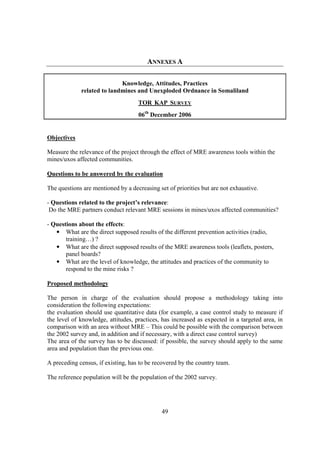
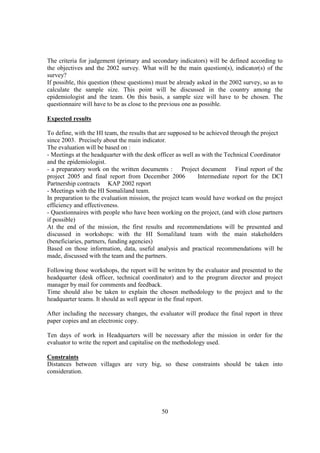
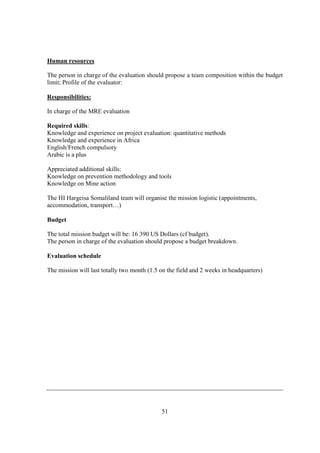
Appendix A: TOR KAP Survey ............................................................................................49
Appendix B: Household Survey Questionnaire (English) .......................................................52
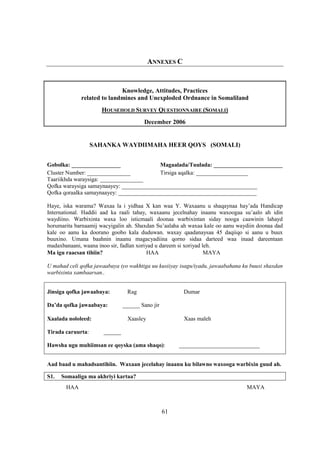
Appendix C: Household Survey Questionnaire (Somali)........................................................61
Appendix D: Cluster survey Protocol ......................................................................................72
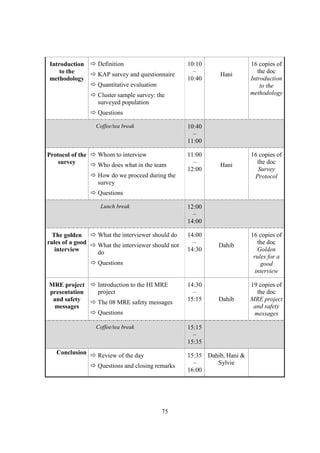
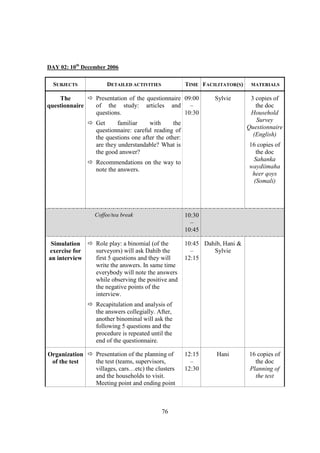
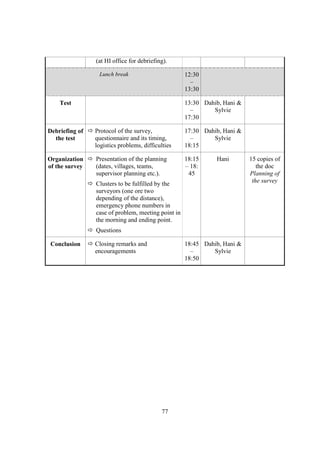
Appendix E: Planning of the training for the surveyors ..........................................................74
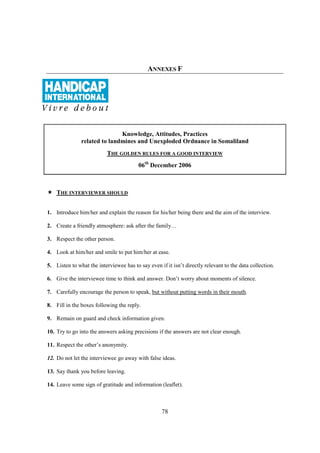
Appendix F: The golden rules for a good interview ................................................................78
Appendix G: List of partners for report dissemination………………………………………80
Appendix H: Budget ................................................................................................................82


                                                                      2
CONTEXT

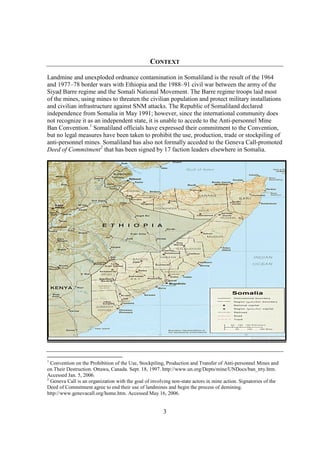
Landmine and unexploded ordnance contamination in Somaliland is the result of the 1964
and 1977–78 border wars with Ethiopia and the 1988–91 civil war between the army of the
Siyad Barre regime and the Somali National Movement. The Barre regime troops laid most
of the mines, using mines to threaten the civilian population and protect military installations
and civilian infrastructure against SNM attacks. The Republic of Somaliland declared
independence from Somalia in May 1991; however, since the international community does
not recognize it as an independent state, it is unable to accede to the Anti-personnel Mine
Ban Convention.1 Somaliland officials have expressed their commitment to the Convention,
but no legal measures have been taken to prohibit the use, production, trade or stockpiling of
anti-personnel mines. Somaliland has also not formally acceded to the Geneva Call-promoted
Deed of Commitment2 that has been signed by 17 faction leaders elsewhere in Somalia.


1
  Convention on the Prohibition of the Use, Stockpiling, Production and Transfer of Anti-personnel Mines and
on Their Destruction. Ottawa, Canada. Sept. 18, 1997. http://www.un.org/Depts/mine/UNDocs/ban_trty.htm.
Accessed Jan. 5, 2006.
2
  Geneva Call is an organization with the goal of involving non-state actors in mine action. Signatories of the
Deed of Commitment agree to end their use of landmines and begin the process of demining.
http://www.genevacall.org/home.htm. Accessed May 16, 2006.


                                                       3
ACKNOWLEDGEMENTS


This report, and the survey data on which it is based, was made possible by the contribution
of many individuals.


The research process and questionnaire was designed with technical inputs from Hassan
Mohamud Mohamed, Program Director, and Sylvie Bouko, MRE Regional Consultant,
Dahib Mohamed Odwa, MRE Project Director, Alexandrine Chamussy and Sophie
Bonichon, Coordination of Mines, Handicap International Headquarters; and Patrick Jullien ,
Epidemiologist Handicap International Headquarters, designed the data input format and
oversaw the data entry in Hargeisa.


Numerous individuals from many organisations also gave their time and knowledge
including: the Somaliland Mine Action Centre, the Landmine Impact Survey Team, Danish
Demining Group; Halo Trust; Saint Barbara Foundation; Save the Children; UNDP;
NEGAD; and FAO.


Many Handicap International staffs whose names are not mentioned here have contributed to
the success of this study. These include the interviewers, supervisors, data input personnel,
logistical support, drivers and most importantly the community members in the various areas.


                                                      Hani Fares
                                                      Epidemiologist
                                                      January 2007


                                             4
LIST OF ACRONYMS


AP       Anti-Personnel mine

AT       Anti-Tank mine

COA      Community Ordnance Awareness

DDG      Danish Demining Group

HI       Handicap International

KAP      Knowledge, Attitudes, Practices

LIS      Landmine Impact Survey

MRE      Mine Risk Education

NDA      National Demining Agency (“Somaliland”)

NGO      Non Governmental Organisation

RPG      Rocket Propelled Grenade

SAM      Surface to Air Missile

SMAC     Somali Mine Action Centre (Hargeisa)

UNDP     United Nations Development Programme

UNICEF   United Nations Children’s Fund

UXO      Unexploded Ordnance


                                       5
FOREWORD

Mine Risk Education, also known as mine awareness, helps communities at risk of
antipersonnel landmines and unexploded ordnance (UXO), especially refugees, internally
displaced people (IDPs) and those returning to their homes after conflict, learn how to live
with the threat of mines and UXO and develop safe behaviors. It involves campaigns to
spread information through the mass media, poster campaigns, television spots and radio
messages. It also involves the integration of appropriate programs into the school curriculum,
and risk education at the community level.

The greatest impact over the long term is achieved through a learning approach that asks
people to participate, so that those who are at risk of landmines and UXO learn by getting
involved and decide themselves the best way to pass on the message to others. Rather than
passive recipients of information, they become active partners in mobilizing their
communities. They review and learn about the need to respect and maintain signs marking
unsafe areas, and how to orchestrate a fundamental change in behavior. By adjusting
everyday habits, they learn to live with the threat of landmines and UXO.

Handicap International has been organizing campaigns for almost ten years to inform people
about the danger of mines. Since its pioneering experience in Mozambique in 1992,
Handicap International has called in many types of expertise (from the worlds of education,
epidemiology, mine clearance and communication), in seven programs spread over three
continents.

In Somalia, there is an identified need to undertake a mine risk education program. Although
the quantitative number of landmines and UXO has been reliably established since the
Landmine Impact Survey conducted in 2003, it is clear that communities living in particular
areas of Somalia have a high perception of living in a mined area. An initial first step in
designing an appropriate mine risk education program in Somaliland has been established by
Handicap International and UNICEF collaboratively through a survey conducted in 2002,
which undertook this Knowledge, Attitudes, and Practices in three regions of the North West
Zone. The three regions of Awdal, Galbeed, and Togdheer were identified as areas where
communities are at a relatively high risk of exposure to landmines and UXO, and the LIS
confirmed it one year later.
To evaluate the impact of the HI’s MRE project since 2003 on the population, an evaluation
study was realized to gather information on current community practices in relation to
landmines and UXO, as well as information on practices related to communication since the
starting of HI project. This information was compared to the information gathered during the
study of 2002. This study provides a basis for more enhanced understanding of the selected
communities and will be used to guide and adapt the planning and the design of a locally-
appropriate HI mine risk education program for the future.
We hope the findings and recommendations of this study will be useful to all partners
working on issues related to mine action and mine risk education.


                                              6
OVERVIEW OF THE IMPLEMENTED PROJECT


Monitoring activities of all Mine Action partners is supposed to be part of SMAC work as a
coordination body, but due to lack of some capacities and resources, they have not been very
effective. HI has been providing strong support and advise to the SMAC.

A monitoring system has been designed by HI with the Mine Action partners to follow up on
progress of the MRE activities and their outreach within the target groups:

         An MRE reporting form was introduced by HI in November 2005 and was shared
         with the Mine Action partners involved in MRE. The reporting forms are
         completed at the end of each month and are eventually given to the SMAC to enter
         the data into their system.

         Additionally the Mine Action partners involved into MRE received in February
         2006 a MRE guideline that could assist them with the implementation of their
         activities.

         Regular field visits have been conducted to monitor the outputs and outcomes of
         the project and to get feedback from targeted communities.


Even though this project was based on experiences gained through HI work in Ethiopian
refugee camps for the Somali population, the context in Somaliland proves to be of different
nature. This phase of the project has been very successful in the establishment of an
appropriate strategy and in mobilizing networks that are willing to contribute to the MRE
campaign.

The creation of these networks, development of the appropriate tools and training of an
effective MRE capacity within the existing Mine Action and community networks forms an
important step towards sustainability. The strategy prepared for the MRE in Somaliland will
require additional time to be implemented fully.

The project has so far covered four regions and will need to be extended to the remaining
parts of Somaliland (Sool and Sanaag) in order to cover the entire Somaliland. Additionally,
HI will extend, in 2007, its MRE activities to Puntland were the Landmine Impact Survey
has now been completed.


                                             7
JUSTIFICATION, OBJECTIVES AND EXPECTED RESULTS


         I. JUSTIFICATION

The practice of evaluation is used more and more frequently in the development al programs.
It served as a quality control of the programs by being a tool of communication between the
actors and specially the donors in order to ensure the appropriateness and efficiency of the
implemented activities towards targeted populations.

In 2002, a KAP Survey was conducted in Somaliland by Handicap International and
UNICEF, having the objective of providing information towards a greater understanding of
the current Knowledge, Attitudes and Practices in the area of mine and UXO safety and
awareness in the Awdal, Galbeed, Togdheer, and Sahil Regions

As Somaliland is entering a phase of stabilization of its populations in the newly accessible
areas, Handicap International wants to give a full impact to its developing and extending
strategy in order to progressively decrease its direct development interventions and hand over
the Mine Risk Education program to local actors.

The aim of this study is to evaluate the impact of the MRE project started by Handicap
International in Somaliland from January 2005 to August 2006 by gathering information
towards a greater understanding of current knowledge, attitudes and practices in the area of
mine and UXO safety and awareness in the Galbeed and Sahil regions of the North West
Zone of Somalia (self-declared Republic of Somaliland) by comparing it to the starting
results given by the previous KAP survey conducted in 2002.

The conclusions and recommendations of this evaluation would be an interesting work in
order to capitalize on the Somaliland experience focusing on the HI MRE strategy and on the
methodology domain (mainly epidemiology). It is intended to provide a basis upon which to
adapt and fine tune an appropriate MRE strategy in the current locations of the project (Sahil,
Togdheer, Galbeed and Awdal). The recommendations made by the evaluation mission on
the HI project in Somaliland will bring useful orientations for the intended project extension
in 2007 to cover the entire Northern Somalia: in the two remaining regions of Somaliland
(Sool and Sanaag) and in the South and Western areas of Nugaal and Mudug of the self-
declared autonomous regional government of Puntland.

        II. OBJECTIVES OF THE SURVEY
   General objectives

   1) To measure the impact of the HI MRE project within the general population.

   2) To assess the current Knowledge, Attitudes and Practices towards the Landmines/
      UXO risks within the targeted population of North West Somalia (self-declared
       Republic of Somaliland).


                                              8
3) To adapt an appropriate MRE strategy with the intention of expanding to cover the
    entire Northern Somalia.

Specific objectives

Compare the results this survey with the results of the KAP survey conducted in 2002, as
much as possible with a statistic validation, to measure the impact of the HI MRE project
within the targeted communities in the urban, rural and nomadic areas of the Galbeed and
Sahil regions of North West Somalia (self-declared Republic of Somaliland) through:

        •   The outcomes (Knowledge, Attitudes, Practices);
        •   The MRE tools and communication channels;
        •   The sustainability and efficiency of the partners’ networks.


   III. EXPECTED RESULTS
1) Information on current knowledge, attitudes, and practices related to mines and UXO
   is gathered and analysed.

2) Socio-cultural and socio-economic factors influencing key risky behaviours and
   practices are better understood.

3) Input towards programme strategy extension on MRE interventions, including the
   identification of appropriate communication channels through which target
   populations can be effectively reached is provided.

4) Baseline information for future monitoring and evaluation is provided.

5) Impact of the MRE project implemented so far is measured.


                                           9
MATERIALS AND METHODS

             I. QUANTITATIVE DATA COLLECTION3
The choice of the methodology used for this evaluation helps the strategy of HI to offer a
good quality control of the MRE program in Somaliland by offering an epidemiological
approach in order to obtain reliable and representative results.

Type of the study: interventional study ‘Before and After’, using a quantitative method.

A quantitative evaluation to help us to collect quantitative data easy to measure and
compare with the data collected in 2002.

The survey attempts to obtain a level of quantification to the extent to which certain
knowledge, behaviors and practices exist especially after MRE program was implemented,
by offering closed-ended questionnaires. These questionnaires were carefully tested, to
ensure that the appropriate categories were provided.

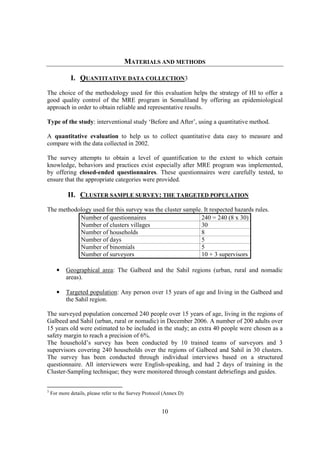
            II. CLUSTER SAMPLE SURVEY: THE TARGETED POPULATION
The methodology used for this survey was the cluster sample. It respected hazards rules.
           Number of questionnaires                        240 = 240 (8 x 30)
           Number of clusters villages                     30
           Number of households                            8
           Number of days                                  5
           Number of binomials                             5
           Number of surveyors                             10 + 3 supervisors

      •    Geographical area: The Galbeed and the Sahil regions (urban, rural and nomadic
           areas).

      •    Targeted population: Any person over 15 years of age and living in the Galbeed and
           the Sahil region.

The surveyed population concerned 240 people over 15 years of age, living in the regions of
Galbeed and Sahil (urban, rural or nomadic) in December 2006. A number of 200 adults over
15 years old were estimated to be included in the study; an extra 40 people were chosen as a
safety margin to reach a precision of 6%.
The household’s survey has been conducted by 10 trained teams of surveyors and 3
supervisors covering 240 households over the regions of Galbeed and Sahil in 30 clusters.
The survey has been conducted through individual interviews based on a structured
questionnaire. All interviewers were English-speaking, and had 2 days of training in the
Cluster-Sampling technique; they were monitored through constant debriefings and guides.


3
    For more details, please refer to the Survey Protocol (Annex D)


                                                        10
The household survey aimed first at gathering a level of quantitative baseline data on
people’s knowledge, attitudes and practices in relation to mines and UXO. Secondly, the
household survey aimed at identifying how information is effectively communicated and
how efficient it is. The collected data allow us to carry out a better evaluation of the
efficiency of the MRE, and its sustainability.

The selection of the sampling for the survey took place in two stages:
   The first stage consisted of the random selection of the village clusters in the Galbeed
   and the Sahil regions from the most recent exclusive list used during the Landmine
   Impact Survey (LIS) 2004, using probability proportional to size method.

      This was carried out by creating a cumulative list of the communities of the Galbeed and
      the Sahil regions and by selecting a systematic sample from a random start.
      This random selection showed 6 nomadic clusters, 11 rural and 13 urban. In conformity
      with other studies, urban is defined as settlements with 10,000 or more inhabitants; rural
      sedentary has less than 10,000 inhabitants; and the nomadic population includes people
      who move from place to place on a seasonal basis, staying on average less than four
      months in one location.

      Based on preliminary findings on landmine/UXO accidents, UNICEF and Handicap
      International determined in 2002 that Galbeed region (administratively including Sahil
      region at that time) was one of the areas most affected by Landmines/UXO and therefore
      data at this time had to be gathered from this region.

      Thus, 240 households were enumerated, with an overall average of 8 households per each
      cluster.
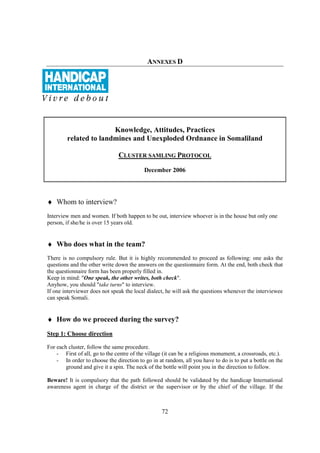
      Five binominal teams of surveyors covered 1 or 2 clusters per day (8 questionnaires
      /cluster) "One speaks, the other writes, both check" and once the quota of the day
      finished, the fulfilled questionnaires were delivered to Handicap International office in
      Hargeysa.

      The second stage of sampling consisted of the actual selection of households in each of
      the clusters. This second stage of sampling has been done during the fieldwork by
      choosing a starting point usually the centre of the village (it could also be a religious
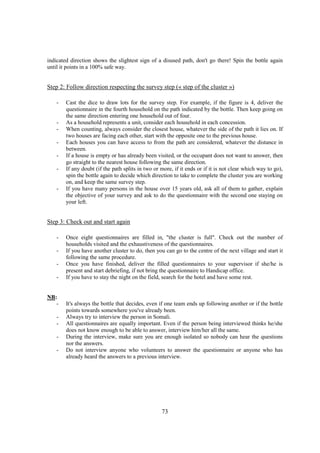
      monument, a crossroads, etc.). The direction to go was randomly chosen using the bottle
      and dice techniques for the ‘cluster step’ and then proceeding in successive ways after4.

      Anonymity was respected. The protocol was decisive in the sense that it enabled us to
      respect a vital rule in the cluster sampling technique, which is to ensure that each
      individual stands the same chance of being randomly selected for interview independent
      from his living place (village), his profession or his sex.


4
    For more details, please refer to the Survey Protocol (Annex D)


                                                        11
III. KAP SURVEY AND QUESTIONNAIRE
The questionnaire was made of 38 main questions; it was translated twice into Somali, and
was tested before the start of the survey. Each questionnaire took about 30 minutes to be
filled in.
Through a KAP study method (used by the WHO in the 80’s for a HIV evaluation program)
the questionnaire aimed at assessing the level of:

Knowledge

•    What is the current knowledge about landmine/UXO safety?

Attitudes

•    What leads to risk-taking behavior?

Practices

•    What are the current practices regarding landmine/ UXO safety?
•    Are Landmines and/or UXO reported?
•    How is information communicated?
•    How do communities alter their behavior in the face of mine accidents, or the risk of
     accidents, and how appropriate is this behavior?
•    Who should be targeted?
•    What has been the impact of previous MRE activities (including the relay networks)
     and tools directed at these communities?

It is important to emphasize that this study did not attempt to quantify the extent of landmine
and UXO contamination, the impact of mine and UXO injuries and fatalities, or measure the
economic impact of mine contamination.

While elaborating the questionnaire, HI has chosen to repeat some of the same questions that
were asked in 2002 to assess the mine and UXO awareness within the population. At the
same time, some of the 2002 questions have been adapted and some new questions have been
designed by our team in order to gather more information about the efficiency and
sustainability of the MRE project on one hand, and to provide more information and
systematic data collection to be adapted to each context for other upcoming surveys on the
other hand.

       IV. CONSTRAINTS AND LIMITATIONS

The intensive Landmine Impact Survey (LIS), developed and tested over a three month
period, yielded the most accurate and credible information to date and provided a baseline
against which progress can be measured. The methodology included the collection of ‘expert


                                              12
opinions’ to establish the location of possible mine-affected communities and a community
interview that determined the exact impact that mines/UXO had upon a given community.

The findings of the LIS survey in North West Somalia revealed that 368 communities out of
588 surveyed, were in at-risk areas, which represents about 1,1 million people out of 2
millions. Around 150 communities, located in the Galbeed region (including Hargeysa), are
highly or moderated affected. Also, out of these 368 mines/UXO affected communities, 35%
had reported clearing minefields and collecting UXO.

The Landmine Impact Survey in Somaliland reported that the recent mines and mainly UXO
victims are children and young people in the ages between 5 and 29 that account today for
55% (4-14 years) and 29% (15-29 years). Among them, 78% are male victims and 75% were
herding at the time of the accident and were most probably tampering with UXO or AT/AP
devices. Herders and travelers, between 14 and 29 years old, who are not aware of the nature
and location of the threat, are also a group at risk.
Considering this information, Handicap International started a one-year an MRE project in
2005, targeting herders in affected communities of four regions (Galbeed, Togdheer, Awdal,
and Sahil).

This 2006 KAP study was conducted in only 2 regions of the 4 pre-mentioned: Galbeed and
Sahil due to difficulties of access, security issues and budget constraints.

The main objective of the 2006 study was to measure/assess the impact of the MRE project
by comparing with the results of the 2002 survey. As a matter of fact, the study couldn’t
evaluate the level of Knowledge, Attitude and Practice of children between 4 and 14 years, as
this age group was not taken into consideration in the 2002 survey.

        V. STATISTICAL ANALYSIS

The study was conducted in two steps. The first was to compare the results of the 2002 study
concerning the level of Knowledge, Attitude and Practice of the concerned population (the
criterion of judgment) as well as the communication channels, to 2006 survey. And this in
order to measure the impact of the HI MRE project within the targeted regions.


To test if there is a difference between the two studies, a statistical test ‘Khi2 for trend or the
Fisher exact test with the risk α =5%’ was used to be relevant to the hypothesis.A statistical
hypothesis test, or more briefly, hypothesis test, is an algorithm to state the alternative (for or
against the hypothesis) which minimizes certain risks.


The null hypothesis in our study was that no difference in the level of Knowledge, attitudes
or practices can be observed between the population in 2006 and in 2002. Among all the sets
of possible values, we must choose one that we think represents the most extreme evidence
against the hypothesis. This is called the critical region of the test statistic. The probability of
the test statistic falling in the critical region when the hypothesis is correct is called the alpha
value (or size) of the test chosen in our study at 5%. When the probability of the difference


                                                13
between the 2 populations presented by “p” is less than 0.05, the null hypothesis is rejected (
there is a difference between the 2002 population and the 2006 population). If the test
statistic is outside the critical region, the only conclusion is that there is not enough evidence
to reject the null hypothesis.


Some statisticians have commented that pure "significance testing" has what is actually a
rather strange goal of detecting the existence of a "real" difference between two populations.
In practice a difference can almost always be found given a large enough sample, what is
typically the more relevant goal of science is a determination of causal effect size. The
amount and nature of the difference, in other words, is what should be studied


The second step consisted of comparing the level of Knowledge, attitude and practice of the
population groups according to the area they live(Urban, rural and nomadic).
The communication channels were also evaluated within the population groups in order to
identify the adapted tools used for each population group.
Based on the same questionnaire, a Khi2 test for trend or the Fisher exact test with the risk α
= 5% was used for this comparison.

The statistical data analyses was done using the SPSS software.


                           RESULTS AND DISCUSSIONS

         I. POPULATION CHARACTERISTICS
A representative random sample of 240 people was selected. The representativity of the
sample was tested using the main sociodemographic caracteristics (the sex, the age and the
area of living).

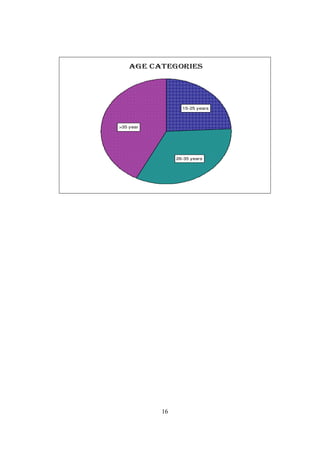
A high level of gender balance was achieved: out of these 240 people, 126 (47.1%) were
male compared to 113 (53.3%) in 2002 with p=0.6.

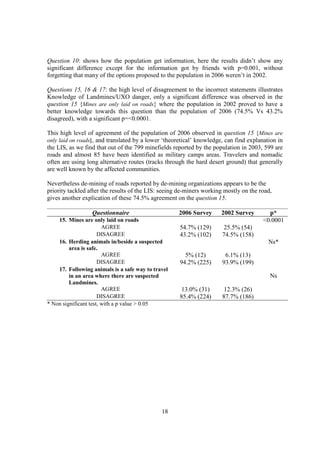
The respondent’s age of the populations of the two studies (2002 and 2006) didn’t show a
significant difference p=0.9.

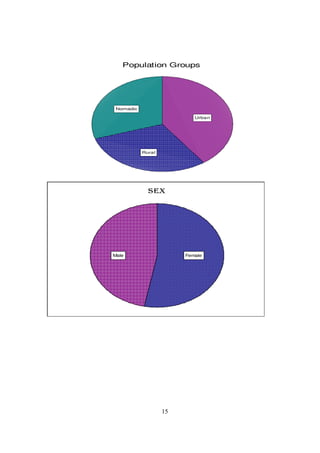
Ninety six respondents (40%) were living in urban area while 72 were living in rural and
nomadic area (30% in each area), this result was also not significantly different from the
study conducted in 2002 (p=0.7). [Table1]


                                               14
Population Groups


 Nomadic

                           Urban


           Rural


             SEX


Male                    Female


                   15
AGE CATEGORIES


                  15-25 years


>35 year


                26-35 years


           16
II. COMPARISON OF THE TWO STUDIES

       II.i.   KNOWLEDGE

      “Knowledge is where we take in and understand information about a subject, and then
             make decisions, form judgments, take opinions or make a forecast”.

The comparison of the level of knowledge was assessed through a group of questions in the
questionnaire. [Table 2]

Questions 2 & 5: Have you ever seen something like this before (Landmines/UXO picture)
while you were walking?

A significant increase in the number of people who saw Landmines and UXO was observed,
compared to the number in 2002. This difference between the two populations was
remarkable with the Landmines with a p value <0.0001, while with UXO the test was on the
limit of significantly with a p value=0.05.
This increase in the number of Landmines and UXO seen reflects a global result of the
activities in the region that the population notices it; the SMAC, HAVAYOCO, HIMRE
project and specially the deminers’ presence on the field.

While 52,1% of the population in 2006 think that they live in an area that has
Landmines/UXO which is not very different from the result in 2002 (52,8%)(Question 8), the
statistical test give a p value =0.06 signaling a tendency of difference between the 2
population, this difference comes from the 11% of the study population in 2006 who don’t
know if they are living in an area that has Landmines/UXO, compared to 5% in 2002.
This result comes to continue the results of the questions 2 ‘Have you ever seen Landmines
while you were walking?’ and 5’ Have you ever seen UXO when you were walking?’; the ‘don’t
know’ answers do not mean the unawareness of this population about the presence of
Landmines/UXO around them but may be the opposite; the population see the deminers
working and de-mining their village but the ‘after’ information is missing. The de-mining
activities around the population have its impact which brings confusion on the answers to this
question.

Around 19% of the population studied in 2006 has been told about Landmines/UXO, while
the 2002 study announced 62% of persons told about Landmines/UXO with a significant
difference p=<0.0001. (Question 9)
This big gap between the two results was expected, as the results of the two studies were
incomparable for this specific question. The study in 2002 signaled that the results of this
question may have some error in translation in the field as overall 33.5% indicated ‘other’ in
the question 10 {Who has told you about Landmines/UXO?}.
Otherwise, this result stays humble for the project objectives and call for better partnership
adaptation in the future specifically concerning Community Liaison activities.


                                             17
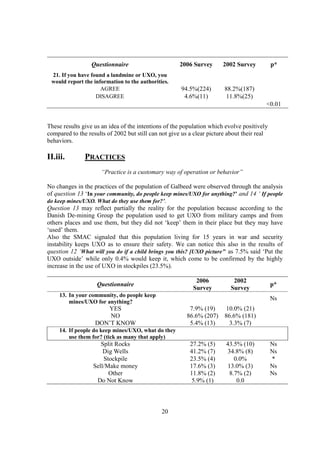
Question 10: shows how the population get information, here the results didn’t show any
significant difference except for the information got by friends with p=0.001, without
forgetting that many of the options proposed to the population in 2006 weren’t in 2002.

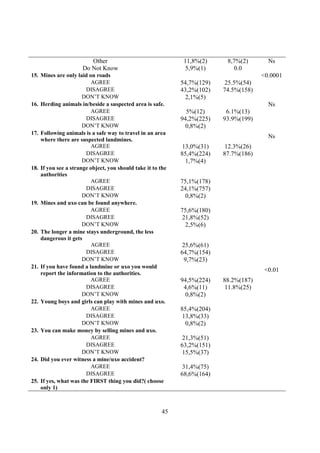
Questions 15, 16 & 17: the high level of disagreement to the incorrect statements illustrates
Knowledge of Landmines/UXO danger, only a significant difference was observed in the
question 15 {Mines are only laid on roads} where the population in 2002 proved to have a
better knowledge towards this question than the population of 2006 (74.5% Vs 43.2%
disagreed), with a significant p=<0.0001.

This high level of agreement of the population of 2006 observed in question 15 {Mines are
only laid on roads}, and translated by a lower ‘theoretical’ knowledge, can find explanation in
the LIS, as we find that out of the 799 minefields reported by the population in 2003, 599 are
roads and almost 85 have been identified as military camps areas. Travelers and nomadic
often are using long alternative routes (tracks through the hard desert ground) that generally
are well known by the affected communities.

Nevertheless de-mining of roads reported by de-mining organizations appears to be the
priority tackled after the results of the LIS: seeing de-miners working mostly on the road,
gives another explication of these 74.5% agreement on the question 15.

                  Questionnaire                      2006 Survey      2002 Survey        p*
    15. Mines are only laid on roads                                                   <0.0001
                        AGREE                        54.7% (129)       25.5% (54)
                      DISAGREE                       43.2% (102)       74.5% (158)
    16. Herding animals in/beside a suspected                                            Ns*
         area is safe.
                        AGREE                          5% (12)          6.1% (13)
                      DISAGREE                       94.2% (225)       93.9% (199)
    17. Following animals is a safe way to travel
         in an area where there are suspected                                             Ns
         Landmines.
                        AGREE                         13.0% (31)       12.3% (26)
                      DISAGREE                       85.4% (224)       87.7% (186)
* Non significant test, with a p value > 0.05


                                              18
II.ii.   ATTITUDES

      “Attitudes is the readiness of the psyche to act or react in a certain way”(Jung, [1921]
1971:par. 687).
Attitudes are difficult to assess because of subjectivity. So the question is how far we can
really count this assessment with the humble information that we have.


Question 12 ‘What will you do if a child brings you this’: shows a big difference between the
population in 2006 and that of 2002, 42.3 % were willing to tell the authorities if a child
brought them an UXO vs. 5.7% in 2002. And 10.5% of the population in 2006 would tell
their children that they are dangerous vs. 2.4%, while only 28% in 2006 would put it in a safe
place vs. 65% in the study of 2002.
The overall test confirm this difference with a significant p=<0.0001.

     12. What will you do if a child brings you this?      2006          2002
              [UXO picture] (choose only 1)
                                                                                        p*
                                                          Survey        Survey
                    Tell Authorities                    42,3%(101)     5.7%(12)
                        Keep It                           0,4%(1)         0.0
                     Put It Outside                      7,5%(18)      3.3%(7)
                   Put In Safe Place                    28,0%(67)    65.1%(138)
                      Throw Away                         9,2%(22)     20.8%(44)
                Tell Them It Dangerous                   10,5%(25)     2.4%(5)
                         Other                            2,1%(5)      2.4%(5)
                     Do Not Know                            0,0        0.5%(1)
                                                                                     <0.0001


An improvement in the practice in the population was observed through a better reaction
toward the message they give to their children, even if the analysis of these practices remains
hard to translate, as telling the authorities can be the result of a good presence of our
authorities partners on the field (the mines affected area) or the result of the beginning of
national stability. Also telling them that it is dangerous is a passive practice, which may
evolute in either of the opposite direction.


Question 21 ‘If you have found a landmine or UXO. You would report the information to the
authorities.’ shows a better intention of the population in 2006 than 2002 as 94.5% agree that
they would report the information to the authorities if they had found a landmine or UXO vs.
88% in 2002, with a significant test and a p value=0.01.
This reflects not only the improvement of the attitude of the population towards mines/UXO
but also the presence of the authorities around them.


                                               19
Questionnaire                       2006 Survey      2002 Survey           p*
 21. If you have found a landmine or UXO, you
 would report the information to the authorities.
                     AGREE                            94.5%(224)        88.2%(187)
                   DISAGREE                            4.6%(11)          11.8%(25)
                                                                                         <0.01


These results give us an idea of the intentions of the population which evolve positively
compared to the results of 2002 but still can not give us a clear picture about their real
behaviors.

II.iii.        PRACTICES
                      “Practice is a customary way of operation or behavior”

No changes in the practices of the population of Galbeed were observed through the analysis
of question 13 ‘In your community, do people keep mines/UXO for anything?’ and 14 ‘ If people
do keep mines/UXO. What do they use them for?’.
Question 13 may reflect partially the reality for the population because according to the
Danish De-mining Group the population used to get UXO from military camps and from
others places and use them, but they did not ‘keep’ them in their place but they may have
‘used’ them.
Also the SMAC signaled that this population living for 15 years in war and security
instability keeps UXO as to ensure their safety. We can notice this also in the results of
question 12 ‘What will you do if a child brings you this? [UXO picture’’ as 7.5% said ‘Put the
UXO outside’ while only 0.4% would keep it, which come to be confirmed by the highly
increase in the use of UXO in stockpiles (23.5%).

                                                            2006           2002
                    Questionnaire                                                            p*
                                                           Survey         Survey
     13. In your community, do people keep
                                                                                             Ns
         mines/UXO for anything?
                      YES                                 7.9% (19)      10.0% (21)
                       NO                                86.6% (207)    86.6% (181)
                   DON’T KNOW                             5.4% (13)       3.3% (7)
     14. If people do keep mines/UXO, what do they
         use them for? (tick as many that apply)
                     Split Rocks                          27.2% (5)      43.5% (10)          Ns
                      Dig Wells                           41.2% (7)      34.8% (8)           Ns
                      Stockpile                           23.5% (4)         0.0%             *
                  Sell/Make money                         17.6% (3)      13.0% (3)           Ns
                        Other                             11.8% (2)       8.7% (2)           Ns
                   Do Not Know                             5.9% (1)          0.0


                                              20
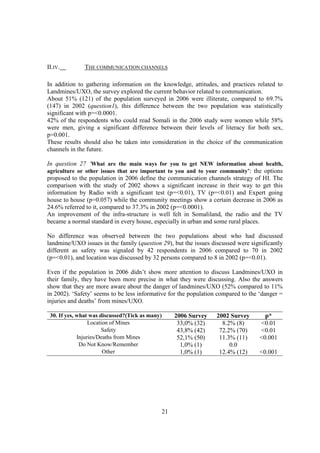
II.IV.         THE COMMUNICATION CHANNELS

In addition to gathering information on the knowledge, attitudes, and practices related to
Landmines/UXO, the survey explored the current behavior related to communication.
About 51% (121) of the population surveyed in 2006 were illiterate, compared to 69.7%
(147) in 2002 (question1), this difference between the two population was statistically
significant with p=<0.0001.
42% of the respondents who could read Somali in the 2006 study were women while 58%
were men, giving a significant difference between their levels of literacy for both sex,
p=0.001.
These results should also be taken into consideration in the choice of the communication
channels in the future.

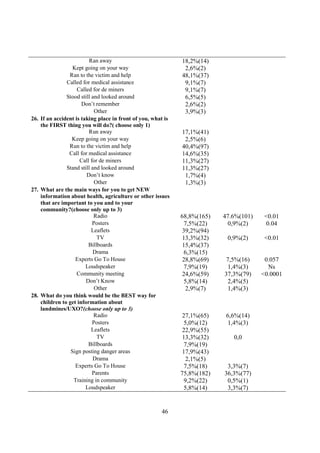
In question 27 ‘What are the main ways for you to get NEW information about health,
agriculture or other issues that are important to you and to your community’: the options
proposed to the population in 2006 define the communication channels strategy of HI. The
comparison with the study of 2002 shows a significant increase in their way to get this
information by Radio with a significant test (p=<0.01), TV (p=<0.01) and Expert going
house to house (p=0.057) while the community meetings show a certain decrease in 2006 as
24.6% referred to it, compared to 37.3% in 2002 (p=<0.0001).
An improvement of the infra-structure is well felt in Somaliland, the radio and the TV
became a normal standard in every house, especially in urban and some rural places.

No difference was observed between the two populations about who had discussed
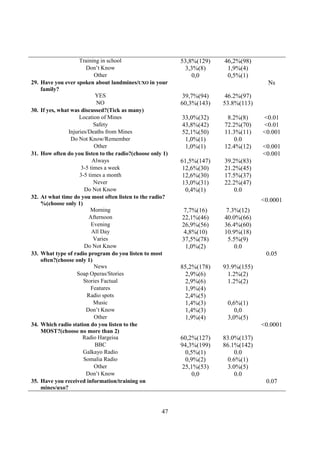
landmine/UXO issues in the family (question 29), but the issues discussed were significantly
different as safety was signaled by 42 respondents in 2006 compared to 70 in 2002
(p=<0.01), and location was discussed by 32 persons compared to 8 in 2002 (p=<0.01).

Even if the population in 2006 didn’t show more attention to discuss Landmines/UXO in
their family, they have been more precise in what they were discussing. Also the answers
show that they are more aware about the danger of landmines/UXO (52% compared to 11%
in 2002). ‘Safety’ seems to be less informative for the population compared to the ‘danger =
injuries and deaths’ from mines/UXO.

 30. If yes, what was discussed?(Tick as many)    2006 Survey     2002 Survey        p*
                  Location of Mines                33,0% (32)       8.2% (8)       <0.01
                       Safety                      43,8% (42)      72.2% (70)      <0.01
             Injuries/Deaths from Mines            52,1% (50)      11.3% (11)      <0.001
              Do Not Know/Remember                  1,0% (1)           0.0
                        Other                       1,0% (1)       12.4% (12)      <0.001


                                             21
61% of the respondents in 2006 always listen to the radio vs 39% in 2002, while 13% never
listened to radio, vs 22% in 2002. This indicates that radio has been one important medium
for information dissemination with a significant difference between 2006 and 2002
(p=<0.001).

A significant difference was also observed between the two populations about the time when
they most often listen to the radio and the type of radio programs they listen to most often
(p=<0.0001, 0.05 respectively). [Question 32, 33]

                                                           2006           2002
                   Questionnaire                                                        p*
                                                          Survey         Survey
 32. At what time do you most often listen to the
 radio? (choose only 1)
                      Morning                           7.7% (16)      7.3% (12)
                      Afternoon                         22.1% (46)     40.0% (66)
                       Evening                          26.9% (56)     36.4% (60)
                       All Day                          4.8% (10)      10.9% (18)
                        Varies                          37.5% (78)      5.5% (9)
                    Do Not Know                          1.0% (2)          0.0
                                                                                     <0.0001

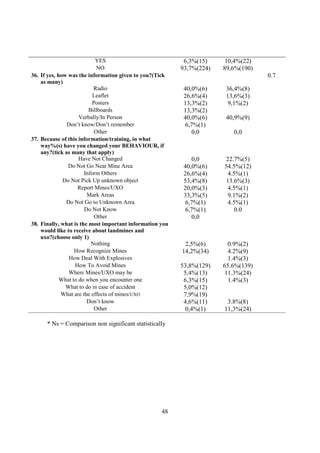
 33. What type of radio program do you listen to            2006           2002         p*
     most often? (choose only 1)                          Survey         Survey
                         News                           85.2% (178)    93.9% (155)
                 Soap Operas/Stories                      2.9% (6)       1.2% (2)
                    Stories Factual                       2.9% (6)       1.2% (2)
                       Features                           1.9% (4)
                     Radio spots                          2.4% (5)
                        Music                             1.4% (3)      0.6% (1)
                     Don’t Know                           1.4% (3)         0.0
                         Other                            1.9% (4)      3.0% (5)
                                                                                       0.05

People tend to listen more to the BBC radio (94.3%) and to other types of radios (25%) in
2006 compared to 2002(p=<0.0001).

 34. Which radio station do you listen to the                                          p*
                                                     Survey 2006      Survey 2002
 MOST?(choose no more than 2)
               Radio Hargeysa                        60.2% (127)      83.0% (137)
                     BBC                             94.3% (199)      86.1% (142)
                Galkayo Radio                          0.5% (1)            0.0
                Somalia Radio                          0.9% (2)         0.6% (1)
                     Other                            25.1% (53)        3.0% (5)
                                                                                     <0.0001


                                                22
All these differences between the two populations about the radio as communication
channels explain the evaluative phase of this population and call for more attention from the
HI’s MRE to be able to follow up on this evolution.


       II.V.   COMPARISON OF KNOWLEDGE AND PRACTICES

In order to further understand the relationship between knowledge and practices, the
household survey included questions that compared what people did and what they thought
they would do if they saw a landmine or UXO. The questionnaire was designed to compare
answers between people who had seen a landmine or a UXO and those who had not seen
such an object.

         Landmines

The number of respondents who had actually seen a landmine while walking in the
community is relatively high : 59% compared to 42% in 2002. Such a high response rate to
“seeing” Landmines is a bit unusual since Landmines are usually covered and cannot be
seen. However, this may indicate that there are, or were at one time, a large number of
uncovered Landmines. People may have also misunderstood the question and the Landmines
they reported seeing were actually part of someone’s stockpile. Nonetheless, this response
rate also indicates a high recognition rate in that at least 59% of respondents would recognize
a landmine if they saw one.

The sex of the respondents didn’t play any role in the actual or the theoretical behaviour
while seeing a landmine while walking.

If the respondent answered “yes” that they had seen a landmine in their community, we then
asked what was the first thing they did. The following table depicts the answers for those who
answered ”yes” and what they actually did when they encountered the landmine in the two
surveys in 2006 and 2002.

                                          2006 Survey                    2002 Survey
         Question 3&4                 Actual     Theoretical         Actual     Theoretical
          (landmine)                behaviour    behaviour         behaviour    behaviour
                                   [landmine] [landmine]          [landmine] [landmine]
         Turned Back                31.0%(31)    36.0%(53)         28.4%(25)    39.8%(47)
         Kept Going                  9.0%(9)      8.2%(12)          6.8%(6)      6.8%(8)
      Found Another Path             9.0%(9)     17.6%(26)         23.9%(21)    24.6%(29)
        Yelled For Help             10.0%(10)     0.7%(1)           9.1%(8)      1.7%(2)
            Took It                  4.0%(4)      8.8%(13)          10.2%(9)    12.7%(15)
       Marked The Area              22.0%(22)    23.1%(34)         14.8%(13)    10.2%(12)
          Stood Still                8.0%(8)      3.4%(5)           1.1%(1)      1.7%(2)
         Exploded It                 4.0%(4)      0.7%(1)           4.5%(4)         0.0
             Other                   3.0%(3)      2.0%(3)           1.1%(1)      2.5%(3)


                                              23
UXO

The number of respondents who had actually seen an UXO while walking in the community
is relatively high 54% in 2006 compared to 45% in 2002 with a difference in the limit of the
significance (p=0.055). People see more mines than UXO; this result put a question mark as
UXO are often on top of the ground and therefore more visible than Landmines.

Here also, the sex of the respondents didn’t play any role in the actual or the theoretical
behavior while seeing an UXO during walking.

If the respondent answered “yes” that they had seen a landmine in their community, we then
asked what was the first thing they did. The following table depicts the answers for those who
answered “yes” and what they actually did when they encountered the UXO in the two
surveys in 2006 and 2002.

                                            2006 Survey                    2002 Survey
          Question 6&7                  Actual     Theoretical         Actual     Theoretical
            (UXO)                     behaviour     behaviour        behaviour    behaviour
                                     [landmine] [landmine]          [landmine] [landmine]
          Turned Back                 22.3%(30) 36.0%%(53)           38.9%(46)    32.1%(35)
          Kept Going                  21.6%(29)     8.2%%(12)         5.9%(7)      6.4%(7)
       Found Another Path              2.9%(4)     17.6%%(26)        13.5%(16)    24.8%(27)
         Yelled For Help              21.6%(29)     0.7%%(1)          4.2%(5)      6.4%(7)
             Took It                   7.4%(10)     8.8%%(13)         8.4%(10)    16.5%(18)
        Marked The Area               13.4%(18) 23.1%%(34)           24.5%(29)    10.1%(11)
           Stood Still                 1.5%(2)      3.4%%(5)          1.7%(2)         0.0
          Exploded It                  2.2%(3)      0.7%%(1)          0.8%(1)         0.0
              Other                    7.4%(10)     2.0%%(3)          0.8%(1)      1.8%(2)


                                               24
III. KAP ANALYSIS WITHIN THE POPULATION GROUPS (URBAN, RURAL
            & NOMADIC) IN 2006

           III.i.         KNOWLEDGE, ATTITUDES AND PRACTICES

Handicap international MRE program targeted the herders (rural and nomadic population) as
first priority, so the assessment of the level of Knowledge, Attitude and Practice within the
population groups was essentials.
Terms such as urban, rural and nomadic were used for the population groups to match and to
insure comparability with the previous study of 2002, which used this term to classify the
population.

This second part of the study aimed to evaluate the level of knowledge, attitude and practice
within the population groups.
For this, we referred to the same ‘KAP’ questionnaires used in the first part of the study for
the comparison between the population in 2002 and 2006.

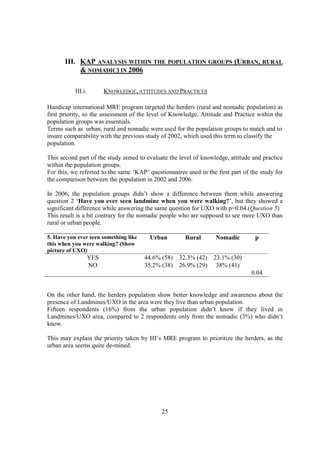
In 2006, the population groups didn’t show a difference between them while answering
question 2 ‘Have you ever seen landmine when you were walking?’, but they showed a
significant difference while answering the same question for UXO with p=0.04.(Question 5)
This result is a bit contrary for the nomadic people who are supposed to see more UXO than
rural or urban people.

5. Have you ever seen something like     Urban         Rural       Nomadic         p
this when you were walking? (Show
picture of UXO)
                    YES                44.6% (58)   32.3% (42)    23.1% (30)
                    NO                 35.2% (38)   26.9% (29)     38% (41)
                                                                                 0.04


On the other hand, the herders population show better knowledge and awareness about the
presence of Landmines/UXO in the area were they live than urban population.
Fifteen respondents (16%) from the urban population didn’t know if they lived in
Landmines/UXO area, compared to 2 respondents only from the nomadic (3%) who didn’t
know.

This may explain the priority taken by HI’s MRE program to prioritize the herders, as the
urban area seems quite de-mined.


                                             25
8. Do you think that you live in an       Urban          Rural       Nomadic       P
area that has Landmines/UXO?
             YES                        29.8% (37)     35.5% (44)    34.7% (43)
              NO                        50.0% (44)     21.6% (19)    28.4% (25)
          DON’T KNOW                    57.7% (15)     34.6% (9)      7.7% (2)
                                                                                  0.001


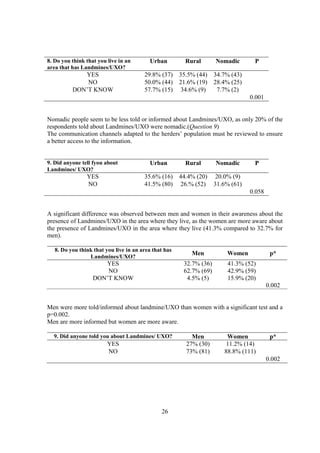
Nomadic people seem to be less told or informed about Landmines/UXO, as only 20% of the
respondents told about Landmines/UXO were nomadic.(Question 9)
The communication channels adapted to the herders’ population must be reviewed to ensure
a better access to the information.


9. Did anyone tell fyou about             Urban          Rural       Nomadic       P
Landmines/ UXO?
                YES                     35.6% (16)     44.4% (20)     20.0% (9)
                NO                      41.5% (80)     26.% (52)     31.6% (61)
                                                                                  0.058


A significant difference was observed between men and women in their awareness about the
presence of Landmines/UXO in the area where they live, as the women are more aware about
the presence of Landmines/UXO in the area where they live (41.3% compared to 32.7% for
men).

   8. Do you think that you live in an area that has
                                                           Men           Women             p*
                 Landmines/UXO?
                      YES                               32.7% (36)       41.3% (52)
                       NO                               62.7% (69)       42.9% (59)
                   DON’T KNOW                            4.5% (5)        15.9% (20)
                                                                                          0.002


Men were more told/informed about landmine/UXO than women with a significant test and a
p=0.002.
Men are more informed but women are more aware.

  9. Did anyone told you about Landmines/ UXO?             Men           Women             p*
                         YES                             27% (30)        11.2% (14)
                         NO                              73% (81)       88.8% (111)
                                                                                          0.002


                                               26
The evaluation of the Knowledge between the population groups reveals some differences
between the population groups in the recognition of the signs/signals which tell that an area
has Landmines/UXO. Some of those signs are less recognized by the population leaving in a
nomadic area.
It seems that every population group has its specific cultural way of behavior on marking the
dangerous area which affects naturally their knowledge. Rural populations don’t seem to
recognize all these signs such as ‘animal skeleton/bones’ neither ‘high grass’.
MRE message should be adapted accordingly.

11. If you are walking down a path       Urban          Rural       Nomadic         P
and there is no one to ask, what signs
or signals will tell you that an area
has Landmines//UXO? [ tick as
many that apply]
          Painted stones                  46.2%         33.3%         20.4%        0.03
       Animal skeleton/bones              53.8%          0.0          46.2%        0.08
               cross                      21.4%         57.1%         21.4%        0.07
            Red cross                      50%          30.3%         19.7%        0.03
           High grass                     46.9%         12.5%         40.6%        0.06

Also question 10 ‘who has told you about Landmines/UXO?’ tells how people in the 3
groups get information about landmine/UXO.
The military seems to be more present in urban areas, while authority and deminers are the
main liaison for herders population. This information is quite important to define and
evaluate the partners of HI’s MRE on the field.

Otherwise, it is quite important to differentiate between these different terms used in question
10; ‘authority’ and ‘military’ and ‘community elder’ and ‘community leader’.
The authority in the HI’s MRE Somaliland project means that the administrative part of the
town or village (governor, Mayor) and this person is the one responsible of reporting the
mine area and accident to the SMAC (Somaliland Mine Action Center).
In small villages they don’t have governor or authority but they have community leaders. The
community elder is a respected person in the community that people trust and consult for
social affairs matters.

10. If Yes, who has told you about       Urban          Rural       Nomadic         P
Landmines/UXO? [ tick as many
that apply]
             Friends                      33.3%          50%          16.7%         Ns
             Family                        25%           75%            0.0         Ns
             Military                      60%           20%           20%          Ns
            Authority                     12.5%          25%          62.5%        0.01
            De-miners                       0.0         57.1%         42.9%        0.03
         Community Elders                 33.3%         33.3%         33.3%         Ns
   Somaliland Mine Action Center
             (SMAC)
                                           25%           50%           25%          Ns


                                              27
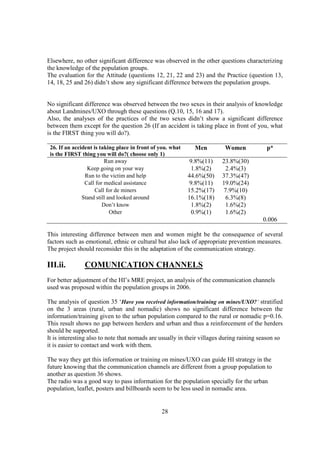
Elsewhere, no other significant difference was observed in the other questions characterizing
the knowledge of the population groups.
The evaluation for the Attitude (questions 12, 21, 22 and 23) and the Practice (question 13,
14, 18, 25 and 26) didn’t show any significant difference between the population groups.


No significant difference was observed between the two sexes in their analysis of knowledge
about Landmines/UXO through these questions (Q.10, 15, 16 and 17).
Also, the analyses of the practices of the two sexes didn’t show a significant difference
between them except for the question 26 (If an accident is taking place in front of you, what
is the FIRST thing you will do?).

 26. If an accident is taking place in front of you. what     Men        Women            p*
 is the FIRST thing you will do?( choose only 1)
                         Run away                            9.8%(11)   23.8%(30)
                 Keep going on your way                       1.8%(2)    2.4%(3)
                Run to the victim and help                  44.6%(50)   37.3%(47)
                Call for medical assistance                  9.8%(11)   19.0%(24)
                     Call for de miners                     15.2%(17)    7.9%(10)
               Stand still and looked around                16.1%(18)    6.3%(8)
                        Don’t know                            1.8%(2)    1.6%(2)
                            Other                             0.9%(1)    1.6%(2)
                                                                                        0.006

This interesting difference between men and women might be the consequence of several
factors such as emotional, ethnic or cultural but also lack of appropriate prevention measures.
The project should reconsider this in the adaptation of the communication strategy.

III.ii.        COMUNICATION CHANNELS
For better adjustment of the HI’s MRE project, an analysis of the communication channels
used was proposed within the population groups in 2006.

The analysis of question 35 ‘Have you received information/training on mines/UXO?’ stratified
on the 3 areas (rural, urban and nomadic) shows no significant difference between the
information/training given to the urban population compared to the rural or nomadic p=0.16.
This result shows no gap between herders and urban and thus a reinforcement of the herders
should be supported.
It is interesting also to note that nomads are usually in their villages during raining season so
it is easier to contact and work with them.

The way they get this information or training on mines/UXO can guide HI strategy in the
future knowing that the communication channels are different from a group population to
another as question 36 shows.
The radio was a good way to pass information for the population specially for the urban
population, leaflet, posters and billboards seem to be less used in nomadic area.


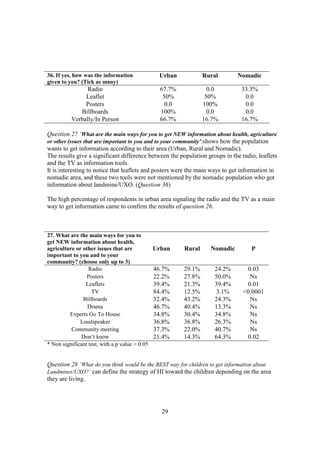
                                                28
36. If yes, how was the information              Urban            Rural       Nomadic
given to you? (Tick as many)
                Radio                             67.7%             0.0        33.3%
               Leaflet                             50%             50%          0.0
               Posters                              0.0           100%          0.0
             Billboards                           100%              0.0         0.0
          Verbally/In Person                      66.7%           16.7%        16.7%

Question 27 ‘What are the main ways for you to get NEW information about health, agriculture
or other issues that are important to you and to your community’:shows how the population
wants to get information according to their area (Urban, Rural and Nomadic).
The results give a significant difference between the population groups in the radio, leaflets
and the TV as information tools.
It is interesting to notice that leaflets and posters were the main ways to get information in
nomadic area, and these two tools were not mentioned by the nomadic population who got
information about landmine/UXO. (Question 36)

The high percentage of respondents in urban area signaling the radio and the TV as a main
way to get information came to confirm the results of question 26.


27. What are the main ways for you to
get NEW information about health,
agriculture or other issues that are            Urban     Rural     Nomadic        P
important to you and to your
community? (choose only up to 3)
                  Radio                         46.7%     29.1%      24.2%       0.03
                 Posters                        22.2%     27.8%      50.0%        Ns
                Leaflets                        39.4%     21.3%      39.4%       0.01
                   TV                           84.4%     12.5%      3.1%       <0.0001
               Billboards                       32.4%     43.2%      24.3%        Ns
                 Drama                          46.7%     40.4%      13.3%        Ns
         Experts Go To House                    34.8%     30.4%      34.8%        Ns
              Loudspeaker                       36.8%     36.8%      26.3%        Ns
          Community meeting                     37.3%     22.0%      40.7%        Ns
              Don’t know                        21.4%     14.3%      64.3%       0.02
* Non significant test, with a p value > 0.05


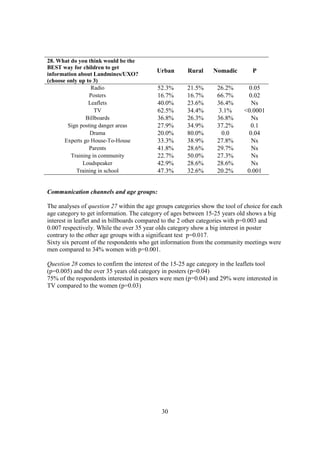
Question 28 ‘What do you think would be the BEST way for children to get information about
Landmines/UXO?’ can define the strategy of HI toward the children depending on the area
they are living.


                                                  29
28. What do you think would be the
BEST way for children to get
                                           Urban       Rural     Nomadic         P
information about Landmines/UXO?
(choose only up to 3)
                  Radio                    52.3%       21.5%       26.2%      0.05
                 Posters                   16.7%       16.7%       66.7%      0.02
                 Leaflets                  40.0%       23.6%       36.4%       Ns
                    TV                     62.5%       34.4%       3.1%      <0.0001
                Billboards                 36.8%       26.3%       36.8%       Ns
        Sign posting danger areas          27.9%       34.9%       37.2%       0.1
                 Drama                     20.0%       80.0%        0.0       0.04
       Experts go House-To-House           33.3%       38.9%       27.8%       Ns
                 Parents                   41.8%       28.6%       29.7%       Ns
         Training in community             22.7%       50.0%       27.3%       Ns
              Loudspeaker                  42.9%       28.6%       28.6%       Ns
            Training in school             47.3%       32.6%       20.2%      0.001


Communication channels and age groups:

The analyses of question 27 within the age groups categories show the tool of choice for each
age category to get information. The category of ages between 15-25 years old shows a big
interest in leaflet and in billboards compared to the 2 other categories with p=0.003 and
0.007 respectively. While the over 35 year olds category show a big interest in poster
contrary to the other age groups with a significant test p=0.017.
Sixty six percent of the respondents who get information from the community meetings were
men compared to 34% women with p=0.001.

Question 28 comes to confirm the interest of the 15-25 age category in the leaflets tool
(p=0.005) and the over 35 years old category in posters (p=0.04)
75% of the respondents interested in posters were men (p=0.04) and 29% were interested in
TV compared to the women (p=0.03)


                                             30
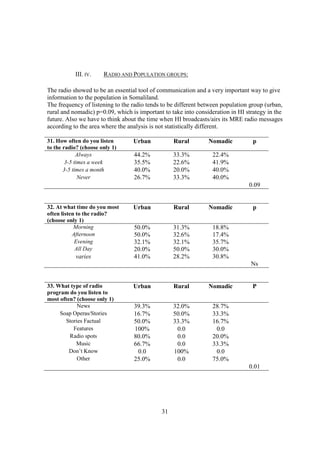
III. IV.    RADIO AND POPULATION GROUPS:

The radio showed to be an essential tool of communication and a very important way to give
information to the population in Somaliland.
The frequency of listening to the radio tends to be different between population group (urban,
rural and nomadic) p=0.09, which is important to take into consideration in HI strategy in the
future. Also we have to think about the time when HI broadcasts/airs its MRE radio messages
according to the area where the analysis is not statistically different.

31. How often do you listen       Urban           Rural         Nomadic           p
to the radio? (choose only 1)
             Always               44.2%           33.3%           22.4%
        3-5 times a week          35.5%           22.6%           41.9%
       3-5 times a month          40.0%           20.0%           40.0%
              Never               26.7%           33.3%           40.0%
                                                                                0.09


32. At what time do you most      Urban           Rural         Nomadic           p
often listen to the radio?
(choose only 1)
            Morning               50.0%           31.3%           18.8%
           Afternoon              50.0%           32.6%           17.4%
            Evening               32.1%           32.1%           35.7%
            All Day               20.0%           50.0%           30.0%
           varies                 41.0%           28.2%           30.8%
                                                                                 Ns


33. What type of radio            Urban           Rural         Nomadic           P
program do you listen to
most often? (choose only 1)
            News                  39.3%           32.0%           28.7%
     Soap Operas/Stories          16.7%           50.0%           33.3%
       Stories Factual            50.0%           33.3%           16.7%
          Features                100%             0.0             0.0
         Radio spots              80.0%            0.0            20.0%
           Music                  66.7%            0.0            33.3%
         Don’t Know                0.0            100%             0.0
            Other                 25.0%            0.0            75.0%
                                                                                0.01


                                             31
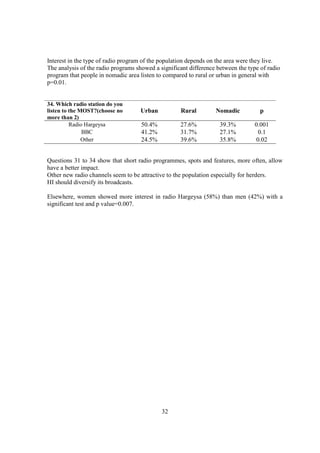
Interest in the type of radio program of the population depends on the area were they live.
The analysis of the radio programs showed a significant difference between the type of radio
program that people in nomadic area listen to compared to rural or urban in general with
p=0.01.


34. Which radio station do you
listen to the MOST?(choose no       Urban           Rural         Nomadic           p
more than 2)
          Radio Hargeysa             50.4%          27.6%           39.3%        0.001
               BBC                   41.2%          31.7%           27.1%         0.1
               Other                 24.5%          39.6%           35.8%        0.02


Questions 31 to 34 show that short radio programmes, spots and features, more often, allow
have a better impact.
Other new radio channels seem to be attractive to the population especially for herders.
HI should diversify its broadcasts.

Elsewhere, women showed more interest in radio Hargeysa (58%) than men (42%) with a
significant test and p value=0.007.


                                             32
CONCLUSION AND RECOMMENDATIONS

The program is rich in activities and distribution of supports; not all of these ‘tools’ are
equally relevant, but all of them have been made by the involvement of dynamic fringes of
the local community who have and still are appropriating the prevention messages.

Therefore the evaluation of the whole MRE project through this KAP survey compared to a
baseline level assessed in 2002 couldn’t give a real impact of the activities of the project, but
it shows an active improvement and a real tendency for better Knowledge, Attitude and
Practice of the population since the implementation of the MRE project. And this tendency
proves that the logic of the message dissemination has worked and explains this continuous
work and adaptation of these messages to the culture and the area of living of the population.

This study was also necessary to adapt the strategy and the tools used of the HI project to the
results of the study through the expected results.
Establishing program objectives and deciding the particular evidence (such as the specific
knowledge, attitudes, or behavior) that will demonstrate that the objectives have been met.

The study was limited by the objective of the comparison of the 2002 study, thus the random
choice of the villages didn’t help to point the real impact of the Somaliland MRE project, as
the project was aiming the mines and UXO affected areas in the Galbeed region and a
specific category groups (herders and children).

This randomized study didn’t stratify on these villages or these category groups.
Even if this limit can explain part of some weak results of the impact of HI’s MRE project,
(e.g. Question 9, Question 35), the tools used by the project remain uncertain to achieve its
objectives within the targeted population.

The level of the Knowledge of the population in 2002 was already high. The maintenance
and even the improvement of this high level of Knowledge in 2006 translate the active
presence of the project with the population.
Nonetheless, these activities need to be sustained and clarified, e.g. the need to inform the
population about the de-mined areas and the perimeter of security around them should be in
coordination with all actors on the field.
Weather (raining season), security or logistical problems may be the cause of interruption of
a de-mining work in a region. With no coordination between the actors, confusion can
generate accidents.

How to recognize mines/UXO and the awareness of the danger of these around them define
one of the main messages of a MRE program.
The attitude of the population remains very difficult to assess but the comparison of the
population ‘before and after’ showed a better behavior or intention to this behavior of the
population in 2006.
The practice remains the final step after the knowledge and the intention which through the
results come delayed for the population in 2006 compared to 2002.


                                               33
In the project strategy, the targeted groups were children and adults herders from age groups
15-35 years. Therefore, according to specific needs, specific approach should be designed.
The study couldn’t evaluate this approach with the children but confirmed the need of a
better adjustment of the project strategy to reach the herders population.

The targeted areas were the affected communities in Awdal, Togdheer, Saxiil and Galbeed
regions of North West Somalia. Therefore the project is not implemented in the whole
regions but in the high and medium impacted areas.
Moreover the quick response teams were also tought in order to address the needs around the
de-mining areas and after accidents.

The project specific objective was that the targeted groups receive an adequate and effective
exposure to Mine Risk Education messages. The study shows a good level of general
knowledge. According to the victim data (activity at risk) and after discussions with the
communities, the partners, relevant information and “messages” should be precised and
emphasized: whom to report to about suspected/dangerous areas and how to do it ,
information about on-going de-mining activities, whom to contact when there is an accident
and where, talking about private stock piles, need of setting (more) local signs with the
communities and/or official marking by the deminers, move of UXO during rainy season
which can lead to more risks or accidents.

The relevance of the tools contents, the communication channels and radio spots should be
re-adjusted, As question 36 “How was the information given to you” shows, rural group did
not mention the radio and nomadic group did not mention leaflets and posters while in the
questions 27 and 28 results show that those medias are good means of information for
herders. The project should consider how those results can provide feedback on the milk
channel relevance and on the use of posters.

In addition, questions 27 and 28 show the importance of a community based approach,
“community meeting”, “experts go to house”, “parents” for adult and children herders.
Not all children attend school and therefore other avenues of information sharing must be
thought which is showed by a low percentage (20%) in nomadic areas. For example, mine
risk education could also be considered as a stand-alone subject taught by a group that
includes deminers/ex-military, women and people affected by Landmines/UXO.
Diversity of radio broadcasting would also be interesting to be thought of in order to reach a
wider audience but the other radios are expensive (BBC) or abroad (Ethiopia, Djibouti).

The messages of MRE program should be revised according to the culture and the setting of
Somaliland and not in the absolute, question 15 proved that mines can be only laid on the
road in Somaliland. These messages have to achieve the talent and the intelligence of
adaptation.

The level of illiteracy decrease significantly within the Somaliland population, an
improvement of the infra-structure is well felt in Somaliland ( radio, TV,
communications…), the population of fear and instability starts to find an optimum normal


                                             34
life, on this road of transformation; people change and adapt what they own or find to what
they need.
Seeing this facts make many behaviors observed during this study more understandable e.g.
the highly increase in the use of UXO in stockpiles after keeping it to as protection, and
invite the HIMRE team to be more attentive to this state of natural evolution which has to be
adjusted in the project indicators and strategy.

To evaluate is to assess or appraise. Hewitt (1989, p 23) sees the purpose of evaluation as
providing data demonstrating the program's effectiveness on targeted behavior. Wigley
(1988, p 21) has a broader view of the purpose to improve the program and facilitate
informed decision making.
Therefore evaluation should have the overriding aim to influence decisions about the need
for future programs, and the need to modify educational tools at all stages of the process.
It seems clear that, if decisions are to be influenced, then the culmination of any set of
evaluation activities is the compilation of a report containing recommendations.


                                             35
MAIN INDICATORS
Ninety percent of the targeted population in North West Somalia has a sufficient level of
knowledge, Attitudes and Practices related to mine/UXO.
In order to prove that the population behaves according to their knowledge and attitudes, the
survey results should be crosschecked with de-mining data (on private stock, risk taking
behaviours, reporting of the community for dangerous objects and areas and the persons
responsible to report…), with victims data (Groups and activities at risk) and specially with
the project activities presented in the following table.


            Expected Results                               Project Activities

                                                   2000 posters, 17,000 leaflets, 23 set of 8
                                                   banners and 20 billboards produced and
                                                   dispatched

                                                   8 youth and 1 script writer from
Expected result 1: Awareness material is           Havayoko and 1 journalist of radio
elaborated, tested, dispatched and                 Hargeisa trained in MRE
evaluated among the targeted
communities and the partners                       112 minutes/month of radio programs
                                                   elaborated and broadcasted
                                                   1.000.000 potential population audience
                                                   reached through radio programs
                                                   10 monitoring field visits and 5
                                                   assessment field visits are implemented
                                                   41of community health workers trained
Expected result 2: A Mine Risk                     and implement MRE sessions.
Education network within the targeted
communities is implemented                         120 villages have received MRE direct
                                                   sessions conducted by our MA partners.

                                                   64 communities in the four regions have
                                                   received a 2 days training targeting
                                                   herders.

                                                   75% of MRE material diffused through
                                                   the networks.

                                                   4 staff of Halo trust, 2 staff of EOD
                                                   police, 6 regional officers and 1
Expected result 3: The capacities of the
                                                   Operation Officer from SMAC, 1 DDG
mine action partners to conduct
                                                   quick response team trained in MRE, 2
coordinated MRE activities are
                                                   members of the Ministry of Defence and
strengthened
                                                   1 member of the National De-mining
                                                   Agency.


                                             36
23 sets of 8 banners are used during
     MRE sessions.

     One coordination meeting/month.
     + Guidelines and monitoring forms
     elaborated by HI for the use of the MA
     partners.


37
CHILDREN AND MRE

As already described in the survey 2002, the information messages exchange with the
children should be adapted; children should not place warning signs to indicate a danger but
report to an adult.
It is relatively rare, except with displaced or refugee children, that landmine incidents are
caused simply by ignorance of Landmines and their consequences.
Whether or not children should be taught to mark Landmines is still controversial and not
applied by HI project. In anyway, children should be involved actively and the messages to
be communicated to them should be more ‘realistic’ and less ‘naïve’”. Telling children who
are collecting UXO scrap for income “not to touch mines” is not convincing (Masla in
Barnen 1998).
It must be also considered that telling children not to touch Landmines/UXO might reinforce
their curiosity to do so. A more problem-solving message is needed with a positive action
attached. For example, “If you see this, report to the police”.
An increasingly popular technique for landmines/UXO awareness for children proposed also
in 2002 was the child-to-child approach. Many contend that this approach has the best chance
of being effective because it places the focal point of communication with the children
themselves.
Another possibility is to provide a safe place for children to play, constructing community
centers or providing safe playing fields. Unfortunately, for those children injured while
herding animals, this is not a viable option.

The non-formal and formal school system can be one forum for mine risk education, but not
the only one. Not all children attend school and therefore other avenues of information
sharing must be sought which is notice in low percentage (20%) in nomadic area. For
example, mine risk education could also be considered as a stand-alone subject taught by a
group that includes deminers/ex-military, women, and persons affected from
Landmines/UXO. The core group could travel together recruiting local mine victims of
different ages and sexes depending on the given area or region.

The 2006 survey strengthens also the fact that educating adults, the primary care givers of
children, and providing useful information to social institutions, both formal and informal,
need to be addressed. The problem of Landmines/UXO is a community problem and
therefore needs to be addressed from all angles within the community.

In 2007 the MRE project should adjust the messages according to the most at risk groups
specially the children in a positive manner messages through the Radio, direct training and
the care givers of the children.


                                             38
TOOLS AND COMMUNICATION STRATEGY
The project should reconsider its tools and its feedbacks on the milk channel relevance and
on the use of posters and concentrate on the distribution of the leaflets and posters according
to the mines/ UXO affected communities and the population groups.
A regular follow up with the SMAC regional liaison officers should be actively insured.
Diversity of radio broadcasting should be interesting to reach a wider audience and other
radios such as BBC, Ethiopia and Djibouti radios.

Mine Risk Education should be considered as a stand-alone subject taught by a group that
includes deminers/ex-military, women and persons affected from Landmines/UXO.
HI should ensure the efficiency of this network and its maintenance as it can be the
continuous liaison between the culture updating of the population and the impact of HI’s
MRE tools.


       COLLABORATION AND PARTNERSHIP
In order to ease the work with the partner and facilitate their MRE/community liaison work,
targeted and priority areas should be targeted.
MRE coverage map (implementing area covered by the partners and HI) should be compared
and match with the targeted areas = 100 medium and high impacted communities/localities
identified by the Landmine Impact Survey (LIS) in the 4 regions.

The project should really develop its community liaison approach based on
problems/solutions identification and links with the partners, networks.
The areas for HI to intervene, the available partners, should be revised, as most of the
mines/UXO affected communities there is no partner available due to the distance of the
mine/UXO affected communities.
From 2006 the de-mining NGOs were withdrawing in Somaliland due to lack of budget for
mine action.
It seems that herders have regular links with deminers, authority, as question 10 results show,
but have rarely mentioned the SMAC officers.
MRE project should focus on reinforcing those links with the Mine Action partners including
for example the deminers, the SMAC Officers and the Police EDO teams. For the project
implementation, the word “authority” needs to be clarified to the locality size in order to
precise the real partners (mayors, community elders, community leaders).

The results show generally a good level of knowledge and attitudes, therefore MRE project
should focus on how those networks, partners work with the community in order to respond
to priority needs, to find solutions, alternatives to the mines/UXO problems and data
reporting system. They may have links with development, victim assistance actors.
Partnership agreements might need to be precised/clarified: What are the tasks of those
partners, networks (who is in charge of what), how do they work together, when/where does
the role of HI stop...as well as the links between the networks/partners.


                                              39
Training for partners, networks should emphasize these points: precise identification of
localities needs towards mine/UXO pollution, risk taking groups and risky activities with
specific approach towards those groups.


       MONITORING SYSTEM AND TOOLS
Information and reporting system are diverse according to the area: authority, deminers,
community elder, and community leader. This should be clear for the population and for the
project monitoring.

Our partners are present on the field but how do we monitor their activities and involvement
(tasks, coordination meetings…).


       SUMMARY

This evaluation can show how supportive the project's culture is of evaluative inquiry, the
extent to which the team models and supports learning and inquiry, and how information is
distributed and accessed, strongly influences the extent and the ways in which evaluation is
successful. A key to successful evaluation is a set of clear, measurable, and realistic program
objectives. If objectives are unrealistically optimistic or are not measurable, the program may
not be able to demonstrate that it has been successful even if it has done a good job


                                              40
TABLES

Table 1: Characteristics of the 240 respondents in 2006 compared to the 212 respondents in
2002

                             Galbeed Region (2006)        Galbeed Region (2002)              p*
     Subject number                    240                          212
            Sex                                                                        0.656
        Male                       47,1%(126)                   53.3%(113)
       Female                      52,9%(112)                   46.7%(99)
            Age                                                                         0.9
        15-25                      24,1 %(57)                   25.5%(54)
        26-35                      33,3 %(79)                   34.0%(72)
         >35                      42,6 %(101)                   40.6%(86)
       Occupation
     Agriculture                   13 ,8%(33)                   15,6%(33)
 Animal Husbandry                   20 %(48)                    35,4%(75)
     Government                     8,3%(15)                     5,7%(12)
        Store                      12,1%(29)                     4,7%(10)
    Import/Export                  11,3%(27)                     8,0%(17)
       Industry                      1,3%(3)                     1,4%%(3)
        Other                      11,3%(27)                   14,6%%(31)
    Unemployed                     15,8%(38)                   14,6%%(31)
    Do not know                     6,3%(15)                       0,0%
          Region                                                                             0.7
        Urban                       40%(96)                      37%(79)
        Rural                       30%(72)                      30%(63)
      Nomadic                       30%(72)                      33%(70)


                                             41
Table 2: questionnaire mine risk education and results in the region of Galbeed in 2006 vs.
      2002

                    Questionnaire                          Survey 2006     Survey 2002        P*

1. Can you read Somali                                                                     <0.0001
                         YES                               48,9%(116)       30,3%(64)
                         NO                                51,1%(121)       69,7%(147)
2. Have you ever seen something like this while you                                        <0.0001
   were walking?(Showing picture of landmines)
                      YES                                  59,2%(142)         42%(89)
                       NO                                   40%(96)          58%(123)
                   DON’T KNOW                               0,8%(2)             0,0

3. If yes, what was the FIRST thing you did?
                    Turned back                             31,0%(31)       28,4%(25)
                    Kept going                               9.0%(9)         6,8%(6)
                 Found another path                          9.0%(9)        23,9%(21)
                      Took it                               10,0%(10)        9,1%(8)
                   Yelled for help                           4.0%(4)         10,2%(9)
                  Marked the area                           22.0%(22)       14,8%(13)
                     Stood still                             8.0%(8)         1,1%(1)        0.003
                     Touched it                                0,0              0,0
                    Exploded it                              4.0%(4)         4,5%(4)
                       Other                                 3,0%(3)         1,1%(1)

4. If you are walking down a path, and you see this
   [picture of landmines] what is the FIRST thing you
   will do?(choose1)
                    Turned back                             36,0%(53)       39,8%(47)        Ns*
                    Kept going                              8,2%(12)         6,8%(8)          Ns
                 Found another path                         17,6%(26)       24,6%(29)         Ns
                      Took it                                0,7%(1)         1,7%(2)          Ns
                   Yelled for help                           8,8%(13)       12,7%(15)         Ns
                  Marked the area                           23,1%(34)       10,2%(12)        0.02
                     Stood still                             3,4%(5)         1,7%(2)          Ns
                     Touched it                                 0,0             0,0
                    Exploded it                              0,7%(1)            0,0
                       Other                                 2,0%(3)         2,5%(3)         Ns
5. Have you ever seen something like this when you                                          0,055
   were walking?(Show picture of uxo)
                      YES                                  54,4%(130)        45,3%(96)
                       NO                                  45,2%(108)       54,2%(115)
                   DON’T KNOW                               0,4%(1)           0,5%(1)
6. If yes, what was the FIRST thing you did?
                     Turned back                            22.3%(30)       17,9%(17)
                     Kept going                             21.6%(29)        4,2%(4)


                                                      42
Found another path                        2,9%(4)     16,8%(16)
                       Took it                             21,6%(29)    13,7%(13)
                    Yelled for help                         7,4%(10)    14,7%(14)
                   Marked the area                         13,4%(18)    16,8%(16)
                      Stood still                           1,5%(2)         0,0
                     Touched it                                0,0       1,1%(1)
                     Exploded it                            2,2%(3)     10,5%(10)
                        Other                              7,4%(10)      4,2%(4)
7. If you are walking down a path, and you see this
   [picture of UXO] what is the FIRST thing you will
   do?(choose1)
                     Turned back                           38,9%(46)    32,1%(35)       Ns
                     Kept going                             5,9%(7)      6,4%(7)        Ns
                  Found another path                       13,5%(16)    24,8%(27)      0.06
                       Took it                              4,2%(5)      6,4%(7)        Ns
                    Yelled for help                        8,4%(10)     16,5%(18)       Ns
                   Marked the area                         24,5%(29)    10,1%(11)     0.017
                      Stood still                           1,7%(2)         0,0
                      Touched it                              0,0           0,0
                     Exploded it                            0,8%(1)         0,0
                     Don’t know                             0,8%(1)      1,8%(2)       Ns
                        Other                                 0,0        1,8%(2)
8. Do you think that you live in an area that has                                     0.06
   landmines/uxo?
                      YES                                  52,1%(124)   52,8%(112)
                       NO                                    37%(88)     42%(89)
                   DON’T KNOW                               10,9%(26)    5,2%(11)
9. Did anyone told you about landmines/ uxo?                                         <0.0001
                      YES                                   18,9%(45)   61,8%(131)
                       NO                                  80,4%(193)    38.2%(81)
                   DON’T KNOW

10. If Yes, who has told you about landmines/uxo? [ tick
    as many that apply]
                      Friends                              25,5%(12)      3%(4)      <0.001
                      Family                                8,7%(4)      3.8%(5)       Ns
                    Neighbours                              2,2%(1)      1,5%(2)       Ns
                     Children                               2,2%(1)
                     Military                              21,7%(10)    17,5%(23)      Ns
                     Authority                              17,4%(8)      8%(11)       Ns
                 Community Leaders                          4,3%(2)        5%(7)       Ns
                    De-miners                               15,2%(7)    15,2%(20)      Ns
                 Community Elders                           13,0%(6)     7,6%(10)      Ns
                      Clergy                                   0,0          0.0
                      Police                                2,2%(1)
                    Milk traders                               0,0
                 Community Groups                              0,0       6,1%(8)


                                                    43
Animal health workers                           0,0
                   HAVOYOCO                                   4,3%(2)
        Somaliland Mine Action Center %(SMAC)                 8,7%(4)
               Do Not Know/Remember                             0,0        0,7%(1)
                       No one
                       Other                                    0,0       36,6%(48)
11. If you are walking down a path and there is no one
    to ask, what signs or signals will tell you that an
    area has landmines//uxo? [ tick as many that apply]
Cloth                                                         2,1%(5)      0.9%(2)        Ns
                     Red Cloth                               25,4%(61)    19.8%(42)      0.03
                   Pile of Stones                            21,7%(52)     6.6%(14)      0,12
                  Painted Stones                             38,8%(93)    15.6%(33)       Ns
                   Pile of Sticks                            13,8%(33)     3.8%(8)       0.1
                Skull and Bone Sign                          13,3%(32)     2.4%(5)       0.03
              Animal Skeleton or Bones                        5,4%(13)     1.4%(3)        Ns
                       Cross                                 5,8%(14)      1.4%(3)        Ns
                     Red Cross                               31,7%(76)     3.3%(7)     <0.001
                       Thorns                                39,2%(94)    33.0%(70)     0.001
                     Deserted areas                           5,0%(12)
                     High Grass                              13,3%(32)     0.9%(2)      0.01
                   Unpicked Fruit                             5,0%(12)        0.0
                  Overturned Vehicle                         16,3%(39)     0.9%(2)     <0.001
                       Nothing                                1,7%(4)      1.4%(3)      0.1
                    Do Not Know                              5,4%(13)     27.4%(58)    <0.001
                          Other                               0,8%(2)
12. What will you do if a child brings you this? [Uxo                                  <0.0001
    picture] %(choose only 1)
                    Tell Authorities                         42,3%(101)     5.7%(12)
                        Keep It                                0,4%(1)         0.0
                     Put It Outside                           7,5%(18)      3.3%(7)
                   Put In Safe Place                          28,0%(67)   65.1%(138)
                     Throw Away                               9,2%(22)     20.8%(44)
                Tell Them It Dangerous                        10,5%(25)     2.4%(5)
                         Other                                 2,1%(5)      2.4%(5)
                     Do Not Know                                 0,0        0.5%(1)
13. In your community, do people keep mines/uxo for                                      Ns
    any anything?
                       YES                                    7,9%(19)     10.0%(21)
                        NO                                   86,6%(207)   86.6%(181)
                    DON’T KNOW                                5,4%(13)      3.3%(7)
14. If people do keep mines/uxo, what do they use them
    for?(tick as many that apply)
                      Split Rocks                             27,2%(5)    43.5%(10)      Ns
                       Dig Wells                              41,2%(7)     34.8%(8)      Ns
                       Stock Pile                             23,5%(4)       0.0%
                   Sell/Make money                            17,6%(3)     13,0%(3)      Ns


                                                        44
Other                                11,8%(2)     8,7%(2)       Ns
                      Do Not Know                             5,9%(1)         0.0
15. Mines are only laid on roads                                                       <0.0001
                         AGREE                               54,7%(129)    25.5%(54)
                       DISAGREE                              43,2%(102)   74.5%(158)
                      DON’T KNOW                              2,1%(5)
16. Herding animals in/beside a suspected area is safe.                                  Ns
                         AGREE                                 5%(12)      6.1%(13)
                       DISAGREE                              94,2%(225)   93.9%(199)
                      DON’T KNOW                              0,8%(2)
17. Following animals is a safe way to travel in an area
                                                                                         Ns
    where there are suspected landmines.
                         AGREE                                13,0%(31)    12.3%(26)
                       DISAGREE                              85,4%(224)   87.7%(186)
                      DON’T KNOW                               1,7%(4)
18. If you see a strange object, you should take it to the
    authorities
                         AGREE                               75,1%(178)
                       DISAGREE                              24,1%(757)
                      DON’T KNOW                              0,8%(2)
19. Mines and uxo can be found anywhere.
                         AGREE                               75,6%(180)
                       DISAGREE                               21,8%(52)
                      DON’T KNOW                               2,5%(6)
20. The longer a mine stays underground, the less
    dangerous it gets
                         AGREE                                25,6%(61)
                       DISAGREE                              64,7%(154)
                      DON’T KNOW                               9,7%(23)
21. If you have found a landmine or uxo you would
                                                                                        <0.01
    report the information to the authorities.
                         AGREE                               94,5%(224)   88.2%(187)
                       DISAGREE                               4,6%(11)     11.8%(25)
                      DON’T KNOW                              0,8%(2)
22. Young boys and girls can play with mines and uxo.
                         AGREE                               85,4%(204)
                       DISAGREE                               13,8%(33)
                      DON’T KNOW                               0,8%(2)
23. You can make money by selling mines and uxo.
                         AGREE                                21,3%(51)
                       DISAGREE                              63,2%(151)
                      DON’T KNOW                              15,5%(37)
24. Did you ever witness a mine/uxo accident?
                         AGREE                                31,4%(75)
                       DISAGREE                              68,6%(164)
25. If yes, what was the FIRST thing you did?( choose
    only 1)


                                                        45
Ran away                             18,2%(14)
                  Kept going on your way                       2,6%(2)
                Ran to the victim and help                    48,1%(37)
               Called for medical assistance                   9,1%(7)
                    Called for de miners                       9,1%(7)
               Stood still and looked around                   6,5%(5)
                      Don’t remember                           2,6%(2)
                            Other                              3,9%(3)
26. If an accident is taking place in front of you, what is
    the FIRST thing you will do?( choose only 1)
                         Run away                             17,1%(41)
                 Keep going on your way                        2,5%(6)
                Run to the victim and help                    40,4%(97)
                Call for medical assistance                   14,6%(35)
                     Call for de miners                       11,3%(27)
               Stand still and looked around                  11,3%(27)
                        Don’t know                             1,7%(4)
                            Other                              1,3%(3)
27. What are the main ways for you to get NEW
    information about health, agriculture or other issues
    that are important to you and to your
    community?(choose only up to 3)
                            Radio                             68,8%(165)   47.6%(101)    <0.01
                           Posters                              7,5%(22)    0,9%(2)      0.04
                           Leaflets                            39,2%(94)
                             TV                                13,3%(32)    0,9%(2)      <0.01
                         Billboards                            15,4%(37)
                           Drama                                6,3%(15)
                   Experts Go To House                         28,8%(69)    7,5%(16)     0.057
                        Loudspeaker                             7,9%(19)    1,4%(3)       Ns
                    Community meeting                          24,6%(59)   37,3%(79)    <0.0001
                        Don’t Know                              5,8%(14)    2,4%(5)
                            Other                               2,9%(7)     1,4%(3)
28. What do you think would be the BEST way for
    children to get information about
    landmines/UXO?(choose only up to 3)
                            Radio                              27,1%(65)    6,6%(14)
                           Posters                              5,0%(12)    1,4%(3)
                           Leaflets                            22,9%(55)
                             TV                                13,3%(32)      0,0
                         Billboards                             7,9%(19)
                 Sign posting danger areas                     17,9%(43)
                           Drama                                2,1%(5)
                   Experts Go To House                          7,5%(18)    3,3%(7)
                           Parents                            75,8%(182)   36,3%(77)
                  Training in community                         9,2%(22)    0,5%(1)
                        Loudspeaker                             5,8%(14)    3,3%(7)


                                                       46
Training in school                    53,8%(129)   46,2%(98)
                          Don’t Know                          3,3%(8)      1,9%(4)
                              Other                              0,0       0,5%(1)
29.   Have you ever spoken about landmines/UXO in your                                   Ns
      family?
                               YES                            39,7%(94)    46.2%(97)
                               NO                            60,3%(143)   53.8%(113)
30.   If yes, what was discussed?(Tick as many)
                       Location of Mines                     33,0%(32)     8.2%(8)     <0.01
                              Safety                         43,8%(42)    72.2%(70)    <0.01
                  Injuries/Deaths from Mines                 52,1%(50)    11.3%(11)    <0.001
                   Do Not Know/Remember                       1,0%(1)         0.0
                              Other                           1,0%(1)     12.4%(12)    <0.001
31.   How often do you listen to the radio?(choose only 1)                             <0.001
                             Always                          61,5%(147)   39.2%(83)
                        3-5 times a week                      12,6%(30)   21.2%(45)
                       3-5 times a month                      12,6%(30)   17.5%(37)
                              Never                           13,0%(31)   22.2%(47)
                         Do Not Know                           0,4%(1)        0.0
32.   At what time do you most often listen to the radio?
                                                                                       <0.0001
      %(choose only 1)
                            Morning                           7,7%(16)     7.3%(12)
                           Afternoon                         22,1%(46)    40.0%(66)
                            Evening                          26,9%(56)    36.4%(60)
                             All Day                          4,8%(10)    10.9%(18)
                              Varies                         37,5%(78)     5.5%(9)
                         Do Not Know                          1,0%(2)         0.0
33.   What type of radio program do you listen to most                                  0.05
      often?(choose only 1)
                              News                           85,2%(178)   93.9%(155)
                      Soap Operas/Stories                     2,9%(6)      1.2%(2)
                         Stories Factual                      2,9%(6)      1.2%(2)
                            Features                          1,9%(4)
                          Radio spots                         2,4%(5)
                              Music                           1,4%(3)      0,6%(1)
                          Don’t Know                          1,4%(3)         0,0
                              Other                           1,9%(4)      3,0%(5)
34.   Which radio station do you listen to the                                         <0.0001
      MOST?(choose no more than 2)
                         Radio Hargeisa                      60,2%(127)   83.0%(137)
                              BBC                            94,3%(199)   86.1%(142)
                         Galkayo Radio                         0,5%(1)        0.0
                         Somalia Radio                         0,9%(2)     0.6%(1)
                              Other                           25,1%(53)    3.0%(5)
                          Don’t Know                             0,0          0.0
35.   Have you received information/training on                                         0.07
      mines/uxo?


                                                       47
YES                            6,3%(15)     10,4%(22)
                             NO                           93,7%(224)   89,6%(190)
36. If yes, how was the information given to you?(Tick                              0.7
    as many)
                           Radio                           40,0%(6)     36,4%(8)
                           Leaflet                         26,6%(4)     13,6%(3)
                           Posters                         13,3%(2)     9,1%(2)
                         Billboards                        13,3%(2)
                     Verbally/In Person                    40,0%(6)     40,9%(9)
               Don’t know/Don’t remember                   6,7%(1)
                            Other                             0,0         0,0
37. Because of this information/training, in what
    way%(s) have you changed your BEHAVIOUR, if
    any?(tick as many that apply)
                     Have Not Changed                         0,0       22.7%(5)
                Do Not Go Near Mine Area                   40,0%(6)    54.5%(12)
                       Inform Others                       26,6%(4)     4.5%(1)
              Do Not Pick Up unknown object                53,4%(8)     13.6%(3)
                    Report Mines/UXO                       20,0%(3)     4.5%(1)
                        Mark Areas                         33,3%(5)     9.1%(2)
               Do Not Go to Unknown Area                   6,7%(1)      4.5%(1)
                       Do Not Know                         6,7%(1)         0.0
                            Other                             0,0
38. Finally, what is the most important information you
    would like to receive about landmines and
    uxo?(choose only 1)
                          Nothing                          2,5%(6)       0.9%(2)
                   How Recognize Mines                    14,2%(34)      4.2%(9)
                How Deal With Explosives                                 1.4%(3)
                   How To Avoid Mines                     53,8%(129)   65.6%(139)
                Where Mines/UXO may be                     5,4%(13)     11.3%(24)
             What to do when you encounter one             6,3%(15)      1.4%(3)
               What to do in case of accident              5,0%(12)
             What are the effects of mines/UXO             7,9%(19)
                        Don’t know                         4,6%(11)     3.8%(8)
                            Other                          0,4%(1)     11,3%(24)

      * Ns = Comparison non significant statistically


                                                    48
ANNEXES A

                            Knowledge, Attitudes, Practices
             related to landmines and Unexploded Ordnance in Somaliland
                                    TOR KAP SURVEY
                                    06th December 2006


Objectives

Measure the relevance of the project through the effect of MRE awareness tools within the
mines/uxos affected communities.

Questions to be answered by the evaluation

The questions are mentioned by a decreasing set of priorities but are not exhaustive.

- Questions related to the project’s relevance:
 Do the MRE partners conduct relevant MRE sessions in mines/uxos affected communities?

- Questions about the effects:
   • What are the direct supposed results of the different prevention activities (radio,
       training…) ?
   • What are the direct supposed results of the MRE awareness tools (leaflets, posters,
       panel boards?
   • What are the level of knowledge, the attitudes and practices of the community to
       respond to the mine risks ?

Proposed methodology

The person in charge of the evaluation should propose a methodology taking into
consideration the following expectations:
the evaluation should use quantitative data (for example, a case control study to measure if
the level of knowledge, attitudes, practices, has increased as expected in a targeted area, in
comparison with an area without MRE – This could be possible with the comparison between
the 2002 survey and, in addition and if necessary, with a direct case control survey)
The area of the survey has to be discussed: if possible, the survey should apply to the same
area and population than the previous one.

A preceding census, if existing, has to be recovered by the country team.

The reference population will be the population of the 2002 survey.


                                              49
The criteria for judgement (primary and secondary indicators) will be defined according to
the objectives and the 2002 survey. What will be the main question(s), indicator(s) of the
survey?
If possible, this question (these questions) must be already asked in the 2002 survey, so as to
calculate the sample size. This point will be discussed in the country among the
epidemiologist and the team. On this basis, a sample size will have to be chosen. The
questionnaire will have to be as close to the previous one as possible.

Expected results

To define, with the HI team, the results that are supposed to be achieved through the project
since 2003. Precisely about the main indicator.
The evaluation will be based on :
- Meetings at the headquarter with the desk officer as well as with the Technical Coordinator
and the epidemiologist.
- a preparatory work on the written documents : Project document Final report of the
project 2005 and final report from December 2006             Intermediate report for the DCI
Partnership contracts KAP 2002 report
- Meetings with the HI Somaliland team.
In preparation to the evaluation mission, the project team would have worked on the project
efficiency and effectiveness.
- Questionnaires with people who have been working on the project, (and with close partners
if possible)
At the end of the mission, the first results and recommendations will be presented and
discussed in workshops: with the HI Somaliland team with the main stakeholders
(beneficiaries, partners, funding agencies)
Based on those information, data, useful analysis and practical recommendations will be
made, discussed with the team and the partners.

Following those workshops, the report will be written by the evaluator and presented to the
headquarter (desk officer, technical coordinator) and to the program director and project
manager by mail for comments and feedback.
Time should also be taken to explain the chosen methodology to the project and to the
headquarter teams. It should as well appear in the final report.

After including the necessary changes, the evaluator will produce the final report in three
paper copies and an electronic copy.

Ten days of work in Headquarters will be necessary after the mission in order for the
evaluator to write the report and capitalise on the methodology used.

Constraints
Distances between villages are very big, so these constraints should be taken into
consideration.


                                              50
Human resources

The person in charge of the evaluation should propose a team composition within the budget
limit; Profile of the evaluator:

Responsibilities:

In charge of the MRE evaluation

Required skills:
Knowledge and experience on project evaluation: quantitative methods
Knowledge and experience in Africa
English/French compulsory
Arabic is a plus

Appreciated additional skills:
Knowledge on prevention methodology and tools
Knowledge on Mine action

The HI Hargeisa Somaliland team will organise the mission logistic (appointments,
accommodation, transport…)

Budget

The total mission budget will be: 16 390 US Dollars (cf budget).
The person in charge of the evaluation should propose a budget breakdown.

Evaluation schedule

The mission will last totally two month (1.5 on the field and 2 weeks in headquarters)


                                             51
ANNEXES B

                             Knowledge, Attitudes, Practices
              related to landmines and Unexploded Ordnance in Somaliland
                      HOUSEHOLD SURVEY QUESTIONNAIRE (ENGLISH)
                                        December 2006


Region: ___________________________          Town/Village: ____________________________
Cluster number: ______                Household number: ______
Date of interview [dd/mm/yy]: ______________
Enumerator Speaker: ____________________________
Enumerator Writer:     ____________________________

Hello, how are you? I am X and this is Y. We're working for Handicap International. If you
agree, we would like to ask you some questions. We will be using this information to help us
develop an awareness program. This questionnaire is also used with other people chosen
randomly in the area. It takes about 45 minutes to fill it in. We do not need your name so it will
be confidential, so please feel free to speak.
Do you agree?             YES                  NO

Thank the respondent for his/her time and ask the appropriate questions to fill in the demographic
information.


Respondent’s sex:        Male            Female

Respondent’s age:      ______ years

Marital status:          Married         Single

Number of children:    ______

Main activity of the household:        ____________________________


Thank you very much. We would like to start with just some general information.

Q1. Can you read in Somali?
       YES                                                                            NO

Q2. Have you ever seen something like this while you were walking?
    [Show picture of LANDMINES and be very clear not have seen poster but actual mine]


                                                  52
YES                                                              NO [skip to Q4]
          DON'T KNOW [skip to Q4]


Q3. If yes, what was the first thing you did? [Read answers and choose only 1]
          Turned back             Kept going           Found another path              Took it
          Yelled for help         Marked the area      Stood still                       Touched
     it
          Exploded it
       Other Describe
     _____________________________________________________________
                            ____________________________________________________________
     _

                                          SKIP TO Q5
Q4. If you are walking down a path, and you see this [show picture of LANDMINES] what is
    the FIRST thing you will do? [Read answers and choose only 1]
          Turn back               Keep going           Find another path               Take it
          Yell for help           Mark the area        Stand Still                     Touch it
          Explode it              Don't know
       Other Describe
     _____________________________________________________________
                            ____________________________________________________________
     _


Q5. Have you ever seen something like this when you were walking?
    [Show picture of UXO and be very clear not have seen poster but actual UXO]
          YES                                                              NO [skip to Q7]
          DON'T KNOW [skip to Q7]


Q6. If yes, what was the FIRST thing you did? [Read answers and choose only 1]
          Turned back             Kept going           Found another path              Took it
          Yelled for help         Marked the area      Stood still                       Touched
     it
          Exploded it
       Other Describe
     _____________________________________________________________
                            ____________________________________________________________
     _


                                                  53
SKIP TO Q8

Q7. If you are walking down a path, and you see this [show picture of UXO] what is the FIRST
    thing you will do? [Read answers and choose only 1]
       Turn back                 Keep going              Find another path              Take it
       Yell for help             Mark the area           Stand Still                    Touch it
       Explode it                Don't know
       Other Describe
_____________________________________________________________
                         ____________________________________________________________
_


Q8. Do you think that you live in an area that has landmines/UXO?
       YES                                                                             NO
                                      DON'T KNOW


Q9. Did anyone told you about landmines/ UXO?
       YES                                                               NO [skip to Q11]
       DON'T KNOW


Q10. If yes, who has told you about landmines/UXO? [Read answers and tick as many that apply]
        Friends                  Family                  Neighbours             Children
        Military/ex-military     Authorities             Community Leaders      De-miners
        Community Elders         Religious leaders       Police                 Milk traders
        Community Groups         Animal health workers                          HAVOYOCO
        Somaliland Mine Action Center (SMAC)
        Don't remember
        Other Describe ___________________________________________________________
                         ___________________________________________________________


Q11. If you are walking down a path and there is no one to ask, what signs or signals will tell
     you that an area has landmines//UXO? [Read answers and tick as many that apply]


                                                 54
Cloth                   Red cloth                 Piles of stones                      Painted
       stone
          Pile of sticks           Skull & bones sign        Animal skeleton/bones         Cross
          Red Cross                Thorns                    Deserted areas                 High grass
          Un-picked fruit          Overturned vehicle        Nothing                                 Don't
       know
          Other Describe ___________________________________________________________
                             ___________________________________________________________


Q12. What will you do if a child brings you this? [Show picture of UXO]
     [Read answers and choose only 1]
        Tell authorities                           Keep it          Tell him/her to put it outside
        Take the object to another place    Take the object and throw it away
        Tell him/her it is dangerous               Don't know
       Other Describe
_____________________________________________________________
                            ____________________________________________________________
_


Q13. In your community, do people keep mines/UXO for any anything?
        YES                                                                    NO [skip to Q15]
        DON'T KNOW [skip to Q15]


Q14. If people do keep mines/UXO, what do they use them for?
     [Read answers and tick as many that apply]
        Split rocks         Dig wells              Stockpile        Sell/make money          Don't
know
       Other Describe
_____________________________________________________________
                            ____________________________________________________________
_


Now I am going to read some statements to you, and I would like to know if you agree or
disagree with each of them.

Q15. Mines are only laid on roads.
        I agree               I disagree           Don’t know


                                                  55
Q16. Herding animals in/beside a suspected area is safe.
        I agree              I disagree           Don’t know


Q17. Following animals is a safe way to travel in an area where there are suspected landmines.
        I agree              I disagree           Don’t know


Q18. If you see a strange object, you should take it to the authorities.
        I agree              I disagree           Don’t know


Q19. Mines and UXO can be found anywhere.
        I agree              I disagree           Don’t know


Q20. The longer a mine stays underground, the less dangerous it gets.
        I agree              I disagree           Don’t know


Q21. If you have found a landmine or UXO, you would report the information to the authorities.
        I agree              I disagree           Don’t know


Q22. Young boys and girls can play with mines and UXO.
        I agree              I disagree           Don’t know


Q23. You can make money by selling mines and UXO.
        I agree              I disagree           Don’t know


Q24. Did you ever witness a mine/UXO accident?
        YES                           NO [skip to Q26]


Q25. If yes, what was the FIRST thing you did? [Read answers and choose only 1]
        Ran away                          Kept going on your way           Ran to the victim and help


                                                56
Called for medical assistance         Called for de-miners                Stood still and looked
     around
       Don’t remember
                   Other                                                                           Describe
_____________________________________________________________
                         ____________________________________________________________
_


Q26. If an accident is taking place in front of you, what is the FIRST thing you will do?
     [Read answers and choose only 1]
       Run away                              Keep going on your way               Run to the victim and
     help
       Call for medical assistance           Call for de-miners                   Stand still and look
     around
       Don’t know
                   Other                                                                           Describe
_____________________________________________________________
                         __________________________________________________________


We would like to understand how children and adults get information, so the next few questions
will be about how people communicate.


Q27. What are the main ways for you to get NEW information about health, agriculture or
     other issues that are important to you and to your community?
     [Read answers and choose only up to 3]
       Radio messages              Posters                      Leaflets                  TV
       Billboards                            Drama                         Expert goes house-to-house
       Loudspeaker                           Community meetings                                   Don't
     know
                   Other                                                                           Describe
_____________________________________________________________
                         ____________________________________________________________
_


Q28. What do you think would be the BEST way for CHILDREN to get information about
     landmines/UXO? [Read answers and choose only up to 3]
       Radio messages              Posters           Leaflets              TV             Billboards
       Sign posting danger areas             Drama              Expert goes house-to-house        Parents


                                                   57
Training in community                Loudspeaker       Training in school
         Don't know
       Other Describe
     _____________________________________________________________
                            ____________________________________________________________
_


Q29. Have you ever spoken about landmines/UXO in your family?
         YES                NO [skip to 31]


Q30. If yes, what was discussed?[Read answers and tick as many that apply]
         Location           Safety            Injuries/deaths             Don't know/don't remember
       Other Describe
     _____________________________________________________________
                            ____________________________________________________________
     _


Now, I would like to ask you some questions about your radio use.

Q31. How often do you listen to the radio? [Read answers and choose only 1]
         Always/everyday                      Never [skip to 35]          Often/ around 3-5 times a week
         Sometimes/around 3-5 times a month                               Don't know


Q32. At what time do you most often listen to the radio? [Read answers and choose only 1]
       Morning              Afternoon         Evening           All day           Varies         Don't
     know


Q33. What type of radio program do you listen to most often? [Read answers and choose only 1]
         News       Soap operas/stories (fiction), drama                  Stories (factual)
         Features           Radio spots               Music                       Don't know
                   Other                                                                          Describe
_____________________________________________________________
                            ____________________________________________________________
_


                                                    58
Q34. Which radio station do you listen to the MOST? [Read answers and choose no more than
     2]
       Radio Hargeisa              BBC              Galkayo Radio         Somalia Radio
       Don't know
                   Other                                                                   Describe
_____________________________________________________________
                        ____________________________________________________________
_


Finally, I would like to ask you about other landmine awareness/safety campaigns that may
have taken place in your community.

Q35. Have you received information/training on mines/UXO?
       YES              NO [skip to 38]


Q36. If yes, how was the information given to you? [Read answers and tick as many that apply]
        Radio           Leaflets          Posters          Billboards     Verbally / in person
       Don't know/don't remember
                   Other                                                                   Describe
_____________________________________________________________
                        ____________________________________________________________
_


Q37. Because of this information/training, in what way(s) have you changed your
     BEHAVIOUR, if any? [Read answers and tick as many that apply]
       Have not changed my behaviour                Do not go near landmine/UXO areas
       Inform others                                       Do not pick up/touch unknown objects
       Report mines/UXO                                    Mark areas
       Do not go to unknown places                         Don't know
                   Other                                                                   Describe
_____________________________________________________________
                        ____________________________________________________________
_


                                                59
Q38. Finally, what is the most important information you would like to receive about
     landmines and UXO? [Read answers and choose only 1]
       Nothing                                  What it is/how to recognise them
       How to avoid mines/UXO                   Where mines/UXO may be
       What to do when you encounter one        What to do in case of accident
       What are the effects of mines/UXO        Don't know
                   Other                                                                   Describe
_____________________________________________________________
                        ____________________________________________________________
_


         Thank the respondent for his/her time. Ask if he/she has any questions for you.


                                               60
ANNEXES C


                            Knowledge, Attitudes, Practices
             related to landmines and Unexploded Ordnance in Somaliland
                      HOUSEHOLD SURVEY QUESTIONNAIRE (SOMALI)
                                       December 2006


                   SAHANKA WAYDIIMAHA HEER QOYS (SOMALI)


Gobolka: _________________                 Magaalada/Tuulada: ________________________
Cluster Number: _______________            Tirsiga aqalka: __________________
Taariikhda waraysiga: _______________
Qofka waraysiga samaynaayey: _______________________________________________
Qofka qoraalka samaynaayey: ________________________________________________

Haye, iska warama? Waxaa la i yidhaa X kan waa Y. Waxaanu u shaqaynaa hay’ada Handicap
International. Haddii aad ka raali tahay, waxaanu jecelnahay inaanu waxoogaa su’aalo ah idin
waydiino. Warbixinta waxa loo isticmaali doonaa warbixintan siday nooga caawinin lahayd
horumarita barnaamij wacyigalin ah. Shaxdan Su’aalaha ah waxaa kale oo aanu waydiin doonaa dad
kale oo aanu ka doorano goobo kala duduwan. waxay qaadanaysaa 45 daqiiqo si aanu u buux
buuxino. Umana baahnin inaanu magacyadiina qorno sidaa darteed waa inaad dareentaan
madaxbanaani, waana inoo sir, fadlan xoriyad u dareem si xoriyad leh.
Ma igu raacsan tihiin?                   HAA                      MAYA

U mahad celi qofka jawaabaya iyo wakhtiga uu kusiiyay isagu/iyadu, jawaabahana ku buuxi shaxdan
warbixinta xambaarsan..


Jinsiga qofka jawaabaya:        Rag                    Dumar

Da’da qofka jawaabaya:         ______ Sano jir

Xaalada nololeed:               Xaasley                Xaas maleh

Tirada caruurta:      ______

Hawsha ugu muhiimsan ee qoyska (ama shaqo):           ____________________________


Aad baad u mahadsantihiin. Waxaan jecelahay inaanu ku bilawno waxooga warbixin guud ah.

S1.   Somaaliga ma akhriyi kartaa?
       HAA                                                                      MAYA


                                                 61
S2.   Waligaa marna miyaad aragtay Wax sidan oo kale ah adigoo socda?
      [Tus Sawiro MIINO DHAWRA waxaanad xaqiijisaa inaanay ka arag poster lakiin miino
      rasmiya]
                                    HAA                   MAYA [uwareeg su’aasha 4]
      GARAN MAAYO [uwareeg su’aasha 4]


S3.   Haddii ay tahay haa, maxaad ugu horayntii Samaysay? [Akhri jawaabahan kana dooro 1
      kaliya]
  Waan Noqday                     Waan iska socday            Dariiq kale ayaan helay Waan
qaday
 Waan qaylyay si la ii caawiyo   Waan Calaamadiyay meeshii    Waan istaagay
Waan taabtay
  Waan qarxiyay              Waxkale Sharax
______________________________________________

                                            ___________________________________________
                                            ___


                                       [Uwareeg su’aasha 5]
S4.   Haddii aad jid socotid, dabadeedna aad aragto tani [tus sawiro MIINO DHAWRA]
      Maxaad ugu HORAYNTA samayn lahayd? [Akhri jawaabahan oo dooro 1 kaliya]
       Dib ayaan u noqon                Waan iska socon             Jid kalaan raadin
      Waan qaadi
       Waan qaylin si la’ii caawiyo     Meeshaan calamadin          Waan iska taagnaan
      Waan taban
        Waan qarxin                     Garanmaayo
       Waxkale Sharax
      ________________________________________________________________

      ________________________________________________________________


S5.   Waligaa marna miyaad aragtay wax sidan oo kale ah adigoo socda?
      [Tus Sawir AALADAHA AAN WALI QARXIN AH waxaanad xaqiijisaa inaanay ka arag
      poster laakiin Aalada aan wali qarxin oo rasmiya]
                                    HAA                   MAYA [u wareeg su’aasha 7]
      GARAN MAAYO [u wareeg su’aasha 7]


                                              62
S6.   Haday tahay haa, Maxaad ugu HORAYN samaysay? [Akhri jawaabahan oo dooro 1
      kaliya]
       Dib ayaan u noqday                    Waan sii socoday          Jid kalaan helay      Waan
      Qaaday
        Waan qayliyay si la’iicawiyo         Goobtaan calamadiyey      Waan istaagay         Waan
      Taabtay
        Waan qarxiyay
       Waxkale Sharax
      ________________________________________________________________

      ________________________________________________________________

                                       U wareeg su’aasha 8


S7.   Haddii aad socotid dariiq, oo aad aragto tani [tus sawirka AALADAHA AAN WALI
      QARXIN] maxaad ugu HOREYN samayn lahayd? [Akhri jawaabahan oo dooro 1 kaliya]
       Dib ayaan u noqon                        Waan sii socon lahaa     Jid kalaan raadin
      Waan qaadi
        Waan qaylin lahaa si la’ii caawiyo      Meeshaan calaamadin      Waan iska tagnaan
        Waan taaban                             Waan qarxin              Garanmaayo
       Waxkale Sharax
      ________________________________________________________________

      ________________________________________________________________


S8.   Ma u malaynaysaan inaad ku nooshihiin goob miinadu ku badantahay ama AALADAHA
      AAN WALI QARXIN?
        HAA                                                                        MAYA
        GARAN MAAYO


S9.   Wali qofna makuu sheegay wax ku saabsan MIINADA/AALADAHA AAN WALI
      QARXIN?
        HAA             MAYA [u wareeg su’aasha 11]             GARAN MAAYO


S10. Haday tahay Haa, ayaa kuu sheegay waxyaabaha ku saabsan MIINADA/AALADAHA
     AAN WALI QARXIN? [Akhri jawaabahan oo calaamadee intii kutusinaysa ee ku haboon]


                                               63
Saaxiibaday
     Qoyska
     Jaarka                                                                        Carruurta
       Askarta/Askartii hore              Maamulka
       Hogaamiyayaasha bulshada
       Miino-Saarayaasha                                                 Odayaasha bulshada
       Wadaadada diinta
       Booliiska                                                                 Caanolayda
                                      Ururada bulshada
       Daryeelayaasha xanaanada xoolaha
       Havoyoco
       Hay’ada Wax-ka-qabadka Miinada ee Soomaaliland (SMAC)               Maxasuusan karo
      Waxkale Sharax
     ________________________________________________________________

     ________________________________________________________________


   S11.        Haddii aad socoto dariiq, islamarkaana aanad hayn qof aad waydiiso, calamadee ayaa
   kutusinaysa inay meeshu leedahay miinooyin/aalada aan wali qarxin?
     [Akhri jawaabahan oo calaamadee intii kutusinaysa ee ku haboon]
       Dhar                       Maro Cas                   Dhagxaan tuulan      Dhagaxan la
     ranjiyeeyay
       Xaabo tuulan               Calaamad qalfoof madax iyo lafo oo cad          Qalfoof
     xayawaan
       Iska talaab                Iskatalaab cas             Qodxo meel la dhigay (Ood tuulan)
       Meel laga guuray           Doog iyo caws dheeraaday oo dihin
       Khudrado aan laga goosan           Gaadhi qaliban           Waxba           Garan maayo
      Waxkale Sharax
     ________________________________________________________________

     ________________________________________________________________


S12. Maxaad samayn lahayd haddii ilmo yari kuu keeno tani? [Tus AALADAHA AAN WALI
     QARXIN]
     [Akhri jawaabahan oo dooro 1 kaliya]
       Maamulkaan u sheegi                          Waan iska haysan       Dibada dhig baan odhan
     lahaa
       Shayga ayaan u qaadi meel kale               Shayga ayaan qaadi oo waan tuuri


                                                   64
Waxaan u sheegi isaga/iyada inuu yahay khatar                   Garan maayo
      Waxkale Sharax
     ________________________________________________________________

     ________________________________________________________________


S13. Bulshadiina gudaheeda, miyay dadku u kaydsadaan miinada ama AALADAHA AAN
     WALI QARXIN wax uun (in ay si uun u anfacaan)?
       HAA          MAYA [u wareeg su’aasha 15]             GARAN MAAYO [u wareeg su’aasha
     15]


S14. Haddii dadku haystaan miino/ AALADAHA AAN WALI QARXIN, maxay u
     isticmaalaan?
     [Akhri jawaabahan oo calaamadee intii kutusinaysa ee ku haboon]
       Dhagaxaanta ayaa lagu jabiyaa        Ceelasha lagu qodaa        Kaydin
       waa la iibiya/ waaana la lacageeya          Garan maayo
      Waxkale Sharax
     ________________________________________________________________

     ________________________________________________________________


Imika waxaan kuu akhriyayaa warbixin gaaban, waxaanan jecelahay inaan ogaado inaad igu
raacdid ama igu raaci waydo mid walba.

S15. Miinooyinka waxa la dhigaa oo kaliya wadooyinka.
       Waan kugu raacay                       Kuguma raacin            Garan maayo


S16. Xoolaha oo lagu raaco gudaha/meel u dhow goob looga shakisan yahay miinadu waa
      amaan.
       Waan kugu raacay                       Kuguma raacin            Garan maayo


S17. Xoolaha oo aad ku kaxayso meeshaad uga shakido inay miinaysan tahay xiliga safarka
      tahay waa hab amaaan ah.
       Waan kugu raacay                       Kuguma raacin            Garan maayo


                                                  65
S18. Haddii aad aragto shay layaab leh, waa inaad u qaadaa dhinaca masuuliyiinta dawlada.
       Waan kugu raacay                    Kuguma raacin            Garan maayo


S19. Miinooyika iyo aaladaha aan wali qarxin waxa laga heli karaa meel walba.
       Waan kugu raacay                    Kuguma raacin            Garan maayo


S20. Inta badan ee ay miinadu dhulka ku jirto marba marka kadambaysa khatarteedu way sii
     yaraataa.
       Waan kugu raacay                    Kuguma raacin            Garan maayo


S21. Haddii aad hesho miino ama aalad aan wali qarxin, warbixinta waa inaad u gudbisaa
     maamulka.
       Waan kugu raacay                    Kuguma raacin            Garan maayo


S22. Inamada iyo gabdhaha yaryar way ku ciyaari karaan miinada iyo aaladaha aan wali
     qarxin.
       Waan kugu raacay                    Kuguma raacin            Garan maayo


S23. Lacag ayaad kaheli kartaa markaad iibiso miinada iyo AALADAHA AAN WALI
     QARXIN.
       Waan kugu raacay                    Kuguma raacin            Garan maayo


S24. Wali ma u taagnayd qof miino/aaladaha aan wali qarxin ku qarxeen?
       Haa                Maya [u wareeg su’aasha 26]


S25. Hadii ay tahay haa, maxaad samaysay ugu HORAYNTII? [Akhri jawaabahan oo dooro 1
     kaliya]

       Waan cararay           Jidkaygii ayaan sii socday    Dhawacii ayaan ku cararay si aan u
     caawiyo
       Kalkaaliye caafimaad ayaan u yeedhay                 Miino-saare ayaan u yeedhay
       Waan istagay oo hareerahaan eegay                    Ma xasuusankaro
      Waxkale Sharax
     ________________________________________________________________


                                              66
________________________________________________________________


S26. Haddii shil ka dhici lahaa adiga hortaada; maxaad ugu HORAYNTA samayn lahayd?
     [Akhri jawaabahan oo dooro mid ahaan]
         Waan cararilahaa                                    Jidkaygii ayaan sii soconlahaa
        Dhaawacii ayaan ku carari lahaa si aan u aawiyo      Kalkaaliye caafimaad ayaan u
yeedhilahaa
         Miino-saarihii ayaan u yeedhi                Waan istagilahaa oo hareeraha ayaan eegi
lahaa
         Garan maayo
         Waxkale Sharax
        ________________________________________________________________

        ________________________________________________________________


Waxaynu doonaynaa inaynu fahano sida caruurta iyo dadka wawayni u helaan warbixinta,
sidaa darteed dhawrkan su’aalood ee u dambeeyaa waxay qeexayaan sida dadku u wada
xidhiidhi karaan.

S27. Waa sidee sida ugu muhiimsan ee aad ku hesho warbixino CUSUB oo ku saabsan
     caafimaadka, beeraha ama waxyaabaha kale ee muhiimka kuu ah adiga ama
     bulshadaba?
       [Akhri jawaabahan oo dooro 3 ahaan]
         Fariimaha Raadyowga             Posters                Waraaq sawiro leh (leaflets)
        TV
          Boodhadhka                     Riwaayad               Aqoonyahanada oo guri guri u
        taga
         Sameecado lagu hadlo            Kulamada bulshada      Ma garanayo
         Waxkale Sharax
        ________________________________________________________________

        ________________________________________________________________


   S28.       Waa maxay waxyaabaha ugu FIICAN ee CARUURTU ku helikaraan warbixin
   kusaabsan Miinada iyo AALADAHA AAN QAARXIN. [Akhri jawaabahan oo dooro 3 ahaan]


                                                67
Fariimaha Raadyowga                 Posters            Waraaq sawiro leh (leaflets)    TV

     Boodhadka                           Calaamad tilmaamaysa goobaha halistaleh

   Riwaayada

     Aqoonyahanada oo guri guri u taga                      Waalidka                 Tababarka

   bulshada

      Smeecado lagu hadlo                                   Iskuulka oo lagu tababaro
     Garan maayo
      Waxkale Sharax
     ________________________________________________________________

     ________________________________________________________________


S29. Wali makala hadashay qoyskiina, Miinada ama AALADAHA AAN WALI QAARXIN?
        HAA              MAYA [uwareeg su’aasha 31]


Q30. Haday tahay haa, Maxaad kawada hadasheen? [Akhri jawaabahan oo dooro inta ku
     haboon]
        Goobta    Amaanka       Dhaawac/dhimasho                    Garan maayo/Ma xasuusto
      Waxkale Sharax
     ________________________________________________________________

     ________________________________________________________________


Imika, waxaan jecelahay inaan ku waydiiyo su’aalo laxidhiidha raadyawga isticmaalkiisa.

S31. Sideed badanaa u dhagaysataa Raadyaha? [Akhri jawaabahan oo dooro 1 kaliya]
       Badanaa/maalinwalba            Marnaba [uwareeg su’aasha 35]                  Badanaa 3-5 jeer
     todobaadkii
        Marmarka qaarkood 3-5 jeer bishiiba                                          Garan maayo


S32. Wakhtigee ayaad badanaa dhagaysataa Raadyaha? [Akhri jawaabahan oo dooro mid
     ahaan]
        Subaxii          Galinka dambe             Fiidka           Maalintoo dhan          Si kala
duwan


                                               68
Garan maayo


S33. Barnaamuj noocee ah ayaad badanaa dhagaysataa? [Akhri jawaabahan oo dooro 1 kaliya]
       Wararka                 Sheekooyinka, ruwayadaha             Sheekooyinka dhaqamiga ah
      Goo gooska               Fariimo gaagaaban raadiyaha ah      Muusiga
     Garan maayo
      Waxkale Sharax
     ________________________________________________________________

     ________________________________________________________________


Q34. Raadyowgee ayaad badanaa Dhagaysataa? [Akhri jawaabahan oo dooro 2 kaliya]
      Radio Hargeisa                   BBC                      Galkayo Radio        Somalia
     Radio
       Garan maayo
      Waxkale Sharax
     ________________________________________________________________

     ________________________________________________________________


Ugu dambayn, Waxaan jecelahay inaan ku waydiiyo, adeegyada wacyigalitna miinada iyo
aaladaha aan wali qarxin ee kadhaca bulshadeena dhexdeeda.

S35. Wali maheshay tababar ama warbixin ku saabsan Miinada ama AALADAHA AAN
     WALI QARXIN?
       HAA              MAYA [uwareeg su’aasha 38]


Q36. Haddii ay tahay haa, Sidee warbixinaha laguu siiyay? [Akhri jawaabahan oo dooro inta ku
haboon]
     Radio                     Waraaq sawiro leh (leaflet)             Posters

   Boodhadh

     Si toosa/shakhsiyaad      Garan maayo/ma xasuusni.


                                             69
Waxkale Sharax
     ________________________________________________________________

     ________________________________________________________________


S37. Tababarkaa ama warbixintaa lagu siiyay sideebay wax uga badashay dabeecadaadii.
     [Akhri jawaabahan oo dooro inta ku haboon]
       Waxa dabeecada igamuu badalin
       Inaanan u dhawaanin miinada iyo AALADAHA AAN WALI QARXIN meel ay yaalaan
       Inaan dadka wax u sheego
       Inaanan Qaadin isla markaana aanan taaban wixii aanan garanayn
       Inaan warbixin ka geeyo Miinada iyo AALADAHA AAN WALI QARXIN.
       Inaan calaamadiyo Meesha
       Inaanan tagin meelaha aanan garanayn
       Garan maayo
      Waxkale Sharax
     ________________________________________________________________

     ________________________________________________________________


S38. Ugudambayn, Waa maxay warbixinta ugu muhiimsan ee aad jeceshayay inaad ka ogaato
     miinooyinka iyo aaladaha aan wali qarxin? [Akhri jawaabahan oo dooro 1 kaliya]
       Waxba
       Waxay yihiin/sida lagu ogaado iyaga
       Sida layskaga ilaaliyo Miinada/Aalada aan wali qarixin
       Halka laga helikaro Miinada iyo aaladaha aan wali qarxin
       Waxaad samayn lahayd hadaad lakulanto mid
       Waxaad samayn lahayd hadii shil dhaco
       Waxa ay tahay waxyeeladeedu miinada/Aaalada aan wali qarxin


                                               70
Garan maayo
 Waxkale Sharax
________________________________________________________________

________________________________________________________________


               Waad ku mahadsantihiin jawaabihiina iyo wakhtiga.
        Waydii haddii uu ku waydiinayo isagu/iyadu wax su’aal ah adiga.


                                      71
ANNEXES D


                       Knowledge, Attitudes, Practices
        related to landmines and Unexploded Ordnance in Somaliland

                               CLUSTER SAMLING PROTOCOL
                                           December 2006


♦ Whom to interview?
Interview men and women. If both happen to be out, interview whoever is in the house but only one
person, if she/he is over 15 years old.


♦ Who does what in the team?
There is no compulsory rule. But it is highly recommended to proceed as following: one asks the
questions and the other write down the answers on the questionnaire form. At the end, both check that
the questionnaire form has been properly filled in.
Keep in mind: "One speak, the other writes, both check".
Anyhow, you should "take turns" to interview.
If one interviewer does not speak the local dialect, he will ask the questions whenever the interviewee
can speak Somali.


♦ How do we proceed during the survey?
Step 1: Choose direction

For each cluster, follow the same procedure.
    - First of all, go to the centre of the village (it can be a religious monument, a crossroads, etc.).
    - In order to choose the direction to go in at random, all you have to do is to put a bottle on the
        ground and give it a spin. The neck of the bottle will point you in the direction to follow.

Beware! It is compulsory that the path followed should be validated by the handicap International
awareness agent in charge of the district or the supervisor or by the chief of the village. If the


                                                   72
indicated direction shows the slightest sign of a disused path, don't go there! Spin the bottle again
until it points in a 100% safe way.


Step 2: Follow direction respecting the survey step (« step of the cluster »)

    -   Cast the dice to draw lots for the survey step. For example, if the figure is 4, deliver the
        questionnaire in the fourth household on the path indicated by the bottle. Then keep going on
        the same direction entering one household out of four.
    -   As a household represents a unit, consider each household in each concession.
    -   When counting, always consider the closest house, whatever the side of the path it lies on. If
        two houses are facing each other, start with the opposite one to the previous house.
    -   Each houses you can have access to from the path are considered, whatever the distance in
        between.
    -   If a house is empty or has already been visited, or the occupant does not want to answer, then
        go straight to the nearest house following the same direction.
    -   If any doubt (if the path splits in two or more, if it ends or if it is not clear which way to go),
        spin the bottle again to decide which direction to take to complete the cluster you are working
        on, and keep the same survey step.
    -   If you have many persons in the house over 15 years old, ask all of them to gather, explain
        the objective of your survey and ask to do the questionnaire with the second one staying on
        your left.


Step 3: Check out and start again

    -   Once eight questionnaires are filled in, "the cluster is full". Check out the number of
        households visited and the exhaustiveness of the questionnaires.
    -   If you have another cluster to do, then you can go to the centre of the next village and start it
        following the same procedure.
    -   Once you have finished, deliver the filled questionnaires to your supervisor if she/he is
        present and start debriefing, if not bring the questionnaire to Handicap office.
    -   If you have to stay the night on the field, search for the hotel and have some rest.


NB:
   -    It's always the bottle that decides, even if one team ends up following another or if the bottle
        points towards somewhere you've already been.
    -   Always try to interview the person in Somali.
    -   All questionnaires are equally important. Even if the person being interviewed thinks he/she
        does not know enough to be able to answer, interview him/her all the same.
    -   During the interview, make sure you are enough isolated so nobody can hear the questions
        nor the answers.
    -   Do not interview anyone who volunteers to answer the questionnaire or anyone who has
        already heard the answers to a previous interview.


                                                   73
ANNEXES E


                            Knowledge, Attitudes, Practices
             related to landmines and Unexploded Ordnance in Somaliland
                    PLANNING OF THE TRAINING FOR THE SURVEYORS
                                06th & 10th December 2006


Trainers:             Dahib Mohamed Odwaa, Hani Fares, Sylvie Bouko.
Needed materials:     1 room to accommodate 19 people, 1 flipchart, 4 marker pens.
Consumables:          Coffee, tea, lunch and drinks for 19 people.

DAY 01: 06th December 2006

  SUBJECTS              DETAILED ACTIVITIES           TIME FACILITATOR(S) MATERIALS

Introduction        Welcoming remarks & official      09:00
& welcoming         opening of the training             –   Dahib, Hani &
                                                      09:20    Sylvie
                    Introduction round table of the
                     trainers and the trainees

Content of the      Planning of the day               09:20       Dahib       16 copies of
  training                                              –                        the doc
                                                      09:30                   Planning of
                                                                               the day for
                                                                                   the
                                                                                surveyors

   General          What is an evaluation and what is 09:30                   16 copies of
 introduction       at stake                            –         Sylvie         the doc
     to the         How we will use the results of    10:10                   Introduction
  evaluation        the evaluation                                                to the
                                                                               evaluation
                    Objectives of the KAP survey
                    2006
                    Questions


                                             74
Introduction      Definition                        10:10                 16 copies of
    to the                                            –                      the doc
                  KAP survey and questionnaire                Hani
methodology                                         10:40                 Introduction
                  Quantitative evaluation                                     to the
                  Cluster sample survey: the                              methodology
                  surveyed population
                  Questions

                  Coffee/tea break                  10:40
                                                      –
                                                    11:00

Protocol of the   Whom to interview                 11:00                 16 copies of
    survey        Who does what in the team           –       Hani          the doc
                                                    12:00                   Survey
                  How do we proceed during the                             Protocol
                  survey
                  Questions

                   Lunch break                      12:00
                                                      –
                                                    14:00

  The golden      What the interviewer should do    14:00                 16 copies of
rules of a good   What the interviewer should not     –       Dahib          the doc
   interview      do                                14:30                    Golden
                                                                           rules for a
                  Questions                                                   good
                                                                            interview

MRE project       Introduction to the HI MRE        14:30                 19 copies of
presentation      project                             –                     the doc
 and safety                                         15:15     Dahib       MRE project
                  The 08 MRE safety messages
 messages                                                                  and safety
                  Questions                                                messages

                  Coffee/tea break                  15:15
                                                      –
                                                    15:35
   Conclusion     Review of the day                 15:35 Dahib, Hani &
                                                      –      Sylvie
                  Questions and closing remarks
                                                    16:00


                                            75
DAY 02: 10th December 2006

  SUBJECTS            DETAILED ACTIVITIES             TIME FACILITATOR(S)    MATERIALS

    The          Presentation of the questionnaire 09:00        Sylvie       3 copies of
questionnaire    of the study: articles and –                                  the doc
                 questions.                        10:30                     Household
                 Get     familiar     with      the                            Survey
                                                                            Questionnaire
                 questionnaire: careful reading of
                                                                              (English)
                 the questions one after the other:
                 are they understandable? What is                           16 copies of
                 the good answer?                                             the doc
                                                                             Sahanka
                 Recommendations on the way to
                 note the answers.                                          waydiimaha
                                                                             heer qoys
                                                                             (Somali)


                 Coffee/tea break                     10:30
                                                        –
                                                      10:45

 Simulation      Role play: a binomial (of the        10:45 Dahib, Hani &
exercise for     surveyors) will ask Dahib the          –      Sylvie
an interview     first 5 questions and they will      12:15
                 write the answers. In same time
                 everybody will note the answers
                 while observing the positive and
                 the negative points of the
                 interview.
                 Recapitulation and analysis of
                 the answers collegially. After,
                 another binominal will ask the
                 following 5 questions and the
                 procedure is repeated until the
                 end of the questionnaire.

Organization     Presentation of the planning of      12:15     Hani        16 copies of
 of the test     the test (teams, supervisors,          –                     the doc
                 villages, cars…etc) the clusters     12:30                 Planning of
                 and the households to visit.                                 the test
                 Meeting point and ending point


                                            76
(at HI office for debriefing).

                 Lunch break                        12:30
                                                      –
                                                    13:30

    Test                                            13:30 Dahib, Hani &
                                                      –      Sylvie
                                                    17:30

Debriefing of   Protocol of the survey,             17:30 Dahib, Hani &
  the test      questionnaire and its timing,         –      Sylvie
                logistics problems, difficulties    18:15

Organization    Presentation of the planning        18:15     Hani        15 copies of
of the survey   (dates, villages, teams,            – 18:                    the doc
                supervisor planning etc.).           45                   Planning of
                Clusters to be fulfilled by the                            the survey
                surveyors (one ore two
                depending of the distance),
                emergency phone numbers in
                case of problem, meeting point in
                the morning and ending point.
                Questions

 Conclusion     Closing remarks and                 18:45 Dahib, Hani &
                encouragements                        –      Sylvie
                                                    18:50


                                           77
ANNEXES F


                              Knowledge, Attitudes, Practices
               related to landmines and Unexploded Ordnance in Somaliland
                           THE GOLDEN RULES FOR A GOOD INTERVIEW
                                         06th December 2006


    THE INTERVIEWER SHOULD


1. Introduce him/her and explain the reason for his/her being there and the aim of the interview.

2. Create a friendly atmosphere: ask after the family…

3. Respect the other person.

4. Look at him/her and smile to put him/her at ease.

5. Listen to what the interviewee has to say even if it isn’t directly relevant to the data collection.

6. Give the interviewee time to think and answer. Don’t worry about moments of silence.

7. Carefully encourage the person to speak, but without putting words in their mouth.

8. Fill in the boxes following the reply.

9. Remain on guard and check information given.

10. Try to go into the answers asking precisions if the answers are not clear enough.

11. Respect the other’s anonymity.

12. Do not let the interviewee go away with false ideas.

13. Say thank you before leaving.

14. Leave some sign of gratitude and information (leaflet).


                                                    78
THE INTERVIEWER SHOULD NOT

1. Be too formal.

2.   Forget that he/she is not at home.

3. Be too quick with the first exchanges.

4. Force the interviewee to speak.

5. Try to help the interviewee to answer; neither influence in any way the answer of the interviewee.

6. Ignore what the interviewee is saying: this is arrogant.

7. Depart from the questions as written.

8. Forget to smile and to look at the other.

9. Cut the interviewee off to get on with the questions in the list.

10. Answer the questions instead of the interviewee.

11. Make any value judgement on the other.

12. Make false promises.


                                                   79
ANNEXES G


                            Knowledge, Attitudes, Practices
             related to landmines and Unexploded Ordnance in Somaliland
                      LIST OF PARTNERS FOR REPORT DISSEMINATION
                                       December 2006


1. Mine Action Agencies operating in Somaliland
   • DDG (Danish Demining Group)
   • HALO Trust (Hazardous Area life-support Organisation)

2. UN Partners
   • UNDP Mine Action (2 : Nairobi + Hargeysa)
   • UNHCR (2 : Nairobi + Hargeysa)
   • WHO
   • UNICEF (2 : Nairobi + Hargeysa)
   • FAO (2 : Nairobi + Hargeysa)

3. Governmental Institutions
   • SMAC (Somaliland Mine Action Centre)
   • NDA (National Demining Agency)
   • Ministry of Education
   • Ministry of Information
   • Ministry of Health
   • Ministry of Repatriation, Rehabilitation and Reconstruction
   • Ministry of Planning

4. International NGOs
   • SCF (Save the Children Alliance, US/UK/Denmark)
   • DRC (Danish Refugee Council)
   • IRC (International Rescue Committee)
   • Action Aid

5. Local NGOs
   • HAVOYOCO
   • Radio Haregeysa
   • IPRT (Institute of Practical Research and Training)
   • APD (Academy for Peace and Development)
   • NAGAAD
   • COSONGO


                                              80
•   SRCS (Somaliland Red Crescent Society)
   •   Disability Action Network

6. HI
   • Hargeysa (2: Programme Director + MRE Project Manager)
   • Nairobi (1)
   • HQ (4: Desk Officer + Mines Department + Patrick Jullien – Epidemio + Documentation
      Center)


                                            81
ANNEXES H


                                   Knowledge, Attitudes, Practices
                    related to landmines and Unexploded Ordnance in Somaliland
                                                BUDGET

                                   December 2006- January 2007


                   ITEM                         Qty    Unit      Duration   Unit    Unit price   TOTAL
Expatriate staff
Epidemiologist                                   1     pers         2       month    2,678 €     5,356 €
Local staff (Salary + perdiem on the field)
Surveyors incentives perdiem accomodation       10     pers         7       days      16 €       1,127 €
Supervisors incentives perdiem accomodation      3     pers         7       days      21 €        441 €
Data Entry                                       2     pers         6       days      13 €        152 €
International travel
Cairo-Hargeisa throught Ethiopia                 1     ticket       1       time      800 €       800 €
divers (taxi, Visa…)                             1     forfait      1       time      100 €       100 €
Visa Dubai (Hani)                                1     visa         1       time      17 €         17 €
Visas & airport taxes Sland (Hani and Sylvie)    2     visa         1       time      75 €        150 €
Logistics
Car rental                                       3     car          6       days      33 €        598 €
Petrol                                           1     forfait      6       days      81 €        486 €
Per diem + accomodation Sland (Hani)             1     forfait                        602 €       602 €
Per diem + accomodation Sland (Sylvie)           1     forfait                        157 €       157 €
Other Miscelleneous costs (lunch, Stationary)    1     forfait                        129 €       129 €
                             BUDGET TOTAL                                                        10,116 €


                                                  82

HI 76a - Knowledge, attitudes, practices

  • 1.
    Knowledge, Attitudes, Practices relatedto Landmines and Unexploded Ordnance North West Zone Somalia January 2007 1
  • 2.
    TABLE OF CONTENT Context.......................................................................................................................................3 Acknowledgements....................................................................................................................4 Listof Acronyms .......................................................................................................................5 Foreword ....................................................................................................................................6 Overview of implemented project .............................................................................................7 Justification, objectives and expected results I. Justification ....................................................................................................................8 II. Objectives of the survey.................................................................................................9 III. Expected Results............................................................................................................9 Materials and Methods I. Quantitative data collection .........................................................................................10 II. Cluster sample survey..................................................................................................10 III. KAP survey & Questionnaire ......................................................................................12 IV. Constraints ...................................................................................................................12 V. Statistical Analysis.......................................................................................................13 Results and Discussion I. Population Characteristics ...........................................................................................14 II. Comparison of the two studies II.i. Knowledge .......................................................................................................17 II.ii. Attitudes ……………………………………………………………………...19 II.iii. Practices………………………………………………………………………20 II.iv. Communication Channels................................................................................21 II.v. Comparison of Knowledge and Practices ........................................................23 III. KAP Analysis within the Population Groups III.i. Knowledge, Attitudes and Practices ….……………………………………...25 III.ii. Communication Channels...…………………………………………………..28 III.iii. Radio & Population groups...…………………………………………………31 Conclusion and recommendations ...........................................................................................33 Main Indicators ..................................................................................................................35 Children and MRE .............................................................................................................38 Tools and communication strategy ....................................................................................39 Collaboration and partnership............................................................................................39 Monitoring system and tools..............................................................................................40 Summary............................................................................................................................40 Tables.......................................................................................................................................41 Appendix A: TOR KAP Survey ............................................................................................49 Appendix B: Household Survey Questionnaire (English) .......................................................52 Appendix C: Household Survey Questionnaire (Somali)........................................................61 Appendix D: Cluster survey Protocol ......................................................................................72 Appendix E: Planning of the training for the surveyors ..........................................................74 Appendix F: The golden rules for a good interview ................................................................78 Appendix G: List of partners for report dissemination………………………………………80 Appendix H: Budget ................................................................................................................82 2
  • 3.
    CONTEXT Landmine and unexplodedordnance contamination in Somaliland is the result of the 1964 and 1977–78 border wars with Ethiopia and the 1988–91 civil war between the army of the Siyad Barre regime and the Somali National Movement. The Barre regime troops laid most of the mines, using mines to threaten the civilian population and protect military installations and civilian infrastructure against SNM attacks. The Republic of Somaliland declared independence from Somalia in May 1991; however, since the international community does not recognize it as an independent state, it is unable to accede to the Anti-personnel Mine Ban Convention.1 Somaliland officials have expressed their commitment to the Convention, but no legal measures have been taken to prohibit the use, production, trade or stockpiling of anti-personnel mines. Somaliland has also not formally acceded to the Geneva Call-promoted Deed of Commitment2 that has been signed by 17 faction leaders elsewhere in Somalia. 1 Convention on the Prohibition of the Use, Stockpiling, Production and Transfer of Anti-personnel Mines and on Their Destruction. Ottawa, Canada. Sept. 18, 1997. http://www.un.org/Depts/mine/UNDocs/ban_trty.htm. Accessed Jan. 5, 2006. 2 Geneva Call is an organization with the goal of involving non-state actors in mine action. Signatories of the Deed of Commitment agree to end their use of landmines and begin the process of demining. http://www.genevacall.org/home.htm. Accessed May 16, 2006. 3
  • 4.
    ACKNOWLEDGEMENTS This report, andthe survey data on which it is based, was made possible by the contribution of many individuals. The research process and questionnaire was designed with technical inputs from Hassan Mohamud Mohamed, Program Director, and Sylvie Bouko, MRE Regional Consultant, Dahib Mohamed Odwa, MRE Project Director, Alexandrine Chamussy and Sophie Bonichon, Coordination of Mines, Handicap International Headquarters; and Patrick Jullien , Epidemiologist Handicap International Headquarters, designed the data input format and oversaw the data entry in Hargeisa. Numerous individuals from many organisations also gave their time and knowledge including: the Somaliland Mine Action Centre, the Landmine Impact Survey Team, Danish Demining Group; Halo Trust; Saint Barbara Foundation; Save the Children; UNDP; NEGAD; and FAO. Many Handicap International staffs whose names are not mentioned here have contributed to the success of this study. These include the interviewers, supervisors, data input personnel, logistical support, drivers and most importantly the community members in the various areas. Hani Fares Epidemiologist January 2007 4
  • 5.
    LIST OF ACRONYMS AP Anti-Personnel mine AT Anti-Tank mine COA Community Ordnance Awareness DDG Danish Demining Group HI Handicap International KAP Knowledge, Attitudes, Practices LIS Landmine Impact Survey MRE Mine Risk Education NDA National Demining Agency (“Somaliland”) NGO Non Governmental Organisation RPG Rocket Propelled Grenade SAM Surface to Air Missile SMAC Somali Mine Action Centre (Hargeisa) UNDP United Nations Development Programme UNICEF United Nations Children’s Fund UXO Unexploded Ordnance 5
  • 6.
    FOREWORD Mine Risk Education,also known as mine awareness, helps communities at risk of antipersonnel landmines and unexploded ordnance (UXO), especially refugees, internally displaced people (IDPs) and those returning to their homes after conflict, learn how to live with the threat of mines and UXO and develop safe behaviors. It involves campaigns to spread information through the mass media, poster campaigns, television spots and radio messages. It also involves the integration of appropriate programs into the school curriculum, and risk education at the community level. The greatest impact over the long term is achieved through a learning approach that asks people to participate, so that those who are at risk of landmines and UXO learn by getting involved and decide themselves the best way to pass on the message to others. Rather than passive recipients of information, they become active partners in mobilizing their communities. They review and learn about the need to respect and maintain signs marking unsafe areas, and how to orchestrate a fundamental change in behavior. By adjusting everyday habits, they learn to live with the threat of landmines and UXO. Handicap International has been organizing campaigns for almost ten years to inform people about the danger of mines. Since its pioneering experience in Mozambique in 1992, Handicap International has called in many types of expertise (from the worlds of education, epidemiology, mine clearance and communication), in seven programs spread over three continents. In Somalia, there is an identified need to undertake a mine risk education program. Although the quantitative number of landmines and UXO has been reliably established since the Landmine Impact Survey conducted in 2003, it is clear that communities living in particular areas of Somalia have a high perception of living in a mined area. An initial first step in designing an appropriate mine risk education program in Somaliland has been established by Handicap International and UNICEF collaboratively through a survey conducted in 2002, which undertook this Knowledge, Attitudes, and Practices in three regions of the North West Zone. The three regions of Awdal, Galbeed, and Togdheer were identified as areas where communities are at a relatively high risk of exposure to landmines and UXO, and the LIS confirmed it one year later. To evaluate the impact of the HI’s MRE project since 2003 on the population, an evaluation study was realized to gather information on current community practices in relation to landmines and UXO, as well as information on practices related to communication since the starting of HI project. This information was compared to the information gathered during the study of 2002. This study provides a basis for more enhanced understanding of the selected communities and will be used to guide and adapt the planning and the design of a locally- appropriate HI mine risk education program for the future. We hope the findings and recommendations of this study will be useful to all partners working on issues related to mine action and mine risk education. 6
  • 7.
    OVERVIEW OF THEIMPLEMENTED PROJECT Monitoring activities of all Mine Action partners is supposed to be part of SMAC work as a coordination body, but due to lack of some capacities and resources, they have not been very effective. HI has been providing strong support and advise to the SMAC. A monitoring system has been designed by HI with the Mine Action partners to follow up on progress of the MRE activities and their outreach within the target groups: An MRE reporting form was introduced by HI in November 2005 and was shared with the Mine Action partners involved in MRE. The reporting forms are completed at the end of each month and are eventually given to the SMAC to enter the data into their system. Additionally the Mine Action partners involved into MRE received in February 2006 a MRE guideline that could assist them with the implementation of their activities. Regular field visits have been conducted to monitor the outputs and outcomes of the project and to get feedback from targeted communities. Even though this project was based on experiences gained through HI work in Ethiopian refugee camps for the Somali population, the context in Somaliland proves to be of different nature. This phase of the project has been very successful in the establishment of an appropriate strategy and in mobilizing networks that are willing to contribute to the MRE campaign. The creation of these networks, development of the appropriate tools and training of an effective MRE capacity within the existing Mine Action and community networks forms an important step towards sustainability. The strategy prepared for the MRE in Somaliland will require additional time to be implemented fully. The project has so far covered four regions and will need to be extended to the remaining parts of Somaliland (Sool and Sanaag) in order to cover the entire Somaliland. Additionally, HI will extend, in 2007, its MRE activities to Puntland were the Landmine Impact Survey has now been completed. 7
  • 8.
    JUSTIFICATION, OBJECTIVES ANDEXPECTED RESULTS I. JUSTIFICATION The practice of evaluation is used more and more frequently in the development al programs. It served as a quality control of the programs by being a tool of communication between the actors and specially the donors in order to ensure the appropriateness and efficiency of the implemented activities towards targeted populations. In 2002, a KAP Survey was conducted in Somaliland by Handicap International and UNICEF, having the objective of providing information towards a greater understanding of the current Knowledge, Attitudes and Practices in the area of mine and UXO safety and awareness in the Awdal, Galbeed, Togdheer, and Sahil Regions As Somaliland is entering a phase of stabilization of its populations in the newly accessible areas, Handicap International wants to give a full impact to its developing and extending strategy in order to progressively decrease its direct development interventions and hand over the Mine Risk Education program to local actors. The aim of this study is to evaluate the impact of the MRE project started by Handicap International in Somaliland from January 2005 to August 2006 by gathering information towards a greater understanding of current knowledge, attitudes and practices in the area of mine and UXO safety and awareness in the Galbeed and Sahil regions of the North West Zone of Somalia (self-declared Republic of Somaliland) by comparing it to the starting results given by the previous KAP survey conducted in 2002. The conclusions and recommendations of this evaluation would be an interesting work in order to capitalize on the Somaliland experience focusing on the HI MRE strategy and on the methodology domain (mainly epidemiology). It is intended to provide a basis upon which to adapt and fine tune an appropriate MRE strategy in the current locations of the project (Sahil, Togdheer, Galbeed and Awdal). The recommendations made by the evaluation mission on the HI project in Somaliland will bring useful orientations for the intended project extension in 2007 to cover the entire Northern Somalia: in the two remaining regions of Somaliland (Sool and Sanaag) and in the South and Western areas of Nugaal and Mudug of the self- declared autonomous regional government of Puntland. II. OBJECTIVES OF THE SURVEY General objectives 1) To measure the impact of the HI MRE project within the general population. 2) To assess the current Knowledge, Attitudes and Practices towards the Landmines/ UXO risks within the targeted population of North West Somalia (self-declared Republic of Somaliland). 8
  • 9.
    3) To adaptan appropriate MRE strategy with the intention of expanding to cover the entire Northern Somalia. Specific objectives Compare the results this survey with the results of the KAP survey conducted in 2002, as much as possible with a statistic validation, to measure the impact of the HI MRE project within the targeted communities in the urban, rural and nomadic areas of the Galbeed and Sahil regions of North West Somalia (self-declared Republic of Somaliland) through: • The outcomes (Knowledge, Attitudes, Practices); • The MRE tools and communication channels; • The sustainability and efficiency of the partners’ networks. III. EXPECTED RESULTS 1) Information on current knowledge, attitudes, and practices related to mines and UXO is gathered and analysed. 2) Socio-cultural and socio-economic factors influencing key risky behaviours and practices are better understood. 3) Input towards programme strategy extension on MRE interventions, including the identification of appropriate communication channels through which target populations can be effectively reached is provided. 4) Baseline information for future monitoring and evaluation is provided. 5) Impact of the MRE project implemented so far is measured. 9
  • 10.
    MATERIALS AND METHODS I. QUANTITATIVE DATA COLLECTION3 The choice of the methodology used for this evaluation helps the strategy of HI to offer a good quality control of the MRE program in Somaliland by offering an epidemiological approach in order to obtain reliable and representative results. Type of the study: interventional study ‘Before and After’, using a quantitative method. A quantitative evaluation to help us to collect quantitative data easy to measure and compare with the data collected in 2002. The survey attempts to obtain a level of quantification to the extent to which certain knowledge, behaviors and practices exist especially after MRE program was implemented, by offering closed-ended questionnaires. These questionnaires were carefully tested, to ensure that the appropriate categories were provided. II. CLUSTER SAMPLE SURVEY: THE TARGETED POPULATION The methodology used for this survey was the cluster sample. It respected hazards rules. Number of questionnaires 240 = 240 (8 x 30) Number of clusters villages 30 Number of households 8 Number of days 5 Number of binomials 5 Number of surveyors 10 + 3 supervisors • Geographical area: The Galbeed and the Sahil regions (urban, rural and nomadic areas). • Targeted population: Any person over 15 years of age and living in the Galbeed and the Sahil region. The surveyed population concerned 240 people over 15 years of age, living in the regions of Galbeed and Sahil (urban, rural or nomadic) in December 2006. A number of 200 adults over 15 years old were estimated to be included in the study; an extra 40 people were chosen as a safety margin to reach a precision of 6%. The household’s survey has been conducted by 10 trained teams of surveyors and 3 supervisors covering 240 households over the regions of Galbeed and Sahil in 30 clusters. The survey has been conducted through individual interviews based on a structured questionnaire. All interviewers were English-speaking, and had 2 days of training in the Cluster-Sampling technique; they were monitored through constant debriefings and guides. 3 For more details, please refer to the Survey Protocol (Annex D) 10
  • 11.
    The household surveyaimed first at gathering a level of quantitative baseline data on people’s knowledge, attitudes and practices in relation to mines and UXO. Secondly, the household survey aimed at identifying how information is effectively communicated and how efficient it is. The collected data allow us to carry out a better evaluation of the efficiency of the MRE, and its sustainability. The selection of the sampling for the survey took place in two stages: The first stage consisted of the random selection of the village clusters in the Galbeed and the Sahil regions from the most recent exclusive list used during the Landmine Impact Survey (LIS) 2004, using probability proportional to size method. This was carried out by creating a cumulative list of the communities of the Galbeed and the Sahil regions and by selecting a systematic sample from a random start. This random selection showed 6 nomadic clusters, 11 rural and 13 urban. In conformity with other studies, urban is defined as settlements with 10,000 or more inhabitants; rural sedentary has less than 10,000 inhabitants; and the nomadic population includes people who move from place to place on a seasonal basis, staying on average less than four months in one location. Based on preliminary findings on landmine/UXO accidents, UNICEF and Handicap International determined in 2002 that Galbeed region (administratively including Sahil region at that time) was one of the areas most affected by Landmines/UXO and therefore data at this time had to be gathered from this region. Thus, 240 households were enumerated, with an overall average of 8 households per each cluster. Five binominal teams of surveyors covered 1 or 2 clusters per day (8 questionnaires /cluster) "One speaks, the other writes, both check" and once the quota of the day finished, the fulfilled questionnaires were delivered to Handicap International office in Hargeysa. The second stage of sampling consisted of the actual selection of households in each of the clusters. This second stage of sampling has been done during the fieldwork by choosing a starting point usually the centre of the village (it could also be a religious monument, a crossroads, etc.). The direction to go was randomly chosen using the bottle and dice techniques for the ‘cluster step’ and then proceeding in successive ways after4. Anonymity was respected. The protocol was decisive in the sense that it enabled us to respect a vital rule in the cluster sampling technique, which is to ensure that each individual stands the same chance of being randomly selected for interview independent from his living place (village), his profession or his sex. 4 For more details, please refer to the Survey Protocol (Annex D) 11
  • 12.
    III. KAP SURVEYAND QUESTIONNAIRE The questionnaire was made of 38 main questions; it was translated twice into Somali, and was tested before the start of the survey. Each questionnaire took about 30 minutes to be filled in. Through a KAP study method (used by the WHO in the 80’s for a HIV evaluation program) the questionnaire aimed at assessing the level of: Knowledge • What is the current knowledge about landmine/UXO safety? Attitudes • What leads to risk-taking behavior? Practices • What are the current practices regarding landmine/ UXO safety? • Are Landmines and/or UXO reported? • How is information communicated? • How do communities alter their behavior in the face of mine accidents, or the risk of accidents, and how appropriate is this behavior? • Who should be targeted? • What has been the impact of previous MRE activities (including the relay networks) and tools directed at these communities? It is important to emphasize that this study did not attempt to quantify the extent of landmine and UXO contamination, the impact of mine and UXO injuries and fatalities, or measure the economic impact of mine contamination. While elaborating the questionnaire, HI has chosen to repeat some of the same questions that were asked in 2002 to assess the mine and UXO awareness within the population. At the same time, some of the 2002 questions have been adapted and some new questions have been designed by our team in order to gather more information about the efficiency and sustainability of the MRE project on one hand, and to provide more information and systematic data collection to be adapted to each context for other upcoming surveys on the other hand. IV. CONSTRAINTS AND LIMITATIONS The intensive Landmine Impact Survey (LIS), developed and tested over a three month period, yielded the most accurate and credible information to date and provided a baseline against which progress can be measured. The methodology included the collection of ‘expert 12
  • 13.
    opinions’ to establishthe location of possible mine-affected communities and a community interview that determined the exact impact that mines/UXO had upon a given community. The findings of the LIS survey in North West Somalia revealed that 368 communities out of 588 surveyed, were in at-risk areas, which represents about 1,1 million people out of 2 millions. Around 150 communities, located in the Galbeed region (including Hargeysa), are highly or moderated affected. Also, out of these 368 mines/UXO affected communities, 35% had reported clearing minefields and collecting UXO. The Landmine Impact Survey in Somaliland reported that the recent mines and mainly UXO victims are children and young people in the ages between 5 and 29 that account today for 55% (4-14 years) and 29% (15-29 years). Among them, 78% are male victims and 75% were herding at the time of the accident and were most probably tampering with UXO or AT/AP devices. Herders and travelers, between 14 and 29 years old, who are not aware of the nature and location of the threat, are also a group at risk. Considering this information, Handicap International started a one-year an MRE project in 2005, targeting herders in affected communities of four regions (Galbeed, Togdheer, Awdal, and Sahil). This 2006 KAP study was conducted in only 2 regions of the 4 pre-mentioned: Galbeed and Sahil due to difficulties of access, security issues and budget constraints. The main objective of the 2006 study was to measure/assess the impact of the MRE project by comparing with the results of the 2002 survey. As a matter of fact, the study couldn’t evaluate the level of Knowledge, Attitude and Practice of children between 4 and 14 years, as this age group was not taken into consideration in the 2002 survey. V. STATISTICAL ANALYSIS The study was conducted in two steps. The first was to compare the results of the 2002 study concerning the level of Knowledge, Attitude and Practice of the concerned population (the criterion of judgment) as well as the communication channels, to 2006 survey. And this in order to measure the impact of the HI MRE project within the targeted regions. To test if there is a difference between the two studies, a statistical test ‘Khi2 for trend or the Fisher exact test with the risk α =5%’ was used to be relevant to the hypothesis.A statistical hypothesis test, or more briefly, hypothesis test, is an algorithm to state the alternative (for or against the hypothesis) which minimizes certain risks. The null hypothesis in our study was that no difference in the level of Knowledge, attitudes or practices can be observed between the population in 2006 and in 2002. Among all the sets of possible values, we must choose one that we think represents the most extreme evidence against the hypothesis. This is called the critical region of the test statistic. The probability of the test statistic falling in the critical region when the hypothesis is correct is called the alpha value (or size) of the test chosen in our study at 5%. When the probability of the difference 13
  • 14.
    between the 2populations presented by “p” is less than 0.05, the null hypothesis is rejected ( there is a difference between the 2002 population and the 2006 population). If the test statistic is outside the critical region, the only conclusion is that there is not enough evidence to reject the null hypothesis. Some statisticians have commented that pure "significance testing" has what is actually a rather strange goal of detecting the existence of a "real" difference between two populations. In practice a difference can almost always be found given a large enough sample, what is typically the more relevant goal of science is a determination of causal effect size. The amount and nature of the difference, in other words, is what should be studied The second step consisted of comparing the level of Knowledge, attitude and practice of the population groups according to the area they live(Urban, rural and nomadic). The communication channels were also evaluated within the population groups in order to identify the adapted tools used for each population group. Based on the same questionnaire, a Khi2 test for trend or the Fisher exact test with the risk α = 5% was used for this comparison. The statistical data analyses was done using the SPSS software. RESULTS AND DISCUSSIONS I. POPULATION CHARACTERISTICS A representative random sample of 240 people was selected. The representativity of the sample was tested using the main sociodemographic caracteristics (the sex, the age and the area of living). A high level of gender balance was achieved: out of these 240 people, 126 (47.1%) were male compared to 113 (53.3%) in 2002 with p=0.6. The respondent’s age of the populations of the two studies (2002 and 2006) didn’t show a significant difference p=0.9. Ninety six respondents (40%) were living in urban area while 72 were living in rural and nomadic area (30% in each area), this result was also not significantly different from the study conducted in 2002 (p=0.7). [Table1] 14
  • 15.
    Population Groups Nomadic Urban Rural SEX Male Female 15
  • 16.
    AGE CATEGORIES 15-25 years >35 year 26-35 years 16
  • 17.
    II. COMPARISON OFTHE TWO STUDIES II.i. KNOWLEDGE “Knowledge is where we take in and understand information about a subject, and then make decisions, form judgments, take opinions or make a forecast”. The comparison of the level of knowledge was assessed through a group of questions in the questionnaire. [Table 2] Questions 2 & 5: Have you ever seen something like this before (Landmines/UXO picture) while you were walking? A significant increase in the number of people who saw Landmines and UXO was observed, compared to the number in 2002. This difference between the two populations was remarkable with the Landmines with a p value <0.0001, while with UXO the test was on the limit of significantly with a p value=0.05. This increase in the number of Landmines and UXO seen reflects a global result of the activities in the region that the population notices it; the SMAC, HAVAYOCO, HIMRE project and specially the deminers’ presence on the field. While 52,1% of the population in 2006 think that they live in an area that has Landmines/UXO which is not very different from the result in 2002 (52,8%)(Question 8), the statistical test give a p value =0.06 signaling a tendency of difference between the 2 population, this difference comes from the 11% of the study population in 2006 who don’t know if they are living in an area that has Landmines/UXO, compared to 5% in 2002. This result comes to continue the results of the questions 2 ‘Have you ever seen Landmines while you were walking?’ and 5’ Have you ever seen UXO when you were walking?’; the ‘don’t know’ answers do not mean the unawareness of this population about the presence of Landmines/UXO around them but may be the opposite; the population see the deminers working and de-mining their village but the ‘after’ information is missing. The de-mining activities around the population have its impact which brings confusion on the answers to this question. Around 19% of the population studied in 2006 has been told about Landmines/UXO, while the 2002 study announced 62% of persons told about Landmines/UXO with a significant difference p=<0.0001. (Question 9) This big gap between the two results was expected, as the results of the two studies were incomparable for this specific question. The study in 2002 signaled that the results of this question may have some error in translation in the field as overall 33.5% indicated ‘other’ in the question 10 {Who has told you about Landmines/UXO?}. Otherwise, this result stays humble for the project objectives and call for better partnership adaptation in the future specifically concerning Community Liaison activities. 17
  • 18.
    Question 10: showshow the population get information, here the results didn’t show any significant difference except for the information got by friends with p=0.001, without forgetting that many of the options proposed to the population in 2006 weren’t in 2002. Questions 15, 16 & 17: the high level of disagreement to the incorrect statements illustrates Knowledge of Landmines/UXO danger, only a significant difference was observed in the question 15 {Mines are only laid on roads} where the population in 2002 proved to have a better knowledge towards this question than the population of 2006 (74.5% Vs 43.2% disagreed), with a significant p=<0.0001. This high level of agreement of the population of 2006 observed in question 15 {Mines are only laid on roads}, and translated by a lower ‘theoretical’ knowledge, can find explanation in the LIS, as we find that out of the 799 minefields reported by the population in 2003, 599 are roads and almost 85 have been identified as military camps areas. Travelers and nomadic often are using long alternative routes (tracks through the hard desert ground) that generally are well known by the affected communities. Nevertheless de-mining of roads reported by de-mining organizations appears to be the priority tackled after the results of the LIS: seeing de-miners working mostly on the road, gives another explication of these 74.5% agreement on the question 15. Questionnaire 2006 Survey 2002 Survey p* 15. Mines are only laid on roads <0.0001 AGREE 54.7% (129) 25.5% (54) DISAGREE 43.2% (102) 74.5% (158) 16. Herding animals in/beside a suspected Ns* area is safe. AGREE 5% (12) 6.1% (13) DISAGREE 94.2% (225) 93.9% (199) 17. Following animals is a safe way to travel in an area where there are suspected Ns Landmines. AGREE 13.0% (31) 12.3% (26) DISAGREE 85.4% (224) 87.7% (186) * Non significant test, with a p value > 0.05 18
  • 19.
    II.ii. ATTITUDES “Attitudes is the readiness of the psyche to act or react in a certain way”(Jung, [1921] 1971:par. 687). Attitudes are difficult to assess because of subjectivity. So the question is how far we can really count this assessment with the humble information that we have. Question 12 ‘What will you do if a child brings you this’: shows a big difference between the population in 2006 and that of 2002, 42.3 % were willing to tell the authorities if a child brought them an UXO vs. 5.7% in 2002. And 10.5% of the population in 2006 would tell their children that they are dangerous vs. 2.4%, while only 28% in 2006 would put it in a safe place vs. 65% in the study of 2002. The overall test confirm this difference with a significant p=<0.0001. 12. What will you do if a child brings you this? 2006 2002 [UXO picture] (choose only 1) p* Survey Survey Tell Authorities 42,3%(101) 5.7%(12) Keep It 0,4%(1) 0.0 Put It Outside 7,5%(18) 3.3%(7) Put In Safe Place 28,0%(67) 65.1%(138) Throw Away 9,2%(22) 20.8%(44) Tell Them It Dangerous 10,5%(25) 2.4%(5) Other 2,1%(5) 2.4%(5) Do Not Know 0,0 0.5%(1) <0.0001 An improvement in the practice in the population was observed through a better reaction toward the message they give to their children, even if the analysis of these practices remains hard to translate, as telling the authorities can be the result of a good presence of our authorities partners on the field (the mines affected area) or the result of the beginning of national stability. Also telling them that it is dangerous is a passive practice, which may evolute in either of the opposite direction. Question 21 ‘If you have found a landmine or UXO. You would report the information to the authorities.’ shows a better intention of the population in 2006 than 2002 as 94.5% agree that they would report the information to the authorities if they had found a landmine or UXO vs. 88% in 2002, with a significant test and a p value=0.01. This reflects not only the improvement of the attitude of the population towards mines/UXO but also the presence of the authorities around them. 19
  • 20.
    Questionnaire 2006 Survey 2002 Survey p* 21. If you have found a landmine or UXO, you would report the information to the authorities. AGREE 94.5%(224) 88.2%(187) DISAGREE 4.6%(11) 11.8%(25) <0.01 These results give us an idea of the intentions of the population which evolve positively compared to the results of 2002 but still can not give us a clear picture about their real behaviors. II.iii. PRACTICES “Practice is a customary way of operation or behavior” No changes in the practices of the population of Galbeed were observed through the analysis of question 13 ‘In your community, do people keep mines/UXO for anything?’ and 14 ‘ If people do keep mines/UXO. What do they use them for?’. Question 13 may reflect partially the reality for the population because according to the Danish De-mining Group the population used to get UXO from military camps and from others places and use them, but they did not ‘keep’ them in their place but they may have ‘used’ them. Also the SMAC signaled that this population living for 15 years in war and security instability keeps UXO as to ensure their safety. We can notice this also in the results of question 12 ‘What will you do if a child brings you this? [UXO picture’’ as 7.5% said ‘Put the UXO outside’ while only 0.4% would keep it, which come to be confirmed by the highly increase in the use of UXO in stockpiles (23.5%). 2006 2002 Questionnaire p* Survey Survey 13. In your community, do people keep Ns mines/UXO for anything? YES 7.9% (19) 10.0% (21) NO 86.6% (207) 86.6% (181) DON’T KNOW 5.4% (13) 3.3% (7) 14. If people do keep mines/UXO, what do they use them for? (tick as many that apply) Split Rocks 27.2% (5) 43.5% (10) Ns Dig Wells 41.2% (7) 34.8% (8) Ns Stockpile 23.5% (4) 0.0% * Sell/Make money 17.6% (3) 13.0% (3) Ns Other 11.8% (2) 8.7% (2) Ns Do Not Know 5.9% (1) 0.0 20
  • 21.
    II.IV. THE COMMUNICATION CHANNELS In addition to gathering information on the knowledge, attitudes, and practices related to Landmines/UXO, the survey explored the current behavior related to communication. About 51% (121) of the population surveyed in 2006 were illiterate, compared to 69.7% (147) in 2002 (question1), this difference between the two population was statistically significant with p=<0.0001. 42% of the respondents who could read Somali in the 2006 study were women while 58% were men, giving a significant difference between their levels of literacy for both sex, p=0.001. These results should also be taken into consideration in the choice of the communication channels in the future. In question 27 ‘What are the main ways for you to get NEW information about health, agriculture or other issues that are important to you and to your community’: the options proposed to the population in 2006 define the communication channels strategy of HI. The comparison with the study of 2002 shows a significant increase in their way to get this information by Radio with a significant test (p=<0.01), TV (p=<0.01) and Expert going house to house (p=0.057) while the community meetings show a certain decrease in 2006 as 24.6% referred to it, compared to 37.3% in 2002 (p=<0.0001). An improvement of the infra-structure is well felt in Somaliland, the radio and the TV became a normal standard in every house, especially in urban and some rural places. No difference was observed between the two populations about who had discussed landmine/UXO issues in the family (question 29), but the issues discussed were significantly different as safety was signaled by 42 respondents in 2006 compared to 70 in 2002 (p=<0.01), and location was discussed by 32 persons compared to 8 in 2002 (p=<0.01). Even if the population in 2006 didn’t show more attention to discuss Landmines/UXO in their family, they have been more precise in what they were discussing. Also the answers show that they are more aware about the danger of landmines/UXO (52% compared to 11% in 2002). ‘Safety’ seems to be less informative for the population compared to the ‘danger = injuries and deaths’ from mines/UXO. 30. If yes, what was discussed?(Tick as many) 2006 Survey 2002 Survey p* Location of Mines 33,0% (32) 8.2% (8) <0.01 Safety 43,8% (42) 72.2% (70) <0.01 Injuries/Deaths from Mines 52,1% (50) 11.3% (11) <0.001 Do Not Know/Remember 1,0% (1) 0.0 Other 1,0% (1) 12.4% (12) <0.001 21
  • 22.
    61% of therespondents in 2006 always listen to the radio vs 39% in 2002, while 13% never listened to radio, vs 22% in 2002. This indicates that radio has been one important medium for information dissemination with a significant difference between 2006 and 2002 (p=<0.001). A significant difference was also observed between the two populations about the time when they most often listen to the radio and the type of radio programs they listen to most often (p=<0.0001, 0.05 respectively). [Question 32, 33] 2006 2002 Questionnaire p* Survey Survey 32. At what time do you most often listen to the radio? (choose only 1) Morning 7.7% (16) 7.3% (12) Afternoon 22.1% (46) 40.0% (66) Evening 26.9% (56) 36.4% (60) All Day 4.8% (10) 10.9% (18) Varies 37.5% (78) 5.5% (9) Do Not Know 1.0% (2) 0.0 <0.0001 33. What type of radio program do you listen to 2006 2002 p* most often? (choose only 1) Survey Survey News 85.2% (178) 93.9% (155) Soap Operas/Stories 2.9% (6) 1.2% (2) Stories Factual 2.9% (6) 1.2% (2) Features 1.9% (4) Radio spots 2.4% (5) Music 1.4% (3) 0.6% (1) Don’t Know 1.4% (3) 0.0 Other 1.9% (4) 3.0% (5) 0.05 People tend to listen more to the BBC radio (94.3%) and to other types of radios (25%) in 2006 compared to 2002(p=<0.0001). 34. Which radio station do you listen to the p* Survey 2006 Survey 2002 MOST?(choose no more than 2) Radio Hargeysa 60.2% (127) 83.0% (137) BBC 94.3% (199) 86.1% (142) Galkayo Radio 0.5% (1) 0.0 Somalia Radio 0.9% (2) 0.6% (1) Other 25.1% (53) 3.0% (5) <0.0001 22
  • 23.
    All these differencesbetween the two populations about the radio as communication channels explain the evaluative phase of this population and call for more attention from the HI’s MRE to be able to follow up on this evolution. II.V. COMPARISON OF KNOWLEDGE AND PRACTICES In order to further understand the relationship between knowledge and practices, the household survey included questions that compared what people did and what they thought they would do if they saw a landmine or UXO. The questionnaire was designed to compare answers between people who had seen a landmine or a UXO and those who had not seen such an object. Landmines The number of respondents who had actually seen a landmine while walking in the community is relatively high : 59% compared to 42% in 2002. Such a high response rate to “seeing” Landmines is a bit unusual since Landmines are usually covered and cannot be seen. However, this may indicate that there are, or were at one time, a large number of uncovered Landmines. People may have also misunderstood the question and the Landmines they reported seeing were actually part of someone’s stockpile. Nonetheless, this response rate also indicates a high recognition rate in that at least 59% of respondents would recognize a landmine if they saw one. The sex of the respondents didn’t play any role in the actual or the theoretical behaviour while seeing a landmine while walking. If the respondent answered “yes” that they had seen a landmine in their community, we then asked what was the first thing they did. The following table depicts the answers for those who answered ”yes” and what they actually did when they encountered the landmine in the two surveys in 2006 and 2002. 2006 Survey 2002 Survey Question 3&4 Actual Theoretical Actual Theoretical (landmine) behaviour behaviour behaviour behaviour [landmine] [landmine] [landmine] [landmine] Turned Back 31.0%(31) 36.0%(53) 28.4%(25) 39.8%(47) Kept Going 9.0%(9) 8.2%(12) 6.8%(6) 6.8%(8) Found Another Path 9.0%(9) 17.6%(26) 23.9%(21) 24.6%(29) Yelled For Help 10.0%(10) 0.7%(1) 9.1%(8) 1.7%(2) Took It 4.0%(4) 8.8%(13) 10.2%(9) 12.7%(15) Marked The Area 22.0%(22) 23.1%(34) 14.8%(13) 10.2%(12) Stood Still 8.0%(8) 3.4%(5) 1.1%(1) 1.7%(2) Exploded It 4.0%(4) 0.7%(1) 4.5%(4) 0.0 Other 3.0%(3) 2.0%(3) 1.1%(1) 2.5%(3) 23
  • 24.
    UXO The number ofrespondents who had actually seen an UXO while walking in the community is relatively high 54% in 2006 compared to 45% in 2002 with a difference in the limit of the significance (p=0.055). People see more mines than UXO; this result put a question mark as UXO are often on top of the ground and therefore more visible than Landmines. Here also, the sex of the respondents didn’t play any role in the actual or the theoretical behavior while seeing an UXO during walking. If the respondent answered “yes” that they had seen a landmine in their community, we then asked what was the first thing they did. The following table depicts the answers for those who answered “yes” and what they actually did when they encountered the UXO in the two surveys in 2006 and 2002. 2006 Survey 2002 Survey Question 6&7 Actual Theoretical Actual Theoretical (UXO) behaviour behaviour behaviour behaviour [landmine] [landmine] [landmine] [landmine] Turned Back 22.3%(30) 36.0%%(53) 38.9%(46) 32.1%(35) Kept Going 21.6%(29) 8.2%%(12) 5.9%(7) 6.4%(7) Found Another Path 2.9%(4) 17.6%%(26) 13.5%(16) 24.8%(27) Yelled For Help 21.6%(29) 0.7%%(1) 4.2%(5) 6.4%(7) Took It 7.4%(10) 8.8%%(13) 8.4%(10) 16.5%(18) Marked The Area 13.4%(18) 23.1%%(34) 24.5%(29) 10.1%(11) Stood Still 1.5%(2) 3.4%%(5) 1.7%(2) 0.0 Exploded It 2.2%(3) 0.7%%(1) 0.8%(1) 0.0 Other 7.4%(10) 2.0%%(3) 0.8%(1) 1.8%(2) 24
  • 25.
    III. KAP ANALYSISWITHIN THE POPULATION GROUPS (URBAN, RURAL & NOMADIC) IN 2006 III.i. KNOWLEDGE, ATTITUDES AND PRACTICES Handicap international MRE program targeted the herders (rural and nomadic population) as first priority, so the assessment of the level of Knowledge, Attitude and Practice within the population groups was essentials. Terms such as urban, rural and nomadic were used for the population groups to match and to insure comparability with the previous study of 2002, which used this term to classify the population. This second part of the study aimed to evaluate the level of knowledge, attitude and practice within the population groups. For this, we referred to the same ‘KAP’ questionnaires used in the first part of the study for the comparison between the population in 2002 and 2006. In 2006, the population groups didn’t show a difference between them while answering question 2 ‘Have you ever seen landmine when you were walking?’, but they showed a significant difference while answering the same question for UXO with p=0.04.(Question 5) This result is a bit contrary for the nomadic people who are supposed to see more UXO than rural or urban people. 5. Have you ever seen something like Urban Rural Nomadic p this when you were walking? (Show picture of UXO) YES 44.6% (58) 32.3% (42) 23.1% (30) NO 35.2% (38) 26.9% (29) 38% (41) 0.04 On the other hand, the herders population show better knowledge and awareness about the presence of Landmines/UXO in the area were they live than urban population. Fifteen respondents (16%) from the urban population didn’t know if they lived in Landmines/UXO area, compared to 2 respondents only from the nomadic (3%) who didn’t know. This may explain the priority taken by HI’s MRE program to prioritize the herders, as the urban area seems quite de-mined. 25
  • 26.
    8. Do youthink that you live in an Urban Rural Nomadic P area that has Landmines/UXO? YES 29.8% (37) 35.5% (44) 34.7% (43) NO 50.0% (44) 21.6% (19) 28.4% (25) DON’T KNOW 57.7% (15) 34.6% (9) 7.7% (2) 0.001 Nomadic people seem to be less told or informed about Landmines/UXO, as only 20% of the respondents told about Landmines/UXO were nomadic.(Question 9) The communication channels adapted to the herders’ population must be reviewed to ensure a better access to the information. 9. Did anyone tell fyou about Urban Rural Nomadic P Landmines/ UXO? YES 35.6% (16) 44.4% (20) 20.0% (9) NO 41.5% (80) 26.% (52) 31.6% (61) 0.058 A significant difference was observed between men and women in their awareness about the presence of Landmines/UXO in the area where they live, as the women are more aware about the presence of Landmines/UXO in the area where they live (41.3% compared to 32.7% for men). 8. Do you think that you live in an area that has Men Women p* Landmines/UXO? YES 32.7% (36) 41.3% (52) NO 62.7% (69) 42.9% (59) DON’T KNOW 4.5% (5) 15.9% (20) 0.002 Men were more told/informed about landmine/UXO than women with a significant test and a p=0.002. Men are more informed but women are more aware. 9. Did anyone told you about Landmines/ UXO? Men Women p* YES 27% (30) 11.2% (14) NO 73% (81) 88.8% (111) 0.002 26
  • 27.
    The evaluation ofthe Knowledge between the population groups reveals some differences between the population groups in the recognition of the signs/signals which tell that an area has Landmines/UXO. Some of those signs are less recognized by the population leaving in a nomadic area. It seems that every population group has its specific cultural way of behavior on marking the dangerous area which affects naturally their knowledge. Rural populations don’t seem to recognize all these signs such as ‘animal skeleton/bones’ neither ‘high grass’. MRE message should be adapted accordingly. 11. If you are walking down a path Urban Rural Nomadic P and there is no one to ask, what signs or signals will tell you that an area has Landmines//UXO? [ tick as many that apply] Painted stones 46.2% 33.3% 20.4% 0.03 Animal skeleton/bones 53.8% 0.0 46.2% 0.08 cross 21.4% 57.1% 21.4% 0.07 Red cross 50% 30.3% 19.7% 0.03 High grass 46.9% 12.5% 40.6% 0.06 Also question 10 ‘who has told you about Landmines/UXO?’ tells how people in the 3 groups get information about landmine/UXO. The military seems to be more present in urban areas, while authority and deminers are the main liaison for herders population. This information is quite important to define and evaluate the partners of HI’s MRE on the field. Otherwise, it is quite important to differentiate between these different terms used in question 10; ‘authority’ and ‘military’ and ‘community elder’ and ‘community leader’. The authority in the HI’s MRE Somaliland project means that the administrative part of the town or village (governor, Mayor) and this person is the one responsible of reporting the mine area and accident to the SMAC (Somaliland Mine Action Center). In small villages they don’t have governor or authority but they have community leaders. The community elder is a respected person in the community that people trust and consult for social affairs matters. 10. If Yes, who has told you about Urban Rural Nomadic P Landmines/UXO? [ tick as many that apply] Friends 33.3% 50% 16.7% Ns Family 25% 75% 0.0 Ns Military 60% 20% 20% Ns Authority 12.5% 25% 62.5% 0.01 De-miners 0.0 57.1% 42.9% 0.03 Community Elders 33.3% 33.3% 33.3% Ns Somaliland Mine Action Center (SMAC) 25% 50% 25% Ns 27
  • 28.
    Elsewhere, no othersignificant difference was observed in the other questions characterizing the knowledge of the population groups. The evaluation for the Attitude (questions 12, 21, 22 and 23) and the Practice (question 13, 14, 18, 25 and 26) didn’t show any significant difference between the population groups. No significant difference was observed between the two sexes in their analysis of knowledge about Landmines/UXO through these questions (Q.10, 15, 16 and 17). Also, the analyses of the practices of the two sexes didn’t show a significant difference between them except for the question 26 (If an accident is taking place in front of you, what is the FIRST thing you will do?). 26. If an accident is taking place in front of you. what Men Women p* is the FIRST thing you will do?( choose only 1) Run away 9.8%(11) 23.8%(30) Keep going on your way 1.8%(2) 2.4%(3) Run to the victim and help 44.6%(50) 37.3%(47) Call for medical assistance 9.8%(11) 19.0%(24) Call for de miners 15.2%(17) 7.9%(10) Stand still and looked around 16.1%(18) 6.3%(8) Don’t know 1.8%(2) 1.6%(2) Other 0.9%(1) 1.6%(2) 0.006 This interesting difference between men and women might be the consequence of several factors such as emotional, ethnic or cultural but also lack of appropriate prevention measures. The project should reconsider this in the adaptation of the communication strategy. III.ii. COMUNICATION CHANNELS For better adjustment of the HI’s MRE project, an analysis of the communication channels used was proposed within the population groups in 2006. The analysis of question 35 ‘Have you received information/training on mines/UXO?’ stratified on the 3 areas (rural, urban and nomadic) shows no significant difference between the information/training given to the urban population compared to the rural or nomadic p=0.16. This result shows no gap between herders and urban and thus a reinforcement of the herders should be supported. It is interesting also to note that nomads are usually in their villages during raining season so it is easier to contact and work with them. The way they get this information or training on mines/UXO can guide HI strategy in the future knowing that the communication channels are different from a group population to another as question 36 shows. The radio was a good way to pass information for the population specially for the urban population, leaflet, posters and billboards seem to be less used in nomadic area. 28
  • 29.
    36. If yes,how was the information Urban Rural Nomadic given to you? (Tick as many) Radio 67.7% 0.0 33.3% Leaflet 50% 50% 0.0 Posters 0.0 100% 0.0 Billboards 100% 0.0 0.0 Verbally/In Person 66.7% 16.7% 16.7% Question 27 ‘What are the main ways for you to get NEW information about health, agriculture or other issues that are important to you and to your community’:shows how the population wants to get information according to their area (Urban, Rural and Nomadic). The results give a significant difference between the population groups in the radio, leaflets and the TV as information tools. It is interesting to notice that leaflets and posters were the main ways to get information in nomadic area, and these two tools were not mentioned by the nomadic population who got information about landmine/UXO. (Question 36) The high percentage of respondents in urban area signaling the radio and the TV as a main way to get information came to confirm the results of question 26. 27. What are the main ways for you to get NEW information about health, agriculture or other issues that are Urban Rural Nomadic P important to you and to your community? (choose only up to 3) Radio 46.7% 29.1% 24.2% 0.03 Posters 22.2% 27.8% 50.0% Ns Leaflets 39.4% 21.3% 39.4% 0.01 TV 84.4% 12.5% 3.1% <0.0001 Billboards 32.4% 43.2% 24.3% Ns Drama 46.7% 40.4% 13.3% Ns Experts Go To House 34.8% 30.4% 34.8% Ns Loudspeaker 36.8% 36.8% 26.3% Ns Community meeting 37.3% 22.0% 40.7% Ns Don’t know 21.4% 14.3% 64.3% 0.02 * Non significant test, with a p value > 0.05 Question 28 ‘What do you think would be the BEST way for children to get information about Landmines/UXO?’ can define the strategy of HI toward the children depending on the area they are living. 29
  • 30.
    28. What doyou think would be the BEST way for children to get Urban Rural Nomadic P information about Landmines/UXO? (choose only up to 3) Radio 52.3% 21.5% 26.2% 0.05 Posters 16.7% 16.7% 66.7% 0.02 Leaflets 40.0% 23.6% 36.4% Ns TV 62.5% 34.4% 3.1% <0.0001 Billboards 36.8% 26.3% 36.8% Ns Sign posting danger areas 27.9% 34.9% 37.2% 0.1 Drama 20.0% 80.0% 0.0 0.04 Experts go House-To-House 33.3% 38.9% 27.8% Ns Parents 41.8% 28.6% 29.7% Ns Training in community 22.7% 50.0% 27.3% Ns Loudspeaker 42.9% 28.6% 28.6% Ns Training in school 47.3% 32.6% 20.2% 0.001 Communication channels and age groups: The analyses of question 27 within the age groups categories show the tool of choice for each age category to get information. The category of ages between 15-25 years old shows a big interest in leaflet and in billboards compared to the 2 other categories with p=0.003 and 0.007 respectively. While the over 35 year olds category show a big interest in poster contrary to the other age groups with a significant test p=0.017. Sixty six percent of the respondents who get information from the community meetings were men compared to 34% women with p=0.001. Question 28 comes to confirm the interest of the 15-25 age category in the leaflets tool (p=0.005) and the over 35 years old category in posters (p=0.04) 75% of the respondents interested in posters were men (p=0.04) and 29% were interested in TV compared to the women (p=0.03) 30
  • 31.
    III. IV. RADIO AND POPULATION GROUPS: The radio showed to be an essential tool of communication and a very important way to give information to the population in Somaliland. The frequency of listening to the radio tends to be different between population group (urban, rural and nomadic) p=0.09, which is important to take into consideration in HI strategy in the future. Also we have to think about the time when HI broadcasts/airs its MRE radio messages according to the area where the analysis is not statistically different. 31. How often do you listen Urban Rural Nomadic p to the radio? (choose only 1) Always 44.2% 33.3% 22.4% 3-5 times a week 35.5% 22.6% 41.9% 3-5 times a month 40.0% 20.0% 40.0% Never 26.7% 33.3% 40.0% 0.09 32. At what time do you most Urban Rural Nomadic p often listen to the radio? (choose only 1) Morning 50.0% 31.3% 18.8% Afternoon 50.0% 32.6% 17.4% Evening 32.1% 32.1% 35.7% All Day 20.0% 50.0% 30.0% varies 41.0% 28.2% 30.8% Ns 33. What type of radio Urban Rural Nomadic P program do you listen to most often? (choose only 1) News 39.3% 32.0% 28.7% Soap Operas/Stories 16.7% 50.0% 33.3% Stories Factual 50.0% 33.3% 16.7% Features 100% 0.0 0.0 Radio spots 80.0% 0.0 20.0% Music 66.7% 0.0 33.3% Don’t Know 0.0 100% 0.0 Other 25.0% 0.0 75.0% 0.01 31
  • 32.
    Interest in thetype of radio program of the population depends on the area were they live. The analysis of the radio programs showed a significant difference between the type of radio program that people in nomadic area listen to compared to rural or urban in general with p=0.01. 34. Which radio station do you listen to the MOST?(choose no Urban Rural Nomadic p more than 2) Radio Hargeysa 50.4% 27.6% 39.3% 0.001 BBC 41.2% 31.7% 27.1% 0.1 Other 24.5% 39.6% 35.8% 0.02 Questions 31 to 34 show that short radio programmes, spots and features, more often, allow have a better impact. Other new radio channels seem to be attractive to the population especially for herders. HI should diversify its broadcasts. Elsewhere, women showed more interest in radio Hargeysa (58%) than men (42%) with a significant test and p value=0.007. 32
  • 33.
    CONCLUSION AND RECOMMENDATIONS Theprogram is rich in activities and distribution of supports; not all of these ‘tools’ are equally relevant, but all of them have been made by the involvement of dynamic fringes of the local community who have and still are appropriating the prevention messages. Therefore the evaluation of the whole MRE project through this KAP survey compared to a baseline level assessed in 2002 couldn’t give a real impact of the activities of the project, but it shows an active improvement and a real tendency for better Knowledge, Attitude and Practice of the population since the implementation of the MRE project. And this tendency proves that the logic of the message dissemination has worked and explains this continuous work and adaptation of these messages to the culture and the area of living of the population. This study was also necessary to adapt the strategy and the tools used of the HI project to the results of the study through the expected results. Establishing program objectives and deciding the particular evidence (such as the specific knowledge, attitudes, or behavior) that will demonstrate that the objectives have been met. The study was limited by the objective of the comparison of the 2002 study, thus the random choice of the villages didn’t help to point the real impact of the Somaliland MRE project, as the project was aiming the mines and UXO affected areas in the Galbeed region and a specific category groups (herders and children). This randomized study didn’t stratify on these villages or these category groups. Even if this limit can explain part of some weak results of the impact of HI’s MRE project, (e.g. Question 9, Question 35), the tools used by the project remain uncertain to achieve its objectives within the targeted population. The level of the Knowledge of the population in 2002 was already high. The maintenance and even the improvement of this high level of Knowledge in 2006 translate the active presence of the project with the population. Nonetheless, these activities need to be sustained and clarified, e.g. the need to inform the population about the de-mined areas and the perimeter of security around them should be in coordination with all actors on the field. Weather (raining season), security or logistical problems may be the cause of interruption of a de-mining work in a region. With no coordination between the actors, confusion can generate accidents. How to recognize mines/UXO and the awareness of the danger of these around them define one of the main messages of a MRE program. The attitude of the population remains very difficult to assess but the comparison of the population ‘before and after’ showed a better behavior or intention to this behavior of the population in 2006. The practice remains the final step after the knowledge and the intention which through the results come delayed for the population in 2006 compared to 2002. 33
  • 34.
    In the projectstrategy, the targeted groups were children and adults herders from age groups 15-35 years. Therefore, according to specific needs, specific approach should be designed. The study couldn’t evaluate this approach with the children but confirmed the need of a better adjustment of the project strategy to reach the herders population. The targeted areas were the affected communities in Awdal, Togdheer, Saxiil and Galbeed regions of North West Somalia. Therefore the project is not implemented in the whole regions but in the high and medium impacted areas. Moreover the quick response teams were also tought in order to address the needs around the de-mining areas and after accidents. The project specific objective was that the targeted groups receive an adequate and effective exposure to Mine Risk Education messages. The study shows a good level of general knowledge. According to the victim data (activity at risk) and after discussions with the communities, the partners, relevant information and “messages” should be precised and emphasized: whom to report to about suspected/dangerous areas and how to do it , information about on-going de-mining activities, whom to contact when there is an accident and where, talking about private stock piles, need of setting (more) local signs with the communities and/or official marking by the deminers, move of UXO during rainy season which can lead to more risks or accidents. The relevance of the tools contents, the communication channels and radio spots should be re-adjusted, As question 36 “How was the information given to you” shows, rural group did not mention the radio and nomadic group did not mention leaflets and posters while in the questions 27 and 28 results show that those medias are good means of information for herders. The project should consider how those results can provide feedback on the milk channel relevance and on the use of posters. In addition, questions 27 and 28 show the importance of a community based approach, “community meeting”, “experts go to house”, “parents” for adult and children herders. Not all children attend school and therefore other avenues of information sharing must be thought which is showed by a low percentage (20%) in nomadic areas. For example, mine risk education could also be considered as a stand-alone subject taught by a group that includes deminers/ex-military, women and people affected by Landmines/UXO. Diversity of radio broadcasting would also be interesting to be thought of in order to reach a wider audience but the other radios are expensive (BBC) or abroad (Ethiopia, Djibouti). The messages of MRE program should be revised according to the culture and the setting of Somaliland and not in the absolute, question 15 proved that mines can be only laid on the road in Somaliland. These messages have to achieve the talent and the intelligence of adaptation. The level of illiteracy decrease significantly within the Somaliland population, an improvement of the infra-structure is well felt in Somaliland ( radio, TV, communications…), the population of fear and instability starts to find an optimum normal 34
  • 35.
    life, on thisroad of transformation; people change and adapt what they own or find to what they need. Seeing this facts make many behaviors observed during this study more understandable e.g. the highly increase in the use of UXO in stockpiles after keeping it to as protection, and invite the HIMRE team to be more attentive to this state of natural evolution which has to be adjusted in the project indicators and strategy. To evaluate is to assess or appraise. Hewitt (1989, p 23) sees the purpose of evaluation as providing data demonstrating the program's effectiveness on targeted behavior. Wigley (1988, p 21) has a broader view of the purpose to improve the program and facilitate informed decision making. Therefore evaluation should have the overriding aim to influence decisions about the need for future programs, and the need to modify educational tools at all stages of the process. It seems clear that, if decisions are to be influenced, then the culmination of any set of evaluation activities is the compilation of a report containing recommendations. 35
  • 36.
    MAIN INDICATORS Ninety percentof the targeted population in North West Somalia has a sufficient level of knowledge, Attitudes and Practices related to mine/UXO. In order to prove that the population behaves according to their knowledge and attitudes, the survey results should be crosschecked with de-mining data (on private stock, risk taking behaviours, reporting of the community for dangerous objects and areas and the persons responsible to report…), with victims data (Groups and activities at risk) and specially with the project activities presented in the following table. Expected Results Project Activities 2000 posters, 17,000 leaflets, 23 set of 8 banners and 20 billboards produced and dispatched 8 youth and 1 script writer from Expected result 1: Awareness material is Havayoko and 1 journalist of radio elaborated, tested, dispatched and Hargeisa trained in MRE evaluated among the targeted communities and the partners 112 minutes/month of radio programs elaborated and broadcasted 1.000.000 potential population audience reached through radio programs 10 monitoring field visits and 5 assessment field visits are implemented 41of community health workers trained Expected result 2: A Mine Risk and implement MRE sessions. Education network within the targeted communities is implemented 120 villages have received MRE direct sessions conducted by our MA partners. 64 communities in the four regions have received a 2 days training targeting herders. 75% of MRE material diffused through the networks. 4 staff of Halo trust, 2 staff of EOD police, 6 regional officers and 1 Expected result 3: The capacities of the Operation Officer from SMAC, 1 DDG mine action partners to conduct quick response team trained in MRE, 2 coordinated MRE activities are members of the Ministry of Defence and strengthened 1 member of the National De-mining Agency. 36
  • 37.
    23 sets of8 banners are used during MRE sessions. One coordination meeting/month. + Guidelines and monitoring forms elaborated by HI for the use of the MA partners. 37
  • 38.
    CHILDREN AND MRE Asalready described in the survey 2002, the information messages exchange with the children should be adapted; children should not place warning signs to indicate a danger but report to an adult. It is relatively rare, except with displaced or refugee children, that landmine incidents are caused simply by ignorance of Landmines and their consequences. Whether or not children should be taught to mark Landmines is still controversial and not applied by HI project. In anyway, children should be involved actively and the messages to be communicated to them should be more ‘realistic’ and less ‘naïve’”. Telling children who are collecting UXO scrap for income “not to touch mines” is not convincing (Masla in Barnen 1998). It must be also considered that telling children not to touch Landmines/UXO might reinforce their curiosity to do so. A more problem-solving message is needed with a positive action attached. For example, “If you see this, report to the police”. An increasingly popular technique for landmines/UXO awareness for children proposed also in 2002 was the child-to-child approach. Many contend that this approach has the best chance of being effective because it places the focal point of communication with the children themselves. Another possibility is to provide a safe place for children to play, constructing community centers or providing safe playing fields. Unfortunately, for those children injured while herding animals, this is not a viable option. The non-formal and formal school system can be one forum for mine risk education, but not the only one. Not all children attend school and therefore other avenues of information sharing must be sought which is notice in low percentage (20%) in nomadic area. For example, mine risk education could also be considered as a stand-alone subject taught by a group that includes deminers/ex-military, women, and persons affected from Landmines/UXO. The core group could travel together recruiting local mine victims of different ages and sexes depending on the given area or region. The 2006 survey strengthens also the fact that educating adults, the primary care givers of children, and providing useful information to social institutions, both formal and informal, need to be addressed. The problem of Landmines/UXO is a community problem and therefore needs to be addressed from all angles within the community. In 2007 the MRE project should adjust the messages according to the most at risk groups specially the children in a positive manner messages through the Radio, direct training and the care givers of the children. 38
  • 39.
    TOOLS AND COMMUNICATIONSTRATEGY The project should reconsider its tools and its feedbacks on the milk channel relevance and on the use of posters and concentrate on the distribution of the leaflets and posters according to the mines/ UXO affected communities and the population groups. A regular follow up with the SMAC regional liaison officers should be actively insured. Diversity of radio broadcasting should be interesting to reach a wider audience and other radios such as BBC, Ethiopia and Djibouti radios. Mine Risk Education should be considered as a stand-alone subject taught by a group that includes deminers/ex-military, women and persons affected from Landmines/UXO. HI should ensure the efficiency of this network and its maintenance as it can be the continuous liaison between the culture updating of the population and the impact of HI’s MRE tools. COLLABORATION AND PARTNERSHIP In order to ease the work with the partner and facilitate their MRE/community liaison work, targeted and priority areas should be targeted. MRE coverage map (implementing area covered by the partners and HI) should be compared and match with the targeted areas = 100 medium and high impacted communities/localities identified by the Landmine Impact Survey (LIS) in the 4 regions. The project should really develop its community liaison approach based on problems/solutions identification and links with the partners, networks. The areas for HI to intervene, the available partners, should be revised, as most of the mines/UXO affected communities there is no partner available due to the distance of the mine/UXO affected communities. From 2006 the de-mining NGOs were withdrawing in Somaliland due to lack of budget for mine action. It seems that herders have regular links with deminers, authority, as question 10 results show, but have rarely mentioned the SMAC officers. MRE project should focus on reinforcing those links with the Mine Action partners including for example the deminers, the SMAC Officers and the Police EDO teams. For the project implementation, the word “authority” needs to be clarified to the locality size in order to precise the real partners (mayors, community elders, community leaders). The results show generally a good level of knowledge and attitudes, therefore MRE project should focus on how those networks, partners work with the community in order to respond to priority needs, to find solutions, alternatives to the mines/UXO problems and data reporting system. They may have links with development, victim assistance actors. Partnership agreements might need to be precised/clarified: What are the tasks of those partners, networks (who is in charge of what), how do they work together, when/where does the role of HI stop...as well as the links between the networks/partners. 39
  • 40.
    Training for partners,networks should emphasize these points: precise identification of localities needs towards mine/UXO pollution, risk taking groups and risky activities with specific approach towards those groups. MONITORING SYSTEM AND TOOLS Information and reporting system are diverse according to the area: authority, deminers, community elder, and community leader. This should be clear for the population and for the project monitoring. Our partners are present on the field but how do we monitor their activities and involvement (tasks, coordination meetings…). SUMMARY This evaluation can show how supportive the project's culture is of evaluative inquiry, the extent to which the team models and supports learning and inquiry, and how information is distributed and accessed, strongly influences the extent and the ways in which evaluation is successful. A key to successful evaluation is a set of clear, measurable, and realistic program objectives. If objectives are unrealistically optimistic or are not measurable, the program may not be able to demonstrate that it has been successful even if it has done a good job 40
  • 41.
    TABLES Table 1: Characteristicsof the 240 respondents in 2006 compared to the 212 respondents in 2002 Galbeed Region (2006) Galbeed Region (2002) p* Subject number 240 212 Sex 0.656 Male 47,1%(126) 53.3%(113) Female 52,9%(112) 46.7%(99) Age 0.9 15-25 24,1 %(57) 25.5%(54) 26-35 33,3 %(79) 34.0%(72) >35 42,6 %(101) 40.6%(86) Occupation Agriculture 13 ,8%(33) 15,6%(33) Animal Husbandry 20 %(48) 35,4%(75) Government 8,3%(15) 5,7%(12) Store 12,1%(29) 4,7%(10) Import/Export 11,3%(27) 8,0%(17) Industry 1,3%(3) 1,4%%(3) Other 11,3%(27) 14,6%%(31) Unemployed 15,8%(38) 14,6%%(31) Do not know 6,3%(15) 0,0% Region 0.7 Urban 40%(96) 37%(79) Rural 30%(72) 30%(63) Nomadic 30%(72) 33%(70) 41
  • 42.
    Table 2: questionnairemine risk education and results in the region of Galbeed in 2006 vs. 2002 Questionnaire Survey 2006 Survey 2002 P* 1. Can you read Somali <0.0001 YES 48,9%(116) 30,3%(64) NO 51,1%(121) 69,7%(147) 2. Have you ever seen something like this while you <0.0001 were walking?(Showing picture of landmines) YES 59,2%(142) 42%(89) NO 40%(96) 58%(123) DON’T KNOW 0,8%(2) 0,0 3. If yes, what was the FIRST thing you did? Turned back 31,0%(31) 28,4%(25) Kept going 9.0%(9) 6,8%(6) Found another path 9.0%(9) 23,9%(21) Took it 10,0%(10) 9,1%(8) Yelled for help 4.0%(4) 10,2%(9) Marked the area 22.0%(22) 14,8%(13) Stood still 8.0%(8) 1,1%(1) 0.003 Touched it 0,0 0,0 Exploded it 4.0%(4) 4,5%(4) Other 3,0%(3) 1,1%(1) 4. If you are walking down a path, and you see this [picture of landmines] what is the FIRST thing you will do?(choose1) Turned back 36,0%(53) 39,8%(47) Ns* Kept going 8,2%(12) 6,8%(8) Ns Found another path 17,6%(26) 24,6%(29) Ns Took it 0,7%(1) 1,7%(2) Ns Yelled for help 8,8%(13) 12,7%(15) Ns Marked the area 23,1%(34) 10,2%(12) 0.02 Stood still 3,4%(5) 1,7%(2) Ns Touched it 0,0 0,0 Exploded it 0,7%(1) 0,0 Other 2,0%(3) 2,5%(3) Ns 5. Have you ever seen something like this when you 0,055 were walking?(Show picture of uxo) YES 54,4%(130) 45,3%(96) NO 45,2%(108) 54,2%(115) DON’T KNOW 0,4%(1) 0,5%(1) 6. If yes, what was the FIRST thing you did? Turned back 22.3%(30) 17,9%(17) Kept going 21.6%(29) 4,2%(4) 42
  • 43.
    Found another path 2,9%(4) 16,8%(16) Took it 21,6%(29) 13,7%(13) Yelled for help 7,4%(10) 14,7%(14) Marked the area 13,4%(18) 16,8%(16) Stood still 1,5%(2) 0,0 Touched it 0,0 1,1%(1) Exploded it 2,2%(3) 10,5%(10) Other 7,4%(10) 4,2%(4) 7. If you are walking down a path, and you see this [picture of UXO] what is the FIRST thing you will do?(choose1) Turned back 38,9%(46) 32,1%(35) Ns Kept going 5,9%(7) 6,4%(7) Ns Found another path 13,5%(16) 24,8%(27) 0.06 Took it 4,2%(5) 6,4%(7) Ns Yelled for help 8,4%(10) 16,5%(18) Ns Marked the area 24,5%(29) 10,1%(11) 0.017 Stood still 1,7%(2) 0,0 Touched it 0,0 0,0 Exploded it 0,8%(1) 0,0 Don’t know 0,8%(1) 1,8%(2) Ns Other 0,0 1,8%(2) 8. Do you think that you live in an area that has 0.06 landmines/uxo? YES 52,1%(124) 52,8%(112) NO 37%(88) 42%(89) DON’T KNOW 10,9%(26) 5,2%(11) 9. Did anyone told you about landmines/ uxo? <0.0001 YES 18,9%(45) 61,8%(131) NO 80,4%(193) 38.2%(81) DON’T KNOW 10. If Yes, who has told you about landmines/uxo? [ tick as many that apply] Friends 25,5%(12) 3%(4) <0.001 Family 8,7%(4) 3.8%(5) Ns Neighbours 2,2%(1) 1,5%(2) Ns Children 2,2%(1) Military 21,7%(10) 17,5%(23) Ns Authority 17,4%(8) 8%(11) Ns Community Leaders 4,3%(2) 5%(7) Ns De-miners 15,2%(7) 15,2%(20) Ns Community Elders 13,0%(6) 7,6%(10) Ns Clergy 0,0 0.0 Police 2,2%(1) Milk traders 0,0 Community Groups 0,0 6,1%(8) 43
  • 44.
    Animal health workers 0,0 HAVOYOCO 4,3%(2) Somaliland Mine Action Center %(SMAC) 8,7%(4) Do Not Know/Remember 0,0 0,7%(1) No one Other 0,0 36,6%(48) 11. If you are walking down a path and there is no one to ask, what signs or signals will tell you that an area has landmines//uxo? [ tick as many that apply] Cloth 2,1%(5) 0.9%(2) Ns Red Cloth 25,4%(61) 19.8%(42) 0.03 Pile of Stones 21,7%(52) 6.6%(14) 0,12 Painted Stones 38,8%(93) 15.6%(33) Ns Pile of Sticks 13,8%(33) 3.8%(8) 0.1 Skull and Bone Sign 13,3%(32) 2.4%(5) 0.03 Animal Skeleton or Bones 5,4%(13) 1.4%(3) Ns Cross 5,8%(14) 1.4%(3) Ns Red Cross 31,7%(76) 3.3%(7) <0.001 Thorns 39,2%(94) 33.0%(70) 0.001 Deserted areas 5,0%(12) High Grass 13,3%(32) 0.9%(2) 0.01 Unpicked Fruit 5,0%(12) 0.0 Overturned Vehicle 16,3%(39) 0.9%(2) <0.001 Nothing 1,7%(4) 1.4%(3) 0.1 Do Not Know 5,4%(13) 27.4%(58) <0.001 Other 0,8%(2) 12. What will you do if a child brings you this? [Uxo <0.0001 picture] %(choose only 1) Tell Authorities 42,3%(101) 5.7%(12) Keep It 0,4%(1) 0.0 Put It Outside 7,5%(18) 3.3%(7) Put In Safe Place 28,0%(67) 65.1%(138) Throw Away 9,2%(22) 20.8%(44) Tell Them It Dangerous 10,5%(25) 2.4%(5) Other 2,1%(5) 2.4%(5) Do Not Know 0,0 0.5%(1) 13. In your community, do people keep mines/uxo for Ns any anything? YES 7,9%(19) 10.0%(21) NO 86,6%(207) 86.6%(181) DON’T KNOW 5,4%(13) 3.3%(7) 14. If people do keep mines/uxo, what do they use them for?(tick as many that apply) Split Rocks 27,2%(5) 43.5%(10) Ns Dig Wells 41,2%(7) 34.8%(8) Ns Stock Pile 23,5%(4) 0.0% Sell/Make money 17,6%(3) 13,0%(3) Ns 44
  • 45.
    Other 11,8%(2) 8,7%(2) Ns Do Not Know 5,9%(1) 0.0 15. Mines are only laid on roads <0.0001 AGREE 54,7%(129) 25.5%(54) DISAGREE 43,2%(102) 74.5%(158) DON’T KNOW 2,1%(5) 16. Herding animals in/beside a suspected area is safe. Ns AGREE 5%(12) 6.1%(13) DISAGREE 94,2%(225) 93.9%(199) DON’T KNOW 0,8%(2) 17. Following animals is a safe way to travel in an area Ns where there are suspected landmines. AGREE 13,0%(31) 12.3%(26) DISAGREE 85,4%(224) 87.7%(186) DON’T KNOW 1,7%(4) 18. If you see a strange object, you should take it to the authorities AGREE 75,1%(178) DISAGREE 24,1%(757) DON’T KNOW 0,8%(2) 19. Mines and uxo can be found anywhere. AGREE 75,6%(180) DISAGREE 21,8%(52) DON’T KNOW 2,5%(6) 20. The longer a mine stays underground, the less dangerous it gets AGREE 25,6%(61) DISAGREE 64,7%(154) DON’T KNOW 9,7%(23) 21. If you have found a landmine or uxo you would <0.01 report the information to the authorities. AGREE 94,5%(224) 88.2%(187) DISAGREE 4,6%(11) 11.8%(25) DON’T KNOW 0,8%(2) 22. Young boys and girls can play with mines and uxo. AGREE 85,4%(204) DISAGREE 13,8%(33) DON’T KNOW 0,8%(2) 23. You can make money by selling mines and uxo. AGREE 21,3%(51) DISAGREE 63,2%(151) DON’T KNOW 15,5%(37) 24. Did you ever witness a mine/uxo accident? AGREE 31,4%(75) DISAGREE 68,6%(164) 25. If yes, what was the FIRST thing you did?( choose only 1) 45
  • 46.
    Ran away 18,2%(14) Kept going on your way 2,6%(2) Ran to the victim and help 48,1%(37) Called for medical assistance 9,1%(7) Called for de miners 9,1%(7) Stood still and looked around 6,5%(5) Don’t remember 2,6%(2) Other 3,9%(3) 26. If an accident is taking place in front of you, what is the FIRST thing you will do?( choose only 1) Run away 17,1%(41) Keep going on your way 2,5%(6) Run to the victim and help 40,4%(97) Call for medical assistance 14,6%(35) Call for de miners 11,3%(27) Stand still and looked around 11,3%(27) Don’t know 1,7%(4) Other 1,3%(3) 27. What are the main ways for you to get NEW information about health, agriculture or other issues that are important to you and to your community?(choose only up to 3) Radio 68,8%(165) 47.6%(101) <0.01 Posters 7,5%(22) 0,9%(2) 0.04 Leaflets 39,2%(94) TV 13,3%(32) 0,9%(2) <0.01 Billboards 15,4%(37) Drama 6,3%(15) Experts Go To House 28,8%(69) 7,5%(16) 0.057 Loudspeaker 7,9%(19) 1,4%(3) Ns Community meeting 24,6%(59) 37,3%(79) <0.0001 Don’t Know 5,8%(14) 2,4%(5) Other 2,9%(7) 1,4%(3) 28. What do you think would be the BEST way for children to get information about landmines/UXO?(choose only up to 3) Radio 27,1%(65) 6,6%(14) Posters 5,0%(12) 1,4%(3) Leaflets 22,9%(55) TV 13,3%(32) 0,0 Billboards 7,9%(19) Sign posting danger areas 17,9%(43) Drama 2,1%(5) Experts Go To House 7,5%(18) 3,3%(7) Parents 75,8%(182) 36,3%(77) Training in community 9,2%(22) 0,5%(1) Loudspeaker 5,8%(14) 3,3%(7) 46
  • 47.
    Training in school 53,8%(129) 46,2%(98) Don’t Know 3,3%(8) 1,9%(4) Other 0,0 0,5%(1) 29. Have you ever spoken about landmines/UXO in your Ns family? YES 39,7%(94) 46.2%(97) NO 60,3%(143) 53.8%(113) 30. If yes, what was discussed?(Tick as many) Location of Mines 33,0%(32) 8.2%(8) <0.01 Safety 43,8%(42) 72.2%(70) <0.01 Injuries/Deaths from Mines 52,1%(50) 11.3%(11) <0.001 Do Not Know/Remember 1,0%(1) 0.0 Other 1,0%(1) 12.4%(12) <0.001 31. How often do you listen to the radio?(choose only 1) <0.001 Always 61,5%(147) 39.2%(83) 3-5 times a week 12,6%(30) 21.2%(45) 3-5 times a month 12,6%(30) 17.5%(37) Never 13,0%(31) 22.2%(47) Do Not Know 0,4%(1) 0.0 32. At what time do you most often listen to the radio? <0.0001 %(choose only 1) Morning 7,7%(16) 7.3%(12) Afternoon 22,1%(46) 40.0%(66) Evening 26,9%(56) 36.4%(60) All Day 4,8%(10) 10.9%(18) Varies 37,5%(78) 5.5%(9) Do Not Know 1,0%(2) 0.0 33. What type of radio program do you listen to most 0.05 often?(choose only 1) News 85,2%(178) 93.9%(155) Soap Operas/Stories 2,9%(6) 1.2%(2) Stories Factual 2,9%(6) 1.2%(2) Features 1,9%(4) Radio spots 2,4%(5) Music 1,4%(3) 0,6%(1) Don’t Know 1,4%(3) 0,0 Other 1,9%(4) 3,0%(5) 34. Which radio station do you listen to the <0.0001 MOST?(choose no more than 2) Radio Hargeisa 60,2%(127) 83.0%(137) BBC 94,3%(199) 86.1%(142) Galkayo Radio 0,5%(1) 0.0 Somalia Radio 0,9%(2) 0.6%(1) Other 25,1%(53) 3.0%(5) Don’t Know 0,0 0.0 35. Have you received information/training on 0.07 mines/uxo? 47
  • 48.
    YES 6,3%(15) 10,4%(22) NO 93,7%(224) 89,6%(190) 36. If yes, how was the information given to you?(Tick 0.7 as many) Radio 40,0%(6) 36,4%(8) Leaflet 26,6%(4) 13,6%(3) Posters 13,3%(2) 9,1%(2) Billboards 13,3%(2) Verbally/In Person 40,0%(6) 40,9%(9) Don’t know/Don’t remember 6,7%(1) Other 0,0 0,0 37. Because of this information/training, in what way%(s) have you changed your BEHAVIOUR, if any?(tick as many that apply) Have Not Changed 0,0 22.7%(5) Do Not Go Near Mine Area 40,0%(6) 54.5%(12) Inform Others 26,6%(4) 4.5%(1) Do Not Pick Up unknown object 53,4%(8) 13.6%(3) Report Mines/UXO 20,0%(3) 4.5%(1) Mark Areas 33,3%(5) 9.1%(2) Do Not Go to Unknown Area 6,7%(1) 4.5%(1) Do Not Know 6,7%(1) 0.0 Other 0,0 38. Finally, what is the most important information you would like to receive about landmines and uxo?(choose only 1) Nothing 2,5%(6) 0.9%(2) How Recognize Mines 14,2%(34) 4.2%(9) How Deal With Explosives 1.4%(3) How To Avoid Mines 53,8%(129) 65.6%(139) Where Mines/UXO may be 5,4%(13) 11.3%(24) What to do when you encounter one 6,3%(15) 1.4%(3) What to do in case of accident 5,0%(12) What are the effects of mines/UXO 7,9%(19) Don’t know 4,6%(11) 3.8%(8) Other 0,4%(1) 11,3%(24) * Ns = Comparison non significant statistically 48
  • 49.
    ANNEXES A Knowledge, Attitudes, Practices related to landmines and Unexploded Ordnance in Somaliland TOR KAP SURVEY 06th December 2006 Objectives Measure the relevance of the project through the effect of MRE awareness tools within the mines/uxos affected communities. Questions to be answered by the evaluation The questions are mentioned by a decreasing set of priorities but are not exhaustive. - Questions related to the project’s relevance: Do the MRE partners conduct relevant MRE sessions in mines/uxos affected communities? - Questions about the effects: • What are the direct supposed results of the different prevention activities (radio, training…) ? • What are the direct supposed results of the MRE awareness tools (leaflets, posters, panel boards? • What are the level of knowledge, the attitudes and practices of the community to respond to the mine risks ? Proposed methodology The person in charge of the evaluation should propose a methodology taking into consideration the following expectations: the evaluation should use quantitative data (for example, a case control study to measure if the level of knowledge, attitudes, practices, has increased as expected in a targeted area, in comparison with an area without MRE – This could be possible with the comparison between the 2002 survey and, in addition and if necessary, with a direct case control survey) The area of the survey has to be discussed: if possible, the survey should apply to the same area and population than the previous one. A preceding census, if existing, has to be recovered by the country team. The reference population will be the population of the 2002 survey. 49
  • 50.
    The criteria forjudgement (primary and secondary indicators) will be defined according to the objectives and the 2002 survey. What will be the main question(s), indicator(s) of the survey? If possible, this question (these questions) must be already asked in the 2002 survey, so as to calculate the sample size. This point will be discussed in the country among the epidemiologist and the team. On this basis, a sample size will have to be chosen. The questionnaire will have to be as close to the previous one as possible. Expected results To define, with the HI team, the results that are supposed to be achieved through the project since 2003. Precisely about the main indicator. The evaluation will be based on : - Meetings at the headquarter with the desk officer as well as with the Technical Coordinator and the epidemiologist. - a preparatory work on the written documents : Project document Final report of the project 2005 and final report from December 2006 Intermediate report for the DCI Partnership contracts KAP 2002 report - Meetings with the HI Somaliland team. In preparation to the evaluation mission, the project team would have worked on the project efficiency and effectiveness. - Questionnaires with people who have been working on the project, (and with close partners if possible) At the end of the mission, the first results and recommendations will be presented and discussed in workshops: with the HI Somaliland team with the main stakeholders (beneficiaries, partners, funding agencies) Based on those information, data, useful analysis and practical recommendations will be made, discussed with the team and the partners. Following those workshops, the report will be written by the evaluator and presented to the headquarter (desk officer, technical coordinator) and to the program director and project manager by mail for comments and feedback. Time should also be taken to explain the chosen methodology to the project and to the headquarter teams. It should as well appear in the final report. After including the necessary changes, the evaluator will produce the final report in three paper copies and an electronic copy. Ten days of work in Headquarters will be necessary after the mission in order for the evaluator to write the report and capitalise on the methodology used. Constraints Distances between villages are very big, so these constraints should be taken into consideration. 50
  • 51.
    Human resources The personin charge of the evaluation should propose a team composition within the budget limit; Profile of the evaluator: Responsibilities: In charge of the MRE evaluation Required skills: Knowledge and experience on project evaluation: quantitative methods Knowledge and experience in Africa English/French compulsory Arabic is a plus Appreciated additional skills: Knowledge on prevention methodology and tools Knowledge on Mine action The HI Hargeisa Somaliland team will organise the mission logistic (appointments, accommodation, transport…) Budget The total mission budget will be: 16 390 US Dollars (cf budget). The person in charge of the evaluation should propose a budget breakdown. Evaluation schedule The mission will last totally two month (1.5 on the field and 2 weeks in headquarters) 51
  • 52.
    ANNEXES B Knowledge, Attitudes, Practices related to landmines and Unexploded Ordnance in Somaliland HOUSEHOLD SURVEY QUESTIONNAIRE (ENGLISH) December 2006 Region: ___________________________ Town/Village: ____________________________ Cluster number: ______ Household number: ______ Date of interview [dd/mm/yy]: ______________ Enumerator Speaker: ____________________________ Enumerator Writer: ____________________________ Hello, how are you? I am X and this is Y. We're working for Handicap International. If you agree, we would like to ask you some questions. We will be using this information to help us develop an awareness program. This questionnaire is also used with other people chosen randomly in the area. It takes about 45 minutes to fill it in. We do not need your name so it will be confidential, so please feel free to speak. Do you agree? YES NO Thank the respondent for his/her time and ask the appropriate questions to fill in the demographic information. Respondent’s sex: Male Female Respondent’s age: ______ years Marital status: Married Single Number of children: ______ Main activity of the household: ____________________________ Thank you very much. We would like to start with just some general information. Q1. Can you read in Somali? YES NO Q2. Have you ever seen something like this while you were walking? [Show picture of LANDMINES and be very clear not have seen poster but actual mine] 52
  • 53.
    YES NO [skip to Q4] DON'T KNOW [skip to Q4] Q3. If yes, what was the first thing you did? [Read answers and choose only 1] Turned back Kept going Found another path Took it Yelled for help Marked the area Stood still Touched it Exploded it Other Describe _____________________________________________________________ ____________________________________________________________ _ SKIP TO Q5 Q4. If you are walking down a path, and you see this [show picture of LANDMINES] what is the FIRST thing you will do? [Read answers and choose only 1] Turn back Keep going Find another path Take it Yell for help Mark the area Stand Still Touch it Explode it Don't know Other Describe _____________________________________________________________ ____________________________________________________________ _ Q5. Have you ever seen something like this when you were walking? [Show picture of UXO and be very clear not have seen poster but actual UXO] YES NO [skip to Q7] DON'T KNOW [skip to Q7] Q6. If yes, what was the FIRST thing you did? [Read answers and choose only 1] Turned back Kept going Found another path Took it Yelled for help Marked the area Stood still Touched it Exploded it Other Describe _____________________________________________________________ ____________________________________________________________ _ 53
  • 54.
    SKIP TO Q8 Q7.If you are walking down a path, and you see this [show picture of UXO] what is the FIRST thing you will do? [Read answers and choose only 1] Turn back Keep going Find another path Take it Yell for help Mark the area Stand Still Touch it Explode it Don't know Other Describe _____________________________________________________________ ____________________________________________________________ _ Q8. Do you think that you live in an area that has landmines/UXO? YES NO DON'T KNOW Q9. Did anyone told you about landmines/ UXO? YES NO [skip to Q11] DON'T KNOW Q10. If yes, who has told you about landmines/UXO? [Read answers and tick as many that apply] Friends Family Neighbours Children Military/ex-military Authorities Community Leaders De-miners Community Elders Religious leaders Police Milk traders Community Groups Animal health workers HAVOYOCO Somaliland Mine Action Center (SMAC) Don't remember Other Describe ___________________________________________________________ ___________________________________________________________ Q11. If you are walking down a path and there is no one to ask, what signs or signals will tell you that an area has landmines//UXO? [Read answers and tick as many that apply] 54
  • 55.
    Cloth Red cloth Piles of stones Painted stone Pile of sticks Skull & bones sign Animal skeleton/bones Cross Red Cross Thorns Deserted areas High grass Un-picked fruit Overturned vehicle Nothing Don't know Other Describe ___________________________________________________________ ___________________________________________________________ Q12. What will you do if a child brings you this? [Show picture of UXO] [Read answers and choose only 1] Tell authorities Keep it Tell him/her to put it outside Take the object to another place Take the object and throw it away Tell him/her it is dangerous Don't know Other Describe _____________________________________________________________ ____________________________________________________________ _ Q13. In your community, do people keep mines/UXO for any anything? YES NO [skip to Q15] DON'T KNOW [skip to Q15] Q14. If people do keep mines/UXO, what do they use them for? [Read answers and tick as many that apply] Split rocks Dig wells Stockpile Sell/make money Don't know Other Describe _____________________________________________________________ ____________________________________________________________ _ Now I am going to read some statements to you, and I would like to know if you agree or disagree with each of them. Q15. Mines are only laid on roads. I agree I disagree Don’t know 55
  • 56.
    Q16. Herding animalsin/beside a suspected area is safe. I agree I disagree Don’t know Q17. Following animals is a safe way to travel in an area where there are suspected landmines. I agree I disagree Don’t know Q18. If you see a strange object, you should take it to the authorities. I agree I disagree Don’t know Q19. Mines and UXO can be found anywhere. I agree I disagree Don’t know Q20. The longer a mine stays underground, the less dangerous it gets. I agree I disagree Don’t know Q21. If you have found a landmine or UXO, you would report the information to the authorities. I agree I disagree Don’t know Q22. Young boys and girls can play with mines and UXO. I agree I disagree Don’t know Q23. You can make money by selling mines and UXO. I agree I disagree Don’t know Q24. Did you ever witness a mine/UXO accident? YES NO [skip to Q26] Q25. If yes, what was the FIRST thing you did? [Read answers and choose only 1] Ran away Kept going on your way Ran to the victim and help 56
  • 57.
    Called for medicalassistance Called for de-miners Stood still and looked around Don’t remember Other Describe _____________________________________________________________ ____________________________________________________________ _ Q26. If an accident is taking place in front of you, what is the FIRST thing you will do? [Read answers and choose only 1] Run away Keep going on your way Run to the victim and help Call for medical assistance Call for de-miners Stand still and look around Don’t know Other Describe _____________________________________________________________ __________________________________________________________ We would like to understand how children and adults get information, so the next few questions will be about how people communicate. Q27. What are the main ways for you to get NEW information about health, agriculture or other issues that are important to you and to your community? [Read answers and choose only up to 3] Radio messages Posters Leaflets TV Billboards Drama Expert goes house-to-house Loudspeaker Community meetings Don't know Other Describe _____________________________________________________________ ____________________________________________________________ _ Q28. What do you think would be the BEST way for CHILDREN to get information about landmines/UXO? [Read answers and choose only up to 3] Radio messages Posters Leaflets TV Billboards Sign posting danger areas Drama Expert goes house-to-house Parents 57
  • 58.
    Training in community Loudspeaker Training in school Don't know Other Describe _____________________________________________________________ ____________________________________________________________ _ Q29. Have you ever spoken about landmines/UXO in your family? YES NO [skip to 31] Q30. If yes, what was discussed?[Read answers and tick as many that apply] Location Safety Injuries/deaths Don't know/don't remember Other Describe _____________________________________________________________ ____________________________________________________________ _ Now, I would like to ask you some questions about your radio use. Q31. How often do you listen to the radio? [Read answers and choose only 1] Always/everyday Never [skip to 35] Often/ around 3-5 times a week Sometimes/around 3-5 times a month Don't know Q32. At what time do you most often listen to the radio? [Read answers and choose only 1] Morning Afternoon Evening All day Varies Don't know Q33. What type of radio program do you listen to most often? [Read answers and choose only 1] News Soap operas/stories (fiction), drama Stories (factual) Features Radio spots Music Don't know Other Describe _____________________________________________________________ ____________________________________________________________ _ 58
  • 59.
    Q34. Which radiostation do you listen to the MOST? [Read answers and choose no more than 2] Radio Hargeisa BBC Galkayo Radio Somalia Radio Don't know Other Describe _____________________________________________________________ ____________________________________________________________ _ Finally, I would like to ask you about other landmine awareness/safety campaigns that may have taken place in your community. Q35. Have you received information/training on mines/UXO? YES NO [skip to 38] Q36. If yes, how was the information given to you? [Read answers and tick as many that apply] Radio Leaflets Posters Billboards Verbally / in person Don't know/don't remember Other Describe _____________________________________________________________ ____________________________________________________________ _ Q37. Because of this information/training, in what way(s) have you changed your BEHAVIOUR, if any? [Read answers and tick as many that apply] Have not changed my behaviour Do not go near landmine/UXO areas Inform others Do not pick up/touch unknown objects Report mines/UXO Mark areas Do not go to unknown places Don't know Other Describe _____________________________________________________________ ____________________________________________________________ _ 59
  • 60.
    Q38. Finally, whatis the most important information you would like to receive about landmines and UXO? [Read answers and choose only 1] Nothing What it is/how to recognise them How to avoid mines/UXO Where mines/UXO may be What to do when you encounter one What to do in case of accident What are the effects of mines/UXO Don't know Other Describe _____________________________________________________________ ____________________________________________________________ _ Thank the respondent for his/her time. Ask if he/she has any questions for you. 60
  • 61.
    ANNEXES C Knowledge, Attitudes, Practices related to landmines and Unexploded Ordnance in Somaliland HOUSEHOLD SURVEY QUESTIONNAIRE (SOMALI) December 2006 SAHANKA WAYDIIMAHA HEER QOYS (SOMALI) Gobolka: _________________ Magaalada/Tuulada: ________________________ Cluster Number: _______________ Tirsiga aqalka: __________________ Taariikhda waraysiga: _______________ Qofka waraysiga samaynaayey: _______________________________________________ Qofka qoraalka samaynaayey: ________________________________________________ Haye, iska warama? Waxaa la i yidhaa X kan waa Y. Waxaanu u shaqaynaa hay’ada Handicap International. Haddii aad ka raali tahay, waxaanu jecelnahay inaanu waxoogaa su’aalo ah idin waydiino. Warbixinta waxa loo isticmaali doonaa warbixintan siday nooga caawinin lahayd horumarita barnaamij wacyigalin ah. Shaxdan Su’aalaha ah waxaa kale oo aanu waydiin doonaa dad kale oo aanu ka doorano goobo kala duduwan. waxay qaadanaysaa 45 daqiiqo si aanu u buux buuxino. Umana baahnin inaanu magacyadiina qorno sidaa darteed waa inaad dareentaan madaxbanaani, waana inoo sir, fadlan xoriyad u dareem si xoriyad leh. Ma igu raacsan tihiin? HAA MAYA U mahad celi qofka jawaabaya iyo wakhtiga uu kusiiyay isagu/iyadu, jawaabahana ku buuxi shaxdan warbixinta xambaarsan.. Jinsiga qofka jawaabaya: Rag Dumar Da’da qofka jawaabaya: ______ Sano jir Xaalada nololeed: Xaasley Xaas maleh Tirada caruurta: ______ Hawsha ugu muhiimsan ee qoyska (ama shaqo): ____________________________ Aad baad u mahadsantihiin. Waxaan jecelahay inaanu ku bilawno waxooga warbixin guud ah. S1. Somaaliga ma akhriyi kartaa? HAA MAYA 61
  • 62.
    S2. Waligaa marna miyaad aragtay Wax sidan oo kale ah adigoo socda? [Tus Sawiro MIINO DHAWRA waxaanad xaqiijisaa inaanay ka arag poster lakiin miino rasmiya] HAA MAYA [uwareeg su’aasha 4] GARAN MAAYO [uwareeg su’aasha 4] S3. Haddii ay tahay haa, maxaad ugu horayntii Samaysay? [Akhri jawaabahan kana dooro 1 kaliya] Waan Noqday Waan iska socday Dariiq kale ayaan helay Waan qaday Waan qaylyay si la ii caawiyo Waan Calaamadiyay meeshii Waan istaagay Waan taabtay Waan qarxiyay Waxkale Sharax ______________________________________________ ___________________________________________ ___ [Uwareeg su’aasha 5] S4. Haddii aad jid socotid, dabadeedna aad aragto tani [tus sawiro MIINO DHAWRA] Maxaad ugu HORAYNTA samayn lahayd? [Akhri jawaabahan oo dooro 1 kaliya] Dib ayaan u noqon Waan iska socon Jid kalaan raadin Waan qaadi Waan qaylin si la’ii caawiyo Meeshaan calamadin Waan iska taagnaan Waan taban Waan qarxin Garanmaayo Waxkale Sharax ________________________________________________________________ ________________________________________________________________ S5. Waligaa marna miyaad aragtay wax sidan oo kale ah adigoo socda? [Tus Sawir AALADAHA AAN WALI QARXIN AH waxaanad xaqiijisaa inaanay ka arag poster laakiin Aalada aan wali qarxin oo rasmiya] HAA MAYA [u wareeg su’aasha 7] GARAN MAAYO [u wareeg su’aasha 7] 62
  • 63.
    S6. Haday tahay haa, Maxaad ugu HORAYN samaysay? [Akhri jawaabahan oo dooro 1 kaliya] Dib ayaan u noqday Waan sii socoday Jid kalaan helay Waan Qaaday Waan qayliyay si la’iicawiyo Goobtaan calamadiyey Waan istaagay Waan Taabtay Waan qarxiyay Waxkale Sharax ________________________________________________________________ ________________________________________________________________ U wareeg su’aasha 8 S7. Haddii aad socotid dariiq, oo aad aragto tani [tus sawirka AALADAHA AAN WALI QARXIN] maxaad ugu HOREYN samayn lahayd? [Akhri jawaabahan oo dooro 1 kaliya] Dib ayaan u noqon Waan sii socon lahaa Jid kalaan raadin Waan qaadi Waan qaylin lahaa si la’ii caawiyo Meeshaan calaamadin Waan iska tagnaan Waan taaban Waan qarxin Garanmaayo Waxkale Sharax ________________________________________________________________ ________________________________________________________________ S8. Ma u malaynaysaan inaad ku nooshihiin goob miinadu ku badantahay ama AALADAHA AAN WALI QARXIN? HAA MAYA GARAN MAAYO S9. Wali qofna makuu sheegay wax ku saabsan MIINADA/AALADAHA AAN WALI QARXIN? HAA MAYA [u wareeg su’aasha 11] GARAN MAAYO S10. Haday tahay Haa, ayaa kuu sheegay waxyaabaha ku saabsan MIINADA/AALADAHA AAN WALI QARXIN? [Akhri jawaabahan oo calaamadee intii kutusinaysa ee ku haboon] 63
  • 64.
    Saaxiibaday Qoyska Jaarka Carruurta Askarta/Askartii hore Maamulka Hogaamiyayaasha bulshada Miino-Saarayaasha Odayaasha bulshada Wadaadada diinta Booliiska Caanolayda Ururada bulshada Daryeelayaasha xanaanada xoolaha Havoyoco Hay’ada Wax-ka-qabadka Miinada ee Soomaaliland (SMAC) Maxasuusan karo Waxkale Sharax ________________________________________________________________ ________________________________________________________________ S11. Haddii aad socoto dariiq, islamarkaana aanad hayn qof aad waydiiso, calamadee ayaa kutusinaysa inay meeshu leedahay miinooyin/aalada aan wali qarxin? [Akhri jawaabahan oo calaamadee intii kutusinaysa ee ku haboon] Dhar Maro Cas Dhagxaan tuulan Dhagaxan la ranjiyeeyay Xaabo tuulan Calaamad qalfoof madax iyo lafo oo cad Qalfoof xayawaan Iska talaab Iskatalaab cas Qodxo meel la dhigay (Ood tuulan) Meel laga guuray Doog iyo caws dheeraaday oo dihin Khudrado aan laga goosan Gaadhi qaliban Waxba Garan maayo Waxkale Sharax ________________________________________________________________ ________________________________________________________________ S12. Maxaad samayn lahayd haddii ilmo yari kuu keeno tani? [Tus AALADAHA AAN WALI QARXIN] [Akhri jawaabahan oo dooro 1 kaliya] Maamulkaan u sheegi Waan iska haysan Dibada dhig baan odhan lahaa Shayga ayaan u qaadi meel kale Shayga ayaan qaadi oo waan tuuri 64
  • 65.
    Waxaan u sheegiisaga/iyada inuu yahay khatar Garan maayo Waxkale Sharax ________________________________________________________________ ________________________________________________________________ S13. Bulshadiina gudaheeda, miyay dadku u kaydsadaan miinada ama AALADAHA AAN WALI QARXIN wax uun (in ay si uun u anfacaan)? HAA MAYA [u wareeg su’aasha 15] GARAN MAAYO [u wareeg su’aasha 15] S14. Haddii dadku haystaan miino/ AALADAHA AAN WALI QARXIN, maxay u isticmaalaan? [Akhri jawaabahan oo calaamadee intii kutusinaysa ee ku haboon] Dhagaxaanta ayaa lagu jabiyaa Ceelasha lagu qodaa Kaydin waa la iibiya/ waaana la lacageeya Garan maayo Waxkale Sharax ________________________________________________________________ ________________________________________________________________ Imika waxaan kuu akhriyayaa warbixin gaaban, waxaanan jecelahay inaan ogaado inaad igu raacdid ama igu raaci waydo mid walba. S15. Miinooyinka waxa la dhigaa oo kaliya wadooyinka. Waan kugu raacay Kuguma raacin Garan maayo S16. Xoolaha oo lagu raaco gudaha/meel u dhow goob looga shakisan yahay miinadu waa amaan. Waan kugu raacay Kuguma raacin Garan maayo S17. Xoolaha oo aad ku kaxayso meeshaad uga shakido inay miinaysan tahay xiliga safarka tahay waa hab amaaan ah. Waan kugu raacay Kuguma raacin Garan maayo 65
  • 66.
    S18. Haddii aadaragto shay layaab leh, waa inaad u qaadaa dhinaca masuuliyiinta dawlada. Waan kugu raacay Kuguma raacin Garan maayo S19. Miinooyika iyo aaladaha aan wali qarxin waxa laga heli karaa meel walba. Waan kugu raacay Kuguma raacin Garan maayo S20. Inta badan ee ay miinadu dhulka ku jirto marba marka kadambaysa khatarteedu way sii yaraataa. Waan kugu raacay Kuguma raacin Garan maayo S21. Haddii aad hesho miino ama aalad aan wali qarxin, warbixinta waa inaad u gudbisaa maamulka. Waan kugu raacay Kuguma raacin Garan maayo S22. Inamada iyo gabdhaha yaryar way ku ciyaari karaan miinada iyo aaladaha aan wali qarxin. Waan kugu raacay Kuguma raacin Garan maayo S23. Lacag ayaad kaheli kartaa markaad iibiso miinada iyo AALADAHA AAN WALI QARXIN. Waan kugu raacay Kuguma raacin Garan maayo S24. Wali ma u taagnayd qof miino/aaladaha aan wali qarxin ku qarxeen? Haa Maya [u wareeg su’aasha 26] S25. Hadii ay tahay haa, maxaad samaysay ugu HORAYNTII? [Akhri jawaabahan oo dooro 1 kaliya] Waan cararay Jidkaygii ayaan sii socday Dhawacii ayaan ku cararay si aan u caawiyo Kalkaaliye caafimaad ayaan u yeedhay Miino-saare ayaan u yeedhay Waan istagay oo hareerahaan eegay Ma xasuusankaro Waxkale Sharax ________________________________________________________________ 66
  • 67.
    ________________________________________________________________ S26. Haddii shilka dhici lahaa adiga hortaada; maxaad ugu HORAYNTA samayn lahayd? [Akhri jawaabahan oo dooro mid ahaan] Waan cararilahaa Jidkaygii ayaan sii soconlahaa Dhaawacii ayaan ku carari lahaa si aan u aawiyo Kalkaaliye caafimaad ayaan u yeedhilahaa Miino-saarihii ayaan u yeedhi Waan istagilahaa oo hareeraha ayaan eegi lahaa Garan maayo Waxkale Sharax ________________________________________________________________ ________________________________________________________________ Waxaynu doonaynaa inaynu fahano sida caruurta iyo dadka wawayni u helaan warbixinta, sidaa darteed dhawrkan su’aalood ee u dambeeyaa waxay qeexayaan sida dadku u wada xidhiidhi karaan. S27. Waa sidee sida ugu muhiimsan ee aad ku hesho warbixino CUSUB oo ku saabsan caafimaadka, beeraha ama waxyaabaha kale ee muhiimka kuu ah adiga ama bulshadaba? [Akhri jawaabahan oo dooro 3 ahaan] Fariimaha Raadyowga Posters Waraaq sawiro leh (leaflets) TV Boodhadhka Riwaayad Aqoonyahanada oo guri guri u taga Sameecado lagu hadlo Kulamada bulshada Ma garanayo Waxkale Sharax ________________________________________________________________ ________________________________________________________________ S28. Waa maxay waxyaabaha ugu FIICAN ee CARUURTU ku helikaraan warbixin kusaabsan Miinada iyo AALADAHA AAN QAARXIN. [Akhri jawaabahan oo dooro 3 ahaan] 67
  • 68.
    Fariimaha Raadyowga Posters Waraaq sawiro leh (leaflets) TV Boodhadka Calaamad tilmaamaysa goobaha halistaleh Riwaayada Aqoonyahanada oo guri guri u taga Waalidka Tababarka bulshada Smeecado lagu hadlo Iskuulka oo lagu tababaro Garan maayo Waxkale Sharax ________________________________________________________________ ________________________________________________________________ S29. Wali makala hadashay qoyskiina, Miinada ama AALADAHA AAN WALI QAARXIN? HAA MAYA [uwareeg su’aasha 31] Q30. Haday tahay haa, Maxaad kawada hadasheen? [Akhri jawaabahan oo dooro inta ku haboon] Goobta Amaanka Dhaawac/dhimasho Garan maayo/Ma xasuusto Waxkale Sharax ________________________________________________________________ ________________________________________________________________ Imika, waxaan jecelahay inaan ku waydiiyo su’aalo laxidhiidha raadyawga isticmaalkiisa. S31. Sideed badanaa u dhagaysataa Raadyaha? [Akhri jawaabahan oo dooro 1 kaliya] Badanaa/maalinwalba Marnaba [uwareeg su’aasha 35] Badanaa 3-5 jeer todobaadkii Marmarka qaarkood 3-5 jeer bishiiba Garan maayo S32. Wakhtigee ayaad badanaa dhagaysataa Raadyaha? [Akhri jawaabahan oo dooro mid ahaan] Subaxii Galinka dambe Fiidka Maalintoo dhan Si kala duwan 68
  • 69.
    Garan maayo S33. Barnaamujnoocee ah ayaad badanaa dhagaysataa? [Akhri jawaabahan oo dooro 1 kaliya] Wararka Sheekooyinka, ruwayadaha Sheekooyinka dhaqamiga ah Goo gooska Fariimo gaagaaban raadiyaha ah Muusiga Garan maayo Waxkale Sharax ________________________________________________________________ ________________________________________________________________ Q34. Raadyowgee ayaad badanaa Dhagaysataa? [Akhri jawaabahan oo dooro 2 kaliya] Radio Hargeisa BBC Galkayo Radio Somalia Radio Garan maayo Waxkale Sharax ________________________________________________________________ ________________________________________________________________ Ugu dambayn, Waxaan jecelahay inaan ku waydiiyo, adeegyada wacyigalitna miinada iyo aaladaha aan wali qarxin ee kadhaca bulshadeena dhexdeeda. S35. Wali maheshay tababar ama warbixin ku saabsan Miinada ama AALADAHA AAN WALI QARXIN? HAA MAYA [uwareeg su’aasha 38] Q36. Haddii ay tahay haa, Sidee warbixinaha laguu siiyay? [Akhri jawaabahan oo dooro inta ku haboon] Radio Waraaq sawiro leh (leaflet) Posters Boodhadh Si toosa/shakhsiyaad Garan maayo/ma xasuusni. 69
  • 70.
    Waxkale Sharax ________________________________________________________________ ________________________________________________________________ S37. Tababarkaa ama warbixintaa lagu siiyay sideebay wax uga badashay dabeecadaadii. [Akhri jawaabahan oo dooro inta ku haboon] Waxa dabeecada igamuu badalin Inaanan u dhawaanin miinada iyo AALADAHA AAN WALI QARXIN meel ay yaalaan Inaan dadka wax u sheego Inaanan Qaadin isla markaana aanan taaban wixii aanan garanayn Inaan warbixin ka geeyo Miinada iyo AALADAHA AAN WALI QARXIN. Inaan calaamadiyo Meesha Inaanan tagin meelaha aanan garanayn Garan maayo Waxkale Sharax ________________________________________________________________ ________________________________________________________________ S38. Ugudambayn, Waa maxay warbixinta ugu muhiimsan ee aad jeceshayay inaad ka ogaato miinooyinka iyo aaladaha aan wali qarxin? [Akhri jawaabahan oo dooro 1 kaliya] Waxba Waxay yihiin/sida lagu ogaado iyaga Sida layskaga ilaaliyo Miinada/Aalada aan wali qarixin Halka laga helikaro Miinada iyo aaladaha aan wali qarxin Waxaad samayn lahayd hadaad lakulanto mid Waxaad samayn lahayd hadii shil dhaco Waxa ay tahay waxyeeladeedu miinada/Aaalada aan wali qarxin 70
  • 71.
    Garan maayo WaxkaleSharax ________________________________________________________________ ________________________________________________________________ Waad ku mahadsantihiin jawaabihiina iyo wakhtiga. Waydii haddii uu ku waydiinayo isagu/iyadu wax su’aal ah adiga. 71
  • 72.
    ANNEXES D Knowledge, Attitudes, Practices related to landmines and Unexploded Ordnance in Somaliland CLUSTER SAMLING PROTOCOL December 2006 ♦ Whom to interview? Interview men and women. If both happen to be out, interview whoever is in the house but only one person, if she/he is over 15 years old. ♦ Who does what in the team? There is no compulsory rule. But it is highly recommended to proceed as following: one asks the questions and the other write down the answers on the questionnaire form. At the end, both check that the questionnaire form has been properly filled in. Keep in mind: "One speak, the other writes, both check". Anyhow, you should "take turns" to interview. If one interviewer does not speak the local dialect, he will ask the questions whenever the interviewee can speak Somali. ♦ How do we proceed during the survey? Step 1: Choose direction For each cluster, follow the same procedure. - First of all, go to the centre of the village (it can be a religious monument, a crossroads, etc.). - In order to choose the direction to go in at random, all you have to do is to put a bottle on the ground and give it a spin. The neck of the bottle will point you in the direction to follow. Beware! It is compulsory that the path followed should be validated by the handicap International awareness agent in charge of the district or the supervisor or by the chief of the village. If the 72
  • 73.
    indicated direction showsthe slightest sign of a disused path, don't go there! Spin the bottle again until it points in a 100% safe way. Step 2: Follow direction respecting the survey step (« step of the cluster ») - Cast the dice to draw lots for the survey step. For example, if the figure is 4, deliver the questionnaire in the fourth household on the path indicated by the bottle. Then keep going on the same direction entering one household out of four. - As a household represents a unit, consider each household in each concession. - When counting, always consider the closest house, whatever the side of the path it lies on. If two houses are facing each other, start with the opposite one to the previous house. - Each houses you can have access to from the path are considered, whatever the distance in between. - If a house is empty or has already been visited, or the occupant does not want to answer, then go straight to the nearest house following the same direction. - If any doubt (if the path splits in two or more, if it ends or if it is not clear which way to go), spin the bottle again to decide which direction to take to complete the cluster you are working on, and keep the same survey step. - If you have many persons in the house over 15 years old, ask all of them to gather, explain the objective of your survey and ask to do the questionnaire with the second one staying on your left. Step 3: Check out and start again - Once eight questionnaires are filled in, "the cluster is full". Check out the number of households visited and the exhaustiveness of the questionnaires. - If you have another cluster to do, then you can go to the centre of the next village and start it following the same procedure. - Once you have finished, deliver the filled questionnaires to your supervisor if she/he is present and start debriefing, if not bring the questionnaire to Handicap office. - If you have to stay the night on the field, search for the hotel and have some rest. NB: - It's always the bottle that decides, even if one team ends up following another or if the bottle points towards somewhere you've already been. - Always try to interview the person in Somali. - All questionnaires are equally important. Even if the person being interviewed thinks he/she does not know enough to be able to answer, interview him/her all the same. - During the interview, make sure you are enough isolated so nobody can hear the questions nor the answers. - Do not interview anyone who volunteers to answer the questionnaire or anyone who has already heard the answers to a previous interview. 73
  • 74.
    ANNEXES E Knowledge, Attitudes, Practices related to landmines and Unexploded Ordnance in Somaliland PLANNING OF THE TRAINING FOR THE SURVEYORS 06th & 10th December 2006 Trainers: Dahib Mohamed Odwaa, Hani Fares, Sylvie Bouko. Needed materials: 1 room to accommodate 19 people, 1 flipchart, 4 marker pens. Consumables: Coffee, tea, lunch and drinks for 19 people. DAY 01: 06th December 2006 SUBJECTS DETAILED ACTIVITIES TIME FACILITATOR(S) MATERIALS Introduction Welcoming remarks & official 09:00 & welcoming opening of the training – Dahib, Hani & 09:20 Sylvie Introduction round table of the trainers and the trainees Content of the Planning of the day 09:20 Dahib 16 copies of training – the doc 09:30 Planning of the day for the surveyors General What is an evaluation and what is 09:30 16 copies of introduction at stake – Sylvie the doc to the How we will use the results of 10:10 Introduction evaluation the evaluation to the evaluation Objectives of the KAP survey 2006 Questions 74
  • 75.
    Introduction Definition 10:10 16 copies of to the – the doc KAP survey and questionnaire Hani methodology 10:40 Introduction Quantitative evaluation to the Cluster sample survey: the methodology surveyed population Questions Coffee/tea break 10:40 – 11:00 Protocol of the Whom to interview 11:00 16 copies of survey Who does what in the team – Hani the doc 12:00 Survey How do we proceed during the Protocol survey Questions Lunch break 12:00 – 14:00 The golden What the interviewer should do 14:00 16 copies of rules of a good What the interviewer should not – Dahib the doc interview do 14:30 Golden rules for a Questions good interview MRE project Introduction to the HI MRE 14:30 19 copies of presentation project – the doc and safety 15:15 Dahib MRE project The 08 MRE safety messages messages and safety Questions messages Coffee/tea break 15:15 – 15:35 Conclusion Review of the day 15:35 Dahib, Hani & – Sylvie Questions and closing remarks 16:00 75
  • 76.
    DAY 02: 10thDecember 2006 SUBJECTS DETAILED ACTIVITIES TIME FACILITATOR(S) MATERIALS The Presentation of the questionnaire 09:00 Sylvie 3 copies of questionnaire of the study: articles and – the doc questions. 10:30 Household Get familiar with the Survey Questionnaire questionnaire: careful reading of (English) the questions one after the other: are they understandable? What is 16 copies of the good answer? the doc Sahanka Recommendations on the way to note the answers. waydiimaha heer qoys (Somali) Coffee/tea break 10:30 – 10:45 Simulation Role play: a binomial (of the 10:45 Dahib, Hani & exercise for surveyors) will ask Dahib the – Sylvie an interview first 5 questions and they will 12:15 write the answers. In same time everybody will note the answers while observing the positive and the negative points of the interview. Recapitulation and analysis of the answers collegially. After, another binominal will ask the following 5 questions and the procedure is repeated until the end of the questionnaire. Organization Presentation of the planning of 12:15 Hani 16 copies of of the test the test (teams, supervisors, – the doc villages, cars…etc) the clusters 12:30 Planning of and the households to visit. the test Meeting point and ending point 76
  • 77.
    (at HI officefor debriefing). Lunch break 12:30 – 13:30 Test 13:30 Dahib, Hani & – Sylvie 17:30 Debriefing of Protocol of the survey, 17:30 Dahib, Hani & the test questionnaire and its timing, – Sylvie logistics problems, difficulties 18:15 Organization Presentation of the planning 18:15 Hani 15 copies of of the survey (dates, villages, teams, – 18: the doc supervisor planning etc.). 45 Planning of Clusters to be fulfilled by the the survey surveyors (one ore two depending of the distance), emergency phone numbers in case of problem, meeting point in the morning and ending point. Questions Conclusion Closing remarks and 18:45 Dahib, Hani & encouragements – Sylvie 18:50 77
  • 78.
    ANNEXES F Knowledge, Attitudes, Practices related to landmines and Unexploded Ordnance in Somaliland THE GOLDEN RULES FOR A GOOD INTERVIEW 06th December 2006 THE INTERVIEWER SHOULD 1. Introduce him/her and explain the reason for his/her being there and the aim of the interview. 2. Create a friendly atmosphere: ask after the family… 3. Respect the other person. 4. Look at him/her and smile to put him/her at ease. 5. Listen to what the interviewee has to say even if it isn’t directly relevant to the data collection. 6. Give the interviewee time to think and answer. Don’t worry about moments of silence. 7. Carefully encourage the person to speak, but without putting words in their mouth. 8. Fill in the boxes following the reply. 9. Remain on guard and check information given. 10. Try to go into the answers asking precisions if the answers are not clear enough. 11. Respect the other’s anonymity. 12. Do not let the interviewee go away with false ideas. 13. Say thank you before leaving. 14. Leave some sign of gratitude and information (leaflet). 78
  • 79.
    THE INTERVIEWER SHOULDNOT 1. Be too formal. 2. Forget that he/she is not at home. 3. Be too quick with the first exchanges. 4. Force the interviewee to speak. 5. Try to help the interviewee to answer; neither influence in any way the answer of the interviewee. 6. Ignore what the interviewee is saying: this is arrogant. 7. Depart from the questions as written. 8. Forget to smile and to look at the other. 9. Cut the interviewee off to get on with the questions in the list. 10. Answer the questions instead of the interviewee. 11. Make any value judgement on the other. 12. Make false promises. 79
  • 80.
    ANNEXES G Knowledge, Attitudes, Practices related to landmines and Unexploded Ordnance in Somaliland LIST OF PARTNERS FOR REPORT DISSEMINATION December 2006 1. Mine Action Agencies operating in Somaliland • DDG (Danish Demining Group) • HALO Trust (Hazardous Area life-support Organisation) 2. UN Partners • UNDP Mine Action (2 : Nairobi + Hargeysa) • UNHCR (2 : Nairobi + Hargeysa) • WHO • UNICEF (2 : Nairobi + Hargeysa) • FAO (2 : Nairobi + Hargeysa) 3. Governmental Institutions • SMAC (Somaliland Mine Action Centre) • NDA (National Demining Agency) • Ministry of Education • Ministry of Information • Ministry of Health • Ministry of Repatriation, Rehabilitation and Reconstruction • Ministry of Planning 4. International NGOs • SCF (Save the Children Alliance, US/UK/Denmark) • DRC (Danish Refugee Council) • IRC (International Rescue Committee) • Action Aid 5. Local NGOs • HAVOYOCO • Radio Haregeysa • IPRT (Institute of Practical Research and Training) • APD (Academy for Peace and Development) • NAGAAD • COSONGO 80
  • 81.
    SRCS (Somaliland Red Crescent Society) • Disability Action Network 6. HI • Hargeysa (2: Programme Director + MRE Project Manager) • Nairobi (1) • HQ (4: Desk Officer + Mines Department + Patrick Jullien – Epidemio + Documentation Center) 81
  • 82.
    ANNEXES H Knowledge, Attitudes, Practices related to landmines and Unexploded Ordnance in Somaliland BUDGET December 2006- January 2007 ITEM Qty Unit Duration Unit Unit price TOTAL Expatriate staff Epidemiologist 1 pers 2 month 2,678 € 5,356 € Local staff (Salary + perdiem on the field) Surveyors incentives perdiem accomodation 10 pers 7 days 16 € 1,127 € Supervisors incentives perdiem accomodation 3 pers 7 days 21 € 441 € Data Entry 2 pers 6 days 13 € 152 € International travel Cairo-Hargeisa throught Ethiopia 1 ticket 1 time 800 € 800 € divers (taxi, Visa…) 1 forfait 1 time 100 € 100 € Visa Dubai (Hani) 1 visa 1 time 17 € 17 € Visas & airport taxes Sland (Hani and Sylvie) 2 visa 1 time 75 € 150 € Logistics Car rental 3 car 6 days 33 € 598 € Petrol 1 forfait 6 days 81 € 486 € Per diem + accomodation Sland (Hani) 1 forfait 602 € 602 € Per diem + accomodation Sland (Sylvie) 1 forfait 157 € 157 € Other Miscelleneous costs (lunch, Stationary) 1 forfait 129 € 129 € BUDGET TOTAL 10,116 € 82