HEDGE FUNDS AND PENSIONS
22
Hedge Funds and Pensions
Contents
Table of Contents:Overview
Hedge funds originated as an investment vehicle to help
diversify portfolios, manage risk, and produce reliable
returns over time. While hedge funds’ investor base has
evolved though the years – from individuals to institutions
such as pension plans, universities, and foundations –
their core goals have not.
Institutions face mounting challenges toward meeting their
financial obligations. Pension plans, in particular, face
demographic challenges resulting in a funding shortfall.
As a result, pension plans have shifted investment
strategies in recent years to alternative investments -
including hedge funds - which have helped place
institutions on firmer ground over the long-term. This
presentation details the growing partnerships between
hedge funds and public and corporate pension plans.
Overview 3
Why Institutions Invest with Hedge Funds 4
• Public and State Pension Plans 5
• Corporate Pension Plans 7
• University Endowments 9
• Foundations 10
33
Hedge Funds and Pensions
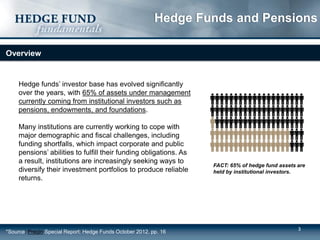
Hedge funds’ investor base has evolved significantly
over the years, with 65% of assets under management
currently coming from institutional investors such as
pensions, endowments, and foundations.
Many institutions are currently working to cope with
major demographic and fiscal challenges, including
funding shortfalls, which impact corporate and public
pensions’ abilities to fulfill their funding obligations. As
a result, institutions are increasingly seeking ways to
diversify their investment portfolios to produce reliable
returns.
*Source: Preqin Special Report: Hedge Funds October 2012, pp. 16
Overview
FACT: 65% of hedge fund assets are
held by institutional investors.
44
Hedge Funds and Pensions
Why Institutions Invest with Hedge Funds
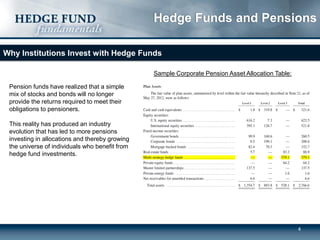
Sample Corporate Pension Asset Allocation Table:
Pension funds have realized that a simple
mix of stocks and bonds will no longer
provide the returns required to meet their
obligations to pensioners.
This reality has produced an industry
evolution that has led to more pensions
investing in allocations and thereby growing
the universe of individuals who benefit from
hedge fund investments.
55
Hedge Funds and Pensions
Public and State Pensions Invest in Hedge Funds
Public and state employee pension plans offer retirement security for millions of workers,
retirees, and their families nationwide. These pension plans have increasingly partnered with
hedge funds to help diversify their investments and help to provide economic security to their
beneficiaries.
*Source: The Changing Role of Hedge Funds in the Global Economy, Everett Ehrlich, pp. 1 (September, 2011)
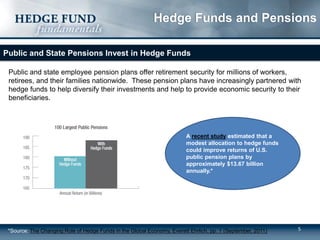
A recent study estimated that a
modest allocation to hedge funds
could improve returns of U.S.
public pension plans by
approximately $13.67 billion
annually.*
66
Hedge Funds and Pensions
Public Pensions Invest in Hedge Funds
Hedge funds’ investor base in the U.S. at the
state and public plan level is diverse.
Investors in hedge funds range from unions
such as AFL-CIO to local retirement plans in
Louisiana to teachers in Illinois.
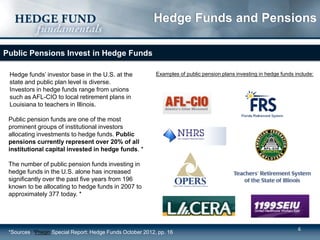
Examples of public pension plans investing in hedge funds include:
*Sources: ¹Preqin Special Report: Hedge Funds October 2012, pp. 16
Public pension funds are one of the most
prominent groups of institutional investors
allocating investments to hedge funds. Public
pensions currently represent over 20% of all
institutional capital invested in hedge funds. *
The number of public pension funds investing in
hedge funds in the U.S. alone has increased
significantly over the past five years from 196
known to be allocating to hedge funds in 2007 to
approximately 377 today. *
777
Hedge Funds and Pensions
Corporate Pensions Invest in Hedge Funds
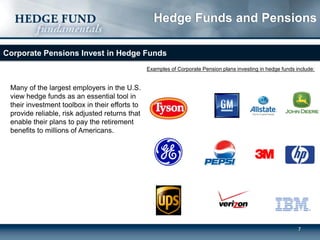
Examples of Corporate Pension plans investing in hedge funds include:
Many of the largest employers in the U.S.
view hedge funds as an essential tool in
their investment toolbox in their efforts to
provide reliable, risk adjusted returns that
enable their plans to pay the retirement
benefits to millions of Americans.
888
Hedge Funds and Pensions
Corporate Pensions Invest in Hedge Funds
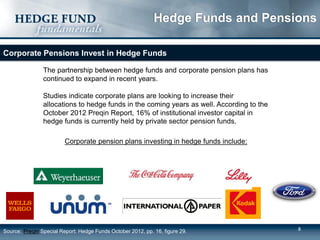
Corporate pension plans investing in hedge funds include:
The partnership between hedge funds and corporate pension plans has
continued to expand in recent years.
Studies indicate corporate plans are looking to increase their
allocations to hedge funds in the coming years as well. According to the
October 2012 Preqin Report, 16% of institutional investor capital in
hedge funds is currently held by private sector pension funds.
Preqin Special Report: Hedge Funds October 2012, pp. 16, figure 29.Source:
9
Hedge Funds and Pensions
University & College Endowments Invest in Hedge Funds
University and college endowments
were among the first institutions to
partner with hedge funds in the early
1990’s, and this relationship has
strengthened in recent years.
A recent study estimated that a modest
allocation to hedge funds could improve returns
of U.S. college and university endowments by
approximately $1.73 billion annually.*
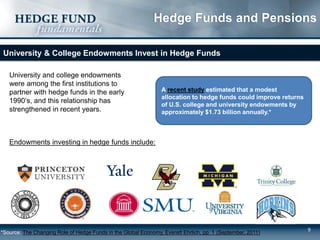
Endowments investing in hedge funds include:
*Source: The Changing Role of Hedge Funds in the Global Economy, Everett Ehrlich, pp. 1 (September, 2011)
1010
Who Invests in Hedge Funds?
Foundations and Non-Profit Organizations Invest in Hedge Funds
Non-profit foundations and charitable organizations around the world partner with hedge funds to help
establish the financial resources needed to fund critical projects in local communities.
For example, The Nobel Foundation recently announced plans to invest more money in hedge funds to
boost returns to restore the award to its previous size after having to reduce its cash prize by 20% in 2012.
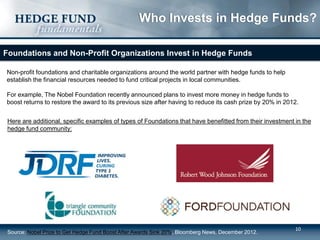
Here are additional, specific examples of types of Foundations that have benefitted from their investment in the
hedge fund community:
Source: Nobel Prize to Get Hedge Fund Boost After Awards Sink 20%, Bloomberg News, December 2012.
11
Summary
The partnership between hedge funds and
pensions continues to grow. Pension funds are
seeking reliable returns and diversified portfolios,
with many plans increasing existing allocations
with hedge funds. These plans use a variety of
asset allocation techniques and most call for a
significant allocation to hedge funds and other
alternative investment options over the next few
years.
Hedge funds are not a silver bullet for the
challenges facing public pensions, but they are
increasingly part of a comprehensive and
responsible approach toward meeting financial
obligations.
Hedge Funds and Pensions

Hff h fs_pensions_02-2013

  • 1.
  • 2.
    22 Hedge Funds andPensions Contents Table of Contents:Overview Hedge funds originated as an investment vehicle to help diversify portfolios, manage risk, and produce reliable returns over time. While hedge funds’ investor base has evolved though the years – from individuals to institutions such as pension plans, universities, and foundations – their core goals have not. Institutions face mounting challenges toward meeting their financial obligations. Pension plans, in particular, face demographic challenges resulting in a funding shortfall. As a result, pension plans have shifted investment strategies in recent years to alternative investments - including hedge funds - which have helped place institutions on firmer ground over the long-term. This presentation details the growing partnerships between hedge funds and public and corporate pension plans. Overview 3 Why Institutions Invest with Hedge Funds 4 • Public and State Pension Plans 5 • Corporate Pension Plans 7 • University Endowments 9 • Foundations 10
  • 3.
    33 Hedge Funds andPensions Hedge funds’ investor base has evolved significantly over the years, with 65% of assets under management currently coming from institutional investors such as pensions, endowments, and foundations. Many institutions are currently working to cope with major demographic and fiscal challenges, including funding shortfalls, which impact corporate and public pensions’ abilities to fulfill their funding obligations. As a result, institutions are increasingly seeking ways to diversify their investment portfolios to produce reliable returns. *Source: Preqin Special Report: Hedge Funds October 2012, pp. 16 Overview FACT: 65% of hedge fund assets are held by institutional investors.
  • 4.
    44 Hedge Funds andPensions Why Institutions Invest with Hedge Funds Sample Corporate Pension Asset Allocation Table: Pension funds have realized that a simple mix of stocks and bonds will no longer provide the returns required to meet their obligations to pensioners. This reality has produced an industry evolution that has led to more pensions investing in allocations and thereby growing the universe of individuals who benefit from hedge fund investments.
  • 5.
    55 Hedge Funds andPensions Public and State Pensions Invest in Hedge Funds Public and state employee pension plans offer retirement security for millions of workers, retirees, and their families nationwide. These pension plans have increasingly partnered with hedge funds to help diversify their investments and help to provide economic security to their beneficiaries. *Source: The Changing Role of Hedge Funds in the Global Economy, Everett Ehrlich, pp. 1 (September, 2011) A recent study estimated that a modest allocation to hedge funds could improve returns of U.S. public pension plans by approximately $13.67 billion annually.*
  • 6.
    66 Hedge Funds andPensions Public Pensions Invest in Hedge Funds Hedge funds’ investor base in the U.S. at the state and public plan level is diverse. Investors in hedge funds range from unions such as AFL-CIO to local retirement plans in Louisiana to teachers in Illinois. Examples of public pension plans investing in hedge funds include: *Sources: ¹Preqin Special Report: Hedge Funds October 2012, pp. 16 Public pension funds are one of the most prominent groups of institutional investors allocating investments to hedge funds. Public pensions currently represent over 20% of all institutional capital invested in hedge funds. * The number of public pension funds investing in hedge funds in the U.S. alone has increased significantly over the past five years from 196 known to be allocating to hedge funds in 2007 to approximately 377 today. *
  • 7.
    777 Hedge Funds andPensions Corporate Pensions Invest in Hedge Funds Examples of Corporate Pension plans investing in hedge funds include: Many of the largest employers in the U.S. view hedge funds as an essential tool in their investment toolbox in their efforts to provide reliable, risk adjusted returns that enable their plans to pay the retirement benefits to millions of Americans.
  • 8.
    888 Hedge Funds andPensions Corporate Pensions Invest in Hedge Funds Corporate pension plans investing in hedge funds include: The partnership between hedge funds and corporate pension plans has continued to expand in recent years. Studies indicate corporate plans are looking to increase their allocations to hedge funds in the coming years as well. According to the October 2012 Preqin Report, 16% of institutional investor capital in hedge funds is currently held by private sector pension funds. Preqin Special Report: Hedge Funds October 2012, pp. 16, figure 29.Source:
  • 9.
    9 Hedge Funds andPensions University & College Endowments Invest in Hedge Funds University and college endowments were among the first institutions to partner with hedge funds in the early 1990’s, and this relationship has strengthened in recent years. A recent study estimated that a modest allocation to hedge funds could improve returns of U.S. college and university endowments by approximately $1.73 billion annually.* Endowments investing in hedge funds include: *Source: The Changing Role of Hedge Funds in the Global Economy, Everett Ehrlich, pp. 1 (September, 2011)
  • 10.
    1010 Who Invests inHedge Funds? Foundations and Non-Profit Organizations Invest in Hedge Funds Non-profit foundations and charitable organizations around the world partner with hedge funds to help establish the financial resources needed to fund critical projects in local communities. For example, The Nobel Foundation recently announced plans to invest more money in hedge funds to boost returns to restore the award to its previous size after having to reduce its cash prize by 20% in 2012. Here are additional, specific examples of types of Foundations that have benefitted from their investment in the hedge fund community: Source: Nobel Prize to Get Hedge Fund Boost After Awards Sink 20%, Bloomberg News, December 2012.
  • 11.
    11 Summary The partnership betweenhedge funds and pensions continues to grow. Pension funds are seeking reliable returns and diversified portfolios, with many plans increasing existing allocations with hedge funds. These plans use a variety of asset allocation techniques and most call for a significant allocation to hedge funds and other alternative investment options over the next few years. Hedge funds are not a silver bullet for the challenges facing public pensions, but they are increasingly part of a comprehensive and responsible approach toward meeting financial obligations. Hedge Funds and Pensions