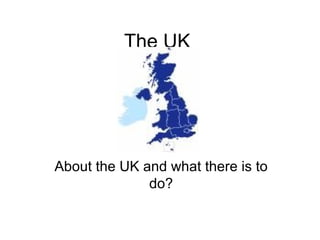
The UK  About the UK and what there is to do?
UK The UK is a country in north-western Europe. It is bordered to the south by the English Channel; to the east by the North Sea; to the west by the Irish Sea and the Atlantic Ocean.
Countries in the UK  England ,  Scotland, Wales, and Northern Ireland (also known as Ulster)
England  England is 74 times smaller than the USA, 59 times smaller than Australia and 3 times smaller than Japan. England is in north-west Europe and is in the southern part of Great Britain. It is an island country and also part of the  United Kingdom  (UK). England has not had a separate political identity since 1707, when Great Britain was established as a political entity. There is no government or parliament just for England.  England is only 35 km from France and is now linked by a tunnel under the English Channel.  The south of England is mostly low-lying land, with hills and agricultural land and the north of England is mostly covered in moorland and mountains. Cross of St George  National Day: 23 April  Area:  129,720 sq km 50,085 sq miles  Population:  49,561,800 (2002) Nationality:  English and British Climate:  Temperate; moderated by prevailing southwest winds over the North Atlantic Current Capital City:   London Currency:   Pound Sterling  (£) Longest river:   Thames  (346 km) Official Animal:  Lion
Scotland  Scotland is in north-west Europe and is part of Great Britain, an island country and the United Kingdom (UK) . Scotland is a mountainous country in the north of the island of Great Britain and shares a land border to the south with England and is bounded by the North Sea on the east and the Atlantic Ocean on the west. Its capital city is Edinburgh.  Scotland has some 790 islands - 130 inhabited. Its fresh water lochs (lakes) – there are over 600 square miles of them. One of the most famous is Loch Ness where a mysterious monster is said to lurk in the depths of the water. It is also famous for its clans, kilts, medieval castles, as well as poetry and songs of Robert Burns. Theatre lovers from around the world come to Edinburgh for its famous theatres festival. Edinburgh was the first city in the world which had its own fire-brigade.  Edinburgh – the capital of Scotland, like Rome, was built on seven hills. Until 1603, Scotland had its own King.  The National Flag of Scotland National Day:  30 November  Area:  78,789 sq km   Population:  5,054,800 (2002) Nationality:  Scottish and British Capital City:  Edinburgh Currency:   Pound Sterling  (£) Longest river: Tay 193 kilometres (120 miles ) long   Official Animal:  unicorn
Wales  Wales is in north-west Europe and is part of Great Britain, an island country and the United Kingdom (UK) . Wales ( Cymru  in Welsh) is a mountainous country on the western side of Great Britain.  Wales is bordered by England to the east, the Bristol Channel to the south, St George's Channel in the west, and the Irish Sea to the north.  The National Flag of Wales Technically, Wales is a  principality . This means that it is ruled by a prince. Traditionally the Prince of Wales is the eldest son of the English monarch.  Wales is one of the four parts of the United Kingdom (along with England, Scotland, and Northern Ireland).  National Day:  1 March Area:  20,779 sq km  Population:   2,918,700 (2002)  Nationality:  Welsh and British  Capital City:  Cardiff    Currency:  Pound Sterling (£) Longest river:  Towy (Tywi) 103 km (64 miles) Official Animal:  dragon
Northern Ireland  Northern Ireland lies in the northeast of the island of Ireland, covering 5,459 square miles (14,139 km²), about a sixth of the island's total area. Northern Ireland is the second most sparsely populated part of the UK after Scotland, with 317 people per square mile (122 per square kilometre).  In 1801 the whole of Ireland became part of the United Kingdom, with the adoption of the name the  United Kingdom of Great Britain and Ireland . After years of civil war, Ireland became a republic in 1921. At this time, Britain negotiated with Ireland to keep the six counties in the north-east of Ireland. These six counties now make up what is known as Northern Ireland or Ulster. The southern part of the island is the Republic of Ireland, or Eire.  1927 - The current name of the UK, the  United Kingdom of Great Britain and Northern Ireland , was adopted The National Flag of Ireland National Day:17 March St Patrick's Day   Area:  5,459 square miles (14,139 km²)  Population: 1,685,000 (Census 2001)   Nationality:  British and Irish   Capital City:  Belfast  Currency:   Pound Sterling  (£) Longest river:   River Bann 129 kilometres (80 miles)
Multicultural in the UK The major ethnic groups are British, Irish, west Indian, African, south Asian
Weather we have

Henry the uk

  • 1.
    The UK About the UK and what there is to do?
  • 2.
    UK The UKis a country in north-western Europe. It is bordered to the south by the English Channel; to the east by the North Sea; to the west by the Irish Sea and the Atlantic Ocean.
  • 3.
    Countries in theUK England , Scotland, Wales, and Northern Ireland (also known as Ulster)
  • 4.
    England Englandis 74 times smaller than the USA, 59 times smaller than Australia and 3 times smaller than Japan. England is in north-west Europe and is in the southern part of Great Britain. It is an island country and also part of the United Kingdom (UK). England has not had a separate political identity since 1707, when Great Britain was established as a political entity. There is no government or parliament just for England. England is only 35 km from France and is now linked by a tunnel under the English Channel. The south of England is mostly low-lying land, with hills and agricultural land and the north of England is mostly covered in moorland and mountains. Cross of St George National Day: 23 April Area: 129,720 sq km 50,085 sq miles Population: 49,561,800 (2002) Nationality: English and British Climate: Temperate; moderated by prevailing southwest winds over the North Atlantic Current Capital City: London Currency: Pound Sterling (£) Longest river: Thames (346 km) Official Animal: Lion
  • 5.
    Scotland Scotlandis in north-west Europe and is part of Great Britain, an island country and the United Kingdom (UK) . Scotland is a mountainous country in the north of the island of Great Britain and shares a land border to the south with England and is bounded by the North Sea on the east and the Atlantic Ocean on the west. Its capital city is Edinburgh. Scotland has some 790 islands - 130 inhabited. Its fresh water lochs (lakes) – there are over 600 square miles of them. One of the most famous is Loch Ness where a mysterious monster is said to lurk in the depths of the water. It is also famous for its clans, kilts, medieval castles, as well as poetry and songs of Robert Burns. Theatre lovers from around the world come to Edinburgh for its famous theatres festival. Edinburgh was the first city in the world which had its own fire-brigade. Edinburgh – the capital of Scotland, like Rome, was built on seven hills. Until 1603, Scotland had its own King. The National Flag of Scotland National Day: 30 November Area: 78,789 sq km Population: 5,054,800 (2002) Nationality: Scottish and British Capital City: Edinburgh Currency: Pound Sterling (£) Longest river: Tay 193 kilometres (120 miles ) long Official Animal: unicorn
  • 6.
    Wales Walesis in north-west Europe and is part of Great Britain, an island country and the United Kingdom (UK) . Wales ( Cymru in Welsh) is a mountainous country on the western side of Great Britain. Wales is bordered by England to the east, the Bristol Channel to the south, St George's Channel in the west, and the Irish Sea to the north. The National Flag of Wales Technically, Wales is a principality . This means that it is ruled by a prince. Traditionally the Prince of Wales is the eldest son of the English monarch. Wales is one of the four parts of the United Kingdom (along with England, Scotland, and Northern Ireland). National Day: 1 March Area: 20,779 sq km Population:  2,918,700 (2002) Nationality: Welsh and British Capital City: Cardiff   Currency: Pound Sterling (£) Longest river: Towy (Tywi) 103 km (64 miles) Official Animal: dragon
  • 7.
    Northern Ireland Northern Ireland lies in the northeast of the island of Ireland, covering 5,459 square miles (14,139 km²), about a sixth of the island's total area. Northern Ireland is the second most sparsely populated part of the UK after Scotland, with 317 people per square mile (122 per square kilometre). In 1801 the whole of Ireland became part of the United Kingdom, with the adoption of the name the United Kingdom of Great Britain and Ireland . After years of civil war, Ireland became a republic in 1921. At this time, Britain negotiated with Ireland to keep the six counties in the north-east of Ireland. These six counties now make up what is known as Northern Ireland or Ulster. The southern part of the island is the Republic of Ireland, or Eire. 1927 - The current name of the UK, the United Kingdom of Great Britain and Northern Ireland , was adopted The National Flag of Ireland National Day:17 March St Patrick's Day Area: 5,459 square miles (14,139 km²) Population: 1,685,000 (Census 2001) Nationality: British and Irish Capital City: Belfast Currency: Pound Sterling (£) Longest river: River Bann 129 kilometres (80 miles)
  • 8.
    Multicultural in theUK The major ethnic groups are British, Irish, west Indian, African, south Asian
  • 9.