Hemorrhoids
By Sobhan Pouramini
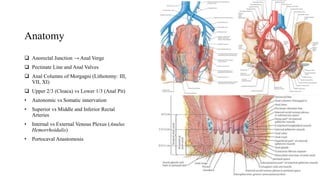
Anatomy
 Anorectal Junction → Anal Verge
 Pectinate Line and Anal Valves
 Anal Columns of Morgagni (Lithotomy: III,
VII, XI)
 Upper 2/3 (Cloaca) vs Lower 1/3 (Anal Pit)
• Autonomic vs Somatic innervation
• Superior vs Middle and Inferior Rectal
Arteries
• Internal vs External Venous Plexus (Anulus
Hemorrhoidalis)
• Portocaval Anastomosis
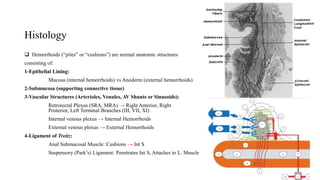
Histology
 Hemorrhoids (“piles” or “cushions”) are normal anatomic structures
consisting of:
1-Epithelial Lining:
Mucosa (internal hemorrhoids) vs Anoderm (external hemorrhoids)
2-Submucosa (supporting connective tissue)
3-Vascular Structures (Arterioles, Venules, AV Shunts or Sinusoids):
Retrorectal Plexus (SRA, MRA) → Right Anterior, Right
Posterior, Left Terminal Branches (III, VII, XI)
Internal venous plexus → Internal Hemorrhoids
External venous plexus → External Hemorrhoids
4-Ligament of Treitz:
Anal Submucosal Muscle: Cushions → Int S
Suspensory (Park’s) Ligament: Penetrates Int S, Attaches to L. Muscle
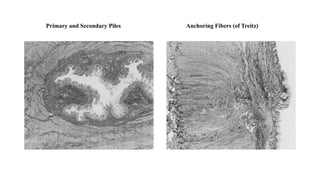
Primary and Secondary Piles Anchoring Fibers (of Treitz)
Physiology
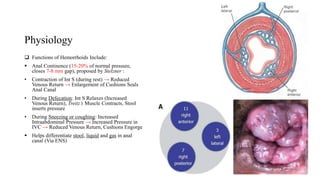
 Functions of Hemorrhoids Include:
 Anal Continence (15-20% of normal pressure,
closes 7-8 mm gap), proposed by Stelzner :
• Contraction of Int S (during rest) → Reduced
Venous Return → Enlargement of Cushions Seals
Anal Canal
• During Defecation: Int S Relaxes (Increased
Venous Return), Treitz’s Muscle Contracts, Stool
inserts pressure
• During Sneezing or coughing: Increased
Intraabdominal Pressure → Increased Pressure in
IVC → Reduced Venous Return, Cushions Engorge
 Helps differentiate stool, liquid and gas in anal
canal (Via ENS)
Pathophysiology
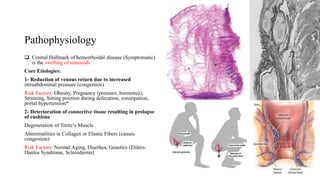
 Central Hallmark of hemorrhoidal disease (Symptomatic)
is the swelling of sinusoids
Core Etiologies:
1- Reduction of venous return due to increased
intraabdominal pressure (congestion)
Risk Factors: Obesity, Pregnancy (pressure, hormones),
Straining, Sitting position during defecation, constipation,
portal hypertension*
2- Deterioration of connective tissue resulting in prolapse
of cushions
Degeneration of Treitz’s Muscle
Abnormalities in Collagen or Elastic Fibers (causes
congestion)
Risk Factors: Normal Aging, Diarrhea, Genetics (Ehlers-
Danlos Syndrome, Scleroderma)
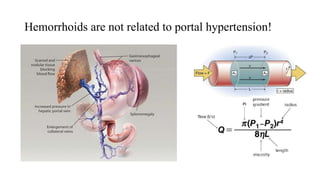
Hemorrhoids are not related to portal hypertension!
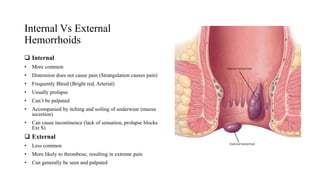
Internal Vs External
Hemorrhoids
 Internal
• More common
• Distension does not cause pain (Strangulation causes pain)
• Frequently Bleed (Bright red, Arterial)
• Usually prolapse
• Can’t be palpated
• Accompanied by itching and soiling of underwear (mucus
secretion)
• Can cause incontinence (lack of sensation, prolapse blocks
Ext S)
 External
• Less common
• More likely to thrombose, resulting in extreme pain
• Can generally be seen and palpated
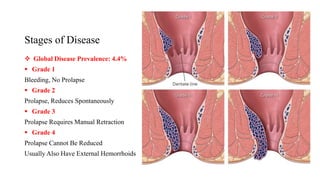
Stages of Disease
 Global Disease Prevalence: 4.4%
 Grade 1
Bleeding, No Prolapse
 Grade 2
Prolapse, Reduces Spontaneously
 Grade 3
Prolapse Requires Manual Retraction
 Grade 4
Prolapse Cannot Be Reduced
Usually Also Have External Hemorrhoids
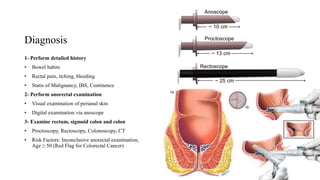
Diagnosis
1- Perform detailed history
• Bowel habits
• Rectal pain, itching, bleeding
• Statis of Malignancy, IBS, Continence
2- Perform anorectal examination
• Visual examination of perianal skin
• Digital examination via anoscope
3- Examine rectum, sigmoid colon and colon
• Proctoscopy, Rectoscopy, Colonoscopy, CT
• Risk Factors: Inconclusive anorectal examination,
Age ≥ 50 (Red Flag for Colorectal Cancer)
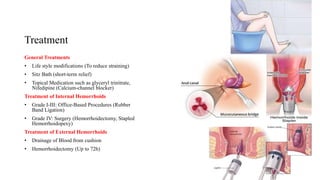
Treatment
General Treatments
• Life style modifications (To reduce straining)
• Sitz Bath (short-term relief)
• Topical Medication such as glyceryl trinitrate,
Nifedipine (Calcium-channel blocker)
Treatment of Internal Hemorrhoids
• Grade I-III: Office-Based Procedures (Rubber
Band Ligation)
• Grade IV: Surgery (Hemorrhoidectomy, Stapled
Hemorrhoidopexy)
Treatment of External Hemorrhoids
• Drainage of Blood from cushion
• Hemorrhoidectomy (Up to 72h)
References
• https://www.ncbi.nlm.nih.gov/pmc/articles/PMC3342598/
• https://www.ncbi.nlm.nih.gov/pmc/articles/PMC6479658/
• https://www.ncbi.nlm.nih.gov/pmc/articles/PMC3342598/
• https://www.ncbi.nlm.nih.gov/pmc/articles/PMC8057569/
• https://pubmed.ncbi.nlm.nih.gov/6745015
• https://www.sciencedirect.com/science/article/abs/pii/S1043148907000292
• www.mayoclinic.org
• www.imaios.com
• www.amboss.com
• www.thenurseszone.com
• www.kenhub.com
• www.colorectalcentre.co.uk
THANK YOU

Hemorrhoids.pptx

  • 1.
  • 2.
    Anatomy  Anorectal Junction→ Anal Verge  Pectinate Line and Anal Valves  Anal Columns of Morgagni (Lithotomy: III, VII, XI)  Upper 2/3 (Cloaca) vs Lower 1/3 (Anal Pit) • Autonomic vs Somatic innervation • Superior vs Middle and Inferior Rectal Arteries • Internal vs External Venous Plexus (Anulus Hemorrhoidalis) • Portocaval Anastomosis
  • 3.
    Histology  Hemorrhoids (“piles”or “cushions”) are normal anatomic structures consisting of: 1-Epithelial Lining: Mucosa (internal hemorrhoids) vs Anoderm (external hemorrhoids) 2-Submucosa (supporting connective tissue) 3-Vascular Structures (Arterioles, Venules, AV Shunts or Sinusoids): Retrorectal Plexus (SRA, MRA) → Right Anterior, Right Posterior, Left Terminal Branches (III, VII, XI) Internal venous plexus → Internal Hemorrhoids External venous plexus → External Hemorrhoids 4-Ligament of Treitz: Anal Submucosal Muscle: Cushions → Int S Suspensory (Park’s) Ligament: Penetrates Int S, Attaches to L. Muscle
  • 4.
    Primary and SecondaryPiles Anchoring Fibers (of Treitz)
  • 5.
    Physiology  Functions ofHemorrhoids Include:  Anal Continence (15-20% of normal pressure, closes 7-8 mm gap), proposed by Stelzner : • Contraction of Int S (during rest) → Reduced Venous Return → Enlargement of Cushions Seals Anal Canal • During Defecation: Int S Relaxes (Increased Venous Return), Treitz’s Muscle Contracts, Stool inserts pressure • During Sneezing or coughing: Increased Intraabdominal Pressure → Increased Pressure in IVC → Reduced Venous Return, Cushions Engorge  Helps differentiate stool, liquid and gas in anal canal (Via ENS)
  • 6.
    Pathophysiology  Central Hallmarkof hemorrhoidal disease (Symptomatic) is the swelling of sinusoids Core Etiologies: 1- Reduction of venous return due to increased intraabdominal pressure (congestion) Risk Factors: Obesity, Pregnancy (pressure, hormones), Straining, Sitting position during defecation, constipation, portal hypertension* 2- Deterioration of connective tissue resulting in prolapse of cushions Degeneration of Treitz’s Muscle Abnormalities in Collagen or Elastic Fibers (causes congestion) Risk Factors: Normal Aging, Diarrhea, Genetics (Ehlers- Danlos Syndrome, Scleroderma)
  • 7.
    Hemorrhoids are notrelated to portal hypertension!
  • 8.
    Internal Vs External Hemorrhoids Internal • More common • Distension does not cause pain (Strangulation causes pain) • Frequently Bleed (Bright red, Arterial) • Usually prolapse • Can’t be palpated • Accompanied by itching and soiling of underwear (mucus secretion) • Can cause incontinence (lack of sensation, prolapse blocks Ext S)  External • Less common • More likely to thrombose, resulting in extreme pain • Can generally be seen and palpated
  • 9.
    Stages of Disease Global Disease Prevalence: 4.4%  Grade 1 Bleeding, No Prolapse  Grade 2 Prolapse, Reduces Spontaneously  Grade 3 Prolapse Requires Manual Retraction  Grade 4 Prolapse Cannot Be Reduced Usually Also Have External Hemorrhoids
  • 10.
    Diagnosis 1- Perform detailedhistory • Bowel habits • Rectal pain, itching, bleeding • Statis of Malignancy, IBS, Continence 2- Perform anorectal examination • Visual examination of perianal skin • Digital examination via anoscope 3- Examine rectum, sigmoid colon and colon • Proctoscopy, Rectoscopy, Colonoscopy, CT • Risk Factors: Inconclusive anorectal examination, Age ≥ 50 (Red Flag for Colorectal Cancer)
  • 11.
    Treatment General Treatments • Lifestyle modifications (To reduce straining) • Sitz Bath (short-term relief) • Topical Medication such as glyceryl trinitrate, Nifedipine (Calcium-channel blocker) Treatment of Internal Hemorrhoids • Grade I-III: Office-Based Procedures (Rubber Band Ligation) • Grade IV: Surgery (Hemorrhoidectomy, Stapled Hemorrhoidopexy) Treatment of External Hemorrhoids • Drainage of Blood from cushion • Hemorrhoidectomy (Up to 72h)
  • 12.
    References • https://www.ncbi.nlm.nih.gov/pmc/articles/PMC3342598/ • https://www.ncbi.nlm.nih.gov/pmc/articles/PMC6479658/ •https://www.ncbi.nlm.nih.gov/pmc/articles/PMC3342598/ • https://www.ncbi.nlm.nih.gov/pmc/articles/PMC8057569/ • https://pubmed.ncbi.nlm.nih.gov/6745015 • https://www.sciencedirect.com/science/article/abs/pii/S1043148907000292 • www.mayoclinic.org • www.imaios.com • www.amboss.com • www.thenurseszone.com • www.kenhub.com • www.colorectalcentre.co.uk
  • 13.