Objectives
After completion ofthis chapter, the student will be able to:
Define differential leukocyte count (DLC)
Discuss three general features to be incorporated in the DLC
Perform a 100 cell differential count according to criteria
established by the instructor
Differentiate a relative cell count from an absolute cell count
Perform a WBC and platelet estimate on a stained peripheral
blood smear
3.
Objectives cont’d
Discussthe clinical implications of the differential
leukocyte count
Identify mature and immature leukocytes
Identify morphological abnormalities of leukocytes
Identify reactive lymphocytes, including clinical
situations associated with their presence
Identify possible sources of error and their remedies in
DLC
Apply QC in DLC
8.1 Introduction
i. AboutDifferential white cell count:
Is the enumeration of the relative proportions
(percentages) of the various types of white cells as
seen in stained blood films
Is used to determine the relative numbers of each
type of leukocyte.
A smear is examined and each time a leukocyte is seen,
it is both tabulated and classified on a special counter
The counting and classifying continues until 100 cells
have been observed
6.
Diff count cont’d
The differential cell count also includes:
an evaluation of RBC morphology,
platelet morphology and numbers, and
general WBC morphology and estimation
With a manual differential count, inaccuracy or
deviation from the true count results both from:
maldistribution
misidentification of cells
7.
Diff count cont’d
Maldistribution of cells
The different types of white cell are not distributed
evenly over a slide
The tail of the film contains:
more neutrophils
fewer lymphocytes,
N.B. monocytes are fairly evenly distributed along
the length of the film
Large cells are preferentially distributed at the edges of
the film
Maldistribution of cells is aggravated:
if a film is too thin or
if a spreader with a rough edge has been used
8.
Diff count cont’d
ii.Clinical significance of Diff count
To evaluate the different leukocytes distribution in the
circulation in normal and pathological states
9.
Diff count cont’d
iii.Principle of Differential white cell count
After taking blood sample, blood film is prepared, and
after staining with Romanowsky stains, 100, 200, 300,
etc., cells will be counted; then the percent distribution
of each cell is calculated
iv. Type of specimen: EDTA anticoagulated venous
or capillary blood
v. Equipment and Reagents
Microscope
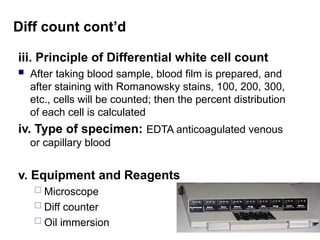
Diff counter
Oil immersion
10.
8.2. Methods ofCounting
Various methods of tracking over a slide have been
proposed to attempt to overcome errors due to
maldistribution:
The Longitudinal Strip Method
The Battlement Method
The Modified Battlement Method
11.
A. The LongitudinalStrip Method
This is a method of tracking along the length of the film
The cells are counted using the 40x dry or 100x oil immersion objectives
in a strip running the whole length of the film until 100 cells are counted.
If all the cells are counted in such a strip, the differential totals will
approximate closely to the true differential count
12.
Longitudinal strip methodcont’d
Advantage and Disadvantages of the Method:
Advatage:
It compensates for maldistribution between the body and
the tail
Disadvantage
It does not compensate for maldistribution between the
centre and the edge
i.e., It does not allow for inclusion of neutrophils and
monocytes at the edges of the film
13.
Longitudinal strip methodcont’d
Disadv cont’d
Difficulty in identifying contracted heavily stained cells in
the thicker parts of the film (head part)
However, this problem is minimized in a well made
film and in practice brings little difference to results
14.
B. The BattlementMethod
Counting is performed by moving from side to side
across the width of the slide in the counting area just
behind the feather edge where the cells are separated
from one another and are free from artifacts.
Advantage
It compensates for maldistribution between the centre
and the edge
Disadvantage
It does not compensates for maldistribution between the
body and the tail
since the customary 100-cell differential count will not
cover a very large proportion of the length of the
blood film
15.
C. The ModifiedBattlement Method
In modified battlement method, two fields are counted
close to the edge parallel to the edge of the film, then four
fields at right angles, then two fields parallel to the edge
and so on.
A modified battlement track is a compromise between the
two methods.
At least 100 cells should be counted.
If there is white cell aggregation, the maldistribution of
cells is so great that an accurate differential count is
impossible.
16.
Cont..
Of thethree methods
the lateral strip method appears to be the method of
choice because it averages out almost all of the
disadvantages of the two other methods
This is to be checked!!!
Multiple manual registers or electronic counters are used
for the count.
17.
Diff count cont’d
Note:All elements of the blood film must be observed while
performing the differential count.
If any abnormality is seen in the smear, it should be
confirmed and reported
The following points should be checked:
Erythrocytes: size, shape, distribution, and degree of
hemoglobinization
presence of inclusion bodies
presence of nucleated red cells, if so, the total
leukocyte count must be corrected
18.
Diff count cont’d
Platelets:
Estimation (10-20/HPF)
Do they look normal?
are there many giant or bizzare forms?
Leukocytes:
Mature? Immature? Atypical?
Average number of lobes? hypersegmented
neutrophils? Hyposegmentation?
Hypergranulated ones? vacuolation?
Toxic granulation, other inclusions
Estimation
etc
Hemoparasites:
malaria, borrelia, babesia, etc.
19.
Diff count cont’d
vi.Procedure
Using the 10x dry objective, scan the smear
for:
Proper staining
WBC distribution
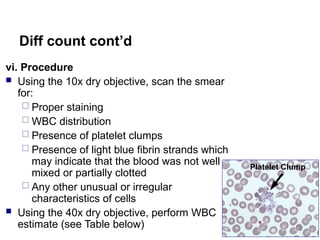
Presence of platelet clumps
Presence of light blue fibrin strands which
may indicate that the blood was not well
mixed or partially clotted
Any other unusual or irregular
characteristics of cells
Using the 40x dry objective, perform WBC
estimate (see Table below)
Platelet Clump
20.
Performing a WBCEstimate Under 40x High Dry
Look for estimate area which has 200 RBCs that are
partially overlapping with many single red cells
Determine a WBC estimate using the following
conversion information (hpf=high power field):
2-4 cells/hpf = 4.0 – 7.0x10⁹
/L
4-6 cells/hpf = 7.0 – 10.0x10⁹
/L
6-10 cells/hpf = 10.0 – 13.0x10⁹
/L
10-20 cells/hpf = 13.0 – 18.0x10⁹
/L
Estimates:
are reported as decreased, Increased, or adequate
are used for QC purpose
Remember!
Estimates
are not
reported!
21.
Procedure cont’d
Locatea thin area of the smear in which the RBCs
are evenly distributed, only slightly overlap, and the
central pallor or “whites-of-their-eyes” is seen
Place a drop of oil on the slide and switch to the oil
immersion objective
Change the objective to 100x oil immersion
Count 100 white cells including all cell lines from
immature to mature
Properly record and report results of differential cell
counts.
Note reference ranges and any abnormal results.
22.
Evaluating Staining Properties
Locate a cell that can be positively identified,
such as a polysegmented neutrophil.
Note the staining characteristics of the nucleus
and cytoplasmic granules.
Relate these features to any unidentified cells
that may be present.
23.
Evaluating Staining Properties
cont’d
Myelocytes and metamyelocytes, if present, are
recorded separately from neutrophils.
Band (stab) cells are generally counted as neutrophils
but it may be useful to record them separately.
An increase may point to an inflammatory process
even in the absence of an absolute leucocytosis.
24.
Evaluating Staining Properties
cont’d
Remember that cells don’t always appear
“picture” perfect.
The actual staining color of cells may vary from
what is seen in textbooks or even in images.
25.
Segmented Neutrophil
Approximately40-75%
in peripheral blood
2-5 lobes of nucleus
Joined by thin filament
Faint pink cytoplasm
sprinkled with pink or
purple neutrophilic granules
26.
Small Lymphocyte
Approximately40% in
peripheral smear
Small round nucleus,
clumpy, chunk
chromatin pattern
Notice the monocyte
on the top right
27.
Large Lymphocyte
Largelymphocytes
are often confused
with monocytes
Remember - the
lymphocyte nuclear
chromatin is
compact, with
blocks of chromatin
The nuclear shape
may be round, oval
or indented
28.
Monocyte
Approximately 5%in peripheral smear
Large, convoluted, brainy looking
nucleus with lacy looking chromatin
Pale, gray blue, ground glass
cytoplasm (numerous fine azurophilic
granules)
Monocyte nucleus can sometimes
take many shapes from a band
shape, to an oblong shape, to a
convolutes brainy shape.
What is important to remember is that
the chromatin is lace, open weaved,
and foamy looking.
29.
Monocytes vs. Lymphocytes
Monocytes and
lymphocytes are often
confused
The chromatin pattern
of the monocyte is
light purple and
arranged in loose,
lacy or linear strands
The nucleus may be
round, lobulated or
folded
30.
Basophil
Approximately 0-2%in peripheral
blood
Nucleus is bi-lobed and obscured
by granules
Cytoplasm is pale, washed out and
contains intense large blue black
granules
Granules are scattered throughout
the cell and it is hard to distinguish
any distinct nuclear characteristics.
31.
Eosinophil
Approximately 2-7%in peripheral
blood
Bi-lobed or banded nucleus
Large, red-orange and distinct
granules
To identify the eosinophil rely on the
granules. The granules are very
individualized looking.
If the stain is right, then the cell will
look red orange.
If not, the cell will be washed-out
looking.
32.
What Does aNormal Adult
Blood Smear Look Like?
Remember, percentages are approximate and
may differ with ethnic groups and in disease
conditions
What normal cell has not been discussed?
Segmented neutrophils ~60%
Lymphocytes ~30%
Monocytes ~5%
Eosinophils, Basophils ~3-5%
33.
What About Bands?
This cell (also called a stab) is a
precursor cell to the segmented
neutrophil
The nucleus is C-shaped or horseshoe
shaped containing no filament and has
no tight or pinched constriction
Cytoplasm is pink gray with granules
Approximately 2-6% in normal
differential
If unsure of identification, classify
as a more mature cell, the
segmented neutrophil
Metamyelocyte
Also calleda juvenile
Rarely seen normally in the peripheral blood
Nucleus characteristically indented or kidney-
shaped
The nuclear chromatin is clumped and
condensed
Specific granules appear the same as in the
band
Myelocyte
Should neverbe seen in the peripheral blood
The nucleus is round or oval and often
eccentrically located in the cell
The nuclear chromatin is beginning to clump; no
nucleoli are visible
A moderate amount of patchy blue cytoplasm
can be seen
The cell is characterized by the presence of light
pink or tan (neutrophilic) specific granules
39.
Promyelocyte
Should neverbe seen in the peripheral blood
Large cell
The nucleus may be eccentric and slightly
indented with nucleoli still visible
The nuclear chromatin is loose and open
The cell is characterized by the presence of few
to many, prominent, dark red or purple
cytoplasmic granules
Myeloblast
Should neverbe seen in the peripheral blood
Large cell (size may vary)
The nucleus is large and round, with one or
more visible nucleoli
The nuclear chromatin is loose and open
The cytoplasm is scanty to moderate and deeply
basophilic
Toxic Granulation
Large,blue-black or deep purple
granules in the cytoplasm of
neutrophils
Represent primary or
“azurophilic” granules
Seen associated with acute
infections, drug poisoning and
burns
45.
Dohle Bodies
Small,round or oval light-blue
staining areas in the cytoplasm of
neutrophils
Represent aggregates of rough
endoplasmic reticulum
Seen in patients with infections,
burns and after exposure to
cytotoxic agents
May also be seen in conjunction with
toxic granulation
46.
Vacuoles
Clear areasor “holes” in the
cytoplasm of neutrophils
Seen when the neutrophilic
cytoplasm begins to
degenerate or if the cell has
been actively phagocytic
Seen in patients with
infections and can be noted
along with toxic granulation
and Dohle bodies
N.B. Also can be seen as an
artifact associated with old
EDTA blood
Reactive Changes in
Lymphocytes
Response to a variety of viral and non-viral
stimuli produce diverse nuclear and/or
cytoplasmic changes in the lymphocytes
Associated with viral infections, e.g., Epstein-Barr
virus (EBV), cytomegalovirus (CMV), human
immunodeficiency virus (HIV)
Also seen in response to drugs or non-viral
organisms such as toxoplasmosis
49.
Reactive Lymphocytes
Characteristics:
Irregular shape of cytoplasm and/or nucleus
Abundant dark blue cytoplasm, overall bigger cell
Cytoplasmic tags, sharp ridges; indented by red
cells
Increased number of reddish granules or vacuoles
in cytoplasm
Fine nuclear chromatin pattern; may see nucleoli
8.3. Reporting theDifferential White Cell
Count
The differential leukocyte count expressed as the
percentage of each type of cell
It should be related to the total leukocyte count
The results reported in absolute numbers as the
absolute value gives better clinical indication
52.
Absolute vs. RelativeCount
Absolute count
Derived by multiplying the
percentage of the identified
cell times the white count
If 40% lymphs are counted
and the white cell count is
5.0x10⁹
/L then the absolute
lymphocyte count is
5.0x10⁹
/L x.40 or 2.0x10⁹
/L
This number is then
compared to the healthy
reference range
Relative count
Strictly the percent counted
in the WBC differential
The relative number is then
compared to the reference
range for normal white cell
differentials
So, it is possible for an
individual to have a relative
increase, an absolute
increase and a relative and
absolute increase of a
particular cell
53.
Approximate Absolute andRelative Reference Ranges
Healthy Adult
Cell Type Absolute Relative
Segmented
Neutrophil
2.0-7.0 x 10⁹
/L 40.0-75.0%
Lymphocyte 1.5-4.5 x 10⁹
/L 20-45%
Monocyte 0.2-0.8 x10⁹
/L 2-10%
Eosinophil 0.04-0.4 x 10⁹
/L 0-7%
Basophil 0.02-0.1 x 10⁹
/L 0-2%
Values may vary according to geographic location
54.
Quality control
Wellprepared well stained blood film which has
3 zones (Head, body, tail)
WBC should contain blue nucleus along with a
lighter staining cytoplasm
RBC should have good quality of color ranging
from buff pink to orange
Platelet should be blue with granules and no
nucleus
55.
Sources of error
Use of unclean slide and improper smear
preparation and staining technique
Counting cells in an area not suitable for
counting
Misidentification of white cells
Interpersonal skill
56.
8.4. Interpretation ofDifferential White
cell count
For proper interpretation the relative count is of little use by
itself
For example, the fact that a sample may have 60%
polymorphs is of little use
A patient sample may have 60% neutrophil and a total
leukocyte count of 8.0 x 10⁹
/L giving 4.8 x 10⁹
/L neutrophils,
which is quite normal
but if the patient has 60% neutrophils in a total leucocyte count
of 3.0 x 10⁹
/L, then the patient’s neutrophil count is1.8 x 109
/L
neutrophils. In this case the patient has granulocytopenia.
57.
Interpretation cont’d
1.Neutrophil
1.1 Neutrophilia/neutrophilicleucocytosis:
an increase in the number of circulating neutrophils
above normal (>2.0-7.0 x 10⁹
/L)
Overwhelming infections
Metabolic disorders: uremia, diabetic acidosis
Drugs and chemicals: lead, mercury, potassium
chlorate
Physical and emotional stress
Hematological disorders: myelogenous leukemia
Tissue destruction or necrosis: burns, surgical
operations
58.
Interpretation cont’d
1.2.Neutropenia:
areduction of the absolute neutrophil count below 2.0 x
109
/L
Myeloid hypoplasia
Drugs (chloramphenicol, phenylbutazone)
Ionizing radiation
1.3. Hypergranular neutrophils (neutrophils with toxic
granules): these are
neutrophils with coarse blue black or purple granules.
indicative of severe infection or other toxic conditions.
59.
Interpretation cont’d..
1.4 Vacuolation
seen in progressive muscular dystrophy
1.5. Hypersegmentation:
neutrophils with more than six lobes to their nucleus
(as many as ten or twelve may be seen)
indicative of megaloblastic erythropoiesis (vitamin
B12 and/or folic acid deficiency), iron deficiency
anemia and uremia.
1.6. Agranular Neutrophils:
neutrophils devoid of granules
having a pale blue cytoplasm( features of leukemia)
Interpretation cont’d
2.2. Eosinopenia:
an eosinophil count below 0.04 x 10⁹
/L
Occurs during:
Acute stress due to secretion of adrenal glucocorticoid
and epinephrine
Acute inflammatory states
3. Basophil
Basophilia:
a basophil count above 0.2 x 10⁹
/L
Rare condition
Occurs during:
Allergic reactions
Chronic myelogenous leukemia
Polycythemia vera
62.
Interpretation cont’d
4. Monocyte
4.1.Monocytosis:
a monocyte count above 1.0 x 10⁹/l
Occurs during
Recovery from acute infections
Tuberculosis
Monocytic leukemia
4.2.Monocytopenia:
a monocyte count below 0.2 x 10⁹/l
Occurs during
Treatment with prednisone
Hairy cell leukemia
63.
Interpretation cont’d
5. Lymphocytes
5.1.Lymphocytosis:
absolute lymphocyte count above 4.0 x 10⁹
/L in adults
and above 8.0 x 10⁹
/L in children.
Seen during
Infectious lymphocytosis associated with coxackie
virus
Other viral infections: Epstein-Barr virus,
cytomegalovirus
Acute and chronic lymphocytic leukemia
Toxoplasmosis
64.
Interpretation cont’d
5.2. Lymphocytopenia:
a lymphocyte count below 1.0 x 10⁹/l in adults and
below 3.0 x 10⁹/l in children
Seen in
Immune deficiency disorders: HIV/AIDS
Drugs, radiation therapy
Atypical lymphocytes:
Large cell; abundant pale blue cytoplasm with
peripheral basophilia, may have azurophilic granules
They are primarily seen in
infectious mononucleosis which is an acute, self-
limiting infectious disease of the reticuloendothelial
tissues, especially the lymphatic tissues
65.
Summary: Performing
Differential CellCounts
Use properly prepared and stained blood smears
Establish a good counting area
Properly identify white cells
Provide an estimate of total white cells and platelets
Record cellular morphology (RBC, WBC, and Plt)
Properly record and report results noting reference
ranges and abnormal results
66.
Review Questions
1. Definedifferential leukocyte count.
2. What is the importance reporting the differential
leukocyte counts in absolute terms?
3. What other elements of the blood film should be
evaluated while doing the differential leukocyte count?
4. Describe three tracking methods of diff counting with
their advantage and disadvantage
5. List at least five factors affecting the differential white
cell count and their remedies
Editor's Notes
#1 This material for Hematology I is a draft document which needs further revision. Please forward your comments to School of Medical Laboratory Sciences, Addis Ababa University. Thanks!!
#6 more neutrophils and fewer lymphocytes, whereas
monocytes are fairly evenly distributed along the
length of the film [31]. When large immature cells
(blasts, promyelocytes and myelocytes) are present
they are preferentially distributed at the edges of the
film rather than in the centre and distally rather than
proximally, in relation to lymphocytes, basophils,
neutrophils and metamyelocytes [32]. The maldistribution
of cells is aggravated if a film is too thin
or if a spreader with a rough edge has been used.
Various methods of tracking over a slide have been
proposed to attempt to overcome errors due to
maldistribution (Fig. 2.3). The method shown in
Fig. 2.3a compensates for maldistribution between
the body and the tail, but not for maldistribution
between the centre and the edge, whereas the
‘battlement’ method shown in Fig. 2.3b tends to do
the reverse, since the customary 100-cell differential
count will not cover a very large proportion of the
length of the blood film. A modified battlement
track (Fig. 2.3c) is a compromise between the two
methods. In practice, the imprecision of a manual
#7 When large immature cells
(blasts, promyelocytes and myelocytes) are present
they are preferentially distributed at the edges of the
film rather than in the centre and distally rather than
proximally, in relation to lymphocytes, basophils,
neutrophils and metamyelocytes [32].
Various methods of tracking over a slide have been
proposed to attempt to overcome errors due to
maldistribution (Fig. 2.3). The method shown in
Fig. 2.3a compensates for maldistribution between
the body and the tail, but not for maldistribution
between the centre and the edge, whereas the
‘battlement’ method shown in Fig. 2.3b tends to do
the reverse, since the customary 100-cell differential
count will not cover a very large proportion of the
length of the blood film. A modified battlement
track (Fig. 2.3c) is a compromise between the two
methods. In practice, the imprecision of a manual
#10 it is only possible to report blood films reliably provided that the thin blood film is well made and correctly stained.
Problems associated with even distribution of cells are probably always present to a small extent even in well made films
#15 Also referred as exaggerated battlement method?
In practice, the imprecision of a manual count is so great that a small degree of inaccuracy caused by maldistribution of cells is not of any great consequence.
#18 If any of these abnormalities are noticed while performing the differential white cell count, please confirm with a senior staff or other reference materials (Atlases) and report
#20 Students will use this formula early on in their training. Once they become familiar with how white cells look on a peripheral smear they will develop a sense of order regarding white cell estimates.
Remember, estimates do not get reported! They can be used as a check when you are performing automated or manual WBC counts.
#21 Instructor note: inform students that there is a 50x oil objective and is used for diff counting (may or may not be available in our country)
#26 There are two types of mature lymphs, the small lymph seen above and the large lymph. See atlas for large lymph. What should be noted (and you can see it here) is the membranal clumping of the chromatin at the nuclear membrane edge.
#27 Look at chromatin pattern and cytoplasm to distinguish from monocyte. Chromatin pattern is more clumped, especially around the exterior edges of the chromatin membrane. The cytoplasm is pale and more abundant than the small lymphocyte.
#32 These are just estimates but they are easy for large groups to remember. Specific number in each cell category may vary from ethnic group to ethnic group. Answer: Band neutrophils may also be present.
#33 Bands have always been a source of controversy. Some facilities count them and some just include them in with the segmented neutrophils. My best advice is to do whatever has been decided by your facility or clinic. And if you are counting bands, be conservative.
#52 The absolute cell count is indicative of a true increase of a specific cell and gives important information to assist the clinician in making a diagnosis. Individuals with HIV will show a decreased absolute neutrophil count and will risk infection.
#56 Percentage = relative count
Instructor note: explain how the absolute count is derived by giving examples