*
* International Boutique Trusts and
Estates firm specializing in
sophisticated multigenerational
asset transfers.
* Recognized both nationally by
Martindale Hubbell as AV
preeminent
* STEP Boutique firm of the year
*
*
1. The increased Federal exemption has created a new paradigm in estate
planning. Why must equal emphasis now be given to capital gains tax
planning?
2. What are the opportunities to achieve a step up in basis after planning is
complete?
3. What are the consequences and income tax benefits of planning
testamentary trusts for the benefit of the surviving spouse as grantor trusts?
4. Can Joint Exempt Step-up Trusts (JEST) be used to ensure a full step up in
basis for jointly owned property first?
5. Gifting “gap-QTIP” (or Qualified Terminable Interest Property) interest
income – how can unused exemption amounts be uniquely leveraged? Why
sprinkle distributions among other beneficiaries?
6. Hot Topics in Life Insurance
*
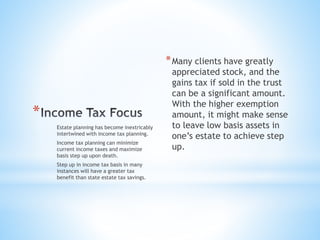
*Many clients have greatly
appreciated stock, and the
gains tax if sold in the trust
can be a significant amount.
With the higher exemption
amount, it might make sense
to leave low basis assets in
one’s estate to achieve step
up.
Estate planning has become inextricably
intertwined with income tax planning.
Income tax planning can minimize
current income taxes and maximize
basis step up upon death.
Step up in income tax basis in many
instances will have a greater tax
benefit than state estate tax savings.
Swapping into the trust high
basis assets or cash for low
basis assets can help to
achieve the desired step up
in basis at the grantor’s
death.
The trust could also hold a
note for assets moved back
into the grantor’s estate to
achieve the same step up in
basis.
*
*
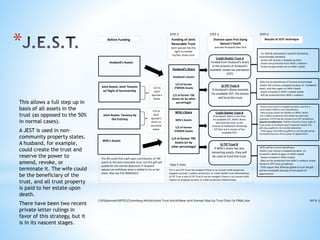
Joint Exempt Step-Up Trust (JEST) Chronology
The 4 Steps from Drafting to Implementation
Copyright 2013 Gassman Law Associates, P.A.
J:GGassmanARTICLELeimberg ArticlesJoint Trust ArticleNew Joint Exempt Step-Up Trust Chart.1e FINAL.xlsx :kh*jr 3/
STEP 2 STEP 4
Step 3 note:
STEP 3
Before Funding Funding of Joint
Revocable Trust
each spouse has the
right to revoke
his/her share until
Division upon First Dying
Spouse's Death
assume Husband dies first
Results of JEST technique
Husband's Assets
Joint Assets: Joint Tenants
w/ Right of Survivorship
Joint Assets: Tenancy by
the Entirety
Wife's Assets
Husband's Share
Husband's Assets
1/2 of former
JTWROS Assets
1/2 of former TBE
Assets (or by other
percentage)
Wife's Share
Wife's Assets
1/2 of former
JTWROS Assets
1/2 of former TBE
Assets (or by
other percentage)
1/2 to
each
Spouse's
Share
1/2 to
each
spouse's
share or
actuarial
value
Credit Shelter Trust A
Funded from Husband's Share
in the amount of Husband's
available estate tax exemption
(EST)
Q-TIP Trust A
If Husband's Share exceeds
his available EST, the excess
will fund this trust
The IRS could find a gift upon contribution of TBE
assets to the joint revocable trust, but this gift will
qualify for the marital deduction if recipient
spouse can withdraw what is added to his or her
share. Also see PLR 200201021.
Credit Shelter Trust B
If Husband's Share is less than
his available EST, Wife's Share
will fund this trust in the
amount of Husband's remaining
EST (but not in excess of her
available EST)
Q-TIP Trust B
If Wife's share has any
remaining assets, they will
be used to fund this trust
- For Wife & descendant's benefit (limited by
ascertainable standard)
- Assets will receive a stepped-up basis
- Assets are protected from Wife's creditors
- Assets escape estate tax on Wife's death
-Wife can be beneficiary of income and principal
-Assets will receive a stepped-up basis on Husband's
death, and then again on Wife's death
- Assets included in Wife's taxable estate
- Will be protected from Wife's creditors
-Assets may receive a stepped-up basis, but this is
more likely if Wife is not a beneficiary
- May escape estate tax liability on Wife's death
-For creditor protection and estate tax exclusion
purposes, CST B may be moved to an APT jurisdiction
Special Consideration: If Wife is found to have a gift of
trust assets to Husband upon Husband's death, this
gift may qualify for the marital deduction
- If IRS argues that Wife has gifted to trust the gift will be
incomplete because of her power of appointment
-Wife will be income beneficiary
-Assets may receive a stepped-up basis on
Husband's death & again on Wife's death
- Assets included in Wife's estate
- May not be protected from Wife's creditors unless
moved to APT trust jurisdiction
- If IRS argues that Wife has gifted to trust the gift
will be incomplete because of her power of
appointment
CST A and CST B can be merged if there is no concern with estate tax,
stepped-up basis, creditor protection, or credit shelter trust effectiveness.
Q-TIP Trust A and Q-TIP Trust B can be merged if there is no concern with
respect to stepped-up basis or credit protection effectiveness.
This allows a full step up in
basis of all assets in the
trust (as opposed to the 50%
in normal cases).
A JEST is used in non-
community property states.
A husband, for example,
could create the trust and
reserve the power to
amend, revoke, or
terminate it. The wife could
be the beneficiary of the
trust, and all trust property
is paid to her estate upon
death.
There have been two recent
private letter rulings in
favor of this strategy, but it
is in its nascent stages.
*
*A trust jumps to the
highest levels of
taxation for gains and
income tax at much
lower thresholds than
for individuals.
*A grantor trust can be set
up to potentially pay
lower rates of taxation
with a trust established
for a surviving spouse for
which distributions are
not mandatory. The
income earned on the
trust will be picked up on
the surviving spouse’s
personal filing.
*
* For the amount of the gap
between the state
exemption amount and
the federal exemption
amount, one should
consider the gift of a gap-
QTIP trust.
* Income interest for the
QTIP should be given to
the trust for the children.
This will leverage the first
spouse’s Deceased Spousal
Unused Exclusion (DSUE)
and avoid inclusion in the
surviving spouse’s estate.
*The surviving spouse
should not be named
Trustee of the gap QTIP
trust but can use the
principal, since only
the owner of the
income interest is
considered owner for
the IRS purposes.
*The exercise by the
spouse of a general
power of appointment
will accomplish the
same tax results.
* Swapping trust assets
* Purchase contracts between trusts
for interpolated reserve value
* Providing for heirs not in family
business
* 2% owner to Christofani
Beneficiaries
*
*
*Avoid a “fire sale”
*Maintain illiquid assets
*Facilitate business
succession plan
*“Key man” policy,
cross purchase
agreements, etc.
*Gifts to those not
beneficiaries of the
estate at large
*Divorce obligations,
alimony or support
*
*No step up for gifted assets
*Insurance to cover gains taxes due
*Insurance employed as a hedge against
mortality risk (GRATs, QPRTs, installment sales)
*
*Move additional cash estate and capital gains
tax free to heirs
*Spousal Access if serving for income
replacement
*Asset protection for estranged spouses, law
suits, creditors, etc.
*Borrowing rights
*Decanting
FBAR, International Inheritances, Non-
Citizen Spouses, Foreign Trusts and more
*
*
*QDOT Trusts
*Unlimited Marital
Deductions
*Annuities and
Retirement Plans
*Administration of
QDOT distribution
issues
*Complications if assets
exceed $2MM
*Gifting limits to non-
citizen spouse
*
*Who is a “covered expatriate?”
*Taxed at the highest rate (40%)
*Tax paid by recipient not individual making the
gift or bequest
*Much more confiscatory estate tax exemptions
*Use the gift tax exemption
*
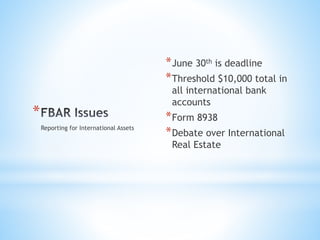
*June 30th is deadline
*Threshold $10,000 total in
all international bank
accounts
*Form 8938
*Debate over International
Real Estate
Reporting for International Assets
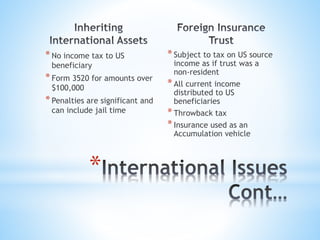
*No income tax to US
beneficiary
*Form 3520 for amounts over
$100,000
*Penalties are significant and
can include jail time
*Subject to tax on US source
income as if trust was a
non-resident
*All current income
distributed to US
beneficiaries
*Throwback tax
*Insurance used as an
Accumulation vehicle
*
*
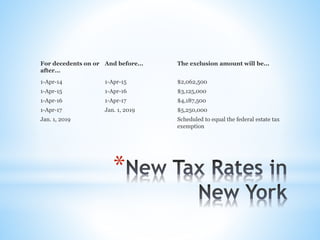
For decedents on or
after...
And before... The exclusion amount will be...
1-Apr-14 1-Apr-15 $2,062,500
1-Apr-15 1-Apr-16 $3,125,000
1-Apr-16 1-Apr-17 $4,187,500
1-Apr-17 Jan. 1, 2019 $5,250,000
Jan. 1, 2019 Scheduled to equal the federal estate tax
exemption
*

Heckerling 2014 Estate Tax Breifing

  • 1.
  • 2.
    * International BoutiqueTrusts and Estates firm specializing in sophisticated multigenerational asset transfers. * Recognized both nationally by Martindale Hubbell as AV preeminent * STEP Boutique firm of the year *
  • 3.
    * 1. The increasedFederal exemption has created a new paradigm in estate planning. Why must equal emphasis now be given to capital gains tax planning? 2. What are the opportunities to achieve a step up in basis after planning is complete? 3. What are the consequences and income tax benefits of planning testamentary trusts for the benefit of the surviving spouse as grantor trusts? 4. Can Joint Exempt Step-up Trusts (JEST) be used to ensure a full step up in basis for jointly owned property first? 5. Gifting “gap-QTIP” (or Qualified Terminable Interest Property) interest income – how can unused exemption amounts be uniquely leveraged? Why sprinkle distributions among other beneficiaries? 6. Hot Topics in Life Insurance
  • 4.
    * *Many clients havegreatly appreciated stock, and the gains tax if sold in the trust can be a significant amount. With the higher exemption amount, it might make sense to leave low basis assets in one’s estate to achieve step up. Estate planning has become inextricably intertwined with income tax planning. Income tax planning can minimize current income taxes and maximize basis step up upon death. Step up in income tax basis in many instances will have a greater tax benefit than state estate tax savings.
  • 5.
    Swapping into thetrust high basis assets or cash for low basis assets can help to achieve the desired step up in basis at the grantor’s death. The trust could also hold a note for assets moved back into the grantor’s estate to achieve the same step up in basis. *
  • 6.
    * Joint Exempt Step-UpTrust (JEST) Chronology The 4 Steps from Drafting to Implementation Copyright 2013 Gassman Law Associates, P.A. J:GGassmanARTICLELeimberg ArticlesJoint Trust ArticleNew Joint Exempt Step-Up Trust Chart.1e FINAL.xlsx :kh*jr 3/ STEP 2 STEP 4 Step 3 note: STEP 3 Before Funding Funding of Joint Revocable Trust each spouse has the right to revoke his/her share until Division upon First Dying Spouse's Death assume Husband dies first Results of JEST technique Husband's Assets Joint Assets: Joint Tenants w/ Right of Survivorship Joint Assets: Tenancy by the Entirety Wife's Assets Husband's Share Husband's Assets 1/2 of former JTWROS Assets 1/2 of former TBE Assets (or by other percentage) Wife's Share Wife's Assets 1/2 of former JTWROS Assets 1/2 of former TBE Assets (or by other percentage) 1/2 to each Spouse's Share 1/2 to each spouse's share or actuarial value Credit Shelter Trust A Funded from Husband's Share in the amount of Husband's available estate tax exemption (EST) Q-TIP Trust A If Husband's Share exceeds his available EST, the excess will fund this trust The IRS could find a gift upon contribution of TBE assets to the joint revocable trust, but this gift will qualify for the marital deduction if recipient spouse can withdraw what is added to his or her share. Also see PLR 200201021. Credit Shelter Trust B If Husband's Share is less than his available EST, Wife's Share will fund this trust in the amount of Husband's remaining EST (but not in excess of her available EST) Q-TIP Trust B If Wife's share has any remaining assets, they will be used to fund this trust - For Wife & descendant's benefit (limited by ascertainable standard) - Assets will receive a stepped-up basis - Assets are protected from Wife's creditors - Assets escape estate tax on Wife's death -Wife can be beneficiary of income and principal -Assets will receive a stepped-up basis on Husband's death, and then again on Wife's death - Assets included in Wife's taxable estate - Will be protected from Wife's creditors -Assets may receive a stepped-up basis, but this is more likely if Wife is not a beneficiary - May escape estate tax liability on Wife's death -For creditor protection and estate tax exclusion purposes, CST B may be moved to an APT jurisdiction Special Consideration: If Wife is found to have a gift of trust assets to Husband upon Husband's death, this gift may qualify for the marital deduction - If IRS argues that Wife has gifted to trust the gift will be incomplete because of her power of appointment -Wife will be income beneficiary -Assets may receive a stepped-up basis on Husband's death & again on Wife's death - Assets included in Wife's estate - May not be protected from Wife's creditors unless moved to APT trust jurisdiction - If IRS argues that Wife has gifted to trust the gift will be incomplete because of her power of appointment CST A and CST B can be merged if there is no concern with estate tax, stepped-up basis, creditor protection, or credit shelter trust effectiveness. Q-TIP Trust A and Q-TIP Trust B can be merged if there is no concern with respect to stepped-up basis or credit protection effectiveness. This allows a full step up in basis of all assets in the trust (as opposed to the 50% in normal cases). A JEST is used in non- community property states. A husband, for example, could create the trust and reserve the power to amend, revoke, or terminate it. The wife could be the beneficiary of the trust, and all trust property is paid to her estate upon death. There have been two recent private letter rulings in favor of this strategy, but it is in its nascent stages.
  • 7.
    * *A trust jumpsto the highest levels of taxation for gains and income tax at much lower thresholds than for individuals. *A grantor trust can be set up to potentially pay lower rates of taxation with a trust established for a surviving spouse for which distributions are not mandatory. The income earned on the trust will be picked up on the surviving spouse’s personal filing.
  • 8.
    * * For theamount of the gap between the state exemption amount and the federal exemption amount, one should consider the gift of a gap- QTIP trust. * Income interest for the QTIP should be given to the trust for the children. This will leverage the first spouse’s Deceased Spousal Unused Exclusion (DSUE) and avoid inclusion in the surviving spouse’s estate. *The surviving spouse should not be named Trustee of the gap QTIP trust but can use the principal, since only the owner of the income interest is considered owner for the IRS purposes. *The exercise by the spouse of a general power of appointment will accomplish the same tax results.
  • 9.
    * Swapping trustassets * Purchase contracts between trusts for interpolated reserve value * Providing for heirs not in family business * 2% owner to Christofani Beneficiaries *
  • 10.
    * *Avoid a “firesale” *Maintain illiquid assets *Facilitate business succession plan *“Key man” policy, cross purchase agreements, etc. *Gifts to those not beneficiaries of the estate at large *Divorce obligations, alimony or support
  • 11.
    * *No step upfor gifted assets *Insurance to cover gains taxes due *Insurance employed as a hedge against mortality risk (GRATs, QPRTs, installment sales)
  • 12.
    * *Move additional cashestate and capital gains tax free to heirs *Spousal Access if serving for income replacement *Asset protection for estranged spouses, law suits, creditors, etc. *Borrowing rights *Decanting
  • 13.
    FBAR, International Inheritances,Non- Citizen Spouses, Foreign Trusts and more *
  • 14.
    * *QDOT Trusts *Unlimited Marital Deductions *Annuitiesand Retirement Plans *Administration of QDOT distribution issues *Complications if assets exceed $2MM *Gifting limits to non- citizen spouse
  • 15.
    * *Who is a“covered expatriate?” *Taxed at the highest rate (40%) *Tax paid by recipient not individual making the gift or bequest *Much more confiscatory estate tax exemptions *Use the gift tax exemption
  • 16.
    * *June 30th isdeadline *Threshold $10,000 total in all international bank accounts *Form 8938 *Debate over International Real Estate Reporting for International Assets
  • 17.
    *No income taxto US beneficiary *Form 3520 for amounts over $100,000 *Penalties are significant and can include jail time *Subject to tax on US source income as if trust was a non-resident *All current income distributed to US beneficiaries *Throwback tax *Insurance used as an Accumulation vehicle *
  • 18.
    * For decedents onor after... And before... The exclusion amount will be... 1-Apr-14 1-Apr-15 $2,062,500 1-Apr-15 1-Apr-16 $3,125,000 1-Apr-16 1-Apr-17 $4,187,500 1-Apr-17 Jan. 1, 2019 $5,250,000 Jan. 1, 2019 Scheduled to equal the federal estate tax exemption
  • 19.