Heather Hilburn – Shape East – Sustainable Innovation and Social Enterprise

Topics:

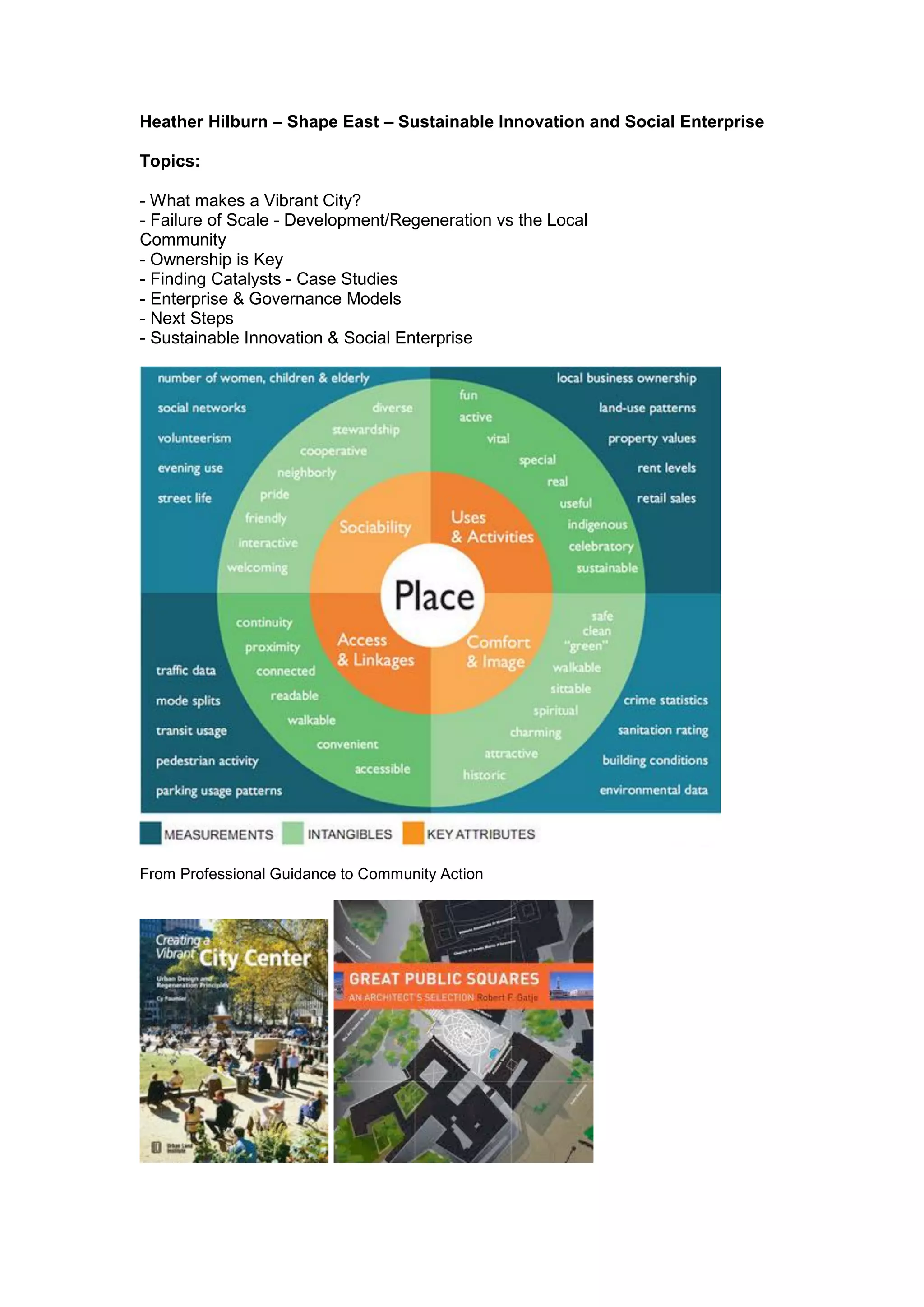
- What makes a Vibrant City?
- Failure of Scale - Development/Regeneration vs the Local
Community
- Ownership is Key
- Finding Catalysts - Case Studies
- Enterprise & Governance Models
- Next Steps
- Sustainable Innovation & Social Enterprise


From Professional Guidance to Community Action
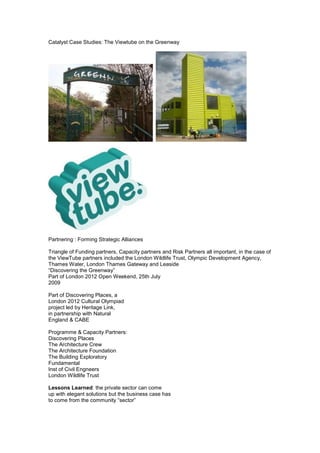
Catalyst Case Studies: The Viewtube on the Greenway


Partnering : Forming Strategic Alliances

Triangle of Funding partners, Capacity partners and Risk Partners all important, in the case of
the ViewTube partners included the London Wildlife Trust, Olympic Development Agency,
Thames Water, London Thames Gateway and Leaside
“Discovering the Greenway”
Part of London 2012 Open Weekend, 25th July
2009

Part of Discovering Places, a
London 2012 Cultural Olympiad
project led by Heritage Link,
in partnership with Natural
England & CABE

Programme & Capacity Partners:
Discovering Places
The Architecture Crew
The Architecture Foundation
The Building Exploratory
Fundamental
Inst of Civil Engneers
London Wildlife Trust

Lessons Learned: the private sector can come
up with elegant solutions but the business case has
to come from the community “sector”
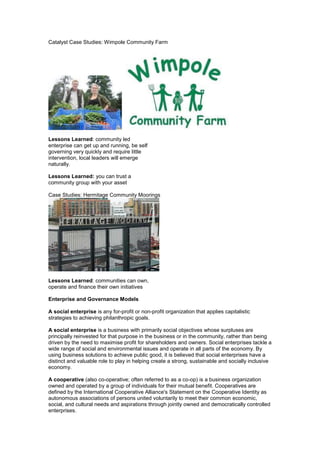
Catalyst Case Studies: Wimpole Community Farm


Lessons Learned: community led
enterprise can get up and running, be self
governing very quickly and require little
intervention, local leaders will emerge
naturally.

Lessons Learned: you can trust a
community group with your asset

Case Studies: Hermitage Community Moorings


Lessons Learned: communities can own,
operate and finance their own initiatives

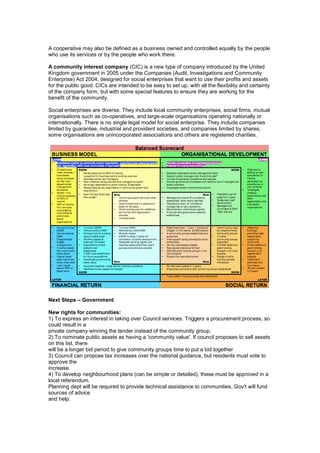
Enterprise and Governance Models

A social enterprise is any for-profit or non-profit organization that applies capitalistic
strategies to achieving philanthropic goals.

A social enterprise is a business with primarily social objectives whose surpluses are
principally reinvested for that purpose in the business or in the community, rather than being
driven by the need to maximise profit for shareholders and owners. Social enterprises tackle a
wide range of social and environmental issues and operate in all parts of the economy. By
using business solutions to achieve public good, it is believed that social enterprises have a
distinct and valuable role to play in helping create a strong, sustainable and socially inclusive
economy.

A cooperative (also co-operative; often referred to as a co-op) is a business organization
owned and operated by a group of individuals for their mutual benefit. Cooperatives are
defined by the International Cooperative Alliance's Statement on the Cooperative Identity as
autonomous associations of persons united voluntarily to meet their common economic,
social, and cultural needs and aspirations through jointly owned and democratically controlled
enterprises.
A cooperative may also be defined as a business owned and controlled equally by the people
who use its services or by the people who work there.

A community interest company (CIC) is a new type of company introduced by the United
Kingdom government in 2005 under the Companies (Audit, Investigations and Community
Enterprise) Act 2004, designed for social enterprises that want to use their profits and assets
for the public good. CICs are intended to be easy to set up, with all the flexibility and certainty
of the company form, but with some special features to ensure they are working for the
benefit of the community.

Social enterprises are diverse. They include local community enterprises, social firms, mutual
organisations such as co-operatives, and large-scale organisations operating nationally or
internationally. There is no single legal model for social enterprise. They include companies
limited by guarantee, industrial and provident societies, and companies limited by shares;
some organisations are unincorporated associations and others are registered charities.


Next Steps – Government

New rights for communities:
1) To express an interest in taking over Council services. Triggers a procurement process, so
could result in a
private company winning the tender instead of the community group.
2) To nominate public assets as having a 'community value'. If council proposes to sell assets
on this list, there
will be a longer bid period to give community groups time to put a bid together
3) Council can propose tax increases over the national guidance, but residents must vote to
approve the
increase.
4) To develop neighbourhood plans (can be simple or detailed), these must be approved in a
local referendum.
Planning dept will be required to provide technical assistance to communities, Gov't will fund
sources of advice
and help.
5) A community organisation will be able to propose any kind of development. If it is
supported in a local
referendum and meets minimum criteria, no planning permission will be needed. Gov't will
support the provision
of advice to community groups wishing to build.
6) Planners will have less supervision from Central Gov't in formulating local plans.
7) Community

Next Steps - What is your project, who are your partners?

Please contact Hollie McNish
h.mcnish@shape-east.org.uk
13-15 Covent Garden | Cambridge | CB1 2HS
T : 01223 462606 | F: 01223 362236 | www.shape-east.org.uk

Heather Hilburn Presentation Notes

  • 1.
    Heather Hilburn –Shape East – Sustainable Innovation and Social Enterprise Topics: - What makes a Vibrant City? - Failure of Scale - Development/Regeneration vs the Local Community - Ownership is Key - Finding Catalysts - Case Studies - Enterprise & Governance Models - Next Steps - Sustainable Innovation & Social Enterprise From Professional Guidance to Community Action
  • 2.
    Catalyst Case Studies:The Viewtube on the Greenway Partnering : Forming Strategic Alliances Triangle of Funding partners, Capacity partners and Risk Partners all important, in the case of the ViewTube partners included the London Wildlife Trust, Olympic Development Agency, Thames Water, London Thames Gateway and Leaside “Discovering the Greenway” Part of London 2012 Open Weekend, 25th July 2009 Part of Discovering Places, a London 2012 Cultural Olympiad project led by Heritage Link, in partnership with Natural England & CABE Programme & Capacity Partners: Discovering Places The Architecture Crew The Architecture Foundation The Building Exploratory Fundamental Inst of Civil Engneers London Wildlife Trust Lessons Learned: the private sector can come up with elegant solutions but the business case has to come from the community “sector”
  • 3.
    Catalyst Case Studies:Wimpole Community Farm Lessons Learned: community led enterprise can get up and running, be self governing very quickly and require little intervention, local leaders will emerge naturally. Lessons Learned: you can trust a community group with your asset Case Studies: Hermitage Community Moorings Lessons Learned: communities can own, operate and finance their own initiatives Enterprise and Governance Models A social enterprise is any for-profit or non-profit organization that applies capitalistic strategies to achieving philanthropic goals. A social enterprise is a business with primarily social objectives whose surpluses are principally reinvested for that purpose in the business or in the community, rather than being driven by the need to maximise profit for shareholders and owners. Social enterprises tackle a wide range of social and environmental issues and operate in all parts of the economy. By using business solutions to achieve public good, it is believed that social enterprises have a distinct and valuable role to play in helping create a strong, sustainable and socially inclusive economy. A cooperative (also co-operative; often referred to as a co-op) is a business organization owned and operated by a group of individuals for their mutual benefit. Cooperatives are defined by the International Cooperative Alliance's Statement on the Cooperative Identity as autonomous associations of persons united voluntarily to meet their common economic, social, and cultural needs and aspirations through jointly owned and democratically controlled enterprises.
  • 4.
    A cooperative mayalso be defined as a business owned and controlled equally by the people who use its services or by the people who work there. A community interest company (CIC) is a new type of company introduced by the United Kingdom government in 2005 under the Companies (Audit, Investigations and Community Enterprise) Act 2004, designed for social enterprises that want to use their profits and assets for the public good. CICs are intended to be easy to set up, with all the flexibility and certainty of the company form, but with some special features to ensure they are working for the benefit of the community. Social enterprises are diverse. They include local community enterprises, social firms, mutual organisations such as co-operatives, and large-scale organisations operating nationally or internationally. There is no single legal model for social enterprise. They include companies limited by guarantee, industrial and provident societies, and companies limited by shares; some organisations are unincorporated associations and others are registered charities. Next Steps – Government New rights for communities: 1) To express an interest in taking over Council services. Triggers a procurement process, so could result in a private company winning the tender instead of the community group. 2) To nominate public assets as having a 'community value'. If council proposes to sell assets on this list, there will be a longer bid period to give community groups time to put a bid together 3) Council can propose tax increases over the national guidance, but residents must vote to approve the increase. 4) To develop neighbourhood plans (can be simple or detailed), these must be approved in a local referendum. Planning dept will be required to provide technical assistance to communities, Gov't will fund sources of advice and help.
  • 5.
    5) A communityorganisation will be able to propose any kind of development. If it is supported in a local referendum and meets minimum criteria, no planning permission will be needed. Gov't will support the provision of advice to community groups wishing to build. 6) Planners will have less supervision from Central Gov't in formulating local plans. 7) Community Next Steps - What is your project, who are your partners? Please contact Hollie McNish h.mcnish@shape-east.org.uk 13-15 Covent Garden | Cambridge | CB1 2HS T : 01223 462606 | F: 01223 362236 | www.shape-east.org.uk