Heart disease prediction based on the machine learning algorithms
1.
TEEGALA KRISHNA REDDYENGINEERING COLLEGE
(Approved By AICTE , Affiliated To JNTUH, Accredited By NBA And NAAC)
Department of Computer Science & Engineering
HEAD OF THE DEPARTMENT
Dr. CH. V
. PHANI KRISHNA
Professor
PROJECT CO-ORDINATOR
Mrs. P.SWETHA
Assistant Professor
2.
SUPERVISOR
Mrs B. Rajeshwari
AssistantProfessor
NAME OF THE STUDENTS
Y
. Vamshi Krishna- 22R91A05R6
Raparthi Rahul- 22R91A05L4
L.Sarthak Kumar- 22R91A05L9
HEART DISEASE PREDICTION USING
LOGISTIC REGRESSION AND SVM
INTRODUCTION
Heart disease isone of the leading causes of death worldwide, affecting
millions of people each year. Early detection and accurate diagnosis of
heart disease are crucial in preventing severe complications and
reducing mortality rates. Traditional methods of diagnosis, such as ECG,
cholesterol tests, and stress tests, require medical expertise and are often
time-consuming and expensive.To overcome these challenges, machine
learning algorithms such as Support Vector Machine (SVM) and
Logistic Regression (LR) can be used to develop an efficient and
automated heart disease prediction system. These algorithms analyze
patient data, including age, blood pressure, cholesterol levels, heart rate,
and other medical parameters, to predict the likelihood of heart disease.
5.
ABSTRACT
Heart disease remainsa leading cause of mortality worldwide,
necessitating early detection and accurate prediction models to
improve patient outcomes. This study explores the effectiveness of
Support Vector Machine (SVM) and Logistic Regression (LR) in
predicting heart disease based on medical attributes such as age,
blood pressure, cholesterol levels, and other clinical parameters.
SVM, known for its robustness in high-dimensional spaces, is
compared with LR, a widely used statistical method for binary
classification. This comparative analysis highlights the strengths and
limitations of both techniques, aiding in the selection of appropriate
predictive models for heart disease diagnosis in clinical settings.
6.
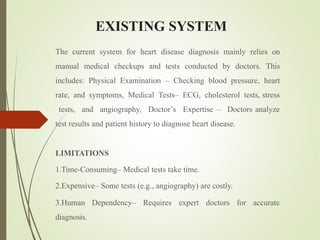
EXISTING SYSTEM
The currentsystem for heart disease diagnosis mainly relies on
manual medical checkups and tests conducted by doctors. This
includes: Physical Examination – Checking blood pressure, heart
rate, and symptoms, Medical Tests– ECG, cholesterol tests, stress
tests, and angiography, Doctor’s Expertise – Doctors analyze
test results and patient history to diagnose heart disease.
LIMITATIONS
1.Time-Consuming– Medical tests take time.
2.Expensive– Some tests (e.g., angiography) are costly.
3.Human Dependency– Requires expert doctors for accurate
diagnosis.
7.
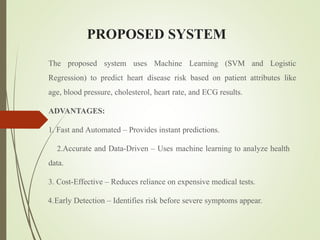
PROPOSED SYSTEM
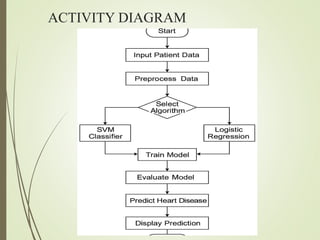
The proposedsystem uses Machine Learning (SVM and Logistic
Regression) to predict heart disease risk based on patient attributes like
age, blood pressure, cholesterol, heart rate, and ECG results.
ADVANTAGES:
1. Fast and Automated – Provides instant predictions.
2.Accurate and Data-Driven – Uses machine learning to analyze health
data.
3. Cost-Effective – Reduces reliance on expensive medical tests.
4.Early Detection – Identifies risk before severe symptoms appear.
8.
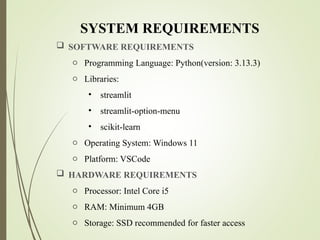
SYSTEM REQUIREMENTS
SOFTWAREREQUIREMENTS
o Programming Language: Python(version: 3.13.3)
o Libraries:
• streamlit
• streamlit-option-menu
• scikit-learn
o Operating System: Windows 11
o Platform: VSCode
HARDWARE REQUIREMENTS
o Processor: Intel Core i5
o RAM: Minimum 4GB
o Storage: SSD recommended for faster access
MODULES
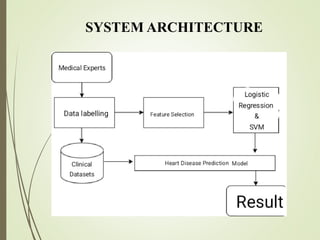
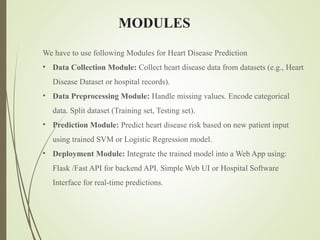
We have touse following Modules for Heart Disease Prediction
• Data Collection Module: Collect heart disease data from datasets (e.g., Heart
Disease Dataset or hospital records).
• Data Preprocessing Module: Handle missing values. Encode categorical
data. Split dataset (Training set, Testing set).
• Prediction Module: Predict heart disease risk based on new patient input
using trained SVM or Logistic Regression model.
• Deployment Module: Integrate the trained model into a Web App using:
Flask /Fast API for backend API. Simple Web UI or Hospital Software
Interface for real-time predictions.
REFERENCES
[1]. Mr. ChalaBeyene,Prof. Pooja Kamat, “Survey on Prediction and
Analysis the Occurrence of Heart Disease Using Data Mining
Technique”, International Journal of Pure and Applied Mathematics,
2018.
[2]. Mohan, Senthilkumar, Chandrasegar Thirumalai, and Gautam
Srivastava, “Effective heart disease prediction using hybrid machine
learning techniques” IEEE Access 7 (2019): 81542-81554.
[3]. Ali, Liaqat, et al, “An optimized stacked support vector machines
based expert system for the effective prediction of heart failure” IEEE
Access 7 (2019): 54007-54014.

![REFERENCES
[1]. Mr. ChalaBeyene, Prof. Pooja Kamat, “Survey on Prediction and
Analysis the Occurrence of Heart Disease Using Data Mining
Technique”, International Journal of Pure and Applied Mathematics,
2018.
[2]. Mohan, Senthilkumar, Chandrasegar Thirumalai, and Gautam
Srivastava, “Effective heart disease prediction using hybrid machine
learning techniques” IEEE Access 7 (2019): 81542-81554.
[3]. Ali, Liaqat, et al, “An optimized stacked support vector machines
based expert system for the effective prediction of heart failure” IEEE
Access 7 (2019): 54007-54014.](https://image.slidesharecdn.com/d14-250710061338-151a0f3b/85/Heart-disease-prediction-based-on-the-machine-learning-algorithms-15-320.jpg)