INTRODUCTION
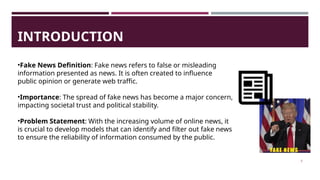
•Fake News Definition:Fake news refers to false or misleading
information presented as news. It is often created to influence
public opinion or generate web traffic.
•Importance: The spread of fake news has become a major concern,
impacting societal trust and political stability.
•Problem Statement: With the increasing volume of online news, it
is crucial to develop models that can identify and filter out fake news
to ensure the reliability of information consumed by the public.
3
4.
OBJECTIVES
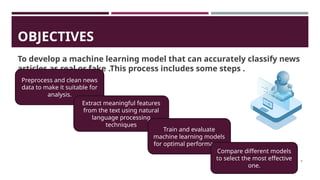
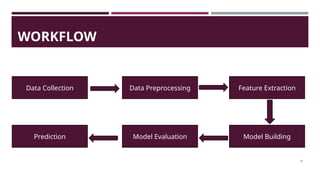
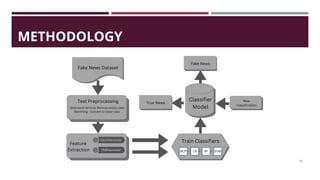
To develop amachine learning model that can accurately classify news
articles as real or fake .This process includes some steps .
Preprocess and clean news
data to make it suitable for
analysis.
Extract meaningful features
from the text using natural
language processing
techniques
Train and evaluate
machine learning models
for optimal performance.
Compare different models
to select the most effective
one.
4
5.
MOTIVATION
•Social Impact: Therapid spread of misinformation can cause significant
damage, from undermining public trust in media to affecting political
outcomes.
•Need for Automation: Manual verification of news articles is impractical
due to the sheer volume of information. Automated detection systems
provide a scalable and efficient solution.
•Technology Trends: With advancements in machine learning and natural
language processing, developing robust fake news detection systems has
become increasingly feasible.
5
6.
RELATED WORKS –1
Contribution
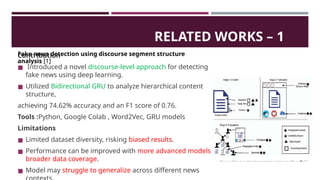
◼ Introduced a novel discourse-level approach for detecting
fake news using deep learning.
◼ Utilized Bidirectional GRU to analyze hierarchical content
structure,
achieving 74.62% accuracy and an F1 score of 0.76.
Tools :Python, Google Colab , Word2Vec, GRU models
Limitations
◼ Limited dataset diversity, risking biased results.
◼ Performance can be improved with more advanced models or
broader data coverage.
◼ Model may struggle to generalize across different news
Fake news detection using discourse segment structure
analysis [1]
6
7.
RELATED WORKS –2
.
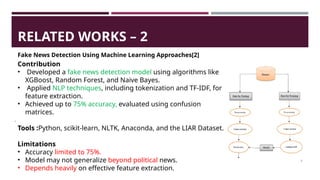
Fake News Detection Using Machine Learning Approaches[2]
Contribution
• Developed a fake news detection model using algorithms like
XGBoost, Random Forest, and Naive Bayes.
• Applied NLP techniques, including tokenization and TF-IDF, for
feature extraction.
• Achieved up to 75% accuracy, evaluated using confusion
matrices.
Tools :Python, scikit-learn, NLTK, Anaconda, and the LIAR Dataset.
Limitations
• Accuracy limited to 75%.
• Model may not generalize beyond political news.
• Depends heavily on effective feature extraction.
7
TOOLS
PYTHON LIBRARIES MACHINELEARNING
MODELS
TEXT PROCESSING TOOLS
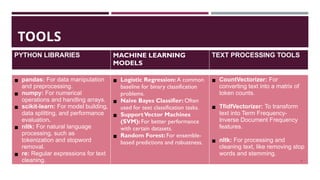
▪ pandas: For data manipulation
and preprocessing.
▪ numpy: For numerical
operations and handling arrays.
▪ scikit-learn: For model building,
data splitting, and performance
evaluation.
▪ nltk: For natural language
processing, such as
tokenization and stopword
removal.
▪ re: Regular expressions for text
cleaning.
▪ Logistic Regression: A common
baseline for binary classification
problems.
▪ Naive Bayes Classifier: Often
used for text classification tasks.
▪ SupportVector Machines
(SVM): For better performance
with certain datasets.
▪ Random Forest: For ensemble-
based predictions and robustness.
▪ CountVectorizer: For
converting text into a matrix of
token counts.
▪ TfidfVectorizer: To transform
text into Term Frequency-
Inverse Document Frequency
features.
▪ nltk: For processing and
cleaning text, like removing stop
words and stemming.
9
CONCLUSION
The project aimsto leverage machine learning and NLP
techniques to build an efficient fake news detection system.
The model can be improved with more diverse data and
advanced algorithms like deep learning . Hopefully it will
enhance the reliability of information and contributes to
combating the spread of misinformation.
11
12.
REFERENCES
1. Uppal, A.,Sachdeva, V., & Sharma, S. (2020, January). Fake news detection using discourse
segment structure analysis. In 2020 10th International Conference on Cloud Computing, Data
Science & Engineering (Confluence) (pp. 751-756). IEEE.
2. Khanam, Z., Alwasel, B. N., Sirafi, H., & Rashid, M. (2021, March). Fake news detection using
machine learning approaches. In IOP conference series: materials science and engineering (Vol.
1099, No. 1, p. 012040). IOP Publishing.
12