Abstract
• This projectdevelops a machine learning-based system for detecting fake news,
addressing the growing challenge of misinformation in today's digital landscape.
Utilizing natural language processing (NLP) techniques, the system preprocesses
textual data, transforming it into numerical formats for model training. Various
machine learning algorithms, including Logistic Regression, Support Vector
Machines, and advanced neural networks such as Recurrent Neural Networks
(RNN) and Transformers, are employed to classify news articles as real or fake.
Model performance is assessed using accuracy, precision, recall, and F1-score to
ensure reliability. By providing an efficient and scalable solution, this system
enhances information credibility and helps combat the spread of fake news.
3.
Introduction
• The rapidproliferation of fake news across digital platforms has become a significant societal
concern, influencing public opinion, politics, and decision-making. Misinformation spreads
quickly, making it essential to develop automated methods for detecting and mitigating its impact.
• This project leverages machine learning and natural language processing (NLP) techniques to
analyze and classify news articles as real or fake.
• By training models such as Logistic Regression, Support Vector Machines, Recurrent Neural
Networks (RNN), and Transformers on labeled datasets, the system ensures accurate and scalable
fake news detection. The implementation of such a system enhances information credibility,
promotes media literacy, and contributes to a more informed society.
4.
Objective
1. Preprocess TextualData – Utilize natural language processing (NLP) techniques to clean,
tokenize, and convert text into numerical representations suitable for machine learning models.
2. Implement Machine Learning Models – Train and evaluate models such as Logistic Regression,
Support Vector Machines, Recurrent Neural Networks (RNN), and Transformers to classify news
articles as real or fake.
3. Enhance Detection Accuracy – Optimize model performance using evaluation metrics like
accuracy, precision, recall, and F1-score to ensure reliable classification.
4. Improve Trust in Information – Provide a robust tool that helps users differentiate between
legitimate news and misinformation, contributing to a more informed and responsible digital
society.
5. Ensure Scalability and Efficiency – Design the system to handle large datasets and adapt to
evolving patterns of fake news for real-time and effective detection.
5.
Literature survey
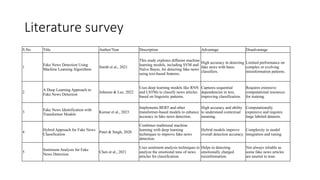
S.No TitleAuthor/Year Description Advantage Disadvantage
1
Fake News Detection Using
Machine Learning Algorithms
Smith et al., 2021
This study explores different machine
learning models, including SVM and
Naïve Bayes, for detecting fake news
using text-based features.
High accuracy in detecting
fake news with basic
classifiers.
Limited performance on
complex or evolving
misinformation patterns.
2
A Deep Learning Approach to
Fake News Detection
Johnson & Lee, 2022
Uses deep learning models like RNN
and LSTMs to classify news articles
based on linguistic patterns.
Captures sequential
dependencies in text,
improving classification.
Requires extensive
computational resources
for training.
3
Fake News Identification with
Transformer Models
Kumar et al., 2023
Implements BERT and other
transformer-based models to enhance
accuracy in fake news detection.
High accuracy and ability
to understand contextual
meaning.
Computationally
expensive and requires
large labeled datasets.
4
Hybrid Approach for Fake News
Classification
Patel & Singh, 2020
Combines traditional machine
learning with deep learning
techniques to improve fake news
detection.
Hybrid models improve
overall detection accuracy.
Complexity in model
integration and tuning.
5
Sentiment Analysis for Fake
News Detection
Chen et al., 2021
Uses sentiment analysis techniques to
analyze the emotional tone of news
articles for classification.
Helps in detecting
emotionally charged
misinformation.
Not always reliable as
some fake news articles
are neutral in tone.
6.
Literature survey
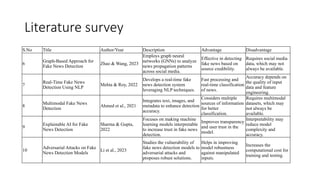
S.No TitleAuthor/Year Description Advantage Disadvantage
6
Graph-Based Approach for
Fake News Detection
Zhao & Wang, 2023
Employs graph neural
networks (GNNs) to analyze
news propagation patterns
across social media.
Effective in detecting
fake news based on
source credibility.
Requires social media
data, which may not
always be available.
7
Real-Time Fake News
Detection Using NLP
Mehta & Roy, 2022
Develops a real-time fake
news detection system
leveraging NLP techniques.
Fast processing and
real-time classification
of news.
Accuracy depends on
the quality of input
data and feature
engineering.
8
Multimodal Fake News
Detection
Ahmed et al., 2021
Integrates text, images, and
metadata to enhance detection
accuracy.
Considers multiple
sources of information
for better
classification.
Requires multimodal
datasets, which may
not always be
available.
9
Explainable AI for Fake
News Detection
Sharma & Gupta,
2022
Focuses on making machine
learning models interpretable
to increase trust in fake news
detection.
Improves transparency
and user trust in the
model.
Interpretability may
reduce model
complexity and
accuracy.
10
Adversarial Attacks on Fake
News Detection Models
Li et al., 2023
Studies the vulnerability of
fake news detection models to
adversarial attacks and
proposes robust solutions.
Helps in improving
model robustness
against manipulated
inputs.
Increases the
computational cost for
training and testing.
7.
Existing system
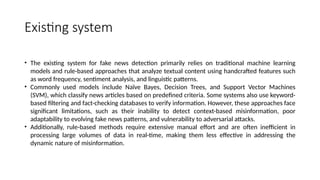
• Theexisting system for fake news detection primarily relies on traditional machine learning
models and rule-based approaches that analyze textual content using handcrafted features such
as word frequency, sentiment analysis, and linguistic patterns.
• Commonly used models include Naïve Bayes, Decision Trees, and Support Vector Machines
(SVM), which classify news articles based on predefined criteria. Some systems also use keyword-
based filtering and fact-checking databases to verify information. However, these approaches face
significant limitations, such as their inability to detect context-based misinformation, poor
adaptability to evolving fake news patterns, and vulnerability to adversarial attacks.
• Additionally, rule-based methods require extensive manual effort and are often inefficient in
processing large volumes of data in real-time, making them less effective in addressing the
dynamic nature of misinformation.
8.
Proposed system
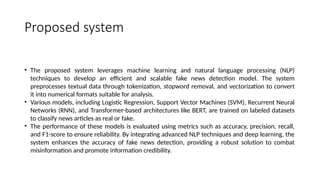
• Theproposed system leverages machine learning and natural language processing (NLP)
techniques to develop an efficient and scalable fake news detection model. The system
preprocesses textual data through tokenization, stopword removal, and vectorization to convert
it into numerical formats suitable for analysis.
• Various models, including Logistic Regression, Support Vector Machines (SVM), Recurrent Neural
Networks (RNN), and Transformer-based architectures like BERT, are trained on labeled datasets
to classify news articles as real or fake.
• The performance of these models is evaluated using metrics such as accuracy, precision, recall,
and F1-score to ensure reliability. By integrating advanced NLP techniques and deep learning, the
system enhances the accuracy of fake news detection, providing a robust solution to combat
misinformation and promote information credibility.
9.
REQUIREMENT
SOFTWARE REQUIREMENTS
Language :Python
Frontend : HTML And CSS
Backend : Machine Learning
Server : Django
Operating system : Windows 10
IDE : Google Colab
HARDWARE REQUIREMENTS
System : Pentium IV 2.4 GHz
Hard Disk : 40 GB
Floppy Drive : 1.44 Mb
Monitor : 15 VGA Colour
Mouse : Logitech
Ram : 512 Mb
10.
Methodology
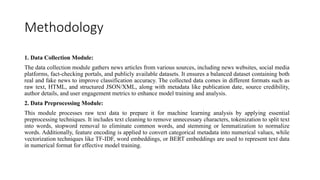
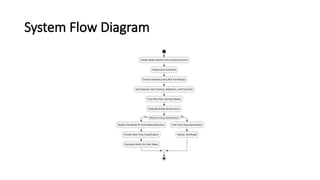
1. Data CollectionModule:
The data collection module gathers news articles from various sources, including news websites, social media
platforms, fact-checking portals, and publicly available datasets. It ensures a balanced dataset containing both
real and fake news to improve classification accuracy. The collected data comes in different formats such as
raw text, HTML, and structured JSON/XML, along with metadata like publication date, source credibility,
author details, and user engagement metrics to enhance model training and analysis.
2. Data Preprocessing Module:
This module processes raw text data to prepare it for machine learning analysis by applying essential
preprocessing techniques. It includes text cleaning to remove unnecessary characters, tokenization to split text
into words, stopword removal to eliminate common words, and stemming or lemmatization to normalize
words. Additionally, feature encoding is applied to convert categorical metadata into numerical values, while
vectorization techniques like TF-IDF, word embeddings, or BERT embeddings are used to represent text data
in numerical format for effective model training.
11.
3. Feature EngineeringModule:
The feature engineering module extracts meaningful attributes from news articles to improve classification
accuracy. Text-based features include word frequency distributions and sentiment scores, while linguistic
features analyze readability and sensational language. Source credibility is assessed based on historical
accuracy and domain reputation, whereas user engagement metrics like social media shares and sentiment
polarity provide additional insights. Contextual features, such as reference validation and hyperlink analysis,
further enhance the system’s ability to detect misinformation.
4. Model Training and Testing Module:
This module is responsible for training and validating machine learning models to classify news articles as real
or fake. The dataset is split into training, validation, and test sets to prevent overfitting. Various models,
including Logistic Regression, SVM, RNNs, and Transformers like BERT and RoBERTa, are compared and fine-
tuned using grid search and cross-validation. The model training process involves optimizing binary cross-
entropy loss using the Adam optimizer while ensuring robustness through cross-validation techniques.
12.
5. Model EvaluationModule:
The trained models are evaluated using performance metrics to ensure accuracy and reliability.
Key evaluation measures include accuracy, precision, recall, and F1-score to assess classification
performance. The ROC-AUC score is used to measure the model’s ability to distinguish between
real and fake news, while confusion matrix analysis helps identify misclassification patterns.
Additionally, computational efficiency is analyzed to ensure that the model can perform real-time
classifications without excessive processing delays.
6. Ethical Considerations and Bias Mitigation Module:
To ensure fairness and transparency, this module focuses on eliminating biases and maintaining
ethical standards in fake news detection. The system ensures unbiased classification by avoiding
favoritism towards specific news sources, political views, or regions. Strategies to reduce false
positives and false negatives are implemented, along with compliance with data privacy
regulations like GDPR. The module also enhances transparency by providing explainable AI
mechanisms and continuously updating the model to adapt to emerging misinformation trends.
Conclusion
• The FakeNews Detection System using Machine Learning provides an effective solution to
combat the spread of misinformation across digital platforms. By leveraging Natural
Language Processing (NLP) techniques and advanced machine learning models such as
Logistic Regression, Support Vector Machines (SVM), Recurrent Neural Networks (RNN),
and Transformers (BERT, RoBERTa), the system efficiently classifies news articles as real or
fake. The modular architecture, including data collection, preprocessing, feature
engineering, model training, evaluation, and real-time deployment, ensures scalability,
accuracy, and adaptability. Furthermore, the system incorporates bias mitigation,
explainability, and ethical considerations, promoting fair and transparent decision-making.
By providing real-time classification and automated alerts, this system significantly enhances
trust in digital news sources, empowering users with reliable information and contributing to
a more informed society. Future enhancements may include adaptive learning mechanisms,
multilingual support, and integration with social media platforms to further improve the
system’s effectiveness in detecting and preventing the spread of fake news.
16.
Reference
1. S. Vosoughi,D. Roy, and S. Aral, "The spread of true and false news online," Science, vol. 359,
no. 6380, pp. 1146-1151, Mar. 2018, doi: 10.1126/science.aap9559.
2. H. Ahmed, I. Traore, and S. Saad, "Detecting opinion spammer groups using supervised learning
approach," Expert Systems with Applications, vol. 85, pp. 319-336, Nov. 2017, doi:
10.1016/j.eswa.2017.05.022.
3. N. Kumar and M. Sachdeva, "Fake news detection using deep learning models: A comprehensive
review," Multimedia Tools and Applications, vol. 82, pp. 4961-4995, Jan. 2023, doi:
10.1007/s11042-022-13190-9.
4. Z. Zhao, P. Resnick, and Q. Mei, "Fake news propagation in social networks: A data-driven study,"
in Proc. 11th Int. Conf. Web Search and Data Mining (WSDM), Los Angeles, CA, USA, 2018, pp.
139-147, doi: 10.1145/3159652.3159673.
5. G. A. Vijjali, A. Potdar, and M. Pai, "Two-Stage Fake News Detection with Graph Neural Networks,"
in Proc. 29th ACM Int. Conf. Information and Knowledge Management (CIKM), Virtual Event, 2020,
pp. 3421-3424, doi: 10.1145/3340531.3417459.