Health Insurance Healthcare, Careers and Services Unit
What is Health Insurance??? It is the cost sharing to help cover medical expenses, hospital fees, etc…
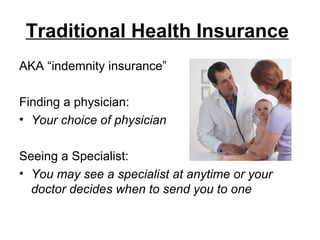
Traditional Health Insurance   AKA “indemnity insurance” Finding a physician: Your choice of physician Seeing a Specialist: You may see a specialist at anytime or your doctor decides when to send you to one
Traditional Health Insurance Hospitalization: Do not need to plan approval for hospitalization or special tests, etc… Payment: Must pay “deductible” in addition to your premium.  (usually $200-1000 per family member)  before insurance kicks in.  Even then you may pay 20% of the bills Other Services: Usually does not cover prescriptions, preventative care (physicals) or immunizations.
Managed Care   PPO - Preferred Provider Organization  (out of network similar to Indemnity)  HMO - Health Maintenance Organization Finding a physician: Must use a physician within the plan’s network PCP = Primary Care Physician
Managed Care Seeing a Specialist: PCP must authorize or refer you to the specialist.  Specialist must also be affiliated with the network. Hospitalization: PCP must get approval from the plan  before hospitalization can occur  such as for elective procedures
Managed Care Payment: “ copay” – fixed rate (usually $10 – 25) paid for each visit out of your pocket.  Some HMOs may have no fees. Other Services: Prescription discounts, preventative care (1 free physical every year), immunizations
Government Health Programs Medicare  Healthcare coverage   for ages 65 and older (deducted from paychecks) covers hospital/nursing homes for 100 days additional insurance (supplemental) is needed to cover Dr. appts and other costs (prescriptions, medical supplies, etc…)
Government Health Programs Medicaid Assistance programs for all ages who are unable to afford medical care. Covers both hospital and Dr. appts Paid through state and federal taxes FYI – you have to submit your income to qualify
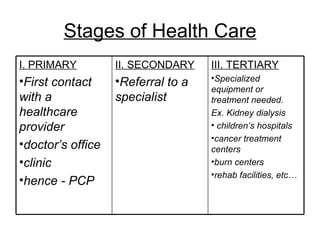
Stages of Health Care III. TERTIARY Specialized equipment or treatment needed. Ex. Kidney dialysis children’s hospitals cancer treatment centers burn centers rehab facilities, etc… II. SECONDARY Referral to a specialist   I. PRIMARY First contact with a healthcare provider  doctor’s office  clinic hence - PCP
END

Health Insurance

  • 1.
    Health Insurance Healthcare,Careers and Services Unit
  • 2.
    What is HealthInsurance??? It is the cost sharing to help cover medical expenses, hospital fees, etc…
  • 3.
    Traditional Health Insurance AKA “indemnity insurance” Finding a physician: Your choice of physician Seeing a Specialist: You may see a specialist at anytime or your doctor decides when to send you to one
  • 4.
    Traditional Health InsuranceHospitalization: Do not need to plan approval for hospitalization or special tests, etc… Payment: Must pay “deductible” in addition to your premium. (usually $200-1000 per family member) before insurance kicks in. Even then you may pay 20% of the bills Other Services: Usually does not cover prescriptions, preventative care (physicals) or immunizations.
  • 5.
    Managed Care PPO - Preferred Provider Organization (out of network similar to Indemnity) HMO - Health Maintenance Organization Finding a physician: Must use a physician within the plan’s network PCP = Primary Care Physician
  • 6.
    Managed Care Seeinga Specialist: PCP must authorize or refer you to the specialist. Specialist must also be affiliated with the network. Hospitalization: PCP must get approval from the plan before hospitalization can occur such as for elective procedures
  • 7.
    Managed Care Payment:“ copay” – fixed rate (usually $10 – 25) paid for each visit out of your pocket. Some HMOs may have no fees. Other Services: Prescription discounts, preventative care (1 free physical every year), immunizations
  • 8.
    Government Health ProgramsMedicare Healthcare coverage for ages 65 and older (deducted from paychecks) covers hospital/nursing homes for 100 days additional insurance (supplemental) is needed to cover Dr. appts and other costs (prescriptions, medical supplies, etc…)
  • 9.
    Government Health ProgramsMedicaid Assistance programs for all ages who are unable to afford medical care. Covers both hospital and Dr. appts Paid through state and federal taxes FYI – you have to submit your income to qualify
  • 10.
    Stages of HealthCare III. TERTIARY Specialized equipment or treatment needed. Ex. Kidney dialysis children’s hospitals cancer treatment centers burn centers rehab facilities, etc… II. SECONDARY Referral to a specialist I. PRIMARY First contact with a healthcare provider doctor’s office clinic hence - PCP
  • 11.