Learning objectives
At theend of this sessions, learners shall understand the
following:
• Modes of transmission of various hepatitis viruses
(Hepatitis A to hepatitis E)
• Strategies for prevention of transmission of these viruses
3.
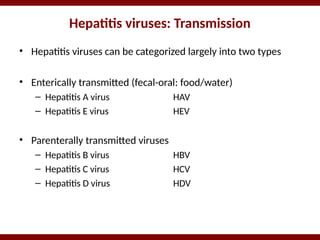
Hepatitis viruses: Transmission
•Hepatitis viruses can be categorized largely into two types
• Enterically transmitted (fecal-oral: food/water)
– Hepatitis A virus HAV
– Hepatitis E virus HEV
• Parenterally transmitted viruses
– Hepatitis B virus HBV
– Hepatitis C virus HCV
– Hepatitis D virus HDV
4.
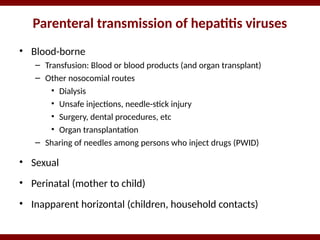
Parenteral transmission ofhepatitis viruses
• Blood-borne
– Transfusion: Blood or blood products (and organ transplant)
– Other nosocomial routes
• Dialysis
• Unsafe injections, needle-stick injury
• Surgery, dental procedures, etc
• Organ transplantation
– Sharing of needles among persons who inject drugs (PWID)
• Sexual
• Perinatal (mother to child)
• Inapparent horizontal (children, household contacts)
5.
• Sporadic
Occurrence ofscattered cases at irregular intervals
• Epidemic (=outbreak*)
Occurrence of a larger than usual number of cases of a
disease in a community over a short period of time
*Sometimes, use of the term ‘epidemic’ is limited to only larger outbreaks
Enterically transmitted hepatitis
6.
Enterically transmitted hepatitis
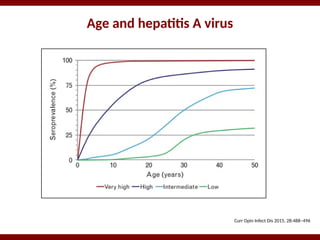
•Endemic
An infection is said to be endemic in a population when it is
constantly maintained at a baseline level in a geographic area
without external input
• Degree of endemicity of an infection may vary
– Very highly endemic
– Highly endemic
– Intermediate endemicity
– Low endemicity
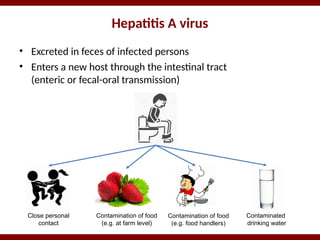
Hepatitis A virus
•Excreted in feces of infected persons
• Enters a new host through the intestinal tract
(enteric or fecal-oral transmission)
Close personal
contact
Contamination of food
(e.g. at farm level)
Contamination of food
(e.g. food handlers)
Contaminated
drinking water
9.
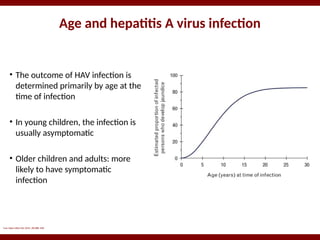
Age and hepatitisA virus infection
Curr Opin Infect Dis 2015, 28:488–496
• The outcome of HAV infection is
determined primarily by age at the
time of infection
• In young children, the infection is
usually asymptomatic
• Older children and adults: more
likely to have symptomatic
infection
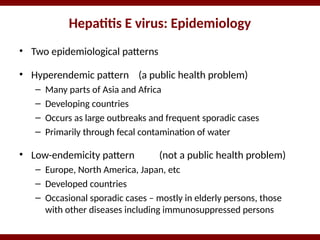
Hepatitis E virus:Epidemiology
• Two epidemiological patterns
• Hyperendemic pattern (a public health problem)
– Many parts of Asia and Africa
– Developing countries
– Occurs as large outbreaks and frequent sporadic cases
– Primarily through fecal contamination of water
• Low-endemicity pattern (not a public health problem)
– Europe, North America, Japan, etc
– Developed countries
– Occasional sporadic cases – mostly in elderly persons, those
with other diseases including immunosuppressed persons
16.
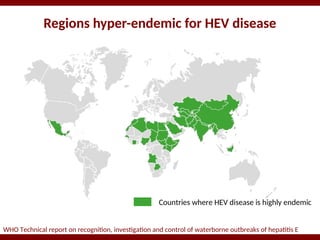
Regions hyper-endemic forHEV disease
WHO Technical report on recognition, investigation and control of waterborne outbreaks of hepatitis E
Countries where HEV disease is highly endemic
17.
Hyper-endemic hepatitis E:transmission
In areas where HEV infection is highly endemic,
•Primarily caused by fecal contamination of drinking water supplies
•Person-to-person transmission very infrequent
(e.g. as compared to hepatitis A)
•Spread via contaminated food is possible, but evidence limited
•Other routes (blood transfusion, mother-to-child) possible, but can
account for only a very small proportion of cases
•Not caused by zoonotic (animal-to-human) transmission
(genotype 1/2 HEV prevalent in these areas does not infect animals)
•Almost exclusively acute infection
18.
Low-endemicity hepatitis E
•Appears to be primarily a zoonotic disease
• Most cases are caused by genotype 3 HEV, which circulates
freely in animals and occasionally infects human
• Human infection: ingestion of un/under-cooked meat, or close
contact with animals
• These strains can cause chronic infection – primarily in
immunosuppressed persons (e.g. those with organ transplant)
HBV: Routes oftransmission
• Perinatal: Mother-to-child
• Horizontal: Infants / young children, household contacts
• Health-care associated
– Unsafe blood and blood products
– Unsafe injections
– Other procedures, e.g. dental treatment
– Needle-stick injuries
– Organ and tissue transplantation
• Sexual (unprotected sexual intercourse)
• Sharing of syringes/needles among people who inject drugs
21.
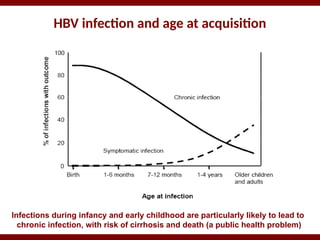
HBV infection andage at acquisition
Infections during infancy and early childhood are particularly likely to lead to
chronic infection, with risk of cirrhosis and death (a public health problem)
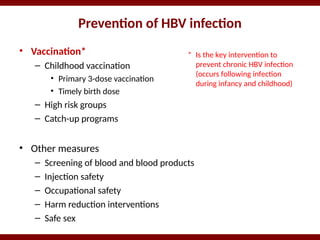
Prevention of HBVinfection
• Vaccination*
– Childhood vaccination
• Primary 3-dose vaccination
• Timely birth dose
– High risk groups
– Catch-up programs
• Other measures
– Screening of blood and blood products
– Injection safety
– Occupational safety
– Harm reduction interventions
– Safe sex
* Is the key intervention to
prevent chronic HBV infection
(occurs following infection
during infancy and childhood)
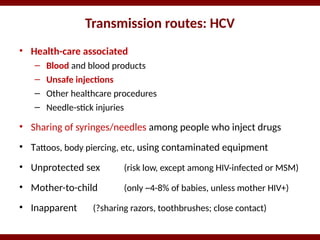
Transmission routes: HCV
•Health-care associated
– Blood and blood products
– Unsafe injections
– Other healthcare procedures
– Needle-stick injuries
• Sharing of syringes/needles among people who inject drugs
• Tattoos, body piercing, etc, using contaminated equipment
• Unprotected sex (risk low, except among HIV-infected or MSM)
• Mother-to-child (only ~4-8% of babies, unless mother HIV+)
• Inapparent (?sharing razors, toothbrushes; close contact)
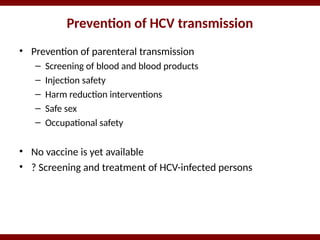
Prevention of HCVtransmission
• Prevention of parenteral transmission
– Screening of blood and blood products
– Injection safety
– Harm reduction interventions
– Safe sex
– Occupational safety
• No vaccine is yet available
• ? Screening and treatment of HCV-infected persons
28.
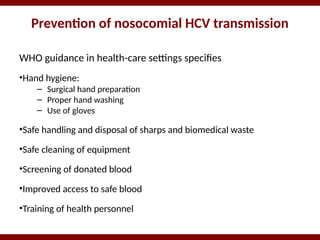
Prevention of nosocomialHCV transmission
WHO guidance in health-care settings specifies
•Hand hygiene:
– Surgical hand preparation
– Proper hand washing
– Use of gloves
•Safe handling and disposal of sharps and biomedical waste
•Safe cleaning of equipment
•Screening of donated blood
•Improved access to safe blood
•Training of health personnel
29.
Prevention of HBV/HCVtransmission in PWID
• Offer rapid hepatitis B vaccination regimen
• Provide incentives to increase uptake and complete the hepatitis B
vaccination series
• Implement sterile needle and syringe programmes
(low dead-space syringes)
• Opioid substitution therapy
(to treat opioid dependence, reduce HCV risk behavior and
transmission through injecting drug use)
• Integrate treatment of opioid dependence with medical services
30.
Prevention of sexualtransmission of HBV/HCV
WHO guidance of prevention of sexual transmission
•Promotion of correct and consistent condom use
•Routine testing of sex workers in high-prevalence settings
•Integrated action to eliminate discrimination and gender violence,
•Increased access to medical and social services for vulnerable persons
31.
Summary
• Hepatitis Aand E are water-borne infections and are transmitted
through contaminated food and water
• To prevent hepatitis A and E, focus on interventions that block fecal-
oral transmission, e.g. sanitation and water safety
• Hepatitis B and C are parenterally transmitted
• Hepatitis B infection in infancy/early childhood is particularly risky,
because of a higher risk of chronic infection
• Vaccination is an effective preventive measure for hepatitis B,
particularly to prevent infection in early childhood
• Safe blood, safe injection practices and safe sex are effective in
preventing both hepatitis B and C



![PERI-PROSTHETIC FRACTURE NAIL-PLATE CONSTRUCT [NPC].pptx](https://cdn.slidesharecdn.com/ss_thumbnails/drarunkumardrmohamedashrafperiprostheticfrasturenail-plateconstructnpc-260209164459-7e9d15a1-thumbnail.jpg?width=640&height=640&fit=bounds)

