Transition Plan
HCBS Programs
Community Supports &
Programs Commission
Here’s what you should know…
The Center for Medicare and Medicaid Services,
known as CMS, has made changes to its requirements
for home and community based services (HCBS).
The focus is on an individual’s quality of life
and making sure they have support to be part
of home and community life, be independent,
make their own choices, and control the lives
when they live in provider owned and controlled
homes, day programs, and work environments.
January 11, 2016
Why the change?
• The new final rule, issued March 17, 2014,
requires states to evaluate its HCBS
settings to meet the new rule’s definition.
• CMS is concerned about the health and
welfare of individuals who are receiving
home and community based services in
residential and day settings.
January 11, 2016
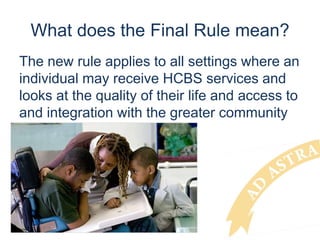
What does the Final Rule mean?
The new rule applies to all settings where an
individual may receive HCBS services and
looks at the quality of their life and access to
and integration with the greater community
January 11, 2016
What does this mean for you?
The new HCBS Settings rule
• Focuses on services provided in a setting
that is owned or operated by the
community service provider.
• Requires that individuals who receive HCBS
services have choices, freedom, support, and
control over their environment similar to
someone who is not disabled to the greatest
extent possible in the least restrictive setting.
January 11, 2016
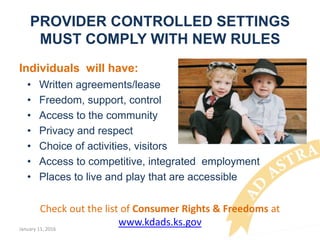
PROVIDER CONTROLLED SETTINGS
MUST COMPLY WITH NEW RULES
Individuals will have:
• Written agreements/lease
• Freedom, support, control
• Access to the community
• Privacy and respect
• Choice of activities, visitors
• Access to competitive, integrated employment
• Places to live and play that are accessible
January 11, 2016
Check out the list of Consumer Rights & Freedoms at
www.kdads.ks.gov
HCBS Program Participants
must be assured…
• A lease or written agreement with
– Protections comparable to landlord tenant laws
– Protections for appeal of a discharge or eviction.
• Privacy and Control
– Unrestricted access to food and visitors
– A locked door to the participant’s unit
• Freedom and Choice
– Ability to choose schedule and activities
– Roommates, services and supports
Any limit or restriction supported by a specific
assessed need, reviewed frequently, and be approved
by the individual, parent or guardian
January 11, 2016
Who is affected?
Those affected by the new rule include consumers
receiving these specific HCBS services:
– Autism (Children who start serves prior to the age of six)
– Frail Elderly (Adults 65 and older)
– Intellectual Developmental Disabilities (Ages 5 and older)
– Technology Assistance (Ages 0 – 21 years)
– Traumatic Brain Injury (Ages 16 – 64 years)
– Physical Disabilities (Ages 16 – 64 year)
– Severe Emotional Disturbance (Ages 4 – 18 years)
Community Service Providers of various settings
(licensed and unlicensed, daycare, residential,
congregate, employment) for those HCBS services.
January 11, 2016
CMS requires a Plan in 120 days
• Kansas will submit a transition plan for all of
the HCBS Programs (Autism, TA, IDD, FE,
TBI, PD, and SED)
• CMS will review the plans and determine if
the State has plans to bring all settings into
compliance
•Timelines for benchmarks
for compliance will be
finalized by CMS and
Kansas expects transitions
to complete within 5 years.
January 11, 2016
Transition Plan
The initial plan is a draft of the State’s
blueprint that incorporates initial feedback
from CMS and outlines how the State will:
 Assess residential and nonresidential
settings
 Ensure compliance with the rules, and
 Transition individuals to compliant settings,
if necessary
January 11, 2016
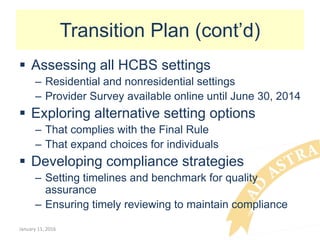
Transition Plan (cont’d)
 Assessing all HCBS settings
– Residential and nonresidential settings
– Provider Survey available online until June 30, 2014
 Exploring alternative setting options
– That complies with the Final Rule
– That expand choices for individuals
 Developing compliance strategies
– Setting timelines and benchmark for quality
assurance
– Ensuring timely reviewing to maintain compliance
January 11, 2016
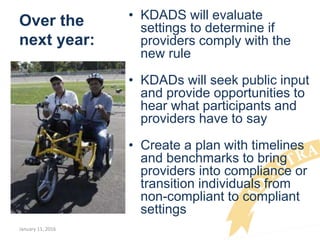
Over the
next year:
• KDADS will evaluate
settings to determine if
providers comply with the
new rule
• KDADs will seek public input
and provide opportunities to
hear what participants and
providers have to say
• Create a plan with timelines
and benchmarks to bring
providers into compliance or
transition individuals from
non-compliant to compliant
settings
January 11, 2016
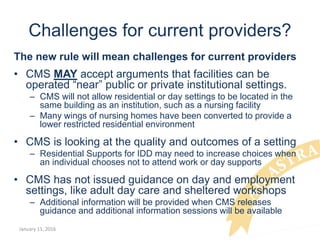
Challenges for current providers?
The new rule will mean challenges for current providers
• CMS MAY accept arguments that facilities can be
operated “near” public or private institutional settings.
– CMS will not allow residential or day settings to be located in the
same building as an institution, such as a nursing facility
– Many wings of nursing homes have been converted to provide a
lower restricted residential environment
• CMS is looking at the quality and outcomes of a setting
– Residential Supports for IDD may need to increase choices when
an individual chooses not to attend work or day supports
• CMS has not issued guidance on day and employment
settings, like adult day care and sheltered workshops
– Additional information will be provided when CMS releases
guidance and additional information sessions will be available
January 11, 2016
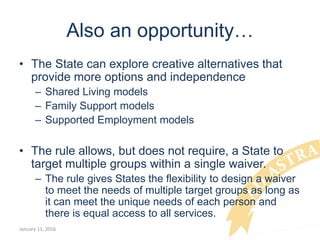
Also an opportunity…
• The State can explore creative alternatives that
provide more options and independence
– Shared Living models
– Family Support models
– Supported Employment models
• The rule allows, but does not require, a State to
target multiple groups within a single waiver.
– The rule gives States the flexibility to design a waiver
to meet the needs of multiple target groups as long as
it can meet the unique needs of each person and
there is equal access to all services.
January 11, 2016
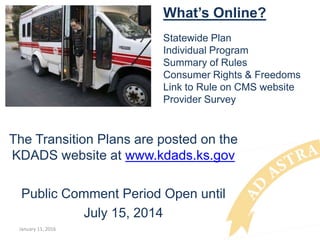
What’s Online?
Statewide Plan
Individual Program
Summary of Rules
Consumer Rights & Freedoms
Link to Rule on CMS website
Provider Survey
The Transition Plans are posted on the
KDADS website at www.kdads.ks.gov
Public Comment Period Open until
July 15, 2014
January 11, 2016
Public Comment Sessions
We will continue to seek public input, even after we
submit the plan for final CMS approval.
Additional public comment sessions (conference calls) are available
during the Public Comment period.
For Consumers
– Wednesday, July 2, 2014 from 12:00 to 1:00 p.m.
For Providers
– Monday, June 23, 2014 from 11:00 to 12:00 p.m.
– Tuesday, July 15, 2014 from 10:00 to 11:00 a.m.
Conference Call Information:
Conference Number: 1-866-620-7326
Conference Code 4283583031#
January 11, 2016
For more information…
For details and updates visit:
http://www.kdads.ks.gov
Contact Aquila “Q” Jordan:
Aquila.Jordan@kdads.ks.gov
January 11, 2016
OPEN FOR DISCUSSION:
IDEAS THOUGHTS, QUESTIONS?
Questions, Comments and Input
By Phone: 785-296-4986
By Email: HCBS-KS@KDADS.KS.GOV
January 11, 2016

HCBS Final Rule

  • 1.
    Transition Plan HCBS Programs CommunitySupports & Programs Commission
  • 2.
    Here’s what youshould know… The Center for Medicare and Medicaid Services, known as CMS, has made changes to its requirements for home and community based services (HCBS). The focus is on an individual’s quality of life and making sure they have support to be part of home and community life, be independent, make their own choices, and control the lives when they live in provider owned and controlled homes, day programs, and work environments. January 11, 2016
  • 3.
    Why the change? •The new final rule, issued March 17, 2014, requires states to evaluate its HCBS settings to meet the new rule’s definition. • CMS is concerned about the health and welfare of individuals who are receiving home and community based services in residential and day settings. January 11, 2016
  • 4.
    What does theFinal Rule mean? The new rule applies to all settings where an individual may receive HCBS services and looks at the quality of their life and access to and integration with the greater community January 11, 2016
  • 5.
    What does thismean for you? The new HCBS Settings rule • Focuses on services provided in a setting that is owned or operated by the community service provider. • Requires that individuals who receive HCBS services have choices, freedom, support, and control over their environment similar to someone who is not disabled to the greatest extent possible in the least restrictive setting. January 11, 2016
  • 6.
    PROVIDER CONTROLLED SETTINGS MUSTCOMPLY WITH NEW RULES Individuals will have: • Written agreements/lease • Freedom, support, control • Access to the community • Privacy and respect • Choice of activities, visitors • Access to competitive, integrated employment • Places to live and play that are accessible January 11, 2016 Check out the list of Consumer Rights & Freedoms at www.kdads.ks.gov
  • 7.
    HCBS Program Participants mustbe assured… • A lease or written agreement with – Protections comparable to landlord tenant laws – Protections for appeal of a discharge or eviction. • Privacy and Control – Unrestricted access to food and visitors – A locked door to the participant’s unit • Freedom and Choice – Ability to choose schedule and activities – Roommates, services and supports Any limit or restriction supported by a specific assessed need, reviewed frequently, and be approved by the individual, parent or guardian January 11, 2016
  • 8.
    Who is affected? Thoseaffected by the new rule include consumers receiving these specific HCBS services: – Autism (Children who start serves prior to the age of six) – Frail Elderly (Adults 65 and older) – Intellectual Developmental Disabilities (Ages 5 and older) – Technology Assistance (Ages 0 – 21 years) – Traumatic Brain Injury (Ages 16 – 64 years) – Physical Disabilities (Ages 16 – 64 year) – Severe Emotional Disturbance (Ages 4 – 18 years) Community Service Providers of various settings (licensed and unlicensed, daycare, residential, congregate, employment) for those HCBS services. January 11, 2016
  • 9.
    CMS requires aPlan in 120 days • Kansas will submit a transition plan for all of the HCBS Programs (Autism, TA, IDD, FE, TBI, PD, and SED) • CMS will review the plans and determine if the State has plans to bring all settings into compliance •Timelines for benchmarks for compliance will be finalized by CMS and Kansas expects transitions to complete within 5 years. January 11, 2016
  • 10.
    Transition Plan The initialplan is a draft of the State’s blueprint that incorporates initial feedback from CMS and outlines how the State will:  Assess residential and nonresidential settings  Ensure compliance with the rules, and  Transition individuals to compliant settings, if necessary January 11, 2016
  • 11.
    Transition Plan (cont’d) Assessing all HCBS settings – Residential and nonresidential settings – Provider Survey available online until June 30, 2014  Exploring alternative setting options – That complies with the Final Rule – That expand choices for individuals  Developing compliance strategies – Setting timelines and benchmark for quality assurance – Ensuring timely reviewing to maintain compliance January 11, 2016
  • 12.
    Over the next year: •KDADS will evaluate settings to determine if providers comply with the new rule • KDADs will seek public input and provide opportunities to hear what participants and providers have to say • Create a plan with timelines and benchmarks to bring providers into compliance or transition individuals from non-compliant to compliant settings January 11, 2016
  • 13.
    Challenges for currentproviders? The new rule will mean challenges for current providers • CMS MAY accept arguments that facilities can be operated “near” public or private institutional settings. – CMS will not allow residential or day settings to be located in the same building as an institution, such as a nursing facility – Many wings of nursing homes have been converted to provide a lower restricted residential environment • CMS is looking at the quality and outcomes of a setting – Residential Supports for IDD may need to increase choices when an individual chooses not to attend work or day supports • CMS has not issued guidance on day and employment settings, like adult day care and sheltered workshops – Additional information will be provided when CMS releases guidance and additional information sessions will be available January 11, 2016
  • 14.
    Also an opportunity… •The State can explore creative alternatives that provide more options and independence – Shared Living models – Family Support models – Supported Employment models • The rule allows, but does not require, a State to target multiple groups within a single waiver. – The rule gives States the flexibility to design a waiver to meet the needs of multiple target groups as long as it can meet the unique needs of each person and there is equal access to all services. January 11, 2016
  • 15.
    What’s Online? Statewide Plan IndividualProgram Summary of Rules Consumer Rights & Freedoms Link to Rule on CMS website Provider Survey The Transition Plans are posted on the KDADS website at www.kdads.ks.gov Public Comment Period Open until July 15, 2014 January 11, 2016
  • 16.
    Public Comment Sessions Wewill continue to seek public input, even after we submit the plan for final CMS approval. Additional public comment sessions (conference calls) are available during the Public Comment period. For Consumers – Wednesday, July 2, 2014 from 12:00 to 1:00 p.m. For Providers – Monday, June 23, 2014 from 11:00 to 12:00 p.m. – Tuesday, July 15, 2014 from 10:00 to 11:00 a.m. Conference Call Information: Conference Number: 1-866-620-7326 Conference Code 4283583031# January 11, 2016
  • 17.
    For more information… Fordetails and updates visit: http://www.kdads.ks.gov Contact Aquila “Q” Jordan: Aquila.Jordan@kdads.ks.gov January 11, 2016
  • 18.
    OPEN FOR DISCUSSION: IDEASTHOUGHTS, QUESTIONS? Questions, Comments and Input By Phone: 785-296-4986 By Email: HCBS-KS@KDADS.KS.GOV January 11, 2016