Healthy Canada by Design: Incubating Healthy
Communities in Urban & Rural Contexts
Kim Perrotta, HCBD Knowledge Translation & Communications
Heart and Stroke Foundation
Canadian Institute of Planners, Fredericton, NB, July 11, 2014
Public Health Interest in the
Built Environment
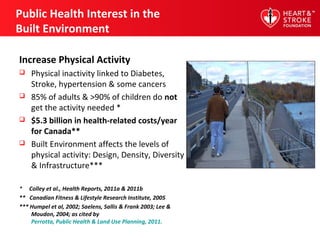
Increase Physical Activity
 Physical inactivity linked to Diabetes,
Stroke, hypertension & some cancers
 85% of adults & >90% of children do not
get the activity needed *
 $5.3 billion in health-related costs/year
for Canada**
 Built Environment affects the levels of
physical activity: Design, Density, Diversity
& Infrastructure***
* Colley et al., Health Reports, 2011a & 2011b
** Canadian Fitness & Lifestyle Research Institute, 2005
*** Humpel et al, 2002; Saelens, Sallis & Frank 2003; Lee &
Moudon, 2004; as cited by
Perrotta, Public Health & Land Use Planning, 2011.
Public Health Interest in the
Built Environment
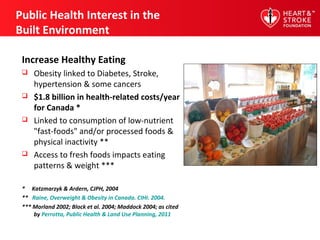
Increase Healthy Eating
 Obesity linked to Diabetes, Stroke,
hypertension & some cancers
 $1.8 billion in health-related costs/year
for Canada *
 Linked to consumption of low-nutrient
"fast-foods" and/or processed foods &
physical inactivity **
 Access to fresh foods impacts eating
patterns & weight ***
* Katzmarzyk & Ardern, CJPH, 2004
** Raine, Overweight & Obesity in Canada. CIHI. 2004.
*** Morland 2002; Block et al. 2004; Maddock 2004; as cited
by Perrotta, Public Health & Land Use Planning, 2011
Public Health Interest in the
Built Environment
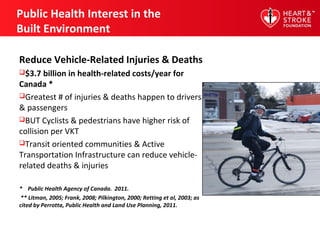
Reduce Vehicle-Related Injuries & Deaths
$3.7 billion in health-related costs/year for
Canada *
Greatest # of injuries & deaths happen to drivers
& passengers
BUT Cyclists & pedestrians have higher risk of
collision per VKT
Transit oriented communities & Active
Transportation Infrastructure can reduce vehicle-
related deaths & injuries
* Public Health Agency of Canada. 2011.
** Litman, 2005; Frank, 2008; Pilkington, 2000; Retting et al, 2003; as
cited by Perrotta, Public Health and Land Use Planning, 2011.
Public Health Interest in the
Built Environment
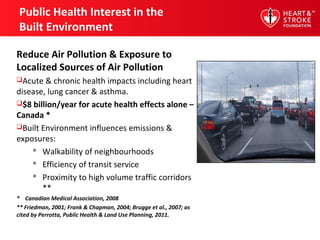
Reduce Air Pollution & Exposure to
Localized Sources of Air Pollution
Acute & chronic health impacts including heart
disease, lung cancer & asthma.
$8 billion/year for acute health effects alone –
Canada *
Built Environment influences emissions &
exposures:
 Walkability of neighbourhoods
 Efficiency of transit service
 Proximity to high volume traffic corridors
**
* Canadian Medical Association, 2008
** Friedman, 2001; Frank & Chapman, 2004; Brugge et al., 2007; as
cited by Perrotta, Public Health & Land Use Planning, 2011.
Public Health Interest in the
Built Environment
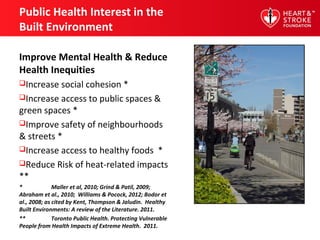
Improve Mental Health & Reduce
Health Inequities
Increase social cohesion *
Increase access to public spaces &
green spaces *
Improve safety of neighbourhoods
& streets *
Increase access to healthy foods *
Reduce Risk of heat-related impacts
**
* Maller et al, 2010; Grind & Patil, 2009;
Abraham et al., 2010; Williams & Pocock, 2012; Bodor et
al., 2008; as cited by Kent, Thompson & Jaludin. Healthy
Built Environments: A review of the Literature. 2011.
** Toronto Public Health. Protecting Vulnerable
People from Health Impacts of Extreme Health. 2011.
Public Health Interest in the
Built Environment
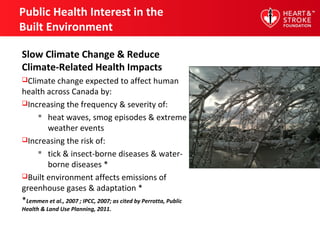
Slow Climate Change & Reduce
Climate-Related Health Impacts
Climate change expected to affect human
health across Canada by:
Increasing the frequency & severity of:
 heat waves, smog episodes & extreme
weather events
Increasing the risk of:
 tick & insect-borne diseases & water-
borne diseases *
Built environment affects emissions of
greenhouse gases & adaptation *
*Lemmen et al., 2007 ; IPCC, 2007; as cited by Perrotta, Public
Health & Land Use Planning, 2011.
HCBD CLASP Vision Statement
Vision Statement:
Health officials, planners, engineers
and NGOs in communities across
Canada collaborate seamlessly to:
ensure built environments are
designed to promote health and
well-being,
thus contributing to the reduction
of risk factors for chronic diseases
(with a particular focus on physical
inactivity).
HCBD CLASP I Partners (2009-12)
Four National Organizations:
 Heart & Stroke Foundation (Lead)
 National Collaborating Centre
Healthy Public Policy
 Canadian Institute of Planners
 Urban Public Health Network
Six Health Authorities:
 Montreal Public Health
 Toronto Public Health
 Peel Public Health
 Vancouver Coastal Health
 Fraser Health Authority
 Vancouver Island Health Authority
HCBD CLASP Partners (2012-14)
5 National Organizations:
 Heart & Stroke Foundation (Lead)
 National Collaborating Centre
Healthy Public Policy
 Canadian Institute of Planners
 Urban Public Health Network
 Canadian Institute of
Transportation Engineers
2 NGOs:
 Toronto Centre for Active
Transportation
 Montreal Urban Ecology Centre
Academic Partner:
 Simon Fraser University
 Several informal partners
Health Authorities:
 Montreal Public Health
 Toronto Public Health
 Peel Public Health
 Vancouver Coastal Health
 Fraser Health Authority
 Newfoundland and Labrador
Provincial Wellness Advisory
Council/Eastern Health Region
 Capital District Health, Halifax
 New Brunswick Department of
Health
 Regina Qu’Appelle Health Region
 Winnipeg Region Health Authority
 Ottawa Public Health (unfunded)
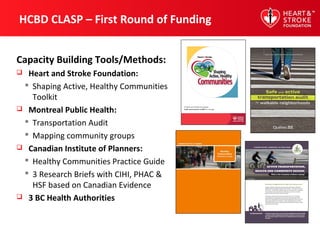
HCBD CLASP – First Round of Funding
Capacity Building Tools/Methods:
 Heart and Stroke Foundation:
 Shaping Active, Healthy Communities
Toolkit
 Montreal Public Health:
 Transportation Audit
 Mapping community groups
 Canadian Institute of Planners:
 Healthy Communities Practice Guide
 3 Research Briefs with CIHI, PHAC &
HSF based on Canadian Evidence
 3 BC Health Authorities
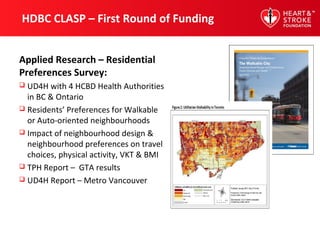
HDBC CLASP – First Round of Funding
Applied Research – Residential
Preferences Survey:
 UD4H with 4 HCBD Health Authorities
in BC & Ontario
 Residents’ Preferences for Walkable
or Auto-oriented neighbourhoods
 Impact of neighbourhood design &
neighbourhood preferences on travel
choices, physical activity, VKT & BMI
 TPH Report – GTA results
 UD4H Report – Metro Vancouver
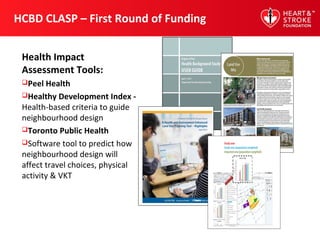
HCBD CLASP – First Round of Funding
Health Impact
Assessment Tools:
Peel Health
Healthy Development Index -
Health-based criteria to guide
neighbourhood design
Toronto Public Health
Software tool to predict how
neighbourhood design will
affect travel choices, physical
activity & VKT
HCBD CLASP – Second Round of Funding
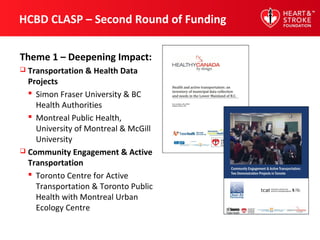
Theme 1 – Deepening Impact:
 Transportation & Health Data
Projects
 Simon Fraser University & BC
Health Authorities
 Montreal Public Health,
University of Montreal & McGill
University
 Community Engagement & Active
Transportation
 Toronto Centre for Active
Transportation & Toronto Public
Health with Montreal Urban
Ecology Centre
HCBD CLASP – Second Round of Funding
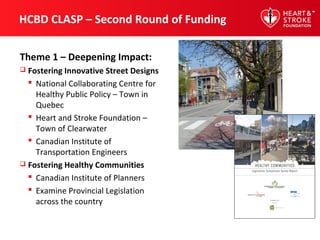
Theme 1 – Deepening Impact:
 Fostering Innovative Street Designs
 National Collaborating Centre for
Healthy Public Policy – Town in
Quebec
 Heart and Stroke Foundation –
Town of Clearwater
 Canadian Institute of
Transportation Engineers
 Fostering Healthy Communities
 Canadian Institute of Planners
 Examine Provincial Legislation
across the country
HCBD CLASP – Second Round of Funding
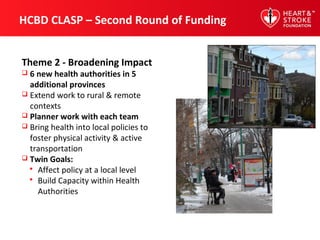
Theme 2 - Broadening Impact
 6 new health authorities in 5
additional provinces
 Extend work to rural & remote
contexts
 Planner work with each team
 Bring health into local policies to
foster physical activity & active
transportation
 Twin Goals:
 Affect policy at a local level
 Build Capacity within Health
Authorities
HCBD CLASP – Second Round of Funding
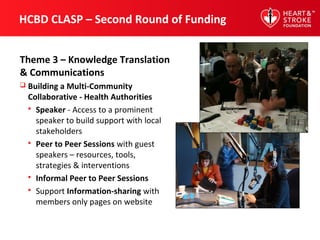
Theme 3 – Knowledge Translation
& Communications
 Building a Multi-Community
Collaborative - Health Authorities
 Speaker - Access to a prominent
speaker to build support with local
stakeholders
 Peer to Peer Sessions with guest
speakers – resources, tools,
strategies & interventions
 Informal Peer to Peer Sessions
 Support Information-sharing with
members only pages on website
HCBD CLASP – Second Round of Funding
Theme 3 – Knowledge Translation
& Communications
Building a Multi-Sectoral Community of
Practice
 Face to Face Meeting – 2 day meeting
for presentations & networking
 Peer Mentoring Sessions - For HCBD
members plus Guests from partner
organizations - Multi-Sectoral Guest
Speakers
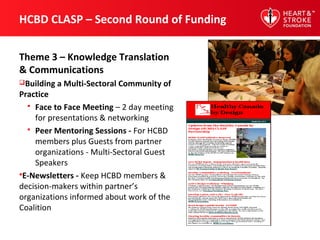
E-Newsletters - Keep HCBD members &
decision-makers within partner’s
organizations informed about work of the
Coalition
HCBD CLASP – Second Round of Funding
Theme 3- Knowledge Translation
& Communications
Communicating with Broader Network
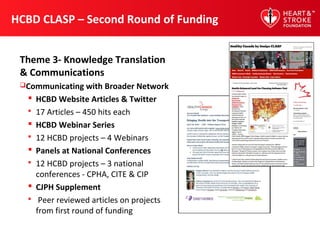
 HCBD Website Articles & Twitter
 17 Articles – 450 hits each
 HCBD Webinar Series
 12 HCBD projects – 4 Webinars
 Panels at National Conferences
 12 HCBD projects – 3 national
conferences - CPHA, CITE & CIP
 CJPH Supplement
 Peer reviewed articles on projects
from first round of funding
Contact Information:
•Kim Perrotta, HCBD Knowledge Translation & Communications & HSF
kperrotta@hsf.ca 905-627-2157, Hamilton, Ontario
•Gene, HCBD Project Manager & HSF
gchin@hsf.ca 604-685-7036, Vancouver, BC
Twitter@hcbdclasp
http://hcbd-clasp.com/

HCBD-CIP-HSF-July 2014

  • 1.
    Healthy Canada byDesign: Incubating Healthy Communities in Urban & Rural Contexts Kim Perrotta, HCBD Knowledge Translation & Communications Heart and Stroke Foundation Canadian Institute of Planners, Fredericton, NB, July 11, 2014
  • 2.
    Public Health Interestin the Built Environment Increase Physical Activity  Physical inactivity linked to Diabetes, Stroke, hypertension & some cancers  85% of adults & >90% of children do not get the activity needed *  $5.3 billion in health-related costs/year for Canada**  Built Environment affects the levels of physical activity: Design, Density, Diversity & Infrastructure*** * Colley et al., Health Reports, 2011a & 2011b ** Canadian Fitness & Lifestyle Research Institute, 2005 *** Humpel et al, 2002; Saelens, Sallis & Frank 2003; Lee & Moudon, 2004; as cited by Perrotta, Public Health & Land Use Planning, 2011.
  • 3.
    Public Health Interestin the Built Environment Increase Healthy Eating  Obesity linked to Diabetes, Stroke, hypertension & some cancers  $1.8 billion in health-related costs/year for Canada *  Linked to consumption of low-nutrient "fast-foods" and/or processed foods & physical inactivity **  Access to fresh foods impacts eating patterns & weight *** * Katzmarzyk & Ardern, CJPH, 2004 ** Raine, Overweight & Obesity in Canada. CIHI. 2004. *** Morland 2002; Block et al. 2004; Maddock 2004; as cited by Perrotta, Public Health & Land Use Planning, 2011
  • 4.
    Public Health Interestin the Built Environment Reduce Vehicle-Related Injuries & Deaths $3.7 billion in health-related costs/year for Canada * Greatest # of injuries & deaths happen to drivers & passengers BUT Cyclists & pedestrians have higher risk of collision per VKT Transit oriented communities & Active Transportation Infrastructure can reduce vehicle- related deaths & injuries * Public Health Agency of Canada. 2011. ** Litman, 2005; Frank, 2008; Pilkington, 2000; Retting et al, 2003; as cited by Perrotta, Public Health and Land Use Planning, 2011.
  • 5.
    Public Health Interestin the Built Environment Reduce Air Pollution & Exposure to Localized Sources of Air Pollution Acute & chronic health impacts including heart disease, lung cancer & asthma. $8 billion/year for acute health effects alone – Canada * Built Environment influences emissions & exposures:  Walkability of neighbourhoods  Efficiency of transit service  Proximity to high volume traffic corridors ** * Canadian Medical Association, 2008 ** Friedman, 2001; Frank & Chapman, 2004; Brugge et al., 2007; as cited by Perrotta, Public Health & Land Use Planning, 2011.
  • 6.
    Public Health Interestin the Built Environment Improve Mental Health & Reduce Health Inequities Increase social cohesion * Increase access to public spaces & green spaces * Improve safety of neighbourhoods & streets * Increase access to healthy foods * Reduce Risk of heat-related impacts ** * Maller et al, 2010; Grind & Patil, 2009; Abraham et al., 2010; Williams & Pocock, 2012; Bodor et al., 2008; as cited by Kent, Thompson & Jaludin. Healthy Built Environments: A review of the Literature. 2011. ** Toronto Public Health. Protecting Vulnerable People from Health Impacts of Extreme Health. 2011.
  • 7.
    Public Health Interestin the Built Environment Slow Climate Change & Reduce Climate-Related Health Impacts Climate change expected to affect human health across Canada by: Increasing the frequency & severity of:  heat waves, smog episodes & extreme weather events Increasing the risk of:  tick & insect-borne diseases & water- borne diseases * Built environment affects emissions of greenhouse gases & adaptation * *Lemmen et al., 2007 ; IPCC, 2007; as cited by Perrotta, Public Health & Land Use Planning, 2011.
  • 8.
    HCBD CLASP VisionStatement Vision Statement: Health officials, planners, engineers and NGOs in communities across Canada collaborate seamlessly to: ensure built environments are designed to promote health and well-being, thus contributing to the reduction of risk factors for chronic diseases (with a particular focus on physical inactivity).
  • 9.
    HCBD CLASP IPartners (2009-12) Four National Organizations:  Heart & Stroke Foundation (Lead)  National Collaborating Centre Healthy Public Policy  Canadian Institute of Planners  Urban Public Health Network Six Health Authorities:  Montreal Public Health  Toronto Public Health  Peel Public Health  Vancouver Coastal Health  Fraser Health Authority  Vancouver Island Health Authority
  • 10.
    HCBD CLASP Partners(2012-14) 5 National Organizations:  Heart & Stroke Foundation (Lead)  National Collaborating Centre Healthy Public Policy  Canadian Institute of Planners  Urban Public Health Network  Canadian Institute of Transportation Engineers 2 NGOs:  Toronto Centre for Active Transportation  Montreal Urban Ecology Centre Academic Partner:  Simon Fraser University  Several informal partners Health Authorities:  Montreal Public Health  Toronto Public Health  Peel Public Health  Vancouver Coastal Health  Fraser Health Authority  Newfoundland and Labrador Provincial Wellness Advisory Council/Eastern Health Region  Capital District Health, Halifax  New Brunswick Department of Health  Regina Qu’Appelle Health Region  Winnipeg Region Health Authority  Ottawa Public Health (unfunded)
  • 11.
    HCBD CLASP –First Round of Funding Capacity Building Tools/Methods:  Heart and Stroke Foundation:  Shaping Active, Healthy Communities Toolkit  Montreal Public Health:  Transportation Audit  Mapping community groups  Canadian Institute of Planners:  Healthy Communities Practice Guide  3 Research Briefs with CIHI, PHAC & HSF based on Canadian Evidence  3 BC Health Authorities
  • 12.
    HDBC CLASP –First Round of Funding Applied Research – Residential Preferences Survey:  UD4H with 4 HCBD Health Authorities in BC & Ontario  Residents’ Preferences for Walkable or Auto-oriented neighbourhoods  Impact of neighbourhood design & neighbourhood preferences on travel choices, physical activity, VKT & BMI  TPH Report – GTA results  UD4H Report – Metro Vancouver
  • 13.
    HCBD CLASP –First Round of Funding Health Impact Assessment Tools: Peel Health Healthy Development Index - Health-based criteria to guide neighbourhood design Toronto Public Health Software tool to predict how neighbourhood design will affect travel choices, physical activity & VKT
  • 14.
    HCBD CLASP –Second Round of Funding Theme 1 – Deepening Impact:  Transportation & Health Data Projects  Simon Fraser University & BC Health Authorities  Montreal Public Health, University of Montreal & McGill University  Community Engagement & Active Transportation  Toronto Centre for Active Transportation & Toronto Public Health with Montreal Urban Ecology Centre
  • 15.
    HCBD CLASP –Second Round of Funding Theme 1 – Deepening Impact:  Fostering Innovative Street Designs  National Collaborating Centre for Healthy Public Policy – Town in Quebec  Heart and Stroke Foundation – Town of Clearwater  Canadian Institute of Transportation Engineers  Fostering Healthy Communities  Canadian Institute of Planners  Examine Provincial Legislation across the country
  • 16.
    HCBD CLASP –Second Round of Funding Theme 2 - Broadening Impact  6 new health authorities in 5 additional provinces  Extend work to rural & remote contexts  Planner work with each team  Bring health into local policies to foster physical activity & active transportation  Twin Goals:  Affect policy at a local level  Build Capacity within Health Authorities
  • 17.
    HCBD CLASP –Second Round of Funding Theme 3 – Knowledge Translation & Communications  Building a Multi-Community Collaborative - Health Authorities  Speaker - Access to a prominent speaker to build support with local stakeholders  Peer to Peer Sessions with guest speakers – resources, tools, strategies & interventions  Informal Peer to Peer Sessions  Support Information-sharing with members only pages on website
  • 18.
    HCBD CLASP –Second Round of Funding Theme 3 – Knowledge Translation & Communications Building a Multi-Sectoral Community of Practice  Face to Face Meeting – 2 day meeting for presentations & networking  Peer Mentoring Sessions - For HCBD members plus Guests from partner organizations - Multi-Sectoral Guest Speakers E-Newsletters - Keep HCBD members & decision-makers within partner’s organizations informed about work of the Coalition
  • 19.
    HCBD CLASP –Second Round of Funding Theme 3- Knowledge Translation & Communications Communicating with Broader Network  HCBD Website Articles & Twitter  17 Articles – 450 hits each  HCBD Webinar Series  12 HCBD projects – 4 Webinars  Panels at National Conferences  12 HCBD projects – 3 national conferences - CPHA, CITE & CIP  CJPH Supplement  Peer reviewed articles on projects from first round of funding
  • 20.
    Contact Information: •Kim Perrotta,HCBD Knowledge Translation & Communications & HSF kperrotta@hsf.ca 905-627-2157, Hamilton, Ontario •Gene, HCBD Project Manager & HSF gchin@hsf.ca 604-685-7036, Vancouver, BC Twitter@hcbdclasp http://hcbd-clasp.com/