National Health Accounts: What do they reveal in Côte d’Ivoire?Anne JuilletHealth Systems 20/20, Abt AssociatesJune 15, 2011Global Health ConferenceWashington, DC
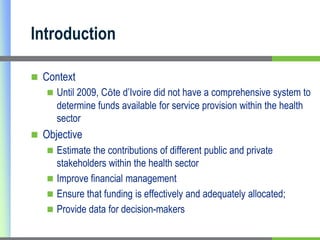
IntroductionContextUntil 2009, Côte d’Ivoire did not have a comprehensive system to determine funds available for service provision within the health sectorObjectiveEstimate the contributions of different public and private stakeholders within the health sectorImprove financial managementEnsure that funding is effectively and adequately allocated;Provide data for decision-makers
MethodologyNational Health Accounts (NHA)Internationally recognized tool which synthesizes and monitors trends in health spendingIntegrates the collection, processing, and analysis of both primary (private enterprises, insurance companies, donors, and international NGOs) and secondary  data (Ministry of Health, households, and national institutions)Examine health expenditures in Côte d’Ivoire in 2007 and 2008
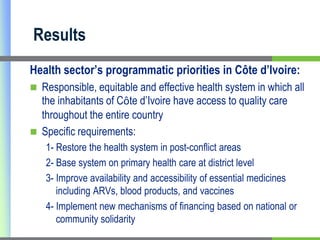
ResultsHealth sector’s programmatic priorities in Côte d’Ivoire:Responsible, equitable and effective health system in which all the inhabitants of Côte d’Ivoire have access to quality care throughout the entire countrySpecific requirements: 1- Restore the health system in post-conflict areas 2- Base system on primary health care at district level 3- Improve availability and accessibility of essential medicines including ARVs, blood products, and vaccines 4- Implement new mechanisms of financing based on national or community solidarity
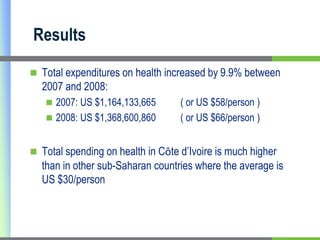
ResultsTotal expenditures on health increased by 9.9% between 2007 and 2008:2007: US $1,164,133,665          ( or US $58/person )2008: US $1,368,600,860          ( or US $66/person )Total spending on health in Côte d’Ivoire is much higher than in other sub-Saharan countries where the average is US $30/person
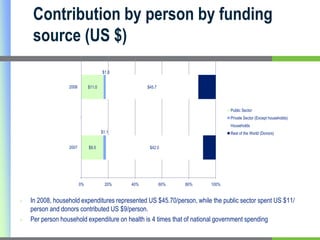
Contribution by person by funding source (US $)27.87029.747In 2008, household expenditures represented US $45.70/person, while the public sector spent US $11/ person and donors contributed US $9/person. 
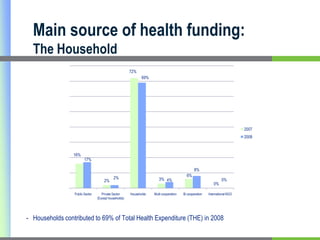
Per person household expenditure on health is 4 times that of national government spendingMain source of health funding: The Household-   Households contributed to 69% of Total Health Expenditure (THE) in 2008
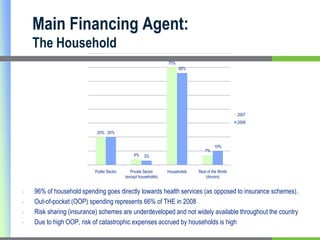
Main Financing Agent: The Household 96% of household spending goes directly towards health services (as opposed to insurance schemes). 
Out-of-pocket (OOP) spending represents 66% of THE in 2008
Risk sharing (insurance) schemes are underdeveloped and not widely available throughout the country
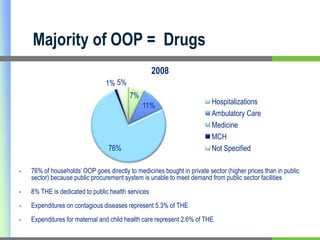
Due to high OOP, risk of catastrophic expenses accrued by households is highMajority of OOP =  Drugs76% of households’ OOP goes directly to medicines bought in private sector (higher prices than in public sector) because public procurement system is unable to meet demand from public sector facilities
8% THE is dedicated to public health services
Expenditures on contagious diseases represent 5.3% of THE
Expenditures for maternal and child health care represent 2.6% of THEGovernment health expendituresAs a financing agent for health, the government spent: 		US $191.2 million in 2007		US $204.5 million in 2008Overall, the national budget’s contribution remains weak, as spending for health budget is 5% of the total national budget
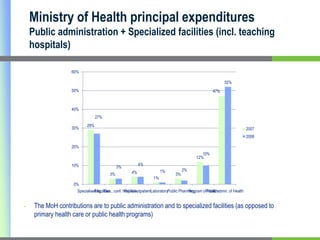
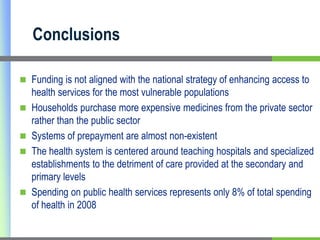
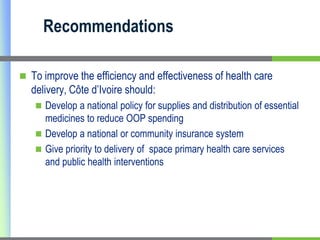
Ministry of Health principal expenditures Public administration + Specialized facilities (incl. teaching hospitals)The MoH contributions are to public administration and to specialized facilities (as opposed to primary health care or public health programs)ConclusionsFunding is not aligned with the national strategy of enhancing access to health services for the most vulnerable populations Households purchase more expensive medicines from the private sector rather than the public sector Systems of prepayment are almost non-existentThe health system is centered around teaching hospitals and specialized establishments to the detriment of care provided at the secondary and primary levelsSpending on public health services represents only 8% of total spending of health in 2008

National Health Accounts: What do they Reveal in Cote d'Ivoire?

  • 1.
    National Health Accounts:What do they reveal in Côte d’Ivoire?Anne JuilletHealth Systems 20/20, Abt AssociatesJune 15, 2011Global Health ConferenceWashington, DC
  • 2.
    IntroductionContextUntil 2009, Côted’Ivoire did not have a comprehensive system to determine funds available for service provision within the health sectorObjectiveEstimate the contributions of different public and private stakeholders within the health sectorImprove financial managementEnsure that funding is effectively and adequately allocated;Provide data for decision-makers
  • 3.
    MethodologyNational Health Accounts(NHA)Internationally recognized tool which synthesizes and monitors trends in health spendingIntegrates the collection, processing, and analysis of both primary (private enterprises, insurance companies, donors, and international NGOs) and secondary data (Ministry of Health, households, and national institutions)Examine health expenditures in Côte d’Ivoire in 2007 and 2008
  • 4.
    ResultsHealth sector’s programmaticpriorities in Côte d’Ivoire:Responsible, equitable and effective health system in which all the inhabitants of Côte d’Ivoire have access to quality care throughout the entire countrySpecific requirements: 1- Restore the health system in post-conflict areas 2- Base system on primary health care at district level 3- Improve availability and accessibility of essential medicines including ARVs, blood products, and vaccines 4- Implement new mechanisms of financing based on national or community solidarity
  • 5.
    ResultsTotal expenditures onhealth increased by 9.9% between 2007 and 2008:2007: US $1,164,133,665 ( or US $58/person )2008: US $1,368,600,860 ( or US $66/person )Total spending on health in Côte d’Ivoire is much higher than in other sub-Saharan countries where the average is US $30/person
  • 6.
    Contribution by personby funding source (US $)27.87029.747In 2008, household expenditures represented US $45.70/person, while the public sector spent US $11/ person and donors contributed US $9/person. 
  • 7.
    Per person householdexpenditure on health is 4 times that of national government spendingMain source of health funding: The Household- Households contributed to 69% of Total Health Expenditure (THE) in 2008
  • 8.
    Main Financing Agent:The Household 96% of household spending goes directly towards health services (as opposed to insurance schemes). 
  • 9.
    Out-of-pocket (OOP) spendingrepresents 66% of THE in 2008
  • 10.
    Risk sharing (insurance)schemes are underdeveloped and not widely available throughout the country
  • 11.
    Due to highOOP, risk of catastrophic expenses accrued by households is highMajority of OOP = Drugs76% of households’ OOP goes directly to medicines bought in private sector (higher prices than in public sector) because public procurement system is unable to meet demand from public sector facilities
  • 12.
    8% THE isdedicated to public health services
  • 13.
    Expenditures on contagiousdiseases represent 5.3% of THE
  • 14.
    Expenditures for maternaland child health care represent 2.6% of THEGovernment health expendituresAs a financing agent for health, the government spent: US $191.2 million in 2007 US $204.5 million in 2008Overall, the national budget’s contribution remains weak, as spending for health budget is 5% of the total national budget
  • 15.
    Ministry of Healthprincipal expenditures Public administration + Specialized facilities (incl. teaching hospitals)The MoH contributions are to public administration and to specialized facilities (as opposed to primary health care or public health programs)ConclusionsFunding is not aligned with the national strategy of enhancing access to health services for the most vulnerable populations Households purchase more expensive medicines from the private sector rather than the public sector Systems of prepayment are almost non-existentThe health system is centered around teaching hospitals and specialized establishments to the detriment of care provided at the secondary and primary levelsSpending on public health services represents only 8% of total spending of health in 2008