“I
nsulate, insulate, insulate,”says Ian Claydon,
technical manager at glass wool
manufacturers URSA UK. He may sound like a
crazed Dalek reprogrammed to promote caring for the
environment, but Claydon has a valid point.
“Increasing energy prices have brought the role of
insulation products into sharp focus – insulation is the
most cost effective means of improving the energy
efficiency of buildings,”Claydon explains.“The
sustainability and environmental impact of
construction materials is high on everyone’s agenda at
the moment. Unlike most construction materials,
insulation actually repays the energy used in its
manufacture in energy
savings in use.”
Chris King, marketing and
business development
director at Celotex agrees.
“With environmental
considerations playing an
ever greater role in the
design and build of our
homes and buildings, the requirement for sustainable
products will become increasingly important,”he says.
“Increasing insulation levels using an environmentally
sound solution such as durable PIR boards remains one
of the simplest and most cost effective methods of
improving the thermal rating of a property.”
Many will remember a time however, when
insulation was completely ignored or installed to such
a poor degree as to barely make any difference at all.
The 1950s and 60s saw some of the first real
innovations with the introduction of products such as
mineral wool insulation. However, it was the
introduction of Part L into
Building Regulations in
1985, including regular
updates over the past 20
years, as well as
technological advances
that made sure insulation
continued to dramatically
improve.
It has been the rapid evolution in the manufacturing
process of insulation products that sets them apart in
the modern world,”comments Dave Khan, technical
product manager at Knauf Insulation.“We
manufacture products which are more thermally
efficient than their predecessors and use fewer
materials, which in turn results in the thermal
requirements of the Building Regulations being more
easily met,”he says.
Richard Lee, sales director atVencel Resil, suggests
that expanded polystyrene (EPS) insulation, such as
Jablite, is the best choice in domestic applications for
both wall and floor insulation.“Compared with other
insulation materials, the economic benefits of EPS are
well known, says Lee.“Not only does it offer good
thermal values at suitable thicknesses but it is also
typically 22% less expensive than other insulants in
the marketplace.”
So what are the biggest headaches for insulation
manufacturers when trying to achieve thermal
performance?“Based on the experience gained from
the Ecohouse, we believe that airtightness is the
biggest headache as the ability to achieve
continuity in jointing of airtight materials, particularly
continuedonpage54
insulation
housebuilder august 2008 53
With all new homes now being built to code for sustainable home
standards, the importance of properly insulating a new home
cannot be ignored, Kevin Stanley reports
Thermal
energy
“Therequirementfor
sustainableproducts
willbecomeincreasingly
important”
Thermal
energy
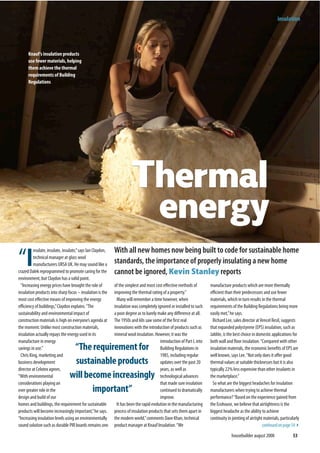
Knauf’s insulation products
use fewer materials, helping
them achieve the thermal
requirements of Building
Regulations
continued from page 539
at the corners of external walls and window and door
openings, is the most difficult.The negative effect of
loss of airtightness can be much greater than the loss
of insulation thickness/performance in certain
circumstances,”says Steve Miller, environmental
manager at Hanson.“Equally the potential for
condensation at cold spots within a highly insulated
structure is much higher where air loss is prevalent.
Although with high standards of workmanship and
site practice, the levels of airtightness needed for high
code levels can be achieved using traditional masonry
materials, modern methods of construction (MMC)
allows greater quality control and the use of much
bigger components.This reduces the number of joints
making it easier to achieve good thermal seals and
airtightness,”he explains.
Asthecodeforsustainablehomessetsthetone,will
insulationmanufacturersbeabletokeepproducing
newerandmoreinnovativeproductswhilstalso
improvingsustainability?Itcertainlyseemsthatthere
hasbeenamassshiftawayfromusinganyinsulation
boardsthatinvolvetheuseofCFCsandHCFCsthatcause
ozonedepletion,andproductscombiningPIRandPUR
withothersustainablematerialsisontheincrease.
“The Ecotherm insulated decking board, EcoDeck, for
flat roofs of residential and commercial buildings has a
laminated sandwich construction in which the PUR
foam board is faced with aluminium foil on the
underside and a plywood deck on top, says Martin
Oxley, technical services manager, at EcoTherm.“The
aluminium foil is inherently recyclable and made from
a high proportion of recycled metal, and the plywood
comes from sustainable sources that are fully FSC
(Forestry Stewardship Council) certified.”
Rockwool has also been working on some innovative
ideas and come up with Rockwool stone wool
insulation manufactured using igneous volcanic rock
and made to minimise heat loss and to resist fire. It
can be used for a number of different purposes
including external cladding, walls and floors, fire
stopping, cavity barriers and structural protection.“It’s
made from an abundantly available resource and is
one of the most environmentally friendly and energy
efficient construction products available,”says Nick
Ralph, technical marketing manager at Rockwool.“It
meets the highest standards of sustainability, energy
conservation and recyclability,”he adds.hb
insulation
54 housebuilder august 2008
Meeting code requirements
Regulationsareduetobetightenedagainin2010
and2013aspartofthegovernment’saimtomake
allnewhousingzerocarbonby2016,inlinewiththe
codeforsustainablehomes.Itislargelythanksto
regulationsthatthelastdecadehasseenanincrease
intheamountandtypesofinsulationproducts
available.
AsPartLhasgraduallytightened,manufacturers
havehadtocomeupwithincreasinglyinnovative
productstokeepthecoldout.Morerecently
however,thedownturninthehousingmarkethas
resultedinanuncertainconstructionmarket.“The
strategybehindthecodeforsustainablehomes
wasagoodmodelinaboomingeconomy,”says
GerryMitchell,headofinnovationatSaint-Gobain
IsoverUK.“Buttheconstructionindustryhashada
realitycheckinthepastsixmonthsandit’sunlikely
thathousebuilderswillmeetthe2016zerocarbon
target.”
“The zero carbon agenda is, as expected, turning
out to be a major challenge to the industry at a
time when the credit crunch is hitting hard,”
agrees Cliff Fudge, technical director at H+H UK.
The Energy SavingTrust states that in a typical
home, 20% of all heat loss is through ventilation
and draughts.“Typical heat loss through walls is
35%, through the roof is 25% and 15% through
the floor.Though insulation has a similar payback
time to draught proofing of around four years,
because insulation provides greater energy
savings, it’s the best way to achieve sustainable,
low and zero carbon emission,”says Mike
Ormesher, commercial director at Springvale.“For
instance, based on an average two storey
detached house with a 100mm cavity, filling the
cavity alone with Springvale’s platinum EPS can
give up to 39% savings on energy costs and 43%
on carbon emissions.”
Celotex www.celotex.co.uk E0038
EcoTherm www.ecotherm.co.uk E0397
Foamglas www.foamglas.co.uk E0399
H+H UK www.hhcelcon.co.uk E0081
Hanson www.hanson.co.uk E0082
Knauf Insulation www.knaufinsulation.co.uk E0398
Rockwool www.rockwool.co.uk E0151
Saint-Gobain Isover www.isover.co.uk E0154
Springvale www.springvale.com E0255
URSA UK www.ursa-uk.co.uk E0400
Vencel Resil www.vencel.co.uk E0188
Forfurtherinformation,fillintheenquirycode
ontheRapidEnquiryServicecardsatthebackofthemagazine
KEY CONTACTS
Saint-Gobain
Isover’sVario system
achieves good levels
of airtightness
Cold comfort
Cold bridging is a critical issue for housebuilders
and installers to address, to ensure insulation
works effectively. Paul Jones, director (UK and
Ireland), at Pittsburgh Corning Europe –
manufacturers of Foamglas, comments:“The UK
housebuilding market has averaged 180,000
units per year and despite the recent market
slowdown, nearly 80% are still using traditional
building techniques.
“However, 100% of these builds suffer from cold
bridging in some form because the floor, wall
cavity and roof junctions cause a natural cold
bridge due to the break in insulation.This can
contribute up to 20% of the heat loss through a
floor depending on perimeter and area ratio.”
Springvale’s platinum
EPS can save up to 39%
on energy costs

hb_insulation

  • 1.
    “I nsulate, insulate, insulate,”saysIan Claydon, technical manager at glass wool manufacturers URSA UK. He may sound like a crazed Dalek reprogrammed to promote caring for the environment, but Claydon has a valid point. “Increasing energy prices have brought the role of insulation products into sharp focus – insulation is the most cost effective means of improving the energy efficiency of buildings,”Claydon explains.“The sustainability and environmental impact of construction materials is high on everyone’s agenda at the moment. Unlike most construction materials, insulation actually repays the energy used in its manufacture in energy savings in use.” Chris King, marketing and business development director at Celotex agrees. “With environmental considerations playing an ever greater role in the design and build of our homes and buildings, the requirement for sustainable products will become increasingly important,”he says. “Increasing insulation levels using an environmentally sound solution such as durable PIR boards remains one of the simplest and most cost effective methods of improving the thermal rating of a property.” Many will remember a time however, when insulation was completely ignored or installed to such a poor degree as to barely make any difference at all. The 1950s and 60s saw some of the first real innovations with the introduction of products such as mineral wool insulation. However, it was the introduction of Part L into Building Regulations in 1985, including regular updates over the past 20 years, as well as technological advances that made sure insulation continued to dramatically improve. It has been the rapid evolution in the manufacturing process of insulation products that sets them apart in the modern world,”comments Dave Khan, technical product manager at Knauf Insulation.“We manufacture products which are more thermally efficient than their predecessors and use fewer materials, which in turn results in the thermal requirements of the Building Regulations being more easily met,”he says. Richard Lee, sales director atVencel Resil, suggests that expanded polystyrene (EPS) insulation, such as Jablite, is the best choice in domestic applications for both wall and floor insulation.“Compared with other insulation materials, the economic benefits of EPS are well known, says Lee.“Not only does it offer good thermal values at suitable thicknesses but it is also typically 22% less expensive than other insulants in the marketplace.” So what are the biggest headaches for insulation manufacturers when trying to achieve thermal performance?“Based on the experience gained from the Ecohouse, we believe that airtightness is the biggest headache as the ability to achieve continuity in jointing of airtight materials, particularly continuedonpage54 insulation housebuilder august 2008 53 With all new homes now being built to code for sustainable home standards, the importance of properly insulating a new home cannot be ignored, Kevin Stanley reports Thermal energy “Therequirementfor sustainableproducts willbecomeincreasingly important” Thermal energy Knauf’s insulation products use fewer materials, helping them achieve the thermal requirements of Building Regulations
  • 2.
    continued from page539 at the corners of external walls and window and door openings, is the most difficult.The negative effect of loss of airtightness can be much greater than the loss of insulation thickness/performance in certain circumstances,”says Steve Miller, environmental manager at Hanson.“Equally the potential for condensation at cold spots within a highly insulated structure is much higher where air loss is prevalent. Although with high standards of workmanship and site practice, the levels of airtightness needed for high code levels can be achieved using traditional masonry materials, modern methods of construction (MMC) allows greater quality control and the use of much bigger components.This reduces the number of joints making it easier to achieve good thermal seals and airtightness,”he explains. Asthecodeforsustainablehomessetsthetone,will insulationmanufacturersbeabletokeepproducing newerandmoreinnovativeproductswhilstalso improvingsustainability?Itcertainlyseemsthatthere hasbeenamassshiftawayfromusinganyinsulation boardsthatinvolvetheuseofCFCsandHCFCsthatcause ozonedepletion,andproductscombiningPIRandPUR withothersustainablematerialsisontheincrease. “The Ecotherm insulated decking board, EcoDeck, for flat roofs of residential and commercial buildings has a laminated sandwich construction in which the PUR foam board is faced with aluminium foil on the underside and a plywood deck on top, says Martin Oxley, technical services manager, at EcoTherm.“The aluminium foil is inherently recyclable and made from a high proportion of recycled metal, and the plywood comes from sustainable sources that are fully FSC (Forestry Stewardship Council) certified.” Rockwool has also been working on some innovative ideas and come up with Rockwool stone wool insulation manufactured using igneous volcanic rock and made to minimise heat loss and to resist fire. It can be used for a number of different purposes including external cladding, walls and floors, fire stopping, cavity barriers and structural protection.“It’s made from an abundantly available resource and is one of the most environmentally friendly and energy efficient construction products available,”says Nick Ralph, technical marketing manager at Rockwool.“It meets the highest standards of sustainability, energy conservation and recyclability,”he adds.hb insulation 54 housebuilder august 2008 Meeting code requirements Regulationsareduetobetightenedagainin2010 and2013aspartofthegovernment’saimtomake allnewhousingzerocarbonby2016,inlinewiththe codeforsustainablehomes.Itislargelythanksto regulationsthatthelastdecadehasseenanincrease intheamountandtypesofinsulationproducts available. AsPartLhasgraduallytightened,manufacturers havehadtocomeupwithincreasinglyinnovative productstokeepthecoldout.Morerecently however,thedownturninthehousingmarkethas resultedinanuncertainconstructionmarket.“The strategybehindthecodeforsustainablehomes wasagoodmodelinaboomingeconomy,”says GerryMitchell,headofinnovationatSaint-Gobain IsoverUK.“Buttheconstructionindustryhashada realitycheckinthepastsixmonthsandit’sunlikely thathousebuilderswillmeetthe2016zerocarbon target.” “The zero carbon agenda is, as expected, turning out to be a major challenge to the industry at a time when the credit crunch is hitting hard,” agrees Cliff Fudge, technical director at H+H UK. The Energy SavingTrust states that in a typical home, 20% of all heat loss is through ventilation and draughts.“Typical heat loss through walls is 35%, through the roof is 25% and 15% through the floor.Though insulation has a similar payback time to draught proofing of around four years, because insulation provides greater energy savings, it’s the best way to achieve sustainable, low and zero carbon emission,”says Mike Ormesher, commercial director at Springvale.“For instance, based on an average two storey detached house with a 100mm cavity, filling the cavity alone with Springvale’s platinum EPS can give up to 39% savings on energy costs and 43% on carbon emissions.” Celotex www.celotex.co.uk E0038 EcoTherm www.ecotherm.co.uk E0397 Foamglas www.foamglas.co.uk E0399 H+H UK www.hhcelcon.co.uk E0081 Hanson www.hanson.co.uk E0082 Knauf Insulation www.knaufinsulation.co.uk E0398 Rockwool www.rockwool.co.uk E0151 Saint-Gobain Isover www.isover.co.uk E0154 Springvale www.springvale.com E0255 URSA UK www.ursa-uk.co.uk E0400 Vencel Resil www.vencel.co.uk E0188 Forfurtherinformation,fillintheenquirycode ontheRapidEnquiryServicecardsatthebackofthemagazine KEY CONTACTS Saint-Gobain Isover’sVario system achieves good levels of airtightness Cold comfort Cold bridging is a critical issue for housebuilders and installers to address, to ensure insulation works effectively. Paul Jones, director (UK and Ireland), at Pittsburgh Corning Europe – manufacturers of Foamglas, comments:“The UK housebuilding market has averaged 180,000 units per year and despite the recent market slowdown, nearly 80% are still using traditional building techniques. “However, 100% of these builds suffer from cold bridging in some form because the floor, wall cavity and roof junctions cause a natural cold bridge due to the break in insulation.This can contribute up to 20% of the heat loss through a floor depending on perimeter and area ratio.” Springvale’s platinum EPS can save up to 39% on energy costs