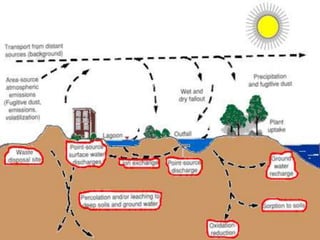
Hazardous or Toxic Wastes
Name : Alivia Salma Lihayati
NIM : 6411414164
Rombel : 06
Toxic materials used in industrial processes can cause ill
effects in workers exposed to the material at the site of
production and in storage, transport, and use of the
materials. Hazardous wastes are defined as any discarded mate-rial that
may pose a substantial threat to human health or
the environment when improperly handled. They include
toxic wastes such as arsenic, heavy metals, and pesticides
which can cause acute or long-term health problems. Reactive wastes
include obsolete munitions and acids that react with water or air to
produce explosions or toxic fumes. Radioactive and infectious wastes
from hospitals are also hazards to public health. Hospital wastes took on
new importance with the dangers of transmission of hepatitis B, HIV, and
drug-resistant microorganisms in contaminated materials.
Minamata Disease
Minamata disease is a chronic neurologic disorder caused by methyl
mercury, a heavy metal with many industrial uses. The disease was
first reported near Minamata Bay in Japan in 1968 when mercury
oxide was being dis charged from a chemical plant into the waters of
the bay. It was converted to an organic form, methyl mercury, by
organisms in the mud and slime of the bay floor. Mer-cury poisoning
of fish is a recurrent phenomenon where industrial wastes
discharged into rivers, lakes, and the sea enter the food chain, and
humans are affected through fish consumption.
TEN THINGS TO KNOW ABOUT MINAMATA
DISEASE
What kind of disease is minamata disease?
What kind of subtance is organic mercury?
How many minamata disease patients are there?
What kind of company was chisso?
What has happened to chisso?
What has happened to minamata bay?
What compensation do the patients receive?
What have the patients been requesting?
What is Moyainaoshi?
What can we learn from minamata disease?
1. What kind of disease is minamata
disease?
The methyl mercury that enters the body mainl attacks the central
nervous system, including the brain., and causes various symptoms
including numbness and unsteadiness in the legs and hands,
tiredness, ringing in the ears, narrowing of the field of vision, loss of
hearing, slurred speech, and awkward movements. Some early
severe victims of Minamata disease went insane, became
unconscious, and died within a month of the onset of the disease.
2. What kind of subtance is organic
mercury?
Mercury is classified into inorganic mercury and organic mercury.
Metallic mercury, which is a type of inorganic mercury, is used in
familiar items such as fluorescent lights, batteries, and
thermometers. The methyl mercury which caused Minamata disease
is a type of organic mercury. It is a white powdery substance and
smells like the sulfur in a hot spring. It is easily absorbed from the
stomach into the blood and carried to the liver and kidney, and then
the brain and even the fetus, where it is absorbed and concentrated
and causes great damage to the human body.
3. How many minamata disease patients are
there?
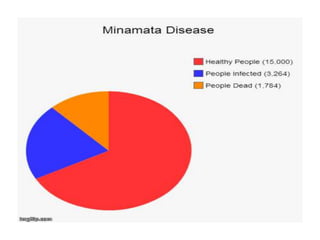
In addition, 10,353 people have been declared eligible for lump sum
payments from Chiss based on the national government’s 1995
settlement plan to aid uncertified patients. Therefore, 12,617 people
have been officially recognized as patients affected by mercury.
However, in addition to these, some people died before the official
discovery of Minamata disease, others died after the discovery but
before they could apply for official certification or medical
assistance, and for various reasons some patients have never
applied for compensation, so it is impossible to know the exact
number of victims.
4. What kind of company was chisso?
Chisso began as a hydroelectric power company in 1908, late in the
Meiji period (1868-1912). It built a carbide factory which used this
electricity, and before long began producing chemical fertilizers,
becoming one of Japan’s major chemical companies. In addition to
chemical fertilizers, Chisso produced acetic acid, vinyl chloride, and
the plasticizers that were necessary in their production. Chisso
became one of the companies that made Japan’s rapid postwar
economic growth possible.
5. What has happened to chisso?
Chisso owes enormous debts as the company that caused
Minamata disease. In 1975 its worsening financial situation led to
fears that it might become unable to make compensation payments
to patients, so since 1978 the national and prefectural governments
have provided it with financial support through the issuance of
prefectural bonds. The total value of the prefectural bonds issued
through the end of December 2000 was about 256.8 billion yen, of
which Chisso must repay 166.1 billion yen to Kumamoto prefecture.
6. What has happened to minamata bay?
The sludge in Minamata Bay with a mercury content above 25 parts
per million (ppm), was dealt with by Kumamoto prefecture by
dredging and reclamation, at the huge cost of 48.5 billion yen over
14 years. As a result, 58 hectares of reclaimed land was created in
Minamata Bay. The water in Minamata Bay is said to be among the
most clear and clean in Kumamoto Prefecture, and it is quite safe to
swim and play in. In order to prevent the spread of polluted fish and
reassure the residents of the prefecture, the prefecture placed nets
around Minamata Bay in 1974, and enlisted the cooperation of the
fishing cooperative to catch fish in the bay. These fish were then
bought and disposed of by Chisso.
7. What compensation do the patients
receive?
The March 1973 decision in the Minamata disease trial was a victory
for the patients, and in July of that year the patients and Chisso
concluded a compensation agreement through direct negotiations.
Under this agreement, Chisso made lump sum consolation
payments of between 16 million and 18 million yen to certified
patients. In addition, costs for annuities, medical treatment, nursing,
funeral expenses, hot spring treatment, and acupuncture and
moxibustion treatments are paid. Also, the interest from a reserve
fund set up by Chisso pays for diapers, home help, condolence gifts,
massage treatments, and transportation to and from hospitals.
8. What have the patients been requesting?
For Minamata disease patients, these have been 40 years of continuous
hardship and strife. What the patients sought through court cases and
negotiations with the government and Chisso was a heartfelt and sincere
apology and acceptance of responsibility for causing Minamata disease
and neglecting the patients. They have also demanded that the truth of
the tragedy be made clear, and that quick relief be provided to the
patients. What they most strongly appealed for during this period of
isolation from the local society was that they be treated as human beings
and as citizens of Minamata. The patients of Minamata disease ask us not
to forget those who were sacrificed in our search for material prosperity
and the destruction of our ties to nature, and to always consider what we
9. What is Moyainaoshi?
“Moyai” literally means to tie boats together or to do something
together, and “naoshi” means repairing something, or doing something
again to get it right. We have given the name “Moyainaoshi” to
cooperative community projects which stress tackling the Minamata
disease issue directly and talking and working together here in
Minamata, where the relationships among people and between people
and nature were once destroyed.
10. What can we learn from minamata
disease?
Minamata disease was caused by eating fish and shellfish
contaminated by chemicals in the industrial waste discharged by
Chisso, and it also caused people to be divided against each other.
Minamata disease teaches us the importance of not destroying nature;
of living with the awareness that nature gives us life; of considering
food safety and the interconnectedness of people, rivers, and the sea;
of reducing and recycling home and industrial waste; and of never
turning our eyes away from local problems.
Toxic Waste Management
Pollution prevention at the workplace has become part of
management processes as industry responded to increasing federal
and state regulation and as the public demand for greater corporate
responsibility led to increasing punitive litigation. The chemical
industry responded with the idea of total quality environmental
management (TQEM), adopting pollution prevention as integral to
industrial management. The search for safe alternatives to toxic
chemical waste management can be costly, but inevitably saves a
company large expen-ditures in fines, litigation, and damage to
corporate image.
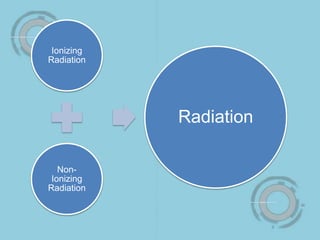
Ionizing
Radiation
Non-
Ionizing
Radiation
Radiation
RADIATION
In 1895, Wilhelm Roentgen’s discovery of x-rays revolu-tionized
medical science. Ionizing radiation includes par-ticulate radiation of
alpha and beta particles, as well as electromagnetic x-rays and
gamma rays. Alpha particles are easily stopped by a thin sheet of
paper, while beta and gamma radiation can penetrate barriers both
inside and outside of the body. Ionizing radiation can dislodge atoms
or parts of atoms and destroy chemical bonds. This can adversely
affect living organisms, especially vulnera-ble fetal cells, resulting in
mutations or carcinogenesis.
Ionizing Radiation
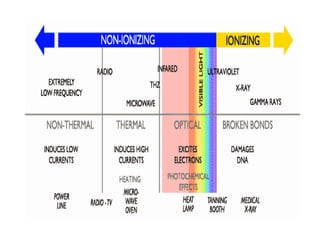
Ionizing radiation includes high-energy electromagnetic radiation,
such as x rays and gamma rays, which are of shorter wavelength
and higher energy than ultraviolet or visible radiation. It also
includes high-energy particles such as electrons, neutrons, protons,
and alpha particles. Ionizing radiation of humans can act as a
mutagen, a carcinogen, and a teratogen. It can cause cataracts,
impaired fertility, premature aging, and skin damage.
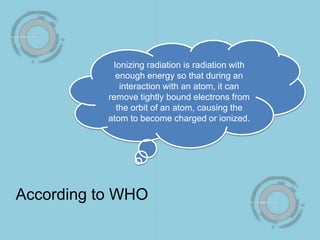
Ionizing radiation is radiation with
enough energy so that during an
interaction with an atom, it can
remove tightly bound electrons from
the orbit of an atom, causing the
atom to become charged or ionized.
According to WHO
Non-Ionizing Radiation
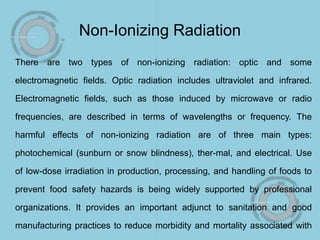
There are two types of non-ionizing radiation: optic and some
electromagnetic fields. Optic radiation includes ultraviolet and infrared.
Electromagnetic fields, such as those induced by microwave or radio
frequencies, are described in terms of wavelengths or frequency. The
harmful effects of non-ionizing radiation are of three main types:
photochemical (sunburn or snow blindness), ther-mal, and electrical. Use
of low-dose irradiation in production, processing, and handling of foods to
prevent food safety hazards is being widely supported by professional
organizations. It provides an important adjunct to sanitation and good
manufacturing practices to reduce morbidity and mortality associated with
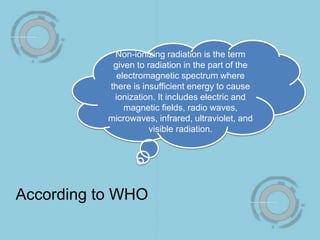
Non-ionizing radiation is the term
given to radiation in the part of the
electromagnetic spectrum where
there is insufficient energy to cause
ionization. It includes electric and
magnetic fields, radio waves,
microwaves, infrared, ultraviolet, and
visible radiation.
According to WHO
Reference
Book of “The New Public Health”
www.who.int
www.teraphysics.com
www.soshisha.org
minamata.weebly.com
geology.isu.edu
Hazardous or Toxic Wastes

Hazardous or Toxic Wastes

  • 1.
    Hazardous or ToxicWastes Name : Alivia Salma Lihayati NIM : 6411414164 Rombel : 06
  • 2.
    Toxic materials usedin industrial processes can cause ill effects in workers exposed to the material at the site of production and in storage, transport, and use of the materials. Hazardous wastes are defined as any discarded mate-rial that may pose a substantial threat to human health or the environment when improperly handled. They include toxic wastes such as arsenic, heavy metals, and pesticides which can cause acute or long-term health problems. Reactive wastes include obsolete munitions and acids that react with water or air to produce explosions or toxic fumes. Radioactive and infectious wastes from hospitals are also hazards to public health. Hospital wastes took on new importance with the dangers of transmission of hepatitis B, HIV, and drug-resistant microorganisms in contaminated materials.
  • 3.
    Minamata Disease Minamata diseaseis a chronic neurologic disorder caused by methyl mercury, a heavy metal with many industrial uses. The disease was first reported near Minamata Bay in Japan in 1968 when mercury oxide was being dis charged from a chemical plant into the waters of the bay. It was converted to an organic form, methyl mercury, by organisms in the mud and slime of the bay floor. Mer-cury poisoning of fish is a recurrent phenomenon where industrial wastes discharged into rivers, lakes, and the sea enter the food chain, and humans are affected through fish consumption.
  • 4.
    TEN THINGS TOKNOW ABOUT MINAMATA DISEASE What kind of disease is minamata disease? What kind of subtance is organic mercury? How many minamata disease patients are there? What kind of company was chisso? What has happened to chisso? What has happened to minamata bay? What compensation do the patients receive? What have the patients been requesting? What is Moyainaoshi? What can we learn from minamata disease?
  • 5.
    1. What kindof disease is minamata disease? The methyl mercury that enters the body mainl attacks the central nervous system, including the brain., and causes various symptoms including numbness and unsteadiness in the legs and hands, tiredness, ringing in the ears, narrowing of the field of vision, loss of hearing, slurred speech, and awkward movements. Some early severe victims of Minamata disease went insane, became unconscious, and died within a month of the onset of the disease.
  • 6.
    2. What kindof subtance is organic mercury? Mercury is classified into inorganic mercury and organic mercury. Metallic mercury, which is a type of inorganic mercury, is used in familiar items such as fluorescent lights, batteries, and thermometers. The methyl mercury which caused Minamata disease is a type of organic mercury. It is a white powdery substance and smells like the sulfur in a hot spring. It is easily absorbed from the stomach into the blood and carried to the liver and kidney, and then the brain and even the fetus, where it is absorbed and concentrated and causes great damage to the human body.
  • 7.
    3. How manyminamata disease patients are there? In addition, 10,353 people have been declared eligible for lump sum payments from Chiss based on the national government’s 1995 settlement plan to aid uncertified patients. Therefore, 12,617 people have been officially recognized as patients affected by mercury. However, in addition to these, some people died before the official discovery of Minamata disease, others died after the discovery but before they could apply for official certification or medical assistance, and for various reasons some patients have never applied for compensation, so it is impossible to know the exact number of victims.
  • 8.
    4. What kindof company was chisso? Chisso began as a hydroelectric power company in 1908, late in the Meiji period (1868-1912). It built a carbide factory which used this electricity, and before long began producing chemical fertilizers, becoming one of Japan’s major chemical companies. In addition to chemical fertilizers, Chisso produced acetic acid, vinyl chloride, and the plasticizers that were necessary in their production. Chisso became one of the companies that made Japan’s rapid postwar economic growth possible.
  • 9.
    5. What hashappened to chisso? Chisso owes enormous debts as the company that caused Minamata disease. In 1975 its worsening financial situation led to fears that it might become unable to make compensation payments to patients, so since 1978 the national and prefectural governments have provided it with financial support through the issuance of prefectural bonds. The total value of the prefectural bonds issued through the end of December 2000 was about 256.8 billion yen, of which Chisso must repay 166.1 billion yen to Kumamoto prefecture.
  • 10.
    6. What hashappened to minamata bay? The sludge in Minamata Bay with a mercury content above 25 parts per million (ppm), was dealt with by Kumamoto prefecture by dredging and reclamation, at the huge cost of 48.5 billion yen over 14 years. As a result, 58 hectares of reclaimed land was created in Minamata Bay. The water in Minamata Bay is said to be among the most clear and clean in Kumamoto Prefecture, and it is quite safe to swim and play in. In order to prevent the spread of polluted fish and reassure the residents of the prefecture, the prefecture placed nets around Minamata Bay in 1974, and enlisted the cooperation of the fishing cooperative to catch fish in the bay. These fish were then bought and disposed of by Chisso.
  • 11.
    7. What compensationdo the patients receive? The March 1973 decision in the Minamata disease trial was a victory for the patients, and in July of that year the patients and Chisso concluded a compensation agreement through direct negotiations. Under this agreement, Chisso made lump sum consolation payments of between 16 million and 18 million yen to certified patients. In addition, costs for annuities, medical treatment, nursing, funeral expenses, hot spring treatment, and acupuncture and moxibustion treatments are paid. Also, the interest from a reserve fund set up by Chisso pays for diapers, home help, condolence gifts, massage treatments, and transportation to and from hospitals.
  • 12.
    8. What havethe patients been requesting? For Minamata disease patients, these have been 40 years of continuous hardship and strife. What the patients sought through court cases and negotiations with the government and Chisso was a heartfelt and sincere apology and acceptance of responsibility for causing Minamata disease and neglecting the patients. They have also demanded that the truth of the tragedy be made clear, and that quick relief be provided to the patients. What they most strongly appealed for during this period of isolation from the local society was that they be treated as human beings and as citizens of Minamata. The patients of Minamata disease ask us not to forget those who were sacrificed in our search for material prosperity and the destruction of our ties to nature, and to always consider what we
  • 13.
    9. What isMoyainaoshi? “Moyai” literally means to tie boats together or to do something together, and “naoshi” means repairing something, or doing something again to get it right. We have given the name “Moyainaoshi” to cooperative community projects which stress tackling the Minamata disease issue directly and talking and working together here in Minamata, where the relationships among people and between people and nature were once destroyed.
  • 14.
    10. What canwe learn from minamata disease? Minamata disease was caused by eating fish and shellfish contaminated by chemicals in the industrial waste discharged by Chisso, and it also caused people to be divided against each other. Minamata disease teaches us the importance of not destroying nature; of living with the awareness that nature gives us life; of considering food safety and the interconnectedness of people, rivers, and the sea; of reducing and recycling home and industrial waste; and of never turning our eyes away from local problems.
  • 16.
    Toxic Waste Management Pollutionprevention at the workplace has become part of management processes as industry responded to increasing federal and state regulation and as the public demand for greater corporate responsibility led to increasing punitive litigation. The chemical industry responded with the idea of total quality environmental management (TQEM), adopting pollution prevention as integral to industrial management. The search for safe alternatives to toxic chemical waste management can be costly, but inevitably saves a company large expen-ditures in fines, litigation, and damage to corporate image.
  • 18.
  • 19.
    RADIATION In 1895, WilhelmRoentgen’s discovery of x-rays revolu-tionized medical science. Ionizing radiation includes par-ticulate radiation of alpha and beta particles, as well as electromagnetic x-rays and gamma rays. Alpha particles are easily stopped by a thin sheet of paper, while beta and gamma radiation can penetrate barriers both inside and outside of the body. Ionizing radiation can dislodge atoms or parts of atoms and destroy chemical bonds. This can adversely affect living organisms, especially vulnera-ble fetal cells, resulting in mutations or carcinogenesis.
  • 20.
    Ionizing Radiation Ionizing radiationincludes high-energy electromagnetic radiation, such as x rays and gamma rays, which are of shorter wavelength and higher energy than ultraviolet or visible radiation. It also includes high-energy particles such as electrons, neutrons, protons, and alpha particles. Ionizing radiation of humans can act as a mutagen, a carcinogen, and a teratogen. It can cause cataracts, impaired fertility, premature aging, and skin damage.
  • 21.
    Ionizing radiation isradiation with enough energy so that during an interaction with an atom, it can remove tightly bound electrons from the orbit of an atom, causing the atom to become charged or ionized. According to WHO
  • 22.
    Non-Ionizing Radiation There aretwo types of non-ionizing radiation: optic and some electromagnetic fields. Optic radiation includes ultraviolet and infrared. Electromagnetic fields, such as those induced by microwave or radio frequencies, are described in terms of wavelengths or frequency. The harmful effects of non-ionizing radiation are of three main types: photochemical (sunburn or snow blindness), ther-mal, and electrical. Use of low-dose irradiation in production, processing, and handling of foods to prevent food safety hazards is being widely supported by professional organizations. It provides an important adjunct to sanitation and good manufacturing practices to reduce morbidity and mortality associated with
  • 23.
    Non-ionizing radiation isthe term given to radiation in the part of the electromagnetic spectrum where there is insufficient energy to cause ionization. It includes electric and magnetic fields, radio waves, microwaves, infrared, ultraviolet, and visible radiation. According to WHO
  • 25.
    Reference Book of “TheNew Public Health” www.who.int www.teraphysics.com www.soshisha.org minamata.weebly.com geology.isu.edu