GO-BACK-N
PROTOCOL
BY HARJOT SINGH
Automatic Repeat Request(ARQ)
 Systems which automatically request the retransmission of missing packets or
packets with errors are called ARQ systems.
Three common schemes are used:
 Stop & Wait
 Go Back N
 Selective Repeat
DEFINITION
 The Go-Back-N (GBN) protocol is a sliding window protocol used in networking
for reliable data transmission. It is part of the Automatic Repeat reQuest (ARQ)
protocols, which ensure that data is correctly received and that any lost or
corrupted packets are retransmitted.
 GBN is a practical approach of sliding window protocol.
Characteristic features of GBN are:
 Sender Window Size (WR)
 Receiver Window Size (WR)
 Acknowledgements
Sender Window Size (WR)
 It is N itself. If we say the protocol is GB10, then Ws = 10. N should be
always greater than 1 in order to implement pipelining.
 For N = 1, it reduces to the Stop and Wait protocol.
Receiver Window Size (WR)
 In the GB-N the receiver window size is one always. i.e. WR is always
1 in GBN.
Acknowledgements
 In flow control, acknowledgments (ACKs) are signals sent by the
receiver to the sender to confirm that data packets have been
successfully received.
 When the sender transmits data, it waits for an acknowledgment
before sending more. This process helps ensure that data is received
correctly.
 If an acknowledgment isn’t received within a certain time, the
sender assumes the packet was lost and retransmits it.
Working of GB-N Protocol
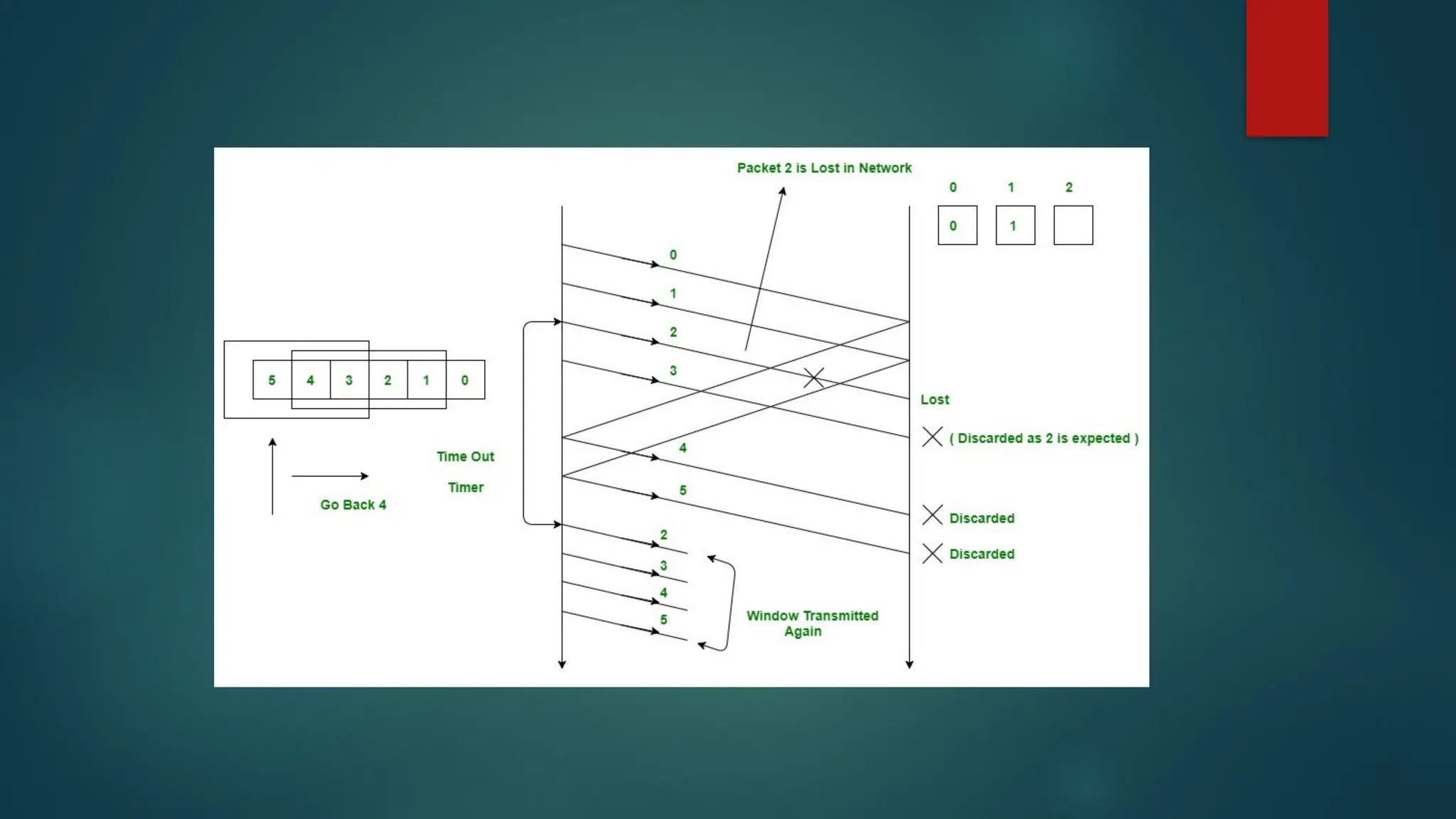
 We have sender window size of 4. Assume that we have lots of
sequence numbers just for the sake of explanation. Now the sender
has sent the packets 0, 1, 2 and 3.
 After acknowledging the packets 0 and 1, receiver is now
expecting packet 2 and sender window has also slided to further
transmit the packets 4 and 5.
 Now suppose the packet 2 is lost in the network, Receiver will
discard all the packets which sender has transmitted after packet 2
as it is expecting sequence number of 2.
 On the sender side for every packet send there is a time out timer
which will expire for packet number 2.
 Now from the last transmitted packet 5 sender will go back to the
packet number 2 in the current window and transmit all the packets
till packet number 5.
 That’s why it is called Go Back N. Go back means sender has to go
back N places from the last transmitted packet in the
unacknowledged window and not from the point where the packet
is lost.
Relationship B/W Window size &
Sequence Number
 The window size determines how many packets the sender can
transmit without needing an acknowledgment.
It’s like a limit on how much data can be sent before the
sender has to stop and wait for confirmation.
 Sequence numbers are used to label packets so the receiver knows
their order and can detect any missing packets.
THANK YOU

Harjot computer networks veryGBN ARQ.pptx

  • 1.
  • 2.
    Automatic Repeat Request(ARQ) Systems which automatically request the retransmission of missing packets or packets with errors are called ARQ systems. Three common schemes are used:  Stop & Wait  Go Back N  Selective Repeat
  • 3.
    DEFINITION  The Go-Back-N(GBN) protocol is a sliding window protocol used in networking for reliable data transmission. It is part of the Automatic Repeat reQuest (ARQ) protocols, which ensure that data is correctly received and that any lost or corrupted packets are retransmitted.  GBN is a practical approach of sliding window protocol.
  • 4.
    Characteristic features ofGBN are:  Sender Window Size (WR)  Receiver Window Size (WR)  Acknowledgements
  • 5.
    Sender Window Size(WR)  It is N itself. If we say the protocol is GB10, then Ws = 10. N should be always greater than 1 in order to implement pipelining.  For N = 1, it reduces to the Stop and Wait protocol.
  • 6.
    Receiver Window Size(WR)  In the GB-N the receiver window size is one always. i.e. WR is always 1 in GBN.
  • 7.
    Acknowledgements  In flowcontrol, acknowledgments (ACKs) are signals sent by the receiver to the sender to confirm that data packets have been successfully received.  When the sender transmits data, it waits for an acknowledgment before sending more. This process helps ensure that data is received correctly.  If an acknowledgment isn’t received within a certain time, the sender assumes the packet was lost and retransmits it.
  • 8.
    Working of GB-NProtocol  We have sender window size of 4. Assume that we have lots of sequence numbers just for the sake of explanation. Now the sender has sent the packets 0, 1, 2 and 3.  After acknowledging the packets 0 and 1, receiver is now expecting packet 2 and sender window has also slided to further transmit the packets 4 and 5.  Now suppose the packet 2 is lost in the network, Receiver will discard all the packets which sender has transmitted after packet 2 as it is expecting sequence number of 2.
  • 9.
     On thesender side for every packet send there is a time out timer which will expire for packet number 2.  Now from the last transmitted packet 5 sender will go back to the packet number 2 in the current window and transmit all the packets till packet number 5.  That’s why it is called Go Back N. Go back means sender has to go back N places from the last transmitted packet in the unacknowledged window and not from the point where the packet is lost.
  • 11.
    Relationship B/W Windowsize & Sequence Number  The window size determines how many packets the sender can transmit without needing an acknowledgment. It’s like a limit on how much data can be sent before the sender has to stop and wait for confirmation.  Sequence numbers are used to label packets so the receiver knows their order and can detect any missing packets.
  • 12.