Halloween
Origins
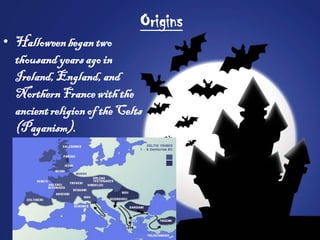
• Halloween began two
thousand years ago in
Ireland, England, and
Northern France with the
ancient religion of the Celts
(Paganism).
Celebration of New Year on November 1st
• This day marked the beginning of the dark, cold
winter, a time of year that was often associated with
human death.
• On the night of October 31, they celebrated
Samhain, when it was believed that the ghosts of the
dead returned to earth.
Costumes
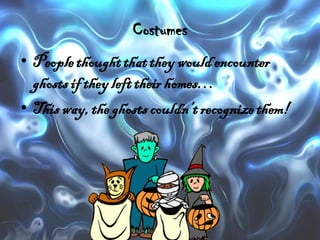
• People thought that they would encounter
ghosts if they left their homes…
• This way, the ghosts couldn’t recognize them!
The Christian influence
• As the influence of Christianity spread into Celtic lands, in
the 7th century, Pope Boniface IV introduced All Saints'
Day, a time to honor saints and martyrs, to replace the Pagan
festival of Samhain. It was observed on May 13th.
• In 834, Pope Gregory III moved All Saint's Day to Nov.
1st. Oct. 31st became All Hallows' Eve ('hallow' means
'saint').
• In catholic church the Soul day is November 2nd.
Trick or Treating
• During the All Souls Day festival in England, poor people
would beg for “soul cakes,” made out of square pieces of bread
with currants

• This tradition was eventually taken up by children who would
visit the houses in their neighborhood and be given food, and
money.
• Today…Sweets.
In America
• In 1848, millions of Irish emigrants poured into America.
They brought with them their traditions of Halloween.
• They called Halloween Oidche Shamhna (`Night of
Samhain'), and kept the traditions.
• The Irish used to carry turnips with candles in them to
light their way at night and to scare away ghosts..In
America they used pumpkins.

Halloween

  • 1.
  • 2.
    Origins • Halloween begantwo thousand years ago in Ireland, England, and Northern France with the ancient religion of the Celts (Paganism).
  • 3.
    Celebration of NewYear on November 1st • This day marked the beginning of the dark, cold winter, a time of year that was often associated with human death. • On the night of October 31, they celebrated Samhain, when it was believed that the ghosts of the dead returned to earth.
  • 4.
    Costumes • People thoughtthat they would encounter ghosts if they left their homes… • This way, the ghosts couldn’t recognize them!
  • 5.
    The Christian influence •As the influence of Christianity spread into Celtic lands, in the 7th century, Pope Boniface IV introduced All Saints' Day, a time to honor saints and martyrs, to replace the Pagan festival of Samhain. It was observed on May 13th. • In 834, Pope Gregory III moved All Saint's Day to Nov. 1st. Oct. 31st became All Hallows' Eve ('hallow' means 'saint'). • In catholic church the Soul day is November 2nd.
  • 6.
    Trick or Treating •During the All Souls Day festival in England, poor people would beg for “soul cakes,” made out of square pieces of bread with currants • This tradition was eventually taken up by children who would visit the houses in their neighborhood and be given food, and money. • Today…Sweets.
  • 7.
    In America • In1848, millions of Irish emigrants poured into America. They brought with them their traditions of Halloween. • They called Halloween Oidche Shamhna (`Night of Samhain'), and kept the traditions. • The Irish used to carry turnips with candles in them to light their way at night and to scare away ghosts..In America they used pumpkins.