Sustainable Development

    An introduction
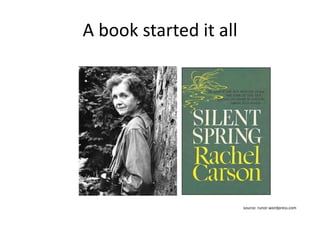
A book started it all


                        source: runor.wordpress.com
In the sixties
• Rachel Carson: ”Silent Spring”
• The book started an environmental movement
• For example was the non governmental
  organisation Greenpeace founded in 1971.
• Scientists found that environmental problems
  were due to man's way of life.
• What to do about it?
In the seventies


•   Scores:   www.sverigesradio.se             Scourse: Plyhm.se


• Some young people wanted to live in harmony
  with nature and mowed out from the cities.
The Brundtland Commission
• After a UN-conference in 1983 the Norwegian
  Prime Minister Gro Harlem Brundtland got the
  mission to find out a definition that should be
  the official environmental aim for the whole
  world.
• The definition was to be as clear as possible,
  but not so clear that the UN-member states
  would not want to plan their politics after it.
A new definition
• In 1987 Mrs. Brundtland presented a report
  named “Our Common Future”.
• It had a definition of ”sustainable
  development” that included both
  environmental, economical and social issues.
• Link to the original report:
• http://www.un-documents.net/ocf-02.htm#I
Source: http://ekstranett.innovasjonnorge.no/Felles_fs/   Source: thwink.org
CVCTeamNorway/Bilder/Illustrations/Brundtland.jpg
Three aspects of
                         Sustainable development
                                       Socurece:


Source:
http://mncompact.files.wordpress.com
The definition…
Sustainable Development
"Development that meets the needs of the present without
compromising the ability of future generations to meet their own
needs".

The three dimensions of sustainable development - economic, social
and environmental - are to be in harmony and mutually reinforcing.

At the UN World Summit on Sustainable Development in Johannesburg
in 2002, the concept of sustainable development was recognised as an
overarching principle in the activities of the United Nations. This makes
it possible to continue to promote sustainability as a broad and holistic
development agenda.
Source: http://www.sweden.gov.se/sb/d/2164

Hallbar utveckling

  • 1.
    Sustainable Development An introduction
  • 2.
    A book startedit all source: runor.wordpress.com
  • 3.
    In the sixties •Rachel Carson: ”Silent Spring” • The book started an environmental movement • For example was the non governmental organisation Greenpeace founded in 1971. • Scientists found that environmental problems were due to man's way of life. • What to do about it?
  • 4.
    In the seventies • Scores: www.sverigesradio.se Scourse: Plyhm.se • Some young people wanted to live in harmony with nature and mowed out from the cities.
  • 5.
    The Brundtland Commission •After a UN-conference in 1983 the Norwegian Prime Minister Gro Harlem Brundtland got the mission to find out a definition that should be the official environmental aim for the whole world. • The definition was to be as clear as possible, but not so clear that the UN-member states would not want to plan their politics after it.
  • 6.
    A new definition •In 1987 Mrs. Brundtland presented a report named “Our Common Future”. • It had a definition of ”sustainable development” that included both environmental, economical and social issues. • Link to the original report: • http://www.un-documents.net/ocf-02.htm#I
  • 7.
    Source: http://ekstranett.innovasjonnorge.no/Felles_fs/ Source: thwink.org CVCTeamNorway/Bilder/Illustrations/Brundtland.jpg
  • 8.
    Three aspects of Sustainable development Socurece: Source: http://mncompact.files.wordpress.com
  • 9.
    The definition… Sustainable Development "Developmentthat meets the needs of the present without compromising the ability of future generations to meet their own needs". The three dimensions of sustainable development - economic, social and environmental - are to be in harmony and mutually reinforcing. At the UN World Summit on Sustainable Development in Johannesburg in 2002, the concept of sustainable development was recognised as an overarching principle in the activities of the United Nations. This makes it possible to continue to promote sustainability as a broad and holistic development agenda. Source: http://www.sweden.gov.se/sb/d/2164