Habitat for Humanity
Group 2:
Abhishek Deiveekan
Jian Chen
Sankalp Dere
Xin Du
Gayatri Gaddi
Background
 Habitat for Humanity (HfH) is an international, non-
governmental, and non-profit organization, which was founded in
1976
 Functions: To provide affordable housing to people
Diagnostic of HfH
 HfH is facing criticism for a number of reasons such as:
 Unsafe work environment
 Slow delivery
 Lack of volunteers
 Untrained volunteers
 Lack of power to do management work
 Failure to meet customers requirements
 Slow and inefficient process
 Inefficient usage of resources
 Sub standard housing materials
Diagnostic of HfH
The net effect of these issues will create following problems:
 Short term:
 Several customer’s complaints will cause the organization to lose
valuable opportunities.
 Due to these inefficiencies the process of fundraising will/has
becomes tedious as the donors may have second thoughts about
donating to HfH.
 Long term:
 It will discount the function of HfH
HfH and Six Sigma
 To help eliminate the problems and help regain its former and
needed glory, that is to build affordable homes, we have used Six
Sigma method
Process Flow of Six Sigma Method
Define: Evaluating Problem Areas
Based on Voice of Customers(VoC) analysis and Pareto principle we
have shorted down the top three customers requirements:
 Quality work
 Fast delivery
 Affordable house
Define: Cost of Poor Quality(COPQ) Concerns
Internal Failure Cost:
 Untrained volunteer’s low performance
 Slow and Inefficient building process: downtime and extra money
 Inefficient use of resources: non-value added activities
 Sub standard material quality
 Conflicts with local affiliates
External Failure Cost:
 Volunteers got injured in the project need medical care
 Difficulty in getting capital investment from people and
government
 Fail to build some “affordable” homes for low income people
 Conflicts with local authority
Define: Cost of Poor Quality(COPQ) Concerns
Define: Selecting Problems Areas For
Improvement
Based on all pre analysis we decided to work on:
 Increasing the quality of building
 Shorten the delivery time
Measure: Verify Need
 Setting a standard for their building based on the review of
architect and the feedback of house owners
 The house quality are rated from unacceptable (score 0) to
qualified (score 5) to excellent (score 10)
 Most houses are around and below score 5
Measure: Process Documentation
Start
Request/Need
Background information
(climate, building style
feasibility)
Qualification
for project
Determining resources available
locally and resources needed from
outside
(food, materials, equipment, labor)
Building houses
and managaing
labor/resources
Training the new
home owners to
maintain houses
Collecting non-
profit mortgage
from home owners
Establish managing
commitee to
overlook on area
project
End of
project
Yes
No
Measure: Understanding Quality Prerequisites
Society Personnel
Finance Equipment
Quality
Attention
from people
Society Level
Responsibility
Training
Level Education
Level
Scope of
Equipments
Materials
Number of
Equipments
Stability of
Equipments
Corruption
prevention
Funding
Allocating
Funds
Culture
Quality Fishbone Chart
Measure: Baseline Performance
 Because the target of HfH is to build affordable house, the
baseline of their project would not be very high.
 An ideal project would be rated between qualified (score 5) and
advanced (score 7)
 If a score from 0 to 4 exists then it needs immediate attention to
improve
Measure: Process Capability
Process
Capability
Measure: Other Data Collections
 Measured house quality in three completely different
geographical locations/projects to measure influence of material
quality and labor training level(in terms of cost to train them)
 Measured the influence of repeatability, reproductively, and part
to part
Analyze: Quality Performance between 3 Projects
 Null hypothesis: Means are equal
 Alternative hypothesis: Atleast one mean is different
 Test: ANOVA
 Result: Alternative hypothesis is true
 Meaning: Quality performance in different projects are
significantly different
Analyze: Finding Quality Gap BW These
Projects
 Test: Tukey Pairwise Comparisons
 Result: Quality gap between project 1 and project 2 is the biggest
 Meaning: House quality of project 1 is better
 Next course: Finding if correlation exist between training level
and house quality or material and house quality in project 1
Analyze: Finding If Correlation Exist
 Test: Pearson correlation
 Result: Correlation exist between material and quality of house
 Next course: Finding the correlation
Analyze: Finding Correlation BW Material
Quality And House Quality
 Test: Regression Analysis
 Result: House Quality = -0.324 + (8.727 x Material Quality)
 Meaning: The quality of material is the driving factor of house
quality
Improve: Design Of Experiments
 We did quality check based on vendor selection from local
supplier and overseas supplier
 Result: Higher quality local supplier is preferred
 Reason: Lower cost and Less delivery time with almost equal
materials quality
Improve: Optimizing Inventory In Supply
Chain
 Tested inventory with materials cap at 9 and 15
 Result: Inventory of 15 is better
 Reason: Total cost is lower as inventory of 15 decreases cost of
overflow
Improve: Other Measures In Need of
Improvement
 Proper capital management
 Give high priority to employ skilled workers
 Finding out sporadic problem areas & dynamic implementation of
solutions proposed
 Incentives for skilled employees
 Aggressively promoting the need for skilled volunteers
 Renting necessary quality equipment, locally if available, to
reduce cost of own equipment deterioration as well as using
improved tech
 Establishing a supervising committee
Improve: Measures To Improve Sustainability
 Using green building techniques and materials that are
comparable in price to traditional counterpart
 Cutting energy waste while building and fitting energy star
electrical devices
 Improving design of houses to minimize deteriorating weather
effects based on locations
 Training quality engineers for sustainability
 Efficient use of raw materials
Control: Use Of Control Charts
 In order to control the building quality, a quality inspection
standard should be set for the incoming raw material
 Because materials are always purchased by huge lot size in a
short period, a sampling plan should be set
 Used: Nomograph
 Result: Sample size (n)=65 and acceptance number (c)=7
Control: Use Of Control Charts
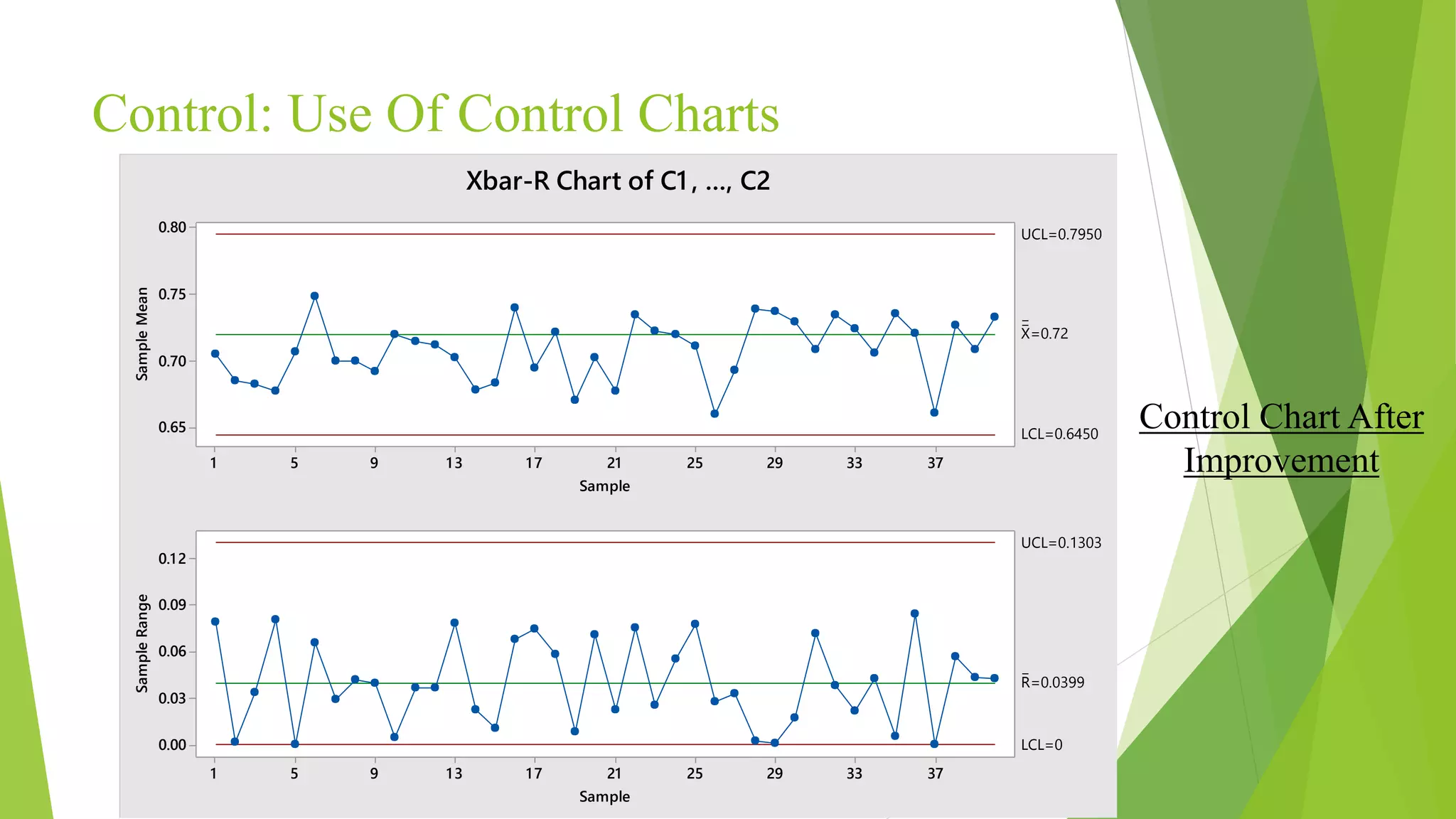
 According to the relationship between material and quality:
House Quality = -0.324 + (8.727 x Material Quality)
We can calculate that if we want to get an average house quality
scoring 6, with upper limit 7 and lower limit 5 the raw material
quality should have a mean equal to 0.72
Control: Use Of Control Charts
37332925211713951
0.80
0.75
0.70
0.65
Sample
SampleMean
__
X=0.72
UCL=0.7950
LCL=0.6450
37332925211713951
0.12
0.09
0.06
0.03
0.00
Sample
SampleRange
_
R=0.0399
UCL=0.1303
LCL=0
Xbar-R Chart of C1 , ..., C2
Control Chart After
Improvement
Control: Use Of Control Charts
 We can see that the mean and range of material quality are fairly
stable by now.
 Because the quality performance may shift over time, it’s critical
to keep checking the situation when new material are purchased.
 Once they have a sample fall out of the limit or go beyond
warning limits, we should stop the process or check the situation
respectively, to assess whether the supplier has deviated from its
stable state.
Control: Assessing Final Process Capability
New Process Capability
Cp=1.43
Cpk=1.33
Old Process Capability
Cp=1.09
Cpk=0.87
Control: For Ongoing Projects
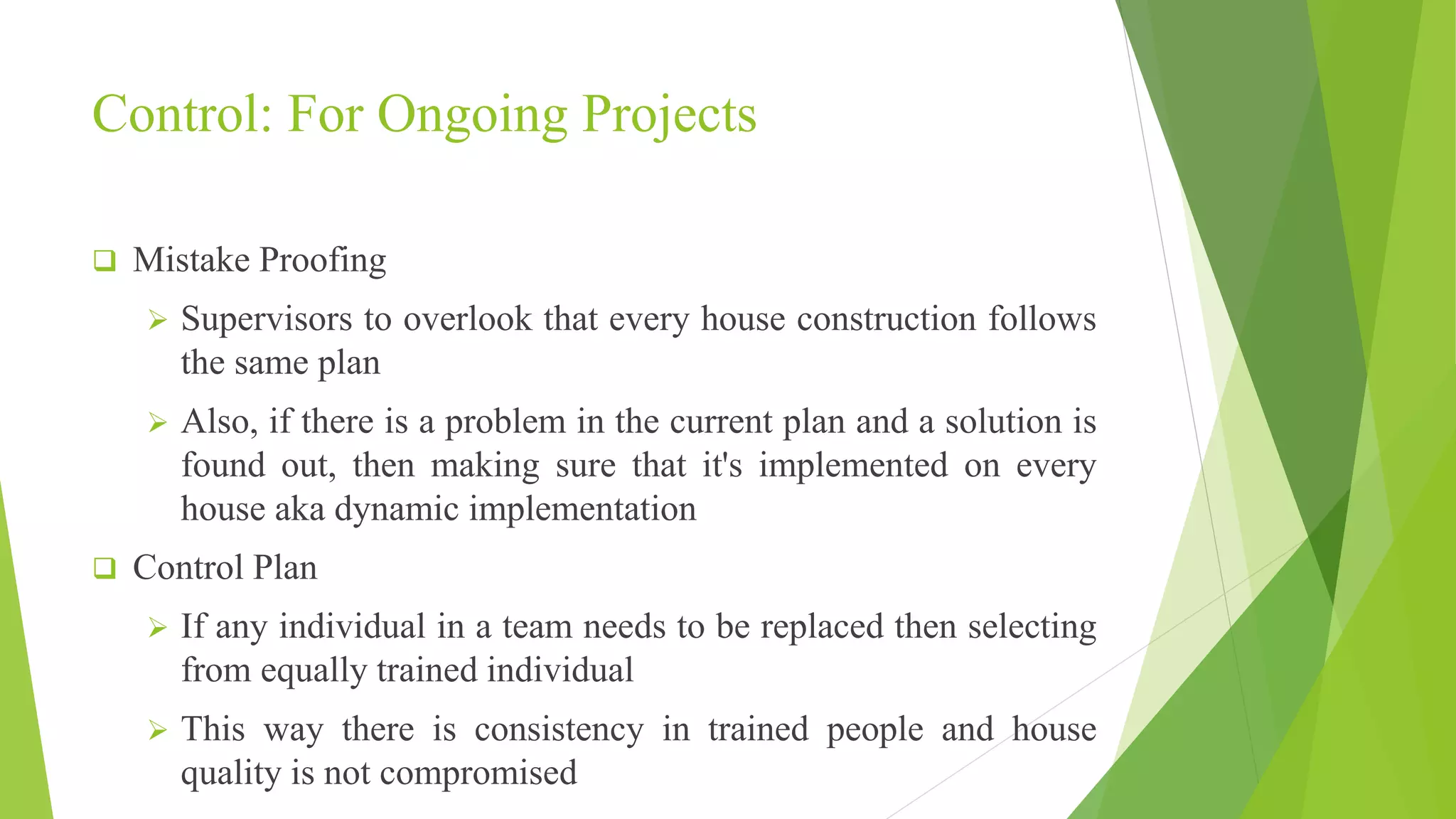
 Mistake Proofing
 Supervisors to overlook that every house construction follows
the same plan
 Also, if there is a problem in the current plan and a solution is
found out, then making sure that it's implemented on every
house aka dynamic implementation
 Control Plan
 If any individual in a team needs to be replaced then selecting
from equally trained individual
 This way there is consistency in trained people and house
quality is not compromised
Control: For Ongoing Projects
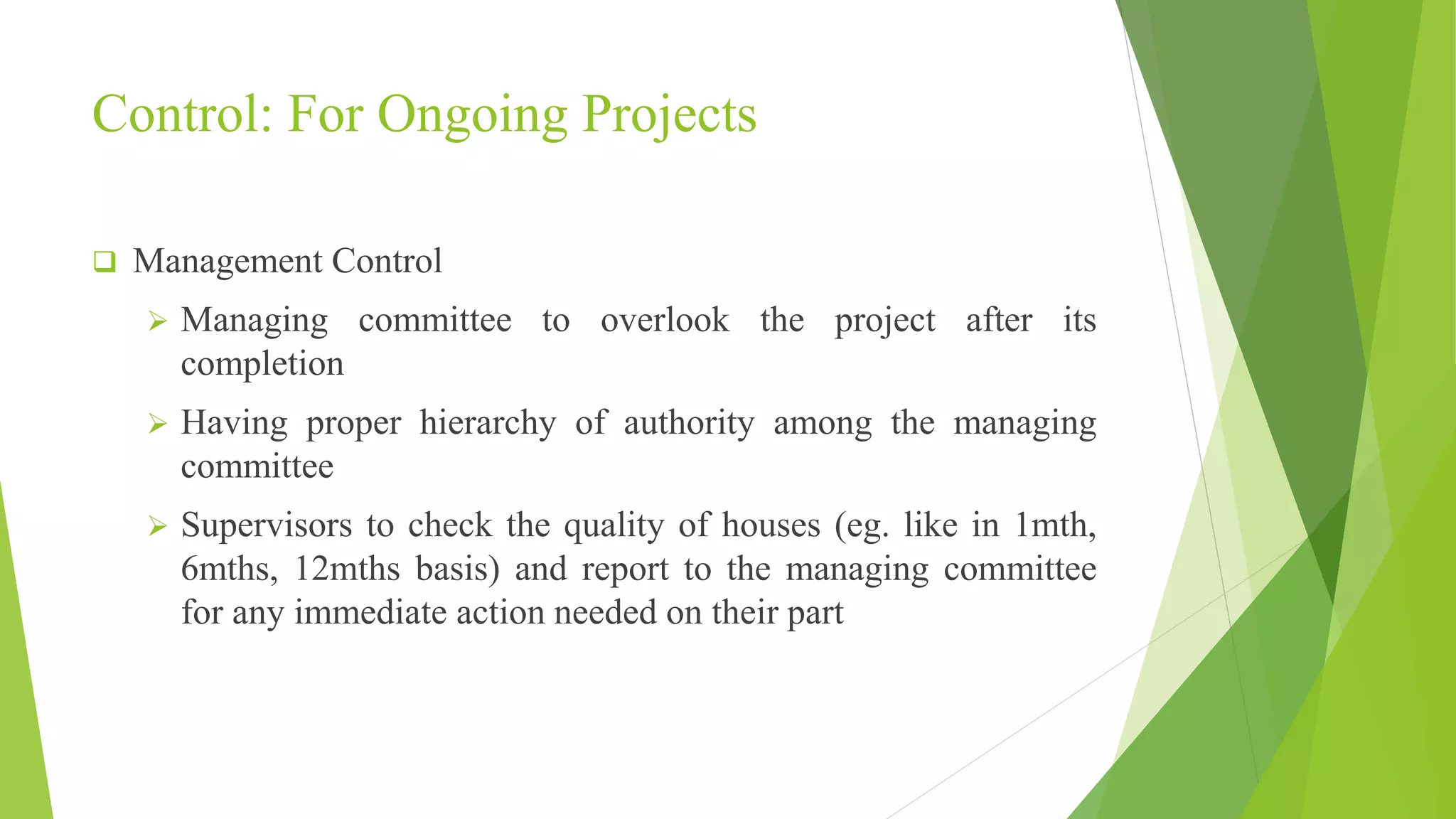
 Management Control
 Managing committee to overlook the project after its
completion
 Having proper hierarchy of authority among the managing
committee
 Supervisors to check the quality of houses (eg. like in 1mth,
6mths, 12mths basis) and report to the managing committee
for any immediate action needed on their part
Control: For New Projects-Use Of 5S
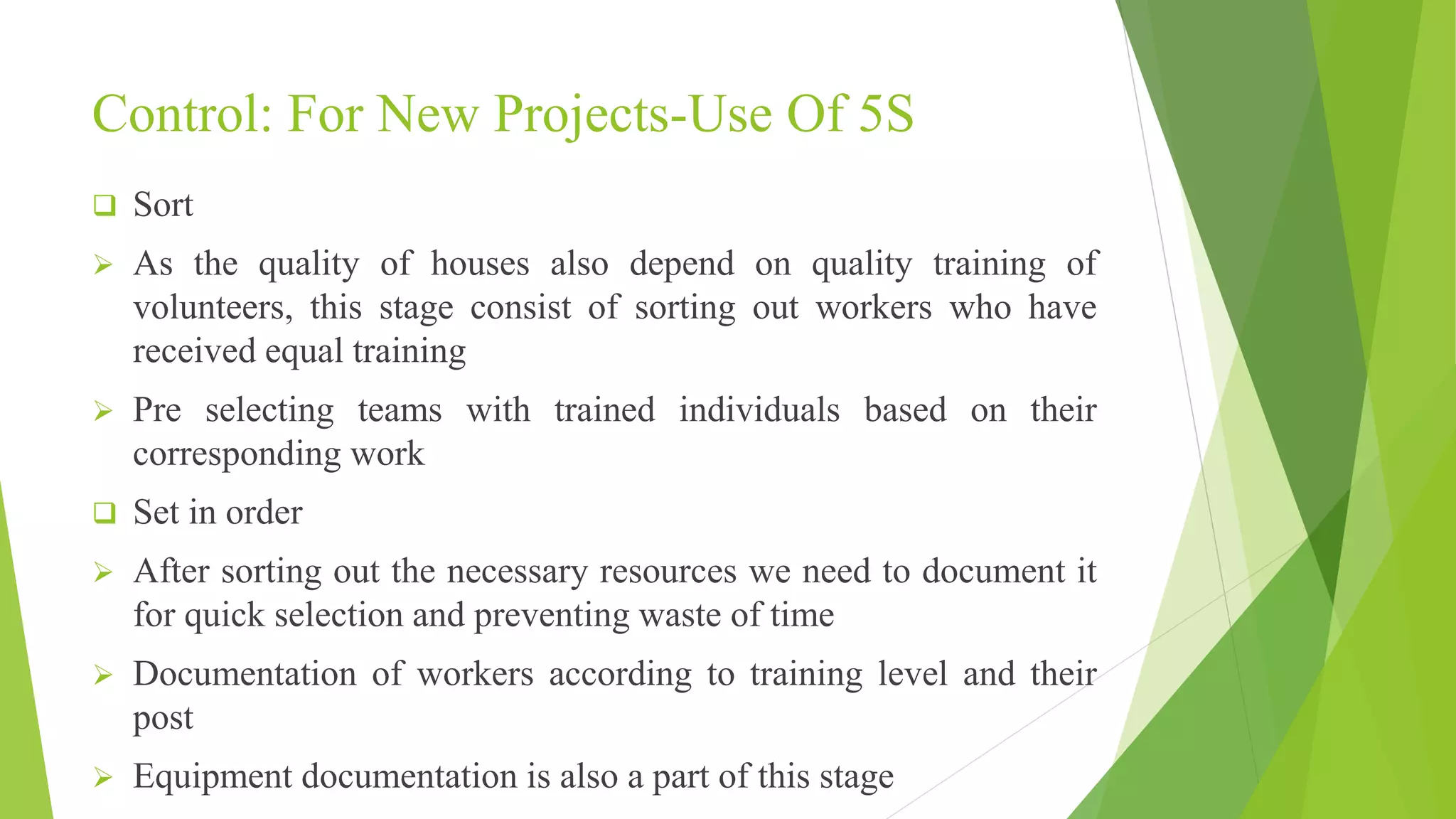
 Sort
 As the quality of houses also depend on quality training of
volunteers, this stage consist of sorting out workers who have
received equal training
 Pre selecting teams with trained individuals based on their
corresponding work
 Set in order
 After sorting out the necessary resources we need to document it
for quick selection and preventing waste of time
 Documentation of workers according to training level and their
post
 Equipment documentation is also a part of this stage
Control: For New Projects-Use Of 5S
 Shine
 In this stage it is necessary to prevent machinery and equipment
deterioration as it will have immediate impact on houses quality
and time needed to complete the project
 Standardize
 Standardizing the best practices in the work area. Some research
is needed to understand which type of houses, materials,
equipments etc. are suitable in the given geographical area
 Maintain orderliness
 Everything in its right place during and after the completion of
project
 Making sure that workers comply with process standard
Control: For New Projects
 Sustain
 To keep everything in working order
 Perform regular audits
 Training and Discipline whenever necessary
Conclusion
 By successfully implementing the techniques suggested the
quality of work and delivery time will improve which is the
required target for our project
 If the targets are attained, HfH can bury their current
shortcomings and be known as THE international organization for
bringing quality & affordable houses to low income families
Thank You
Questions?

Habitat for humanity final ppt

  • 1.
    Habitat for Humanity Group2: Abhishek Deiveekan Jian Chen Sankalp Dere Xin Du Gayatri Gaddi
  • 2.
    Background  Habitat forHumanity (HfH) is an international, non- governmental, and non-profit organization, which was founded in 1976  Functions: To provide affordable housing to people
  • 4.
    Diagnostic of HfH HfH is facing criticism for a number of reasons such as:  Unsafe work environment  Slow delivery  Lack of volunteers  Untrained volunteers  Lack of power to do management work  Failure to meet customers requirements  Slow and inefficient process  Inefficient usage of resources  Sub standard housing materials
  • 5.
    Diagnostic of HfH Thenet effect of these issues will create following problems:  Short term:  Several customer’s complaints will cause the organization to lose valuable opportunities.  Due to these inefficiencies the process of fundraising will/has becomes tedious as the donors may have second thoughts about donating to HfH.  Long term:  It will discount the function of HfH
  • 6.
    HfH and SixSigma  To help eliminate the problems and help regain its former and needed glory, that is to build affordable homes, we have used Six Sigma method Process Flow of Six Sigma Method
  • 7.
    Define: Evaluating ProblemAreas Based on Voice of Customers(VoC) analysis and Pareto principle we have shorted down the top three customers requirements:  Quality work  Fast delivery  Affordable house
  • 8.
    Define: Cost ofPoor Quality(COPQ) Concerns Internal Failure Cost:  Untrained volunteer’s low performance  Slow and Inefficient building process: downtime and extra money  Inefficient use of resources: non-value added activities  Sub standard material quality  Conflicts with local affiliates
  • 9.
    External Failure Cost: Volunteers got injured in the project need medical care  Difficulty in getting capital investment from people and government  Fail to build some “affordable” homes for low income people  Conflicts with local authority Define: Cost of Poor Quality(COPQ) Concerns
  • 10.
    Define: Selecting ProblemsAreas For Improvement Based on all pre analysis we decided to work on:  Increasing the quality of building  Shorten the delivery time
  • 11.
    Measure: Verify Need Setting a standard for their building based on the review of architect and the feedback of house owners  The house quality are rated from unacceptable (score 0) to qualified (score 5) to excellent (score 10)  Most houses are around and below score 5
  • 12.
    Measure: Process Documentation Start Request/Need Backgroundinformation (climate, building style feasibility) Qualification for project Determining resources available locally and resources needed from outside (food, materials, equipment, labor) Building houses and managaing labor/resources Training the new home owners to maintain houses Collecting non- profit mortgage from home owners Establish managing commitee to overlook on area project End of project Yes No
  • 13.
    Measure: Understanding QualityPrerequisites Society Personnel Finance Equipment Quality Attention from people Society Level Responsibility Training Level Education Level Scope of Equipments Materials Number of Equipments Stability of Equipments Corruption prevention Funding Allocating Funds Culture Quality Fishbone Chart
  • 14.
    Measure: Baseline Performance Because the target of HfH is to build affordable house, the baseline of their project would not be very high.  An ideal project would be rated between qualified (score 5) and advanced (score 7)  If a score from 0 to 4 exists then it needs immediate attention to improve
  • 15.
  • 16.
    Measure: Other DataCollections  Measured house quality in three completely different geographical locations/projects to measure influence of material quality and labor training level(in terms of cost to train them)  Measured the influence of repeatability, reproductively, and part to part
  • 17.
    Analyze: Quality Performancebetween 3 Projects  Null hypothesis: Means are equal  Alternative hypothesis: Atleast one mean is different  Test: ANOVA  Result: Alternative hypothesis is true  Meaning: Quality performance in different projects are significantly different
  • 18.
    Analyze: Finding QualityGap BW These Projects  Test: Tukey Pairwise Comparisons  Result: Quality gap between project 1 and project 2 is the biggest  Meaning: House quality of project 1 is better  Next course: Finding if correlation exist between training level and house quality or material and house quality in project 1
  • 19.
    Analyze: Finding IfCorrelation Exist  Test: Pearson correlation  Result: Correlation exist between material and quality of house  Next course: Finding the correlation
  • 20.
    Analyze: Finding CorrelationBW Material Quality And House Quality  Test: Regression Analysis  Result: House Quality = -0.324 + (8.727 x Material Quality)  Meaning: The quality of material is the driving factor of house quality
  • 21.
    Improve: Design OfExperiments  We did quality check based on vendor selection from local supplier and overseas supplier  Result: Higher quality local supplier is preferred  Reason: Lower cost and Less delivery time with almost equal materials quality
  • 22.
    Improve: Optimizing InventoryIn Supply Chain  Tested inventory with materials cap at 9 and 15  Result: Inventory of 15 is better  Reason: Total cost is lower as inventory of 15 decreases cost of overflow
  • 23.
    Improve: Other MeasuresIn Need of Improvement  Proper capital management  Give high priority to employ skilled workers  Finding out sporadic problem areas & dynamic implementation of solutions proposed  Incentives for skilled employees  Aggressively promoting the need for skilled volunteers  Renting necessary quality equipment, locally if available, to reduce cost of own equipment deterioration as well as using improved tech  Establishing a supervising committee
  • 24.
    Improve: Measures ToImprove Sustainability  Using green building techniques and materials that are comparable in price to traditional counterpart  Cutting energy waste while building and fitting energy star electrical devices  Improving design of houses to minimize deteriorating weather effects based on locations  Training quality engineers for sustainability  Efficient use of raw materials
  • 25.
    Control: Use OfControl Charts  In order to control the building quality, a quality inspection standard should be set for the incoming raw material  Because materials are always purchased by huge lot size in a short period, a sampling plan should be set  Used: Nomograph  Result: Sample size (n)=65 and acceptance number (c)=7
  • 26.
    Control: Use OfControl Charts  According to the relationship between material and quality: House Quality = -0.324 + (8.727 x Material Quality) We can calculate that if we want to get an average house quality scoring 6, with upper limit 7 and lower limit 5 the raw material quality should have a mean equal to 0.72
  • 27.
    Control: Use OfControl Charts 37332925211713951 0.80 0.75 0.70 0.65 Sample SampleMean __ X=0.72 UCL=0.7950 LCL=0.6450 37332925211713951 0.12 0.09 0.06 0.03 0.00 Sample SampleRange _ R=0.0399 UCL=0.1303 LCL=0 Xbar-R Chart of C1 , ..., C2 Control Chart After Improvement
  • 28.
    Control: Use OfControl Charts  We can see that the mean and range of material quality are fairly stable by now.  Because the quality performance may shift over time, it’s critical to keep checking the situation when new material are purchased.  Once they have a sample fall out of the limit or go beyond warning limits, we should stop the process or check the situation respectively, to assess whether the supplier has deviated from its stable state.
  • 29.
    Control: Assessing FinalProcess Capability New Process Capability Cp=1.43 Cpk=1.33 Old Process Capability Cp=1.09 Cpk=0.87
  • 30.
    Control: For OngoingProjects  Mistake Proofing  Supervisors to overlook that every house construction follows the same plan  Also, if there is a problem in the current plan and a solution is found out, then making sure that it's implemented on every house aka dynamic implementation  Control Plan  If any individual in a team needs to be replaced then selecting from equally trained individual  This way there is consistency in trained people and house quality is not compromised
  • 31.
    Control: For OngoingProjects  Management Control  Managing committee to overlook the project after its completion  Having proper hierarchy of authority among the managing committee  Supervisors to check the quality of houses (eg. like in 1mth, 6mths, 12mths basis) and report to the managing committee for any immediate action needed on their part
  • 32.
    Control: For NewProjects-Use Of 5S  Sort  As the quality of houses also depend on quality training of volunteers, this stage consist of sorting out workers who have received equal training  Pre selecting teams with trained individuals based on their corresponding work  Set in order  After sorting out the necessary resources we need to document it for quick selection and preventing waste of time  Documentation of workers according to training level and their post  Equipment documentation is also a part of this stage
  • 33.
    Control: For NewProjects-Use Of 5S  Shine  In this stage it is necessary to prevent machinery and equipment deterioration as it will have immediate impact on houses quality and time needed to complete the project  Standardize  Standardizing the best practices in the work area. Some research is needed to understand which type of houses, materials, equipments etc. are suitable in the given geographical area  Maintain orderliness  Everything in its right place during and after the completion of project  Making sure that workers comply with process standard
  • 34.
    Control: For NewProjects  Sustain  To keep everything in working order  Perform regular audits  Training and Discipline whenever necessary
  • 35.
    Conclusion  By successfullyimplementing the techniques suggested the quality of work and delivery time will improve which is the required target for our project  If the targets are attained, HfH can bury their current shortcomings and be known as THE international organization for bringing quality & affordable houses to low income families
  • 36.