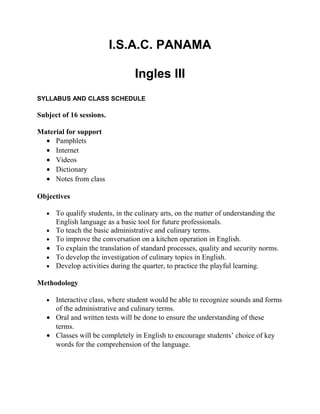
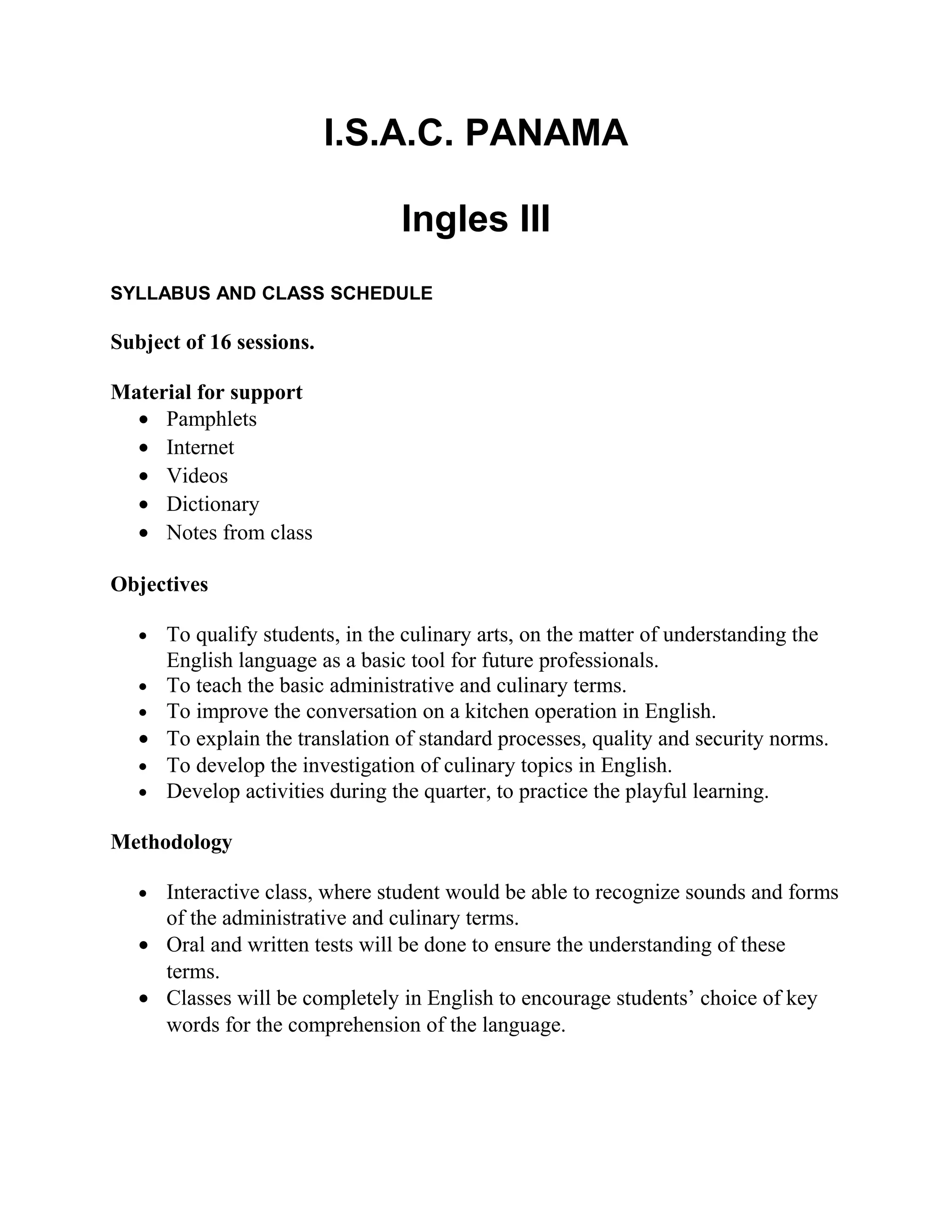
I.S.A.C. PANAMA

                                  Ingles III
SYLLABUS AND CLASS SCHEDULE

Subject of 16 sessions.

Material for support
  • Pamphlets
  • Internet
  • Videos
  • Dictionary
  • Notes from class

Objectives

   •   To qualify students, in the culinary arts, on the matter of understanding the
       English language as a basic tool for future professionals.
   •   To teach the basic administrative and culinary terms.
   •   To improve the conversation on a kitchen operation in English.
   •   To explain the translation of standard processes, quality and security norms.
   •   To develop the investigation of culinary topics in English.
   •   Develop activities during the quarter, to practice the playful learning.

Methodology

   • Interactive class, where student would be able to recognize sounds and forms
     of the administrative and culinary terms.
   • Oral and written tests will be done to ensure the understanding of these
     terms.
   • Classes will be completely in English to encourage students’ choice of key
     words for the comprehension of the language.
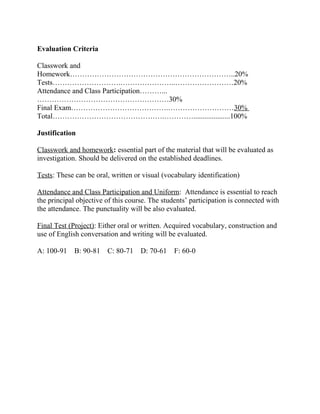
Evaluation Criteria

Classwork and
Homework…………………………………………………………..20%
Tests……………………….…………………..……………………20%
Attendance and Class Participation………...
………………………………………………30%
Final Exam………………………………….………………………30%
Total……………………………………….…………....................100%

Justification

Classwork and homework: essential part of the material that will be evaluated as
investigation. Should be delivered on the established deadlines.

Tests: These can be oral, written or visual (vocabulary identification)

Attendance and Class Participation and Uniform: Attendance is essential to reach
the principal objective of this course. The students’ participation is connected with
the attendance. The punctuality will be also evaluated.

Final Test (Project): Either oral or written. Acquired vocabulary, construction and
use of English conversation and writing will be evaluated.

A: 100-91    B: 90-81   C: 80-71    D: 70-61    F: 60-0
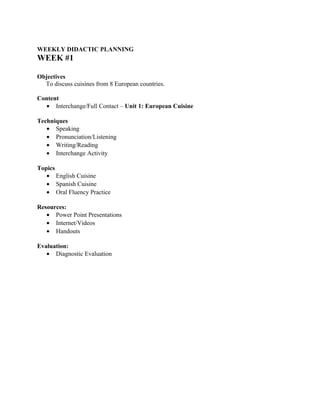
WEEKLY DIDACTIC PLANNING
WEEK #1

Objectives
  To discuss cuisines from 8 European countries.

Content
  • Interchange/Full Contact – Unit 1: European Cuisine

Techniques
   • Speaking
   • Pronunciation/Listening
   • Writing/Reading
   • Interchange Activity

Topics
   • English Cuisine
   • Spanish Cuisine
   • Oral Fluency Practice

Resources:
   • Power Point Presentations
   • Internet/Videos
   • Handouts

Evaluation:
   • Diagnostic Evaluation
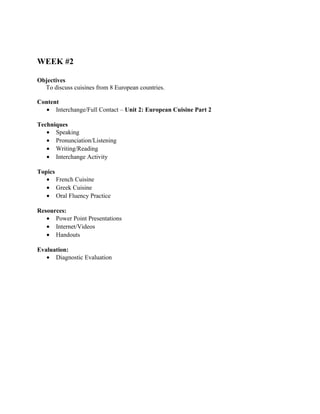
WEEK #2

Objectives
  To discuss cuisines from 8 European countries.

Content
  • Interchange/Full Contact – Unit 2: European Cuisine Part 2

Techniques
   • Speaking
   • Pronunciation/Listening
   • Writing/Reading
   • Interchange Activity

Topics
   • French Cuisine
   • Greek Cuisine
   • Oral Fluency Practice

Resources:
   • Power Point Presentations
   • Internet/Videos
   • Handouts

Evaluation:
   • Diagnostic Evaluation
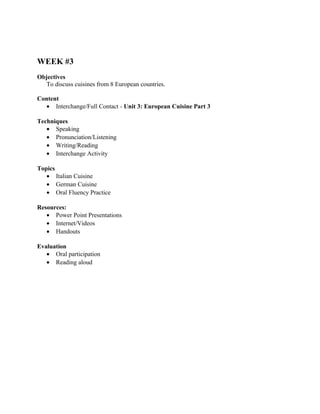
WEEK #3
Objectives
   To discuss cuisines from 8 European countries.

Content
  • Interchange/Full Contact - Unit 3: European Cuisine Part 3

Techniques
   • Speaking
   • Pronunciation/Listening
   • Writing/Reading
   • Interchange Activity

Topics
   • Italian Cuisine
   • German Cuisine
   • Oral Fluency Practice

Resources:
   • Power Point Presentations
   • Internet/Videos
   • Handouts

Evaluation
   • Oral participation
   • Reading aloud
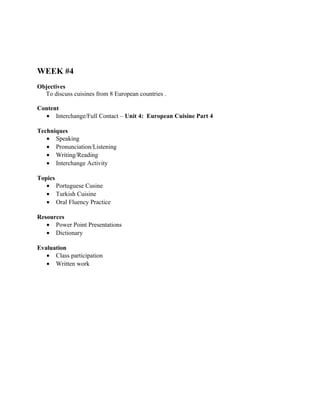
WEEK #4
Objectives
  To discuss cuisines from 8 European countries .

Content
  • Interchange/Full Contact – Unit 4: European Cuisine Part 4

Techniques
   • Speaking
   • Pronunciation/Listening
   • Writing/Reading
   • Interchange Activity

Topics
   • Portuguese Cusine
   • Turkish Cuisine
   • Oral Fluency Practice

Resources
   • Power Point Presentations
   • Dictionary

Evaluation
   • Class participation
   • Written work
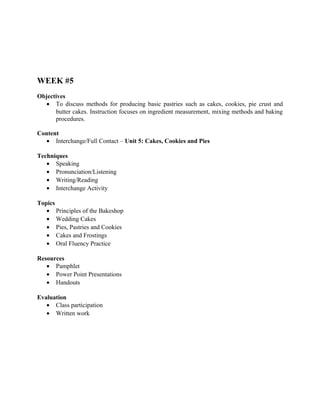
WEEK #5
Objectives
   • To discuss methods for producing basic pastries such as cakes, cookies, pie crust and
      butter cakes. Instruction focuses on ingredient measurement, mixing methods and baking
      procedures.

Content
  • Interchange/Full Contact – Unit 5: Cakes, Cookies and Pies

Techniques
   • Speaking
   • Pronunciation/Listening
   • Writing/Reading
   • Interchange Activity

Topics
   • Principles of the Bakeshop
   • Wedding Cakes
   • Pies, Pastries and Cookies
   • Cakes and Frostings
   • Oral Fluency Practice

Resources
   • Pamphlet
   • Power Point Presentations
   • Handouts

Evaluation
   • Class participation
   • Written work
WEEK #6
Objectives
   • To discuss the history and facts of chocolate and also emphasize nutrients and nutritional
      components.

Content
  • Interchange/Full Contact: Unit 6: Chocolate

Techniques
   • Speaking
   • Pronunciation/Listening
   • Writing/Reading
   • Interchange Activity

Topics
   • History of chocolate
   • Production of chocolate
   • Chocolate uses
   • Nutritional information
   • Types of chocolate
   • Oral Fluency Practice

Resources
   • Power Point Presentations
   • Internet/Videos
   • Handouts

Evaluation
   • Dictation.
   • Class participation.
WEEK #7
Objectives
   • To introduces basic history and production of beer.

Content
  • Interchange/Full Contact - Unit 7: Beer

Techniques
   • Speaking
   • Pronunciation/Listening
   • Writing/Reading
   • Interchange Activity

Topics
   • History of beer
   • Production of beer
   • Ingredients and facts
   • Oral Fluency Practice

Resources
   • Pamphlet
   • Power Point
   • Internet/Videos
   • Dictionary

Evaluation
   • Class participation.
   • Vocabulary test.


ADIESTRAMIENTO PROFESIONAL
SEMANA 8, 9, 10, 11, 12, 13, 14


SEMANA 15

             INVITADO A DICTAR CONFERENCIA

SEMANA 16

               ENTREGA DEL TRABAJO FINAL
                           Ó
              REALIZACIÓN DEL EXAMEN FINAL

H ingles iii

  • 1.
    I.S.A.C. PANAMA Ingles III SYLLABUS AND CLASS SCHEDULE Subject of 16 sessions. Material for support • Pamphlets • Internet • Videos • Dictionary • Notes from class Objectives • To qualify students, in the culinary arts, on the matter of understanding the English language as a basic tool for future professionals. • To teach the basic administrative and culinary terms. • To improve the conversation on a kitchen operation in English. • To explain the translation of standard processes, quality and security norms. • To develop the investigation of culinary topics in English. • Develop activities during the quarter, to practice the playful learning. Methodology • Interactive class, where student would be able to recognize sounds and forms of the administrative and culinary terms. • Oral and written tests will be done to ensure the understanding of these terms. • Classes will be completely in English to encourage students’ choice of key words for the comprehension of the language.
  • 2.
    Evaluation Criteria Classwork and Homework…………………………………………………………..20% Tests……………………….…………………..……………………20% Attendanceand Class Participation………... ………………………………………………30% Final Exam………………………………….………………………30% Total……………………………………….…………....................100% Justification Classwork and homework: essential part of the material that will be evaluated as investigation. Should be delivered on the established deadlines. Tests: These can be oral, written or visual (vocabulary identification) Attendance and Class Participation and Uniform: Attendance is essential to reach the principal objective of this course. The students’ participation is connected with the attendance. The punctuality will be also evaluated. Final Test (Project): Either oral or written. Acquired vocabulary, construction and use of English conversation and writing will be evaluated. A: 100-91 B: 90-81 C: 80-71 D: 70-61 F: 60-0
  • 3.
    WEEKLY DIDACTIC PLANNING WEEK#1 Objectives To discuss cuisines from 8 European countries. Content • Interchange/Full Contact – Unit 1: European Cuisine Techniques • Speaking • Pronunciation/Listening • Writing/Reading • Interchange Activity Topics • English Cuisine • Spanish Cuisine • Oral Fluency Practice Resources: • Power Point Presentations • Internet/Videos • Handouts Evaluation: • Diagnostic Evaluation
  • 4.
    WEEK #2 Objectives To discuss cuisines from 8 European countries. Content • Interchange/Full Contact – Unit 2: European Cuisine Part 2 Techniques • Speaking • Pronunciation/Listening • Writing/Reading • Interchange Activity Topics • French Cuisine • Greek Cuisine • Oral Fluency Practice Resources: • Power Point Presentations • Internet/Videos • Handouts Evaluation: • Diagnostic Evaluation
  • 5.
    WEEK #3 Objectives To discuss cuisines from 8 European countries. Content • Interchange/Full Contact - Unit 3: European Cuisine Part 3 Techniques • Speaking • Pronunciation/Listening • Writing/Reading • Interchange Activity Topics • Italian Cuisine • German Cuisine • Oral Fluency Practice Resources: • Power Point Presentations • Internet/Videos • Handouts Evaluation • Oral participation • Reading aloud
  • 6.
    WEEK #4 Objectives To discuss cuisines from 8 European countries . Content • Interchange/Full Contact – Unit 4: European Cuisine Part 4 Techniques • Speaking • Pronunciation/Listening • Writing/Reading • Interchange Activity Topics • Portuguese Cusine • Turkish Cuisine • Oral Fluency Practice Resources • Power Point Presentations • Dictionary Evaluation • Class participation • Written work
  • 7.
    WEEK #5 Objectives • To discuss methods for producing basic pastries such as cakes, cookies, pie crust and butter cakes. Instruction focuses on ingredient measurement, mixing methods and baking procedures. Content • Interchange/Full Contact – Unit 5: Cakes, Cookies and Pies Techniques • Speaking • Pronunciation/Listening • Writing/Reading • Interchange Activity Topics • Principles of the Bakeshop • Wedding Cakes • Pies, Pastries and Cookies • Cakes and Frostings • Oral Fluency Practice Resources • Pamphlet • Power Point Presentations • Handouts Evaluation • Class participation • Written work
  • 8.
    WEEK #6 Objectives • To discuss the history and facts of chocolate and also emphasize nutrients and nutritional components. Content • Interchange/Full Contact: Unit 6: Chocolate Techniques • Speaking • Pronunciation/Listening • Writing/Reading • Interchange Activity Topics • History of chocolate • Production of chocolate • Chocolate uses • Nutritional information • Types of chocolate • Oral Fluency Practice Resources • Power Point Presentations • Internet/Videos • Handouts Evaluation • Dictation. • Class participation.
  • 9.
    WEEK #7 Objectives • To introduces basic history and production of beer. Content • Interchange/Full Contact - Unit 7: Beer Techniques • Speaking • Pronunciation/Listening • Writing/Reading • Interchange Activity Topics • History of beer • Production of beer • Ingredients and facts • Oral Fluency Practice Resources • Pamphlet • Power Point • Internet/Videos • Dictionary Evaluation • Class participation. • Vocabulary test. ADIESTRAMIENTO PROFESIONAL
  • 10.
    SEMANA 8, 9,10, 11, 12, 13, 14 SEMANA 15 INVITADO A DICTAR CONFERENCIA SEMANA 16 ENTREGA DEL TRABAJO FINAL Ó REALIZACIÓN DEL EXAMEN FINAL