GUJARAT
 The Gujarat state of India, boasts of a rich culture and heritage.
The people of Gujarat are very particular regarding their value
system.
 Gujarat is proud of their customs and traditions and follow them
withutmostpride.
 The people of Gujarat are very simpleand live lifeto thefullest.
 The spirit of Gujarat is quite visible from the varied fairs and
festivalscelebrated in thestate.
Gujaratis known astheland offestivals.
A numberof fairs and festivals are celebrated inthe state
withgreatfervor andjoy.
Thestatehas beenblessed witha richtraditionof
performing arts.
OctobertoMarchis thebest timetovisit Baroda,the
closest importantdestinationinGujarat.
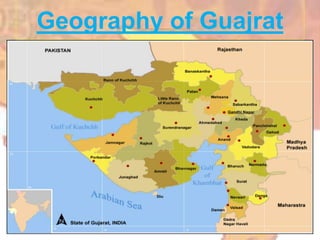
Geography of Guajrat
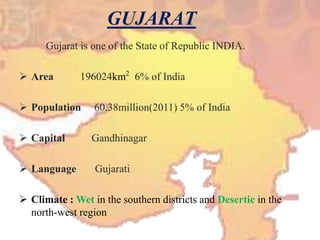
Gujarat is one of the State of Republic INDIA.
 Area 196024km2
6% of India
 Population 60.38million(2011) 5% of India
 Capital Gandhinagar
 Language Gujarati
 Climate : Wet in the southern districts and Desertic in the
north-west region
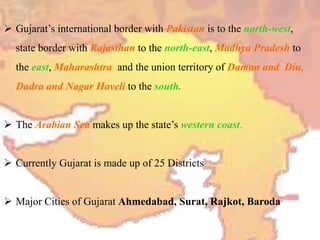
 Gujarat’s international border with Pakistan is to the north-west,
state border with Rajasthan to the north-east, Madhya Pradesh to
the east, Maharashtra and the union territory of Daman and Diu,
Dadra and Nagar Haveli to the south.
 The Arabian Sea makes up the state’s western coast.
 Currently Gujarat is made up of 25 Districts
 Major Cities of Gujarat Ahmedabad, Surat, Rajkot, Baroda
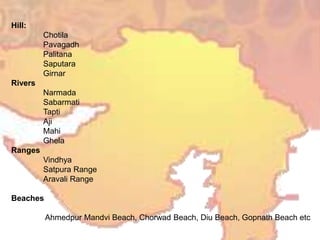
Hill:
Chotila
Pavagadh
Palitana
Saputara
Girnar
Rivers
Narmada
Sabarmati
Tapti
Aji
Mahi
Ghela
Ranges
Vindhya
Satpura Range
Aravali Range
Beaches
Ahmedpur Mandvi Beach, Chorwad Beach, Diu Beach, Gopnath Beach etc
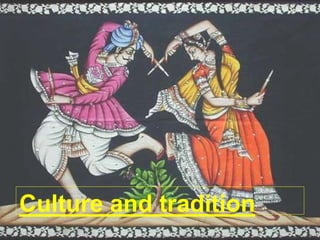
Culture and tradition
Dress and Jewellery
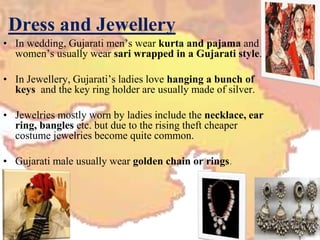
• In wedding, Gujarati men’s wear kurta and pajama and
women’s usually wear sari wrapped in a Gujarati style.
• In Jewellery, Gujarati’s ladies love hanging a bunch of
keys and the key ring holder are usually made of silver.
• Jewelries mostly worn by ladies include the necklace, ear
ring, bangles etc. but due to the rising theft cheaper
costume jewelries become quite common.
• Gujarati male usually wear golden chain or rings.
Food of Gujarati People.
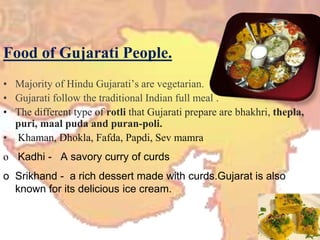
• Majority of Hindu Gujarati’s are vegetarian.
• Gujarati follow the traditional Indian full meal .
• The different type of rotli that Gujarati prepare are bhakhri, thepla,
puri, maal puda and puran-poli.
• Khaman, Dhokla, Fafda, Papdi, Sev mamra
o Kadhi - A savory curry of curds
o Srikhand - a rich dessert made with curds.Gujarat is also
known for its delicious ice cream.
Art and Entertainment.
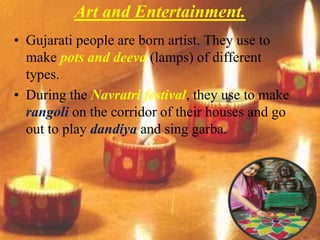
• Gujarati people are born artist. They use to
make pots and deeva (lamps) of different
types.
• During the Navratri festival, they use to make
rangoli on the corridor of their houses and go
out to play dandiya and sing garba.
Major festivals of
Gujarati’s.
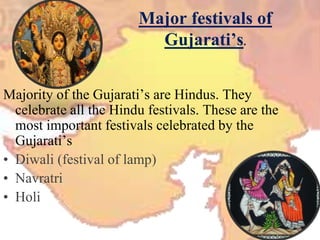
Majority of the Gujarati’s are Hindus. They
celebrate all the Hindu festivals. These are the
most important festivals celebrated by the
Gujarati’s
• Diwali (festival of lamp)
• Navratri
• Holi
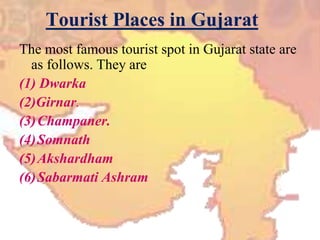
Tourist Places in Gujarat
The most famous tourist spot in Gujarat state are
as follows. They are
(1) Dwarka
(2)Girnar.
(3)Champaner.
(4)Somnath
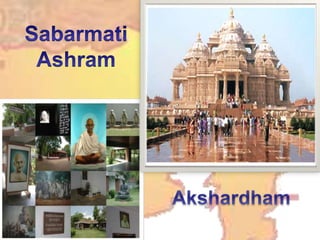
(5)Akshardham
(6)Sabarmati Ashram
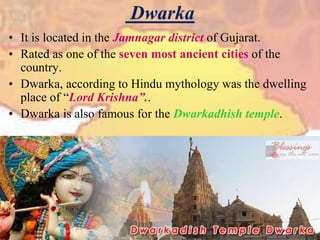
Dwarka
• It is located in the Jamnagar district of Gujarat.
• Rated as one of the seven most ancient cities of the
country.
• Dwarka, according to Hindu mythology was the dwelling
place of “Lord Krishna”..
• Dwarka is also famous for the Dwarkadhish temple.
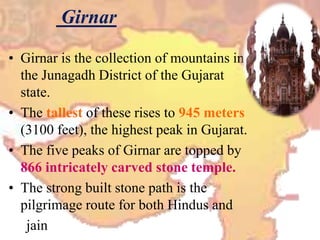
Girnar
• Girnar is the collection of mountains in
the Junagadh District of the Gujarat
state.
• The tallest of these rises to 945 meters
(3100 feet), the highest peak in Gujarat.
• The five peaks of Girnar are topped by
866 intricately carved stone temple.
• The strong built stone path is the
pilgrimage route for both Hindus and
jain
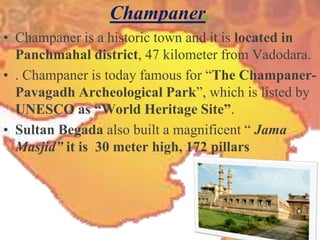
Champaner.
• Champaner is a historic town and it is located in
Panchmahal district, 47 kilometer from Vadodara.
• . Champaner is today famous for “The Champaner-
Pavagadh Archeological Park”, which is listed by
UNESCO as “World Heritage Site”.
• Sultan Begada also built a magnificent “ Jama
Masjid” it is 30 meter high, 172 pillars
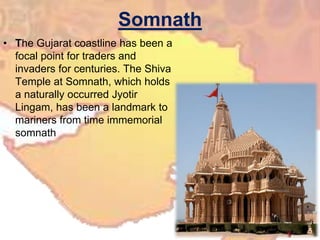
Somnath
• The Gujarat coastline has been a
focal point for traders and
invaders for centuries. The Shiva
Temple at Somnath, which holds
a naturally occurred Jyotir
Lingam, has been a landmark to
mariners from time immemorial
somnath
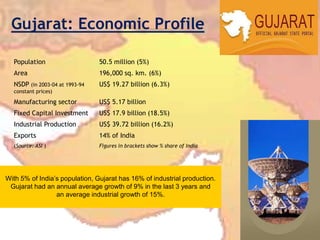
Gujarat: Economic Profile
Population 50.5 million (5%)
Area 196,000 sq. km. (6%)
NSDP (in 2003-04 at 1993-94
constant prices)
US$ 19.27 billion (6.3%)
Manufacturing sector US$ 5.17 billion
Fixed Capital Investment US$ 17.9 billion (18.5%)
Industrial Production US$ 39.72 billion (16.2%)
Exports 14% of India
(Source: ASI ) Figures in brackets show % share of India
With 5% of India’s population, Gujarat has 16% of industrial production.
Gujarat had an annual average growth of 9% in the last 3 years and
an average industrial growth of 15%.
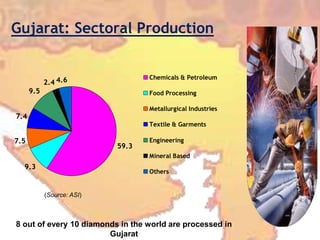
Gujarat: Sectoral Production
(Source: ASI)
59.3
9.3
7.5
7.4
9.5
2.4 4.6 Chemicals & Petroleum
Food Processing
Metallurgical Industries
Textile & Garments
Engineering
Mineral Based
Others
8 out of every 10 diamonds in the world are processed in
Gujarat
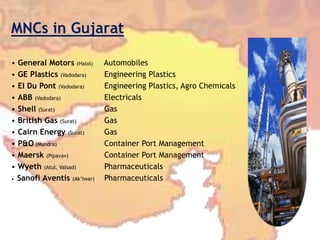
MNCs in Gujarat
• General Motors (Halol)
• GE Plastics (Vadodara)
• EI Du Pont (Vadodara)
• ABB (Vadodara)
• Shell (Surat)
• British Gas (Surat)
• Cairn Energy (Surat)
• P&O (Mundra)
• Maersk (Pipavav)
• Wyeth (Atul, Valsad)
• Sanofi Aventis (Ak’lwar)
Automobiles
Engineering Plastics
Engineering Plastics, Agro Chemicals
Electricals
Gas
Gas
Gas
Container Port Management
Pharmaceuticals
Pharmaceuticals
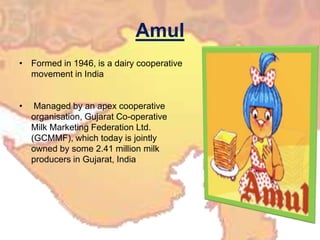
Amul
• Formed in 1946, is a dairy cooperative
movement in India
• Managed by an apex cooperative
organisation, Gujarat Co-operative
Milk Marketing Federation Ltd.
(GCMMF), which today is jointly
owned by some 2.41 million milk
producers in Gujarat, India
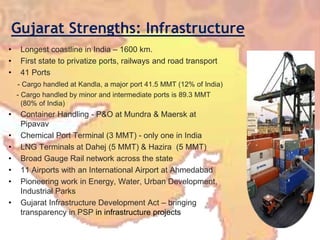
Gujarat Strengths: Infrastructure
• Longest coastline in India – 1600 km.
• First state to privatize ports, railways and road transport
• 41 Ports
- Cargo handled at Kandla, a major port 41.5 MMT (12% of India)
- Cargo handled by minor and intermediate ports is 89.3 MMT
(80% of India)
• Container Handling - P&O at Mundra & Maersk at
Pipavav
• Chemical Port Terminal (3 MMT) - only one in India
• LNG Terminals at Dahej (5 MMT) & Hazira (5 MMT)
• Broad Gauge Rail network across the state
• 11 Airports with an International Airport at Ahmedabad
• Pioneering work in Energy, Water, Urban Development,
Industrial Parks
• Gujarat Infrastructure Development Act – bringing
transparency in PSP in infrastructure projects
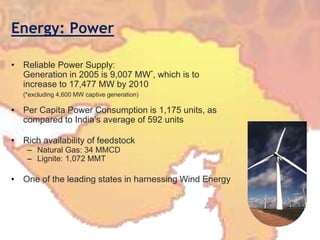
Energy: Power
• Reliable Power Supply:
Generation in 2005 is 9,007 MW*, which is to
increase to 17,477 MW by 2010
(*excluding 4,600 MW captive generation)
• Per Capita Power Consumption is 1,175 units, as
compared to India’s average of 592 units
• Rich availability of feedstock
– Natural Gas: 34 MMCD
– Lignite: 1,072 MMT
• One of the leading states in harnessing Wind Energy
SEZs & Industrial Parks
•11 SEZs
•2 functional multi product SEZs (Kandla & Surat)
•9 under development (Multi Product-3, Apparel-2,
Gems & Jewellery-1, Electronics-1, Petroleum &
Petrochemicals-1, Pharma-1)
•Major amendments in labour legislations in SEZs
•Industrial Parks established in key industries such as Apparel, Gems
& Jewelry, Biotechnology, Pharmaceuticals and IT & Electronics
•83 product clusters - Chemicals, Drugs and Pharmaceuticals, Textile,
Ceramics, Foundry, Engineering, Brass Parts, Fish Processing, etc.
Gujarat is the only state in India having labour
flexibility and full relaxation in Labour laws in SEZs
Industry
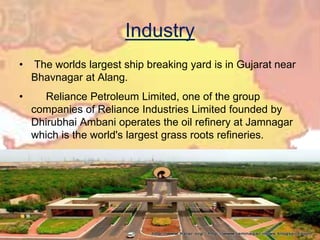
• The worlds largest ship breaking yard is in Gujarat near
Bhavnagar at Alang.
• Reliance Petroleum Limited, one of the group
companies of Reliance Industries Limited founded by
Dhirubhai Ambani operates the oil refinery at Jamnagar
which is the world's largest grass roots refineries.
Industry Growth
During the period 1960-90, Gujarat established itself as a leader in various
industrial sectors - Textiles, Engineering, Chemicals, Petrochemicals. Drugs &
Pharmaceuticals. Dairy, Cement & Ceramics. Gems & Jewellery, etc.
Post-liberalization period saw Gujarat's State Domestic Product (SDP) rising at
an average growth rate of 12.4% per annum
Gujarat ranks first nationwide in gas-based thermal electricity generation with
national market share of over 18% and second nationwide in nuclear electricity
generation with national market share of over 16%.
Agriculture
Major Agricultural produce of the state include cotton,
peanuts, dates, sugar cane, milk & milk products.
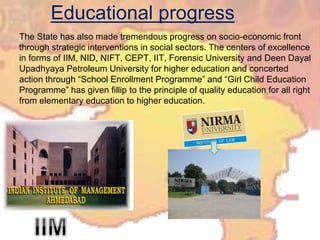
Educational progress
The State has also made tremendous progress on socio-economic front
through strategic interventions in social sectors. The centers of excellence
in forms of IIM, NID, NIFT, CEPT, IIT, Forensic University and Deen Dayal
Upadhyaya Petroleum University for higher education and concerted
action through “School Enrollment Programme” and “Girl Child Education
Programme” has given fillip to the principle of quality education for all right
from elementary education to higher education.
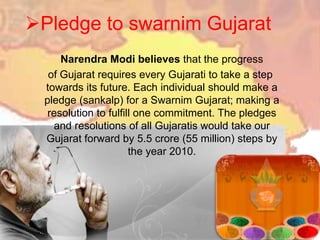
Pledge to swarnim Gujarat
Narendra Modi believes that the progress
of Gujarat requires every Gujarati to take a step
towards its future. Each individual should make a
pledge (sankalp) for a Swarnim Gujarat; making a
resolution to fulfill one commitment. The pledges
and resolutions of all Gujaratis would take our
Gujarat forward by 5.5 crore (55 million) steps by
the year 2010.
conclusion
INCREDIBLE GUJARAT
Presented by:-
sagar sontake
sagar kulkarni
kirti mohite
umesh mate
mukesh tank
sopihya husale
amruta duhmal

Gujarat nes

  • 2.
    GUJARAT  The Gujaratstate of India, boasts of a rich culture and heritage. The people of Gujarat are very particular regarding their value system.  Gujarat is proud of their customs and traditions and follow them withutmostpride.  The people of Gujarat are very simpleand live lifeto thefullest.  The spirit of Gujarat is quite visible from the varied fairs and festivalscelebrated in thestate.
  • 3.
    Gujaratis known asthelandoffestivals. A numberof fairs and festivals are celebrated inthe state withgreatfervor andjoy. Thestatehas beenblessed witha richtraditionof performing arts. OctobertoMarchis thebest timetovisit Baroda,the closest importantdestinationinGujarat.
  • 4.
  • 5.
    Gujarat is oneof the State of Republic INDIA.  Area 196024km2 6% of India  Population 60.38million(2011) 5% of India  Capital Gandhinagar  Language Gujarati  Climate : Wet in the southern districts and Desertic in the north-west region
  • 6.
     Gujarat’s internationalborder with Pakistan is to the north-west, state border with Rajasthan to the north-east, Madhya Pradesh to the east, Maharashtra and the union territory of Daman and Diu, Dadra and Nagar Haveli to the south.  The Arabian Sea makes up the state’s western coast.  Currently Gujarat is made up of 25 Districts  Major Cities of Gujarat Ahmedabad, Surat, Rajkot, Baroda
  • 7.
  • 8.
  • 9.
    Dress and Jewellery •In wedding, Gujarati men’s wear kurta and pajama and women’s usually wear sari wrapped in a Gujarati style. • In Jewellery, Gujarati’s ladies love hanging a bunch of keys and the key ring holder are usually made of silver. • Jewelries mostly worn by ladies include the necklace, ear ring, bangles etc. but due to the rising theft cheaper costume jewelries become quite common. • Gujarati male usually wear golden chain or rings.
  • 10.
    Food of GujaratiPeople. • Majority of Hindu Gujarati’s are vegetarian. • Gujarati follow the traditional Indian full meal . • The different type of rotli that Gujarati prepare are bhakhri, thepla, puri, maal puda and puran-poli. • Khaman, Dhokla, Fafda, Papdi, Sev mamra o Kadhi - A savory curry of curds o Srikhand - a rich dessert made with curds.Gujarat is also known for its delicious ice cream.
  • 11.
    Art and Entertainment. •Gujarati people are born artist. They use to make pots and deeva (lamps) of different types. • During the Navratri festival, they use to make rangoli on the corridor of their houses and go out to play dandiya and sing garba.
  • 12.
    Major festivals of Gujarati’s. Majorityof the Gujarati’s are Hindus. They celebrate all the Hindu festivals. These are the most important festivals celebrated by the Gujarati’s • Diwali (festival of lamp) • Navratri • Holi
  • 13.
    Tourist Places inGujarat The most famous tourist spot in Gujarat state are as follows. They are (1) Dwarka (2)Girnar. (3)Champaner. (4)Somnath (5)Akshardham (6)Sabarmati Ashram
  • 14.
    Dwarka • It islocated in the Jamnagar district of Gujarat. • Rated as one of the seven most ancient cities of the country. • Dwarka, according to Hindu mythology was the dwelling place of “Lord Krishna”.. • Dwarka is also famous for the Dwarkadhish temple.
  • 15.
    Girnar • Girnar isthe collection of mountains in the Junagadh District of the Gujarat state. • The tallest of these rises to 945 meters (3100 feet), the highest peak in Gujarat. • The five peaks of Girnar are topped by 866 intricately carved stone temple. • The strong built stone path is the pilgrimage route for both Hindus and jain
  • 16.
    Champaner. • Champaner isa historic town and it is located in Panchmahal district, 47 kilometer from Vadodara. • . Champaner is today famous for “The Champaner- Pavagadh Archeological Park”, which is listed by UNESCO as “World Heritage Site”. • Sultan Begada also built a magnificent “ Jama Masjid” it is 30 meter high, 172 pillars
  • 17.
    Somnath • The Gujaratcoastline has been a focal point for traders and invaders for centuries. The Shiva Temple at Somnath, which holds a naturally occurred Jyotir Lingam, has been a landmark to mariners from time immemorial somnath
  • 20.
    Gujarat: Economic Profile Population50.5 million (5%) Area 196,000 sq. km. (6%) NSDP (in 2003-04 at 1993-94 constant prices) US$ 19.27 billion (6.3%) Manufacturing sector US$ 5.17 billion Fixed Capital Investment US$ 17.9 billion (18.5%) Industrial Production US$ 39.72 billion (16.2%) Exports 14% of India (Source: ASI ) Figures in brackets show % share of India With 5% of India’s population, Gujarat has 16% of industrial production. Gujarat had an annual average growth of 9% in the last 3 years and an average industrial growth of 15%.
  • 21.
    Gujarat: Sectoral Production (Source:ASI) 59.3 9.3 7.5 7.4 9.5 2.4 4.6 Chemicals & Petroleum Food Processing Metallurgical Industries Textile & Garments Engineering Mineral Based Others 8 out of every 10 diamonds in the world are processed in Gujarat
  • 22.
    MNCs in Gujarat •General Motors (Halol) • GE Plastics (Vadodara) • EI Du Pont (Vadodara) • ABB (Vadodara) • Shell (Surat) • British Gas (Surat) • Cairn Energy (Surat) • P&O (Mundra) • Maersk (Pipavav) • Wyeth (Atul, Valsad) • Sanofi Aventis (Ak’lwar) Automobiles Engineering Plastics Engineering Plastics, Agro Chemicals Electricals Gas Gas Gas Container Port Management Container Port Management Pharmaceuticals Pharmaceuticals
  • 23.
    Amul • Formed in1946, is a dairy cooperative movement in India • Managed by an apex cooperative organisation, Gujarat Co-operative Milk Marketing Federation Ltd. (GCMMF), which today is jointly owned by some 2.41 million milk producers in Gujarat, India
  • 24.
    Gujarat Strengths: Infrastructure •Longest coastline in India – 1600 km. • First state to privatize ports, railways and road transport • 41 Ports - Cargo handled at Kandla, a major port 41.5 MMT (12% of India) - Cargo handled by minor and intermediate ports is 89.3 MMT (80% of India) • Container Handling - P&O at Mundra & Maersk at Pipavav • Chemical Port Terminal (3 MMT) - only one in India • LNG Terminals at Dahej (5 MMT) & Hazira (5 MMT) • Broad Gauge Rail network across the state • 11 Airports with an International Airport at Ahmedabad • Pioneering work in Energy, Water, Urban Development, Industrial Parks • Gujarat Infrastructure Development Act – bringing transparency in PSP in infrastructure projects
  • 25.
    Energy: Power • ReliablePower Supply: Generation in 2005 is 9,007 MW*, which is to increase to 17,477 MW by 2010 (*excluding 4,600 MW captive generation) • Per Capita Power Consumption is 1,175 units, as compared to India’s average of 592 units • Rich availability of feedstock – Natural Gas: 34 MMCD – Lignite: 1,072 MMT • One of the leading states in harnessing Wind Energy
  • 26.
    SEZs & IndustrialParks •11 SEZs •2 functional multi product SEZs (Kandla & Surat) •9 under development (Multi Product-3, Apparel-2, Gems & Jewellery-1, Electronics-1, Petroleum & Petrochemicals-1, Pharma-1) •Major amendments in labour legislations in SEZs •Industrial Parks established in key industries such as Apparel, Gems & Jewelry, Biotechnology, Pharmaceuticals and IT & Electronics •83 product clusters - Chemicals, Drugs and Pharmaceuticals, Textile, Ceramics, Foundry, Engineering, Brass Parts, Fish Processing, etc. Gujarat is the only state in India having labour flexibility and full relaxation in Labour laws in SEZs
  • 27.
    Industry • The worldslargest ship breaking yard is in Gujarat near Bhavnagar at Alang. • Reliance Petroleum Limited, one of the group companies of Reliance Industries Limited founded by Dhirubhai Ambani operates the oil refinery at Jamnagar which is the world's largest grass roots refineries.
  • 28.
    Industry Growth During theperiod 1960-90, Gujarat established itself as a leader in various industrial sectors - Textiles, Engineering, Chemicals, Petrochemicals. Drugs & Pharmaceuticals. Dairy, Cement & Ceramics. Gems & Jewellery, etc. Post-liberalization period saw Gujarat's State Domestic Product (SDP) rising at an average growth rate of 12.4% per annum Gujarat ranks first nationwide in gas-based thermal electricity generation with national market share of over 18% and second nationwide in nuclear electricity generation with national market share of over 16%. Agriculture Major Agricultural produce of the state include cotton, peanuts, dates, sugar cane, milk & milk products.
  • 29.
    Educational progress The Statehas also made tremendous progress on socio-economic front through strategic interventions in social sectors. The centers of excellence in forms of IIM, NID, NIFT, CEPT, IIT, Forensic University and Deen Dayal Upadhyaya Petroleum University for higher education and concerted action through “School Enrollment Programme” and “Girl Child Education Programme” has given fillip to the principle of quality education for all right from elementary education to higher education.
  • 30.
    Pledge to swarnimGujarat Narendra Modi believes that the progress of Gujarat requires every Gujarati to take a step towards its future. Each individual should make a pledge (sankalp) for a Swarnim Gujarat; making a resolution to fulfill one commitment. The pledges and resolutions of all Gujaratis would take our Gujarat forward by 5.5 crore (55 million) steps by the year 2010.
  • 31.
  • 32.
  • 33.
    Presented by:- sagar sontake sagarkulkarni kirti mohite umesh mate mukesh tank sopihya husale amruta duhmal