Guiding Principles
for
Production
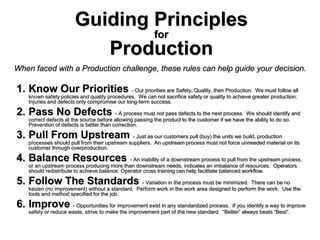
1. Know Our Priorities - Our priorities are Safety, Quality, then Production. We must follow all
known safety policies and quality procedures. We can not sacrifice safety or quality to achieve greater production.
Injuries and defects only compromise our long-term success.
2. Pass No Defects - A process must not pass defects to the next process. We should identify and
correct defects at the source before allowing passing the product to the customer if we have the ability to do so.
Prevention of defects is better than correction.
3. Pull From Upstream - Just as our customers pull (buy) the units we build, production
processes should pull from their upstream suppliers. An upstream process must not force unneeded material on its
customer through overproduction.
4. Balance Resources - An inability of a downstream process to pull from the upstream process,
or an upstream process producing more than downstream needs, indicates an imbalance of resources. Operators
should redistribute to achieve balance. Operator cross training can help facilitate balanced workflow.
5. Follow The Standards - Variation in the process must be minimized. There can be no
kaizen (no improvement) without a standard. Perform work in the work area designed to perform the work. Use the
tools and method specified for the job.
6. Improve - Opportunities for improvement exist in any standardized process. If you identify a way to improve
safety or reduce waste, strive to make the improvement part of the new standard. “Better” always beats “Best”.
When faced with a Production challenge, these rules can help guide your decision.
Guiding Principles
for
Product Design
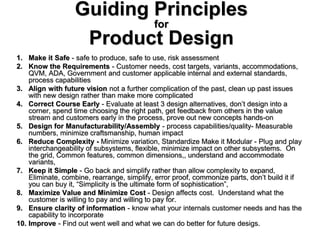
1. Make it Safe - safe to produce, safe to use, risk assessment
2. Know the Requirements - Customer needs, cost targets, variants, accommodations,
QVM, ADA, Government and customer applicable internal and external standards,
process capabilities
3. Align with future vision not a further complication of the past, clean up past issues
with new design rather than make more complicated
4. Correct Course Early - Evaluate at least 3 design alternatives, don’t design into a
corner, spend time choosing the right path, get feedback from others in the value
stream and customers early in the process, prove out new concepts hands-on
5. Design for Manufacturability/Assembly - process capabilities/quality- Measurable
numbers, minimize craftsmanship, human impact
6. Reduce Complexity - Minimize variation, Standardize Make it Modular - Plug and play
interchangeability of subsystems, flexible, minimize impact on other subsystems. On
the grid, Common features, common dimensions,, understand and accommodate
variants,
7. Keep it Simple - Go back and simplify rather than allow complexity to expand,
Eliminate, combine, rearrange, simplify, error proof, commonize parts, don’t build it if
you can buy it, “Simplicity is the ultimate form of sophistication”,
8. Maximize Value and Minimize Cost - Design affects cost. Understand what the
customer is willing to pay and willing to pay for.
9. Ensure clarity of information - know what your internals customer needs and has the
capability to incorporate
10. Improve - Find out went well and what we can do better for future desigs.

Guiding Principles.ppt

  • 1.
    Guiding Principles for Production 1. KnowOur Priorities - Our priorities are Safety, Quality, then Production. We must follow all known safety policies and quality procedures. We can not sacrifice safety or quality to achieve greater production. Injuries and defects only compromise our long-term success. 2. Pass No Defects - A process must not pass defects to the next process. We should identify and correct defects at the source before allowing passing the product to the customer if we have the ability to do so. Prevention of defects is better than correction. 3. Pull From Upstream - Just as our customers pull (buy) the units we build, production processes should pull from their upstream suppliers. An upstream process must not force unneeded material on its customer through overproduction. 4. Balance Resources - An inability of a downstream process to pull from the upstream process, or an upstream process producing more than downstream needs, indicates an imbalance of resources. Operators should redistribute to achieve balance. Operator cross training can help facilitate balanced workflow. 5. Follow The Standards - Variation in the process must be minimized. There can be no kaizen (no improvement) without a standard. Perform work in the work area designed to perform the work. Use the tools and method specified for the job. 6. Improve - Opportunities for improvement exist in any standardized process. If you identify a way to improve safety or reduce waste, strive to make the improvement part of the new standard. “Better” always beats “Best”. When faced with a Production challenge, these rules can help guide your decision.
  • 2.
    Guiding Principles for Product Design 1.Make it Safe - safe to produce, safe to use, risk assessment 2. Know the Requirements - Customer needs, cost targets, variants, accommodations, QVM, ADA, Government and customer applicable internal and external standards, process capabilities 3. Align with future vision not a further complication of the past, clean up past issues with new design rather than make more complicated 4. Correct Course Early - Evaluate at least 3 design alternatives, don’t design into a corner, spend time choosing the right path, get feedback from others in the value stream and customers early in the process, prove out new concepts hands-on 5. Design for Manufacturability/Assembly - process capabilities/quality- Measurable numbers, minimize craftsmanship, human impact 6. Reduce Complexity - Minimize variation, Standardize Make it Modular - Plug and play interchangeability of subsystems, flexible, minimize impact on other subsystems. On the grid, Common features, common dimensions,, understand and accommodate variants, 7. Keep it Simple - Go back and simplify rather than allow complexity to expand, Eliminate, combine, rearrange, simplify, error proof, commonize parts, don’t build it if you can buy it, “Simplicity is the ultimate form of sophistication”, 8. Maximize Value and Minimize Cost - Design affects cost. Understand what the customer is willing to pay and willing to pay for. 9. Ensure clarity of information - know what your internals customer needs and has the capability to incorporate 10. Improve - Find out went well and what we can do better for future desigs.