GUIDELINES FOR TRAINING REPORT
1 The training report shall be computer typed (English- British, Font –
Times Roman,Size-12 point) and printed on A4 size paper.
2 The training report shall be hard bound with cover page in Sky Blue
colour. The name of the candidate, degree (specifying the specialization),
year of submission, name of the University including college name shall
be printed in black on the cover [Refer sample sheet (outer cover)]
3 The training report shall be typed on one side only with 1.5 lines space
with a margin 3.5 cm on the left, 2.5 cm on the top, and 1.25 cm on the
right and at bottom.
4 In the training report, the title page [Refer sample sheet (inner cover)]
should be given first then the Certificate by the candidate and the
supervisor(s) in sequence, followed by an acknowledgment, and this
should be followed by the abstract of the thesis (not exceeding 1500
words)., contents with page no.s list of figures/ list of tables,
notations/nomenclature, and then
5 In the body of the text, a reference should be indicated giving author
name and year of publication in parenthesis such as (Singh and Shan,
2002).
6 The reference should be given at the end of the training report in
alphabetical Order indicating:
i) The authors name and his initials
ii) The title of the paper and name of the journal
iii) The name of the book and the publisher
iv) The number of the volume, page numbers, and the year of publication
v) standard abbreviation may be used in the names of the journals
For Example:
1 Singh, S. and Shan, H. S. (2002) “Development of Magneto Abrasive
Flow Machining Process”, International Journal of Machine Tools &
Manufacturing, vol. 42, 2, 2002, pp. 953-959.
2 Laroiya, S.C. and Adithan, M. (1994), “Precision Machining of
Advanced Ceremics” Proceeding of the International Conference on
Advanced Manufacturing Technology (ICMAT - 94), 29-30 August
1994. University Teknoloi Malaysia, Johor Bahru,Malaysia, pp 203-210.
3 Adithan, M. and Gupta, A.B. (1996), “Manufacturing Technology”,
New Age, International Publishers, New Delhi.
4 The diagrams should be printed on a light/white background, Tabular
Matter should be clearly arranged. Decimal point may be indicated by full
stop (.). The caption for Figure must be given at the BOTTOM of the Fig.
and Caption for the Table must be given at the TOP of the Table.
5 The graphs should be combined for the same parameters for proper
comparison. Single graph should be avoided as far as possible.
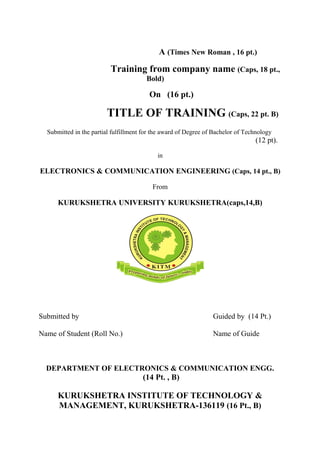
A (Times New Roman , 16 pt.)
Training from company name (Caps, 18 pt.,
Bold)
On (16 pt.)
TITLE OF TRAINING (Caps, 22 pt. B)
Submitted in the partial fulfillment for the award of Degree of Bachelor of Technology
(12 pt).
in
ELECTRONICS & COMMUNICATION ENGINEERING (Caps, 14 pt., B)
From
KURUKSHETRA UNIVERSITY KURUKSHETRA(caps,14,B)
Submitted by Guided by (14 Pt.)
Name of Student (Roll No.) Name of Guide
DEPARTMENT OF ELECTRONICS & COMMUNICATION ENGG.
(14 Pt. , B)
KURUKSHETRA INSTITUTE OF TECHNOLOGY &
MANAGEMENT, KURUKSHETRA-136119 (16 Pt., B)
TRAINING REPORT TRAINING TITLE
DECLARATION
We hereby certify the work which is being presented in the training entitled
“Training title” by “Student Name” in partial fulfillment of requirements for the
award of degree B.Tech (Electronics & Communication Engg.) submitted in the
Department of Electronics & Communication Engg. at Kurukshetra
Institute Of Technology & Management Kurukshetra under Kurukshetra
University, Kurukshetra is carried out during a period from Aug. 2011 to Dec.
2011 under the supervision of “Guide’s Name”. The matter presented in this
training has not been submitted by me in any other University/ Institute for the
award of B.Tech. Degree.
Student Name (Roll No.)
This is to certify that the above statement made by the candidate is correct to the best of
my/our knowledge.
Name
Training Incharge
H.O.D.
i
DEPARTMENT OF ELECTRONICS & COMMUNICATION ENGG.
KURUKSHETRA INSTITUTE OF TECHNOLOGY & MANAGEMENT
KURUKSHETRA- 136119
TRAINING REPORT TRAINING TITLE
ABSTRACT
Transmitting and receiving signals through antenna into different require the tuning of
antenna into different directions this tuning cannot be done manually in case of Heavy
antennas and also it is not precise.
 PRECISION
 AUTOMATIC TUNING
Continued………………
The abstract of the training (not exceeding 1500 words).,
iii
DEPARTMENT OF ELECTRONICS & COMMUNICATION ENGG.
KURUKSHETRA INSTITUTE OF TECHNOLOGY & MANAGEMENT
KURUKSHETRA- 136119
G REPORT TRAINING TITLE
ACKNOWLEDGEMENT
Many lives & destinies are destroyed due to the lack of proper guidance, directions &
opportunities. It is in this respect we feel that we are in much better condition today due to
continuous process of completion of this training was a tedious job & requires careful &
support at all stages. We would like to highlight the role by individuals towards this.
Firstly we are very thankful to our parents and family members for the providing us the
opportunity for providing to build our carrier in field of engineering. Their invaluable
inspiration, guidance & our decisions are worthwhile, without which this training will might
be a dream in our eyes.
We are eternally grateful to honorable Director-Principal Dr. P. J. George for providing us
the opportunity & infrastructure to complete the training as a fulfillment of B.Tech degree.
We are very thankful to Er RAKESH GARG, Head of the Department, for his kind support
& faith in us.
We would like to express our sincere thanks, with a deep sense of gratitude to our training &
Training Incharge for their keen interest in our training.
We are also thankful to all the visible hands, which helped us to complete this training with a
feeling of success.
The above underline matter must be included in the acknowledgement. The above & below
the underline matter is just sample matter, you can change it.
ii
DEPARTMENT OF ELECTRONICS & COMMUNICATION ENGG.
KURUKSHETRA INSTITUTE OF TECHNOLOGY & MANAGEMENT
KURUKSHETRA- 136119
TRAINING REPORT TRAINING TITLE
CONTENTS
Declaration i
Acknowledgement ii
Abstract
iii List of Figures
iv
List of Tables v
Chapter 1: Overview of Company PAGE No.
Chapter 2: INTRODUCTION
1.1 Orthogonal Frequency Division Multiplexing 1
1.1 History of OFDM
2
Chapter 3: CIRCUIT DIAGRAM & WORKING (If Any)
3.1 Establishment of need 10
3.2 Need Analysis 12
3.2.1 Face to Face interview 14
Chapter 4: RESULTS & DISCUSSION 26
Chapter 5: CONCLUSIONS AND FUTURE SCOPE
5.1 Conclusions 27
5.2 Future Scope 28
REFERENCES
APPENDIX (include Datasheet, Source code) 31
DEPARTMENT OF ELECTRONICS & COMMUNICATION ENGG.
KURUKSHETRA INSTITUTE OF TECHNOLOGY & MANAGEMENT
KURUKSHETRA- 136119
TRAINING REPORT TRAINING TITLE
LIST OF FIGURES
S.NO. FIGURE
NO.
DESCRIPTION PAGE
NO.
1. 1.1 Concept of OFDM Signal 4
2 1.2 Time Domain Construction of an OFDM Signal 7
3. 1.3 Frequency Responses of the Subcarriers in a 5 Tone OFDM Signal 10
4 1.4 Elimination of ISI Guard Interval 11
5 1.5 Intercarrier Interference Caused by Guard Interval 12
6 1.6 Addition of Cyclic Prefix 12
8 3.1 Effect of Synchronization 21
9 3.2 Doppler Effect 25
10 4.1 Block Diagram Showing a Basic OFDM Transceiver 26
11
4.2 Example IQ Modulation Constellations. 16-QAM, with Gray
Coding of the Data to Each Location
28
12 4.3 IQ Plot for 16-QAM Data with Added Noise. (Script s0083) 29
13 4.4 OFDM Generations, IFFT Stage 30
14 4.5
RF Modulation of Complex Base Band OFDM Signal, Using
Analog Techniques
30
15 4.6
RF Modulation of Complex Base Band OFDM Signal, Using
Digital Techniques. (DDS = Direct Digital Synthesis)
31
iv
DEPARTMENT OF ELECTRONICS & COMMUNICATION ENGG.
KURUKSHETRA INSTITUTE OF TECHNOLOGY & MANAGEMENT
KURUKSHETRA- 136119
TRAINING REPORT TRAINING TITLE
LIST OF TABLES
S.NO.
TABLE
NO.
DESCRIPTION
PAGE
NO.
1. 1.1 Comparison of Parallel and Serial Transmission Schemes 4
2 5.1 BER Table for Standard OFDM 47
3 5.2 BER Table for Self Cancellation 48
4 5.3 BER Table for Windowing 49
5 5.4 BER Table for Maximum Likelihood 50
6 5.5 BER Table for Epsilon = 0.0 51
7 5.6 BER Table for Epsilon = 0.15 52
8 5.7 BER Table for Epsilon = 0.30 53
9 5.8 BER Table for QAM 56
10 5.9 BER Table for BPSK 56
11 5.10 BER Table for MSK 56
12 5.11 BER Table for N=32 57
13 5.12 BER Table for N=128 57
v
DEPARTMENT OF ELECTRONICS & COMMUNICATION ENGG.
KURUKSHETRA INSTITUTE OF TECHNOLOGY & MANAGEMENT
KURUKSHETRA- 136119

Guidelines for training

  • 1.
    GUIDELINES FOR TRAININGREPORT 1 The training report shall be computer typed (English- British, Font – Times Roman,Size-12 point) and printed on A4 size paper. 2 The training report shall be hard bound with cover page in Sky Blue colour. The name of the candidate, degree (specifying the specialization), year of submission, name of the University including college name shall be printed in black on the cover [Refer sample sheet (outer cover)] 3 The training report shall be typed on one side only with 1.5 lines space with a margin 3.5 cm on the left, 2.5 cm on the top, and 1.25 cm on the right and at bottom. 4 In the training report, the title page [Refer sample sheet (inner cover)] should be given first then the Certificate by the candidate and the supervisor(s) in sequence, followed by an acknowledgment, and this should be followed by the abstract of the thesis (not exceeding 1500 words)., contents with page no.s list of figures/ list of tables, notations/nomenclature, and then 5 In the body of the text, a reference should be indicated giving author name and year of publication in parenthesis such as (Singh and Shan, 2002). 6 The reference should be given at the end of the training report in alphabetical Order indicating: i) The authors name and his initials ii) The title of the paper and name of the journal iii) The name of the book and the publisher iv) The number of the volume, page numbers, and the year of publication v) standard abbreviation may be used in the names of the journals For Example: 1 Singh, S. and Shan, H. S. (2002) “Development of Magneto Abrasive Flow Machining Process”, International Journal of Machine Tools & Manufacturing, vol. 42, 2, 2002, pp. 953-959. 2 Laroiya, S.C. and Adithan, M. (1994), “Precision Machining of Advanced Ceremics” Proceeding of the International Conference on Advanced Manufacturing Technology (ICMAT - 94), 29-30 August 1994. University Teknoloi Malaysia, Johor Bahru,Malaysia, pp 203-210. 3 Adithan, M. and Gupta, A.B. (1996), “Manufacturing Technology”, New Age, International Publishers, New Delhi. 4 The diagrams should be printed on a light/white background, Tabular Matter should be clearly arranged. Decimal point may be indicated by full stop (.). The caption for Figure must be given at the BOTTOM of the Fig. and Caption for the Table must be given at the TOP of the Table. 5 The graphs should be combined for the same parameters for proper comparison. Single graph should be avoided as far as possible.
  • 2.
    A (Times NewRoman , 16 pt.) Training from company name (Caps, 18 pt., Bold) On (16 pt.) TITLE OF TRAINING (Caps, 22 pt. B) Submitted in the partial fulfillment for the award of Degree of Bachelor of Technology (12 pt). in ELECTRONICS & COMMUNICATION ENGINEERING (Caps, 14 pt., B) From KURUKSHETRA UNIVERSITY KURUKSHETRA(caps,14,B) Submitted by Guided by (14 Pt.) Name of Student (Roll No.) Name of Guide DEPARTMENT OF ELECTRONICS & COMMUNICATION ENGG. (14 Pt. , B) KURUKSHETRA INSTITUTE OF TECHNOLOGY & MANAGEMENT, KURUKSHETRA-136119 (16 Pt., B)
  • 3.
    TRAINING REPORT TRAININGTITLE DECLARATION We hereby certify the work which is being presented in the training entitled “Training title” by “Student Name” in partial fulfillment of requirements for the award of degree B.Tech (Electronics & Communication Engg.) submitted in the Department of Electronics & Communication Engg. at Kurukshetra Institute Of Technology & Management Kurukshetra under Kurukshetra University, Kurukshetra is carried out during a period from Aug. 2011 to Dec. 2011 under the supervision of “Guide’s Name”. The matter presented in this training has not been submitted by me in any other University/ Institute for the award of B.Tech. Degree. Student Name (Roll No.) This is to certify that the above statement made by the candidate is correct to the best of my/our knowledge. Name Training Incharge H.O.D. i DEPARTMENT OF ELECTRONICS & COMMUNICATION ENGG. KURUKSHETRA INSTITUTE OF TECHNOLOGY & MANAGEMENT KURUKSHETRA- 136119
  • 4.
    TRAINING REPORT TRAININGTITLE ABSTRACT Transmitting and receiving signals through antenna into different require the tuning of antenna into different directions this tuning cannot be done manually in case of Heavy antennas and also it is not precise.  PRECISION  AUTOMATIC TUNING Continued……………… The abstract of the training (not exceeding 1500 words)., iii DEPARTMENT OF ELECTRONICS & COMMUNICATION ENGG. KURUKSHETRA INSTITUTE OF TECHNOLOGY & MANAGEMENT KURUKSHETRA- 136119
  • 5.
    G REPORT TRAININGTITLE ACKNOWLEDGEMENT Many lives & destinies are destroyed due to the lack of proper guidance, directions & opportunities. It is in this respect we feel that we are in much better condition today due to continuous process of completion of this training was a tedious job & requires careful & support at all stages. We would like to highlight the role by individuals towards this. Firstly we are very thankful to our parents and family members for the providing us the opportunity for providing to build our carrier in field of engineering. Their invaluable inspiration, guidance & our decisions are worthwhile, without which this training will might be a dream in our eyes. We are eternally grateful to honorable Director-Principal Dr. P. J. George for providing us the opportunity & infrastructure to complete the training as a fulfillment of B.Tech degree. We are very thankful to Er RAKESH GARG, Head of the Department, for his kind support & faith in us. We would like to express our sincere thanks, with a deep sense of gratitude to our training & Training Incharge for their keen interest in our training. We are also thankful to all the visible hands, which helped us to complete this training with a feeling of success. The above underline matter must be included in the acknowledgement. The above & below the underline matter is just sample matter, you can change it. ii DEPARTMENT OF ELECTRONICS & COMMUNICATION ENGG. KURUKSHETRA INSTITUTE OF TECHNOLOGY & MANAGEMENT KURUKSHETRA- 136119
  • 6.
    TRAINING REPORT TRAININGTITLE CONTENTS Declaration i Acknowledgement ii Abstract iii List of Figures iv List of Tables v Chapter 1: Overview of Company PAGE No. Chapter 2: INTRODUCTION 1.1 Orthogonal Frequency Division Multiplexing 1 1.1 History of OFDM 2 Chapter 3: CIRCUIT DIAGRAM & WORKING (If Any) 3.1 Establishment of need 10 3.2 Need Analysis 12 3.2.1 Face to Face interview 14 Chapter 4: RESULTS & DISCUSSION 26 Chapter 5: CONCLUSIONS AND FUTURE SCOPE 5.1 Conclusions 27 5.2 Future Scope 28 REFERENCES APPENDIX (include Datasheet, Source code) 31 DEPARTMENT OF ELECTRONICS & COMMUNICATION ENGG. KURUKSHETRA INSTITUTE OF TECHNOLOGY & MANAGEMENT KURUKSHETRA- 136119
  • 7.
    TRAINING REPORT TRAININGTITLE LIST OF FIGURES S.NO. FIGURE NO. DESCRIPTION PAGE NO. 1. 1.1 Concept of OFDM Signal 4 2 1.2 Time Domain Construction of an OFDM Signal 7 3. 1.3 Frequency Responses of the Subcarriers in a 5 Tone OFDM Signal 10 4 1.4 Elimination of ISI Guard Interval 11 5 1.5 Intercarrier Interference Caused by Guard Interval 12 6 1.6 Addition of Cyclic Prefix 12 8 3.1 Effect of Synchronization 21 9 3.2 Doppler Effect 25 10 4.1 Block Diagram Showing a Basic OFDM Transceiver 26 11 4.2 Example IQ Modulation Constellations. 16-QAM, with Gray Coding of the Data to Each Location 28 12 4.3 IQ Plot for 16-QAM Data with Added Noise. (Script s0083) 29 13 4.4 OFDM Generations, IFFT Stage 30 14 4.5 RF Modulation of Complex Base Band OFDM Signal, Using Analog Techniques 30 15 4.6 RF Modulation of Complex Base Band OFDM Signal, Using Digital Techniques. (DDS = Direct Digital Synthesis) 31 iv DEPARTMENT OF ELECTRONICS & COMMUNICATION ENGG. KURUKSHETRA INSTITUTE OF TECHNOLOGY & MANAGEMENT KURUKSHETRA- 136119 TRAINING REPORT TRAINING TITLE
  • 8.
    LIST OF TABLES S.NO. TABLE NO. DESCRIPTION PAGE NO. 1.1.1 Comparison of Parallel and Serial Transmission Schemes 4 2 5.1 BER Table for Standard OFDM 47 3 5.2 BER Table for Self Cancellation 48 4 5.3 BER Table for Windowing 49 5 5.4 BER Table for Maximum Likelihood 50 6 5.5 BER Table for Epsilon = 0.0 51 7 5.6 BER Table for Epsilon = 0.15 52 8 5.7 BER Table for Epsilon = 0.30 53 9 5.8 BER Table for QAM 56 10 5.9 BER Table for BPSK 56 11 5.10 BER Table for MSK 56 12 5.11 BER Table for N=32 57 13 5.12 BER Table for N=128 57 v DEPARTMENT OF ELECTRONICS & COMMUNICATION ENGG. KURUKSHETRA INSTITUTE OF TECHNOLOGY & MANAGEMENT KURUKSHETRA- 136119