Vic06 6.19   7/4/06    1:24 pm     Page 1


             INTERNATIONAL REFERENCE GUIDE TO HAZARDOUS AREAS

                                   HAZARDOUS AREA STANDARDS AND APPROVALS
              There are different standards used for hazardous areas and electrical equipment designed for use in those environments,
              depending upon where in the world they are to be used. In Europe EN standards are used to check compliance with
              the ATEX directive. In the USA the standard is NEC (National Electric Code), with a variant called CEC (Canadian Electric
              Code) used in Canada. In addition some countries have their own approval standards (e.g. GOST for Russia and the
              former Soviet States, TISI for Thailand, etc), however these are often based on EN standards.
              To simplify matters an attempt is being made to harmonise all major standards for use in the IEC Ex scheme. The aim
              of the IECEx Scheme is to facilitate international trade in electrical equipment intended for use in explosive atmospheres
              (Ex equipment) by eliminating the need for multiple national certification while preserving an appropriate level of safety.
              Whilst the standards used in Europe and America are intended to achieve the safe installation and operation of electrical
              equipment in hazardous areas, they are different in principles, classification and approach.
              The purpose of the following guide is to detail some of the differences in the two approaches and to use a step-by-step
              process to select the correct type of luminaire or other electrical, equipment for use in a hazardous area.
              THE CLASSIFICATION OF HAZARDOUS AREAS INTO ZONES IS GIVEN FOR GAS MIXTURES, IN IEC OR
              EN 60079-10 AND SELECTION IN IEC OR EN 60079-14.
              FOR COMBUSTIBLE DUST HAZARDS THE EUROPEAN STANDARDS ARE EN 61241-10 AND EN 61241-14.
              THE INFORMATION FOLLOWING IS GIVEN AS BACKGROUND TO THE USE OF THE ABOVE STANDARDS.
              THE APPLICATION OF THE STANDARDS AND ANY LOCAL REGULATION IS THE RESPONSIBILITY OF THE USER.

                              EUROPEAN HAZARDOUS AREA EQUIPMENT DIRECTIVE,
                                       STANDARDS AND APPROVALS
              ATEX DIRECTIVE
              The ATEX Directive 94/9/EC is a directive adopted by the European Union (EU) to facilitate free trade in the EU by
              aligning the technical and legal requirements in the Member States for products intended for use in potentially explosive
              atmospheres.
              The Directive covers electrical and mechanical equipment and protective systems, which may be used in potentially
              explosive atmospheres (flammable gases, vapours or dusts.) It became mandatory at the end of June 2003 for Europe.
              One of the significant changes that was introduced in the ATEX directive was the move away from defining types of
              equipment by their protection concept and using categories instead. These are in effect levels of safety. They are linked
              to the protection concept by the wording in the individual harmonised European standards. In fact the definition of the
              categories aligns the protection concept with it’s traditional area of use. The directive for use is 99/92/EC.
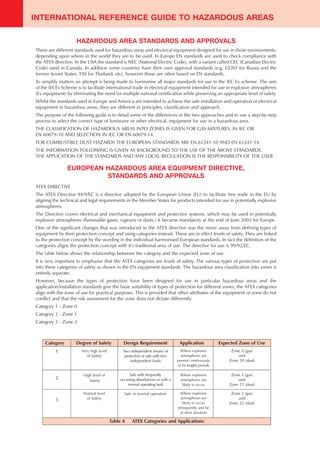
              The table below shows the relationship between the category and the expected zone of use.
              It is very important to emphasise that the ATEX categories are levels of safety. The various types of protection are put
              into these categories of safety as shown in the EN equipment standards. The hazardous area classification into zones is
              entirely separate.
              However, because the types of protection have been designed for use in particular hazardous areas and the
              application/installation standards give the basic suitability of types of protection for different zones, the ATEX categories
              align with the zone of use for practical purposes. This is provided that other attributes of the equipment or zone do not
              conflict and that the risk assessment for the zone does not dictate differently.
              Category 1 - Zone 0
              Category 2 - Zone 1
              Category 3 - Zone 2


                   Category        Degree of Safety          Design Requirement                Application             Expected Zone of Use
                        1            Very high level         Two independent means of           Where explosive             Zone 0 (gas)
                                        of Safety             protection or safe with two       atmospheres are                and
                                                                  independent faults          present continuously         Zone 20 (dust)
                                                                                              or for lengthy periods

                                      High level of              Safe with frequently           Where explosive             Zone 1 (gas)
                        2                                  occurring disturbances or with a     atmospheres are                and
                                         Safety
                                                               normal operating fault            likely to occur           Zone 21 (dust)

                                      Normal level           Safe in normal operation           Where explosive             Zone 2 (gas)
                        3              of Safety                                                atmospheres are                and
                                                                                                 likely to occur           Zone 22 (dust)
                                                                                              infrequently and be
                                                                                                of short duration

                                                       Table 4    ATEX Categories and Applications
Vic06 6.19   7/4/06     1:24 pm          Page 2


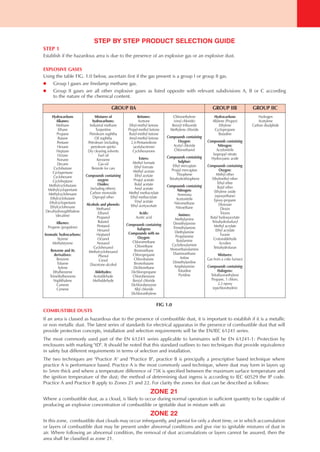
                                                  STEP BY STEP PRODUCT SELECTION GUIDE
                 STEP 1
                 Establish if the hazardous area is due to the presence of an explosive gas or an explosive dust.

                 EXPLOSIVE GASES
                 Using the table FIG. 1.0 below, ascertain first if the gas present is a group I or group II gas.
                 ●      Group I gases are firedamp methane gas.
                 ●      Group II gases are all other explosive gases as listed opposite with relevant subdivisions A, B or C according
                        to the nature of the chemical content.

                                                             GROUP IIA                                                 GROUP IIB              GROUP IIC
                      Hydrocarbons                Mixtures of                Ketones:           Chloroethylene          Hydrocarbons              Hydrogen
                         Alkanes:               hydrocarbons:                Acetone            (vinyl chloride)       Allylene (Propyn)          Acetylene
                         Methane              Industrial methane       Ethyl-methyl ketone     Benzyl trifluoride           Ethylene          Carbon disulphide
                          Ethane                  Turpentine          Propyl-methyl ketone    Methylene chloride        Cyclopropane
                         Propane              Petroleum naphtha       Butyl-methyl ketone                                   Butadine
                          Butane                  Oil naphtha         Amyl-methyl ketone     Compounds containing
                         Pentane             Petroleum (including       2,4-Pentanedione          Oxygen:           Compounds containing
                          Hexane               petroleum spirits)        (acetylacetone)        Acetyl chloride           Nitrogen:
                         Heptane             Dry cleaning solvents       Cyclohexanone          Chloroethanol            Acrylonitrile
                          Octane                    Fuel oil                                                           Isopropyl nitrate
                                                                             Esters:         Compounds containing     Hydrocyanic acide
                         Nonane                    Kerosene                                         Sulphur:
                          Decane                    Gas-oil             Methyl formate
                                                                          Ethyl formate         Ethyl mercaptan     Compounds containing
                       Cyclobutane              Benzole for cars                               Propyl mercaptan            Oxygen:
                       Cyclopentane                                      Methyl acetate
                                            Compounds containing          Ethyl acetate            Thiophene             Mrthyl ether
                       Cyclohexane                                                            Tetrahydrothiophene     Ethylmethyl ether
                       Cycloheptane                 oxygen:              Propyl acetate
                                                    Oxides:               Butyl acetate                                   Ethyl ether
                   Methylcyclobutane                                                         Compounds containing         Butyl ether
                   Methylcyclopentane         (including ethers):         Amyl acetate            Nitrogen:
                                              Carbon monoxide         Methyl methacrylate                               Ethylene oxide
                   Methylcyclohexane                                                              Ammonia               (epoxyethane)
                     Ethylcyclobutane           Dipropyl ether         Ethyl methacrylate        Acetonitrile
                                                                          Vinyl acetate                                Epoxy-propane
                    Ethylcyclopentane       Alcohols and phenols:                               Nitromethane               Dioxoian
                    Ethylcyclohexane                                   Ethyl acetyacetate        Nitroethane
                                                  Methanol                                                                  Dioxin
                  Decahydronaphthalene             Ethanol                  Acids:                                          Trioxin
                        (decaline)                                                                  Amines:
                                                  Propanol                Acetic acid            Methylamine         Butyl hydoxyacetate
                          Alkenes:                 Butanol                                      Dimethylamine         Tetrahydrofurfuryl
                                                  Pentanol           Compounds containing                              Methyl acrylate
                     Propene (propylene)                                   halogens             Trimethylamine
                                                  Hexanol                                        Diethylamine            Ethyl acrylate
                 Aromatic hydrocarbons:           Heptanol            Compounds with no                                     Furane
                                                                           Oxygen:                Propylamine
                         Styrene                   Octanol                                        Butylamine           Crotonaldehyde
                     Methylstyrene                Nonanol               Chloromethane                                      Acrolien
                                                                         Chlorethane           Cyclohexylamine
                                                Cyclohexanol                                  Monoethanolamine         Tetrahydrofuran
                       Benzene and its       Methylcyclohexanol          Bromoethane
                          derivatives:                                  Chloropropane           Diaminoethane              Mixtures:
                                                   Phenol                                            Anline
                           Benzene                  Cresol               Chlorobutane                               Gas from a coke furnace
                            Toluene                                      Bromobutane           Dimethylaniline
                                              Diacetone-alcohol                                  Amphetamine        Compounds containing
                             Xylene                                     Dichlorethane
                         Ethylbenzene              Aldehydes:          Dichloropropane             Toluidine               Halogens:
                      Trimethylbenzene            Acetaldehyde          Chlorobenzene               Pyridine          Telrafluoroethylene
                         Naphthalene              Methaldehyde          Benzyl chloride                               Propane, 1 chloro.
                           Cumene                                      Dichlorobenzene                                     2,3 epoxy
                            Cymene                                       Allyl chloride                                (epichlorohydrin)
                                                                       Dichloroethylene

                                                                                        FIG 1.0
                 COMBUSTIBLE DUSTS
                 If an area is classed as hazardous due to the presence of combustible dust, it is important to establish if it is a metallic
                 or non metallic dust. The latest series of standards for electrical apparatus in the presence of combustible dust that will
                 provide protection concepts, installation and selection requirements will be the EN/IEC 61241 series.
                 The most commonly used part of the EN 61241 series applicable to luminaires will be EN 61241-1: Protection by
                 enclosures with marking "tD". It should be noted that this standard outlines to two techniques that provide equivalence
                 in safety but different requirements in terms of selection and installation.
                 The two techniques are "Practice A" and "Practice B", practice B is principally a prescriptive based technique where
                 practice A is performance based. Practice A is the most commonly used technique, where dust may form in layers up
                 to 5mm thick and where a temperature difference of 75K is specified between the maximum surface temperature and
                 the ignition temperature of the dust; the method of determining dust ingress is according to IEC 60529 the IP code.
                 Practice A and Practice B apply to Zones 21 and 22. For clarity the zones for dust can be described as follows:
                                                                                    ZONE 21
                 Where a combustible dust, as a cloud, is likely to occur during normal operation in sufficient quantity to be capable of
                 producing an explosive concentration of combustible or ignitable dust in mixture with air.
                                                                                    ZONE 22
                 In this zone, combustible dust clouds may occur infrequently, and persist for only a short time, or in which accumulation
                 or layers of combustible dust may be present under abnormal conditions and give rise to ignitable mixtures of dust in
                 air. Where following an abnormal condition, the removal of dust accumulations or layers cannot be assured, then the
                 area shall be classified as zone 21.
Vic06 6.19   7/4/06      1:24 pm          Page 3


             INTERNATIONAL REFERENCE GUIDE TO HAZARDOUS AREAS

              STEP 2
              Now having established which gas or dusts are present, the next thing to establish is the hazardous area category.
              FIG 1.1 below sets out the zone definitions to classify your area.


                  ZONE                TYPE OF PROTECTION ASSIGNED TO APPARATUS

                  Zone 0              An area in which an explosive atmosphere is continuously present or for long periods or frequently

                  Zone 1              An area in which an explosive atmosphere is likely to occur in normal operation occasionally

                  Zone 2              An area in which an explosive atmosphere is not likely to occur in normal operation
                                      and if it occurs it will exist only for a short time.
                                      (Zone 2 is often described as the ‘remotely hazardous area’.)
                                                           TABLE 2 HAZARDOUS AREA CLASSIFICATION

                                                                                    FIG 1.1


              Using the guide in FIG 1.1 you can now classify the hazardous area into a zone. If you are unsure as to which zone an
              area should be classified as, please refer to your local health and safety officer or your fire brigade for guidance. Victor
              Lighting or any other manufacturer of hazardous area equipment is not able to offer any advice in this respect.


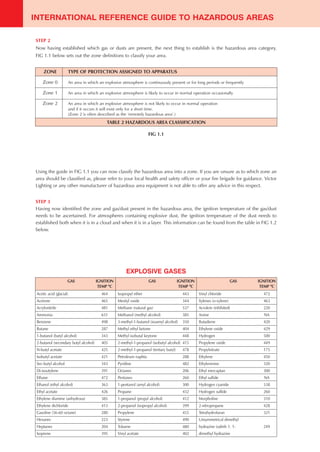
              STEP 3
              Having now identified the zone and gas/dust present in the hazardous area, the ignition temperature of the gas/dust
              needs to be ascertained. For atmospheres containing explosive dust, the ignition temperature of the dust needs to
              established both when it is in a cloud and when it is in a layer. This information can be found from the table in FIG 1.2
              below.


                                                                      EXPLOSIVE GASES
                                  GAS                IGNITION                       GAS                 IGNITION                        GAS   IGNITION
                                                      TEMP oC                                            TEMP oC                               TEMP oC
              Acetic acid (glacial)                     464      Isopropyl ether                          443      Vinyl chloride               472
              Acetone                                   465      Mesityl oxide                            344      Xylenes (o-xylene)           463
              Acrylonitrile                             481      Methane (natural gas)                    537      Acrolein (inhibited)         220
              Ammonia                                   651      Methanol (methyl alcohol)                385      Arsine                       NA
              Benzene                                   498      3-methyl-1-butanol (isoamyl alcohol)     350      Butadiene                    420
              Butane                                    287      Methyl ethyl ketone                      404      Ethylene oxide               429
              1-butanol (butyl alcohol)                 343      Methyl isobutal keytone                  448      Hydrogen                     500
              2-butanol (secondary butyl alcohol)       405      2-methyl-1-propanol (isobutyl alcohol) 415        Propylene oxide              449
              N-butyl acetate                           425      2-methyl-1-propanol (tertiary butyl)     478      Propylnitrate                175
              Isobutyl acetate                          421      Petroleum naphta                         288      Ethylene                     450
              Sec-butyl alcohol                         343      Pyridine                                 482      Ethylenmine                  320
              Di-isoutylene                             391      Octanes                                  206      Ethyl mercaptan              300
              Ethane                                    472      Pentanes                                 260      Ethyl sulfide                NA
              Ethanol (ethyl alcohol)                   363      1-pentanol (amyl alcohol)                300      Hydrogen cyanide             538
              Ethyl acetate                             426      Propane                                  432      Hydrogen sulfide             260
              Ethylene diamine (anhydrous)              385      1-propanol (propyl alcohol)              412      Morpholine                   310
              Ethylene dichloride                       413      2-propanol (isopropyl alcohol)           399      2-nitropropane               428
              Gasoline (56-60 octane)                   280      Propylene                                455      Tetrahydrofuran              321
              Hexanes                                   223      Styrene                                  490      Unsymmetrical dimethyl
              Heptanes                                  204      Toluene                                  480      hydrazine (udmh 1. 1-        249
              Isoprene                                  395      Vinyl acetate                            402      dimethyl hydrazine
Vic06 6.19   7/4/06   1:24 pm     Page 4


                                   EXPLOSIVE DUSTS                                            EXPLOSIVE DUSTS
                                      METALLIC                                                 NON METALLIC
                              MATERIAL                      CLOUD LAYER                  MATERIAL                  CLOUD LAYER
                              Aluminum                       650   760                   Alfalfa                    460   200
                              Magnesium                      620   490                   Cocoa                      420   200
                                                                                         Coffee                     410   220
                              Titanium                       330   510
                                                                                         Corn                       400   250
                              Zinc                           630   430
                                                                                         Cornstarch                 380   200
                              Bronze                         370   190                   Malt                       400   250
                              Chromium                       580   400                   Skim milk                  490   200
                              Tin                            630   430                   Rice                       440   220
                              Cadmium                        570   250                   Sugar                      350   400
                                                                                         Wheat                      480   220
                                                                                         Coal (pittsburgh seam)     610   180
                                                                                         Wheat flour                380   360
                                                                                         Cellulose acetate          450   390
                                   EXPLOSIVE FIBRES                                      Ethyl acetate              450   390
                                                                                         Nylon                      500   430
                              MATERIAL                      CLOUD LAYER                  Polyethylene               450   380
                                                                                         Polystyrene                560    -
                              Cotton lint                    520    -
                                                                                         Epoxy                      540    -
                              Flax                           430   230
                                                                                         Polyurethane               550   390
                              Rayon                          520   250                   Cork                       490   280
                                                                                         Wood flour (white pine)    470   260
                                                                           FIG 1.2
                 STEP 4
                 Knowing the ignition temperature of the explosive atmosphere, the zone and the gas grouping or dust type we are better
                 able to decide upon the appropriate type of electrical apparatus required. It is important therefore to understand the
                 certified protection concepts recognised for safe operation as used for an ATEX category and/or within a zone.
                 The category in ATEX links to types of protection listed below. If the ATEX categories are used as a cross reference to
                 zones then the protection concepts listed apply


                  ATEX CATEGORY PROTECTION TYPE - STANDARDS AND PROTECTION METHODS

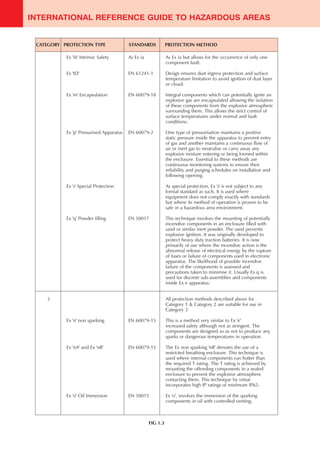
                 CATEGORY PROTECTION TYPE                          STANDARDS         PROTECTION METHOD

                      1         Ex 'ia' Intrinsic Safety.          EN 50020          Where the design limits the ignition spark energy to
                                                                                     below that which will ignite the explosive gas. Safe
                                                                                     even with two simultaneous faults.

                                Special protection for             EN60079-26        Special construction normally based on the use of
                                Category 1 [and Zone 1]                              two independent types of protection both
                                                                                     individually suitable for Category 1.


                      2         Ex 'ia' Intrinsic Safety                             All protection methods described above for
                                                                                     Category 1 are also suitable for Category 2.

                                Ex 'e' Increased Safety            EN 60079-7        Design prevents any ignition from occurring by
                                                                                     ensuring no normally sparking components are used
                                                                                     and other components reduce the risk of causing a
                                                                                     fault that may cause an ignition. This is achieved by
                                                                                     strictly controlling and limiting the temperature of
                                                                                     components, ensuring adequate insulation is used,
                                                                                     all electrical connections are true and the IP rating
                                                                                     offers adequate protection against contamination.

                                Ex 'd' Flameproof                  EN60079-1         The components may produce sparks that could
                                                                                     cause ignition of the explosive gas but which are
                                                                                     housed in an explosive proof enclosure. The design
                                                                                     of the enclosure may allows the gas to enter, but
                                                                                     any explosion is contained within the enclosure.
Vic06 6.19   7/4/06   1:24 pm   Page 5


             INTERNATIONAL REFERENCE GUIDE TO HAZARDOUS AREAS


              CATEGORY PROTECTION TYPE                    STANDARDS            PROTECTION METHOD

                           Ex 'ib' Intrinsic Safety       As Ex ia             As Ex ia but allows for the occurrence of only one
                                                                               component fault.

                           Ex 'tD'                        EN 61241-1           Design ensures dust ingress protection and surface
                                                                               temperature limitation to avoid ignition of dust layer
                                                                               or cloud.

                           Ex 'm' Encapsulation           EN 60079-18          Integral components which can potentially ignite an
                                                                               explosive gas are encapsulated allowing the isolation
                                                                               of these components from the explosive atmosphere
                                                                               surrounding them. This allows the strict control of
                                                                               surface temperatures under normal and fault
                                                                               conditions.

                           Ex 'p' Pressurised Apparatus   EN 60079-2           One type of pressurisation maintains a positive
                                                                               static pressure inside the apparatus to prevent entry
                                                                               of gas and another maintains a continuous flow of
                                                                               air or inert gas to neutralise or carry away any
                                                                               explosive mixture entering or being formed within
                                                                               the enclosure. Essential to these methods are
                                                                               continuous monitoring systems to ensure their
                                                                               reliability and purging schedules on installation and
                                                                               following opening.

                           Ex 's' Special Protection                           As special protection, Ex 's' is not subject to any
                                                                               formal standard as such. It is used where
                                                                               equipment does not comply exactly with standards
                                                                               but where its method of operation is proven to be
                                                                               safe in a hazardous area environment.

                           Ex 'q' Powder filling          EN 50017             This technique involves the mounting of potentially
                                                                               incendive components in an enclosure filled with
                                                                               sand or similar inert powder. The sand prevents
                                                                               explosive ignition. It was originally developed to
                                                                               protect heavy duty traction batteries. It is now
                                                                               primarily of use where the incendive action is the
                                                                               abnormal release of electrical energy by the rupture
                                                                               of fuses or failure of components used in electronic
                                                                               apparatus. The likelihood of possible incendive
                                                                               failure of the components is assessed and
                                                                               precautions taken to minimise it. Usually Ex q is
                                                                               used for discrete sub-assemblies and components
                                                                               inside Ex e apparatus.


                  3                                                            All protection methods described above for
                                                                               Category 1 & Category 2 are suitable for use in
                                                                               Category 3

                           Ex 'n' non sparking            EN 60079-15          This is a method very similar to Ex 'e'
                                                                               increased safety although not as stringent. The
                                                                               components are designed so as not to produce any
                                                                               sparks or dangerous temperatures in operation.

                           Ex 'nA' and Ex 'nR'            EN 60079-15          The Ex non sparking 'nR' denotes the use of a
                                                                               restricted breathing enclosure. This technique is
                                                                               used where internal components run hotter than
                                                                               the required T rating. The T rating is achieved by
                                                                               mounting the offending components in a sealed
                                                                               enclosure to prevent the explosive atmosphere
                                                                               contacting them. This technique by virtue
                                                                               incorporates high IP ratings of minimum IP65.

                           Ex 'o' Oil Immersion           EN 50015             Ex 'o', involves the immersion of the sparking
                                                                               components in oil with controlled venting.


                                                                     FIG 1.3
Vic06 6.19   7/4/06   1:24 pm    Page 6


                 STEP 5
                 Now that you have clarified the gases/dusts present, their ignition temperature, the zone and applicable protection
                 methods, the certified temperature codings must be understood for choosing the correct luminaire. Failure to
                 understand the relationships could result in selecting an inappropriate luminaire for the zone and atmosphere. If the
                 luminaires T rating code signifies the surface temperature of the equipment is greater than the ignition temperature of
                 the gas/dust present, the luminaire will ignite the surrounding atmosphere causing an explosion.
                 Below FIG 1.4 shows the temperature codes related to surface temperatures. Using this table check the ignition
                 temperature of the gas/dust present, as shown in FIG 1.2. This will then indicate the suitability of the equipment you
                 have selected, or the temperature rating of the equipment you need to select.


                                             TEMPERATURE                       MAXIMUM SURFACE TEMPERATURE
                                            CLASSIFICATION                          OF EQUIPMENT (OC)

                                                    T1                                              450
                                                    T2                                              300
                                                    T3                                              200
                                                    T4                                              135
                                                    T5                                              100
                                                    T6                                              85

                                                                          FIG 1.4


                 STEP 6
                 The environment that the equipment will operate in is also important. Many environments are arduous and may involve
                 the equipment being subject to the following:


                                            TYPES OF ENVIRONMENT                                     EXAMPLES

                                   Extreme high or low temperatures                         Middle east/Norway
                                   Arduous weather conditions                               Offshore/Marine
                                   Immersion in water                                       Dry docks
                                   Subject to dusty atmospheres                             Clean rooms/Grain silos


                                                                          FIG 1.5
                 In order to ensure that the equipment selected will perform in the environment for which it is intended, the following
                 factors of equipment performance need to be considered.

                 ●    Ambient temperature - Does the equipment have certification to operate within the minimum and maximum
                      temperatures of the environment?
                 ●    How much dust/liquid etc will the equipment be subjected to and for how long?
                 ●    Will the equipment be subject to any likely impact during its service life?
                 ●    Are there any chemicals/vapours present that could attack luminaires with plastic enclosures?
                 When selecting equipment, the product information will state the certified operating temperature such as the example
                 below. If in selecting equipment the product information contains no statement or reference to ambient temperature be
                 very sceptical and do not assume. Always check and obtain written confirmation from the manufacturer.
                                                                Example Floodlight VL65A
                                                                   -50OC to +55OC
Vic06 6.19   7/4/06     1:24 pm              Page 7


             INTERNATIONAL REFERENCE GUIDE TO HAZARDOUS AREAS

              Always check that the ambient temperature certification is applicable to your relevant choice of product as maximum
              ambient performances are often quoted and may only be applicable to certain product variants.
              If the environment will subject the equipment to any dust/fibres/liquids, ensure it is certified to an appropriate level of
              ingress protection. This can be done using the table below.


                                                                              INDEX OF PROTECTION (IP XX)
              IP** degree of protection of enclosures of electrical equipment in accordance with standards IEC 529, EN 60529 and
              NFC 20-010


               1st figure: Protection against solid bodies
                IP         0                        1                                    2                              3                               4                              5                              6
                                                                                      Ø12.5mm
                TESTS


                                                       Ø50mm
                                                                                                                          Ø2.5mm                         Ø1mm


                        No           Protected against solid               Protected against solid bodies Protected against solid bodies Protected against solid bodies Protected against dust            Completely protected
                        Protection   bodies of 50 mm and greater           of 12.5 mm and greater         of 2.5mm and greater           larger than 1 mm                 (no harmful deposit)            against dust
                                     (e.g. accidental contact with         (e.g. finger)                  (e.g. tools, wires)            (e.g. thin tools and fine wires)
                                     the hand)


               2nd figure: Protection against liquids
                IP         0                   1                            2                       3                       4                      5                       6                       7                       8
                                                                                                                                                                                                                            Ø50mm
                TESTS


                                                                       O

                                                                      15                      60
                                                                                                O


                                                                                                                                                                                                                  m
                                                                                                                                                                                          1m


                                                                                                                                                                                                          15cm
                                                                                                                                                                                                          min
                        No           Protected against          Protected against         Protected against        Protected against      Protected against jets   Protected against      Protected against the   Protected against the
                        Protection   vertically falling drops   drops of water falling    drops of water falling   splashing water from   of water from all        powerful jets of water effects of temporary    continuous effects of
                                     of water                   up to 15o from the        up to 60o from the       all directions         directions               from all directions    immersion in water      immersion in water
                                     (condensation)             vertical                  vertical                                                                                                                having regard to
                                                                                                                                                                                                                  specific conditions


                                                                                                                   FIG 1.6

                                                                                              Example Floodlight VL65A
                                                                                         Ingress protection to IP66 and IP67
              STEP 7... FINALLY
              Having covered all the rules and safety considerations of the operation of electrical equipment in a hazardous area it is
              now possible to select a safe and appropriate product.
Vic06 6.19   7/4/06   1:24 pm   Page 8


                                      INTERNATIONAL STANDARDS AND APPROVALS

                 IECEx International Certification Scheme
                 “The aim of the IECEx Scheme is to facilitate international trade in electrical equipment intended for use in
                 explosive atmosphere (Ex equipment) by eliminating the need for multiple national certification while
                 preserving an appropriate level of safety.”
                 “The final objective of the IECEx Scheme is worldwide acceptance of one standard, one certificate and one
                 mark.”


                 GOST-R (Russia)
                 Gosstandart of Russia is responsible for:
                      ●   establishment of the general rules and recommendations for certification of products, services (works)
                          and systems of quality and production harmonised with international norms and rules;
                      ●   carrying out the State registration of the mandatory and voluntary certification systems and of the
                          conformity marks.
                 Russia participates in the following international certification systems:
                      ●   System of the International Electrotechnical Commission (IEC) for tests of electrical equipment on
                          conformity to the safety standards.


                 GGTN
                 Gosgortekhnadzor (GGTN) is the Federal Mining and Industrial Safety Supervisory Authority of Russia, and is
                 responsible for the issue of permits and licenses for a broad range of machinery and equipment. As a separate
                 entity to Gosstandart, GGTN requires product types that fall under its jurisdiction to undergo a further
                 certification process.
                 All potentially hazardous machinery and equipment, such as pressure vessels, boilers, burners, lifts and cranes
                 is subject to GGTN approval, even if it has already obtained a GOST-R Coc.
                 In addition, any machinery to be used in hazardous or potentially explosive environments, such as oil or gas
                 fields, refineries or chemical plants also require a separate GGTN permit. This applies even where the
                 equipment itself would not normally require GOST-R approval.
Vic06 6.19   7/4/06       1:24 pm      Page 9


             INTERNATIONAL REFERENCE GUIDE TO HAZARDOUS AREAS

                                       NORTH AMERICAN STANDARDS AND APPROVALS
              PRODUCT CODING
              As in the European section, products are coded according to their certification for use in particular types of
              environments.
                            Class                       Division                        Gas Grouping           Surface temperature rating


                            Class I                    Division 2                  Groups A, B, C and D                       T4A


              STEP I
              As detailed in the European section in STEP 1 the gas/dust/fibre present in the hazardous area needs to be identified
              and classified under the CECNEC (North American) classifications detailed in FIG 1.9 below.


                                                      CLASS I (EXPLOSIVE GASES)

                          GROUP A ATMOSPHERE                                              GROUP D ATMOSPHERE
              Acetylene                         305     Acetic acid (glacial)                 464   Mesityl oxide                            344
                                                        Acetone                               465   Methane (natural gas)                    537
                          GROUP B ATMOSPHERE            Acrylonitrile                         481   Methanol (methyl alcohol)                385
              Acrolein (inhibited)              220     Ammonia                               651   3-methyl-1-butanol (isoamyl alcohol)     350
              Arsine                            NA      Benzene                               498   Methyl ethyl ketone                      404
              Butadiene                         420     Butane                                287   Methyl isobutal keytone                  448
              Ethylene oxide                    429     1-butanol (butyl alcohol)             343   2-methyl-1-propanol (isobutyl alcohol)   415
              Hydrogen                          500     2-butanol (secondary butyl alcohol)   405   2-methyl-1-propanol (tertiary butyl)     478
              Propylene oxide                   449     N-butyl acetate                       425   Petroleum naphta                         288
              Propylnitrate                     175     Isobutyl acetate                      421   Pyridine                                 482
                                                        Sec-butyl alcohol                     343   Octanes                                  206
                          GROUP C ATMOSPHERE            Di-isoutylene                         391   Pentanes                                 260
              Ethylene                          450     Ethane                                472   1-pentanol (amyl alcohol)                300
              Ethylenmine                       320     Ethanol (ethyl alcohol)               363   Propane                                  432
              Ethyl mercaptan                   300     Ethyl acetate                         426   1-propanol (propyl alcohol)              412
              Ethyl sulfide                     NA      Ethylene diamine (anhydrous)          385   2-propanol (isopropyl alcohol)           399
              Hydrogen cyanide                  538     Ethylene dichloride                   413   Propylene                                455
              Hydrogen sulfide                  260     Gasoline (56-60 octane)               280   Styrene                                  490
              Morpholine                        310     Hexanes                               223   Toluene                                  480
              2-nitropropane                    428     Heptanes                              204   Vinyl acetate                            402
              Tetrahydrofuran                   321     Isoprene                              395   Vinyl chloride                           472
              Unsymmetrical dimethyl                    Isopropyl ether                       443   Xylenes (o-xylene)                       463
              hydrazine (udmh 1. 1-             249
              dimethyl hydrazine
Vic06 6.19   7/4/06   1:24 pm       Page 10


                                                          CLASS II (EXPLOSIVE DUSTS)

                                  GROUP E
                 MATERIAL                 CLOUD LAYER        MATERIAL             CLOUD LAYER      MATERIAL                  CLOUD LAYER
                 Aluminum                   650     760      Alfalfa                 460   200     Wheat flour                380   360
                 Magnesium                  620     490      Cocoa                   420   200     Cellulose acetate          450   390
                 Titanium                   330     510      Coffee                  410   220     Ethyl acetate              450   390
                 Zinc                       630     430      Corn                    400   250     Nylon                      500   430
                 Bronze                     370     190      Cornstarch              380   200     Polyethylene               450   380
                 Chromium                   580     400      Malt                    400   250     Polystyrene                560    -
                 Tin                        630     430      Skim milk               490   200     Epoxy                      540    -
                 Cadmium                    570     250      Rice                    440   220     Polyurethane               550   390
                                                             Sugar                   350   400     Cork                       490   280
                                  GROUP F                    Wheat                   480   220     Wood flour (white pine)    470   260
                 MATERIAL                 CLOUD LAYER
                 Coal (Pittsburgh Seam)       610    180


                                                      CLASS III (EXPLOSIVE FIBRES)

                                                            MATERIAL              CLOUD LAYER
                                                            Cotton lint              520     -
                                                            Flax                     430    230
                                                            Rayon                    520    250


                                                                           FIG 1.9
                 Using FIG 1.9 we can also ascertain the ignition temperatures of the identified gas/dust/fibre present.


                 STEP 2
                 Select the Gas/Dust/Fibre type present from FIG 1.9 and note:
                 ●    Material classification
                      I = Gas
                      II = Dust
                      III = Fibre

                 ●    The material group

                 ●    If the material present is a dust or fibre and whether it forms a cloud or a layer on surfaces

                 ●    The ignition temperature of the material

                 STEP 3
                 Assess the hazardous area as in STEP 2 of the european section with regard to the potential frequency and longevity of
                 an explosive atmosphere. This can be done using the classifications below.


                     DIVISION        CLASSIFICATION CRITERIA

                        1            Gas/dust/fibres normally present in explosive amounts during operation.

                        2            Gas/dust/fibres not normally present in explosive amounts during operation.
Vic06 6.19   7/4/06      1:24 pm              Page 11


             INTERNATIONAL REFERENCE GUIDE TO HAZARDOUS AREAS

              STEP 4
              Now having defined the explosive gas/dust/fibres present, the nature of their presence, their ignition temperature and
              the classification of the hazardous area we, need to determine the temperature classifications to ensure the selection of
              equipment which will be safe in operation.
              The classifications, which are similar to Europe, are further subdivided as follows


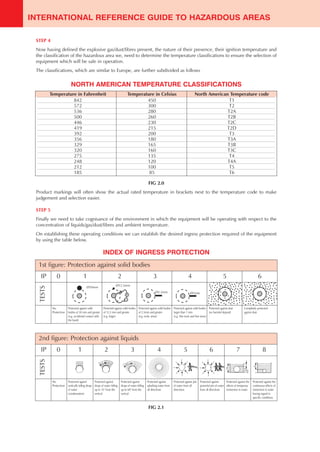
                                        NORTH AMERICAN TEMPERATURE CLASSIFICATIONS
                        Temperature in Fahrenheit                                                Temperature in Celsius                                        North American Temperature code
                                  842                                                                    450                                                                  T1
                                  572                                                                    300                                                                  T2
                                  536                                                                    280                                                                 T2A
                                  500                                                                    260                                                                 T2B
                                  446                                                                    230                                                                 T2C
                                  419                                                                    215                                                                T2D
                                  392                                                                    200                                                                  T3
                                  356                                                                    180                                                                 T3A
                                  329                                                                    165                                                                 T3B
                                  320                                                                    160                                                                 T3C
                                  275                                                                    135                                                                  T4
                                  248                                                                    120                                                                 T4A
                                  212                                                                    100                                                                  T5
                                  185                                                                     85                                                                  T6

                                                                                                                     FIG 2.0
              Product markings will often show the actual rated temperature in brackets next to the temperature code to make
              judgement and selection easier.

              STEP 5
              Finally we need to take cognisance of the environment in which the equipment will be operating with respect to the
              concentration of liquids/gas/dust/fibres and ambient temperature.
              On establishing these operating conditions we can establish the desired ingress protection required of the equipment
              by using the table below.

                                                                         INDEX OF INGRESS PROTECTION
               1st figure: Protection against solid bodies
                IP          0                        1                                    2                              3                               4                              5                              6
                                                                                       Ø12.5mm
                TESTS


                                                        Ø50mm
                                                                                                                           Ø2.5mm                         Ø1mm


                         No           Protected against solid               Protected against solid bodies Protected against solid bodies Protected against solid bodies Protected against dust            Completely protected
                         Protection   bodies of 50 mm and greater           of 12.5 mm and greater         of 2.5mm and greater           larger than 1 mm                 (no harmful deposit)            against dust
                                      (e.g. accidental contact with         (e.g. finger)                  (e.g. tools, wires)            (e.g. thin tools and fine wires)
                                      the hand)


               2nd figure: Protection against liquids
                IP          0                   1                            2                       3                       4                      5                       6                       7                      8
                TESTS


                                                                        O

                                                                       15                      60
                                                                                                 O
                                                                                                                                                                                                                   m
                                                                                                                                                                                           1m


                                                                                                                                                                                                           15cm
                                                                                                                                                                                                           min


                         No           Protected against          Protected against         Protected against        Protected against      Protected against jets   Protected against      Protected against the   Protected against the
                         Protection   vertically falling drops   drops of water falling    drops of water falling   splashing water from   of water from all        powerful jets of water effects of temporary    continuous effects of
                                      of water                   up to 15o from the        up to 60o from the       all directions         directions               from all directions    immersion in water      immersion in water
                                      (condensation)             vertical                  vertical                                                                                                                having regard to
                                                                                                                                                                                                                   specific conditions


                                                                                                                     FIG 2.1
Vic06 6.19   7/4/06     1:24 pm    Page 12


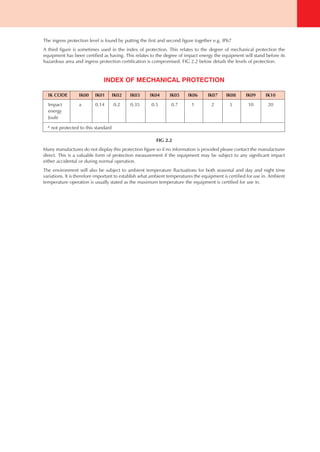
                 The ingress protection level is found by putting the first and second figure together e.g. IP67
                 A third figure is sometimes used in the index of protection. This relates to the degree of mechanical protection the
                 equipment has been certified as having. This relates to the degree of impact energy the equipment will stand before its
                 hazardous area and ingress protection certification is compromised. FIG 2.2 below details the levels of protection.


                                                 INDEX OF MECHANICAL PROTECTION

                   IK CODE          IK00     IK01       IK02   IK03     IK04      IK05      IK06      IK07      IK08      IK09      IK10
                   Impact           a        0.14       0.2    0.35      0.5       0.7        1         2         5        10         20
                   energy
                   Joule
                   a   not protected to this standard

                                                                           FIG 2.2
                 Many manufactures do not display this protection figure so if no information is provided please contact the manufacturer
                 direct. This is a valuable form of protection measurement if the equipment may be subject to any significant impact
                 either accidental or during normal operation.
                                                                              FIG 2.2
                 The environment will also be subject to ambient temperature fluctuations for both seasonal and day and night time
                 Many manufactures do not display to establish what ambient no information is provided please contact the manufacturer
                 variations. It is therefore important this protection figure so if temperatures the equipment is certified for use in. Ambient
                 direct. This is a valuable usually stated as themeasurement if the equipment may be is certified for use in.
                 temperature operation is form of protection maximum temperature the equipment subject to any significant impact
                 either accidental or during normal operation.
                 The environment will also be subject to ambient temperature fluctuations for both seasonal and day and night time
                 variations. It is therefore important to establish what ambient temperatures the equipment is certified for use in. Ambient
                 temperature operation is usually stated as the maximum temperature the equipment is certified for use in.
Vic06 6.19   7/4/06     1:24 pm      Page 13


             INTERNATIONAL REFERENCE GUIDE TO HAZARDOUS AREAS

              STEP 6 ..... FINALLY
              We have developed the methodology to select the correct hazardous area type approved equipment that suits an
              environment by establishing as follows:
              ●   Class I, II or III (Gas, dust or fibre present)


              ●   Division 1 or 2 (Level of hazardous area)


              ●   Ignition temperature of gas/dust/fibre present


              ●   Max operating space temperature of equipment (T code)


              ●   Ingress protection level of equipment


              ●   Min and max ambient operating temperature of equipment


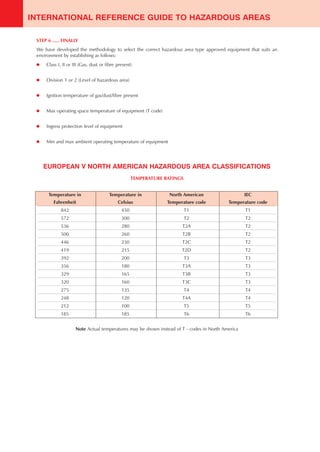
                  EUROPEAN V NORTH AMERICAN HAZARDOUS AREA CLASSIFICATIONS
                                                                 TEMPERATURE RATINGS


                      Temperature in                Temperature in            North American                    IEC
                        Fahrenheit                       Celsius              Temperature code          Temperature code
                           842                             450                         T1                       T1
                           572                             300                         T2                       T2
                           536                             280                      T2A                         T2
                           500                             260                      T2B                         T2
                           446                             230                      T2C                         T2
                           419                             215                      T2D                         T2
                           392                             200                         T3                       T3
                           356                             180                      T3A                         T3
                           329                             165                      T3B                         T3
                           320                             160                      T3C                         T3
                           275                             135                         T4                       T4
                           248                             120                      T4A                         T4
                           212                             100                         T5                       T5
                           185                             185                         T6                       T6


                                  Note Actual temperatures may be shown instead of T - codes in North America
Vic06 6.19   7/4/06   1:24 pm   Page 14


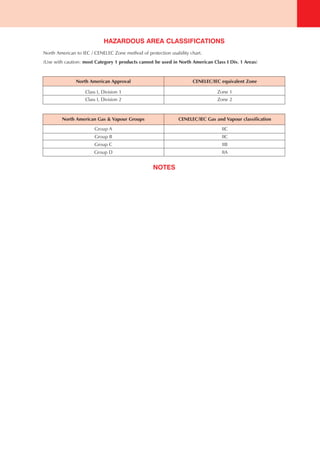
                                             HAZARDOUS AREA CLASSIFICATIONS
                 North American to IEC / CENELEC Zone method of protection usability chart.
                 (Use with caution: most Category 1 products cannot be used in North American Class I Div. 1 Areas)


                                North American Approval                               CENELEC/IEC equivalent Zone

                                    Class I, Division 1                                          Zone 1
                                    Class I, Division 2                                          Zone 2


                         North American Gas & Vapour Groups                     CENELEC/IEC Gas and Vapour classification

                                        Group A                                                    IIC
                                        Group B                                                    IIC
                                        Group C                                                    IIB
                                        Group D                                                    IIA


                                                                    NOTES

Guide to hazardous_areas

  • 1.
    Vic06 6.19 7/4/06 1:24 pm Page 1 INTERNATIONAL REFERENCE GUIDE TO HAZARDOUS AREAS HAZARDOUS AREA STANDARDS AND APPROVALS There are different standards used for hazardous areas and electrical equipment designed for use in those environments, depending upon where in the world they are to be used. In Europe EN standards are used to check compliance with the ATEX directive. In the USA the standard is NEC (National Electric Code), with a variant called CEC (Canadian Electric Code) used in Canada. In addition some countries have their own approval standards (e.g. GOST for Russia and the former Soviet States, TISI for Thailand, etc), however these are often based on EN standards. To simplify matters an attempt is being made to harmonise all major standards for use in the IEC Ex scheme. The aim of the IECEx Scheme is to facilitate international trade in electrical equipment intended for use in explosive atmospheres (Ex equipment) by eliminating the need for multiple national certification while preserving an appropriate level of safety. Whilst the standards used in Europe and America are intended to achieve the safe installation and operation of electrical equipment in hazardous areas, they are different in principles, classification and approach. The purpose of the following guide is to detail some of the differences in the two approaches and to use a step-by-step process to select the correct type of luminaire or other electrical, equipment for use in a hazardous area. THE CLASSIFICATION OF HAZARDOUS AREAS INTO ZONES IS GIVEN FOR GAS MIXTURES, IN IEC OR EN 60079-10 AND SELECTION IN IEC OR EN 60079-14. FOR COMBUSTIBLE DUST HAZARDS THE EUROPEAN STANDARDS ARE EN 61241-10 AND EN 61241-14. THE INFORMATION FOLLOWING IS GIVEN AS BACKGROUND TO THE USE OF THE ABOVE STANDARDS. THE APPLICATION OF THE STANDARDS AND ANY LOCAL REGULATION IS THE RESPONSIBILITY OF THE USER. EUROPEAN HAZARDOUS AREA EQUIPMENT DIRECTIVE, STANDARDS AND APPROVALS ATEX DIRECTIVE The ATEX Directive 94/9/EC is a directive adopted by the European Union (EU) to facilitate free trade in the EU by aligning the technical and legal requirements in the Member States for products intended for use in potentially explosive atmospheres. The Directive covers electrical and mechanical equipment and protective systems, which may be used in potentially explosive atmospheres (flammable gases, vapours or dusts.) It became mandatory at the end of June 2003 for Europe. One of the significant changes that was introduced in the ATEX directive was the move away from defining types of equipment by their protection concept and using categories instead. These are in effect levels of safety. They are linked to the protection concept by the wording in the individual harmonised European standards. In fact the definition of the categories aligns the protection concept with it’s traditional area of use. The directive for use is 99/92/EC. The table below shows the relationship between the category and the expected zone of use. It is very important to emphasise that the ATEX categories are levels of safety. The various types of protection are put into these categories of safety as shown in the EN equipment standards. The hazardous area classification into zones is entirely separate. However, because the types of protection have been designed for use in particular hazardous areas and the application/installation standards give the basic suitability of types of protection for different zones, the ATEX categories align with the zone of use for practical purposes. This is provided that other attributes of the equipment or zone do not conflict and that the risk assessment for the zone does not dictate differently. Category 1 - Zone 0 Category 2 - Zone 1 Category 3 - Zone 2 Category Degree of Safety Design Requirement Application Expected Zone of Use 1 Very high level Two independent means of Where explosive Zone 0 (gas) of Safety protection or safe with two atmospheres are and independent faults present continuously Zone 20 (dust) or for lengthy periods High level of Safe with frequently Where explosive Zone 1 (gas) 2 occurring disturbances or with a atmospheres are and Safety normal operating fault likely to occur Zone 21 (dust) Normal level Safe in normal operation Where explosive Zone 2 (gas) 3 of Safety atmospheres are and likely to occur Zone 22 (dust) infrequently and be of short duration Table 4 ATEX Categories and Applications
  • 2.
    Vic06 6.19 7/4/06 1:24 pm Page 2 STEP BY STEP PRODUCT SELECTION GUIDE STEP 1 Establish if the hazardous area is due to the presence of an explosive gas or an explosive dust. EXPLOSIVE GASES Using the table FIG. 1.0 below, ascertain first if the gas present is a group I or group II gas. ● Group I gases are firedamp methane gas. ● Group II gases are all other explosive gases as listed opposite with relevant subdivisions A, B or C according to the nature of the chemical content. GROUP IIA GROUP IIB GROUP IIC Hydrocarbons Mixtures of Ketones: Chloroethylene Hydrocarbons Hydrogen Alkanes: hydrocarbons: Acetone (vinyl chloride) Allylene (Propyn) Acetylene Methane Industrial methane Ethyl-methyl ketone Benzyl trifluoride Ethylene Carbon disulphide Ethane Turpentine Propyl-methyl ketone Methylene chloride Cyclopropane Propane Petroleum naphtha Butyl-methyl ketone Butadine Butane Oil naphtha Amyl-methyl ketone Compounds containing Pentane Petroleum (including 2,4-Pentanedione Oxygen: Compounds containing Hexane petroleum spirits) (acetylacetone) Acetyl chloride Nitrogen: Heptane Dry cleaning solvents Cyclohexanone Chloroethanol Acrylonitrile Octane Fuel oil Isopropyl nitrate Esters: Compounds containing Hydrocyanic acide Nonane Kerosene Sulphur: Decane Gas-oil Methyl formate Ethyl formate Ethyl mercaptan Compounds containing Cyclobutane Benzole for cars Propyl mercaptan Oxygen: Cyclopentane Methyl acetate Compounds containing Ethyl acetate Thiophene Mrthyl ether Cyclohexane Tetrahydrothiophene Ethylmethyl ether Cycloheptane oxygen: Propyl acetate Oxides: Butyl acetate Ethyl ether Methylcyclobutane Compounds containing Butyl ether Methylcyclopentane (including ethers): Amyl acetate Nitrogen: Carbon monoxide Methyl methacrylate Ethylene oxide Methylcyclohexane Ammonia (epoxyethane) Ethylcyclobutane Dipropyl ether Ethyl methacrylate Acetonitrile Vinyl acetate Epoxy-propane Ethylcyclopentane Alcohols and phenols: Nitromethane Dioxoian Ethylcyclohexane Ethyl acetyacetate Nitroethane Methanol Dioxin Decahydronaphthalene Ethanol Acids: Trioxin (decaline) Amines: Propanol Acetic acid Methylamine Butyl hydoxyacetate Alkenes: Butanol Dimethylamine Tetrahydrofurfuryl Pentanol Compounds containing Methyl acrylate Propene (propylene) halogens Trimethylamine Hexanol Diethylamine Ethyl acrylate Aromatic hydrocarbons: Heptanol Compounds with no Furane Oxygen: Propylamine Styrene Octanol Butylamine Crotonaldehyde Methylstyrene Nonanol Chloromethane Acrolien Chlorethane Cyclohexylamine Cyclohexanol Monoethanolamine Tetrahydrofuran Benzene and its Methylcyclohexanol Bromoethane derivatives: Chloropropane Diaminoethane Mixtures: Phenol Anline Benzene Cresol Chlorobutane Gas from a coke furnace Toluene Bromobutane Dimethylaniline Diacetone-alcohol Amphetamine Compounds containing Xylene Dichlorethane Ethylbenzene Aldehydes: Dichloropropane Toluidine Halogens: Trimethylbenzene Acetaldehyde Chlorobenzene Pyridine Telrafluoroethylene Naphthalene Methaldehyde Benzyl chloride Propane, 1 chloro. Cumene Dichlorobenzene 2,3 epoxy Cymene Allyl chloride (epichlorohydrin) Dichloroethylene FIG 1.0 COMBUSTIBLE DUSTS If an area is classed as hazardous due to the presence of combustible dust, it is important to establish if it is a metallic or non metallic dust. The latest series of standards for electrical apparatus in the presence of combustible dust that will provide protection concepts, installation and selection requirements will be the EN/IEC 61241 series. The most commonly used part of the EN 61241 series applicable to luminaires will be EN 61241-1: Protection by enclosures with marking "tD". It should be noted that this standard outlines to two techniques that provide equivalence in safety but different requirements in terms of selection and installation. The two techniques are "Practice A" and "Practice B", practice B is principally a prescriptive based technique where practice A is performance based. Practice A is the most commonly used technique, where dust may form in layers up to 5mm thick and where a temperature difference of 75K is specified between the maximum surface temperature and the ignition temperature of the dust; the method of determining dust ingress is according to IEC 60529 the IP code. Practice A and Practice B apply to Zones 21 and 22. For clarity the zones for dust can be described as follows: ZONE 21 Where a combustible dust, as a cloud, is likely to occur during normal operation in sufficient quantity to be capable of producing an explosive concentration of combustible or ignitable dust in mixture with air. ZONE 22 In this zone, combustible dust clouds may occur infrequently, and persist for only a short time, or in which accumulation or layers of combustible dust may be present under abnormal conditions and give rise to ignitable mixtures of dust in air. Where following an abnormal condition, the removal of dust accumulations or layers cannot be assured, then the area shall be classified as zone 21.
  • 3.
    Vic06 6.19 7/4/06 1:24 pm Page 3 INTERNATIONAL REFERENCE GUIDE TO HAZARDOUS AREAS STEP 2 Now having established which gas or dusts are present, the next thing to establish is the hazardous area category. FIG 1.1 below sets out the zone definitions to classify your area. ZONE TYPE OF PROTECTION ASSIGNED TO APPARATUS Zone 0 An area in which an explosive atmosphere is continuously present or for long periods or frequently Zone 1 An area in which an explosive atmosphere is likely to occur in normal operation occasionally Zone 2 An area in which an explosive atmosphere is not likely to occur in normal operation and if it occurs it will exist only for a short time. (Zone 2 is often described as the ‘remotely hazardous area’.) TABLE 2 HAZARDOUS AREA CLASSIFICATION FIG 1.1 Using the guide in FIG 1.1 you can now classify the hazardous area into a zone. If you are unsure as to which zone an area should be classified as, please refer to your local health and safety officer or your fire brigade for guidance. Victor Lighting or any other manufacturer of hazardous area equipment is not able to offer any advice in this respect. STEP 3 Having now identified the zone and gas/dust present in the hazardous area, the ignition temperature of the gas/dust needs to be ascertained. For atmospheres containing explosive dust, the ignition temperature of the dust needs to established both when it is in a cloud and when it is in a layer. This information can be found from the table in FIG 1.2 below. EXPLOSIVE GASES GAS IGNITION GAS IGNITION GAS IGNITION TEMP oC TEMP oC TEMP oC Acetic acid (glacial) 464 Isopropyl ether 443 Vinyl chloride 472 Acetone 465 Mesityl oxide 344 Xylenes (o-xylene) 463 Acrylonitrile 481 Methane (natural gas) 537 Acrolein (inhibited) 220 Ammonia 651 Methanol (methyl alcohol) 385 Arsine NA Benzene 498 3-methyl-1-butanol (isoamyl alcohol) 350 Butadiene 420 Butane 287 Methyl ethyl ketone 404 Ethylene oxide 429 1-butanol (butyl alcohol) 343 Methyl isobutal keytone 448 Hydrogen 500 2-butanol (secondary butyl alcohol) 405 2-methyl-1-propanol (isobutyl alcohol) 415 Propylene oxide 449 N-butyl acetate 425 2-methyl-1-propanol (tertiary butyl) 478 Propylnitrate 175 Isobutyl acetate 421 Petroleum naphta 288 Ethylene 450 Sec-butyl alcohol 343 Pyridine 482 Ethylenmine 320 Di-isoutylene 391 Octanes 206 Ethyl mercaptan 300 Ethane 472 Pentanes 260 Ethyl sulfide NA Ethanol (ethyl alcohol) 363 1-pentanol (amyl alcohol) 300 Hydrogen cyanide 538 Ethyl acetate 426 Propane 432 Hydrogen sulfide 260 Ethylene diamine (anhydrous) 385 1-propanol (propyl alcohol) 412 Morpholine 310 Ethylene dichloride 413 2-propanol (isopropyl alcohol) 399 2-nitropropane 428 Gasoline (56-60 octane) 280 Propylene 455 Tetrahydrofuran 321 Hexanes 223 Styrene 490 Unsymmetrical dimethyl Heptanes 204 Toluene 480 hydrazine (udmh 1. 1- 249 Isoprene 395 Vinyl acetate 402 dimethyl hydrazine
  • 4.
    Vic06 6.19 7/4/06 1:24 pm Page 4 EXPLOSIVE DUSTS EXPLOSIVE DUSTS METALLIC NON METALLIC MATERIAL CLOUD LAYER MATERIAL CLOUD LAYER Aluminum 650 760 Alfalfa 460 200 Magnesium 620 490 Cocoa 420 200 Coffee 410 220 Titanium 330 510 Corn 400 250 Zinc 630 430 Cornstarch 380 200 Bronze 370 190 Malt 400 250 Chromium 580 400 Skim milk 490 200 Tin 630 430 Rice 440 220 Cadmium 570 250 Sugar 350 400 Wheat 480 220 Coal (pittsburgh seam) 610 180 Wheat flour 380 360 Cellulose acetate 450 390 EXPLOSIVE FIBRES Ethyl acetate 450 390 Nylon 500 430 MATERIAL CLOUD LAYER Polyethylene 450 380 Polystyrene 560 - Cotton lint 520 - Epoxy 540 - Flax 430 230 Polyurethane 550 390 Rayon 520 250 Cork 490 280 Wood flour (white pine) 470 260 FIG 1.2 STEP 4 Knowing the ignition temperature of the explosive atmosphere, the zone and the gas grouping or dust type we are better able to decide upon the appropriate type of electrical apparatus required. It is important therefore to understand the certified protection concepts recognised for safe operation as used for an ATEX category and/or within a zone. The category in ATEX links to types of protection listed below. If the ATEX categories are used as a cross reference to zones then the protection concepts listed apply ATEX CATEGORY PROTECTION TYPE - STANDARDS AND PROTECTION METHODS CATEGORY PROTECTION TYPE STANDARDS PROTECTION METHOD 1 Ex 'ia' Intrinsic Safety. EN 50020 Where the design limits the ignition spark energy to below that which will ignite the explosive gas. Safe even with two simultaneous faults. Special protection for EN60079-26 Special construction normally based on the use of Category 1 [and Zone 1] two independent types of protection both individually suitable for Category 1. 2 Ex 'ia' Intrinsic Safety All protection methods described above for Category 1 are also suitable for Category 2. Ex 'e' Increased Safety EN 60079-7 Design prevents any ignition from occurring by ensuring no normally sparking components are used and other components reduce the risk of causing a fault that may cause an ignition. This is achieved by strictly controlling and limiting the temperature of components, ensuring adequate insulation is used, all electrical connections are true and the IP rating offers adequate protection against contamination. Ex 'd' Flameproof EN60079-1 The components may produce sparks that could cause ignition of the explosive gas but which are housed in an explosive proof enclosure. The design of the enclosure may allows the gas to enter, but any explosion is contained within the enclosure.
  • 5.
    Vic06 6.19 7/4/06 1:24 pm Page 5 INTERNATIONAL REFERENCE GUIDE TO HAZARDOUS AREAS CATEGORY PROTECTION TYPE STANDARDS PROTECTION METHOD Ex 'ib' Intrinsic Safety As Ex ia As Ex ia but allows for the occurrence of only one component fault. Ex 'tD' EN 61241-1 Design ensures dust ingress protection and surface temperature limitation to avoid ignition of dust layer or cloud. Ex 'm' Encapsulation EN 60079-18 Integral components which can potentially ignite an explosive gas are encapsulated allowing the isolation of these components from the explosive atmosphere surrounding them. This allows the strict control of surface temperatures under normal and fault conditions. Ex 'p' Pressurised Apparatus EN 60079-2 One type of pressurisation maintains a positive static pressure inside the apparatus to prevent entry of gas and another maintains a continuous flow of air or inert gas to neutralise or carry away any explosive mixture entering or being formed within the enclosure. Essential to these methods are continuous monitoring systems to ensure their reliability and purging schedules on installation and following opening. Ex 's' Special Protection As special protection, Ex 's' is not subject to any formal standard as such. It is used where equipment does not comply exactly with standards but where its method of operation is proven to be safe in a hazardous area environment. Ex 'q' Powder filling EN 50017 This technique involves the mounting of potentially incendive components in an enclosure filled with sand or similar inert powder. The sand prevents explosive ignition. It was originally developed to protect heavy duty traction batteries. It is now primarily of use where the incendive action is the abnormal release of electrical energy by the rupture of fuses or failure of components used in electronic apparatus. The likelihood of possible incendive failure of the components is assessed and precautions taken to minimise it. Usually Ex q is used for discrete sub-assemblies and components inside Ex e apparatus. 3 All protection methods described above for Category 1 & Category 2 are suitable for use in Category 3 Ex 'n' non sparking EN 60079-15 This is a method very similar to Ex 'e' increased safety although not as stringent. The components are designed so as not to produce any sparks or dangerous temperatures in operation. Ex 'nA' and Ex 'nR' EN 60079-15 The Ex non sparking 'nR' denotes the use of a restricted breathing enclosure. This technique is used where internal components run hotter than the required T rating. The T rating is achieved by mounting the offending components in a sealed enclosure to prevent the explosive atmosphere contacting them. This technique by virtue incorporates high IP ratings of minimum IP65. Ex 'o' Oil Immersion EN 50015 Ex 'o', involves the immersion of the sparking components in oil with controlled venting. FIG 1.3
  • 6.
    Vic06 6.19 7/4/06 1:24 pm Page 6 STEP 5 Now that you have clarified the gases/dusts present, their ignition temperature, the zone and applicable protection methods, the certified temperature codings must be understood for choosing the correct luminaire. Failure to understand the relationships could result in selecting an inappropriate luminaire for the zone and atmosphere. If the luminaires T rating code signifies the surface temperature of the equipment is greater than the ignition temperature of the gas/dust present, the luminaire will ignite the surrounding atmosphere causing an explosion. Below FIG 1.4 shows the temperature codes related to surface temperatures. Using this table check the ignition temperature of the gas/dust present, as shown in FIG 1.2. This will then indicate the suitability of the equipment you have selected, or the temperature rating of the equipment you need to select. TEMPERATURE MAXIMUM SURFACE TEMPERATURE CLASSIFICATION OF EQUIPMENT (OC) T1 450 T2 300 T3 200 T4 135 T5 100 T6 85 FIG 1.4 STEP 6 The environment that the equipment will operate in is also important. Many environments are arduous and may involve the equipment being subject to the following: TYPES OF ENVIRONMENT EXAMPLES Extreme high or low temperatures Middle east/Norway Arduous weather conditions Offshore/Marine Immersion in water Dry docks Subject to dusty atmospheres Clean rooms/Grain silos FIG 1.5 In order to ensure that the equipment selected will perform in the environment for which it is intended, the following factors of equipment performance need to be considered. ● Ambient temperature - Does the equipment have certification to operate within the minimum and maximum temperatures of the environment? ● How much dust/liquid etc will the equipment be subjected to and for how long? ● Will the equipment be subject to any likely impact during its service life? ● Are there any chemicals/vapours present that could attack luminaires with plastic enclosures? When selecting equipment, the product information will state the certified operating temperature such as the example below. If in selecting equipment the product information contains no statement or reference to ambient temperature be very sceptical and do not assume. Always check and obtain written confirmation from the manufacturer. Example Floodlight VL65A -50OC to +55OC
  • 7.
    Vic06 6.19 7/4/06 1:24 pm Page 7 INTERNATIONAL REFERENCE GUIDE TO HAZARDOUS AREAS Always check that the ambient temperature certification is applicable to your relevant choice of product as maximum ambient performances are often quoted and may only be applicable to certain product variants. If the environment will subject the equipment to any dust/fibres/liquids, ensure it is certified to an appropriate level of ingress protection. This can be done using the table below. INDEX OF PROTECTION (IP XX) IP** degree of protection of enclosures of electrical equipment in accordance with standards IEC 529, EN 60529 and NFC 20-010 1st figure: Protection against solid bodies IP 0 1 2 3 4 5 6 Ø12.5mm TESTS Ø50mm Ø2.5mm Ø1mm No Protected against solid Protected against solid bodies Protected against solid bodies Protected against solid bodies Protected against dust Completely protected Protection bodies of 50 mm and greater of 12.5 mm and greater of 2.5mm and greater larger than 1 mm (no harmful deposit) against dust (e.g. accidental contact with (e.g. finger) (e.g. tools, wires) (e.g. thin tools and fine wires) the hand) 2nd figure: Protection against liquids IP 0 1 2 3 4 5 6 7 8 Ø50mm TESTS O 15 60 O m 1m 15cm min No Protected against Protected against Protected against Protected against Protected against jets Protected against Protected against the Protected against the Protection vertically falling drops drops of water falling drops of water falling splashing water from of water from all powerful jets of water effects of temporary continuous effects of of water up to 15o from the up to 60o from the all directions directions from all directions immersion in water immersion in water (condensation) vertical vertical having regard to specific conditions FIG 1.6 Example Floodlight VL65A Ingress protection to IP66 and IP67 STEP 7... FINALLY Having covered all the rules and safety considerations of the operation of electrical equipment in a hazardous area it is now possible to select a safe and appropriate product.
  • 8.
    Vic06 6.19 7/4/06 1:24 pm Page 8 INTERNATIONAL STANDARDS AND APPROVALS IECEx International Certification Scheme “The aim of the IECEx Scheme is to facilitate international trade in electrical equipment intended for use in explosive atmosphere (Ex equipment) by eliminating the need for multiple national certification while preserving an appropriate level of safety.” “The final objective of the IECEx Scheme is worldwide acceptance of one standard, one certificate and one mark.” GOST-R (Russia) Gosstandart of Russia is responsible for: ● establishment of the general rules and recommendations for certification of products, services (works) and systems of quality and production harmonised with international norms and rules; ● carrying out the State registration of the mandatory and voluntary certification systems and of the conformity marks. Russia participates in the following international certification systems: ● System of the International Electrotechnical Commission (IEC) for tests of electrical equipment on conformity to the safety standards. GGTN Gosgortekhnadzor (GGTN) is the Federal Mining and Industrial Safety Supervisory Authority of Russia, and is responsible for the issue of permits and licenses for a broad range of machinery and equipment. As a separate entity to Gosstandart, GGTN requires product types that fall under its jurisdiction to undergo a further certification process. All potentially hazardous machinery and equipment, such as pressure vessels, boilers, burners, lifts and cranes is subject to GGTN approval, even if it has already obtained a GOST-R Coc. In addition, any machinery to be used in hazardous or potentially explosive environments, such as oil or gas fields, refineries or chemical plants also require a separate GGTN permit. This applies even where the equipment itself would not normally require GOST-R approval.
  • 9.
    Vic06 6.19 7/4/06 1:24 pm Page 9 INTERNATIONAL REFERENCE GUIDE TO HAZARDOUS AREAS NORTH AMERICAN STANDARDS AND APPROVALS PRODUCT CODING As in the European section, products are coded according to their certification for use in particular types of environments. Class Division Gas Grouping Surface temperature rating Class I Division 2 Groups A, B, C and D T4A STEP I As detailed in the European section in STEP 1 the gas/dust/fibre present in the hazardous area needs to be identified and classified under the CECNEC (North American) classifications detailed in FIG 1.9 below. CLASS I (EXPLOSIVE GASES) GROUP A ATMOSPHERE GROUP D ATMOSPHERE Acetylene 305 Acetic acid (glacial) 464 Mesityl oxide 344 Acetone 465 Methane (natural gas) 537 GROUP B ATMOSPHERE Acrylonitrile 481 Methanol (methyl alcohol) 385 Acrolein (inhibited) 220 Ammonia 651 3-methyl-1-butanol (isoamyl alcohol) 350 Arsine NA Benzene 498 Methyl ethyl ketone 404 Butadiene 420 Butane 287 Methyl isobutal keytone 448 Ethylene oxide 429 1-butanol (butyl alcohol) 343 2-methyl-1-propanol (isobutyl alcohol) 415 Hydrogen 500 2-butanol (secondary butyl alcohol) 405 2-methyl-1-propanol (tertiary butyl) 478 Propylene oxide 449 N-butyl acetate 425 Petroleum naphta 288 Propylnitrate 175 Isobutyl acetate 421 Pyridine 482 Sec-butyl alcohol 343 Octanes 206 GROUP C ATMOSPHERE Di-isoutylene 391 Pentanes 260 Ethylene 450 Ethane 472 1-pentanol (amyl alcohol) 300 Ethylenmine 320 Ethanol (ethyl alcohol) 363 Propane 432 Ethyl mercaptan 300 Ethyl acetate 426 1-propanol (propyl alcohol) 412 Ethyl sulfide NA Ethylene diamine (anhydrous) 385 2-propanol (isopropyl alcohol) 399 Hydrogen cyanide 538 Ethylene dichloride 413 Propylene 455 Hydrogen sulfide 260 Gasoline (56-60 octane) 280 Styrene 490 Morpholine 310 Hexanes 223 Toluene 480 2-nitropropane 428 Heptanes 204 Vinyl acetate 402 Tetrahydrofuran 321 Isoprene 395 Vinyl chloride 472 Unsymmetrical dimethyl Isopropyl ether 443 Xylenes (o-xylene) 463 hydrazine (udmh 1. 1- 249 dimethyl hydrazine
  • 10.
    Vic06 6.19 7/4/06 1:24 pm Page 10 CLASS II (EXPLOSIVE DUSTS) GROUP E MATERIAL CLOUD LAYER MATERIAL CLOUD LAYER MATERIAL CLOUD LAYER Aluminum 650 760 Alfalfa 460 200 Wheat flour 380 360 Magnesium 620 490 Cocoa 420 200 Cellulose acetate 450 390 Titanium 330 510 Coffee 410 220 Ethyl acetate 450 390 Zinc 630 430 Corn 400 250 Nylon 500 430 Bronze 370 190 Cornstarch 380 200 Polyethylene 450 380 Chromium 580 400 Malt 400 250 Polystyrene 560 - Tin 630 430 Skim milk 490 200 Epoxy 540 - Cadmium 570 250 Rice 440 220 Polyurethane 550 390 Sugar 350 400 Cork 490 280 GROUP F Wheat 480 220 Wood flour (white pine) 470 260 MATERIAL CLOUD LAYER Coal (Pittsburgh Seam) 610 180 CLASS III (EXPLOSIVE FIBRES) MATERIAL CLOUD LAYER Cotton lint 520 - Flax 430 230 Rayon 520 250 FIG 1.9 Using FIG 1.9 we can also ascertain the ignition temperatures of the identified gas/dust/fibre present. STEP 2 Select the Gas/Dust/Fibre type present from FIG 1.9 and note: ● Material classification I = Gas II = Dust III = Fibre ● The material group ● If the material present is a dust or fibre and whether it forms a cloud or a layer on surfaces ● The ignition temperature of the material STEP 3 Assess the hazardous area as in STEP 2 of the european section with regard to the potential frequency and longevity of an explosive atmosphere. This can be done using the classifications below. DIVISION CLASSIFICATION CRITERIA 1 Gas/dust/fibres normally present in explosive amounts during operation. 2 Gas/dust/fibres not normally present in explosive amounts during operation.
  • 11.
    Vic06 6.19 7/4/06 1:24 pm Page 11 INTERNATIONAL REFERENCE GUIDE TO HAZARDOUS AREAS STEP 4 Now having defined the explosive gas/dust/fibres present, the nature of their presence, their ignition temperature and the classification of the hazardous area we, need to determine the temperature classifications to ensure the selection of equipment which will be safe in operation. The classifications, which are similar to Europe, are further subdivided as follows NORTH AMERICAN TEMPERATURE CLASSIFICATIONS Temperature in Fahrenheit Temperature in Celsius North American Temperature code 842 450 T1 572 300 T2 536 280 T2A 500 260 T2B 446 230 T2C 419 215 T2D 392 200 T3 356 180 T3A 329 165 T3B 320 160 T3C 275 135 T4 248 120 T4A 212 100 T5 185 85 T6 FIG 2.0 Product markings will often show the actual rated temperature in brackets next to the temperature code to make judgement and selection easier. STEP 5 Finally we need to take cognisance of the environment in which the equipment will be operating with respect to the concentration of liquids/gas/dust/fibres and ambient temperature. On establishing these operating conditions we can establish the desired ingress protection required of the equipment by using the table below. INDEX OF INGRESS PROTECTION 1st figure: Protection against solid bodies IP 0 1 2 3 4 5 6 Ø12.5mm TESTS Ø50mm Ø2.5mm Ø1mm No Protected against solid Protected against solid bodies Protected against solid bodies Protected against solid bodies Protected against dust Completely protected Protection bodies of 50 mm and greater of 12.5 mm and greater of 2.5mm and greater larger than 1 mm (no harmful deposit) against dust (e.g. accidental contact with (e.g. finger) (e.g. tools, wires) (e.g. thin tools and fine wires) the hand) 2nd figure: Protection against liquids IP 0 1 2 3 4 5 6 7 8 TESTS O 15 60 O m 1m 15cm min No Protected against Protected against Protected against Protected against Protected against jets Protected against Protected against the Protected against the Protection vertically falling drops drops of water falling drops of water falling splashing water from of water from all powerful jets of water effects of temporary continuous effects of of water up to 15o from the up to 60o from the all directions directions from all directions immersion in water immersion in water (condensation) vertical vertical having regard to specific conditions FIG 2.1
  • 12.
    Vic06 6.19 7/4/06 1:24 pm Page 12 The ingress protection level is found by putting the first and second figure together e.g. IP67 A third figure is sometimes used in the index of protection. This relates to the degree of mechanical protection the equipment has been certified as having. This relates to the degree of impact energy the equipment will stand before its hazardous area and ingress protection certification is compromised. FIG 2.2 below details the levels of protection. INDEX OF MECHANICAL PROTECTION IK CODE IK00 IK01 IK02 IK03 IK04 IK05 IK06 IK07 IK08 IK09 IK10 Impact a 0.14 0.2 0.35 0.5 0.7 1 2 5 10 20 energy Joule a not protected to this standard FIG 2.2 Many manufactures do not display this protection figure so if no information is provided please contact the manufacturer direct. This is a valuable form of protection measurement if the equipment may be subject to any significant impact either accidental or during normal operation. FIG 2.2 The environment will also be subject to ambient temperature fluctuations for both seasonal and day and night time Many manufactures do not display to establish what ambient no information is provided please contact the manufacturer variations. It is therefore important this protection figure so if temperatures the equipment is certified for use in. Ambient direct. This is a valuable usually stated as themeasurement if the equipment may be is certified for use in. temperature operation is form of protection maximum temperature the equipment subject to any significant impact either accidental or during normal operation. The environment will also be subject to ambient temperature fluctuations for both seasonal and day and night time variations. It is therefore important to establish what ambient temperatures the equipment is certified for use in. Ambient temperature operation is usually stated as the maximum temperature the equipment is certified for use in.
  • 13.
    Vic06 6.19 7/4/06 1:24 pm Page 13 INTERNATIONAL REFERENCE GUIDE TO HAZARDOUS AREAS STEP 6 ..... FINALLY We have developed the methodology to select the correct hazardous area type approved equipment that suits an environment by establishing as follows: ● Class I, II or III (Gas, dust or fibre present) ● Division 1 or 2 (Level of hazardous area) ● Ignition temperature of gas/dust/fibre present ● Max operating space temperature of equipment (T code) ● Ingress protection level of equipment ● Min and max ambient operating temperature of equipment EUROPEAN V NORTH AMERICAN HAZARDOUS AREA CLASSIFICATIONS TEMPERATURE RATINGS Temperature in Temperature in North American IEC Fahrenheit Celsius Temperature code Temperature code 842 450 T1 T1 572 300 T2 T2 536 280 T2A T2 500 260 T2B T2 446 230 T2C T2 419 215 T2D T2 392 200 T3 T3 356 180 T3A T3 329 165 T3B T3 320 160 T3C T3 275 135 T4 T4 248 120 T4A T4 212 100 T5 T5 185 185 T6 T6 Note Actual temperatures may be shown instead of T - codes in North America
  • 14.
    Vic06 6.19 7/4/06 1:24 pm Page 14 HAZARDOUS AREA CLASSIFICATIONS North American to IEC / CENELEC Zone method of protection usability chart. (Use with caution: most Category 1 products cannot be used in North American Class I Div. 1 Areas) North American Approval CENELEC/IEC equivalent Zone Class I, Division 1 Zone 1 Class I, Division 2 Zone 2 North American Gas & Vapour Groups CENELEC/IEC Gas and Vapour classification Group A IIC Group B IIC Group C IIB Group D IIA NOTES