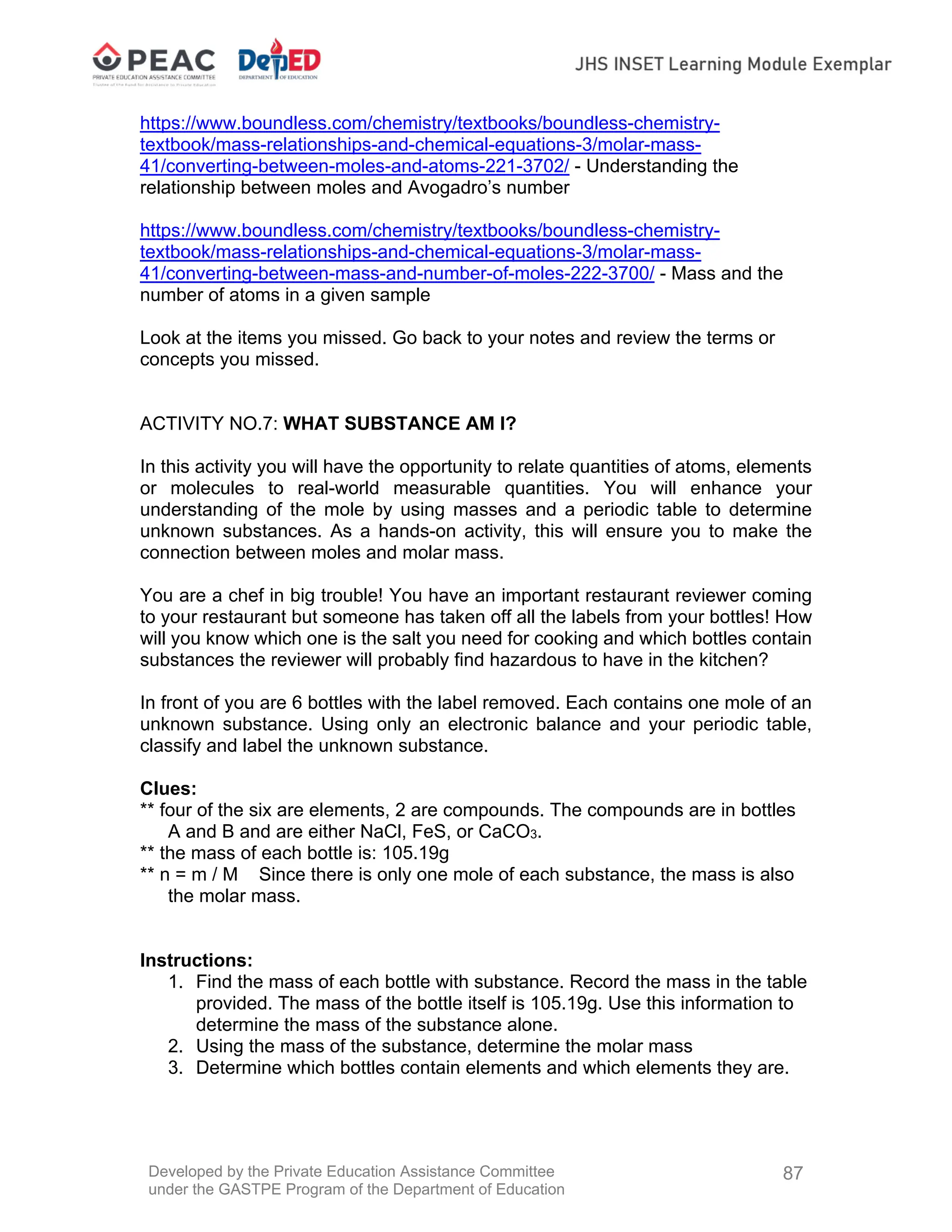
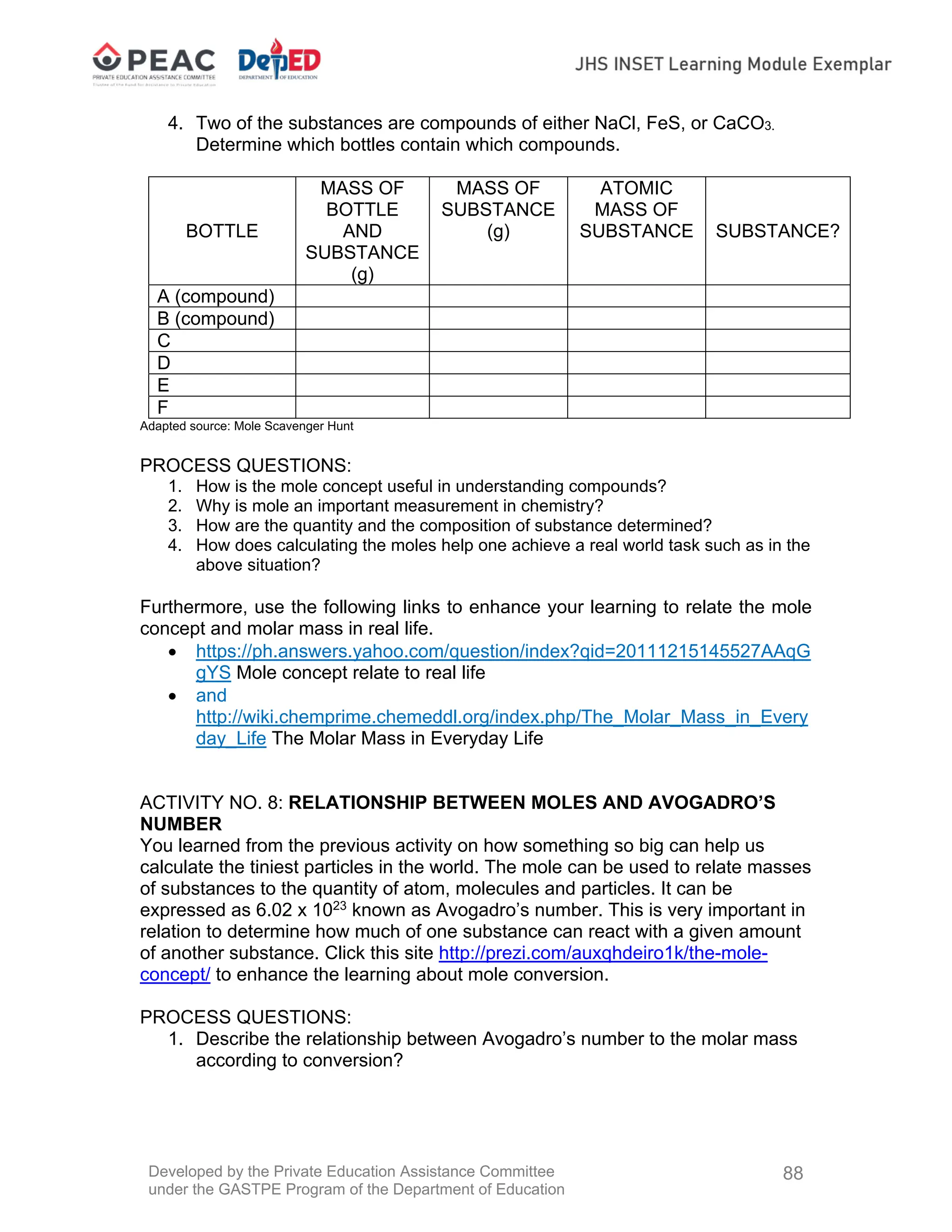
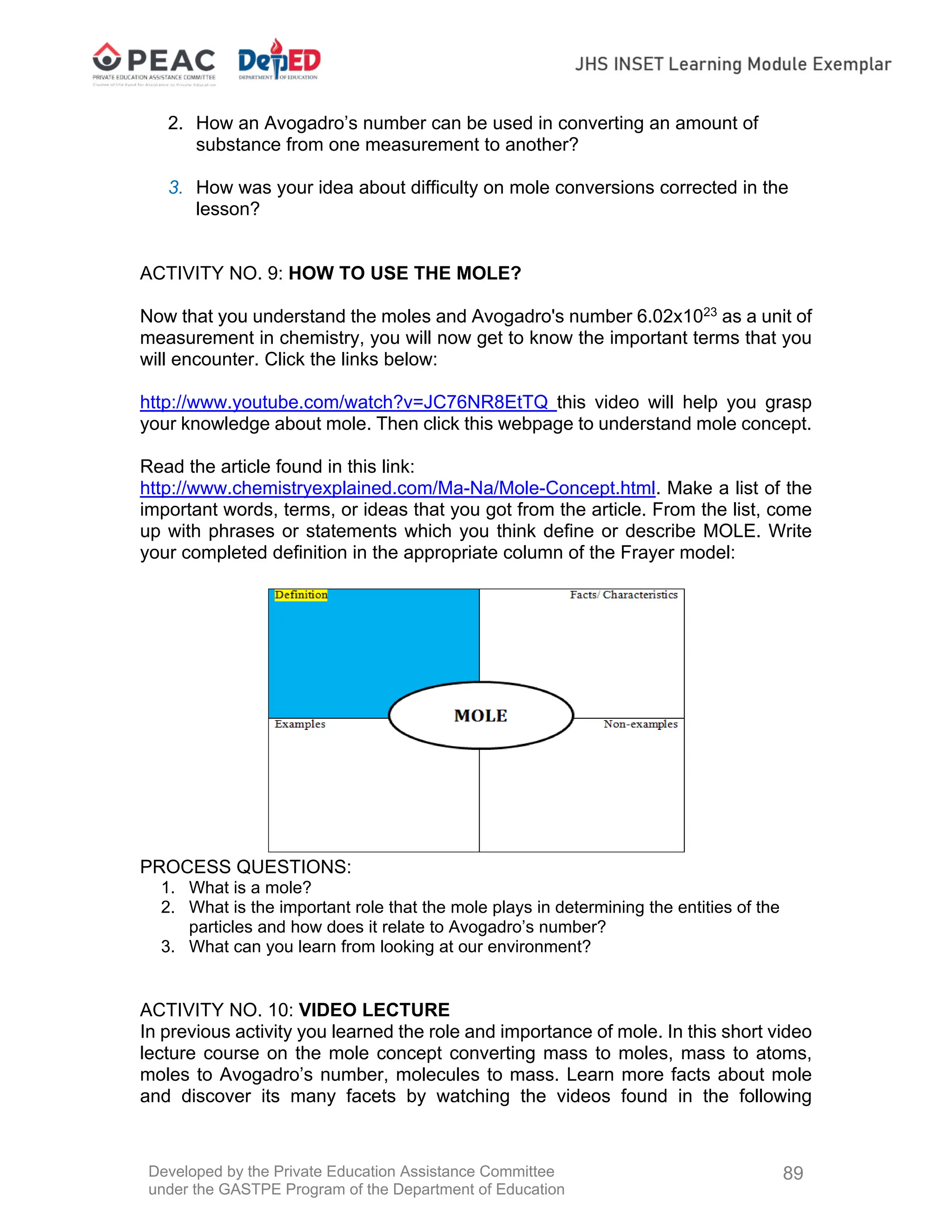
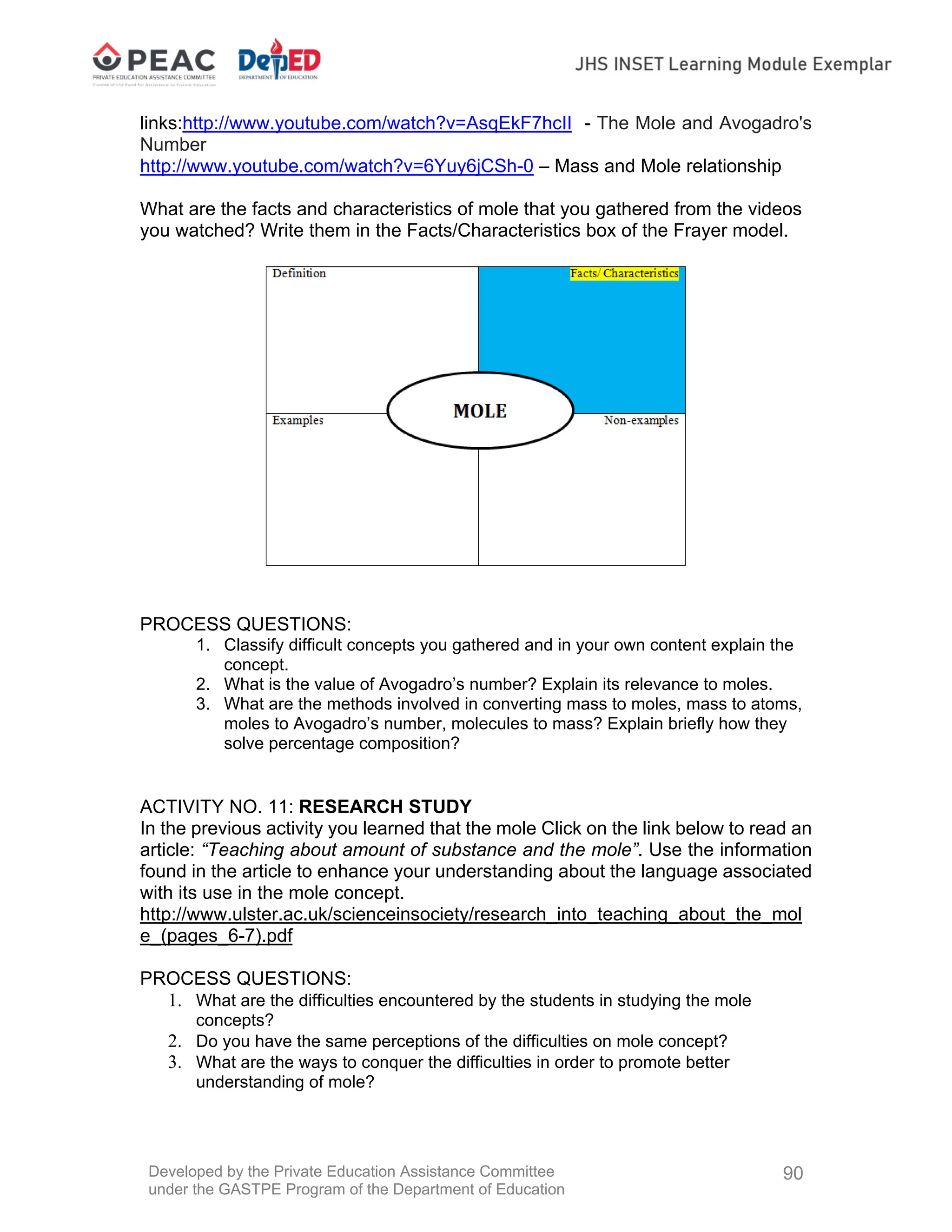
Mole Concept
Science G9| Q2
LEARNING MODULE
2017
NOTICE TO THE SCHOOLS
This learning module (LM) was developed by the Private Education Assistance
Committee under the GASTPE Program of the Department of Education. The learning
modules were written by the PEAC Junior High School (JHS) Trainers and were used as
exemplars either as a sample for presentation or for workshop purposes in the JHS In-
Service Training (INSET) program for teachers in private schools.
The LM is designed for online learning and can also be used for blended learning and
remote learning modalities. The year indicated on the cover of this LM refers to the year
when the LM was used as an exemplar in the JHS INSET and the year it was written or
revised. For instance, 2017 means the LM was written in SY 2016-2017 and was used in
the 2017 Summer JHS INSET. The quarter indicated on the cover refers to the quarter of
the current curriculum guide at the time the LM was written. The most recently revised
LMs were in 2018 and 2019.
The LM is also designed such that it encourages independent and self-regulated learning
among the students and develops their 21st century skills. It is written in such a way that
the teacher is communicating directly to the learner. Participants in the JHS INSET are
trained how to unpack the standards and competencies from the K-12 curriculum guides
to identify desired results and design standards-based assessment and instruction.
Hence, the teachers are trained how to write their own standards-based learning plan.
The parts or stages of this LM include Explore, Firm Up, Deepen and Transfer. It is
possible that some links or online resources in some parts of this LM may no longer be
available, thus, teachers are urged to provide alternative learning resources or reading
materials they deem fit for their students which are aligned with the standards and
competencies. Teachers are encouraged to write their own standards-based learning
plan or learning module with respect to attainment of their school’s vision and mission.
The learning modules developed by PEAC are aligned with the K to 12 Basic Education
Curriculum of the Department of Education. Public school teachers may also download
and use the learning modules.
Schools, teachers and students may reproduce the LM so long as such reproduction is
limited to (i) non-commercial, non-profit educational purposes; and to (ii) personal use or
a limited audience under the doctrine of fair use (Section 185, IP Code). They may also
share copies of the LM and customize the learning activities as they see fit so long as
these are done for non-commercial, non-profit educational purposes and limited to
personal use or to a limited audience and fall within the limits of fair use. This document
is password-protected to prevent unauthorized processing such as copying and pasting.
Developed by the Private Education Assistance Committee
under the GASTPE Program of the Department of Education
1
SCIENCE 9
Module 2. Matter
Lessons 1-2: Chemical Bonding and Variety of Carbon
Compounds
INTRODUCTION AND FOCUS QUESTION(S):
Look around you. Do you think you see anything composed of just one
element… any objects consisting only of carbon, or of gold, or of hydrogen? The
correct answer is almost certainly no. Have you ever wondered why there are
millions of chemical compounds out there? Have you tried making your own
chemical substance? Have you ever tried to separate sheets of plastic that are
stuck together? Did you dream of having a diamond but did not think how it is
made up of? Did you come to think how atoms participate in forming
compounds?
Understanding the bonding in compounds is essential to developing new
chemical and technologies. These compounds are too complex to work on. You
probably know that your mother’s mother is your grandmother and that your
grandmother’s sister is your great aunt but what do you call your grandmother’s
brother’s daughter? Naming these compounds requires set of rules, just as
naming family relationships requires rules.
In this module, you will find out how atoms form compounds with another
atom. Remember to search for the answer to the following question(s):
1. What holds atoms together in a chemical bond?
2. Why do atoms form single, double and triple covalent bonds?
3. How are compounds formed?
LESSONS AND COVERAGE:
In this module, you will examine this question when you take the following
lessons:
Lesson 1.1 – Ionic Bonding and Metallic Bonding
A. Ion Formation
B. Lewis Structure of Ionic Compound
Lesson 1.2 – Covalent Bonding
A. LEDS of Covalent Compound
B. Polar and Nonpolar Compounds
C. Chemical Nomenclature
Lesson 2.1 – Carbon and its Compound
A. Carbon: Its Properties
B. Families of Carbon
Developed by the Private Education Assistance Committee
under the GASTPE Program of the Department of Education
2
In these lessons, you will learn the following:
Lesson 1.1 Write the Lewis Structures of Ionic Compound.
Lesson 1.2 Name chemical compounds formed through chemical bonding.
Lesson 2.3 Make a compound through mini science investigatory project.
Create a digital story of the uses of Carbon compounds.
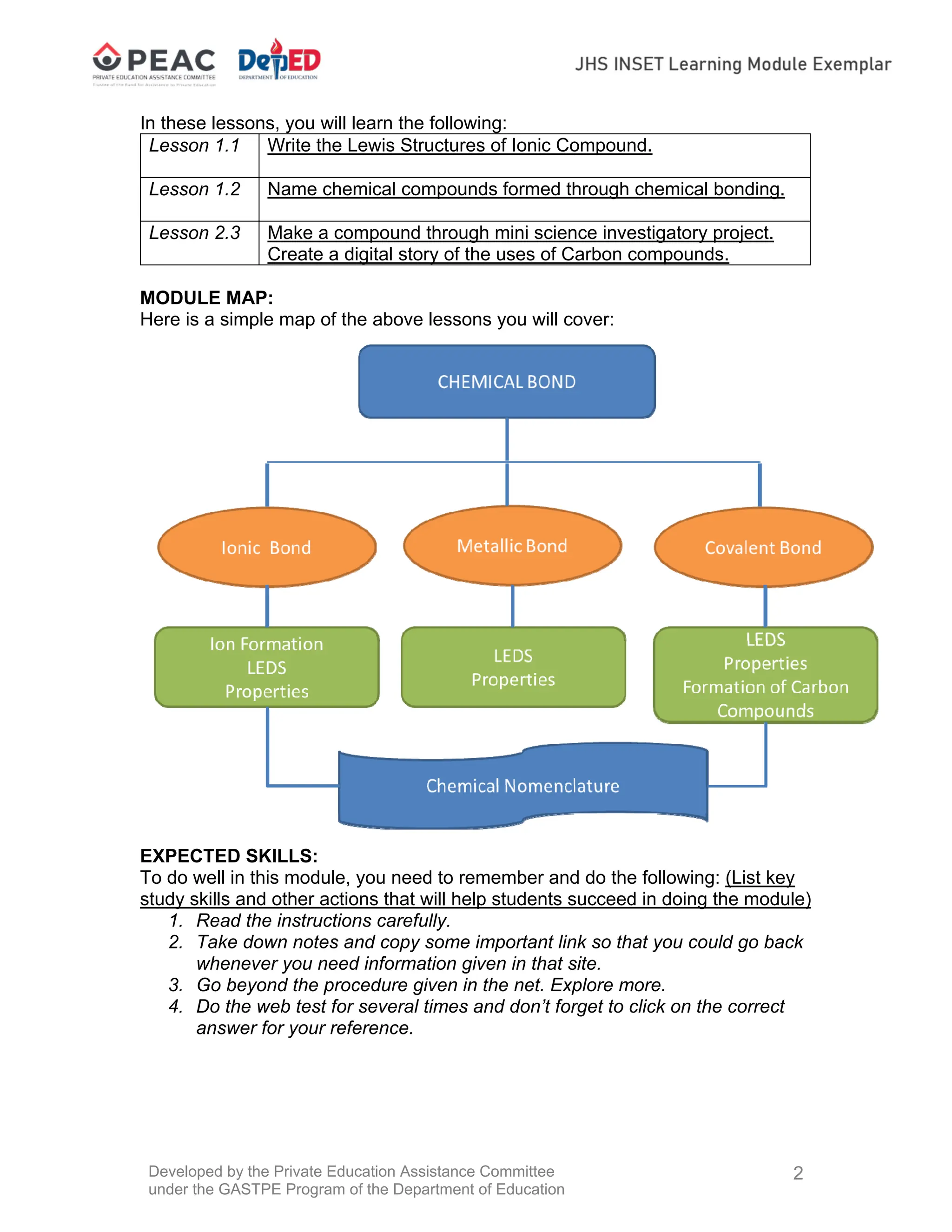
MODULE MAP:
Here is a simple map of the above lessons you will cover:
EXPECTED SKILLS:
To do well in this module, you need to remember and do the following: (List key
study skills and other actions that will help students succeed in doing the module)
1. Read the instructions carefully.
2. Take down notes and copy some important link so that you could go back
whenever you need information given in that site.
3. Go beyond the procedure given in the net. Explore more.
4. Do the web test for several times and don’t forget to click on the correct
answer for your reference.
Developed by the Private Education Assistance Committee
under the GASTPE Program of the Department of Education
3
PRE-ASSESSMENT:
Let’s find out how much you already know about this module. Click on the letter
that you think best answers the question. Please answer all items. After taking
this short test, you will see your score. Take note of the items that you were not
able to correctly answer and look for the right answer as you go through this
module.
1. Which two statements about covalent bond are correct?
1. It can be formed between two metal atoms.
2. It can be formed between two non-metal ions.
3. It is formed by the transfer of electrons between atoms.
4. It is formed by sharing of electrons between
atoms.
A. 1 and 3 B. 2 and 3
C. 1 and 4 D. 2 and 4
2. Alkenes always contain a __________.
A) C=C bond
B) C≡C bond
C) C-C bond
D) C=H bond
3. Order the following by decreasing bond length: C≡C, C=C, C-C
A. they are all the same
B. C≡C, C=C, C-C
C. C≡C, C-C, C=C
D. C-C, C=C, C≡C
4. How many unpaired electrons are there in the Lewis structures of a N3-
ion?
A. 0 C. 1
B. 2 D. 3
5. Which of the following lists contains no ionic compounds?
a. HCN, NO, Ca(NO3)2
b. KOH, CCl4, SF6
c. NaH, CaF2, NaNH2
d. CH2O, H2S, NH3
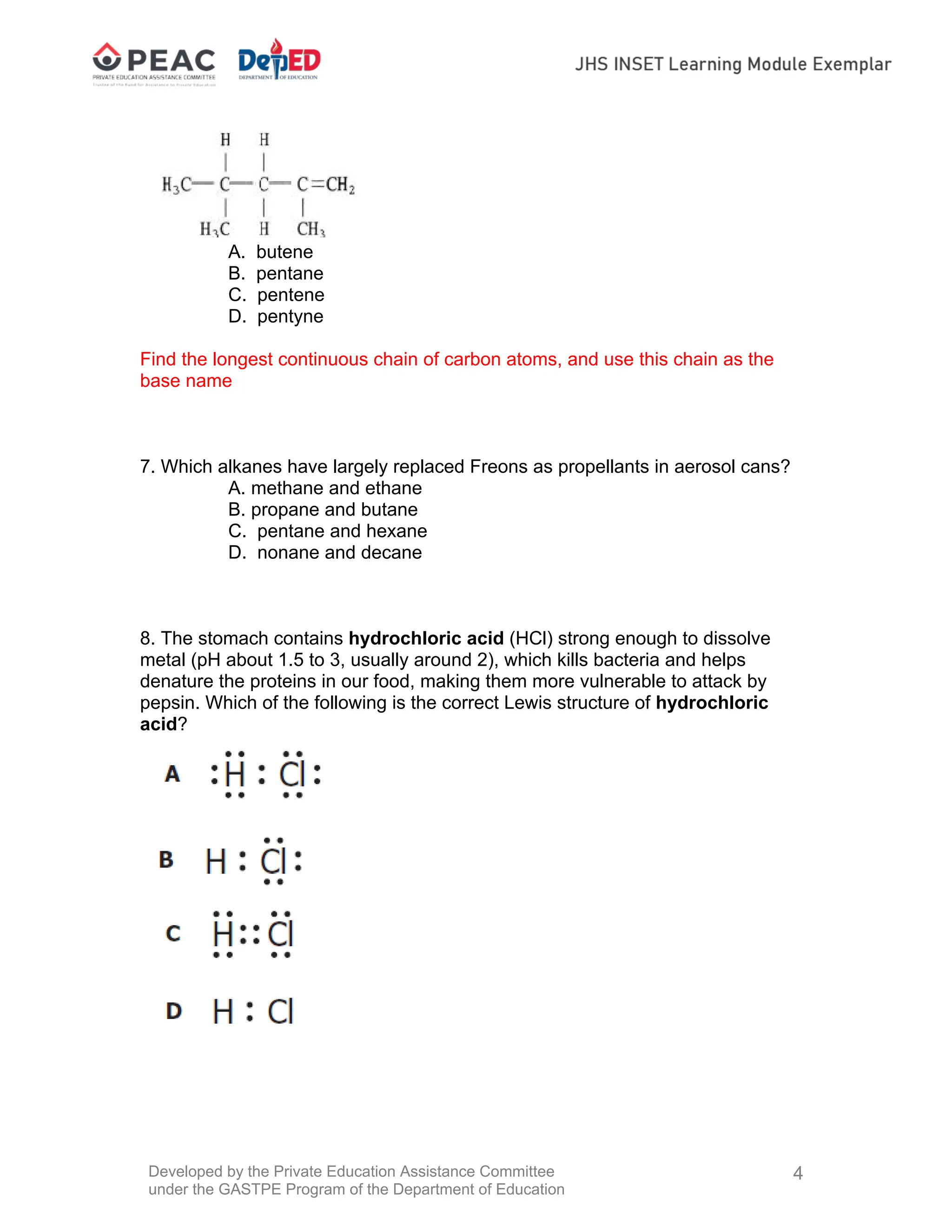
6. Give the simple base name of the molecular structure below:
Developed by the Private Education Assistance Committee
under the GASTPE Program of the Department of Education
4
A. butene
B. pentane
C. pentene
D. pentyne
Find the longest continuous chain of carbon atoms, and use this chain as the
base name
7. Which alkanes have largely replaced Freons as propellants in aerosol cans?
A. methane and ethane
B. propane and butane
C. pentane and hexane
D. nonane and decane
8. The stomach contains hydrochloric acid (HCl) strong enough to dissolve
metal (pH about 1.5 to 3, usually around 2), which kills bacteria and helps
denature the proteins in our food, making them more vulnerable to attack by
pepsin. Which of the following is the correct Lewis structure of hydrochloric
acid?
Developed by the Private Education Assistance Committee
under the GASTPE Program of the Department of Education
5
9. Ethene is also used as a plant hormone to control the ripening and color
development of fruit. The molecular structure of ethene is responsible for this
property.
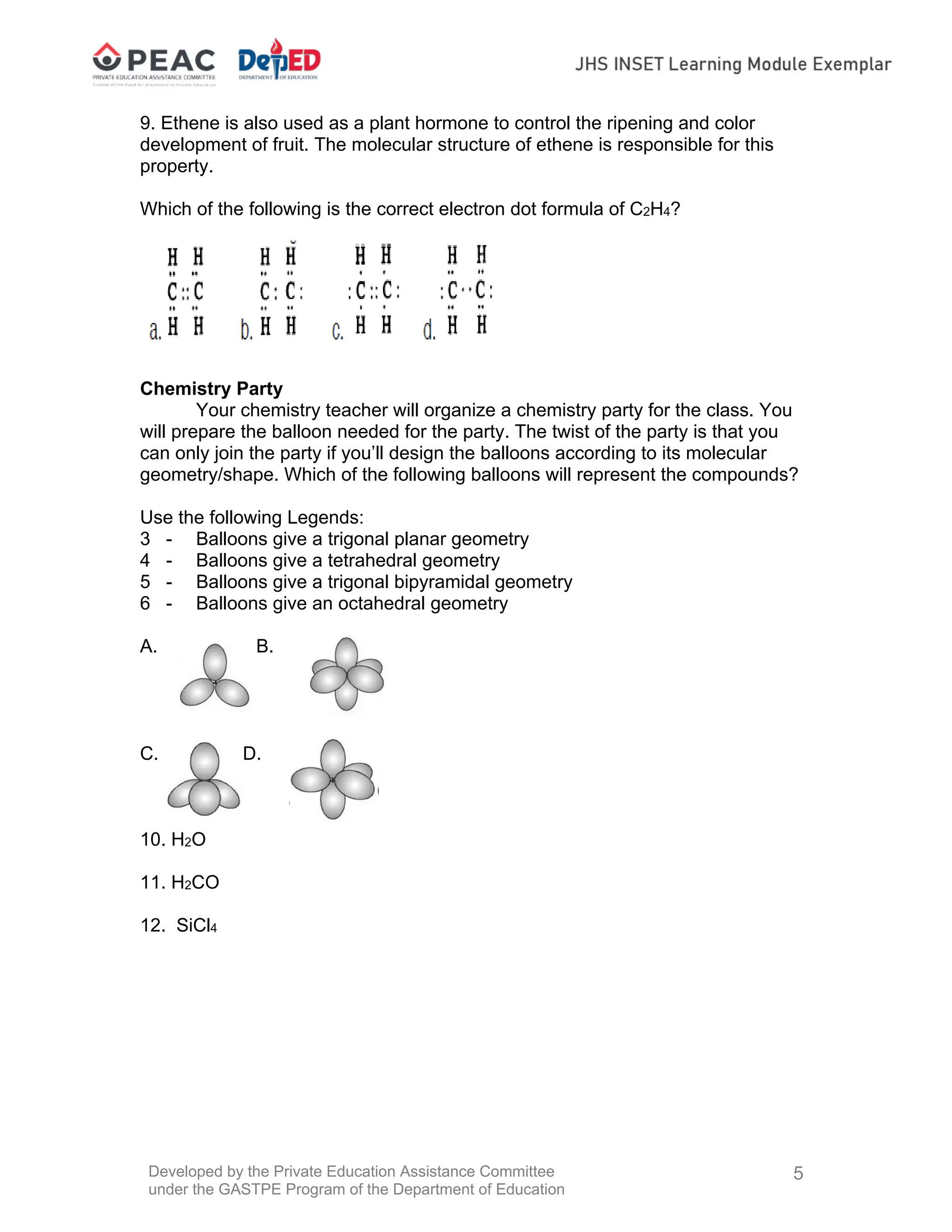
Which of the following is the correct electron dot formula of C2H4?
Chemistry Party
Your chemistry teacher will organize a chemistry party for the class. You
will prepare the balloon needed for the party. The twist of the party is that you
can only join the party if you’ll design the balloons according to its molecular
geometry/shape. Which of the following balloons will represent the compounds?
Use the following Legends:
3 - Balloons give a trigonal planar geometry
4 - Balloons give a tetrahedral geometry
5 - Balloons give a trigonal bipyramidal geometry
6 - Balloons give an octahedral geometry
A. B.
C. D.
10. H2O
11. H2CO
12. SiCl4
Developed by the Private Education Assistance Committee
under the GASTPE Program of the Department of Education
6
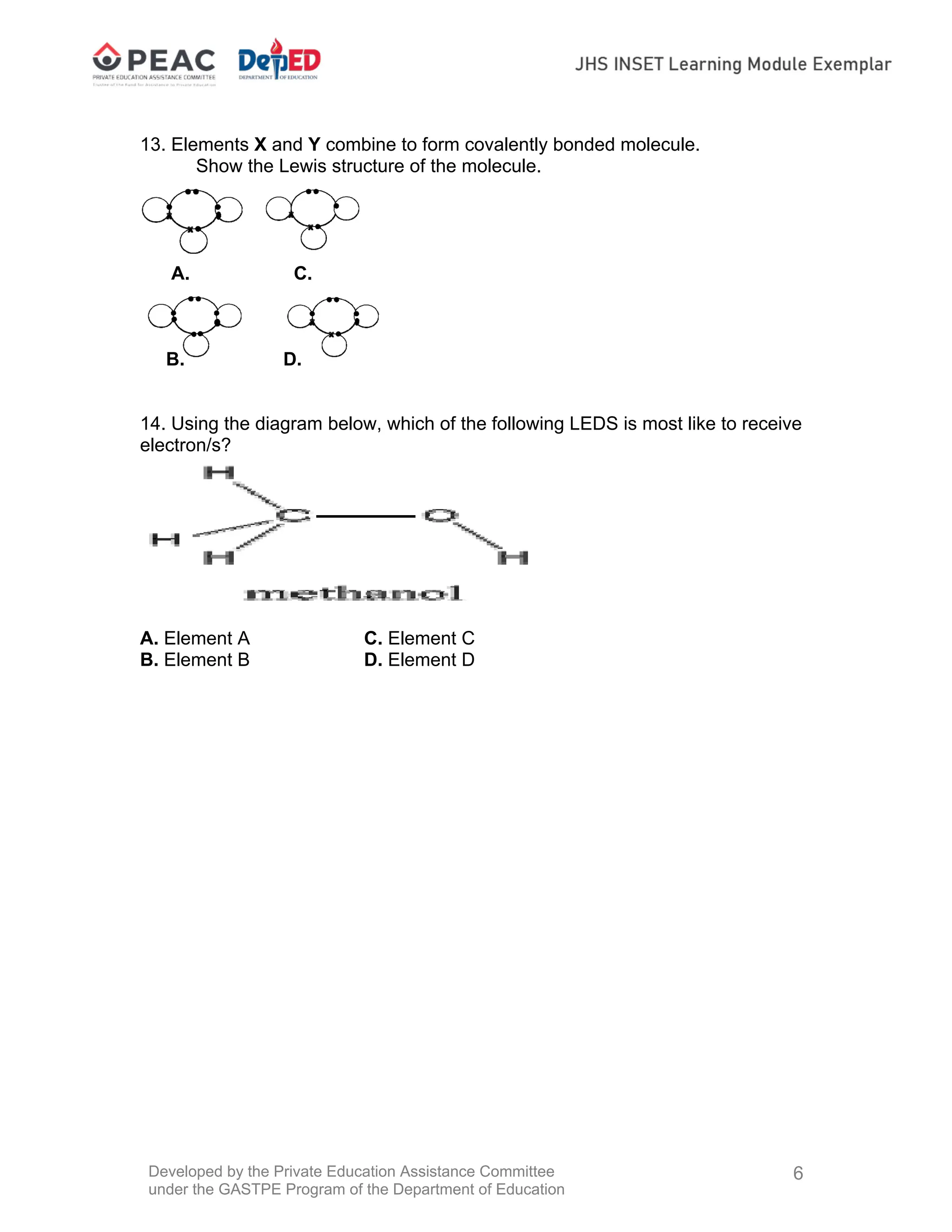
13. Elements X and Y combine to form covalently bonded molecule.
Show the Lewis structure of the molecule.
A. C.
B. D.
14. Using the diagram below, which of the following LEDS is most like to receive
electron/s?
A. Element A C. Element C
B. Element B D. Element D
Developed by the Private Education Assistance Committee
under the GASTPE Program of the Department of Education
7
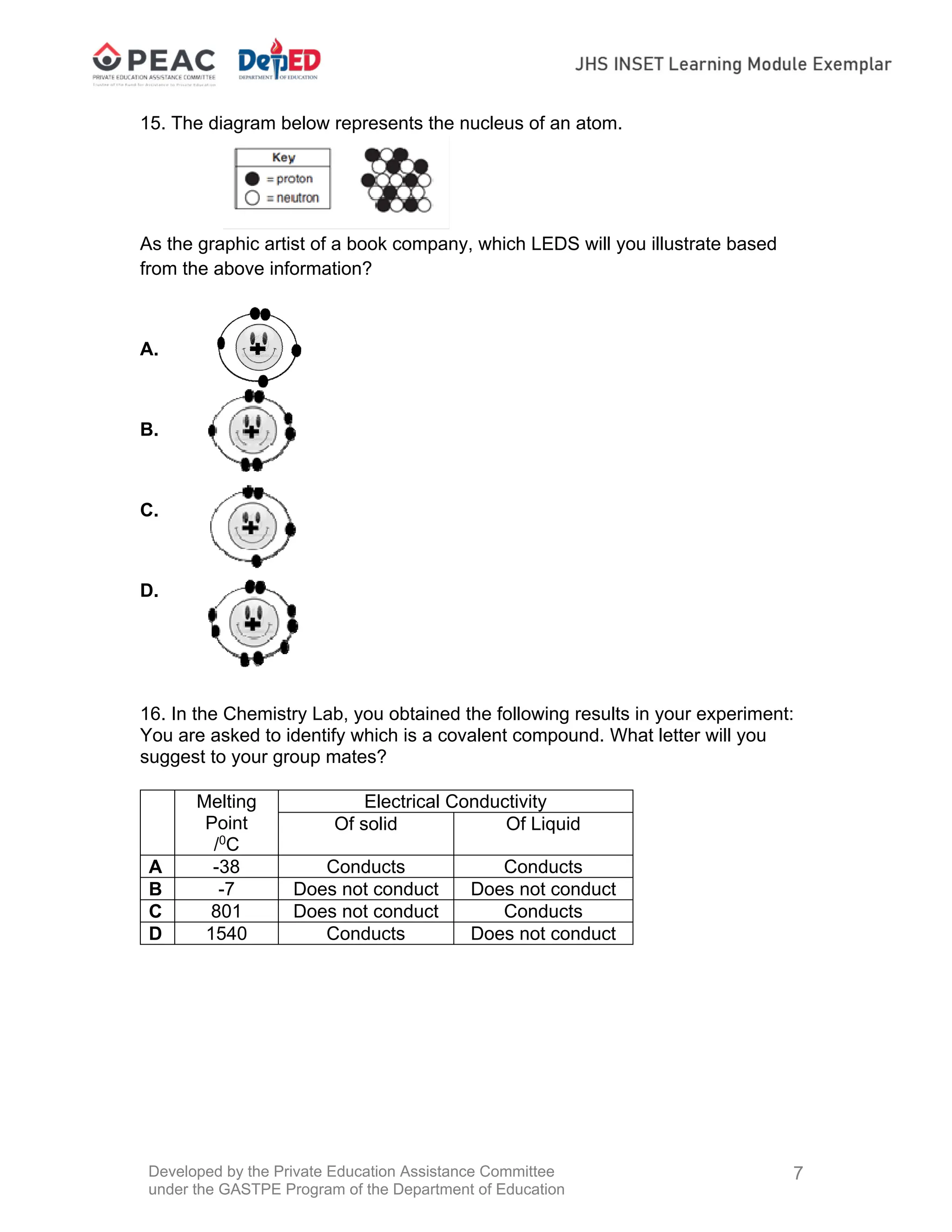
15. The diagram below represents the nucleus of an atom.
As the graphic artist of a book company, which LEDS will you illustrate based
from the above information?
A.
B.
C.
D.
16. In the Chemistry Lab, you obtained the following results in your experiment:
You are asked to identify which is a covalent compound. What letter will you
suggest to your group mates?
Melting
Point
/0
C
Electrical Conductivity
Of solid Of Liquid
A -38 Conducts Conducts
B -7 Does not conduct Does not conduct
C 801 Does not conduct Conducts
D 1540 Conducts Does not conduct
Developed by the Private Education Assistance Committee
under the GASTPE Program of the Department of Education
8
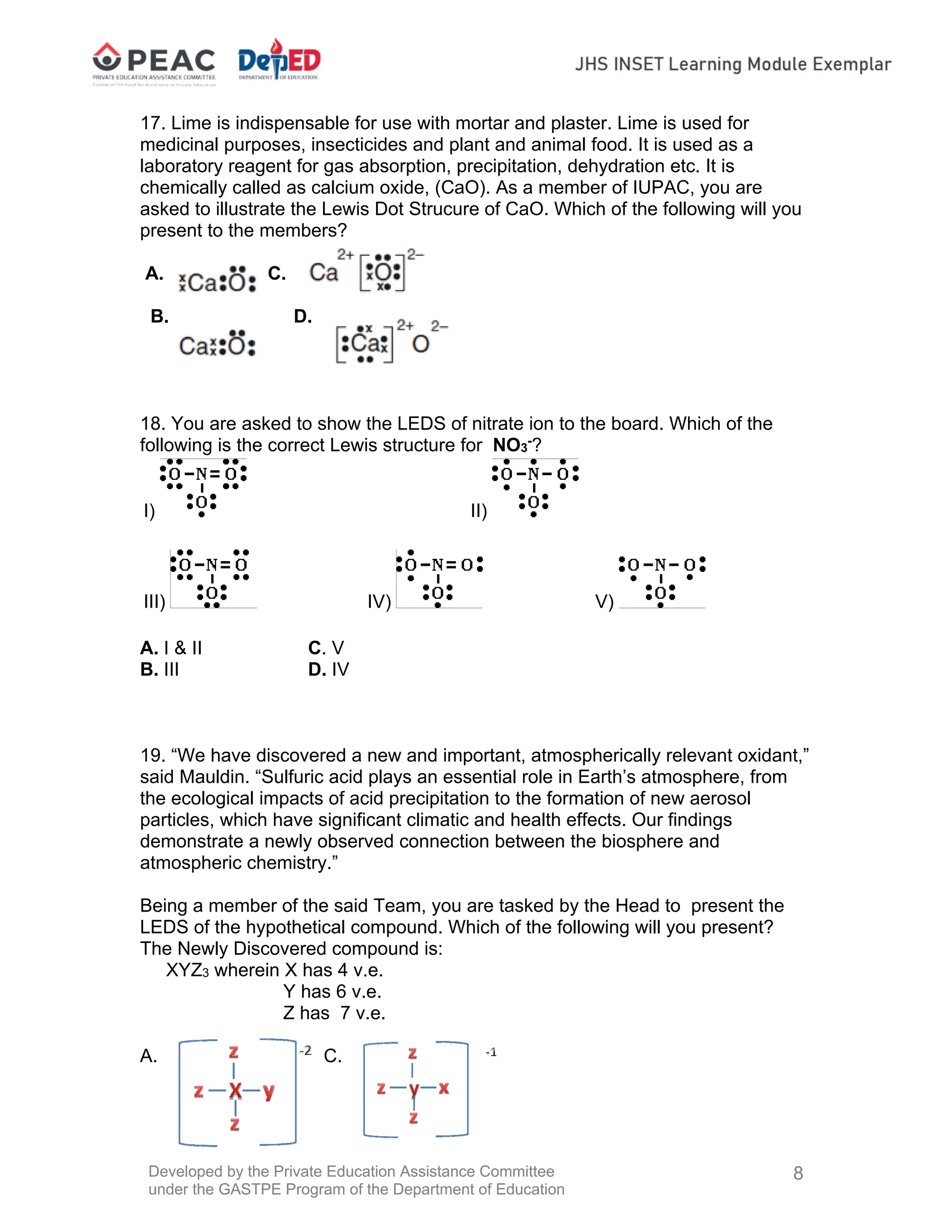
17. Lime is indispensable for use with mortar and plaster. Lime is used for
medicinal purposes, insecticides and plant and animal food. It is used as a
laboratory reagent for gas absorption, precipitation, dehydration etc. It is
chemically called as calcium oxide, (CaO). As a member of IUPAC, you are
asked to illustrate the Lewis Dot Strucure of CaO. Which of the following will you
present to the members?
A. C.
B. D.
18. You are asked to show the LEDS of nitrate ion to the board. Which of the
following is the correct Lewis structure for NO3
-
?
I) II)
III) IV) V)
A. I & II C. V
B. III D. IV
19. “We have discovered a new and important, atmospherically relevant oxidant,”
said Mauldin. “Sulfuric acid plays an essential role in Earth’s atmosphere, from
the ecological impacts of acid precipitation to the formation of new aerosol
particles, which have significant climatic and health effects. Our findings
demonstrate a newly observed connection between the biosphere and
atmospheric chemistry.”
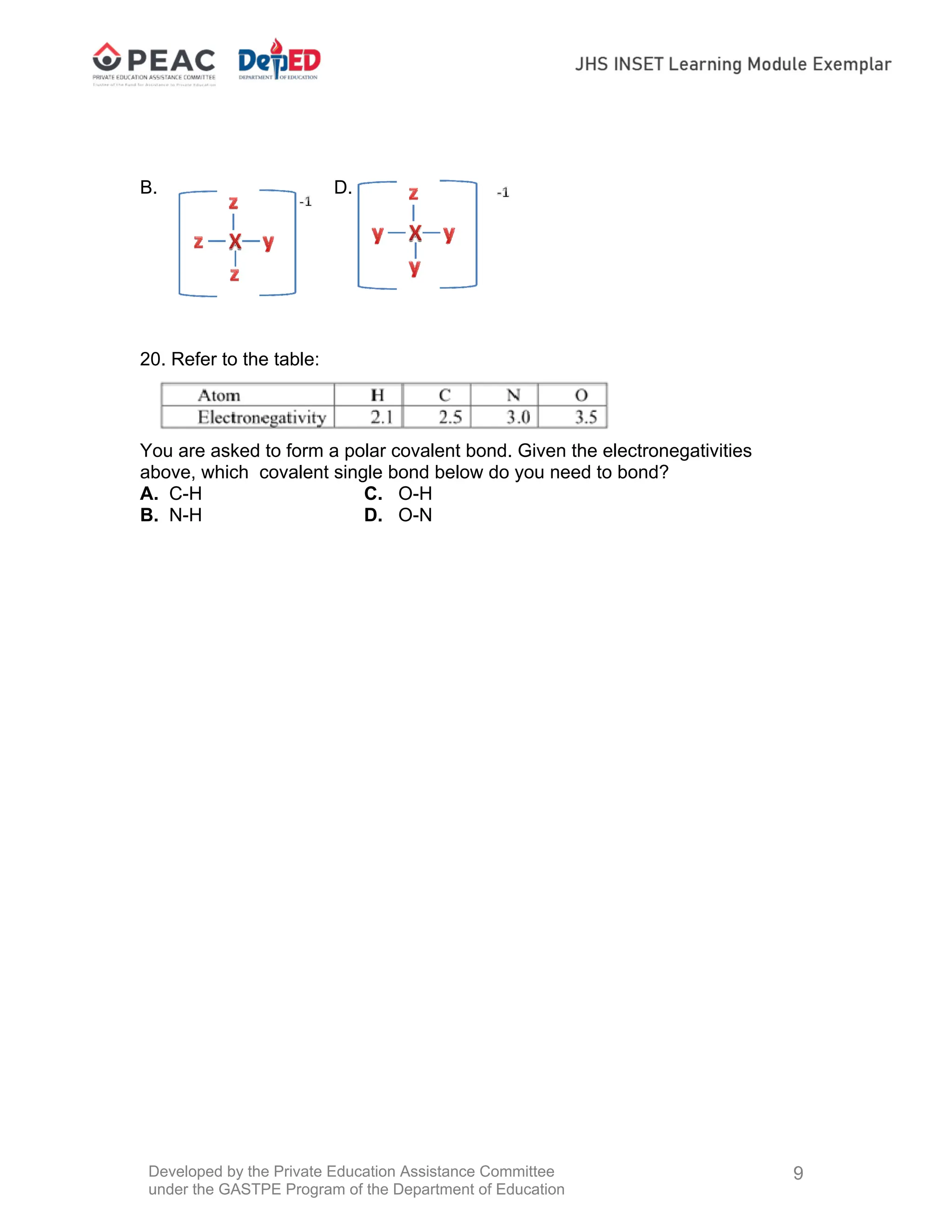
Being a member of the said Team, you are tasked by the Head to present the
LEDS of the hypothetical compound. Which of the following will you present?
The Newly Discovered compound is:
XYZ3 wherein X has 4 v.e.
Y has 6 v.e.
Z has 7 v.e.
A. C.
Developed by the Private Education Assistance Committee
under the GASTPE Program of the Department of Education
9
B. D.
20. Refer to the table:
You are asked to form a polar covalent bond. Given the electronegativities
above, which covalent single bond below do you need to bond?
A. C-H C. O-H
B. N-H D. O-N
Developed by the Private Education Assistance Committee
under the GASTPE Program of the Department of Education
10
ACTIVITY NO. 1: THOUSAND WORDS IN A PICTURE
From the three pictures below, allow yourself to make your own
interpretations of what a chemical bond is all about. Think of the importance the
illustrations presented to you.
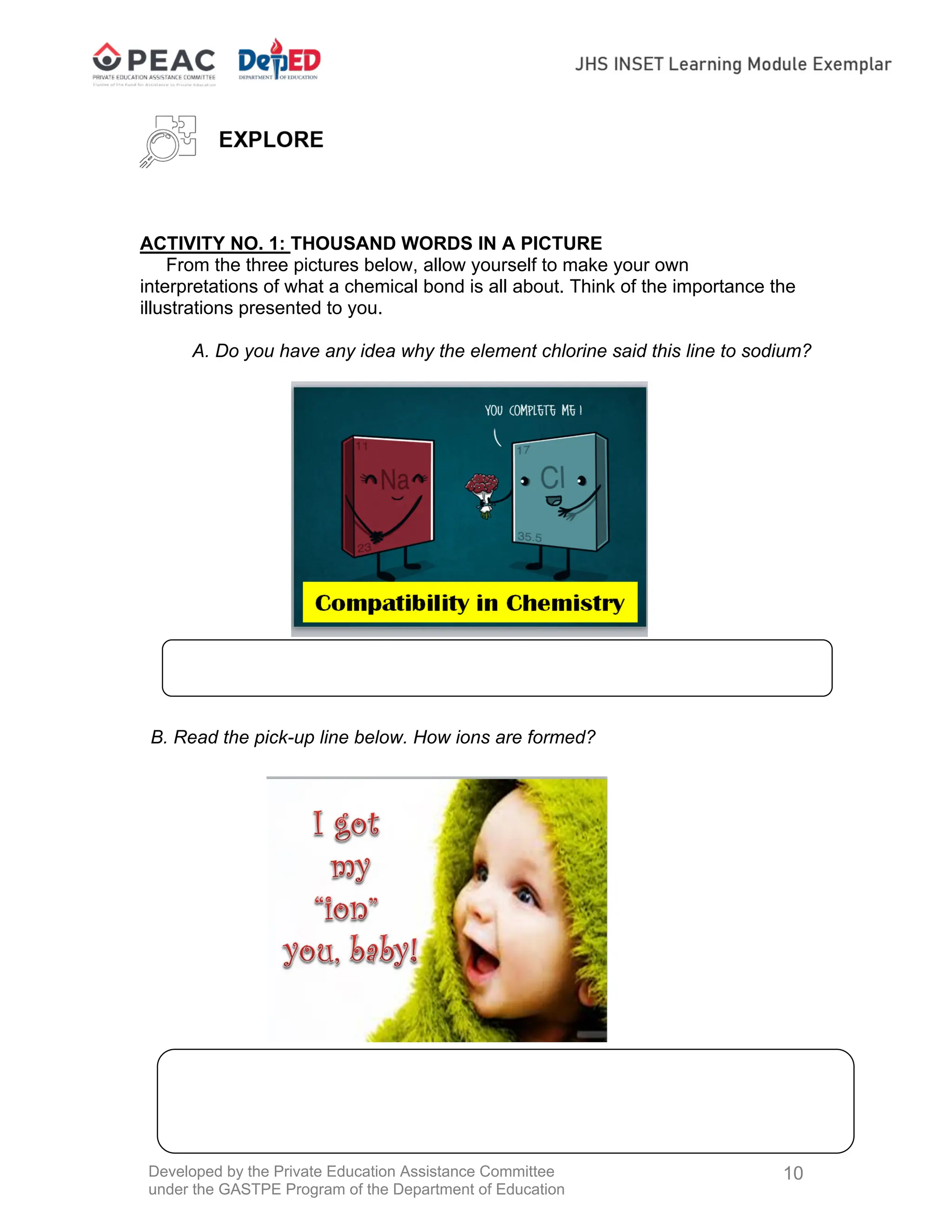
A. Do you have any idea why the element chlorine said this line to sodium?
B. Read the pick-up line below. How ions are formed?
Developed by the Private Education Assistance Committee
under the GASTPE Program of the Department of Education
11
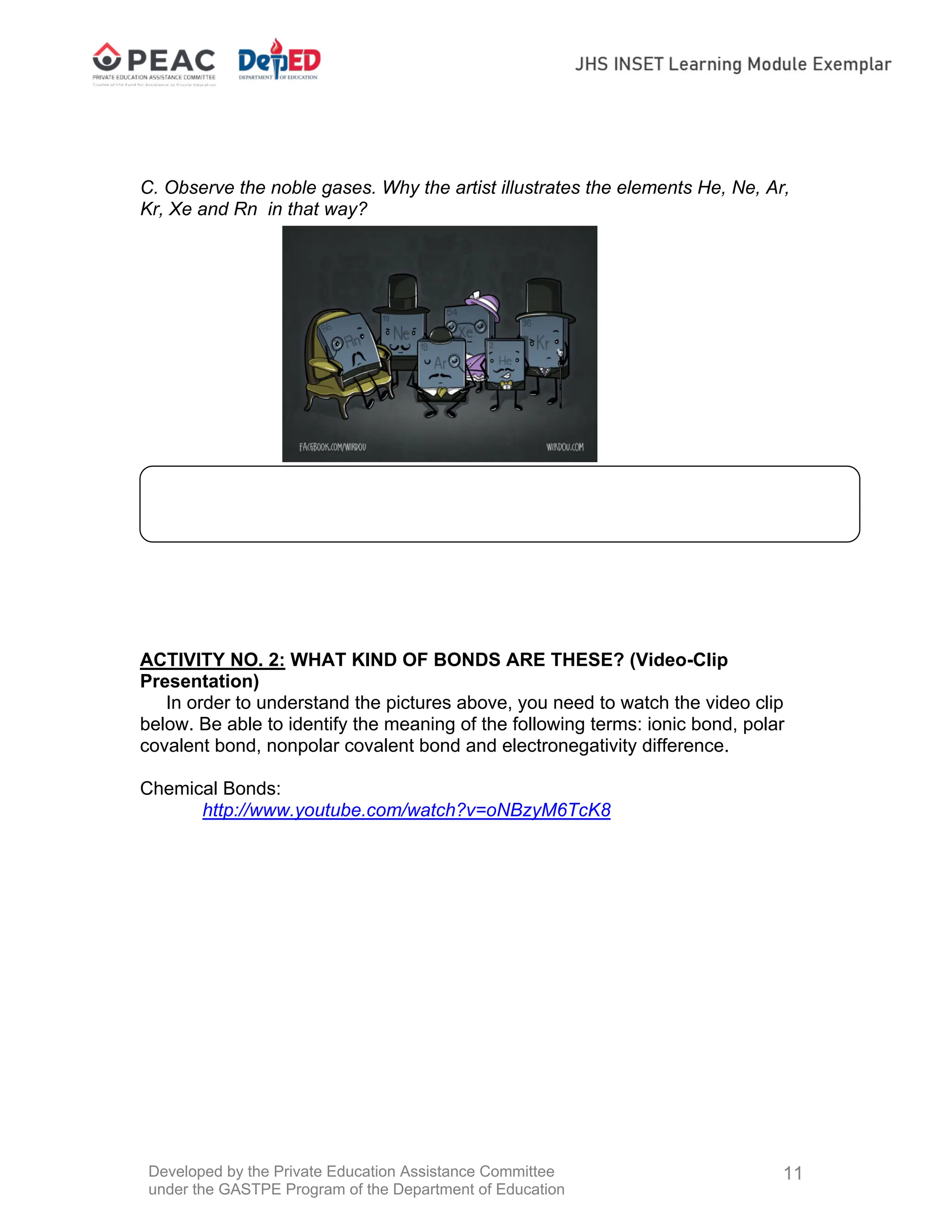
C. Observe the noble gases. Why the artist illustrates the elements He, Ne, Ar,
Kr, Xe and Rn in that way?
ACTIVITY NO. 2: WHAT KIND OF BONDS ARE THESE? (Video-Clip
Presentation)
In order to understand the pictures above, you need to watch the video clip
below. Be able to identify the meaning of the following terms: ionic bond, polar
covalent bond, nonpolar covalent bond and electronegativity difference.
Chemical Bonds:
http://www.youtube.com/watch?v=oNBzyM6TcK8
Developed by the Private Education Assistance Committee
under the GASTPE Program of the Department of Education
12
PROCESS QUESTIONS:
1. What are the primary compositions of Sodium Chloride?
2. What are ions?
3. How does an atom form into an ion?
3. What is the role of noble gases in forming compounds?
4. How many valence electrons do noble gases have? What does it imply?
5. Why are elements stable on their own while others are more stable than in a
compound?
6. How is a compound formed?
ACTIVITY NO. 3: ELICITING PRIOR KNOWLEDGE THROUGH I-R-F CHART
Given below is an IRF sheet. Fill in the first row with your answer to the
question:
How is a compound formed?
Initial
Revised
Final
End of EXPLORE:
You have just given your initial ideas about how compounds are formed. Find
out in the next section if your ideas are correct. What you learn in the next
sections will also enable you to do the final project which involves creating a
compound through scientific investigation.
Let’s start by doing the next activity.
Developed by the Private Education Assistance Committee
under the GASTPE Program of the Department of Education
13
Even though a few elements, such as carbon and gold, are sometimes
found in elemental form in nature, most of the substances we see around us
consist of two or more elements that have combined chemically to form more
complex substances called compounds.
Your goal in this section is to learn and understand the formation and
development of chemical substances. You will explain how atoms are bonded
differently.
ACTIVITY NO. 4: WRITING LEWIS STRUCTURES
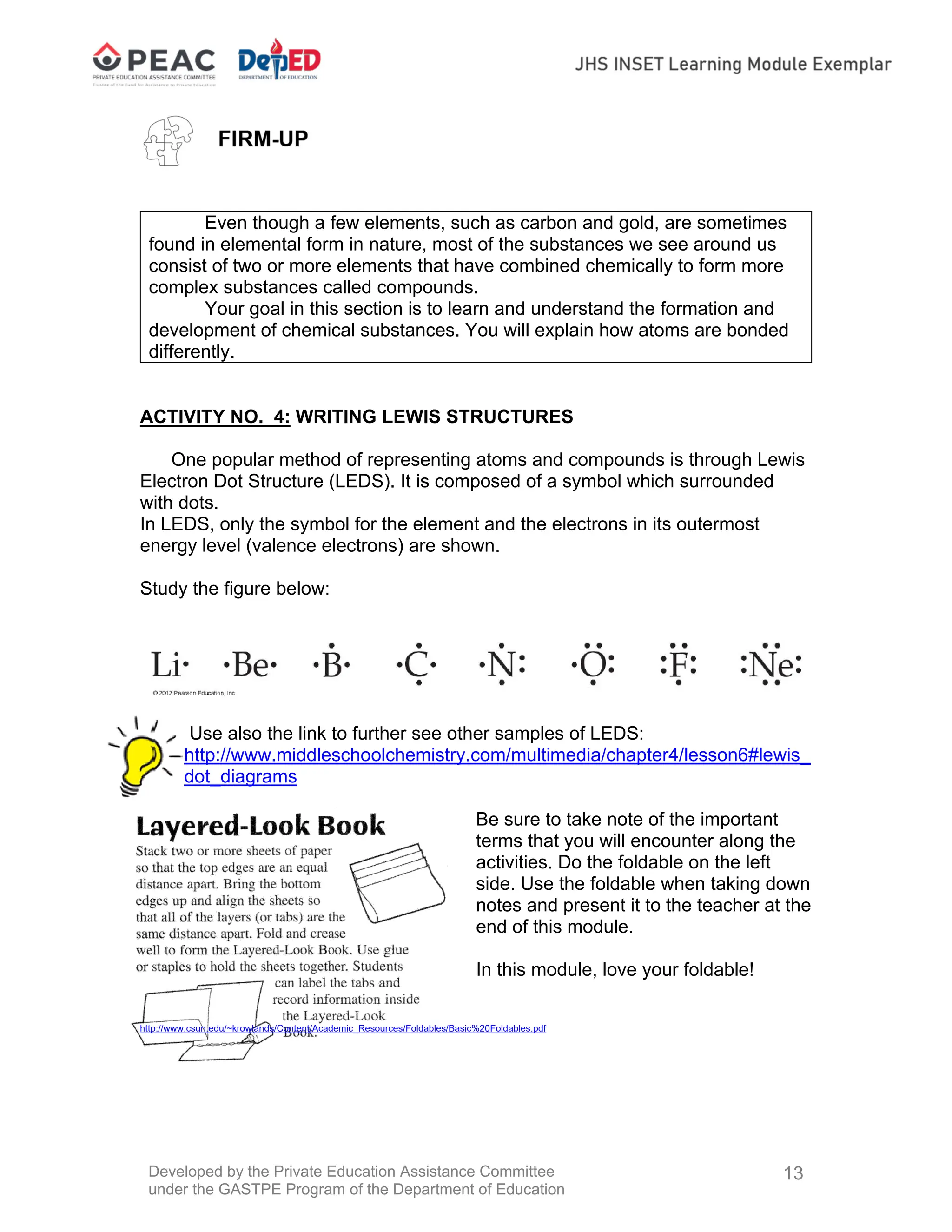
One popular method of representing atoms and compounds is through Lewis
Electron Dot Structure (LEDS). It is composed of a symbol which surrounded
with dots.
In LEDS, only the symbol for the element and the electrons in its outermost
energy level (valence electrons) are shown.
Study the figure below:
Use also the link to further see other samples of LEDS:
http://www.middleschoolchemistry.com/multimedia/chapter4/lesson6#lewis_
dot_diagrams
Be sure to take note of the important
terms that you will encounter along the
activities. Do the foldable on the left
side. Use the foldable when taking down
notes and present it to the teacher at the
end of this module.
In this module, love your foldable!
http://www.csun.edu/~krowlands/Content/Academic_Resources/Foldables/Basic%20Foldables.pdf
Developed by the Private Education Assistance Committee
under the GASTPE Program of the Department of Education
14
Process Questions:
1. What does the symbol of the element represent in the LEDS?
2. What is accountable for the valence electrons in the LEDS?
3. The number of dots near hydrogen and helium are the same as in the energy
level chart. Why?
Allow yourself to practice writing the Lewis Electron Dot.
DO Worksheet #1.
WORKSHEET #1: VALENCE ELECTRONS AND LEDS:
Apply your knowledge of valence electrons, Lewis dot structures and the octet rule to
complete the table below.
ELEMENTS VALENCE
ELECTRONS
LEDS HOW TO ACHIEVE
THE OCTET?
1. Hydrogen
2. Magnesium
3. Aluminum
4. Oxygen
5. Nitrogen
6. Bromine
7. Neon
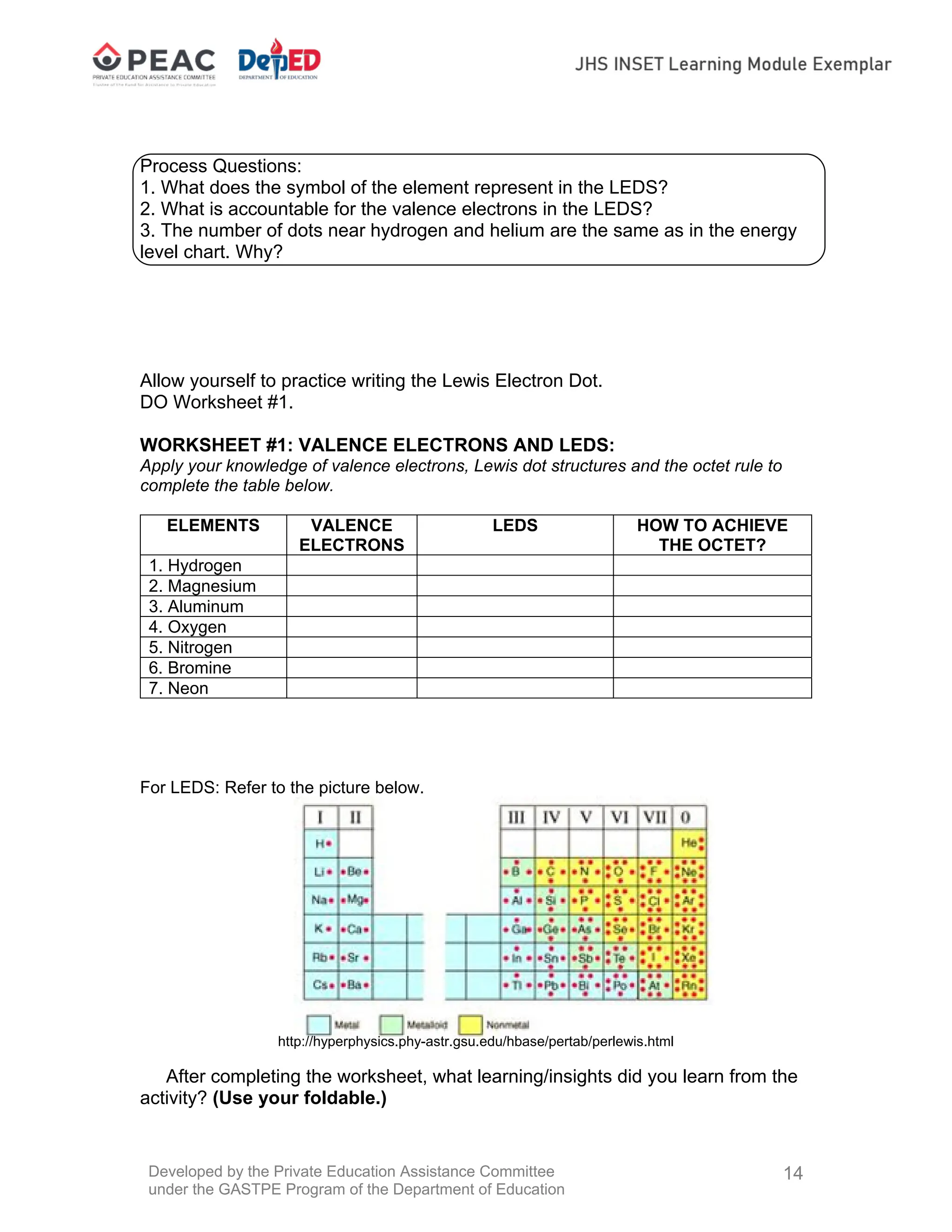
For LEDS: Refer to the picture below.
http://hyperphysics.phy-astr.gsu.edu/hbase/pertab/perlewis.html
After completing the worksheet, what learning/insights did you learn from the
activity? (Use your foldable.)
Developed by the Private Education Assistance Committee
under the GASTPE Program of the Department of Education
15
___________________________________________________________
________________________________________________________________
____________________________________________
Understanding the Lewis Structure will help you identify the number of
valence electrons and the number of electrons needed to complete the octet in
the next activity. Make sure to familiarize how many electrons are needed/given
up in forming ions.
ACTIVITY NO. 5: The CHEMICAL AVENGERS
Welcome! You are invited to be part of !!!
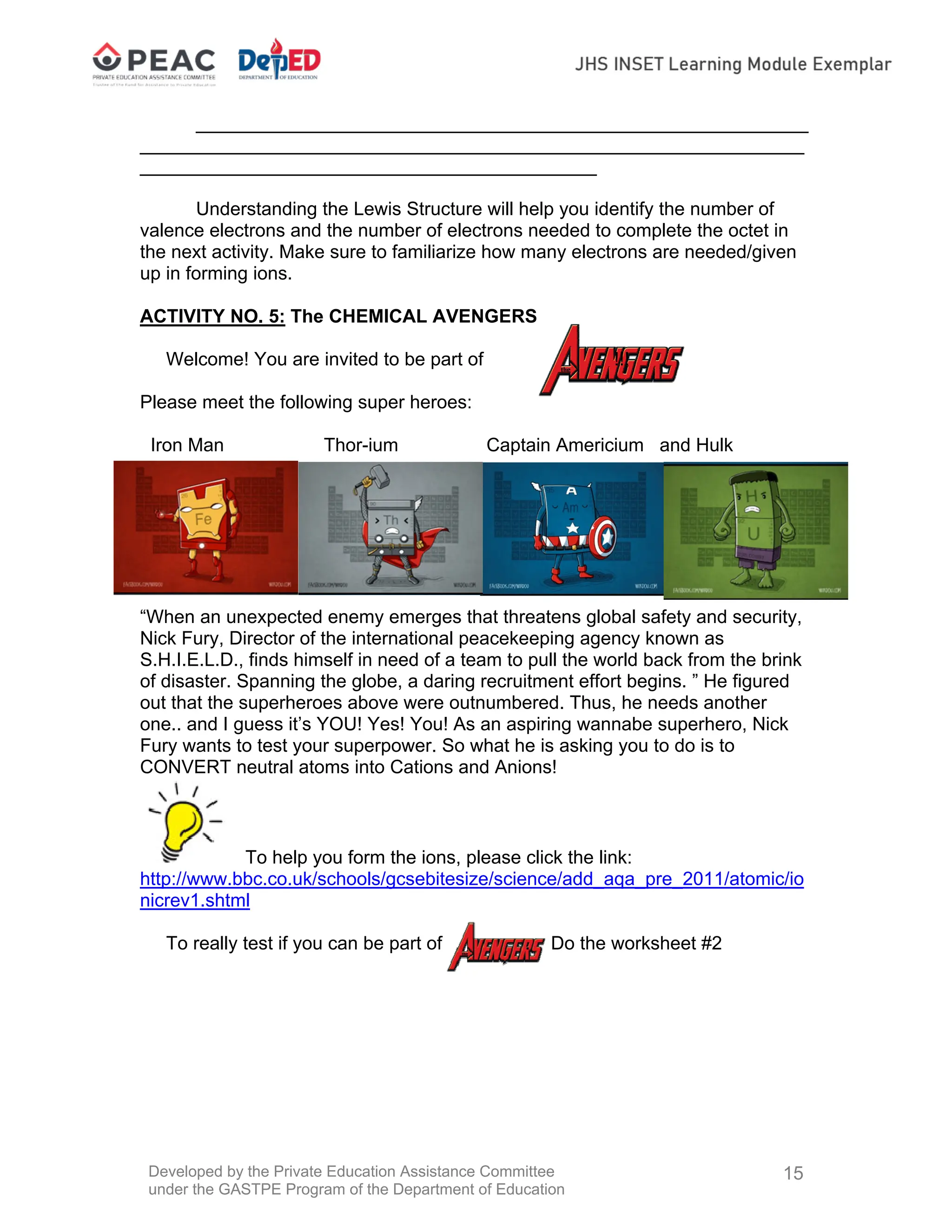
Please meet the following super heroes:
Iron Man Thor-ium Captain Americium and Hulk
“When an unexpected enemy emerges that threatens global safety and security,
Nick Fury, Director of the international peacekeeping agency known as
S.H.I.E.L.D., finds himself in need of a team to pull the world back from the brink
of disaster. Spanning the globe, a daring recruitment effort begins. ” He figured
out that the superheroes above were outnumbered. Thus, he needs another
one.. and I guess it’s YOU! Yes! You! As an aspiring wannabe superhero, Nick
Fury wants to test your superpower. So what he is asking you to do is to
CONVERT neutral atoms into Cations and Anions!
To help you form the ions, please click the link:
http://www.bbc.co.uk/schools/gcsebitesize/science/add_aqa_pre_2011/atomic/io
nicrev1.shtml
To really test if you can be part of . Do the worksheet #2
Developed by the Private Education Assistance Committee
under the GASTPE Program of the Department of Education
16
Worksheet #2: Monoatomic Ions
Use a periodic table to complete the table below:
Element Name Element Symbol Ion Name Ion Formula
1. sodium
2. bromine
3. magnesium
4. chlorine
5. oxygen
6. boron
7. lithium
8. neon
9. phosphorus
10.aluminum
Submit your answers and assess yourself. If your score is:
10 – Congratulations! You belong to the superheroes undoubtedly.
9-8 – Good Job! You are Next in line!
7-6 - You are such a wannabe! You are in the waiting list.
Below 5 - More training! Read the link below for more practice.
http://itc.gsw.edu/faculty/speavy/spclass/chemistry/ions.htm
Process Questions:
1. Can atoms lose electrons? Gain electrons? Explain.
2. What are ions?
3. Differentiate a cation and an anion.
4. How is the Lewis dot configuration used to represent atoms?
5. How are ions formed?
How do you find the worksheet? Look at the items you missed. Go back to your
notes and review the terms or concepts you missed.
You learned how ions are formed. In the next activity, you will be using this to
visualize how ionic compounds are formed.
Developed by the Private Education Assistance Committee
under the GASTPE Program of the Department of Education
17
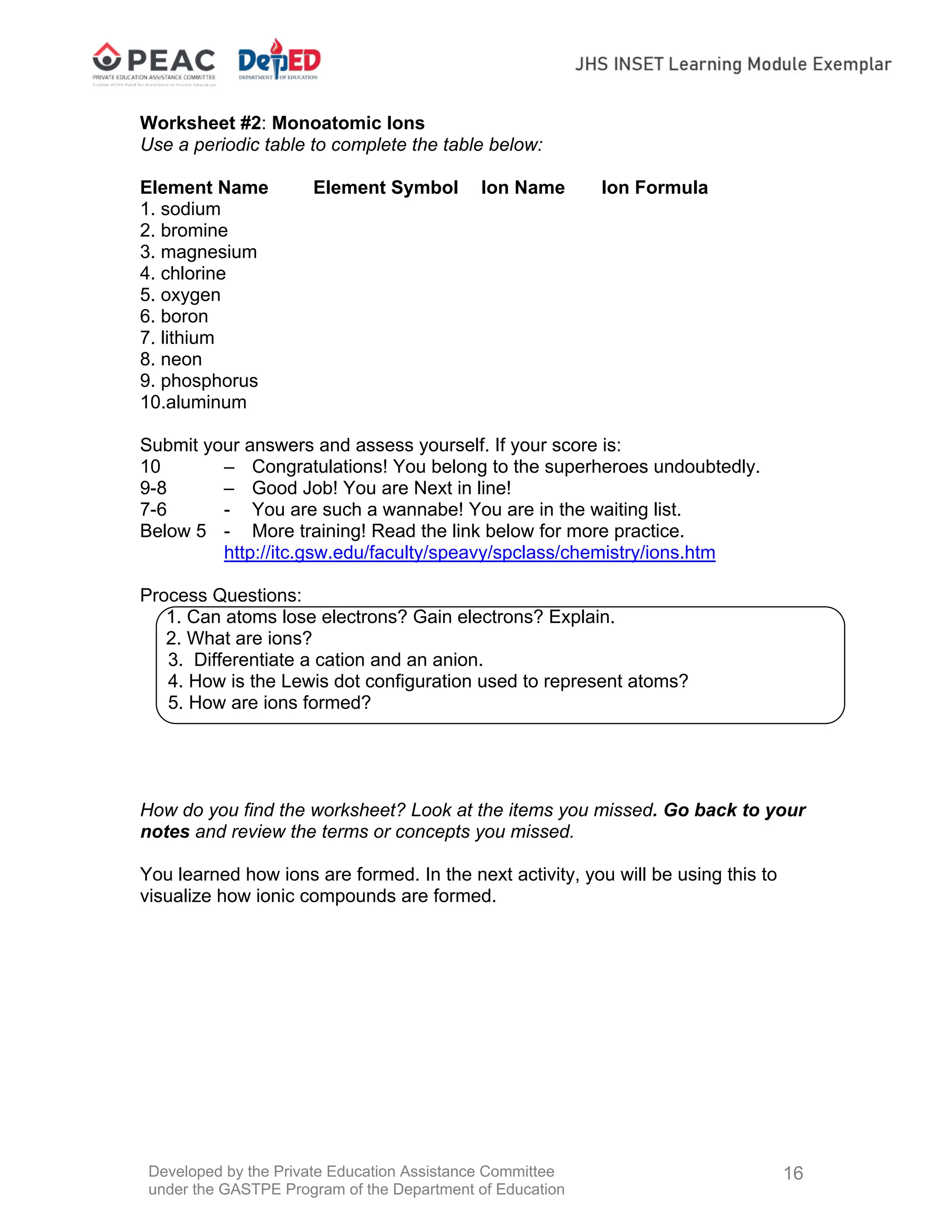
ACTIVITY NO. 6: Ionic Bond: Taken Not Shared
Atoms are held together in compounds
by the forces of attraction which result in
formation of chemical bonds. The
formation of chemical bonds results in
the lowering of energy which is less than
the energy the individual atoms. The
resulting compound
is lower in energy as compared to sum
of energies of the reacting
atom/molecule and hence is more
stable. In this activity, you get to learn
on one kind of bond, that is ionic
compound.
One type of chemical bond is the ionic bond. To understand how an ionic
bond works and its properties, click the link below:
http://www.education.uoit.ca/lordec/ID_LORDEC/ionic_compounds/law_ionic_co
mpounds.swf
Note down concepts/terms presented from the link in your foldable.
PROCESS QUESTIONS:
1. Name the two types of ions present in NaCl.
2. What are the components of an ionic bond?
3. What is the final product of Na+
ion and Cl-
?
4. What is the number of electrons present in Cl–
ion?
5. In a sodium chloride lattice, how many Cl–
ions surround each Na+ ion?
Developed by the Private Education Assistance Committee
under the GASTPE Program of the Department of Education
18
6. How is an ionic compound formed?
What are the essential concepts that you gathered?
What can help you more easily remember these terms? Look back at your notes
and try to cluster related concepts.
What’s the difference between you and
Harry Potter?
Oh well, Harry has a wand and a spell while you have only a SPARKLER and a
spell!
For Info:
 Magic: A wand is a unique spell/charm caster that every wizard
must have to be powerful. Once a wizard holds the right one,
sparks may potentially fly from the tip. When casting spells and
charms, light, noise and smoke emerge from the wand.
 Science: Perhaps these wands are similar to sparklers. Sparklers
are unique to the fabricator, produce sparks, light, noise and
smoke. The only difference is that you cannot levitate or expel
anyone or anything with a sparkler.
Developed by the Private Education Assistance Committee
under the GASTPE Program of the Department of Education
19
Conclusion:
Research about sparklers by clicking the website below. Look into the
composition of sparklers.
http://www.ehow.com/info_8299010_composition-sparklers.html
ACTIVITY NO. 7: IONIC BONDING GAME
You learned from the previous activity how ionic bond is formed. In this game,
you are challenged to create compounds by combining ions
http://www.learner.org/interactives/periodic/groups_interactive.html
Answer the Process Questions below:
1. What were the compounds that you’d created?
2. What are the main components of an ionic bond?
3. How is a compound formed?
What is it made up of? What kind of compounds are these?
Developed by the Private Education Assistance Committee
under the GASTPE Program of the Department of Education
20
Let’s check if you have learned something from the previous activities. Do the
quiz below:
Quiz #1
http://highered.mcgraw-hill.com/sites/0072402334/student_view0/quiz-
ionic_bonding.html
Where can you find ionic compounds? Are these substances rare? The next
activity will help you hunt for these compounds.
All you need is to look for it… so Let the hunting begin:
ACTIVITY NO. 8: The Search for Ionic Compounds
You have learned that ionic compounds are basically defined as being
compounds where two or more ions are held next to each other by electrical
attraction. One of the ions has a positive charge (called a "cation") and the other
has a negative charge ("anion"). Cations are usually metal atoms and anions are
either nonmetals or polyatomic ions (ions with more than one atom). Think back
to grade school: The same thing that makes the positive and negative ends of a
magnet stick to each other is what makes cations and anions stick to each other.
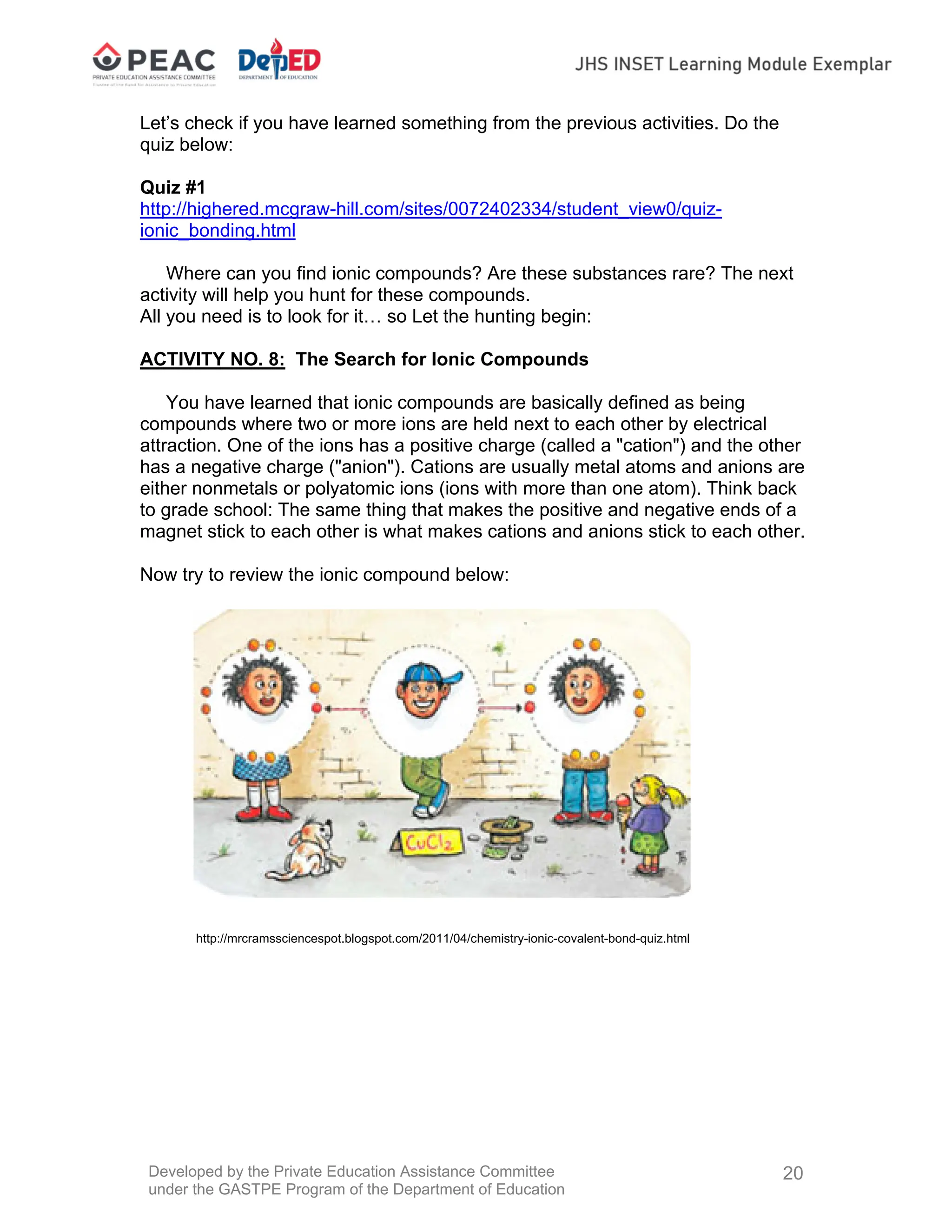
Now try to review the ionic compound below:
http://mrcramssciencespot.blogspot.com/2011/04/chemistry-ionic-covalent-bond-quiz.html
Developed by the Private Education Assistance Committee
under the GASTPE Program of the Department of Education
21
1) What type of bond is shown in the cartoon above? How do you know?
2) How many valence electrons is each "Cl" atom receiving? Why is each "Cl"
receiving this amount of electrons?
3) Copper (Cu) is not in group 1A or 2A, but it is behaving like metal. How many
valence electrons does Copper (Cu) lose?
4) What will the charge on the Cu atom be after it gives its valence electrons
away?
5) What will be the charge on each Cl atom after they receive their valence
electrons?
6) What are the uses of CuCl2?
Read out loud the discussion below:
Usually, when we have ionic compounds, they form large crystals that you
can see with the naked eye. Table salt is one example of this - if you look at a
crystal of salt, chances are you'll be able to see that it looks like a little cube. This
is because salt likes to stack in little cube-shaped blocks.
Sometimes when you see a salt, it looks like a powder instead of a cube.
This doesn't mean that the salt is not a crystal - it means that the crystals are just
so small that you can't see them with the naked eye. If you were to put the
powder under a microscope, chances are that you would see little geometric
block.
Now let’s search for the many Ionic Compounds! What to do? Research
for ionic compounds (as many as you can) and complete the table below in
terms of its properties.
Worksheet # 3: Table Completion
Ionic
Compounds
Properties Uses
Process Questions:
1. What properties are common to these ionic compounds?
2. How will you use these properties in identifying these compounds?
3. How are the subscripts helpful in the formation of these compounds?
Developed by the Private Education Assistance Committee
under the GASTPE Program of the Department of Education
22
In the previous activity, we saw how atoms could achieve a complete shell of
electrons by losing or gaining one or more electrons, to form ions. There is
another way atoms can satisfy the octet rule. The next activity will explain what
covalent bonding is.
ACTIVITY NO. 9: Interactive Webpage Reading – Covalent Bond
In this activity, we will study about another kind of bonding called covalent
bonding. Covalent bonding is helpful in understanding the formation of
molecules. Let us now see how these molecules are formed.
Click the animation below. The animation discusses how covalent bond is
formed. Write down the important concepts that you will gather in your foldable.
http://www.pbslearningmedia.org/asset/lsps07_int_covalentbond/
Study the notes you have and apply it in Worksheet #4: Understanding
Covalent Bond
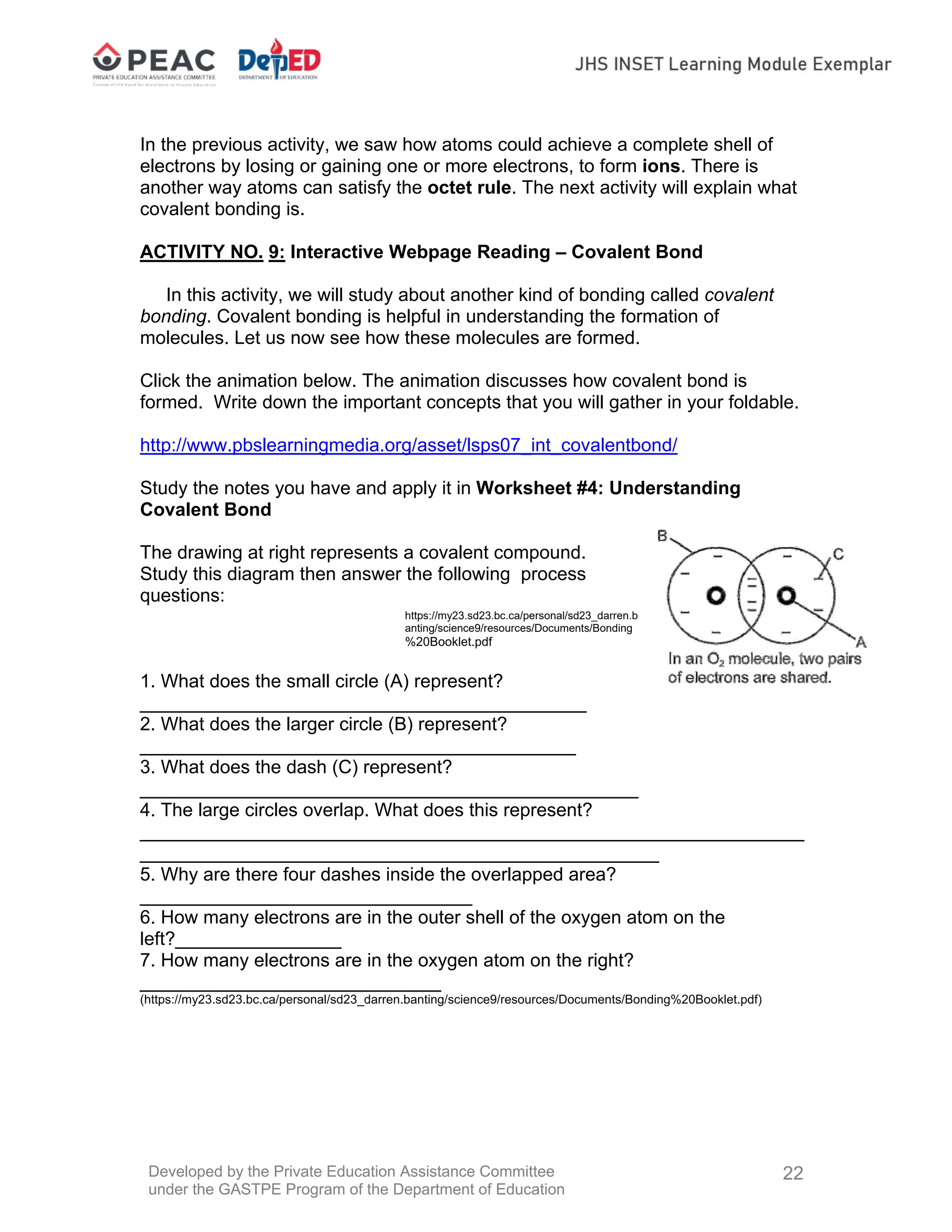
The drawing at right represents a covalent compound.
Study this diagram then answer the following process
questions:
1. What does the small circle (A) represent?
___________________________________________
2. What does the larger circle (B) represent?
__________________________________________
3. What does the dash (C) represent?
________________________________________________
4. The large circles overlap. What does this represent?
________________________________________________________________
__________________________________________________
5. Why are there four dashes inside the overlapped area?
________________________________
6. How many electrons are in the outer shell of the oxygen atom on the
left?________________
7. How many electrons are in the oxygen atom on the right?
_____________________________
(https://my23.sd23.bc.ca/personal/sd23_darren.banting/science9/resources/Documents/Bonding%20Booklet.pdf)
https://my23.sd23.bc.ca/personal/sd23_darren.b
anting/science9/resources/Documents/Bonding
%20Booklet.pdf
Developed by the Private Education Assistance Committee
under the GASTPE Program of the Department of Education
23
So, how did you go far? Did you get to understand how covalent bond is formed?
What are the important concepts you had written down in your foldable?
After learning the properties of ionic and covalent bonds, the next activity will
provide the many ways you can differentiate the two bonds. Furthermore, this will
help you even remember terms related to ionic and covalent bonds.
ACTIVITY NO. 10: The Singing Bond (Band)!
Let’s try to loosen up with the technicalities of chemical bonds. The link
below will lead you to a song that may not be within your genre but it’s a very
common song because maybe, you’ve heard it in radio stations, videoke bar or
hummed by you mom. Join with the music just for fun!
Chemical Bond Song (To the tune of Dancing Queen)
http://www.youtube.com/watch?v=BCYrNU-7SfA
First we'll start with ionic bonds,
A metal and nonmetal are involved.
The metal gives over electrons, the nonmetal ... it receives.
The atoms become IONS!
Metals might have 1,2 or 3
Electrons for the nonmetal to receive
It all depends on what's needed, to make the number 8
For the nonmetals' outer shell.
AND IF IT HAPPENS FOR THEM ...
They both become IONS ...... CHARGED ATOMS .... They become IONS!
The metal's positive, the nonmetal's negative,
They become IONS, oh yeah.
The metal's plus, the nonmetal minus, and opposites they do attract.
So what you get, when they come together, is an IONIC BOND.
So what about those covalent bonds?
It's not about loss and gain of electrons.
Valence electrons they are shared, to complete the outer shells
Of the nonmetals set to bond.
IT'S WHEN NONMETALS JOIN ... to make covalent bonds
With shared electrons ,,,, they're covalent bonds.
Not a transfer, instead they share valence electrons, oh yeah!
Ionic bonds ... covalent bonds ... both of them chemical bonds.
Developed by the Private Education Assistance Committee
under the GASTPE Program of the Department of Education
24
How are they made? What's the difference? Play the song again !
Ionic bonds, covalent bonds ..... both chemical bonds!
Based from the song, complete the table below by
differentiating an ionic bond from covalent bond:
Characteristics Ionic Bond Covalent Bond
Process Questions:
1. What composes a covalent bond?
2. How did the valence electrons in a covalent compound achieve the octet?
3. How will you differentiate an ionic compound from a molecular compound?
4. How compound is formed?
Now you have a clear picture on how ionic bond differs from covalent bond. Did
you add something in your foldable?
The next activity will help you imagine how a compound or substance looks
like. Focus on the following: Dots and Dashes. The next activity indicates the
difference of molecular compound.
ACTIVITY NO. 11: The LEDS Of Covalent Compound
It is best to represent the formation of covalent bonds through the Lewis
Electron Dot Structure.
The link below shows how to bond molecular (covalent) compound:
http://www.kentchemistry.com/links/bonding/covalentlewisdot.htm
Developed by the Private Education Assistance Committee
under the GASTPE Program of the Department of Education
25
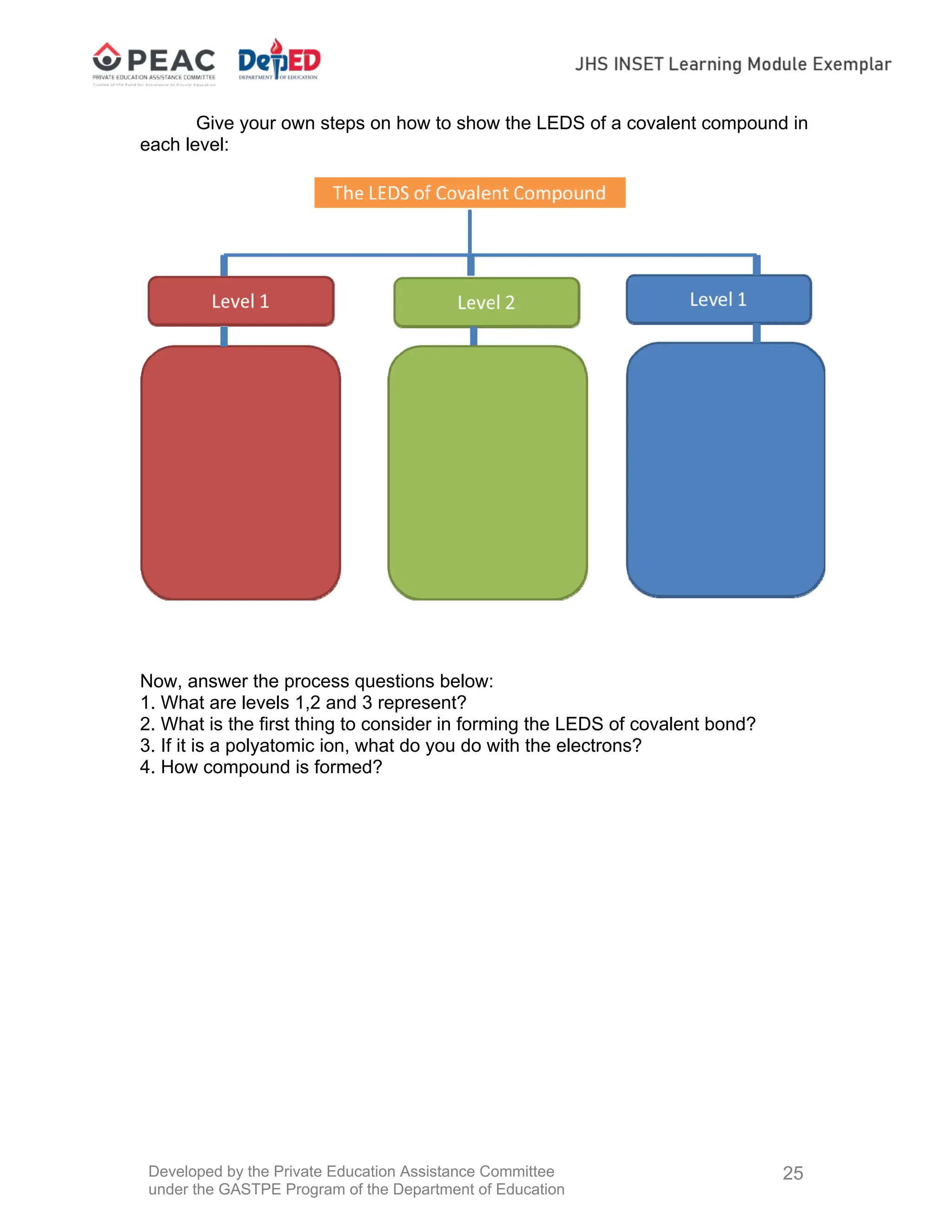
Give your own steps on how to show the LEDS of a covalent compound in
each level:
Now, answer the process questions below:
1. What are levels 1,2 and 3 represent?
2. What is the first thing to consider in forming the LEDS of covalent bond?
3. If it is a polyatomic ion, what do you do with the electrons?
4. How compound is formed?
Developed by the Private Education Assistance Committee
under the GASTPE Program of the Department of Education
26
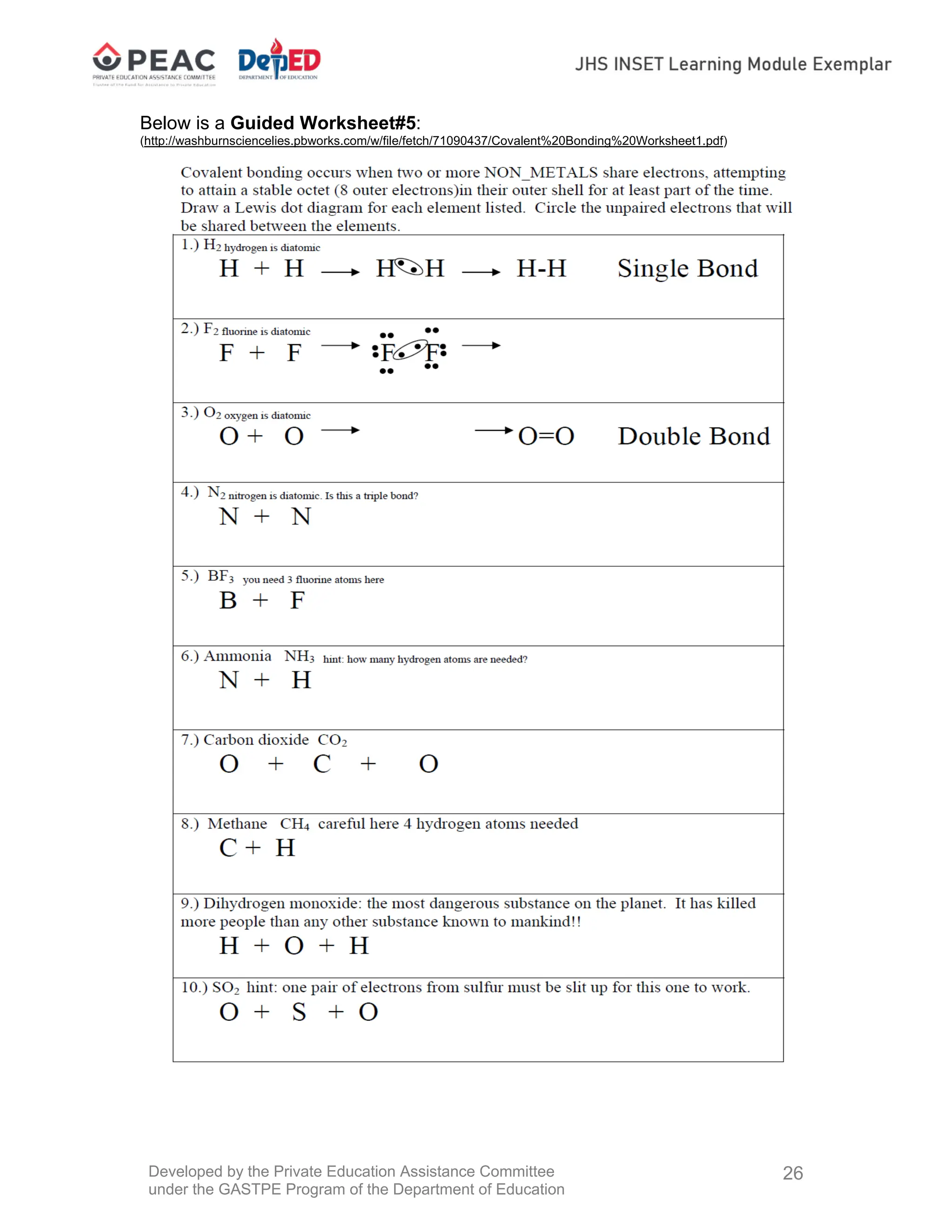
Below is a Guided Worksheet#5:
(http://washburnsciencelies.pbworks.com/w/file/fetch/71090437/Covalent%20Bonding%20Worksheet1.pdf)
Developed by the Private Education Assistance Committee
under the GASTPE Program of the Department of Education
27
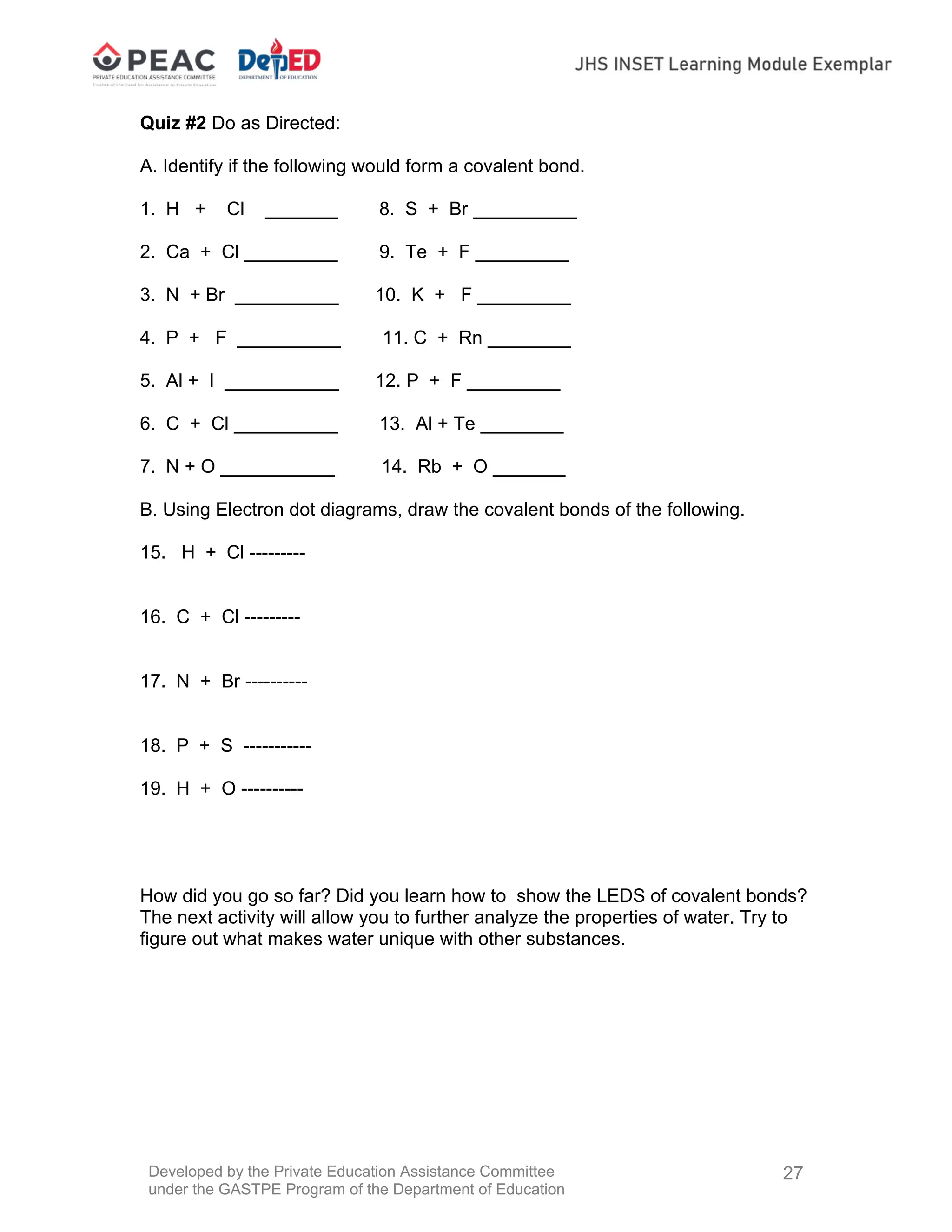
Quiz #2 Do as Directed:
A. Identify if the following would form a covalent bond.
1. H + Cl _______ 8. S + Br __________
2. Ca + Cl _________ 9. Te + F _________
3. N + Br __________ 10. K + F _________
4. P + F __________ 11. C + Rn ________
5. Al + I ___________ 12. P + F _________
6. C + Cl __________ 13. Al + Te ________
7. N + O ___________ 14. Rb + O _______
B. Using Electron dot diagrams, draw the covalent bonds of the following.
15. H + Cl ---------
16. C + Cl ---------
17. N + Br ----------
18. P + S -----------
19. H + O ----------
How did you go so far? Did you learn how to show the LEDS of covalent bonds?
The next activity will allow you to further analyze the properties of water. Try to
figure out what makes water unique with other substances.
Developed by the Private Education Assistance Committee
under the GASTPE Program of the Department of Education
28
ACTIVITY NO. 12: Water Love Story
Did you ever wonder how water is formed? What type of bond does it work on?
To find out, click the website below:
The Love Story of Hydrogen Bond – Animation
http://programs.northlandcollege.edu/biology/Biology1111/animations/hydrogenb
onds.html
Write down in your foldable the concepts learned in the animation above.
Process Questions
1. What polarity of water means?
2. How polarity makes water behave strangely?
3. How water is formed?
When the atoms bind together their electron clouds interact with one another
and if this interaction is ‘favorable’ then bonding occur. On the next topic, you will
get to encounter the two types of covalent.
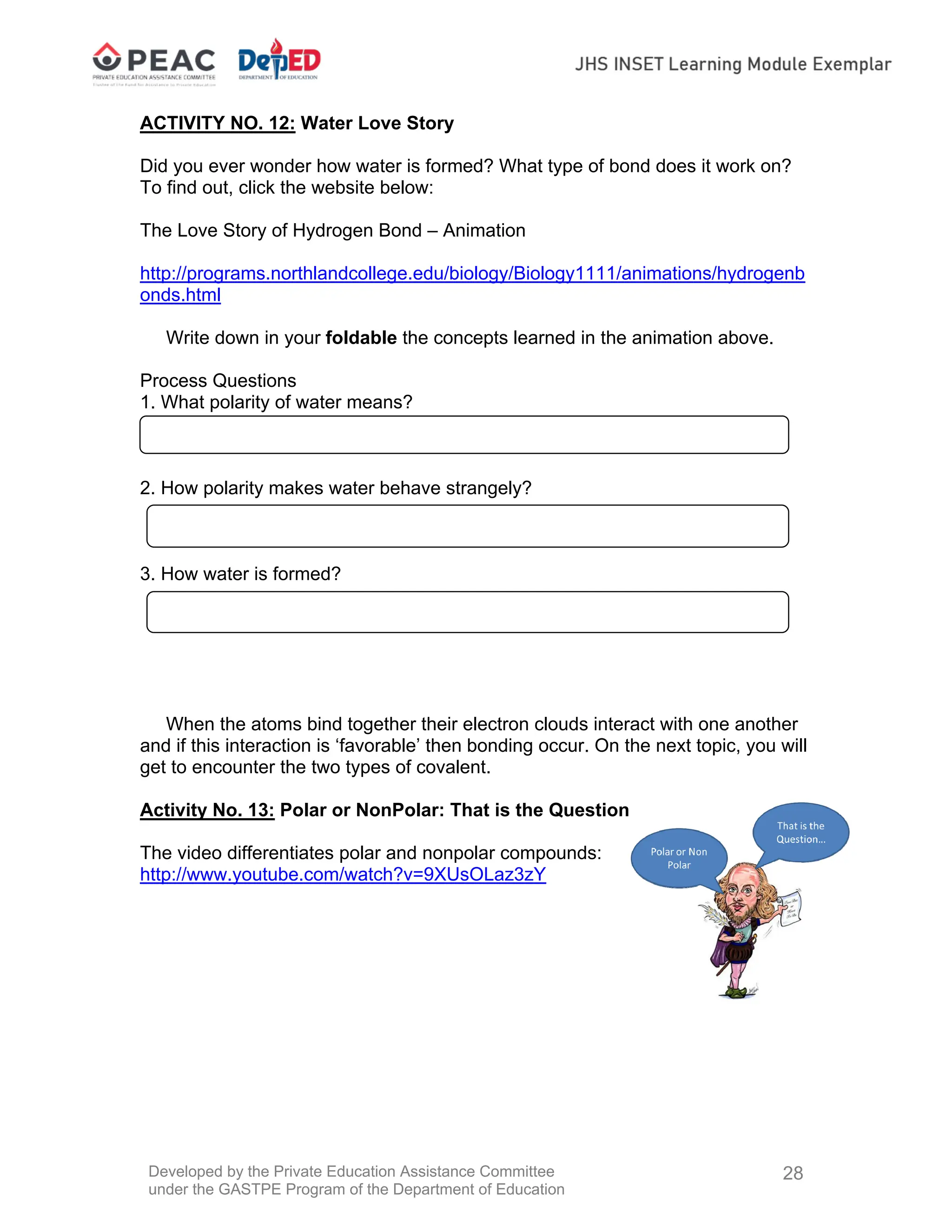
Activity No. 13: Polar or NonPolar: That is the Question
The video differentiates polar and nonpolar compounds:
http://www.youtube.com/watch?v=9XUsOLaz3zY
Developed by the Private Education Assistance Committee
under the GASTPE Program of the Department of Education
29
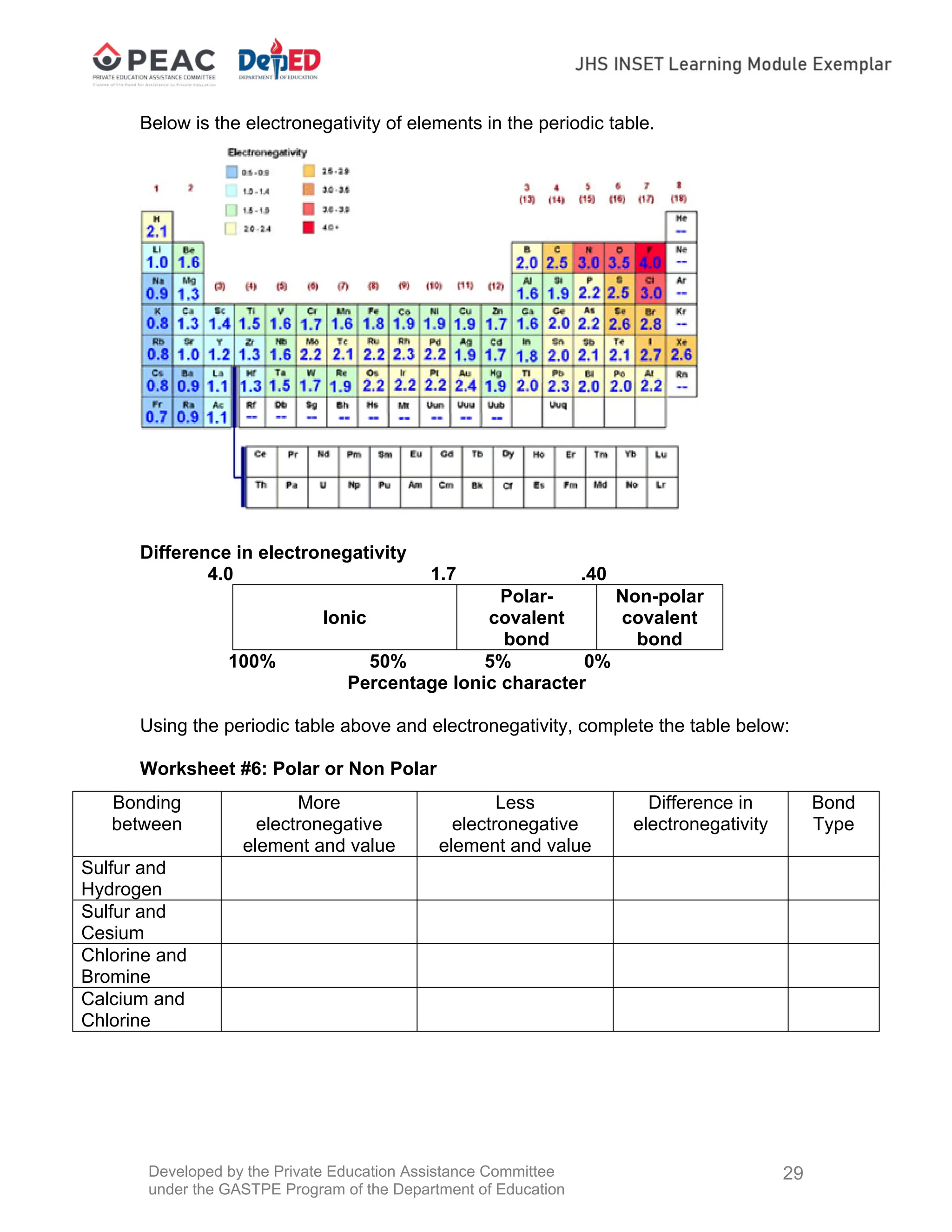
Below is the electronegativity of elements in the periodic table.
Difference in electronegativity
4.0 1.7 .40
Ionic
Polar-
covalent
bond
Non-polar
covalent
bond
100% 50% 5% 0%
Percentage Ionic character
Using the periodic table above and electronegativity, complete the table below:
Worksheet #6: Polar or Non Polar
Bonding
between
More
electronegative
element and value
Less
electronegative
element and value
Difference in
electronegativity
Bond
Type
Sulfur and
Hydrogen
Sulfur and
Cesium
Chlorine and
Bromine
Calcium and
Chlorine
Developed by the Private Education Assistance Committee
under the GASTPE Program of the Department of Education
30
After learning the how ionic and molecular compound are formed, it is important
in Chemistry to name the compounds. We don’t just name according to how we
feel naming it. Compounds are named from different rules according its
composition.
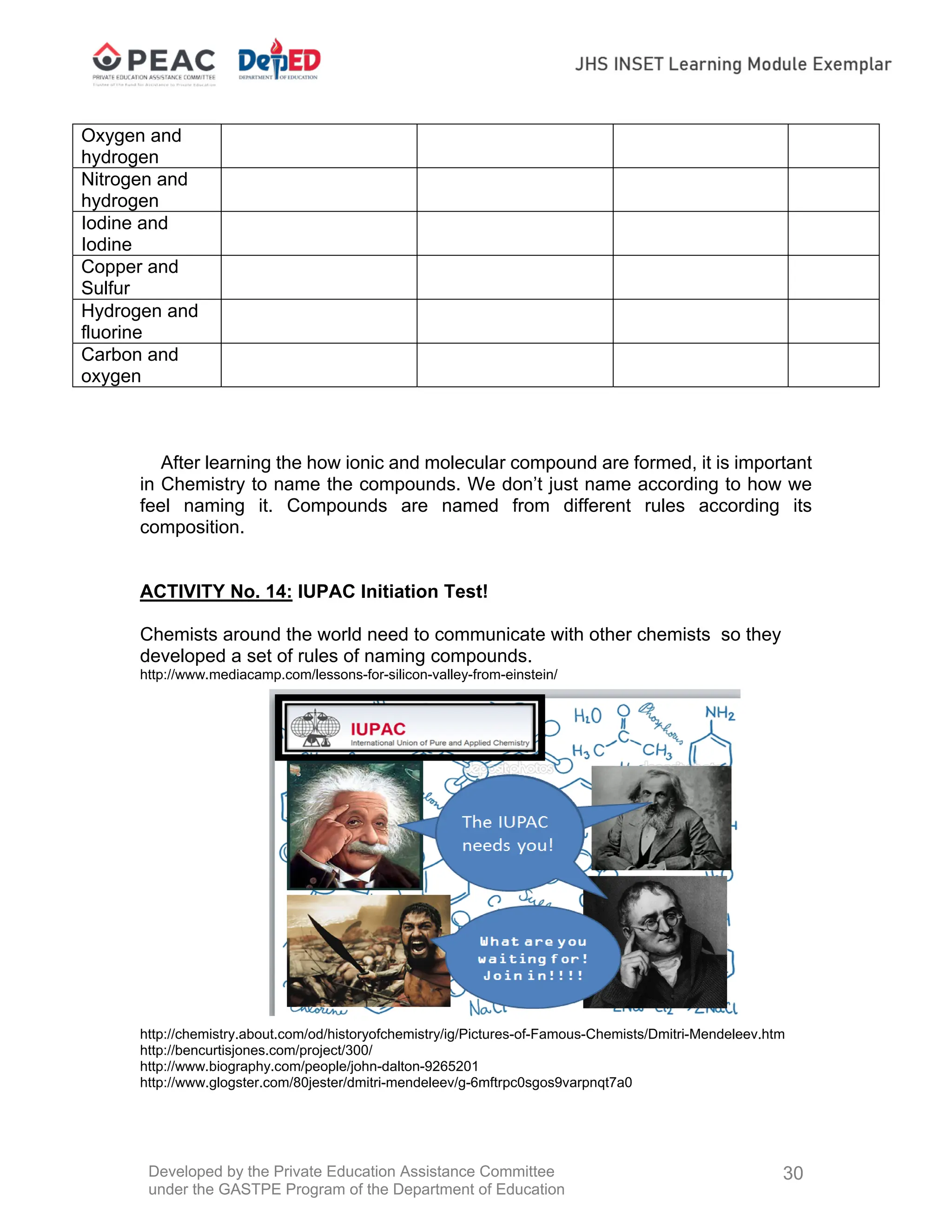
ACTIVITY No. 14: IUPAC Initiation Test!
Chemists around the world need to communicate with other chemists so they
developed a set of rules of naming compounds.
http://www.mediacamp.com/lessons-for-silicon-valley-from-einstein/
http://chemistry.about.com/od/historyofchemistry/ig/Pictures-of-Famous-Chemists/Dmitri-Mendeleev.htm
http://bencurtisjones.com/project/300/
http://www.biography.com/people/john-dalton-9265201
http://www.glogster.com/80jester/dmitri-mendeleev/g-6mftrpc0sgos9varpnqt7a0
Oxygen and
hydrogen
Nitrogen and
hydrogen
Iodine and
Iodine
Copper and
Sulfur
Hydrogen and
fluorine
Carbon and
oxygen
Developed by the Private Education Assistance Committee
under the GASTPE Program of the Department of Education
31
“The IUPAC Affiliate Membership Program (AMP) allows any individual
with an interest in IUPAC and IUPAC Activities to sustain a relationship with the
Union. The program was launched in 1986 in order to maximize the participation
of chemists throughout the world in the affairs of IUPAC and also to disseminate
information about its activities to a much wider audience.
"In 2003, almost 5000 chemists from 66 countries registered as Affiliates.
Included in this number are nearly 400 sponsored (free) Affiliate memberships for
chemists, aged 35 years or less, from developing and economically
disadvantaged countries.”
As an aspiring chemist, you wish to be a member of the IUPAC, for greater
opportunities are waiting for you… and you wish to be part of the mission of the
organization: IUPAC advances the worldwide role of chemistry for the benefit of
Mankind.
So to be part of the said organization you have to undergo series of tests. So,
are YOU ready?!
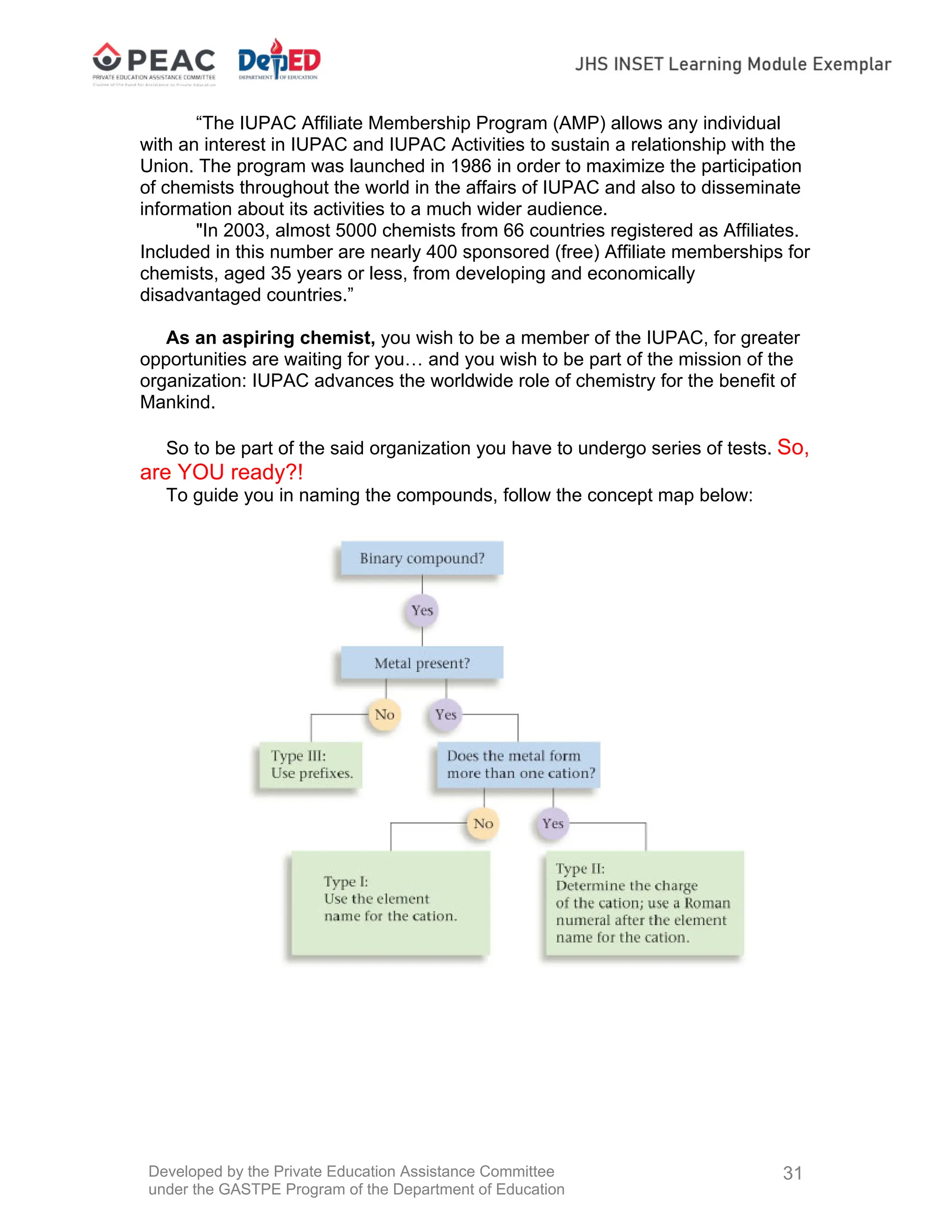
To guide you in naming the compounds, follow the concept map below:
Developed by the Private Education Assistance Committee
under the GASTPE Program of the Department of Education
32
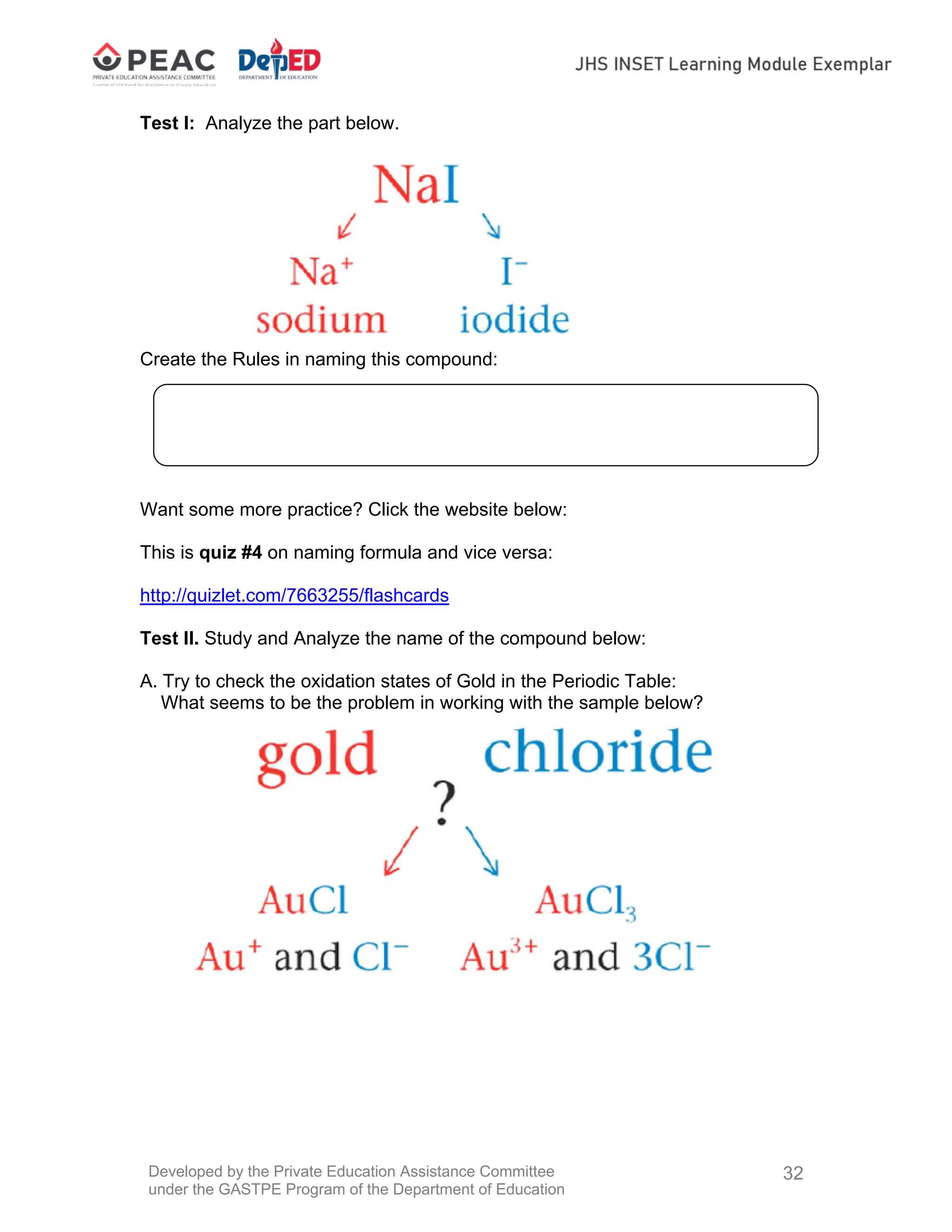
Test I: Analyze the part below.
Create the Rules in naming this compound:
Want some more practice? Click the website below:
This is quiz #4 on naming formula and vice versa:
http://quizlet.com/7663255/flashcards
Test II. Study and Analyze the name of the compound below:
A. Try to check the oxidation states of Gold in the Periodic Table:
What seems to be the problem in working with the sample below?
Developed by the Private Education Assistance Committee
under the GASTPE Program of the Department of Education
33
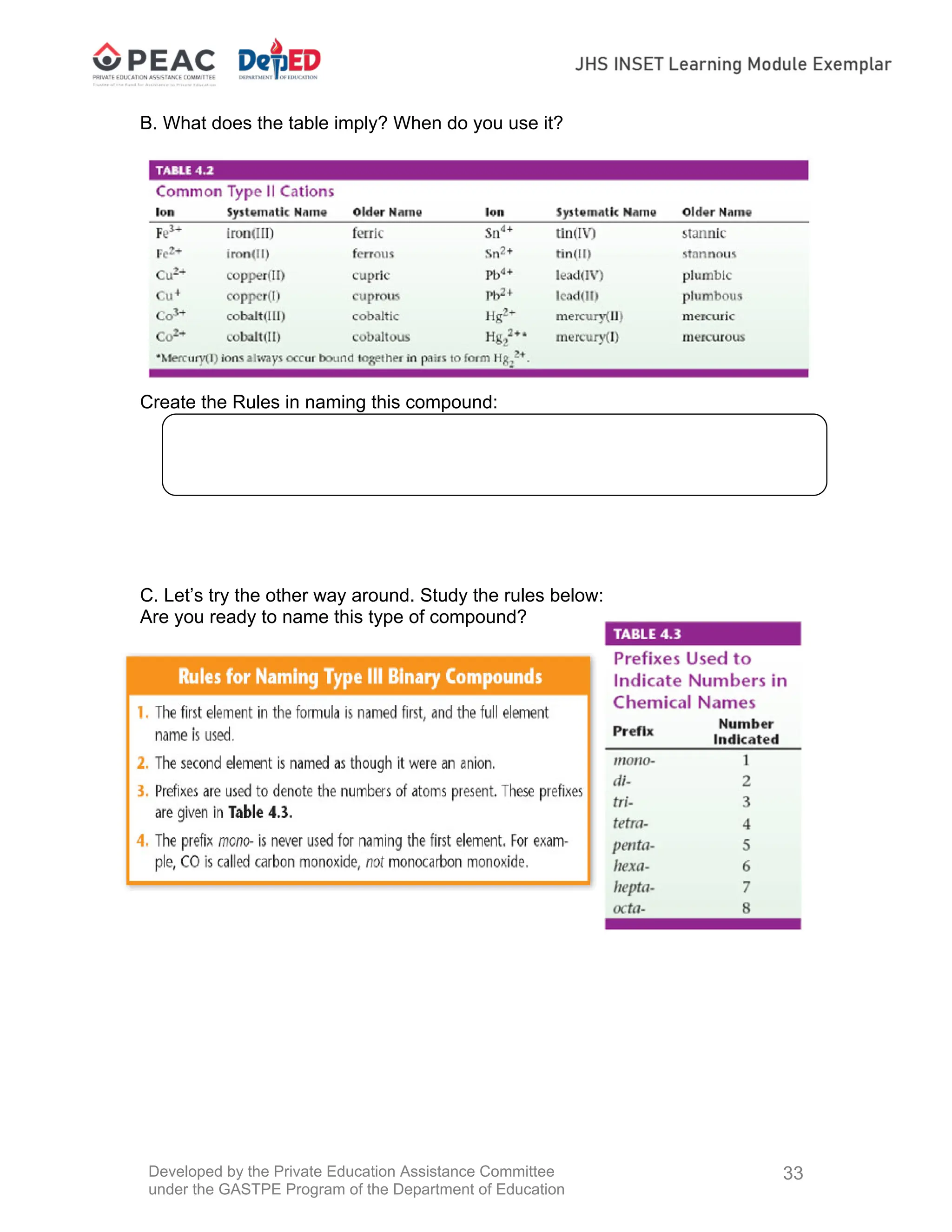
B. What does the table imply? When do you use it?
Create the Rules in naming this compound:
C. Let’s try the other way around. Study the rules below:
Are you ready to name this type of compound?
Developed by the Private Education Assistance Committee
under the GASTPE Program of the Department of Education
34
Complete the worksheet below:
Worksheet # 6: Naming Binary Compounds
Name each of the following compounds:
1. AsF3
2. BF3
3. BrF5
4. BrCl
5. ClF
6. Cl2O6
7. IF5
8. KrF2
9. NI3
10. N2O3
11. I2O4
12. P2Cl4
13. SeCl2
14. SiO2
15. SO3
Developed by the Private Education Assistance Committee
under the GASTPE Program of the Department of Education
35
Final Test:
Can you do the activity as shown in the picture below?
http://www.middleschoolchemistry.com/lessonplans/chapter6/lesson2
Read aloud the products formed based from the picture above.
Study the picture A and Picture B
Picture A Picture B
Now, how are you going to name salts?
Developed by the Private Education Assistance Committee
under the GASTPE Program of the Department of Education
36
Quiz #5
Do the Interactive Quiz Below:
http://www.chemistrywithmsdana.org/wp-content/uploads/2012/07/ionic.html
So, do you think you are qualified to be part of the IUPAC team? If not, review
naming compounds through this videoclip:
http://www.youtube.com/watch?v=9XUsOLaz3zY (Naming Tutorial)
For the next activity, you will get to understand how aluminum cans are made
and reasons why jewelry is beautifully shaped.
ACTIVITY NO. 15: Metallic Bond
Do you really wanna know what happens to the electrons? Click the animations
below:
A. http://www.drkstreet.com/resources/metallic-bonding-animation.swf
B. http://www.youtube.com/watch?v=srxNJ03W_qM (This explains why metal is
malleable.)
Developed by the Private Education Assistance Committee
under the GASTPE Program of the Department of Education
37
Now, let’s see the details of metallic bonding by reading the page below:
http://www.chemguide.co.uk/atoms/bonding/metallic.html
Process Questions:
1. What do you mean by sea of electrons?
2. Describe the movement of electrons when potential difference is applied.
3. When does the electrons delocalized?
3. How is metallic bond formed?
Since bonding of atoms is essential in the formation of compound, the next
activity can lead you to form new substances by investigating scientifically.
ACTIVITY NO 16: HOW TO CONDUCT A SCIENTIFIC INVESTIGATION?
Scientists act like detectives. They work also by piecing together clues to
learn and create something new. One way that scientists gather clues is by
carrying out experiments. An experiment tests an idea in a careful, orderly
manner. Although experiments do not all follow the same steps in the same
order, many follow a pattern similar to the one described here.
To learn about conducting scientific investigation, read the webpages
provided for you below:
Webpage Reading #1: How to Conduct a Scientific Investigation?
http://www.usca.edu/biogeo/researchguide/investigation.html
Webpage Reading #2: Designing an Experiment
http://www.longwood.edu/cleanva/images/sec6.designexperiment.pdf
Webpage Reading #3: Tips about Scientific Investigation
http://coseenow.net/mare/scientific-investigations/
Process Questions
1. What are scientific investigations?
Developed by the Private Education Assistance Committee
under the GASTPE Program of the Department of Education
38
2. What processes used by scientist in solving problems that you can be used
when doing science investigations? Explain.
3. What are the components of a scientific investigation?
4. How important are the scientific investigations? Discuss.
Developed by the Private Education Assistance Committee
under the GASTPE Program of the Department of Education
39
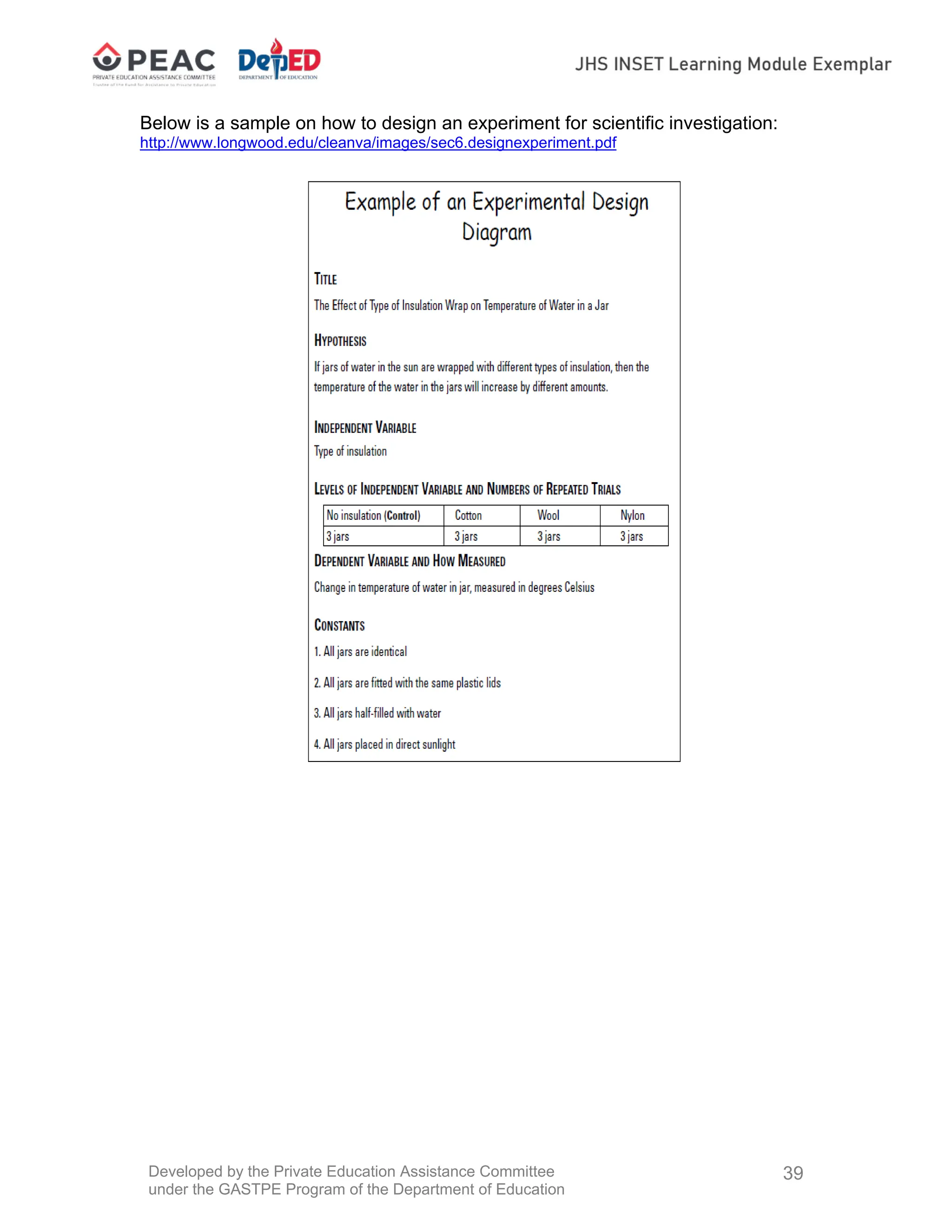
Below is a sample on how to design an experiment for scientific investigation:
http://www.longwood.edu/cleanva/images/sec6.designexperiment.pdf
Developed by the Private Education Assistance Committee
under the GASTPE Program of the Department of Education
40
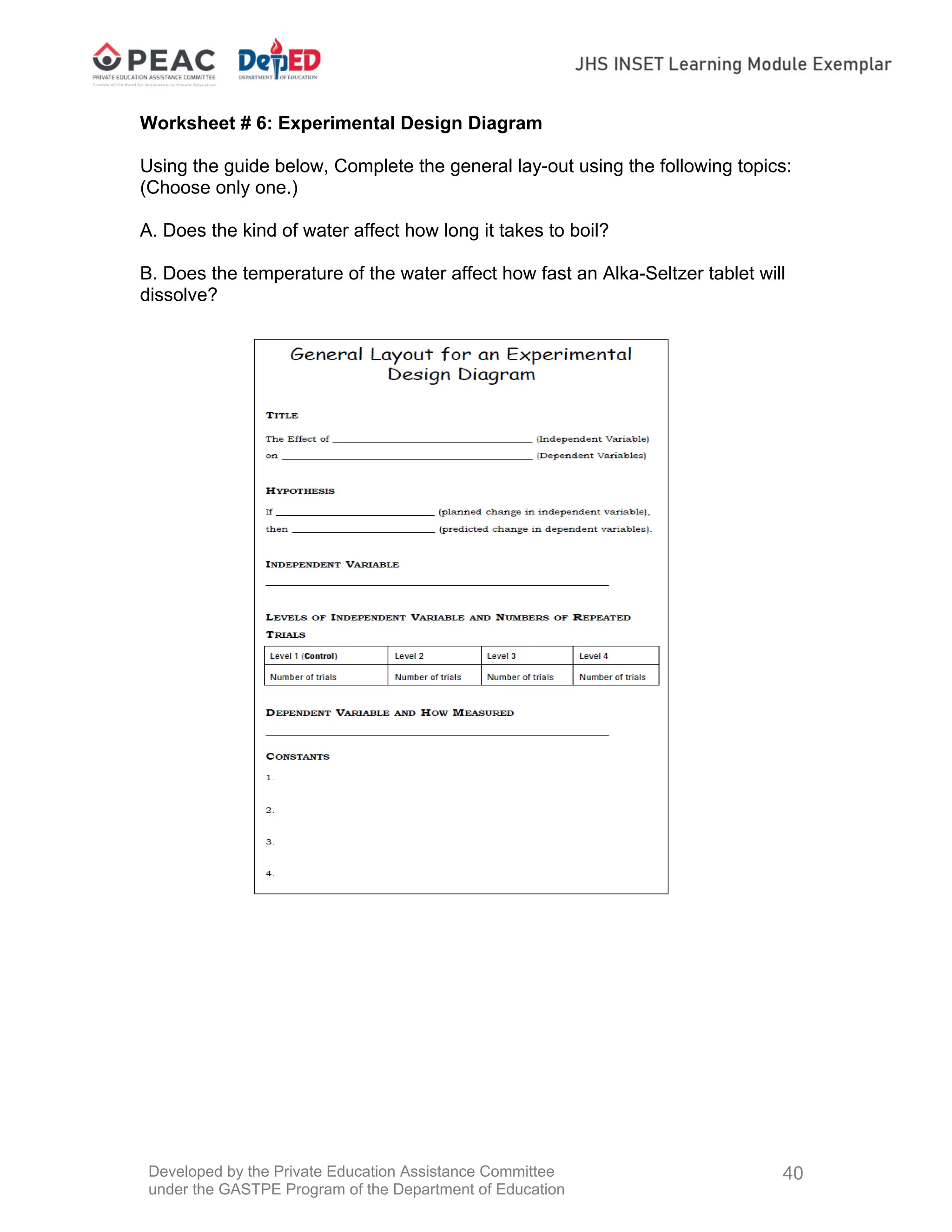
Worksheet # 6: Experimental Design Diagram
Using the guide below, Complete the general lay-out using the following topics:
(Choose only one.)
A. Does the kind of water affect how long it takes to boil?
B. Does the temperature of the water affect how fast an Alka-Seltzer tablet will
dissolve?
Developed by the Private Education Assistance Committee
under the GASTPE Program of the Department of Education
41
Having made your lay-out for experimental design, rate yourself on how capable
you are in designing and experiment: Bad in designing an experiment and as
Best in designing an experiment. Use this scale below.
The chemical compounds of life are known as organic compounds.
Organic compounds, which are the compounds associated with life processes,
are the subject matter of organic chemistry. Among the numerous types of
organic compounds, four major categories are found in all living things:
carbohydrates, lipids, protein, and nucleic acids. The next activity will explain to
you the main composition of organic compounds. As you go along with the
activity, try to recognize what type of bond is formed from carbon.
Activity No. 17: The Element of Life
You have learned about the metals and non-metals. Carbon is an
important non –metallic element. The chemistry of carbon and its compounds is
an equally important field about which you will learn in this lesson. Carbon is the
sixth most abundant element in the universe. It can exist in the free state or in the
form of its compounds.
To learn more about the uniqueness of carbon. Watch the 3 videoclips below:
The video clip #1 describes the characteristics and properties of carbon.
http://www.youtube.com/watch?v=1H02SkLEr4E
Q: What do you know about the element carbon?
Q: What biological processes involve carbon compounds?
Developed by the Private Education Assistance Committee
under the GASTPE Program of the Department of Education
42
Video clip #2 Are Diamonds Forever?
http://www.youtube.com/watch?v=KB9FtcNvS6o
Q: How are diamonds formed?
Q: Why carbon is an important element?
Video Clip #3
Elements of Chemistry Carbon: The Element of Life
http://www.youtube.com/watch?v=1ypuSYEa9lY
Q. Why carbon has been called the element of Life?
Q. How did the carbon form compound with other elements?
Q. How do compounds formed?
What important concepts can you write down in your foldable? Now can you
make a generalization out of the three video clips?
Now that you had a glimpse of how carbon form compounds with other
elements, try to observe the many substances that carbon can bring on the next
activity.
Developed by the Private Education Assistance Committee
under the GASTPE Program of the Department of Education
43
ACTIVITY NO #18: It’s A Family Thing
You have learned that in hydrocarbons, carbon atoms are linked only to other
carbon atoms or hydrogen atoms. Carbon atoms can also form strong covalent
compounds with other elements.
This music - video clip tells about the Classes of Organic Compounds:
http://www.youtube.com/watch?v=mAjrnZ-znkY
This is a tutorial video clip about the functional groups:
http://www.youtube.com/watch?v=C5ZK6nPPAbo
Process Questions:
1. What are functional groups?
2. What are examples of functional groups?
3. Give the uses for each of the functional groups.
4. How are these groups formed?
In your foldable, write down what you know about these functional groups.
Then, let’s check you Understanding by doing the worksheet below:
Worksheet # 7: Functional Groups
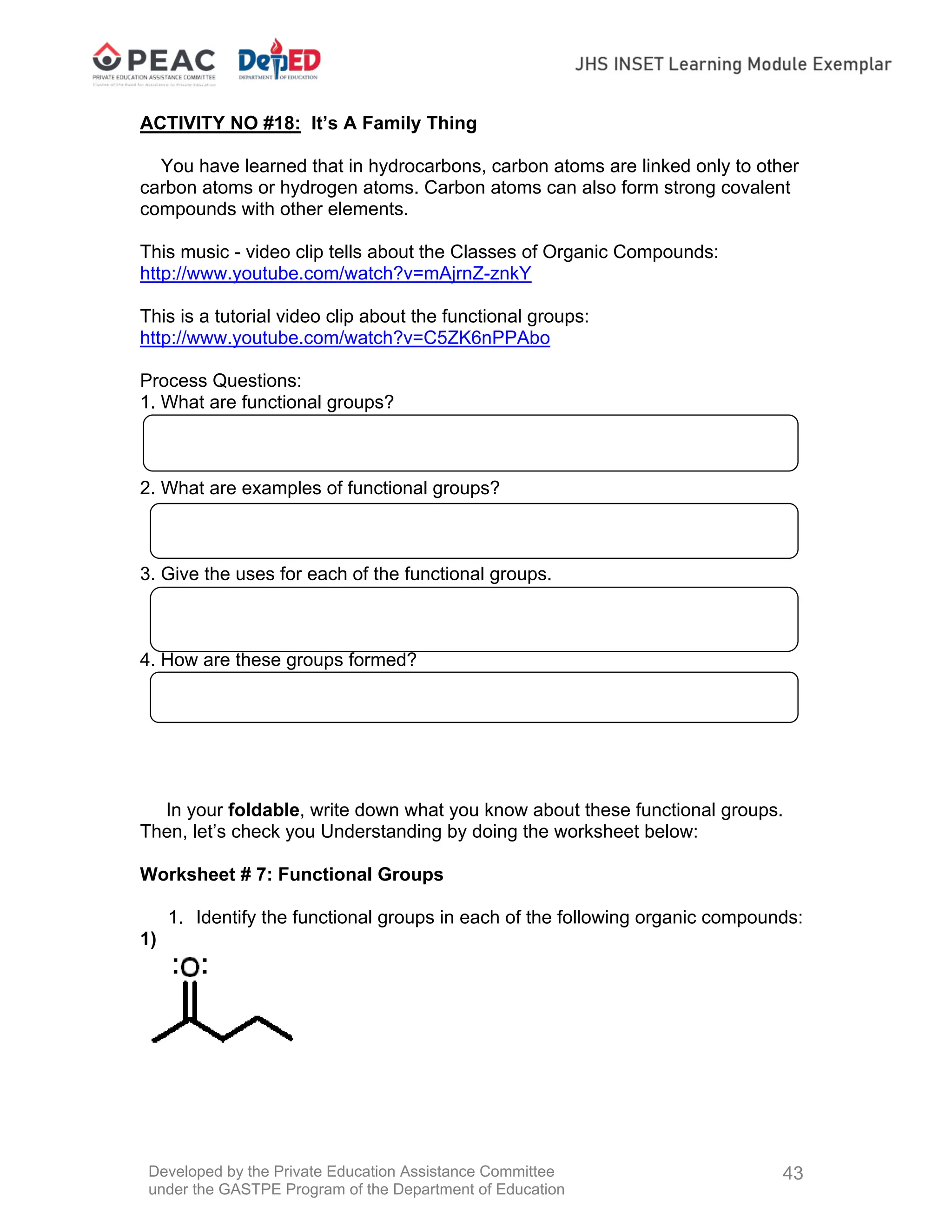
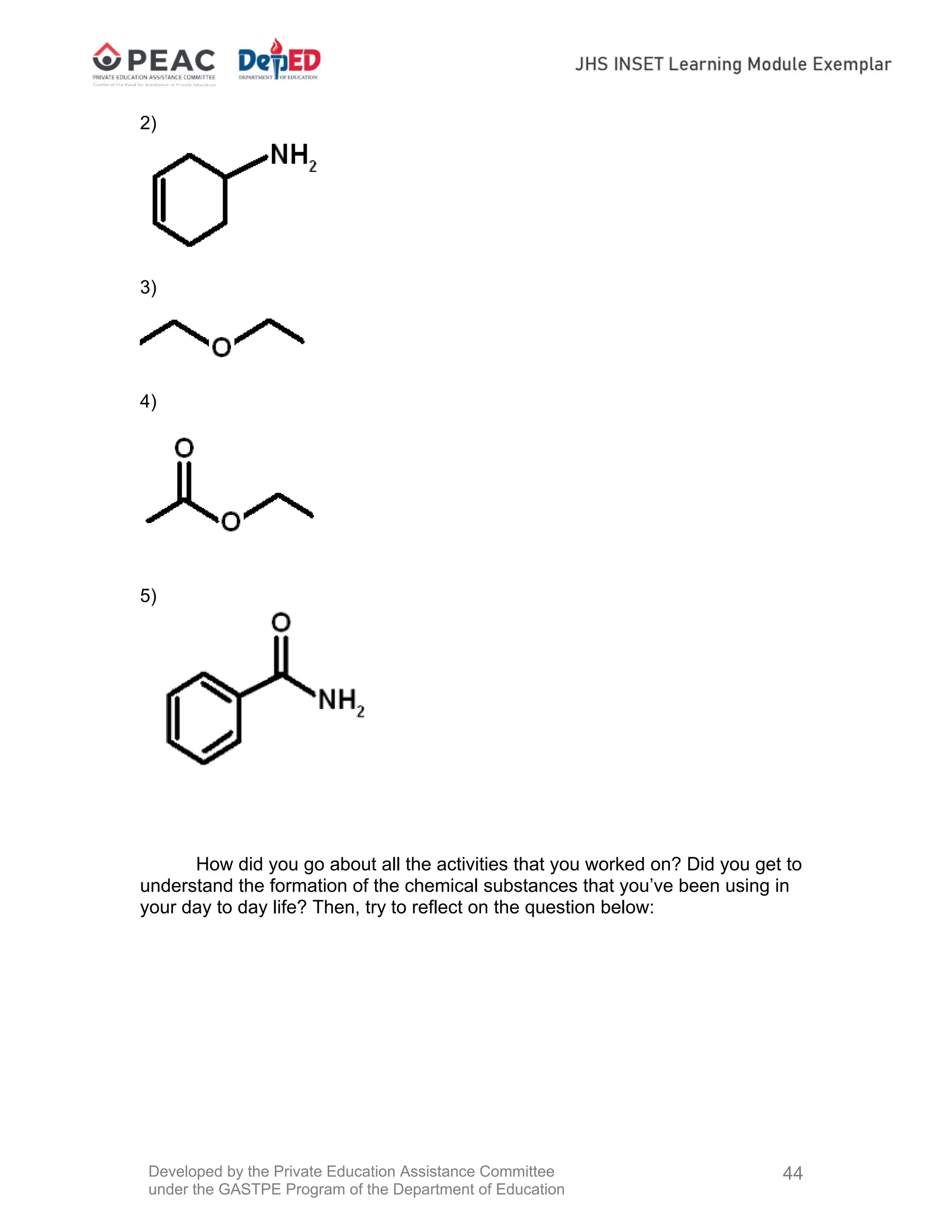
1. Identify the functional groups in each of the following organic compounds:
1)
Developed by the Private Education Assistance Committee
under the GASTPE Program of the Department of Education
44
2)
3)
4)
5)
How did you go about all the activities that you worked on? Did you get to
understand the formation of the chemical substances that you’ve been using in
your day to day life? Then, try to reflect on the question below:
Developed by the Private Education Assistance Committee
under the GASTPE Program of the Department of Education
45
Given below is an IRF sheet. Fill in the second row with your answer
to the question:
How is compound formed?
Initial
Revised
Final
End of FIRM UP:
Go back to the previous section and compare your initial ideas with the
discussion. How much of your initial ideas are found in the discussion? Which
ideas are different and need revision? What new learning goal should you now
try to achieve?
Now that you know the important ideas about this topic, let’s go deeper by
moving on to the next section.
Now that you have learned about the chemical bonds, it’s time for you to
analyze and assess chemical substances that are formed from particles. You
are also going to learn about molecular shapes of different substances.
Your goal in this section is to take a closer look at these aspects of the
topic.
Developed by the Private Education Assistance Committee
under the GASTPE Program of the Department of Education
46
ACTIVITY NO. 19: Metallic Properties
Although metals are not ionic, they share several properties with ionic
compounds. Metals often form lattices in the solid state. View the website below
to explain further the metallic bonding:
http://safeshare.tv/w/SfdicjauSG
For centuries, people have treated metals with heat to change their properties.
The final properties of metal depend on the temperature to which the metal is
heated and the rate at which it cools.
Do the activity below:
Materials:
Hairpins
Forceps
Burner
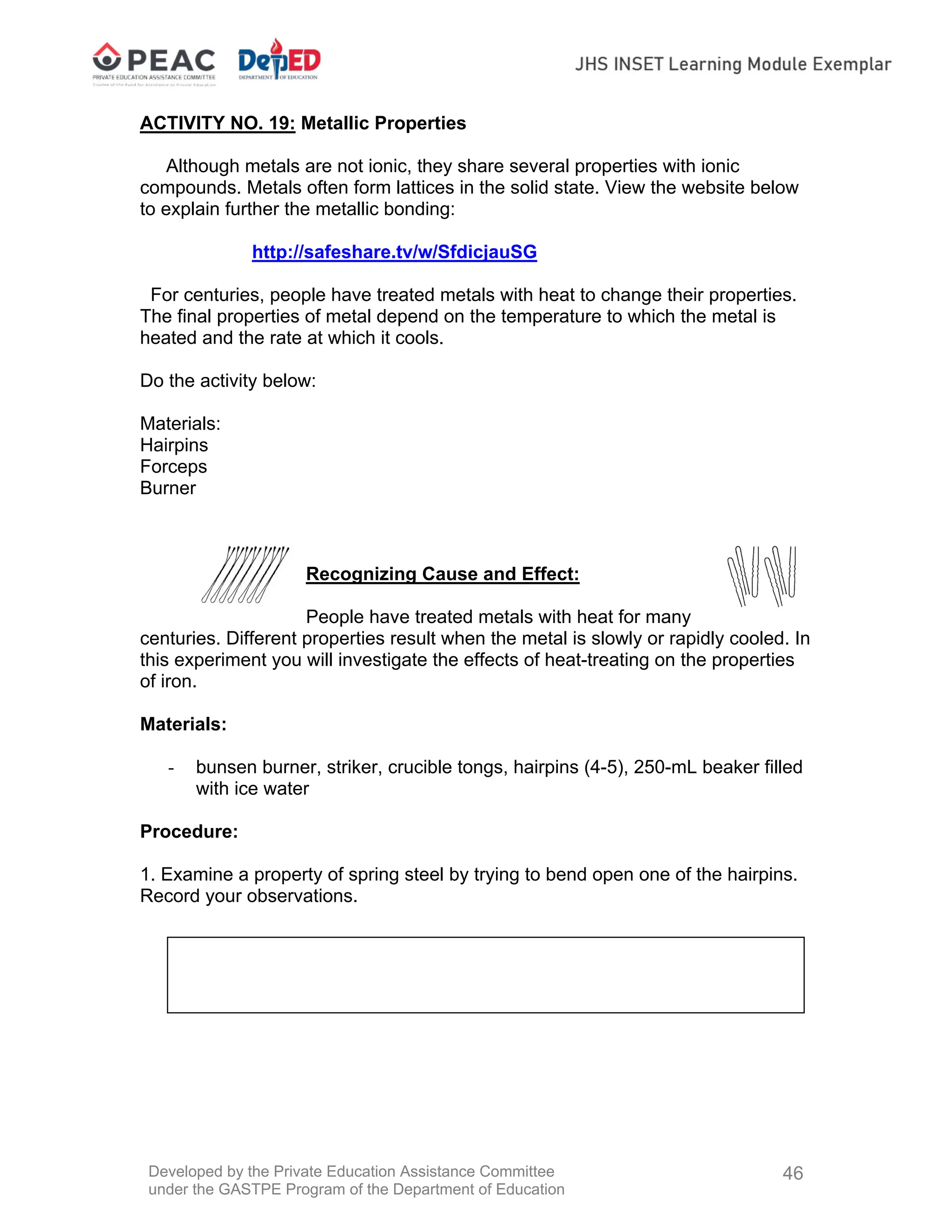
Recognizing Cause and Effect:
People have treated metals with heat for many
centuries. Different properties result when the metal is slowly or rapidly cooled. In
this experiment you will investigate the effects of heat-treating on the properties
of iron.
Materials:
- bunsen burner, striker, crucible tongs, hairpins (4-5), 250-mL beaker filled
with ice water
Procedure:
1. Examine a property of spring steel by trying to bend open one of the hairpins.
Record your observations.
Developed by the Private Education Assistance Committee
under the GASTPE Program of the Department of Education
47
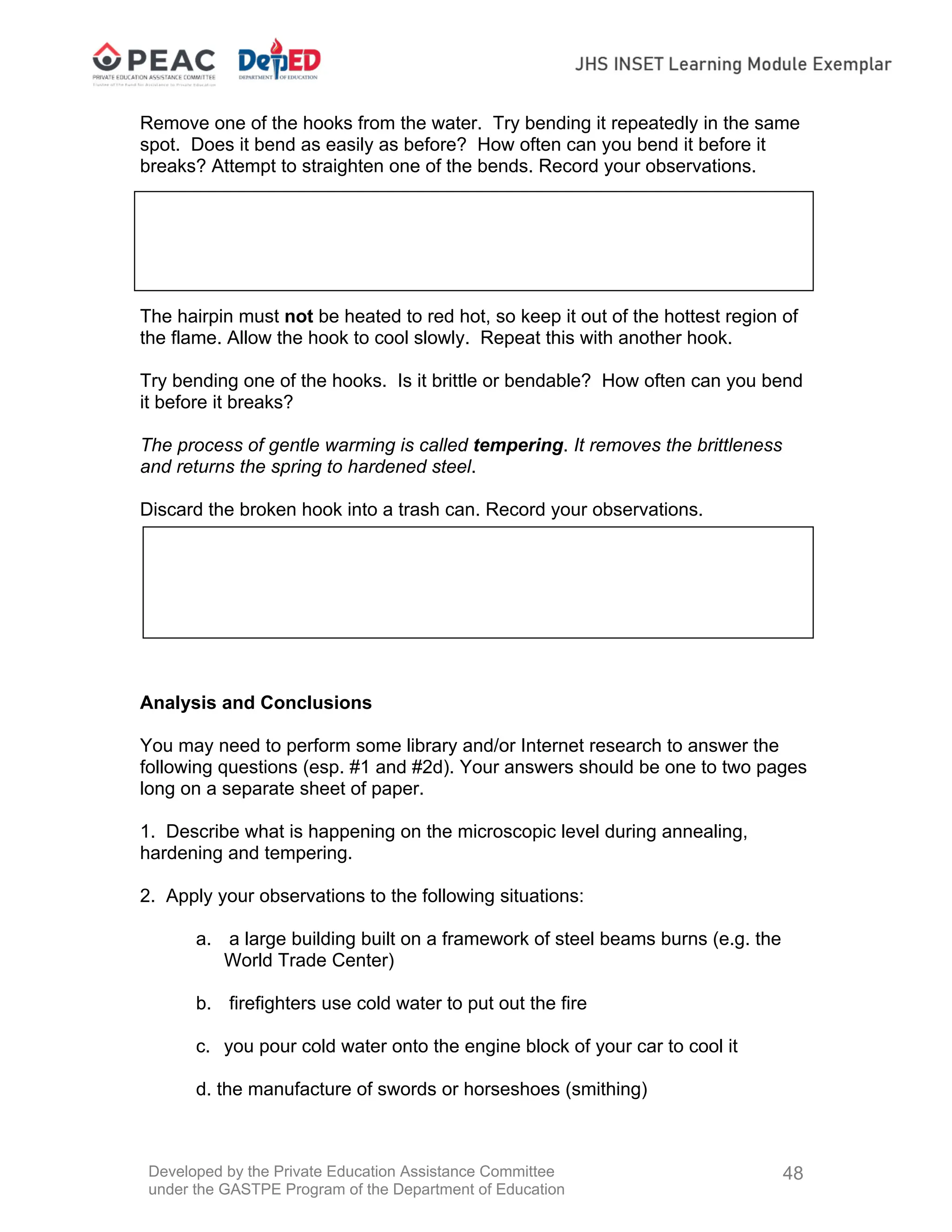
2. Hold each end of the hairpins with forceps. Place the curved central loop in the
top of the burner’s flame. When it turns red, pull it open into a straight piece of
metal. CAUTION: Do not touch hot metal. Allow the hairpins to cool as you
record your observations. Repeat this procedure for all hairpins.
3. To make softened steel, use forceps to hold all hairpins vertically in the flame
until they grow red all over. Slowly raise the three hairpins straight up and out of
the flame so they cool slowly. Slow cooling results in the formation of large
crystals. The process of heating followed by slow cooling is called annealing
(“making soft”). After cooling, bend each of the three hairpins into the shape of
the letter J. Record how the metal feels as you bend it. Do the wires bend more
easily now after they have been heated? Are they as springy as they were
before? Take one of the wires and bend it back and forth in the same place.
How often can you bend it before it breaks?
5. To harden the steel, use tongs to hold two of the bent hairpins in the flame
until they are glowing red all over. Quickly plunge the hot hairpins into a 250-mL
beaker containing approximately 200 mL of cold water. Quick cooling causes the
crystal size to be small. The process of heating followed by rapid cooling is called
hardening.
Developed by the Private Education Assistance Committee
under the GASTPE Program of the Department of Education
48
Remove one of the hooks from the water. Try bending it repeatedly in the same
spot. Does it bend as easily as before? How often can you bend it before it
breaks? Attempt to straighten one of the bends. Record your observations.
7. Carefully grasp one of the other hooks with crucible tongs and slowly lower it
into the Bunsen burner flame until an iridescent blue coating forms on the hook.
The hairpin must not be heated to red hot, so keep it out of the hottest region of
the flame. Allow the hook to cool slowly. Repeat this with another hook.
Try bending one of the hooks. Is it brittle or bendable? How often can you bend
it before it breaks?
The process of gentle warming is called tempering. It removes the brittleness
and returns the spring to hardened steel.
Discard the broken hook into a trash can. Record your observations.
Analysis and Conclusions
You may need to perform some library and/or Internet research to answer the
following questions (esp. #1 and #2d). Your answers should be one to two pages
long on a separate sheet of paper.
1. Describe what is happening on the microscopic level during annealing,
hardening and tempering.
2. Apply your observations to the following situations:
a. a large building built on a framework of steel beams burns (e.g. the
World Trade Center)
b. firefighters use cold water to put out the fire
c. you pour cold water onto the engine block of your car to cool it
d. the manufacture of swords or horseshoes (smithing)
Developed by the Private Education Assistance Committee
under the GASTPE Program of the Department of Education
49
Can you reflect on the activity that you did a while ago? What insights can you
add to your foldable?
Chemical substances are just everywhere. These are materials with known
compositions. The existence of these substances can be purposeful or can bring
threat to life. The next activity will allow you to reflect on how these substances
can be of great help.
ACTIVITY NO 20: Who’s The Culprit?
Headline News!!!
One man died through electrocution!
The investigators said that there’s nothing wrong with
the electrical connection. The only materials present
were salt solution and sugar. How did it happen?
As a forensic scientist, you are asked to solve
the case. So you decide to conduct an investigation.
You will the following materials:
Electrical conductivity apparatus (commercial or home-made)
50-mL, or 2-oz. wide-mouth bottles
Solid sodium chloride, NaCl, and sucrose, C12H22O11 (common table sugar)
2 or 3 Small glass saucers
Ringstand, ring, triangle
0.1 M Solutions of NaCl and sucrose (5.6 g NaCl/100 mL solution and 3.4 g
sucrose/100 mL solution)
Safety
If the conductivity tester used is powered by a 120-V source, then use caution to
prevent electric shock.
To avoid electrical shock, always turn off the switch or pull the
plug while cleaning or rinsing the electrodes or changing the solutions.
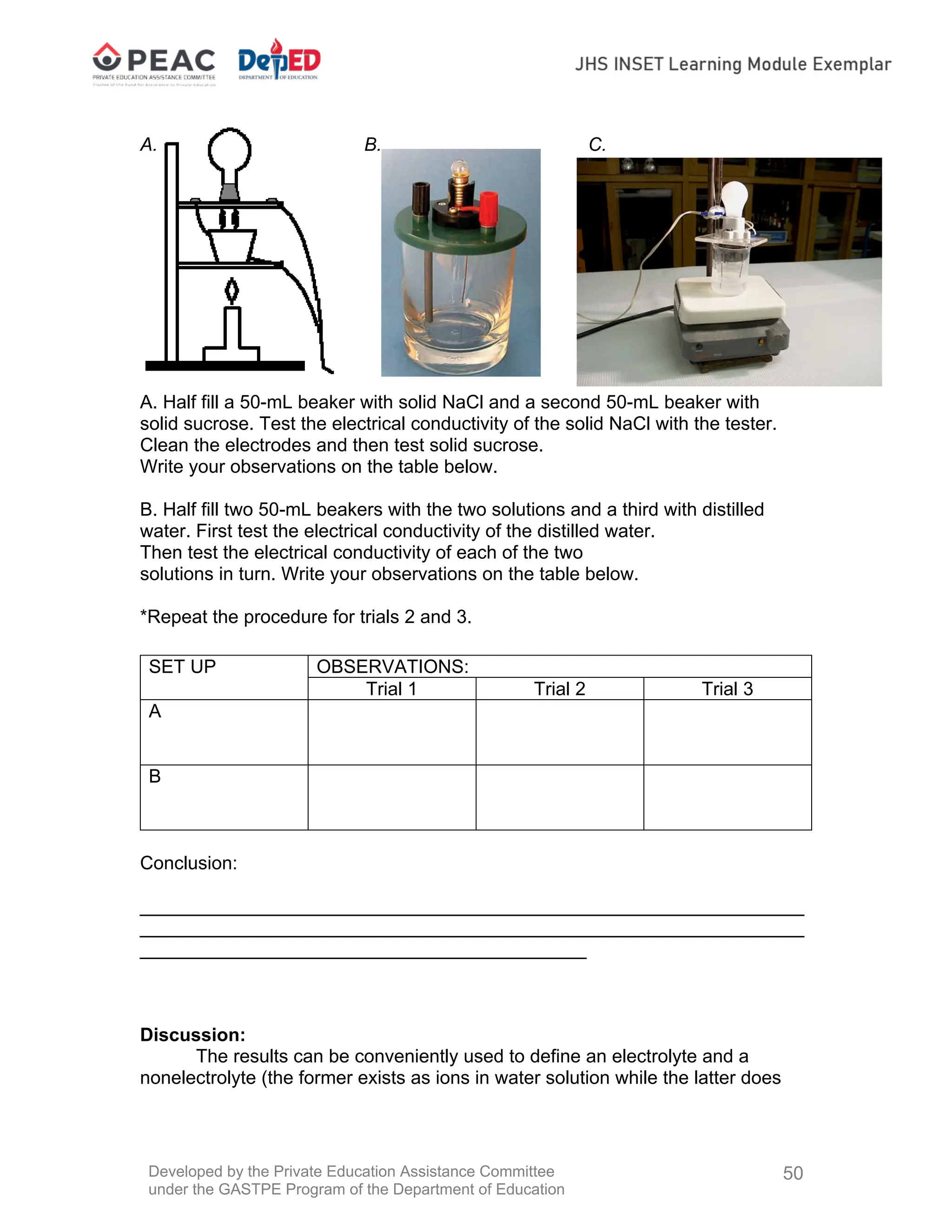
You may ask assistance from a hardware store to prepare any of the following
set up:
Developed by the Private Education Assistance Committee
under the GASTPE Program of the Department of Education
50
A. B. C.
A. Half fill a 50-mL beaker with solid NaCl and a second 50-mL beaker with
solid sucrose. Test the electrical conductivity of the solid NaCl with the tester.
Clean the electrodes and then test solid sucrose.
Write your observations on the table below.
B. Half fill two 50-mL beakers with the two solutions and a third with distilled
water. First test the electrical conductivity of the distilled water.
Then test the electrical conductivity of each of the two
solutions in turn. Write your observations on the table below.
*Repeat the procedure for trials 2 and 3.
Conclusion:
________________________________________________________________
________________________________________________________________
___________________________________________
Discussion:
The results can be conveniently used to define an electrolyte and a
nonelectrolyte (the former exists as ions in water solution while the latter does
SET UP OBSERVATIONS:
Trial 1 Trial 2 Trial 3
A
B
Developed by the Private Education Assistance Committee
under the GASTPE Program of the Department of Education
51
not). The solids do not conduct since the ions in sodium chloride are not mobile
and cannot move toward the electrodes and act as charge carriers.
Sucrose is a molecular solid and does not have ions present in either the
solid or solution. The melted silver nitrate conducts because the ions are able to
move to the electrodes and act as charge carriers. This emphasizes that an ionic
solid consists of ions and not molecules.
Do not get involved in a discussion of electrical conductivity now, since the
students’ backgrounds are probably insufficient for understanding. The point is to
distinguish between electrolytes and nonelectrolytes and to show that ionic solids
exist as ions in the solid state. If students ask about the lack of conductivity of
distilled water, you can test the conductivity of tap water.
Tap water conducts because there are ions present in it but not in the
distilled water.
Process Questions:
1. What are the independent variables? Dependent Variables? Constant
Variables?
2. What are we trying to derive from the activity?
3. How can you possibly tell that the solution is an electrolyte or non-electrolyte?
4. How do electrolytes formed?
So how did you do in this activity? What insights did you learn from it? Write in
your foldable what you feel in working the activity:
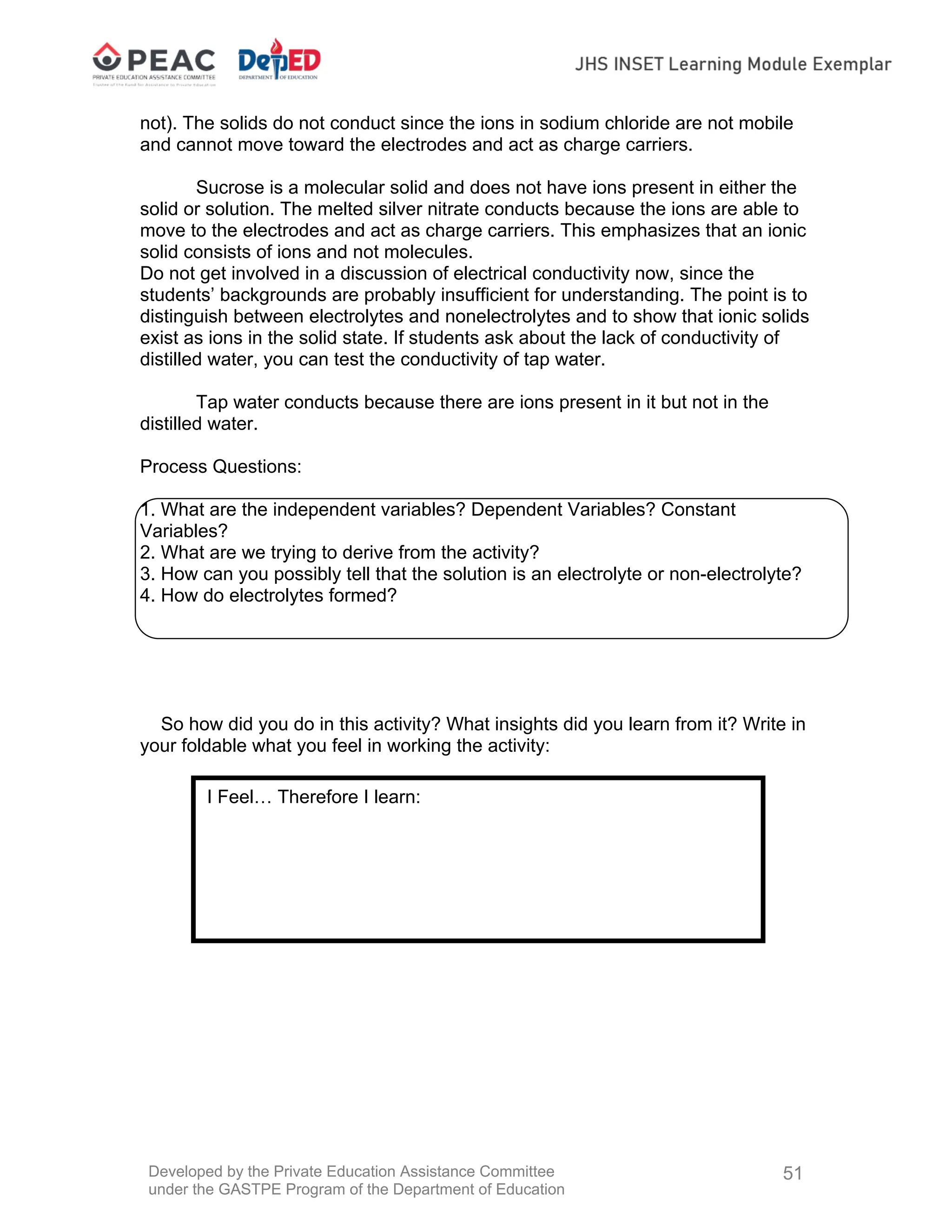
I Feel… Therefore I learn:
Developed by the Private Education Assistance Committee
under the GASTPE Program of the Department of Education
52
Can you imagine the molecular structure of the diamond? How about Oxygen
molecules? Sulfur Dioxide? The next activity shows the beautiful arrangement of
the elements in a compound.
ACTIVITY NO # 21: VSEPR
Are you familiar with the different taglines of the famous product companies in
the Philippines in order to catch the attention of the consumers? Take a Glimpse
of the following:
Smart: Live More
KFC: It’s finger lickin good!
Metrobank: You’re in good hands!
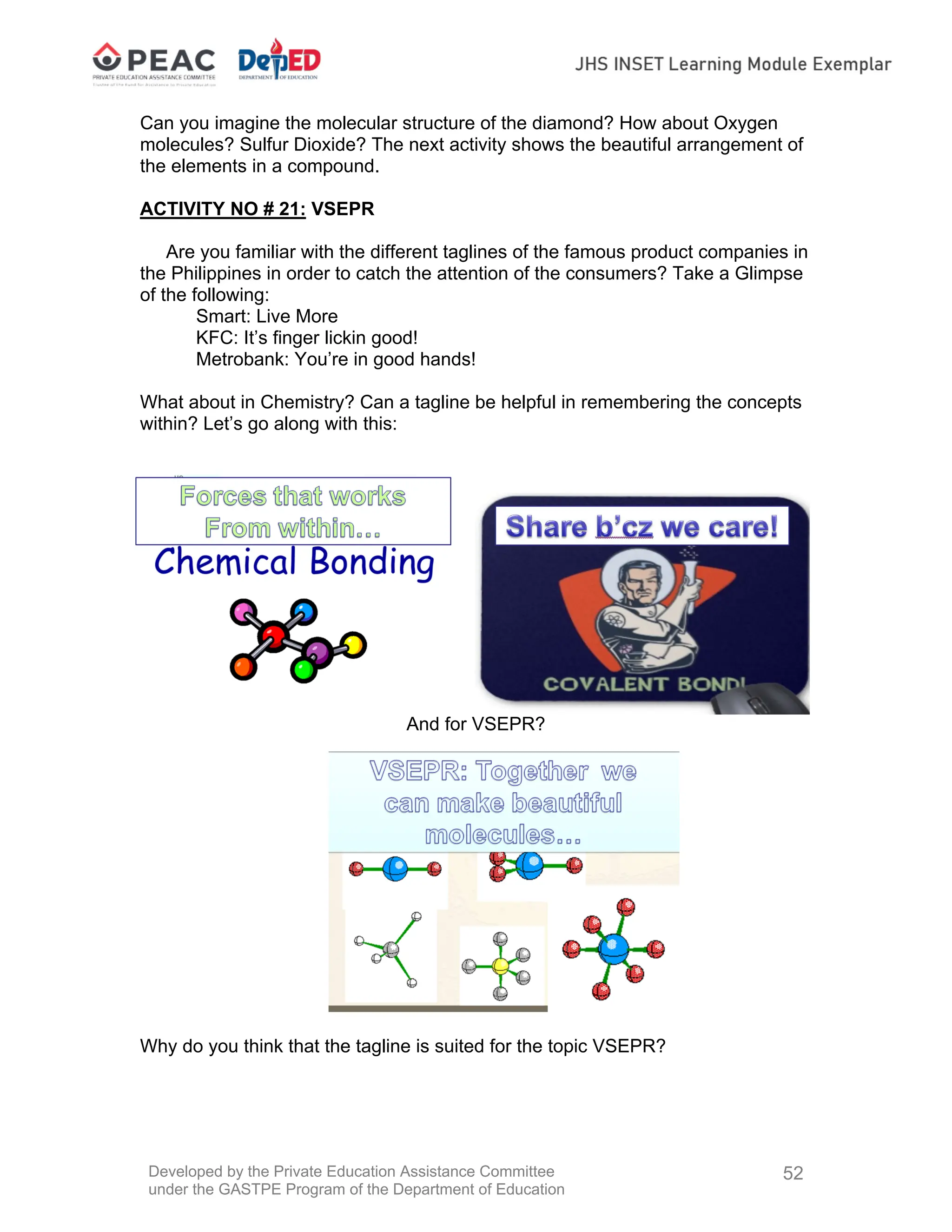
What about in Chemistry? Can a tagline be helpful in remembering the concepts
within? Let’s go along with this:
And for VSEPR?
Why do you think that the tagline is suited for the topic VSEPR?
Developed by the Private Education Assistance Committee
under the GASTPE Program of the Department of Education
53
Lewis structure can help in determining the molecular geometry of a
molecule. The model used to determine the molecular shape is referred to as the
Valence Shell Electron Pair Repulsion. To further explore VSEPR, click the
website below:
http://www.chem.ox.ac.uk/vrchemistry/vsepr/intro/vsepr_splash.html
Developed by the Private Education Assistance Committee
under the GASTPE Program of the Department of Education
54
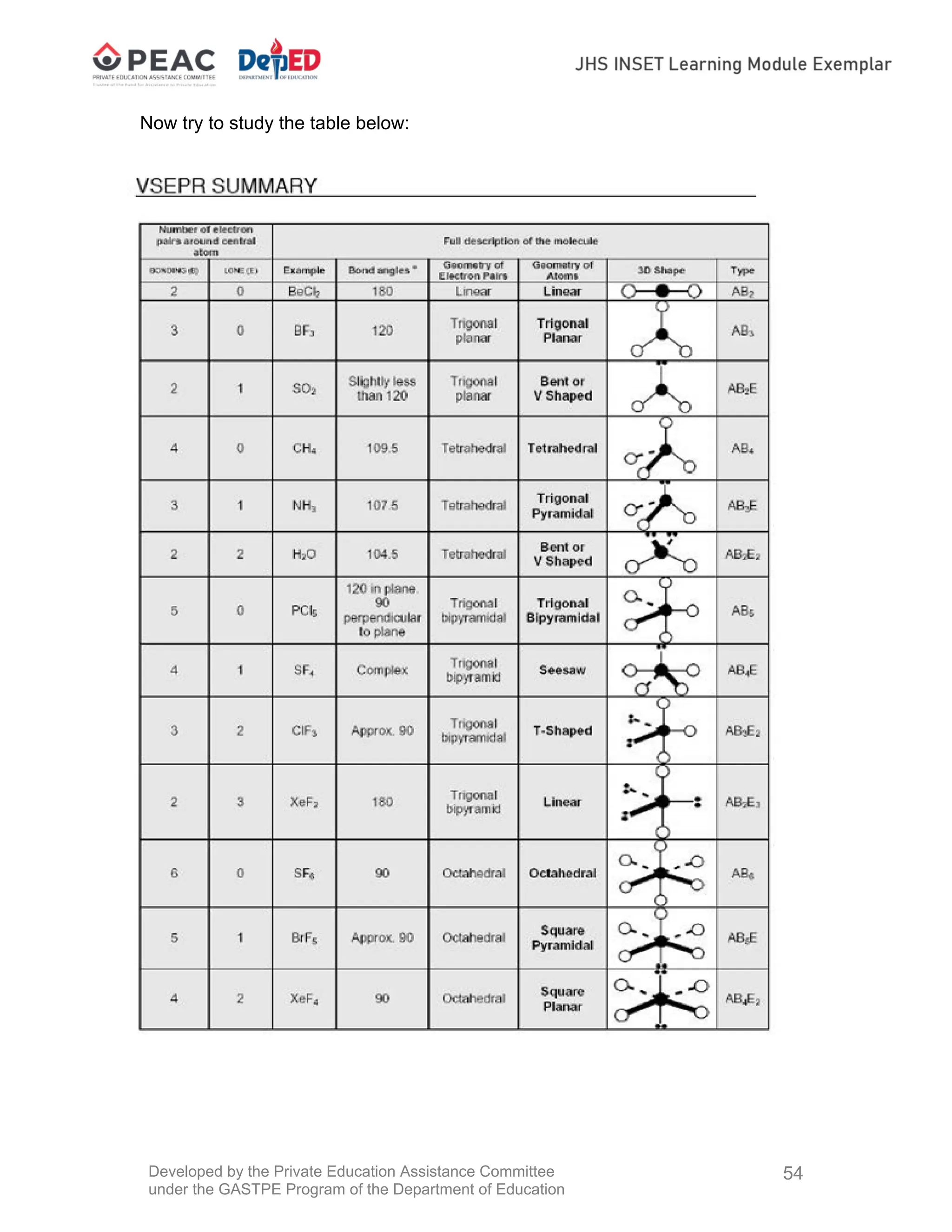
Now try to study the table below:
Developed by the Private Education Assistance Committee
under the GASTPE Program of the Department of Education
55
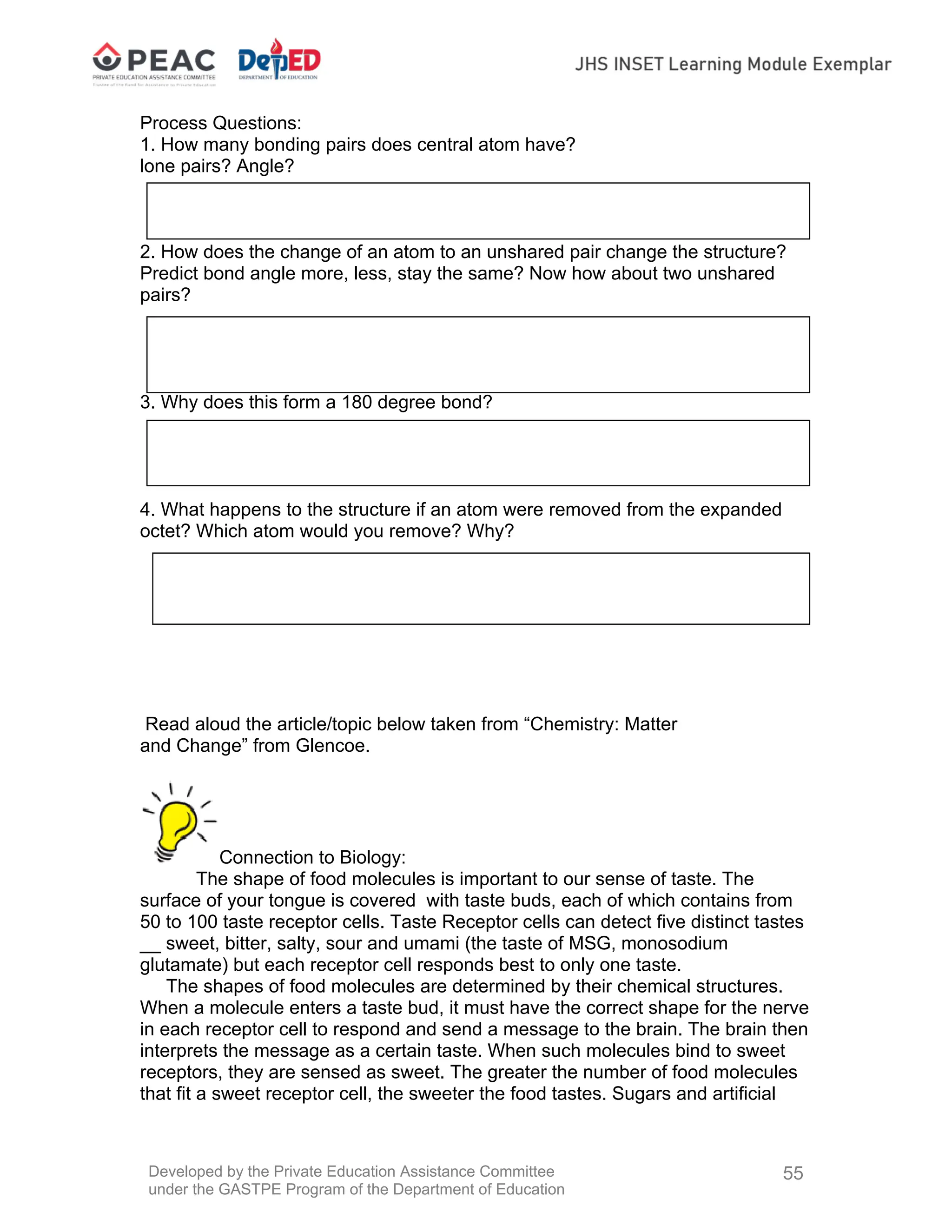
Process Questions:
1. How many bonding pairs does central atom have?
lone pairs? Angle?
2. How does the change of an atom to an unshared pair change the structure?
Predict bond angle more, less, stay the same? Now how about two unshared
pairs?
3. Why does this form a 180 degree bond?
4. What happens to the structure if an atom were removed from the expanded
octet? Which atom would you remove? Why?
Read aloud the article/topic below taken from “Chemistry: Matter
and Change” from Glencoe.
Connection to Biology:
The shape of food molecules is important to our sense of taste. The
surface of your tongue is covered with taste buds, each of which contains from
50 to 100 taste receptor cells. Taste Receptor cells can detect five distinct tastes
__ sweet, bitter, salty, sour and umami (the taste of MSG, monosodium
glutamate) but each receptor cell responds best to only one taste.
The shapes of food molecules are determined by their chemical structures.
When a molecule enters a taste bud, it must have the correct shape for the nerve
in each receptor cell to respond and send a message to the brain. The brain then
interprets the message as a certain taste. When such molecules bind to sweet
receptors, they are sensed as sweet. The greater the number of food molecules
that fit a sweet receptor cell, the sweeter the food tastes. Sugars and artificial
Developed by the Private Education Assistance Committee
under the GASTPE Program of the Department of Education
56
sweeteners are not the only sweet molecules. Some proteins found in fruits are
also sweet molecules.
Why do you think that the tagline is suited for the topic VSEPR?
Worksheet #8: VSEPR
Lewis Structures, VSEPR, Polarity, IM Forces
For each of the following molecules, draw the Lewis structure and indicate the
following:
A. How many central atom?
B. How many Bonded atoms?
C. How many lone pairs
D. What formula type?
E. Give the molecular shape.
1) carbon tetrafluoride
2) BF3
3) NF3
4) H2CS
5) carbonate ion
6) CH2F2
7) nitrate ion
8) O2
9) PF3
10) H2S
ACTIVITY NO #22: Another Carbon Compound Story
All of us who are fans of forensic TV
shows have seen the CSI hero (in
obligatory sunglasses of course)
dim the lights and spray the ‘magical’
substance over the carpet and
dramatically reveal the blood splatter of
many a poor victim. How do they do that you
may wonder? It all has to do with some
interesting chemicals we come into
contact with every day in carpet cleaning:
Developed by the Private Education Assistance Committee
under the GASTPE Program of the Department of Education
57
The Chemical Reaction
The "central" chemical in this drama is luminol (C8H7O3N3), a powdery
compound made up of nitrogen, hydrogen, oxygen and carbon. The CSI mix the
luminol powder with a liquid containing hydrogen peroxide (H2O2), and other
chemicals, and pour the liquid into a simple spray bottle. The hydrogen peroxide
and the luminol are actually the principle players in the chemical reaction, but in
order to produce a strong glow, they need a catalyst, in this case the iron in the
victim’s blood.
So, are you ready to create your own story?
As a crime novelist, you are asked by your boss to create a short story about
forensics. In your story, you have to make use any carbon compounds that can
lead to solve a crime.
To guide you further in writing a digital
Story, use the link below:
http://www.web2teachingtools.com/my-storymaker.html
After the tutorial, create your digital story in this website:
http://www.clpgh.org/kids/storymaker/embed.cfm
ACTIVITY NO 23: Carbon is a Girl’s Best Friend
Welcome to Chemistry Broadway!!!
You are asked to be part of the broadway… so to
prepare yourself… you get to practice the following
piece:
http://www.youtube.com/watch?v=JH96P4Lpobc
1. What makes Carbon as nature’s best friend?
2. What makes Carbon as girl’s best friend?
So are you ready to sing out loud your piece? But aside from that, you are
asked also to make your own song. The lyrics should be based from the following
video clips:
Versatility of Carbon:
http://www.youtube.com/watch?v=XKh3mjBaimY&list=PLF2604402E8E8F4D9
Developed by the Private Education Assistance Committee
under the GASTPE Program of the Department of Education
58
Classes of Carbon Compounds:
http://www.youtube.com/watch?v=ZrCSc8csdhY
To let your group join with your song, create your own videoke and share it
with them. Use the Karaoke Video Creator:
http://www.powerkaraoke.com/src/prod-karaoke-video-creator.php
After learning the properties of carbon, try to do the following tasks in a
way to understand how of carbon compounds are bonded to form a substance.
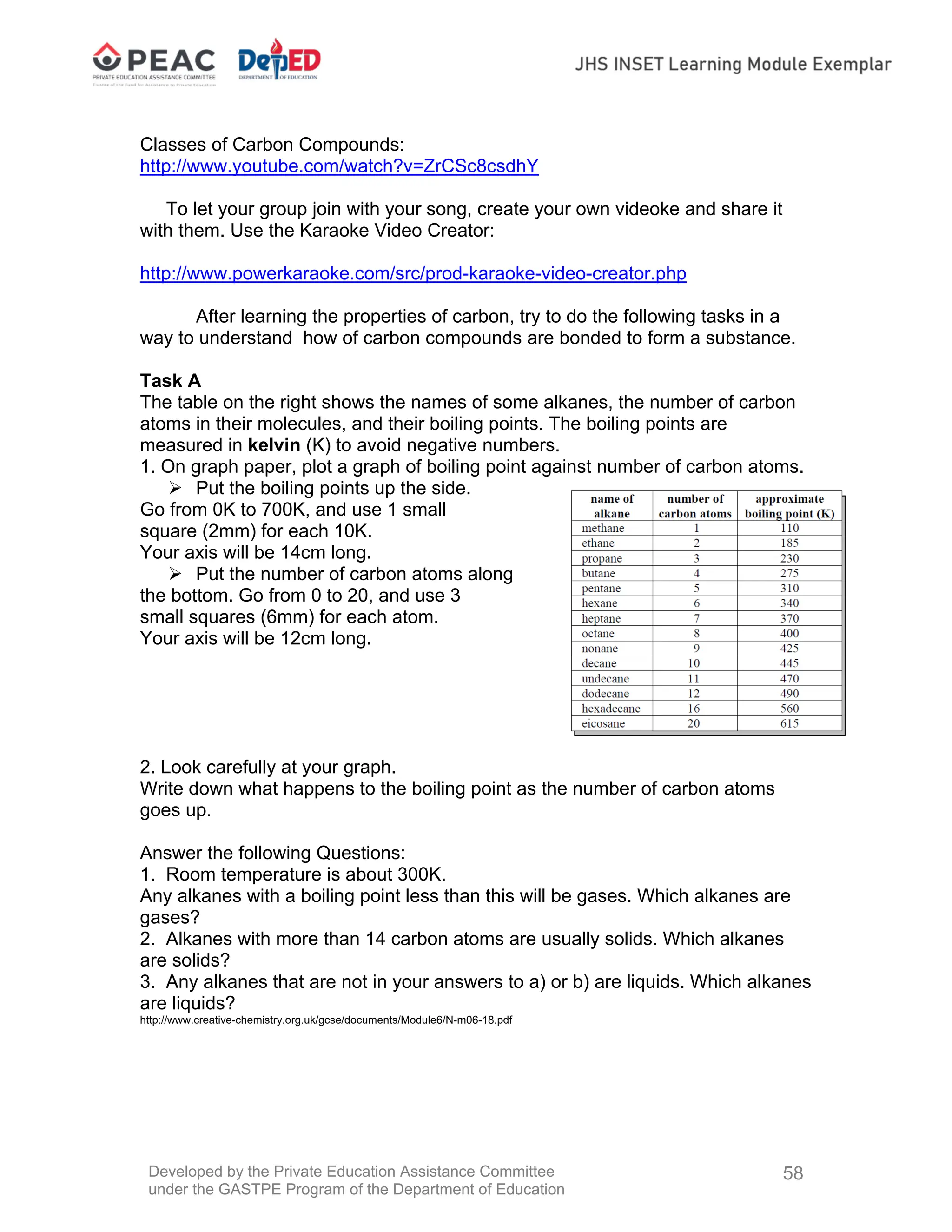
Task A
The table on the right shows the names of some alkanes, the number of carbon
atoms in their molecules, and their boiling points. The boiling points are
measured in kelvin (K) to avoid negative numbers.
1. On graph paper, plot a graph of boiling point against number of carbon atoms.
 Put the boiling points up the side.
Go from 0K to 700K, and use 1 small
square (2mm) for each 10K.
Your axis will be 14cm long.
 Put the number of carbon atoms along
the bottom. Go from 0 to 20, and use 3
small squares (6mm) for each atom.
Your axis will be 12cm long.
2. Look carefully at your graph.
Write down what happens to the boiling point as the number of carbon atoms
goes up.
Answer the following Questions:
1. Room temperature is about 300K.
Any alkanes with a boiling point less than this will be gases. Which alkanes are
gases?
2. Alkanes with more than 14 carbon atoms are usually solids. Which alkanes
are solids?
3. Any alkanes that are not in your answers to a) or b) are liquids. Which alkanes
are liquids?
http://www.creative-chemistry.org.uk/gcse/documents/Module6/N-m06-18.pdf
Developed by the Private Education Assistance Committee
under the GASTPE Program of the Department of Education
59
Task B
Read the information in the box, then answer question 4.
4. a) What is “cracking”?
b) What is the difference between alkanes and alkenes (apart from their name!)?
c) What is a “double bond”?
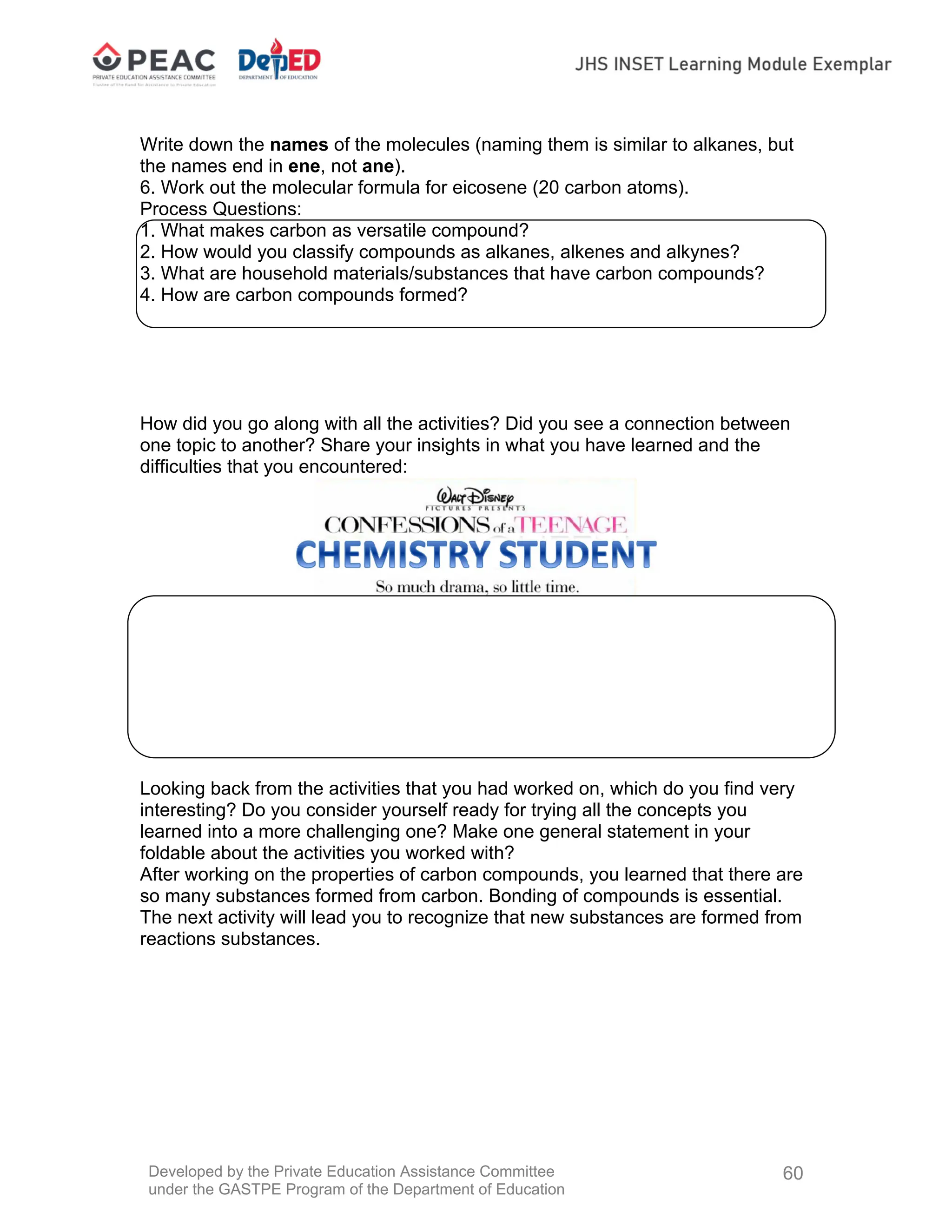
5. The structural formula of propene is
and its molecular formula is C3H6.
Draw the structural formulae and molecular formulae for the first seven
alkenes (from ethene with 2 carbon atoms to octene with 8 carbon atoms –
methene does not exist).
1.
2.
3.
Developed by the Private Education Assistance Committee
under the GASTPE Program of the Department of Education
60
Write down the names of the molecules (naming them is similar to alkanes, but
the names end in ene, not ane).
6. Work out the molecular formula for eicosene (20 carbon atoms).
Process Questions:
1. What makes carbon as versatile compound?
2. How would you classify compounds as alkanes, alkenes and alkynes?
3. What are household materials/substances that have carbon compounds?
4. How are carbon compounds formed?
How did you go along with all the activities? Did you see a connection between
one topic to another? Share your insights in what you have learned and the
difficulties that you encountered:
Looking back from the activities that you had worked on, which do you find very
interesting? Do you consider yourself ready for trying all the concepts you
learned into a more challenging one? Make one general statement in your
foldable about the activities you worked with?
After working on the properties of carbon compounds, you learned that there are
so many substances formed from carbon. Bonding of compounds is essential.
The next activity will lead you to recognize that new substances are formed from
reactions substances.
Developed by the Private Education Assistance Committee
under the GASTPE Program of the Department of Education
61
ACTIVITY NO. 24: ARTICLE ANALYSIS
Article 1: A Superstrong Biomimetic Tape Inspired By Gecko Feet
http://www.fastcodesign.com/1671053/a-superstrong-biomimetic-tape-inspired-
by-gecko-feet
Process Questions:
1. What part of the Gecko feet is discovered to give a superstrong grip?
2. What is it made up of?
ARTICLE 2: Accidental Inventor!
http://discovermagazine.com/1996/oct/theaccidentalinv893#.UyMUo6L3uu4
Process Questions:
1. What is the greatest triumph of synthetic polymer chemistry to date?
2. How does Teflon differ from nylon?
3. What are the uses of Teflon?
4. How was Teflon formed?
Developed by the Private Education Assistance Committee
under the GASTPE Program of the Department of Education
62
ARTICLE 3: Pioneering Scientists Discover New Material
http://www.manchester.ac.uk/aboutus/news/display/?id=4353
Process Questions:
1. How was graphene discovered?
2. What are the possible uses of grapheme?
After reading the three articles, you discovered that new substances are formed.
Investigate how these new substances formed. Create an experimental
procedure about formation of new substance.
“How are the substances discovered?” Generate a conclusion based on the
question and place your insights in the:
http://www.fodey.com/generators/newspaper/snippet.asp
After working on the different activities, answer question below:
Given below is an IRF sheet. Fill in the third row with your answer to
the question:
How is compound formed?
Initial
Revised
Final
Developed by the Private Education Assistance Committee
under the GASTPE Program of the Department of Education
63
End of DEEPEN:
What new realizations do you have about the topic? What new connections
have you made for yourself? What helped you make these connections?
Now that you have a deeper understanding of the topic, you are ready to do
the tasks in the next section.
Your goal in this section is apply your learning to real life situations. You will be
given a practical task which will demonstrate your understanding.
ACTIVITY NO. 24: Building A Compound
To start the activity, read the discussion below:
Discussion:
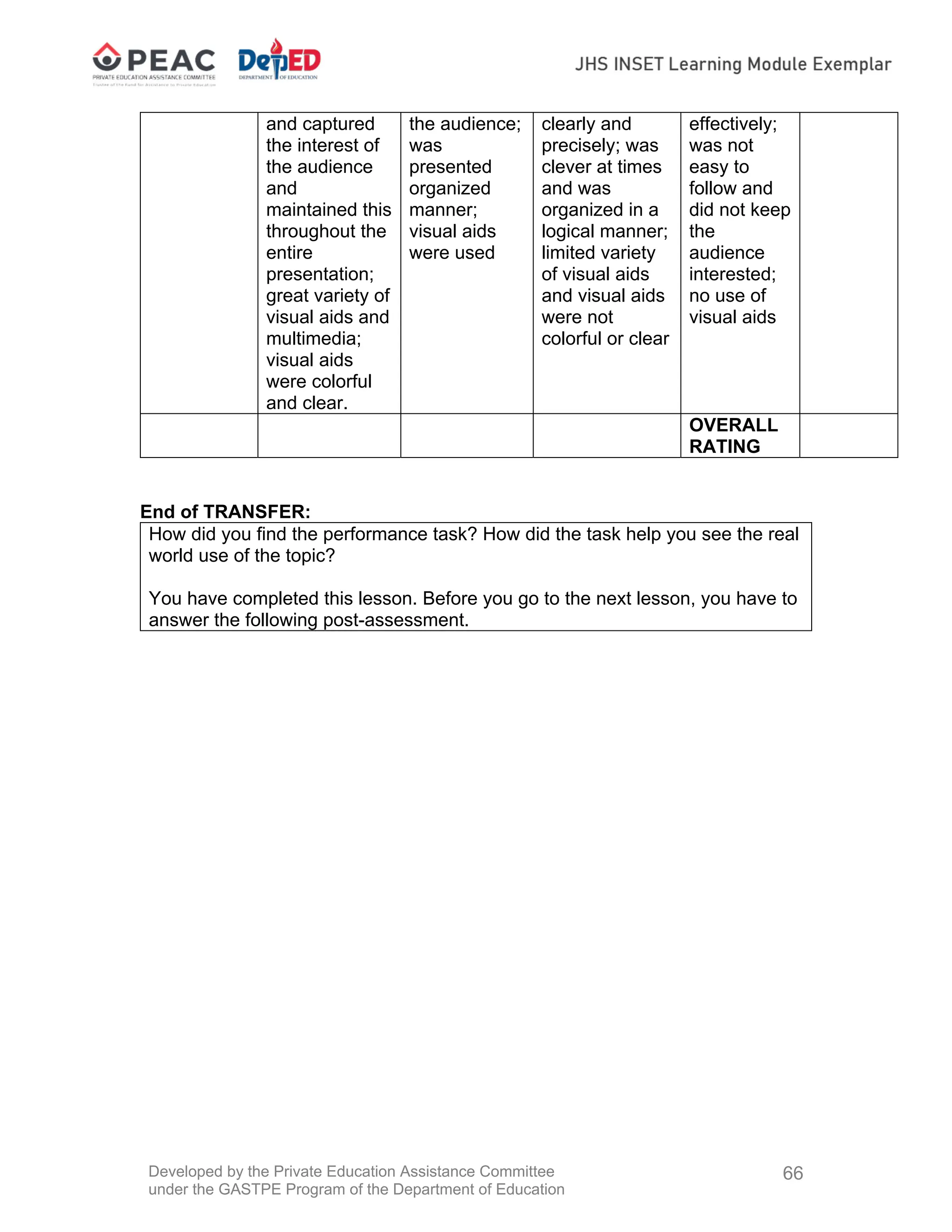
If you live in a place that has lots of snow and ice in the winter, then you
have probably seen the highway department spreading salt on the road to melt
the ice. You may have also used salt on ice when making home-made ice cream.
Salt lowers the freezing/melting point of water, so in both cases the idea is to
take advantage of the lower melting point.
http://www.mortonsalt.com/for-your-business/snow-and-ice-control
Situation:
With freezing rain and winter storms coating roads with ice throughout
central and northern New Jersey, a state of emergency has been declared
across the state, reports Townsquare news staff in an article appearing on New
Jersey 101.5. Making matters worse, a shortage of salt could leave roads
dangerously slippery, as Michael George and Brian Thompson write for 4 New
York.
Developed by the Private Education Assistance Committee
under the GASTPE Program of the Department of Education
64
What’s your Solution?
Sodium chloride is not the only ionic compound that forms from sea water.
Identify four other compounds that could be formed that contain the sodium. In
order to help the community of New Jersey, you are asked to help the production
of salt in order to lower the freezing point.
Design your own experiment in producing salt.
Process Questions:
1. What salt did you produce?
2. What substances did you use in forming salt?
3. What type of substances are these salt formers?
4. How did you produce the salt?
5. How compounds are formed?
ACTIVITY NO. 25: CONCEPT MAP
You are almost done with the module. Try to summarize everything you
learned through a concept map. Try to connect one concepts to another.
ACTIVITY NO. 26: SMARTER PHILIPPINES
The DOST is sponsoring an activity with the theme “Science, Technology and
Innovation: The Road to a Smarter Philippines,”. The annual NSTW 2014 gives
Developed by the Private Education Assistance Committee
under the GASTPE Program of the Department of Education
65
emphasis on the role of science and technology in making a better future for
Filipinos through its projects and services that spur socio-economic development.
As an aspiring scientist, you are asked to present a sample of compound that
can be produced from an investigative experiment. You must present a “sample”
of this compound to the assembly with its specific uses in the community. The
production of the compound must convince the group of DOST scientists that
proper procedures have been followed, and that you understand the physical and
chemical characteristics of the new compound. The sample presentation will be
judged based on the following: Scientific Thought, Scientific content and
accuracy, impact to the community and presentation.
CRITERIA Outstanding
4
Satisfactory
3
Developing
2
Beginning
1
RATING
Scientific
Thought
Followed the
scientific
method in a
detailed way in
order to
perform the
experiment.
Followed the
Scientific
method
Minimal use of
Scientific
method. Some
steps are
incorrectly
done.
Did not
follow the
scientific
method
Scientific
content
and
accuracy
The content is
thorough and
complete. It is
accurate.
The content
is substantial
and generally
accurate.
The content is
partial/
incomplete and
inaccurate.
Numerous
errors detract
from the result.
The content
contains
misunder-
standings
and serious
misconcep-
tions. It has
major
inaccuracie
s and
significant
errors
throughout.
Impact to
the
Community
The sample
product is
highly useful
and highly
commendable.
The sample
product is
useful and
commendabl
e.
The sample
product is
useful but
needs further
study.
The sample
product is
not useful
and
commen-
dable.
Presentatio
n
Was engaging,
provocative,
unique manner
Was well
done and
interesting to
Was at times
interesting and
was presented
Was not
organized
Developed by the Private Education Assistance Committee
under the GASTPE Program of the Department of Education
66
and captured
the interest of
the audience
and
maintained this
throughout the
entire
presentation;
great variety of
visual aids and
multimedia;
visual aids
were colorful
and clear.
the audience;
was
presented
organized
manner;
visual aids
were used
clearly and
precisely; was
clever at times
and was
organized in a
logical manner;
limited variety
of visual aids
and visual aids
were not
colorful or clear
effectively;
was not
easy to
follow and
did not keep
the
audience
interested;
no use of
visual aids
OVERALL
RATING
End of TRANSFER:
How did you find the performance task? How did the task help you see the real
world use of the topic?
You have completed this lesson. Before you go to the next lesson, you have to
answer the following post-assessment.
Developed by the Private Education Assistance Committee
under the GASTPE Program of the Department of Education
67
POST-ASSESSMENT:
It’s now time to evaluate your learning. Click on the letter of the answer that you
think best answers the question. Your score will only appear after you answer all
items. If you do well, you may move on to the next module. If your score is not at
the expected level, you have to go back and take the module again.
1. Which two statements about ionic bond are correct?
1. It can be formed between two opposite charge ions.
2. It can be formed between two non-metal ions.
3. It is formed by the transfer of electrons between atoms.
4. It is formed by sharing of electrons between atoms.
A. 1 and 3 B. 2 and 3
C. 1 and 4 D. 2 and 4
2. Alkynes always contain a __________.
A)C=C bond
B) C≡C bond
C) C-C bond
D)C=H bond
3. Order the following by increasing bond length: C≡C, C=C, C-C
A. they are all the same
B. C≡C, C=C, C-C
C. C≡C, C-C, C=C
D. C-C, C=C, C≡C
4. How many unpaired electrons are there in the Lewis structures of a P3-
ion?
A. 0 C. 1
B. 2 D. 3
5. Which of the following lists contains no ionic compounds?
a. CO2, NO, Mg(NO3)2
b. NaOH, CF4, SF6
c. NaH, CaF2, Na3N
d. H2O, H2S, NH3
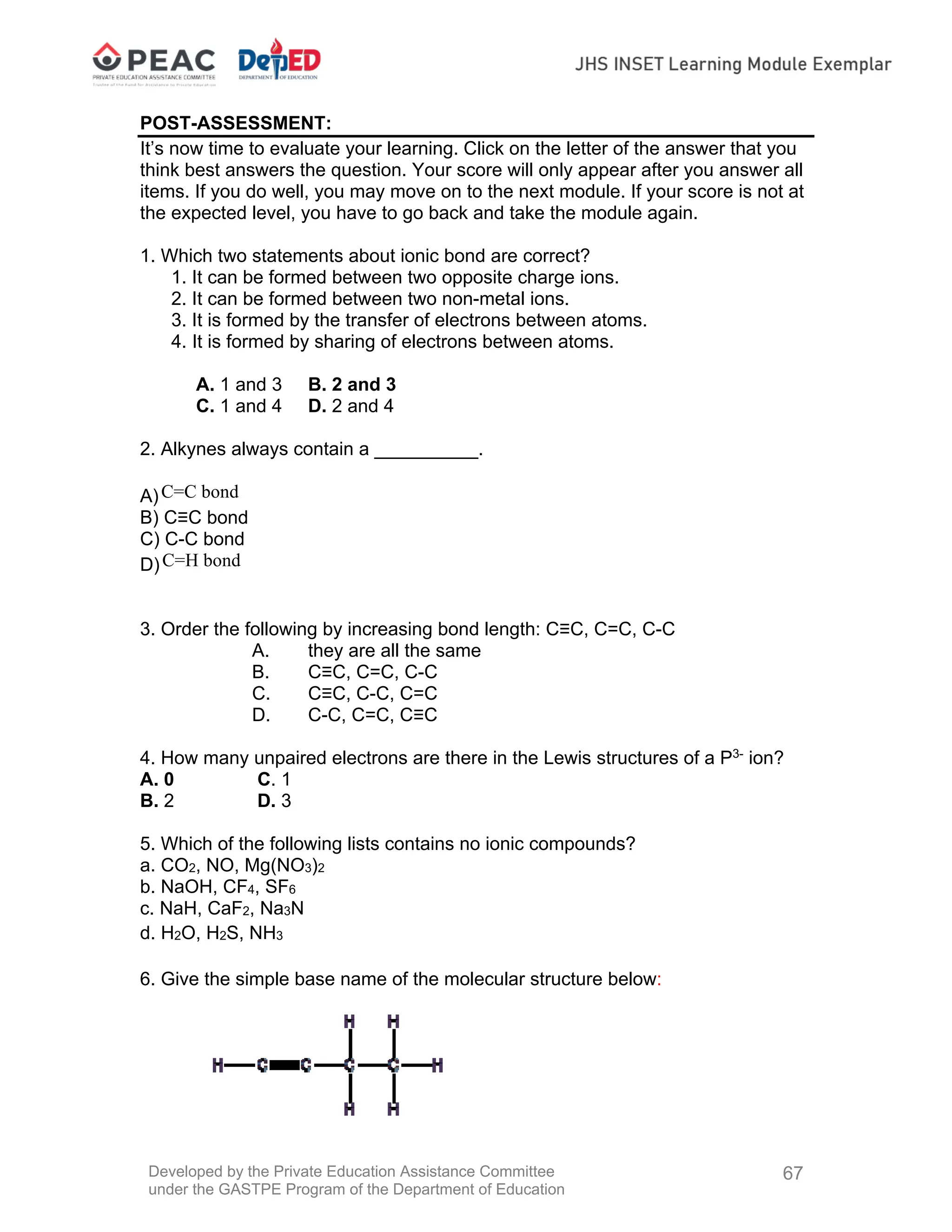
6. Give the simple base name of the molecular structure below:
Developed by the Private Education Assistance Committee
under the GASTPE Program of the Department of Education
68
A. butyne
B. butane
C. pentene
D. pentyne
7. Luminol (C8H7N3O2) is a versatile chemical that exhibits chemiluminescence,
with a striking blue glow, when mixed with an appropriate oxidizing agent.
What kind of compound is Luminol?
A. Ionic Compound
B. Salt
C. Molecular Compound
D. Metallic Compound
8. Ion X has a charge of 2+, and ion Y has a charge of 1-. What is the correct
formula of the compound formed?
A. XY2 C. (XY)2
B. X2Y D. X2Y2
For items 9-10, please refer to the following molecular models.
A. B. C. D.
As a chemistry student, you are asked by your teacher to regroup your molecular
models according to following questions:
9. Which shows a molecular geometry of ClF3?
10. Which is octahedral?
Chemistry Party
Your chemistry teacher will organize a chemistry party for the class. You
will prepare the balloon needed for the party. The twist of the party is that you
can only join the party if you’ll design the balloons according to its molecular
geometry/shape. Which of the following balloons will represent the compounds?
Use the following Legends:
3 - Balloons give a trigonal planar geometry
4 - Balloons give a tetrahedral geometry
Developed by the Private Education Assistance Committee
under the GASTPE Program of the Department of Education
69
5 - Balloons give a trigonal bipyramidal geometry
6 - Balloons give an octahedral geometry
A. B.
C. D.
11. CH4
12. CCl4
13. Elements X and Y combine to form covalently bonded molecule.
Show the Lewis structure of the molecule.
A. C.
B. D.
14. Using the diagram below, which of the following LEDS is most like to form
Na+
ion?
A. Element A C. Element C
B. Element B D. Element D
15. Element C (electronic configuration 2,8,18,8,2) and element E (electronic
configuration 2,7) react to form an ionic compound, CE2.
I True II False (Circle if the statement is true or false)
Developed by the Private Education Assistance Committee
under the GASTPE Program of the Department of Education
70
What do you think is the reason why the statement is correct or incorrect?
A. An atom of C will share one pair of electrons with each atom of E to form a
covalent molecule, CE2.
B. A macromolecule consists of covalently bonded atoms of C and E.
C. Atoms of C will each lose two electrons and twice as many atoms of E will
each gain one electron to form an ionic compound CE2.
D. An atom of C will lose one electron to an atom of E to form an ionic compound
CE.
16. SGS’s food chemical testing services use state of the art equipment and
apply intricate analytical techniques in testing your food products. As chemical
analyst of the said company you are asked to analyze organic or inorganic
compounds to determine chemical or physical properties, composition, structure,
relationships, or reactions.
As the chemical analyst, you are asked to give the systematic name of
substances below present in different commercialized products for your report to
the company’s chemists.
Which of the following choices of systematic names will you give to the
company’s chemist?
A. Potassium nitrate, Sodium bicarbonate
Magnesium sulfate, Calcium oxide
Hydrochloric acid, Magnesium hydroxide
B. Potassium nitrate, Sodium carbonate
Magnesium sulfate, Calcium oxide
Hydrochloric acid, Magnesium hydroxide
C. Potassium nitrite, Sodium bicarbonate
Magnesium sulfate, Calcium oxide
Hydrochloric acid, Magnesium hydroxide
D. Potassium nitrate, Sodium bicarbonate
Magnesium sulfate, Calcium oxide
Chloric acid, Magnesium hydroxide
17. An atom of element A has two electrons in its outermost shell while an atom
of
element B has five electrons in its outermost shell. When A reacts with B, the
compound will be:
A. covalent C. ionic
B. Diatomic D. element
Saltpeter, KNO3 Lime, CaO
Soda Ash, Na2CO3 muriatic acid, HCl
Epsom salts, MgSO4 milk of magnesia, Mg(OH)2
Developed by the Private Education Assistance Committee
under the GASTPE Program of the Department of Education
71
18. Based from number 17, you are asked to illustrate the reason for your
answer. Which of the following will you represent?
19. Sodium chloride, NaCl, exists as a molecule. Please encircle.
I True II False
Which of the following is the best reason for your answer:
A The sodium atom shares a pair of electrons with the chlorine atom to form a
simple molecule.
B After donating its valence electron to the chlorine atom, the sodium ion forms a
molecule with the chloride ion.
C Sodium chloride exists as a lattice consisting of sodium ions and chloride ions.
D Sodium chloride exists as a lattice consisting of covalently bonded sodium and
chlorine atoms.
20. A typographical error on an exam produced the formula, P4Se7, in one of the
questions. How would you name this compound?
A. tetraphosphorus hexaselenide
B. tetraphosphorus heptaselenide
C. phosphorus heptaselenite
D. phosphorus(IV) selenide
Developed by the Private Education Assistance Committee
under the GASTPE Program of the Department of Education
72
GLOSSARY OF TERMS USED IN THIS LESSON: (List in alphabetical order the
key terms and give their definitions)
Anion - A negatively charged ion. It is formed by receiving electrons from
another atom to achieve the octet
Cation - A positively charged particle. It is formed by losing electrons to achieve
the octet.
Chemical Bond - The force that holds two atoms together
Covalent Bond - It forms a molecular compound. Electron sharing.
Electronegativity - It is the ability of an element’s atoms to attract electrons in a
chemical bond.
Ions - Charged particle
Ionic Bond - The electrostatic force that holds oppositely charged particles
together in an ionic compound.
Ionic Compound - Compounds that contain ionic bonds.
LEDS (Lewis Electron Dot Structure) - A model that uses electron dot
structures to show how electrons are arranged in molecules.
Monoatomic Ion - An ion formed from only one atom.
Nonpolar Covalent Bond - A type of bond that forms when electrons are shared
equally
Oxidation State - The positive and negative charge of a monoatomic ion
Polar Covalent Bond - A type of bond that forms when electrons are not shared
equally
Valence Electrons - Electrons in an atom’s outermost orbitals; determine the
chemical properties of an element.
REFERENCES AND WEBSITE LINKS USED IN THIS LESSON:
Book
Chemistry: Matter and Change, Buthelezi et.al, Phoenix Publishing House.
http://www.middleschoolchemistry.com/lessonplans/chapter6/lesson2
Developed by the Private Education Assistance Committee
under the GASTPE Program of the Department of Education
73
Connect to the Real World Clip art
http://www.clker.com/clipart-8214.html
Sparkler Clip art
http://www.clipartof.com/portfolio/bnpdesignstudio/illustration/boy-holding-out-a-
new-year-or-fourth-of-july-sparkler-1049870.html
Happy Potter picture
http://www.dailymail.co.uk/tvshowbiz/article-1391176/Harry-Potter-And-The-
Deathly-Hallows-posters-revealed.html
Chemical Bonds:
http://www.youtube.com/watch?v=oNBzyM6TcK8
Ions: Practice Activity
http://itc.gsw.edu/faculty/speavy/spclass/chemistry/ions.htm
Samples of LED
http://www.middleschoolchemistry.com/multimedia/chapter4/lesson6#lewis_dot_
diagrams
VSEPR Table
http://www.lifesmith.com/VHS%20Web/chemistry.html
VSPER Worksheet
https://www.google.com.ph/?gfe_rd=ctrl&ei=hWIJU-
bHK6mL8Qerp4DQBg&gws_rd=cr#q=vsepr+worksheet
CHEMISTRY INTERACTIVES
http://bio-alive.com/animations/chemistry.htm
Naming binary covalent
http://www.sciencegeek.net/Chemistry/taters/Unit4BinaryNomenclature.htm
Making Models of Matter
http://apliense.xtec.cat/arc/sites/default/files/student.pdf
Webpage Reading about ionic and Covalent with animation
Developed by the Private Education Assistance Committee
under the GASTPE Program of the Department of Education
74
http://www2.nl.edu/jste/bonds.htm
Picture baby
http://www.hdwallpapers.in/little_cute_baby-wallpapers.html
Chemmodule
http://www.nios.ac.in/media/documents/secscicour/English/Chapter-7.pdf
Dancing Queen: Chemical Bonds
http://www.youtube.com/watch?v=DD6uh01X7Gg&list=PL574EB8B52AE5EF36
What are ionic Bonds?
http://www.youtube.com/watch?v=zpaHPXVR8WU
What kinds of bonds are these?
http://www.youtube.com/watch?v=oNBzyM6TcK8
Metallic Bonding
http://www.youtube.com/watch?v=Bi0rUNV8mEw
Chemistry graphics
http://wirdou.com/tag/chemistry/
Chemical Bonding - Webpage
http://www.scienceclarified.com/everyday/Real-Life-Chemistry-Vol-2/Chemical-
Bonding.html
Interactive Periodic Table/ionic bonding
http://www.learner.org/interactives/periodic/groups_interactive.html
The Bonding Game
http://www.powayusd.com/pusdphs/webquests/chemwebquest/chemsite.htm#Bo
ndingGame
Rags to Riches Quiz
http://www.quia.com/rr/1079.html?AP_rand=1738890253
adhesives
Developed by the Private Education Assistance Committee
under the GASTPE Program of the Department of Education
75
http://www.youtube.com/watch?v=PpyKN2O5Ll0
Chocolate: The New Health Food. Or Is It?
http://www.acs.org/content/dam/acsorg/education/resources/highschool/chemma
tters/chocolate-the-new-health-food-or-is-it.pdf
Quiz on Naming Ionic
http://www.chemistrywithmsdana.org/wp-content/uploads/2012/07/ionic.html
Complete the notetaking guide:
http://www.gpb.org/files/pdfs/gpbclassroom/chemistry/note_ep603.pdf
Dice Template
http://www.gpb.org/files/pdfs/gpbclassroom/chemistry/labDiceTemplate.pdf
IUPAC logo
http://www.iupac.org/home/about/affiliate-membership-program.html
Web 2.0: Digital StoryTelling
http://www.clpgh.org/kids/storymaker/embed.cfm
STEEL LAB
http://bartrug-tamhigh.weebly.com/chemical-bonding.html
Electrocuted Man clip art
http://www.picturesof.net/pages/100112-052675-088042.html
Alkanes Worksheet # 7
http://www.creative-chemistry.org.uk/gcse/documents/Module6/N-m06-18.pdf
VSEPR
http://www.chem.ox.ac.uk/vrchemistry/vsepr/intro/vsepr_splash.html
Building Molecules – Modelling VSEPR
http://yhsscience.net/lvena/Dec%20pdf%20files/molecularmodelslab.pdf
Developed by the Private Education Assistance Committee
under the GASTPE Program of the Department of Education
76
Lesson 3: Mole Concept
INTRODUCTION AND FOCUS QUESTION(S):
Have you tried counting the number of grains of rice in a gallon container? It is
difficult to do so because rice particles are very small and numerous. Chemists
face a similar problem when they try to count atoms. Atoms are too small to be
counted one at a time. Because they are so small, it is difficult to measure the
mass of each atom.
In this module you will find out how chemists overcome the problems of counting
tiny particles of the atoms and molecules and measuring the moles, mass, and
number of particles and relate to one another.
Remember to search for the answer to the following questions:
1. Why is the mole an important measurement in chemistry?
2. How are the quantity and the composition of substance determined?
3. Why the mole concept is an important concept in industry for production
of consumer goods?
LESSONS AND COVERAGE:
In this module, you will examine this question when you take the following lessons:
Lesson 1 – Chemical Bonding
A. Ionic and Covalent Bonding
B. Metallic Bonding
1.
Lesson 2 – The Variety of Carbon Compounds
A. Carbon Atoms
B. Organic Compounds
2.
Lesson 3 – Mole Concept
A. Mass
B. Moles
C. Percentage Composition of a Compound
In these lessons, you will learn the following:
Lesson 1 Write in bulleted form Performance Objectives.
Lesson 2 Write in bulleted form Performance Objectives.
Lesson 3 The Learner:
1. Use the mole concept to express mass of substances
2. Determine the percentage composition of a compound given its
chemical formula and vice versa.
Developed by the Private Education Assistance Committee
under the GASTPE Program of the Department of Education
77
MODULE MAP:
Here is a simple map of the above lessons you will cover:
Matter
Chemical
Bonding
The Variety of
Carbon
Compounds
Mole Concept
Ionic and Covalent Bonding
Metallic Bonding
Carbon Atoms
Organic Compounds
Mass
Moles
Percentage Composition of a
Compound
Developed by the Private Education Assistance Committee
under the GASTPE Program of the Department of Education
78
EXPECTED SKILLS:
To do well in this module, you need to remember and do the following:)
1. Read the instructions carefully.
2. Take down notes and copy some important link so that you could go back whenever
you need information given in that site.
3. Go beyond the procedure given in the net. Explore more.
4. Do the web test for several times and don’t forget to click on the correct answer for
your reference.
LESSON 3: MOLE CONCEPT
In this lesson, you will:
1. Use the mole concept to express mass of substances
2. Determine the percentage composition of a compound given its chemical
formula and vice versa.
PRE-ASSESSMENT:
1. Which of the following represents a mole?
a. 6.02 x 10²²
Pb atoms c. 3.01 x 10²³
CH4 molecules
b. 6.02 x 10²³
F atoms d. 1.63 x 10²¹
Si atoms
2. Which of the following choices is equivalent to one mole of CH4?
a. 16 g; 6.02 x 10²³
particles c. 32 g CH4; 6.02 x 10²³
particles
b. 32 g CH4; 12.02 x 10²³
particles d. 64 g CH4; 6.02 x 10²³
particles
3. How many moles are contained in 36g of NH4?
a. 1 mol b. 2 mol c. 3 mol d. 4 mol
4. Which of the following is the correct percentage composition of water in
Na2CO3.10H20
a. 2.93% b. 33.93% c. 62.93% d. 93.93%
5. What is the percent composition of oxygen in MgO?
a. 10% b. 20% c. 30% d. 40%
6. An organic compound contains 12.8% C, 1.1% H and 17% O by mass.
What is its empirical formula?
a. CHO b. CH2O c. CHO2 d. C2H2O2
Developed by the Private Education Assistance Committee
under the GASTPE Program of the Department of Education
79
7. What information is needed to calculate the percent composition of a
compound?
a. the density of the compound and Avogadro’s
b. the weight of the sample to be analyzed and its density.
c. the weight of the sample to be analyzed and its molar volume
d. the formula of the compound and the gram atomic mass of its elements
8. Which of the following is the percentage by mass of elements in Na2CO3?
a. Na = 43.39% c. Na = 44.39%
C = 11.32% C =11.00%
O = 45.28% O = 44.28%
b. Na = 44.39% d. Na = 43.93%
C = 12.32% C = 11.23%
O = 46.28% O = 45.82%
9. Which statement is correct about the molar mass of substance?
a. 4 g of CH4 is equal to 4 moles of CH4
b. 4 g of CH4 is equal to 1 mole of CH4
c. 4 moles of CH4 is equal to 16 g of CH4
d. 4 moles is equal to 64 g of CH4
10. If we breathed in 2.107 x 10²¹
molecules of air pollutant, nitrogen oxide
(NO2), how many grams of NO2 would we breathe in?
a. .160 g b. .161g c. .162g d. .163g
11. What is the mass of one-half mole of CO2?
a. 6 g b. 12 g c. 22 g d. 44 g
12. How many hydrogen atoms are there in 72 mol of H atoms?
a. 6.02 x 10²³
c. 4.3 x 1025
b. 12.04 x 1024
d. 6.02 x 1046
13. Which statement is NOT correct regarding the molecule C5H8O6?
a. One mole of C5H8O6 contains 6.02 x 10²³
particles.
b. One mole of C5H8O6 is equal to 168 g of C5H8O6.
c. The molar mass of C5H8O6 is equal to one mole of C5H8O6.
d. 84 g of C5H8O6 contains 6.02 x 10²³
molecules.
Developed by the Private Education Assistance Committee
under the GASTPE Program of the Department of Education
80
14. Which of the following statements is NOT true about mole?
a. One mole of a substance contains a fixed number of particles.
b. One mole each of different substances has different masses and
different number of particles.
c. One mole each of different substances has the same number of particles
but they have different masses.
d. The formula weight of the compound is equal to one mole of that
substance.
15. On a clean and dry bowl, mix 0.665 mol hard and soft flour (C4H8O4) together
with 5.5 x 10²¹
formula units of sodium hydrogen carbonate (NaHCO3) and
with 5. 42 x 10 21
formula units sodium chloride (NaCl). Calculate the exact
standard cooking measurement in mass?
a. Flour = 74 g c. Flour = 78 g
3. Baking soda = .2g Baking soda = .6 g
4. Salt = .5g Salt = .5g
5.
b. Flour = 76 g d. Flour = 80 g
6. Baking soda = .4 g Baking soda = .8 g
7. Salt = .5g Salt = .5g
16. How many molecules are there in 2 moles of H202?
a. 2 x 10²³
b. 6.02 x 10²³
c. 12.04 x 10²³
d. 6.02 x 1046
17. From the balanced equation: CS2 + 2CaO → CO2 + 2CaS
How many moles of CO2 are obtained from the reaction of 2 moles of CaO?
a. 0.5 mol b. 1.0 mol c. 1.5 mol d. 2.0 mol
18. Which of the following cookies made by spreading a thin batter onto a
baking sheet and moulding the cookies into shape?
a. Icebox cookie c. Rolled cookie
b. Pressed cookie d. Wafer cookie
19. At what temperature should you bake the cookies?
a. 305 0
F b. 315 0
F c. 350 0
F d. 375 0
F
20. Which ingredient does the chef NOT use to make his cookies?
a. baking powder b. flour c. salt d. sugar
Developed by the Private Education Assistance Committee
under the GASTPE Program of the Department of Education
81
Let’s start the module by exploring the mole concept on how mole concept useful
in understanding compounds? Why was Avogadro’s concept so important to
chemistry? How are moles related to the mass or volume of an element or
compound and Avogadro’s number of particles? How are the quantity and the
composition of substance determined?
ACTIVITY NO. 1: SONG ANALYSIS
Listen and analyze the song entitled “Avogadro’s number song” by clicking on the
link provided below. The song is a catalyst to understand the concept of mole in
chemistry. http://www.youtube.com/watch?v=R76zj9Y6zxI
PROCESS QUESTIONS:
1. Based on the song what questions come to your mind about the mole?
2. How does the Avogadro’s number help us understanding the mole concept in
chemistry?
3. How are moles related to the mass or volume of an element or compound
and Avogadro’s number of particles?
Here is a simple map of the lessons you will cover:
Developed by the Private Education Assistance Committee
under the GASTPE Program of the Department of Education
82
ACTIVITY NO. 2: I-R-F CHART
Before you begin with this lesson, Fill in the table: Provide answers in the first
two columns on the mole concept: Write your answers in your notebook.
Statements about Mole
Agree or
Disagre
e
Initial
Explanatio
n
Revised
Explanatio
n
Concluding
Explanatio
n
1. Equal volumes or equal
masses of different
substances contain the
same number of moles
(or
atoms/molecules/formul
a units).
2. A mole is just a number
of molecules
3. One mole of various
substances may contain
different numbers of
units of those
substances
4. Mole is similar to
molecular, molar and
molecule.
8.
5. The number of moles of
reactants must equal the
number of moles of
products
9.
http://intro.chem.okstate.edu/chemsource/moles/mole16.htm
As you go on to the succeeding activities you will find out the answer of the
above statements.
Process Questions:
1. Why is understanding the mole important in chemistry and to living
organism?
2. Does the mole concept important in industry for production of consumer
goods?
3. How are the quantity and the composition of substances determined?
Developed by the Private Education Assistance Committee
under the GASTPE Program of the Department of Education
83
ACTIVITY NO. 3: FUN WITH MOLES
You are now about to learn the mole concept in chemistry. As you explore this
concept, do remember the various study skills and strategies that are mention
initially in this module such as solving problems, downloading videos, exporting a
web page to PDF, taking screen shots, screen recording, taking down notes, and
many more.
In this activity you will check your understanding by answering the problems below.
Write and show your solution in your notebook. Solve the problem to identify
mystery words from each problem. When you get the answer refer it to the problem
code. Write the Mystery word on the first column and put your calculated answer
on the third column. Find the mystery sentence.
Word Problem Answer
How many moles of Pb are in 2.3456 g of Pb
How many atoms are present in 4.80 mol of Fe?
How many moles of K are in 5.7 x 10²³
atoms?
Calculate the number of atoms in 7.50 mol of S?
What is the molar mass of Na2SO4
What is the molar mass of C6H12O6
How many moles are in 1459 g of erbium?
Adapted source: http://www.nclark.net/ChemicalQuantities
Answer:
PROBLEM CODE
Word Answer Word Answer
Saturn 142 g/mol Scorpion(s) 1.2 g
Ion 180 g/mol Vampires 227.8 g
Eat 3.01 x 10²³
particles
Bad 4860 g
Kittens 190.5 g Cu Ms. Piller 0.01132 ml
And 0.4796 mol Owns 2.9 x 1024
Puppies 0.58 mol A .95 moles
Don’t 151.9 Red 4.5 x 1024
Breakfast 126 g Dead 0.500 mol
For 0.0638 mol Really 998.54 g
Very 616 g Okay? 8.7 mol
They 9.03 x 1024
Smell 1,371.5 g
Mystery Sentence:
Ms. Piller owns a red Saturn ion, okay?
Developed by the Private Education Assistance Committee
under the GASTPE Program of the Department of Education
84
In the activity, the reverse conversion from mass to mole also involves the molar
mass as a conversion factor, but it is the reverse of the molar mass that is used.
Can you explain why? To convert a mass in grams to mole, the reverse molar
mass is used so that the unit of grams cancels.
End of EXPLORE:
You just tried finding out how mole an important measurement in chemistry.
Let’s find out how your other classmates answered the first column of the IRF
chart. You can make use the Round-Robin Discussion to communicate with your
classmates. Compare their ideas to your own.
What you learn in the next sections will also enable you to do the final project.
Your understanding of the mole will be increased as you study the lessons and
perform the activities in the FIRM UP phase.
Let’s start gathering information by proceeding to the next part.
Your goal in this section is to learn and understand the unit mole quantitatively
measure the number of very small particles. You will determine and relate the
mass, moles, and number of particles to one another. The competencies you are
to learn are listed in the checklist below. Monitor your accomplishment in these
competencies.
CHECKLIST OF COMPETENCIES
Use the mole concept to express mass of substances
Determine the percentage composition of a compound given its
chemical formula and vice versa.
ACTIVITY NO. 4: LET’S REVIEW
When you were in the 8th
grade, you were asked to make a chart, poster or
multimedia presentation of elements, ions and compounds that are important to
living organisms. Let’s review the atoms, molecules, and the chemical reactions
between them by watching this video. Click on the link.
https://www.youtube.com/watch?v=vlSOESXQI7o Atoms are basic building
blocks of any matter. Combinations of these atoms are molecules.
Developed by the Private Education Assistance Committee
under the GASTPE Program of the Department of Education
85
PROCESS QUESTIONS:
1. What is an atom?
2. How are atoms and molecules related?
3. How will you describe the internal structure of an atom?
Now that you’ve learned information about atom and molecules, before we get
into the use of Avogadro's number. The next part will be about knowing the size
of moles and calculating their sizes. Why is the mole so important in chemistry?
And how is it used in calculations?
The purpose of calculating the mole concept in chemistry is to allow scientists,
students, etc., to bridge the gap by relating he numbers of elementary entities
(usually atoms or molecules) in a certain mass of a given substance.
Click the link below about the application of moles in concrete terms
https://ph.answers.yahoo.com/question/index?qid=20080915132541AAQtjFu
ACTIVITY NO. 5: HOW BIG IS A MOLE?
In previous activity you explore the mole concepts, to enhance your
understanding and to gather information about mole concepts you need to watch
a video clip below. Learn the incredible magnitude of the mole and how
something so big can help us calculate the tiniest particles in the world,
http://www.youtube.com/watch?v=TEl4jeETVmg
PROCESS QUESTIONS:
After watching, try to find answers to the following questions:
1. What were the views illustrated in the animation?
2. What was contribution of Avogadro in the field of Chemistry?
3. How do you use mole to the tiniest particles in the world
4. Why a substance so big can help us calculate the tiniest particles in the
world.
5. How are the quantity and the composition of substance determined?
ACTIVITY NO. 6: PICTURE ANALYSIS
In the previous activity you learned that atoms are tiny particles and counting
these tiny particles is as difficult as counting grains of sand in a desert.
Developed by the Private Education Assistance Committee
under the GASTPE Program of the Department of Education
86
Adapted Source: http://www.slideshare.net/entranceisolutions/mole-concept-ok1294991357
PROCESS QUESTIONS:
1. Based on the picture, what questions come to your mind about mole
concept?
2. How big is this number 6 x 10²³
?
3. How will you compare Avogadro’s number to the number of grains of sand
in the Sahara Desert?
4. What is the implication of mole concept to the tiny particles?
5. Why is the understanding of the tiny particles of mole significant to living
organisms?
The concept of mole is very important in chemistry, almost all the calculations, at
least in general chemistry, involve this concept. Here you will able to count atoms,
molecules, and ions through the vehicle of mole. The mole is a fundamental unit
in the SI units to measure the amount of substance.
Before you get into the Avogadro's number problems, take a look in the following
examples. This will intensify your knowledge on mass to mole conversion which
can be facilitated by employing the molar mass as a conversion ratio.
Example 1:
Convert 18 grams of water to moles of water.
Solution: The molar mass of water is 18 g/mol. Therefore:
18 g H2O x = 1.0 mol H2O
Example 2:
If you have 34.5 g of NaCl, how many moles of NaCl do you have?
Solution:
34.5 g Na Cl x .
= 0.591 moles NaCl
If the foregoing problem doesn’t make sense, you should review these links:
http://www.chem1.com/acad/webtext/intro/int-2.html. - Introduction to the mole
concept in Chemistry
Developed by the Private Education Assistance Committee
under the GASTPE Program of the Department of Education
87
https://www.boundless.com/chemistry/textbooks/boundless-chemistry-
textbook/mass-relationships-and-chemical-equations-3/molar-mass-
41/converting-between-moles-and-atoms-221-3702/ - Understanding the
relationship between moles and Avogadro’s number
https://www.boundless.com/chemistry/textbooks/boundless-chemistry-
textbook/mass-relationships-and-chemical-equations-3/molar-mass-
41/converting-between-mass-and-number-of-moles-222-3700/ - Mass and the
number of atoms in a given sample
Look at the items you missed. Go back to your notes and review the terms or
concepts you missed.
ACTIVITY NO.7: WHAT SUBSTANCE AM I?
In this activity you will have the opportunity to relate quantities of atoms, elements
or molecules to real-world measurable quantities. You will enhance your
understanding of the mole by using masses and a periodic table to determine
unknown substances. As a hands-on activity, this will ensure you to make the
connection between moles and molar mass.
You are a chef in big trouble! You have an important restaurant reviewer coming
to your restaurant but someone has taken off all the labels from your bottles! How
will you know which one is the salt you need for cooking and which bottles contain
substances the reviewer will probably find hazardous to have in the kitchen?
In front of you are 6 bottles with the label removed. Each contains one mole of an
unknown substance. Using only an electronic balance and your periodic table,
classify and label the unknown substance.
Clues:
** four of the six are elements, 2 are compounds. The compounds are in bottles
A and B and are either NaCl, FeS, or CaCO3.
** the mass of each bottle is: 105.19g
** n = m / M Since there is only one mole of each substance, the mass is also
the molar mass.
Instructions:
1. Find the mass of each bottle with substance. Record the mass in the table
provided. The mass of the bottle itself is 105.19g. Use this information to
determine the mass of the substance alone.
2. Using the mass of the substance, determine the molar mass
3. Determine which bottles contain elements and which elements they are.
Developed by the Private Education Assistance Committee
under the GASTPE Program of the Department of Education
88
4. Two of the substances are compounds of either NaCl, FeS, or CaCO3.
Determine which bottles contain which compounds.
BOTTLE
MASS OF
BOTTLE
AND
SUBSTANCE
(g)
MASS OF
SUBSTANCE
(g)
ATOMIC
MASS OF
SUBSTANCE SUBSTANCE?
A (compound)
B (compound)
C
D
E
F
Adapted source: Mole Scavenger Hunt
PROCESS QUESTIONS:
1. How is the mole concept useful in understanding compounds?
2. Why is mole an important measurement in chemistry?
3. How are the quantity and the composition of substance determined?
4. How does calculating the moles help one achieve a real world task such as in the
above situation?
Furthermore, use the following links to enhance your learning to relate the mole
concept and molar mass in real life.
 https://ph.answers.yahoo.com/question/index?qid=20111215145527AAqG
gYS Mole concept relate to real life
 and
http://wiki.chemprime.chemeddl.org/index.php/The_Molar_Mass_in_Every
day_Life The Molar Mass in Everyday Life
ACTIVITY NO. 8: RELATIONSHIP BETWEEN MOLES AND AVOGADRO’S
NUMBER
You learned from the previous activity on how something so big can help us
calculate the tiniest particles in the world. The mole can be used to relate masses
of substances to the quantity of atom, molecules and particles. It can be
expressed as 6.02 x 10²³
known as Avogadro’s number. This is very important in
relation to determine how much of one substance can react with a given amount
of another substance. Click this site http://prezi.com/auxqhdeiro1k/the-mole-
concept/ to enhance the learning about mole conversion.
PROCESS QUESTIONS:
1. Describe the relationship between Avogadro’s number to the molar mass
according to conversion?
Developed by the Private Education Assistance Committee
under the GASTPE Program of the Department of Education
89
2. How an Avogadro’s number can be used in converting an amount of
substance from one measurement to another?
3. How was your idea about difficulty on mole conversions corrected in the
lesson?
ACTIVITY NO. 9: HOW TO USE THE MOLE?
Now that you understand the moles and Avogadro's number 6.02x10²³
as a unit of
measurement in chemistry, you will now get to know the important terms that you
will encounter. Click the links below:
http://www.youtube.com/watch?v=JC76NR8EtTQ this video will help you grasp
your knowledge about mole. Then click this webpage to understand mole concept.
Read the article found in this link:
http://www.chemistryexplained.com/Ma-Na/Mole-Concept.html. Make a list of the
important words, terms, or ideas that you got from the article. From the list, come
up with phrases or statements which you think define or describe MOLE. Write
your completed definition in the appropriate column of the Frayer model:
PROCESS QUESTIONS:
1. What is a mole?
2. What is the important role that the mole plays in determining the entities of the
particles and how does it relate to Avogadro’s number?
3. What can you learn from looking at our environment?
ACTIVITY NO. 10: VIDEO LECTURE
In previous activity you learned the role and importance of mole. In this short video
lecture course on the mole concept converting mass to moles, mass to atoms,
moles to Avogadro’s number, molecules to mass. Learn more facts about mole
and discover its many facets by watching the videos found in the following
Developed by the Private Education Assistance Committee
under the GASTPE Program of the Department of Education
90
links:http://www.youtube.com/watch?v=AsqEkF7hcII - The Mole and Avogadro's
Number
http://www.youtube.com/watch?v=6Yuy6jCSh-0 – Mass and Mole relationship
What are the facts and characteristics of mole that you gathered from the videos
you watched? Write them in the Facts/Characteristics box of the Frayer model.
PROCESS QUESTIONS:
1. Classify difficult concepts you gathered and in your own content explain the
concept.
2. What is the value of Avogadro’s number? Explain its relevance to moles.
3. What are the methods involved in converting mass to moles, mass to atoms,
moles to Avogadro’s number, molecules to mass? Explain briefly how they
solve percentage composition?
ACTIVITY NO. 11: RESEARCH STUDY
In the previous activity you learned that the mole Click on the link below to read an
article: “Teaching about amount of substance and the mole”. Use the information
found in the article to enhance your understanding about the language associated
with its use in the mole concept.
http://www.ulster.ac.uk/scienceinsociety/research_into_teaching_about_the_mol
e_(pages_6-7).pdf
PROCESS QUESTIONS:
1. What are the difficulties encountered by the students in studying the mole
concepts?
2. Do you have the same perceptions of the difficulties on mole concept?
3. What are the ways to conquer the difficulties in order to promote better
understanding of mole?
Developed by the Private Education Assistance Committee
under the GASTPE Program of the Department of Education
91
After reading the article, you will also give your own hypothesis after finding out
important ideas with regard to this research.
What are the examples and non-examples of mole that you gathered from the
article? Write them in the Examples and Non-example boxes of the Frayer model.
Check your understanding by answering the problems below. Write and Show
your solution in your notebook.
ACTIVITY NO. 12: DRILL
You learned how to do conversion according to the number of particles that the
substance contains. In this drill you are challenged to perform mole, mass, and
molecule conversions below:
. Question Answer
1. How many moles of Na are in 42 g of
Na?
2. What is the mass of 1.2 x 1025
molecules of CO?
3. How many molecules are there in 52 g
of CO?
4. What is the mass of 1.20 x 1025 atoms
of sulfur?
5. How many atoms are in 36 g of
bromine?
Review the previous interactive site; pausing it every now and then so you can
take down notes.
Developed by the Private Education Assistance Committee
under the GASTPE Program of the Department of Education
92
PROCESS QUESTIONS:
Go back to the previous section and compare your computation with the
discussion.
1. How will you assess your performance in solving the problems?
2. What do you think was the cause of your mistakes in your calculation? Go back
to your notes and review the terms or concepts you missed.
3. Cite an example for the way you use mole in your everyday life. Explain
your answer
4. How are chemists able to keep track of the number of particles (atoms, or
molecules) that enter a chemical reaction?
5. How are the quantity and the composition of substances determined?
All of the previous problems have involved single–step conversions between
moles, mass, volume, or number of particles. The following is a summary of the
conversion factors needed:
CONVERSION CONVERSION FACTOR
MOLES ←→ NUMBER OF PARTICLES
5.02 x 10²³ particles
1 mol
or
1 mol
6.02 x 10²³ particles
MOLES ←→ MASS
( molar mass ) g
1 mol or
1 mol
( molar mass ) g
MOLES ←→ VOLUME (gases @ STP)
22.4 L
1 mol or
1 mol
22.4 L
MOLECULES ←→ ATOMS
(atom count) atoms
1 mol or
1 mol
(atom count) atoms
Developed by the Private Education Assistance Committee
under the GASTPE Program of the Department of Education
93
The following flow chart will help to simply calculations that involve multiple conversions.
Now that you have practiced conversions between mass, moles, and
representative particles, you probably realize that the mole is at the center of these
calculations. Mass must be converted to moles before being converted to atoms
and atoms must similarly be converted to mole before calculating their mass.. The
flow chart above shows the steps to follow as you complete these conversions. In
the Example problems, two steps were used to convert either mass to moles to
atoms, or atoms to moles to mass. Instead of two separate steps, these
conversions can be made in one step. Observe the examples
EXAMPLE MOLE CALCULATIONS INVOLVING
MULTIPLE CONVERSIONS
Problem : (a) What is the volume occupied by 50.0
g of NH3(g) at STP?
(b) What is the mass of 1.00 x 10¹²
atoms of Cl?
11.
(c) How many oxygen atoms are
contained in 75.0 L of SO3 (g) at
STP?
Solution : (a) MASS → MOLES → VOLUME
? L = 50.0 g x 1 mol x 22.4 L = 65.9 L
17.0 g 1 mol
(b) ATOMS → MOLES → MASS
? g = 1.00 x 10¹² atoms g x 1 mol
MOLES Volume
Mass of Substances
Number of
Atoms/Particles/
Molecules
Divide by
6.02 x 10
23
Multiply by
6.02 x 10
23
Multiply by
22.4L
Divide by
22.4L
Multiply by
mass
Divide by
grams
Developed by the Private Education Assistance Committee
under the GASTPE Program of the Department of Education
94
6.02 x 10²³
atoms x 35.5 g
1 mol = 5.90 x 10⁻¹¹
g
(d) VOLUME → MOLES → MOLECULES
→ ATOMS of O
? O’s = 75.0 L x 1 mol 6.02 x 10²³ SO3
22.4 L x 1 mol
x
3O’s
SO3
= 6.05 x 1024
O’s
ACTIVITY NO. 13: SKILLS READINESS CHECK:
Reflection to the level of your performance for this lesson. Check the color of the
light that measures your understanding: Red - if you need more practice or
activities, Yellow – 50% of the concepts understand, and Green – understand all
and will be able to apply.
ACTIVITY NO.14: PERCENTAGE COMPOSITION
In the previous activity, you learned the relationship between Avogadro’s number
and mass of a substance. Now, the mass of each element present in one mole of
compound can be compared to the mass of one mole of compound, based on
the chemical formula of the compound. The value obtained, multiplied by 100%,
is called the percentage composition. The mass percent of a compound is
calculated this way:
𝑀𝑎𝑠𝑠 𝑝𝑒𝑟𝑐𝑒𝑛𝑡 𝑜𝑓 𝑒𝑙𝑒𝑚𝑒𝑛𝑡
𝑚𝑎𝑠𝑠 𝑜𝑓 𝑒𝑙𝑒𝑚𝑒𝑛𝑡 𝑝𝑟𝑒𝑠𝑒𝑛𝑡 𝑖𝑛 𝑜𝑛𝑒 𝑚𝑜𝑙𝑒 𝑜𝑓 𝑐𝑜𝑚𝑝𝑜𝑢𝑛𝑑
𝑚𝑎𝑠𝑠 𝑜𝑓 𝑜𝑛𝑒 𝑚𝑜𝑙𝑒 𝑜𝑓 𝑐𝑜𝑚𝑝𝑜𝑢𝑛𝑑
𝑥 100
To determine the mass percent of Al(OH)3, the following steps can be followed:
Developed by the Private Education Assistance Committee
under the GASTPE Program of the Department of Education
95
STEP 1: Calculate molar mass of Al(OH)3
g Al
27 𝑔 𝐴𝑙
𝑚𝑜𝑙 𝐴𝑙
𝑥 1 𝑚𝑜𝑙𝑒 𝐴𝑙 27 𝑔
g O
16 𝑔 𝑂
𝑚𝑜𝑙 𝑂
𝑥 3 𝑚𝑜𝑙𝑒𝑠 𝑂 48 𝑔
g H 𝑥 3 𝑚𝑜𝑙𝑒𝑠 𝐻 3 𝑔
Molar mass =78 g
STEP 2: Determine mass percent of each element
% Al
27 𝑔 𝐴𝑙
78 𝑔 𝐴𝑙 𝑂𝐻
𝑥 100 34.62 %
% O
48 𝑔 𝑂
78 𝑔 𝐴𝑙 𝑂𝐻
𝑥 100 61.53 %
% O 𝑥 100 3.85 %
Total = 100 %
The mass percentages of all elements in a compound add up to 100%. In some
cases, the sum of the mass percentages in a compound is not exactly 100% due
to the rounding of values.
Sample Problem
Find the percentage composition of Vitamin E (C29H50O2)
Solution
1. Analyze: Given: Formula C29H50O2
29 mole C
50 mole H
2 mole O
Find: % of each element
2. Plan: a. Get molar mass of C29H50O2
C = 12 g/mole C
H = 1 g/mole H
O = 16 g/mole O
b. Calculate percentage composition
3. Calculate
STEP 1: Determine molar mass of C29H50O2
Developed by the Private Education Assistance Committee
under the GASTPE Program of the Department of Education
96
g C 29 𝑚𝑜𝑙𝑒 𝐶 𝑥
12 𝑔 𝐶
𝑚𝑜𝑙 𝐶
348 𝑔 𝐶
g H 50 𝑚𝑜𝑙𝑒 𝐻 𝑥
1 𝑔 𝐻
𝑚𝑜𝑙 𝐻
50 𝑔 𝐻
g O 2 𝑚𝑜𝑙𝑒 𝑂 𝑥 32 𝑔 𝑂
Molar mass = 430 g
STEP 2: Calculate percentage composition of C29H50O2
% C
348 𝑔 𝐶
430 𝑔 C H O
𝑥 100 80.93 %
% H
50 𝑔 𝐻
430 𝑔 C H O
𝑥 100 11.63 %
% O
32 𝑔 𝑂
430 𝑔 C H O
𝑥 100 7.44 %
4. Evaluate Add the percentage to check if the sum is 100 %
80.93% + 11.63% + 7.44% = 100%
In this case, the percentages add up to 100%.
Check your understanding by answering the problems below. Write and Show
your solution in your notebook.
SELF-ASSESSMENT
Recall what you have learned in the lesson, you will solve on your own the
percentage composition of the following compounds
1. Determine the percentage composition of CH3COOH
2. Which of the following which are used as fertilizers, would be cheaper
source of nitrogen if the cost per kilogram of the given compounds is the
same? Show your calculation.
a. Urea, N2H4CO
b. Ammonium nitrate, NH4NO3
c. Ammonium sulfate, (NH4)2SO4
Process Question:
1. How is percent composition determined?
2. How percent composition data for a compound are related to the masses
of the elements in the compound? Percent composition is numerically
equal to the mass in grams of each element in a 100.0 g sample.
Developed by the Private Education Assistance Committee
under the GASTPE Program of the Department of Education
97
3. What are your common mistakes in solving the problem?
4. How are the quantity and the composition of substances determined?
Look at the items you missed. Go back to your notes and review the process you
missed.
ACTIVITY NO. 15: EMPIRICAL FORMULA VS MOLECULAR FORMULA
A. Determining the Empirical Formula Adapted source from Science
Impact Chemistry
Now you learned to calculate the percentage composition, in this activity, you
will determine the empirical formula that gives the simplest whole-number
ratio of atoms in a compound, expressed as a ratio of elements in the
compound.
Sample problem 1:
Determine the empirical formula for a compound made up of 71.65% Cl,
24.27% C and 4.07% H.
Solution:
1. Analyze Given:% Cl, %C, and %H
Find: Empirical formula for the compound
2. Plan a. Convert % to mass of element
b. Change mass to moles
c. Find simplest whole number ratio of moles
d. Write the empirical formula
3. Compute
a. Find number of moles
mole Cl 71.65 g Cl x
1 𝑚𝑜𝑙𝑒 𝐶𝑙
35.5 𝑔 𝐶𝑙
2. .02
mole C 24.28 g C x
1 𝑚𝑜𝑙𝑒 𝐶
12.0 𝑔 𝐶
2. .02
mole H 4.07 g H x
1 𝑚𝑜𝑙𝑒 𝐻
1.0 𝑔 𝐻
4. .07
b. Divide each mole value by the smallest mole value
mol Cl
2.02 𝑚𝑜𝑙 𝐶𝑙
2.02
1.0 𝑚𝑜𝑙 𝐶𝑙 𝑎𝑡𝑜𝑚𝑠
mol C
2.02 𝑚𝑜𝑙 𝐶
2.02
1.0 𝑚𝑜𝑙 𝐶 𝑎𝑡𝑜𝑚𝑠
Developed by the Private Education Assistance Committee
under the GASTPE Program of the Department of Education
98
mol H
4.07 𝑚𝑜𝑙 𝐻
2.02
2.01 𝑜𝑟 2 𝑚𝑜𝑙 𝐻 𝑎𝑡𝑜𝑚𝑠
The simplest whole number ratio of the elements in the
compound is 1 mole chlorine atoms is to 1 mole carbon
atoms is to 2 moles hydrogen atoms
c. The empirical formula for the compound is CH2Cl
If the composition of the compound is given in terms of the masses of
the elements in the sample, convert the given masses into moles and
reduce the mole ration simple whole numbers.
Sample problem 2:
A new compound is found to contain 0.2322 g C, 0.05848 g H, and
0.3091 g O. Calculate the empirical formula for the compound.
Solution:
1. Analyze Given: 0.2322 g C
0.05848 g H
0.3091 g O
Find: empirical formula for compound
2. Plan a) Change g to moles
b) Convert mole values to simple whole number ratios
c) Write empirical formula
3. Compute
a. no. of moles of each element
mol C .02322 g C x
1 𝑚𝑜𝑙𝑒 𝐶
12.0 𝑔 𝐶
0. .019
mol H 0.05848 g H x
1 𝑚𝑜𝑙𝑒 𝐻
1.00 𝑔 𝐻
0.058
mol O 0.3091 g O x
1 𝑚𝑜𝑙𝑒 𝑂
16.0 𝑔 𝑂
0.019
b. simplest mole ratio
mol C
0.019 𝑚𝑜𝑙 𝐶
0.019
1.0
mol H
0.058𝑚𝑜𝑙 𝐻
0.019
3.05 𝑜𝑟 3
Developed by the Private Education Assistance Committee
under the GASTPE Program of the Department of Education
99
mol O
0.019 𝑚𝑜𝑙 𝑂
0.019
1.0
c. Empirical formula of compound: CH3O
Check your understanding by answering the problems below. Write and Show
your solution in your notebook.
SELF-ASSESSMENT
Recall what you have learned in the empirical formula, you will solve on your own
1. A platinum (II) compound, which is used to treat tumors, contains
65.0%Pt, 23.6% Cl, 9.35% N, and 2.05% by mass. Calculate the empirical
formula.
2. Determine the empirical formula for the compound containing 72.25% Mg
and 27.75% N.
B. Determining the Molecular Formula Adapted source from Science Impact
Chemistry
In the previous activity you learned to formulate the empirical formula, in this
activity you will determine a molecular formula, first determine the empirical
formula for the compound as shown in the section above and then determine
the molecular mass. Next, divide the molecular mass by the molar mass of the
empirical formula (calculated by finding the sum the total atomic masses of all
the elements in the empirical formula). Multiply the subscripts of the molecular
formula by this answer to get the molecular formula.
This can be shown as:
𝑀𝑜𝑙𝑎𝑟 𝑚𝑎𝑠𝑠
𝐸𝑚𝑝𝑖𝑟𝑖𝑐𝑎𝑙 𝑓𝑜𝑟𝑚𝑢𝑙𝑎 𝑚𝑎𝑠𝑠
𝑛
Where n stands for the number of units present in the
molecular formula of the compound.
Sample Problem:
An unknown sugar compound has a mass of 180
g/mol and a chemical composition of 40% C, 6.67% H, and
53.33% O. What is the molecular formula for the sugar
compound?
Solution:
Analyze Given % Composition of compound
Developed by the Private Education Assistance Committee
under the GASTPE Program of the Department of Education
100
40% C, 6.67% H, 53.33% O
Find: Molecular Formula
Plan a. determine the empirical formula
b. calculate the empirical mass
c. calculate the molecular mass
STEP 1: Determine the empirical formula
mol C 40 𝑔 𝐶 𝑥
1 𝑚𝑜𝑙 𝐶
120 𝑔 𝐶
3.33
mol H 6.67 𝑔 𝐻 𝑥
1 𝑚𝑜𝑙 𝐻
1.0 𝑔 𝐻
6.67
mol O 53.33 𝑔 𝑂 𝑥
1 𝑚𝑜𝑙 𝑂
16.0 𝑔 𝐶
3.33
Smallest mole ratio
mol C
3.33
3.33
1
mol H
6.67
3.33
2
mol O
3.33
3.33
1
Therefore empirical formula is CH2O
STEP 2: Calculate the empirical mass
g C 1 𝑚𝑜𝑙 𝐶 𝑥
12 𝑔 𝑂
𝑚𝑜𝑙 𝐶
12.0
g H 2 𝑚𝑜𝑙 𝐻 𝑥
1.0 𝑔 𝐻
𝑚𝑜𝑙 𝐻
2.0
g O 1 𝑚𝑜𝑙 𝑂 𝑥
16 𝑔 𝑂
𝑚𝑜𝑙 𝑂
16.0
Therefore empirical mass = 30.0 g
STEP 3: Compare the molar mass with the empirical mass
Developed by the Private Education Assistance Committee
under the GASTPE Program of the Department of Education
101
𝑀𝑜𝑙𝑎𝑟 𝑚𝑎𝑠𝑠
𝐸𝑚𝑝𝑖𝑟𝑖𝑐𝑎𝑙 𝑚𝑎𝑠𝑠
180 𝑔
30 𝑔
6
The molecular formula for the sugar compound is (CH2O)6 or
C6H12O6
SELF-ASSESSMENT
Solve on your own:
1. A sodium metaphosphate, used in detergents, is composed of 22.5% Na,
30.4% P, and 47.1% O. The formula mass of the compound is 612 g.
What is the formula of the compound?
Process Questions:
1. Can empirical formula affect the Molecular formula? Explain
Empirical Formula: a GENERAL formula of a compound in its most
simplified whole # ratio of atoms. Molecular Formula: A SPECIFIC non-
simplified formula of a compound.
2. Would you expect an empirical formula to be the same even though
different masses used? Cite an example
Yes, if we're talking about different masses of the same compound. This is
because an empirical formula is the simplest whole number ratio of
elements in a compound.
Example water contains 2 hydrogen atoms for every one oxygen atom.
18 grams of water, I have 2 mol H and 1 mol O. The empirical formula is
H2O.
3. What is your conclusion about the relationship between empirical formula
and molecular formula? The molecular formula is equal to twice the
empirical formula.
4. How are the quantity and the composition of substances determined?
ACTIVITY NO. 16: SKILLS READINESS CHECK: Reflection to the level of your
performance for this lesson. Check the first column if you need more practice or
the second column if you are ready to move on the next activity.
I need more practice
(If most of your answers are incorrect)
I am ready to move on to the next
activity
(if you incur only few errors in the first
three skills practice)
Developed by the Private Education Assistance Committee
under the GASTPE Program of the Department of Education
102
Go back to the videos you have
viewed to review the input and
examples. Then answer again the
three skills practice
You may proceed to the next activity
Click SAVE if you done this part before moving to the next activity.
Recall what you have learned in the previous section of this lesson. Based from
the drill, what are your operational plans or steps in converting mass, mole and
numbers of particles to get a realistic answer?
Answers:
Synthesis Question: What are the different ways that you need to consider
in solving mole concepts?
How was your experience about conversion according to the number of particles
and the operational plans in converting mass, mole and numbers of particles?
Share your experience and answer to these questions by creating an Org chart
with http://www.gliffy.com/uses/org-chart-software/. Submit your chart by sharing
the link in this portal.
STEP 1: ANALYZE
STEP 4: EVALUTE
STEP 3: COMPUTE
STEP 2: PLAN
STEP 1: ANALYZE
Developed by the Private Education Assistance Committee
under the GASTPE Program of the Department of Education
103
ACTIVITY NO. 17: MOLE COMPUTATION
One of our main concerns in the mole concept is doing conversions between
grams, moles, and Number of Atoms/Particles/ Molecules. Open and read this
web page:
http://www.austincc.edu/dlyon/introsp04/Intro%20Chem%20ch7%20the%20mole
%20and%20percent%20comp.pdf. and
http://crescentok.com/staff/jaskew/isr/chemistry/class13.htm. These sites feature
the procedures on mole calculations. After reading the latter site, for skill-
building exercise click mole calculation to solve some problems.
How did you perform mole calculations exercise? Look at the items you missed.
Go back to your notes and review the terms or concepts you missed.
ACTIVITY NO. 18: ONLINE QUIZ
Check your understanding from the previous activity you have learned
Review the terms and concepts learned in the previous activity by taking the
online quiz found in the link below.
http://www.glencoe.com/qe/science.php?qi=978 online quiz about mole
How did you perform in the quiz? Look at the items you missed. Go back to your
notes and review the terms or concepts you missed.
ACTIVITY NO. 19: Reviewing Prior Knowledge through I-R-F Chart
You have just learned the use the mole concept to express mass of substances
and the percentage composition of a compound given its chemical formula and
vice versa. Let’s re-examine the I-R-F to answer the third column the revised
explanation part.
You were given this question in the previous activity: Why is understanding the
mole important in chemistry and to living organism? Does the mole concept
important in industry for production of consumer goods? How are the quantity
and the composition of substances determined?
Statements about Mole
Agree or
Disagree
Initial
Explanation
Revised
Explanation
Concluding
Explanation
1. Equal volumes or equal
masses of different
substances contain the
same number of moles
(or
atoms/molecules/formula
units).
Developed by the Private Education Assistance Committee
under the GASTPE Program of the Department of Education
104
2. A mole is just a number
of molecules
3. One mole of various
substances may contain
different numbers of
units of those
substances
4. Mole is similar to
molecular, molar and
molecule.
5. The number of moles of
reactants must equal the
number of moles of
products
http://intro.chem.okstate.edu/chemsource/moles/mole16.htm
As you go on to the succeeding activities you will find out the answer of the
above statements.
Open this video: http://www.youtube.com/watch?v=xPdqEX_WMjo this video will
enrich your learning about mole conversion.
Be sure to take note of the important method of mole conversion that you will
encounter.
What are the techniques of mole conversion you gathered? Are you familiar
about the method used in the mole conversion? Look back at your notes and try
to cluster related concepts.
End of FIRM UP:
In this section, the discussion was all about mole concept and how a mole can be
used in converting an amount of substance from one measurement to another
Go back to the previous section and compare your initial ideas with the
discussion. How much of your initial ideas are found in the discussion? Which
ideas are different and need revision? What new learning goal should you now
try to achieve? Go back to your checklist of learning competencies and how
much you’ve accomplished:
CHECKLIST OF COMPETENCIES
Use the mole concept to express mass of substances
Determine the percentage composition of a compound given its
chemical formula and vice versa.
Developed by the Private Education Assistance Committee
under the GASTPE Program of the Department of Education
105
Now that you know the important ideas about this topic, let’s go deeper by
moving on to the next section.
Now that you have learned to express mass of substances, it’s time for you to
analyze and assess the percentage composition of a compound given its
chemical formula and vice versa
Your goal in this section is to take a closer look at some aspects of the topic on
mole conversion, common misconceptions and understand the mole concept and
its significance to the quantitative analysis of chemical reactions.
ACTIVITY NO. 20: PERCENT SUGAR IN GUM (Lab. Activity)
This is activity you will perform to understand what is meant by percent
composition by mass of a compound and determine the percent composition by
mass of a compound. Open this webpage,
http://www.gpb.org/files/pdfs/gpbclassroom/chemistry/sugarInGumLab.pdf this
site will enrich your learning about the percent composition of a substance.
PROCESS QUESTIONS:
1. How do you find percent composition from the activity?
2. How is the mass percentage of an element in a compound determined
from its formula?
3. How are the quantity and the composition of substance determined?
Generalization:
Based on the experimentation, fill in the “Connections to Life” box of our Think
Pad. Write or illustrate how the activity might apply to real life situation in the
contemporary world
Developed by the Private Education Assistance Committee
under the GASTPE Program of the Department of Education
106
In your notebook, write a brief reflection on your experience about how did you
go along all with all the activity? Did you see a connection between one topic to
another? Share your insights in what you have learned and the difficulties that
you encountered:
To know more on percent and the calculation of percent which is essential in
daily life, click on this link
 http://www.800mainstreet.com/2/002-13.htmlcomposition of compounds
 https://ph.answers.yahoo.com/question/index?qid=20100616093530AAJ0
Lpo some uses of percent composition in everyday life
ACTIVITY NO. 21: CHALK ACTIVITY
In this activity, you will look back on the skills you learned and determine which of
these you would use to meet the requirements of the given task.
You are asked to calculate moles of chalk (calcium carbonate CaCO3), atoms of
elements in the compound (chalk) and number of atoms of each element in the
chalk, left on a sidewalk after a piece of chalk is used to write or draw their name,
symbol or personal message on a sidewalk using a piece of chalk. You will
perform the experiment as scientist. The goal of this activity is to calculate moles
using mass and chemical formula. You will produce a summary of the labeled
calculations of moles and atom. The data will be submitted to your teacher.
Open this webpage to perform the activity:
http://www.learner.org/workshops/chemistry/support/act1_d2.pdf this site will
enrich your skills in calculating grams and moles
PROCESS QUESTIONS:
1. What have learned about the activity?
Developed by the Private Education Assistance Committee
under the GASTPE Program of the Department of Education
107
2. How is the mole concept useful in understanding compounds?
3. How the mole concepts become beneficial to living organisms?
4. How are the quantity and the composition of substances determined?
Now fill in the “WORDS” part of your Think Pad by writing the descriptive
characteristics of mole that you have encountered in the activity and the
“PICTURE” part by visualizing mole in a given situation.
Looking back from the activities that you had worked on, which do you find very
interesting? Do you consider yourself ready for trying all the concepts you learned
into a more challenging one? Make one general statement in your notebook about
the activities you worked with.
After working on the mole of compounds and the percentage composition of a
compound given its chemical formula, you learned that it is convenient to use the
mole to measure amounts of substances. The next activity will lead to recognize
that new substances are formed from mole
ACTIVITY NO. 22: CHEMISTRY COOKIE
Now that you understand the mole concept the next activity will assess how you
can apply your skill to mole conversion in baking cookies.
In this activity, you will be converting a recipe from moles to standard cooking
measurements and then using that recipe to bake some cookies. Open this
webpage:
http://www.pleasanton.k12.ca.us/fhsweb/hansen/chemlab/CookieChocolateChip.
pdf this site will give you a task which will demonstrate your skill on mole
concept.
Fill in the table about properties of the cookies:
PROPERTY DESCRIPTION
Moisture
Texture
Consistency
Height
Taste
Developed by the Private Education Assistance Committee
under the GASTPE Program of the Department of Education
108
PROCESS QUESTION:
1. How does baking the moles affect your cookies product?
2. How are the quantity and the composition of substance determined?
12.
Now that you have enough knowledge about mole, fill in the “SYMBOL” part of
your Think Pad by creating one or more symbols that might capture the key theme
of the activity
ACTIVITY NO. 23: CONCEPT MAP
In this activity you need to review the previous activities to organize how ideas
are connected to one another about mole. Click http://www.gliffy.com/examples/ .
https://www.gliffy.com/go/html5/launch?app=1b5094b0-6042-11e2-bcfd-
0800200c9a66. Click the org. chart icon from the overview page to create your
concept map. Submit your output to your OHSP teacher.
Model diagram .
Adapted source: Prentice Hall connections to our changing world second edition
Answers:
Row 2: Molar mass; 6.02 x 10²³
particles
Developed by the Private Education Assistance Committee
under the GASTPE Program of the Department of Education
109
Row 3: Atomic mass; Molecules; Formula units
Row 4: Elements
Process Questions:
Based on the concept map:
1. How is the mole organized?
2. How did you review the concepts related to mole?
3. How do you assess our own learning and understanding about the
mole?
Go back to your notes and review the terms or concepts you missed.
In your notebook, write a brief reflection on your experience about how did you
go along all with all the activity? Did you see a connection between one topic to
another? Share your insights about what you have learned and the difficulties
that you encountered:
ACTIVITY NO. 24: ARTICLES OF FOOD AND NUTRITION
In the previous sessions and exercises how did you perform computation in the
percent composition? You will read or view that the percentage compositions are
part of our daily nutrition and learn that natural products are made of chemicals:
the food we eat, the air we breathe, the clothes we wear, and even our own bodies.
In this activity, you will read 4 articles related to percent composition part of our
daily nutrition and how does it affects to humans. You will be asked to summarize
each article.
Article 1: Recovering your Nutrition
Click the link below to know more.
www.aw-bc.com/info/hopson/assets/pdf/chapter8.pdf the study of how people
consume and use the nutrients.
Read the article keep in mind that as you encounter the highlighted key words and
the vocabulary, review and repeat these key words to yourself by saying them out
loud. You may also keep writing down these key words and their meaning until you
remember them.
After reading, accomplish the Concept Wheel with 6 Spokes graphic organizer.
Write the evidence within each spoke with a short description. Use the box at the
right for additional information or ideas. Then submit your work.
Developed by the Private Education Assistance Committee
under the GASTPE Program of the Department of Education
110
Source: Source: http://www.dailyteachingtools.com/images/ConceptWheel6.jpg
Guide Questions:
1. How does your diet influence your person health and lifestyle?
2. How does healthy eating affect mental and emotional health?
3. How are the quantity and the composition of substances determined?
Article 2: Food Science
Click this link to read the first article.
http://www.ncbi.nlm.nih.gov/pmc/articles/PMC3951542/ Comparative study on
nutrient composition, phytochemical, and functional characteristics of raw,
germinated, and fermented Moringa oleifera seed flour written by: Oluwole S.
Ijarotimi, Oluwole A. Adeoti, and Oluwaseun Ariyo All Authors, 21 OCT 2013
Sum It Up Instructions:
 Read the article and, as you read, list the main idea words on the “Sum It
Up” sheet.
 Write a summary of the article using as many words of the main idea words
as possible. Put one word in each box under the “Text Summary”. Imagine
that you have only $2.00 and that each word you use is worth 10 cents.
 Finally, you’ll sum it up in 20 words.
Sum It Up!
Name: Date:
Title of the Article:
Main Idea Word Bank
Developed by the Private Education Assistance Committee
under the GASTPE Program of the Department of Education
111
Text Summary (10 cents per word)
Sum it up for $2.00
Submit your Sum It Up sheet.
PROCESS QUESTIONS:
1. What was the most significant discovery about the Moringa oleifera?
2. How can we benefit from this “miracle tree”?
3. How do nutritional values of Moringa oleifera affect humans?
Article 3: Skimmed Powder in Fortified
Click this link to read the second article.
http://jn.nutrition.org/content/138/1/145S.full The Use of Whey or Skimmed Milk
Powder in Fortified Blended Foods for Vulnerable Groups written by: Camilla
Hoppe, Gregers S. Andersen, Stine Jacobsen, Christian Molgaard, Henrik Friis,
Per T. Sangild, and Kim F. Michaelsen, 2008 American Society for Nutrition
After reading the article, answer this question: How are the recipes developed to
provide a balance intake of essential nutrients for growth and development of
young and for malnourished individuals?
Connect your learning to the previous activity on how to compute for moles.
To know more by learning from the expert links to molecular gastronomy which a
lot of chefs now do. See
 http://www.molecularrecipes.com/molecular-gastronomy/ new innovative
dishes and
 https://illumin.usc.edu/147/from-chemistry-labs-to-the-kitchen-molecular-
gastronomy/ the culinary world
Developed by the Private Education Assistance Committee
under the GASTPE Program of the Department of Education
112
To guide you in answering that question, fill in the POW + Tree Activity that might
capture the key theme of the activity
Strategy Activity
Pick an idea or
opinion
Formulate an opinion and state that opinion clearly
____________________________________________
____________________________________________
____________________________________________
Organize and
generate notes and
ideas for each part of
the TREE.
Organize notes by completing a graphic organizer
Topic Sentence
Formulate a topic sentence
expressing an opinion
___________________________
____
Reason
Give at least three reasons to
support the topic sentence
1.
2.
3.
Explanation
Explain your reasons
Ending
Formulate a statement to
summarize
___________________________
________
Write and say more
__________________________________
_________
Write a complete paragraph.
Follow the plan developed using
the TREE strategy
Source: http://iris.peabody.vanderbilt.edu/module/pow/cresource/how-might-ms-price-provide-help-to-meet-the-individual-
needs-of-all-her-students-including-those-with-disabilities/pow_04/
Developed by the Private Education Assistance Committee
under the GASTPE Program of the Department of Education
113
PROCESS QUESTIONS:
1. What is the main difference between whole milk powder and the other
powdered products?
2. How are infants and young children vulnerable to malnutrition?
3. How will the result of this study be of use to humans?
Compress your summary part of the POW + TREE in one sentence then create
your own speaking avatar using this link, http://www.voki.com/create.php. Email
or submit the speaking avatar to your teacher.
Article 4: The Determinants of Food Choice
Click this link to read the second article.
http://www.eufic.org/article/en/expid/review-food-choice/ The determinants of food
choice (EUFIC) by: EUFIC REVIEW 04/2005Reviewed by Dr France Bellisle,
INRA, France
Summarize the article by listing down the determinants of food choice with a focus
on those that are amenable to change and discusses some successful
interventions. As you identify the intervention, write the details or give a specific
example for each strategy. Use the “Outliner” sheet to accomplish this task then
submit your work.
Developed by the Private Education Assistance Committee
under the GASTPE Program of the Department of Education
114
Source: http://www.dailyteachingtools.com/images/Outliner.jpg
Process Questions:
1. What foods do you eat that contain sugar?
2. What types of food and ingredients, if consumed in excess, can lead to diet
related diseases?
3. If you’re looking on the nutrition label, will sugar and sweeteners always
be labeled as sugar?
4. Why would eating out at restaurants and other retailers be of concern to
public health professionals?
5. How are the quantity and the composition of substance determined?
ACTIVITY NO. 25: COMPLETE ME! IRF CHART COMPLETION
Let us go back to the I-R-F. Let’s re-examine the mole concepts on mole
conversion for the concluding explanation columns. Let’s find out how your other
Developed by the Private Education Assistance Committee
under the GASTPE Program of the Department of Education
115
classmates answered the Concluding Explanation column of the IRF chart. Write
your answers in your notebook. This will go through as your check up quiz.
You can make use of the Discussion Forum to communicate with your
classmates. Compare their ideas to your own.
Statements about
Mole
Agree or
Disagree
Initial
Explanation
Revised
Explanation
Concluding
Explanation
1. Equal volumes or
equal masses of
different substances
contain the same
number of moles (or
atoms/molecules/
formula units).
2. A mole is just a
number of
molecules
3. One mole of
various
substances may
contain different
numbers of units
of those
substances
4. Mole is similar to
molecular, molar
and molecule.
13.
5. The number of
moles of reactants
must equal the
number of moles of
products
14.
Developed by the Private Education Assistance Committee
under the GASTPE Program of the Department of Education
116
End of DEEPEN:
In this section, the discussion was about mole concept on mole conversion,
common misconceptions.
Go back to the previous section and compare your initial ideas with the
discussion. How much of your initial ideas are found in the discussion? Which
ideas are different and need revision? What new learning goal should you now
try to achieve? Go back to your checklist of learning competencies and see how
much you have accomplished:
CHECKLIST OF COMPETENCIES
Use the mole concept to express mass of substances
Determine the percentage composition of a compound given its
chemical formula and vice versa.
Now that you have a deeper understanding of the topic, you are ready to do the
tasks in the next section.
Your goal in this section is to analyze the percentage composition of food
products and apply your learning to real life situations. You will be given a
practical task which will demonstrate your understanding
ACTIVITY 26: THE CHEMICAL COMPOSITION
In previous activities of this module, you’ve watched, heard and read about the use
of concept of mole by converting mass to moles, mass to atoms, moles to
Avogadro’s number, molecules to mass and analyze percentage compositions of
different substances using mole concepts that are all beneficial to humans.
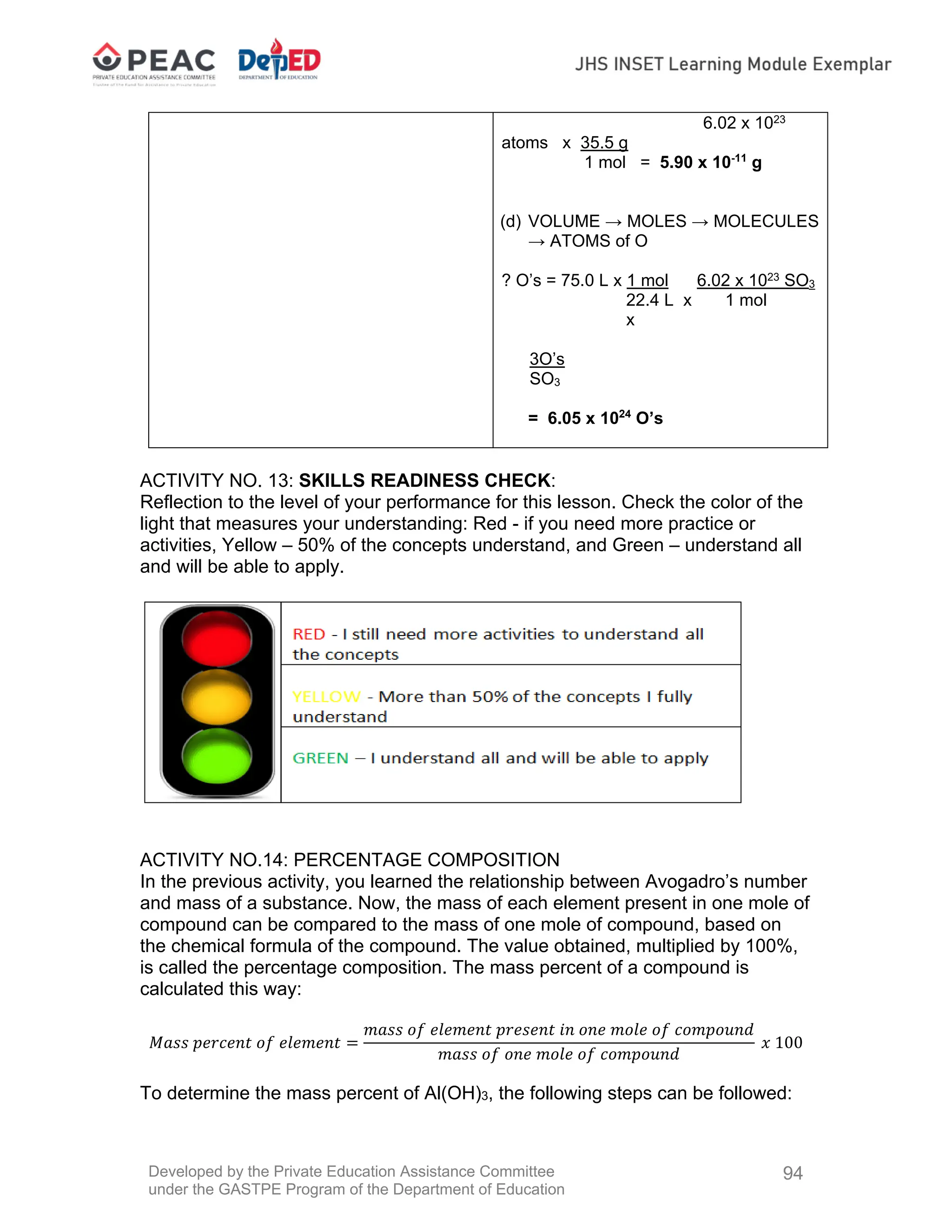
In this activity, you will be a given a chance to create a plan for the improvement
of nutrients in the body.
Now that you have learned mole concept you may want to review the skills you’ve
learned in previous activities and figure out how to come up a nutrition plan
Read the details about Rappler’s report and Action plan of the government as
shown below. Click the adapted source links
Developed by the Private Education Assistance Committee
under the GASTPE Program of the Department of Education
117
Policy - National Nutrition Action Plan 2012 - 2017
Start date: 2012
Published by: Ministry of Public Health and
Sanitation
Is the policy document adopted?: No / No
information
End date: 2017
Published year: 2012
Type of policy: National Nutrition Policy,
Strategy or Action Plan
Goals Strategies M&E Indicators
Goals, objectives or targets related to
nutrition:
Purpose:
This Plan has been developed to
operationalize the strategies outlined in
the Food Security and Nutrition policy
2012. It serves as a road map for
coordinated implementation of nutrition
interventions by the government and
nutrition stakeholders across
development sectors for maximum
impact.
Objectives:
1. To improve the nutritional status
of women of reproductive age
(15-49 years)
2. To improve the nutritional status
of children under 5 years of age
3. To reduce the prevalence of
micronutrient deficiencies in the
population
4. To prevent deterioration of
nutritional status and save lives
of vulnerable groups in
emergencies
5. To improve access to quality
curative nutrition services
6. To improve prevention,
management and control of diet
related NCDs
7. To improve nutrition in schools,
public and private institutions
8. To improve nutrition knowledge
attitudes and practices among
the population
9. To strengthen the nutrition
surveillance, monitoring and
evaluation systems
Developed by the Private Education Assistance Committee
under the GASTPE Program of the Department of Education
118
10. To enhance evidence-based
decision-making through
research
11. To strengthen coordination and
partnerships among the key
nutrition actors and mobilize
essential resources
Adapted source: http://scalingupnutrition.org/wp-content/uploads/2013/02/Kenya_KNN_Action-Plan_2012_2017.pdf
The excerpts report from Rappler Philippines, Jul 10, 2014: The 2013 National
Nutrition Survey: How far the Philippines has gone in its fight against hunger
Developed by the Private Education Assistance Committee
under the GASTPE Program of the Department of Education
119
Developed by the Private Education Assistance Committee
under the GASTPE Program of the Department of Education
120
Adapted source: http://www.rappler.com/move-ph/issues/hunger/61824-2013-
national-nutrition-survey
You can read more from the links provided. There are also other available
resources online about this National Nutrition Policy in the Philippines which you
may access.
Collaborate with the members of your group, brainstorm, solicit their ideas for this
task, and assign roles. Each group should have a coordinator, a researcher, and
a multimedia designer. Everyone should be involved in making the plan.
After studying the facts about the Latest Philippine Survey on nutrition and Policy-
National Nutrition Action Plan of 2012-2017. Use the Writing Project Planning Map
to help you organize your ideas.
Developed by the Private Education Assistance Committee
under the GASTPE Program of the Department of Education
121
Source: http://www.dailyteachingtools.com/images/WritingProjectPlanMap.jpg
Then organize and present your Nutrition plan using www.canva.com. When your
Canva presentation is done, export it as a PDF then upload to www.slideshare.net.
Set the privacy settings to public in Slideshare then submit the link in the OHSP
portal. You need to create a free account for each app.
PROCESS QUESTIONS:
1. If National Statistical Coordination Board made a clear Policy - National
Nutrition Action Plan 2012 – 2017, why there are many people and even
children begging in the street?
2. What should a good Action Plan contain?
3. What is your opinion about the statement: What you eat is what you are”
4. How are the quantity and the composition of substances determined?
Developed by the Private Education Assistance Committee
under the GASTPE Program of the Department of Education
122
ACTIVITY NO. 27: DIFFERENTIATED TASK
You are now ready to make the task for this module on percentage composition of
food products in preparation for the final performance. You will be given three
options for your product. You only need to choose and make one.
Option 1: Dietician
The department of Health has alarmed about malnourished issue have been
increasing in a certain barangay. Data of barangay health have shown that
malnourish children in that community are susceptible of that condition due to lack
of balance nutritional value of food intake. As a dietician, you are invited by
barangay officials to reach out and give information drive in the form of multimedia
presentation to the constituent in the barangay.
 Make a multimedia presentation showing the product has the appropriate
percentage composition or nutritive value.
 Create a hand-out about food product that has the appropriate percentage
composition or nutritive value.
 Conduct a seminar to promote dissemination of information on healthy food
that improves the health welfare of the people.
Option 2: Chef
In celebration for the obesity month (September), you are a Chef by profession
and a part time news anchor in one of the broadcasting network. As a part time
news anchor you are given a task for the network management to deliver a health
tip program on proper diet that is relevant to the times. The purpose of this program
is on the awareness of the rise of obesity. As a Chef by profession you were asked
to showcase balance diet that will analyse on nutritive value.
 Create a screenplay for the news that will show the effects of nutritional
value of food to avoid obesity.
 Select a Web 2.0 application that will deliver the message to as many
individuals as possible. (e.g., www.emaze.com, www.prezi.com)
 Make a multimedia to analyze the quantity and the percentage composition
of food and to showcase a balance diet.
Option 3: Food Chemist
We've all heard about how microwaving food removes some nutritional value, but
is it true? Is something bad happening to our food behind that microwave glass?
As a renowned Food chemist of the country, you are invited by media men to clarify
the matter. The public expects your point to be presented in any medium they are
commonly exposed to. You may:
 Write a column in a newspaper explaining in details the percentage
composition of different brand of two food products on whether the public
needs to be scared or not in using microwave glass.
Developed by the Private Education Assistance Committee
under the GASTPE Program of the Department of Education
123
 Appear in a live interview in a morning TV show telling the people the facts
of the matter. (Web 2.0) or www.powtoon.com
 Write a script for a scientific cartoon showing the details of the microwaving
and nutritional value.
Process Questions:
1. Look at your answers to the essential question in the table above. What do
all the answers have in common?
2. Are the experts’ shows the same style to conduct the quantity and the
composition of substances? If yes, explain. If not why are the styles
different?
3. Complete the following statement and support your answer with example
from the above experts.
The quantity and the composition of substances is …..
Now that you have a real world view of the topic, you are ready to do the final
tasks in the next section.
ACTIVITY NO. 28: PERFORMANCE TASK
In this section as a closing session, your final task is to apply your knowledge and
understanding about the mole.
In support of the United Nation’s campaign against poverty by helping communities
value nutrition, the Food and Drugs Administration (FDA) has been tasked to make
a comparative study on the quantity and the chemical composition of two food
products. Being the resident chemist, you will spearhead the study which covers
analysis percentage composition of these products. You will present the analysis
to the industry partners involved in food distribution during the annual food
meeting. Based on the result of your study, the partners will decide which product
has the appropriate percentage composition or nutritive value. The study will be
presented via power point and evaluated according to its Content, Organization,
Research, and Delivery.
Rubrics for the Performance Task:
Developed by the Private Education Assistance Committee
under the GASTPE Program of the Department of Education
124
CATEGORY Outstanding
(4)
Commendable
(3)
Developing
(2)
Beginning
(1)
Content
15.
All content
about the
computation is
qualitatively
accurate.
Subject
knowledge is
deep
The content
about
computation is
qualitatively
accurate.
Subject
knowledge is
good.
Some
computation
is partially
inaccurate.
Content
about
computation
is confusing
contains
multiple fact
errors.
Organization
All information
about mole
concept are
presented in
logical and
detailed
Most
information
about mole
concept is
generally
logical and
understandable
.
Some ideas
not
presented
in proper
order,
information
seem out of
place.
Ideas are not
presented in
proper order:
no clear plan
for the
organization
of information
Research
Uses a variety
of updated and
standard
sources in
reaching
accurate
conclusions
Uses a variety
of standard
sources in
reaching
conclusions
Presents
only
evidence
that
supports a
preconceive
d point of
view
Does not
justify
conclusions
with research
evidence
Delivery
Student
maintains eye
contact with
audience,
seldom
returning to
notes.
Student
maintains eye
contact most of
the time but
frequently
sometimes
returns to
notes/report.
Student
occasionally
uses eye
contact, but
still reads
most of
report.
Student
reads all of
report with no
eye contact.
Voice Quality
Voice was
clear and
engaging.
Voice is
engaging.
Quality of
voice.is
partially
engaging.
Quality of
voice.is not
engaging.
Developed by the Private Education Assistance Committee
under the GASTPE Program of the Department of Education
125
Before you go to the post-assessment, write a reflection in your synthesis journal
about your experiences in the entire lessons. You may choose to answer one, or
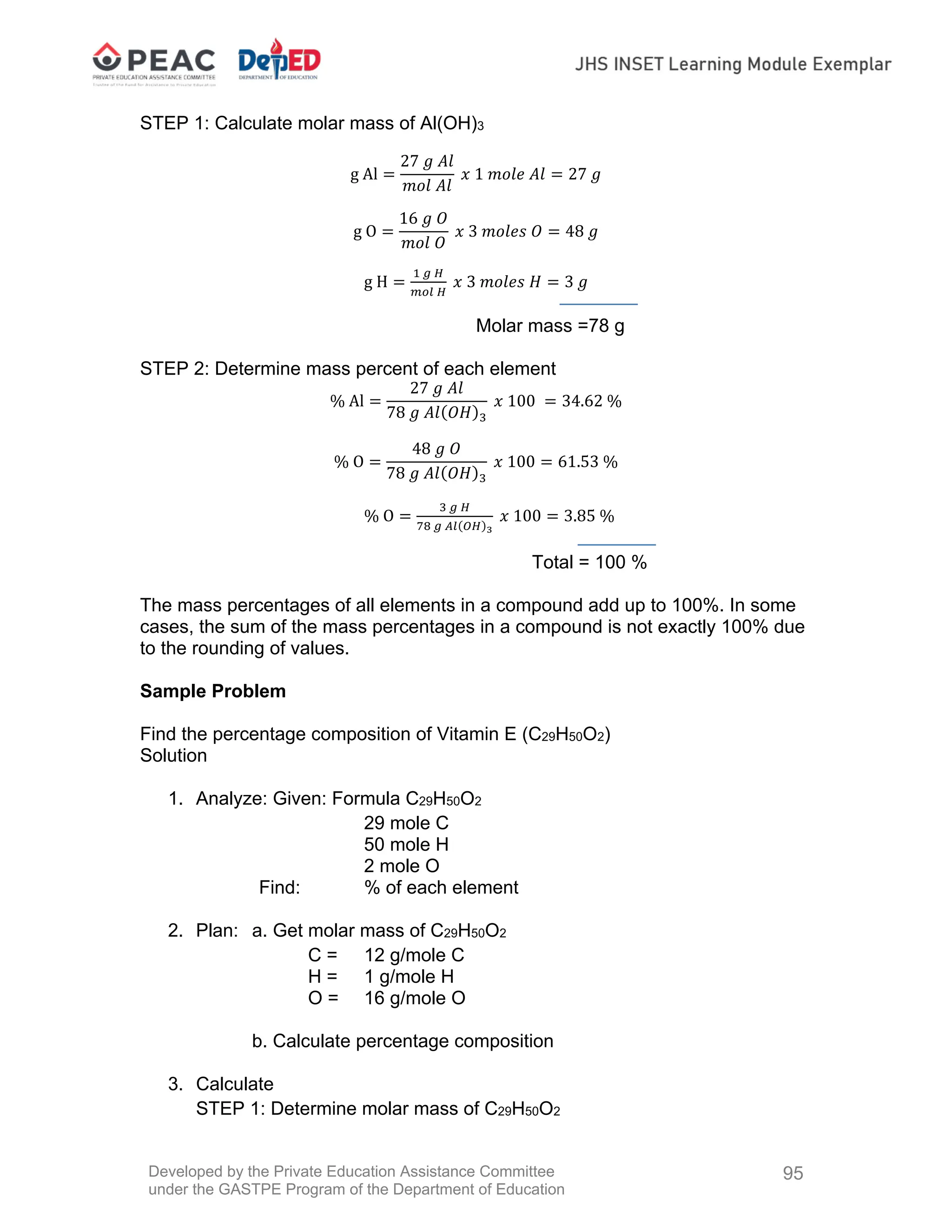
all of these guide questions:
1. What have you learned about the entire lesson? Is it challenging to see
the world you live in?
2. Did you have initial difficulty understanding the mole concept?
3. What would our life be if mole conversion was not discovered by the
scientists?
4. How the mole concepts become beneficial to living organisms?
5. What other task you would like to work on in the future that could be
beneficial in human and in environment?
End of TRANSFER:
In this section, your task was to analyze the percentage composition of different
brand of two food products and decide on products on appropriate percentage
composition.
How did you find the performance task? How did the task help you see the real
world use of the topic?
Have a final assessment of your accomplishment of the goals for this lesson
(Assessment of Goals, 3rd
column). Then, give this form to your teacher so
he/she can give his/her assessment of you. Finally, summarize what you have
accomplished for this unit by filling up the bottom part of the learning log
LEARNING LOG
GOALS ASSESSMENT OF GOALS
Unit Goal My Personal Goal My personal
Assessment
Teacher’s
Assessment
In summary, what have I learned from this module?
Developed by the Private Education Assistance Committee
under the GASTPE Program of the Department of Education
126
You have completed this lesson. Before you go to the next lesson, you have to
answer the following post-assessment.
POST-ASSESSMENT
It’s now time to evaluate your learning. Click on the letter of the answer that you
think best answers the question. Your score will only appear after you answer all
items. If you do well, you may move on to the next module. If your score is not at
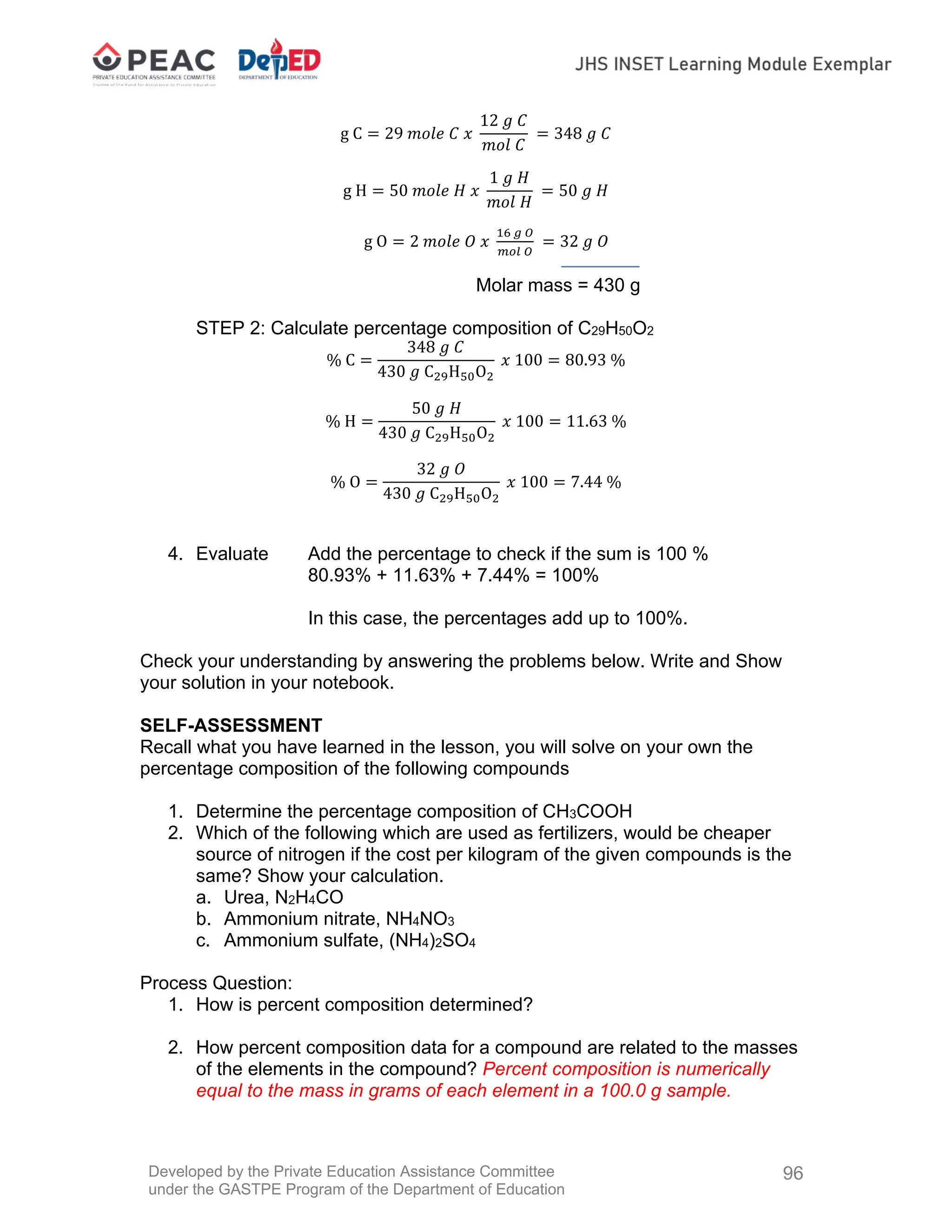
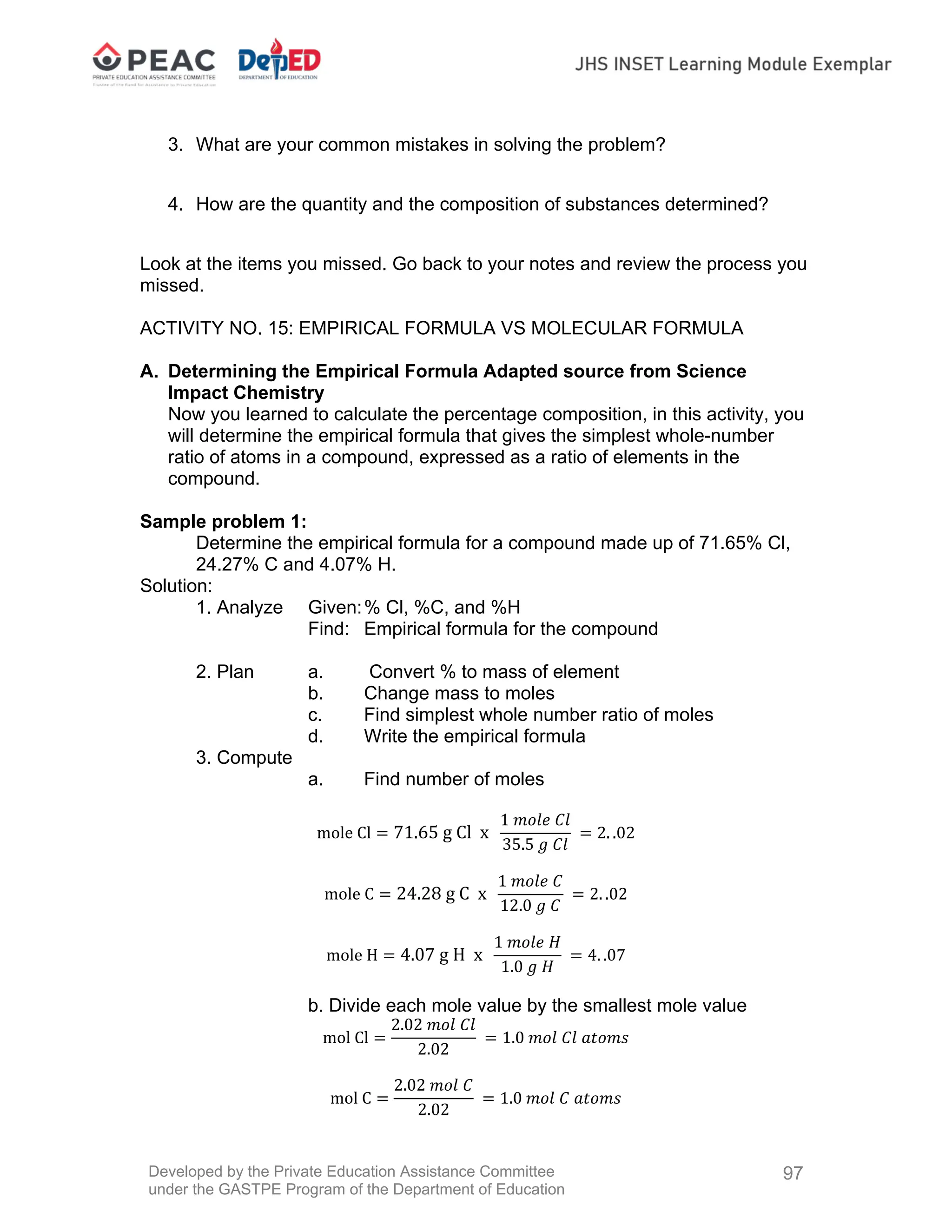
the expected level, you have to go back and take the module again.
1. What relationship exists between the mole and Avogadro’s number?
a. Avogadro’s number contains .20 moles of matter.
b. a mole contains 6.02 x 10²³
units.
c. a mole contains Avogadro’s number of units of matter.
d. There exists no relationship between Avogadro’s number and the mole.
2. Which is equivalent to one mole?
a. 37.0 g aluminum pan c. 3.50 g silicon chip
b. 0.18 g diamond d. 24.0 g magnesium ribbon
3. What is the mass of 1.5 moles of SiH4?
a. 16 g b. 24 g c. 32 g d. 48 g
4. What is the percent composition of sulfur in MgSO4?
a. 19 % b. 27% c. 45% d. 33%
5. Which among these compounds has the greatest oxygen composition?
a. Mg(OH)2 b. LiOH c. Na3PO4 d. K2SO4
6. What is the mass in grams of a single chlorine atom? Of a single molecule
of oxygen gas
a. 5.81 x 10 -22
g/atoms, 5.31 x 10 -22
g/molecules
b. 5.81 x 10 22
g/atoms, 5.31 x 10 22
g/molecules
c. 5.81 x 10 -23
g/atoms, 5.31 x 10 -23
g/molecules
d. 5.81 x 10 23
g/atoms, 5.31 x 10 23
g/molecules
7. The percent composition of an unknown element X in CH3X is 32%. Which
of the following is element X?
a. Cl b. F c. H d. Li
8. What is the percent composition of oxygen of potassium chromate, KCrO4 if
K is 25.16 % and Cr is 33.55%?
a. 4 x 16 = 64
b. 40.3 + 26.8 = 67.1
c. 100 – (25.16 + 33.55) = 41.29
d. The mass of the sample is needed to finish the calculation.
Developed by the Private Education Assistance Committee
under the GASTPE Program of the Department of Education
127
9. Which statement is correct?
a. 4 g of NH3 is equal to 4 moles of NH3
b. 4 g of NH3 is equal to 1 mole of NH3
c. 4 moles of NH3 is equal to 17 g of NH3
d. 4 moles of NH3 is equal to 68 g of NH3
10. How many moles of CO2 are obtained from the reaction of 2 moles of C3H8?
a. 1.5 mol b. 3.0 mol c. 4.5 mol d. 6.0 mol
11. How many grams of C3H8 are obtained if 44 g of CO2 is produced? (Note:
refer the chemical equation in No. 10)
a. 14.7 g b. 72g c. 144 g d. 288 g
12. A balance equation verifies the law of conservation of matter because
a. The molar masses of all the substances are the same.
b. The coefficients on both sides of the equations are the same.
c. The mass of the reactants equals the mass of the products.
d. The mass of the products equals 100 grams.
13. Which statement is correct regarding the molecule H2O?
a. one mole of H2O contains 18.06 x 10²³
particles
b. one mole of H2O is equal to twice its molar mass
c. one mole of H2O has 18 particles
d. one mole of H20 contains 6.02 x 10²³
particles
14. Which statement is correct?
a. One mole of different substances has the same masses and different
number of particles.
b. The formula weight of the compound determines the number of particles
in a compound.
c. One mole of a substance contains a fixed number of particles.
d. One mole of a substance is not equal to 6.02 x 10²³
things.
15. Baking is an exact science, less forgiving of imprecise measurements and
incorrect techniques than, say, a pasta sauce. If a recipe calls for 100g butter,
100g sugar and 100g flour, what's that in ounces?
a. About 2 oz of each c. About 5 oz of each
b. About 4 oz of each d. About 7 oz of each
16. Honesto, Renz, and Nita are the only consumers in the market. Using the
information in the above table, what is the market demand for chocolate chip
cookies at Php 4.00?
Developed by the Private Education Assistance Committee
under the GASTPE Program of the Department of Education
128
a. 4 b. 11 c. 17 d. 21
17. In order to determine a household's budget line, you must know the:
a. Prices of the goods bought, but not the household's income.
b. Prices of the goods bought and the household's income.
c. Household’s income, but not the prices of goods bought.
d. Household’s income, prices of the goods bought, and the household's
preferences.
18. This baking pan comes preloaded. What are you most likely to make with
this kitchen item?
a. Cupcakes b. Macaroons c. Pie crust d. Pizza
19. Which of the following is NOT part of the causes why cookies spread and
thin out while baking?
a. Dough was properly chilled.
b. Dough was placed on warm baking sheets.
c. Baking pans were greased too much. Don't grease the cookie sheet
unless the recipe calls for it.
d. Pure cane sugar (sucrose) was not used; fructose sugar or a blend of
sugars was substituted.
Developed by the Private Education Assistance Committee
under the GASTPE Program of the Department of Education
129
20. Which of the following product will be formed if beating together the
materials at room temperature like butter, sugar and eggs until light and
fluffy and gradually add mixed dry ingredients?
a. biscuits b. cookies c. pancakes d. pizza dough
Developed by the Private Education Assistance Committee
under the GASTPE Program of the Department of Education
130
GLOSSARY OF TERMS USED IN THIS LESSON:
Atomic mass. The mass in atomic mass units (amu) of one mole of a substance.
Conversion Factor. A ratio equal to one that expresses the same quantity in two
different ways
Formula mass. The mass of a molecular compound
Gram-mole: The mass of one mole, or 6.02 x 10²³
particles, expressed in grams.
Mole. The quantity of a substance that has a mass, measured in grams, that is
numerically equal to the molecular mass of that substance. Expressed as
6.02 x 10²³
particles (Avogadro’s number); mol is used in equations, mole is
used in writing.
Molar Mass. The sum of all the atomic masses in a molecule or compound; the
mass in grams of mole of a substance.
Representative Particles. The atoms, molecules, Ions, or formula units present
in a substance.
REFERENCES AND WEBSITE LINKS USED IN THIS LESSON:
http://www.youtube.com/watch?v=JC76NR8EtTQ - This is a brief introduction to
the chemistry unit moles and Avogadro's number 6.02x10²³
. The mole is nothing
more than a unit of measurement in chemistry.
http://antoine.frostburg.edu/chem/senese/101/moles/faq/why-use-moles.shtml
Webpage to understand mole concept
http://www.youtube.com/watch?v=TEl4jeETVmg - This video will help you
understand the concept of the mole in chemistry. Learn the incredible magnitude
of the mole--and how something so big can help us calculate the tiniest particles
in the world.
http://www.youtube.com/watch?v=6Yuy6jCSh-0 - This short video lecture course
on the Mole Concept includes introduction to the mole concept, converting mass
to moles, mass to atoms, moles to Avogadro’s number, molecules to mass.
http://chemistry.tutorvista.com/inorganic-chemistry/mole-chemistry.html - this
vide is essential to enhance your learning all about moles.
http://www.glencoe.com/qe/science.php?qi=978 - online quiz about mole
Developed by the Private Education Assistance Committee
under the GASTPE Program of the Department of Education
131
http://www.gliffy.com/uses/org-chart-software/ - Web 2.0 a graphic organizer
about mole conversion using Gliffy.com.
http://www.nclark.net/ChemicalQuantitie - Solving the problems to identify
mystery words from each problem.
http://www.youtube.com/watch?v=xPdqEX_WMjo - This video will enrich your
learning about mole conversion.
http://prezi.com/auxqhdeiro1k/the-mole-concept/ - To enhance the learning
about mole conversion.
http://www.austincc.edu/dlyon/introsp04/Intro%20Chem%20ch7%20the%20mole
%20and%20percent%20comp.pdf. – Webpage for mole conversion
http://crescentok.com/staff/jaskew/isr/chemistry/class13.htm - skill-building
exercise for mole calculation
http://www.gpb.org/files/pdfs/gpbclassroom/chemistry/sugarInGumLab.pdf - this
site will enrich your learning about the percent composition of a substance.
http://www.gliffy.com/examples/ - Web 2.0 flowchart about the steps in
performing a unit conversion.
http://www.ulster.ac.uk/scienceinsociety/research_into_teaching_about_the_mol
e_(pages_6-7).pdf – Webpage research article: “Teaching about amount of
substance and the mole”. Use the information found in the article to enhance
your understanding in the mole concept.
http://www.learner.org/workshops/chemistry/support/act1_d2.pdf - enrich your
learning to gain experience in calculating grams and moles
http://www.pleasanton.k12.ca.us/fhsweb/hansen/chemlab/CookieChocolateChip.
pdf - A recipe from moles to standard cooking measurements and then using that
recipe to bake some cookies.

guide sa science guide sa science guide sa science

  • 1.
    Mole Concept Science G9|Q2 LEARNING MODULE 2017
  • 2.
    NOTICE TO THESCHOOLS This learning module (LM) was developed by the Private Education Assistance Committee under the GASTPE Program of the Department of Education. The learning modules were written by the PEAC Junior High School (JHS) Trainers and were used as exemplars either as a sample for presentation or for workshop purposes in the JHS In- Service Training (INSET) program for teachers in private schools. The LM is designed for online learning and can also be used for blended learning and remote learning modalities. The year indicated on the cover of this LM refers to the year when the LM was used as an exemplar in the JHS INSET and the year it was written or revised. For instance, 2017 means the LM was written in SY 2016-2017 and was used in the 2017 Summer JHS INSET. The quarter indicated on the cover refers to the quarter of the current curriculum guide at the time the LM was written. The most recently revised LMs were in 2018 and 2019. The LM is also designed such that it encourages independent and self-regulated learning among the students and develops their 21st century skills. It is written in such a way that the teacher is communicating directly to the learner. Participants in the JHS INSET are trained how to unpack the standards and competencies from the K-12 curriculum guides to identify desired results and design standards-based assessment and instruction. Hence, the teachers are trained how to write their own standards-based learning plan. The parts or stages of this LM include Explore, Firm Up, Deepen and Transfer. It is possible that some links or online resources in some parts of this LM may no longer be available, thus, teachers are urged to provide alternative learning resources or reading materials they deem fit for their students which are aligned with the standards and competencies. Teachers are encouraged to write their own standards-based learning plan or learning module with respect to attainment of their school’s vision and mission. The learning modules developed by PEAC are aligned with the K to 12 Basic Education Curriculum of the Department of Education. Public school teachers may also download and use the learning modules. Schools, teachers and students may reproduce the LM so long as such reproduction is limited to (i) non-commercial, non-profit educational purposes; and to (ii) personal use or a limited audience under the doctrine of fair use (Section 185, IP Code). They may also share copies of the LM and customize the learning activities as they see fit so long as these are done for non-commercial, non-profit educational purposes and limited to personal use or to a limited audience and fall within the limits of fair use. This document is password-protected to prevent unauthorized processing such as copying and pasting.
  • 3.
    Developed by thePrivate Education Assistance Committee under the GASTPE Program of the Department of Education 1 SCIENCE 9 Module 2. Matter Lessons 1-2: Chemical Bonding and Variety of Carbon Compounds INTRODUCTION AND FOCUS QUESTION(S): Look around you. Do you think you see anything composed of just one element… any objects consisting only of carbon, or of gold, or of hydrogen? The correct answer is almost certainly no. Have you ever wondered why there are millions of chemical compounds out there? Have you tried making your own chemical substance? Have you ever tried to separate sheets of plastic that are stuck together? Did you dream of having a diamond but did not think how it is made up of? Did you come to think how atoms participate in forming compounds? Understanding the bonding in compounds is essential to developing new chemical and technologies. These compounds are too complex to work on. You probably know that your mother’s mother is your grandmother and that your grandmother’s sister is your great aunt but what do you call your grandmother’s brother’s daughter? Naming these compounds requires set of rules, just as naming family relationships requires rules. In this module, you will find out how atoms form compounds with another atom. Remember to search for the answer to the following question(s): 1. What holds atoms together in a chemical bond? 2. Why do atoms form single, double and triple covalent bonds? 3. How are compounds formed? LESSONS AND COVERAGE: In this module, you will examine this question when you take the following lessons: Lesson 1.1 – Ionic Bonding and Metallic Bonding A. Ion Formation B. Lewis Structure of Ionic Compound Lesson 1.2 – Covalent Bonding A. LEDS of Covalent Compound B. Polar and Nonpolar Compounds C. Chemical Nomenclature Lesson 2.1 – Carbon and its Compound A. Carbon: Its Properties B. Families of Carbon
  • 4.
    Developed by thePrivate Education Assistance Committee under the GASTPE Program of the Department of Education 2 In these lessons, you will learn the following: Lesson 1.1 Write the Lewis Structures of Ionic Compound. Lesson 1.2 Name chemical compounds formed through chemical bonding. Lesson 2.3 Make a compound through mini science investigatory project. Create a digital story of the uses of Carbon compounds. MODULE MAP: Here is a simple map of the above lessons you will cover: EXPECTED SKILLS: To do well in this module, you need to remember and do the following: (List key study skills and other actions that will help students succeed in doing the module) 1. Read the instructions carefully. 2. Take down notes and copy some important link so that you could go back whenever you need information given in that site. 3. Go beyond the procedure given in the net. Explore more. 4. Do the web test for several times and don’t forget to click on the correct answer for your reference.
  • 5.
    Developed by thePrivate Education Assistance Committee under the GASTPE Program of the Department of Education 3 PRE-ASSESSMENT: Let’s find out how much you already know about this module. Click on the letter that you think best answers the question. Please answer all items. After taking this short test, you will see your score. Take note of the items that you were not able to correctly answer and look for the right answer as you go through this module. 1. Which two statements about covalent bond are correct? 1. It can be formed between two metal atoms. 2. It can be formed between two non-metal ions. 3. It is formed by the transfer of electrons between atoms. 4. It is formed by sharing of electrons between atoms. A. 1 and 3 B. 2 and 3 C. 1 and 4 D. 2 and 4 2. Alkenes always contain a __________. A) C=C bond B) C≡C bond C) C-C bond D) C=H bond 3. Order the following by decreasing bond length: C≡C, C=C, C-C A. they are all the same B. C≡C, C=C, C-C C. C≡C, C-C, C=C D. C-C, C=C, C≡C 4. How many unpaired electrons are there in the Lewis structures of a N3- ion? A. 0 C. 1 B. 2 D. 3 5. Which of the following lists contains no ionic compounds? a. HCN, NO, Ca(NO3)2 b. KOH, CCl4, SF6 c. NaH, CaF2, NaNH2 d. CH2O, H2S, NH3 6. Give the simple base name of the molecular structure below:
  • 6.
    Developed by thePrivate Education Assistance Committee under the GASTPE Program of the Department of Education 4 A. butene B. pentane C. pentene D. pentyne Find the longest continuous chain of carbon atoms, and use this chain as the base name 7. Which alkanes have largely replaced Freons as propellants in aerosol cans? A. methane and ethane B. propane and butane C. pentane and hexane D. nonane and decane 8. The stomach contains hydrochloric acid (HCl) strong enough to dissolve metal (pH about 1.5 to 3, usually around 2), which kills bacteria and helps denature the proteins in our food, making them more vulnerable to attack by pepsin. Which of the following is the correct Lewis structure of hydrochloric acid?
  • 7.
    Developed by thePrivate Education Assistance Committee under the GASTPE Program of the Department of Education 5 9. Ethene is also used as a plant hormone to control the ripening and color development of fruit. The molecular structure of ethene is responsible for this property. Which of the following is the correct electron dot formula of C2H4? Chemistry Party Your chemistry teacher will organize a chemistry party for the class. You will prepare the balloon needed for the party. The twist of the party is that you can only join the party if you’ll design the balloons according to its molecular geometry/shape. Which of the following balloons will represent the compounds? Use the following Legends: 3 - Balloons give a trigonal planar geometry 4 - Balloons give a tetrahedral geometry 5 - Balloons give a trigonal bipyramidal geometry 6 - Balloons give an octahedral geometry A. B. C. D. 10. H2O 11. H2CO 12. SiCl4
  • 8.
    Developed by thePrivate Education Assistance Committee under the GASTPE Program of the Department of Education 6 13. Elements X and Y combine to form covalently bonded molecule. Show the Lewis structure of the molecule. A. C. B. D. 14. Using the diagram below, which of the following LEDS is most like to receive electron/s? A. Element A C. Element C B. Element B D. Element D
  • 9.
    Developed by thePrivate Education Assistance Committee under the GASTPE Program of the Department of Education 7 15. The diagram below represents the nucleus of an atom. As the graphic artist of a book company, which LEDS will you illustrate based from the above information? A. B. C. D. 16. In the Chemistry Lab, you obtained the following results in your experiment: You are asked to identify which is a covalent compound. What letter will you suggest to your group mates? Melting Point /0 C Electrical Conductivity Of solid Of Liquid A -38 Conducts Conducts B -7 Does not conduct Does not conduct C 801 Does not conduct Conducts D 1540 Conducts Does not conduct
  • 10.
    Developed by thePrivate Education Assistance Committee under the GASTPE Program of the Department of Education 8 17. Lime is indispensable for use with mortar and plaster. Lime is used for medicinal purposes, insecticides and plant and animal food. It is used as a laboratory reagent for gas absorption, precipitation, dehydration etc. It is chemically called as calcium oxide, (CaO). As a member of IUPAC, you are asked to illustrate the Lewis Dot Strucure of CaO. Which of the following will you present to the members? A. C. B. D. 18. You are asked to show the LEDS of nitrate ion to the board. Which of the following is the correct Lewis structure for NO3 - ? I) II) III) IV) V) A. I & II C. V B. III D. IV 19. “We have discovered a new and important, atmospherically relevant oxidant,” said Mauldin. “Sulfuric acid plays an essential role in Earth’s atmosphere, from the ecological impacts of acid precipitation to the formation of new aerosol particles, which have significant climatic and health effects. Our findings demonstrate a newly observed connection between the biosphere and atmospheric chemistry.” Being a member of the said Team, you are tasked by the Head to present the LEDS of the hypothetical compound. Which of the following will you present? The Newly Discovered compound is: XYZ3 wherein X has 4 v.e. Y has 6 v.e. Z has 7 v.e. A. C.
  • 11.
    Developed by thePrivate Education Assistance Committee under the GASTPE Program of the Department of Education 9 B. D. 20. Refer to the table: You are asked to form a polar covalent bond. Given the electronegativities above, which covalent single bond below do you need to bond? A. C-H C. O-H B. N-H D. O-N
  • 12.
    Developed by thePrivate Education Assistance Committee under the GASTPE Program of the Department of Education 10 ACTIVITY NO. 1: THOUSAND WORDS IN A PICTURE From the three pictures below, allow yourself to make your own interpretations of what a chemical bond is all about. Think of the importance the illustrations presented to you. A. Do you have any idea why the element chlorine said this line to sodium? B. Read the pick-up line below. How ions are formed?
  • 13.
    Developed by thePrivate Education Assistance Committee under the GASTPE Program of the Department of Education 11 C. Observe the noble gases. Why the artist illustrates the elements He, Ne, Ar, Kr, Xe and Rn in that way? ACTIVITY NO. 2: WHAT KIND OF BONDS ARE THESE? (Video-Clip Presentation) In order to understand the pictures above, you need to watch the video clip below. Be able to identify the meaning of the following terms: ionic bond, polar covalent bond, nonpolar covalent bond and electronegativity difference. Chemical Bonds: http://www.youtube.com/watch?v=oNBzyM6TcK8
  • 14.
    Developed by thePrivate Education Assistance Committee under the GASTPE Program of the Department of Education 12 PROCESS QUESTIONS: 1. What are the primary compositions of Sodium Chloride? 2. What are ions? 3. How does an atom form into an ion? 3. What is the role of noble gases in forming compounds? 4. How many valence electrons do noble gases have? What does it imply? 5. Why are elements stable on their own while others are more stable than in a compound? 6. How is a compound formed? ACTIVITY NO. 3: ELICITING PRIOR KNOWLEDGE THROUGH I-R-F CHART Given below is an IRF sheet. Fill in the first row with your answer to the question: How is a compound formed? Initial Revised Final End of EXPLORE: You have just given your initial ideas about how compounds are formed. Find out in the next section if your ideas are correct. What you learn in the next sections will also enable you to do the final project which involves creating a compound through scientific investigation. Let’s start by doing the next activity.
  • 15.
    Developed by thePrivate Education Assistance Committee under the GASTPE Program of the Department of Education 13 Even though a few elements, such as carbon and gold, are sometimes found in elemental form in nature, most of the substances we see around us consist of two or more elements that have combined chemically to form more complex substances called compounds. Your goal in this section is to learn and understand the formation and development of chemical substances. You will explain how atoms are bonded differently. ACTIVITY NO. 4: WRITING LEWIS STRUCTURES One popular method of representing atoms and compounds is through Lewis Electron Dot Structure (LEDS). It is composed of a symbol which surrounded with dots. In LEDS, only the symbol for the element and the electrons in its outermost energy level (valence electrons) are shown. Study the figure below: Use also the link to further see other samples of LEDS: http://www.middleschoolchemistry.com/multimedia/chapter4/lesson6#lewis_ dot_diagrams Be sure to take note of the important terms that you will encounter along the activities. Do the foldable on the left side. Use the foldable when taking down notes and present it to the teacher at the end of this module. In this module, love your foldable! http://www.csun.edu/~krowlands/Content/Academic_Resources/Foldables/Basic%20Foldables.pdf
  • 16.
    Developed by thePrivate Education Assistance Committee under the GASTPE Program of the Department of Education 14 Process Questions: 1. What does the symbol of the element represent in the LEDS? 2. What is accountable for the valence electrons in the LEDS? 3. The number of dots near hydrogen and helium are the same as in the energy level chart. Why? Allow yourself to practice writing the Lewis Electron Dot. DO Worksheet #1. WORKSHEET #1: VALENCE ELECTRONS AND LEDS: Apply your knowledge of valence electrons, Lewis dot structures and the octet rule to complete the table below. ELEMENTS VALENCE ELECTRONS LEDS HOW TO ACHIEVE THE OCTET? 1. Hydrogen 2. Magnesium 3. Aluminum 4. Oxygen 5. Nitrogen 6. Bromine 7. Neon For LEDS: Refer to the picture below. http://hyperphysics.phy-astr.gsu.edu/hbase/pertab/perlewis.html After completing the worksheet, what learning/insights did you learn from the activity? (Use your foldable.)
  • 17.
    Developed by thePrivate Education Assistance Committee under the GASTPE Program of the Department of Education 15 ___________________________________________________________ ________________________________________________________________ ____________________________________________ Understanding the Lewis Structure will help you identify the number of valence electrons and the number of electrons needed to complete the octet in the next activity. Make sure to familiarize how many electrons are needed/given up in forming ions. ACTIVITY NO. 5: The CHEMICAL AVENGERS Welcome! You are invited to be part of !!! Please meet the following super heroes: Iron Man Thor-ium Captain Americium and Hulk “When an unexpected enemy emerges that threatens global safety and security, Nick Fury, Director of the international peacekeeping agency known as S.H.I.E.L.D., finds himself in need of a team to pull the world back from the brink of disaster. Spanning the globe, a daring recruitment effort begins. ” He figured out that the superheroes above were outnumbered. Thus, he needs another one.. and I guess it’s YOU! Yes! You! As an aspiring wannabe superhero, Nick Fury wants to test your superpower. So what he is asking you to do is to CONVERT neutral atoms into Cations and Anions! To help you form the ions, please click the link: http://www.bbc.co.uk/schools/gcsebitesize/science/add_aqa_pre_2011/atomic/io nicrev1.shtml To really test if you can be part of . Do the worksheet #2
  • 18.
    Developed by thePrivate Education Assistance Committee under the GASTPE Program of the Department of Education 16 Worksheet #2: Monoatomic Ions Use a periodic table to complete the table below: Element Name Element Symbol Ion Name Ion Formula 1. sodium 2. bromine 3. magnesium 4. chlorine 5. oxygen 6. boron 7. lithium 8. neon 9. phosphorus 10.aluminum Submit your answers and assess yourself. If your score is: 10 – Congratulations! You belong to the superheroes undoubtedly. 9-8 – Good Job! You are Next in line! 7-6 - You are such a wannabe! You are in the waiting list. Below 5 - More training! Read the link below for more practice. http://itc.gsw.edu/faculty/speavy/spclass/chemistry/ions.htm Process Questions: 1. Can atoms lose electrons? Gain electrons? Explain. 2. What are ions? 3. Differentiate a cation and an anion. 4. How is the Lewis dot configuration used to represent atoms? 5. How are ions formed? How do you find the worksheet? Look at the items you missed. Go back to your notes and review the terms or concepts you missed. You learned how ions are formed. In the next activity, you will be using this to visualize how ionic compounds are formed.
  • 19.
    Developed by thePrivate Education Assistance Committee under the GASTPE Program of the Department of Education 17 ACTIVITY NO. 6: Ionic Bond: Taken Not Shared Atoms are held together in compounds by the forces of attraction which result in formation of chemical bonds. The formation of chemical bonds results in the lowering of energy which is less than the energy the individual atoms. The resulting compound is lower in energy as compared to sum of energies of the reacting atom/molecule and hence is more stable. In this activity, you get to learn on one kind of bond, that is ionic compound. One type of chemical bond is the ionic bond. To understand how an ionic bond works and its properties, click the link below: http://www.education.uoit.ca/lordec/ID_LORDEC/ionic_compounds/law_ionic_co mpounds.swf Note down concepts/terms presented from the link in your foldable. PROCESS QUESTIONS: 1. Name the two types of ions present in NaCl. 2. What are the components of an ionic bond? 3. What is the final product of Na+ ion and Cl- ? 4. What is the number of electrons present in Cl– ion? 5. In a sodium chloride lattice, how many Cl– ions surround each Na+ ion?
  • 20.
    Developed by thePrivate Education Assistance Committee under the GASTPE Program of the Department of Education 18 6. How is an ionic compound formed? What are the essential concepts that you gathered? What can help you more easily remember these terms? Look back at your notes and try to cluster related concepts. What’s the difference between you and Harry Potter? Oh well, Harry has a wand and a spell while you have only a SPARKLER and a spell! For Info:  Magic: A wand is a unique spell/charm caster that every wizard must have to be powerful. Once a wizard holds the right one, sparks may potentially fly from the tip. When casting spells and charms, light, noise and smoke emerge from the wand.  Science: Perhaps these wands are similar to sparklers. Sparklers are unique to the fabricator, produce sparks, light, noise and smoke. The only difference is that you cannot levitate or expel anyone or anything with a sparkler.
  • 21.
    Developed by thePrivate Education Assistance Committee under the GASTPE Program of the Department of Education 19 Conclusion: Research about sparklers by clicking the website below. Look into the composition of sparklers. http://www.ehow.com/info_8299010_composition-sparklers.html ACTIVITY NO. 7: IONIC BONDING GAME You learned from the previous activity how ionic bond is formed. In this game, you are challenged to create compounds by combining ions http://www.learner.org/interactives/periodic/groups_interactive.html Answer the Process Questions below: 1. What were the compounds that you’d created? 2. What are the main components of an ionic bond? 3. How is a compound formed? What is it made up of? What kind of compounds are these?
  • 22.
    Developed by thePrivate Education Assistance Committee under the GASTPE Program of the Department of Education 20 Let’s check if you have learned something from the previous activities. Do the quiz below: Quiz #1 http://highered.mcgraw-hill.com/sites/0072402334/student_view0/quiz- ionic_bonding.html Where can you find ionic compounds? Are these substances rare? The next activity will help you hunt for these compounds. All you need is to look for it… so Let the hunting begin: ACTIVITY NO. 8: The Search for Ionic Compounds You have learned that ionic compounds are basically defined as being compounds where two or more ions are held next to each other by electrical attraction. One of the ions has a positive charge (called a "cation") and the other has a negative charge ("anion"). Cations are usually metal atoms and anions are either nonmetals or polyatomic ions (ions with more than one atom). Think back to grade school: The same thing that makes the positive and negative ends of a magnet stick to each other is what makes cations and anions stick to each other. Now try to review the ionic compound below: http://mrcramssciencespot.blogspot.com/2011/04/chemistry-ionic-covalent-bond-quiz.html
  • 23.
    Developed by thePrivate Education Assistance Committee under the GASTPE Program of the Department of Education 21 1) What type of bond is shown in the cartoon above? How do you know? 2) How many valence electrons is each "Cl" atom receiving? Why is each "Cl" receiving this amount of electrons? 3) Copper (Cu) is not in group 1A or 2A, but it is behaving like metal. How many valence electrons does Copper (Cu) lose? 4) What will the charge on the Cu atom be after it gives its valence electrons away? 5) What will be the charge on each Cl atom after they receive their valence electrons? 6) What are the uses of CuCl2? Read out loud the discussion below: Usually, when we have ionic compounds, they form large crystals that you can see with the naked eye. Table salt is one example of this - if you look at a crystal of salt, chances are you'll be able to see that it looks like a little cube. This is because salt likes to stack in little cube-shaped blocks. Sometimes when you see a salt, it looks like a powder instead of a cube. This doesn't mean that the salt is not a crystal - it means that the crystals are just so small that you can't see them with the naked eye. If you were to put the powder under a microscope, chances are that you would see little geometric block. Now let’s search for the many Ionic Compounds! What to do? Research for ionic compounds (as many as you can) and complete the table below in terms of its properties. Worksheet # 3: Table Completion Ionic Compounds Properties Uses Process Questions: 1. What properties are common to these ionic compounds? 2. How will you use these properties in identifying these compounds? 3. How are the subscripts helpful in the formation of these compounds?
  • 24.
    Developed by thePrivate Education Assistance Committee under the GASTPE Program of the Department of Education 22 In the previous activity, we saw how atoms could achieve a complete shell of electrons by losing or gaining one or more electrons, to form ions. There is another way atoms can satisfy the octet rule. The next activity will explain what covalent bonding is. ACTIVITY NO. 9: Interactive Webpage Reading – Covalent Bond In this activity, we will study about another kind of bonding called covalent bonding. Covalent bonding is helpful in understanding the formation of molecules. Let us now see how these molecules are formed. Click the animation below. The animation discusses how covalent bond is formed. Write down the important concepts that you will gather in your foldable. http://www.pbslearningmedia.org/asset/lsps07_int_covalentbond/ Study the notes you have and apply it in Worksheet #4: Understanding Covalent Bond The drawing at right represents a covalent compound. Study this diagram then answer the following process questions: 1. What does the small circle (A) represent? ___________________________________________ 2. What does the larger circle (B) represent? __________________________________________ 3. What does the dash (C) represent? ________________________________________________ 4. The large circles overlap. What does this represent? ________________________________________________________________ __________________________________________________ 5. Why are there four dashes inside the overlapped area? ________________________________ 6. How many electrons are in the outer shell of the oxygen atom on the left?________________ 7. How many electrons are in the oxygen atom on the right? _____________________________ (https://my23.sd23.bc.ca/personal/sd23_darren.banting/science9/resources/Documents/Bonding%20Booklet.pdf) https://my23.sd23.bc.ca/personal/sd23_darren.b anting/science9/resources/Documents/Bonding %20Booklet.pdf
  • 25.
    Developed by thePrivate Education Assistance Committee under the GASTPE Program of the Department of Education 23 So, how did you go far? Did you get to understand how covalent bond is formed? What are the important concepts you had written down in your foldable? After learning the properties of ionic and covalent bonds, the next activity will provide the many ways you can differentiate the two bonds. Furthermore, this will help you even remember terms related to ionic and covalent bonds. ACTIVITY NO. 10: The Singing Bond (Band)! Let’s try to loosen up with the technicalities of chemical bonds. The link below will lead you to a song that may not be within your genre but it’s a very common song because maybe, you’ve heard it in radio stations, videoke bar or hummed by you mom. Join with the music just for fun! Chemical Bond Song (To the tune of Dancing Queen) http://www.youtube.com/watch?v=BCYrNU-7SfA First we'll start with ionic bonds, A metal and nonmetal are involved. The metal gives over electrons, the nonmetal ... it receives. The atoms become IONS! Metals might have 1,2 or 3 Electrons for the nonmetal to receive It all depends on what's needed, to make the number 8 For the nonmetals' outer shell. AND IF IT HAPPENS FOR THEM ... They both become IONS ...... CHARGED ATOMS .... They become IONS! The metal's positive, the nonmetal's negative, They become IONS, oh yeah. The metal's plus, the nonmetal minus, and opposites they do attract. So what you get, when they come together, is an IONIC BOND. So what about those covalent bonds? It's not about loss and gain of electrons. Valence electrons they are shared, to complete the outer shells Of the nonmetals set to bond. IT'S WHEN NONMETALS JOIN ... to make covalent bonds With shared electrons ,,,, they're covalent bonds. Not a transfer, instead they share valence electrons, oh yeah! Ionic bonds ... covalent bonds ... both of them chemical bonds.
  • 26.
    Developed by thePrivate Education Assistance Committee under the GASTPE Program of the Department of Education 24 How are they made? What's the difference? Play the song again ! Ionic bonds, covalent bonds ..... both chemical bonds! Based from the song, complete the table below by differentiating an ionic bond from covalent bond: Characteristics Ionic Bond Covalent Bond Process Questions: 1. What composes a covalent bond? 2. How did the valence electrons in a covalent compound achieve the octet? 3. How will you differentiate an ionic compound from a molecular compound? 4. How compound is formed? Now you have a clear picture on how ionic bond differs from covalent bond. Did you add something in your foldable? The next activity will help you imagine how a compound or substance looks like. Focus on the following: Dots and Dashes. The next activity indicates the difference of molecular compound. ACTIVITY NO. 11: The LEDS Of Covalent Compound It is best to represent the formation of covalent bonds through the Lewis Electron Dot Structure. The link below shows how to bond molecular (covalent) compound: http://www.kentchemistry.com/links/bonding/covalentlewisdot.htm
  • 27.
    Developed by thePrivate Education Assistance Committee under the GASTPE Program of the Department of Education 25 Give your own steps on how to show the LEDS of a covalent compound in each level: Now, answer the process questions below: 1. What are levels 1,2 and 3 represent? 2. What is the first thing to consider in forming the LEDS of covalent bond? 3. If it is a polyatomic ion, what do you do with the electrons? 4. How compound is formed?
  • 28.
    Developed by thePrivate Education Assistance Committee under the GASTPE Program of the Department of Education 26 Below is a Guided Worksheet#5: (http://washburnsciencelies.pbworks.com/w/file/fetch/71090437/Covalent%20Bonding%20Worksheet1.pdf)
  • 29.
    Developed by thePrivate Education Assistance Committee under the GASTPE Program of the Department of Education 27 Quiz #2 Do as Directed: A. Identify if the following would form a covalent bond. 1. H + Cl _______ 8. S + Br __________ 2. Ca + Cl _________ 9. Te + F _________ 3. N + Br __________ 10. K + F _________ 4. P + F __________ 11. C + Rn ________ 5. Al + I ___________ 12. P + F _________ 6. C + Cl __________ 13. Al + Te ________ 7. N + O ___________ 14. Rb + O _______ B. Using Electron dot diagrams, draw the covalent bonds of the following. 15. H + Cl --------- 16. C + Cl --------- 17. N + Br ---------- 18. P + S ----------- 19. H + O ---------- How did you go so far? Did you learn how to show the LEDS of covalent bonds? The next activity will allow you to further analyze the properties of water. Try to figure out what makes water unique with other substances.
  • 30.
    Developed by thePrivate Education Assistance Committee under the GASTPE Program of the Department of Education 28 ACTIVITY NO. 12: Water Love Story Did you ever wonder how water is formed? What type of bond does it work on? To find out, click the website below: The Love Story of Hydrogen Bond – Animation http://programs.northlandcollege.edu/biology/Biology1111/animations/hydrogenb onds.html Write down in your foldable the concepts learned in the animation above. Process Questions 1. What polarity of water means? 2. How polarity makes water behave strangely? 3. How water is formed? When the atoms bind together their electron clouds interact with one another and if this interaction is ‘favorable’ then bonding occur. On the next topic, you will get to encounter the two types of covalent. Activity No. 13: Polar or NonPolar: That is the Question The video differentiates polar and nonpolar compounds: http://www.youtube.com/watch?v=9XUsOLaz3zY
  • 31.
    Developed by thePrivate Education Assistance Committee under the GASTPE Program of the Department of Education 29 Below is the electronegativity of elements in the periodic table. Difference in electronegativity 4.0 1.7 .40 Ionic Polar- covalent bond Non-polar covalent bond 100% 50% 5% 0% Percentage Ionic character Using the periodic table above and electronegativity, complete the table below: Worksheet #6: Polar or Non Polar Bonding between More electronegative element and value Less electronegative element and value Difference in electronegativity Bond Type Sulfur and Hydrogen Sulfur and Cesium Chlorine and Bromine Calcium and Chlorine
  • 32.
    Developed by thePrivate Education Assistance Committee under the GASTPE Program of the Department of Education 30 After learning the how ionic and molecular compound are formed, it is important in Chemistry to name the compounds. We don’t just name according to how we feel naming it. Compounds are named from different rules according its composition. ACTIVITY No. 14: IUPAC Initiation Test! Chemists around the world need to communicate with other chemists so they developed a set of rules of naming compounds. http://www.mediacamp.com/lessons-for-silicon-valley-from-einstein/ http://chemistry.about.com/od/historyofchemistry/ig/Pictures-of-Famous-Chemists/Dmitri-Mendeleev.htm http://bencurtisjones.com/project/300/ http://www.biography.com/people/john-dalton-9265201 http://www.glogster.com/80jester/dmitri-mendeleev/g-6mftrpc0sgos9varpnqt7a0 Oxygen and hydrogen Nitrogen and hydrogen Iodine and Iodine Copper and Sulfur Hydrogen and fluorine Carbon and oxygen
  • 33.
    Developed by thePrivate Education Assistance Committee under the GASTPE Program of the Department of Education 31 “The IUPAC Affiliate Membership Program (AMP) allows any individual with an interest in IUPAC and IUPAC Activities to sustain a relationship with the Union. The program was launched in 1986 in order to maximize the participation of chemists throughout the world in the affairs of IUPAC and also to disseminate information about its activities to a much wider audience. "In 2003, almost 5000 chemists from 66 countries registered as Affiliates. Included in this number are nearly 400 sponsored (free) Affiliate memberships for chemists, aged 35 years or less, from developing and economically disadvantaged countries.” As an aspiring chemist, you wish to be a member of the IUPAC, for greater opportunities are waiting for you… and you wish to be part of the mission of the organization: IUPAC advances the worldwide role of chemistry for the benefit of Mankind. So to be part of the said organization you have to undergo series of tests. So, are YOU ready?! To guide you in naming the compounds, follow the concept map below:
  • 34.
    Developed by thePrivate Education Assistance Committee under the GASTPE Program of the Department of Education 32 Test I: Analyze the part below. Create the Rules in naming this compound: Want some more practice? Click the website below: This is quiz #4 on naming formula and vice versa: http://quizlet.com/7663255/flashcards Test II. Study and Analyze the name of the compound below: A. Try to check the oxidation states of Gold in the Periodic Table: What seems to be the problem in working with the sample below?
  • 35.
    Developed by thePrivate Education Assistance Committee under the GASTPE Program of the Department of Education 33 B. What does the table imply? When do you use it? Create the Rules in naming this compound: C. Let’s try the other way around. Study the rules below: Are you ready to name this type of compound?
  • 36.
    Developed by thePrivate Education Assistance Committee under the GASTPE Program of the Department of Education 34 Complete the worksheet below: Worksheet # 6: Naming Binary Compounds Name each of the following compounds: 1. AsF3 2. BF3 3. BrF5 4. BrCl 5. ClF 6. Cl2O6 7. IF5 8. KrF2 9. NI3 10. N2O3 11. I2O4 12. P2Cl4 13. SeCl2 14. SiO2 15. SO3
  • 37.
    Developed by thePrivate Education Assistance Committee under the GASTPE Program of the Department of Education 35 Final Test: Can you do the activity as shown in the picture below? http://www.middleschoolchemistry.com/lessonplans/chapter6/lesson2 Read aloud the products formed based from the picture above. Study the picture A and Picture B Picture A Picture B Now, how are you going to name salts?
  • 38.
    Developed by thePrivate Education Assistance Committee under the GASTPE Program of the Department of Education 36 Quiz #5 Do the Interactive Quiz Below: http://www.chemistrywithmsdana.org/wp-content/uploads/2012/07/ionic.html So, do you think you are qualified to be part of the IUPAC team? If not, review naming compounds through this videoclip: http://www.youtube.com/watch?v=9XUsOLaz3zY (Naming Tutorial) For the next activity, you will get to understand how aluminum cans are made and reasons why jewelry is beautifully shaped. ACTIVITY NO. 15: Metallic Bond Do you really wanna know what happens to the electrons? Click the animations below: A. http://www.drkstreet.com/resources/metallic-bonding-animation.swf B. http://www.youtube.com/watch?v=srxNJ03W_qM (This explains why metal is malleable.)
  • 39.
    Developed by thePrivate Education Assistance Committee under the GASTPE Program of the Department of Education 37 Now, let’s see the details of metallic bonding by reading the page below: http://www.chemguide.co.uk/atoms/bonding/metallic.html Process Questions: 1. What do you mean by sea of electrons? 2. Describe the movement of electrons when potential difference is applied. 3. When does the electrons delocalized? 3. How is metallic bond formed? Since bonding of atoms is essential in the formation of compound, the next activity can lead you to form new substances by investigating scientifically. ACTIVITY NO 16: HOW TO CONDUCT A SCIENTIFIC INVESTIGATION? Scientists act like detectives. They work also by piecing together clues to learn and create something new. One way that scientists gather clues is by carrying out experiments. An experiment tests an idea in a careful, orderly manner. Although experiments do not all follow the same steps in the same order, many follow a pattern similar to the one described here. To learn about conducting scientific investigation, read the webpages provided for you below: Webpage Reading #1: How to Conduct a Scientific Investigation? http://www.usca.edu/biogeo/researchguide/investigation.html Webpage Reading #2: Designing an Experiment http://www.longwood.edu/cleanva/images/sec6.designexperiment.pdf Webpage Reading #3: Tips about Scientific Investigation http://coseenow.net/mare/scientific-investigations/ Process Questions 1. What are scientific investigations?
  • 40.
    Developed by thePrivate Education Assistance Committee under the GASTPE Program of the Department of Education 38 2. What processes used by scientist in solving problems that you can be used when doing science investigations? Explain. 3. What are the components of a scientific investigation? 4. How important are the scientific investigations? Discuss.
  • 41.
    Developed by thePrivate Education Assistance Committee under the GASTPE Program of the Department of Education 39 Below is a sample on how to design an experiment for scientific investigation: http://www.longwood.edu/cleanva/images/sec6.designexperiment.pdf
  • 42.
    Developed by thePrivate Education Assistance Committee under the GASTPE Program of the Department of Education 40 Worksheet # 6: Experimental Design Diagram Using the guide below, Complete the general lay-out using the following topics: (Choose only one.) A. Does the kind of water affect how long it takes to boil? B. Does the temperature of the water affect how fast an Alka-Seltzer tablet will dissolve?
  • 43.
    Developed by thePrivate Education Assistance Committee under the GASTPE Program of the Department of Education 41 Having made your lay-out for experimental design, rate yourself on how capable you are in designing and experiment: Bad in designing an experiment and as Best in designing an experiment. Use this scale below. The chemical compounds of life are known as organic compounds. Organic compounds, which are the compounds associated with life processes, are the subject matter of organic chemistry. Among the numerous types of organic compounds, four major categories are found in all living things: carbohydrates, lipids, protein, and nucleic acids. The next activity will explain to you the main composition of organic compounds. As you go along with the activity, try to recognize what type of bond is formed from carbon. Activity No. 17: The Element of Life You have learned about the metals and non-metals. Carbon is an important non –metallic element. The chemistry of carbon and its compounds is an equally important field about which you will learn in this lesson. Carbon is the sixth most abundant element in the universe. It can exist in the free state or in the form of its compounds. To learn more about the uniqueness of carbon. Watch the 3 videoclips below: The video clip #1 describes the characteristics and properties of carbon. http://www.youtube.com/watch?v=1H02SkLEr4E Q: What do you know about the element carbon? Q: What biological processes involve carbon compounds?
  • 44.
    Developed by thePrivate Education Assistance Committee under the GASTPE Program of the Department of Education 42 Video clip #2 Are Diamonds Forever? http://www.youtube.com/watch?v=KB9FtcNvS6o Q: How are diamonds formed? Q: Why carbon is an important element? Video Clip #3 Elements of Chemistry Carbon: The Element of Life http://www.youtube.com/watch?v=1ypuSYEa9lY Q. Why carbon has been called the element of Life? Q. How did the carbon form compound with other elements? Q. How do compounds formed? What important concepts can you write down in your foldable? Now can you make a generalization out of the three video clips? Now that you had a glimpse of how carbon form compounds with other elements, try to observe the many substances that carbon can bring on the next activity.
  • 45.
    Developed by thePrivate Education Assistance Committee under the GASTPE Program of the Department of Education 43 ACTIVITY NO #18: It’s A Family Thing You have learned that in hydrocarbons, carbon atoms are linked only to other carbon atoms or hydrogen atoms. Carbon atoms can also form strong covalent compounds with other elements. This music - video clip tells about the Classes of Organic Compounds: http://www.youtube.com/watch?v=mAjrnZ-znkY This is a tutorial video clip about the functional groups: http://www.youtube.com/watch?v=C5ZK6nPPAbo Process Questions: 1. What are functional groups? 2. What are examples of functional groups? 3. Give the uses for each of the functional groups. 4. How are these groups formed? In your foldable, write down what you know about these functional groups. Then, let’s check you Understanding by doing the worksheet below: Worksheet # 7: Functional Groups 1. Identify the functional groups in each of the following organic compounds: 1)
  • 46.
    Developed by thePrivate Education Assistance Committee under the GASTPE Program of the Department of Education 44 2) 3) 4) 5) How did you go about all the activities that you worked on? Did you get to understand the formation of the chemical substances that you’ve been using in your day to day life? Then, try to reflect on the question below:
  • 47.
    Developed by thePrivate Education Assistance Committee under the GASTPE Program of the Department of Education 45 Given below is an IRF sheet. Fill in the second row with your answer to the question: How is compound formed? Initial Revised Final End of FIRM UP: Go back to the previous section and compare your initial ideas with the discussion. How much of your initial ideas are found in the discussion? Which ideas are different and need revision? What new learning goal should you now try to achieve? Now that you know the important ideas about this topic, let’s go deeper by moving on to the next section. Now that you have learned about the chemical bonds, it’s time for you to analyze and assess chemical substances that are formed from particles. You are also going to learn about molecular shapes of different substances. Your goal in this section is to take a closer look at these aspects of the topic.
  • 48.
    Developed by thePrivate Education Assistance Committee under the GASTPE Program of the Department of Education 46 ACTIVITY NO. 19: Metallic Properties Although metals are not ionic, they share several properties with ionic compounds. Metals often form lattices in the solid state. View the website below to explain further the metallic bonding: http://safeshare.tv/w/SfdicjauSG For centuries, people have treated metals with heat to change their properties. The final properties of metal depend on the temperature to which the metal is heated and the rate at which it cools. Do the activity below: Materials: Hairpins Forceps Burner Recognizing Cause and Effect: People have treated metals with heat for many centuries. Different properties result when the metal is slowly or rapidly cooled. In this experiment you will investigate the effects of heat-treating on the properties of iron. Materials: - bunsen burner, striker, crucible tongs, hairpins (4-5), 250-mL beaker filled with ice water Procedure: 1. Examine a property of spring steel by trying to bend open one of the hairpins. Record your observations.
  • 49.
    Developed by thePrivate Education Assistance Committee under the GASTPE Program of the Department of Education 47 2. Hold each end of the hairpins with forceps. Place the curved central loop in the top of the burner’s flame. When it turns red, pull it open into a straight piece of metal. CAUTION: Do not touch hot metal. Allow the hairpins to cool as you record your observations. Repeat this procedure for all hairpins. 3. To make softened steel, use forceps to hold all hairpins vertically in the flame until they grow red all over. Slowly raise the three hairpins straight up and out of the flame so they cool slowly. Slow cooling results in the formation of large crystals. The process of heating followed by slow cooling is called annealing (“making soft”). After cooling, bend each of the three hairpins into the shape of the letter J. Record how the metal feels as you bend it. Do the wires bend more easily now after they have been heated? Are they as springy as they were before? Take one of the wires and bend it back and forth in the same place. How often can you bend it before it breaks? 5. To harden the steel, use tongs to hold two of the bent hairpins in the flame until they are glowing red all over. Quickly plunge the hot hairpins into a 250-mL beaker containing approximately 200 mL of cold water. Quick cooling causes the crystal size to be small. The process of heating followed by rapid cooling is called hardening.
  • 50.
    Developed by thePrivate Education Assistance Committee under the GASTPE Program of the Department of Education 48 Remove one of the hooks from the water. Try bending it repeatedly in the same spot. Does it bend as easily as before? How often can you bend it before it breaks? Attempt to straighten one of the bends. Record your observations. 7. Carefully grasp one of the other hooks with crucible tongs and slowly lower it into the Bunsen burner flame until an iridescent blue coating forms on the hook. The hairpin must not be heated to red hot, so keep it out of the hottest region of the flame. Allow the hook to cool slowly. Repeat this with another hook. Try bending one of the hooks. Is it brittle or bendable? How often can you bend it before it breaks? The process of gentle warming is called tempering. It removes the brittleness and returns the spring to hardened steel. Discard the broken hook into a trash can. Record your observations. Analysis and Conclusions You may need to perform some library and/or Internet research to answer the following questions (esp. #1 and #2d). Your answers should be one to two pages long on a separate sheet of paper. 1. Describe what is happening on the microscopic level during annealing, hardening and tempering. 2. Apply your observations to the following situations: a. a large building built on a framework of steel beams burns (e.g. the World Trade Center) b. firefighters use cold water to put out the fire c. you pour cold water onto the engine block of your car to cool it d. the manufacture of swords or horseshoes (smithing)
  • 51.
    Developed by thePrivate Education Assistance Committee under the GASTPE Program of the Department of Education 49 Can you reflect on the activity that you did a while ago? What insights can you add to your foldable? Chemical substances are just everywhere. These are materials with known compositions. The existence of these substances can be purposeful or can bring threat to life. The next activity will allow you to reflect on how these substances can be of great help. ACTIVITY NO 20: Who’s The Culprit? Headline News!!! One man died through electrocution! The investigators said that there’s nothing wrong with the electrical connection. The only materials present were salt solution and sugar. How did it happen? As a forensic scientist, you are asked to solve the case. So you decide to conduct an investigation. You will the following materials: Electrical conductivity apparatus (commercial or home-made) 50-mL, or 2-oz. wide-mouth bottles Solid sodium chloride, NaCl, and sucrose, C12H22O11 (common table sugar) 2 or 3 Small glass saucers Ringstand, ring, triangle 0.1 M Solutions of NaCl and sucrose (5.6 g NaCl/100 mL solution and 3.4 g sucrose/100 mL solution) Safety If the conductivity tester used is powered by a 120-V source, then use caution to prevent electric shock. To avoid electrical shock, always turn off the switch or pull the plug while cleaning or rinsing the electrodes or changing the solutions. You may ask assistance from a hardware store to prepare any of the following set up:
  • 52.
    Developed by thePrivate Education Assistance Committee under the GASTPE Program of the Department of Education 50 A. B. C. A. Half fill a 50-mL beaker with solid NaCl and a second 50-mL beaker with solid sucrose. Test the electrical conductivity of the solid NaCl with the tester. Clean the electrodes and then test solid sucrose. Write your observations on the table below. B. Half fill two 50-mL beakers with the two solutions and a third with distilled water. First test the electrical conductivity of the distilled water. Then test the electrical conductivity of each of the two solutions in turn. Write your observations on the table below. *Repeat the procedure for trials 2 and 3. Conclusion: ________________________________________________________________ ________________________________________________________________ ___________________________________________ Discussion: The results can be conveniently used to define an electrolyte and a nonelectrolyte (the former exists as ions in water solution while the latter does SET UP OBSERVATIONS: Trial 1 Trial 2 Trial 3 A B
  • 53.
    Developed by thePrivate Education Assistance Committee under the GASTPE Program of the Department of Education 51 not). The solids do not conduct since the ions in sodium chloride are not mobile and cannot move toward the electrodes and act as charge carriers. Sucrose is a molecular solid and does not have ions present in either the solid or solution. The melted silver nitrate conducts because the ions are able to move to the electrodes and act as charge carriers. This emphasizes that an ionic solid consists of ions and not molecules. Do not get involved in a discussion of electrical conductivity now, since the students’ backgrounds are probably insufficient for understanding. The point is to distinguish between electrolytes and nonelectrolytes and to show that ionic solids exist as ions in the solid state. If students ask about the lack of conductivity of distilled water, you can test the conductivity of tap water. Tap water conducts because there are ions present in it but not in the distilled water. Process Questions: 1. What are the independent variables? Dependent Variables? Constant Variables? 2. What are we trying to derive from the activity? 3. How can you possibly tell that the solution is an electrolyte or non-electrolyte? 4. How do electrolytes formed? So how did you do in this activity? What insights did you learn from it? Write in your foldable what you feel in working the activity: I Feel… Therefore I learn:
  • 54.
    Developed by thePrivate Education Assistance Committee under the GASTPE Program of the Department of Education 52 Can you imagine the molecular structure of the diamond? How about Oxygen molecules? Sulfur Dioxide? The next activity shows the beautiful arrangement of the elements in a compound. ACTIVITY NO # 21: VSEPR Are you familiar with the different taglines of the famous product companies in the Philippines in order to catch the attention of the consumers? Take a Glimpse of the following: Smart: Live More KFC: It’s finger lickin good! Metrobank: You’re in good hands! What about in Chemistry? Can a tagline be helpful in remembering the concepts within? Let’s go along with this: And for VSEPR? Why do you think that the tagline is suited for the topic VSEPR?
  • 55.
    Developed by thePrivate Education Assistance Committee under the GASTPE Program of the Department of Education 53 Lewis structure can help in determining the molecular geometry of a molecule. The model used to determine the molecular shape is referred to as the Valence Shell Electron Pair Repulsion. To further explore VSEPR, click the website below: http://www.chem.ox.ac.uk/vrchemistry/vsepr/intro/vsepr_splash.html
  • 56.
    Developed by thePrivate Education Assistance Committee under the GASTPE Program of the Department of Education 54 Now try to study the table below:
  • 57.
    Developed by thePrivate Education Assistance Committee under the GASTPE Program of the Department of Education 55 Process Questions: 1. How many bonding pairs does central atom have? lone pairs? Angle? 2. How does the change of an atom to an unshared pair change the structure? Predict bond angle more, less, stay the same? Now how about two unshared pairs? 3. Why does this form a 180 degree bond? 4. What happens to the structure if an atom were removed from the expanded octet? Which atom would you remove? Why? Read aloud the article/topic below taken from “Chemistry: Matter and Change” from Glencoe. Connection to Biology: The shape of food molecules is important to our sense of taste. The surface of your tongue is covered with taste buds, each of which contains from 50 to 100 taste receptor cells. Taste Receptor cells can detect five distinct tastes __ sweet, bitter, salty, sour and umami (the taste of MSG, monosodium glutamate) but each receptor cell responds best to only one taste. The shapes of food molecules are determined by their chemical structures. When a molecule enters a taste bud, it must have the correct shape for the nerve in each receptor cell to respond and send a message to the brain. The brain then interprets the message as a certain taste. When such molecules bind to sweet receptors, they are sensed as sweet. The greater the number of food molecules that fit a sweet receptor cell, the sweeter the food tastes. Sugars and artificial
  • 58.
    Developed by thePrivate Education Assistance Committee under the GASTPE Program of the Department of Education 56 sweeteners are not the only sweet molecules. Some proteins found in fruits are also sweet molecules. Why do you think that the tagline is suited for the topic VSEPR? Worksheet #8: VSEPR Lewis Structures, VSEPR, Polarity, IM Forces For each of the following molecules, draw the Lewis structure and indicate the following: A. How many central atom? B. How many Bonded atoms? C. How many lone pairs D. What formula type? E. Give the molecular shape. 1) carbon tetrafluoride 2) BF3 3) NF3 4) H2CS 5) carbonate ion 6) CH2F2 7) nitrate ion 8) O2 9) PF3 10) H2S ACTIVITY NO #22: Another Carbon Compound Story All of us who are fans of forensic TV shows have seen the CSI hero (in obligatory sunglasses of course) dim the lights and spray the ‘magical’ substance over the carpet and dramatically reveal the blood splatter of many a poor victim. How do they do that you may wonder? It all has to do with some interesting chemicals we come into contact with every day in carpet cleaning:
  • 59.
    Developed by thePrivate Education Assistance Committee under the GASTPE Program of the Department of Education 57 The Chemical Reaction The "central" chemical in this drama is luminol (C8H7O3N3), a powdery compound made up of nitrogen, hydrogen, oxygen and carbon. The CSI mix the luminol powder with a liquid containing hydrogen peroxide (H2O2), and other chemicals, and pour the liquid into a simple spray bottle. The hydrogen peroxide and the luminol are actually the principle players in the chemical reaction, but in order to produce a strong glow, they need a catalyst, in this case the iron in the victim’s blood. So, are you ready to create your own story? As a crime novelist, you are asked by your boss to create a short story about forensics. In your story, you have to make use any carbon compounds that can lead to solve a crime. To guide you further in writing a digital Story, use the link below: http://www.web2teachingtools.com/my-storymaker.html After the tutorial, create your digital story in this website: http://www.clpgh.org/kids/storymaker/embed.cfm ACTIVITY NO 23: Carbon is a Girl’s Best Friend Welcome to Chemistry Broadway!!! You are asked to be part of the broadway… so to prepare yourself… you get to practice the following piece: http://www.youtube.com/watch?v=JH96P4Lpobc 1. What makes Carbon as nature’s best friend? 2. What makes Carbon as girl’s best friend? So are you ready to sing out loud your piece? But aside from that, you are asked also to make your own song. The lyrics should be based from the following video clips: Versatility of Carbon: http://www.youtube.com/watch?v=XKh3mjBaimY&list=PLF2604402E8E8F4D9
  • 60.
    Developed by thePrivate Education Assistance Committee under the GASTPE Program of the Department of Education 58 Classes of Carbon Compounds: http://www.youtube.com/watch?v=ZrCSc8csdhY To let your group join with your song, create your own videoke and share it with them. Use the Karaoke Video Creator: http://www.powerkaraoke.com/src/prod-karaoke-video-creator.php After learning the properties of carbon, try to do the following tasks in a way to understand how of carbon compounds are bonded to form a substance. Task A The table on the right shows the names of some alkanes, the number of carbon atoms in their molecules, and their boiling points. The boiling points are measured in kelvin (K) to avoid negative numbers. 1. On graph paper, plot a graph of boiling point against number of carbon atoms.  Put the boiling points up the side. Go from 0K to 700K, and use 1 small square (2mm) for each 10K. Your axis will be 14cm long.  Put the number of carbon atoms along the bottom. Go from 0 to 20, and use 3 small squares (6mm) for each atom. Your axis will be 12cm long. 2. Look carefully at your graph. Write down what happens to the boiling point as the number of carbon atoms goes up. Answer the following Questions: 1. Room temperature is about 300K. Any alkanes with a boiling point less than this will be gases. Which alkanes are gases? 2. Alkanes with more than 14 carbon atoms are usually solids. Which alkanes are solids? 3. Any alkanes that are not in your answers to a) or b) are liquids. Which alkanes are liquids? http://www.creative-chemistry.org.uk/gcse/documents/Module6/N-m06-18.pdf
  • 61.
    Developed by thePrivate Education Assistance Committee under the GASTPE Program of the Department of Education 59 Task B Read the information in the box, then answer question 4. 4. a) What is “cracking”? b) What is the difference between alkanes and alkenes (apart from their name!)? c) What is a “double bond”? 5. The structural formula of propene is and its molecular formula is C3H6. Draw the structural formulae and molecular formulae for the first seven alkenes (from ethene with 2 carbon atoms to octene with 8 carbon atoms – methene does not exist). 1. 2. 3.
  • 62.
    Developed by thePrivate Education Assistance Committee under the GASTPE Program of the Department of Education 60 Write down the names of the molecules (naming them is similar to alkanes, but the names end in ene, not ane). 6. Work out the molecular formula for eicosene (20 carbon atoms). Process Questions: 1. What makes carbon as versatile compound? 2. How would you classify compounds as alkanes, alkenes and alkynes? 3. What are household materials/substances that have carbon compounds? 4. How are carbon compounds formed? How did you go along with all the activities? Did you see a connection between one topic to another? Share your insights in what you have learned and the difficulties that you encountered: Looking back from the activities that you had worked on, which do you find very interesting? Do you consider yourself ready for trying all the concepts you learned into a more challenging one? Make one general statement in your foldable about the activities you worked with? After working on the properties of carbon compounds, you learned that there are so many substances formed from carbon. Bonding of compounds is essential. The next activity will lead you to recognize that new substances are formed from reactions substances.
  • 63.
    Developed by thePrivate Education Assistance Committee under the GASTPE Program of the Department of Education 61 ACTIVITY NO. 24: ARTICLE ANALYSIS Article 1: A Superstrong Biomimetic Tape Inspired By Gecko Feet http://www.fastcodesign.com/1671053/a-superstrong-biomimetic-tape-inspired- by-gecko-feet Process Questions: 1. What part of the Gecko feet is discovered to give a superstrong grip? 2. What is it made up of? ARTICLE 2: Accidental Inventor! http://discovermagazine.com/1996/oct/theaccidentalinv893#.UyMUo6L3uu4 Process Questions: 1. What is the greatest triumph of synthetic polymer chemistry to date? 2. How does Teflon differ from nylon? 3. What are the uses of Teflon? 4. How was Teflon formed?
  • 64.
    Developed by thePrivate Education Assistance Committee under the GASTPE Program of the Department of Education 62 ARTICLE 3: Pioneering Scientists Discover New Material http://www.manchester.ac.uk/aboutus/news/display/?id=4353 Process Questions: 1. How was graphene discovered? 2. What are the possible uses of grapheme? After reading the three articles, you discovered that new substances are formed. Investigate how these new substances formed. Create an experimental procedure about formation of new substance. “How are the substances discovered?” Generate a conclusion based on the question and place your insights in the: http://www.fodey.com/generators/newspaper/snippet.asp After working on the different activities, answer question below: Given below is an IRF sheet. Fill in the third row with your answer to the question: How is compound formed? Initial Revised Final
  • 65.
    Developed by thePrivate Education Assistance Committee under the GASTPE Program of the Department of Education 63 End of DEEPEN: What new realizations do you have about the topic? What new connections have you made for yourself? What helped you make these connections? Now that you have a deeper understanding of the topic, you are ready to do the tasks in the next section. Your goal in this section is apply your learning to real life situations. You will be given a practical task which will demonstrate your understanding. ACTIVITY NO. 24: Building A Compound To start the activity, read the discussion below: Discussion: If you live in a place that has lots of snow and ice in the winter, then you have probably seen the highway department spreading salt on the road to melt the ice. You may have also used salt on ice when making home-made ice cream. Salt lowers the freezing/melting point of water, so in both cases the idea is to take advantage of the lower melting point. http://www.mortonsalt.com/for-your-business/snow-and-ice-control Situation: With freezing rain and winter storms coating roads with ice throughout central and northern New Jersey, a state of emergency has been declared across the state, reports Townsquare news staff in an article appearing on New Jersey 101.5. Making matters worse, a shortage of salt could leave roads dangerously slippery, as Michael George and Brian Thompson write for 4 New York.
  • 66.
    Developed by thePrivate Education Assistance Committee under the GASTPE Program of the Department of Education 64 What’s your Solution? Sodium chloride is not the only ionic compound that forms from sea water. Identify four other compounds that could be formed that contain the sodium. In order to help the community of New Jersey, you are asked to help the production of salt in order to lower the freezing point. Design your own experiment in producing salt. Process Questions: 1. What salt did you produce? 2. What substances did you use in forming salt? 3. What type of substances are these salt formers? 4. How did you produce the salt? 5. How compounds are formed? ACTIVITY NO. 25: CONCEPT MAP You are almost done with the module. Try to summarize everything you learned through a concept map. Try to connect one concepts to another. ACTIVITY NO. 26: SMARTER PHILIPPINES The DOST is sponsoring an activity with the theme “Science, Technology and Innovation: The Road to a Smarter Philippines,”. The annual NSTW 2014 gives
  • 67.
    Developed by thePrivate Education Assistance Committee under the GASTPE Program of the Department of Education 65 emphasis on the role of science and technology in making a better future for Filipinos through its projects and services that spur socio-economic development. As an aspiring scientist, you are asked to present a sample of compound that can be produced from an investigative experiment. You must present a “sample” of this compound to the assembly with its specific uses in the community. The production of the compound must convince the group of DOST scientists that proper procedures have been followed, and that you understand the physical and chemical characteristics of the new compound. The sample presentation will be judged based on the following: Scientific Thought, Scientific content and accuracy, impact to the community and presentation. CRITERIA Outstanding 4 Satisfactory 3 Developing 2 Beginning 1 RATING Scientific Thought Followed the scientific method in a detailed way in order to perform the experiment. Followed the Scientific method Minimal use of Scientific method. Some steps are incorrectly done. Did not follow the scientific method Scientific content and accuracy The content is thorough and complete. It is accurate. The content is substantial and generally accurate. The content is partial/ incomplete and inaccurate. Numerous errors detract from the result. The content contains misunder- standings and serious misconcep- tions. It has major inaccuracie s and significant errors throughout. Impact to the Community The sample product is highly useful and highly commendable. The sample product is useful and commendabl e. The sample product is useful but needs further study. The sample product is not useful and commen- dable. Presentatio n Was engaging, provocative, unique manner Was well done and interesting to Was at times interesting and was presented Was not organized
  • 68.
    Developed by thePrivate Education Assistance Committee under the GASTPE Program of the Department of Education 66 and captured the interest of the audience and maintained this throughout the entire presentation; great variety of visual aids and multimedia; visual aids were colorful and clear. the audience; was presented organized manner; visual aids were used clearly and precisely; was clever at times and was organized in a logical manner; limited variety of visual aids and visual aids were not colorful or clear effectively; was not easy to follow and did not keep the audience interested; no use of visual aids OVERALL RATING End of TRANSFER: How did you find the performance task? How did the task help you see the real world use of the topic? You have completed this lesson. Before you go to the next lesson, you have to answer the following post-assessment.
  • 69.
    Developed by thePrivate Education Assistance Committee under the GASTPE Program of the Department of Education 67 POST-ASSESSMENT: It’s now time to evaluate your learning. Click on the letter of the answer that you think best answers the question. Your score will only appear after you answer all items. If you do well, you may move on to the next module. If your score is not at the expected level, you have to go back and take the module again. 1. Which two statements about ionic bond are correct? 1. It can be formed between two opposite charge ions. 2. It can be formed between two non-metal ions. 3. It is formed by the transfer of electrons between atoms. 4. It is formed by sharing of electrons between atoms. A. 1 and 3 B. 2 and 3 C. 1 and 4 D. 2 and 4 2. Alkynes always contain a __________. A)C=C bond B) C≡C bond C) C-C bond D)C=H bond 3. Order the following by increasing bond length: C≡C, C=C, C-C A. they are all the same B. C≡C, C=C, C-C C. C≡C, C-C, C=C D. C-C, C=C, C≡C 4. How many unpaired electrons are there in the Lewis structures of a P3- ion? A. 0 C. 1 B. 2 D. 3 5. Which of the following lists contains no ionic compounds? a. CO2, NO, Mg(NO3)2 b. NaOH, CF4, SF6 c. NaH, CaF2, Na3N d. H2O, H2S, NH3 6. Give the simple base name of the molecular structure below:
  • 70.
    Developed by thePrivate Education Assistance Committee under the GASTPE Program of the Department of Education 68 A. butyne B. butane C. pentene D. pentyne 7. Luminol (C8H7N3O2) is a versatile chemical that exhibits chemiluminescence, with a striking blue glow, when mixed with an appropriate oxidizing agent. What kind of compound is Luminol? A. Ionic Compound B. Salt C. Molecular Compound D. Metallic Compound 8. Ion X has a charge of 2+, and ion Y has a charge of 1-. What is the correct formula of the compound formed? A. XY2 C. (XY)2 B. X2Y D. X2Y2 For items 9-10, please refer to the following molecular models. A. B. C. D. As a chemistry student, you are asked by your teacher to regroup your molecular models according to following questions: 9. Which shows a molecular geometry of ClF3? 10. Which is octahedral? Chemistry Party Your chemistry teacher will organize a chemistry party for the class. You will prepare the balloon needed for the party. The twist of the party is that you can only join the party if you’ll design the balloons according to its molecular geometry/shape. Which of the following balloons will represent the compounds? Use the following Legends: 3 - Balloons give a trigonal planar geometry 4 - Balloons give a tetrahedral geometry
  • 71.
    Developed by thePrivate Education Assistance Committee under the GASTPE Program of the Department of Education 69 5 - Balloons give a trigonal bipyramidal geometry 6 - Balloons give an octahedral geometry A. B. C. D. 11. CH4 12. CCl4 13. Elements X and Y combine to form covalently bonded molecule. Show the Lewis structure of the molecule. A. C. B. D. 14. Using the diagram below, which of the following LEDS is most like to form Na+ ion? A. Element A C. Element C B. Element B D. Element D 15. Element C (electronic configuration 2,8,18,8,2) and element E (electronic configuration 2,7) react to form an ionic compound, CE2. I True II False (Circle if the statement is true or false)
  • 72.
    Developed by thePrivate Education Assistance Committee under the GASTPE Program of the Department of Education 70 What do you think is the reason why the statement is correct or incorrect? A. An atom of C will share one pair of electrons with each atom of E to form a covalent molecule, CE2. B. A macromolecule consists of covalently bonded atoms of C and E. C. Atoms of C will each lose two electrons and twice as many atoms of E will each gain one electron to form an ionic compound CE2. D. An atom of C will lose one electron to an atom of E to form an ionic compound CE. 16. SGS’s food chemical testing services use state of the art equipment and apply intricate analytical techniques in testing your food products. As chemical analyst of the said company you are asked to analyze organic or inorganic compounds to determine chemical or physical properties, composition, structure, relationships, or reactions. As the chemical analyst, you are asked to give the systematic name of substances below present in different commercialized products for your report to the company’s chemists. Which of the following choices of systematic names will you give to the company’s chemist? A. Potassium nitrate, Sodium bicarbonate Magnesium sulfate, Calcium oxide Hydrochloric acid, Magnesium hydroxide B. Potassium nitrate, Sodium carbonate Magnesium sulfate, Calcium oxide Hydrochloric acid, Magnesium hydroxide C. Potassium nitrite, Sodium bicarbonate Magnesium sulfate, Calcium oxide Hydrochloric acid, Magnesium hydroxide D. Potassium nitrate, Sodium bicarbonate Magnesium sulfate, Calcium oxide Chloric acid, Magnesium hydroxide 17. An atom of element A has two electrons in its outermost shell while an atom of element B has five electrons in its outermost shell. When A reacts with B, the compound will be: A. covalent C. ionic B. Diatomic D. element Saltpeter, KNO3 Lime, CaO Soda Ash, Na2CO3 muriatic acid, HCl Epsom salts, MgSO4 milk of magnesia, Mg(OH)2
  • 73.
    Developed by thePrivate Education Assistance Committee under the GASTPE Program of the Department of Education 71 18. Based from number 17, you are asked to illustrate the reason for your answer. Which of the following will you represent? 19. Sodium chloride, NaCl, exists as a molecule. Please encircle. I True II False Which of the following is the best reason for your answer: A The sodium atom shares a pair of electrons with the chlorine atom to form a simple molecule. B After donating its valence electron to the chlorine atom, the sodium ion forms a molecule with the chloride ion. C Sodium chloride exists as a lattice consisting of sodium ions and chloride ions. D Sodium chloride exists as a lattice consisting of covalently bonded sodium and chlorine atoms. 20. A typographical error on an exam produced the formula, P4Se7, in one of the questions. How would you name this compound? A. tetraphosphorus hexaselenide B. tetraphosphorus heptaselenide C. phosphorus heptaselenite D. phosphorus(IV) selenide
  • 74.
    Developed by thePrivate Education Assistance Committee under the GASTPE Program of the Department of Education 72 GLOSSARY OF TERMS USED IN THIS LESSON: (List in alphabetical order the key terms and give their definitions) Anion - A negatively charged ion. It is formed by receiving electrons from another atom to achieve the octet Cation - A positively charged particle. It is formed by losing electrons to achieve the octet. Chemical Bond - The force that holds two atoms together Covalent Bond - It forms a molecular compound. Electron sharing. Electronegativity - It is the ability of an element’s atoms to attract electrons in a chemical bond. Ions - Charged particle Ionic Bond - The electrostatic force that holds oppositely charged particles together in an ionic compound. Ionic Compound - Compounds that contain ionic bonds. LEDS (Lewis Electron Dot Structure) - A model that uses electron dot structures to show how electrons are arranged in molecules. Monoatomic Ion - An ion formed from only one atom. Nonpolar Covalent Bond - A type of bond that forms when electrons are shared equally Oxidation State - The positive and negative charge of a monoatomic ion Polar Covalent Bond - A type of bond that forms when electrons are not shared equally Valence Electrons - Electrons in an atom’s outermost orbitals; determine the chemical properties of an element. REFERENCES AND WEBSITE LINKS USED IN THIS LESSON: Book Chemistry: Matter and Change, Buthelezi et.al, Phoenix Publishing House. http://www.middleschoolchemistry.com/lessonplans/chapter6/lesson2
  • 75.
    Developed by thePrivate Education Assistance Committee under the GASTPE Program of the Department of Education 73 Connect to the Real World Clip art http://www.clker.com/clipart-8214.html Sparkler Clip art http://www.clipartof.com/portfolio/bnpdesignstudio/illustration/boy-holding-out-a- new-year-or-fourth-of-july-sparkler-1049870.html Happy Potter picture http://www.dailymail.co.uk/tvshowbiz/article-1391176/Harry-Potter-And-The- Deathly-Hallows-posters-revealed.html Chemical Bonds: http://www.youtube.com/watch?v=oNBzyM6TcK8 Ions: Practice Activity http://itc.gsw.edu/faculty/speavy/spclass/chemistry/ions.htm Samples of LED http://www.middleschoolchemistry.com/multimedia/chapter4/lesson6#lewis_dot_ diagrams VSEPR Table http://www.lifesmith.com/VHS%20Web/chemistry.html VSPER Worksheet https://www.google.com.ph/?gfe_rd=ctrl&ei=hWIJU- bHK6mL8Qerp4DQBg&gws_rd=cr#q=vsepr+worksheet CHEMISTRY INTERACTIVES http://bio-alive.com/animations/chemistry.htm Naming binary covalent http://www.sciencegeek.net/Chemistry/taters/Unit4BinaryNomenclature.htm Making Models of Matter http://apliense.xtec.cat/arc/sites/default/files/student.pdf Webpage Reading about ionic and Covalent with animation
  • 76.
    Developed by thePrivate Education Assistance Committee under the GASTPE Program of the Department of Education 74 http://www2.nl.edu/jste/bonds.htm Picture baby http://www.hdwallpapers.in/little_cute_baby-wallpapers.html Chemmodule http://www.nios.ac.in/media/documents/secscicour/English/Chapter-7.pdf Dancing Queen: Chemical Bonds http://www.youtube.com/watch?v=DD6uh01X7Gg&list=PL574EB8B52AE5EF36 What are ionic Bonds? http://www.youtube.com/watch?v=zpaHPXVR8WU What kinds of bonds are these? http://www.youtube.com/watch?v=oNBzyM6TcK8 Metallic Bonding http://www.youtube.com/watch?v=Bi0rUNV8mEw Chemistry graphics http://wirdou.com/tag/chemistry/ Chemical Bonding - Webpage http://www.scienceclarified.com/everyday/Real-Life-Chemistry-Vol-2/Chemical- Bonding.html Interactive Periodic Table/ionic bonding http://www.learner.org/interactives/periodic/groups_interactive.html The Bonding Game http://www.powayusd.com/pusdphs/webquests/chemwebquest/chemsite.htm#Bo ndingGame Rags to Riches Quiz http://www.quia.com/rr/1079.html?AP_rand=1738890253 adhesives
  • 77.
    Developed by thePrivate Education Assistance Committee under the GASTPE Program of the Department of Education 75 http://www.youtube.com/watch?v=PpyKN2O5Ll0 Chocolate: The New Health Food. Or Is It? http://www.acs.org/content/dam/acsorg/education/resources/highschool/chemma tters/chocolate-the-new-health-food-or-is-it.pdf Quiz on Naming Ionic http://www.chemistrywithmsdana.org/wp-content/uploads/2012/07/ionic.html Complete the notetaking guide: http://www.gpb.org/files/pdfs/gpbclassroom/chemistry/note_ep603.pdf Dice Template http://www.gpb.org/files/pdfs/gpbclassroom/chemistry/labDiceTemplate.pdf IUPAC logo http://www.iupac.org/home/about/affiliate-membership-program.html Web 2.0: Digital StoryTelling http://www.clpgh.org/kids/storymaker/embed.cfm STEEL LAB http://bartrug-tamhigh.weebly.com/chemical-bonding.html Electrocuted Man clip art http://www.picturesof.net/pages/100112-052675-088042.html Alkanes Worksheet # 7 http://www.creative-chemistry.org.uk/gcse/documents/Module6/N-m06-18.pdf VSEPR http://www.chem.ox.ac.uk/vrchemistry/vsepr/intro/vsepr_splash.html Building Molecules – Modelling VSEPR http://yhsscience.net/lvena/Dec%20pdf%20files/molecularmodelslab.pdf
  • 78.
    Developed by thePrivate Education Assistance Committee under the GASTPE Program of the Department of Education 76 Lesson 3: Mole Concept INTRODUCTION AND FOCUS QUESTION(S): Have you tried counting the number of grains of rice in a gallon container? It is difficult to do so because rice particles are very small and numerous. Chemists face a similar problem when they try to count atoms. Atoms are too small to be counted one at a time. Because they are so small, it is difficult to measure the mass of each atom. In this module you will find out how chemists overcome the problems of counting tiny particles of the atoms and molecules and measuring the moles, mass, and number of particles and relate to one another. Remember to search for the answer to the following questions: 1. Why is the mole an important measurement in chemistry? 2. How are the quantity and the composition of substance determined? 3. Why the mole concept is an important concept in industry for production of consumer goods? LESSONS AND COVERAGE: In this module, you will examine this question when you take the following lessons: Lesson 1 – Chemical Bonding A. Ionic and Covalent Bonding B. Metallic Bonding 1. Lesson 2 – The Variety of Carbon Compounds A. Carbon Atoms B. Organic Compounds 2. Lesson 3 – Mole Concept A. Mass B. Moles C. Percentage Composition of a Compound In these lessons, you will learn the following: Lesson 1 Write in bulleted form Performance Objectives. Lesson 2 Write in bulleted form Performance Objectives. Lesson 3 The Learner: 1. Use the mole concept to express mass of substances 2. Determine the percentage composition of a compound given its chemical formula and vice versa.
  • 79.
    Developed by thePrivate Education Assistance Committee under the GASTPE Program of the Department of Education 77 MODULE MAP: Here is a simple map of the above lessons you will cover: Matter Chemical Bonding The Variety of Carbon Compounds Mole Concept Ionic and Covalent Bonding Metallic Bonding Carbon Atoms Organic Compounds Mass Moles Percentage Composition of a Compound
  • 80.
    Developed by thePrivate Education Assistance Committee under the GASTPE Program of the Department of Education 78 EXPECTED SKILLS: To do well in this module, you need to remember and do the following:) 1. Read the instructions carefully. 2. Take down notes and copy some important link so that you could go back whenever you need information given in that site. 3. Go beyond the procedure given in the net. Explore more. 4. Do the web test for several times and don’t forget to click on the correct answer for your reference. LESSON 3: MOLE CONCEPT In this lesson, you will: 1. Use the mole concept to express mass of substances 2. Determine the percentage composition of a compound given its chemical formula and vice versa. PRE-ASSESSMENT: 1. Which of the following represents a mole? a. 6.02 x 10²² Pb atoms c. 3.01 x 10²³ CH4 molecules b. 6.02 x 10²³ F atoms d. 1.63 x 10²¹ Si atoms 2. Which of the following choices is equivalent to one mole of CH4? a. 16 g; 6.02 x 10²³ particles c. 32 g CH4; 6.02 x 10²³ particles b. 32 g CH4; 12.02 x 10²³ particles d. 64 g CH4; 6.02 x 10²³ particles 3. How many moles are contained in 36g of NH4? a. 1 mol b. 2 mol c. 3 mol d. 4 mol 4. Which of the following is the correct percentage composition of water in Na2CO3.10H20 a. 2.93% b. 33.93% c. 62.93% d. 93.93% 5. What is the percent composition of oxygen in MgO? a. 10% b. 20% c. 30% d. 40% 6. An organic compound contains 12.8% C, 1.1% H and 17% O by mass. What is its empirical formula? a. CHO b. CH2O c. CHO2 d. C2H2O2
  • 81.
    Developed by thePrivate Education Assistance Committee under the GASTPE Program of the Department of Education 79 7. What information is needed to calculate the percent composition of a compound? a. the density of the compound and Avogadro’s b. the weight of the sample to be analyzed and its density. c. the weight of the sample to be analyzed and its molar volume d. the formula of the compound and the gram atomic mass of its elements 8. Which of the following is the percentage by mass of elements in Na2CO3? a. Na = 43.39% c. Na = 44.39% C = 11.32% C =11.00% O = 45.28% O = 44.28% b. Na = 44.39% d. Na = 43.93% C = 12.32% C = 11.23% O = 46.28% O = 45.82% 9. Which statement is correct about the molar mass of substance? a. 4 g of CH4 is equal to 4 moles of CH4 b. 4 g of CH4 is equal to 1 mole of CH4 c. 4 moles of CH4 is equal to 16 g of CH4 d. 4 moles is equal to 64 g of CH4 10. If we breathed in 2.107 x 10²¹ molecules of air pollutant, nitrogen oxide (NO2), how many grams of NO2 would we breathe in? a. .160 g b. .161g c. .162g d. .163g 11. What is the mass of one-half mole of CO2? a. 6 g b. 12 g c. 22 g d. 44 g 12. How many hydrogen atoms are there in 72 mol of H atoms? a. 6.02 x 10²³ c. 4.3 x 1025 b. 12.04 x 1024 d. 6.02 x 1046 13. Which statement is NOT correct regarding the molecule C5H8O6? a. One mole of C5H8O6 contains 6.02 x 10²³ particles. b. One mole of C5H8O6 is equal to 168 g of C5H8O6. c. The molar mass of C5H8O6 is equal to one mole of C5H8O6. d. 84 g of C5H8O6 contains 6.02 x 10²³ molecules.
  • 82.
    Developed by thePrivate Education Assistance Committee under the GASTPE Program of the Department of Education 80 14. Which of the following statements is NOT true about mole? a. One mole of a substance contains a fixed number of particles. b. One mole each of different substances has different masses and different number of particles. c. One mole each of different substances has the same number of particles but they have different masses. d. The formula weight of the compound is equal to one mole of that substance. 15. On a clean and dry bowl, mix 0.665 mol hard and soft flour (C4H8O4) together with 5.5 x 10²¹ formula units of sodium hydrogen carbonate (NaHCO3) and with 5. 42 x 10 21 formula units sodium chloride (NaCl). Calculate the exact standard cooking measurement in mass? a. Flour = 74 g c. Flour = 78 g 3. Baking soda = .2g Baking soda = .6 g 4. Salt = .5g Salt = .5g 5. b. Flour = 76 g d. Flour = 80 g 6. Baking soda = .4 g Baking soda = .8 g 7. Salt = .5g Salt = .5g 16. How many molecules are there in 2 moles of H202? a. 2 x 10²³ b. 6.02 x 10²³ c. 12.04 x 10²³ d. 6.02 x 1046 17. From the balanced equation: CS2 + 2CaO → CO2 + 2CaS How many moles of CO2 are obtained from the reaction of 2 moles of CaO? a. 0.5 mol b. 1.0 mol c. 1.5 mol d. 2.0 mol 18. Which of the following cookies made by spreading a thin batter onto a baking sheet and moulding the cookies into shape? a. Icebox cookie c. Rolled cookie b. Pressed cookie d. Wafer cookie 19. At what temperature should you bake the cookies? a. 305 0 F b. 315 0 F c. 350 0 F d. 375 0 F 20. Which ingredient does the chef NOT use to make his cookies? a. baking powder b. flour c. salt d. sugar
  • 83.
    Developed by thePrivate Education Assistance Committee under the GASTPE Program of the Department of Education 81 Let’s start the module by exploring the mole concept on how mole concept useful in understanding compounds? Why was Avogadro’s concept so important to chemistry? How are moles related to the mass or volume of an element or compound and Avogadro’s number of particles? How are the quantity and the composition of substance determined? ACTIVITY NO. 1: SONG ANALYSIS Listen and analyze the song entitled “Avogadro’s number song” by clicking on the link provided below. The song is a catalyst to understand the concept of mole in chemistry. http://www.youtube.com/watch?v=R76zj9Y6zxI PROCESS QUESTIONS: 1. Based on the song what questions come to your mind about the mole? 2. How does the Avogadro’s number help us understanding the mole concept in chemistry? 3. How are moles related to the mass or volume of an element or compound and Avogadro’s number of particles? Here is a simple map of the lessons you will cover:
  • 84.
    Developed by thePrivate Education Assistance Committee under the GASTPE Program of the Department of Education 82 ACTIVITY NO. 2: I-R-F CHART Before you begin with this lesson, Fill in the table: Provide answers in the first two columns on the mole concept: Write your answers in your notebook. Statements about Mole Agree or Disagre e Initial Explanatio n Revised Explanatio n Concluding Explanatio n 1. Equal volumes or equal masses of different substances contain the same number of moles (or atoms/molecules/formul a units). 2. A mole is just a number of molecules 3. One mole of various substances may contain different numbers of units of those substances 4. Mole is similar to molecular, molar and molecule. 8. 5. The number of moles of reactants must equal the number of moles of products 9. http://intro.chem.okstate.edu/chemsource/moles/mole16.htm As you go on to the succeeding activities you will find out the answer of the above statements. Process Questions: 1. Why is understanding the mole important in chemistry and to living organism? 2. Does the mole concept important in industry for production of consumer goods? 3. How are the quantity and the composition of substances determined?
  • 85.
    Developed by thePrivate Education Assistance Committee under the GASTPE Program of the Department of Education 83 ACTIVITY NO. 3: FUN WITH MOLES You are now about to learn the mole concept in chemistry. As you explore this concept, do remember the various study skills and strategies that are mention initially in this module such as solving problems, downloading videos, exporting a web page to PDF, taking screen shots, screen recording, taking down notes, and many more. In this activity you will check your understanding by answering the problems below. Write and show your solution in your notebook. Solve the problem to identify mystery words from each problem. When you get the answer refer it to the problem code. Write the Mystery word on the first column and put your calculated answer on the third column. Find the mystery sentence. Word Problem Answer How many moles of Pb are in 2.3456 g of Pb How many atoms are present in 4.80 mol of Fe? How many moles of K are in 5.7 x 10²³ atoms? Calculate the number of atoms in 7.50 mol of S? What is the molar mass of Na2SO4 What is the molar mass of C6H12O6 How many moles are in 1459 g of erbium? Adapted source: http://www.nclark.net/ChemicalQuantities Answer: PROBLEM CODE Word Answer Word Answer Saturn 142 g/mol Scorpion(s) 1.2 g Ion 180 g/mol Vampires 227.8 g Eat 3.01 x 10²³ particles Bad 4860 g Kittens 190.5 g Cu Ms. Piller 0.01132 ml And 0.4796 mol Owns 2.9 x 1024 Puppies 0.58 mol A .95 moles Don’t 151.9 Red 4.5 x 1024 Breakfast 126 g Dead 0.500 mol For 0.0638 mol Really 998.54 g Very 616 g Okay? 8.7 mol They 9.03 x 1024 Smell 1,371.5 g Mystery Sentence: Ms. Piller owns a red Saturn ion, okay?
  • 86.
    Developed by thePrivate Education Assistance Committee under the GASTPE Program of the Department of Education 84 In the activity, the reverse conversion from mass to mole also involves the molar mass as a conversion factor, but it is the reverse of the molar mass that is used. Can you explain why? To convert a mass in grams to mole, the reverse molar mass is used so that the unit of grams cancels. End of EXPLORE: You just tried finding out how mole an important measurement in chemistry. Let’s find out how your other classmates answered the first column of the IRF chart. You can make use the Round-Robin Discussion to communicate with your classmates. Compare their ideas to your own. What you learn in the next sections will also enable you to do the final project. Your understanding of the mole will be increased as you study the lessons and perform the activities in the FIRM UP phase. Let’s start gathering information by proceeding to the next part. Your goal in this section is to learn and understand the unit mole quantitatively measure the number of very small particles. You will determine and relate the mass, moles, and number of particles to one another. The competencies you are to learn are listed in the checklist below. Monitor your accomplishment in these competencies. CHECKLIST OF COMPETENCIES Use the mole concept to express mass of substances Determine the percentage composition of a compound given its chemical formula and vice versa. ACTIVITY NO. 4: LET’S REVIEW When you were in the 8th grade, you were asked to make a chart, poster or multimedia presentation of elements, ions and compounds that are important to living organisms. Let’s review the atoms, molecules, and the chemical reactions between them by watching this video. Click on the link. https://www.youtube.com/watch?v=vlSOESXQI7o Atoms are basic building blocks of any matter. Combinations of these atoms are molecules.
  • 87.
    Developed by thePrivate Education Assistance Committee under the GASTPE Program of the Department of Education 85 PROCESS QUESTIONS: 1. What is an atom? 2. How are atoms and molecules related? 3. How will you describe the internal structure of an atom? Now that you’ve learned information about atom and molecules, before we get into the use of Avogadro's number. The next part will be about knowing the size of moles and calculating their sizes. Why is the mole so important in chemistry? And how is it used in calculations? The purpose of calculating the mole concept in chemistry is to allow scientists, students, etc., to bridge the gap by relating he numbers of elementary entities (usually atoms or molecules) in a certain mass of a given substance. Click the link below about the application of moles in concrete terms https://ph.answers.yahoo.com/question/index?qid=20080915132541AAQtjFu ACTIVITY NO. 5: HOW BIG IS A MOLE? In previous activity you explore the mole concepts, to enhance your understanding and to gather information about mole concepts you need to watch a video clip below. Learn the incredible magnitude of the mole and how something so big can help us calculate the tiniest particles in the world, http://www.youtube.com/watch?v=TEl4jeETVmg PROCESS QUESTIONS: After watching, try to find answers to the following questions: 1. What were the views illustrated in the animation? 2. What was contribution of Avogadro in the field of Chemistry? 3. How do you use mole to the tiniest particles in the world 4. Why a substance so big can help us calculate the tiniest particles in the world. 5. How are the quantity and the composition of substance determined? ACTIVITY NO. 6: PICTURE ANALYSIS In the previous activity you learned that atoms are tiny particles and counting these tiny particles is as difficult as counting grains of sand in a desert.
  • 88.
    Developed by thePrivate Education Assistance Committee under the GASTPE Program of the Department of Education 86 Adapted Source: http://www.slideshare.net/entranceisolutions/mole-concept-ok1294991357 PROCESS QUESTIONS: 1. Based on the picture, what questions come to your mind about mole concept? 2. How big is this number 6 x 10²³ ? 3. How will you compare Avogadro’s number to the number of grains of sand in the Sahara Desert? 4. What is the implication of mole concept to the tiny particles? 5. Why is the understanding of the tiny particles of mole significant to living organisms? The concept of mole is very important in chemistry, almost all the calculations, at least in general chemistry, involve this concept. Here you will able to count atoms, molecules, and ions through the vehicle of mole. The mole is a fundamental unit in the SI units to measure the amount of substance. Before you get into the Avogadro's number problems, take a look in the following examples. This will intensify your knowledge on mass to mole conversion which can be facilitated by employing the molar mass as a conversion ratio. Example 1: Convert 18 grams of water to moles of water. Solution: The molar mass of water is 18 g/mol. Therefore: 18 g H2O x = 1.0 mol H2O Example 2: If you have 34.5 g of NaCl, how many moles of NaCl do you have? Solution: 34.5 g Na Cl x . = 0.591 moles NaCl If the foregoing problem doesn’t make sense, you should review these links: http://www.chem1.com/acad/webtext/intro/int-2.html. - Introduction to the mole concept in Chemistry
  • 89.
    Developed by thePrivate Education Assistance Committee under the GASTPE Program of the Department of Education 87 https://www.boundless.com/chemistry/textbooks/boundless-chemistry- textbook/mass-relationships-and-chemical-equations-3/molar-mass- 41/converting-between-moles-and-atoms-221-3702/ - Understanding the relationship between moles and Avogadro’s number https://www.boundless.com/chemistry/textbooks/boundless-chemistry- textbook/mass-relationships-and-chemical-equations-3/molar-mass- 41/converting-between-mass-and-number-of-moles-222-3700/ - Mass and the number of atoms in a given sample Look at the items you missed. Go back to your notes and review the terms or concepts you missed. ACTIVITY NO.7: WHAT SUBSTANCE AM I? In this activity you will have the opportunity to relate quantities of atoms, elements or molecules to real-world measurable quantities. You will enhance your understanding of the mole by using masses and a periodic table to determine unknown substances. As a hands-on activity, this will ensure you to make the connection between moles and molar mass. You are a chef in big trouble! You have an important restaurant reviewer coming to your restaurant but someone has taken off all the labels from your bottles! How will you know which one is the salt you need for cooking and which bottles contain substances the reviewer will probably find hazardous to have in the kitchen? In front of you are 6 bottles with the label removed. Each contains one mole of an unknown substance. Using only an electronic balance and your periodic table, classify and label the unknown substance. Clues: ** four of the six are elements, 2 are compounds. The compounds are in bottles A and B and are either NaCl, FeS, or CaCO3. ** the mass of each bottle is: 105.19g ** n = m / M Since there is only one mole of each substance, the mass is also the molar mass. Instructions: 1. Find the mass of each bottle with substance. Record the mass in the table provided. The mass of the bottle itself is 105.19g. Use this information to determine the mass of the substance alone. 2. Using the mass of the substance, determine the molar mass 3. Determine which bottles contain elements and which elements they are.
  • 90.
    Developed by thePrivate Education Assistance Committee under the GASTPE Program of the Department of Education 88 4. Two of the substances are compounds of either NaCl, FeS, or CaCO3. Determine which bottles contain which compounds. BOTTLE MASS OF BOTTLE AND SUBSTANCE (g) MASS OF SUBSTANCE (g) ATOMIC MASS OF SUBSTANCE SUBSTANCE? A (compound) B (compound) C D E F Adapted source: Mole Scavenger Hunt PROCESS QUESTIONS: 1. How is the mole concept useful in understanding compounds? 2. Why is mole an important measurement in chemistry? 3. How are the quantity and the composition of substance determined? 4. How does calculating the moles help one achieve a real world task such as in the above situation? Furthermore, use the following links to enhance your learning to relate the mole concept and molar mass in real life.  https://ph.answers.yahoo.com/question/index?qid=20111215145527AAqG gYS Mole concept relate to real life  and http://wiki.chemprime.chemeddl.org/index.php/The_Molar_Mass_in_Every day_Life The Molar Mass in Everyday Life ACTIVITY NO. 8: RELATIONSHIP BETWEEN MOLES AND AVOGADRO’S NUMBER You learned from the previous activity on how something so big can help us calculate the tiniest particles in the world. The mole can be used to relate masses of substances to the quantity of atom, molecules and particles. It can be expressed as 6.02 x 10²³ known as Avogadro’s number. This is very important in relation to determine how much of one substance can react with a given amount of another substance. Click this site http://prezi.com/auxqhdeiro1k/the-mole- concept/ to enhance the learning about mole conversion. PROCESS QUESTIONS: 1. Describe the relationship between Avogadro’s number to the molar mass according to conversion?
  • 91.
    Developed by thePrivate Education Assistance Committee under the GASTPE Program of the Department of Education 89 2. How an Avogadro’s number can be used in converting an amount of substance from one measurement to another? 3. How was your idea about difficulty on mole conversions corrected in the lesson? ACTIVITY NO. 9: HOW TO USE THE MOLE? Now that you understand the moles and Avogadro's number 6.02x10²³ as a unit of measurement in chemistry, you will now get to know the important terms that you will encounter. Click the links below: http://www.youtube.com/watch?v=JC76NR8EtTQ this video will help you grasp your knowledge about mole. Then click this webpage to understand mole concept. Read the article found in this link: http://www.chemistryexplained.com/Ma-Na/Mole-Concept.html. Make a list of the important words, terms, or ideas that you got from the article. From the list, come up with phrases or statements which you think define or describe MOLE. Write your completed definition in the appropriate column of the Frayer model: PROCESS QUESTIONS: 1. What is a mole? 2. What is the important role that the mole plays in determining the entities of the particles and how does it relate to Avogadro’s number? 3. What can you learn from looking at our environment? ACTIVITY NO. 10: VIDEO LECTURE In previous activity you learned the role and importance of mole. In this short video lecture course on the mole concept converting mass to moles, mass to atoms, moles to Avogadro’s number, molecules to mass. Learn more facts about mole and discover its many facets by watching the videos found in the following
  • 92.
    Developed by thePrivate Education Assistance Committee under the GASTPE Program of the Department of Education 90 links:http://www.youtube.com/watch?v=AsqEkF7hcII - The Mole and Avogadro's Number http://www.youtube.com/watch?v=6Yuy6jCSh-0 – Mass and Mole relationship What are the facts and characteristics of mole that you gathered from the videos you watched? Write them in the Facts/Characteristics box of the Frayer model. PROCESS QUESTIONS: 1. Classify difficult concepts you gathered and in your own content explain the concept. 2. What is the value of Avogadro’s number? Explain its relevance to moles. 3. What are the methods involved in converting mass to moles, mass to atoms, moles to Avogadro’s number, molecules to mass? Explain briefly how they solve percentage composition? ACTIVITY NO. 11: RESEARCH STUDY In the previous activity you learned that the mole Click on the link below to read an article: “Teaching about amount of substance and the mole”. Use the information found in the article to enhance your understanding about the language associated with its use in the mole concept. http://www.ulster.ac.uk/scienceinsociety/research_into_teaching_about_the_mol e_(pages_6-7).pdf PROCESS QUESTIONS: 1. What are the difficulties encountered by the students in studying the mole concepts? 2. Do you have the same perceptions of the difficulties on mole concept? 3. What are the ways to conquer the difficulties in order to promote better understanding of mole?
  • 93.
    Developed by thePrivate Education Assistance Committee under the GASTPE Program of the Department of Education 91 After reading the article, you will also give your own hypothesis after finding out important ideas with regard to this research. What are the examples and non-examples of mole that you gathered from the article? Write them in the Examples and Non-example boxes of the Frayer model. Check your understanding by answering the problems below. Write and Show your solution in your notebook. ACTIVITY NO. 12: DRILL You learned how to do conversion according to the number of particles that the substance contains. In this drill you are challenged to perform mole, mass, and molecule conversions below: . Question Answer 1. How many moles of Na are in 42 g of Na? 2. What is the mass of 1.2 x 1025 molecules of CO? 3. How many molecules are there in 52 g of CO? 4. What is the mass of 1.20 x 1025 atoms of sulfur? 5. How many atoms are in 36 g of bromine? Review the previous interactive site; pausing it every now and then so you can take down notes.
  • 94.
    Developed by thePrivate Education Assistance Committee under the GASTPE Program of the Department of Education 92 PROCESS QUESTIONS: Go back to the previous section and compare your computation with the discussion. 1. How will you assess your performance in solving the problems? 2. What do you think was the cause of your mistakes in your calculation? Go back to your notes and review the terms or concepts you missed. 3. Cite an example for the way you use mole in your everyday life. Explain your answer 4. How are chemists able to keep track of the number of particles (atoms, or molecules) that enter a chemical reaction? 5. How are the quantity and the composition of substances determined? All of the previous problems have involved single–step conversions between moles, mass, volume, or number of particles. The following is a summary of the conversion factors needed: CONVERSION CONVERSION FACTOR MOLES ←→ NUMBER OF PARTICLES 5.02 x 10²³ particles 1 mol or 1 mol 6.02 x 10²³ particles MOLES ←→ MASS ( molar mass ) g 1 mol or 1 mol ( molar mass ) g MOLES ←→ VOLUME (gases @ STP) 22.4 L 1 mol or 1 mol 22.4 L MOLECULES ←→ ATOMS (atom count) atoms 1 mol or 1 mol (atom count) atoms
  • 95.
    Developed by thePrivate Education Assistance Committee under the GASTPE Program of the Department of Education 93 The following flow chart will help to simply calculations that involve multiple conversions. Now that you have practiced conversions between mass, moles, and representative particles, you probably realize that the mole is at the center of these calculations. Mass must be converted to moles before being converted to atoms and atoms must similarly be converted to mole before calculating their mass.. The flow chart above shows the steps to follow as you complete these conversions. In the Example problems, two steps were used to convert either mass to moles to atoms, or atoms to moles to mass. Instead of two separate steps, these conversions can be made in one step. Observe the examples EXAMPLE MOLE CALCULATIONS INVOLVING MULTIPLE CONVERSIONS Problem : (a) What is the volume occupied by 50.0 g of NH3(g) at STP? (b) What is the mass of 1.00 x 10¹² atoms of Cl? 11. (c) How many oxygen atoms are contained in 75.0 L of SO3 (g) at STP? Solution : (a) MASS → MOLES → VOLUME ? L = 50.0 g x 1 mol x 22.4 L = 65.9 L 17.0 g 1 mol (b) ATOMS → MOLES → MASS ? g = 1.00 x 10¹² atoms g x 1 mol MOLES Volume Mass of Substances Number of Atoms/Particles/ Molecules Divide by 6.02 x 10 23 Multiply by 6.02 x 10 23 Multiply by 22.4L Divide by 22.4L Multiply by mass Divide by grams
  • 96.
    Developed by thePrivate Education Assistance Committee under the GASTPE Program of the Department of Education 94 6.02 x 10²³ atoms x 35.5 g 1 mol = 5.90 x 10⁻¹¹ g (d) VOLUME → MOLES → MOLECULES → ATOMS of O ? O’s = 75.0 L x 1 mol 6.02 x 10²³ SO3 22.4 L x 1 mol x 3O’s SO3 = 6.05 x 1024 O’s ACTIVITY NO. 13: SKILLS READINESS CHECK: Reflection to the level of your performance for this lesson. Check the color of the light that measures your understanding: Red - if you need more practice or activities, Yellow – 50% of the concepts understand, and Green – understand all and will be able to apply. ACTIVITY NO.14: PERCENTAGE COMPOSITION In the previous activity, you learned the relationship between Avogadro’s number and mass of a substance. Now, the mass of each element present in one mole of compound can be compared to the mass of one mole of compound, based on the chemical formula of the compound. The value obtained, multiplied by 100%, is called the percentage composition. The mass percent of a compound is calculated this way: 𝑀𝑎𝑠𝑠 𝑝𝑒𝑟𝑐𝑒𝑛𝑡 𝑜𝑓 𝑒𝑙𝑒𝑚𝑒𝑛𝑡 𝑚𝑎𝑠𝑠 𝑜𝑓 𝑒𝑙𝑒𝑚𝑒𝑛𝑡 𝑝𝑟𝑒𝑠𝑒𝑛𝑡 𝑖𝑛 𝑜𝑛𝑒 𝑚𝑜𝑙𝑒 𝑜𝑓 𝑐𝑜𝑚𝑝𝑜𝑢𝑛𝑑 𝑚𝑎𝑠𝑠 𝑜𝑓 𝑜𝑛𝑒 𝑚𝑜𝑙𝑒 𝑜𝑓 𝑐𝑜𝑚𝑝𝑜𝑢𝑛𝑑 𝑥 100 To determine the mass percent of Al(OH)3, the following steps can be followed:
  • 97.
    Developed by thePrivate Education Assistance Committee under the GASTPE Program of the Department of Education 95 STEP 1: Calculate molar mass of Al(OH)3 g Al 27 𝑔 𝐴𝑙 𝑚𝑜𝑙 𝐴𝑙 𝑥 1 𝑚𝑜𝑙𝑒 𝐴𝑙 27 𝑔 g O 16 𝑔 𝑂 𝑚𝑜𝑙 𝑂 𝑥 3 𝑚𝑜𝑙𝑒𝑠 𝑂 48 𝑔 g H 𝑥 3 𝑚𝑜𝑙𝑒𝑠 𝐻 3 𝑔 Molar mass =78 g STEP 2: Determine mass percent of each element % Al 27 𝑔 𝐴𝑙 78 𝑔 𝐴𝑙 𝑂𝐻 𝑥 100 34.62 % % O 48 𝑔 𝑂 78 𝑔 𝐴𝑙 𝑂𝐻 𝑥 100 61.53 % % O 𝑥 100 3.85 % Total = 100 % The mass percentages of all elements in a compound add up to 100%. In some cases, the sum of the mass percentages in a compound is not exactly 100% due to the rounding of values. Sample Problem Find the percentage composition of Vitamin E (C29H50O2) Solution 1. Analyze: Given: Formula C29H50O2 29 mole C 50 mole H 2 mole O Find: % of each element 2. Plan: a. Get molar mass of C29H50O2 C = 12 g/mole C H = 1 g/mole H O = 16 g/mole O b. Calculate percentage composition 3. Calculate STEP 1: Determine molar mass of C29H50O2
  • 98.
    Developed by thePrivate Education Assistance Committee under the GASTPE Program of the Department of Education 96 g C 29 𝑚𝑜𝑙𝑒 𝐶 𝑥 12 𝑔 𝐶 𝑚𝑜𝑙 𝐶 348 𝑔 𝐶 g H 50 𝑚𝑜𝑙𝑒 𝐻 𝑥 1 𝑔 𝐻 𝑚𝑜𝑙 𝐻 50 𝑔 𝐻 g O 2 𝑚𝑜𝑙𝑒 𝑂 𝑥 32 𝑔 𝑂 Molar mass = 430 g STEP 2: Calculate percentage composition of C29H50O2 % C 348 𝑔 𝐶 430 𝑔 C H O 𝑥 100 80.93 % % H 50 𝑔 𝐻 430 𝑔 C H O 𝑥 100 11.63 % % O 32 𝑔 𝑂 430 𝑔 C H O 𝑥 100 7.44 % 4. Evaluate Add the percentage to check if the sum is 100 % 80.93% + 11.63% + 7.44% = 100% In this case, the percentages add up to 100%. Check your understanding by answering the problems below. Write and Show your solution in your notebook. SELF-ASSESSMENT Recall what you have learned in the lesson, you will solve on your own the percentage composition of the following compounds 1. Determine the percentage composition of CH3COOH 2. Which of the following which are used as fertilizers, would be cheaper source of nitrogen if the cost per kilogram of the given compounds is the same? Show your calculation. a. Urea, N2H4CO b. Ammonium nitrate, NH4NO3 c. Ammonium sulfate, (NH4)2SO4 Process Question: 1. How is percent composition determined? 2. How percent composition data for a compound are related to the masses of the elements in the compound? Percent composition is numerically equal to the mass in grams of each element in a 100.0 g sample.
  • 99.
    Developed by thePrivate Education Assistance Committee under the GASTPE Program of the Department of Education 97 3. What are your common mistakes in solving the problem? 4. How are the quantity and the composition of substances determined? Look at the items you missed. Go back to your notes and review the process you missed. ACTIVITY NO. 15: EMPIRICAL FORMULA VS MOLECULAR FORMULA A. Determining the Empirical Formula Adapted source from Science Impact Chemistry Now you learned to calculate the percentage composition, in this activity, you will determine the empirical formula that gives the simplest whole-number ratio of atoms in a compound, expressed as a ratio of elements in the compound. Sample problem 1: Determine the empirical formula for a compound made up of 71.65% Cl, 24.27% C and 4.07% H. Solution: 1. Analyze Given:% Cl, %C, and %H Find: Empirical formula for the compound 2. Plan a. Convert % to mass of element b. Change mass to moles c. Find simplest whole number ratio of moles d. Write the empirical formula 3. Compute a. Find number of moles mole Cl 71.65 g Cl x 1 𝑚𝑜𝑙𝑒 𝐶𝑙 35.5 𝑔 𝐶𝑙 2. .02 mole C 24.28 g C x 1 𝑚𝑜𝑙𝑒 𝐶 12.0 𝑔 𝐶 2. .02 mole H 4.07 g H x 1 𝑚𝑜𝑙𝑒 𝐻 1.0 𝑔 𝐻 4. .07 b. Divide each mole value by the smallest mole value mol Cl 2.02 𝑚𝑜𝑙 𝐶𝑙 2.02 1.0 𝑚𝑜𝑙 𝐶𝑙 𝑎𝑡𝑜𝑚𝑠 mol C 2.02 𝑚𝑜𝑙 𝐶 2.02 1.0 𝑚𝑜𝑙 𝐶 𝑎𝑡𝑜𝑚𝑠
  • 100.
    Developed by thePrivate Education Assistance Committee under the GASTPE Program of the Department of Education 98 mol H 4.07 𝑚𝑜𝑙 𝐻 2.02 2.01 𝑜𝑟 2 𝑚𝑜𝑙 𝐻 𝑎𝑡𝑜𝑚𝑠 The simplest whole number ratio of the elements in the compound is 1 mole chlorine atoms is to 1 mole carbon atoms is to 2 moles hydrogen atoms c. The empirical formula for the compound is CH2Cl If the composition of the compound is given in terms of the masses of the elements in the sample, convert the given masses into moles and reduce the mole ration simple whole numbers. Sample problem 2: A new compound is found to contain 0.2322 g C, 0.05848 g H, and 0.3091 g O. Calculate the empirical formula for the compound. Solution: 1. Analyze Given: 0.2322 g C 0.05848 g H 0.3091 g O Find: empirical formula for compound 2. Plan a) Change g to moles b) Convert mole values to simple whole number ratios c) Write empirical formula 3. Compute a. no. of moles of each element mol C .02322 g C x 1 𝑚𝑜𝑙𝑒 𝐶 12.0 𝑔 𝐶 0. .019 mol H 0.05848 g H x 1 𝑚𝑜𝑙𝑒 𝐻 1.00 𝑔 𝐻 0.058 mol O 0.3091 g O x 1 𝑚𝑜𝑙𝑒 𝑂 16.0 𝑔 𝑂 0.019 b. simplest mole ratio mol C 0.019 𝑚𝑜𝑙 𝐶 0.019 1.0 mol H 0.058𝑚𝑜𝑙 𝐻 0.019 3.05 𝑜𝑟 3
  • 101.
    Developed by thePrivate Education Assistance Committee under the GASTPE Program of the Department of Education 99 mol O 0.019 𝑚𝑜𝑙 𝑂 0.019 1.0 c. Empirical formula of compound: CH3O Check your understanding by answering the problems below. Write and Show your solution in your notebook. SELF-ASSESSMENT Recall what you have learned in the empirical formula, you will solve on your own 1. A platinum (II) compound, which is used to treat tumors, contains 65.0%Pt, 23.6% Cl, 9.35% N, and 2.05% by mass. Calculate the empirical formula. 2. Determine the empirical formula for the compound containing 72.25% Mg and 27.75% N. B. Determining the Molecular Formula Adapted source from Science Impact Chemistry In the previous activity you learned to formulate the empirical formula, in this activity you will determine a molecular formula, first determine the empirical formula for the compound as shown in the section above and then determine the molecular mass. Next, divide the molecular mass by the molar mass of the empirical formula (calculated by finding the sum the total atomic masses of all the elements in the empirical formula). Multiply the subscripts of the molecular formula by this answer to get the molecular formula. This can be shown as: 𝑀𝑜𝑙𝑎𝑟 𝑚𝑎𝑠𝑠 𝐸𝑚𝑝𝑖𝑟𝑖𝑐𝑎𝑙 𝑓𝑜𝑟𝑚𝑢𝑙𝑎 𝑚𝑎𝑠𝑠 𝑛 Where n stands for the number of units present in the molecular formula of the compound. Sample Problem: An unknown sugar compound has a mass of 180 g/mol and a chemical composition of 40% C, 6.67% H, and 53.33% O. What is the molecular formula for the sugar compound? Solution: Analyze Given % Composition of compound
  • 102.
    Developed by thePrivate Education Assistance Committee under the GASTPE Program of the Department of Education 100 40% C, 6.67% H, 53.33% O Find: Molecular Formula Plan a. determine the empirical formula b. calculate the empirical mass c. calculate the molecular mass STEP 1: Determine the empirical formula mol C 40 𝑔 𝐶 𝑥 1 𝑚𝑜𝑙 𝐶 120 𝑔 𝐶 3.33 mol H 6.67 𝑔 𝐻 𝑥 1 𝑚𝑜𝑙 𝐻 1.0 𝑔 𝐻 6.67 mol O 53.33 𝑔 𝑂 𝑥 1 𝑚𝑜𝑙 𝑂 16.0 𝑔 𝐶 3.33 Smallest mole ratio mol C 3.33 3.33 1 mol H 6.67 3.33 2 mol O 3.33 3.33 1 Therefore empirical formula is CH2O STEP 2: Calculate the empirical mass g C 1 𝑚𝑜𝑙 𝐶 𝑥 12 𝑔 𝑂 𝑚𝑜𝑙 𝐶 12.0 g H 2 𝑚𝑜𝑙 𝐻 𝑥 1.0 𝑔 𝐻 𝑚𝑜𝑙 𝐻 2.0 g O 1 𝑚𝑜𝑙 𝑂 𝑥 16 𝑔 𝑂 𝑚𝑜𝑙 𝑂 16.0 Therefore empirical mass = 30.0 g STEP 3: Compare the molar mass with the empirical mass
  • 103.
    Developed by thePrivate Education Assistance Committee under the GASTPE Program of the Department of Education 101 𝑀𝑜𝑙𝑎𝑟 𝑚𝑎𝑠𝑠 𝐸𝑚𝑝𝑖𝑟𝑖𝑐𝑎𝑙 𝑚𝑎𝑠𝑠 180 𝑔 30 𝑔 6 The molecular formula for the sugar compound is (CH2O)6 or C6H12O6 SELF-ASSESSMENT Solve on your own: 1. A sodium metaphosphate, used in detergents, is composed of 22.5% Na, 30.4% P, and 47.1% O. The formula mass of the compound is 612 g. What is the formula of the compound? Process Questions: 1. Can empirical formula affect the Molecular formula? Explain Empirical Formula: a GENERAL formula of a compound in its most simplified whole # ratio of atoms. Molecular Formula: A SPECIFIC non- simplified formula of a compound. 2. Would you expect an empirical formula to be the same even though different masses used? Cite an example Yes, if we're talking about different masses of the same compound. This is because an empirical formula is the simplest whole number ratio of elements in a compound. Example water contains 2 hydrogen atoms for every one oxygen atom. 18 grams of water, I have 2 mol H and 1 mol O. The empirical formula is H2O. 3. What is your conclusion about the relationship between empirical formula and molecular formula? The molecular formula is equal to twice the empirical formula. 4. How are the quantity and the composition of substances determined? ACTIVITY NO. 16: SKILLS READINESS CHECK: Reflection to the level of your performance for this lesson. Check the first column if you need more practice or the second column if you are ready to move on the next activity. I need more practice (If most of your answers are incorrect) I am ready to move on to the next activity (if you incur only few errors in the first three skills practice)
  • 104.
    Developed by thePrivate Education Assistance Committee under the GASTPE Program of the Department of Education 102 Go back to the videos you have viewed to review the input and examples. Then answer again the three skills practice You may proceed to the next activity Click SAVE if you done this part before moving to the next activity. Recall what you have learned in the previous section of this lesson. Based from the drill, what are your operational plans or steps in converting mass, mole and numbers of particles to get a realistic answer? Answers: Synthesis Question: What are the different ways that you need to consider in solving mole concepts? How was your experience about conversion according to the number of particles and the operational plans in converting mass, mole and numbers of particles? Share your experience and answer to these questions by creating an Org chart with http://www.gliffy.com/uses/org-chart-software/. Submit your chart by sharing the link in this portal. STEP 1: ANALYZE STEP 4: EVALUTE STEP 3: COMPUTE STEP 2: PLAN STEP 1: ANALYZE
  • 105.
    Developed by thePrivate Education Assistance Committee under the GASTPE Program of the Department of Education 103 ACTIVITY NO. 17: MOLE COMPUTATION One of our main concerns in the mole concept is doing conversions between grams, moles, and Number of Atoms/Particles/ Molecules. Open and read this web page: http://www.austincc.edu/dlyon/introsp04/Intro%20Chem%20ch7%20the%20mole %20and%20percent%20comp.pdf. and http://crescentok.com/staff/jaskew/isr/chemistry/class13.htm. These sites feature the procedures on mole calculations. After reading the latter site, for skill- building exercise click mole calculation to solve some problems. How did you perform mole calculations exercise? Look at the items you missed. Go back to your notes and review the terms or concepts you missed. ACTIVITY NO. 18: ONLINE QUIZ Check your understanding from the previous activity you have learned Review the terms and concepts learned in the previous activity by taking the online quiz found in the link below. http://www.glencoe.com/qe/science.php?qi=978 online quiz about mole How did you perform in the quiz? Look at the items you missed. Go back to your notes and review the terms or concepts you missed. ACTIVITY NO. 19: Reviewing Prior Knowledge through I-R-F Chart You have just learned the use the mole concept to express mass of substances and the percentage composition of a compound given its chemical formula and vice versa. Let’s re-examine the I-R-F to answer the third column the revised explanation part. You were given this question in the previous activity: Why is understanding the mole important in chemistry and to living organism? Does the mole concept important in industry for production of consumer goods? How are the quantity and the composition of substances determined? Statements about Mole Agree or Disagree Initial Explanation Revised Explanation Concluding Explanation 1. Equal volumes or equal masses of different substances contain the same number of moles (or atoms/molecules/formula units).
  • 106.
    Developed by thePrivate Education Assistance Committee under the GASTPE Program of the Department of Education 104 2. A mole is just a number of molecules 3. One mole of various substances may contain different numbers of units of those substances 4. Mole is similar to molecular, molar and molecule. 5. The number of moles of reactants must equal the number of moles of products http://intro.chem.okstate.edu/chemsource/moles/mole16.htm As you go on to the succeeding activities you will find out the answer of the above statements. Open this video: http://www.youtube.com/watch?v=xPdqEX_WMjo this video will enrich your learning about mole conversion. Be sure to take note of the important method of mole conversion that you will encounter. What are the techniques of mole conversion you gathered? Are you familiar about the method used in the mole conversion? Look back at your notes and try to cluster related concepts. End of FIRM UP: In this section, the discussion was all about mole concept and how a mole can be used in converting an amount of substance from one measurement to another Go back to the previous section and compare your initial ideas with the discussion. How much of your initial ideas are found in the discussion? Which ideas are different and need revision? What new learning goal should you now try to achieve? Go back to your checklist of learning competencies and how much you’ve accomplished: CHECKLIST OF COMPETENCIES Use the mole concept to express mass of substances Determine the percentage composition of a compound given its chemical formula and vice versa.
  • 107.
    Developed by thePrivate Education Assistance Committee under the GASTPE Program of the Department of Education 105 Now that you know the important ideas about this topic, let’s go deeper by moving on to the next section. Now that you have learned to express mass of substances, it’s time for you to analyze and assess the percentage composition of a compound given its chemical formula and vice versa Your goal in this section is to take a closer look at some aspects of the topic on mole conversion, common misconceptions and understand the mole concept and its significance to the quantitative analysis of chemical reactions. ACTIVITY NO. 20: PERCENT SUGAR IN GUM (Lab. Activity) This is activity you will perform to understand what is meant by percent composition by mass of a compound and determine the percent composition by mass of a compound. Open this webpage, http://www.gpb.org/files/pdfs/gpbclassroom/chemistry/sugarInGumLab.pdf this site will enrich your learning about the percent composition of a substance. PROCESS QUESTIONS: 1. How do you find percent composition from the activity? 2. How is the mass percentage of an element in a compound determined from its formula? 3. How are the quantity and the composition of substance determined? Generalization: Based on the experimentation, fill in the “Connections to Life” box of our Think Pad. Write or illustrate how the activity might apply to real life situation in the contemporary world
  • 108.
    Developed by thePrivate Education Assistance Committee under the GASTPE Program of the Department of Education 106 In your notebook, write a brief reflection on your experience about how did you go along all with all the activity? Did you see a connection between one topic to another? Share your insights in what you have learned and the difficulties that you encountered: To know more on percent and the calculation of percent which is essential in daily life, click on this link  http://www.800mainstreet.com/2/002-13.htmlcomposition of compounds  https://ph.answers.yahoo.com/question/index?qid=20100616093530AAJ0 Lpo some uses of percent composition in everyday life ACTIVITY NO. 21: CHALK ACTIVITY In this activity, you will look back on the skills you learned and determine which of these you would use to meet the requirements of the given task. You are asked to calculate moles of chalk (calcium carbonate CaCO3), atoms of elements in the compound (chalk) and number of atoms of each element in the chalk, left on a sidewalk after a piece of chalk is used to write or draw their name, symbol or personal message on a sidewalk using a piece of chalk. You will perform the experiment as scientist. The goal of this activity is to calculate moles using mass and chemical formula. You will produce a summary of the labeled calculations of moles and atom. The data will be submitted to your teacher. Open this webpage to perform the activity: http://www.learner.org/workshops/chemistry/support/act1_d2.pdf this site will enrich your skills in calculating grams and moles PROCESS QUESTIONS: 1. What have learned about the activity?
  • 109.
    Developed by thePrivate Education Assistance Committee under the GASTPE Program of the Department of Education 107 2. How is the mole concept useful in understanding compounds? 3. How the mole concepts become beneficial to living organisms? 4. How are the quantity and the composition of substances determined? Now fill in the “WORDS” part of your Think Pad by writing the descriptive characteristics of mole that you have encountered in the activity and the “PICTURE” part by visualizing mole in a given situation. Looking back from the activities that you had worked on, which do you find very interesting? Do you consider yourself ready for trying all the concepts you learned into a more challenging one? Make one general statement in your notebook about the activities you worked with. After working on the mole of compounds and the percentage composition of a compound given its chemical formula, you learned that it is convenient to use the mole to measure amounts of substances. The next activity will lead to recognize that new substances are formed from mole ACTIVITY NO. 22: CHEMISTRY COOKIE Now that you understand the mole concept the next activity will assess how you can apply your skill to mole conversion in baking cookies. In this activity, you will be converting a recipe from moles to standard cooking measurements and then using that recipe to bake some cookies. Open this webpage: http://www.pleasanton.k12.ca.us/fhsweb/hansen/chemlab/CookieChocolateChip. pdf this site will give you a task which will demonstrate your skill on mole concept. Fill in the table about properties of the cookies: PROPERTY DESCRIPTION Moisture Texture Consistency Height Taste
  • 110.
    Developed by thePrivate Education Assistance Committee under the GASTPE Program of the Department of Education 108 PROCESS QUESTION: 1. How does baking the moles affect your cookies product? 2. How are the quantity and the composition of substance determined? 12. Now that you have enough knowledge about mole, fill in the “SYMBOL” part of your Think Pad by creating one or more symbols that might capture the key theme of the activity ACTIVITY NO. 23: CONCEPT MAP In this activity you need to review the previous activities to organize how ideas are connected to one another about mole. Click http://www.gliffy.com/examples/ . https://www.gliffy.com/go/html5/launch?app=1b5094b0-6042-11e2-bcfd- 0800200c9a66. Click the org. chart icon from the overview page to create your concept map. Submit your output to your OHSP teacher. Model diagram . Adapted source: Prentice Hall connections to our changing world second edition Answers: Row 2: Molar mass; 6.02 x 10²³ particles
  • 111.
    Developed by thePrivate Education Assistance Committee under the GASTPE Program of the Department of Education 109 Row 3: Atomic mass; Molecules; Formula units Row 4: Elements Process Questions: Based on the concept map: 1. How is the mole organized? 2. How did you review the concepts related to mole? 3. How do you assess our own learning and understanding about the mole? Go back to your notes and review the terms or concepts you missed. In your notebook, write a brief reflection on your experience about how did you go along all with all the activity? Did you see a connection between one topic to another? Share your insights about what you have learned and the difficulties that you encountered: ACTIVITY NO. 24: ARTICLES OF FOOD AND NUTRITION In the previous sessions and exercises how did you perform computation in the percent composition? You will read or view that the percentage compositions are part of our daily nutrition and learn that natural products are made of chemicals: the food we eat, the air we breathe, the clothes we wear, and even our own bodies. In this activity, you will read 4 articles related to percent composition part of our daily nutrition and how does it affects to humans. You will be asked to summarize each article. Article 1: Recovering your Nutrition Click the link below to know more. www.aw-bc.com/info/hopson/assets/pdf/chapter8.pdf the study of how people consume and use the nutrients. Read the article keep in mind that as you encounter the highlighted key words and the vocabulary, review and repeat these key words to yourself by saying them out loud. You may also keep writing down these key words and their meaning until you remember them. After reading, accomplish the Concept Wheel with 6 Spokes graphic organizer. Write the evidence within each spoke with a short description. Use the box at the right for additional information or ideas. Then submit your work.
  • 112.
    Developed by thePrivate Education Assistance Committee under the GASTPE Program of the Department of Education 110 Source: Source: http://www.dailyteachingtools.com/images/ConceptWheel6.jpg Guide Questions: 1. How does your diet influence your person health and lifestyle? 2. How does healthy eating affect mental and emotional health? 3. How are the quantity and the composition of substances determined? Article 2: Food Science Click this link to read the first article. http://www.ncbi.nlm.nih.gov/pmc/articles/PMC3951542/ Comparative study on nutrient composition, phytochemical, and functional characteristics of raw, germinated, and fermented Moringa oleifera seed flour written by: Oluwole S. Ijarotimi, Oluwole A. Adeoti, and Oluwaseun Ariyo All Authors, 21 OCT 2013 Sum It Up Instructions:  Read the article and, as you read, list the main idea words on the “Sum It Up” sheet.  Write a summary of the article using as many words of the main idea words as possible. Put one word in each box under the “Text Summary”. Imagine that you have only $2.00 and that each word you use is worth 10 cents.  Finally, you’ll sum it up in 20 words. Sum It Up! Name: Date: Title of the Article: Main Idea Word Bank
  • 113.
    Developed by thePrivate Education Assistance Committee under the GASTPE Program of the Department of Education 111 Text Summary (10 cents per word) Sum it up for $2.00 Submit your Sum It Up sheet. PROCESS QUESTIONS: 1. What was the most significant discovery about the Moringa oleifera? 2. How can we benefit from this “miracle tree”? 3. How do nutritional values of Moringa oleifera affect humans? Article 3: Skimmed Powder in Fortified Click this link to read the second article. http://jn.nutrition.org/content/138/1/145S.full The Use of Whey or Skimmed Milk Powder in Fortified Blended Foods for Vulnerable Groups written by: Camilla Hoppe, Gregers S. Andersen, Stine Jacobsen, Christian Molgaard, Henrik Friis, Per T. Sangild, and Kim F. Michaelsen, 2008 American Society for Nutrition After reading the article, answer this question: How are the recipes developed to provide a balance intake of essential nutrients for growth and development of young and for malnourished individuals? Connect your learning to the previous activity on how to compute for moles. To know more by learning from the expert links to molecular gastronomy which a lot of chefs now do. See  http://www.molecularrecipes.com/molecular-gastronomy/ new innovative dishes and  https://illumin.usc.edu/147/from-chemistry-labs-to-the-kitchen-molecular- gastronomy/ the culinary world
  • 114.
    Developed by thePrivate Education Assistance Committee under the GASTPE Program of the Department of Education 112 To guide you in answering that question, fill in the POW + Tree Activity that might capture the key theme of the activity Strategy Activity Pick an idea or opinion Formulate an opinion and state that opinion clearly ____________________________________________ ____________________________________________ ____________________________________________ Organize and generate notes and ideas for each part of the TREE. Organize notes by completing a graphic organizer Topic Sentence Formulate a topic sentence expressing an opinion ___________________________ ____ Reason Give at least three reasons to support the topic sentence 1. 2. 3. Explanation Explain your reasons Ending Formulate a statement to summarize ___________________________ ________ Write and say more __________________________________ _________ Write a complete paragraph. Follow the plan developed using the TREE strategy Source: http://iris.peabody.vanderbilt.edu/module/pow/cresource/how-might-ms-price-provide-help-to-meet-the-individual- needs-of-all-her-students-including-those-with-disabilities/pow_04/
  • 115.
    Developed by thePrivate Education Assistance Committee under the GASTPE Program of the Department of Education 113 PROCESS QUESTIONS: 1. What is the main difference between whole milk powder and the other powdered products? 2. How are infants and young children vulnerable to malnutrition? 3. How will the result of this study be of use to humans? Compress your summary part of the POW + TREE in one sentence then create your own speaking avatar using this link, http://www.voki.com/create.php. Email or submit the speaking avatar to your teacher. Article 4: The Determinants of Food Choice Click this link to read the second article. http://www.eufic.org/article/en/expid/review-food-choice/ The determinants of food choice (EUFIC) by: EUFIC REVIEW 04/2005Reviewed by Dr France Bellisle, INRA, France Summarize the article by listing down the determinants of food choice with a focus on those that are amenable to change and discusses some successful interventions. As you identify the intervention, write the details or give a specific example for each strategy. Use the “Outliner” sheet to accomplish this task then submit your work.
  • 116.
    Developed by thePrivate Education Assistance Committee under the GASTPE Program of the Department of Education 114 Source: http://www.dailyteachingtools.com/images/Outliner.jpg Process Questions: 1. What foods do you eat that contain sugar? 2. What types of food and ingredients, if consumed in excess, can lead to diet related diseases? 3. If you’re looking on the nutrition label, will sugar and sweeteners always be labeled as sugar? 4. Why would eating out at restaurants and other retailers be of concern to public health professionals? 5. How are the quantity and the composition of substance determined? ACTIVITY NO. 25: COMPLETE ME! IRF CHART COMPLETION Let us go back to the I-R-F. Let’s re-examine the mole concepts on mole conversion for the concluding explanation columns. Let’s find out how your other
  • 117.
    Developed by thePrivate Education Assistance Committee under the GASTPE Program of the Department of Education 115 classmates answered the Concluding Explanation column of the IRF chart. Write your answers in your notebook. This will go through as your check up quiz. You can make use of the Discussion Forum to communicate with your classmates. Compare their ideas to your own. Statements about Mole Agree or Disagree Initial Explanation Revised Explanation Concluding Explanation 1. Equal volumes or equal masses of different substances contain the same number of moles (or atoms/molecules/ formula units). 2. A mole is just a number of molecules 3. One mole of various substances may contain different numbers of units of those substances 4. Mole is similar to molecular, molar and molecule. 13. 5. The number of moles of reactants must equal the number of moles of products 14.
  • 118.
    Developed by thePrivate Education Assistance Committee under the GASTPE Program of the Department of Education 116 End of DEEPEN: In this section, the discussion was about mole concept on mole conversion, common misconceptions. Go back to the previous section and compare your initial ideas with the discussion. How much of your initial ideas are found in the discussion? Which ideas are different and need revision? What new learning goal should you now try to achieve? Go back to your checklist of learning competencies and see how much you have accomplished: CHECKLIST OF COMPETENCIES Use the mole concept to express mass of substances Determine the percentage composition of a compound given its chemical formula and vice versa. Now that you have a deeper understanding of the topic, you are ready to do the tasks in the next section. Your goal in this section is to analyze the percentage composition of food products and apply your learning to real life situations. You will be given a practical task which will demonstrate your understanding ACTIVITY 26: THE CHEMICAL COMPOSITION In previous activities of this module, you’ve watched, heard and read about the use of concept of mole by converting mass to moles, mass to atoms, moles to Avogadro’s number, molecules to mass and analyze percentage compositions of different substances using mole concepts that are all beneficial to humans. In this activity, you will be a given a chance to create a plan for the improvement of nutrients in the body. Now that you have learned mole concept you may want to review the skills you’ve learned in previous activities and figure out how to come up a nutrition plan Read the details about Rappler’s report and Action plan of the government as shown below. Click the adapted source links
  • 119.
    Developed by thePrivate Education Assistance Committee under the GASTPE Program of the Department of Education 117 Policy - National Nutrition Action Plan 2012 - 2017 Start date: 2012 Published by: Ministry of Public Health and Sanitation Is the policy document adopted?: No / No information End date: 2017 Published year: 2012 Type of policy: National Nutrition Policy, Strategy or Action Plan Goals Strategies M&E Indicators Goals, objectives or targets related to nutrition: Purpose: This Plan has been developed to operationalize the strategies outlined in the Food Security and Nutrition policy 2012. It serves as a road map for coordinated implementation of nutrition interventions by the government and nutrition stakeholders across development sectors for maximum impact. Objectives: 1. To improve the nutritional status of women of reproductive age (15-49 years) 2. To improve the nutritional status of children under 5 years of age 3. To reduce the prevalence of micronutrient deficiencies in the population 4. To prevent deterioration of nutritional status and save lives of vulnerable groups in emergencies 5. To improve access to quality curative nutrition services 6. To improve prevention, management and control of diet related NCDs 7. To improve nutrition in schools, public and private institutions 8. To improve nutrition knowledge attitudes and practices among the population 9. To strengthen the nutrition surveillance, monitoring and evaluation systems
  • 120.
    Developed by thePrivate Education Assistance Committee under the GASTPE Program of the Department of Education 118 10. To enhance evidence-based decision-making through research 11. To strengthen coordination and partnerships among the key nutrition actors and mobilize essential resources Adapted source: http://scalingupnutrition.org/wp-content/uploads/2013/02/Kenya_KNN_Action-Plan_2012_2017.pdf The excerpts report from Rappler Philippines, Jul 10, 2014: The 2013 National Nutrition Survey: How far the Philippines has gone in its fight against hunger
  • 121.
    Developed by thePrivate Education Assistance Committee under the GASTPE Program of the Department of Education 119
  • 122.
    Developed by thePrivate Education Assistance Committee under the GASTPE Program of the Department of Education 120 Adapted source: http://www.rappler.com/move-ph/issues/hunger/61824-2013- national-nutrition-survey You can read more from the links provided. There are also other available resources online about this National Nutrition Policy in the Philippines which you may access. Collaborate with the members of your group, brainstorm, solicit their ideas for this task, and assign roles. Each group should have a coordinator, a researcher, and a multimedia designer. Everyone should be involved in making the plan. After studying the facts about the Latest Philippine Survey on nutrition and Policy- National Nutrition Action Plan of 2012-2017. Use the Writing Project Planning Map to help you organize your ideas.
  • 123.
    Developed by thePrivate Education Assistance Committee under the GASTPE Program of the Department of Education 121 Source: http://www.dailyteachingtools.com/images/WritingProjectPlanMap.jpg Then organize and present your Nutrition plan using www.canva.com. When your Canva presentation is done, export it as a PDF then upload to www.slideshare.net. Set the privacy settings to public in Slideshare then submit the link in the OHSP portal. You need to create a free account for each app. PROCESS QUESTIONS: 1. If National Statistical Coordination Board made a clear Policy - National Nutrition Action Plan 2012 – 2017, why there are many people and even children begging in the street? 2. What should a good Action Plan contain? 3. What is your opinion about the statement: What you eat is what you are” 4. How are the quantity and the composition of substances determined?
  • 124.
    Developed by thePrivate Education Assistance Committee under the GASTPE Program of the Department of Education 122 ACTIVITY NO. 27: DIFFERENTIATED TASK You are now ready to make the task for this module on percentage composition of food products in preparation for the final performance. You will be given three options for your product. You only need to choose and make one. Option 1: Dietician The department of Health has alarmed about malnourished issue have been increasing in a certain barangay. Data of barangay health have shown that malnourish children in that community are susceptible of that condition due to lack of balance nutritional value of food intake. As a dietician, you are invited by barangay officials to reach out and give information drive in the form of multimedia presentation to the constituent in the barangay.  Make a multimedia presentation showing the product has the appropriate percentage composition or nutritive value.  Create a hand-out about food product that has the appropriate percentage composition or nutritive value.  Conduct a seminar to promote dissemination of information on healthy food that improves the health welfare of the people. Option 2: Chef In celebration for the obesity month (September), you are a Chef by profession and a part time news anchor in one of the broadcasting network. As a part time news anchor you are given a task for the network management to deliver a health tip program on proper diet that is relevant to the times. The purpose of this program is on the awareness of the rise of obesity. As a Chef by profession you were asked to showcase balance diet that will analyse on nutritive value.  Create a screenplay for the news that will show the effects of nutritional value of food to avoid obesity.  Select a Web 2.0 application that will deliver the message to as many individuals as possible. (e.g., www.emaze.com, www.prezi.com)  Make a multimedia to analyze the quantity and the percentage composition of food and to showcase a balance diet. Option 3: Food Chemist We've all heard about how microwaving food removes some nutritional value, but is it true? Is something bad happening to our food behind that microwave glass? As a renowned Food chemist of the country, you are invited by media men to clarify the matter. The public expects your point to be presented in any medium they are commonly exposed to. You may:  Write a column in a newspaper explaining in details the percentage composition of different brand of two food products on whether the public needs to be scared or not in using microwave glass.
  • 125.
    Developed by thePrivate Education Assistance Committee under the GASTPE Program of the Department of Education 123  Appear in a live interview in a morning TV show telling the people the facts of the matter. (Web 2.0) or www.powtoon.com  Write a script for a scientific cartoon showing the details of the microwaving and nutritional value. Process Questions: 1. Look at your answers to the essential question in the table above. What do all the answers have in common? 2. Are the experts’ shows the same style to conduct the quantity and the composition of substances? If yes, explain. If not why are the styles different? 3. Complete the following statement and support your answer with example from the above experts. The quantity and the composition of substances is ….. Now that you have a real world view of the topic, you are ready to do the final tasks in the next section. ACTIVITY NO. 28: PERFORMANCE TASK In this section as a closing session, your final task is to apply your knowledge and understanding about the mole. In support of the United Nation’s campaign against poverty by helping communities value nutrition, the Food and Drugs Administration (FDA) has been tasked to make a comparative study on the quantity and the chemical composition of two food products. Being the resident chemist, you will spearhead the study which covers analysis percentage composition of these products. You will present the analysis to the industry partners involved in food distribution during the annual food meeting. Based on the result of your study, the partners will decide which product has the appropriate percentage composition or nutritive value. The study will be presented via power point and evaluated according to its Content, Organization, Research, and Delivery. Rubrics for the Performance Task:
  • 126.
    Developed by thePrivate Education Assistance Committee under the GASTPE Program of the Department of Education 124 CATEGORY Outstanding (4) Commendable (3) Developing (2) Beginning (1) Content 15. All content about the computation is qualitatively accurate. Subject knowledge is deep The content about computation is qualitatively accurate. Subject knowledge is good. Some computation is partially inaccurate. Content about computation is confusing contains multiple fact errors. Organization All information about mole concept are presented in logical and detailed Most information about mole concept is generally logical and understandable . Some ideas not presented in proper order, information seem out of place. Ideas are not presented in proper order: no clear plan for the organization of information Research Uses a variety of updated and standard sources in reaching accurate conclusions Uses a variety of standard sources in reaching conclusions Presents only evidence that supports a preconceive d point of view Does not justify conclusions with research evidence Delivery Student maintains eye contact with audience, seldom returning to notes. Student maintains eye contact most of the time but frequently sometimes returns to notes/report. Student occasionally uses eye contact, but still reads most of report. Student reads all of report with no eye contact. Voice Quality Voice was clear and engaging. Voice is engaging. Quality of voice.is partially engaging. Quality of voice.is not engaging.
  • 127.
    Developed by thePrivate Education Assistance Committee under the GASTPE Program of the Department of Education 125 Before you go to the post-assessment, write a reflection in your synthesis journal about your experiences in the entire lessons. You may choose to answer one, or all of these guide questions: 1. What have you learned about the entire lesson? Is it challenging to see the world you live in? 2. Did you have initial difficulty understanding the mole concept? 3. What would our life be if mole conversion was not discovered by the scientists? 4. How the mole concepts become beneficial to living organisms? 5. What other task you would like to work on in the future that could be beneficial in human and in environment? End of TRANSFER: In this section, your task was to analyze the percentage composition of different brand of two food products and decide on products on appropriate percentage composition. How did you find the performance task? How did the task help you see the real world use of the topic? Have a final assessment of your accomplishment of the goals for this lesson (Assessment of Goals, 3rd column). Then, give this form to your teacher so he/she can give his/her assessment of you. Finally, summarize what you have accomplished for this unit by filling up the bottom part of the learning log LEARNING LOG GOALS ASSESSMENT OF GOALS Unit Goal My Personal Goal My personal Assessment Teacher’s Assessment In summary, what have I learned from this module?
  • 128.
    Developed by thePrivate Education Assistance Committee under the GASTPE Program of the Department of Education 126 You have completed this lesson. Before you go to the next lesson, you have to answer the following post-assessment. POST-ASSESSMENT It’s now time to evaluate your learning. Click on the letter of the answer that you think best answers the question. Your score will only appear after you answer all items. If you do well, you may move on to the next module. If your score is not at the expected level, you have to go back and take the module again. 1. What relationship exists between the mole and Avogadro’s number? a. Avogadro’s number contains .20 moles of matter. b. a mole contains 6.02 x 10²³ units. c. a mole contains Avogadro’s number of units of matter. d. There exists no relationship between Avogadro’s number and the mole. 2. Which is equivalent to one mole? a. 37.0 g aluminum pan c. 3.50 g silicon chip b. 0.18 g diamond d. 24.0 g magnesium ribbon 3. What is the mass of 1.5 moles of SiH4? a. 16 g b. 24 g c. 32 g d. 48 g 4. What is the percent composition of sulfur in MgSO4? a. 19 % b. 27% c. 45% d. 33% 5. Which among these compounds has the greatest oxygen composition? a. Mg(OH)2 b. LiOH c. Na3PO4 d. K2SO4 6. What is the mass in grams of a single chlorine atom? Of a single molecule of oxygen gas a. 5.81 x 10 -22 g/atoms, 5.31 x 10 -22 g/molecules b. 5.81 x 10 22 g/atoms, 5.31 x 10 22 g/molecules c. 5.81 x 10 -23 g/atoms, 5.31 x 10 -23 g/molecules d. 5.81 x 10 23 g/atoms, 5.31 x 10 23 g/molecules 7. The percent composition of an unknown element X in CH3X is 32%. Which of the following is element X? a. Cl b. F c. H d. Li 8. What is the percent composition of oxygen of potassium chromate, KCrO4 if K is 25.16 % and Cr is 33.55%? a. 4 x 16 = 64 b. 40.3 + 26.8 = 67.1 c. 100 – (25.16 + 33.55) = 41.29 d. The mass of the sample is needed to finish the calculation.
  • 129.
    Developed by thePrivate Education Assistance Committee under the GASTPE Program of the Department of Education 127 9. Which statement is correct? a. 4 g of NH3 is equal to 4 moles of NH3 b. 4 g of NH3 is equal to 1 mole of NH3 c. 4 moles of NH3 is equal to 17 g of NH3 d. 4 moles of NH3 is equal to 68 g of NH3 10. How many moles of CO2 are obtained from the reaction of 2 moles of C3H8? a. 1.5 mol b. 3.0 mol c. 4.5 mol d. 6.0 mol 11. How many grams of C3H8 are obtained if 44 g of CO2 is produced? (Note: refer the chemical equation in No. 10) a. 14.7 g b. 72g c. 144 g d. 288 g 12. A balance equation verifies the law of conservation of matter because a. The molar masses of all the substances are the same. b. The coefficients on both sides of the equations are the same. c. The mass of the reactants equals the mass of the products. d. The mass of the products equals 100 grams. 13. Which statement is correct regarding the molecule H2O? a. one mole of H2O contains 18.06 x 10²³ particles b. one mole of H2O is equal to twice its molar mass c. one mole of H2O has 18 particles d. one mole of H20 contains 6.02 x 10²³ particles 14. Which statement is correct? a. One mole of different substances has the same masses and different number of particles. b. The formula weight of the compound determines the number of particles in a compound. c. One mole of a substance contains a fixed number of particles. d. One mole of a substance is not equal to 6.02 x 10²³ things. 15. Baking is an exact science, less forgiving of imprecise measurements and incorrect techniques than, say, a pasta sauce. If a recipe calls for 100g butter, 100g sugar and 100g flour, what's that in ounces? a. About 2 oz of each c. About 5 oz of each b. About 4 oz of each d. About 7 oz of each 16. Honesto, Renz, and Nita are the only consumers in the market. Using the information in the above table, what is the market demand for chocolate chip cookies at Php 4.00?
  • 130.
    Developed by thePrivate Education Assistance Committee under the GASTPE Program of the Department of Education 128 a. 4 b. 11 c. 17 d. 21 17. In order to determine a household's budget line, you must know the: a. Prices of the goods bought, but not the household's income. b. Prices of the goods bought and the household's income. c. Household’s income, but not the prices of goods bought. d. Household’s income, prices of the goods bought, and the household's preferences. 18. This baking pan comes preloaded. What are you most likely to make with this kitchen item? a. Cupcakes b. Macaroons c. Pie crust d. Pizza 19. Which of the following is NOT part of the causes why cookies spread and thin out while baking? a. Dough was properly chilled. b. Dough was placed on warm baking sheets. c. Baking pans were greased too much. Don't grease the cookie sheet unless the recipe calls for it. d. Pure cane sugar (sucrose) was not used; fructose sugar or a blend of sugars was substituted.
  • 131.
    Developed by thePrivate Education Assistance Committee under the GASTPE Program of the Department of Education 129 20. Which of the following product will be formed if beating together the materials at room temperature like butter, sugar and eggs until light and fluffy and gradually add mixed dry ingredients? a. biscuits b. cookies c. pancakes d. pizza dough
  • 132.
    Developed by thePrivate Education Assistance Committee under the GASTPE Program of the Department of Education 130 GLOSSARY OF TERMS USED IN THIS LESSON: Atomic mass. The mass in atomic mass units (amu) of one mole of a substance. Conversion Factor. A ratio equal to one that expresses the same quantity in two different ways Formula mass. The mass of a molecular compound Gram-mole: The mass of one mole, or 6.02 x 10²³ particles, expressed in grams. Mole. The quantity of a substance that has a mass, measured in grams, that is numerically equal to the molecular mass of that substance. Expressed as 6.02 x 10²³ particles (Avogadro’s number); mol is used in equations, mole is used in writing. Molar Mass. The sum of all the atomic masses in a molecule or compound; the mass in grams of mole of a substance. Representative Particles. The atoms, molecules, Ions, or formula units present in a substance. REFERENCES AND WEBSITE LINKS USED IN THIS LESSON: http://www.youtube.com/watch?v=JC76NR8EtTQ - This is a brief introduction to the chemistry unit moles and Avogadro's number 6.02x10²³ . The mole is nothing more than a unit of measurement in chemistry. http://antoine.frostburg.edu/chem/senese/101/moles/faq/why-use-moles.shtml Webpage to understand mole concept http://www.youtube.com/watch?v=TEl4jeETVmg - This video will help you understand the concept of the mole in chemistry. Learn the incredible magnitude of the mole--and how something so big can help us calculate the tiniest particles in the world. http://www.youtube.com/watch?v=6Yuy6jCSh-0 - This short video lecture course on the Mole Concept includes introduction to the mole concept, converting mass to moles, mass to atoms, moles to Avogadro’s number, molecules to mass. http://chemistry.tutorvista.com/inorganic-chemistry/mole-chemistry.html - this vide is essential to enhance your learning all about moles. http://www.glencoe.com/qe/science.php?qi=978 - online quiz about mole
  • 133.
    Developed by thePrivate Education Assistance Committee under the GASTPE Program of the Department of Education 131 http://www.gliffy.com/uses/org-chart-software/ - Web 2.0 a graphic organizer about mole conversion using Gliffy.com. http://www.nclark.net/ChemicalQuantitie - Solving the problems to identify mystery words from each problem. http://www.youtube.com/watch?v=xPdqEX_WMjo - This video will enrich your learning about mole conversion. http://prezi.com/auxqhdeiro1k/the-mole-concept/ - To enhance the learning about mole conversion. http://www.austincc.edu/dlyon/introsp04/Intro%20Chem%20ch7%20the%20mole %20and%20percent%20comp.pdf. – Webpage for mole conversion http://crescentok.com/staff/jaskew/isr/chemistry/class13.htm - skill-building exercise for mole calculation http://www.gpb.org/files/pdfs/gpbclassroom/chemistry/sugarInGumLab.pdf - this site will enrich your learning about the percent composition of a substance. http://www.gliffy.com/examples/ - Web 2.0 flowchart about the steps in performing a unit conversion. http://www.ulster.ac.uk/scienceinsociety/research_into_teaching_about_the_mol e_(pages_6-7).pdf – Webpage research article: “Teaching about amount of substance and the mole”. Use the information found in the article to enhance your understanding in the mole concept. http://www.learner.org/workshops/chemistry/support/act1_d2.pdf - enrich your learning to gain experience in calculating grams and moles http://www.pleasanton.k12.ca.us/fhsweb/hansen/chemlab/CookieChocolateChip. pdf - A recipe from moles to standard cooking measurements and then using that recipe to bake some cookies.